




Abstract
This study investigated the role of behavioral norms on concurrent links between problem behaviors (externalizing problems, internalizing problems, attention–hyperactivity problems) and social status (acceptance, rejection) in special education classrooms at four time points within and across school years. Two opposing models were considered, the “person–group similarity model,” suggesting moderation of behavioral norms, and the “social skill model,” suggesting no moderation. The sample included a total of 580 pupils (88% boys, Mage Time1 = 10.82 years, SD = .86) attending 37 classrooms from 13 Dutch schools for special education. Multilevel analyses revealed that the data generally supported a “social skill model,” meaning that higher individual levels of attention–hyperactivity problems and externalizing problems were related to lower acceptance and higher rejection, independent of behavioral norms. Support for behavioral norms as moderators of the link between individual behaviors and social status was limited to pupils with attention–hyperactivity problems being less rejected in classrooms in which this behavior was normative. In sum, these results provide an initial exploration of the role of behavioral norms in special education. Various explanations for the results, including special education characteristics and the value of behavioral norms, are discussed.
Pupils with emotional or behavioral problems are more likely to be rejected by classroom peers than classmates without these problems (e.g., Erath, Flanagan, & Bierman, 2007; Perron-Gélinas, Brendgen, & Vitaro, 2017). In turn, being rejected by peers is a risk factor for the (further) development of problem behaviors (e.g., Ialongo, Vaden-Kiernan, & Kellam, 1998; Laird, Jordan, Dodge, Pettit, & Bates, 2001). Peer acceptance or rejection of pupils is not only influenced by individual characteristics but also by the classroom context. A contextual factor is the extent to which pupils conform to or deviate from behavioral classroom norms (Sentse, Scholte, Salmivalli, & Voeten, 2007; Stormshak et al., 1999).
Studies have demonstrated that pupils with high levels of social problem behavior are more accepted by peers in classrooms in which these behaviors are normative than in classrooms where their behavior deviates from the norm (Dijkstra, Lindenberg, & Veenstra, 2008; Jackson, Cappella, & Neal, 2015; Powers & Bierman, 2013; Stormshak et al., 1999). Although the importance of adherence to behavioral norms has been consistently found in regular education classrooms, it remains unclear whether conforming to or deviating from behavioral norms is related to pupils’ social status in special education classrooms for pupils with emotional and behavioral problems. The goal of this study was to address this gap in the literature by examining behavioral classroom norms as moderators of concurrent associations between individual problem behavior and social status (acceptance, rejection) in special education classrooms.
Behavioral Norms in the Classroom and Social Status
Social norms generally represent the consensus within a group about how group members behave or ought to behave. Thereby social norms function as a guide for the individuals’ behavior (Dijkstra et al., 2008; Veenstra, Dijkstra, & Kreager, 2018). Descriptive norms, also called behavioral norms, reflect the average levels of pupils’ behavior (Veenstra et al., 2018). In special education for pupils with emotional and behavioral problems, higher individual levels of problem behaviors are much more common than in regular education. Consequently, average classroom levels of behavior (behavioral norms) are also higher. For this reason, the study of behavioral norms in the special education context is of particular interest.
Studies in regular education have used the “person-group similarity model” (Wright, Giammarino, & Parad, 1986) to explain the relationship between behavioral norms and pupils’ acceptance or rejection by classmates. According to this theory, pupils with high levels of problem behavior are more rejected by peers in classrooms in which levels of this problem behavior are low. In classrooms in which high levels of problem behavior are normative, however, pupils with high levels of individual problem behavior are judged less negatively, or even positively, by their classmates. Empirical studies have found support for this idea with regard to aggressive behavior (Jackson et al., 2015; Powers & Bierman, 2013; Stormshak et al., 1999), bullying and victimization (Sentse et al., 2007), and social withdrawal (Chang, 2004; Stormshak et al., 1999). In sum, in the regular education context, conforming to behavioral norms is related to more positive evaluations of pupils by their peers.
Behavioral Norms and Their Association With Social Status in Special Education
In European countries and the U.S., the number of pupils who receive schooling in segregated special education classes ranges from 1% to 5% (Meijer, 2003; U.S. Department of Education, 2016). Not much is known about behavioral norms in different populations, such as special education. In the Netherlands, four categories of special education schools can be differentiated, namely schools for pupils with (1) visual impairments, (2) hearing deficits and speech-language pathology, (3) moderate intellectual disability and physical disability, and (4) emotional and behavioral disturbances (EBD). This last category is the focus of our study. Pupils with EBD are characterized by increased levels of internalizing, externalizing, and attention–hyperactivity problems and by deficits in social and adaptive behavior (Bradley, Doolittle, & Bartolotta, 2008; Lane, Wehby, Little, & Cooley, 2005). In addition, classrooms are relatively small (10–15 pupils) and boys are overrepresented (Smeets, 2007).
It is unclear whether behavioral norms moderate the associations between individual behavior and social status in this context, in line with the “person–group similarity model.” Some researchers have proposed that social skill deficits accompanying behavior may incur rejection regardless of behavioral norms in a classroom (Stormshak et al., 1999). This alternative model is called the “social skill model.” For pupils with EBD in special education, increases in problem behavior may go hand in hand with increased social skill deficits (Bradley et al., 2008). These social skill problems, for example, with regard to processing social cues, perspective taking, and resolving social problems, may hinder social interactions and increase peer rejection by classmates, regardless of behavioral norms. Previous studies have linked externalizing behavior to increased peer rejection in special education (Breeman et al., 2015). More research is needed to better understand whether deviating from or conforming to behavioral norms in classrooms with a high prevalence of problem behavior is associated with pupils’ social status.
The Present Study
The aim of our study was to investigate descriptive behavioral norms in the classroom (mean classroom level behavior) as moderators of links between individual problem behavior and social status (acceptance, rejection) in special education. We examined three types of problem behaviors, namely externalizing problems, internalizing problems, and attention–hyperactivity problems (Achenbach, McConaughy, Ivanova, & Rescorla, 2011), as individual-level predictors of the different forms of social status. We were particularly interested in the moderating role of behavioral norms on concurrent associations between behavior and social status at multiple occasions within and across school years. For that reason, we repeated cross-sectional analyses at four time points.
With regard to the moderating role of behavioral norms, we expected that pupils with high levels of problem behavior would be more accepted and less rejected in classrooms with higher average levels of problem behavior. Following a “social skill model,” an alternative hypothesis was that social status would mainly be related to individual pupil behavior and less by the normative behavior in the classroom. With regard to the individual behavior–social status associations, we expected higher levels of problem behavior to be linked to lower acceptance and higher rejection. We included gender in the models, because peer nominations of acceptance and rejection may be related to the extent to which peers are similar to themselves on this individual characteristic (e.g., boys may nominate other boys as liked most) (Gifford-Smith & Brownell, 2003). Boys were overrepresented in our studies’ sample.
Method
Participants and Procedure
Data for this study were derived from a larger 2-year longitudinal study focusing on classroom group dynamics in special education. Participants attended 13 Dutch special education schools. In total, 580 pupils (88% boys, Mage Time1 = 10.82 years, SD = .86) from 37 classrooms and their teachers completed survey items in at least one of the four assessments (collected biannually across two school years). A total of 419 pupils participated at Time 1, 422 participated at Time 2, 488 participated at Time 3, and 477 pupils participated at Time 4. The number of pupils within each classroom ranged from 4–14 to 6–13 across time points (M = 10.69, SD = 2.01). If there were multiple teachers linked to a classroom, the teacher that educated the pupils for the most hours a week filled in the surveys. Pupils were in Grades 4 and 5 at the first assessment (Grades 6 and 7 in the Dutch educational system). While the total number of participating pupils ranged from 419 to 488 at each assessment, only pupils with complete data at each assessment were included in the analyses. Missing cases were analyzed with Little’s missing completely at random (MCAR) tests. Results of the four tests were nonsignificant (p > .05), indicating individual problem behavior and social status scores to be MCAR across all four measurements. Specifically, there were a total of 373 pupils with complete information at Time 1, 367 pupils at Time 2, 352 pupils at Time 3, and 355 pupils at Time 4. There was a high degree of overlap among participants within school years (91% of participants at Time 1 also participated at Time 2 and 92% of participants at Time 3 also participated at Time 4). The composition of the sample was less stable between school years (74% of participants at Time 2 also participated at Time 3). A total of 233 pupils participated at all four assessments. Active parental consent was obtained for all participants prior to data collection. Researchers administered the surveys to small groups of pupils during regular school hours.
Measures
Social status
Acceptance and rejection were measured using peer nomination procedures (Marks, Babcock, Cillessen, & Crick, 2013). Randomized lists with pupils’ names were created for each classroom. Pupils could nominate an unlimited number of classmates on the sociometric questions but could not nominate themselves (Marks et al., 2013). Classmates could be nominated as “most liked” and “least liked.” Peer acceptance was operationalized as the number of nominations received by each pupil on the “liked most” item; peer rejection describes the number of nominations received by each pupil on the “liked least” item. To account for differences in class size, proportion scores were calculated. The number of nominations of each pupil was divided by the total possible number of nominations in each classroom (see, e.g., Dijkstra et al., 2008). Participation within classrooms was generally high (M = 77.1% pupils per classroom, SD = 19.3, range 14.3–100%), but social status scores were only computed for pupils in classrooms, in which more than 60% of classmates participated in the study. This decision was based on general guidelines indicating that lower participation rates within classrooms reduce the reliability of measures based on peer nominations (Marks et al., 2013).
Individual problem behavior
To assess individual problem behavior of pupils, teachers filled in the Brief Problem Monitor (BPM-T), teacher version, for each pupil (Achenbach et al., 2011). Teachers rated the 18 items of the list from 0 to 2 (0 = not true, 1 = somewhat true, and 2 = very true). The three scales of the BPM, attention problems, externalizing problems, and internalizing problems were used, each consisting of 6 items. The attention problems scale is comprised of items regarding attention problems and hyperactivity, such as “cannot concentrate, can’t pay attention for long,” and “cannot sit still, is restless, or hyperactive.” Internal reliability of the studies’ measures was high on all time points (α ≥ .79). Examples from the externalizing problems scale are “argues a lot” and “is disobedient at school” (α ≥ .85). The internalizing problems scale consists of items, such as “too fearful or anxious” and “unhappy, sad, or depressed” (α ≥ .85). The scores on the 6 items of each subscale were summed to create a score on the subscale. Correlations for internalizing and externalizing problems were .14–.31, for internalizing and attention problems .09–.26, and for externalizing and attention problems .43–.51, across time points. All correlations were significant (p < .01), except for internalizing and attention problems at Time 1.
Individual’s sum scores on each of the subscales were relatively low across all time points: attention problems: M = 4.56–5.29 (SD = 3.30–3.52); externalizing: M = 2.38–2.84 (SD = 2.78–2.94); and internalizing: M = 3.23–3.91 (SD = 3.09–3.27). An explanation for the low scores may be that teachers in special education may have a different frame of reference and compare their pupils to other pupils in their classroom and not to healthy developing pupils, thereby underestimating levels of problem behaviors (Hutton, 1995).
Behavioral classroom norms
Mean classroom levels of problem behavior were computed for all three behavioral measures separately at each of the four time points (see, e.g., Sentse et al., 2007), externalizing problems (Mclassmean = 2.17–2.79, SD = 1.37–1.72), internalizing problems (Mclassmean = 3.33–4.17, SD = 1.56–1.83), and attention–hyperactivity problems (Mclassmean = 4.55–5.27, SD = 1.50–1.64).
Plan of Analysis
To investigate whether classroom behavioral norms moderate the association between individual problem behavior of pupils and their social status, multilevel models were specified in the R statistical program (version 3.6.1; R Core Team, 2019) with the package lme4 version 1.1-21 (Bates, Maechler, Bolker, & Walker, 2015). Multilevel modeling is specifically designed to accommodate nonindependence in nested data (pupils nested within classrooms). Furthermore, we measured variables on two different levels, individual-level predictors and classroom-level predictors. Separate models were specified with acceptance and rejection as the dependent variable. On the individual level, the three problem behaviors were entered into the model. Gender was also included on the individual level. The individual-level behaviors were centered within classroom, to disentangle within-classroom variance from between-classroom variance (Enders & Tofighi, 2007). As a result, pupils were compared with their classmates. On the classroom level, the mean classroom levels of each of the behaviors were entered in the model. The classroom level behaviors were grand mean centered (unweighted mean of classroom means). Furthermore, to investigate moderation of behavioral norms, cross-level interactions were specified. This was done by multiplying each of the individual behaviors with the mean classroom levels of the behavior. The intercepts and slopes for each behavior were allowed to vary randomly across classrooms. Models were specified with restricted maximum likelihood estimation. This procedure was repeated at each of the four assessments. To reduce the risk for false discovery rates (FDRs; cross-sectional analyses at four time points), we utilized an FDR controlling procedure when determining statistical significance (Benjamini & Hochberg, 1995). Thus, p values across the four time points were first ordered from smallest to largest, ranking them i = 1–4. A threshold of significance (critical value) was established according the formula: critical value (pi) = i/m*Q (m = number of tests and Q = percentage of false discoveries 5% = .05). This procedure resulted in the following critical values: p(1) ≤ .0125, p(2) ≤ .025, p(3) ≤ .0375, p(4) ≤ .05. Each ranked p value was then compared to their corresponding critical value, starting with i = 4. The critical value that was utilized was that of the highest ranking p value that was below its corresponding critical value. Thus, the lowest p value was compared to p(1) ≤ .0125, the second lowest to p(2) ≤ .025, and so on.
Results
Descriptive Statistics
Table 1 reports means, SD, t-values, and effect sizes (Cohen’s d) of the individual-level variables for boys and girls on each of the four time points. Boys were consistently rated as having more attention–hyperactivity problems than girls (effect size small to medium). At Time 1 and in the second school year (Time 3 and Time 4), boys were more accepted than girls (effect size small to medium).
Means and SDs for the Individual Variables, for Boys and Girls.
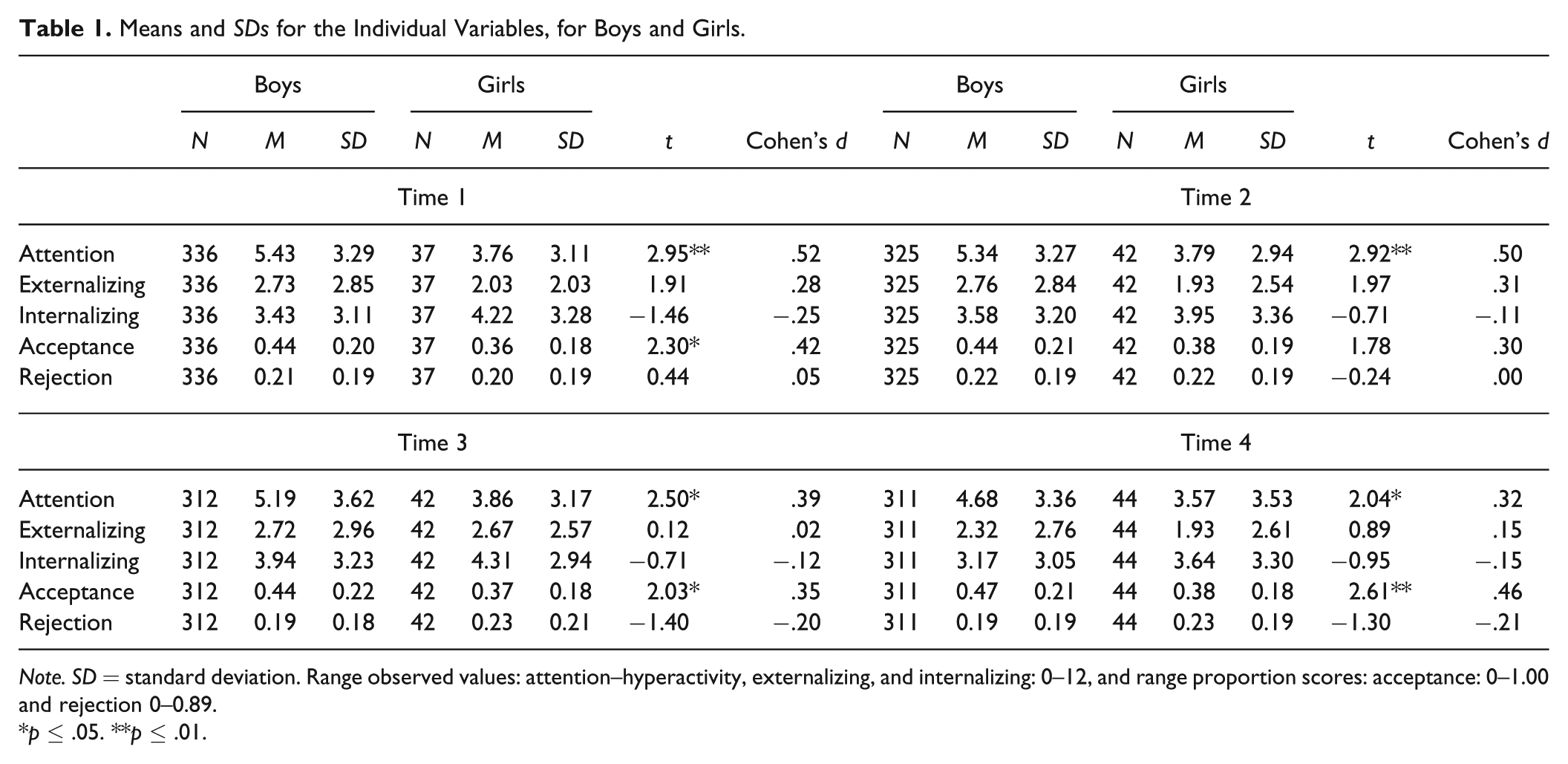
Note. SD = standard deviation. Range observed values: attention–hyperactivity, externalizing, and internalizing: 0–12, and range proportion scores: acceptance: 0–1.00 and rejection 0–0.89.
*p ≤ .05. **p ≤ .01.
Between-Classroom Variability
Examining between-classroom variance is important when dealing with nested data, which are assumed to be nonindependent (e.g., Kreft & de Leeuw, 1998). To examine how much of the variance of the variables was explained by between-classroom differences, we calculated intraclass correlations (ICCs). The ICC for acceptance ranged from .04 to .10 across the four time points, which indicated that up to 10% of the variability in acceptance scores could be attributed to differences between classrooms. The ICC for rejection ranged from .02 to .04 across time points, indicating that 2–4% of the variance was explained by between classroom differences. The ICC for attention–hyperactivity problems ranged from .07 to .17 across the four time points, which indicated that up to 17% of the variance in attention–hyperactivity problems could be explained by differences between classrooms. ICC for externalizing behavior ranged from .12 to .19 and for internalizing from .16 to .22, indicating that between 12–19% and 16–22% of the variance of externalizing and internalizing, respectively, was due to between-classroom differences.
Models Predicting Social Status
Acceptance models
Table 2 displays cross-level interactions and main effects of the models predicting peer acceptance at each of the time points. The main effects represent the behavior–social status associations while the Level-2 variables are at their grand mean. The acceptance models yielded no statistically significant cross-level interactions for the three problem behaviors, after applying a B-H procedure. The main effects for individual attention–hyperactivity problems emerged as statistically significant at three of the four time points (the second largest ranked p value was the first to reach significance, therefore the critical value was p(3) ≤ .0375). This suggests that higher individual levels of attention–hyperactivity problems were linked to lower peer acceptance each time point, except Time 1, when other parameters were set to zero. Main effects for externalizing problems and for gender reached statistical significance at all four time points (p(4) ≤ .05). This indicates that higher externalizing problems were associated with lower acceptance by peers. Boys were also less accepted than girls.
Main Effects and Cross-Level Interactions of the Problem Behaviors and Predicting Acceptance at the Four Time Points.
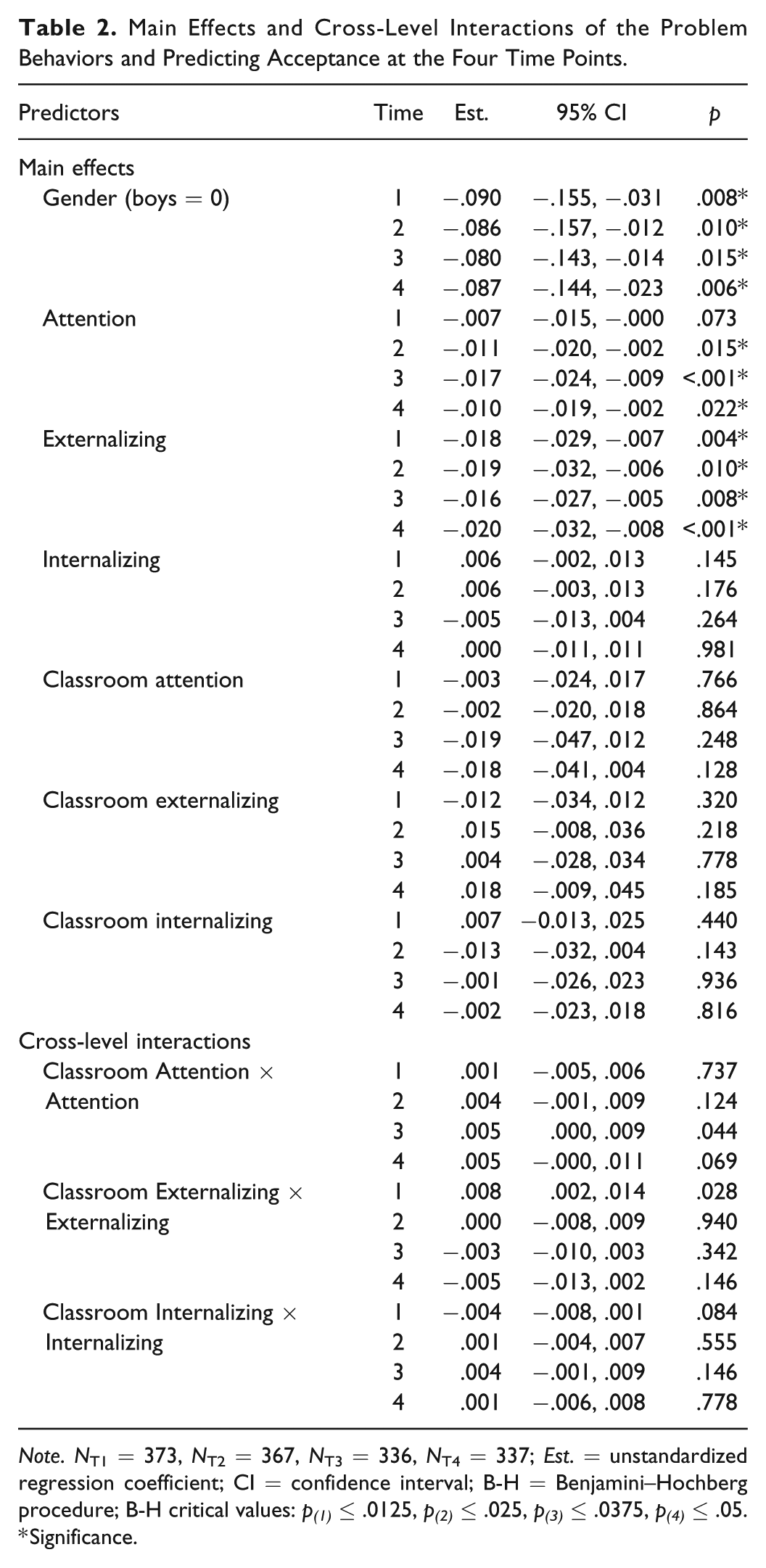
Note. NT1 = 373, NT2 = 367, NT3 = 336, NT4 = 337; Est. = unstandardized regression coefficient; CI = confidence interval; B-H = Benjamini–Hochberg procedure; B-H critical values: p(1) ≤ .0125, p(2) ≤ .025, p(3) ≤ .0375, p(4) ≤ .05.
* Significance.
Rejection models
Table 3 displays cross-level interactions and main effects of the models predicting peer rejection at each of the time points. Main effects represent the behavior–social status associations while the Level-2 variables are at their grand mean. The rejection models yielded one statistically significant cross-level interaction for attention–hyperactivity problems at Time 4 (p(1) ≤ .0125) after applying the B-H procedure (see Figure 1). Simple slopes were calculated for classrooms with above-average (+1 SD) and below-average (−1 SD) levels of attention–hyperactivity problems to interpret this interaction. In classrooms with below-average levels of attention-hyperactivity problems, higher individual levels of problems were related to rejection (b = .016, SE = .006, p = .006), but this was not the case in classrooms with above-average levels of attention–hyperactivity problems (b = −.003, SE = .005, p = .511). This indicates that pupils with higher levels of attention–hyperactivity problems were more rejected in classrooms in which mean classroom attention–hyperactivity levels were low. The other cross-level interactions did not reach statistical significance.
Main Effects and Cross-Level Interactions of the Problem Behaviors and Predicting Rejection at the Four Time Points.
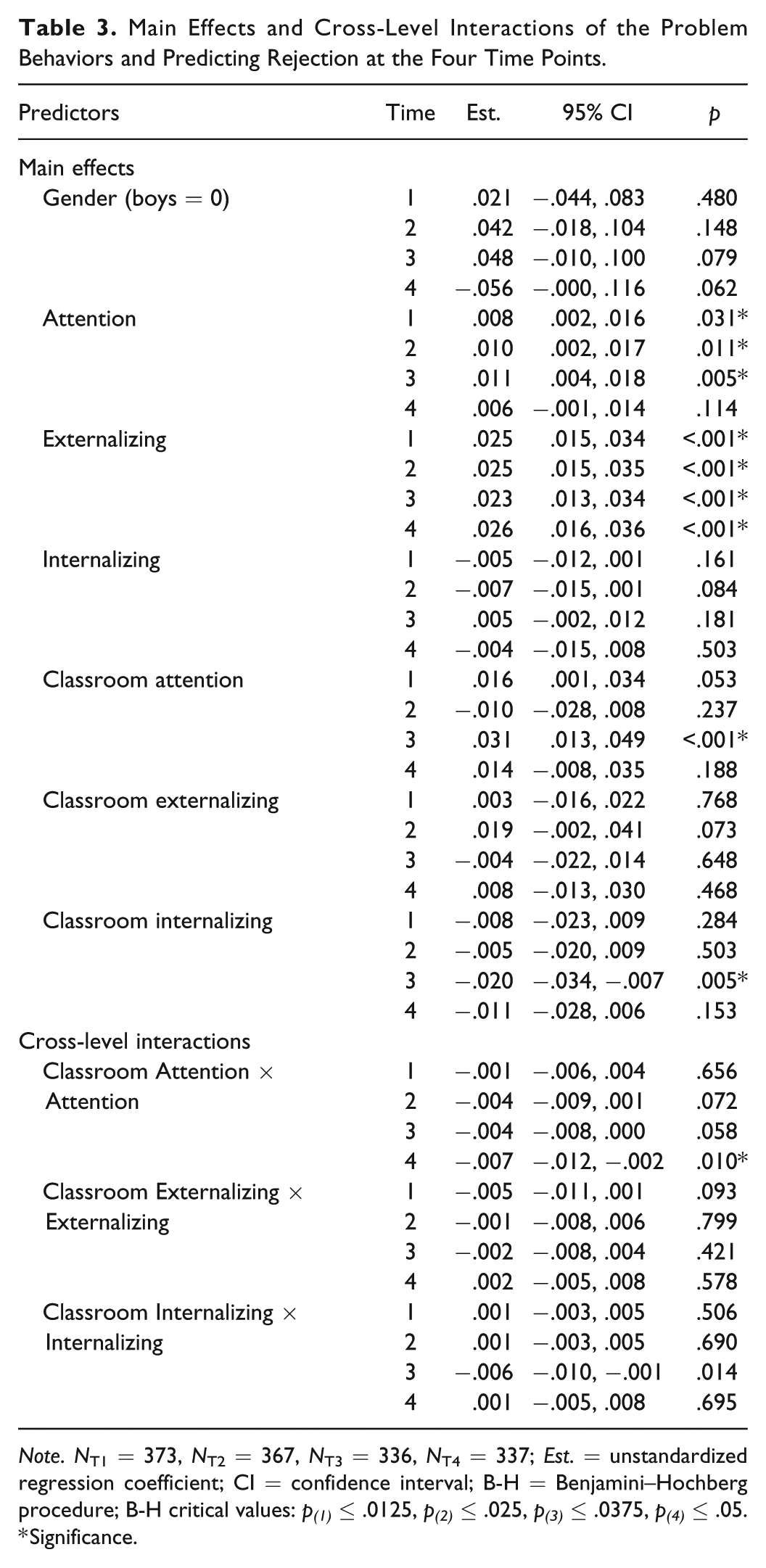
Note. NT1 = 373, NT2 = 367, NT3 = 336, NT4 = 337; Est. = unstandardized regression coefficient; CI = confidence interval; B-H = Benjamini–Hochberg procedure; B-H critical values: p(1) ≤ .0125, p(2) ≤ .025, p(3) ≤ .0375, p(4) ≤ .05.
* Significance.
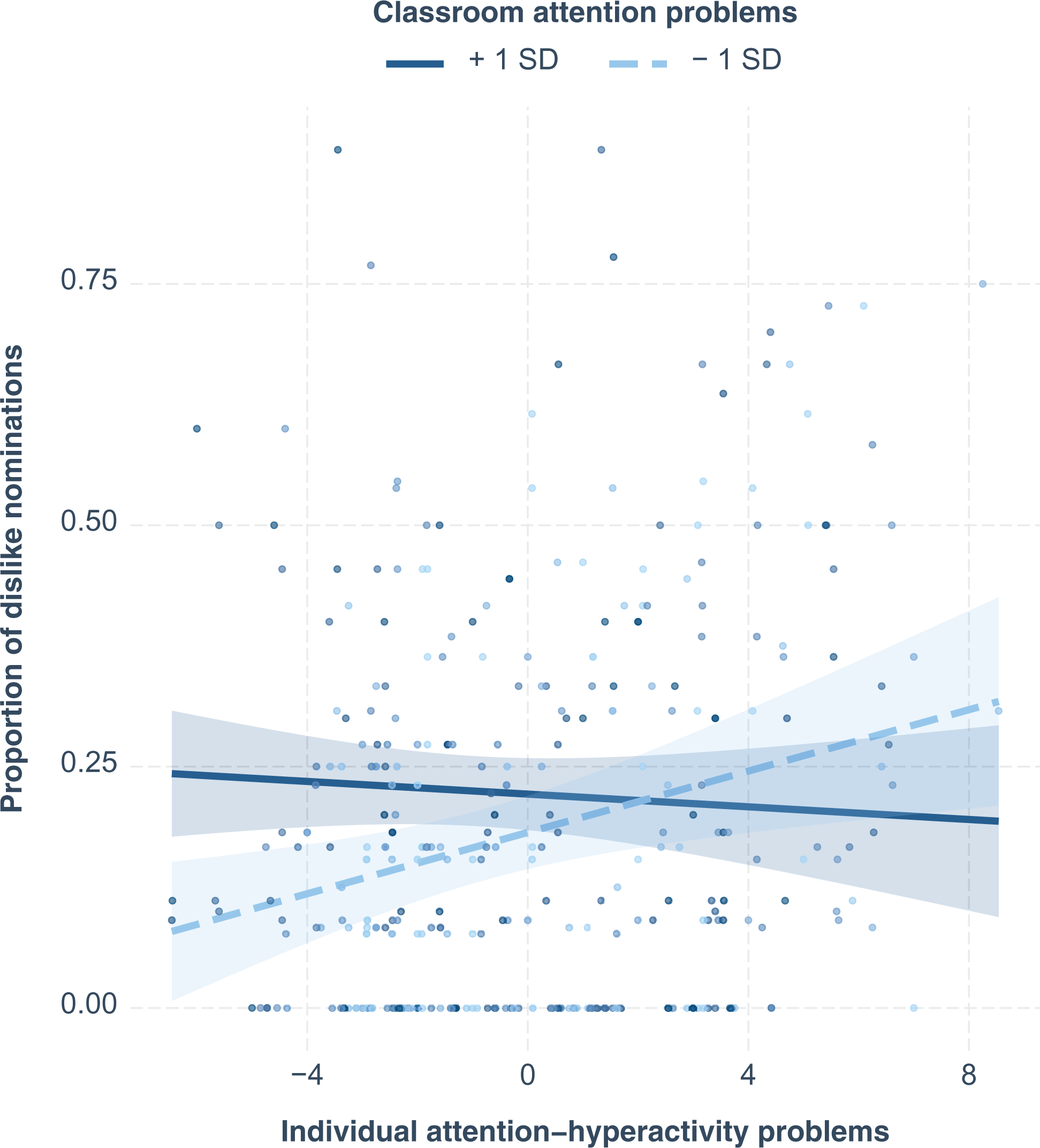
Visual Representation of the Statistically Significant Cross-Level Interaction Between Individual Attention–Hyperactivity Problems and Behavioral Norms.
Utilizing B-H procedures statistically significant main effects emerged for individual attention–hyperactivity problems at three of four time points (p(3) ≤ .0375). This suggested that, except at Time 4, higher individual attention–hyperactivity problems were linked to higher peer rejection. Main effects for individual externalizing problems reached statistical significance at all four time points (p(4) ≤ .05). Thus, higher individual externalizing problems were associated with higher peer rejection. Furthermore, there were two main effects of classroom level behaviors at Time 3 (p(1) ≤ .0125). A main effect of classroom-level attention–hyperactivity problems on rejection indicated that in classrooms with higher levels of attention–hyperactivity problems pupils were more rejected than in classrooms with lower levels of these problems. A main effect of classroom levels of internalizing problems on rejection suggested that pupils in classrooms with higher levels of internalizing problems were less rejected than in classrooms with lower levels of internalizing problems. These results were not replicated at the other time points.
Discussion
This study investigated whether behavioral norms moderated concurrent associations between problem behaviors and social status in special education classrooms. Based on the “person–group similarity model” (Wright et al., 1986) and previous empirical work (e.g., Sentse et al., 2007; Stormshak et al., 1999), we expected that pupils exhibiting more problem behaviors would be more accepted and less rejected in classrooms with higher prevalence of problem behaviors. Findings indicated that the role of behavioral norms for the associations between problem behaviors and social status was not consistent and very limited. One of the 24 cross-level interactions tested in this study emerged as statistically significant (after controlling for family-wise error rates). Overall, our results were more in line with the “social skill model” (Stormshak et al., 1999), which posits that social skill problems accompanying problem behaviors of pupils may incur peer rejection regardless of behavioral classroom norms.
Behavioral Norms, Acceptance, and Rejection
In general, individual behaviors seemed better predictors of social status, consistent with the “social skill model.” Higher individual levels of externalizing and attention–hyperactivity problems were consistently linked to more peer rejection and less acceptance across classrooms. Individual levels of internalizing problems were not related to social status. There are several explanations for the broader applicability of the “social skill model” over the “person–group similarity model” in the special education context. The first explanation relates to the more severe social skill impairments that accompany the higher levels of problem behaviors of pupils with EBD in special education (Bradley et al., 2008). For example, pupils may suffer underlying deficits in social information processing, social problem-solving, and perspective taking that are related to their EBD, such as Autism or Attention Deficit Hyperactivity Disorder (Gardner & Gerdes, 2015; White et al., 2010). These problems may hinder positive interactions with classmates and friendship formation with similarly behaving pupils (see Powers & Bierman, 2013), which may lead to rejection by peers independent of behavioral norms. A second explanation may be the instability of the classroom composition in special education. Changes in classroom composition characteristic for special education classrooms (e.g., due to newly admitted pupils) may be related to changes in group dynamics within and across school years. This may explain why behavioral norms inconsistently moderate associations between behavior and social status. Because previous studies testing the “person–group similarity model” only utilized cross-sectional data, we cannot be sure whether our findings are unique to this sample, to special education settings, or whether our findings provide initial evidence that behavioral norms do not consistently moderate behavior–social status associations in the general (special education) population. Third, it could be that other norm constructs are more appropriate to explain between classroom differences in acceptance and rejection of pupils with certain behavior. Not all pupils in the classroom may be as influential in their contribution to which behavior is accepted in the classroom. Pupils with high status (e.g., popular pupils) may be more influential. Particularly, the behaviors that correlate with popularity within the classroom (norm salience) may play a role in the extent to which behaviors are accepted by classmates (Dijkstra & Gest, 2015; Veenstra et al., 2018). Incorporating other social norms may therefore enhance our insight in between classroom differences with regard to the acceptability of certain behaviors in special education.
Although our findings in general supported a “social skill model,” there was limited evidence that behavioral norms attenuated some of the associations between individual behavior and social status. There were some marginally significant findings that suggested moderation of behavioral norms. This concerned findings for externalizing behavior on the first time point and internalizing behavior on the third time point, as well as attention problems on the third time point. Although the findings were in the expected direction, indicating that pupils with more problems were more accepted or less rejected in classrooms with higher levels of problem behavior, the findings must be interpreted with caution. For one, they were only marginally significant. Second, the findings for externalizing behavior and internalizing behavior were not replicated on other time points. For attention–hyperactivity problems, statistically significant findings indicated that at the end of the second school year, behavioral norms of attention–hyperactivity problems attenuated the associations between individual behavior and rejection. These findings are bolstered by the marginally significant results of the acceptance model at the third time point, showing that pupils with high levels of attention–hyperactivity problems were more accepted in classrooms in which this behavior was normative. A tentative explanation for these findings may be the high prevalence of pupils with attention–hyperactivity problems in special education, which may reduce the extent to which levels of attention–hyperactivity problems serve as a criterion for peer rejection in some classrooms. Other individual characteristics of pupils may become more important. Pupils with attention–hyperactivity problems may even seek out friendships with similar pupils (see Powers & Bierman, 2013) who may be more able to fulfill their need for “amusement” and “fun” in friendships (Heiman, 2005).
Strengths and Limitations
This study has several strengths, including that we examined behavioral norms in a large representative sample in special education for pupils with EBD and that we gathered information on multiple time points within and across school years.
This study also has limitations. First, because social norms reflect behaviors that are approved within a certain group (Veenstra et al., 2018), injunctive norms and norm salience may provide a better insight in the social norms within classrooms than behavioral norms (Dijkstra et al., 2008; Dijkstra & Gest, 2015; Garandeau, Ahn, & Rodkin, 2011; Veenstra et al., 2018). Second, we used teacher reports of behavior, which may underestimate actual behavioral problem levels. They tend to be lower than self-reported behavior, particularly with regard to internalizing problems (Van der Ende, Verhulst, & Tiemeier, 2012). Third, sociometric measurements may be less reliable to measure social status in small-sized classrooms. Fourth, because of the gender imbalance that is particular to special education classrooms, results generalize mainly to boys in special education.
Our study has implications for special education practice. The results suggest that also in special education classrooms for pupils with EBD, teachers should be aware of the negative position pupils with higher levels of problem behavior have within their classroom. Effort should be invested in reducing peer rejection by promoting positive social interactions and train pupils’ social skills. Teachers may even seek out suitable playmates and guide social interactions (Farmer et al., 2018). Additionally, teachers can promote acceptance in classrooms by explaining pupils’ behavioral difficulties to classmates.
Conclusions
This study provided initial evidence suggesting that conforming to or deviating from behavioral norms is less important in determining pupils’ social status in special education classrooms compared to regular education. In general, pupils with higher levels of attention–hyperactivity problems and externalizing problems were less accepted and more rejected than less problematic classmates. There was some evidence that behavioral norms of attention–hyperactivity problems moderated associations between individual behavior and social status. To enhance understanding of these processes, future research should zoom in on multiple social norm constructs to identify whether particular pupils in classrooms are important in the establishment of classroom values and norms and to investigate how their status and behavior influence the social position of other pupils in the classroom in special education.
