




Abstract
The current study examined emerging adults’ gender identity and its link with several gender-related and social outcomes, by using a novel dual-identity approach that was originally developed in children. Dutch emerging adults between 18 and 25 years old (N = 318, Mage = 21.73, SD = 2.02; 51% female) indicated their similarity to the own-gender group and the other-gender group to assess gender identity. They completed questionnaires assessing gender-typed behavior (internalized sexualization, toughness, emotional stoicism) and attitudes (i.e., sexism); friendship efficacy and ability; and social-emotional adjustment. Cluster analysis on the gender-identity items revealed four gender-identity types: (a) feeling similar to one’s own gender, but not to the other gender (Own-GS); (b) feeling similar to both one’s own and the other gender (Both-GS); (c) feeling dissimilar to one’s own gender (Low-Own-GS); and (d) feeling similar to neither gender (Low-GS). Own-GS and Low-GS adults were most gender-typed in their behavior and showed sexist attitudes. Both-GS adults felt efficacious and were highly able to relate to both genders, whereas the other groups felt efficacious and were able to relate to only one gender (Own-GS, Low-Own-GS), or to neither gender (Low-GS). Low-Own-GS and Low-GS were least well-adjusted social-emotionally. Findings suggest that identifying with one’s own gender is helpful for certain aspects of social-emotional adjustment but that also identifying with the other gender provides the advantage of flexible social and interpersonal skills and egalitarian gender attitudes.
Emerging adulthood (18–25 years) is an important period for identity formation and consolidation (Arnett, 2000; Schwartz, Zamboanga, Luyckx, Meca, & Ritchie, 2013), and for gender identity in particular (Barrett & White, 2002). Surprisingly, only a few studies have been conducted on gender identity development from adolescence to adulthood (Barrett & White, 2002; Marcell, Eftim, Sonenstein, & Pleck, 2011; McDermott & Schwartz, 2013). As there is a consistent link between gender identity and mental health outcomes (Carver, Yunger, & Perry, 2003; Egan & Perry, 2001), which appears to strengthen over the adolescent years (Horwitz & White, 1987), it is important to increase understanding of these processes in emerging adulthood. The current study examined emerging adults’ gender identity and its link with several gender-related and social outcomes, using a new approach for conceptualizing and measuring gender identity that was originally developed for use with children (Martin, Andrews, England, Zosuls, & Ruble, 2017).
Gender identity is a multidimensional construct; one aspect of gender identity—gender typicality (Egan & Perry, 2001)—is frequently cited as a strong predictor of personal and social adjustment. Early conceptions of gender typicality viewed it as a single bipolar dimension, with high scores reflecting high compatibility with one’s own gender and low compatibility with the other gender, and low scores reflecting low compatibility with one’s own gender and high compatibility with the other gender (Egan & Perry, 2001). Others have suggested that a two-dimensional conceptualization better captures the complexity of gender identity and the experiences of individuals who feel similar to both genders or to neither gender (Bukowski, Panarello, & Santo, 2017; Martin, Cook, & Andrews, 2016; Martin et al., 2017; Pauletti, Menon, Cooper, Adults, & Perry, 2017). Highly influential in developing this approach was Bem’s (1974) conceptualization of psychological androgyny (i.e., individuals possessing both masculine and feminine characteristics), which she associated with flexibility in one’s behavioral repertoire, thought to foster optimal adjustment. However, research testing Bem’s propositions provided mixed results, possibly because androgyny was not adequately measured (e.g., most studies only used personality traits). To revive Bem’s androgyny conceptualization, Martin, Andrews, England, Zosuls, and Ruble (2017) proposed a dual-identity approach in which gender identity involves both a connection to one’s own gender as well as to the other gender. The feminist theoretical framework of intersectionality provides some justification for conceptualizing gender identity in this way (Shields, 2008). A key assumption of intersectionality is that the process of identifying with more than one social group produces new forms of subjective experience that are unique, nonadditive, and not reducible to the original identities of which it is composed (Stewart & McDermott, 2004).
To support the dual gender-identity conceptualization and measure, the authors demonstrated, in a sample of first- to fifth-grade children, that own- and other-gender similarity represent separate identity dimensions (Martin et al., 2017). Further, four different identity typologies were identified: feeling similar to one’s own gender but not to the other gender (own-gender similarity, or Own-GS); feeling similar to both one’s own and the other gender (both-gender similarity, or Both-GS); feeling similar to the other gender but not to one’s own gender (cross-gender similarity, or Cross-GS); and feeling similar to neither one’s own nor the other gender (low-gender similarity, or Low-GS).
In emerging adulthood, the relative proportion of individuals in each typology may differ from a youth sample for two opposing reasons: Gender identity becomes more typical in and after adolescence (Carr, 2007; van Caenegem et al., 2015), possibly because of increased socialization pressures that encourage adolescent boys and girls to become increasingly different (i.e., “gender-intensification,” Hill & Lynch, 1983). Thus, Own-GS identity might be more prevalent in emerging adults than in children. From a cognitive-developmental perspective (Erikson, 1968; Kohlberg, 1966), increased cognitive complexity and perspective-taking abilities in emerging adults could be reflected in more flexible views of one’s own gender identity. Indeed, most men and women acquire a more androgynous identity (identifying as both masculine and feminine) from adolescence to adulthood (Barrett & White, 2002). Thus, Both-GS identity might be more prevalent in emerging adults than in children.
The new measurement of gender identity proposed by Martin et al. (2017) furthers our understanding of the links between gender identity and adjustment. Previous work provides inconclusive evidence of these relations: in some cases, gender-typicality is related to optimal psychological adjustment (e.g., Carver et al., 2003; Egan & Perry, 2001), whereas in others, androgyny is linked to positive psychological adjustment (e.g., Alpert-Gillis & Connell, 1989; Rose & Montemayor, 1994). Recently, even low gender-typicality was associated with positive outcomes, such as egalitarian gender attitudes (Patterson, 2012). Scholars examining the consequences of feeling similar to one’s own gender as well as the other gender provide clarity by showing that Both-GS children felt included by and had friends of both genders, showed egalitarian gender attitudes (Martin et al., 2017), had high self-esteem, few internalizing behavior problems, and lower scores on sexism (for boys; Pauletti et al., 2017). Own-GS children had high self-esteem, but they primarily had own-gender friends and did not feel included by the other gender, and expressed gender-typed attitudes. Measuring gender identity unidimensionally would have combined these two groups of children (i.e., Both-GS and Own-GS both have high own-gender similarity), but considering their similarity to other-gender peers as well yields a more complex understanding of adjustment outcomes. Using the dual identity approach, Cross-GS and Low-GS children both scored low on social adjustment. Cross-GS children did feel included and had friends of the other gender, while Low-GS children did not feel included by or have many friends of either gender (Martin et al., 2017). Similar associations are expected for emerging adults.
Studies on the gender identity of adolescents and emerging adults are usually conducted on relatively homogeneous and highly educated subjects (e.g., Galambos & Leadbeater, 2000; Schwartz et al., 2013). However, higher educational level is associated with more egalitarian gender attitudes and less conformity with traditional gender roles (e.g., Harris & Firestone, 1998; Dodson & Borders, 2006) and lower masculine gender identity in young men (Marcell et al., 2011). Further, advanced cognitive capacities and perspective taking skills associated with higher education might increase the possibility of finding similarities with other-gender individuals (Moshman, 2011). Thus, higher education might be related to more felt similarity to the other gender and Both-GS identity.
The goal of this study was to examine the robustness of the novel dual-identity approach for measuring gender identity in a sample of Dutch emerging adults. We expected: (a) perceived similarity to one’s own and other gender would be relatively separate dimensions of gender identity (Martin et al., 2017); and (b) individual differences in levels of own- versus other-gender similarity could be captured in typologies of gender identity (Martin et al., 2017). We also explored whether gender-identity typologies would be associated with differing patterns of gender-related and social outcomes. We expected Both-GS and Cross-GS adults to show lower levels on two aspects of gender-typed behavior (internalized sexuality in females; toughness and emotional stoicism in relationships in males) and more sexist attitudes than Own-GS adults, because identifying with the other gender increases a person’s positive evaluation of the other group, which is associated with more flexible and egalitarian gender stereotypes and more positive behavior toward them (Arthur, Bigler, Liben, Gelman, & Ruble, 2008). Identifying with the other gender might also reduce gender-typed behavior via opposite-gender friendships that reinforce opposite-gender behavior. Further, because feeling dissimilar to a gender group hampers interaction and formation of friendships with the members of the dissimilar group (i.e., out-group; Ames, 2004), we expected Own-GS adults and Both-GS adults to feel more efficacious and able to relate to own-gender peers than Low-GS and Cross-GS adults, whereas Both-GS and Cross-GS adults would feel highly efficacious and able to relate to other-gender peers. Moreover, we expected Cross-GS and Low-GS adults to show lower social-emotional adjustment (i.e., self-esteem, externalizing and internalizing problems) and social self-efficacy than Both-GS and Own-GS adults, because people derive a sense of self-worth from identifying with one’s own social group (Tajfel & Turner, 1986). Finally, we expected that lower educated adults would feel more own- than other-gender similarity compared to higher educated adults, and that Own-GS identity would be more prevalent in lower-educated adults, whereas Both-GS identity would be more prevalent in higher-educated adults (Marcell et al., 2011).
Methods
Participants
Emerging adults between 18 and 25 years old were recruited via the personal networks of 29 students that were writing their bachelor’s or master’s thesis under supervision of the first author. Using information leaflets (provided in-person, via email, or social media), each student recruited 10–20 participants currently enrolled in education.
Data were collected from 381 emerging adults across the three educational levels available in the Netherlands: lower vocational level (preparation for an associate’s degree, e.g., clerk, plumber, n = 101), higher vocational level (preparation for a vocational bachelor’s degree, e.g., secondary school teacher, real-estate agent, n = 119), and university level (preparation for a master’s degree, n = 161) (see Table 1 for sample characteristics). There were expected differences (Nuffic, 2011) between the educational levels on all background variables (p-values < 0.01), including age, gender, ethnicity, living with parents, and study major. There variables were, therefore, controlled for in analyses examining education level differences. The sample was diverse in terms of study major. Ethnic diversity of the sample was like the Dutch population.
Sample Characteristics.
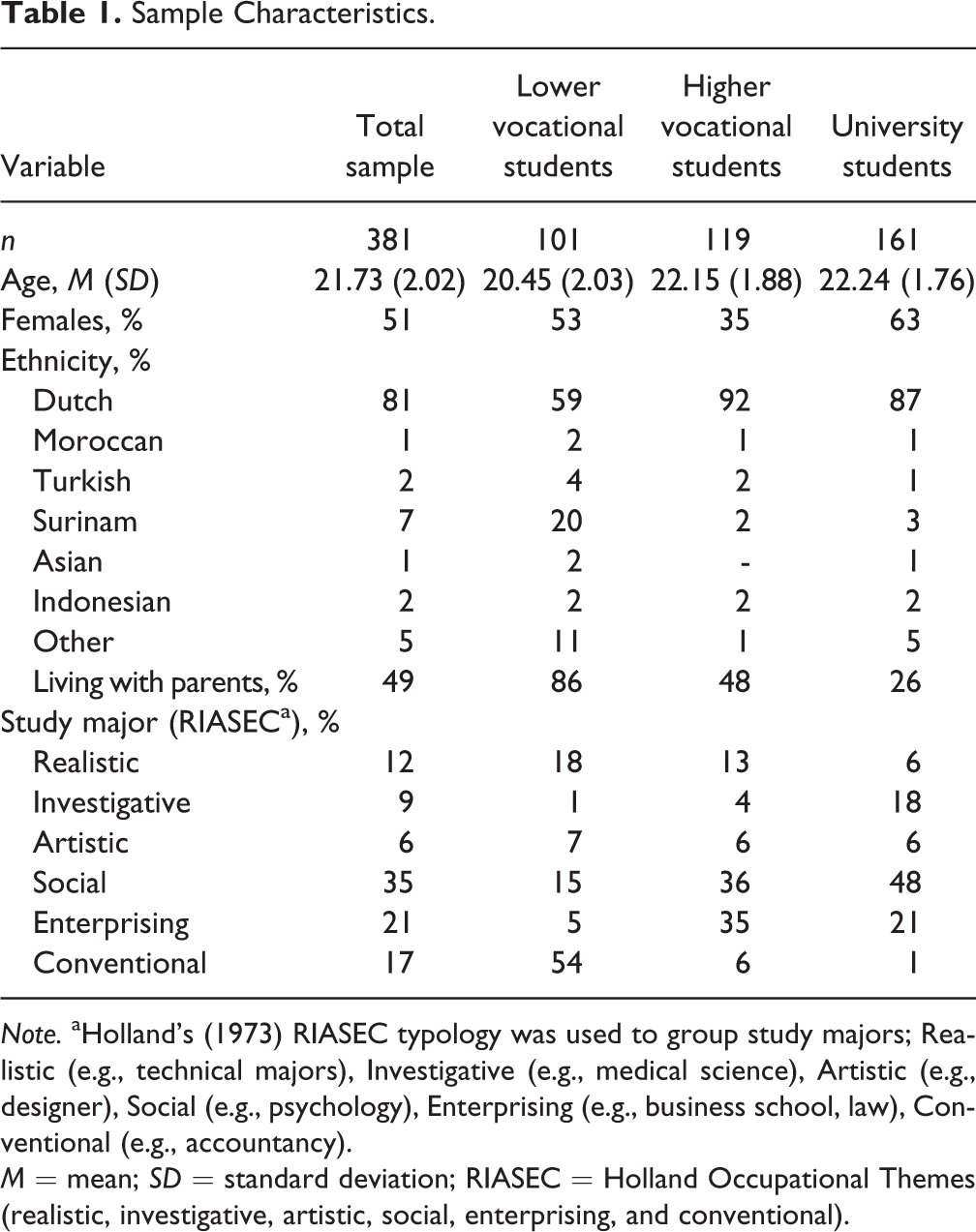
Note. a Holland’s (1973) RIASEC typology was used to group study majors; Realistic (e.g., technical majors), Investigative (e.g., medical science), Artistic (e.g., designer), Social (e.g., psychology), Enterprising (e.g., business school, law), Conventional (e.g., accountancy).
M = mean; SD = standard deviation; RIASEC = Holland Occupational Themes (realistic, investigative, artistic, social, enterprising, and conventional).
Procedure and Measures
Participants completed an online survey (duration: approximately 45 min) including questions about family background, gender-typed behavior, friendships, attitudes, and social-emotional adjustment. Approximately half of the lower vocational students completed the questionnaires in class under supervision of the master’s students who recruited entire classes to participate. The other half of the lower vocational students and the higher vocational students and academic students completed the questionnaire by themselves at their convenience. There were no differences in results between these groups.
Perceived similarity to gender groups
Similarity to own-gender and other-gender peers was assessed with a measure developed by Martin and colleagues (2017). Students answered 10 questions regarding how similar they felt to both men and women (e.g., “How similar do you feel to [men/women]?”, see Appendix A for all items) using a graphical response scale with circles indicating similarity (see Martin et al., 2017). Responses ranged from 0 (circles farthest apart) to 4 (overlapping circles). Student’s responses on the five own-gender and five other-gender items were averaged, with higher scores representing more similarity to own gender or other gender (for both scales, α = 0.65).
Gender attitudes
The Ambivalent Sexism Inventory (Glick & Fiske, 1996) assessed sexist gender attitudes. Participants indicated how much they agreed (1 = disagree strongly to 6 = agree strongly) with 22 statements (e.g., “Men should be willing to sacrifice their own well-being to provide financially for the women in their lives”) about men and women. Items were recoded when necessary (such that high scores reflect more sexism) and averaged to create an overall sexist gender-attitude score (α = 0.78).
Gender-typed behavior
Females completed 15 items of the Internalized Sexualization Scale (power and self-compromise subscales; McKenney & Bigler, 2016). Items assessed the extent to which women engage in behaviors associated with being sexually attractive (e.g., “I have used my looks to get people’s attention”; self-compromise: “I wake up early to put on make-up, even though I would rather sleep in”). Responses ranged from 1 = disagree to 5 = agree, and were averaged across the subscales to create a score for internalized sexualization (α = 0.87). Subscales correlated highly, r = 0.73, p < 0.01.
Males completed an adapted version of the Adolescent Masculinity in Relationships Scale (Chu, Porche, & Tolman, 2005; see Appendix A) which assessed adherence to male-typed behaviors in the context of interpersonal relationships. Participants indicated how much they agreed (1 = disagree strongly to 5 = agree strongly) with nine statements concerning adherence to toughness (e.g., “I cannot respect a friend who backs down from a confrontation”) and restrictive emotional expressivity (e.g., “I do not let it show to my friend when my feelings are hurt”). Responses were averaged to create a score for adherence to toughness and emotional stoicism (α = 0.70).
Own- and other-gender friendships: Ability and self-efficacy
To assess ability to form own- and other-gender friendships, participants reported how many of their friends were women and men, using a 4-point scale ranging from 1 = none/almost none to 4 = almost all/all. There were separate items for closest friends and acquaintances, which correlated strongly (own gender: r = 0.80, p < 0.01; other gender: r = 0.83, p < 0.01) and were averaged into composite scores for own- and other-gender friends.
The Gender-Based Relationship Efficacy questionnaire (GBRE; Zosuls, Field, Martin, Andrews, & England, 2014) assessed perceived ability to relate to own- and other-gender peers. Participants were asked to rate their efficacy with regard to interacting with males and females in seven situations (e.g., “How much do you feel like you know how to work with [women/men]?”), using a 5-point scale, ranging from 1 = not at all to 5 = a lot. Scores were averaged to create separate scores for GBRE-own gender and for GBRE-other gender (α = 0.86 and 0.88, respectively).
Participants completed the 25-item Perceived Social Self-Efficacy scale (Smith & Betz, 2000), which assesses confidence in one’s ability to interact with and relate to others, regardless of gender (e.g., “How much confidence do you have that you could make friends in a group where everyone else knows each other?”). Responses, on a 5-point scale ranging from 1 = no confidence to 5 = complete confidence, were averaged to create a score for social self-efficacy (α = 0.95).
Social-emotional adjustment
Self-esteem was assessed with the Rosenberg Self-Esteem Scale (Rosenberg, 1965). Participants indicated feelings of value and self-worth (e.g., “I am satisfied with myself”) on 10 items, on a scale from 0 = strongly disagree to 3 = strongly agree. Items were averaged to create a score for self-esteem (α = 0.89).
In addition, the Dutch version of the Young Adult Self Report (Ferdinand & Verhulst, 1995) assessed social-emotional adjustment. Participants indicated whether 48 items assessing internalizing problems (anxiety, depression, withdrawn behavior; e.g., “Would rather be alone”) and externalizing problem (delinquency, aggressive behavior; “Argues a lot”) were applicable (0 = not, 1 = a little/sometimes, 2 = clearly/frequently) to them in the last six months. Scores were averaged to create composite scores for internalizing (α = 0.88) and externalizing problem behavior (α = 0.84).
Results
Initial Analyses and Descriptive Statistics
Table 2 presents descriptive statistics for the study variables. The correlation between own- and other-gender similarity was low, r(381) = 0.13, p < 0.01, suggesting that these are indeed separate dimensions. An exploratory factor analysis with Maximum Likelihood and Promax rotation on all items of the gender-similarity measure confirmed that a two-factor solution fit the data best. The own-gender similarity items loaded on one factor, and the other-gender similarity items loaded on the other factor (see Appendix B, also for results of factor analyses showing a clear distinction between similarity measures and GBRE and friendship scales).
Means and SDs of Study Variables.
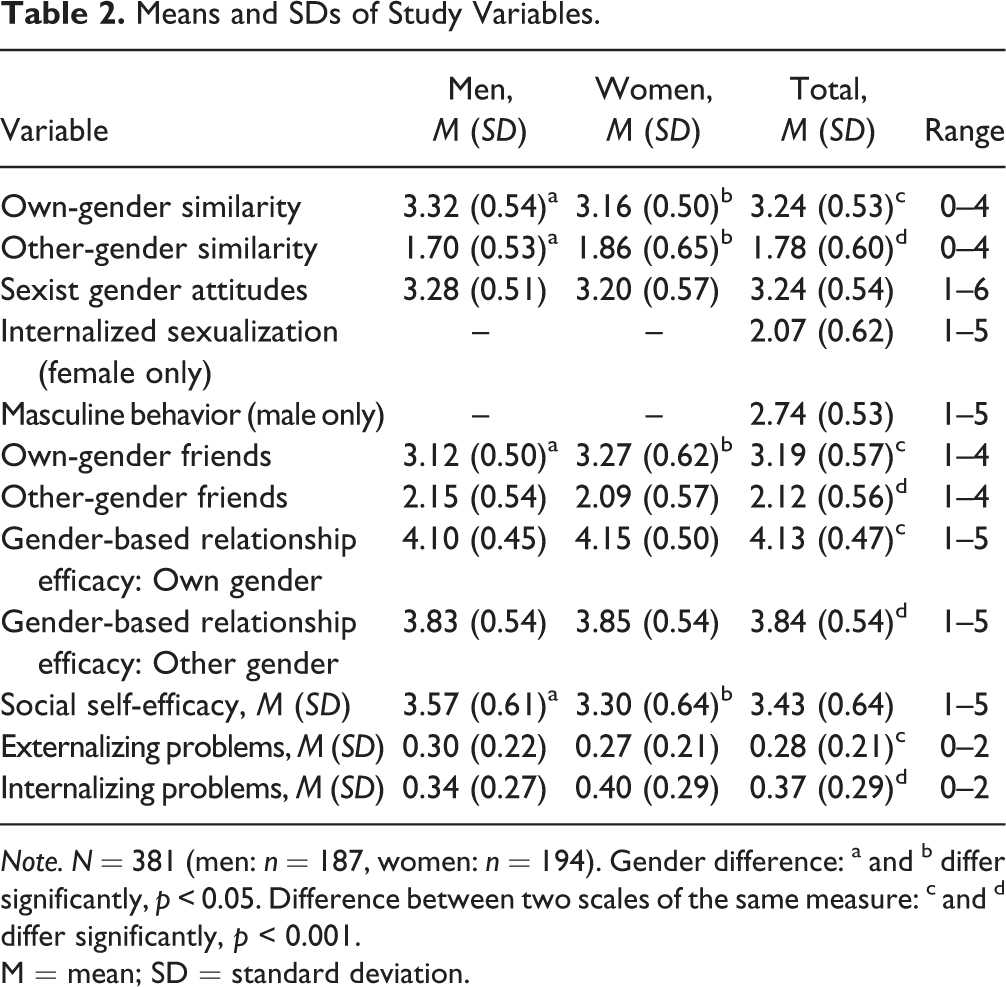
Note. N = 381 (men: n = 187, women: n = 194). Gender difference: a and b differ significantly, p < 0.05. Difference between two scales of the same measure: c and d differ significantly, p < 0.001.
M = mean; SD = standard deviation.
A repeated-measures analysis of variance (RMANOVA) was used to examine differences in own- and other-gender similarity between men and women at different educational levels. Gender and educational level (lower vocational, higher vocational, university) were between-subjects factors and similarity to own- versus other-gender peers was the within-subjects factor. We controlled for age, ethnicity (Dutch, non-Dutch), living with parents, and study major. Across genders and educational levels, emerging adults felt more similar to own- than other-gender peers, F(1, 365) = 35.73, p < 0.01, partial η2 = 0.09. However, this main effect was subsumed by interactions with gender, F(1, 365) = 12.80, p < 0.01, partial η2 = 0.03, ethnicity, F(1, 365) = 10.13, p < 0.01, partial η2 = 0.03, and age, F(1, 365) = 6.35, p < 0.05, partial η2 = 0.02. Men differentiated own- and other-gender similarity more than women (see Table 2). Non-Dutch and younger students also differentiated more between own- and other-gender similarity than, respectively, Dutch and older students (see Figure 1). The interaction between similarity type and educational level was not significant, F(1, 365) = 2.66, p = 0.07, nor was the three-way interaction among gender, educational level, and similarity type, F(2, 365) = 0.44, p = 0.65.
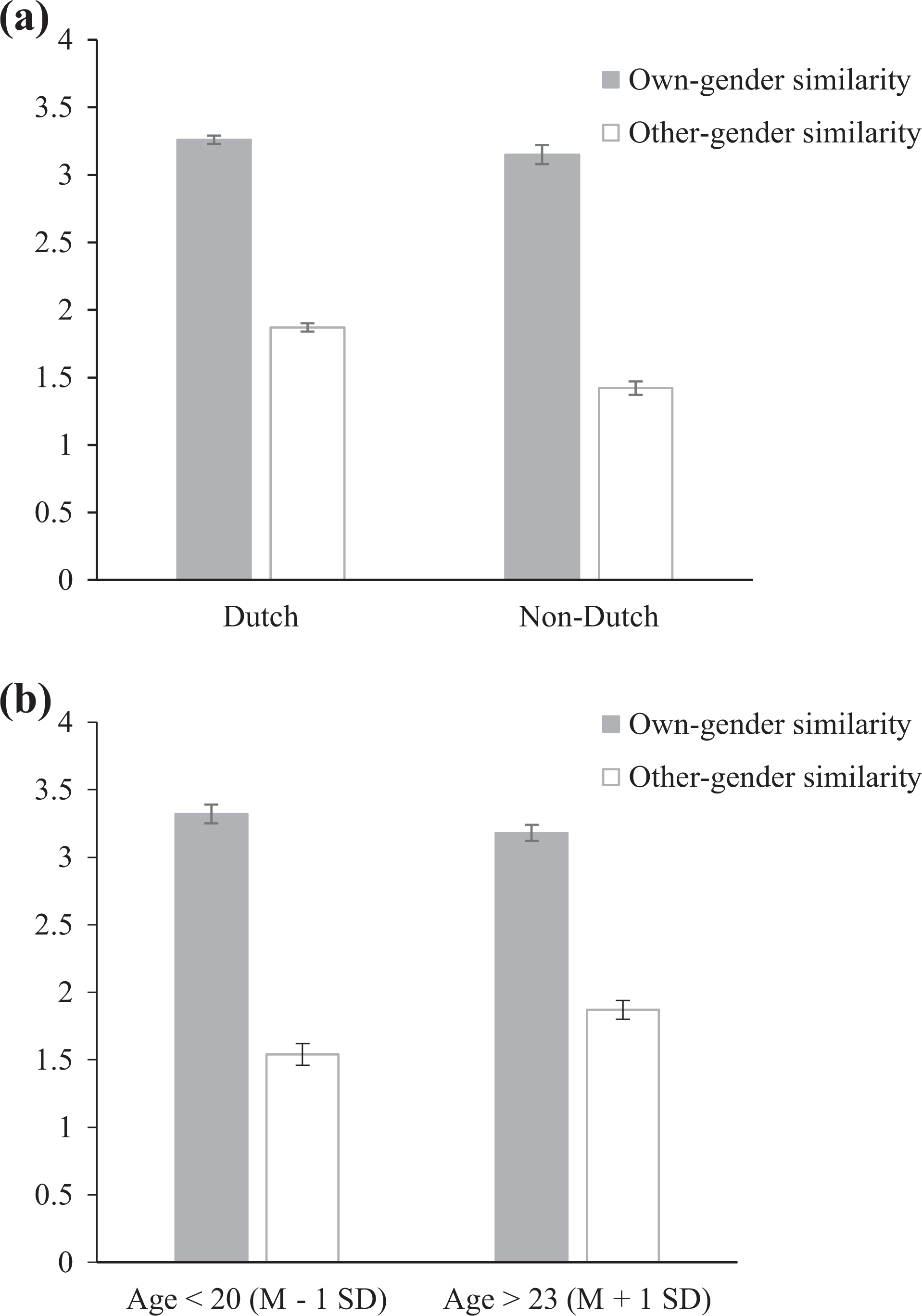
Means and SEs of similarity to own and other gender by ethnicity (a) and age (b). Subgroup n-values: n = 309 (Dutch); n = 72 (Non-Dutch); n = 73 (Age < 20); n = 87 (Age > 23).
Gender-Identity Typologies
Nonhierarchical K-means cluster analysis was used to determine similarity typologies. We conducted separate analyses for 2–5 cluster-solutions with multiple random starts ranging from 50 to 1,000 starts. The final cluster solutions were selected based on the Calinski–Harabasz index (Rendón, Abundez, Arizmendi, & Quiroz, 2011), reductions in within-cluster variability, and the amount of variance explained in own- and other-gender similarity variables. A four-cluster solution fit the data best (see Appendix C). Since cluster membership is determined on standardized scores, the groups were labeled based on standardized own- and other-gender similarity scores (see Figure 2): (a) Own-GS (scoring above average on own- but below average on other-gender similarity), (b) Both-GS (scoring above average on own- and other-gender similarity), (c) Low-Own-GS (low own-gender similarity; scoring below average on own-gender similarity), and (4) Low-GS (scoring below average on own- and other-gender similarity).
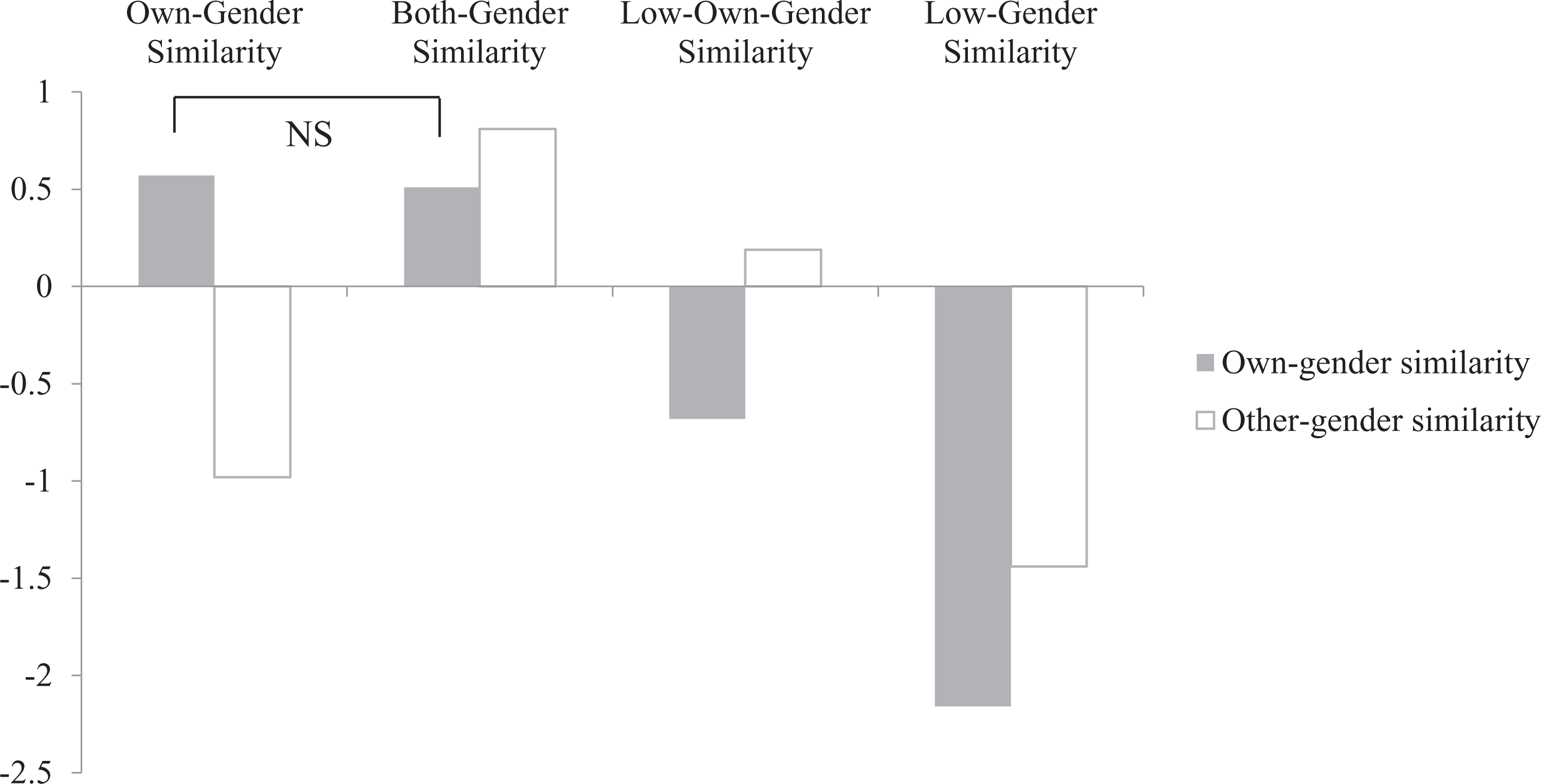
Differences between clusters in similarity to own- and other-gender people. Subgroup n-values: n = 102 (Own-gender similarity), n = 141 (Both-gender similarity), n = 113 (Low-own-gender similarity), n = 25 (Low-gender similarity). Standardized scores are used. Only nonsignificant differences between groups are labeled; all other differences between groups are significant at p < 0.01.
RMANOVA was used to examine differences in own- and other-gender similarity (raw scores) between the clusters to validate cluster membership. In addition to significant main effects of similarity type, F(1, 377) = 1978.78, p < 0.01, partial η2 = 0.84 and cluster, F(3, 377) = 316.04, p < 0.01, partial η2 = 0.72; there was a significant interaction between similarity type and cluster, F(1, 377) = 150.43, p < 0.01, partial η2 = 0.55. Simple effects analyses showed that all clusters scored higher on own- than other-gender similarity (Own-GS: t(101) = 60.96, p < 0.01, d = 7.34; Both-GS: t(140) = 29.92, p < 0.01, d = 3.97; Low-Own-GS: t(112) = 18.49, p < 0.01, d = 2.90; Low-GS: t(24) = 8.82, p < 0.01, d = 2.24). However, clusters differed with regard to own-gender similarity, F(3, 380) = 214.34, p < 0.01, partial η2 = 0.63, with the Own-GS and Both-GS groups scoring the highest, followed by the Low-Own-GS group, and the Low-GS group scoring the lowest. Clusters also differed with regard to other-gender similarity, F(3, 380) = 233.54, p < 0.01, partial η2 = 0.65, with the Low-GS group scoring the lowest, followed by the Own-GS group, and the Low-Own-GS and the Both-GS groups scoring higher. These findings confirm the labels given to the identity clusters.
See Table 3 for characteristics of these groups. Chi-square tests revealed that men and women were distributed fairly equally across the cluster types, χ2 (3) = 7.28, p = 0.06. Lower vocational students were more likely to be in the Own-GS (resadj = 3.7), or Low-GS group (resadj = 3.9), whereas higher educated adults were more likely to be in the Both-GS (university students; resadj = 3.7) and Low-Own-GS group (higher vocational students; resadj = 2.1) (χ2 (6) = 42.59, p < 0.01). Ethnicity was also significantly different between the clusters, χ2 (3) = 30.49, p < 0.01, indicating that Dutch students were most likely to be in the Both-GS group (resadj = 3.3), whereas Non-Dutch students were more likely to be in the Own-GS (resadj = 2.4) and Low-GS groups (resadj = 4.4). Further, age differed between the clusters, F(3, 377) = 3.66, p < 0.05, partial η2 = 0.03, with post-hoc analyses showing that Own-GS emerging adults were younger than Low-Own-GS emerging adults (p < 0.05).
Characteristics of Cluster Types Regarding Background Variables and Study Variables.
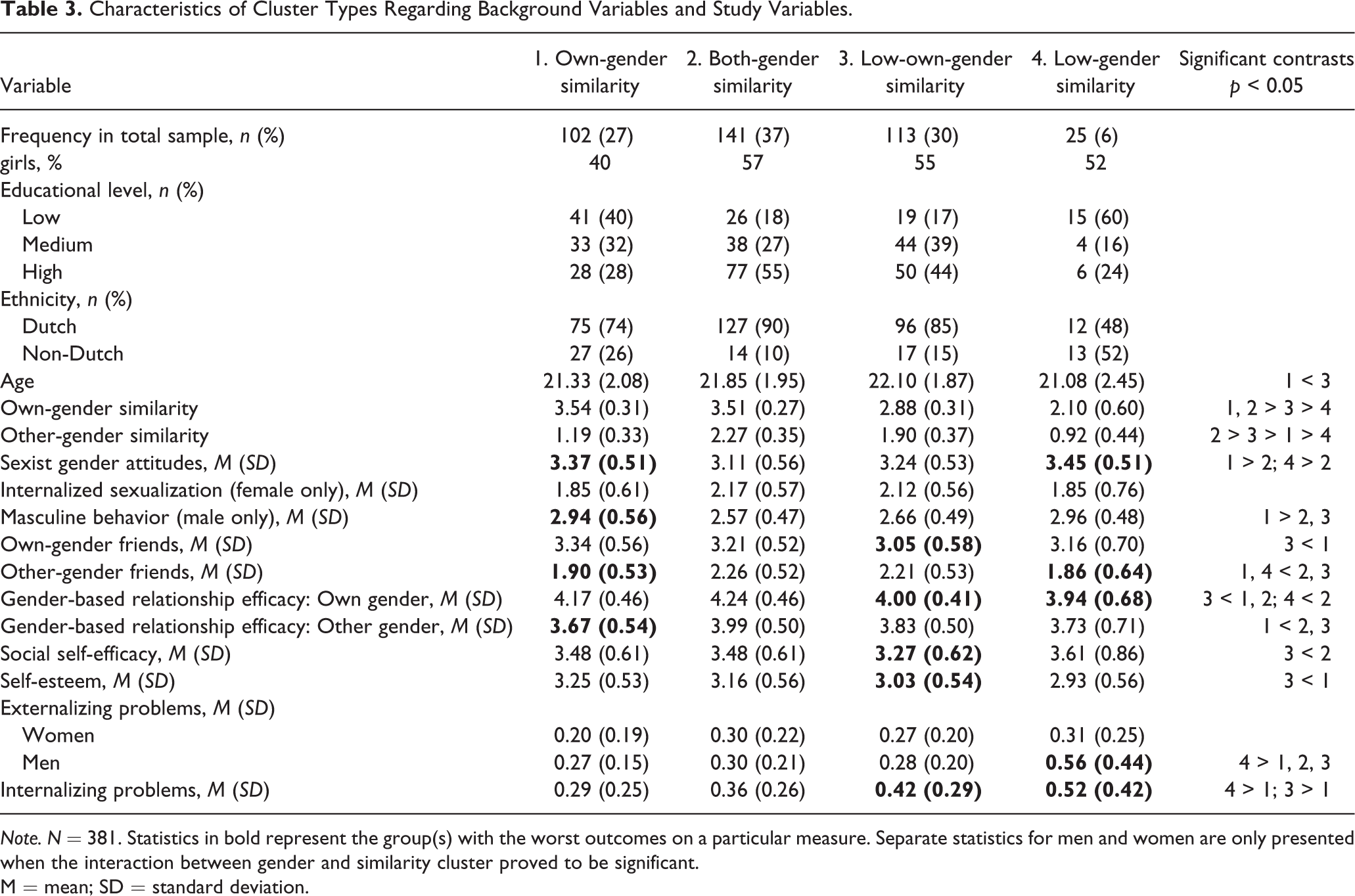
Note. N = 381. Statistics in bold represent the group(s) with the worst outcomes on a particular measure. Separate statistics for men and women are only presented when the interaction between gender and similarity cluster proved to be significant.
M = mean; SD = standard deviation.
Associations of Gender-Identity Typologies to Gender and Adjustment Outcomes
To examine associations between gender-identity typologies and outcomes, analyses of variance (ANOVAs) and RMANOVAs were conducted, with identity typology, gender, and educational level as between subject variables. See Table 3 for means and SDs on the outcome measures for each similarity cluster.
Gender-typed attitudes and behavior
With regard to sexism, a main effect of identity typology was found, F(3, 371) = 2.74, p < 0.05, partial η2 = 0.02; Own-GS and Low-GS adults reported more sexist attitudes than Both-GS and Low-Own-GS adults. Women’s internalized sexualization did not differ between identity typologies, F(3, 190) = 1.68, p = 0.17, partial η2 = 0.03. Men’s adherence to masculine behaviors of toughness and emotional stoicism did differ between the identity typologies, F(3, 179) = 5.65, p < 0.01, partial η2 = 0.09, such that Own-GS men reported more adherence to masculine-typed behaviors than Both-GS men and Low-Own-GS men. No interactions were significant.
Own- and other-gender friendships: Ability and self-efficacy
An RMANOVA on the friendship scales revealed a significant interaction between identity typology and friendship target (Own-gender vs Other-gender), F(3, 365) = 13.42, p < 0.01, partial η2 = 0.10. Low-Own-GS adults were less likely to have own-gender friends than Own-GS adults. Further, Own-GS and Low-GS adults were less likely to have other-gender friends than Both-GS and Low-Own-GS adults. Similarly for GBRE, there was an interaction between the within-subjects factor (GBRE-own vs -other gender) and identity typology, F(3, 365) = 13.03, p < 0.01, partial η2 = 0.10. Post hoc analyses indicated that GBRE-own gender was lower in Low-Own-GS and Low-GS adults than in Own-GS and Both-GS adults. Further, Own-GS adults scored lowest on GBRE-other gender. Last, social self-efficacy differed between the identity typologies, F(3, 371) = 3.05, p < 0.05, partial η2 = 0.02, with Low-Own-GS adults scoring lowest on social self-efficacy.
Social-emotional adjustment
The identity typologies differed in self-esteem, F(3, 371) = 3.58, p < 0.05, partial η2 = 0.03, with Low-Own-GS adults having lower self-esteem than Own-GS adults. An RMANOVA on internalizing and externalizing behavior revealed a significant behavior type × identity typology × gender interaction, F(3, 365) = 3.66, p < 0.05, partial η2 = 0.03. However, ANOVAs run separately for internalizing and externalizing behavior showed that the interaction between gender and identity typology was only significant for externalizing behavior, F(4, 371) = 3.07, p < 0.05, partial η2 = 0.03, and not for internalizing behavior, F(4, 371) = 1.39, p = 0.24, partial η2 = 0.02. For internalizing behavior, only identity typology was significant, F(3, 371) = 5.72, p < 0.01, partial η2 = 0.04, indicating that Low-Own-GS and Low-GS adults reported more internalizing problems than Own-GS and Both-GS adults. With regard to externalizing behavior, Low-GS men reported more externalizing problems than Own-GS, Both-GS, and Low-Own-GS men. For women, there were no differences between the identity typologies in externalizing behavior, F (3, 190) = 2.32, p = 0.08.
Discussion
In this study, we used the novel dual-identity approach to examine emerging adults’ gender identity and its link with gender-related and social outcomes. First, emerging adults’ perceived similarity to one’s own and other gender were relatively separate dimensions of gender identity. Second, four gender-identity typologies were identified based on individual differences in the combination of own- versus other-gender similarity. Third, gender-identity typologies were associated with differing patterns of gender-related and social outcomes in predictable ways. Together these findings validate the application of a novel conceptualization of gender identity for emerging adults, which involves a connection to one’s own as well as the other gender. Convergent with the intersectionality perspective, it appears that identifying with more than one social group (or not) produces unique forms of subjective experience (Stewart & McDermott, 2004), that consequently influence how we behave in our social world.
Interestingly, we did not find a group of emerging adults with Cross-GS identity, which is in line with previously found increases in androgyny (Barrett & White, 2002) and reduced cross-gender identity in adults (Carr, 2007; van Caenegem et al., 2015). Instead, we identified a group characterized by low-own gender similarity, but average other-gender similarity (Low-Own-GS). In addition, Own-Gender Similarity and Low-Gender Similarity were less prevalent in emerging adults (Own-GS 27% vs 47.8%; Low-GS 6% vs 16.7%) than in the elementary-age children and Both-Gender Similarity was more prevalent in emerging adults (37% vs 29.8%; Martin et al., 2017). Relatedly, in the current study, younger emerging adults felt more own- than other-gender similarity and were more likely to feel primarily similar to the own gender (Own-GS), compared to older emerging adults. Emerging adults seem to be better able to identify themselves with the other gender than younger individuals, possibly because of increased cognitive and perspective-taking skills (Moshman, 2011). However, differences in gender-identity typologies between the current study and the Martin et al. (2017) study could also be due to cultural differences. In the Netherlands, gender equality is considerably higher than in the USA (United Nations (UN) Development Program, 2016), which might explain the higher prevalence of Both-GS and the lower prevalence of Own-GS.
Associations between identity typologies and gender-related and social outcomes were largely as expected (Martin et al., 2017; Pauletti et al., 2017). First, Own-GS and Low-GS emerging adults held the most gender-typed attitudes. Own-GS males also were the most gender-typed of all the groups in the male-typed behaviors of toughness and restrictive emotional expressivity we assessed. High gender-typicality has previously been found to be related to more traditional gender stereotypes and interest in gender-typed activities (Patterson, 2012). Similarly, feeling similar to both genders has been associated with lower scores on sexism in boys (Pauletti et al., 2017). However, this does not explain why Low-GS adults also displayed high levels of gender-typed attitudes and behavior. It is possible that identifying with the other gender, which is something both Own-GS and Low-GS adults do not do, increases a person’s positive evaluation of the other group, thus leading to more flexible and egalitarian gender stereotypes (Arthur et al., 2008). Therefore, other-gender similarity might be a more important predictor of some gender-typed behaviors and sexist attitudes than the combination of own- and other-gender similarity (see Appendix C, Table C1, C2). It is important to note, however, that we assessed only relatively negative aspects of gender-typed behavior (i.e., toughness, internalized sexualization), thus processes might be different for other aspects of gender-typing (e.g., empathy, prosocial behavior, activity interests).
With regard to the ability and efficacy to form own- and other-gender friendships, Both-GS adults showed better social adjustment than the other groups. Own-GS adults felt able to relate to their own gender, had own-gender friends, and had high self-esteem, but were less comfortable with the other gender and had few other-gender friends, which is in line with a recent study in college students (Mehta, Hojjat, Smith, & Ayotte, 2016). Low-Own-GS adults showed the opposite pattern, in which they felt able to relate to the other gender and had other-gender friends, but at the same time they had low self-esteem and perceived themselves as the least socially competent in general. Last, Low-GS adults did not feel confident they could relate to own-gender peers and had few other-gender friends. In emerging adulthood, feeling efficacious and being able to develop friendships with both genders might be crucial as men and women have to manage interactions with the other gender in academic and professional settings. These findings suggest that feeling dissimilar to a gender group might lead to an exaggerated sense of “otherness” with regard to that group, which hampers interaction and formation of friendships with the members of the dissimilar group (i.e., out-group; Ames, 2004).
Regarding social-emotional adjustment, Low-Own-GS and Low-GS emerging adults experienced the highest levels of internalizing behavior problems, and Low-GS men experienced the highest levels of externalizing problems. As the gender identity of both Low-Own-GS and Low-GS emerging adults can be characterized as gender-atypical, these findings correspond with a body of research showing that feeling typical of one’s own gender is related to optimal psychological adjustment (e.g., Carver et al., 2003; Egan & Perry, 2001). The adjustment advantage of Low-Own-GS men over Low-GS men might be because they have other-gender friends, and friends appear to play a buffering role in the adjustment of gender atypical people (Jewell & Brown, 2014). That Low-GS men were less well-adjusted than their female counterparts might not be surprising considering the stricter gender roles for men and the greater social importance of gender typicality for boys relative to girls (Egan & Perry, 2001; Leaper, 2000). Previous research has also shown that low gender typicality predicted more negative mental health outcomes for adolescent boys than for girls (Jewell & Brown, 2014).
We also found interesting differences between emerging adults with different educational levels and ethnicities. Lower vocational students were more likely to be in the Own-GS or Low-GS group, whereas higher vocational and university students were more likely to be in the Both-GS and Low-Own-GS group. However, the effect of current educational level was carried in part by ethnicity, as ethnicity, but not educational level, interacted significantly with own- and other-gender similarity. Non-Dutch emerging adults reported more own- than other-gender similarity than Dutch emerging adults did. Non-Dutch emerging adults were also more likely to feel primarily similar to their own gender, whereas Dutch emerging adults felt similar to both genders. There are two possible explanations for these findings that require further exploration in future research. First, non-Dutch emerging adults are typically from cultures that score higher on gender-inequality and adhere to a strict division of gender roles (UN Development Program, 2016), which reduces opportunities to experience similarities with the other gender. Second, non-Dutch emerging adults may have experienced stronger pressures to behave according to the social norms for one’s own gender (Corby, Hodges, & Perry, 2007), which is likely to enhance feelings of similarity to their own gender.
Our findings must be viewed in light of some limitations. Because of the correlational design of this study, we were not able to determine the direction of effects in the association between gender-identity clusters and gender-related, social and adjustment outcomes. This issue might be particularly important for associations between gender-identity typologies and closely related constructs, such as gendered friendship ability and efficacy. Long-term longitudinal studies examining gender identity development from childhood to adulthood can provide further clarity in this regard. Further, we only used self-report measures to assess gender identity and its correlates, which increases the risk of social desirability in responding and of shared-method variance. However, self-reports of subjective experiences such as gender identity are appropriate to employ. And, correlations between self-reported aspects of gender development could be seen as an indication of the importance of cognitive schemas in people’s representations of gender. In addition, almost 40% of the emerging adults were willing to report an atypical gender-identity, which suggests that social desirability issues were not present. Moreover, internal consistency of the own- and other-gender similarity scales was somewhat low in this sample, which warrants further research to explore why that might be the case for this Dutch sample. Future studies may consider the use of mixed methods to assess the correlates of gender identity, for example, by using implicit association tests to assess gender-related attitudes (Nosek, Banaji, & Greenwald, 2002).
In sum, our findings imply that identifying with one’s own gender might be essential for good social-emotional adjustment, because people derive a sense of self-worth from identifying with one’s own social group (Tajfel & Turner, 1986). However, also identifying with the other gender has the advantage of promoting flexible social and interpersonal skills and egalitarian gender attitudes, consistent with Bem’s androgyny perspective (1974). With Martin and colleagues’ dual-identity approach, it is possible to capture a more robust range of gender identities than has been done before, and this approach appears to be appropriate for assessing developmental trends in young children through to emerging adults, even those from different educational levels and ethnicities. This presents the opportunity for long-term developmental studies examining individual differences in gender-identity development and its link with other gender-related outcomes and social or personal adjustment.
Supplemental Material
JBD820686_supplementary_appendices - Gender-identity typologies are related to gender-typing, friendships, and social-emotional adjustment in Dutch emerging adults
JBD820686_supplementary_appendices for Gender-identity typologies are related to gender-typing, friendships, and social-emotional adjustment in Dutch emerging adults by William M. Bukowski, David G. Perry, Melisa Castellanos, Joyce J. Endendijk, Naomi C. Z. Andrews, Dawn E. England and Carol L. Martin in International Journal of Behavioral Development
Footnotes
Funding
The authors disclosed receipt of the following financial support for the research, authorship, and/or publication of this article: The research was supported in part by funds from the T. Denny Sanford School of Social and Family Dynamics.

Appendix A
Appendix B
Appendix C
Appendix D
References
Supplementary Material
Please find the following supplemental material available below.
For Open Access articles published under a Creative Commons License, all supplemental material carries the same license as the article it is associated with.
For non-Open Access articles published, all supplemental material carries a non-exclusive license, and permission requests for re-use of supplemental material or any part of supplemental material shall be sent directly to the copyright owner as specified in the copyright notice associated with the article.
