



Abstract
This study examines how counter-stereotypical employer communication can reduce prejudice against older workers. In an experiment with Dutch employers and hiring decision-makers (n = 444), participants viewed a video message in which two employers shared positive experiences with workers aged 50 and above. Two message styles and a media literacy instruction were tested to assess how different ways of framing counter-stereotypical information influence perceptions of older workers. Results show that the employer-as-ambassador message, particularly when combined with the instructional element, most effectively improved perceptions of older workers’ employability among employers. The employer-as-educator message was least effective, even when compared to the control condition. This study demonstrates the potential of stereotype-reversing employer communication to challenge and reduce age bias in the workplace, addressing a key gap by evaluating the employer’s role in shaping perceptions of older workers. The study leverages our collaboration with societal partners to communicate these insights to practice.
Keywords
Introduction
As the population ages and the retirement age continues to rise in many Western countries, older workers are expected to stay active in the labor market for longer (OECD, 2013; Van Solinge & Henkens, 2017). While these workers are often praised for their reliability, trustworthiness, and loyalty, they are also frequently stereotyped as lacking adaptability, motivation, and competence (Krings et al., 2011; Kroon et al., 2016a; Van Dalen et al., 2010). Such stereotypes are not only pervasive but also deeply ingrained, particularly among employers, which can significantly undermine the professional prospects of older workers in the labor market (Billett et al., 2011; Van Dalen & Henkens, 2020). This raises an important question: how can we challenge and reshape these deeply held prejudices regarding aging in the workplace?
Existing research has provided valuable insights into media representations of older workers and their potential for neutralizing stereotypical beliefs about older workers (e.g., Kroon et al., 2016b; Kroon & Van Selm, 2024; Van Selm & Van der Heijden, 2014). Building upon this body of work, our study shifts attention to employer communication as a crucial yet underexplored context for stereotype reduction. Employers are not only subject to the same age-related stereotypes that circulate in society, but also actively reproduce, or contest, these beliefs through their organizational practices and communication (Van Selm & Van den Heijkant, 2021). Because of their authority and credibility in the labor market, employers are uniquely positioned to act as role models for their peers by advocating the employment of individuals aged 50 and above.
Against this backdrop, the present study examines how employers can use counter-stereotypical messaging to challenge age-related bias and promote a more balanced understanding of older workers’ competence and employability. Using an experiment with Dutch employers and hiring decision-makers (n = 444), we compare different message strategies to determine which forms of employer communication are most effective in improving other employers’ perceptions of older workers. In doing so, this research contributes to the literature on stereotype reduction and age bias by emphasizing the communicative role of employers in fostering a more inclusive and sustainable labor market.
Stereotypes
Stereotypes are oversimplified and often biased perceptions of particular social groups. People readily grasp onto stereotypes as convenient mental shortcuts to quickly judge others, process and organize information, and justify their own actions (Mastro & Tukachinsky, 2011; Ramasubramanian, 2011; Van Dalen & Henkens, 2020). The older worker stereotype is one of these persistent stereotypes that is highly visible in society, including in media representations (e.g., Kroon et al., 2016a) and employer communication (Van Selm & Van den Heijkant, 2021). In the field of social psychology, a framework has been established to describe the content of stereotypes about any social group (Fiske et al., 2002). This Stereotype Content Model (SCM) posits that group stereotypes can essentially be reduced to two key dimensions: the warmth dimension, which ranges from warm to cold, and the competence dimension, which ranges from competent to incompetent (Fiske et al., 2002). The warmth dimension is operationalized into traits such as friendliness, trustworthiness, sincerity, while the competence is operationalized as confidence, capability, efficiency and intelligence (Fiske et al., 2002).
In the case of older workers, the prevailing stereotype is mixed: they are often seen as warm but lacking in competence (Cuddy et al., 2005; Van Dalen & Henkens, 2020). Specifically, older workers are perceived as reliable, trustworthy, and loyal, yet there is also a widespread belief that they may lack adaptability, motivation, and capability (Krings et al., 2011; Kroon et al., 2016b; Van Dalen et al., 2010). This stereotype can be detrimental to older workers’ job prospects (Billett et al., 2011; Van Dalen & Henkens, 2020). If employers use the stereotype to make quick judgments about older individuals, it can lead to a substantial portion of the potential workforce within an organization being overlooked due to biases. This is particularly problematic as empirical evidence refutes the notion of a negative correlation between age and performance. Generally, there is little evidence that job performance declines as workers get older; rather, performance often improves with age (Posthuma & Campion, 2009). Ng and Feldman (2012) conducted a meta analysis of six stereotypes about older workers and found evidence for only one: that they are less willing to undergo training. Other studies have shown that older workers are valued for their flexibility, up-to-date skills, and willingness to learn new tasks and take on challenging work (see Billett et al., 2011), further confirming that age is not associated with declining performance.
Consequently, strengthening perceptions of older workers’ competence (or hard skills) is crucial for their sustainable integration into the workforce (Van Dalen & Henkens, 2020). Our study therefore addresses counter-stereotypical information specifically aimed at challenging and reshaping these negative perceptions about older workers’ competence.
The Role of Employers
Employers have an important role to play in countering the unjustified stereotype of older workers. As key decision-makers in the labor market who directly shape hiring, promotion, and training opportunities, they have the power to improve employment prospects for older individuals, thereby alleviating the precarious situation of older (unemployed) workers (OECD, 2006; Van Dalen & Henkens, 2020). By addressing age-related biases in these processes, employers not only improve prospects for older workers but also strengthen their own organizations. Dismissing older workers too easily or too quickly means overlooking valuable human capital (Van Dalen & Henkens, 2020), which can ultimately weaken an organization’s long-term competitiveness (Kroon et al., 2016a). When managers allow negative stereotypes about older workers to influence their hiring or retention decisions, they risk missing out on valuable skills, accumulated expertise, and institutional knowledge that older workers bring to the workforce (Posthuma & Campion, 2009). Beyond the organizational benefits, retaining older workers also has broader societal benefits, including easing pressure on pension systems (Posthuma & Campion, 2009).
Importantly, the role of employers extends beyond their own organizations, as they are uniquely positioned to shape broader labor market norms. Their messages carry weight because they speak from a position of direct responsibility and practical experience, rather than primarily from motives related to ideology or justice (as would be the case with employees or unions). This credibility enables employers to lead by example and act as trusted communicators in convincing their peers of the value of older workers. Established professional networks and employer associations, such as the AWVN in the Netherlands (which is collaborating on this project, details to follow), provide trusted channels through which such employer-to-employer communication can occur. By visibly hiring and promoting employees aged over 50, employers can counter stereotypes within their own organizations and set normative standards that can inspire similar practices across the industry. The key question, however, is how employers can most effectively communicate and spread this message as role models.
Counter-Stereotypical Information Strategy
To mitigate stereotypical thinking by means of communication, one key approach involves presenting counter-stereotypical content (Fraser et al., 2021; Ramasubrarnanian, 2007a). This strategy seeks to subtly shift intergroup attitudes by introducing individuals to information that directly challenges or disconfirms existing stereotypes. The underlying principle is that exposure to contradictory information can trigger a reassessment of deeply held beliefs (Ramasubrarnanian, 2007b). As people encounter new experiences and information, their understanding of social groups evolves, with each new piece of information potentially reshaping their cognitive categorizations (Mastro & Tukachinsky, 2011).
Previous research has demonstrated that when individuals are introduced to counter-stereotypical exemplars—individuals who do not fit the typical norm and defy the prevailing stereotypes—subtle but meaningful shifts in attitudes can occur (see e.g., Mastro & Tukachinsky, 2011; Ramasubramanian, 2011b; Robertson & Weiss, 2017). Specifically in the context of the older worker stereotype, a recent study by Kroon and Van Selm (2024) showed that exposure to messages defying common stereotypes significantly improved older workers’ perceptions of their own employability, providing evidence for counter-stereotypical messages as a fruitful strategy.
Building on this, our study explores how employers can challenge the stereotype of older workers by presenting counter-stereotypical information and exemplars to persuade other employers to recognize the value and potential of older workers. Since the prevailing stereotype suggests that older workers lack competence, we focus on portraying them as highly skilled and capable professionals. We hypothesize that exposure to this counter-stereotypical information will lead to more positive evaluations of older workers:
Participants exposed to a counter-stereotypical employer message about older workers will rate them more positively on (a) perceived employability, (b) hiring intention, and (c) promotion intention than those not exposed to such a message.
However, existing research has identified several challenges in counter-stereotyping efforts, underscoring the need for further investigation to determine which strategies most effectively reduce biases (Oliver et al., 2015). In response to this gap, our study examines two distinct message styles through which employers communicate counter-stereotypical information about older workers. Both messages emphasize similar counter-stereotypical content—portraying older workers as competent and committed—but differ in style and in how they position the employer as a communicator. In the first approach, which we refer to as the ambassador style, employers act as advocates who actively demonstrate how older workers’ competence, stability, and experience contribute to organizational success. By contrast, the second approach, labeled the educator style, positions employers as instructors who appeal to a sense of responsibility, calling on their peers to avoid dismissing or overlooking candidates based on age.
The theory of moral elevation suggests that people are naturally inclined to do good. Observing acts of kindness or moral behavior reinforces their belief in the goodness of humanity, elicits uplifting emotions, and inspires them to act positively and emulate the moral example (Freeman et al., 2009; Pohling & Diessner, 2016). We propose that the ambassador approach leverages this effect by adopting an inspirational, values-driven tone that encourages genuine enthusiasm and engagement. In contrast, the educator approach is designed with a more directive, responsibility-focused tone that emphasizes duty over inspiration. While this tone may make the message straightforward, it also carries the risk of being perceived as somewhat moralizing, which could make employers less receptive. Consequently, we expect the ambassador style to be more effective in reducing age bias than the educator style.
Participants exposed to the ambassador counter-stereotypical message will rate older workers more positively on (a) perceived employability, (b) hiring intention, and (c) promotion intention than those exposed to the educator counter-stereotypical message.
Another way to reduce the harmful effects of stereotypical (media) content is through a media-literacy approach, which involves providing an explicit viewer instruction or warning that helps audiences critically process and question biased materials (Nathanson, 2002; Steinke et al., 2007). Rather than altering biased materials, this approach prepares the audience, in our case the employers, to think more critically about what they are about to see. This method aims to reduce the automatic activation of stereotypes by prompting active reflection (Ramasubrarnanian, 2007b).
However, research on the effectiveness of media-literacy interventions has produced mixed findings. This is partly because such interventions are subject to the broader boomerang effect observed in many stereotype-reduction efforts: attempts to suppress or counter stereotypes can sometimes backfire and reinforce them. In the context of media literacy, this risk emerges when explicit instructions or warnings draw attention to the very stereotypes they aim to debunk (Gawronski et al., 2008; Macrae et al., 1994; Monteith et al., 1998).
Our research attempts to reconcile these conflicting findings by taking a different approach, one that deliberately avoids mentioning the negative stereotype. In doing so, we aim to circumvent any potential rebound effect. The media literacy component in our design serves as a pre-message instruction intended to stimulate critical thinking in viewers before they encounter the actual employer message. It explicitly draws attention to the fact that older workers are often overlooked in the labor market, which is a missed opportunity given their capabilities, particularly in times of labor shortages. We expect that incorporating media literacy in this way will lead to more favorable employer perceptions in terms of employability and hiring decisions.
Participants who receive a media literacy instruction will rate older workers more positively on (a) perceived employability, (b) hiring intention, and (c) promotion intention than those who do not receive this instruction.
Method
Sample
A sample of 444 Dutch participants was recruited from a panel agency, consisting of direct managers (n = 85), HR-professionals (n = 21), business owners (n = 311), and other relevant professionals (n = 27), all of whom are involved in hiring and promotion decisions. The mean age of the respondents was 55.4 years (SD = 9.04), and 22.75% were female. The average work experience in the relevant role was 20.8 years (SD = 11.05). In total, 16.4% of the participants worked in the public sector, 76.1% in the private sector, and 7.4% chose ‘other’. In terms of organization size, 85.8% of participants worked in small companies with 1–50 employees.
Co-Creation Process Between Academia and Practice
The study was conducted as a co-creation process between academia and practice, with two societal partners actively engaged throughout the project: AWVN, the largest employers’ association in the Netherlands, and RADAR, an agency dedicated to equal treatment and combating workplace discrimination. Expertise from these partners shaped the stimulus material, ensuring the practical relevance and soundness of the study’s design. The co-creation process included multiple stages of consultation, during which societal partners provided feedback on the study setup and the stimulus materials.
Experimental Design and Procedure
An online experiment was conducted to investigate how counter-stereotypical employer communication can help reduce prejudice against older workers among other employers. Using a 2 × 2 between-subjects factorial design, the experiment manipulated two key factors: the type of counter-stereotypical message (employer-as-ambassador vs. employers-as-educator) and the presence or absence of an instructional element. A control group was included for comparison. Participants were randomly assigned to one of the five groups: (1) ambassador message with instructional reinforcement (n = 86), (2) ambassador message only (n = 82), (3) educator message with instructional reinforcement (n = 79), (4) educator message only (n = 92), and (5) control group (n = 105), which received neither a video message nor instruction. The study was approved by the Ethics Review Committee of the Erasmus School of History, Culture, and Communication (Reference: ETH2122-0143).
At the start of the questionnaire, after providing written informed consent, participants were informed that the questionnaire was about older workers. We clarified that this referred to job seekers and workers aged 50 and above. After this introduction, participants were shown the stimuli according to their assigned condition. A small pilot study (n = 15) conducted beforehand confirmed that the stimuli were perceived largely as intended. Participants recognized the key elements of the messages, including that the videos portrayed older workers in a positive light. Based on this pilot, no changes were made to the stimuli themselves; however, the feedback was used to refine the phrasing of the manipulation check items in the main study to ensure clearer differentiation between conditions.
The counter-stereotypical message was conveyed through a video message. This message was based on a video produced by the Dutch Chamber of Commerce (KVK) in response to labor market shortages and unfair perceptions of people over 50 (Gallimore, 2022). Designed to challenge stereotypes, the video featured older workers in diverse work settings (i.e., a bakery and a training and development agency), accompanied by testimonials from two employers who described their positive experiences with them. Two employers were featured in the video to reinforce the idea that positive attitudes towards older workers are shared across contexts, rather than expressed by a single employer. The employers differed in gender and age appearance, one being a middle-aged male employer and the other being a slightly younger female employer, each representing a distinct type of organization (i.e., a bakery and a training and development agency), We carefully tailored two versions of the video: an ambassador version and an educator version. In the ambassador version, the employers acted as advocates, emphasizing the invaluable contributions of older workers to their organizations’ success. For example, one employer stated: “For us, that [hiring people over 50] was a deliberate choice. […]. We really needed a stable foundation of people who enjoy their work, are skilled, and want to keep doing it for years to come”. The other employer added, to illustrate: “Older employees often give you that extra sense that things will be taken care of”. In the educator version, the same two employers appeared, but in this version, they are urging other employers to recognize their responsibility in considering older workers. To illustrate, one employer stated: “My tip to other entrepreneurs is that you should not write someone off before they have had a chance”, while the other emphasized: “Do not just focus on age, focus on the qualities of people and what you need in your business”. This version also included on-screen bullet points summarizing the key tips, thereby visually underscoring the instructive nature of the educator approach. To maintain consistency, both versions featured identical opening and closing shots. Participants in each experimental group were required to watch the video at least once and were given the option to replay it if desired. Full transcripts of both video messages are provided in Appendix A.
The second factor in the study was the presence or absence of the instructional element. In the instruction condition, participants received a brief instruction before viewing the video. Specifically, the instruction stated: “Did you know? Older workers are often overlooked when it comes to recruiting new colleagues. What a missed opportunity, especially now that labor shortage is greater than ever. Moreover, by hiring someone over 50, you are bringing on board a professional with strong work motivation, commitment, and a stable work-life balance” (see Appendix B). This instructional message functioned as a media literacy prompt designed to activate critical reflection before exposure. By drawing attention to the common tendency to overlook older workers and framing this as a missed opportunity, it was meant to encourage participants to approach the subsequent video with greater awareness and to evaluate its message more consciously. Participants in the no-instruction condition did not receive any explicit instructional information about older workers before watching the video.
After being exposed to the stimuli, participants responded to a series of statements assessing their perceptions of older workers’ employability and their willingness to hire or promote them. The control group received these statements without prior exposure to any instructional content or video message designed to counteract the older workers’ stereotype. In addition, several background characteristics were measured, including work experience and organizational characteristics (e.g., sector). Manipulation checks were then carried out, after which participants were asked to provide demographic information (age, gender, education level) and were debriefed.
Manipulation Checks
Respondents were asked to identify the instruction they had received. The vast majority (98.2%) correctly recognized that it addressed the missed opportunity of overlooking older workers in recruitment, while a small minority (1.8%) selected one of the two incorrect options. These results suggest that participants grasped the core message of the instruction, allowing us to conclude that the manipulation was successful. Regarding the type of counter-stereotypical message, we first asked participants to what extent they agreed that the video message presented a positive image of older workers in the workplace (i.e., not a negative stereotype). Participants in both conditions rated the video fairly positive on average (ambassador: M = 5.95, SD = 1.21; educator: M = 5.88, SD = 1.03). Next, we asked respondents about the content of the video, specifically how the employers addressed them. Fisher’s Exact test revealed a significant difference between participants in the ambassador and educator conditions in recognizing the video’s message, p < .001. In the ambassador condition, most participants (91.1%) correctly identified that the employers emphasized choosing 50+ workers for their ability to bring peace and stability to the organization. In the educator condition, the majority (70.8%) correctly indicated that employers offered concrete tips on looking beyond age and being open to hiring 50+ employees. These findings confirm the validity of the manipulation.
Dependent Variables
We examined three key aspects related to employers’ perceptions of older workers’ employability and value: (a) perceived employability; (b) hiring intention; and (c) promotion intention.
Perceived Employability of Older Workers
To assess participants’ perceptions of older workers’ employability, they were asked to rate their agreement with six statements about older workers on a 7-point Likert scale, ranging from 1 (completely disagree) to 7 (completely agree). Based on the five dimensions of employability and the corresponding measurement tool developed by Van der Heijde and Van der Heijden (2006), we self-selected a subset of items that best captured the dimensions relevant to our study context. These statements addressed the following aspects of employability: Older workers are generally able to (1) do their work accurately and with few errors; (2) distinguish between main and secondary issues and set priorities; (3) keep up with new developments in their field; (4) adapt to changes in the workplace; (5) share their knowledge and experience with others; and (6) balance their work and personal life. Higher scores indicated greater perceived employability of older workers (α = .88, M = 5.01, SD = .86).
Intention to Hire Older Workers
Participants’ intention to hire older workers was assessed using a single 7-point scale question adapted from (Kroon et al., 2016b): “Imagine that in your role as a manager or HR professional, you can hire a new employee for an open position. The situation is that both a younger and an older candidate apply for the position. Assuming both are equally qualified, how likely is it that you would choose the older candidate?” (1 = very unlikely, 7 = very likely; M = 4.63, SD = 1.42).
Intention to Promote Older Workers
In the same way, participants’ intention to promote older workers was measured using a single question: “Imagine that in your role as a manager or HR professional, you could offer a promotion to a current employee. The situation is that both a younger and an older employee are being considered for the promotion. Assuming both are equally qualified, how likely would you be to offer the promotion to the older employee?” (1 = very unlikely, 7 = very likely; M = 4.67, SD = 1.14).
Results
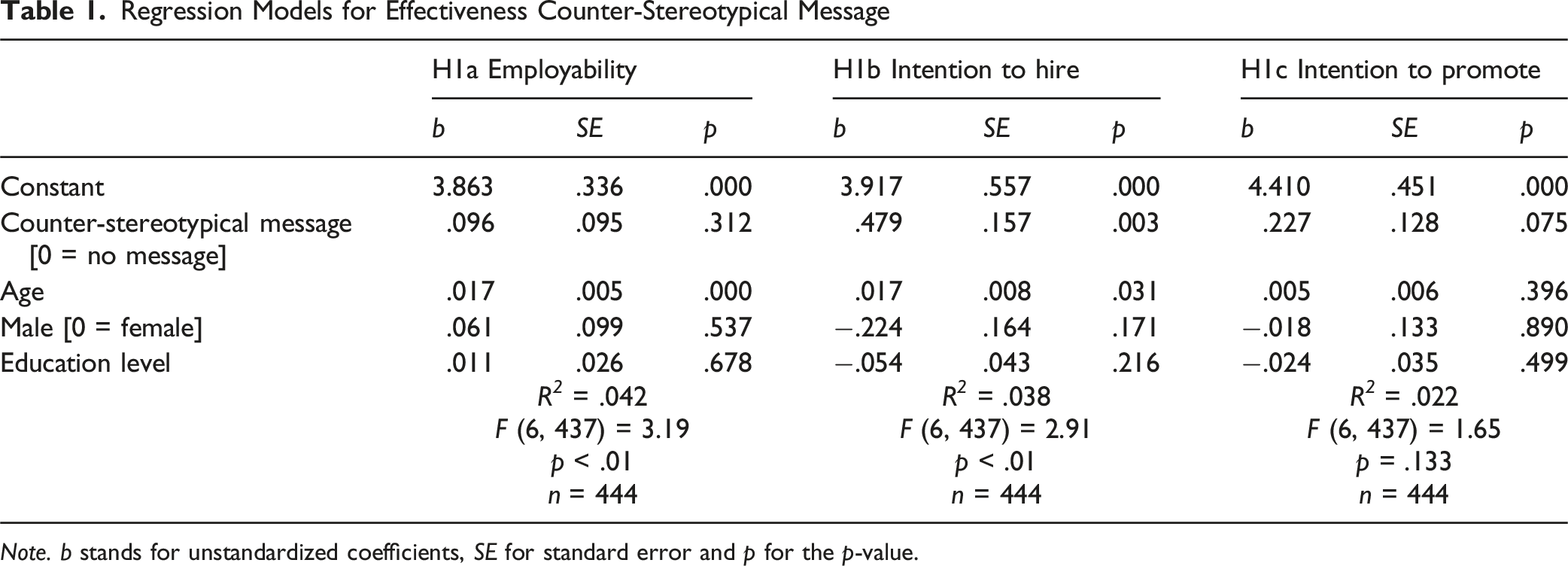
Regression Models for Effectiveness Counter-Stereotypical Message
Note. b stands for unstandardized coefficients, SE for standard error and p for the p-value.
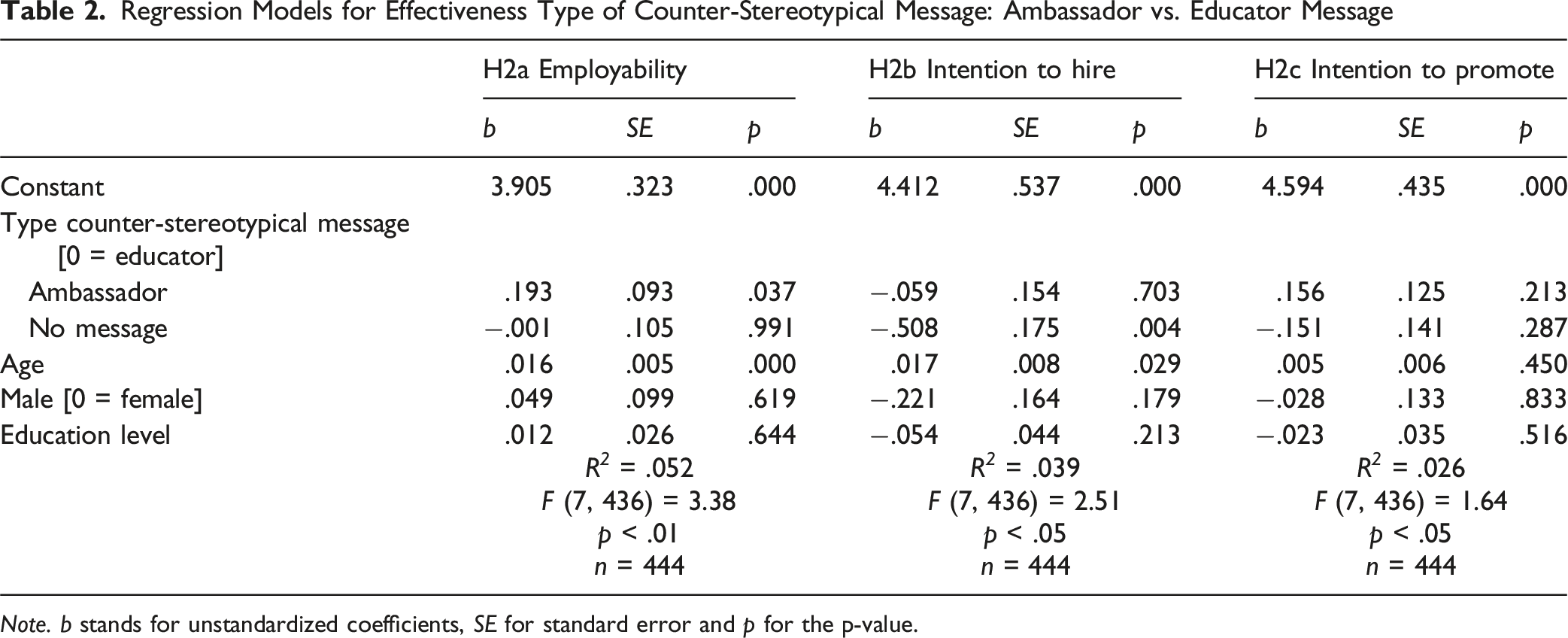
Regression Models for Effectiveness Type of Counter-Stereotypical Message: Ambassador vs. Educator Message
Note. b stands for unstandardized coefficients, SE for standard error and p for the p-value.
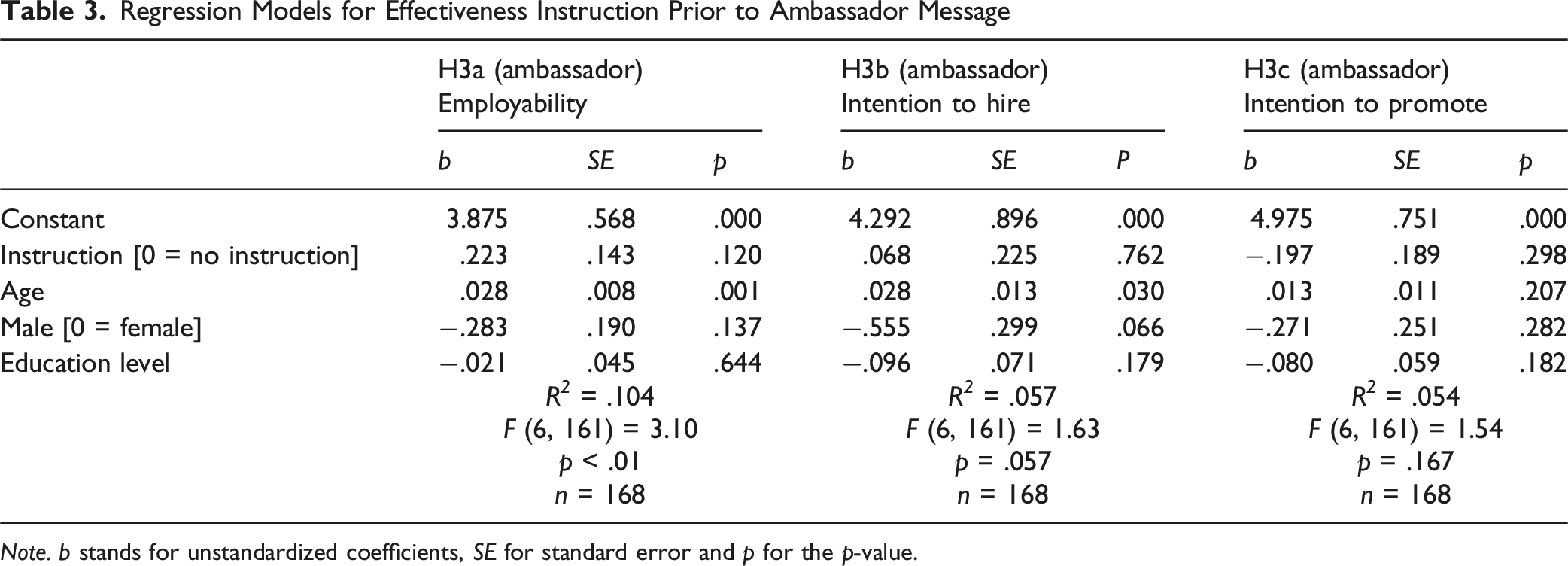
Regression Models for Effectiveness Instruction Prior to Ambassador Message
Note. b stands for unstandardized coefficients, SE for standard error and p for the p-value.
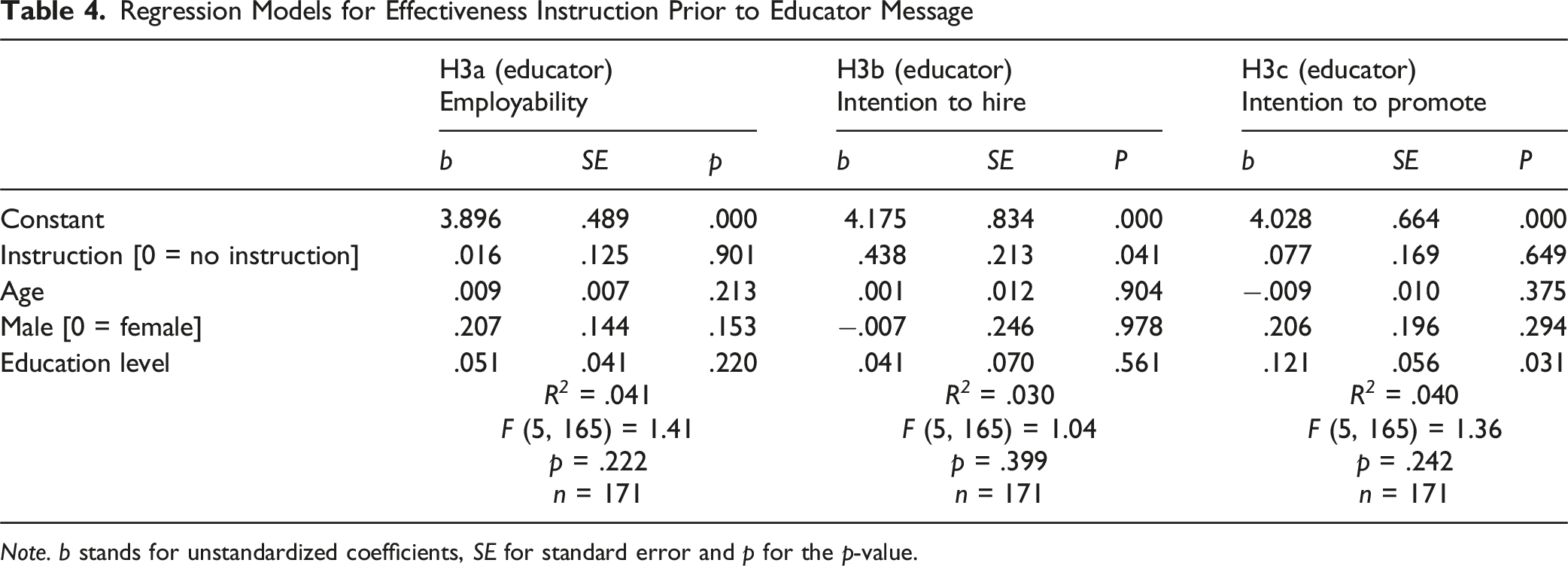
Regression Models for Effectiveness Instruction Prior to Educator Message
Note. b stands for unstandardized coefficients, SE for standard error and p for the p-value.
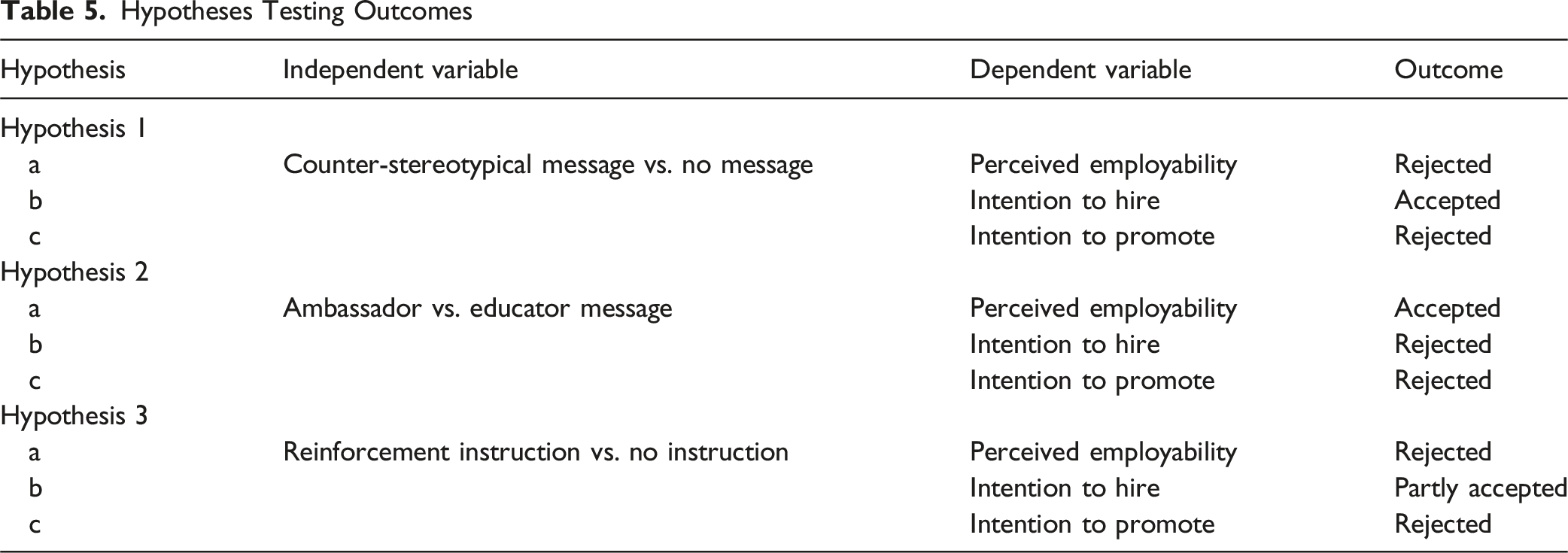
Hypotheses Testing Outcomes
Effectiveness of the Counter-Stereotypical Message
To test the sub hypotheses of H1, we compared participants who viewed a counter-stereotypical message (Groups 1–4; n = 339) with those in the control group who did not receive a message (Group 5; n = 105). For H1a, the results show no significant effect of the counter-stereotypical message on the perceived employability of older workers. Those exposed to the counter-stereotypical message rated older workers only slightly higher in terms of employability, by an average of 0.096 points, a negligible difference that led to the rejection of H1a.
In contrast, H1b was supported: the counter-stereotypical message significantly increased participants’ intention to hire older workers, b = .479, p < .01. Participants who received the message reported an average hiring intention score that was 0.479 points higher than the control group (see Table 1).
Finally, for H1c, promotion intentions were marginally higher for participants who received the counter-stereotypical message compared to the control group, b = .227, p = .075, but this difference was not statistically significant, resulting in the rejection of H1c.
Effectiveness of the Type of Counter-Stereotypical Message: Ambassador vs. Educator
To test which of the two counter-stereotypical messages was more effective (H2), we compared participants who saw the ambassador message (Groups 1 and 2; n = 168) with those who saw the educator message (Groups 3 and 4; n = 171). The results supported H2a, showing that the ambassador message significantly improved perceived employability ratings compared to the educator message, b = .193, p < .05 (see Table 2). In addition, we see that the educator message showed almost no advantage over the control group, indicating the absence of impact on improving employers’ perceptions of older workers’ employability.
For H2b, we found no significant effect of message type on participants’ intention to hire older workers, b = −.059, p = .703 (see Table 2). Although both messages outperformed the control group, their effects on hiring intentions were similar, leading to the rejection of H2b.
Finally, for H2c, participants exposed to the ambassador message reported on average a 0.156 point higher intention to promote older workers compared to those exposed to the educator message, but the effect was not statistically significant, b = .156, p = .213 (see Table 3), leading to the rejection of H2c.
Effectiveness of the Instructional Element
Finally, for H3, we examined whether a brief instructional segment—delivered prior to the counter-stereotypical message and emphasizing the value of older workers while encouraging critical reflection on age bias—increased message effectiveness. For H3a, among participants who received the ambassador message, employability ratings did not significantly differ between those who received the instruction (Group 1, n = 86) and those who did not (Group 2, n = 82), b = .223, p = .120 (see Table 3). The same was true for the educator message: no significant difference was found between participants with an instruction (Group 3, n = 79) and the ones without an instruction (Group 4, n = 92), b = .016, p = .901 (see Table 4). These findings lead to the rejection of H3a.
For H3b, hiring intention was unaffected by the explicit instruction prior to the ambassador message, b = .068, p = .762 (see Table 3), however, in the educator condition, the instruction significantly boosted hiring intention, b = .438, p < .05 (see Table 4). Participants who received the instructional segment prior to the educator message reported a notably 0.438 points higher intention to hire older workers compared to those without instruction. This supports H3b, but only for the educator-style message.
Finally, for H3c, we found no significant effect of the instruction on promotion intentions in either condition—ambassador (b = −.197, p = .298; see Table 3) or educator (b = .077, p = .649, see Table 4). Thus, we reject H3c, concluding that the instructional element had no effect on the intention to promote older workers.
Discussion
Our study carefully provides further empirical support for the theoretical idea that counter-stereotypical messages can effectively reduce bias. Building on prior research into counter-stereotypical portrayals in the media (e.g., Mastro & Tukachinsky, 2011; Ramasubramanian, 2011b), and more specifically on studies addressing such portrayals in the context of the older worker stereotype (Kroon & Van Selm, 2024), this study shifts the focus to a new context: employer communication. By exploring how employers themselves can potentially counteract age-related stereotypes, we extend research beyond media representations to the ways in which workplace narratives shape perceptions of older employees. We examined the effect of counter-stereotypical messages, and more in particular we examined two message types—an ambassador-style and an educator-style message—both delivered by employers and assessed how these messages influence other employers’ perceptions of older workers’ employability, hiring intentions, and promotion potential.
When looking into the respective message styles, the ambassador message proved to be particularly effective in improving employers’ perceptions of the employability of older workers. With employers as advocates for older workers, this message emphasized the value of their contributions to organizational success, leading to more favorable evaluations of their employability in terms of competence, adaptability, and personal stability. In contrast, the educator message—which appealed to employers’ moral responsibility not to pre-judge individuals based on age—did not improve perceptions of employability compared to the no-message control condition. In fact, the educator message may have resonated with underlying stereotypes by drawing attention to the need for “giving a chance”, potentially positioning older workers as exceptions to the norm. This finding highlights the nuanced nature of bias reduction—a complexity that has also been emphasized in prior research (Gawronski et al., 2008; Legault et al., 2011; Ramasubramanian & Oliver, 2007): simply advocating fairness may not suffice if the underlying assumptions about older workers’ competence remain unchallenged.
In addition, following the theoretical approach of media-literacy, introducing a brief prompt to reflect on age bias and the value of older workers preceding the ambassador message appeared to further increase positive perceptions of employability, although this increase did not reach statistical significance. Nevertheless, the pattern suggests that an instructional component, when paired with an ambassador message, may have a reinforcing effect on reducing age bias among employers.
Interestingly, the same instructional segment, when paired with the educator message, was most effective in enhancing hiring intentions. This effect may be attributed to the instruction’s explicit reference to the missed opportunities that result from overlooking older workers in hiring decisions, which likely reinforced the educator message’s call to offer equal opportunities regardless of age and helps explain its specific influence on hiring intentions. This offers cautious support for incorporating realistic—and especially positive—information in critical reflection instructions, potentially addressing the mixed findings on whether explicit debiasing efforts reduce or reinforce stereotypes (Macrae et al., 1994; Monteith et al., 1998).
Based on our findings, we see at least three additional reflections that need further discussion. First, the study shows that combining insights from media literacy literature, with insights on stereotype dimensions, moral elevation and communication styles is needed to disentangle the complexity of the potential role of employer communication in countering the persistent negative consequences of older workers’ stereotypes.
Second, the lack of an effect of the educator style message requires further examination into a potential mismatch between using this message style and employer-endorsed communication directed at peer employers. Such communication may only be effective when it aligns with employers’ primary concern: running a stable and profitable business with reliable, well-qualified staff. Appealing to a sense of social responsibility—such as addressing ageism in the workplace—may be less effective when coming from an employer acting as a peer communicator.
Third, the overall finding that counter-stereotypical messages (both communication styles taken together) especially increased employers’ intention to hire older workers, rather than their perception of older workers’ employability or intentions to promote them, might challenge the older worker stereotype in a tight labor market. The finding that exposure to a counter-stereotypical message increases the intention to hire without necessarily viewing older workers as more employable or more likely to be promoted than other (younger) colleagues could imply that communicating positively about older workers simply makes those responsible for hiring practices aware of the availability of this much-needed group of workers when labor is scarce, without being overly convinced that older workers are more employable or promotable compared to other (age-)groups. The willingness to hire a particular type of staff does not necessarily imply prioritizing said staff’s abilities over those of other employee groups. Future research could find ways to assess the underlying reasons influencing hiring decisions.
Limitations of the Study
While we secured a robust sample of over 400 participants, the composition—heavily weighted toward small business owners and companies—may have influenced the study’s outcome. Although highly speculative and yet to be examined, compared to being part of a larger organization, small business owners might be less likely involved in well-developed diversity and inclusion programs or active aging policies. Instead, these businesses may prioritize profitability, which could explain the relatively low appeal of the educator-style message. In addition, the sample was somewhat older in age on average, including relatively few younger participants. This higher mean age likely reflects the professional categories targeted in our study, particularly direct managers and business owners, roles typically held by individuals with substantial career experience. HR professionals may enter such roles earlier in their career, but they represented only a small share of our sample. Nonetheless, it is possible that younger professionals may respond differently to the messages, as they have not yet experienced aging in the workplace themselves and may view older workers from a more external, generational perspective. Future research could examine whether these different life-stage perspectives shape how counter-stereotypical messages are interpreted and evaluated.
The videos used in our study featured older workers in two settings: a bakery and a training and development setting. These settings demonstrate both ‘hands-on’ and ‘mind’ work. In future studies, other rationales regarding representing different types of workplaces might need attention too, such as rationales relating to size, profit/non-profit, or technology drivenness.
Another limitation relates to the nature of the instructional element, which was text-only and lacked visual elements to support the central tenet of the message. Future research could incorporate visual elements to illustrate the key message in a more engaging way. The communication toolbox’s animated images of older workers in powerful roles would be suitable for this purpose.
Impact
The impact of this study extends beyond academic research. As mentioned before, the study was a co-creation process between academia and practice, with two societal partners actively engaged throughout the project: AWVN, the largest employers’ association in the Netherlands, and RADAR, an agency dedicated to equal treatment and combating workplace discrimination. In an iterative dialogue, we formulated advice to employers on effective employer communication in combating age bias. The advice extended to developing a tangible resource that would meet the needs and expectations of employers, such as a toolbox with communication messages and images that can easily be shared on company social media platforms. The messages and images should communicate in a consistent manner an employer-endorsed message in an ambassadorial style, emphasizing the value that older workers bring to an organization and how their contributions are crucial to its success, combined with realistic facts about older workers.
Based on this advice, a video toolbox was developed as an open source, allowing organizations to freely access and use it for purposes such as active aging programs or otherwise, thereby maximizing its potential for impact. Through existing professional networks and employer associations such as AWVN, these materials can also circulate among organizations, facilitating peer-to-peer exchange and strengthening employer-to-employer communication about inclusive hiring practices. It would be important and interesting to follow up on the uses and results of the video toolbox in real organizations by means of a monitoring and evaluation study.
This study contributes by demonstrating the significance of leveraging a stereotype-reversing message in employer communication as a tool to challenge and reduce age bias on the work floor. It addressed a critical gap in the literature by evaluating the employer’s role in shaping older worker narratives and examining the influence of different message styles. Although the examined video messages may not immediately change employer attitudes drastically, our study provides valuable insights into message components that resonate with employes when building employer-to-employer communication aimed at challenging age bias. The findings underscore the potential of counter-stereotypical messages to meaningfully contribute to more neutral or positive beliefs about older workers, paving the way from unconscious bias to conscious inclusion —thereby acknowledging, in line with previous research, that these changes in perceptions may unfold gradually (Mastro & Tukachinsky, 2011). In addition to advancing theoretical insights, the study equips employers with practical tools to foster a more equitable and age-diverse workforce.
Supplemental Material
Supplemental Material - Countering Age Bias in the Workplace: The Impact of Counter-Stereotypical Employer Communication
Supplemental Material for Countering Age Bias in the Workplace: The Impact of Counter-Stereotypical Employer Communication by Linda van den Heijkant, Martine van Selm in Research on Aging
Footnotes

Ethical Consideration
Approved by the Erasmus School of History, Culture, and Communication Ethics Review Committee (Reference: ETH2122-0143).
Funding
The authors disclosed receipt of the following financial support for the research, authorship, and/or publication of this article: Supported by a Goldschmeding Foundation grant (Project: Beeldvorming; No. 32c). The Goldschmeding Foundation played no role in the design, execution, analysis and interpretation of data, or writing of the study.
Declaration of Conflicting Interests
The authors declared no potential conflicts of interest with respect to the research, authorship, and/or publication of this article.
Data Availability Statement
Data will not be shared due to privacy restrictions.
Supplemental Material
Supplemental material for this article is available online.
Author Biographies
References
Supplementary Material
Please find the following supplemental material available below.
For Open Access articles published under a Creative Commons License, all supplemental material carries the same license as the article it is associated with.
For non-Open Access articles published, all supplemental material carries a non-exclusive license, and permission requests for re-use of supplemental material or any part of supplemental material shall be sent directly to the copyright owner as specified in the copyright notice associated with the article.
