



Abstract
Despite growing awareness of loneliness and social isolation among older adults, efforts to address these issues among Black older adults (BOAs) in Canada remain limited. Literature subsumes their lived experiences within broader racialized populations, obscuring their unique challenges. This study explores the narratives of 13 BOAs (n = 5 male, n = 8 female, Mean Age: 68.3) on their roles as both family caregivers and care recipients, examining how these dynamics shape their experiences of loneliness. Using a collectivist theoretical lens and a narrative inquiry approach, the analysis identified three key themes: (1) care and support from adult children, (2) family devotion, and (3) the tension between gendered façades and nurturing dynamics. While cultural expectations of family devotion and caregiving reinforced a strong sense of duty, they often masked deeper emotional gaps. These findings signal the need for culturally tailored interventions that address the emotional landscapes of BOAs, moving beyond generalized assumptions.
Introduction
Loneliness and social isolation are growing public health concerns, particularly among older adults. However, in Canada and North America, minimal targeted efforts have been made to address these issues within Black older adults (BOAs), whose experiences remain underexplored. Existing research often generalizes their realities within broader racialized groups, overlooking the unique cultural, familial, and structural factors that shape their experiences of care and connection. This study investigates the perception and experience of loneliness among BOAs in Canada through the lens of family caregiving—both as care providers and recipients. This study is guided by the theory of collectivism to explore how caregiving and family dynamics intersect to shape the manifestation and perception of loneliness among BOAs in Ontario. It also explores the extent to which familial support mitigates or exacerbates feelings of isolation, particularly in relation to cultural expectations of caregiving, gender roles, and emotional fulfillment.
Background
Loneliness, defined as negative and undesirable subjective feelings caused by unmet social and intimate needs, is a prevalent social and public health issue affecting older adults across the globe (Czaja et al., 2021), thus making it an integral aspect of the human condition. Loneliness impacts both the mental and physical well-being of older adults (Czaja et al., 2021), including their spiritual health (O’Sullivan et al., 2024), leading to poor quality of life. Many factors, including race, ethnicity, class, sex, disability, or language, have been identified as predictors of loneliness among older adults (Ojembe et al., 2022; Taylor et al., 2023; Victor et al., 2021). Empirical measures, programs, and services are emerging to either mitigate or reduce loneliness among older adults in Canada and globally (Ambagtsheer et al., 2024; Ojembe et al., 2023a; Salma & Salami, 2020; Smale et al., 2022). Statistical evidence from the North America revealed the complex intersectional of social isolation, economic margination, and systemic racism collectively deepens feelings of loneliness among BOAs (Grullon et al., 2024; Taylor et al., 2024). For instance, KFF Survey on Racism, Discrimination, and Health (2023) found that 19% of Black adults reported frequent loneliness, compared to 14% of White adults, with Black women experiencing even higher rates (22%) than their White (17%), Hispanic (16%), or Asian (15%) counterparts (Artiga et al., 2023). In Canada, the Canadian Health Survey on Seniors (2019/2020) observed that immigrant seniors, including many Black older adults, had 1.6 times higher odds of experiencing loneliness compared to their Canadian-born counterparts (Gilmour & Ramage-Morin, 2020). While some of the studies have explored the constellating factors predicting loneliness among racialized and immigrant Black older adults such as language, they often overlook family relational dynamics, caregiving dynamics and socio-economic vulnerability as critical factors that shape loneliness among racialized older adults particularly BOAs.
Country specific studies from regions like UK (Victor et al., 2021), Canada (Ojembe et al., 2023a, b; Salma & Salami, 2020) and the US (Finlay & Kobayashi, 2018; Taylor et al., 2023, 2024) revealed that the prevalence of loneliness is relatively higher among BOAs, especially when controlled for certain variables that increases their chances for loneliness. For example, in an exploratory study among ethnic minoritized groups aged 65+ in Great Britain, the prevalence of loneliness was shown to be highest among participants from Africa (50%), China (40%), and the Caribbean (24%) (Victor et al., 2021). However, in Canada, most studies that have examined loneliness among ethnically minoritized older Canadians often lump the other racialized and minoritized ethnic groups, for example, Black and Latino groups, together as “others” while focusing more on immigrant Europeans (De Jong Gierveld et al., 2015). As a result, the “othering” and underrepresentation of groups such as BOAs obscure the understanding of the unique experiences of these groups within the empirical literature. Thus, raising the critical needs for studies focusing on this demographic.
This study guided by the theory of collectivism, aimed at exploring how caregiving and family dynamics intersect to shape the manifestation and perception of loneliness among BOAs (aged 55 years and older) living in Ontario and how it can facilitate the construction and the understanding of the experience of loneliness among older adults in several ways.
Informal Social Support Among BOAs
Informal caregiving among BOAs is embedded within cultural frameworks that prioritize intergenerational responsibility and collective resilience among families (Broese van Groenou & De Boer, 2016; Johnson & Carter, 2020). Thus, the perception of Black families as collectivist, with a strong emphasis on honoring older adults, has been well-documented in research (Aaron et al., 2021; Akinrolie et al., 2020). Specifically, among the Black communities, research has shown that emotional support from family members is consistently linked to reduced depressive symptoms and a lower likelihood of being diagnosed with depression (Lincoln & Chae, 2012). However, while caregiving enhances familial bonds and provides a sense of purpose, it is also a site of tension, particularly in contexts of economic precarity and systemic marginalization (Nguyen et al., 2016; Wang et al., 2018). Financial strain, emotional exhaustion, and the disproportionate caregiving burden placed on women exposes inequities that caregiving often seeks to ameliorate (Johnson & Carter, 2020; Ryu & Fan, 2023; Seedat & Rondon, 2021).
Gendered patterns of care within Black communities have been richly documented, but yet uneven. North American scholarship has illuminated the extraordinary, often invisible labour that Black women contribute as primary caregivers for older relatives (Clergé, 2023; Fabius et al., 2020; Fabius & Parker, 2022). Furthermore, research attempt to capture in-group differential caregiving experience within Black communities have often reported more involvement by Black women (Alexander, 2023), while leaving the caregiving experiences of Black men conspicuously absent from the literature. When Black men do step into sustained care roles, their actions disrupt long-standing gender expectations and hint at new possibilities for sharing domestic and emotional labour more equitably within Black families (Crooks et al., 2024; Johnson et al., 2024). Nonetheless, research on interpersonal relationships within the Black families have often focused on the caregiving roles of women, leaving the experiences of Black men, their dynamic experience with family members and processes of navigating these relationships largely unexamined. And the relationships they share with their family members, often omitting Black men’s needs, their dynamic experience with family members and processes of navigating these relationships. Hence, the impact of family relationship on the experience of loneliness among Black men is not known.
Despite active caregiving within the Black families, loneliness remains a prevalent issue among BOAs, driven by isolation, shrinking social networks, and the erosion of community cohesion due to migration (Ojembe et al., 2022). Consequently, caregiving, while vital, cannot fully substitute for broader systemic and social support that BOAs need. Therefore, documenting the dual-edged nature of caregiving and involving Black families more equitably in caregiving processes could strengthen familial support systems and also reduce the adverse effects of loneliness among BOAs.
Theoretical Framework: Theory of Collectivism
Theory of collectivism as used in this paper, emphasizes the interdependence and embeddedness of individuals within their social contexts (Willis, 2012). In essence, collectivism underscores a cultural value where the extended family holds paramount importance, prioritizing familial obligations over individual needs. Thus, in collectivist families, there is often a strong sense of closeness and mutual reliance among members. From an Afrocentric lens, collectivism has been related to a commitment to the philosophy of “Ubuntu” – “I am because we are,” where “I” is normally merged into “we” or “ours” (Ewuoso & Hall, 2019). Thus, Ubuntu as an arm of collectivism emphasizes the grounding of care within the Black culture in relational ethics that prizes connection, membership, relationality, cooperation, fellowship, reciprocity and community friendliness, compassion and actions that are likely to benefit the united whole rather than the unit (Ewuoso & Hall, 2019). Therefore, by integrating the theory of collectivism, our study sought to understand the dynamics of care provision and interaction within the Black families, the role of interdependency or dependency of BOAs on their families, communities and their intersecting influence on the experience of loneliness among BOAs. We also hoped to glean a comprehensive understanding of how these system and practice might be working for or against BOAs, particularly those dependent on their family or community members.
Methods
Research Design
This study employed narrative inquiry, a qualitative approach that prioritized the depth and particularity of lived experiences over generalized patterns (Chase, 2008). Grounded in a social constructivist paradigm, the research acknowledged the existence of multiple, co-constructed realities shaped by individual perceptions and social contexts (Lincoln & Guba, 2016). By centering the narratives of participants, the study captured the nuanced and evolving constructions of loneliness, emphasizing how meaning was subjectively interpreted rather than externally imposed. This methodological stance facilitated an interpretive understanding of loneliness as experienced and articulated by BOAs, rather than as predefined by external frameworks or dominant discourses. The research answers the question: “How does the dynamic of care provision and reception within the Black cultural context intersect to shape the experience of loneliness among BOAs (55 years and older) living in Ontario?
Sampling/Recruitment Techniques
We used a criteria-based purposive and snowballing sampling in participants selection. Participants were selected if they (a) were aged 55 years and above, (b) self-identified as Black (c) self-identified as being lonely (d) could communicate in English, Broken or Pidgin English and (e) living in Ontario. The criterion-based selection offered detailed information and high accuracy, especially with the relatively small number of participants used in the study (Sarantakos, 2013). Snowballing technique was included as a recruitment strategy to enable participants and gatekeepers to refer people with relevant characteristics (Atkinson & Flint, 2001). Individuals interested in participating in the study contacted the first author via email or phone call, and participants were screened with the short form of the Social and Emotional Loneliness Scale for Adults (SELSA-S) to ensure they have experienced loneliness and met the inclusion criteria. For participants who met inclusion criteria, interviews were scheduled based on their preferred availability.
Data Collection
Narrative interviewing adopts a semi-structured and unstructured method (Anderson & Kirkpatrick, 2016). The study was approved by McMaster University (MREB - #5476). The initial phase of the first interview was unstructured and as the conversation progressed organically, the interview session allowed further probing and allowed the participants to share their stories. Interviews were conducted via telephone (Lechuga, 2011) or virtually (Crichton & Kinash, 2003) depending on the participant’s preference. Five participants opted to be interviewed over the phone because they did not know how to use Zoom. The remaining eight participants were interviewed on Zoom, because the participants were geographically dispersed across Ontario, and the data collected during the peak of COVID-19 when there were concerns about in-person visit due to health-risks and uncertainties. All but one participant was interviewed twice. The discussion started with statements like, “can you tell me about yourself, your family?”, “tell me what loneliness means to you”, “tell me about your experience with loneliness” etc. These questions offered in-depth unstructured conversation between the researcher and the participant, helping build trust. Each interview lasted between 60–120 minutes. Participation was voluntary, and participants gave their informed consent before and on the interview day and identification number chosen by the participants were assigned for privacy. The interview guide (See Appendix A) was pilot tested, and the tool was revised after the pilot testing. All interviews were recorded using an audio-tape-recorder (with the respondent’s consent) and transcribed verbatim for the analysis.
Data Analysis
Adopting thematic analysis, data were managed in NVivo 12 and analysed inductively. Thematic narrative analysis (Riessman, 2008) focus on the content of what was said within-case and between cases, rather than the structure of what was said. The first author (BO) explored the stories by BOAs that portrayed the narrative of loneliness and caregiving. This allowed for theorizing across cases and paying attention to the significance of the story (Riessman, 2008). The steps involved transcribing the interviews, reading the interview transcripts, field notes and memos several times. Next, the first author inductively generated a coding tree that revealed patterns, meanings and relevant narrative elements that are represented by themes and subthemes. The first author (BO), an expert gerontological social worker shared the themes with her supervisory committee members and the third author (MK), a gerontologist and physiotherapist reviewed the themes offering insights as an outside to the analysis. Finally, the first author presented the themes to the research team members, who deliberated and verified, acted as peer review for member checking of the themes that emerged, which further increased the credibility of our analytical process. To ensure that the analysis was data-driven, the researchers sought not to subdue the particularity of the participants’ experiences while seeking similarity in the data and showing how they facilitate the understanding of the connection between loneliness and caregiving (Chase, 2008). We did not apply saturation in our coding because of our interest in the particularity of every story and narrative told by each participant.
Researchers’ Characteristics, Reflexivity and Strategies to Ensure Rigor
At the time of writing this manuscript, two authors (BO and MK) serve as assistant professors at different universities in Canada, with backgrounds in social work and physiotherapy respectively. OO is a social worker pursuing a PhD at a Canadian university while EE and AA are research assistants assigned to this project. Additionally, all researchers acknowledged their Subjective I’s (Kalu, 2019), recognizing the biases and assumptions they brought to the study. For example, BO, who conducted the interviews, reflected on her identity as a Black woman and considered how this perspective might influence her probing during the interview process. Discussions regarding the power dynamics between the interviewer and participants were emphasized in research meetings, particularly during the analysis of emerging themes.
We ensured the credibility of the research findings through several means including double-checking the themes generated by other authors, as well as peer member checking where individuals with experience in qualitative analysis provided peer feedback on the themes that emerged. We ensured transferability by purposively recruiting participants who had or are experiencing loneliness and providing a thick description of the participants and their context. We ensured dependability by ensuring that we kept an audit trail and reflexive journalling of all the research activities. The second interviews conducted in this study enabled us to provide an additional in-depth understanding of the themes emerging, also serving as a member checking to ensure that we captured participants’ thoughts and ideas in the first interviews.
Results
Demographic Characteristics of Participants
Demographic Information of Participants (N = 13).
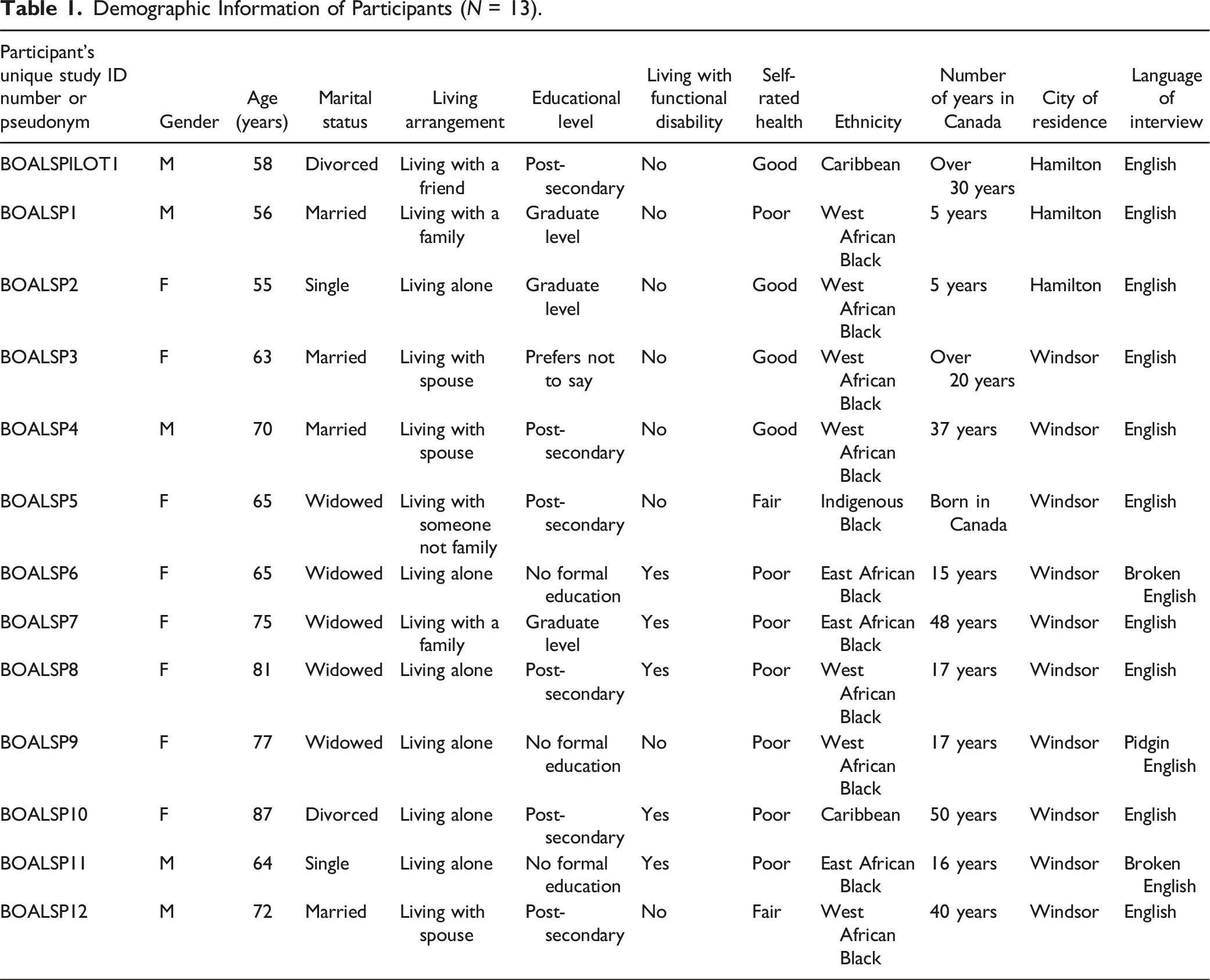
Three themes were identified depicting patterns of meanings and relevant narrative elements about the interplay between loneliness and caregiving by BOAs: care and support, familial devotion, gendered façading versus nurturing dynamics. The themes explicate the intricate interplay between family relationships, care reception and provision and the experience of loneliness among BOAs, supported with direct quotes from participants.
Theme 1: Care and Support
Participants shared the narrative of receiving care and support as fluid concepts and relational gains that can be provided by any relationship accessible to them reducing loneliness. However, two major subthemes were prominent in the stories of BOAs: inadequate support by the black community, and children as a dependable source of nurturance for parents.
Lack of Support by the Black Community
Inadequate social support affecting the traditional systems of care within the Black community was predominantly noted as a barrier to why BOAs lack some care and support leading to compounded loneliness. Some participants talked about the need for assisting older widows with mentoring and raising young children after the demise of the father, providing financial support and social capital to enable older widows, their children and grandchildren live a more meaningful life, as shown by the excerpt below: “I was about 60 when my husband died… my children were still very young and needed a father figure, but not a single man from the black community in my city called to say hello. How are you guys doing? Is everything okay? I went through a lot, but nobody helped. No help… the African community in Canada does not support you. They don’t support each other. It is unfortunate…When someone is in a crisis, people will not help…” (BOALSP7, 75 years, Female)
Other participants narrated how they would show up to take care of and support each other, particularly when needed support is not readily provided by younger people within the Black community. Often, this would be in the form of making food, as noted by BOALSP8, “some of them will bring me some gifts in the house here - sometimes food or money. It helps me to forget about my loneliness.” However, many of the participants believe the support of older adults in the community should be the responsibility of everyone irrespective of age. “To me, loneliness actually means that one is not getting enough support from their community. If you get enough support from your community, you won’t feel that lonely. One has to know that the community cares” (BOALSP8, 81 years, Female)
Children as a Dependable Source of Support for Parents
Contrary to the finding that the broader Black community provides inadequate support, participants noted that children are a reliable source of social support and nurturance for their older parents, replacing the need for community support (Fingerman et al., 2011). In our study, all the participants have children, and the findings shows that the presence of children and grandchildren acts as a critical buffer against loneliness, even if the connection is not absolute. Our findings indicates that different factors account for differences in receiving care and support from children, ranging from age of the parents, gender of the child, economic status, proximity, measures of needs and availability of family members. For example, in terms of proximity, participants whose children lived in another city or country reported receiving less care than those whose children resided in the same city. Secondly, BOAs with physical and cognitive limitations, such as BOALSP10, reported receiving more care and support from their children than those without such limitations. In addition, BOAS who have older children reported receiving more material and instrumental support from their children than those whose children are still younger. Also, participants who reported on this were those in their late third age and fourth age—none of the younger participants reported on this. This confirms that the relationship between parents and children improves as both the child and the parent increase in age (Akinrolie et al., 2020). However, specific to gender, participants reported receiving caregiving from both their children irrespective of the gender. …I don’t have anybody to share anything with. No. I only call my daughter. She is the one that does my shopping, takes me to appointments, takes me out and is always there when I need anything. (BOALSP10, 87 years, Female) I am very lucky I got a family … I have to tell you; I have all sons; I am lucky I have grandchildren … I am very lucky … They have kept me going. I can say I don’t have 100% loneliness because of them, but sometimes I have about 50–60% loneliness … In a way, I’m blessed, but how many people have that?” (BOALSP7, 75 years, Female)
Theme 2: Familial Devotion
For most of the participants, deprivation, unintentional elder abuse, and disposability of BOAs was prominent in their narratives. These themes highlight caregiving involvement of BOAs and how their commitment and dedication to their families may deprive them of getting involved with things that will improve their adaptability to their new environment and even lead to unintended abuse from family members.
Deprivation
Participants narratives highlighted deprivation represented in form of a lack of opportunity to receive or seek out information, relevant education, or knowledge needed to thrive in their new home, which contributes to loneliness for BOAs. According to the participants, this is often due to their engagement in caregiving support for grandchildren and overall selfless devotion to their families. Particularly, BOAs who are new to Canada reported that their dedication to their families and desire to fulfil family obligations often deprives them of seeking and utilizing opportunities that will help them familiarize themselves with their new environment. Secondly, for Black women who migrated to Canada to babysit their grandchildren, depriving themselves the opportunity to go out and connect with others is largely perceived as a duty they owe their family members as older members of the family. (in Pidgin English) “…my stepdaughter bring me come Canada, make I help look after im children. I spend 12 years for im house. “…most women came here to serve as nannies. They were just at home taking care of the children. So, they didn’t have time to go out and associate with others. Now the children are all grown and left the house, and they are just learning to go out and see what is out there. But they have missed out for a long, and they don’t know all these Canadian cultures. So, it will be very hard for them to learn these things now, and since they cannot learn, they decide to isolate themselves.” (BOALSP3, 63 years, Female)
Thus, by dedicating their time and years to their children and grandchildren, these women miss out on becoming a part of their new home and equally making their new country a part of whom they have become. They are often not allowed to work because they must stay home with the grandchildren while their children work (Treas, 2008), thus, missing out on the benefits of being employed outside the home and gaining financial freedom. The freedom that employment income brings is recognized by our participants as an essential determinant of health and wellbeing. This narrative is further illustrated by the quotes below, which demonstrate the complexity of the challenges that older Black women have to navigate as they fulfil their responsibilities to their family members. …They watch the children Monday to Sunday and cannot go out. They only stay at home. How do you expect them not to feel lonely? I have grandchildren, but you can’t expect me to sit at home with them from Monday to Sunday. I will go crazy. The person has no space to relax, sit down, and watch the sun because she is busy watching the children and husband and wife they are working. So, the mother will be the caretaker, but with no pay and no life. (BOALSP7, 75 years, Female)
Unintentional Elder Abuse
A tension on elder abuse emerged during the conversation with BOAs. Some of them mentioned the inability to seek out opportunities because their relatives did not deem it appropriate to provide opportunities for them to integrate socially. Some of the participants talked about how these types of treatment constitute abuse to the older adults who are usually not at liberty to voice their dissatisfaction with the exploitation and deprivation because of fear of losing connection with their families and the feeling of indebtedness to their children’s benevolence of sponsoring their immigration processes. Also, the findings of this study did not identify men as victims of this type of abuse, perhaps, because women are mostly the ones that engage in childcare provision for family members (Zhong & Peng, 2020). I think is fear… The fear of being hurt again and don’t forget, the older you get, the more hurt you collect, especially older women, and you get to a point where you have hurt overload and there won’t be any more room to take anymore. That the point where an individual will decide to alienate themselves…Yeah! So, there is always the fear of getting hurt, insulted, treated badly, abused, whether intentional or not, and whatever. (BOALSP3, 63 years, Female) Some seniors suffer elder abuse… there is abuse in seniors, which people don’t talk about. Because if you raise that issue, you are a terrible person and will become the enemy of the children. But you know, the seniors cannot say no when their child needs their help with babysitting the children. And you know, because the children brought them here, they are afraid to talk. Because they are also afraid of losing their children, their grandchildren or family. So, because they want to have a connection with their families, they keep quiet. But they will tell you that they are not happy about it, but they have no choice. Yes, the senior is supposed to take care of the family but let her have some leisure … She should not be a prisoner every Monday to Sunday. (BOALSP7, 75 years, Female)
Disposability of BOAs
There were also stories of abuse and disposability of older Black women brought to Canada by their relatives and later abandoned or disposed by the same family members because they voiced their dissatisfaction for an incidence that might have occurred with their family members. This theme highlights the vulnerable situation that BOAs are conditioned to which keeps them perpetually dependent on their family members and increase their experience of loneliness, social isolation and overall mental distress. As captured by the comment below: (in Pidgin English) “… as I come remember all the people wey don die for my family as I dey Canada here. I no happy again. I go sit down lonely dey thinking … Na so my daughter come tell me say make I prepare to go home. I come think, na so my 12 years for Canada go waste. No paper, no money, nothing… I no get power again to work. The power I get, I don use am for my daughter. Now, I cannot do anything… Na so I comot their house and I come go shelter… as I dey here alone, I no get anybody wey I go fit talk wetin dey my mind with. E dey pain me well, well (Translated: …due to several deaths that has occurred in my house while I was in Canada, I became unhappy, lonely, and most times, I will sit down thinking. My stepdaughter told me that she cannot continue to keep me in her house … told me that I will go back to my country. I thought about how my 12 years in Canada will just be a waste. No paper, No money, nothing… I do not have the strength to work anymore. I have used up my strength to work for my daughter. Now, I can’t work anymore…I moved out of their house and moved into a shelter. Living alone now, I have no one to share my problems with and it is painful and devastating)” (BOALSP9, 77years, Female)
Theme 3: Gendered Façading versus Nurturing Dynamics
Two major subthemes are discussed under this theme namely, gendered façading and gendered nurturing. Collectively, gendered façading versus nurturing dynamics refers to the contrasting ways in which BOAs respond to giving or receiving care within the Black family structure and navigate emotional vulnerability, particularly based on their gender. This could be reflected by either masking or minimizing their care needs or by embracing opportunities for emotional support and receiving care.
Gendered Façading
As shown by the finding, gendered façading involves conforming to societal expectations or stereotypes associated with one’s gender and the tendency for BOAs, particularly Black men, put up a façade or hide impairment when dealing with health challenges. This may include presenting outward appearance that aligns with traditional gender expectations such as displaying confidence, assertiveness, emotional stoicism, or not showing vulnerability, even when it their need for care and support is imminent. …in the black community, we are afraid to talk about many things…we are so private and keep everything inside. We don't even share it with our children, our grandchildren …we are afraid to open up and talk about many things (BOALSPILOT 58years, Male).
Our findings confirms that Black men have often been historically poised to appear strong and unemotional, contrary to women who may feel compelled to appear nurturing and accommodating, downplaying their actual emotional or care needs. As discussed by one of the participants, this act of façading or putting up a superficial appearance by Black men which is likely tied to stereotypes and historical expectations is often an avenue to avoid sharing one’s story or journey, whatever the journey or story might depict. For example, health journey, immigration experiences and even personal struggles towards building resilience and coping with the pain of loneliness as highlighted by BOALSP4. Other times, it might be to avoid presenting themselves as a burden to family members or children and being seen as deteriorating, weak or dependent on family members (Eriksson et al., 2016). This performance of stoicism may limit older Black men’s access to emotional support, increase isolation and, in turn, contribute to experience of loneliness. In addition, as noted by our finding, this façading and stoicism gets passed down from one generation to another without fully acknowledging the long-term impact it has on Black men, Black boys and Black families as whole, becoming an intergenerational and lifelong experience. So, if people say that loneliness could be more devastating for men, yes, I agree because, I have to confess that, I fell a victim of that pain (BOALSP4, 70 years, Male). For me, I know that black men don’t like to open up or share. We always seem to be private, and we don't want anyone to invade in our private life… Some Black men are dying lonely… suffering from prostate cancer … and other health challenges… We are dying inside, but we keep it to ourselves... We secretly go to the doctor…Because we are afraid to open up and talk about something…but I strongly believe that we have to be more open, especially as a black man and talk more. And you know, try to share our story, because there are others that would like to know, wants to hear our story, our journey... So, we need to learn to talk, learn to communicate, learn to share what bothers us…and not to say “okay, my dad was like that, so I have to be like that.” …And then I teach my son to be like that too. (BOALSPILOT, 58 years, Male)
Contrary to this view, another participant suggested that privacy and emotional restrain might stem from past experiences of rejection. Such experience, they argued, can contribute facading tendencies and further withdrawal. As the excerpt below depicts: I don't think people…, I don't think we are private, I think people don't easily accept rejection… especially when you don’t have self-confidence. It’s difficult, you know…. That’s my opinion. (BOALSP1, 56 years, Male)
Thus, putting up a façade highlights the innate human desire to not present oneself as deteriorating instead to self-preserve irrespective of the consequences. It also reveals the significant role that cultural differences play in shaping patterns of social relationships (Rodrigues et al., 2014) and gender roles within the Black community, especially around expressing one’s mind and sharing sensitive matters.
Gendered Nurturing
This subtheme highlights Black women’s genuine expressions of care, empathy, and support for others and by others, regardless of gendered expectations. This may involve openly sharing emotions, receiving and offering comfort and assistance to those in need, and fostering meaningful connections with family members and non-family members, which stands in stark contrast to much of the rhetoric on gendered façade. Black women’s nurturing dynamics which prioritize authenticity and emotional honesty, increase their tendency to experience less loneliness, as they more openly express themselves freely and form genuine social connections with others without fear of judgement. In essence, older Black women’s role as natural “nurturers…making sure that everyone is properly taken care of” (BOALSP5, 65 years, Female) may contribute not only to the wellbeing of those around them or those they provide care to and nurture, but also to their own emotional health and resilience against loneliness and social isolation. …you have your grandchildren and children, and they are always there with you. You take care of them, love them, as a mother that I am. (BOALSP8, 87 years, Female)
This subtheme suggests that caregiving, as a cultural value, creates room for authentic vulnerability for older Black women. Beyond just passing as a socially constructed gender roles, caregiving by older Black women enhances their capacity to support their families and others, fosters intergenerational reciprocal connections, while also serving as a protective factor for their own emotional well-being and a buffer against loneliness and social isolation.
Discussion and Implications
This study is part of the ongoing exploration of the lived realties of loneliness among BOAs encompassing African, Caribbeans and Indigenous Blacks living in Canada (Ojembe et al., 2023a, b). This study guided by the theory of collectivism, revealed the intricate connection between caregiving, familial relationships, and societal gender norms shaping loneliness among BOAs, highlighting the complex interplay of structural and cultural influences on loneliness. The theory of Collectivism allowed for the nuanced understanding of diverse ways in which caregiving and family dynamics intersect and shape the experience of loneliness among 13 BOAs (aged 55 years and older) living in Ontario. Three dominant themes along with sub-themes, were identified from our data analysis, highlighting the significant role of relational dynamics BOAs share with their families particularly within the context of caregiving, and their connection to the experiences of loneliness: Care and support, familial devotion, and gendered façading versus nurturing dynamics. However, this section will highlight key substantive findings identified across the data and describe their implication for research, policy and practice.
First, the most significant finding from this study is the heightened vulnerability of immigrant older women to disposability and abuse within family contexts, compounding their experience of loneliness. This specific finding resonates with findings from a previous scoping review on the global situation of elder abuse which reported that Black older adults may be at increased risk for financial abuse and psychological abuse (Pillemer et al., 2016). Furthermore, it reflects broader patterns identified in the literature confirming that older immigrant women often face higher levels of abuse and loneliness due to their perceived nurturing roles and greater dependence on family members (Choudhry, 2001; Roger et al., 2015). Collectively, this evidence aligns with the idea that cultural expectations around caregiving often place disproportionate emotional and physical burdens on women, who are socially conditioned to prioritize familial needs over their own well-being. Moreso, our study showed that immigrant older women are reluctant to report abuse by family members due to the relational gains that accrue from such relationships and fear of destroying the relationship. This predisposes them to social isolation, which previous research has identified as a predictor of loneliness among immigrant older adults (Koehn et al., 2020). However, we recognize expecting older immigrant women to report abuse by family members who happen to be the sole reason for their stay in Canada, requires a much more critical understanding, including the delineation of how age, immigration policies in Canada and poverty shape vulnerability of Black older adults, particularly immigrants.
In addition, we argue that the blame for the disposability of immigrant older adults extends beyond the immediate family, pointing to immigration policies, practices and services that overlook this group (Guruge et al., 2015; Salma & Salami, 2020), failing to recognize them as a key demographic in need of empowerment, support and protection from unscrupulous actors including family members. This, therefore, underscores the need to understand the social cultural context in which elder abuse or neglect emerges within families of immigrant older adults, especially when dependent on their family members. Also, it also opens a discussion on the need for expanded immigration policies that will protect racialized immigrant older adults, including older Black women and men, and emphasizes the importance of interventions that empower immigrant BOAs to achieve economic independence from their families, safeguarding them from deprivation, neglect, and abuse.
Second, our study also uncovered the gendered pressures facing Black men, who are often compelled to perform façades of strength and emotional restraint. This façading, while culturally valorized, often comes at the cost of emotional isolation and disrupted family dynamics (Hammond, 2012; Johnson et al., 2024). Our findings suggest that such façading can contribute to the silencing of emotional struggles among Black men, reinforcing loneliness and eroding relational connections within their families and community. This aligns with broader critiques of hegemonic masculinity that highlight the psychological costs of emotional suppression for men across cultures (Ryu & Fan, 2023).
In contrast, the nurturing roles typically associated with Black women, characterized by emotional openness and caregiving, can also become sources of vulnerability. These roles, while facilitating meaningful connections, often come with unspoken expectations of emotional labor that remain unacknowledged and undervalued, potentially reinforcing gendered inequities within families (Johnson & Carter, 2020). This dual dynamic of façading among men and nurturing among women highlights the need for culturally sensitive interventions that foster open emotional expression, open collective dialogue to redefine masculinity, and promote equitable caregiving roles within Black families, reducing isolation and improving relational well-being.
Finally, our finding challenges the assumption that collectivist cultural values inherently protect against loneliness. Despite the foundational principle of interconnectedness found in the Ubuntu philosophy (“I am because we are”), our findings reveal a significant gap in community support for many BOAs, particularly those without children (Ewuoso & Hall, 2019). This finding resonates with Ewuoso and Hall’s (2019) critique of the romanticization of collectivist cultures, highlighting that financial and social capital deficits within marginalized communities can undermine the protective effects of collectivism. The lack of support, particularly for BOAs, underscores the need for innovative, community-based support structures that extend beyond immediate family networks. This is critical for reducing the social isolation and financial precarity that may accompany aging among BOAs. Additionally, our findings indicate that children serve as a reliable source of support for their parents, reinforcing the concept of reciprocity, whereby children are expected to care for their parents in return for the care they received during their upbringing (Akinrolie et al., 2020). However, these findings raise important questions regarding the impactful experiences of loneliness among Black older adults who do not have children, especially in light of the limited financial and social support available within the black community. Overall, this finding contributes to a nuanced discussion on enhancing social capital within the Black community, to enable communal financial support for BOAs without children, alleviating their loneliness and reducing financial precarity that may accompany aging among BOAs.
Strengths and Limitations
Although the utilization of thematic narrative analysis allowed us to extract and show common patterns across stories, it is possible that some uniqueness or particularities of individuals’ stories were omitted. However, the researcher ensured to avoid this by observing and reporting some observed tensions while analysing the data. Due to funding limitations, the recruitment method employed by this study might have excluded some participants whose stories might have further contributed to the richness of this paper. For example, only participants who could speak English, Broken or pidgin English were included, making it difficult for BOAs experiencing loneliness and do not speak any of the eligible languages to be excluded, even though a language barrier is a risk factor for loneliness among immigrant older adults in Canada (Stewart et al., 2011). This emphasizes the need to expand funding support for studies to further cultural understandings of health and social problems among a larger scale of BOAs in Canada. Also, the study did not use double coders for the analysis because proofing reliability is not relevant to the method used, rather a greater importance is placed on the retelling of participants’ stories. However, peer-member validation was done, and meetings with the author’s supervisor aided in the development of codes and themes, providing new insight into the data analysis.
Conclusion
This study critically examined how family caregiving and relational dynamics shape the experience of loneliness among BOAs in Canada, challenging reductive, individualistic explanations of social isolation. Our findings highlight the interplay between structural and cultural forces, revealing how caregiving expectations are deeply embedded within broader systems of familial duty, intergenerational reciprocity, and cultural identity. Rather than functioning as a straightforward source of emotional support, caregiving relationships often mask unspoken vulnerabilities, particularly along gendered lines. The analysis illuminated how gendered façades reinforce stoicism among Black men, discouraging emotional expression and fostering intergenerational norms of silence and self-reliance. These patterns, while culturally significant, may inadvertently perpetuate cycles of emotional isolation. Our study further highlights the need to move beyond generalized understandings of aging and loneliness to examine the culturally specific ways in which care, emotional well-being, and social connection are negotiated, particularly for older Black women who are more vulnerable to abuse. Future research should engage in deeper mixed-method inquiry to explore how these dynamics unfold across different socioeconomic backgrounds, migration histories, and caregiving contexts within Black communities in Canada. Addressing these issues requires not only recognizing cultural strengths but also challenging structures that constrain emotional expression and inclusion in later life.
Footnotes
Acknowledgements
The author wants to appreciate the 13 Black older adults who participated and shared their stories for the success of the study and the Nigerian Canadians for Cultural Educational and Economic Progress (NCCEEP) for their recruitment support. We also want to thank the doctoral supervisory committee members of the first author for their guidance during the study.
Declaration of Conflicting Interests
The authors declared no potential conflicts of interest with respect to the research, authorship, and/or publication of this article.
Funding
The authors received no financial support for the research, authorship, and/or publication of this article.
IRB Statement
This is study was approved by McMaster University Research Ethics Board- #5476.
