




Abstract
Internet-connected smart speakers have expanded the reach of radio by enabling easy access to broadcasts and podcasts from around the world. However, access to radio on smart speakers depends on the policies of voice assistant platforms including Alexa, Google Assistant, and Siri; these platforms ultimately determine which audio services are available to users and which are excluded. Our paper presents findings from an empirical study of smart speakers in Australia. Using a device testing method, we compared the availability and discoverability of 373 radio stations across the major smart speaker brands. Overall, we find that a third of Australian radio stations are not available on smart speakers, with particularly poor availability on Apple devices. We argue that this reflects a larger problem for radio stations, which risk becoming disintermediated from the streaming media ecosystem in favour of on-demand services like Spotify, Apple Music, Amazon Music and YouTube Music. Our analysis also considers the role of radio aggregators (including TuneIn, RadioApp, and iHeart) in this opaque market.
Introduction
Since their emergence in 2014, smart speakers such as Amazon Echo, Apple HomePod and Google Home – and their voice assistant platforms Alexa, Siri and Google Assistant – have subtly reconfigured the distribution model of live radio. In Australia, an estimated 34% of the population aged over 12 owns a smart speaker, with music listening the most common use for these devices (Edison Research, 2024: 15, 32). Industry research suggests that more than a third of Australians who stream radio use a smart speaker to do so (Edison Research, 2024: 18). This household adoption of smart speakers has functioned to “(re)centre the auditory. . . represent[ing] an important new interface for accessing sound media” (Baade, 2024). Radio stations are increasingly mindful of the need for their content to be easily accessible through smart devices, including speakers, and have invested significant resources in ensuring their broadcasts and podcasts are available within these devices (DCMS, 2021).
Distributing radio through smart speaker platforms is not straightforward. Radio stations and other providers often struggle to gain access to the smart speaker platforms controlled by Amazon, Apple and Google. When they do, they become subject to those companies’ curation policies and commercial terms, including their collection of user data. These conflicts over distribution are a foundational condition of the online audio economy (Sullivan, 2024). A key consideration here for radio stations is discoverability, or “how platforms present and make content available for users, as well as how content creators engineer their content to be discoverable” (Morris, 2021a: 731). If a smart speaker cannot easily deliver a station requested by the user, then this disadvantages the station in relation to its competitors—which include other radio stations as well as streaming services like YouTube Music, Apple Music, and Spotify. This gatekeeping role of voice platforms in directing users to or away from online audio providers is comparable to the “algo-torial power” of music platforms in their ability to shape the “listening agendas” of users (Bonini and Gandini, 2019). In such cases, concerns about fairness, transparency, and equitable public access to radio arise.
Responding to these concerns, legislators in several countries have launched inquiries into the treatment of radio broadcasters by voice assistant platforms (Australian Government, 2024; DCMS, 2021). These inquiries have largely focussed on Alexa, Siri and Google Assistant, as well as radio aggregators such as TuneIn which are used to deliver radio content via smart devices. Specific areas of concern expressed during these inquiries include the inability for users to find radio stations on smart speakers, opaque or misleading responses by smart speakers to voice searches for radio stations, the tendency of platforms to self-preference (Tagiuri, 2024) by redirecting user queries to their own services, and the ability of platforms and aggregators to modify radio content without authorisation by superimposing or inserting ads.
These conflicts between radio and tech industries have received scant attention from researchers, aside from a handful of industry- and government-commissioned studies (Edison Research, 2021; RadioCentre/MTM, 2020). As a result, impacts for audiences, radio stations, and the wider media industries are poorly understood, as are the policy implications.
Addressing this gap, our paper presents findings from an empirical study conducted in Australia in Q4 2024. We used a device testing method to measure the availability and discoverability of 373 Australian public-service, community and commercial radio stations on three smart speakers: the Amazon Echo Pop, the Apple Homepod Mini and the Google Nest Mini. For each radio station we issued voice commands to check if the correct station was recognised and delivered (e.g. “OK Google, play [stationname]”). The speakers’ responses were recorded, allowing us to assess their performance in playing the requested radio stations along with other relevant details such as the aggregator used (e.g. TuneIn, iHeart, RadioApp) and/or error details. From this experiment we were able to clarify several aspects of smart speaker discovery, namely: (1) the adequacy of voice assistant platforms in making Australian radio stations discoverable to audiences; (2) the use of aggregators to deliver audio content; and (3) how different radio stations are advantaged or disadvantaged within this distribution system.
Overall, our study found that the smart speakers we tested failed to play around a third of Australian radio stations on average, across all devices. We observed noticeable differences between smart speaker brands, and also between commercial, community and public-service radio stations—which reinforce existing power differentials in the radio sector. We argue that this state of affairs reflects a larger discovery problem for radio stations, which risk becoming disintermediated from the streaming media ecosystem in favour of on-demand services like Spotify, Apple Music, Amazon Music and YouTube Music.
The article proceeds in four parts. First, we review the literature on platformisation, smart speakers and online radio. Second, we introduce our experiment and explain the device testing method. We then present our findings regarding radio station availability, integration, and aggregation. Finally, we explore the implications that arise for scholarly and policy debates about platformisation.
The platformisation of audio distribution
Radio and sound studies have long been concerned with the proliferation of radio across digital platforms. Research in these fields seeks to understand how radio has become “materialised, diversified, [and] de-spatialised” (Loviglio and Hilmes, 2013) due to digitalisation. Dubber (2014) and Lindgren and Loviglio (2022) examined the cultural logics of radio in the digital age, exploring the new mobility and personalisation of a mass medium. Freire (2007) and Morris (2021a) documented the history of online audio curation and discovery, including internet radio. These contributions form part of a wider tradition of scholarship that interrogates the changing ontology and phenomenology of radio over time (Black, 2001; Scannell, 1995; Tacchi, 2000). Together, this research helps to locate radio within what Hilmes (2013: pp. 43–44) describes as “soundwork,” or the “entire complex of sound-based digital media that enters our experience thorough variety of technologies and forms.” This view treats the smart speaker as one of many platforms through which radio now circulates.
More recently, radio and popular music scholars have also begun to debate the effects of platformisation, defined by Nieborg and Poell (2018: p. 4726) as “the penetration of economic, governmental, and infrastructural extensions of digital platforms into the web and app ecosystems, fundamentally affecting the operations of the cultural industries.” A notable example is Gallego’s (2021) analysis of data-driven interdependencies between hardware and software platforms for music streaming. Seaver (2022), Bonini and Magaudda (2024) and Hesmondhalgh (2025) have scrutinised platformisation dynamics in music streaming, noting the mixed implications for content providers, technology companies, and audiences, as well as the contested role of Spotify, Amazon and Apple as new gatekeepers of audio distribution. Stuhl (2025) has similarly documented Google’s attempts to control radio distribution.
Radio distribution in the platform age is also a concern for podcast studies. Scholars including Morris (2024) and Sullivan (2024) have shown how standards-based RSS podcasting, a distribution model “hailed by small businesses, tech futurists, and Brechtian revolutionaries for its capacity for accessibility and decentralised distribution” (Loviglio, 2024: 53), has given way to a platformised distribution model controlled by a handful of technology companies. Morris coined the phrase “Spotification” to describe “a particular kind of encroachment that platforms engage in where access to vast stores of media content serves as the carrot for drawing users into a more restrictive, contingent, and liminal relationship with the very media they seek to use” (Morris, 2021b: 214).
A related body of literature in internet, digital media and communication studies has investigated the role of voice assistants in platformisation. Turow’s book The Voice Catchers (2021) documented the rise of a voice intelligence industry that collects personal data for marketing purposes. For Turow, assistants such as Alexa and Siri place a central role in this corporate surveillance. Crawford and Joler (2018) critiqued the environmental harms of AI voice assistants, showing how “each small moment of convenience – be it answering a question, turning on a light, or playing a song – requires a vast planetary network, fuelled by the extraction of non-renewable materials, labour, and data.” Klatt (2022: p. 1549; see also Hill, 2020) has examined Alexa’s function as a “data exchange point” within Amazon’s vertically integrated surveillance system. Natale and Cooke (2021: p. 1002) have examined how voice assistants and audio hardware make the web discoverable, exploring specific “conditions for its use in different contexts and at different moments of time.” Other work has interrogated the cultural and labour politics of voice assistants in the home, including their gendered and racialised aspects (Lingel and Crawford, 2020; Phan, 2021; Schiller and McMahon, 2019; Strengers and Kennedy, 2021). Together, these studies remind us of that everyday use of voice assistants supports an extractive AI ecosystem dominated by a handful of global firms – a system that replicates and perpetuates the biases of its training data.
Smart speakers and mobile phones are consumers’ most common entry points into this platform ecosystem. The global market for smart speakers, as for voice assistants, is concentrated and vertically integrated. The top three providers of smart speakers – Amazon, Apple and Google – also control much of the global distribution of podcasts, recorded music, audiobooks, and eBooks. Alongside Microsoft, Samsung, Baidu and Alibaba, these companies are also the leading providers of voice assistants. As Gallego (2021) observes, hardware devices enable “the first level of information gathering” within these firms’ platform ecosystems.
Mindful of this platform economy, scholars have begun to explore smart speaker use as an everyday practice. Baade (2024: p. 111) analyses the smart speaker as a delivery technology for radio, noting “the genealogies of domestic audio technology that smart speakers draw on, as well as their impact on the music, streaming audio, and radio Industries.” Researchers in human-computer interaction and marketing disciplines have also published empirical studies that explore how smart speakers are being adopted in specific national contexts (Garg et al., 2021; McCloskey and Bennett, 2020). Others suggest useful methodologies for smart speaker testing (Choi and Lee, 2024; Iqbal et al., 2023).
Despite being grouped together as smart speakers, Amazon, Google and Apple represent distinct platform infrastructures with divergent approaches to integration, aggregation, and control over third-party audio services. Each company has its own competitive agenda (and material interest) in “soundwork” (Hilmes, 2013: 43–44). Amazon, Apple and Google all operate with vertically integrated hardware, operating systems, voice assistants, data infrastructures, and proprietary audio services, but diverge in how they incorporate third-party content such as live radio. Amazon’s Alexa system has historically encouraged third-party participation through developer tools and “skills,” facilitating direct integration of external services. Google’s approach has relied more heavily on partnerships with industry intermediaries and aggregators, embedding radio within a broader search- and data-driven structure. Apple, by contrast, maintains a comparatively closed platform environment oriented around its own subscription services and tightly managed interfaces. These differing approaches are reflected in our findings below, although they require further study and interrogation.
The aforementioned studies of radio distribution, podcasting, platformisation, and smart speakers provide suggestive concepts for our paper. Yet further work is needed to connect the dots between them. In particular, there is a need to understand how the macro-level structure of the platform economy can impact legacy media industries such as radio. How do legacy media industries become integrated into the AI-powered voice ecosystem? What is the value of radio to platforms, and vice versa? Under what terms is radio made available, and discoverable, to smart speaker users? What barriers and blockages may inhibit radio’s ability to circulate across voice platforms? These are some of the questions raised for media industry research. There is also a need to combine empirical research with platform critique, allowing an evidence-based assessment. While there is now a substantial body of critical research on platforms, assumptions made in this literature about the conduct of platforms are rarely tested with reference to actual device use. Our study seeks to fill this gap by empirically investigating the discoverability of radio stations in a specific national market. In this way, we seek to assess the ability of legacy media industries to compete within the platform economy.
Policy context: Contested access to audiences and data
Separate to these scholarly debates, there is also a growing public policy debate about the platformisation of radio in countries including the United Kingdom and Australia. A key concern here is the vertically integrated nature of Amazon, Apple and Google, and their power in multiple markets for consume electronics hardware, voice platforms, content aggregation, and audio services. Because these three companies over their own audio services (the music streaming apps Apple Music, Amazon Music, YouTube Music, and Amazon’s audiobooks app Audible), they effectively compete for time and attention with the legacy radio services available through their devices. This market structure inevitably creates incentives for Google, Amazon and Apple to restrict competing audio services on smart speakers and/or to self-preference and prioritise their own in-house services.
In 2020 the United Kingdom government commissioned a Digital Radio and Audio Review (DCMS, 2021), which investigated the role of smart devices in radio distribution. This report was prompted in part by complaints from British radio providers, including the BBC, that their content was being unfairly treated by the major smart speaker platforms. The Review observes that the platformisation of radio distribution is likely to “disrupt traditional relationships between radio broadcasters and the end user, potentially limiting radio’s ability to reach audiences” (78), presenting new barriers to access for users while also compromising the longstanding status of radio as a historically free-to-listen medium. As the report concludes, the available information on the adoption and use of connected audio devices suggests that access to UK radio and audio content is transitioning from being free and open to listeners to being intermediated and potentially commercialised at the point of access (DCMS, 2021: 79)
The Review finds that this creeping intermediation of radio access will likely empower technology companies including Amazon, Apple and Google at the expense of radio incumbents. It suggests that smaller radio providers may struggle to negotiate with and obtain access to voice assistant platforms (84). The Review also discusses the complex issue of personal data use within smart speakers, noting complaints by British radio providers that these data are unfairly withheld by the major technology companies. This gatekeeping power is central to what Turow (2021) describes as a new “voice intelligence industry” which seeks to expand and centralise corporate control over voice data.
Similar discussions have taken place in Australia, where radio stations have long criticised the major technology platforms for anti-competitive practices. In 2024, an official consultation on digital radio distribution was launched by the Australian federal government (the Radio Prominence in Smart Speakers discussion paper). This paper, and related parliamentary hearings and inquiries, document some of the complaints made by Australian radio stations and networks about Amazon, Apple and Google. Such complaints include: “inaccurate surfacing of radio stations in response to [smart speaker] user requests” (Australian Government, 2024: 6); the need for radio stations to enter into commercial deals with the platforms in order to make their stations sufficiently discoverable for smart speaker users (26); and the inability of radio station staff to negotiate on fair terms with the major technology platforms (Commercial Radio and Audio, 2023).
Public policy reform to address these issues is now underway in both countries. In 2024 the UK government passed the Media Act, a package of legislation aimed to address these radio industry concerns along with other reform issues in television and video. The Act brought voice assistant platforms into scope for media law for the first time by mandating free access to radio services on smart speakers and outlawing the practices of charging for, inserting ads into, or altering the content of radio transmissions. A similar proposal to require smart speakers to provide “consistent and reliable access” (Australian Government, 2024: 30) to radio is also being considered in Australia. This signals a renewed interest in radio prominence, in the wake of a TV prominence law in 2023 that required smart TV operators to ensure availability and visibility of local TV broadcaster apps.
While the politics of platformisation in radio were well covered during these various inquiries, little independent evidence on radio availability or discoverability through smart speakers was presented. This knowledge gap limits our collective ability to understand how radio is redistributed, remediated, and restricted by digital devices, and what this means for the wider “platform politics” of the audio sector. In the next section, we describe our novel method for investigating these problems.
Method
In 2024–2025 we set out to empirically investigate the role of voice platforms in smart speaker radio distribution. The project used a device testing method to assess smart speakers’ ability to correctly identify and play Australian radio stations from our voice commands. We focussed our attention on entry-level smart speakers from Amazon, Apple and Google: respectively, Nest Mini, Alexa Echo Pop, and Apple Homepod Mini. These devices are powered by voice assistant platforms (Google Assistant, Alexa, and Siri) also available on other devices including iPhones, Android phones, tablets, TV set-top-boxes, and smart watches. While the testing focussed specifically on smart speakers, our findings may also be relevant to these other devices powered by Amazon, Apple and Google.
Our testing proceeded in two phases. First, we created a master list of 373 licenced Australian radio stations (Appendix 1). The list included all of Australia’s commercial stations (259), public-service stations (74), and a sample of community stations (40; a purposive sample was used due to the large number of community broadcasters in Australia). We then purchased three new smart speakers (Alexa Echo Pop, Apple HomePod Mini, and Google Next Mini) from an electronics store. A blank user account was created with throwaway email address. We systematically issued voice commands to each speaker to retrieve the stations and podcasts in our master list (e.g. “OK Google, play [station name]”), noting the speaker’s responses and the outcome in a spreadsheet along with any other relevant details, such as aggregator used (“Streaming ABC Radio National from TuneIn”).
The testing procedure required several stages to capture the nuances of the platforms. To account for variations in voice and accent, we repeated the station name up to three times, speaking slowly, clearly, and from a position close to the speaker microphone. We began by using a simplified identifier of the radio station or podcast, mimicking the informal nature of everyday speech, and then became more specific in our requests if needed. For example, we would first say “Play PBS,” using the common name of a local Melbourne community station (Progressive Broadcasting Service); if this was not recognised, we would then ask for “PBS FM”, “PBS 106.7 FM”, and finally “the radio station PBS 106.7FM.” This process was repeated for each of the radio stations in our master list, and for each device. Our findings represent a best-case scenario for speech recognition, as everyday user interactions are typically noisier, spoken from a greater distance, and involve users issuing less precise commands than we did in our testing.
Where the speaker played the radio station correctly based on the simplified identifier, we would record the result as Successful–simplified. Where the speaker needed us to add further details such as “FM,” the callsign, or “the radio station,” we recorded the result as Successful–required more information. Where the speaker could not return a successful result despite our best efforts, we recorded the result as Unsuccessful. Unsuccessful results were further categorised into error categories – indexing error, language processing error, localisation error, or delivery error. The resulting data were analysed quantitatively to assess the overall performance of each speaker across the three radio station categories and the three smart speakers. Percentages shown in this article have been rounded to the nearest whole and thus may not always sum to 100%.
Findings: Radio discovery
The performance of smart speakers in our testing varied considerably between different devices and across the sample of stations. However, overall the three speakers were unable to play about a third (35%) of the Australian radio stations we asked for. This suggests a major operational challenge for digital distribution of radio, given that a substantial minority of stations cannot be played by smart speaker users.
There were noticeable differences in performance between the three speakers (Table 1). The highest-performing speakers were the Google Nest and Amazon Echo Dot, with a 74% success rate. The Apple HomePod Mini performed noticeably worse: it failed to play more than half (54%) of the stations we asked for. This can be largely explained by differences in platform structure. As we discussed earlier, Apple maintains a closed platform environment which is difficult for radio stations to access. In contrast, Amazon—and to a lesser extent, Google—allow direct integration of radio services. Both Amazon and Google also encourage the use of third-party aggregators such as RadioApp and TuneIn. Hence access to radio via smart speakers is related to the openness of the voice assistant’s platform structure, which determines the range and number of stations available.
Results of radio discovery testing.
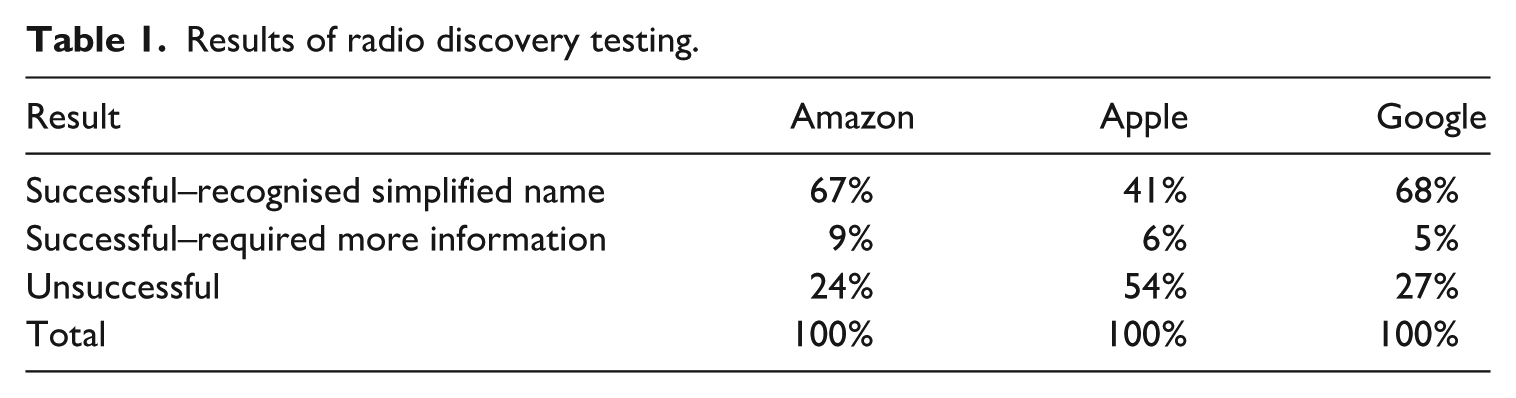
We also observed differences among the radio stations, with some proving to be more discoverable than others. We found that public-service broadcaster stations were most likely to play successfully, with an overall 90% success rate for SBS stations and 87% for ABC stations. The success rate for commercial stations was 68%, with a higher result for stations affiliated to a national network, for example, Nova or Triple M, and 58% for community stations. However, successful recognition of community stations often required additional information such as the callsign or official station name. Metropolitan and FM stations were generally more discoverable than regional, remote and AM stations. Unfortunately, the First Nations community radio stations in our sample (First Nations Radio, Gove FM, 8CCC, Noongar Radio, Black Star, Triple A Murri Country) fared poorly, with less than a third of requests for these stations successful. Overall, these findings suggest that institutional factors matter when it comes to smart speaker discoverability. National networks are generally better integrated into smart speakers than commercial stations outside a national network. The two public-service radio networks also achieved excellent results. All this gives an advantage to established players, who are more likely to have the in-house expertise needed to make their content available across the Google, Alexa and Apple ecosystems.
Having gathered the data, our next step was to investigate why speakers fail to play some stations correctly. To do this, we analysed the error messages given by each speaker following an unsuccessful request. This allowed us to define three different types of error:
indexing error (station not found, or plays podcast instead),
language recognition error (cannot understand the station name after multiple attempts),
localisation error (speaker plays a station in the wrong city or country), and
delivery error (other issue related to retrieval and transmission).
Table 2 shows our findings from this analysis. The most common error type by far was poor indexing, which accounted for 86% of total errors. In these cases, the speaker understood the words we spoke and was able to repeat those words back to us, but could not match them to a live radio station–instead typically offering a similarly-named station or “best guess” alternative. Language recognition errors comprised only 6% of the total, reflecting the advanced state of natural language processing in the tested smart speakers.
Smart speaker error types.
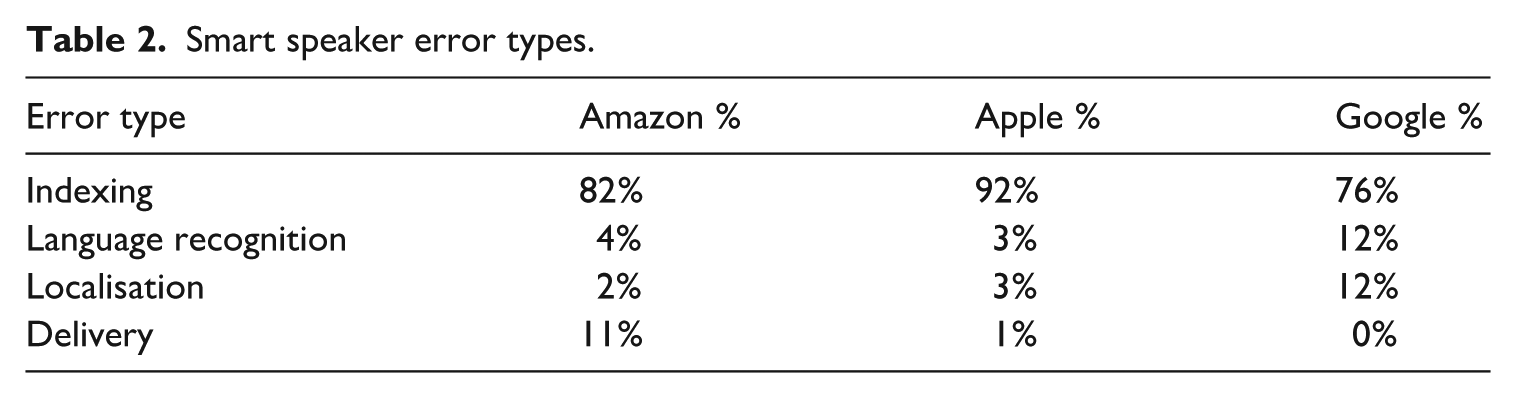
Why is this finding important? The inability of smart speakers to deliver radio appears from our research to be largely unrelated to their natural language processing. The problem is instead a metadata issue: an operational issue rather than a technical constraint. This means that smart speaker companies could improve their radio offerings with little effort if they improved the metadata used for indexing. Such metadata form an essential part of the infrastructural back-end of online audio distribution, which comprises “the features, mechanisms, interfaces and pathways that serve to prepare, present and make cultural content searchable and legible” (Morris, 2021a: 729). When indexing fails, radio stations become inaccessible to users.
Our testing revealed at least two ways in which radio stations can be successfully indexed: integration and aggregation.
Integration occurs when the relevant URLs and identifying information used to locate an online radio station are uploaded directly into the smart speaker platform, either by the platform owner or by a third party (such as a radio network or industry association). Some voice platforms already have infrastructure needed for third-party providers to update their metadata. Alexa Skills, which is well regarded in the radio industry, allows third-party developers to teach Alexa how to do things. Uploading a spreadsheet containing identifiers, keywords and URLs to Alexa will tell Alexa where to look for the relevant radio stations. Alternatively, radio stations may require the cooperation of the smart speaker company to integrate their stations. For example, the Australian government’s radio prominence review noted that the radio industry association Commercial Radio Australia “entered into a commercial agreement with Google and a separate arrangement with Amazon to improve the identification of Australian radio stations” in 2020 (Australian Government, 2024: 26), which involved sending these companies the relevant metadata to ingest into their platforms.
The other approach is to stream radio stations via an aggregator, that is, a platform that provides feeds for multiple radio stations. Aggregators can be detected during testing because the smart speaker will say words to this effect (“Here’s [station name] provided by iHeart Radio”). These speaker outputs were captured in our spreadsheet, allowing us to track the proportion of radio stations delivered through these aggregators. Each aggregator has its own coverage and business model. RadioApp is an initiative of Australia’s commercial radio networks and also indexes ABC and SBS stations. iHeart Radio is operated by the US-based radio giant iHeart, which also hosts several dozen commercial radio stations in Australia. TuneIn is an ad-supported discovery engine for audio content that indexes thousands of radio stations worldwide, and which is used as an aggregator by many smart devices, including the three speakers tested. In addition, the major technology companies also have their own in-house platforms including YouTube Music, Amazon Music, and Apple Music, which also function as aggregators.
When an indexing error occurred in our testing, we could trace back the cause of the problem by listening closely to the speaker’s messages, which include clues about how the speaker is attempting to find the station. For example, the Alexa Echo Pop – when asked to play the West Australian radio station 91.7 The Wave FM – will respond with the confirmation message “91.7 The Wave from TuneIn,” indicating the feed is being delivered via TuneIn. Conversely, when asked to play another West Australian station, 6PR, the Echo Pop will simply reply “Playing 6PR,” indicating the 6PR metadata is already directly integrated into Alexa. The use of these different methods for indexing radio vary from one smart speaker to the next (Table 3), which has a material impact on the speaker’s ability to find radio stations.
Integration and aggregation.
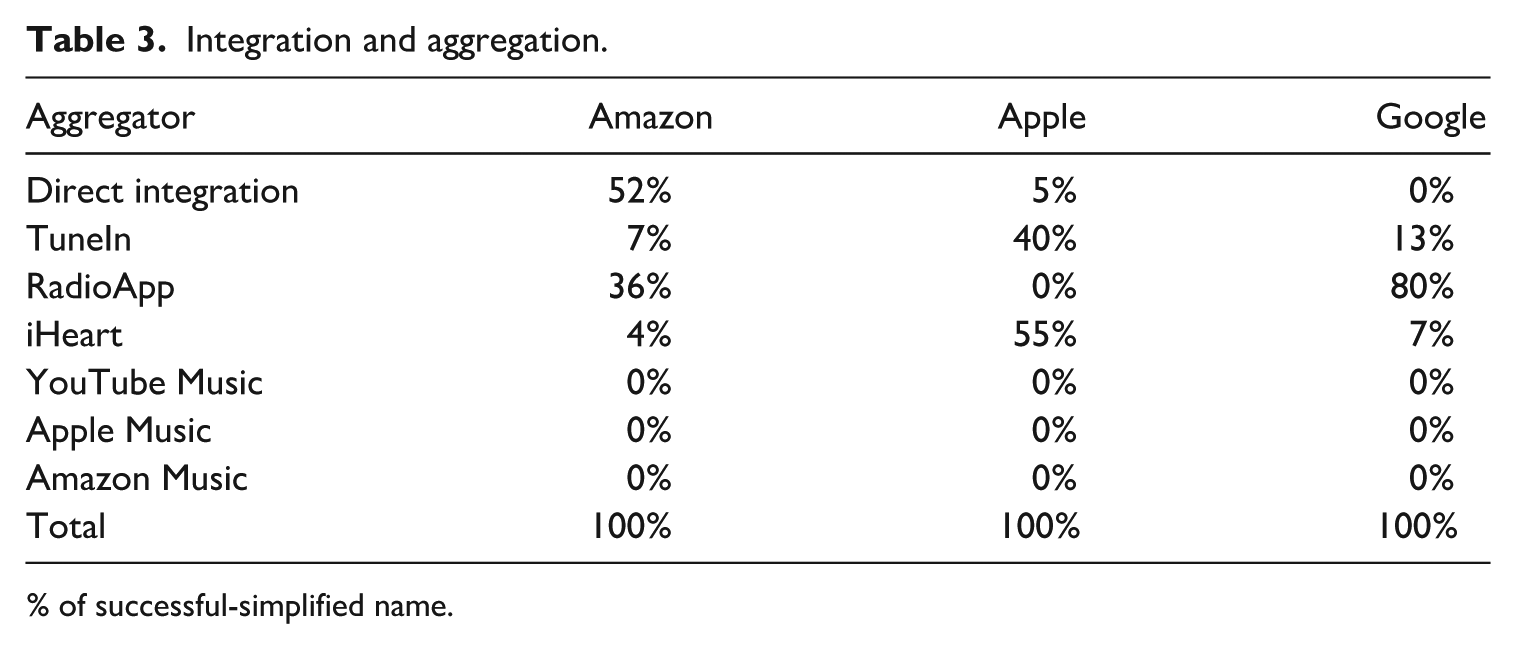
% of successful-simplified name.
Table 3 shows that each speaker has quite different ways of indexing stations. Alexa prefers direct integration, which confirms findings from our background research that many Australian broadcasters had successfully “taught” Alexa where to look for its stations. In contrast, Google most commonly uses RadioApp, which is Australia’s leading radio aggregator run by Commercial Radio Australia. Apple, however, does not use RadioApp and appears to offer few directly-integrated radio stations. As a result, Apple’s indexing error rate is much higher overall than the other speakers (Table 2). This finding—Apple’s lack of direct integration of radio stations as well as its non-use of RadioApp—may explain why the Apple HomePod Mini was unable to play many of the Australian radio stations in our sample.
This structure, in which radio feeds are indexed by smart speakers through aggregators and/or direct integration, results in a rather complex and opaque distribution system. To aid understanding, we created a simplified version of this system in Figure 1. As shown, radio providers are not in control of their own content when distributing via smart speakers; their content must travel through at least one and possibly two intermediaries (the voice assistant platform and possibly a third-party aggregator) before it can be heard by a user. In this sense, our findings confirm arguments previously made by Morris (2020), Seaver (2022) and Vonderau (2015) about the importance of metadata in shaping the discoverability of content. When a radio station request by the user fails, the cause is most commonly a consequence of insufficient integration between aggregators, radio stations, and voice assistants. However, because the voice assistants ultimately control where the speaker should “look” to find radio content, the ultimate responsibility for the error most often lies there. This responsibility becomes clearer when we consider that voice assistants are controlled by three of the world’s largest technology platforms, which have resources to support the equitable distribution of third-party content on their devices, should they desire to do so.
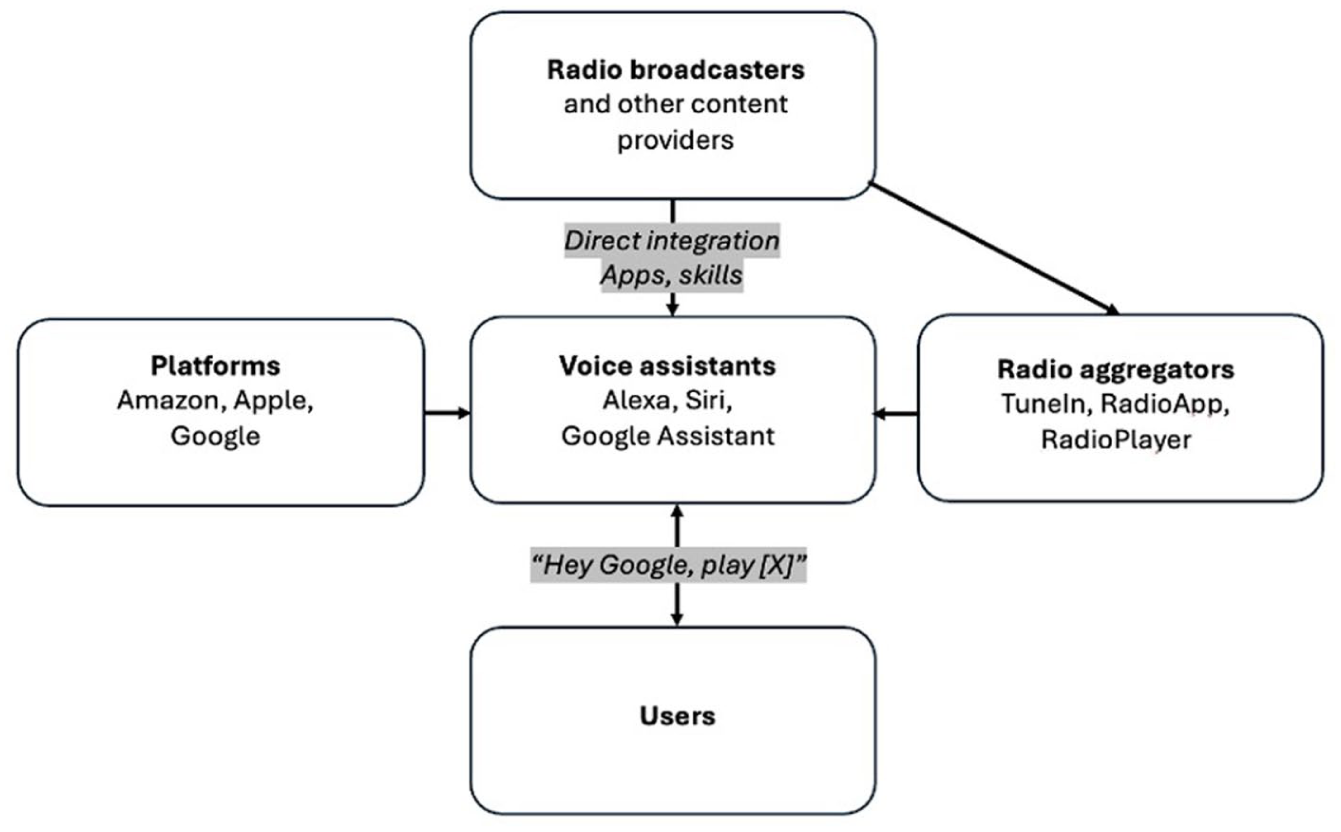
Smart speaker distribution of radio.
Implications for platformisation debates
Operational choices made by Amazon, Apple and Google about how to manage third-party content, including radio, will ultimately impact users’ access to that content. The size of this impact is hard to quantify because effects are often indirect and impossible to calculate without access to walled-garden data. Nonetheless, our research shows that there is a clear link between user access to radio and the indexing and aggregation approaches used in smart speakers. In this sense, we might say that smart speaker distribution of radio is a classic sociotechnical problem in which the intricacies of system design produce real-world cultural effects for smart speaker users, including the inability to access radio services.
Amidst this uncertainty, radio – the oldest electronic mass-media industry – is now coming into focus for scholars and policymakers as the latest frontier of the platform wars; the same wars that have already gripped television, recorded music, and publishing. We have shown that access to radio is increasingly mediated by smart devices, through platforms and infrastructures that the radio industry does not control. The companies in charge of these infrastructures – Amazon, Apple, and Google – are not neutral platforms and tend to shun responsibility to treat radio content equitably and consistently. In fact, these companies are competitors with radio, as they offer their own audio services such as Amazon Music, Apple Music and YouTube Music. The ultimate goal of these services is to shift audience attention and advertiser dollars away from legacy media, so the platforms’ treatment of radio is inevitably shaped by this strategic context.
There is an implication here for media industry analysis. As we have shown, control over radio distribution and discoverability can change the competitive terrain of digital media to advantage some players over others. The socio-technical structure described above, in which platforms mediate access to audio content through smart devices, diminishes the power of the broadcast radio sector to control its own means of distribution. This situation is not unique to radio and is arguably characteristic of digital media generally. But the situation exacerbates existing inequities within the radio sector, as it favours the larger networks in the commercial and public-service sectors which are in a better position to negotiate with the platforms for direct integration. This inequity was reflected in the poor discoverability of First Nations stations, for example, along with smaller commercial stations that are not part of a network. In other words, we expect that the platformization of radio distribution will disproportionately impact smaller players who have fewer resources and less ability to negotiate.
In summary, it is clear from our research that Amazon, Apple and Google do not see it as their job to provide universal access to radio on their smart speakers. “All care, no responsibility” is the general attitude. It is rational for these companies to weigh the costs of managing radio station feeds, and dealing with hundreds of local broadcasters, against the benefits of investing those resources into other parts of their business. Live radio, in this sense, is likely regarded as useful but inessential content for the smart speaker ecosystem—and something that can ultimately be partly replicated through AI-generated playlists, AI newsreaders, and AI DJs. Legacy radio providers are right to feel vulnerable in this system. Long-term, they face the risk of being disintermediated from these and other digital platforms.
These intermediation risks are also present in other devices controlled by voice assistant platforms, including smartphones, smart watches, and in-car media systems. In this sense, our findings have a larger relevance beyond smart speakers. Connected in-car entertainment, in particular, is emerging as a major site of conflict between content providers and voice platforms, because of the importance of in-car listening to radio listening and advertising. While radio has long been the primary entertainment source for drivers, this dominance is increasingly threatened by connected-car entertainment systems that are curated and controlled by digital platforms — and thus carry the same discovery inequities described in this article. Apple, for example, claims that Apple CarPlay (which relies on the Siri voice platform) is used 600 million times a day (Apple, 2025). For this reason, we expect that the importance of discoverability as an issue in digital media research will continue to grow, and further research will be needed to clarify how different kinds of cultural producers, institutions and audiences will be affected.
There are several issues here requiring further research. The platforms’ different approaches to personalisation, for instance, may influence how well they retrieve radio content; as will the “inbuilt values and weightings that have been programmed into the [AI] decisioning model” used by each platform (DCMS, 2021: 84). Another consideration is the default provider settings used by each device (e.g. which provider Alexa or Siri or Google Assistant chooses when issued with a generic request such as “play the news” or “play some relaxing music”), which can be used to strategically nudge users towards certain services over others. These issues can be investigated to some degree through device testing, which—while offering limited visibility into the algorithmic black box—may clarify the implications of different system designs for users. Finally, there is also a need to combine device testing with empirical user research to understand how different people might be differently affected by the conditions described in this article.
Footnotes
Appendix
Radio stations tested.
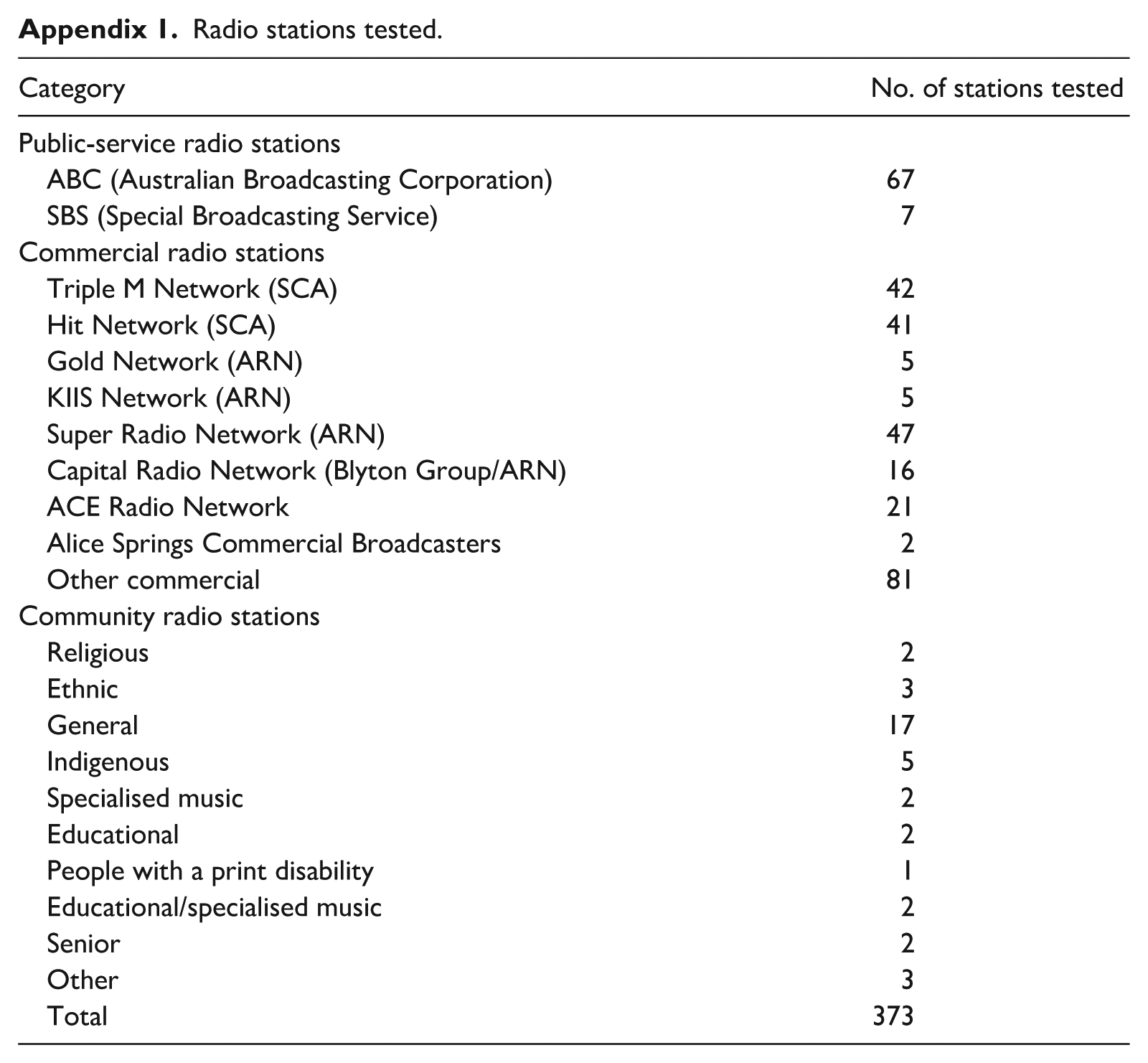
| Category | No. of stations tested |
|---|---|
| Public-service radio stations | |
| ABC (Australian Broadcasting Corporation) | 67 |
| SBS (Special Broadcasting Service) | 7 |
| Commercial radio stations | |
| Triple M Network (SCA) | 42 |
| Hit Network (SCA) | 41 |
| Gold Network (ARN) | 5 |
| KIIS Network (ARN) | 5 |
| Super Radio Network (ARN) | 47 |
| Capital Radio Network (Blyton Group/ARN) | 16 |
| ACE Radio Network | 21 |
| Alice Springs Commercial Broadcasters | 2 |
| Other commercial | 81 |
| Community radio stations | |
| Religious | 2 |
| Ethnic | 3 |
| General | 17 |
| Indigenous | 5 |
| Specialised music | 2 |
| Educational | 2 |
| People with a print disability | 1 |
| Educational/specialised music | 2 |
| Senior | 2 |
| Other | 3 |
| Total | 373 |

Funding
The authors disclosed receipt of the following financial support for the research, authorship, and/or publication of this article: Australian Research Council (grant number FT190100144).
Declaration of conflicting interests
The authors declared no potential conflicts of interest with respect to the research, authorship, and/or publication of this article.