




Abstract
This article explores how social media entertainment matters for teens and does so by connecting experiences to conditions crucial for well-being. I ask if and how teens experience the content they seek and encounter on TikTok, YouTube and Instagram as worthwhile and meaningful. To answer this question, I analyse qualitative interviews with Norwegian teens. The analysis portrays how teens experience social media entertainment as meaningful in how content connects to self-formation processes, to the need for belonging, and to the agency they perceive to have in user-platforms relations. Theoretically, the study draws on two overlapping but currently unconnected fields of research: media psychology-informed entertainment studies and a capabilities approach. My theoretical aim is to elucidate how these fields complement and contrast each other in relating media experience to well-being. I argue that media psychology offers an operationalization of the same well-being conditions that are central in a capabilities approach, while the latter opens a space for a critique of the platform economy.
Introduction
Understanding youth lives and cultures requires understanding the role social media entertainment plays. Screen entertainment is no longer a domain and business only for legacy media but encompasses content delivered by social media platforms (Cunningham and Craig, 2019). And while social media entertainment is not a youth-phenomenon, today’s teens have always assumed the place of global platforms as part of life. Their formative years have been shaped by the possibility to turn to social media for content that aligns with their interests, values and cultural preferences.
Social media entertainment has largely been addressed from its production side, emphasizing, for example, the work conditions of content creators or the importance of relational labour with followers (see e.g. Arriagada and Bishop, 2021; Cunningham and Craig, 2019; Duffy, 2017). When studied from an audience-perspective, the focus likewise tends to be directed at perceived relationships with content creators (see e.g. Chou et al., 2023; Marôpo et al., 2020). This article enquires how social media entertainment matters for teens and does so by connecting experiences to conditions central for well-being. My aim is not to analyse whether social media entertainment contributes positively or negatively to well-being, but to understand some mechanisms through which teens experience scrolling feeds and watching videos as meaningful.
Such insights are important in the context of increasing societal concern for the assumed detrimental impact of social media (and screen time) on teens, most recently voiced by Jonathan Haidt (2024) in his book The anxious generation, which attributes the mental health crisis among youth to an alleged disastrous combination of social media and smartphones. Scholars have countered Haidt’s thesis of causality (Odgers, 2024), but Haidt’s assertions and proposed solutions have undeniable societal impact. While social media entertainment admittedly plays but a part of teen’s digital lives, it can account for substantial ‘screen time’.
I first review central works on social media, youth and well-being before introducing the study aims and a theoretical framework where well-being is conceptualized as flourishing. Based upon a qualitative study of Norwegian teens, I explicate how social media entertainment connects to fundamental human functionings for self-formation, belonging and agency.
Social media, youth and well-being
The topic of social media, youth and well-being has been thoroughly investigated, though rarely with an emphasis on social media as entertainment per se. Core topics include how social media affect the social lives and mental health of teens. Social media have transformed how youth communicate, and numerous studies have investigated how platform use impacts social skills and offline interactions – with inconclusive findings (Dredge and Schreurs, 2020; Steinsbekk et al., 2024). Increases in mental distress among youth have been linked to how social media negatively affect cognitive and socioemotional functioning (Abi-Jaoude et al., 2020), but there is a lack of evidence for causality (Odgers and Jensen, 2020).
Other studies examine how ‘passive’ (browsing) or ‘active’ (posting, communicating) ways of using social media may have opposite effects on well-being (Valkenburg et al., 2022). The theoretical reasoning relates to how passive browsing exposes teens to the picture-perfect lives of others, which may induce feelings of inferiority or social envy, whereas active use bolsters social connection. Again, results are inconclusive and suggest that effects on well-being differ between adolescents (Beyens et al., 2021; Boer et al., 2022). Moreover, teens portray the affective experiences of browsing and exploring content in both positive and negative ways (Weinstein, 2018).
By focusing on social media entertainment, this study also ties in with research on the place of popular culture in young people’s lives: media use and experiences connect to cultural taste, to symbolic work and to developing a sense of self (Livingstone, 2007; Thompson, 1995; Willis, 1990). From this approach, the conceptual framing of browsing social media feeds as ‘passive’ is reductive by ignoring how audiences actively relate to and interpret media texts. Recent TikTok studies also challenge the idea of passive browsing. TikTok captures the attention of users with its effortless delivery of content, but people also experience TikTok to adapt to their input and behaviour (Bhandari and Bimo, 2022; Schellewald, 2022), and hence to reflect key facets of one’s multifaceted self and feelings of belonging towards others (Lee et al., 2022). Thus, even seemingly inconsequential feeds of videos can instigate experiences of belonging and recognition, both of which are recognized as essential capabilities for well-being (Naerland and Dahl, 2022).
Like TikTok, Instagram and YouTube are dominant sites for entertainment among teens, and algorithmic recommendations are important also on these (Pires et al., 2021; Romero Saletti et al., 2022). In a Global North context, TikTok, Instagram and/or YouTube are platforms most teens turn to for a variety of content. They are exemplars of datafied, powerful platforms and regularly framed as capitalizing upon the free labour and data of powerless users (Cheney-Lippold, 2017; Zuboff, 2019). Even so, part of their attraction might be linked to the control people experience with behaving in ways that sway the content they encounter (Bhandari and Bimo, 2022; Kang and Lou, 2022; Lee et al., 2022; Schellewald, 2023).
Study aims
The ways in which social media entertainment connects to the self and to feelings of belonging substantiate a need to move beyond understanding social media entertainment as concerned only with mindlessly scrolling feeds. I consequently ask if and how teens experience the content they seek and encounter on TikTok, YouTube and Instagram as worthwhile and meaningful. I answer this question by analysing qualitative interviews with Norwegian teens. By enquiring the meaningfulness of social media entertainment, I address conditions that relate to conceptions of well-being as flourishing. This connects the study to two overlapping but currently unconnected fields of research: media psychology-informed entertainment studies (Oliver and Raney, 2011; Ryan et al., 2006; Tamborini et al., 2010) and its philosophical sibling: the capabilities approach (Hesmondhalgh, 2017; Naerland and Dahl, 2022; Nussbaum, 2006; Sen, 2005). My theoretical aim is thus to elucidate how media psychology and a capabilities approach complement and contrast each other in relating media experiences to well-being, and how both are relevant for understanding the digital lives of teens.
Theoretical framework: capabilities and media entertainment studies
In Frontiers of Justice, Nussbaum (2006: 73) refers to libertarian philosopher Nozick’s idea of the ‘experience machine’ when she argues that Utilitarianism, with its focus on satisfaction, disregards the importance of agency: ‘a person is hooked up to a machine that produces pleasant experiences, while he or she actually does nothing. Most people would agree that being hooked up to the machine does not suffice for well-being.’ The experience machine is a tempting metaphor for how social media provide perpetual streams of content, but it is not straightforwardly so that the person hooked up to the stream does nothing.
The idea of the experience machine is not central to Nussbaum, she merely refers to it in outlining how a capabilities approach moves beyond a contractarian approach to social justice. Her thesis concerns how well-being for all requires a society that respects the dignity of the human being, achieved by centring on a set of capabilities that people, regardless of their conceptions of what is ‘good’, can agree must apply to all humans (Nussbaum, 2006: 70). Nussbaum proceeds to list capabilities central for well-being, some of which have a direct relevance to the role of entertainment: being able to use senses, imagination and thoughts; having emotions; feeling affiliation; and being able to play and enjoy recreational activities. Underpinning all is an emphasis on human agency and control with one’s own life (within the boundaries set by the well-being of others).
Amartya Sen, who originally introduced and developed the capabilities approach (Sen, 1980, 1993), has been adamant in his refusal to provide a list of capabilities, arguing for example, that a list, ‘emanating entirely from pure theory, is to deny the possibility of fruitful public participation on what should be included and why’ (Sen, 2005: 158). For Sen, the approach is ‘based on a view of living as a combination of various ‘doings and beings’, with quality of life to be assessed in terms of the capability to achieve valuable functionings’ (Sen, 1993: 31). Sen’s notion of functionings refers to things a person does or is in leading their life – from elementary functionings such as being in good health to complex functionings such as achieving self-respect – and capability derives from a set of functionings (Sen, 1993). Functionings are separate from the commodities that enable functionings, a distinction which acknowledges that people differ in their abilities to employ a commodity.
Nussbaum’s and Sen’s works have developed in dialogue, and they are both informed by an Aristotelian ethics regarding how a good life connects to eudaimonia or flourishing, that is, realizing virtuous aspects of life. If we return to the idea of the experience machine as an entryway to the role of media entertainment, this machine is detrimental for a good life if there is nothing but ‘pleasant experiences’ and if the hooked-up person does nothing. Well-being implies being part of the world and in relations with others, and rests upon a scope of being active, having choice and having the opportunity for personal development.
A capabilities approach is relatively rarely applied in media and communication research (Couldry, 2019), but there are exceptions that have informed this article. Hesmondhalgh’s (2017) capabilities-informed moral economy for an ethics-based critique of relations between the media and capitalism substantiates the importance of including popular culture when studying how audiences ‘find their well-being compromised or enhanced by current communication provision’ (Hesmondhalgh, 2017: 215). Naerland and Dahl’s (2022) study of how public service media entertainment can facilitate the promotion of capabilities among young immigrants in Norway is a rare example of an empirical study. Naerland and Dahl mapped how the participants’ reflections resonated with three theoretically identified capabilities: to feel recognized, to have a sense of voice and to feel belonging. The present article follows in the path of Naerland and Dahl’s study by empirically exploring how entertainment cannot be reduced to fulfilling humans needs for pleasure. This is, however, not a very original take on why entertainment matters:
Within media psychology, numerous studies have explicated how entertainment matters from a hedonic and eudaimonic perspective. Thus, like Nussbaum and Sen, this field finds its roots in Aristotle’s virtue ethics (Daneels et al., 2021). An oft-applied theory is Ryan and Deci’s Self-Determination theory (SDT), which embraces the concept of eudaimonia as central to well-being and posits autonomy, competence and relatedness as psychological needs essential for psychological growth, integrity and well-being (Deci and Ryan, 2000; Ryan and Deci, 2001). SDT has for example been applied to explain enjoyment and appreciation of playing video games (Oliver et al., 2016; Ryan et al., 2006; Tamborini et al., 2010). While enjoyment in these studies usually operates as an outcome variable, it is conceptualized as a multifaceted experiential state beyond pleasure-seeking.
Other forms of media entertainment have been studied with an interest in how they elicit states of meaningfulness. Conceptualizations of eudaimonic entertainment centre on how media entertainment can activate affective, cognitive experiences of importance for well-being, by fostering a sense of insight, meaning and social connectedness (Janicke-Bowles et al., 2021: 364). Studies have found eudaimonic experiences to be relevant for why people appreciate and find meaning in films (Janicke and Oliver, 2017; Oliver and Raney, 2011), television (Raney et al., 2018), books (Koopman, 2015), social media (Oliver, 2022; Rieger and Klimmt, 2019) and videogames (Daneels et al., 2020; Oliver et al., 2016).
Despite sharing similar conceptions of well-being and an interest in conceiving the role of media for a good life, there is very little, if any, dialogue between media scholars who have used a capability approach and media psychology-informed studies of entertainment. I suggest that the latter helps operationalize conditions at play when audiences ascribe meaning to social media entertainment, and that a normative capabilities approach opens a space where these can be discussed critically and holistically with respect to living a good life.
Method and data
The analysis is based on qualitative interviews with 19 teens, conducted as part of a larger project about use of global platforms and legacy media for entertainment purposes among Norwegian teens. Care was taken to recruit a varied sample of participants in terms of gender, ethnicity and socio-economic background. Interviews were conducted in 2022, lasted between 60 and 90 minutes and took place offline or online (Zoom) according to the participants’ preferences.
The interview study used Q-methodology to investigate participants’ views on media entertainment (Peters et al., 2022). As part of the study, participants ranked 30 cards on a normally distributed nine-column grid, where the left end reflected platforms, services and content participants considered least important as entertainment and the right end reflected those they deemed most important as entertainment. The cards covered social media platforms, TV-streaming services, popular legacy media genres, popular social media entertainment genres, playing video games and gaming-related content, music and books.
This article reports only from the interviews, but Table 1 presents how participants ranked TikTok, YouTube and Instagram. This portrays the relative importance of these platforms and demonstrates the prominence these hold as entertainment.
Study participants.
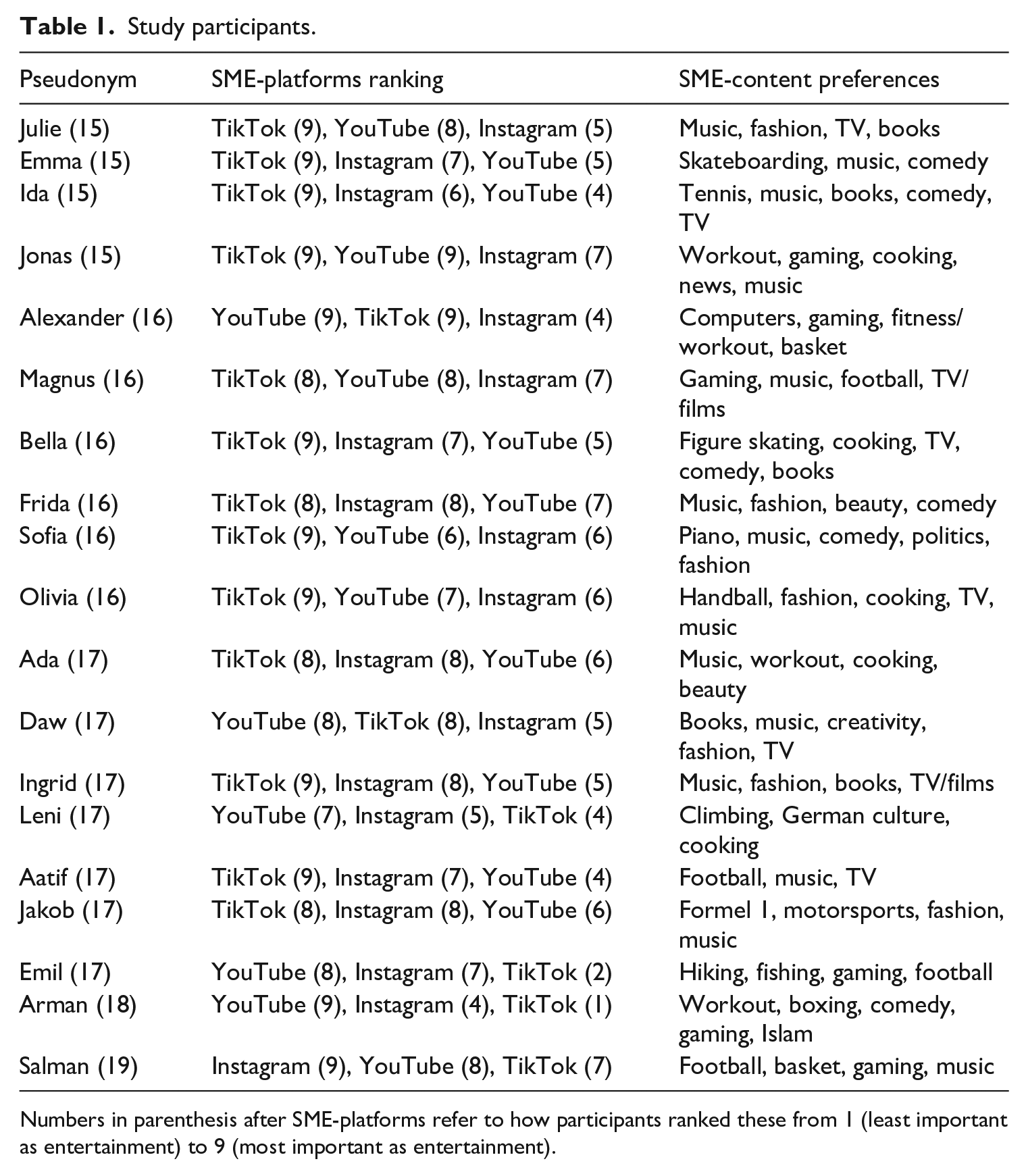
Numbers in parenthesis after SME-platforms refer to how participants ranked these from 1 (least important as entertainment) to 9 (most important as entertainment).
The first part of the interviews was structured according to the cards participants placed on the grid. While the three platforms only cover three of 30 cards, several others were relevant, such as popular topics for social media entertainment (e.g. fashion and/or beauty, workout and/or fitness, comedy, YouTubers, watch let’s play videos, other SME content). For platforms and types of content that participants considered important, participants were asked questions related to why these were important, what they liked to watch (and why), who they followed or subscribed to, how they experienced personalized recommendations and whether they engaged (liked, commented or shared) with content. In the second part of the interviews, participants were asked additional questions related to content creators and influencers and algorithmic recommendations.
Analytical approach and findings
The transcribed interviews were first inductively coded in NVivo by developing codes through readings of the material. These codes were descriptive, denoting how platforms and social media entertainment experiences relate to, for example, content preferences, interests, perceptions of self, relatedness and belonging, agency and control and perceptions of algorithms and recommendations.
Next, I categorized the coded material, considering how they aligned with the theoretical framework. Understanding how teens experience the content they seek and encounter on TikTok, YouTube and Instagram as meaningful compelled an analysis starting with how social media entertainment relates to self-formation processes. The second theme concerns affiliation and relatedness, for example by forming a sense of belonging to like-minded people. The final theme centres on how the experiential value of social media entertainment hinges on a sense of agency.
Self-formation
When asked about what grown-ups do not understand regarding their media use, participants would explain how they are not just ‘wasting time’ or watching ‘brainless videos’ (Daw). Sure, they are also passing time, and finding pleasure in ‘trivial stuff’, but they turn to TikTok, Instagram and YouTube for learning, for inspiration, for motivation. Bella lamented how her dad – being of a different generation – could not understand ‘how valuable it is for me’. Ingrid likewise brought up a generational explanation for why her parents complained: My parents complain about me scrolling all day long. ‘Don’t you get tired of it?’ It’s just completely foreign because they grew up with something else. We have totally different understandings. This is the only thing we know. We’re born into this. And because of that, there are some misunderstandings. We can’t see each other’s perspectives.
So, what are their perspectives? What is it like ‘to be born into this’? And how is scrolling feeds meaningful? In preparing for the analysis, I retrieved all passages coded for what participants enjoyed watching. It is hardly surprising that preferences reflect individual interests. Aatif loves football, sports, TV-series and music and his feeds reflect those interests. Alexander is passionate about computers, coding, gaming and workout and his feeds reflect those interests. Arman trains boxing and loves comedy, and his feeds reflect those interests. Likewise, Frida’s feeds reflect her interest in make-up, clothes, fashion and comedy. All participants portray how the content they turn to connects to their interests and who they are. Referring to TikTok, Ida recaps: It’s like comedy-videos, mini-skits sort of, or people who have made a song and want to promote it or make-a-dress-with-me videos. Or a tennis-video, or perhaps a person who goes on randonnée and makes a cool video of skiing downhill, or a person who makes a living by baking cakes. (. . .) Mostly, comedy, sports, music. It’s me in a nutshell. (. . .) Or it can be how to get a better topspin on my backhand. (. . .) I like hiking, so people who recommend mountain-hikes or just inspo-clips from the mountains.
This already responds to how they experience social media entertainment as worthwhile: they see fragments of who they are (and becoming) in the content they consume.
Conceiving media experiences in the context of the self as a reflexive and symbolic project taps into a longstanding trajectory in media and communication studies. To quote Thompson (1995: 207), ‘the process of self-formation is increasingly nourished by mediated symbolic materials (. . .).’ Thompson puts forward an account of the self and self-formation as increasingly dependent on mediated experiences. Building on Giddens’ work on the self as an open-ended and reflexively organized endeavour (Giddens, 1991), Thompson foregrounds how media accentuate this process by expanding on the symbolic resources available.
Thirty years later, there is seemingly no end to the symbolic resources available for the self as a reflexive project. Labelling content preferences by referring to interests such as ‘gaming’, ‘music’, ‘comedy’ (like I did above) is too crude and hides the individual variety within each category. The self ‘as a project’ connects to the bricolage of individually specific likes and interests, exemplified by Ida’s ‘me in a nutshell’ depiction quoted above.
Lee et al.’s (2022) study of how young adults perceive TikTok’s algorithms delineates how recommended content is portrayed as aligning with participants’ sense of self-concept as multifaceted and dynamic. In the third part of the analysis, I will return to how the participants play with algorithms. But this sense of the self as multifaceted is relevant also for how participants talk about the content they like – independent of algorithmic recommendations. Alexander states that on YouTube, ‘I like to watch other people play, and I like to watch, like technology-videos, where they explain about computer components and stuff. So, I learn from YouTube.’ On what he finds interesting on Instagram, he says, ‘Like Linus Tech Tips. And I follow Dennis Vareide, who I find interesting. And I have these fitness-people, who I follow for inspiration. Like Cbum.’ And on TikTok, he likes, (. . .) a lot, but work-out videos, basketball-videos, and like gaming-videos. And it has these other videos, that are just completely random. That don’t relate to the other videos (. . .). And there are some TikTok accounts that I follow who invest in stocks, because that’s also one of my interests.
‘Random’ and ‘variety’ are words many participants use when they talk about TikTok, and most appreciate how the app manages to match who they are: ‘There’s so much variety, you get so many different videos about what you feel, or videos that you fit with. . .. On TikTok, there’s bigger and kind of more topics’ (Olivia).
These experiences portray how content mirrors the manifold and evolving self. It is not a far stretch to connect self-formation to a capabilities approach. That participants in this study are teens makes self-formation processes particularly important. They would typically reflect on how the content they turned to had evolved with them over the years. I will end this section by turning to Daw, who reflected on how she used to struggle with self-confidence. The following passage – on why she likes fashion videos – may at first seem inconsequential: I didn’t use to be interested in clothes and how to dress. But the last few years, it’s been really fun to dress-up for myself. It’s been fun to try different types of styles, and like layer clothes. If things go together. It does something with your self-confidence. And that makes you feel, wow, I look good today! It makes me want to go out, listen to music, it makes me want to do stuff. Like, I feel boss [laughs]! [italics for expressions originally in English].
She elaborated on how she dressed mirrored how she felt; varying between cute clothes/feminine; casual/masculine, or ‘when I’m presenting stuff [at school], I lean toward classic, prep styles (. . .) to make an impression.’ Later in the interview, she told me she was reading the novel Red, White and Royal Blue. Daw is an avid reader (BookTok is an important source of inspiration). I asked her if this novel was typical for books she liked. ‘As long as it’s queer, I’m into it.’ It turned out that her queerness was important across everything she does and is: ‘Yes. I’d say it’s very visible in much of what I do. How I dress. What I read. My TikTok-feed. What videos I watch. Everything.’
This was towards the end of the interview: she had talked at length about how social media entertainment played into her life, and yet there was nothing apparently queer about what she had told me. For example, her account of why she liked fashion videos as inspiration for playing with styles (and gender) did not have to be an act of queering. The interview with Daw is a reminder for how the analysis of the interviews cannot possibly uncover what social media entertainment really signifies for the participants.
Belonging and relatedness
Daw’s experiences highlight how social media entertainment also affords a sense of belonging. The content she turns to connects her to placeless spaces of likeminded creative and oftentimes queer online communities. In their study of young immigrants, Naerland and Dahl (2022: 5) identify ‘to feel belonging’ as a capability and argue that public service media have a mandate ‘to provide content that textually gestures inclusion, and at the level of reception engenders a sense of belonging to the larger community.’ Arguably, social media entertainment can be considered an all-encompassing reservoir of content, ‘gesturing inclusion’ towards whatever combinations of cultural inclinations audiences may have. These include interests participants do not necessarily share with their friends:
I follow some skateboarders. And some who do parkour. Just so I can pretend to be a bit more active than I really am. I don’t do parkour, but I try to do some skateboarding and to learn some tricks. Not that I have friends who do it, so I usually skate alone.
It is not as if Emma conveyed being part of an online skateboarding community. This is rather a looser sense of belonging that nonetheless taps into a part of who she is. That said, her skateboarding self was also reflected in her outfit when I met her: casual pants and sweater, skate shoes, cap. The sense of belonging that is activated when encountering certain types of content can also be quite strong:
Sometimes it’s really like ‘this is For You’, right? It’s like ‘this is exactly how I think’ and then it’s fun to know that there are other people who think like me and that there are others who have it like me! Right? And it makes me feel good.
Encountering content that reverberates with who participants see themselves as yields a ‘self-centred’ sense of belonging to likeminded people. But social media entertainment also plays a role in a friend-centred sense of belonging. Schellewald (2023) argues that TikTok is used in socially enriching ways, and how sharing videos activates a sense of relating to people. Similarly, a recurring topic among the participants is various ways of sharing content with friends, and how such practices work as acts of knowing who their friends are. Sometimes as playful bantering: ‘It’s just random stuff, some of it is fun and you send it to your friend. . . Like hate against a football-club, and perhaps that’s the favourite club of a friend, then I send it to him’ (Aatif). Sharing videos (by sending or tagging friends) works as acts of socializing and signals caring for that person, resonating with how SDT conceives of relatedness – the desire to connect to and care for others – as a psychological need (Deci and Ryan, 2000).
For some, watching content together is also part of hanging out. Emma refers to how ‘we might talk about something, and then I recall a video I liked, and I might show that video and then we’re on TikTok or similar.’ Ida explains how watching TikTok on one phone is a way of being together: I was at a ski-gathering this weekend. And my friend and I sat in the sofa, we were both worn out – you just want to relax, and TikTok is good for that. But at the same time, you want to be together. Then it’s better to watch on one phone than two. We can laugh at the same video and think ‘oh, we should do that this summer!’ Or ‘OMG, next time we’re together, let’s try to make that’. So, it’s sort of, you can be together and relax.
Understanding how teens experience social media entertainment as meaningful hence necessitates considering how it matters when alone in search for belonging to likeminded communities, when sharing videos with friends and even when hanging out together.
Expressions of relatedness were somewhat less prevalent in how participants talked about content creators. They recognized how creators tried to create a community with their followers and how this was part of the relational labour of being an online profile (Cunningham and Craig, 2019; Duffy, 2017). Arman explained how YouTubers ‘say stuff like, subscribe to be part of my squad’ and many participants noted the common practice among profiles to come up with a nickname for their fan communities: Frida: When they [YouTubers, influencers] have a community, they have a name for their followers. And they have contests or giveaways, where they give something to their followers. To show their gratitude to their followers. (. . .) There’s a Norwegian influencer, Isabel Eriksen. She calls us VIP. She always says that in her intros.
Jonas referred to how profiles engage their followers through Discord-servers ‘for fans to communicate with each other. And comedy-YouTubers like KSI, he has his own Reddit, where fans can post entries that he goes through in his videos.’ Salman likewise said, ‘They [YouTubers] take suggestions from fans.’ When I asked if any of these managed to create a kind of closeness to followers, he answered, ‘I don’t feel that they become close to me, but we sort of have the same interests. I can relate to a lot of what they say.’ Relatability also came up among participants who appreciated authenticity. Jakob noted how profiles maintain a community with their followers by ‘not always showing their perfect side, and that their lives can be tough and not only sunshine.’ Julie depicted similar reasons for why she likes Emma Chamberlain, because she is relatable and ‘doesn’t try too hard to be perfect.’
The importance of authenticity and relatability for YouTubers and influencers is consistently reflected in studies both from the creator-perspective (see e.g. Duffy, 2017) and the audience-perspective (see e.g. Chou et al., 2023). It is a part of what content creators do for a living and participants recognize it as such. Julie, for example, adds that Chamberlain – while real and relatable – is probably ‘different behind the camera’.
Agency
In an SDT-framework, autonomy – the desire to self-organize experience in concordance with one’s sense of self – is pivotal for well-being (Deci & Ryan, 2000). Having a sense of control and choice strengthens autonomy, which can be enhanced by providing people with flexibility of use, and responsiveness and feedback to how they behave (Ryan et al., 2006). My argument here is that such perceptions are important for understanding why teens experience social media entertainment as worthwhile and meaningful.
Autonomy, however, connotes a self-contained ability to act without external influence. Agency better accounts for the relational and structural context within which actions take place. More specifically, I build on Ytre-Arne and Das (2021: 792), who conceive of how audience agency in the context of datafied systems becomes prospective: audiences engage with data with views to future. For example, when asked about how she experiences receiving content based on her preferences, Ingrid reflected, I think a lot about it. If I like one video, the next day I get four of the same. If I comment, there’s even more. It’s something I talk about with my friends, for example, what type of For You page you have. It varies a lot from person to person, depending on what you like and your interests. So absolutely, we work a lot with these algorithms, particularly on TikTok and Instagram.
Similar observations of how feeds reflect their own behaviour were common among all participants, and several participants conveyed notions of ‘working with the algorithms.’ Thus, they express agency in informing the types of content they encounter, and they take on a position of co-creating their experiences by engaging with data and content. For some, this can entail clearing their history with a platform. For example, when I asked Jonas if he would say that YouTube knows him well, he answered, ‘I’ve sometimes deleted all my information on YouTube because I don’t find anything interesting anymore. And sort of started from scratch. But YouTube knows me pretty well.’ Jonas also explained how he engages with content on TikTok quite purposefully: I like stuff on TikTok just to manipulate the algorithm. If there’s content I want less of, I don’t click like and instead like other things. So, I like because I want to see more of things, but for stuff I don’t want too much of, but want a bit of, like for example, I often search for recipes on TikTok and if there’s too many recipes, I don’t find it that interesting and I don’t like it. But I still want a little of it, so I don’t click ‘not interested’, because then it’s completely removed. So, I try to be a bit conscious about the algorithms to manipulate it a bit.
Such practices imply that engaging with content (views, likes, comments, saves) transforms from being an act of showing appreciation to becoming an act of working with the algorithms, a purposeful mode of use with a view to how actions leave traces that sway one’s own feed of content. The place of human agency is central in these user-platforms relations. And while many participants foreground TikTok, the same user-platform dynamic is evident in how they talked about other platforms. Magnus, for example, portrayed how interacting with Instagram is like pulling levers to steer what types of content he likes to encounter: I’ve almost examined it [Instagram], tried to figure out how I can manipulate it. First, there were only memes. And I decided to scroll past to a post that’s not a meme, and then like that. Or stay there for a few seconds. Just to see how my Instagram goes from meme, meme, meme, meme to another thing, that I’ve stopped at. Watch how it changes. From football, to music, to memes, how quickly can I develop it. And now I feel that it’s a perfect mix of what I want. Music, football, a bit of memes, updates on what’s happening in the world.
Social media platforms rely on user data for commercial purposes and with an aim to personalize experiences. Providing personalized content in a continuous flow might be part of their ideological packaging (Lupinacci, 2021), which might also encompass positioning users as in control. Yet this should not be interpreted to imply that agency is an ideological illusion. It is very real and core to why social media entertainment matters to teens.
Concluding discussion
This article has portrayed how teens experience the content they seek and encounter on TikTok, YouTube and Instagram as worthwhile and meaningful by connecting their reflections to self-perceptions and self-formation; to the need for belonging and connecting with likeminded people and communities; and to the agency they perceive to have in user-platform relations. The analysis depicts teens as quite proficient, for example in reflecting on how their actions inform the content they encounter and in recognizing the relational labour tactics of content creators.
Addressing ‘how ordinary, demotic and sociable cultural practices might be thought of as enhancing people’s well-being in a meaningfully enriching way’ (Hesmondhalgh, 2017: 214), necessitates situating subjective accounts to theoretically sound conceptions of well-being. Regarding the latter, I have argued that media psychology and a capabilities approach share similar conceptions of well-being as flourishing. Amidst studies following up on societal concerns about the potential harmful effects of social media on youth (Beyens et al., 2021; Boer et al., 2022; Odgers and Jensen, 2020; Valkenburg et al., 2022), this study thus brings forth a different approach for understanding how social media may play into the well-being of teens. Rather than conceiving of well-being as ‘being happy’ (Beyens et al., 2021) or life-satisfaction (Boer et al., 2022), well-being as eudaimonia or flourishing taps into what needs to be in place for thriving across various domains of life, including mental, emotional, social, physical and existential fulfilment.
Social media do not make people flourish, but they may matter in eudaimonic ways. The analysis indicates that this holds true also for scrolling and watching videos, that is, modes of use that are often inaccurately categorized as ‘passive’. Valkenburg et al. (2022: 544) relatedly argue that ‘it is no longer fruitful to investigate’ if passive use leads to negative effects on well-being. I propose that a way forward for media effects studies is to include eudaimonic aspects of well-being. A comprehensive understanding of teens’ digital lives is important also in the context of policy-moves towards restricting teens’ access to social media and digital technologies (Odgers and Jensen, 2020).
While this study does not examine how social media entertainment actually impacts well-being among teens, its findings suggest how platforms for social media entertainment could be said to leverage from needs that are core to well-being. I will briefly elaborate on this point in closing the article. I will first, however, expound on how the study proposes a model that is not premised upon social media entertainment always being beneficial, and next discuss how relating platform experiences to human needs does not fall into utilitarian ‘needs-satisfaction’ explanations (Hesmondhalgh, 2017; Nussbaum, 2006). By discussing these three points in the context of the present study, I elucidate how media psychology and a capabilities approach complement and contrast each other in relating media experiences to well-being.
First, this study may seem flawed in its inattentiveness to how platforms and social media entertainment relate to experiences that are potentially detrimental to well-being. The interview conversations to a limited extent veered into the ‘meaningless’ of social media entertainment, but participants would sometimes talk about wasting time on platforms, problematic content, or the importance of disconnecting, hanging out with friends, schoolwork and having an active lifestyle. A good life is not achieved by scrolling feeds, and the analysis must be interpreted against a backdrop that seemed evident for the participants: scrolling feeds should not conflict with other goals and obligations in life. My decision to downplay these aspects is based how participants were eager to explain why and how social media entertainment matters to them. Importantly, however, the explanatory model that I put forward does not rest upon a premise where social media entertainment experiences are always positive or enriching. For example, the content teens encounter mirrors the dynamic and manifold self regardless of whether the content per se is constructive or problematic. The flip side of the analysis is how the same model could also apply to harmful and hateful content (e.g. eating disorders, compulsive exercise, radicalism, misogyny and racism).
Second, the analysis centres on needs, a trait it shares with media psychology studies. This brings up the question of how needs are conceptually distinguished from capabilities, and how the analysis differs from a utilitarian satisfaction-of-needs explanation (Hesmondhalgh, 2017; Nussbaum, 2006). Media psychology studies enquire how well-being is contingent on the satisfaction of human needs (Daneels et al., 2021; Janicke-Bowles et al., 2021; Ryan et al., 2006). And yet, its understanding of well-being does not resemble what Hesmondhalgh (2017: 209) identifies as a market liberal and utilitarian ‘preference-satisfaction conception of well-being.’ To be clear, Hesmondhalgh does not refer to media psychology. But this omission necessitates reiterating their common ground: enquiring how media experiences play into well-being as flourishing.
Moreover, Nussbaum’s (2006) list of capabilities (e.g. feeling affiliation and being able to enjoy recreational activities) in effect refers to conditions (or needs) that quality of life depends on. Sen’s (1993) notion of functionings might here be useful by distinguishing between social media entertainment as a commodity from what it enables people to be or do (i.e. functionings). And yet, this too, is not far from how media entertainment studies conceive of the affective and cognitive experiences that can be ‘activated’ by entertainment (Janicke-Bowles et al., 2021). When entertainment experiences are studied empirically, relating experiences to needs becomes a necessity, even in studies that employ a capabilities approach (Naerland and Dahl, 2022). Likewise, when I relate social media entertainment experiences to needs, these are not determined by what participants believe is good for them, but rooted in a conception of needs that are foundational to well-being.
Finally, the findings from this study have relevance for a normative critique of the platform economy. This is where a capabilities approach moves beyond media psychology, which rarely lifts its gaze to critically interrogate cultural and economic media systems. The present study explains how platforms for social media entertainment align with needs and functionings important for well-being. Their very existence depends on latching on to human needs: encountering symbolic resources that help (in this case) teens figure out who they are (becoming), the need for relatedness and belonging and a sense of volition and agency. It might be tempting to claim platforms prey on human needs to lure people into their systems, that they leverage from delivering ‘a sense of me’ and a ‘sense of user-control’. Yet such claims risk slipping into media/platform power explanations that disregard peoples’ experiences. What is needed is a non-binary conception of agency that considers power as relational and residing in platforms and audiences. Ultimately, platforms resemble experience machines for well-being because they enable and leverage from elementary human functionings. Studies that shed light on platformed experiences are needed precisely because platforms are so centrally situated in daily life, enabling what a person does and is.
Footnotes
Funding
The author disclosed receipt of the following financial support for the research, authorship, and/or publication of this article: This article is produced in association with the research project hosted by the University of Oslo, ‘GLOBAL NATIVES? Serving young audiences on new media platforms’, funded by the Research Council of Norway under Grant Number 315917.
