




Abstract
This article contributes to the rethinking of the relationship between news media and democracy by adopting the perspective of ‘epistemic democracy’, characterised by universal and equal participation of all knowers. While this perspective foregrounds the tension between the normative vision of news media as facilitators of democratic deliberation and their actual socio-political position as part of the hegemonic domain, it also enables the reconceptualisation of media’s democratic role as the cultivation of ‘democratic imagination’. On the one hand, media can exercise democratic imagination in their reporting by promoting epistemic diversity. On the other hand, they may extend the public’s horizon of democratic imagination by generating epistemic friction. The article operationalises this process as countering epistemic exclusion of minoritised knowers and employs the three-tier framework borrowed from feminist philosophy as its main heuristic. Empirically, the investigation focuses on the Polish liberal news media’s coverage of minoritised activism. This is a particularly relevant case due to the liberal media’s stake in reimagining democracy in Poland. The article finds that the Polish liberal media were ready to include minoritised perspectives and relay minoritised experiential knowledge, though they were unable to offer them an equal platform.
Introduction
This article takes stock of news media’s contribution to ‘epistemic democracy’, characterised by a universal and equal inclusion of all knowers (Anderson, 2006, 2012; Estlund and Landemore, 2018). The epistemic perspective on democracy has been underutilised in journalism and media studies. Yet, it is illuminating in that it foregrounds the tension between the normative vision of (news) media as the ‘lifeblood’ of democracy – promoting values such as rationality, consent, reasoned thought, order, objectivity and progress (Zelizer, 2013) – and their actual socio-political position within the ‘hegemonic domain’ of power (Collins, 2002). As argued by feminist scholars, news media are invested in justifying oppression and maintaining asymmetrical power relations that produced their privileged, even if declining, status in the first place. In epistemic terms, they are generally prone to reproducing hegemonic knowledges, sustaining epistemic insensitivity and perpetuating epistemic exclusions (García, 2022). From the viewpoint of epistemic democracy, then, news media tend not to serve democracy very well.
Although illuminating this tension is not in itself novel (McLaughlin, 1993), epistemic democracy also offers a new, positive contribution to the ongoing rethinking of the relationship between news media and democracy (e.g. Carlson et al., 2021; De Albuquerque, 2019; Josephi, 2013; Nielsen, 2017; Zelizer, 2013). To this end, this article theorises a role for news media in cultivating ‘democratic imagination’. I conceptualise ‘democratic imagination’ as an epistemic exercise in perspective-taking that has as its goal an advancement of (epistemic-)democratic values of universal inclusion, equality, pluralism and openness to diversity. This role is twofold: it consists of exercising democratic imagination in reporting by promoting epistemic diversity and extending the public’s horizon of democratic imagination by generating epistemic friction that enables minoritised perspective to interact with mainstream knowledges productively and reciprocally (Medina, 2011b). I further operationalise this process as redressing the exclusion of minoritised groups and adapt Dotson’s (2012, 2014) three-tier framework for assessing and countering epistemic exclusion as my main heuristic.
To empirically deploy and refine this framework, I investigate the Polish liberal news media’s coverage of minoritised activism. Importantly, this article’s primary aims are theoretical (i.e. introducing the epistemic perspective on democracy to journalism studies) and conceptual (i.e. developing a notion of news media as cultivators of democratic imagination and proposing a framework for assessing how they perform in such a role) rather than deepening the understanding of news media in Poland. By using the Polish case to advance theoretically and conceptually, I go against the grain of most research on news media and journalism, which tends to apply existing frameworks to the Polish context to provide comparative evidence (e.g. Głowacki and Kuś, 2019; Olechowska, 2022; Stępińska et al., 2024).
Poland is a particularly prescient context for testing my argument because of the country’s rather volatile political situation. Historically, its democratic trajectory was ambiguous (Przybylski, 2018), and it is currently entering a rebound period following 8 years of ‘democratic deconsolidation’ under the rule of the ultraconservative, illiberal Law and Justice (PiS) party (Foa and Mounk, 2017). PiS’s two terms in government further exacerbated the traditional socio-political polarisation reflected in the media and sealed the division of the media landscape into two radically opposing camps (Klimkiewicz, 2021). On the one hand, the ‘radical conservative’ camp advances the nationalistic agenda in the public sphere, which it perceives as a competitive arena. On the other, the ‘liberal’ camp views the public sphere as a pluralist common space (Olechowska, 2022: 2127). In addition to being polarised, Polish media are also extremely politicised, whereby the ‘conservative’ camp aligns itself closely with PiS, while the ‘liberal’ camp is avowedly anti-PiS (Głowacki and Kuś, 2019: 101).
Given their previous vehement opposition to the PiS regime and its illiberal politics, liberal news media have both a stake and a vital role to play in not simply recovering but essentially reinventing democracy in Poland. Minoritised activism significantly intensified in response to the tightening of state-sponsored oppression under the PiS rule. Therefore, liberal media regarded minoritised groups as allies in their anti-government struggle and sympathised with, and attempted to support, their causes. To examine how that support played out in practice, I zoom in on two cases of minoritised activism that peaked in the summer of 2020.
Minoritised activism: An overview of empirical cases
The first case of minoritised activism was an effort by the Black community to oust racist vocabulary. This long-lasting struggle gained a renewed impetus following the Black Lives Matter (BLM) solidarity demonstration on 4 June. The event became notable because of an ‘iconic’ photo, which captured an Afro-Polish girl holding a placard that read ‘Stop calling me “Murzyn”’, thereby taking aim at a Polish word used to describe Black people (see Balogun and Pędziwiatr, 2023). Despite carrying colonial connotations conveyed in sayings and idioms related to servitude, slavery and backwardness, the word ‘Murzyn’ is conventionally regarded by the white Polish majority as neutral and inoffensive (Ohia-Nowak, 2020). The indirect outcome of the Afro-Polish mobilisation was the following year’s recommendation by the Council for the Polish Language against the use of the ‘M-word’ in the public discourse due to its obsolescence and offensiveness.
The second case was the Stop Bzdurom (Stop the Bullshit) queer and feminist collective’s struggle against the state-sponsored anti-LGBTQI+ propaganda. The collective was set up in 2019 to oppose the disinformation campaign by the anti-abortion PRO Foundation, which misconstrued sex education as an effort by the ‘LGBT lobby’ to ‘sexualise’ children and ‘groom’ them for (gay) paedophiles. This propaganda was taken up by the PiS government and amplified by the pro-government media, leading to the increase in anti-LGBTQI+ violence and the deepening of the mental health crisis in the queer community, including the growing suicide rate among young people (Koziara et al., 2022). Stop Bzdurom began its activities by debunking the homophobic claims of the PRO Foundation’s campaign and organising a series of dance party protests. While these early activities had largely gone unheeded in the media, the collective became notorious for actions that were deemed iconoclastic in the Polish context: the forceful detention and destruction of a PRO Foundation’s van and the hanging of rainbow flags on several monuments in the downtown of Warsaw, including the statue of a cross-bearing Christ. In connection to these events, Margot, a non-binary activist whom the media arbitrarily proclaimed the leader of the collective, was repeatedly arrested in a legally dubious manner. The last arrest ignited a protest in Warsaw, which went down in the local LGBTQI+ history as the ‘Rainbow Night’, due in part to the scale of mobilisation and the atmosphere of solidarity, and in part to police brutality and mass detentions. Although the collective disbanded in 2021, it can be considered successful insofar as it introduced queer issues to the wider public. However, above all, its members became heroes in the collective imagination of the LGBTQI+ community: they pioneered tactics for active resistance in the Polish context, where patient endurance had been a go-to strategy for dealing with oppression (Sobczak, 2022).
In what follows, I use the liberal media coverage of these two cases of minoritised activism to appraise the contribution of news media to epistemic democracy. Firstly, I introduce the epistemic approach to democracy and, from this vantage point, theorise a role for news media as cultivators of democratic imagination. Secondly, I discuss Dotson’s (2012, 2014) three-tier framework for countering epistemic exclusion as my heuristic device. Thirdly, I present the results of the analysis, paying particular attention to how liberal media both consciously opposed and inadvertently perpetuated epistemic exclusion of minoritised groups. Finally, I sum up the findings and tease out some conclusions that transcend the empirical context of Poland.
Epistemic democracy, news media and democratic imagination
For journalism studies, the affinity between journalism and democracy is nearly a foundational assumption (e.g. McNair, 2009, cf. Zelizer, 2013). However, for some time, it has been questioned and rethought with varying intensity. On the one hand, it seems that journalism can be successfully practised and even flourish in non-democratic contexts (Josephi, 2013; Roudakova, 2012). On the other hand, there is a recognition that journalism itself need not be a democratic force (Zelizer, 2013) and can instead function to amplify establishment ideas and elite voices (Maeseele and Raeijmaekers, 2020). More than that, news media can even undermine democracy by sacrificing popular political choices at the altar of their own interests and elite status (De Albuquerque, 2019). These and similar insights have paved the way for the scaling down the significance of journalism for democracy from its essential ‘lifeblood’ – tasked with fostering public deliberation and addressing socio-political problems – to a ‘minimalist’ conception, whereby journalism’s only viable contribution to democracy is to ‘provide people with relatively accurate, accessible, diverse, relevant, and timely independently produced information about public affairs’ (Nielsen, 2017: 1252).
However, this line of questioning relatively rarely intersects with one launched from feminist positions, whereby news media are viewed as not necessarily conducive to democracy insofar as they are socio-politically located within the ‘hegemonic domain’ (Collins, 2002; McLaughlin, 1993). Their own privileged status, even if declining, as well as their ties with political, social and cultural elites, means that news media are inclined to reproduce unequal power relations. This is encoded in both journalistic standards, such as objectivity that ‘serves dominant groups who don’t play fair’ (Steiner, 2018: 1855), journalistic practices on the ground, such as news sourcing patterns that favour experts over minoritised groups (e.g. Capuzza, 2014), and journalistic texts that perpetuate stereotypical and harmful representations (e.g. Gershon, 2012; Seely, 2021). This article integrates the two strands of criticism, grounded in journalism studies and feminist research, respectively, to offer a reconstructive perspective. To this end, it plugs into the notion of ‘epistemic democracy’ that illuminates the tension between the normative vision and the feminist view while offering clues for reimaging the news media’s democratic role.
The epistemic perspective on democracy exceeds process-oriented deliberative approaches that posit deliberation alone as a sufficient condition for democracy and begins to appraise the outcomes of deliberation (Landemore, 2017). It starts from the assumption that democracy maximises ‘the chances of getting to the correct or right decision, or at least getting as close to it as possible’ by increasing the diversity of knowers who get to participate in decision-making (Estlund and Landemore, 2018: 113). This, in turn, advances the truth-tracking potential of democracy while still treating truth as undogmatic and open-ended, concerned more with the interpretation of social reality than with bare empirical facts alone (Rosenfeld, 2018).
In particular, I subscribe to Anderson’s (2012: 172, italics mine) definition of epistemic democracy as ‘universal participation on terms of equality of all inquirers’ that is geared towards propagating such democratic values as equity, pluralism and tolerance. Given the complexity of problems encountered in democracies, to successfully address them, epistemic diversity is needed: not only experts but also ordinary knowers and affected individuals must be polled and have their contributions treated equally (Anderson, 2006). From this vantage point, exclusion or marginalisation of any knowers – unless their perspectives themselves undermine the democratic values (Landemore, 2017) – is democratically harmful as it may cause some valuable insight, cognitive perspective or experiential knowledge to go unheeded (Dotson, 2012). This is particularly true for minoritised groups who are more likely to produce richer explanations (Steiner, 2018). Ideally, epistemic diversity would generate epistemic friction, whereby differing viewpoints are exposed to mutual scrutiny so as to ‘unmask, displace, and uproot forms of insensitivity’ that otherwise cripple democratic truth-tracking (Medina, 2019: 30). Thus, to count as a plausible democracy, a socio-political system must have an epistemic capacity to learn from diverse perspectives and experiences and to self-correct accordingly (Medina, 2012).
For diverse viewpoints to be intelligibly articulated and successfully received, the ‘democratic sensibilities’ are needed that ‘consist in cognitive–affective attitudes that facilitate and promote the capacity to relate, to listen, to feel concerned, and to care for the interests and aspirations of others’ (Medina, 2012: 9). Such democratic sensibilities develop through imagination, which helps one link their actual experiences with other possible ones by envisioning alternative pasts, presents and futures (Andrews, 2014). In other words, imagination departs from the available experiential knowledge and opens up hypothetical experiential realms. It takes situated experiences as a starting point from which to construct and understand the social world in the present while also supplying the ‘anticipatory desires’ for a more equal and inclusive – in a word, democratic – social future (Stoetzler and Yuval-Davis, 2002). Imagination, furthermore, is instrumental to both the production and prevention of social harms (Stoetzler and Yuval-Davis, 2002: 324). In the context of racial and sexual oppression, imagination may alleviate or be restricted by ‘cognitive–affective deficits’ such as the lack of capacity to listen and learn from others, the inability to question one’s own perspective, and the unwillingness to accept the epistemic friction engendered by viewpoints that diverge from one’s own (Medina, 2012: 18–19).
To disambiguate the positively inflected imagination that I am concerned with here, I propose the notion of ‘democratic imagination’: an epistemic activity of perspective-taking geared towards advancing the (epistemic-)democratic values of universal inclusion, equality, pluralism and openness to diversity. When practised structurally, this disposition would enable democracy to mend its harmful practices and inadequate institutions by learning from variegated experiences and perspectives. I privilege the processual understanding of democratic imagination over the static democratic ‘imaginary’ because the democratic horizon shall never be set in stone but, rather, continuously probed and revised (Medina, 2012).
Taking this all on board, I propose a new role for news media in a democracy that relates to the cultivation of democratic imagination. To this end, they should exercise democratic imagination in their reporting by promoting epistemic diversity. Subsequently, news media should strive to extend the public’s horizon of democratic imagination by generating epistemic friction. In so doing, news media can help to envision a renewed democracy that goes beyond a set of deliberative rituals, practices and institutions to truly ensure equality, justice and pluralism.
Cultivation of democratic imagination as redressing epistemic exclusions
I operationalise the twofold process of cultivating democratic imagination as redressing the epistemic exclusion of minoritised groups. Dotson (2012: 24) defines epistemic exclusion as ‘an infringement on the epistemic agency of knowers that reduces her or his ability to participate in a given epistemic community’. Here, this means specifically the compromised capacity of minoritised groups to contribute to media discourse, which diminishes epistemic diversity, inhibits epistemic friction, and, consequently, impoverishes social knowledge and hampers truth-tracking. While epistemic exclusion cannot be fully eliminated, it may be significantly minimised (Dotson, 2012); a process to which news media can measurably contribute by implementing certain discursive interventions.
As the main heuristic (summarised in Table 1), I adapt Dotson’s (2012, 2014) three-tier framework for assessing and countering epistemic exclusion that uses shared ‘epistemic resources’ as a benchmark. Simply put, epistemic resources are tools with which one gets to know the world, ‘such as language to formulate propositions, concepts to make sense of experience, procedures to approach the world and standards to judge particular accounts of experience’ (Pohlhaus, 2012: 718). Accordingly, the first-order epistemic exclusion results from the inefficiency of shared epistemic resources (Dotson, 2014), whereby minoritised knowers who are perfectly capable of truthfully articulating their experiences are assigned deficient epistemic credibility because of prejudice against their identity or social, economic and/or political status (Bailey, 2014; Fricker and Jenkins, 2017). To be mended, the first-order epistemic exclusion requires first-order changes, that is, an improvement in the application and distribution of epistemic resources, such as epistemic credibility (Dotson, 2014). In other words, the credibility bias must be recognised and counteracted. In news media, I propose, this would mean assigning more space to people who possess minoritised experiential knowledge relevant to the issue at hand, thereby boosting their epistemic credibility, than to those who do not (see Fricker, 2007).
A three-tier framework for redressing epistemic exclusion in news media discourse, adapted from Dotson (2012, 2014).
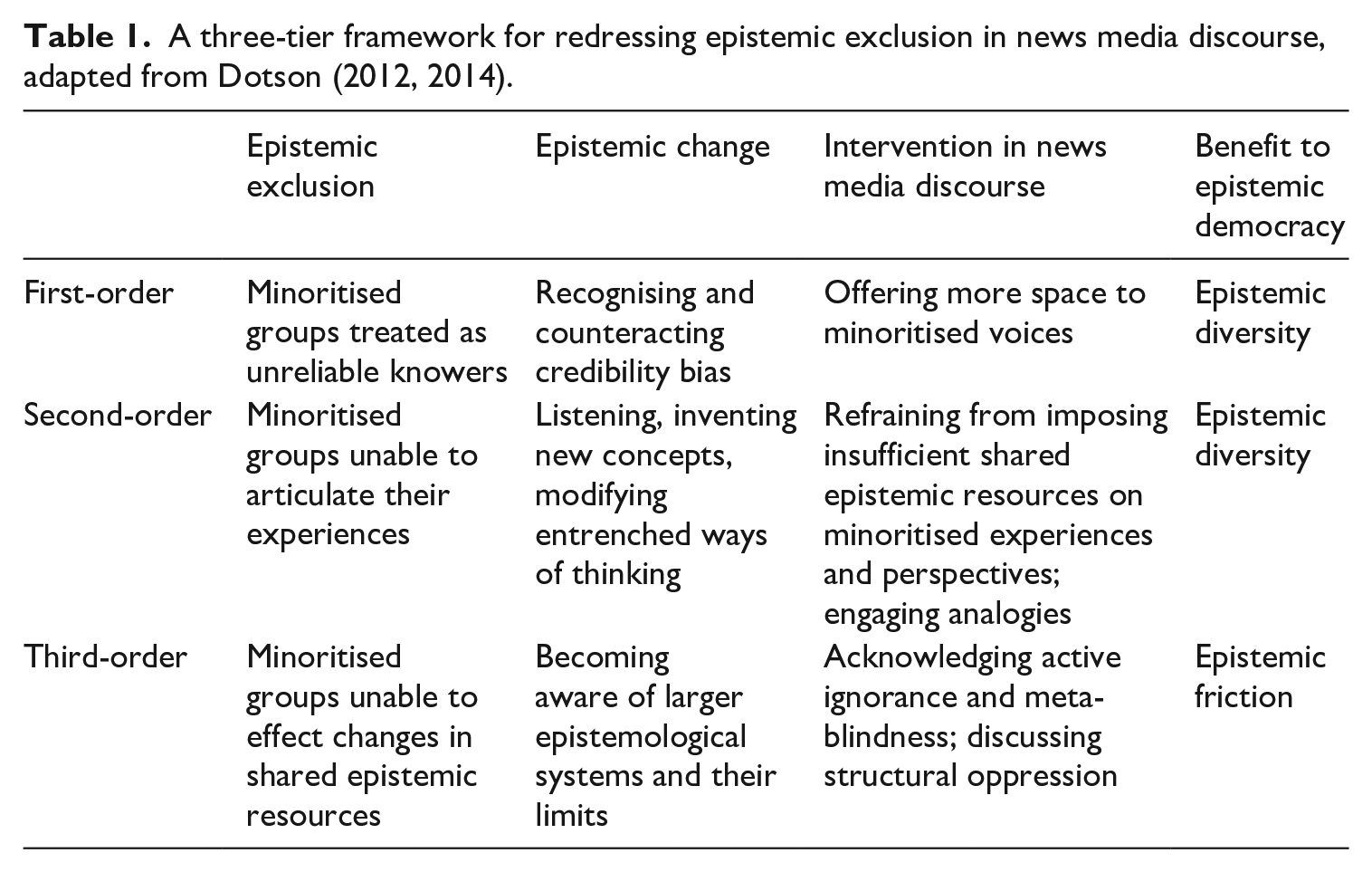
The second-order epistemic exclusion is caused by insufficient shared epistemic resources (Dotson, 2014), which are crafted by the dominant groups to reflect their experiential knowledge, thus rendering unintelligible experiences that fall outside that range (Bailey, 2014). Consequently, certain minoritised experiences remain inarticulable for those who have them, and untracked by those who do not, because of the lack of shared resources through which they could be effectively communicated (Dotson, 2012). The second-order changes required in such cases call not simply for giving a voice to minoritised groups but for the majority to listen to such voices actively and deeply and, in response, modify their entrenched ways of thinking (Dotson, 2014). For news media, I argue, this means that they should refrain from imposing their own (or otherwise hegemonic) language, interpretations and understandings on minoritised experiences and perspectives that clearly escape those frameworks. However, they may, to some extent, engage an ‘analogical’ mode of communication, which relies on a metaphor or an image to ‘evoke a set of beliefs understood to apply to a different situation in a new context’ (Bartunek and Moch, 1994: 27). By adopting the first- and second-order changes together, news media would increase epistemic diversity, thereby cultivating democratic imagination.
The third-order epistemic exclusion, in turn, is symptomatic of the inadequacy of dominant, shared epistemic resources. Minoritised experiential knowledge undermines such resources from the outside, yet they remain resilient because of their incapability to recognise their own inadequacy (Bailey, 2014). Due to the impossibility of reconciling minoritised knowledge with the shared epistemic resources, such knowledge continues to be ignored and goes unheeded, thereby constituting the ‘contributory injustice’, whereby minoritised knowers are effectively prevented from shaping shared epistemic resources and contributing to joint knowledge (Dotson, 2014). While the first- and second-order epistemic exclusions are reducible to other forms of exclusion, like economic or social, contributory injustice is a uniquely epistemic phenomenon that lays bare the resilience of ‘the unlevel knowing field itself’ (Bailey, 2014: 62).
The third-order epistemic changes that would actively integrate minoritised knowledge entail three requirements: firstly, becoming aware of one’s own epistemic system and recognising that it coexists with other epistemic systems; secondly, acknowledging the restricted parameters of the dominant epistemic system; and thirdly, altering that hegemonic system (Dotson, 2014). In news media, I hypothesise, this could play out as admitting their socio-political location within the hegemonic domain, understanding the epistemic consequences of such location, and actively trying to resist it in reporting (see Graves and Spencer, 2022). More concretely, news media could acknowledge that their claims to objectivity and neutrality might serve to reproduce dominant power relations (Steiner, 2018). News media must also come to terms with their active ignorance and concede ‘meta-blindness’; that is, their inability to recognise that there are certain things that they are unable to comprehend (Dotson, 2011; Medina, 2011a). Acknowledging, rather than covering up, this epistemic insufficiency could lead to minoritised knowledge becoming a starting point for questioning, challenging and revising the inadequate epistemic frameworks. In other words, it would expand the horizon of democratic imagination by generating productive epistemic friction (Medina, 2019). This, in turn, could initiate the process of integrating minoritised knowledge and lived experiences into the majority’s existing frames of reference and their epistemic resources. However, for that to happen, reporting must go beyond individual minoritised experiences to illuminate the structural aspects of minoritisation.
Method
This heuristic was mapped onto the coverage of two cases of minoritised activism: the Afro-Poles’ effort to oust the M-word and the activities of Stop Bzdurom queer collective. Both those struggles can be perceived as opposing epistemic exclusion. The ‘Stop Calling Me “Murzyn”’ demand resisted the persistent use of the M-word by the white Polish majority, which is an instance of epistemic exclusion insofar as it discredits minoritised knowledge and experiences conveyed in the Afro-Poles’ pleas and testimonies. As such, the Afro-Poles’ demand opposed ‘epistemic racism’, which considers any knowledge claims put forward by non-white (here, also ostensibly non-Polish) actors to be inferior by default (Grosfoguel, 2013). At its narrowest, then, the stubborn use of the M-word is the first-order epistemic exclusion.
Stop Bzdurom, in turn, was established to oppose the enduring oppression suffered by the queer youth whose experiences are habitually misrecognised, misunderstood and denied in both private and public spheres, pushing some of them to suicide (see Koziara et al., 2022). As extreme as it is, this oppression is a common condition of queer knowers who find themselves either unable to properly name their experience or feel that the ‘truth’ about it is out of their hands (see Fricker and Jenkins, 2017). Such epistemic violence is geared towards the protection of prevailing Western assumptions about the sexuality-gender nexus, whereby sexuality is configured as stable and sexual identities as natural and pregiven (Hall, 2017: 158). Thus, the epistemic oppression opposed by Stop Bzdurom was the third-order epistemic exclusion insofar as the cis-gender majority refused to actively and reciprocally engage with the perspectives that transcended the realm of their immediate experiences, despite the ready availability of necessary epistemic resources (Pohlhaus, 2017).
Empirically, I analysed the coverage of these two cases by five liberal media outlets that are all rather popular and influential while also representing a variety of media channels: (1) a news TV channel TVN 24, (2) a news radio channel TOK FM, (3) a daily Gazeta Wyborcza (GW), (4) a weekly Polityka and (5) an online portal NaTemat.pl (NT). In late January 2023, I used a search engine embedded in each website to collect items related to the discussion around the M-word and the Stop Bzdurom collective. To retrieve articles from the TOK FM website, which is not fitted with a search engine, I used the Google Search tool.
Firstly, I employed the word ‘Murzyn’ as a search term to retrieve all the items published from 4 June 2020, the day of the BLM solidarity demonstration in Warsaw, onwards. This sample consisted of 67 items: 4 from NT, 7 from TVN 24, 10 from TOK FM, 22 from GW and 24 from Polityka. Then, I changed the search term to ‘Stop Bzdurom’. I collected all the articles that mentioned the collective and were published following the detention of the Foundation PRO’s van on 27 June 2020. Here, the sample included 186 items: 17 from TOK FM, 27 from TVN 24, 30 from Polityka, 34 from NT and 78 from GW. The final corpus consisted of 251 items (two articles appeared in both samples). Even though the two cases were analysed separately, the investigation lacked comparative ambitions. Hence, the quantitative differences in the number of items across outlets or between the two cases were not considered a limitation.
Analysis
Epistemic concerns are easily detectable in the Polish liberal news media’s coverage of minoritised activism. Journalists and commentators alike identify epistemic issues, particularly in terms of exclusions faced by minoritised groups, and try to propose and implement solutions. Predictably, their diagnoses and remedies vary. In what follows, I will present the results of the analysis of the two cases, organised according to the adapted version of Dotson’s (2014) three-tier framework.
M-word
As the first-order epistemic change, liberal news media seem to unanimously agree that the ousting of the M-word from public discourse is the correct course of action. They consider the persistent use and stubborn defence of the M-word to concern only certain societal segments and attribute it to the white Polish majority’s ‘wilful ignorance’, set on protecting epistemic comfort and linguistic habits (see Pohlhaus, 2017). A letter published in GW (14 August 2020) pronounces that: Stubbornly claiming that [the M-word] has existed in the Polish language ‘for ages’ and that there is no need to replace it with ‘new creations’, such as – for example – an ‘African’, is an anachronism . . . It is an anachronism to stubbornly and unreflexively cling to the belief that language does not transform together with social, civilisational changes, etc.
Liberal news media often link this wilful ignorance to the conservative worldview, often ascribed directly to the PiS government and its allies (GW, 17 September 2020; Polityka, 6 April 2021). The illustrative example is an extensive discussion around a politicised, substantially deficient, and linguistically weak textbook that the Ministry of Education and Science promoted in the summer of 2022 for the hastily introduced secondary-school course on ‘history and present’. The textbook is the main topic of no less than eight articles in the sample because one of the charges levelled against it is the persistent use of the ‘offensive and archaic’ M-word, even after the Council for the Polish Language had recommended against its use in public discourse (TVN 24, 28 June 2022, see also Polityka, 15 August 2022; TOK FM, 22 August 2022). Thus, clinging to the M-word becomes politicised as yet another line of socio-cultural polarisation that organises the Polish media landscape (Olechowska, 2022). The instrumentalisation of minoritised activism as a frontline in the ongoing political conflict speaks to the liberal news media’s location within the hegemonic domain (Collins, 2002).
In justifying the need to abandon the M-word, liberal news media claim to accord primacy to the experiential knowledge of Afro-Poles (see Fricker, 2007). However, paradoxically, merely four items are interviews with (GW, 10 June 2020; GW, 11 June 2020), or interventions by (GW, 8 June 2020; GW, 25 January 2021), the Afro-Poles. Thus, they can hardly convey the Afro-Poles’ unique experiential knowledge into which their embodied experiences have been reforged, thereby disenabling learning about the situation of this specific racialised minority in the distinct setting that is Poland. These experiences, moreover, are often related in aggregate and relayed by white Poles, primarily linguists, who draw on a completely different epistemological system, namely, their domain expertise (e.g. Polityka, 21 June 2020; Polityka, 26 March 2021).
While ostensibly introducing the first-order change by offering greater credibility and some space to the Afro-Poles’ minoritised perspectives, liberal news media perpetuate the second-order epistemic exclusion by failing to radically listen to such perspectives and, consequently, to consistently alter their ways (see Graves and Spencer, 2022). Most rudimentarily, they occasionally ignore even their own limited prescriptions and gleefully continue to use the M-word (Polityka, 7 July 2020; Polityka, 21 August 2021). Few, moreover, still reserve for themselves a right to arbitrate the validity of minoritised claims, such as their usual demand to use endonyms (Polityka, 26 January 2021), thereby unashamedly displaying their own meta-blindness (Medina, 2011a).
Nonetheless, liberal news media occasionally foray into the second-order epistemic change. To this end, journalists and commentators construct analogies between the M-word and the offensive language targeting Poles abroad (GW, 13 August 2020), such as the derogatory use of the anglicisation of the Poles’ own endonym (GW, 20 July 2021) and the ‘Polish jokes’ (GW, 14 August 2020). Although the purpose of such analogies is to elicit empathy by bringing the unfamiliar situation of a racialised minority closer to home, they also erase the uniqueness of the Afro-Polish experiential knowledge and make it impossible for the majority to learn from it. In contrast, a contribution by the mother of the young girl who held the ‘Stop Calling Me “Murzyn”’ placard at the BLM solidarity demonstration ushers in the second-order change by acknowledging that epistemic resources available to the Polish majority are insufficient for grasping the experience of Afro-Poles (GW, 10 June 2020). Herself a white Pole, she points out that ‘[m]any people in Poland . . ., probably in good faith, comment that the word “Murzyn” has always been neutral and inoffensive to them. One is compelled to ask: “How many times were you yourself called a “Murzyn” and had a chance to feel something on your cost because of it?’ In so doing, she makes plain that the perspectives of minoritised groups on issues that directly concern them should be prioritised over the hegemonic frameworks.
Tellingly, liberal news media seldom connect the M-word to the wider frame of racism. Even the Afro-Poles refrain from mentioning racism in their contributions and instead talk about, for example, ‘bullying’ (GW, 25 January 2021). This is a symptom of the third-order epistemic exclusion running so deep that it causes even those who possess adequate epistemic resources for discussing racism to self-silence. This exclusion grows from the hegemonic epistemological system that produces the dominant vision of Polish exceptionalism, predicated on the assumption that because, historically, Poland had no colonies and there was no enslavement of Black people, there can be no racism in the country at present (Balogun, 2018; Polynczuk-Alenius, 2021).
Thus, to initiate the third-order changes, which – per Dotson (2014) – would include the recognition and alteration of the limits of the dominant epistemic system, liberal news media should acknowledge the existence of the specifically Polish brand of racism and mainstream the discussion about it. However, the contributions to this effect are few and far between. If explicitly mentioned, racism is usually reduced to its linguistic articulations (Polityka, 21 June 2020) or to stereotypes perpetuated in cultural production (GW, 7 June 2020; GW, 9 June 2020). A report on the results of a study with the Afro-Polish community is exceptional in that it names and discusses a range of racist acts to which interviewees have been exposed, including microaggressions and ‘soft’ racism to physical violence and systemic discrimination (GW, 21 October 2022). As such, it prods the public to revisit the myth of Poland’s race exceptionalism. Diving even deeper, a radio conversation unsettles this myth by revealing the country’s interwar colonial ambitions and the racist mindset on which they rested (TOK FM, 16 December 2022; see also Polityka, 22 September 2022).
On a conceptual level, the liberal news media coverage of the antiracist struggle against the M-word does, to some extent, cultivate democratic imagination. Insofar as the first-order changes boost the Afro-Poles’ epistemic credibility and the embryonic second-order changes advocate empathy and kindness, they do foster some epistemic diversity and encourage perspective-taking. However, the limits to the expansion of the horizon of democratic imagination are set by the liberal news media’s apparent reluctance to critically examine the parameters of the hegemonic epistemological system, coloured by racism, of which both they and most of their audiences are part (see Dotson, 2014). This inability prevents them from truly exposing themselves, and – consequently – their audiences, to minoritised knowledge that could generate epistemic friction and facilitate learning.
Stop Bzdurom
Liberal news media treat the Stop Bzdurom activism as targeting the first-level exclusion of queer knowers, hinging on the (mis)perception of their credibility as compromised by their claims to supposedly impossible experiences and unavailable identities (Hall, 2017). Due to the very limited presence of queer perspectives in public discourse, the collective set liberal news media on a steep learning curve (Polityka, 2 September 2020), with which they deal by zooming in on the individual case of Margot, whom they arbitrarily proclaim the collective’s leader. To this end, they dissect Margot’s non-binary gender identity (Polityka, 16 August 2020) and explain her decision to opt for female pronouns in this context (Polityka, 11 August 2020; TVN 24, 11 August 2020). With rare exceptions – predominantly in early news pieces, which refer to Margot as ‘transsexual’ (TOK FM, 8 August 2020; TVN 24,11 August 2020) or incorrectly describe her as ‘considering herself a woman’ (GW, 15 July 2020) – liberal news media habitually accept her identity by characterising her as non-binary, using her preferred name and pronouns (NT, 13 August 2020). What is more, they cite the instances of misgendering and deadnaming to shame the police (GW, 14 July 2020), the PiS government (TOK FM, 10 August 2020), or even an insensitive liberal journalist (NT, 2 September 2020; NT, 3 December 2020). Equally, the decision to place Margot with male inmates is largely condemned (NT, 8 August 2020). In so doing, liberal news media lend credibility to queer self-knowledge and identification.
In addition, liberal news media initiate the first-order epistemic change by dedicating some space to queer voices. A total of 16 items consist primarily of interventions concerning homophobia and transphobia by members of the queer community (journalists, activists, intellectuals and artists), including four interviews with Margot herself. Contributions by queer knowers illuminate some ways in which the superficial first-order changes implemented by liberal news media paradoxically augment the second-order exclusion that prevents minoritised groups from effectively articulating their perspectives. This exclusion is perpetuated when liberal news media rely on their own inadequate epistemic resources to make sense of minoritised experiences (see Medina, 2019). As a transgender activist explains: Theoretically, it is cool that someone thinks about minorities that ‘those people are the same as me’. But this can lead to further assumptions, which are no longer cool: ‘If they are like me, then they have the same experiences as me. Maybe they have problems that affect them directly, concern their identity, dignity, sense of safety. Problems that I do not have. But if they are like me, then they must approach them the same way I do. Thus, I can speak on their behalf and scold them when they do something the way I do not.’ (TOK FM, 29 August 2020)
This misguided allyship, where a self-professed ally assumes they know everything that there is to know about minoritised experiences solely because of their sympathy for the cause (see Graves and Spencer, 2022), regularly crops up in liberal news media as tone-policing of the queer community, distracting from substantive discussion about their postulates (Polityka, 12 August 2020). Occasionally, it seamlessly morphs into victim-blaming, such as when Poland’s former president is quoted saying that ‘the LGBT milieus have a sacred right to fight for their rights, subjectivity, tolerance and respect for them. However, some of the measures undertaken by these communities provide the argument for the other side’s sustained aggression and intolerance’ (NT, 13 August 2020). The queer voices that appear in liberal news media counter this misinterpretation, generated by employing inadequate hegemonic epistemic resources, and read the ‘controversial’ protest tactics employed by Stop Bzdurom as an intervention that breaks with the tacit acceptance within the LGBTQI+ community of the presupposition that they are the ‘problem’ (Polityka, 22 August 2020). Having realised the practical inefficiency of continuously striving to prove that they are well-behaved, cool and ‘normal’, the queer community ‘can never be polite again’ (TVN 24, 26 September 2020). Instead, they must ‘defend’ (GW, 23 August 2020) and ‘flaunt’ themselves (NT, 9 September 2020).
To usher in the second-order change, liberal news media must not only relay but also actively listen to the queer testimonies and update their practices in their light. A transgender activist and former MP describes the process of opening oneself up to minoritised experiences and perspectives with an ocular metaphor: ‘For people who have their eyes open . . . the Rainbow Night was a showcase of conservative oppression, and for those who have their eyes wide shut and do not understand what transgender is, Margot’s actions were an offence and madness’ (NT, 30 August 2021; see also NT, 31 August 2020). To this end, liberal news media begin to solicit and aggregate the minoritised group’s unique experiential knowledge on the topics that have direct consequences for their lives, including about transphobia (TOK FM, 29 August 2020) and better allyship practices (NT, 11 August 2020).
Despite embracing the first-order epistemic change, introducing some second-order changes and, in so doing, visibly increasing the epistemic diversity in their reporting, liberal news media partake in the third-order epistemic exclusion of queer knowers. In particular, the queer community is unable to effect any serious changes to the dominant epistemological system, contingent on the gender binary as both an interpretative device and a world-ordering tool. In the case of Stop Bzdurom, the queer perspective on the petrified gendered order is further linked to a broader worldview that rejects vertical power relations, authority, and the oppressive family and state structures in favour of horizontal solidarity and grassroots organising (Polityka, 16 August 2020; Polityka, 2 September 2020). This is best captured by Margot: [W]hen you learn about total institutions, fascism, open/closed cognitive approaches, analyse social roles, it is hard not to notice that you have two more such categories, namely a woman and a man . . . You look at [women’s magazines] and simply see that women are re-programmed every now and then . . . And then I knew that I did not want to live in the world where everything is based on gender dichotomy. (GW, 19 October 2020)
Despite its clear and eloquent articulation, this minoritised perspective fails to find a wider resonance in liberal news media. For the most part, they still treat gender as a neutral ‘fact’ that only becomes problematic for those exceptional cases who do not conform to the binary: For most people [sex and gender identity] are obvious and in agreement with each other – they are cisgender . . . However, in every population there are people who do not fit into this binary division, that is, their perception of gender and the way they think about it do not correspond to their biology . . . [T]hey are transgender. (Polityka, 12 August 2020)
However, two articles about youth begin to acknowledge that the gender binary is not a given, transcendent reality but a product of a larger socio-epistemic system. The first article simply reports that among the youth, the gender binary is gradually becoming irrelevant and mentions that some domains, such as psychiatry and psychology, are already responding to this shift (Polityka, 27 July 2022). The second article, in turn, connects gender to a larger system of power and oppression against which the young generation is rebelling: The difference between the world of powerful people, who try to impose limitations, and of the youth, who freely live their identity and sexuality, is so enormous that the young do not take authority seriously. They do not believe in the old world, destroyed by adults and full of oppression and weird rituals, and sexuality [sic] is one way to fix it. (Polityka, 5 July 2022)
In conceptual terms, liberal news media cultivate democratic imagination in several ways. Firstly, by generally aligning their coverage with Margot’s gender identity, they promote both individual right to self-determination and a more inclusive language as an epistemic resource. Secondly, they offer some space to minoritised voices that validate the tactics of queer activism and recognise the inadequacy of dominant epistemic resources for making sense of minoritised experiences. Taken together, these changes foster some epistemic diversity. However, they are fraught with ambiguity insofar as queer contributions are interspersed among articles that replicate tone-policing and victim-blaming. The expansion of the horizon of democratic imagination is effectively stymied, moreover, by the third-level epistemic exclusion, which prevents liberal news media from reading the Stop Bzdurom’s activism in the larger context of gender binary, whose arbitrariness and oppressiveness remain hardly acknowledged. As such, liberal news media have a not-yet-realised potential to expose the public to epistemic friction by problematising the gender binary.
Conclusion
This article had primarily theoretical and conceptual aims. Theoretically, it sought to introduce to journalism studies the epistemic perspective on democracy, which offers at least two advantages. First, diagnostically, it foregrounds the inevitable tension between the normative vision of journalism as a ‘lifeblood’ of democracy and the epistemic blind spots conditioned by its being part of the hegemonic domain. While this tension is by no means new (McLaughlin, 1993), its two sides seem to be, for the most part, dealt with in separate bodies of literature. Second, positively, the conception of epistemic democracy enables us to reimagine a news media’s contribution to democracy in terms of what I conceptualise as the cultivation of ‘democratic imagination’. Here, I operationalised this contribution as redressing the epistemic exclusion of minoritised groups and adapted as my main heuristic the three-tier framework of epistemic exclusion developed in feminist epistemology (Dotson, 2012, 2014). These interventions open new avenues of research into the journalistic discourse on minoritised groups that go beyond studying how minoritised groups’ mediated representations reflect and reinforce societal prejudice and existing inequalities to examining how integration of their perspectives and experiences into journalistic discourses might possibly alleviate prejudice and inequality. To this end, the three-tier framework, particularly as laid out in Table 1, can be a useful tool also for journalists eager to pursue more inclusive and diverse reporting to assess their practices.
The theoretical and conceptual propositions were subsequently deployed empirically in the study of the reporting on minoritised activism by Afro-Poles and the queer community in the Polish liberal news media. This was a particularly promising testing ground due to the liberal media’s stake in reimagining democracy in Poland and their support of the minoritised groups as allies in the struggle against the former ultraconservative government. Indeed, the analysis supplied some empirical evidence for the Polish liberal media’s efforts to cultivate democratic imagination in their reporting. In particular, the liberal news media eagerly introduced the first-order changes, which included the ousting – albeit with some significant oversights – of the racist ‘M-word’ and the recognition of non-binary gender identifications, accompanied by preferred names and pronouns. To some degree, the Polish liberal news media also implemented the second-order changes insofar as they mainstreamed the minoritised knowledge for their audiences. Thus, they increased epistemic diversity.
The exclusive focus on the minoritised activists’ most immediate demands, rather than on their underlying socio-epistemic causes, prevented third-order changes, precluding Polish liberal news media from critically engaging with larger epistemic frameworks opposed by the minoritised knowers. As such, they failed to reforge epistemic diversity into fully-fledged epistemic friction that would, in turn, truly expand the horizon of democratic imagination. By refusing to expose themselves and their audiences to alternative epistemic frameworks so as to acknowledge the existence of specifically Polish racism and the arbitrariness and oppressiveness of the gender binary, Polish liberal news media ultimately hampered the ability of minoritised knowers to participate in democratic deliberation on equal terms. Thus, while they were ready to include minoritised perspectives and relay minoritised experiential knowledge, they were unable to offer them an equal platform.
By identifying the threshold of Polish news media’s contribution to epistemic democracy, the article empirically pins down the tension between journalism’s normative vision as a driver of democracy and its actual links to the hegemonic socio-political power that very likely obtains also in other contexts. If a democracy is assumed to be only as strong as its most vulnerable subjects, then news media – as agents of democracy worldwide – should strive for universal and equal inclusion of all knowers, their perspectives and experiences, provided that they are not themselves anti-democratic. This, rather than a defence of objectivity and neutrality, might be journalism’s most plausible epistemic contribution to the ongoing battle for democracy.
Supplemental Material
sj-docx-1-mcs-10.1177_01634437241271031 – Supplemental material for Rethinking news media from the perspective of epistemic democracy: ‘Democratic imagination’ in the coverage of minoritised activism in Polish liberal media
Supplemental material, sj-docx-1-mcs-10.1177_01634437241271031 for Rethinking news media from the perspective of epistemic democracy: ‘Democratic imagination’ in the coverage of minoritised activism in Polish liberal media by Kinga Polynczuk-Alenius in Media, Culture & Society
Footnotes
Acknowledgements
I would like to thank Mervi Pantti, Jessica Gustafsson and the participants of the ‘Gender and sexuality’ seminar for their comments on the earlier versions of this paper. I am also grateful to the Reviewers for their encouraging feedback.
Funding
The author disclosed receipt of the following financial support for the research, authorship, and/or publication of this article: This project has received funding from the European Union’s Horizon 2020 research and innovation programme under the Marie Skłodowska-Curie grant agreement No 847639 and from the Ministry of Education and Science.

Supplemental material
Supplemental material for this article is available online.
References
Supplementary Material
Please find the following supplemental material available below.
For Open Access articles published under a Creative Commons License, all supplemental material carries the same license as the article it is associated with.
For non-Open Access articles published, all supplemental material carries a non-exclusive license, and permission requests for re-use of supplemental material or any part of supplemental material shall be sent directly to the copyright owner as specified in the copyright notice associated with the article.
