




Abstract
This paper reports on an ethnographic study that examined smart TV use in low-income migrant households in Australia. We find that the smart TV is used by migrant families for diverse forms of social and cultural participation. In addition, we find that YouTube – which is often accessed using the smart TV – is reshaping family media practices. We argue that while digital inclusion scholarship has focussed on access to and use of mobile phones, laptops and computers, the smart TV, perhaps more than any other device in the home, enables digital inclusion through intergenerational media engagement. This paper presents insights for policymakers and offers a new area for investigation for digital inclusion and media scholars.
Keywords
Introduction
This paper examines how migrant families in Australia are using the smart TV. The paper is based on ethnographic research carried out over a period of 15 months (2021–2023) in five multi-lingual, migrant, low-income households in Western Sydney, Australia. The research is part of a multi-sited national digital inclusion research project which collected experiences and insights from 30 families located in six diverse communities across urban, regional and rural locations (Dezuanni et al., 2022). While the smart TV was not a specific focus for this research project, much to our surprise, we found this device was a prominent and highly valued internet-enabled device in four of the five family households that were included as part of the Western Sydney research site.
Television has come a long way since its early beginnings in the 1920s as a monochrome ‘two knob technology’ (Hartley and Notley, 2005). Through advances in digital coding and compression technologies, as early as the 1990s, television transitioned from analog transmission to satellite and cable broadcasting (Starks, 2013), a transformation which has had profound implications for the ways content was produced, distributed and consumed. Digitisation of broadcasting and the widespread use of satellite television led to the formation of a global television industry and transnational broadcasting (Chalaby, 2003; Karim, 1998; Morley and Robins, 1995). These developments offered producers the advantages of ‘greater capacity and lower running costs per channel’ (Starks, 2013: 4) while consumers had access to a much wider range of national, global and transnational content. However, the Smart TV, which has gained prominence in households starting the mid-2000s, moves beyond offering extended global and transnational media subscriptions and content choice, by also being internet-enabled and introducing interactive capabilities (Johnson, 2019). In Australia, more than two-thirds (67%) of Australian households now use an internet-enabled TV – which includes both smart TVs and ‘dumb’ TVs with added internet-enabled devices. Most (72%) people who use the smart TV in Australia report using this device on a daily basis (Lobato et al., 2023).
Johnson proposes that both the emergence of online television and the smart TV are closely interlinked to the rapid success of YouTube, starting in 2005, which was ‘a catalyst in encouraging television providers to experiment with online delivery of television programmes’ (2019: 57). She further notes that between 2008 and 2012, ‘YouTube shifted its strategy and began to collaborate, rather than compete, with the television industry’ (Johnson, 2019: 46), which resulted in the internet being ‘positioned as a means of delivering and experiencing television, rather than as an alternative to, or extension of, television’ (2019: 47).
These developments in television technologies have led to expanded choice and the option of on-demand viewing, rather than households being limited to a limited number of live broadcast channels. As a result, dominant ideas about ‘television’ have been challenged (Courtois et al., 2013) and new scholarship has emerged to examine the changing role of television in society. However, the television is still rarely examined as an internet-enabled device. Perhaps for this reason, the smart TV has not yet been the subject of digital inclusion scholarship, with scholars in this field instead focussing on access to and use of laptops, computers, tablets and mobile phones (Helsper, 2021).
Notley (2008; 2009) has proposed that digital inclusion refers to the information and communication technology capabilities people need to participate in society in ways that they value (Notley, 2009). Building on Warschauer’s (2004) concept of digital inclusion, along with Sen’s (1999, 2000) notion of capabilities, she argues that digital inclusion initiatives should ‘respond to people’s own needs, rather than to fixed, value-laden and time-specific goals set by governments’ (Notley, 2008: 63; Notley and Aziz, 2024). This study builds on this framing to address a gap in digital inclusion literature by examining the role of the smart TV in low-income migrant family households.
Our paper begins by exploring historical and contemporary studies that have examined the social and cultural uses of television in the home with a focus on migrant households. We then connect this literature with recent research about the use of the smart TV. Next, we outline the research context and methods used in our study. Finally, we present our findings and reflect on key themes that have emerged about the use of the smart TV for social and cultural participation and consider the implications for digital inclusion.
Literature review
The social and cultural role of television in family life
Concerns and fears about how television may be altering family life dominated early television scholarship during the period mid to late 20th Century. Much of this early research was led or influenced by the social and cultural theories and perspectives of the Frankfurt School thinkers (e.g. Horkheimer and Adorno, 1972; Marcuse, 1964). These researchers made claims about the pacifying and isolating role of television on individuals and its disruptive impact on socialisation (Kubey, 1990: 312). However, this body of work was soon challenged by British cultural studies scholars and by those influenced by a sociocultural approach. For instance, Hall’s (1973) influential paper, ‘Encoding and Decoding in the Television Discourse’ emphasised that all television content – whether relaying factual or entertainment content – is a representation. As such, television messages and meaning, he argued, move through a process of encoding and decoding. In the encoding stage audience knowledge and expectations of media language, form and genre shape production, while in the decoding stage audiences decide how media is received and understood when they make sense of it. Scholars associated with a sociocultural approach to television research tended to argue for active and positive associations relating to television viewing in the home, emphasising the potential of television to stimulate family interaction, communality, socialisation and sophisticated meaning-making processes (e.g. see among others Ang, 1985, 1991, 1996; Fiske, 1987, 1991; Kubey, 1990; Lull, 1980; Morley, 1986; Silverstone, 1993, 1994; Spigel, 1992).
Building on this audience-centered approach, a series of later ethnographic and sociological empirical studies emerged, starting in the 1990s, that examined family uses of television. For example, Spigel (1992) explored how engagement with television was used to create family rituals that were often structured around scheduled programmes and prime-time viewing. Silverstone (1994) provided the concept of ‘clocking’ to indicate the structure of activities as ‘family or household members come together or pass each other, according to a pattern which is set and engrained in their daily routines’ (1994: 36). In a similar vein, Livingstone (2002) considered television to have become ‘part of the infrastructure of family life’ (67).
Media and cultural studies scholarship has also examined the special role television plays in the home of diasporic and transnational families over several decades. Starting with the widespread adoption of the VHS in the 1980s, then satellite dishes in the 1990s, television has offered migrants a way to regularly engage with their home countries from a distance (Karanfil, 2009). Research has explored how television programmes support migrants to forge connections with their homeland, with other diasporic viewers dispersed in other places and negotiate their own identity between their homeland and new country of residence (e.g. Chalaby, 2005; Cunningham and Sinclair, 2000; Georgiou, 2006; Karim, 2003; Naficy, 1993; Ponzanesi, 2021). Other research has explored the ways migrants deploy television and satellite broadcasts to negotiate migratory, diasporic and transnational experiences (eg. Aksoy and Robins, 2000, 2003; Aziz, 2022; Christensen, 2013; Iwabuchi, 2002; Ogan, 2001; Shi, 2005). For instance, Robins and Aksoy (2005) argue that migrant’s satellite television consumption can disrupt a ‘frozen image’ of the homeland. In his research on the impact of satellite television on Turkish-Australians, Karanfil notes that transnational media accessed via satellite television provides ‘points of identification by re-linking cultures to places, and by fulfilling the desire for memory, myth, nostalgia and self-identification’ (2009: 888).
Many scholars anticipated that multiscreen household culture would individualise viewing patterns, fragment households’ media habits and erode ‘family time’ (Lally, 2002). However, significant research now challenges this expectation. For example, Aziz (2022) found that YouTube-based diasporic television (e.g. Rohingya Vision) was commonly used by Rohingya refugee families in Australia as a key source of information. Lexander and Androutsopoulos’ (2023) ethnographic study of families who migrated from Senegal to Norway finds that digital and online media supports family member’s multilingualism and diasporic socialising. Castro and Ponte’s (2021) study of transnational families in Portugal and England found that the Smart TV enables parents and older siblings to keep a watchful eye over children’s explorative use of YouTube.
This research builds on this body of literature about the social and cultural role and value of television in the home by examining the affordances, uses and opportunities enabled by the smart TV. While research has been carried out to consider how access to and use of technology in the home can address social and cultural exclusion or marginalisation (see Helsper, 2021), the smart TV has not featured in this research – perhaps because this device has been more closely associated with television than with internet use. This study seeks to address this gap while also building on earlier scholarship on the role of television in the family home.
Methods, background and setting
This article is based on ethnographic research with five low-income, migrant family households in Western Sydney – the most culturally diverse region of Australia. The Western Sydney region has a population of around 2.6 million people and is the most multicultural region of Australia in terms of residents born overseas and residents who speak a language other than English at home (ABS, 2021). The area also serves as a key arrival hub for refugees and new migrants when they first settle in Australia (Robertson and Aquino, 2017) including for more than 80 percent of humanitarian entrants arriving in the State of New South Wales (NSW Government, 2023).
The research presented in this paper is based on repeated (four to five) visits to each household. Four households were visited in person, while in one household all interviews were carried out remotely, via Zoom. Each family had at least one parent living in the home who had migrated to Australia, while parents from four families had arrived as refugees, in some cases with children. Three of the households were headed by single mothers and one by a single father. A family interview was first carried out in each household. This included a household technology audit (Katz et al., 2017) and asked questions to explore how technology use relates to family relationships, how families make decisions about purchasing and using technologies and the extent to which families are connected to local institutions and digital resources. Individual interviews focussed on each household member’s experience with and perceptions of technology over time as well as their personal technology practices, needs, challenges and aspirations. Interviews primarily consisted of qualitative, open-ended questions, which were audio-recorded and transcribed verbatim. Photographs were at times taken of technologies in the home (where the family were comfortable with this) and fieldnotes were written after each interview to allow the researcher to describe the interview experience as well as technologies and media that were shared during the interview. Both open coding and selective coding were used to identify themes (Creswell, 1998; LaRossa, 2005). The participants’ names have been changed to ensure their anonymity (see Notley and Aziz, 2024 for more detail on the methodology.)
Key findings
Most of the initial household interviews we carried out with the five families took place in the living room where, in four of the five homes, there was a large, prominent internet-enabled smart TV. This smart TV was often turned on when we arrived and, in some cases, remained on as children searched for content while we spoke to their parents. In presenting our findings we explore the experiences of the four households that had a smart TV in their home.
The Rahman family: Cultural learning and re-connecting to the homeland
The Raman Family include a mother (Fatima) and her four children aged between 4 and 16 years. Fatima had migrated to Australia 25 years ago, as a refugee from Somalia. Our initial interview with the family took place in their rented home soon after a 3-month COVID-19 lockdown. Fatima was clearly stressed and agitated about the lockdown experience and explained that several days a week she was receiving text messages in the morning from her children’s schools and childcare centre about sudden shutdowns. These regular disruptions made Fatima’s work as a cleaner impossible and she was financially struggling and worried about her ability to pay rent.
Around an hour into our initial 90-minute family interview, Fatima mentioned that she often uses YouTube via the smart TV to watch documentaries. ‘I want to see the upgrade [in Somalia], what happened, how technology is changing home [. . .] technology was nothing when I left. Like we had tents when I was leaving’. This discussion was a turning point in the interview because Fatima’s stress seemed to immediately dissipate as she became relaxed and nostalgic talking about her country. For the first time, we saw that technology also gave Fatima pleasure and joy – up until this point in our discussion she had focussed on the burden and stress of technology in terms of the cost, last minute communication from the school and digital privacy concerns. Fatima specifically identified the arrival of drones and drone footage as a ‘phase towards massive technology development’ in her home country.
For me, to have a drone in my country – it’s huge. She’s going to laugh at me [looking at daughter]. Someone else might think ‘Oh my god that’s not even a big deal’, but there was nothing. There wasn’t even a TV. There wasn't a satellite. Nothing like that. To have a drone in my country. It’s huge. For me, it’s like going to NASA. Going to space. It’s huge. So that’s why I love documentaries [about Somalia] because I just want to see what's been going on since I left home and it’s actually amazing the progress they’ve made.
When we asked Fatima how she searched for Somalian documentaries using YouTube she explained:
Yeah, like if I hear something, like if you know there’s an election going on or something and then I hear about it I come home and I search. But sometimes if I want to cook something and I want to know how to make that dish then I go to YouTube and ‘Somalian rice’ or ‘Somalian dish’. And then I follow that. But sometimes it can be like just listening to Somali music and then I just scroll down the one the artist that I like. And then sometimes it can just be ‘Oh I just want to watch something about Somalia’ and I just type Somalia and whatever comes up.
Fatima also explained that the smart TV was a way for her to ensure she could learn with her children about their multi-cultural heritage.
My kids are half Somali, half Sri Lanka. I want to show them both worlds and have an experience, like actually three worlds – Australia, Somalia, Sri Lanka – so it’s kind of a culture change for me as well. . .
During Ramadan, Fatima explained, her family were actively engaged with a smart TV to watch religious content, including Quran recitation, Islamic lectures and discussion. Watching content like this from her home country provided Fatima with an important opportunity for her family to practice their religion and to learn about language and culture. ‘Sometimes, we just all sit on the couch and just watch a video about religion and Somalia culture and just like to discuss what's happening’.
However, it was not only content from Somalia that the family watched together. The family continued the ritual of watching entertainment content each week in the loungeroom with their Saturday family movie night which began early with a film for the younger children. In addition, the children would sometimes come home and ask their mother to look up a video they had watched at school so they could view it together.
Every single day it’s different ok. Someone might say, ‘Mum I want you to see something from school. Can we google it?’ And then we sit down and google it and then. We watch it. Someone else might say, ‘I just want you to see this movie that we watched’, especially the baby [the youngest child, aged 4]. . . And we can all sit down and watch it even though we saw this movie actually a thousand times before her, we still sit down to make her feel special. So, every single day is different. (Figure 1)
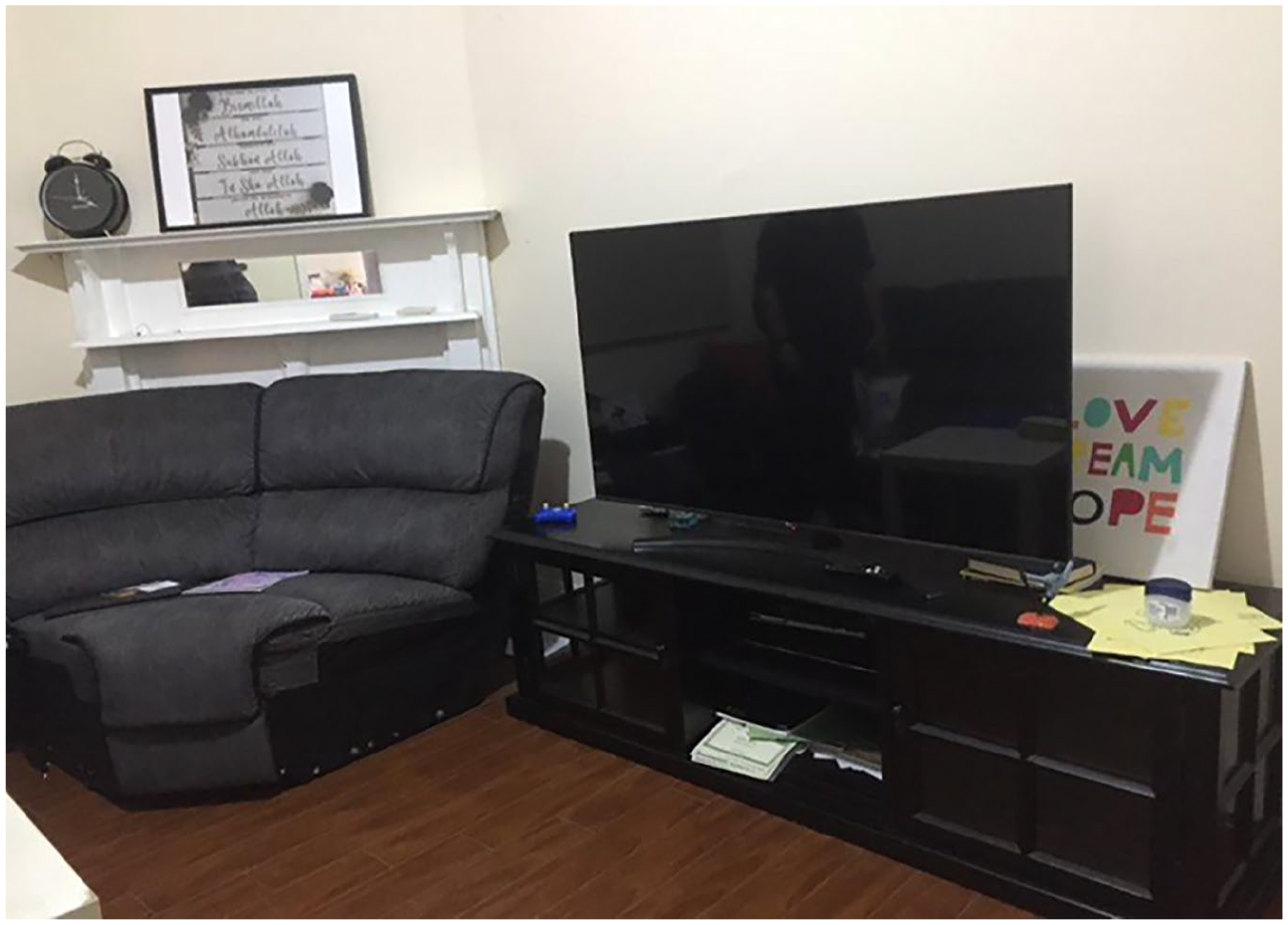
Fatima Rahman’s loungeroom.
The Ali family: Raising young children as a single parent
The Ali Family includes a mother (Laila) and her four children ranging from 4 months to 8 years of age. The three eldest children told us that they love to watch programs on YouTube using the smart TV, especially Tom and Jerry cartoons that were made in the 1940s and 1950s, which came as a surprise to us given the array of choices on YouTube. Each visit to the home the children took turns typing things into YouTube to watch, often arguing about whose turn it is. They also used the smart TV to play games via Google Play, mostly on weekends. Their mother Laila, however, mostly accessed content via YouTube when using the smart TV for her own personal use – primarily videos to help her speak English or Somali language content. Unlike Fatima though, Laila had no interest in watching content about developments back in Somalia which clearly connected her with traumatic memories.
No. I don’t like it [watching Somalian news or current affairs]. It’s always about the problems and fights. It makes me sick. I can’t sleep after watching those programs.
Laila explained that she uses the smart TV (and YouTube) to play her children Somali language content so they can become familiar with her language, which she said they enjoy. She also told us how vital the smart TV was to help entertain the children when she needed to ‘get things done’. Recently their smart TV had broken (see the second TV screen behind the smart TV in Figure 2). Laila explained how difficult and stressful this period had been for her and said she had asked the children’s father (who does not live with them) to help her by purchasing a new one.
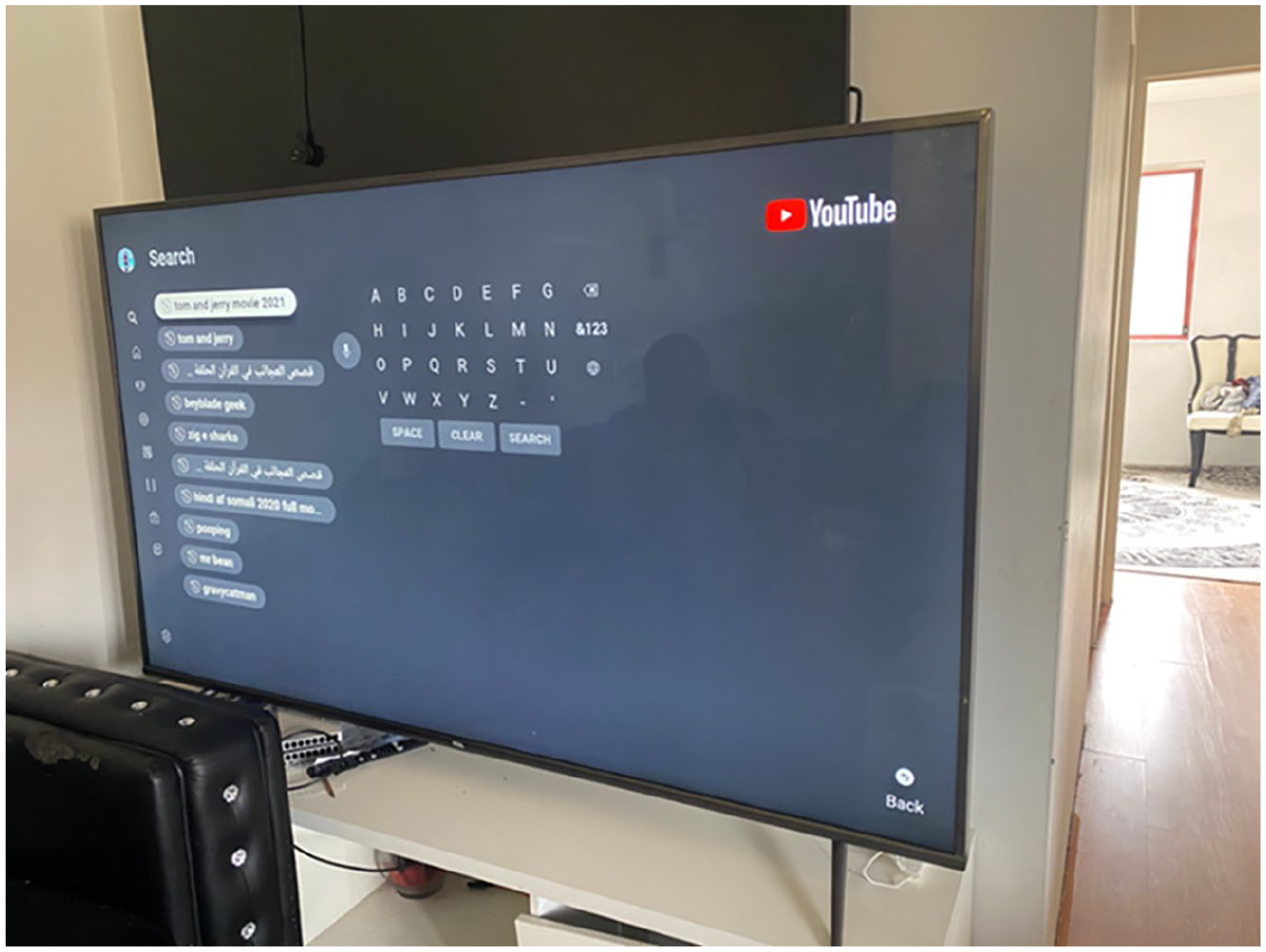
The display of the smart TV in Laila’s house (Family 2) shows the mixed cultural consumption in both English and Somali.
We asked Laila about the types of programmes she enjoys along with her children.
[...] So it depends. My children like to maintain their language in Somali so programs with talking so they can hear and can relate. Not all the time but sometimes...They don’t understand all of Somali, but they like to see the country, language, and other kids in Somalia.
We asked Laila’s permission to take a picture of the smart TV (Figure 2), which shows the search history performed on YouTube. These search terms show how the smart TV is primarily used by the children to search for entertainment content but also by Laila and her children to connect with Somalian language content.
The Sharma family: Maintaining cultural connections
The Sharma Family include a single father and his three teenage children aged between 16 and 19 years (only two daughters take part in the study). Father Krishna is in his late 50s and identifies as Indo-Fijian. Krishna told us he has a fairly low level of confidence in using technology but he has been able to manage his basic needs following a government training course he took some years ago while he was unemployed. He also receives help to use technology from his children. Krishna explained how he had recently drawn on his children’s technology skills to ensure the family could continue their weekly religious practices since his family’s ritual of visiting the local Hindu temple twice every week had been disrupted by COVID-19 lockdowns. Because of this, the Sharma family had started watching the temple livestream twice a week on Facebook, while he and his daughters also used YouTube on the smart TV to access religious and spiritual teachings.
At one point during an interview with Krishna’s 16-year-old daughter, Leela, she started talking about a programme the family used to watch together when she was younger using ‘you know the old square files’. When we looked confused, she went to her room and came back with some old VHS cassettes of the Ramayan TV series, an Indian Hindi-language series based on an ancient Hindu Indian Sanskrit epic, Ramayana. Leela spoke nostalgically about how often the family had watched the tapes together when she was younger and said even though they can no longer play them – because they don’t have a VHS player – she was reluctant to throw them away. She explained the family can now easily find this series on YouTube along with other Vedic and Hindu teaching. This experience shows the way the Smart TV can extend the life of old audio-visual content and support opportunities for parents to share with their children content that influenced them as children. Leela said she and her father sometimes put on yoga programmes as well, showing that the smart TV enables easy engagement with exercise and wellbeing activities in a way that is likely more accessible than was the case with older technologies such as the traditional television set. (Figure 3)
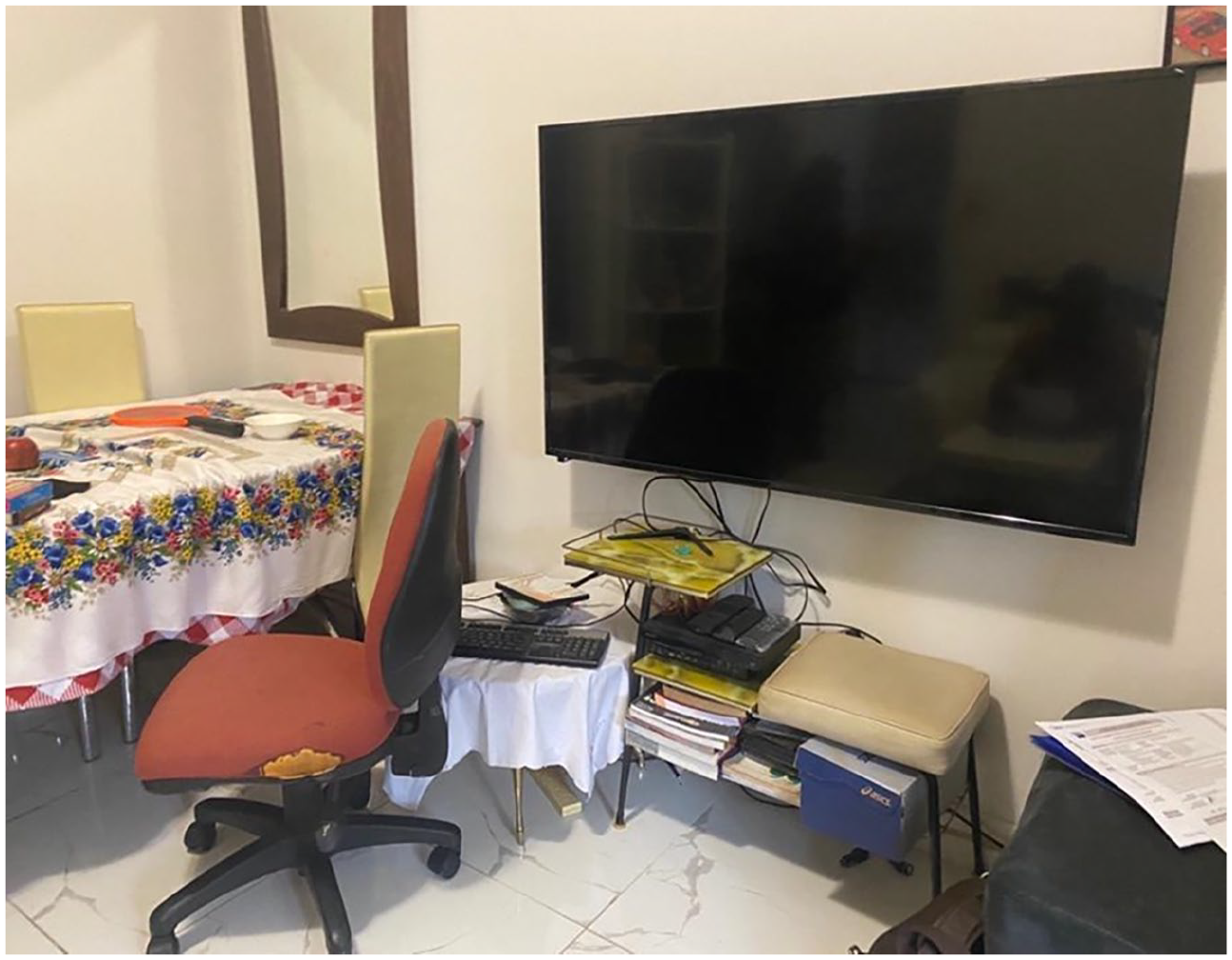
The smart TV in the Sharma household.
Both of Krishna’s daughters explained in our individual interviews that they like consuming media with their father that connects them with their culture and religion. Each of his daughters had different programmes they liked to watch with their father. Sixteen-year-old Leela liked to look up Indian recipes to cook with her father and Indian comedy programmes (in Hindi language). Older sister Radha, 19, watches a dramatised real life crime programme from India with her father, called Crime Patrol. All of this content they watched with their father was played on the smart TV, via YouTube.
Not all content being consumed is related to their Indian heritage. Leela also told us she followed Jay Shetty on YouTube, an Indian English podcaster, author and ‘life coach’ who has videos on YouTube about how to have good relationships, be more confident and achieve life goals. This content she said made her feel like ‘I have a purpose in my life’. She preferred to watch on her personal mobile device though, rather than the family smart TV.
However, Krishna pointed out in our individual interview with him that searching for health advice on YouTube at times produced problematic content and he felt this needed to be monitored in the home.
Like the other day my daughter went on there [YouTube]. I told her, ‘what are you doing?’ She said, ‘it’s telling when you’ve got too much headache put some ice on your head.’ And I said ‘no’. She said ‘no no it will get better, that’s what they were saying.’ I said ‘no, you don’t know what you’re doing to yourself. You might get sinus with it. You can’t put cold water on your head and think you are fixing yourself. No. It’s not right. It’s completely wrong’.
The Ahmed family: Negotiating intergenerational media use
The Ahmed family include two parents (only mother Zara takes part in the study) and their seven children (six of whom took part in the study). The children’s ages range between 6 and 25 years. Zara, her husband and eldest two daughters migrated from Libya as refugees 17 years earlier. The younger children in the household use YouTube extensively on the Smart TV. This was the only way to consume content on their Smart TV since their antenna was broken and terrestrial television was not available and they don’t have subscriptions to any streaming platforms. Eight-year-old Sakeena told us that she subscribed to many ‘lifestyle’ channels while she also likes some educational content—like ‘videos that show different styles of handwriting’. Zara also puts on the Quran study for the children and her older daughters also put movies on for their young siblings on the weekend.
Mother Zara explained she sometimes likes watching sport on TV, especially tennis and the family watched some of the most recent Olympics together. She says she has strict rules about technology free times though – especially during dinner and she insists the children do homework and Quran study before they watch entertainment. In Zara's house, because terrestrial television options were disabled, YouTube and the national broadcaster’s ABC iview were the main channels being used to access content on the smart TV. Zara’s 22-year-old daughter Jameela explained:
I personally don’t watch TV now, because I never have time to just sit down and just watch but sometimes if I'm putting on a movie for them [the younger children], then I will be there. So YouTube; watching movies. Sometimes my mom would watch the news, any updates that are on YouTube as well. And just things like that because at the moment, we don't have a connection to like actual digital TV. So we're just making use of what we have.
Eight-year-old Sakeena explained that although she watched content from YouTube across devices there are ongoing negotiations that take place around what can be viewed on the smart TV.
And how about YouTube, like do you subscribe, any channels on YouTube?
Yeah. Vlogs, lifestyle and aesthetic stuff. Like when they like to organise things and like decorating rooms, and that kind of stuff.
Okay, and how about — do you watch any religious videos or education videos on YouTube as well?
Yeah, we put the Quran on the [smart] TV and we listen to it.
Okay, what is your favourite YouTube channel?
Nicole Leonard [an ice-skater]. Like lifestyle stuff. . .On weekends we have family time. Sometimes I watch family movies, and like, one, favourite movie, sometimes we'll all choose and watch.
Okay, who decides which program to watch on the smart TV?
My older sisters! [laughing]
Key findings and discussion
While the emergence of social media has dramatically changed the way people consume digital culture by making it more personalised and individualised, the Internet-mediated smart TV can be seen to challenge this trend by allowing personalised media engagement to become a shared experience that is both social and participatory (Beer and Burrows, 2010).
During the 15-month period we carried out ethnographic research with the four families described in this paper, we learnt about the ways each family use the smart TV for learning, socialisation, entertainment, health activities and advice and cultural connection. For each family, it was evident that the smart TV was integral to family life, functioning as a device for both shared and individual learning and experiences. The frustration and anxiety Laila expressed due to her family’s smart TV breaking and becoming unusable provides one example that demonstrates the central role the smart TV had acquired in this household.
Our findings show that the smart TV both disrupts and extends the role the traditional television played in migrant family homes. We find that the smart TV (a) enables diverse forms of social and cultural participation that connect migrants with their homeland and help to establish diasporic and transnational subjectivities; (b) offers an all-in-one media experience within the household through its built-in internet connectivity and (c) contributes to processes of digital inclusion as an empowering technology that supports intergenerational social and cultural participation in society and informal learning. We explore each finding further in the following sections.
The smart TV and identity negotiation
At least since the uptake of satellite TV, television has enabled communication across territorial borders and offered rich possibilities for migrants and their families to engage in multiple cultures and social contexts (Bozdağ, 2014; Georgiou, 2006). Aksoy and Robins (2003) found that satellite television offers migrants transnational content which provided multiple points of reference for the construction of imagined selves and communities through connection with the homeland and the blurring of spatial boundaries. More recent developments in television technology and the evolution of YouTube have continued to influence how diasporic, transnational and intercultural consciousnesses are shaped (Aziz, 2022; Hepp et al., 2012; Leurs et al., 2016). Our research suggests that in the current smart TV era, migrant families use this device as a means for both familial cultural connection and identity negotiation.
This experience of connection and tapping into a multitude of reference points for forging migrant subjectivities was evident across all four households included in this article. For instance, Fatima felt watching documentaries through YouTube on the smart TV transported her back to Somalia, where she was able to experience the same changes and growth her family still located in the country were experiencing. This form of connection ensured the ‘de-mythologisation’ of the frozen image of the homeland (Aksoy and Robins, 2003:95). This content also provided an opportunity to share new and historical developments with her children and extended family. Sixteen-year-old Leela, of the Sharma family, explained to us how she was following an Indian-English life coach podcaster and watching TV series and spiritual programmes in Hindi language with her father on YouTube, demonstrating how streaming technologies allow migrants to ‘think across spaces’ (Aksoy and Robins, 2000:358) using personalised and shared media consumption practices in the home. Similarly, our interview with the Ali family was telling with regards to how the smart TV was mobilised in different ways by each member of the family, seemingly in accordance with generational variances and distinct needs and tastes, while still supporting discussion and connection and some shared experiences. While Laila’s children were using the smart TV to play games from Google Play, watch Tom and Jerry cartoons and familiarise themselves with their mother tongue, Laila was predominantly engaging with the smart TV to learn English and nurture her feelings of connectedness with her homeland Somalia.
It was also evident in the research that the smart TV was being used by all the parents in the four households to access and share with their children content from their home country, childhood and/or cultural heritage – food, music, films as well as religious content. In this way, transnational consumption of local language media was being shared in the home and being used by parents to share and explore cultural knowledge. These varied media consumption patterns within the households that were included in our study all point to the salient finding that the smart TV addresses diverse social and cultural needs and experiences and because of this has become an integral part of everyday life of low-income migrant families. In doing so, the smart TV plays a crucial role in shaping migration experiences and subjectivities.
The smart TV as an all-in one media experience
Each family’s narrative about their everyday use of the smart TV illustrated that in each case the television is understood as something much more than a broadcast device in the conventional sense. Perhaps one of the most important novelties of the smart TV in relation to migrant households was its capacity to offer a multiple of functions via a single device. Whether using YouTube as a search engine to find instructional content, watching a TV series in their parents’ mother tongue, or consuming entertainment and news from their homeland, the smart TV was mobilised by members of migrant families as an all-in-one household media that connected each family member to one another and built or consolidated their sense of a shared culture.
Our research also showed that YouTube – often accessed through the smart TV – was being used to perform rituals that were once performed in religious spaces. Since it was not always possible for households to attend their religious place of worship during COVID restrictions, the four families continued this ritual by watching religious content on YouTube. This was a particularly unexpected form of engagement with the television and offered us insight into a novel media consumption practice made possible by the smart TV: that is, media consumption on YouTube, which is often (mis)understood as individual or ‘personalised’ media in a communal manner, often takes place communally, in the company of family members. However, the all-in-one capabilities of the smart TV did not mean that the terrestrial television no longer had any value. All households (except for one without access to terrestrial television) used YouTube on the smart TV, but still engaged with traditional broadcast television as well.
Our ethnographic research findings demonstrate that the smart TV in diasporic family households blurs the boundaries between television and the internet as two different forms of media. As Beer and Burrows (2010) have suggested, the smart TV enables the transformation of personalised media consumption into a shared experience, opening up novel methods for socialisation and participation. In this regard, it offers an unprecedented media experience for the family, not only juxta positioning and merging online personalised media and mass targeted broadcast media in a single device, but also hybridising and intermixing the ways in which these different media are being consumed, so that, on the one hand, watching a religious ceremony in the parent’s mother tongue on YouTube becomes a communal family practice, and on the other, the family television can become a personal platform through which video games might be played or YouTube influencers may be followed. Perhaps this is one of the most prominent novelties of the smart TV, or in a McLuhanian (1964) sense, the ‘intrinsic message’ of this particular medium. In turn, as we have come to realise through this ethnographic research that the smart TV has become a ‘central hub’ for entertainment, education, socialisation and connectivity within the family context that operates on both personal and communal levels.
The smart TV and digital inclusion
Finally, our study has shown us that one of the most prominent ways the smart TV was used among the low-income migrant families who participated in the research was as a platform for digitally-mediated social and cultural participation. Although this participation does not immediately align with current understandings of digital inclusion, we think this warrants more attention. As Helsper (2021) argues, ‘social interaction, belonging and empowerment’ (182) have been neglected areas in digital inclusion research while solutions have largely had an ‘individualistic framing’ that puts the onus on individuals to develop their own digital capabilities (185). This framing assumes that everyone has the equal ability and confidence to work out how digital participation can enhance their ability to participate in society and to address their socio-economic disadvantage. Dezuanni et al. (2023) and Helsper (2021) argue that digital inclusion responses need to be reframed as a whole-of-society effort, rather than individuals being left to work this out for themselves. The smart TV may support this shift because it potentially offers a way to recognise and connect with everyday family life and benefit from the expanded needs, interests, skills and abilities different family members have.
Digital exclusion deepens social, cultural and economic divides (Helsper, 2021). People who are digitally excluded are far less likely to use the internet for health or government services, to learn or study or to socialise and connect with friends and family (Thomas et al., 2021). In our Western Sydney research, the migrant parents included in our study often experienced low literacy, low digital ability and/or low English fluency and all of these factors stood in their way of using digital social support services. In addition, the parents in the study were all extremely time-poor, with much of their time spent on making ends meet and addressing the household and children’s needs. This left very little time or opportunity to explore how digital engagement could help them to achieve their goals and meet their needs. However, the smart TV supported informal digital and cultural learning that happened incidentally as different members of the home used this device to meet their own or other family member’s needs and interests. For example, when Krisna’s daughters told him they could watch old videos on YouTube he asked them to look up cultural and entertainment content that he had grown up with. When they did this, he learnt about the affordances of YouTube, while they learnt more about his childhood and cultural influences. Along the way they worked out they could find authentic Indian recipes and yoga videos that they now sometimes enjoyed. These experiences enriched their family experience and deepened their shared sense of identity while also developing everyday knowledge and skills.
Migrant families facing socio-economic challenges are particularly vulnerable to digital exclusion (Dezuanni et al., 2023; Notley and Aziz, 2024). Smart TVs, with their Internet connectivity and multifaceted functionalities, hold the potential to help address this issue by providing access to online resources, education, healthcare information and entertainment while challenging the current individual focus of most digital inclusion initiatives. When families can discuss the potential of digital inclusion to meet their needs, limitations such as language, literacy and digital skills barriers can potentially be addressed by different members of the household (Aziz, 2023).
While the digital inclusion potential of the smart TV remains largely unrealised, some examples of use in this research clearly point to this opportunity. To further develop digital inclusion via the smart TV and/or YouTube, governments, community and social services need to consider how content can be made accessible and relevant on this device. Our research suggests that a ‘family-centred design’ approach could be used to inform digital and social inclusion services that are accessed and engaged with by migrant families (Trilar et al., 2019). Overall, while digital inclusion research primarily focusses on access to, affordability of and the ability to use mobile phones, laptops and desktop computers (Helsper, 2021; Ragnedda and Muschert, 2017; van Dijk, 2020), the smart TV provides a new direction and opportunity to focus some initiatives on shared, household practices.
Conclusion
In this study we explored how the smart TV has become a highly valued device in low-income migrant family homes in Australia. Through our ethnographic research, we find that in four of the five homes included in our study, the smart TV is a prominent, multifunctional device that is used for many different purposes — to engage with children’s learning at school, to look up recipes and play music from the parent’s home country, to learn languages, to play entertainment content for the children so as to permit work to be done and for familial engagement with cultural, religious and spiritual content.
Our findings show that while the parents in each household had limited digital skills and often experienced anxieties associated with digital harms and threats such as online scams as well as financial hardship associated with their connectivity (Notley and Aziz, 2024), the affordances of the smart TV enabled a diverse range of shared experiences and learning about language, religion and culture which ultimately supported the parent’s digital inclusion as they learnt (often from their children) how to find content that meets their immediate interests and needs. In return, children benefited from their parent’s guidance and knowledge which served to identify and contextualise trustworthy, relevant and appropriate content for them to deepen their social and cultural connections. The smart TV was also unique in that all other internet-enabled devices in the home – laptops, mobile phones and iPads – were primarily used by one individual only or by one person at a time. For this reason, the smart TV played an important role in the family as a shared internet-enabled device. We therefore find that the smart TV, perhaps more than any other device in the home, has a crucial role to play in intergenerational digital inclusion because it enables shared social and cultural participation and learning.
This paper specifically focusses on uses of the smart TV to better understand and contextualise intergenerational digital inclusion opportunities in the home. Digital inclusion scholars may want to further consider this issue from the perspective of migrant and low-income household settings by examining, for example, how digital abilities can be developed in family settings or how access to social services can be mediated through family-focussed interactions on YouTube. This study, however, provides some preliminary insights about everyday smart TV practices and indicates the significant potential this device holds for developing digital inclusion in low-income multi-lingual migrant family households.
Footnotes
Acknowledgements
Tanya Notley would like to thank Dr Jasbeer Musthafa Mamalipurath for his support and rich insights as the fieldwork co-researcher for the Western Sydney research.
Funding
The author(s) disclosed receipt of the following financial support for the research, authorship, and/or publication of this article: This research was funded by an Australian Council Linkage grant (LP 190100677).
