




Abstract
This study examines journalists’ working experiences to understand how they hinder the recognition of female footballers’ performances. It relies on 16 semi-structured interviews with Swiss sports journalists on Swiss French-speaking television. Guided by Pierre Bourdieu’s theory, the study shows that advancements in the recognition of women’s football are promoted by a combination of external actors’ economic and political powers, while hindrances arise from internal factors within sports journalism. The embodied norms, routines and professional practices of journalists – that define performance as physical capital and naturalize hierarchies between women’s and men’s football – are disrupted by the credit (i.e. symbolic capital) given to women’s football by the Swiss football league and sponsors for political and economic reasons. This specific case of football enhances our understanding of the cultural and social factors that hinder the recognition and appreciation of performances by women in sports. Further, the study largely highlights how texts and their symbolic power are embedded in the social conditions of information production.
Introduction
An extensive body of research has examined the mediation of women’s sports. Overall, women suffer more from gender-biased coverage, both quantitatively and qualitatively (e.g. Bruce, 2016; Cooky et al., 2021). Scholars have denounced the negative impact of the gender-biased coverage of sports on the recognition of female athletes and their status, as it supports the idea that women’s sports are not newsworthy (Serra and Burnett, 2007). The direct impact of such coverage – that it makes attracting sponsors and the females becoming professionals harder – on the economic value of women’s sports has also been studied (Cooky et al., 2013). Gender bias also negatively impacts consumer perceptions of women’s sports and female athletes (Fink, 2015). These elements reinforce stereotypes and assumptions about those who participate in sports (Zenquis and Mwaniki, 2019), and perpetuate the asymmetrical gender order in sports and the ideology of sports as a male domain (Delorme and Pressland, 2016).
The bulk of research on this topic has been dedicated to content analyses and readings of media texts, with a focus on how sports media reproduce, legitimate and occasionally challenge the ideologies of gender (Bruce, 2013). However, the production of sports articles has not been sufficiently focussed upon. Nevertheless, the negative impact of gender-biased coverage in sports calls for critical investigations of disparities in the representation of male and female athletes to identify changes and inertia in different countries and over time. It is essential to understand the mechanisms that slow or promote these changes. Therefore, more research that goes beyond the usual denunciations of gender biases in media coverage is required. Merely assigning blame to individuals involved in the production of sports news does not contribute significantly to knowledge advancement. Thus, the processes of selection and hierarchies of the news within the broader system of cultural recognition, which produces a difference in value between male and female athletes and sports events, should be better understood.
To critically address the reasons why sports newsrooms continue to privilege men over women, this study focuses on the complex system of sports performance in which sports journalism participates. It analyses the case of women’s football in the Swiss context, where the first league – the Women’s Super League (WSL) – was broadcast for the first time in 2020. The findings show that this change is not the result of a single actor or a change in sports journalists’ mindsets, but rather a combination of internal and external factors, which also explains why the Swiss journalistic field refracts the gender issue differently and gives a relatively greater symbolic value to women’s football. Using Bourdieu’s theory, we argue that contrary to the dominant journalists’ discourses, this recognition is not due to the fact that the new generation of women footballers have greater bodily ‘dispositions’ (Bourdieu, 1986) and that women’s football has ‘made progress’ and reached a ‘new level’. As we argue, the value given to the physical capital of women footballers – as a form of ‘embodied state’ of cultural capital (Bourdieu, 1986: 242) – has increased because of the changes in the system of cultural recognition that produces their symbolic capital, which is ‘a credit’ (Bourdieu, 1989: 23). Therefore, by employing Bourdieu’s theory, this study aimed to understand the particular social conditions that limit or facilitate the conversion of women’s physical capital into symbolic capital.
To this end, we first analyzed the internal logics of sports journalism focussing on professional practices which resist the conversion of women’s football into symbolic capital. Journalists’ definition of performance as physical capital, central to the norms of sports journalism, contributes to the naturalization of hierarchies between women’s and men’s football. This supports the argument that women’s football is more newsworthy and has more value when women players can play like men. Second, we turn to the external logics that impact this journalistic field and question how they contribute to disrupting professional norms. To grasp the credit given to women’s football, one needs to understand the symbolic economy of the stakeholders, particularly from the media market and sports, which produce the value of women’s football. Within the specific broadcasting culture of Switzerland, the advancements in the recognition of women’s football are promoted by a combination of external actors’ economic and political powers, while hindrances arise from internal factors within sports journalism. While this study’s findings are dependent on a particular time and context, and it is reasonable to anticipate that the situation may differ in other countries, this case study holds a unique appeal as it highlights the way external factors can lead to significant changes in a country’s broadcasting culture, despite these shifts conflicting with the established practices and norms of journalists, as understood within the framework of ‘dispositions’ according to Bourdieu. This study goes beyond current research critiquing gender bias, which has had limited impact on reshaping the value attributed to women’s athletic achievements, by exploring how, in the intricate interplay of broader structural factors and journalistic professional practices and norms, levers for achieving more equitable coverage of women’s sports are conceivable within similar complex systems across different contexts.
Literature review
Media coverage of women’s sport and football
Research has been conducted on the media coverage of women’s sports from a quantitative perspective. Studies have shown that despite positive changes (e.g. Sherwood et al., 2017; Wolter, 2021), female athletes continue to be greatly underrepresented in media regardless of the type of sport, level or age of competitors or the type and origin of the media, and that changes appear slowly (Cooky et al., 2021; Godoy-Pressland, 2014). The coverage of men and women has been shown as more balanced during major sports events such as the Olympic Games (Bruce, 2013). Furthermore, the type of sport influences the amount of media coverage on women, and female athletes generally receive more media coverage when they participate in ‘gender-appropriate’ sports (Sainz-de-Baranda et al., 2020).
Specific research on the media coverage of women’s football is scarce. Several studies have revealed an increase in media coverage of women’s football – despite being a traditionally male-dominated sport – particularly during major events such as the World Cup. In the US, Ravel and Gareau (2016) noted a significant surge in media attention towards women’s football as early as the 1999 World Cup. The 2015 final, won by the US women’s national team, set a record for the most-watched football match (in both men’s and women’s matches) in US history, and Bell and Coche (2018) viewed it as a positive development towards addressing the stereotypical underrepresentation of female athletes in the media. In the European context, Petty and Pope (2019: 492), while examining the coverage of the 2015 Women’s World Cup in the UK press, observed ‘a more positive shift in media representation of women’s football since 2011’ and argued for a new age of media coverage of women’s sports. Leflay and Biscomb (2021) observed greater media coverage and more positive and authentic portrayals in England in 2017. Coche (2022) conducted a comparative study of French, English, German, and Spanish online media during the 2019 Women’s World Cup and revealed varying degrees of coverage.
Media coverage of football outside major events, particularly national championships, remains poorly documented. In the Netherlands, Peeters and Elling (2015) have shown the greater visibility of women’s football in Dutch print media and television since the introduction of the women’s national championship in 2007. This is also the case in the US, where football is the third most covered women’s sport after tennis and basketball (Cooky et al., 2021). However, the COVID-19 pandemic has adversely impacted the media coverage of women’s football in the British media (Parry et al., 2021). Football remains vulnerable and is infrequently covered by television (Crouse, 2013). Overall, these studies show that football seems to have received more media attention. This increase is a general trend in women’s sports (despite its overall under-mediatization), although football seems to perform particularly well.
From a qualitative standpoint, these observations are less positive; however, research continues to point to severe biases in the nature of discourses that accompany female football players’ performance. Pfister (2015) showed that in the German press, women’s football was presented as ‘inferior’ to men’s football with suggestions that women ‘by nature’ were not made for ‘real’ football. Black and Fielding-Lloyd (2019: 296) revealed that UK newspaper discourses on the 2015 World Cup ‘represent the women’s teams and games in relation to an established dominant male standard’. It has been shown more generally, not being limited to football, that a good ranking was not sufficient for most female athletes to gain media coverage. The coverage of women’s performances has traditionally been supported through their sexualization, which is often assumed to contribute to the sale of women’s sports (Kane et al., 2013). However, sexualization alone is not sufficient to bridge the gap between women’s and men’s sports. It simply enables a select few female athletes to benefit from their adherence to societal norms of ‘emphasized femininity’ (Connell and Messerschmidt, 2005). Davis-Delano et al. (2009) observed that to avoid being labelled negatively and to take advantage of their sport performances, female athletes need to engage ‘apologetic behaviours’, such as participating in feminine sports, emphasizing femininity in appearance, minimizing muscular development or moving in feminine ways. The focus on women’s athletic abilities tends to be on their aesthetic qualities, which can lead to an underestimation of the value of women’s sporting performance. However, a decrease of sexualisation as a means of recognition (Cooky et al., 2021) and the valorization of ‘unapologetic behaviours’ challenging the dominant gender norms (Davis-Delano et al., 2009) show a greater diversity of the forms to value women’s sporting performance.
Reasons for under-mediatization of women’s sport
Research examining reasons for the overall under-mediatization of women’s sports, especially football, suggests three different factors governing sports news:
(1) Male-dominated sports newsrooms: Extensive literature on women and sports shows that sports remains a domain structured around hegemonic masculine values that contribute to the reinforcement of historical gender norms (Connell, 1995) and that this hegemonic masculinity is reflected in sports newsrooms (Whiteside and Hardin, 2012) which remain a ‘men’s environment’ (Lenartowicz et al., 2019). In a long-term historical process, this hegemonic masculinity has made it particularly difficult to change sports newsrooms (Black and Fielding-Lloyd, 2019). Structural and organizational barriers have caused sports newsrooms to be dominated by men and women, who are treated as outsiders (Organista and Mazur, 2020; Schoch, 2020) and men predominantly define professional norms and values in sports newsrooms (Schoch, 2013).
(2) Assumptions about readership/audience: Several studies (e.g. Knoppers and Elling, 2004) have suggested that sports media prioritize men’s sports because they believe that it is what readers expect. However, Rowe (2007) and Sherwood et al. (2017) found that sports editors base their selection of sports news on audience or readership expectations, that are mainly based on personal beliefs and ingrained assumptions, rather than on hard evidence. There is an assumed taste of the audience, identified by mass media as male viewers and readers mostly interested in male sports (Wu, 2008). Nevertheless, Laucella et al. (2017) showed that US sports editors’ values and beliefs have shifted over the past decade in ways that could lead to improvements in the coverage of women’s sports.
(3) As a result of male-dominated professional culture, scholars have observed that women’s sports continue to be considered of lesser value and cannot generate audience interest among male journalists who occupy the positions of power within sports newsrooms and largely determine the newsworthiness of subjects (Lenartowicz et al., 2019; Schoch, 2020). Journalists’ low valuation of women’s sports is reflected in the way they speak about female athletes and their performance (Kane, 2013). These low-value narratives are particularly expressed in media producers’ audience research motivations (Lowes, 1999; Sherwood et al., 2017). Furthermore, gender is embodied in sports newsroom norms, routines and professional practices, and, therefore, is not discussed or questioned by female or male journalists (Lobo et al., 2017). This aligns with Hardin and Shain’s (2005) observation that women sports journalists in the US adopt hegemonic values, thus being more willing to accept their marginal status and less likely to facilitate any change.
While these studies are useful, they do not consider how female athletes’ performance is valued in connection with the cultural changes that produce recognition. Sports and the media refract women’s sports in different ways based on the types of sports, countries and cultures. Therefore, particular social conditions inside and outside the field of sports journalism, which create (or do not create) a new configuration and allow women’s sports to receive greater media recognition should be better understood.
Research question and theoretical framework
We drew on Bourdieu’s (1980, 1984) theory to understand why the ecology of sports media refracts women’s football differently and in interaction with social conditions. Journalism can be analyzed as a field – defined as a ‘field of forces’, that is, partially autonomous, wherein symbolic struggles are featured (Bourdieu, 1980) – and every journalistic speciality can be considered a subfield that operates like a microcosm (Marchetti, 2005). Journalists, as actors of a specific field, share ‘categories of perception which constitute the doxa’ (Bourdieu and Wacquant, 2013: 298). The doxa – the ‘explicit orthodox/heterodox news values which are part of the sphere of journalistic judgement, and the implicit, silent doxic news values which are part of the sphere of journalistic doxa’ (Schultz, 2007: 15) – defines values attributed to various subjects and stories. Scholars have shown that journalists’ struggles for position, recognition and power within the journalistic field further explain how they produce a specific piece of information (Marchetti, 1998). The issue of symbolic power represents the ‘epicentral and truly original’ Bourdieu’s concept (Wacquant and Akçaoğlu, 2017: 57). Symbolic power is concentrated in cultural institutions, where the media play a key role (Thompson, 1995), as observed in the central role they play in the value given to sports performance. By making some things more visible than others (Thompson, 2005), the media influence the recognition of the value of sports performance. This question of symbolic power has already been used to understand how women’s magazines rank lifestyles (Törrönen and Simonen, 2015) and to question the limitations of subversive symbolic power on the Internet (Tang and Yang, 2011). Symbolic power is central to understanding how a specific subfield of sports journalism shapes, diffuses and legitimizes symbolic frames in sports. Journalists have the power to convert female athletes’ physical capital. They translate the meaning of sporting events through articles, comments and editorial choices. The way in which they do this affects the valorization of sports performances. Although some sports journalists may be more convinced of the importance of valuing women’s performance better, women’s sports are not arguably a central issue in their work. As many studies have shown, the classic doxa of sports journalism places men’s sports as the norm above women’s sports, which are largely underreported.
In this study, we argue that the nature of the content with which journalists deal is important for them, because their professional symbolic value is attributed in the way performances are given meaning and are prioritized. On the one hand, they face internal constraints within their organizations (general strategy of the media, economic resources of the media, etc.), and they must ensure internal professional recognition. However, they also face external constraints because they have competing media outlets, and their recognition depends on the audience and other stakeholders – mainly sponsors and sports organizations whose economic and political power (Thompson, 1995) has symbolic dimensions.
Sports journalism is not immune to external changes, such as a federation’s action plan in favour of women, the arrival of a new major sponsor, government policy recommendations favouring a gender-balanced representation of females and males practicing sports in the media – as it is heteronomous, and the latter can therefore change the refraction of the value given to women’s football in combination with internal logics. Journalists are not isolated from other social spaces; they must deal with women’s football or risk not meeting internal and external expectations for wider coverage. This means that their symbolic capital is at stake when they choose to emphasize female athletes’ value. Their position is complex because it requires them to adapt their professional habitus to accommodate the societal expectations of an increased coverage of women’s football. This adaptation involves navigating tensions between their adherence to the doxa, which prioritizes men’s football as the benchmark, and the societal demand for greater attention to be given to women’s football, of which they remain hesitant overall.
Field and methods
Sport news in the Swiss media context
Switzerland is a small multicultural country divided into three linguistic regions that correspond to three regional media markets. Television remains the most popular medium in terms of media consumption (IGEM, 2021), particularly sports news, as 65% of the Swiss population consumes sports on television (Lamprecht et al., 2020). Swiss public broadcasting group (SRG) operates in three linguistic regions. In the French-speaking area, its share is 14.5 times higher than the average market share of the Swiss private’s channels (OFS, 2021b). Sports play a prominent role in the SRG’s programme schedule. In 2019–2020, sports content had almost the same broadcasting time as ‘fiction’ and much more than ‘Education, Science, Culture, Religion’ programmes (OFS, 2021a). Football is so far the most covered sport in the press and on TV. Female athletes and sports represent only 13% of Swiss sports news (Schwaiger et al., 2021).
Collection of the data
We conducted 16 semi-structured interviews with journalists (n = 10), editors-in-chief (n = 2), producers (n = 3) and marketing and sales directors (n = 1). Nine worked for RTS, a public channel, and seven for private Swiss French-speaking television. Ten were men and six were women. Their average age was 42 years, and the average duration of their employment in sports journalism was 18 years. We interviewed people in various positions on both public and private TV channels to understand how the broadcasting of women’s football was facilitated on the RTS; how and by whom this change was initiated and supported, and whether there was any resistance. The interviews were conducted between April 2021 and March 2022. Interviewees were asked a range of questions on their trajectories, work and views on the mediatization of men’s and women’s sports, especially football. The interviews were transcribed with the participants’ consent. A thematic qualitative analysis informed by a combination of deductive and inductive approaches (Mayring, 2014) was performed. We started by using an analysis grid that followed the topics framing the interview grid and previous literature. However, following an inductive approach, we identified emerging patterns of expression and recurring topics and arguments and added them to the grid (Mayring, 2014). To preserve anonymity, we removed all identifying names of the individuals and media for which they worked when we presented the interview data. Further, we gathered data on the diffusion of football in the Swiss television market, audience ratings, amount of viewing and audience share of football broadcasting on Swiss TV. Data were collected through websites, press releases and reports available online from various organizations.
Results
Internal logics: professional habitus and resistance to the conversion of women’s football into symbolic capital
The interactions that journalists opt for in their professional practice are contingent upon their social and professional history which has produced their ‘dispositions’ (e.g. socializations, sporting tastes, professional routines, capital), their positions in the journalistic field (e.g. seniority, hierarchical position), as well as the position and recognition of their interlocutor within the sports field (e.g. the athlete’s level, their role as coaches, leaders). Inspired by Bourdieu (1984, 1989), we found these dimensions to be highly relevant in understanding why journalists prioritize men’s football and the resistance to promoting the performances of women footballers.
Embracing Women’s Football: Journalists’ Compelled Coverage Driven by Competitive Media Market Forces
The 2000s witnessed the development of private and commercial channels in Switzerland. This has resulted in an increase in broadcasting rights for the main sports events and championships, particularly football, the most popular sport in the country. Since 2006, the public channel has lost TV rights for the main male international and national championships to private channels. In this context, men’s football has become too expensive for the audio-visual Swiss public group. Because of the lack of interest in private channels in women’s football, RTS has acquired the rights for the WSL in the 2020–2021 season. A male journalist working for a public channel states, And we, in the RTS, tell ourselves: “we must make the investment now”, not be overtaken and find ourselves excluded from the market the day when the private sector realizes that the sponsors are coming, it is worth showing women’s football.
Competition between channels and the need to negotiate deals on emerging practices have created a favourable context for women’s Swiss football. Figure 1 shows that the coverage of women’s football has remained much lower than that of men’s football in the RTS. However, we observe that proportionally, the share of the domestic league and other international competitions is the same for men and women. Thus, since 2020, media coverage of women’s football has depended less on major international events and championships, which is an often-observed bias.
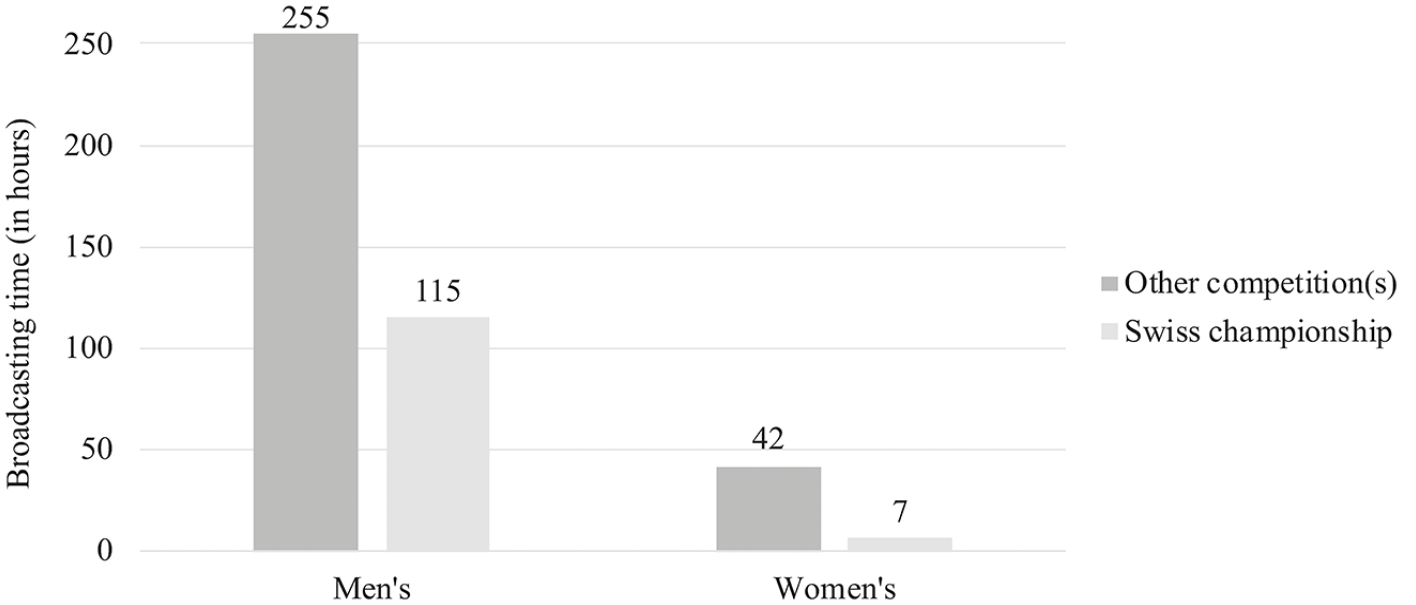
Broadcasting time of men’s and women’s football on RTS, 2018–2021, all competitions.
Economic opportunities contribute to redefining the content broadcast in the RTS. This is achieved through managerial decisions taken at the top of the media group without consultation with the sports newsroom.
As shown in the next section, the conditions under which male journalists form their habitus no longer entirely align with the conditions under which they are expected to carry out their work and, consequently, some adjustments are required (Bourdieu, 1974). Despite this new situation, characterized by a mismatch between the professional habitus of male journalists, which tends to value men’s football over female’s football and the emerging injunction to take women’s football seriously, male journalists have been reluctant to recognize the value of women’s performances.
Women’s football in sports newsrooms: tensions between professional doxa and promotion of sports diversity
There is no school of journalism in Switzerland, and to become a journalist, one must complete a two-year internship at a media outlet, generally after graduating from university. Thus, professional socialization within the speciality of sports is strong, and high acculturation of the professional habitus of sports newsrooms is observed. Journalists unanimously consider male soccer and ice hockey as the most important sports, deserving of the widest coverage by journalists and these two sports are consequently central to journalists’ professional norms transmitted through professional socialization. This hierarchy originates outside the field of journalism, and these sports generate the greatest public interest (Moret and Ohl, 2019). This accounts for the resistance encountered in acknowledging the media value of sports perceived as minor, as well as the value of women’s sports. One female RTS journalist observed the following: Male journalists take less interest in sports that are a bit more feminine. In sports, male journalists often prefer football and ice hockey. It is women who commented on so-called minor sports and women’s sports. On the other hand, hockey and football are somewhat preserved.
Therefore, for football, the practice of men is set as a reference. While journalists’ specific professional capital is based on encyclopaedic knowledge of men’s football, remembering rankings, transfers and so on, their knowledge of women’s football is limited. When asked who the best current Swiss female football players were, several journalists could not name more than two or three. Here is an example: In French-speaking Switzerland, who is there? There’s Caroline Abbé and then. . . The names escape me, so that means it is not yet anchored in people’s minds. . . The Servette goalkeeper. . . What’s her name? Well [laughs]. . . (male private producer)
Journalists’ professional capital is contingent on their capacity to establish connections with athletes who have high symbolic capital. Thus, the lack of knowledge about female players’ names shows how little women’s football contributes to the value of journalistic work. The way in which media organizations give journalists the ‘power to speak’ (Bourdieu, 1991: 9) also significantly affects female players, because making them invisible hinders their recognition. Furthermore, interviewees tended to compare women’s football with men’s football and insisted on the differences in terms of physical and technical performance: It is not the same approach as sport, not the same way of being, not the same way of playing. There may not be the strength or power that male footballers possess. However, there is also a tactic in which there is a game. It’s interesting to see. (male RTS journalist).
Although this journalist finds positive aspects in women’s football, he refers to physical capital as the determining element in the conversion of performance into symbolic value and, therefore, unintentionally devalues women’s football. As in the following testimony, interviewees often constructed a hierarchy by differentiating the tactical/strategic qualities of women from their lower physical (speed and strength) capacities, which limited the recognition of the performance value: The problem with women’s football – and this is due to us men – is that we want to compare them. However, with rare exceptions, a girl will have less strength than a boy, so logically, girls should play differently based on their qualities. Thus, they are more intuitive. You have to play with your qualities; you cannot play like you are copying what the men do. (male RTS journalist)
The conversion of physical capital into symbolic capital cannot be achieved through the value attributed to sports events. The more prestigious the event, the more valuable the athlete’s performance. Female tennis players hit the ball less hard, and female skiers go slightly slower than men. However, when they win a grand slam tournament or Olympic title, physical differences are of little importance. This shows that the symbolic value of a performance does not depend primarily on physical capital but on how the performance is perceived, processed and converted.
However, not all journalists adhere unanimously to these norms; some are more critical. This distance may be experienced by a few male RTS journalists, but mostly by female sports journalists interviewed in this study. As they had worked in various sections before sports, the interviewed women had a more polyvalent profile than their male colleagues who specialized more in sports because they had worked exclusively in sports as their professional objective and had been mostly socialized in this journalistic section. Furthermore, these women were often responsible for minor sports. This is also the case for some of their male colleagues, because owing to the fierce competition for TV rights, a much wider variety of sports is covered – and football and ice hockey are emphasised less – on the RTS than on other private channels. One female RTS journalist observed the following: We have to play the role of being plural, taking side steps, and sometimes being a little more original. We always pay attention to what we consider editorially relevant. In this context, there are major sports; football remains a major sport, hockey, in target periods. But voluntarily, we always try to keep room for our side steps.
Furthermore, the interviewed women acknowledged professional standards that value men’s football over women’s football, but they were more positive towards women’s practices, highlighting the quality of performance: It’s true that it’s a game that runs more slowly. However, in terms of execution and technique, there is still quality, and there can still be a show, the same as with men’s sport. (female private journalist).
They also called on their colleagues to compare men’s and women’s football less often: In any case, men and women are not similar; so to seek a comparison between them is to lack comprehension! (female RTS editor)
Journalists who stand out from the monopolization of symbolic value in men’s football are mostly women and work for public channels. The quality of their work depends on their ability to cover a variety of sports and the diversity of their performance. In sports journalism, they are dominated and do not challenge the doxa maintained mostly by male journalists, especially those from private channels, who occupy most of the dominant positions in the field. Overall, male journalists, like the following male private producer, do not believe in more balanced media coverage: But I don’t know if one day, um. . . I have my doubts, but if one day women’s football will get as much media coverage and as much attention as men’s football, I have my doubts.
Despite a more positive view of women’s football and the quality of the game, sceptical discourses on the mediatization of women’s football remain abundant. This reflects the strong professional socialization within sports journalism that contributes to the maintenance of a male-dominated professional norm that values prestigious male sports. Further, journalists’ professional capital, which makes their professional reputation, largely depends on the popularity of the athletes, championships and events they cover – the greater the prestige of a sport, event or athlete, the more they attract a large audience, leading to an increase in journalists’ professional capital. Thus, while Swiss sports media allocate more room for women’s football, the power structure within the sport journalism subfield endows male journalists with the ‘possession of capital conferring power over capital’ (Bourdieu, 2011: 128). Consequently, the combination of their powerful position and their professional habitus hinders the conversion of women’s sporting performances into symbolic capital.
External logics: a favourable trend in women’s football and its differential refraction in sports journalism
Political and symbolic power of sport organizations
The recognition of women’s football depends on how different social spaces reflect its values. Sports journalism is partially permeable to these changes, as expressed by a male producer working on a public channel: Perhaps a little more interest or attention is given to women’s football. Earlier, it might not have been considered; now, perhaps because of past experiences, we see that the public is following, that this practice is becoming more important, and that the championship is perhaps becoming more professional.
When clubs and federations invest in female teams, increase the recognition of their qualities and try to create a new market in which they can be leaders, they challenge the journalistic field and journalists’ use of their symbolic power. Clubs and federations do not just produce football skills; rather, they legitimize and value women’s football and spread the idea that women’s football is now ‘professional’ for their benefits. Interviewees knew the increased value of women’s football in some clubs, which challenged their professional standards. A female RTS journalist observed the following: Taking the case of Lyon or Paris, we see that clubs have spent a lot of money to have good teams. Also, given that these teams go far enough in the championships, in the Champions League, it creates a fervour. Well, it’s sad to say, but I think that it really depends on the financial means of the clubs to have teams that are worthy.
This journalist associates economic performance with sporting performance; however, the clubs do not just produce football skills. Prestigious clubs also have power over the production of players’ capital. Therefore, the creation of a department dedicated to women’s football (in 2020) shows that the national federation leveraged its power to enhance the conversion rate of women’s physical capital: Departments within the federation: according to me, that it is a good point to allow women’s football to develop in the right direction and in the right way. (male private journalist)
Another journalist mentions the financial support now given to Swiss women’s football: More financial resources are being allocated, particularly by the clubs. Structures are created and put in place. (female RTS journalist)
These changes made by the Swiss Football Federation provide recognition to women’s football but are disrupting the sport journalists’ doxa. Journalists were often caught in contradictions as they emphasized the recognition of women’s football, while simultaneously undermining the presumed poor quality of women’s plays.
The other day, I watched part of the match. In terms of quality, the performance was poor. Therefore, I think that in terms of media coverage, it does not necessarily interest the media beyond that. (male private journalist)
Another male journalist, who is employed by a private channel, diminishes the professionalism of women’s leagues: When you watch Paris and Lyon win all their games by 7-8 goals, does that make you want to follow this kind of football? I am not sure about that.
These examples show that the gaze of journalists is riddled with contradictions because, on one hand, their professional habitus leads them to rely on a highly technical framework that belittles women’s performances, while on the other hand, due to the political and symbolic power wielded by sports organizations, there is an obligation to acknowledge women’s football.
Impact of a major sponsor’s arrival: how economic power elevates the symbolic value of women’s performances
Prior to its TV mediatization, the WSL witnessed a key change: the arrival of AXA, the European leader in insurance, as the primary sponsor of the championship, leading the competition to be named ‘the Axa Women’s Super League’. The arrival of AXA’s sponsorship has been a game-changer. First, it has brought additional money to women’s football. Second, it has changed the recognition for the championship: it is now worthy of being supported by a major sponsor. However, this new recognition runs counter to the typical professional norms of sports journalism. Journalists are embarrassed and tend to downgrade the Swiss women’s championship as just a ‘product’ that was sold to the RTS. This enables them to express their power over the doxa by defining the ‘real’ journalistic value of the competition that their channel requires them to cover but which they do not consider as newsworthy. A male journalist described this injunction well, emphasizing the need to accommodate it: The product, now, is served on a platter [laughs]. Therefore, it is simple to implement. [. . .] Football has the right to exist at the moment, because it is really a product. I use the term “product” on purpose, which we are trying to promote.
Journalists’ professional norms are shaken by changes in the economic valuation of female football. However, AXA’s economic power (Thompson, 1995) also functions as a symbolic recognition that transforms women’s games into attractive products. Similar to the self-fulfilling prophecy, the combination of local and international stakeholders endorsing women’s football positively indicates that a commercially viable product is emerging. Although the sporting performance of these athletes is often ignored and sometimes even despised, they gradually become convertible. While these changes may not align with a complete transformation in the dominant doxa of sports journalists, they are still compelled to adapt their practices and discourse to the changes.
The figure of the citizen to be satisfied: an additional form of political power that requires journalists’ consideration
Journalists also justified the coverage of women’s football as part of their public service duties. As a public channel, the RTS must deal with the political power of other social spaces (Bourdieu, 1989; Thompson, 1995). The channel is under pressure, as some Swiss citizens want to reduce the public funding of the media, which finances the public broadcasting group by 75%, and this question is regularly addressed. Therefore, satisfying the public is essential. Journalists’ professional recognition depends on their ability to fulfil their public service mission, which requires them to find a balance between their traditional professional practices and their value system and the expectations of powerful organizations (e.g. the Swiss football league) and the public. This means that having a good audience and fulfilling its mission of public service leads RTS to be guided by a cultural logic as opposed to private channels, whose choices are primarily dictated by economic imperatives.
A female producer working for a public channel observes current expectations from the public towards the coverage of women’s sports and women’s football and describes how it was necessary for the public channel to adapt to these new social conditions despite the low adhesion of journalists inside the sports newsroom: It’s society that wants it and that pushes us. [. . .] If we were not in this current trend, we would never have done it (. . .) otherwise, we could have done it very well for years.
When speaking about women’s football, this male producer working for a public channel observes the following: I think that at the moment it is very fashionable, we must not hide.
This heteronomy of the public broadcasting group can be attributed to its dependence on the political power of the actors mentioned earlier. RTS must consider these societal expectations on the media coverage of women’s sports, even if its sports newsroom is not necessarily convinced. Furthermore, the idea of charitable ‘support’ for women’s football was echoed by many journalists who were quick to say that women’s football is not profitable and attracts little audience. A male producer working in RTS observed the following: Unless I am mistaken, the [last] woman’s derby was broadcast. I do not know what kind of audience it reached, but. . . probably not a lot.
The journalists’ account is not grounded on factual audience metrics and displays a notable implicit bias against women’s football, which is perceived as a ‘trendy product’ but not a noble journalistic topic. The mediatization of the WSL goes against journalists’ habitus, which limits the symbolic valuation of women’s achievements within the newsroom.
Conclusion
When analyzing gender bias in the coverage of women’s sports, researchers commonly adopt a ‘moral entrepreneur’ (Becker, 1963) posture, which involves condemning journalists’ ideologies and stereotypes. This is often the case because sociologists ‘usually take the side of the underdog’ (Becker, 1967: 244). While highlighting gender biases in journalism is essential, this alone does not create a comprehensive, ambitious and critical perspective. It does not provide a complete understanding of the intricate processes of change, including the considerable inertia within journalistic practices that hinder the conversion of women’s physical capital.
To advance our understanding, this study focussed on the specific case of women’s football in Switzerland and examined how the economic, political and symbolic power of actors from other social spaces (Bourdieu, 1989; Thompson, 1995) is combined with the internal logic of the journalistic field. This approach provides a more profound understanding of how the autonomy or heteronomy of the journalistic field shapes the social conditions for the production of representations and their persistence over time.
To understand why journalists hinder the valorization of women’s performances, it is crucial to examine how they perceive their place in their work. This involves considering how external factors, such as league support for women’s sports, the influence of high-profile sponsors, media market forces and public expectations, combine with internal factors, such as editorial pressures, new policies and marketing strategies, to influence journalists’ work. However, ‘Linguistic habitus is also inscribed in the body’ (Bourdieu, 1991: 17) and is observed in sports journalists’ habitus. Thus, despite this context of cultural change, journalist’s habitus, shaped by a passion for men’s sports, leads them to undervalue women’s sports performance because of the strong symbolic power associated with the recognition of male athletes, from which they derive symmetrical benefits for their own professional capital.
This study’s findings are time- and context-specific, with a reasonable expectation that the situation would diverge in other countries. For example, in the US and UK, a shift towards greater media coverage of women’s football has been observed since the mid-2010s (Petty and Pope, 2019; Ravel and Gareau, 2016), while Switzerland is likely lagging a bit behind. Nevertheless, even in these cases, the conversion of physical capital between male and female athletes remains unequal, as reflected, for instance, in the persistently high overall gender pay gaps (Harris, 2019). The variations between countries should be understood as arising from both internal factors – including the specificities of the media landscape (e.g. competitiveness, the role of public broadcasters) and the characteristics of sports journalism (e.g. journalist training, the feminization of the profession) – as well as external factors (e.g. level of development of women’s football, sponsorship support, role of the league), which are likely to vary significantly in each context. This also implies that, notwithstanding unique circumstances in the structuring of sports, media, economic and political domains and their interconnections, the sociological factors that either hinder or facilitate the recognition of women’s athletic capital are likely to be relatively consistent.
Bourdieu’s sociology has been criticized because it does not reflect the complexity of meaning making (Alexander, 2003) which gives value to sports performance (Broch, 2020). Although the case of women’s football confirms the importance of narratives, the key issue is to understand how social and professional backgrounds, gender, positions and structural changes within and outside the journalistic field shape journalists’ use of their symbolic power. Thus, rather than asserting that a text ‘shapes the world’ (Alexander, 2003: 19), this case shows that texts and their symbolic power are embedded in the social conditions of information production. It does not confirm the ‘relative freedom of performance from background representations’ (Alexander, 2004: 550) but explains the agonizingly slow process of recognizing the value of women’s performance in sports.
