



Abstract
From a zemiological perspective, organizations causing social harm in their pursuit of profit is a form of white-collar deviance. In the case of sport and violence committed by athletes outside of the field of play, the structures of professional sport and the decisions made by organizations can impact not only the athletes involved, but victims, potential victims and society at large. Interviewing National Basketball Association (NBA) and National Football League (NFL) front office members and journalists, I explore how teams in both elite professional sports leagues make player evaluation decisions regarding players who have been accused of criminality and violence against women, to assess sport organizations and leagues’ role in the violence of athletes. Interviewees noted that the talent of the player, their ability to produce value for the organization, and the potential backlash from fans and media play a pre-eminent role in organizational decision-making. Paired with professional sport’s privileging of dominance and aggression by athletes, this talent and production-based sanctioning of players accused of VAW illustrates organizational, league and capitalist sport structures’ complicity in continued acts of violence by athletes. Implications for contemporary conceptualizations of deviant leisure and organizational white-collar crime are also discussed.
Introduction
While it is hardly shocking when a case of criminal violence makes headline news, some may be surprised at how often this is the case in sports as well. Though it is not clear whether athletes commit more acts of violence than those in the general population (Kreager, 2007), male athlete violence, and specifically male sexual and domestic violence against women (hereafter ‘VAW’) frequently makes headlines in sports news (Anderson, 2017). While studies have shown that, contrary to popular belief, the careers of athletes arrested for an act of VAW are not systematically negatively impacted by arrests (Sailofsky, 2023; Sailofsky and Shor, 2022), some accused athletes are released from their employment with an organization, as the team purports to ‘take a stand’ against their violent behaviour. While an optimistic reading of these team decisions might suggest that sport organizations assess the facts of the case and make employment decisions based on whether the player actually engaged in the alleged violent behaviour, a cursory glance at arrested athletes’ careers following arrests reveal that the veracity of the allegation and the harm caused by the alleged behaviour are far from the only factors considered.
It remains unclear what factors sport decision makers do consider in employment decisions involving players accused of VAW. In addition, little attention has been paid to the role that these organizational decisions can play in perpetuating continued athlete violence. Athlete (mis)behaviour is often discussed and written about from an individualistic, sometimes psychological perspective, where either violent behaviour on the field is theorized to ‘spill over’ to the rest of an athlete’s life (Bloom and Smith, 1996), violent youth self-select into violent sports (Kreager, 2007) or brain injury and head trauma leads to increased violence (Gregory, 2020). While scholars and journalists have also noted the larger hegemonic masculine culture around sport that privileges male athlete violence and domination of women and other men (Messerschmidt and Connell, 2005; Schwartz, 2021), this is often where structural arguments for physical sport violence end.
In terms of organizational violence in sport, more attention has been paid to labour, political and environmental violence and harm (Boykoff, 2022; Shimshi, 2022; Tóffano Pereira et al., 2019). From American colleges with largely white athletic departments reaping financial rewards from the unpaid labour of Black athletic workers (Van Rheenen, 2013), to political displacement of local populations and environmental destruction wrought by the International Olympic Committee in the lead up to their mega-events (Boykoff, 2022; Horne, 2012), critical sport scholars have outlined some of the ways that the actions of sport organizations and the profit imperatives of elite sports can produce harm and violence. However, this structural understanding of sport-related violence and harm has rarely been expanded to include how organizational behaviour impacts the violent behaviour of athletes.
This paper seeks to address this gap, theorizing organizational action and inaction on athlete VAW as a form of white-collar deviance. I examine why certain arrested players may or may not be impacted by VAW arrests, and more specifically, assess the role of NBA and NFL organizations in this process. I analyse how and when these professional sport organizations decide to release, trade or refuse to employ players accused of VAW, through the lens of white collar or organizational corporate deviance. I posit that – if teams’ decisions regarding whether to punish or ignore allegations of VAW are done solely in their pursuit of profit, and these decisions create and exacerbate harm through their excusing of some behaviour and punishment of others – the actions and inactions of these organizations can be considered a form of white-collar deviance or even crime. In this article, I attempt to move past an analysis of individual athlete criminality or deviant behaviour, widening the scope of complicity for physical violence (and other deviant acts committed by athlete-employees) to both organizations and to wider structures like professional sport and capitalism.
Physical violence and organizational deviance in sport
Though much has been written about athlete criminality and especially physical violence (Sailofsky and Shor, 2022; Schwartz, 2021), this research and media coverage has generally focused on individual perpetrators rather than the structural issues inherent to sport. Research examining media coverage of off-field athlete violence has found that the men accused (and especially Black men accused) are framed and pathologized as naturally aggressive (Enck-Wanzer, 2009). Athlete violent behaviour is also blamed on the few ‘bad apples’ involved, rather than interrogating sport leagues and larger sporting culture’s complicity (Anderson, 2017; Kennedy and Silva, 2020). This is consistent with Raymen and Smith’s (2019) description of the leisure and sport space as privileging the ‘individualism of the autonomous subject, protected by negative liberty’ which, combined ‘with the competitive individualism of consumer capitalism, cultivate(s) subjectivities willing to harm others in the pursuit of their own desires’ (p. 122). In other words, combining a neoliberal focus on individual personal freedom with cutthroat capitalist imperatives in professional sport paves the way for those in sport to pursue ‘success’ (usually defined in wins and revenue) at almost any cost, without regard to who may be harmed along the way.
Sport organizations and leagues attempt to obfuscate their role in producing or exacerbating this harm. For example, many sport organizations and leagues (e.g. the NFL, National Hockey League and Ultimate Fighting Championship) demand physicality and aggression from athletes and commodify and promote violence to fans (Allain, 2008; Messerschmidt and Connell, 2005), but do not take any responsibility for the ‘excess’ or ‘unsanctioned’ violence that occurs by these same athletes or those around these sport. As Rugg (2019) writes, many organizations, leagues and their ‘media partners attempt to keep an unstable compromise – to preserve the league(s) as a favored producer of violent masculine identities while simultaneously absolving itself of the consequences of those identities’ (p. 58). Black athletes specifically are often depicted as hypermasculine and deviant (Harris, 2013), in further attempts to link off field violence with the individual players involved rather than in the sport systems that encourage, glorify and many times excuse violence in pursuit of profit.
White-collar crime and organizational deviance in sport
This focus on the individual is also common in analyses of white-collar crime in sport. Research in this area has generally either focused on white collar crime committed by athletes – in the form of match-fixing or gambling scandals (Andrews and Harrington, 2016) – or on state and state-corporate crime committed in and around major sport events, including over-policing and disproportionate surveillance (Atkinson and Young, 2012), sex trafficking (Fredericks, 2016) and corruption (Masters, 2015). The tendency to focus on individual athletes’ or individual sport industry actors’ harm-production can shield larger and more powerful entities from complicity. Sports journalism has also historically been especially guilty of this, ignoring the responsibilities of organizations and larger corporate entities, instead focusing on the more flashy, tabloid-worthy scandals of celebrity athletes involving cheating, gambling, illegal drug use and violence (Stebbins, 2011).
Attempts to strip the structural scaffolding from explanations of harmful actions within sport remain pervasive, even as some scholars have explored the harmful nature of sport systems (Hawkins, 2013; Schwartz, 2021). As Corteen (2018) writes, ‘sport is steeped in and encourages injuries and sport-related violence – organised and spontaneous, including: abuse within sport; the commission of player and fan violence; organisational neglect; work place victimisation, and employee exploitation’ (Corteen, 2018: 53).
Some scholars have focused on organizational deviance in the sport context, though they have not examined how organizations respond to athlete violence. This research includes work examining Canadian hockey culture’s creation and maintenance of Canadian hockey masculinity (Allain, 2008), the English Football Association’s 55 year ban on women’s football (Williams, 2003), major league baseball teams’ exploitation of Latin American teenagers (Shimshi, 2022), and FIFA’s continued sportswashing in places like Qatar and Russia (Fruh et al., 2023). Research on organizational deviance in sport often demonstrates the gendered and racial and gendered inequities produced and reified in sport, as well as the privileging of a masculinity rooted in dominance, violence and control (Schwartz, 2021).
Corteen’s (2018) study of pro wrestling and Kennedy and Silva’s (2020) analysis of punitive logics in the National Hockey League (NHL) stand out in examining the responsibility of corporate entities and sport culture in the harm suffered by its participants. Corteen (2018) attributes the physical and psychological harm done to wrestlers – including injury, substance abuse and death – to the decision makers, governing body and wider structures of the sport, while Kennedy and Silva (2020) discuss how the NHL’s discipline system puts the responsibility for injury prevention and ensuring a safe workplace solely on athletes themselves, obfuscating the league’s own role in condoning and encouraging violence in the sport.
Corporate and state responsibility for violence and harm prevention
While there is little work in sport discussing organizational responsibility for off-field physical violence, there is a litany of research assessing corporate and state responsibility for violence prevention more generally, as well as for other issues like natural disasters and homelessness (Collins, 2015; Dum et al., 2017; Wonders and Caulfield, 1993). Wonders and Caulfield (1993) write specifically about VAW, noting that states that do not respond adequately to VAW can and should be held responsible.
Much violence against women is a result of state crimes of omission; a large proportion of such violence is directly related to the state’s active choice not to intervene or limit serious harms if they are directed primarily toward women. This includes the failure to create law to address known harms, as well as the differential application of existing laws to harms committed against women (Wonders and Caulfield, 1993, pp. 80–81).
Though they are discussing state and not corporate responsibility, the mechanisms – failing to intervene or act and differentially applying existing laws – by which a culture of violence is created can also be applied to the corporate and sport-corporate spheres. Moreover, sport leagues have a particularly overarching, state-like role over the affairs of organizations and players and therefore should have both a responsibility to intervene after violence has occurred and a role in violence prevention (Kennedy and Silva, 2020).
Theoretical framework: Critical white collar deviance and communicative capitalism
Critical white-collar deviance in sport
Orthodox criminology has always had apprehensions towards discussing and including forms of deviance and harm that are not strictly illegal (Michalowski, 2016). In capitalist societies, definitions of crime and even deviance are influenced and often constituted by ruling class interests, ‘despite the orthodox view that criminology is a value-neutral enterprise devoid of political agendas or consequences’ (Dantzker and Hunter, 2006; Michalowski, 2016: 184). A completely legalistic approach to criminological inquiry can advantage powerful sectors and people in society who cause harm without contravening any explicit law, as ‘the social injuries and harms resulting from the corporate pursuit of profit, capital accumulation and power are not subjects for criminological inquiry’ (Michalowski, 2016: 188). This can be especially problematic in professional sport contexts, where sport leagues and the organizations within them are often the ones enacting the very regulations and bylaws that govern their own conduct.
Using a zemiological framework (Collett, 2020; Hillyard and Tombs, 2017; Raymen and Smith, 2019) – which ‘encompasses the study of harm in its multiple forms’ (Collett, 2020: 104) – it becomes clear how the ‘legal’ actions of corporate or state entities can be conceptualized as a form of white collar harm or deviance. While debates continue regarding how to conceptualize and define social harm or injury –Schwendinger and Schwendinger (1970) wrote cogently about social harm-based versus legalistic definitions of crime more than 50 years ago, noting the need to use human-rights and international standards for determining what is criminal (which Tombs (2018) and others reject) – social harm-based, zemiological perspectives occupy an important place in criminology. Zemiological understandings of white collar crime and state-corporate crime have led to analyses of all sorts of behaviours and practices, spanning diverse industries and actors (Tombs, 2018). These include the privatizing of higher education and creation of the student loan crisis (Carlson, 2020), corporations withholding information from environmental regulators and the public (Bleakley, 2020), and the labour exploitation of professional wrestlers (Corteen, 2018), among many others.
While using a zemiological approach to organizational deviance and white collar crime is not new – again, Sutherland is often credited with first bringing these perspectives in to discussion in 1945 (Friedrichs, 2007) – this perspective has not yet been used to understand how sport organizations’ (in)actions regarding their employees can be conceptualized as white collar deviance. Organizational deviance regarding VAW in sport should come as no surprise; combining professional sport’s historical privileging of hegemonic masculinity and violence (Messerschmidt and Connell, 2005) with its single-minded focus on winning and profitability, the professional sport context is positioned to be a site of amoral behaviour, and specifically VAW.
Some might point out that sport organizations do not have a responsibility towards the ‘social benefits of their work’ (Giulianotti, 2015: 246), only to their bottom line. However, adopting a critical, more holistic view of white-collar crime and deviance, it is possible (and I would argue necessary) to adequately problematize the capitalist sport structures that produce harms, as well as the sport managers and decision makers that act within these systems.
Performative capitalism and communicative capitalism
To theorize sport organization’s decision making on athlete VAW as organizational deviance, it is also important to understand how these decisions interact with notions of performative and communicative capitalism. Performative or ‘woke’ capitalism 1 is a concept used to explain the phenomenon where organizations or brands purport to take a stand against social injustice by removing a person from a job or releasing a company statement, without making any substantial changes to the policies or systems that allowed those behaviours or beliefs to perpetuate (Sailofsky, 2022). This frames organizational decision-making as responsive to consumer demands, where even decisions ostensibly made for moral purposes (e.g. firing an employee accused of VAW or of making racist remarks) may actually be done for public relations and reputation-saving purposes in the ultimate pursuit of profit.
Similarly, communicative capitalism is based on the idea of commodification and privatization of communication, whereby ‘capitalist productivity derives from its expropriation and exploitation of communicative processes’ (p. 4). While Dean (2014, 2019) often writes about how this expropriation and commodification impacts individuals and specifically workers – creating hierarchies in networks – communicative capitalism is also helpful in understanding how organizational messaging and communication (especially for public-facing organizations with substantial influence and reach) is commodified and turned into profit.
Method
Sample recruitment
I used a combination of purposeful, convenience and snowball sampling to recruit participants (Suri, 2011) working in the basketball and football operations departments of NBA and NFL teams (respectively), or covering these teams as journalists. 2 I used team websites, LinkedIn, and Twitter to recruit participants from every team in both leagues. Given that the most of the front office people that I reached out to were high-status workers within their organizations, I had to cast a wide net, sending emails or direct messages (LinkedIn and Twitter) to every available front office member of each NBA (30) and NFL (32) team, and to journalists from every team. In total, I sent over 500 individual recruiting emails or messages (approximately 350 to front office members, 150 to journalists). About 71 of 350 front office members responded to my initial query, while 20 of approximately 150 journalists responded. Of the front office members who responded to my initial recruitment message, 41 refused to participate or stopped answering, though 5 of them connected me with another person in their organization that they thought might speak to me. Of the 41 who refused to participate, most stated that they were not allowed to or did not feel comfortable divulging information about their team’s internal evaluation and decision-making processes. In terms of journalists, only three journalists who responded to my initial query stopped responding to subsequent messages. In total, I interviewed 30 people: 17 journalists and 13 team employees (Table A1 in Appendix).
Pseudonyms reflect the interviewee’s position and the sport that they work with. M denotes management and J denotes journalist, while B denotes basketball (working in the NBA), and F denotes football (working in the NFL). MB1, for example, is therefore a front office member who works in the NBA. While I made an explicit attempt to contact front office members and journalists who were non-male and non-white, the sample is relatively homogenous in terms of gender (28 of 30 interviewees are men) and race (26 of 30 are white). Both NBA and NFL management (Young, 2021) and journalists (Schmidt, 2018) are predominantly male and white.
Interview procedure
Semi structured interviews (Rowley, 2012) were conducted either on video calling software such as Zoom or Skype or on the phone, and each interviewee provided verbal consent and was informed that confidentiality will be maintained during the publication of research findings. Participants were not provided any form of remuneration.
To develop some rapport with interviewees, I often began conversations with general ‘sports talk’ about the previous season or something that had happened in the news recently. I then moved to questions about team decision making processes generally, before asking more ‘controversial’ questions around athlete criminality. I then examined how much weight decision makers place on alleged acts of VAW and player criminality at large, character factors (athlete personality attributes such as toughness, discipline, charisma and leadership), as well as how different circumstances and contexts impact their assessments.
Coding and analysis
Data analysis began with verbatim transcription of the recorded interviews. Once this was completed, I coded the transcripts with MAXQDA software to identify trends and themes in participant responses (Creswell and Miller, 2000), organizing responses into themes relating to how decision makers factor in allegations of athlete VAW. Following this thematic analysis (Braun and Clarke, 2006), I used member-checking (Nowell et al., 2017) with five participants to verify my interpretations of their interviews. While it was difficult to confirm the veracity of interviewees’ claims, given that they were discussing conversations and team-specific decision-making processes that happen in private, their claims regarding how much teams (in general) care about athlete allegations of VAW were triangulated with quantitative empirical research on the topic (Sailofsky, 2023; Sailofsky and Shor, 2022).
Results
While there are differences in how individual teams evaluate, draft and acquire players, front office members and journalists explained a broadly similar procedure for decision-making. Generally, organizations employ a general manager (GM) and management team who oversee all player evaluation and decision making, a coaching staff who work directly with athletes and scouting and basketball/football operations departments that handle in-person and video scouting and data analysis (‘analytics’). These groups will work together to provide evaluations and assessments of player skills, abilities, performance statistics, medical records and personality factors, before the highest-ranking employees make the final choice. As one NBA front office employee explained, ‘the main guys are really making the decision – the GM, the assistant GM and the head coach, but they pull in things from the analytics, scouting team, and other departments’ (MB1).
All interviewees named personality and behavioural considerations as important. Within this consideration, interviewees listed and discussed several factors that affect how much impact a player’s negative behaviour will have on their evaluation and thus their career. For the purposes of this analysis, I focused on four broad factors: the severity of the crime and severity of VAW, the talent of players and societal and fan response to arrests.
Severity of the crime/behaviour
About 24 of the 30 interviewees noted that the severity of the crime impacts a player’s evaluation. Many found the question of which crimes were considered most severe to be obvious, as if ‘there is an intuitive sense of degrees of criminality for players’ (JB10). Interviewees generally noted that physical violence was a worse and therefore more impactful accusation, usually compared to non-violent offenses like drug possession or driving under the influence.
As one NFL journalist explained, ‘I think there’s definitely some things that are much more radioactive than others. In today's NFL, anything that's violent, that's violent towards women, there's going to be really limited tolerance for that’ (JF1). Nearly all interviewees, when asked about violence and more specifically VAW, noted that there is lower tolerance for VAW than there is for other crime or misbehaviour. While it is clear that there are hierarchies in terms of the severity of different offenses, interviewees did not say that violence or VAW was an automatic ‘dealbreaker’ for teams, only stating that it was more severe than other offenses.
Some interviewees even suggested that the severity of an offense is not based on the harm the athlete produced or even the public’s perception of it, but rather on whether it will impact a players’ availability to participate in team practices and games. As one NFL journalist explained, ‘the biggest thing is really, are we going to miss time on the field? Very little of it has to do with a moral component, very little of it has to do with a PR component’ (JF4). Even the severity of the offense, which at first glance may seem like a morality-based assessment of athlete behaviour, is often only seen through the prism of an athlete’s ability to produce value for ownership and management.
Severity: Violence Against Women
Many interviewees mentioned that VAW offenses are seen as particularly negative for teams, and are therefore more detrimental to player careers. As one NBA front office employee explained, ‘with domestic violence or any type of sexual abuse or assault, we try and stay away’ (MB5). Other NFL front office employees and journalists corroborated this point, with one NFL journalist noting that ‘teams would tell you that violence against women is something that would be disqualifying for them’ (JF3).
While some interviewees explained that VAW allegations are particularly negative for NBA and NFL teams because of the general immorality and intrinsically harmful nature of the behaviour, they also mentioned the public relations (PR) impact of these crimes. Several respondents discussed how VAW allegations can have severe PR implications for a team, pose a threat to the team and the league’s organizational reputation and ‘brand’ (JB8), and result in financial losses for teams due to loss of ticket and merchandise sales and sponsorship. As one NFL front office employee explained: I feel like the league is a lot more critical of anything that's domestic violence related; it's become such a hot button issue that I think it can really, really severely impact the value that teams will place in a player. Just because if something were to happen again when that player is in the league, the league can punish that player pretty harshly. And then that's not to mention the public relations hit that your team can take, in the eyes of your fan base, and just kind of the general public (MF2).
This quote is instructive in several ways. MF2 notes that domestic violence can impact a player in a negative way because of the potential games the player may miss if he is punished by the NFL, the public relations impact it might have, and the way fans may react. These considerations are all related to a player’s potential negative impact on team revenue, either through missed time on the field or bad publicity.
Five NBA journalists mentioned that teams care about player VAW more now than they did in the past. To illustrate this point, one brought up the example of Kobe Bryant: ‘You look at a case like the late Kobe Bryant and his sexual assault situation. That situation, if it happened today and was happening concurrently, I think his legacy would be very different’ (JBF1). Bryant was arrested for felony sexual assault in 2003, with the court proceedings lasting 14 months until the accuser eventually dropped the charges. He played 13 more seasons following his arrest and made over 250 million dollars the rest of his career.
While it is possible that Bryant’s career and legacy would be different had he been arrested more recently, given his extremely high level of production for his organization, it is unlikely to have changed drastically. The case of NFL quarterback Deshaun Watson provides more modern-day evidence of the lack of consequences suffered by star athletes. Following public accusations of sexual harassment and assault by 22 different women, Watson signed a five-year contract worth 230 million dollars in 2022 (Vrentas, 2022), demonstrating how even today, athletes accused of physical violence can remain unscathed by allegations as long as they can produce value for ownership and management.
Relatedly, interviewees were mixed on whether recent social movements like #MeToo have had an impact on the way sport leagues and teams handle incidents of VAW. Some interviewees mentioned the heightened awareness among the public about the ubiquity of sexual violence and sexual harassment, explaining that this awareness may produce more potential anger and backlash from fans, which could then impact team decision making. Interviewees noted it is possible that the #MeToo movement had an effect on team’s perceptions of VAW, but perhaps more importantly, on teams’ perceptions of how much fans and sponsors care about VAW.
There are other teams and organizations that will take a hard line because it's a business decision for them. They understand that we're in an era of intense scrutiny, (with) #MeToo, and Black Lives Matter and everything else going out in the United States and elsewhere. So they just won’t touch people if they think there's going to be blowback, because that blowback can happen on multiple fronts, not just pissed off fans, but pissed off business partners, saying, ‘well, we're going to cancel our $50 million contract with you, we're not going to renew our suite next year, because we don't like what you're doing with your personnel’. There are dollar signs behind everything (JBF1).
Some respondents were more cautious in their estimation of the impact of the #MeToo movement, saying that ‘they haven’t seen an appreciable impact (due to #MeToo)’ (JF6) or that ‘in the NFL bubble, it's less about #MeToo movement and more about what the reaction was to Ray Rice’ (JF3). 3 Interestingly, while many respondents from both the NFL and NBA brought up the Ray Rice incident as a ‘tent-pole moment’ (JF3) or ‘watershed’ moment (JF6), only two NFL journalists stated that it has made a significant impact on how NFL teams handle players accused of acts of VAW. In both cases, they noted that teams are now more concerned, post-Ray Rice, about the reaction of the public, as ‘fan anger about things like that has actually moved the needle and changed some habits for teams’ (JF5).
The importance of perception was brought up in reference to NFL organizations wanting to show the public that they care about VAW, and also in reference to organizations wanting to demonstrate they care about racial justice in the aftermath of the George Floyd killing in May 2020.
I think (the #MeToo movement) changed the way the NFL wants people to think they've looked at violence against women, which is a very subtle but important difference, right? Like, did the NFL start caring about women a lot more after Ray Rice? Maybe a handful of folks, but as an ownership group, as a league office, probably not. Same thing, NFL owners don't give a fuck about Black people after Kaepernick. No, but they need people to think they do, so they put ‘end racism’ in the end zones, Black Lives Matter tweets and t-shirts, they’ve got to look like they do, right, because the league is all about perception (JF2).
Talent versus crime/behaviour
About 23 of 30 respondents mentioned that a player’s talent level and/or productivity as a performer is important to how criminal behaviours are evaluated. When asked about how important an athlete’s arrest is to their evaluation, one NBA front office employee replied that ‘there’s probably two factors. The first is what's the actual arrest. And then, the second one is who's the player, sadly. If it's a better player, they probably have more leeway’ (MB7). This was echoed by front office employees and journalists in both sports. As one NBA journalist explained: I think you could probably view it as a scale, like a weighted scale on both sides. The more stuff you put on one side, and this is like the negative stories and PR and all this stuff, the more talent there has to be on the other side to balance it. I think we see this over and over and in a lot of contexts. and ultimately, if you're LeBron James, your talent on one side is going to be so overwhelmingly heavy, that it will take a lot (to counter that) (JB3).
While some players are talented or productive enough to be kept on a team or signed to another contract even after they have been accused or convicted of crimes, others do not receive the same treatment. As an NBA front office employee explained, ‘the biggest thing is: is the guy’s skill bigger than his problems? Does it outweigh his issues?’ (MB1). Several interviewees also discussed teams feeling like they ‘needed’ to draft, trade for or re-sign a player accused of VAW or other criminality, because if they did not, another team would, and they would lose a competitive advantage. This kind of thinking reflects the organizational imitation and consensus that is often integral to white-collar crime (Ruggiero, 2015), as teams engage in similar behaviour and create a ‘consensus’ on the acceptability of acquiring players accused of VAW. By claiming that ‘everyone does it so we have to also’, teams can wring their hands of any of the moral baggage associated with acquiring a violent player, pointing instead to how other teams and the competitive landscape of the league has forced their hand.
Another NFL journalist brought up the importance of talent in the impact of the Ray Rice incident, illustrating how talent and productivity is always at the forefront of team decision-making. While this incident is sometimes framed as a case where Rice’s act was so egregious that the Baltimore Ravens (his NFL team) had no choice but to release him, ‘the thing about even Ray Rice, his most recent year in the NFL was abysmal, and so it was very easy for the Ravens to be like “you know, we don’t need to deal with this”’ (JF4).
Interviewees often explained the different treatment of players based on their talent as a product of the business oriented, win-at-all-costs nature of professional sport, where ‘the only thing that matters to teams is wins and money, ultimately’ (JB9). Teams aim to acquire and retain as many talented players as possible, because talent wins games, and ‘winning is the bottom line that we're all judged on in professional sports’ (MF5).
If you are lower on the depth chart, you definitely have to be on your best behavior. But I think that goes for any company, that if you were very easily replaceable, you definitely don't have a lot of leverage or wiggle room in any circumstance, to be perfectly honest. So I think that's pretty common when you look at business as a whole. And that's essentially, at the end of the day all the NFL is - it’s a business (JF5).
While this interviewee is likely correct in suggesting that lower performing employees generally have lower misbehaviour thresholds than higher performing employees, this phenomenon is most extreme in professional sport. This is due to the importance of winning and competition in sport and the strong link between winning and revenue, as well as the more explicit ways talent and productivity can be measured in sport compared to other industries. In the case of productive or valuable employees in other industries (academia, technology, medicine, law, etc.), their individual importance to the success of the company – both in an absolute sense and compared to their potential replacement – is often not enough to warrant retention in the case of wrongdoing. It also may be more difficult to accurately assess their value to the company and relative to a replacement, especially compared to the ways that it is possible to assess an athlete’s performance through their statistics and recordings of their performance.
Finally, interviewees noted that teams must also assess the risk or ‘investment’ put into acquiring a player with negative criminal or behavioural history. As one NFL journalist explained: I think it's all about the resource you’re going to allocate to them. So if you’re going to spend a first round pick on a dude who was either asleep in meetings, or has been arrested for DUIs, or hitting his girlfriend. . . all of these things matter a great deal. It's like a sliding scale.
This quote highlights how teams condone off-field player violence, even when they are aware of it. This journalist demonstrates that if a team is not making too large an initial ‘investment’ in an athlete, or if the investment is worth the ‘risk’ of employing a talented player with a history of physical violence, they are willing to do so. Many interviewees even noted that some teams may use negative behaviour as a sort of market inefficiency, purposely drafting or acquiring talented players with criminal history or a reputation of bad behaviour because ‘players that have some of those personality issues tend to potentially be undervalued’ (MB4). As one NFL front office employee explained, using the dehumanizing corporate language of athletes as ‘assets’: I think there's some clubs that see them as depressed assets too, where they can get them on the cheap because of their criminal background, and they're willing to live with it. And they see the upside on the fields for someone that might cost less than what the talent would suggest they should be (MF6).
Interviewees brought up a variety of examples to demonstrate this point, citing players like Antonio Brown (MF4), Tyreek Hill (MF3), Kareem Hunt (JBF1) and Kendrick Nunn (JB1), as well as teams like the Portland Trail Blazers (crudely nicknamed the ‘Jail Blazers’) of the late 1990’s and early 2000’s (MB3) and the Cincinnati Bengals of the late 2000’s (JF4, JF3).
Fan and societal response
About 25 of 30 respondents believed that in some way, organizations consider the reactions of their fans and the media, while five thought that it did not have an impact. As two NBA front office members explained, organizations are generally interested in ‘looking good in the eyes of the media’ (MB1), and ‘don't want to be put in a situation where [their] home fans in particular are already lined up against the player’ (MB3), as this can affect team popularity and thus profits, the ultimate prism through which teams make decisions. As one journalist explained: These are typically multibillion dollar businesses, especially in the NFL, in the NBA. You’ve got to ensure that the talent that you put on your roster is the best talent as possible, but you also have to filter that through, are these good people too? If you've got a guy that can shoot 60% from beyond the arc, but he's also a white nationalist, you've got a decision to make there (JBF1).
Like the rational choice calculation made by teams when assessing a player’s talent versus the severity of their offense, teams assess a player’s worth versus the backlash they will elicit from fans and the media when deciding to keep a player or let him go. Team decision makers operate in a capitalist sport framework dictated by the profits earned through fan consumption of their product, and this ‘product’ is based on the athletic labour of athletes. If this athletic labour can be done effectively and athletes are a net positive for management in terms team profits, they become ‘worth’ any backlash related to their off-field violence.
Discussion and conclusions
Profits and talent above harm-production
While team decision makers all noted that VAW was unacceptable, and nearly all of them mentioned this type of physical violence when asked about more severe crimes, the actions taken by teams regarding accused players mostly tell a different story (Sailofsky, 2023; Sailofsky and Shor, 2022). If organizations had a zero-tolerance, morality-based policy to criminality or to VAW, the talent and productivity of a player would not have any impact on a player’s evaluation. In such a hypothetical scenario, organizations would be mainly concerned with the severity of the crime and the veracity of the allegation, and could even discipline players where they believe there is substantial evidence of violence, even without a legal conviction. 4 They might also consider whether the athlete is a repeat offender, if they suffer from a mental health issue or if they were unfairly apprehended by police. Considerations related to the talent level of the player and the media attention surrounding their allegation or conviction would hold no weight. In reality however, given the case-by-case assessment of each player, alleged criminality (even for VAW) is often considered just another ‘cost’ in organizations’ rational choice calculation of whether to employ a player. While the NFL’s Ray Rice scandal or the #MeToo movement may have brought increased media attention to the prevalence and negative consequences of VAW, teams in the NBA and NFL have not systematically stopped signing, retaining or drafting players accused of acts of VAW (Sailofsky 2023; Sailofsky and Shor 2022). Instead, the increased societal and media attention to the issue may be causing organizations to focus more on creating the perception that they care about VAW.
When paired with professional sport’s harm-producing structures and rewarding of male aggression and violence on the field of play (Schwartz, 2021), this admission – that teams’ decisions regarding the employment of players accused of violence is as much or more about the talent and productivity of the player than the facts of their case – points to team and league complicity in the ongoing violence done by athletes. By not intervening and holding players accountable when doing so would hurt team revenue, and only intervening when a player is situated lower in the team’s hierarchy, sport organizations and the decision makers within them are putting profits and the protection of capital ahead of those that may be harmed, which includes victims, future potential victims and potentially those accused. While athletes surely still have agency in whether to engage in VAW (and the vast majority of athletes do not act violently), using a zemiology-based definition of deviance or crime, these organizational harm-producing actions and inactions can be considered an act of white-collar, organizational deviance. Given the ‘role model’ position many of these athletes hold in their communities (Leng and Phua, 2022), the impact of this organizational deviance may also extend beyond violent professional athletes and their victims of violence, to other athletes, young people and to other potential victims of their behaviour.
Performative, communicative capitalism and increasing attention on VAW
Given organizations’ mandate to protect capital and to professional sport’s existence as a consumer product, changing market demands may be the only viable path (under capitalism) to substantial change in how sport leagues handle VAW accusations. Short of wide-scale changes to the relations of production in society or to sport’s place within these relations, fan withholding of support for teams employing players who have engaged in VAW may be the best lever sport consumers have for reducing the frequency of violent acts.
However, it is important to be wary of sport organizations potentially engaging in performative capitalism (Lewis, 2020). As discussions of the importance of social issues (like VAW) in sport continue to increase, it is possible that ‘expendable’ athlete-workers will be the only ones whose careers are impacted by VAW (or other criminal or deviant) allegations (Sailofsky, 2023). The interviews above indicate that this already seems to be the case, as the teams release lower-performing players to ‘show’ that they care about victims of violence, without negatively impacting the team’s performance and the organization’s bottom line. This organizational framing of players as either ‘expendable’ or ‘useful’ depending on their ability to produce profit should be especially harrowing in professional sport contexts like the NBA and NFL and de facto professional sport contexts like NCAA men’s basketball and football, given that these are institutions of racial capitalism (Mellis et al., 2021) where mostly White team management and ownership profit through the work of predominantly Black athletic labourers.
Organizations’ use of athlete discipline as a signal to prospective fans and sponsors can also be understood through the prism of Dean’s (2014) communicative capitalism, where ‘communication, culture and care are seized and tagged’ (p. 12) as capital to be sold and exchanged. As Dean (2014) explains, widespread communication networks have created ‘a shift from the primacy of a message’s use value to the primacy of its exchange value’ (p. 6). In a world where ever-present communication is both commodified and expected – even from multi-billion-dollar sport organizations – and at least cursory nods to social justice causes have become the norm, sport organizations must communicate their care for VAW. For the organization, this message does not have (use) value in and of itself; rather, the message acts as a sort of ‘care currency’ that can be exchanged for continued fandom and sponsorship. It can perhaps even be used as a discursive bartering chip down the line (e.g. ‘we may have signed a star quarterback with sexual assault allegations, but look, just last year we cut a player arrested for domestic violence’) in service of profit-based decisions.
However, if consumers and fans see through this performative capitalism and withhold support from teams that base their evaluation of player arrests on the quality of the player rather than the veracity and severity of the arrest, teams may be forced to properly investigate incidents of violence and sanction players with a credible history of VAW. This could have downstream impacts on reductions of violence against more generally. However, it is also important to note that leagues and organizations sanctioning players after a violent arrest does nothing to change many of the underlying professional sport structures that promote violence, aggression, dominance and in the case of the NFL, brain injury (Kennedy and Silva, 2020; Messerschmidt and Connell, 2005), all of which are important factors in explaining continued off-field violence by athletes.
With recent social justice initiatives in both the NBA and NFL focused on anti-Black racism and racial injustice (Montez, 2020), it will be interesting to see whether performative and/or communicative capitalism is used to excuse violence committed by high-performing Black players. Under the guise of protecting the right to due process and to equal treatment by the justice system for (predominantly) Black players, teams could acquire or retain players accused of an act of VAW. It is possible, as some interviewees have suggested, that teams already do this. Seen from a communicative capitalist lens, this kind of organizational messaging (retaining Black players with proof of VAW) could be even more effective, obfuscating organizations’ profit-based motives through purported care for athletes. This is especially ironic given the nature of football itself, where organizational profit is predicated on the sacrifice of these very same (predominantly Black) bodies.
To be clear, I am not suggesting that athletes do not deserve or should not receive due process and proper investigation into criminal accusations, especially given North American law enforcement’s history of biased and unequal treatment of young Black men, and the historic exploitation of Black athletic labour (Hawkins, 2013). Rather, I am suggesting that this fair treatment and investigation should be provided equally to all players, and should not be based on the player’s value as an athletic labourer.
Some might also ask whether it is appropriate for sport organizations to intervene and sanction players for criminal or behavioural wrongdoing done outside of their roles as employees. This perspective largely ignores the structural role that sport and especially professional sport plays in encouraging violence among athletes in the field of play, and exacerbating harm in pursuit of profit (Corteen, 2018; Hawkins, 2013; Schwartz, 2021). As it currently stands, sport organization ownership and management reap the rewards of the violence and harm that sport produces, while taking little to no responsibility for their role in this harm. While the sports world and society more generally has perhaps begun to grapple with the idea that sport can produce harm for athletes directly (through physical injury, exploitation and coercion, psychological harm and abuse, etc.), sport organizations and structures also bear some responsibility for the harm done by athletes, given the way that these organizations incentivize aggression and domination while making clear that an athlete’s ability to produce wins and profits is all that ultimately matters for their continued employment.
Conclusion
Through interviews with these decision makers and with journalists covering the NBA and NFL, I showed how the win-at-all costs, profit-extracting relationship that exists between management and athletic labour in professional sport results in uneven player decision-making that puts profit over harm-reduction, epitomizing the relations of production under capitalism and in capitalist sport. This paper breaks new ground, demonstrating that employers and stakeholders in sport and other entertainment industries should also be considered complicit in the interpersonal physical violence of employees, and conceptualizing these decisions as a form of organizational white-collar deviance. Like financial and accounting firms who did not curb the risky behaviour of traders in advance of the 2008 financial crisis (Cooper, 2015) or international institutions and structures like the International Monetary Fund who directly and indirectly permit and enable state violence against exploited nations (Friedrichs, 2007), capitalist professional sport stakeholders are complicit in the violence that these athletes perform outside the field of play.
Also typical of white-collar deviance, the organizational inaction of management and ownership breeds imitation and consensus (Ruggiero, 2015) across the leagues, as organizations often feel they need to acquire talented players accused or convicted of violence to avoid losing a competitive advantage in the sport marketplace. Losing such a competitive advantage is a de facto non-starter for professional sport organizations in capitalist sport, as it can mean lost games, lost revenue and ultimately lost jobs for those working for organizations. Like white-collar deviance, these decisions to ignore violence can be ‘depicted as beneficial to the collectivity’ (Ruggiero, 2015), often through the rhetoric of ‘second chances’ for players or ‘letting the justice system work independently’, even as these chances and patience with the justice system are only granted to high performing athletes.
This analysis provides evidence of the way sport organizations and decision makers prioritize winning and profit over harm, elucidates how they justify these decisions and perhaps most importantly, offers a new way to think about why this violence continues to happen in professional sport or other high-profile entertainment industries. In a capitalist sport system that flattens athletes into labour employed only for its ability to provide value for organizations, what these athletes do outside of the field of play, who they may harm, and what the approval and tolerance of this harm might signal to society matters little (if at all) to the organizations that employ them. Expanding our view of white-collar crime to include tolerance of physical violence opens the door to richer, more root-cause based analyses of physical and other types of violence, by locating this violence in the capitalist framework and relations of production that it is inextricably tied to.
Footnotes
Appendix
Interviewee sample.
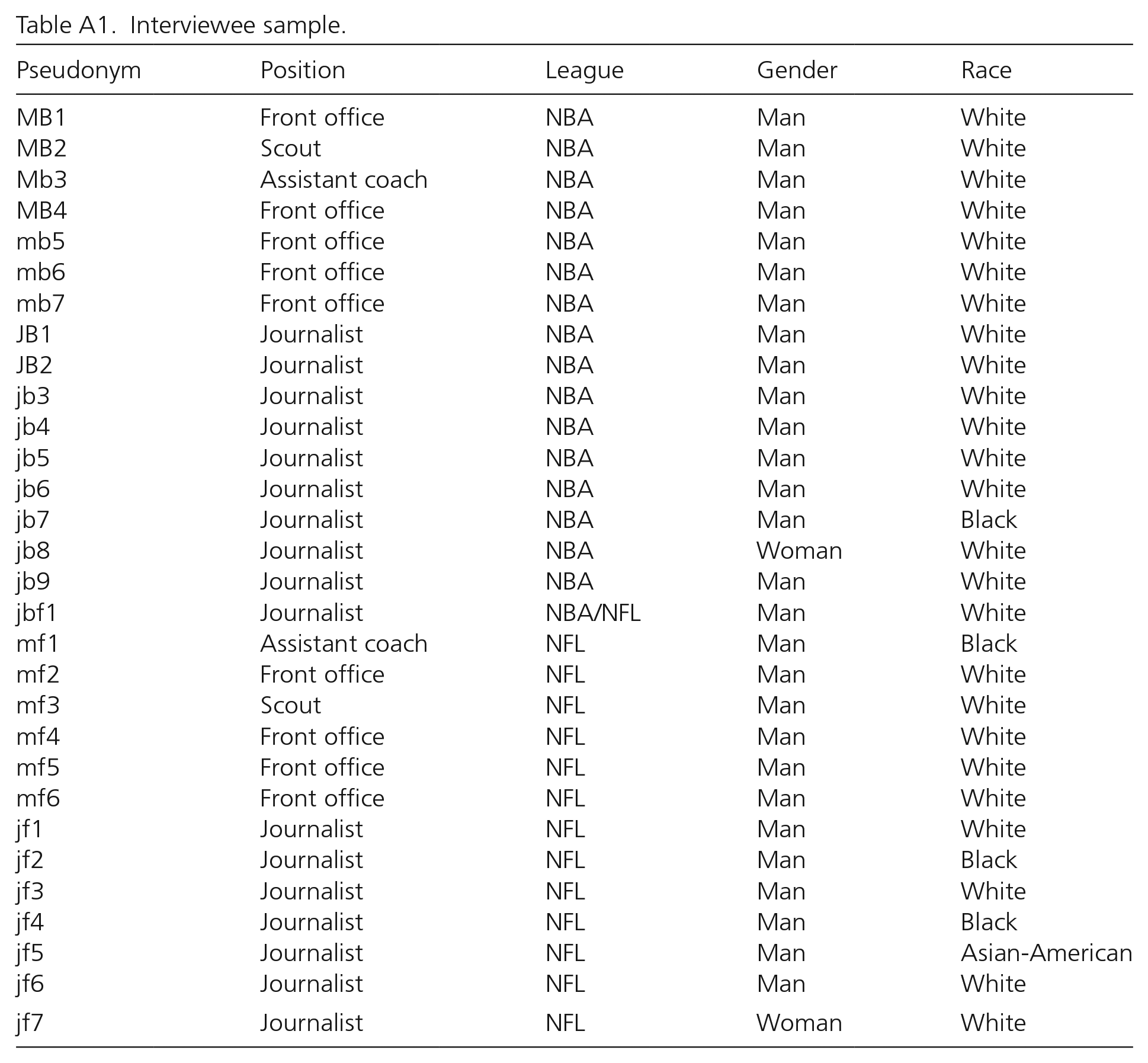
| Pseudonym | Position | League | Gender | Race |
|---|---|---|---|---|
| MB1 | Front office | NBA | Man | White |
| MB2 | Scout | NBA | Man | White |
| Mb3 | Assistant coach | NBA | Man | White |
| MB4 | Front office | NBA | Man | White |
| mb5 | Front office | NBA | Man | White |
| mb6 | Front office | NBA | Man | White |
| mb7 | Front office | NBA | Man | White |
| JB1 | Journalist | NBA | Man | White |
| JB2 | Journalist | NBA | Man | White |
| jb3 | Journalist | NBA | Man | White |
| jb4 | Journalist | NBA | Man | White |
| jb5 | Journalist | NBA | Man | White |
| jb6 | Journalist | NBA | Man | White |
| jb7 | Journalist | NBA | Man | Black |
| jb8 | Journalist | NBA | Woman | White |
| jb9 | Journalist | NBA | Man | White |
| jbf1 | Journalist | NBA/NFL | Man | White |
| mf1 | Assistant coach | NFL | Man | Black |
| mf2 | Front office | NFL | Man | White |
| mf3 | Scout | NFL | Man | White |
| mf4 | Front office | NFL | Man | White |
| mf5 | Front office | NFL | Man | White |
| mf6 | Front office | NFL | Man | White |
| jf1 | Journalist | NFL | Man | White |
| jf2 | Journalist | NFL | Man | Black |
| jf3 | Journalist | NFL | Man | White |
| jf4 | Journalist | NFL | Man | Black |
| jf5 | Journalist | NFL | Man | Asian-American |
| jf6 | Journalist | NFL | Man | White |
| jf7 | Journalist | NFL | Woman | White |
Funding
The author(s) disclosed receipt of the following financial support for the research, authorship, and/ or publication of this article: This work was supported by the Fonds de Recherche du Québec – Société et Culture (grant no. 285852, 2021).
