




Abstract
Social media platforms evolved into significant arenas for comprehending crises, hardships, violence, and murder. This paper contributes to the discourse within the intersection of social media and crime by delving into the narratives through which people pour meaning online into tragedies with personal significance. When people experience life-changing events, some go through a process of “sense-making” to fully understand the events and their implications, and reach closure. Processes of “sense-making” become increasingly public and collaborative through stories people tell on social media. Still, a dearth of literature exists that systematically examines these stories as conduits for infusing meaning into tragedies. This article bridges this gap by analyzing the narratives emanating from Facebook groups commemorating Tair Rada and advocating for justice for Roman Zadorov, who was convicted with her murder. These narratives not only challenge Zadorov’s culpability but also recount the sequence of events leading to the tragedy. Furthermore, they delve into the identity and motivations of the perpetrator(s), resuscitating neglected lines of police investigation and occasionally introducing alternative narratives. To establish their narratives’ credibility, authors employ a range of strategies such as integrating source materials, employing categorical language, and cultivating an atmosphere of personal witnessing or knowledge acquisition.
Introduction
The digital landscape of social media has transformed into a significant domain, enabling individuals to navigate and fathom crises, adversities, violence, and even instances of homicide. This article enriches the ongoing dialogue at the crossroads of social media and crime by immersing into the narratives disseminated across these platforms. These narratives serve as conduits through which individuals “make sense” and imbue personal significance into tragic events, thus adding depth to the discourse surrounding the intersection of online platforms and criminal activities.
Originally, the “sense-making” process involved a close circle of people, and it occurred outside the public’s eyes (De Jaegher and Di Paolo, 2007). Sense-making through online social media differ in two fundamental aspects. First, it is public, and the victim’s acquaintances and friends, even the general public, are exposed to her posts about loss and bereavement, the meaning attributed, and ways of coping. Second, the degree of collaboration changed. Such processes on social media are visible to many who can participate through comments, sharing stories, and more.
To contribute to the scholarship concerning social media’s influence on perceptions of criminal activities, this paper examines a pivotal inquiry: What characterizes the narratives that individuals construct regarding acts of murder within the realm of social media? To address this query, I center my investigation on the fervent campaign for justice surrounding the case of Roman Zadorov. Convicted and sentenced to life imprisonment in 2010 for the murder of a young girl, Zadorov’s culpability was fervently contested by a vast majority of the Israeli populace. This fervor manifested as an unprecedented surge of activity on social media platforms, predominantly on Facebook, all rallying for Zadorov’s exoneration. Remarkably, in 2021, Zadorov was granted a re-trial, culminating in his acquittal in 2023.
Elsewhere, I delved into the individuals steering social media engagement, exploring their identities, motives, the intricacies of conversations within these digital groups, and the resultant implications (Lev-On, 2022; Lev-On 2023; Lev-On, in press). In this context, my current focus shifts toward the narratives cultivated as a product of the sense-making endeavors within these online social media groups. Drawing from a netnographic analysis of the activism surrounding justice for Zadorov, I find that people create multiple narratives presented in a logical manner that significantly differ from the narratives adopted by the establishment. Most of these narratives are based on investigative materials and revive lines of investigation that were abandoned by the police. Additionally, I address the rhetorical strategies employed to validate these narratives.
Sense-making through storytelling
The theory of sense-making addresses how people create and tell stories as part of a process of deciphering life-changing events and creating new identities that encompass their loss. The stories relate not only to the chain of events that led to loss and trauma, but also to the way in which the people who were “left behind” deal with society and the establishment. The injuries and threats to the familiar order raise many questions, such as: who are the murderers? why did they commit the murder? Am I certain they were caught? How did the relevant institutions act?
When people experience confusion, and their past experiences are not helpful, communication is key for building a narrative to bring them closer to closing the circle (Stretesky et al., 2010). According to Rosnow’s sense-making theory, the main function of communication is to address and ameliorate feelings of anxiety and uncertainty. The more stressful and ambiguous the situation, the greater the need to interpret it, to try to create a clear meaning and ways to alleviate ambiguity (Chandra and Pal, 2019; Esposito and Rosnow, 1984; Rosnow, 1980).
Another study by Avekasis et al. (2023) shows that people who try to make sense of difficult situations support their arguments with theories, or names of institutions or experts, to increase the perceived reliability of their statements. Attributed source credibility can affect the persuasion process of people exposed to such arguments (Crano, 1970; Crisci and Kassinove, 1973; Manfredo and Bright, 1991).
Sense-making in social media
In contemporary times, online social media platforms have arisen as enablers within the intricate realm of sense-making. Within these virtual spheres, individuals present a spectrum of information, which spans varying degrees of accuracy (Introne et al., 2018), alongside an open sharing of their personal narratives. Nonetheless, notable distinctions distinguish this approach to “sense-making” from the more conventional offline counterpart.
In the conventional mode of “sense-making,” the narratives within the immediate circles of victims remained shielded from the public eye; these processes unfolded in the private domain (De Jaegher and Di Paolo, 2007). Contrasting starkly, the sense-making dynamics on online social media exhibit two foundational shifts. Primarily, they unfold within a public sphere, where the writer’s circle of friends, as well as the general public, engage with posts that delve into loss, grief, the attributed meanings, and the strategies employed to cope. Secondly, the level of collaboration has undergone a transformation. The online social media sense-making journey unfolds in plain view, accessible to a multitude of individuals who can actively participate by means of comments, sharing personal anecdotes, and other interactive engagements (Bietti et al., 2019; Hardey and James, 2022; Stieglitz et al., 2018; Xiao et al., 2022).
In addition to telling personal stories, people are interested in controversial crime cases that brought up on social media (Childs et al., 2020; Marsh, 2016; Stratton, 2019). In such cases, people often use materials from the media and other sources to collaboratively generate narratives that make sense. While there is a lot of literature on the stories that people share online and their co-construction of information and knowledge (i.e. Döveling et al., 2018; Papacharissi and de Fatima Oliveira, 2012; Thorson and Wells, 2016), there is still no literature analyzing the outcomes of the collaborative activity by which people makes sense of crime cases. This study sheds light on this phenomenon and analyzes the character of the stories that people generate.
Research environment: Online activism calling for justice for Roman Zadorov
On 6/12/2006, the 13-year-old Tair Rada was murdered at her school in Katzrin, Israel. Roman Zadorov, a flooring installer who worked at the school, was arrested 6 days later, and a week later confessed to the killing – but immediately recanted, and since denied connection to the murder. Zadorov was convicted of murder in 2010 and sentenced to life in prison. The verdict referred to a “high-quality, dense and real fabric of evidence” that points to Zadorov, including his confessions to the informant and to police investigators and reconstruction of the murder. Zadorov’s appeal to the Supreme Court was rejected in 2015.
But the firmness of the court’s ruling contradicts public opinion, with polls repeatedly showing that overwhelming majorities thinking Zadorov is innocent. In 2021 the Supreme Court decided to grant Zadorov a retrial, and in March 2023 he was fully acquitted (Lev-On, 2023).
Immediately after the murder, the affair attracted public attention because the victim was a young girl murdered in school. A source that helped to cast doubt on Roman Zadorov’s involvement in the murder was Tair Rada’s mother. Shortly after Zadorov’s reconstruction of the murder, she declared that she doubted that he was the killer. In time, problems in Zadorov’s confession and reconstruction also contributed to these doubts, along with alternative narratives about the identity of the murderer(s), the manner in which the murder was committed, and the motives behind it.
Unlike many other cases, where murder investigations are typically conducted away from the public eye, the current case has made investigation materials available to a wide audience. These materials were transferred from Zadorov’s defense team to the victim’s family and activists who supported them following the guilty verdict in the original trial back in 2010. Over time, these materials gradually became accessible to the public, including being uploaded to Facebook groups. Furthermore, since 2016, an organized collection of these materials has been available on the website “Truth Today.” Correspondence, summaries, and documents related to the retrial have continued to be uploaded to this website. Consequently, activists had access to an up-to-date set of investigation materials. There are also a number of YouTube channels with video materials – from the investigations, conversations with police informers, and the reconstruction. Additionally, numerous documentaries and articles on the case can be found online.
Another factor responsible for the overwhelming public interest in the case is the intensive social media activity to promote Zadorov’s innocence. Since 2009, many Facebook groups dealing with this affair were established. In 2015, after Zadorov’s appeal to the Supreme Court was rejected, the largest of which, The whole Truth about the Murder of the Late Tair Rada, became one of the largest in Israel (Ben-Israel, 2016).
Thus, apart from its scope, this social media activity is unique in additional aspects:
The context: The activity involves a murder trial and a call for justice for a putative false conviction. By contrast, findings and products of police investigations and legal proceedings are typically far from the public eye.
The identity of participants: Typically, participants in public discourse regarding law and justice are “insiders”—police officers, lawyers, and legal commentators. Here, however, the involvement of “outsiders” is evident, including activists familiar with small and large issues.
The activity is also unique in its significant effects; for example, on public opinion of the functioning of the relevant state institutions and Zadorov’s guilt/innocence (Lev-On, 2023).
In addition, this activism is unique in that it led to the many discoveries by activists – including discoveries that led to the decision to hold a retrial (Lev-On, 2023). For all these reasons, the activity for Zadorov represents a fascinating case for examining the characteristics and effects of social media activism.
Within the discussions among activists regarding the case, it becomes evident that there are individuals who assume the role of “experts.” These experts may have earned their status through their familiarity with the materials, their personal connection to the case, or their relevant expertise (Grossman and Lev-On, 2023). Even after more than 16 years since the murder took place, significant posts that shed light on interesting aspects from the investigation materials receive extensive engagement.
Elsewhere, I delved into the role of opinion leaders and managers within social media groups and their influence on shaping the opinions of group members (Lev-On, 2022; Lev-On, in press). I also explored the dynamics of conversations within these groups (Lev-On, 2022; Lev-On and Steinfeld, 2020). In this paper, I focus on the outcomes of bottom-up investigation processes facilitated by social media. Specifically, I examine the stories shared online as an integral part of these sense-making processes in the social media sphere.
Method
This study is based on netnographic research. Netnography is a qualitative-interpretive research approach to studying the behavioral and communicative patterns of individuals and groups online (Kozinets, 2010; Rageh and Melewar, 2013).
Netnography involves collecting data from online sources as social networks, chats, petition sites, and more. Researchers can identify communities, observe and join them, and interview participants. The triangulation of participant observation, interviews, and content analysis enables a comprehensive picture of the justice for Zadorov activism. This netnographic study lasted seven years, from 2015 (the rejection of Zadorov’s appeal to the Supreme Court and resulting intensification of activism) to 2022.
Participant observation
Contacts were established with group administrators and leading activists. Conversations with administrators were about content that was published, issues and dilemmas that arose, and activities that occurred.
Content analysis
I have employed several methods to ensure the inclusion of a maximum number of relevant posts. Firstly, with the assistance of activists, I identified and mapped the active Facebook groups related to Zadorov, subsequently focusing on the five largest groups that attracted the most active participants. Secondly, I utilized the netVizz software initially, and after its discontinuation, I transitioned to using CrowdTangle software to back up all the posts published within these groups. This resulted in a collection of over 10,000 posts and hundreds of thousands of comments. The content analysis was carried out thematically by repeatedly reviewing the texts and identifying recurring themes, which were subsequently categorized.
Interviews
Twenty-five interviews with group administrators were conducted – among other issues, about the truth-value and content of stories posted online, and reactions by admins. The interviews lasted an hour to an hour-and-a-half, and were conducted by four interviewers under the supervision of the lead researcher.
Findings
The first finding is that when people interpret the evidence, they do not converge on one scenario. Rather, there are multiple scenarios that people support.
First scenario: Did teenagers murder Tair?
The most popular scenario focuses on teenagers, and is divided into three versions. The first version suggests that teenagers from Katsrin or the area, for example, a boy and two girls – murdered Tair. Posts sometimes include a reference to their parents’ presumed roles in the police, politics, or criminal world, as a motive for the arguable connection of silence surrounding the murder. Sometimes it is suggested that the parents helped to smuggle the teenagers abroad (although there is no evidence of such actions).
There is a similarity among the posts supporting this narrative – probably because people read the existing posts and follow-up or draw inspiration from them. Some posts include a high level of detail – pertaining, for example, to the physical descriptions of the boy and two girls, what they did with the clothes they wore, and even the disturbances made at the scene of the murder and during the investigation.
The second version of this scenario involves teenagers from Tair’s school or class. The post in Figure 1 presents a detailed story (full of inaccuracies) based on extensive knowledge of the legal case, implying that the murder was committed by boys who later threw away their blood-soaked shirts. The police knew who the murderers were and even had the murder weapon, but wanted “the mystery to remain a mystery forever.” The author starts with “everything is already known” and concludes with “end of story.”
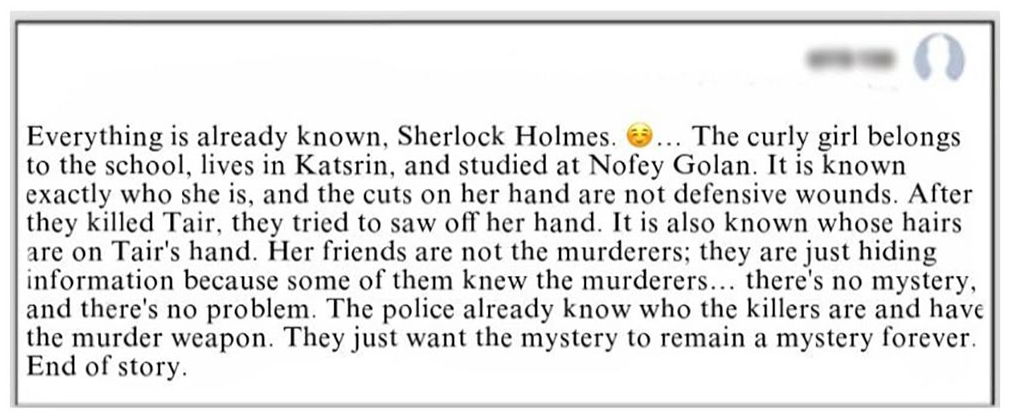
From the group “the whole truth.”
Typically, such posts focus on conflicts between teenagers. For example, the author of the post in Figure 2 claims that the murder resulted from jealousy of a girl because Tair “messed” with a boy who had a girlfriend (there is no evidence for that). The girlfriend “activated” a boy from an upper class, who murdered Tair (“The fuel of hatred from a jealous girl activated him”). As a rule of thumb, the writers of such scenarios demonstrate great self-confidence and even imply that they were present and know what happened, or state that the content they upload is “vetted” or “definite.” A-typically, the writer of the current post qualifies her words when she opens and closes with the statement “in my personal opinion.”
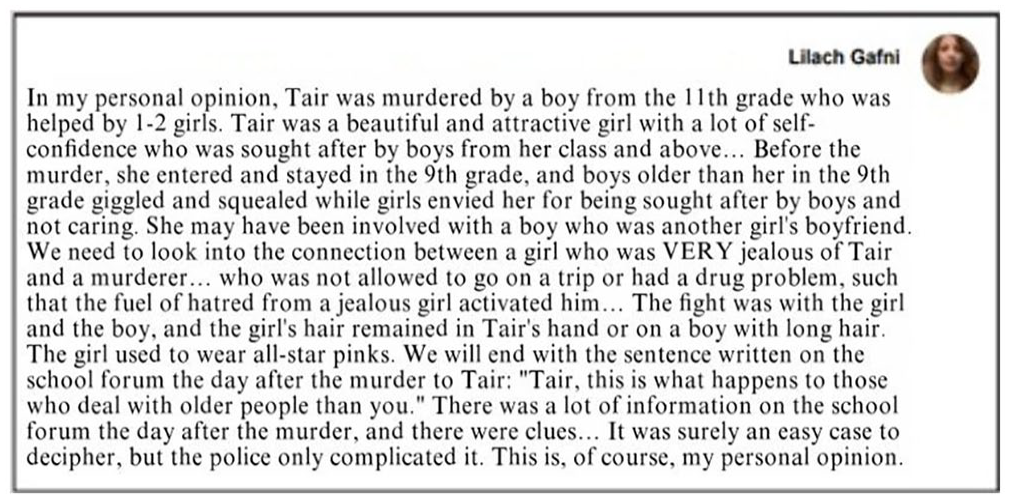
From the group “all the truth.”
According to the third version of this scenario, Tair’s girlfriends were connected to the murder, and may have committed it themselves. Some authors claim that the act was done purposefully, while others believe that they did not plan to murder Tair, but only to threaten her, and things got out of control following her persistent struggle. Some posts suggest a coordination of versions between Tair’s girlfriends.
Second scenario: Was Tair exposed to a drug deal?
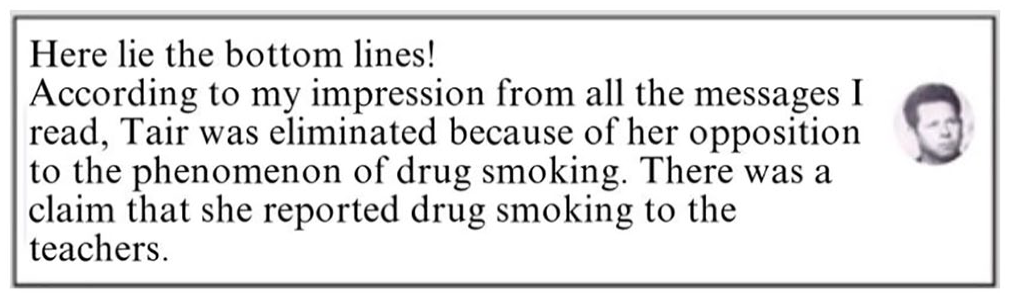
According to a second scenario, Tair was exposed to a drug deal or another criminal activity. Some believe that Tair was not an occasional victim, but that she informed the teachers about the youths who were dealing drugs, and they, in turn “silenced” her. Some posts refer to teenagers from the school who were in Tair’s close circle, and were involved at various stages in their lives in drug deals.
Third and fourth scenarios: Was Tair murdered due to satanic activity? Did a psychopath murder her?
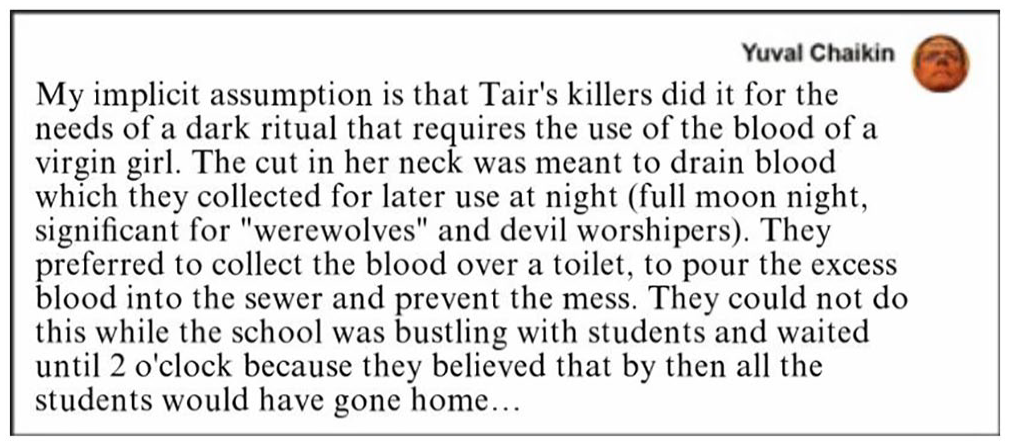
The third scenario places the blame for the murder on people associated with the Satanic cult. One version focuses on an institutionalized act conducted by a group of cult members, such as an initiation ceremony that Tair stumbled upon by chance (see Figure 3). According to another version, the murder was not carried out in a ceremonial and planned manner, but did involve cult members.
The group “the whole truth.”
According to the fourth scenario, the killer is a psychopath who lusts to satisfy his murderous urges. The posts refer to the sick character that someone capable of committing such a brutal murder has (See Figure 4).
From the group “the double murder mystery.”
Additional findings
The second finding is that the vast majority of scenarios are positive – that is they do not elaborate on “who did not commit the murder,” but on who did commit the murder, why, and what chain of events led to it. Apparently, the focus on positive scenarios derives from the fact that they are more interesting, and from the writers’ need to construct a logical story with a beginning, middle, and end.
The third finding is that the scenarios are fundamentally different from the scenario adopted by the courts in the various rulings. Until 2023; the court accepted the scenario that Zadorov killed Tair. However, this scenario almost never appears in the groups. Occasionally, one can find stories about why Zadorov admitted to a murder he did not commit.
The fourth finding is that the scenarios “revive” lines of investigation that the police abandoned. However, activists reconstruct such scenarios using original investigation materials available online, such as chat correspondences about fights between teenagers, a poster caught on school on which someone wrote that it was Tair’s time, and of course, details from the crime scene.
The fact that the scenarios are supported by materials from the legal case, may strengthen their credibility. Although investigative actions carried out by the police refuted activists’ scenarios and the findings at the scene do not support them, on social media, the rules of evidence are different. These scenarios continue to develop lives of their own, many years after the police rejected them.
In addition to scenarios promoted by the police and then rejected, there is also an original scenario prevalent in several groups which was not considered by the police – the “secondary-arena scenario,” whereby Tair was murdered elsewhere in school (“the secondary scene”), and her body was moved to the murder scene later.
The scenario is based on the fact that several witnesses claimed that the toilet cubicle where Tair’s body was found was open and empty after the estimated time of murder (many other witnesses testified otherwise). Activists build a scenario that would fit these testimonies and explain how the body got to the cubicle. Figure 5 details this scenario, and the commenter supports the argument with quotes from Tair’s chat (ICQ) conversations.
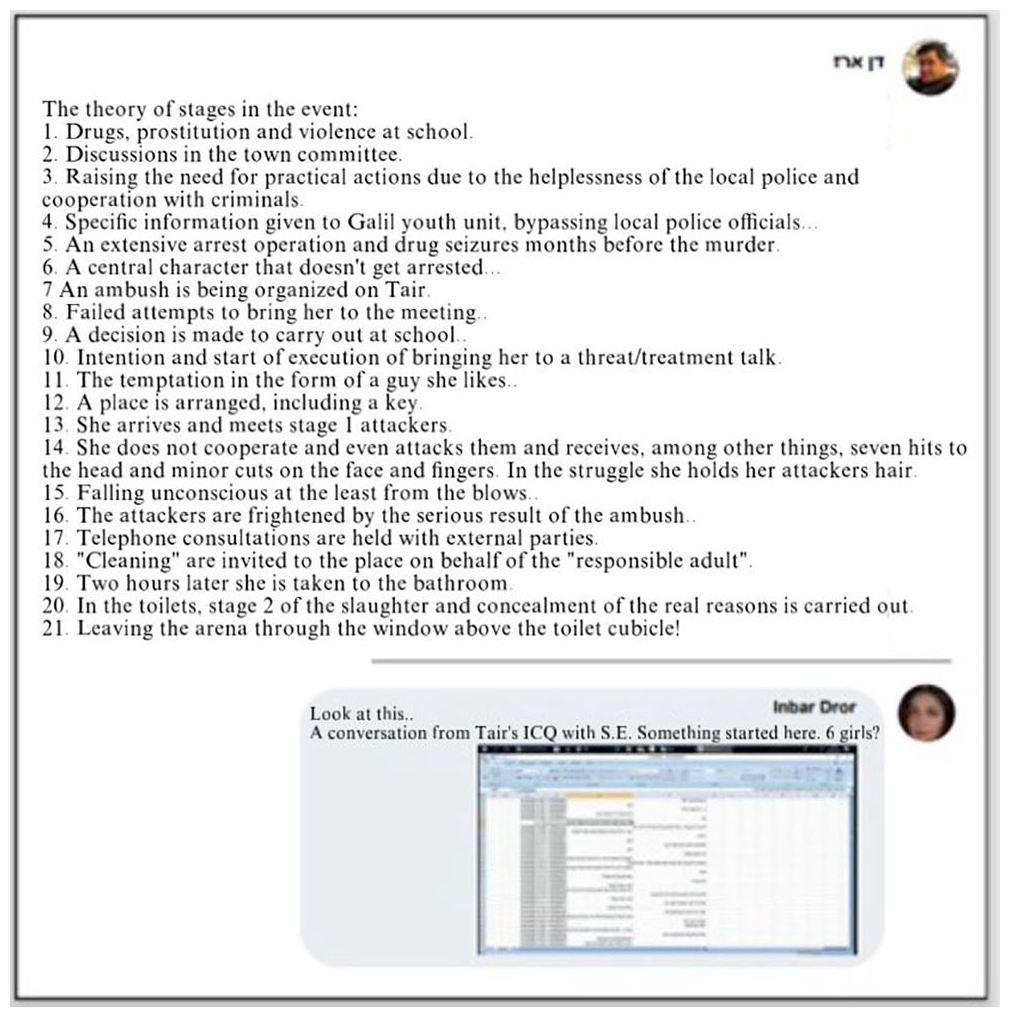
From the group “time for truth.”
Discussion and conclusions
In the realm of online social media, platforms have evolved into significant arenas that aid individuals in comprehending crises, hardships, violence, and even instances of murder. This paper contributes to ongoing debates in the field of social media and crime by delving into the narratives circulating within these digital spaces, narratives that serve as conduits for imbuing tragedies with personal significance.
People grappling with life-altering crises, adversities, and even the gravity of murder have perpetually sought to decipher their occurrences. This entails an endeavor to fathom the events, discern their rationales, and devise coping strategies. The advent of online social media has revolutionized this process, rendering it more public and collaborative in nature. Individuals not only share their narratives with their immediate social circles but also extend them to encompass a wider audience, which includes strangers. In return, these narratives elicit input, ranging from empathetic gestures to practical advice, from a diverse array of individuals. Despite the pervasiveness of this phenomenon, a distinct gap exists within the literature—specifically, a dearth in characterizing this transformative shift.
The study is based on Netnographic research of social media activity surrounding the justice for Zadorov activism, and the stories that people tell online about the murder of Tair Rada. The findings indicate that there are multiple scenarios that arise frequently about who committed the murder, why and how. The court (until 2023) accepted the scenario that Zadorov killed Tair. But this scenario almost never appears in the groups. When it is mentioned it is in order to be refuted. Occasionally one can find scenarios explaining why Zadorov admitted to the murder he did not commit.
In the majority of these scenarios, the writers are not focused on ruling out suspects who did not commit the murder, but rather on identifying the true culprit, the motive behind the crime, and the sequence of events that led to it. This is likely driven by their desire to construct a coherent story with a clear beginning, middle, and end.
It is fascinating to see the high level of detail in some scenarios. Some tell the story with great confidence, as if they were there and know the people involved in person. Some include a physical description of (e.g.) the boy and two girls who (arguably) committed the murder, what they did with the clothes they wore, and how they hid their identity and disrupted the murder scene. Sometimes the posts include reference to their parents’ (apparent) roles in the police, politics, or the criminal world, as a motive for incriminating an innocent person and the “deadly silence” surrounding the murder between “those who know but do not tell.”
The scenarios created by activists are fundamentally different from the scenario adopted by the court in its various rulings, and they “revive” lines of investigation that the police have abandoned. The most popular scenario focuses on teenagers who committed the murder out of jealousy or hatred. According to another scenario, the victim was inadvertently involved in a drug deal or other criminal activity, and her presence at the wrong place and time led to murder. The third scenario places the blame for the murder on people associated with a Satanic cult. According to the fourth scenario, the killer is a psychopath who had an insatiable desire to satisfy his murderous impulses.
The scenarios I reviewed were examined by the police and ruled out. The activists, who rely on the materials available online, rebuild the scenarios based on these materials and other materials that came up in time. However, there is also a scenario prevalent in several groups and has not been seriously considered by the police – the “secondary-arena scenario,” whereby Tair was murdered elsewhere, and her body was moved to the murder scene.
This article, to the best of our knowledge, is the first to provide an in-depth characterization of collaborative social-media-based sense-making in the context of controversial crime cases. While there is a significant body of research on how people discuss social, cultural, and political issues on social media, there is still a gap in understanding how people construct shared meaning about crime cases. This study aims to fill this gap by shedding light on these aspects of online discourse.
Future studies can explore comparable cases of controversial issues discussed on social media platforms worldwide and identify similarities and differences in how people make sense of them. These studies can also shed light on the ways people utilize existing materials to construct and validate their narratives, as well as the rhetorical strategies employed to make sense of them.
Footnotes
Acknowledgements
This study was supported by the Institute for the study of new media, society, and politics in Ariel University. I thank Inbal Laks-Freund, Hodaya Abekasis, and Inbar Malka for their assistance in preparing this manuscript for publication.
Funding
The author received no financial support for the research, authorship, and/or publication of this article.
