




Abstract
How do transnational bloggers position their digital identities on Chinese social media platforms? To answer this question, this study builds a coordinate system of digital identity positioning with intensity of ethnic differences and cultural affinities as the horizontal and vertical coordinates. Four digital identities are found: culturalists, individualists, cultural otherness, and cultural admirers. Transnational bloggers may have overlapping or changing digital identities rather than a single, defined identity. This reflects the process and multiplicity of identity formation, which involves negotiation and flow between ethnic differences and cultural affinities. This study traces transnational bloggers in local digital cultural spaces, raises awareness about the types of split identities in the digital age, and provides an analytical framework for digital identities. Considering the transformation of digital society, researchers should continue to investigate new forms of digital identity building in global and local digital cultural spaces: linking actions, ideologies, and experiences in Internet spaces to broader social, cultural, and political contexts.
Most research on bloggers focuses on the global digital environment. However, transnational bloggers who engage in local digital cultural spaces have rarely been studied. In this study, transnational bloggers refers to bloggers who are not of Chinese nationality and whose cultural background differs from that of Chinese culture. On Chinese social media platforms, transnational bloggers represent “heterogeneous,” “diverse,” or “global” cultures. Unlike local (Chinese) bloggers, transnational bloggers face the challenge of positioning their digital identities. They need to show their distinctive ethnic identities while also expressing their affinity for Chinese culture, a requirement for entering Chinese social media platforms. How do transnational bloggers position their digital identities on Chinese social media platforms? The study found that transnational bloggers represent four digital identities in the coordinate system of ethnic differences and cultural affinities: cultural bridges, individualists, cultural otherness, and cultural admirers. These new digital identities enrich the global landscape of digital identity construction, enhance our profound understanding of different digital identities, and reveal the complexity of self-identity positioning of transnational individuals in the local digital cultural space of the digital age.
This study contributes to the literature on digital identity and digital culture in several ways. First, I construct a theoretical framework for interpreting the complex identity positioning of heterogeneous cultural bloggers in local digital cultural spaces. Second, by tracing transnational bloggers in local digital cultural spaces, this study highlights the split identities of the digital age. Finally, it moves beyond the dichotomy between ethnic identity and mainstream culture, demonstrating theoretically and empirically the possibility of interweaving and negotiating between the two.
Internet space, ethnic identity, and mainstream culture
The Internet is a public space for creating, maintaining, and performing ethnic identities. Digital ethnic identity researchers have focused on the ways users present and experience ethnic identities and their actions against digital racism. Florini (2014) explores the use of “signifyin’” in African American cultural traditions as a means of performing racial identities online. The linguistic practice of “signifyin’” allows Black users to perform Blackness without corporeal signifiers. Harper and Quaye (2007) find that the expression of specific bloggers’ identities contributes to racial progress and justifies the interests of racial/ethnic minority students. By interpreting national identity as a cultural identity De Cillia et al. (1999) and Rulyova and Zagibalov (2012) analyze bloggers’ strategies for creating their national identities through representation of the Other. In Australia, Indigenous athletes use the media to represent their identities and counter the prevailing nationalist rhetoric (Hallinan and Judd, 2009). Nakamura argues that online communities provide a form of “identity tourism,” where appropriation of racial identity in games becomes a form of entertainment and a vacation from identities and locales (Nakamura, 2013: 42). For example, by donning racial avatars like samurai and geisha, users can temporarily experience Asian racial identities without any of the risks associated with being a racial minority in real life (Nakamura, 2013: 40). Digital ethnic identity reflects not only individual self-identity construction, but is also a result of being shaped by digital technologies (Hamilton, 2020).
Internet racism research reveals the ways in which digital technologies are complicit in racism (Noble, 2018). For example, Siapera and Viejo-Otero (2021) key findings show that Facebook takes a post-racial race-blind approach that disregards historical and material differences, while its primary focus is on law enforcement, data, and efficiency. It socializes users and develops behaviors/content that accommodate racial illiteracy, leading to flexible circulation of racism. Digital technology facilitates expressions of racism (Back, 2002) and online hate speech (Awan, 2014) under the guise of objectivity, neutrality, and benevolence, and it exacerbates systemic inequalities (Benjamin, 2019). Arguably, the Internet, like race itself, is a product of culture and its attendant power dynamics (Nakamura, 2013: 31), where perceptions of who speaks and who is heard are rigorously mediated (Georgiou, 2020). From this perspective, the Internet is cultural model that maps the matrix of contemporary online racist politics (Florini, 2014). These studies demonstrate the ever-present fact of marginalized Internet users’ online lives (Chao, 2015), which in turn highlights the importance of presenting ethnic identities in the digital public sphere (Nakamura, 2013).
Race (identity) and mainstream culture on the Internet are important themes in the digital age. Cultural positioning inevitably constrains the lived reality of the vast majority of the world’s population (Nakamura, 2013: 31). The mainstream cultural sphere of the Internet constitutes its own racist hegemony by eliminating or domesticating culturally and politically constituted identities (Butler, 1993: 118). In a trans-local and inter-national context, racial exclusion and pro-local grammar are combined through digital technologies (Florini, 2014). Brock (2005) reveals fundamental cultural differences in the design and response to mainstream and African American websites. For example, the cultural agnosticism of Yahoo’s homepage suggests that its default audience is white Americans. Black people are under constant pressure to be culturally assimilated into mainstream society while engaging with beliefs and practices designed to exclude them from the mainstream. Gray develops a theory of Black cyberfeminism, showing that the presence of women’s and/or people of color’s bodies in digital spaces dominated by white (and male) cultures is marked as abnormal (Gray, 2017: 355–368). Important issues about the Black American community and the Indigenous Australian community rarely become trending topics on social media platforms (Gillespie, 2016: 52–75) because they are not mainstream white-based discourse (Fuchs, 2018). Culture constructs the way people think and act about race in ways that perpetuate racial oppression (Wilson, 1996: 24).
The relationship between ethnic identity and mainstream culture on the Internet is antagonistic. Many studies have demonstrated this opposite relationship by analyzing the ways mainstream culture reinforces racism via digital technology (Brock, 2020) and studying the actions and strategies of racial and ethnic minorities to maintain ethnic identity in the digital mainstream culture (Ortiz, 2021). These are conceptualized as digital racism (Siapera, 2019), white racial frames (Feagin, 2020), colorblind racism (Bonilla-Silva, 2006), platformed racism (Matamoros-Fernández, 2017), and cyber racism (Daniels, 2009a, 2009b), among others. However, a research gap exists: Is there an intertwined relationship between ethnic identity and mainstream culture beyond the oppositional relationship? That is, are there people who want to display their ethnic identities while also trying to express affection and closeness to the dominant culture? On Chinese social media platforms, I found the existence of intertwined relationships between ethnic identity and local dominant culture. In the process of emphasizing (or weakening) ethnic differences and emphasizing (or weakening) affinity with mainstream culture, a person’s self-identity is constantly split and reshaped. This is a complex practice that is currently ignored in the literature on digital identity, racism, and digital culture.
Chinese social media platforms and transnational bloggers
The transnational bloggers in this study come from two Chinese social media platforms: Douyin, a short-video community for young people to record and share their lives, and Xiaohongshu, which links consumers with premium brands. They are among the most “active” social media platforms in China, with approximately 680 and over 200 million monthly active users on Douyin (Douyin Ecommerce, 2022) and Xiaohongshu (Fu, 2022), respectively.
Douyin was founded in 2016 (Tik Tok is its international version). Users can watch algorithmically curated short videos in an endless scrolling mode (Elegant, 2019). Founded in 2013, users of Xiaohongshu can post images, text, and videos. Xiaohongshu’s interface shows a little red book that displays four to six items at once. Users can review the title and cover image of posts and then choose whether to open it. On Douyin, the interface shows one video at a time, which is played automatically. Both Douyin and Xiaohongshu publicly display users’ IP addresses on their profiles and comment boxes, their geographical scopes are not limited to China. For example, French users’ profiles display: “IP: France,” and if they comment on another’s content, “France” is shown in the comment box. For Chinese users, their specific Chinese province is disclosed, such as “IP: Beijing” or “IP: Shanghai.” In the past, the Internet was technically indifferent to the geographical location of its users, giving rise to the idea of “geolessness,” a space untethered from nation-states (Rogers, 2009: 22). However, on Chinese social media platforms, this geolessness has been disrupted by geolocation monitoring and display.
In terms of digital economy, both Douyin and Xiaohongshu have upgraded from digital cultural communities to e-commerce, completing the commercial closure loop. In traditional digital communities, the business model for influencers is mainly becoming product-endorsers who are paid through advertisements (Schouten et al., 2020) and rewards from the platforms. Recently, a new model, digital community + e-commerce, provides a greater potential for influencers to seek personal development. Douyin and Xiaohongshu have three main digital community + e-commerce models: (1) Live streaming + e-commerce. Bloggers can sell merchandise on platforms through live streaming, earning a cut or commission for items sold. (2) Social + e-commerce. Bloggers can include a “shopping window” on their personal homepage, which users can click on to see and purchase products that the blogger is selling. (3) Advertising. Bloggers receive advertisement offers, take photos or videos for products, and promote them through posts. Echoing the digital economy, digital work in the social media industry has opened up new forms of employment and investment opportunities. Increasingly, people are becoming bloggers (or influencers, celebrities) to pursue their dreams (Johnson and Woodcock, 2019), increase their income, or expand their employment prospects. Online digital work is not just an opportunity for Chinese bloggers; it is also attracting an increasing number of non-Chinese users to Chinese social media platforms.
Transnational bloggers are an unusual presence on Chinese social media platforms. Their entry into the Chinese social media space constitutes a reconceptualization of ethnic identity in the local digital cultural sphere. Because China is not a country of immigrants, Chinese people rarely come across non-Chinese people in their daily lives. When overseas bloggers with different skin colors and accents appear on social media platforms, they are undoubtedly fundamentally different from Chinese bloggers. This “difference” has given rise to a cliché in the media world: that transnational bloggers can get a lot of “likes” and attention without much effort. All they must do is share their daily experiences of living abroad, including language, culture, habits, and food. If they can speak some Mandarin, they have a much greater competitive advantage. This all comes with transnational bloggers performing and emphasizing their ethnic identities on Chinese social media platforms, because Chinese audiences are somehow willing to pay for this “difference.” If perceived similarity is what makes viewers resonate with creators (Hoffner and Buchanan, 2005), then transnational bloggers provide Chinese audiences unusual experiences through their various ethnic and cultural identities. However, for ethnic differences to play a positive role, transnational bloggers’ digital identity construction must include an element of affinity with Chinese culture. That is, although they are not Chinese, they are very fond of Chinese culture and have taken practical actions to get close to Chinese culture. As a result, transnational bloggers must reconcile the relationship between ethnic difference and cultural affinity.
Methods
Identities are constructed within discourse (Hall, 1996: 4). Therefore, this study adopts a biographical approach to capture the discursive expressions of transnational bloggers in depth and comprehensively, supplemented by participant observation and analysis of online posting content. The author collected biographies of 27 transnational bloggers from August 2021 to December 2022. Each interview lasted between 2 and 2.5 hours. I participated in script design, video shooting, and production with six of the participants to observe the actual process of digital work. I also collected various posts made by transnational bloggers on Douyin and Xiaohongshu and comments from netizens (“what they did?”). This was done to analyze the online actions of transnational bloggers and their responses to netizens, which was then cross-referenced with the narratives of transnational bloggers (“what they said?”). The personal biography collection used a semi-structural framework for the interviews, the actual process was largely based on the rhythm of the interviewees’ narratives. The interview questions included four sections: (1) their digital work process, (2) reasons for establishing connections with China (culture), (3) past work experiences and future career development plans, and (4) past living environment and future plans for their place of residence. From this, we were able to tease out “complete” biographies of transnational bloggers, not just information on their digital work in cyberspace. Obtaining as much detail as possible about the lived experiences of the participants in different spatial and temporal dimensions helped us to fully understand their digital identity constructions. To investigate how transnational bloggers locate objective digital identities between ethnic difference and cultural affinity, I focused on their cultural narratives when organizing the research materials for this study. I identified two main threads: first, emphasis on bloggers’ own ethnic identity differences, and second, transnational bloggers’ performances and actual actions of affinity for Chinese culture.
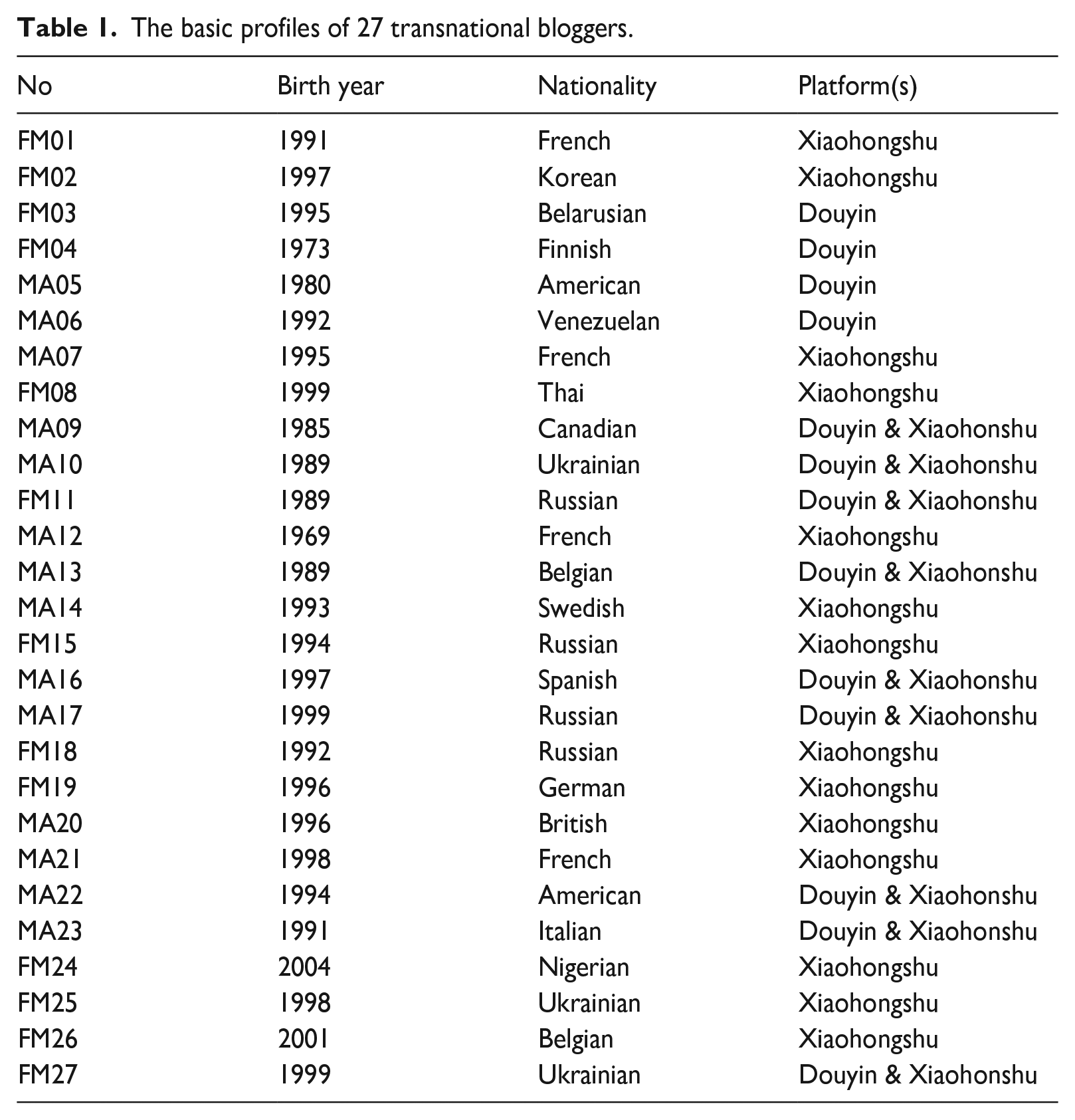
Transnational bloggers in this study are defined as, bloggers who are not of Chinese nationality (in the institutional sense) and whose cultural origins are different from Chinese culture (in the cultural sense). Their audience is almost exclusively Chinese. Although recruitment was largely random, the author did consider the diversity of participants in terms of gender, age, nationality, and blogging style. Table 1 provides a brief overview of 27 transnational bloggers.
The basic profiles of 27 transnational bloggers.
Findings
How do transnational bloggers position their digital identities on Chinese social media platforms? Based on the theoretical gaps identified in the literature review and the new information found in the investigation, a coordinate system for transnational bloggers was constructed to locate their digital identities. The horizontal coordinate is the intensity of their ethnic differences, and the vertical coordinate is the intensity of their cultural affinities (see Figure 1). Four digital identities are represented in four quadrants: cultural bridges, individualists, cultural otherness, and cultural admirers. These identities overlap and mix. Each transnational blogger may occupy one or more identity positions at the same time, or at different times.
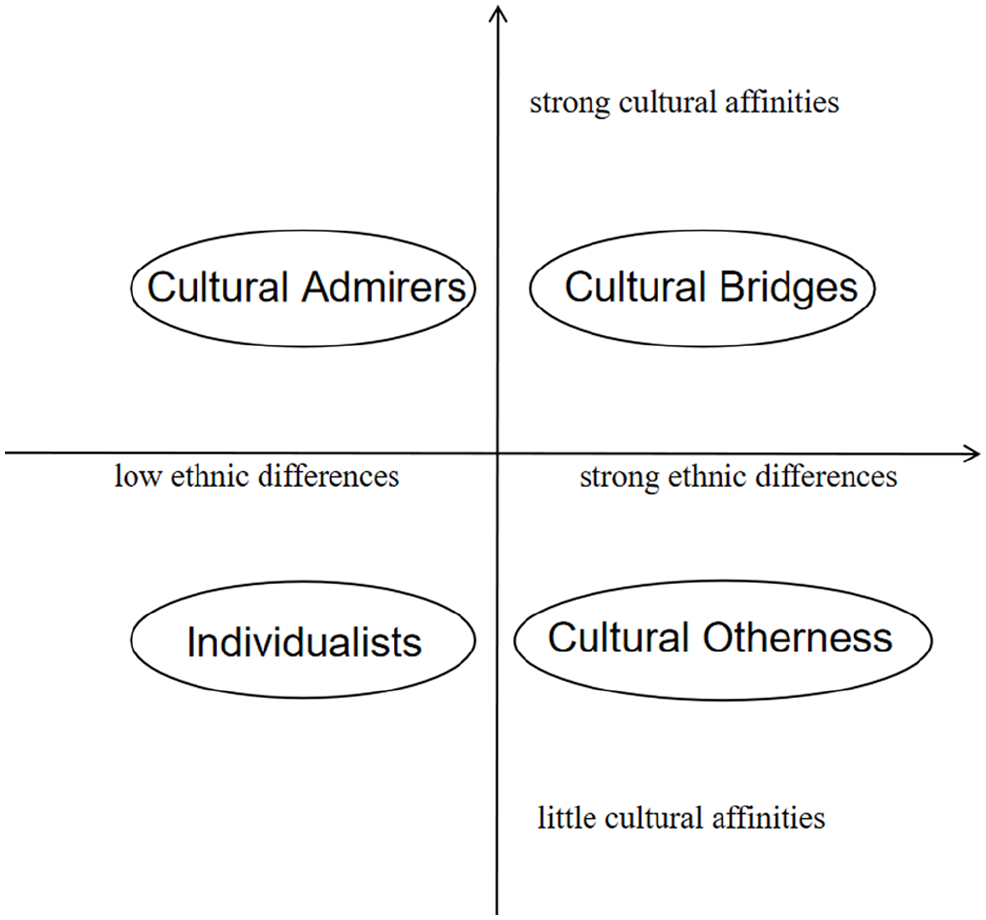
Digital identity coordinate system.
Cultural bridges
Transnational bloggers position themselves as cultural bridges, with a sense of cultural mission and responsibility; that is, they work to break prejudices between China and their country of origin through cultural communication. “Cultural bridges” occupy the strong ethnic differences and strong cultural affinities quadrant.
Individualists
Transnational bloggers aim to play their subjectivity on Chinese social media platforms, demonstrate their singularity, pursue broader self-development opportunities, and ultimately realize their selves. “Individualists” occupy the low ethnic differences and little cultural affinities quadrant.
Cultural Otherness
Cultural otherness includes both active and passive aspects. They actively establish an “us” and “them” distinction between Chinese users and themselves through the lens of the Other. They are also passively subjected to racist and online hate discourse by users of the mainstream local culture. “Cultural otherness” occupy the strong ethnic differences and little cultural affinities quadrant.
Cultural admirers
Transnational bloggers emphasize their affinity for Chinese culture, minimizing ethnic differences and their potential negative impacts. Cultural admirers not only demonstrate their enthusiasm for Chinese culture, they also learn and practice Chinese culture in real life. “Cultural admirers” occupy the low ethnic differences and strong cultural affinities quadrant.
Cultural Bridges: “I want to be a bridge”
In the cultural bridges quadrant, transnational bloggers position themselves as bridges between Chinese culture and their own. This approach is a good combination of strong ethnic differences and strong cultural affinities, implying that, while differences exist, there must be affinity. This is obtained through the transmission and interaction of different cultures. As one transnational blogger put it.
MA05: It has to be something related to Chinese and foreign relations. It has to be a bridge, it can’t just be foreign stuff, and it can’t just be Chinese stuff. It has to be what they want from me, such that from this face, they want to see a connection between China and the outside world.
The reasons transnational bloggers construct “cultural bridges” digital identities are often related to their personal life experiences. Transnational bloggers have, to some extent, experienced first-hand the shock, misunderstanding, or conflict that arise from differences in nationality, ethnicity, and culture. Thus, they hope to break down some of the prejudices between China and their country of origin through cultural communication. This is a mode of digital identity positioning that “weaves meaning in the past, present and future” (Kenny et al., 2011: 16). Being a “cultural bridge” is not only associated with self-actualization and the image of the “social hero” (Menger, 2021: 343; Roulleau-Berger, 2021: 1–3), it also embodies a grand purpose of serving the interests of the community and society in general, and even the interests of humanity (Blaug, 2019). MA05 started his account on Douyin after living in China for more than a decade. He has faced two-way prejudice and culture shock between China and the United States many times in his life. Therefore, when he became a blogger, he had a very strong desire to clarify some of the biases between China and the United States.
MA05: You know because I’ve studied Chinese and I hear what the Chinese always say about me, and sometimes they have these um. . . stereotypes of how foreigners are, and so I would try to just reverse these stereotypes. I will try to say, look, not all Americans are rich; see I am living a normal life with my family or look, don’t think every Chinese treats Americans like super well like sometimes I can’t get a cab because they don’t think I can speak Chinese well. . . So, I would do that at first just to kind of um. . . make them see the other side of the picture. So, what I like to do is just turn around these conceptions or misconceptions of everything; and I do the same thing on Facebook. I go to Americans who have misconceptions about China, and I try to tell them listen like you know China is just a normal place. There’s not like armed people walking around like all the time you know, monitoring everybody and no freedom.
Individualists: “I’m pretty pretty sure that I will find opportunities to become better!”
In the individualists quadrant, bloggers target self-actualization rather than cultural objectives. Embedded in the social environment of neoliberalism and individualism, bloggers can now benefit from having a unique selling point or an online public identity (Khamis et al., 2017). Success stories about influencer marketing, internet celebrity economy, and self-fulfillment inspire those who are looking for direction in life to become bloggers. In their discourse, we can see transnational bloggers’ aspirations for better personal career development.
MA22: I don’t know what’s going to happen this year later on or maybe next year. But I just think that I need to do what I like. I’m pretty pretty sure that I will find opportunities to become better, to develop, to make more money, to become a very successful blogger. MA20: My family sells champagne. Hopefully one day somebody from China will say to me, ‘hey, you make champagne, you speak French, you want to sell and be the face of champagne in China,’ and then that would be interesting. Probably something like that is more likely to happen than somebody say, ‘you want to advertise this or that.’ FM01: I knew I wasn’t going to make a lot of money in the beginning. I know this, but I still choose to make videos (on Xiaohongshu). I’m thinking of a long-term investment, not short-term. If it’s short term, I think then you go do something else you can make money, make money much faster. Long term, I really want to know what will happen if I start my own company. I really want to do something between international companies and China. That’s for sure. Well, I really want to explore that and help foreign brands come over to the Chinese markets. You see I’m a blogger and there are some brands come to me, so I know what the experience of a blogger is like. Yeah. So, if I need to find a blogger (for advertising) in the future, I will know how to do it.
Since the early 1980s, society has shifted from values of work and responsibility to a new central value: self-actualization (Menger, 2021: 19). “Being yourself” has become a staple of contemporary society, its cornerstone, and its central meaning (Martuccelli, 2010). Bloggers, a kind of digital micro-entrepreneur, are transforming their personal lives and styles into online businesses characterized by flexibility, autonomy, and creativity (Brydges and Sjöholm, 2019; Leung and Cossu, 2019). Thus, transnational bloggers are individualists who perform singularity (Martuccelli, 2010; Reckwitz, 2021) and pursue self-actualization. The “individualist” identity signifies a respite for transnational bloggers gain from the pressures of traditional work and to find opportunities for themselves.
MA14 is a Swede who lives in Beijing and works as an engineer for a Chinese company. He very much hopes to reach a higher position in the company as soon as possible, but he encounters great resistance, which puts substantial pressure on his life and work. The higher-ups always promise him a good future. However, some in the company feel that his promotion would threaten their interests, so they hinder his progress. Plus, the Covid-19 pandemic caused many interruptions, making it impossible for him to continue improving his career.
MA14: The thing I feel the most is that I’m just standing still on the same spot without any development, without any growth. [. . .] So I think also because of this reason, I started to post stuff on Xiaohongshu. [. . .] I do like the concept, because this is a completely new type of work, it’s not something that our parents’ generation, or you can imagine that it could be possible. So, I think it’s interesting, and has more future than working at the, I don’t know, grocery store. [. . .] So right now, I’m not here for the money, I’m here for personal development, future potential adventure.
Respondents included many stories of self-actualization failure in traditional work, and this failure is often related to overbearing bosses, suppression of talent, salary ceilings, harsh working hours, boring tasks, bureaucracy, and limited room for growth. If these keywords extracted in the interviews describe traditional work, their antonyms express digital work in the imaginations of transnational bloggers. Instead of submissive and docile employees, explicitly assigned to positions and roles, workers are now transcendent, mobile, identity-drifting individuals, concerned with uniqueness rather than conformity (Le Bart, 2013). Transnational bloggers proactively choose a flexible and autonomous working environment and are unleashing their individuality and subjectivity.
As transnational blogger FM11 said, I want to do more high-quality content and bring value to people. If it can reach monetization, of course it will be the best! If I can, no matter where I go around the world, all I need is a phone and a computer, like I don’t have to go to work. That will be an ultimate goal. For example, I can drink a cocktail at the beach, then go home and do something (like edit videos). Of course, this is the most ideal.
Cultural otherness: “A foreigner may not understand a lot of things” and “Please leave China”
In the cultural otherness quadrant, the ethnic differences of transnational bloggers are magnified to the extent that they do not have time to take cultural affinities into account. These transnational bloggers look at China through the lens of the “Other” and establish an identity boundary between Chinese people and themselves. Additionally, they are perceived as “Other” by Chinese users and are sometimes subjected to online hate speech. “A foreigner may not understand a lot of things,” a quote from an interviewee, aptly demonstrates the awkwardness of transnational bloggers and their marginalized position as cultural others on Chinese social media platforms. Identities are constructed through difference (Hall, 1996: 4). In narrating discursive taboos and cultural powers in Chinese Internet space, transnational bloggers use “we” to divide their homeland and China, reinforcing their ethnic differences from the Chinese.
FM04: A foreigner may not understand a lot of things. In fact, many overseas Chinese and foreigners have been permanently banned because they didn’t figure out what they could and couldn’t say. A permanent ban doesn’t give you any opportunity to reopen your account, which means that all your previous work was for nothing. [. . .] There are some things we just can’t say, even if we’re telling the truth. [. . .] Foreign bloggers who know Chinese culture know the sensitive things, cannot be talked about, especially like the epidemic. FM03: This is not only the state of the Chinese media, but also the state of Chinese society. If you know the situation in China and have been here for a while, you won’t criticize publicly and you won’t say very negative things. The premise is that it is very important to understand Chinese culture and know what might be a bomb. For example, we generally only talk about China’s achievements in epidemic control, but I can’t say that the Belarusian policy actually has its benefits. Because there is a principle here: ‘How can something from a foreign country be better than that from China.’ In fact, in the eyes of foreigners, in our opinions, China may be depriving people of their freedom, or think that such a ‘closed door’ approach is actually not good for the country, but we can’t post these ideas in China.
As the cultural other, ensuring that the opinions and content they publish align with Chinese ideology is a priority for transnational bloggers, more important than gaining more followers and “likes.” Cultural objects and their opposites represent a powerful lens for understanding hierarchies of power and identity in the cultural sphere (Gandolfi, 2016). The discourse position of transnational bloggers in the Chinese Internet space is marginal, and they need to speak very cautiously. They must have a deep understanding of the taboos of Chinese discourse. Arguably, actors seem to be trapped in a strategic arena, often against their will (Illouz, 2007: 80, 111). In fact, cultural power, ideology, and Internet opinion are factors that have created psychological stress and tension for transnational bloggers.
MA22: I’m a little sort of stuck in a rut with my channels because I’m not quite sure what kind of content to make. The videos that get attention are kind of sensitive. They stress me out, they stress my publisher out. MA08: So lately, foreigners have been finding it challenging to be bloggers in China. I think the situation is getting worse. I have to be more judicious with my content.
A hostile Chinese Internet nationalism has developed over the past two decades (Gries, 2005), often thought to be driven by netizens’ perceptions of external threats to China (Liu, 2012). Racism has always been present on the Internet in explicit or implicit forms (Tynes et al., 2013). Western societies generally value egalitarianism, and prejudice and discrimination often manifest themselves in covert ways (Dovidio, 2001; Sue et al., 2007). However, social norms consistent with egalitarianism may be weakened due to the anonymity mechanism of the Internet (Evans et al., 2003). In China, online racial discrimination is “ethnically conscious” (Baumann, 2002: 151) and is clearly marked by Chinese cyber nationalism (Wu, 2007: 73). Moreover, mainstream social media platforms are furthering China’s national political agenda by promoting a form of playful patriotism (Chen et al., 2021). As MA08 states, “Maybe because you’re a foreigner, he won’t give you a ‘like’ because he thinks if he hits the ‘like,’ it shows that he doesn’t love China.” Online hate discourse can be focused on non-Chinese targets without any justification, in a direct, pointed, and powerful, rather than subtle, way.
FM02: There are some people. [. . .] I don’t think he’s disgusted with me; he’s disgusted with Korea. Last time I misspoke in the video, where I was referring to something that I ate. I should have said that I ate ‘Korean nori wrap rice,’ but I said, ‘Korean sushi.’ They scolded me in the comments, ‘You Koreans think everything belongs to Korea!’ They also said, ‘It’s good for you to come to China, but don’t rob the Chinese culture.’ Then, I become more cautious about the kind of topics they all resent. MA06: Because of my face, I can’t shoot much of the video content. I may be scolded for a gesture or a look. For example, I want to create a video that promotes positive energy. I played a bad guy to push down a Chinese girl, and then she was saved. Let me tell you, because of my face, even if I was trying to share some righteous content, people would scold me and say, ‘Don’t bully us Chinese people.’ Sometimes they’re aggressive, they scold me in private messages.
Intercultural contact can lead to exclusionary practices (Chiu et al., 2011), and from a communitarian perspective, cultural difference itself may be seen as divisive because it is detrimental to homogeneity (Delanty, 2010: 70). The mainstream culture in a given digital cultural space takes the moral high ground in the sense of “exclusivity” and “homogeneity,” contributing to racist online discourse, for example, “White pigs, get the hell out of China” (MA07), “If you really love China, please leave” (MA09), and so on. In this respect, social media platforms become instruments of repression rather than liberation (Baumann, 2002: 89), emphasizing the structural cultural inequalities faced by cultural others. More importantly, transnational bloggers are not powerful enough to counteract inequalities in local digital cultural spaces. On the one hand, the ethnic differences of cultural others are emphasized negatively by local users, and cultural affinities lose their role in maintaining solidarity in the fourth quadrant. As MA05 puts it, “No matter what, once they see the face, how much more you say China is good, I love China, I love China the best, someone will still call you a yang gui zi (foreign devil).” On the other hand, if a transnational blogger engages in a heated debate with a racist, it will most likely stir public opinion, and the consequences will be unpredictable. Therefore, most interviewees chose not to have head-on confrontations with online hate speech.
Cultural Admirers: “I was really obsessed with Chinese stuff”
In the cultural admirers quadrant, the digital identity construction emphasizes transnational bloggers’ affinity for Chinese culture and minimizes ethnic differences and their potential impacts. For cultural admirers, Chinese social media platforms are an important window to Chinese culture, where they can learn what young Chinese like, learn Chinese, and interact with Chinese people. At least at a certain point, the cultural bridges, individualists, and cultural otherness quadrants are not, or have not yet been, central to the construction of admirers’ digital identities. Here, FM24’s narrative is a typical story in the culture admirers quadrant. A Nigerian, born in the UK, FM24 is now a senior in high school in Manchester. She joined Xiaohongshu in 2022. Her Chinese expression has gone beyond fluency to the point where she can confuse Chinese people. When I first read her post on Xiaohongshu, I completely assumed that the blogger was a Chinese girl studying in the UK because the words and sentences she used are exactly the same as the 20-something Chinese girls I know like to use. In her comment area, many Chinese users were as shocked as I was when they found out that she is not Chinese. FM24 declares her interest in Chinese culture and her passion and persistence in learning Chinese.
FM24: I just wanted to learn Chinese because of the TV shows and drama, media, music. I was really obsessed (with Chinese stuff) at the time. It made me started like with the TV shows dramas yeah and then some music and then some celebrities and then the food. I really love the food. And then like I just started to greater understand all these aspects of Chinese culture. I was thinking to myself what if I learned a language, because if I learn a language, Chinese is a language that is spoken by one point five billion people. I think it’s a learnable language. I was thinking how useful the language will be for me in the future. So, I was thinking I’m fine to just to learn the language. So, I decided I was gonna learning and then I just from then on, I was learning every single day two hours.
When I asked her whether her motivation for participating in Xiaohongshu was to improve her Chinese as it is a useful language, she did not think that was exactly her intention. The cultural affinities of transnational bloggers are multifaceted, from being interested in Chinese culture, learning Chinese, keeping up with Chinese Internet trends, making friends, and establishing good relationships with Chinese people to traveling to China to work, study, and live. All of which demonstrate the high intensity of affinities with Chinese culture.
FM24: It was mainly I wanted to be around a Chinese environment. And I like Chinese social media. So, I just enjoy it. It wasn’t particularly to improve my Chinese, but it was just like improved my Chinese came as an extra part to download the app like Xiaohongshu. It’s just because I enjoy them rather than want to learn language. But for making friends as aspects that I knew that I want to make friends yeah. [. . .] I have a plan basically. I’ve dreamed about this many times. My plan is to study undergraduate in England and then obviously I’m gonna have my year abroad in the third year because I’m studying Chinese studies, so then when I graduate, I want to do a Masters in China. Maybe education or journalism, or media. And then I’m gonna want to maybe do the TESOL, teaching English as a foreign language. I want to do that course and then if I get jobs, then I, you know, reach China, work there, pass my time basically.
It is important to note that cultural affinities should not be seen purely as online actions and discourse in the Internet space. The cultural affinities of transnational bloggers have their roots in offline contexts. Moreover, the identities of cultural admirers have continuities across both horizontal and vertical dimensions throughout their lives.
FM26: When I was a small kid, me and my dad we were watching a lot of Asian movies with Jackie Chen, Bruce Lee or something like this, and a lot of movies were about China and about Asian culture. So maybe since childhood, I was obsessed with the Asian countries, especially with China and with South Korea. When I was fifteen years old, I met my first boyfriend, he was a Chinese guy, and we were together about four years. And I even though I wanted to study in China to get my bachelor’s degree there. In twenty nineteen, I came to China for the first time, so it was my dream, and I guess China is so big a country and it’s a powerful country. It has such a special culture, I mean that every province they have their own traditions, different foods, different dialects and something like this. So, it’s so interesting to know about this.
FM26 downloaded Xiaohongshu in 2021 because her Belarusian and Russian friends who had settled in China told her that if she wanted to know more about China and Chinese culture, she had to download Xiaohongshu, where she could find a lot of interesting voices. “Yeah, I must do it, and I’m really so thankful for them,” FM26 said. Using the Xiaohongshu is challenging for her because she is not yet proficient in reading Chinese. FM26 usually takes screenshots and uses Google Translate to translate Chinese. Sometimes the machine translation is not accurate, so she sends the screenshot to her boyfriend and asks him to translate it. For the future, FM26 is considering going to China as an exchange student, or if she could get a master’s degree in China, she thinks it would be wonderful.
Conclusion
The postmodern self means that there is no core self, but multiple roles to play. The construction of digital identities in local digital cultural spaces highlights the multiplicity of identity and the identity formation process, which requires negotiation and flow between ethnic differences and cultural affinities. This study outlines a coordinate system of transnational bloggers’ identity positioning in local digital cultural spaces through their cultural narratives, with the intensity of ethnic differences and cultural affinities as the two axes. This forms four types of identity positioning: (1) Cultural bridges have found a win–win state between ethnic differences and cultural affinities, where they can legitimately show affinity with other ethnic cultures while maintaining their own ethnic identities. (2) In contrast, individualists are more concerned with self-actualization, downplaying the importance of ethnic differences and cultural affinities. (3) Cultural otherness means that, while transnational bloggers set identity boundaries with Chinese users, they are also the targets of Chinese Internet nationalism. (4) Cultural admirers tend to downplay ethnic differences and prove their affection for Chinese culture through practical actions. The relationship between these four digital identities is not either/or, rather it is intertwined. The digital identity positioning of transnational bloggers captures the changing construction of individual identity in contemporary digital society. It is not only about the positioning of self-identity in a specific cultural space, but also about improving cultural skills to regulate social relations and interpersonal interactions in a multicultural environment.
Despite the burgeoning research on digital culture and digital ethnic identities, our understanding of their multidimensional characteristics, different forms, participants, and dynamics remains limited. Admittedly, digital cultural spaces can seem to be mobile, lightweight, de-territorialized, open spaces in which everyone can enter and create a digital identity at any time, no matter who or where they are – just like transnational bloggers who can now participate in China’s cultural communities and platform economy marketplace in the cloud without having to move to China as traditional expatriates do. However, it is this apparent openness and flexibility that leads to the neglect of inequalities in global geographic space. Indeed, structural inequalities and online hate discourse based on race, gender, and cultural differences occur in Internet spaces all the time and in a way that evades accountability. Because of these tensions, multicultural participants endure a process of self-fragmentation, their objective identities are fragmented, connected, and re-fragmented in local digital cultural spaces. Therefore, researchers should continue to identify and discover new forms of digital identity building in global and local digital cultural spaces, linking actions, ideologies, and experiences in Internet spaces to broader social, cultural, and political contexts. It is then that we can provide detailed and powerful responses to new changes and challenges regarding multiculturalism, racism, self-identity, and subjectivity in the digital age.
Footnotes

Declaration of conflicting interests
The author declares that there is no conflict of interest.
Funding
The author disclosed receipt of the following financial support for the research, authorship, and/or publication of this article: This research was supported by the 2023 “Academic Innovation Enhancement Program for Excellent Doctoral Students” of East China Normal University (YBNLTS2023-037), and the JORISS project “Toward Post-Western Sociology: The Two Experiences of Digital Work and Environmental Mobilizations in France, China, and Canada.”