




Abstract
This study identifies how three prominent Israeli online newspapers frame gay Members of Knesset (Israeli parliament) and cabinet ministers. 2019 was chosen since the number of gay MKs reached a historic milestone of representation. The study employed a mixed-methods design, combining descriptive statistics, based on a quantitative content analysis, with a thematic qualitative analysis. 1015 retrieved news items constituted the initial database. They were divided into two categories: “Gay relevant” (items explicitly referring to, or mentioning the politician’s sexual orientation); or “Gay irrelevant” (all other items), to thematically focus on the Gay relevant items (N = 159). Six themes were then identified: Novelty; LGBTQ Political Representation; Private Sphere; Homophobia; Community Recognition and Rights; and Incongruity. Findings revealed that elite newspaper coverage is similar to popular ones; cabinet ministers’ framing is more neutral compared to junior MKs; and liberal MKs are framed differently than conservative ones.
Introduction
In 2020, there were only 230 LGBTQ MPs in 50 countries, of whom 81% were gay men (Reynolds, 2020). In Israel, after decades of symbolic annihilation and political struggles, 2019 marked a watershed, when 5% of Knesset (Israeli parliament) members were gay men.
Only a few studies examined media coverage and framing of LGBTQ elected politicians, and they mainly referred to English-speaking countries or media (Britain, Canada, Iceland, and the USA). Indeed, Chan’s (2017) review found no study in non-English contexts. These studies suggested that sexual mediation (analogous to gendered mediation, that typifies female politicians’ coverage) is still biased and skewed despite the positive changes in the societal acceptance of LGBTQ in most Western countries (Gidengil and Everitt, 1999; Lachover, 2017; Lalancette and Tremblay, 2019; Lee, 2004; Rohrbach et al., 2020; Smith, 2013).
This study addresses the lacuna by examining a non-English speaking country or media. 1 Israel offers an interesting case study, since it holds the third place globally in the number of LGBTQ parliament members, after Britain (7%) and New Zealand (6%), with six openly gay MKs (5%). Using a mixed-method (content and thematic analyses) design, the study analyzes gay politicians’ media coverage during 2019 in three widely-read online newspapers, in order to reveal sexual mediation themes.
The paper begins with the concept of political representation. It then presents the scarce literature on LGBTQ politicians’ media coverage and framing, followed by a description of the case study’s setting by charting the Israeli LGBTQ political representation history. Then, it presents a two phased methodology, the findings, and concludes with an analysis of the six found themes, and their contributions to understanding sexual mediation.
The study’s main contributions are: (1) The focus on non-English media; (2) Differentiation between coverage of junior versus senior, as well as liberal versus conservative gay politicians; (3) Their coverage in diverse (popular versus elite) online newspapers.
Theoretical framework
Political representation conceptualization
Political representation transpires when political actors speak, advocate, symbolize, and act on behalf of others in the political arena (Dovi, 2018). Pitkin (1972) defines it as the activity of making citizens’ voices, opinions, and perspectives present in public policy making processes. She differentiates between four kinds of representation, from which we employ two: Descriptive Representation and Substantive Representation.
Whereas descriptive representation of an interest group (e.g., LGBTQ community) merely refers to the number of representatives in the legislature and its relative ratio compared to the interest group size in the population; substantive representation of an interest group refers to the actions taken on behalf of, in the interest of, as an agent of, and as a substitute for the represented. Practically, substantive representation refers to the extent in which the representatives advance the policy preferences that serve the interests of the represented (Haider-Markel et al., 2000; Reynolds, 2013; Tremblay, 2019c).
LGBTQ politicians’ representation, media coverage, and framing
Reynolds’s (2013, 2020) reports of LGBTQ legislators around the globe show that their numbers are consistently associated with enhanced national LGBTQ rights. The current era is distinctive and laudable in a global perspective: in 2020 there were 230 LGBTQ MPs in 50 countries, of whom 81% are gay men (Reynolds, 2020). In Israel, 5% of the Knesset assembly in 2019 was gay. This positions the Knesset as the third leading parliament in the world, following the U.K. and New Zealand, with 7 and 6%, respectively (Reynolds, 2020).
In addition to their descriptive representation, LGBTQ politicians play a significantly positive role in transforming attitudes and advancement of legalization and have a dramatic and irrefutable impact on policy. Haider-Markel (2010) observes that the number of pro-LGBTQ bills introduced and passed increases significantly as LGBTQ legislators take office. As will exhibited later, this overarching conclusion is not quite conforming to the Israeli context, where most legal advancements were achieved by proxy politicians.
Before discussing media framing of LGBTQ politicians, we offer a definition for the terms framing and frames. Framing is one of the ways through which the media establish social narratives and cultural norms. Framing theory maintains that the media have the power to create authoritative interpretations, based on narratives, that enable the public to read, identify, label, and process the news. The concept of a “coverage frame” describes recurring themes or thinking patterns in the media that have the power to express and reflect, and sometimes even to construct and shape, social and cultural ways of thinking about events, objects, and social groups (Entman, 2004; Greenwald, 2023).
Employing this conceptualization, only a dearth of studies was conducted on LGBTQ politicians’ media coverage: in Britain (Smith, 2013), Canada (Everitt and Camp, 2009, 2014; Lalancette and Tremblay, 2019), the USA (Golebiowska, 2006), and Iceland (Mundy, 2013). Mundy (2013) found that the coverage of Iceland’s openly lesbian Prime Minister focused on two frames: firstly, her election proved that Iceland is tolerant and liberal. The global media accentuated her reception by Icelandic society more than being lesbian per se. The second frame emphasized her being a woman, more so than being lesbian. On the other hand, Everitt and Camp (2009) argued that lesbian politicians are primarily framed as “Others.” Their entire identity and political activity are reduced to their sexual orientation that becomes the dominant signifier of their public life. This biased coverage generates news value that negatively impact the politician’s political image.
Lalancette and Tremblay (2019) found that LGBT politicians’ sexuality was usually framed as a non-issue and rarely discussed in negative terms. Yet, they were portrayed in three (overlapping) frames:
(1) “The first lesbian/gay elected” (p. 108), a descriptive conception of political representation that emphasizes identity, as if their sexual orientation is their principal attribute. In this context, we will mention the concept of “Novelty labels.” These are media frames that categorize events or people as “historic,” “new,” or “different.” Like gay politicians, women in office are also norm-breakers in many countries, and this fact might encourage journalists to describe them as pioneers (Greenwald and Lehman-Wilzig, 2019; Meeks, 2012). Similarly, Golebiowska (2006) concurs that what is particularly attractive to the media about gay candidates is not necessarily their campaign platforms, but their sexual orientation. As we will see, this is also found in the present study where the novelty dimension is focal.
(2) “Representation of LGBT communities and interests” (p. 111), a substantive mode of representation that focuses on activity, notably the defense of interests. However, these individuals may be suspected of being “single-issue” politicians.
(3) “Respectability” (p. 114) is the ability to pass as a “normal” person who does not threaten the heteronormative order. Lalancette and Tremblay conceptualized “sexual mediation” (p. 103) imbued with and based on heteronormative assumptions. This general frame is not necessarily hostile, but since it focuses on the politicians’ assumed respectability, it subtly communicates judgments about what “normal” life is.
Finally, Smith (2013) distinguishes between two frames, within which British gay MPs are represented in the press: (1) “Unacceptable” or “bad” politicians who are closeted (some of whom may come out – voluntarily or outed by the media – during their tenure). They are embroiled in scandals, frequently involving public sexual behavior. They are deemed as “dirty” or “dangerous.” (2) “Acceptable” or “good” gay politicians are out of the closet prior to their election and lead discreet and private sex lives and/or are in a stable, monogamous relationship. They are open and relaxed about their identity and hence considered worthy of press approval and accorded positive representation. “Good” gay politicians are considered respected citizens due to their “normal” relationship and conduct. Smith, however, maintains that both types are, even in the 2000s, sometimes (mostly in popular tabloids) depicted in a derogatory manner and their sexuality remaining their defining feature; “a gay politician is often defined as such above all else” (p. 200). Even today, despite an overall public acceptance and generally positive media representation, gay politicians often find themselves at the mercy of a heteronormative press. Their news value is still high. Smith’s bifurcate framing constitutes a vital basis of the current research questions, that ultimately proved that Israeli MKs are deemed “good” by and large. Smith also found that tabloid newspapers are more likely to pay attention to gay politicians’ personal lives. As we will see, in the Israeli case no difference was found between the two genres.
Israeli setting: Evolution of LGBTQ 2 political participation in Israel
Three eras can be demarcated in the history of the Israeli LGBTQ political participation: (1) Pre-decriminalization. Until 1988 the Israeli penal code reiterated the British legal system that criminalized sexual acts between (consenting) adult males. Despite the decree by the Attorney General in the late 1950s not to prosecute homosexuals, the law nevertheless situated them as criminals de jure. In 1975, the Society for the Protection of Personal Rights 3 was founded and a few years later a lobby called Otzma (empowerment) was established to decriminalize homosexuality. During this period of symbolic annihilation in the public sphere and the fact that being homosexual in itself was conceptualized as a crime (Kama, 2000; Yonay, 1998), all activists remained anonymous. Several attempts by MKs to amend the law were crushed by Jewish Orthodox MKs. The dominant feature of this era was the reluctance of gay and lesbian activists to come out publicly. They were interviewed and reported by the media under cover using aliases. This can be understood within the larger scheme in which coming out, even in the private sphere, was deemed dangerous and could entail negative consequences for the individual. Two caveats are in order here: First, a couple of MKs were alleged to be gay and were known as such in private circles. Second, Marcia Freedman served as an MK in between 1974 and 1977. She came out publicly as lesbian only later.
(2) The Great Leap Forward. On March 22, 1988, MK Shulamit Aloni (Meretz, liberal-leftist party) succeeded to eliminate the anti-homosexual clause from the penal code and thus paved the way into a new era. Otzma continued to change public opinion and to recruit MKs to amend more laws that would foster legal and civil equation between LGBTQ and other citizens. These were slow, few, and far between. The real “big bang” occurred on February 2, 1992, when MK Yael Dayan (Avoda/Labour) founded a parliamentary sub-committee to fight discrimination based on sexual orientation. Its first meeting re-charted the trajectory of LGBTQ history in multifarious aspects that due to the brevity of this paper cannot be fully detailed: for example, the first sympathetic media coverage of identifiable gay men and lesbians; a change in the military policy that called for the equal recruitment and advancement of soldiers regardless of their sexual orientation; and many other social, cultural, and judicial achievements (e.g., Kama, 2011; Gross, 2015; Harel, 2000; Kaplan and Ben-Ari, 2000; Levy, 2007). These achievements echo an overarching homonormative yearning by the LGBTQ community to be incorporated within the center of mainstream society.
One of the offshoots of the workings of this sub-committee was the establishment of LGBTQ caucuses in political parties. The first was Ge’ut (proud) in Meretz. Ge’ut was not only the first LGBTQ partisan forum founded in 1996, but the first to have its founding member, Prof. Uzi Even, elected to the Knesset in 2002. Five other forums were established later: Red-Pink Forum within Hadash (Democratic Front for Peace and Equality); Kadima Be’Ga’ava (Forward in Pride) in right-centrist Kadima; Ga’ava (pride) Ba-Likud of the right-wing Likud party; the LGBTQ caucus of the Avoda party; and Ha’Mate Ha’Ge’e (Proud Caucus) of the centrist party Yesh Atid. These caucuses have worked within the parties to gain support for advancing an LGBTQ agenda and its inclusion in their platforms. Unlike similar forums in other countries who predominantly operate within left-leaning parties (Tremblay, 2019a), some were established in the right side of the political map.
This era was relatively fruitful in promoting several laws that ensured LGBTQ rights (e.g., equal opportunities and non-discrimination at the workplace, anti-defamation based on sexual orientation and gender identity). The work of proxy MKs attested to their commitment for civil rights and equality. Yet, the actual battlefield where LGBTQ individuals and organizations successfully fought for their rights transpired at the courtrooms (e.g., recognition of adoption of children, recognition of same-sex spouse rights at the workplace). This era is characterized by concerted efforts on both the legal arena by what Tremblay (2019b) calls proxy MKs, namely heterosexual allies, and in judicial fronts by LGBTQ individuals. Tremblay adds that although these proxies’ support is indispensable, only (out) LGBTQ politicians can represent their group, thanks to their historically and individually shared experiences of being marginalized because of their non-heteronormative sexuality.
(3) Self-representation and stagnation. 4 Although the parliamentary career of Even was short-lived, he was succeeded by five gay men who were elected when their sexuality was public knowledge, and one (Shmuli 5 ) who came out publicly 2 years after being elected: Nitzan Horowitz (Meretz) in 2009; Itzik Shmuli (Avoda) in 2013; Amir Ohana (Likud) in 2015; Eitan Ginzburg (Kachol Lavan, a centrist party), Yorai Lahav-Hertzanu, and Idan Roll (both of Yesh Atid) in 2019. Ohana was the first Israeli gay man to be elected as a cabinet minister. Ginzburg was the first Israeli gay man to serve as mayor of a city prior to his election to the Knesset. Horowitz was the first to head a political party. The socio-demographic profile of these MKs is relevant and interesting: Like MPs around the world (Reynolds, 2020; Wagner, 2019), they represent the majority ethnic group: they are Jews. Four are Ashkenazim, two are Mizrahim. 6 All six live in a publicly acknowledged long-term partnership. Two spouses are famous on their own right (a theater director and a popular singer). Four are parents. All are highly educated (five hold a law degree, one in education). It is clear that all MKs (including Even, an Ashkenazi professor) conform to what Smith (2013) frames as “good” gays.
Unlike some “bad” British LGBTQ politicians, who were entangled in scandals and perceived misconduct (particularly involving sexual transgressions), and were intensively and negatively reported by the media (Smith, 2013); all gay MKs’ personal reputation has been without a blemish. As we shall show later, the only personal fault found among them was the fact that Horowitz and Lahav-Hertzanu do not conform to the “sacred” familism/childbearing value profoundly embedded in Israeli society (Fogiel-Bijaoui, 2002). Furthermore, all Israeli gay politicians exhibit in their biographies and political attitudes exemplary homonormativity, that is, a politics that does not challenge heteronormative assumptions. Homonormative LGBTQ pursue and aspire for assimilation within the prevailing social and political order without challenging the status quo (Gross, 2015; Hartal and Sasson-Levy, 2018; Mowlabocus, 2021). This phenomenon is widespread around the world, where most LGBTQ elected officials strive for assimilation (Reynolds, 2020).
However, unlike their peers in other countries who were pivotal and instrumental in furthering legal steps for the benefit of their community, the MKS are entrapped and entangled in very thorny circumstances where Orthodox Jewish and ultra-right MKs and government heads prevent and preempt any discussion concerning LGBTQ rights. As we shall show later, their only contribution was participation in pro-LGBTQ demonstrations that were organized and staged by grassroots organizations. Moreover, Ohana and Shmuli were appointed by the prime minister to serve as cabinet ministers (justice and then home security; and labor, welfare, and social services, respectively), but did not accomplish to pass even one law for the advancement of LGBTQ rights.
During 2019, Israeli politics was at a turmoil: Three Knesset assemblies were convened during this year (Haleva-Amir, 2022). The majority of MKs adhered to conservative and traditionalist (not to say, outright homophobic) ideologies and policies that constituted an immense obstacle to any attempts to make any legal reform to benefit the LGBTQ community (Levy and Schlesinger, 2015). Haider-Markel (2010) explains that pro-LGBTQ legislation does not work by magic: gay MKs do not operate in an ideological vacuum, but greatly depend on a favorable context. Since Ohana was Minister of Justice, it was expected of him to bring forth pro-LGBTQ legislation. But he remained loyal to the right-wing/religious coalition and proved to be an incompetent token, at best.
In sum, despite the impressive share of gay MKs during this era, it is marred by legal stagnation. While Israel had been, thanks to the work of proxy politicians, at the global vanguard in respect to LGBTQ rights and equality during the era of the Great Leap Forward; in the last two decades, albeit the number of gay MKs and ministers, it is demoted to an inferior position (Levy and Schlesinger, 2015; Morgenstern et al., 2016).
The study
Research objective and questions
The Israeli case study can be illuminating, due to its rather idiosyncratic circumstances: a volatile political climate (e.g., two national elections within 1 year); the enormous political power clerical (Jewish and Muslim) parties uphold; and the fact that Israeli politicians do not run for office at the Knesset on an individual basis, and thus personal campaigning is not an integral component of the political system (some parties hold internal primaries. In others the chairperson determines the party’s list).
The study’s main objective is to identify how Israeli media cover and frame the six gay MKs and cabinet ministers, and is based on two central research questions:
Corpus
Our corpus was based on the three most prominent online newspapers in Israel. These were selected to ensure a comprehensive, variable, and reliable examination of the coverage, representing two types of journalism (popular and elite), as well as different ideological orientations:
1. Ynet, an online platform of the popular Israeli print Yedioth Ahronoth. It is the most popular news website in Israel, ranked first in Israel’s top 50 news and media sites list (SimilarWeb, 2022). Ynet is a tabloid, targeting the widest common denominator, characterized by patriotic “middle-of-the-road” political views.
2. Haaretz Online, the digital version of the Haaretz print newspaper. It is ranked fourth in Israel’s top 50 news and media sites list (SimilarWeb, 2022). Haaretz is a broadsheet (one of its kind in Israel), caters to a smaller elite of readership, offering neo-liberal economic leanings and left-wing political positions.
3. Israel Hayom, a free-of-charge newspaper and the most popular print newspaper in Israel. Its online version is ranked 10th in the top 50 list (SimilarWeb, 2022). It addresses a more right-wing/conservative readership (Grossman et al., 2020).
Research design
2019 was chosen for two reasons: (1) the number of gay MKs reached a historic milestone; (2) two consecutive electoral rounds took place during this period. Political coverage is obviously at its height during an electoral year, especially so when two rounds transpire within 1 year.
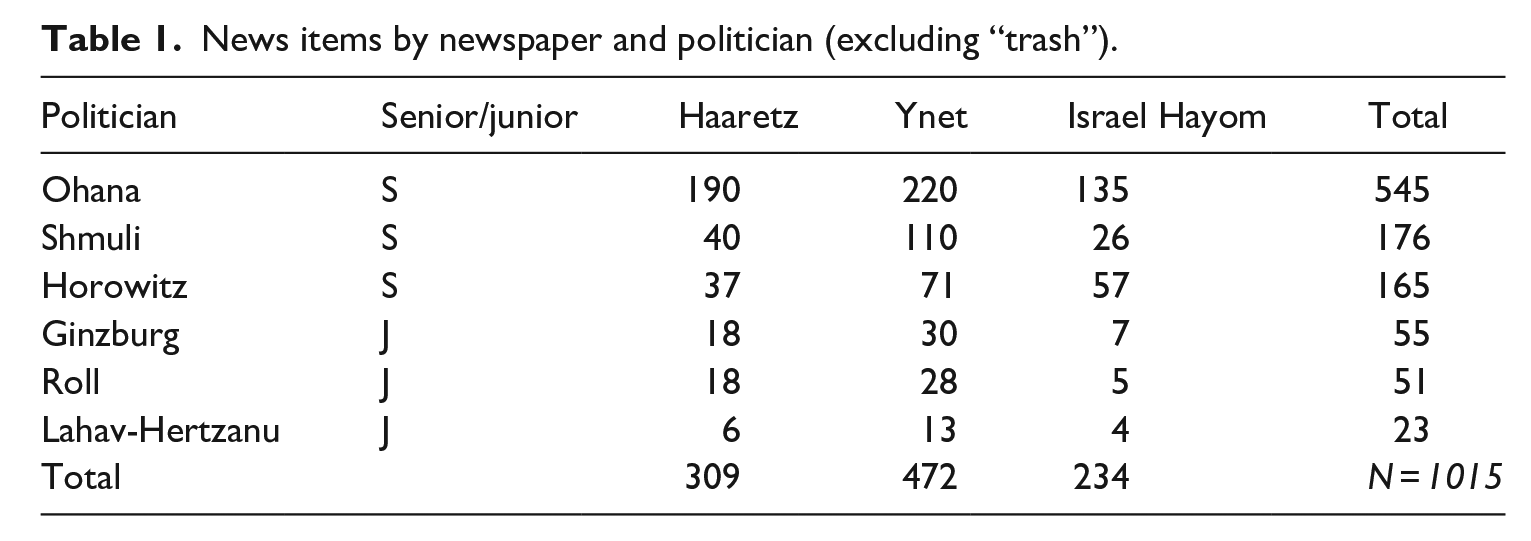
To build the corpus, news items were collected through Google© advanced search module. By applying search queries for each politician on each of the online newspaper domains between January 1 to December 31, 2019, 1290 retrieved news items constituted an initial database. As a preliminary step, we “cleaned” the data to dispose of the “noise.” All 1290 items were read to identify and dismiss “trash” results received during retrieval (e.g., gossip stories or personal anecdotes published before the politician was appointed as an MK), leaving a database of 1015 news items.
The study then employed a mixed-methods design, combining descriptive statistics, based on a quantitative content analysis, together with a thematic qualitative analysis.
Quantitative content analysis
The first stage of analysis was based on revealing the direct, but also the deep, covert, and symbolic meanings of the texts (Krippendorff, 2004; Neuendorf, 2017; Ponterotto, 2006). Thus, the items were divided into either of two categories: Gay Relevant or Gay Irrelevant. Gay Relevant includes items that explicitly refer to, or mention the politician’s sexual orientation or being gay, whether in the public-political or personal contexts. The category, Gay Irrelevant, is of a residual nature, and includes items that have no reference to the politician’s sexual orientation. After categorizing the news items, we could compare the number of news items of each category, and then focus on the Gay Relevant items to study how the gay politicians were framed. Since our objective was to study how the media frame the MKs’ sexual orientation per se, the Gay Irrelevant category was out of this study spectrum.
Qualitative thematic analysis
The second phase consisted of a thematic analysis, that is “a process for encoding qualitative information” (Boyatzis, 1998: VI), used to identify, analyze, organize, describe, and report main themes found within a data set (Braun and Clarke, 2006). Following Brown and Clarke’s six step process, and while referring only to the news items marked as Gay Relevant (N = 159), we thematically analyzed them by creating frames to identify the ways, by which the MKs were covered. Each of the items was coded with an ID number; its source; publication date; URL; headline; and primary quotations.
To become familiar with the data, each of the authors read all articles and developed an initial coding frame, according to which every news item was categorized as an individual unit. After the completion of the individual identification of the recurrent themes, we reviewed them to reach an agreement, define, and name six leading themes. Finally, all news items were re-coded by all authors according to the new thematic scheme. Intercoder reliability, based on Cohen’s Kappa statistical test, ranged between k = 0.73 (for the “LGBTQ Political Representation” theme), to k = 0.95 (for the “Homophobia” theme), with an average rate of k = 0.86.
Results
Quantitative content analysis
On the politicians’ axis, Ohana is by far the most covered politician among all six, due to his position (at the time) as the Minister of Justice. Almost 54% of all news items refer to Ohana (545/1015). Shmuli’s coverage is only a third of Ohana’s with 17% of the news items (176/1015), followed by Horowitz with 16% of the items (165/1015). These three are deemed as “senior politicians”: Ohana had a ministerial office; Shmuli won the first place in the Avoda party’s primaries in February 2019; and Horowitz was Meretz’ chair. The other three MKs are “newcomers” to the national political arena, and thereby their media coverage is scarce. Ginzburg, Roll, and Lahav-Hertzanu together constitute only 12% of the items (5%; 5%; 2%, respectively).
On the newspapers’ axis, the most prominent news outlet is Ynet with 47% of all items (472/1015), followed by Haaretz with 30% of the items (309/1015). Israel Hayom has the least items with less than a quarter (23%: 234/1015) of the corpus.
The highest rate of Gay Relevant items is in Ynet for Ginzburg with 60%. The lowest rate is for Shmuli in Israel Hayom with only 4% of the items. However, it seems that the bias toward Roll is the largest with an average of 50% of the items categorized as Gay Relevant. Roll is followed by Ginzburg and Lahav-Hertzanu with 42 and 39%, respectively. Like in Table 1, there is a clear demarcation line between the newcomers and senior politicians. Shmuli’s Gay Relevant news items constitute only 9% of items that refer to him as a political persona. This means that 91% of the news items concerning his public activity bear a factual nature, while minimizing attention to being gay. Shmuli is followed by Ohana with a Gay Relevant rate of 10%, and Horowitz with a rate of 19%.
News items by newspaper and politician (excluding “trash”).
From the news outlets’ perspective, it seems that in general they are more factual than biased: Popular Ynet and Israel Hayom with averages of 19 and 14%, respectively. Elite Haaretz holds the lowest average rate with only 12% of items categorized as Gay Relevant.
Qualitative thematic analysis
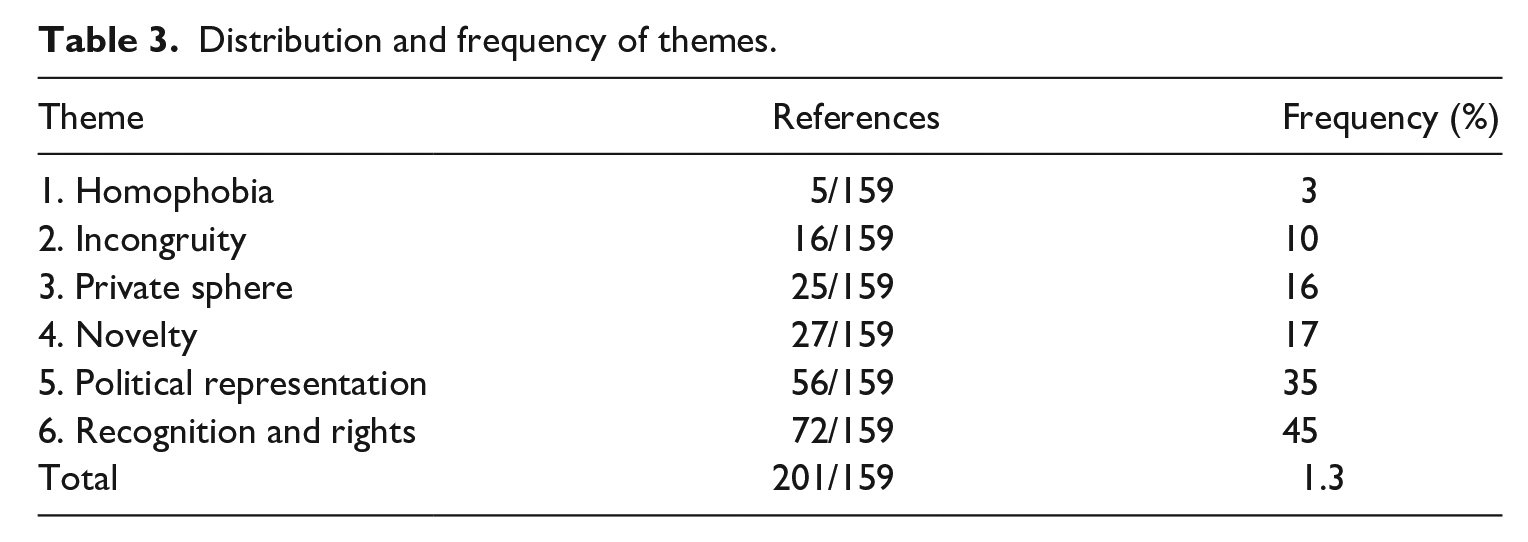
In the second stage, six main themes were identified within the 159 Gay Relevant items. Each news item was labeled with up to three themes according to the issues it covered and discussed and the tone it employed. Thereby, each item received an average of 1.3 labels (201 mentions/159 items).
Community recognition and rights
This theme is the most prevalent, found in 45% of the items. These items refer to the politician’s activities, in which he advances and calls for recognition of the LGBTQ community and its civil and legal rights. The MK is usually depicted within an LGBTQ context (e.g., participating in Pride Parades, voicing an opposition to conversion therapies, promoting pro-LGBTQ legislation, etc.). Since this theme refers to the politician’s substantive representation role, his sexual orientation is relevant to his political activity.
The following examples demonstrate and illustrate this theme: “Itzik Shmuli, Eitan Ginzburg, and Nitzan Horowitz protest against the delay in funding [LGBTQ] community organizations. ‘It’s unthinkable’, they wrote to the Minister of Education” (Ynet, 18.11.2019)
7
; “Idan Roll, an out gay man, was among the marchers [in the Pride Parade]. ‘It’s exciting to see the thousands who’ve come to celebrate tolerance and equality. This Parade is another proof for the victory of liberalism over extremism’” (Ynet, 18.06.2019); Kahol Lavan MKs, Idan Roll and Yorai Lahav-Hertzanu, both gay men, wrote to the Minister of Education: “We once more witness abhorrent violence against the LGBTQ community” [. . .] Roll added: “I will promptly work to promote the establishment of a safe space for LGBTQ youth and advocate laws banning anti-gay violence.” (Haaretz, 16.04.2019)
LGBTQ political representation
This theme, evident in 35% of the items, refers to the descriptive representation of the LGBTQ community, merely mentioning the MK’s sexual orientation per se. In most cases, stating his being gay is quite irrelevant to the content of the item at large: “MK Amir Ohana, the founder of the gay forum in the Likud, was appointed to replace [Ayelet] Shaked, who was fired” (Ynet, 05.06.2019); “The next Knesset assembly holds a record in the number of MKs who are members of the LGBT community” (Ynet, 10.04.2019).
Novelty
This theme was found in 17% of the items, and its essence is the reference to the novelty per se of a gay man’s appointment. It is characterized by the use of expressions such as “for the first time,” “the first gay man,” or “a historical appointment.”
Here are some examples of Novelty: “History in the Israeli government [. . .] For the first time, a member of the LGBT community will be a minister, a moment before Pride week” (Ynet, 05.06.2019); “The dramatic announcement of Ohana’s appointment as Minister of Justice made him the first homosexual to be a cabinet member” (Israel Hayom, 13.06.2019); “He [Ohana] joined the Knesset as the first right-wing MK who is an out gay man” (Haaretz, 18.03.2019); “Eitan Ginzburg was elected as the mayor of the city of Ra’anana, and was the first out gay man to be a mayor” (Haaretz, 18.03.2019); “Horowitz is the first gay man to be elected as head of a party [. . .] ‘It’s not surprising that this happens in Meretz’, he said. ‘I am convinced that in a few years this will become a routine’” (Haaretz, 27.06.2019).
Private sphere
This theme, found in 16% of the items, includes gossip or personal stories about the politician’s private life, his partner, his family, or his children: “Ohana is married and father of twins” (Ynet, 23.02.2019); “Last week MK Itzik Shmuli posted on the social media a picture of his son, who was born thanks to a surrogate mother in the USA” (Haaretz, 09.04.2019); “Eitan Ginzburg, 42 [. . .] raises two kids with his partner” (Haaretz, 18.03.2019); “Idan Roll, 35, is a fashion model and the spouse of singer Harel Skaat [. . .] In 2018, he and his partner gave birth to a child through surrogate motherhood in the USA” (Haaretz, 18.03.2019).
Incongruity
This theme, with a frequency rate of 10%, is interesting for it includes items that refer only to Amir Ohana. It is grounded in an incongruity between the popular and widely held understanding and conceptualization that LGBTQ people in general are, and should be, liberal and to hold leftist perspectives; while, in reality, some (or many) of them are actually right-wing and conservative. Ohana, being a strict conservative and right-wing, enticed vigorous critique by LGBTQ and non-LGBTQ publics and journalists. Upon being appointed as Minister of Justice, it was assumed that LGBTQ rights would be at the top of his agenda. However, not only did he not fulfil these expectations, he advocated conservative, nationalistic, and religious values. Hence, this theme reflects a deep dissatisfaction with Ohana’s political conduct on these grounds.
Examples of Incongruity: How does Ohana live with what he calls “first a member of Likud, and only then gay”? [. . .] Ohana [. . .] is precisely the man who is ready to blast the judiciary system. How awful is the thought that of all men, a member of the LGBT community is the one who will drive Israeli democracy to its demise? A gay man, a father, who owes his entire personal life and marital status to the judiciary system, will assist the Prime Minister to dismantle the system of checks and balances. (Ynet, 06.06.2019) MK Ohana, despite being an out gay man who became a father through surrogacy in the USA, is a fanatic member of the Netanyahu party, that blocked a law against LGBT hate crimes [. . .] Even Freud would not have known how to deal with a man who votes against himself, his family, and children. (Ynet, 17.09.2019)
Homophobia
This theme was scarce and appeared in only 3% of the items. It includes items that reflect a negative and demeaning attitude toward LGBTQ people: Amir Ohana is “so not gay” that it hurts me. I wish he were a bit homo-like [. . .] I want him to be a bit gay. It’s nice, it’s human [. . .] I wish he’d wear pink and come to the Knesset wearing a thong [. . .] Bring along some poppers when you arrive at the Knesset. (Israel Hayom, 17.11.2019) Nitzan Horowitz and his spouse, director Ido Riklin, live in smallish apartment in Tel Aviv [. . .] Except for them, a dog, who’s joined them on many Pride Parades, is walking around the home. Children, at the time being, are out of the question. They have decided to give up on children [. . .] Don’t you feel obliged to keep on the inter-generational dynasty? Horowitz: “There is no such obligation.” (Ynet, 19.07.2019)
Discussion and conclusion
This part addresses two perspectives that emerged from the findings. We first discuss the descriptive statistics, that revealed some similarities and some differences in the coverage of Israeli gay politicians, based on their identity and the covering newspaper; then we examine the main themes of their media coverage.
Statistically, the findings revealed some interesting points. The data suggest that senior politicians (cabinet ministers and party leaders) attain and enjoy more media exposure, and are also covered in a more balanced and relevant manner compared to junior politicians (recently elected MKs). The latter are more prone to be symbolically annihilated: their media coverage is much smaller than their actual number, and hence carry less import and significance. Senior politicians, on the other hand, are much more prominent in the media and political agendas: 87% of the news items explicitly included the three senior politicians. Consequently, their media presence boosts their status (and recognition) in the public sphere.
As Table 2 demonstrates, the gaps in bias between senior and junior politicians are very large (between 39 and 50% biased coverage of junior politicians, compared to only 9 to 19% biased coverage of senior ones). This finding reiterates a study by Lachover (2017), who found the same trend in the media coverage of female politicians in Israel. She showed that senior female politicians received much more substantive coverage compared with their junior colleagues. We propose that this finding is grounded in the fact that the more senior a politician is, the more he/she influences the political agenda, regardless of their gender or sexual orientation. This finding is also important for LGBTQ struggles for inclusion, because it shows that when more gay politicians enter the higher-ranking political echelons, the more their media perception and attention are enhanced. This, in turn, can facilitate the acceptance of LGBTQ at large, and in the political arena in particular.
Distribution and frequency of Gay Relevant news items.
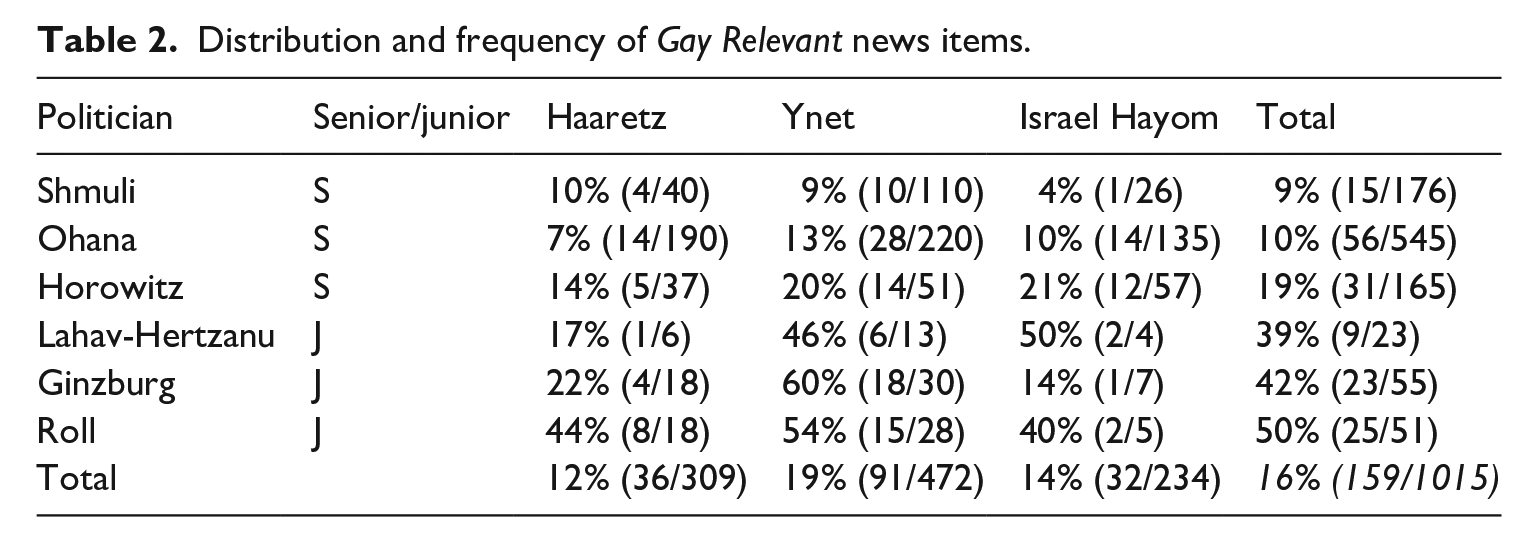
In the context of expected distinctions between popular and elite newspapers, we found no significant differences in the ways in which popular newspapers (Ynet and Israel Hayom) cover gay politicians compared with an elite newspaper (Haaretz). Although Haaretz has the lowest bias rates (12%), it is not significantly different from Israel Hayom (14%). This finding stands in contrast to Smith’s (2013) finding that tabloid newspapers are heavily biased in their coverage of gay politicians. However, other studies (Greenwald and Lehman-Wilzig, 2019) found that in the case of media coverage of female politicians, the differences between the two genres of newspapers are limited, as well. These limited differences may show that social stereotypes toward LGBTQ are so deeply rooted, they outweigh traditional journalistic work norms.
Looking at the themes, a number of important and interesting elements should be pointed out. First, as can be seen in Table 3, homophobia was found in only 3% of the news items. There are two possible explanations for this: (1) Western mainstream media are generally more liberal and less homophobic in comparison to mainstream public opinion (Sutter, 2000). This explanation is particularly important in light of the assumption that the media may help shape and change common attitudes among the public. Thus, we may conclude that the Israeli media are, to some extent, liberal and tolerant in accepting the participation of gay men in politics; something that can also create more positive attitudes toward them in many parts of Israeli society (Kama, 2011).
Distribution and frequency of themes.
(2) This finding can also be related to the differentiation that Smith (2013) makes between “good” and “bad” gay politicians. As previously mentioned, all MKs maintain what may be called a “homonormative lifestyle”: They are in monogamous relationships and most of them raise children. In other words, they are framed within a heteronormative “respectability” (Lalancette and Tremblay, 2019), that affords journalists and publics to accept their homosexuality. Furthermore, their politics overtly embrace Puar’s (2013) conceptualization of homonationalism, and thus may be viewed favorably by “patriotic” journalists. Homonationalism is a common politics within lesbian and gay liberal rights discourses, that honor the nation-state and its revered institutions. Israeli queer scholars (e.g., Gross, 2015; Hartal and Sasson-Levy, 2018) shed light on how local LGBT struggles are well embedded within a homonational framework. As we see, some of our findings, especially those related to the media coverage of Amir Ohana, are strongly influenced by this conceptual setting.
Second, gay politicians’ media coverage places special emphasis on political representation (Dovi, 2018). In this context, the most prominent themes found in our study are political representation (35%), and recognition and rights (45%). The coverage included both aspects of Descriptive Representation (explicit reference to the politician’s sexual orientation), as well as aspects of Substantive Representation (issues relevant to the LGBTQ community, such as Pride Parades and promoting legislation pertinent to this group). This finding is noteworthy since the media emphasize a fundamental notion, according to which the presence of representatives from minority groups in the political arena, and especially in parliaments, helps advancing vital issues for their group (Reynolds, 2013, 2020). In this sense, the media materialize the idea of representation, as one of the central ideas in liberal democracy. Unlike Everitt and Camp (2009) and Golebiowska (2006), who claim that both descriptive and substantive representations may be harmful for LGBTQ politicians, as if they are “single issue politicians,” devoted to the “gay agenda”; we think that this type of framing actually signifies a positive attitude by the media.
Third, the “novelty” and “private sphere” themes support studies of political communication and gender, and specifically research on media coverage of female politicians (Greenwald and Lehman-Wilzig, 2019; Meeks, 2012). In terms of “novelty labels,” we found that gay politicians are oftentimes portrayed by the media as “pioneers.” This framing accentuates the groundbreaking, even radical, nature of their election, and hence can be considered positive. However, it should be noted that this highlight may also be deemed “offensive,” since it frames the politician within a rather limited scope, as if his sexual orientation is his primary characteristic (Lalancette and Tremblay, 2019). This media practice places an emphasis on the politician’s sexual orientation per se, rather than his professional functioning.
In terms of the “private sphere” theme, the traditional gender division of labor is between heterosexual women, identified with this sphere (including childcare and household chores), and heterosexual men, identified with the public sphere (including the political arena) (Trimble et al., 2013). Our findings show that, similar to female politicians’ coverage, the framing of gay politicians includes a significant reference (25 mentions) to various aspects of their private sphere, particularly focusing on their family. Perhaps they are conceived as less “manly” than their heterosexual peers. Gendered mediation (Gidengil and Everitt, 1999; Lachover, 2017) or bias (Rohrbach et al., 2020) is defined as the gendered characteristics that can be found in the coverage of female politicians who are sidelined by the media and portrayed stereotypically (balancing between private and public life, objectified, portrayed by appearance and age, referred to only by first name, etc.). In this context, Mundy (2013) found that the most salient frame of the Icelandic lesbian Prime Minister was actually being a woman. Interestingly, our findings regarding the prevalence of the private sphere reveal that gay male politicians’ news framing seems to be the intersection of gendered mediation and sexual mediation, in the sense that, considering the politicians’ sexual orientation, gender characteristics are very much relevant, even when the politicians are men.
We see this finding as a fascinating opening for further research that may address the question: Is it in the power of LGBTQ politicians to undermine the traditional media perception that distinguishes between men and women and designates them to opposing spheres? Further research in other political and cultural environments is needed to confirm this finding.
Finally, the “incongruity” theme emphasized the differences between the coverage of gay politicians on the right side of the political map, and their colleagues on the left. The premise here is that an LGBTQ politician should be identified with liberal and leftist values, such as equality for all (in the Israeli case, this includes Palestinians), while eschewing nationalistic and conservative values. In this sense, Ohana differs starkly from the other five politicians, and therefore this media theme was found to be relevant only to him. His coverage was much more critical than that of the others, emphasizing the paradox or tension between being gay and politically conservative and nationalistic.
In conclusion, this study is the first to be conducted on LGBTQ politicians’ coverage by mainstream non-English media. The findings show that there are variables significantly related to the balanced or biased coverage of these politicians (e.g., their seniority and political position). On the other hand, there are variables that have a limited effect on the nature of the coverage of gay politicians (e.g., being a popular or elite newspaper). In addition, the study found prominent coverage frames (themes), that characterize gay politicians’ media representation (e.g., political representation, novelty, and private sphere) compared to less prominent themes (e.g., homophobia).
Future studies can expand the examination of media coverage of LGBTQ politicians (not only gay men) in diverse countries, in order to compare this coverage with the findings of the present and previous studies. Such comparative studies can shed light on the interrelations between a national/socio-cultural environment and media coverage of LGBTQ politicians. Moreover, what is needed now is to accumulate enough knowledge from a large array of locales, to establish a theoretical paradigm that interrogates the relations between the media and LGBTQ elected politicians. Such a framework can be then compared with coverage of elected politicians of other minorities.
