




Abstract
This article focuses on new media technologies and practices that are reshaping how human rights media activism is practiced, disseminated and received. Through an examination of two works by the research agency Forensic Architecture, we examine how these new technologies and practices aim to reframe and deploy forms of raw media evidence in human rights struggles and broader modes of political activism. We also consider how these nascent forms of activist media practice are indebted to the broader legacies of radical documentary practice, particularly through the theoretical lineage of the “camera as weapon.” The new technological and aesthetic strategies being developed and utilized by these groups are radically reshaping investigatory methodologies and collaborative practices across contemporary human rights, documentary, and new media practice. Ultimately, within these new ecologies of media practice, raw forms of media evidence are reframed and redeployed; entering into larger assemblages and ecologies to examine – and concomitantly resist – formations of political power and state violence. This is a practice that we term “mediated forensics.”
Introduction
This article focuses on new media technologies and practices that are reshaping how human rights media activism is practiced, disseminated, and received. Within our digitally networked, mediated, and platformed present, the sheer ubiquity of – and access to – diverse forms of media evidence has been well documented and theorized (Dubberley et al., 2020; Higgins, 2021). Such forms of raw media evidence can be divided into two broad categories: citizen-produced (such as mobile phone videos, social media posts, personal dash cams etc.) and operational, state-produced (police body camera footage, surveillance technologies, satellite imagery etc.). A range of media and journalistic groups, such as Forensic Architecture, WITNESS Media Lab, SITU Research, Mnemonic, INDEX, and VFrame, have developed new media practices and technologies that aim to reframe and deploy these forms of raw media evidence in human rights struggles and broader modes of political activism. More precisely, the practices developed by these, and other diverse groups place varied forms of raw media evidence into larger media assemblages (digital 3D models, interactive online media interfaces, virtual and augmented reality simulations, gallery installations, amongst others) with the aim of enhancing both their truth-bearing capacities as well as their political and legal potency. Moreover, the dissemination and presentation strategies developed by these groups – moving into art galleries, onto online multimedia platforms, and across activist media networks – have also attempted to bypass the traditional spaces of jurisprudence by creating novel forums of public engagement, opening crucial practices of witnessing and activism to wider audiences and fostering new forms of political action and pressure (Weizman, 2017). Ultimately, within these new ecologies of media practice, raw forms of media evidence are reframed and redeployed, entering into larger assemblages to examine – and concomitantly resist – formations of state and corporate power and violence. Within this article, we examine the origins, practices, and politics of this new trend in nonfiction media culture, a practice that we term “mediated forensics.” We aim to identify some of the underlying catalysts behind this turn toward the forensic, as well as surveying and analyzing two key works within this recent branch of nonfiction media practice.
Mediated forensics extends the broader legacy in documentary media studies of the conceptualization of the “camera as weapon” as a way for on-the-ground activists and artists to intervene in political struggles using the camera a forceful tool against state power and violence. In the networked digital age, cameras are everywhere, producing vast quantities of affective and effective documentary based “militant evidence.” Militant evidence refers to both the production and tactical utilization of raw evidentiary media forms by diverse publics; purposefully amassing and curating evidentiary forms to speak truth to power. Here, our work extends from, and builds upon, the concept of militant evidence. In a contemporary moment of media oversaturation, the “accumulation and corroboration” of diverse raw evidentiary media is a key praxis and a central dimension of the militant evidentiary (Watson, 2021: 10). Such accumulatory and corroboratory processes help “each piece of evidence [to] build on the force of others” and, concomitantly, aid and support diverse forms of political and humanitarian activism (p. 10). Thus, this building of affective and effective forces aims to help forms of evidence to enter new public forums of visibility, witnessing, and contestation that can counter the violence of diverse state power formations and human rights abuses (Weizman, 2017). Consequently, at a broader conceptual level this article is concerned with tracing the political, material, and discursive genealogies of how particular forms of media change state. More precisely, we aim to examine how particular media forms transition from a state of existence as individuated fragments of raw evidentiary material and individual witness testimonies and toward functioning as constitutive nodes in larger, more complex, and powerful evidentiary media assemblages.
These contemporary forms of political media assemblage will be situated in relation to the aforementioned legacies of documentary activism (the theorizations of both the “camera as weapon” and the militant evidentiary) with the aim of understanding how this contemporary work exists on a continuum with previous forms of radical theory and praxis within documentary media studies. It is our contention that the mediated forensic work being undertaken by the aforementioned research clusters and groups constitutes a new strand of militant evidentiary practice. Through novel technological and aesthetic practices, these groups are reframing and redeploying diverse forms of multimedia evidence; placing them within larger assemblages and ecologies and aiming to increase their affective and effective power and ability to intervene in forms of political and humanitarian struggle. If the foundational materials of militant evidence are these forms of often raw “affective” and “effective” evidence (Watson, 2019, 2021), examining how these media forms find their way onto new and diverse digital platforms and public forums is of primary interest for us here.
To examine these political, material, and discursive shifts, we focus on two recent projects by Forensic Architecture, a multidisciplinary research group based at the University of London who are working at the forefront of this new evidentiary mode. The two projects under examination, The Killing of Harith Augustus and Torture in Saydnaya Prison allow us to explore the practical, political and methodological strategies being fostered by a key group working within this forensic mode. Before we move into the analysis of Forensic Architecture’s practice, it is important first historicize the concept of the camera as weapon, and later, to more concretely define two key terms we have briefly touched on already: “militant evidence” and “mediated forensics.” These histories and concepts are integral to understanding the technological and political potentialities of these new uptakes and reframings of varied media evidence.
Camera as weapon?
The notion of the film “camera as weapon” has a long theoretical and conceptual history in transnational political cinema and media cultures. The original use of the term can perhaps be most concretely traced back to Solanas and Getino canonical essay “Toward a Third Cinema,” published in 1969. Arguing for the political potentialities of the cinematic, the authors argue that the moving image must be transformed “from mere entertainment into an active means of de-alienation. . . The camera then becomes a gun, and the cinema must be a guerrilla cinema” (Solanas and Getino, 1969: 1). For Solanas and Getino, in the face of neocolonial state violence, propaganda and active misinformation, the camera could be weaponized to combat these alienating logics; reaffirming the documentary capacities of the visual and its concomitant potential to speak truth to power.
As Julianne Burton wrote in 1978, in her essay surveying the use of the camera as a revolutionary weapon throughout the Latin American Third Cinema movement in the 1960s and 70s, “[i]n countries where the camera has been wielded as a weapon in the cultural offensive, many of the results have indeed been explosive” (Burton, 1978: 49). This explosion refers to both the proliferation of committed and radical filmmaking being done in the name of allied national liberation movements as well as the lasting influences such practices would have on future conceptions of radical political documentary practices in the proceeding decades. It also refers to the potential power of the camera as a gun, as in Getino and Solanas’ formulation. Burton notes that “[a]mong Latin American filmmakers, there has been a critique of the easy and formulaic association of the camera and the gun.” For some, like Uruguayan filmmaker Walter Achugar, “[a] camera is a camera, and a gun is a gun” (p. 75). While, for Cuban filmmaker Julio Garcia Espinosa, who coined the term “imperfect cinema,” “[t]he camera depends upon the gun.” (p. 75) Within that environment, a militant cinema can emerge where the camera and the images it produces act as counterforces against the status quo.
Burton’s discussion and historical gloss of the camera as weapon concept reveals its complex, dialectical nature and development since the advent of Third Cinema. In the 21st century, the possibilities of armed revolution or epoch changing revolutionary events seems like a relic from a previous century. But today, billions of people around the world have a cell phone with a camera in their pockets, standing armed and ready to document the world around them. The camera has both more and less power than it used to. While individual images have little lasting power, their accumulated affective and effective forces, when tactically and strategically presented, can be potent. The camera is not a gun, rather it is more of a potential evidence collecting device that produces images that can be accumulated and deployed against state violence within the framework of forensic mediation.
Anjali Nath has examined how the Third Cinema formulation of “the camera as weapon” might be retooled and recalibrated for the contemporary age of digital ubiquity, particularly in militarized regions like Kashmir where the suppression and regulation of information is of primary importance for maintaining state control. “The camera is a weapon,” Nath (2019) argues, “but only so in relation to an already weaponized visual field” (p. 272). Nath takes up the notion of “camera as weapon” to examine how emergent and nascent forms of visual media practice can resist such modes of information suppression. Ultimately, for Nath, “the landscape of digital media has rapidly shifted the politics of witnessing and the work of the ‘documentary’ as a self-evident politically oriented genre” (p. 272). Here then, she is interested in the role that visual technologies can play in undermining the manufactured “stability” of a visual field that is restrictively managed by the state apparatus.
State power dominates the visual field not just in Kashmir, but in many occupied and oppressed areas in the world. In the US, the recent rash of killings of Black and brown people at the hands of the police has reached new levels of visibility due to cell phone cameras. At the same time, police have adopted a counter-visual strategy aimed at protecting themselves from accountability. Body worn cameras have become a popular choice for many police departments, with cameras mounted near the top of an officer’s chest, in addition to cameras and audio recording equipment in patrol cruisers. One police department, in King City, California became the first to mandate cameras on officers’ guns. The cameras, which are mounted on the bottom of the barrel of the guns, automatically start recording when the weapon is holstered. Recordings like these are rarely used to exonerate individual suspects and are instead used to frame the police point of view in courts and other legal settings that allow visible evidence, further eroding the potential power of individuals recording with their cell phones.
For Nath, new visual media forms become crucial avenues for reasserting the importance of witnessing, documentation, visibility, and accountability. Thus, she asks the question, “in the age of digital reproduction, what might it mean to think of a documentary impulse as distributed across networks and platforms?” (p. 271). In many ways, our mapping of the contemporary proliferation of militant evidence and its organization through processes of mediated forensics links up closely with Nath’s thinking here. We are similarly interested in how the rapid accumulation of militant evidence is “distributed across networks and platforms,” made accessible, legible, effective and affective through multifarious processes of what can be termed “mediated forensics.”
Can this political formulation of the moving image still be a useful conceptual and methodological framework in an age defined by rapid image and information proliferation? Does the “camera as weapon” still provide a useful critical and political approach to image making and processes of witnessing? The camera as weapon analogy is fundamentally one about power, giving power to the people and taking it away from states and corporations, rather than violent weaponization. In early formulations of the concept, the revealing powers of cameras in the hands of the people did constitute a shift in power relations. However, as cameras proliferate on cell phones throughout the world, the camera’s power, in and of itself, is, ironically, diminished. Yet, documentary images can still wield powerful forces and we argue that this happens in the shift from forms of militant evidence to mediated forensics, that provides militant evidence new aesthetic assemblages, organizations, presentations, media ecologies, and platforms to realize its potential power. In the networked digital age of new media, expanded documentary-based practices like those of Forensic Architecture work to deeply contextualize, forensically mediate, and re-orient narratives and practices of state violence, countering the power of state domination within the visual field.
Militant evidence
The broader idea of militant evidence focuses on how everyday people can harness the power and forces of the proliferation of documentary images that have saturated the world since the turn of the 21st century. These images are produced in great quantities by digital active witnesses – activists, artists, amateurs, and everyday people – on cell phones and consumer grade digital cameras. They emerge particularly in spaces of global crisis and are the raw, connective tissue that binds allied struggles against occupations, wars, and human rights abuses. Militant evidence consists of what Steyerl (2009) defines as “poor images” which are produced by digital active witnesses in spaces of global crises. When these images are amassed and strategically targeted as militant evidence, they work to corroborate images, events, witnesses, and testimonials where each piece of evidence builds on the effective and affective force of others. This collection of affective and effective forces rendered by militant evidence reveals the systemic effects of wars, occupations, and human rights abuses while representing the usually “unseen” struggles and people cast aside by traditional media outlets. These user generated forms of militant evidence compete, in a weaponized visual field, against state and corporate produced narratives and evidence that often obfuscate state violence. In the networked digital age, militant evidence produced by digital active witnesses competes against police body cams, surveillance and drone footage, and other operational images and forms of state visual power. When militant evidence is deployed in a counter-forensic mode by groups like Forensic Architecture, it functions as a force against these state-produced operational images.
The “militant” part of the term refers to non-violent, but unyielding struggle on the part of digital active witnesses across the globe that capture documentary images and/or give first-person testimonies to intervene in their world. The “evidence” aspect of the term refers to the effective and affective uses of evidence in the globalized digital age. Within documentary studies, militant evidence is an extension and update of the term “visible evidence” coined at the dawn of the digital age in the 1990s in the wake of the Rodney King tape and verdict (Gaines and Renov, 1999). Mere visibility is no longer enough. Rather, the concept of militant evidence takes into account the complex media, legal, political, and social ecologies that poor images make meaning within. This alternative economy of militant evidence that is produced by digital active witnesses and deployed in partnership with other groups, is wielded in new modes of effectively and affectively radical documentary practices, as forces and tactical interventions for resistance, revolution, counter-archives, and justice.
Mediated forensics
What shape does such an alternative economy of militant evidence take? How would such modes of evidentiary engagement help to foster new forms of radical nonfiction media practice? As suggested above, a range of new technological and aesthetic practices are reshaping the roles that these diverse forms of raw evidence can play in exposing and countering violations of human rights globally. Here, diverse forms of militant evidence are placed in new media assemblages and ecologies in ways that enhance their ability to tactically intervene in political struggle and human rights activism. Within these new assemblages – online multimedia works, interactive documentaries, gallery installations, augmented reality environments, amongst others – there is thus a reassertion that visual media forms have a renewed capacity to speak truth to power. In addition, new technologies and representational practices of visual and forensic analysis – 3D scanning, virtual reality simulations, mapping, 3D and acoustic modeling, diagramming photogrammetry, remote sensing, fluid dynamic simulations – are utilized as mediated sensing devices, which can help unearth and build new forms of evidentiary material. Thus, the practice of mediated forensics produces, amplifies, and forensically mediates forms of militant evidence. This contemporary shift toward counter-forensic forms of investigation and representation against that state is yet to be properly interrogated or theorized.
By focusing on how these media forms evolve from a state of raw evidentiary material into counter-forensic visual nodes within wider public networks, we also aim to examine how practices of witnessing, jurisprudence and activism are being reshaped within this age of image saturation. Here, we build on the work already done by Eyal Weizman and Forensic Architecture in relation to the notion of the “forum” (Weizman, 2017). As they suggest, by moving into the gallery, onto diverse platforms of media consumption and through activist networks of solidarity, these variegated visual media forms aim to shift the practice of truth construction beyond a strictly juridical context; opening access to the powerful practices of witnessing, jurisprudence, and justice to wider publics precisely through their emplacement within different cultural spaces and contexts (Weizman, 2017).
In mapping these movements and transformations of media evidence, we also want to highlight the particular importance afforded to the performative and aesthetic in these practices, and how this structures their emplacement within the broader ecologies of mediated forensics. 1 Ultimately, the forensic and evidentiary practices examined here understand that the establishment of any reality or fact is something that must be produced – aesthetically and discursively – and presented within a forum for debate (Weizman, 2017). Indeed, the establishment of any reality or truth within such new media practices is “the result of an intentional process of production. . . the adaption of new technologies borrowed from the world of creative media production” (Gates, 2013: 244). Mapping these movements will also allow us to gain a better understanding of how these new media and journalistic collectives frame their practices, aesthetically, discursively, and politically.
Forensic architecture
Forensic Architecture is a research agency based at Goldsmiths, University of London, UK and established in 2010. Their primary aim is “to carry out investigations with and on behalf of communities and individuals affected by conflict, police brutality, border regimes and environmental violence” (Forensic Architecture, 2019b). Through the two case studies examined below, we will gain insights into how their collaborative practices utilize different aesthetic and technological techniques and tactics of forensic mediation to intervene in real world forms of struggle against diverse formations of state power. The first case study, The Killing of Harith Augustus centers on the murder of a young Black man in Chicago in 2018 at the hands of the police. We will examine how a broad array of “operational,” state produced media forms are utilized to counter-forensically critique and condemn endemic police violence in Chicago. The second case study, the project Torture in Saydnaya Prison, and the interactive documentenary Saydnaya: Inside a Syrian Torture Prison (2017) produced in collaboration with Amnesty International, and Jordanian-British media artist Lawrence Abu Hamdan, focuses on the Saydnaya Military Prison near Damascus, Syria, which has long been a site for the state sponsored torture of political prisoners. Through a practice of “situated testimony,” former prisoners helped to build an architectural map of a carceral space that has remained publicly inaccessible and invisible. Although the projects engage with radically different sites, incidents, and histories, there are methodological, technological, and aesthetic overlaps between the two that are built around a shared emphasis on recalibrating and reframing forms of media evidence to increase their potential to undermine forms of humanitarian abuse and violence.
The Killing of Harith Augustus
On July 14th 2018, Harith Augustus was shot and killed by police in Chicago. The Chicago Police Department (CPD) statement released the day of the shooting stated: “officers approached a male suspect exhibiting characteristics of an armed person, when an armed confrontation ensued resulting in an officer discharging his weapon and fatally striking the offender” (Kalven and Weizman, 2019). The next day, the CPD released an edited body camera video of the shooting, claiming the material “spoke for itself.” As Weizman and Kalven suggest, the most significant moment in this version of the video is the use of a freeze frame and digital zoom in on Augustus’ holstered firearm as he turns away from the police officers as they attempt to illegally detain him (Kalven and Weizman, 2019) (Figures 1 and 2). Crucially for Kalven and Weizman, this simple visual and temporal manipulation of the footage (freezing and zooming) suggested that the CPD clearly felt that the video in its raw and unedited state did not effectively bolster the narrative they were constructing, and, consequently, did not sufficiently “speak for itself” – hence its manipulation, reframing and rearticulation. It was ultimately established that Augustus had a license to carry his gun and never unholstered his weapon during the incident (Kalven and Weizman, 2019).
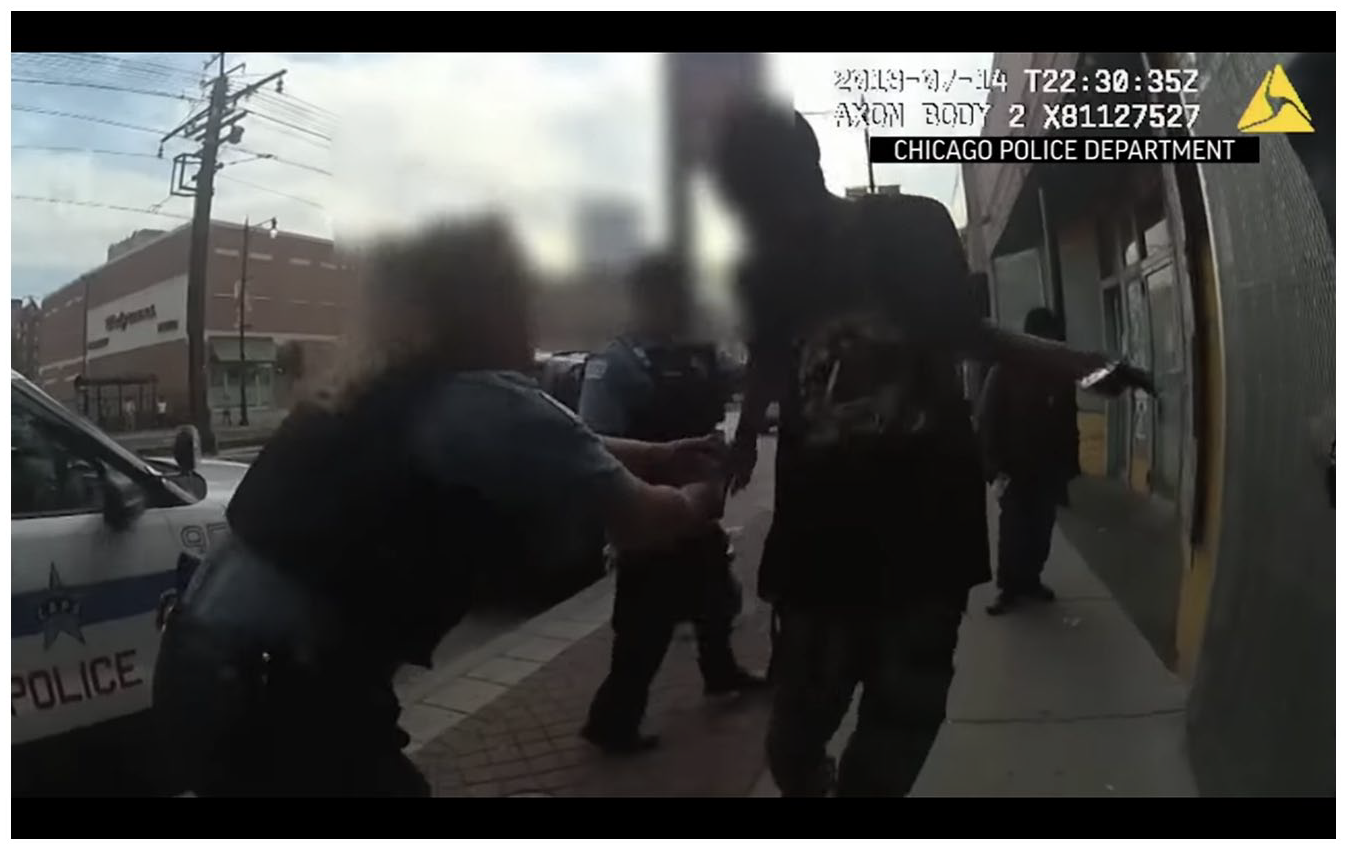
Still from Six Durations of a Split Second: The Killing of Harith Augustus.
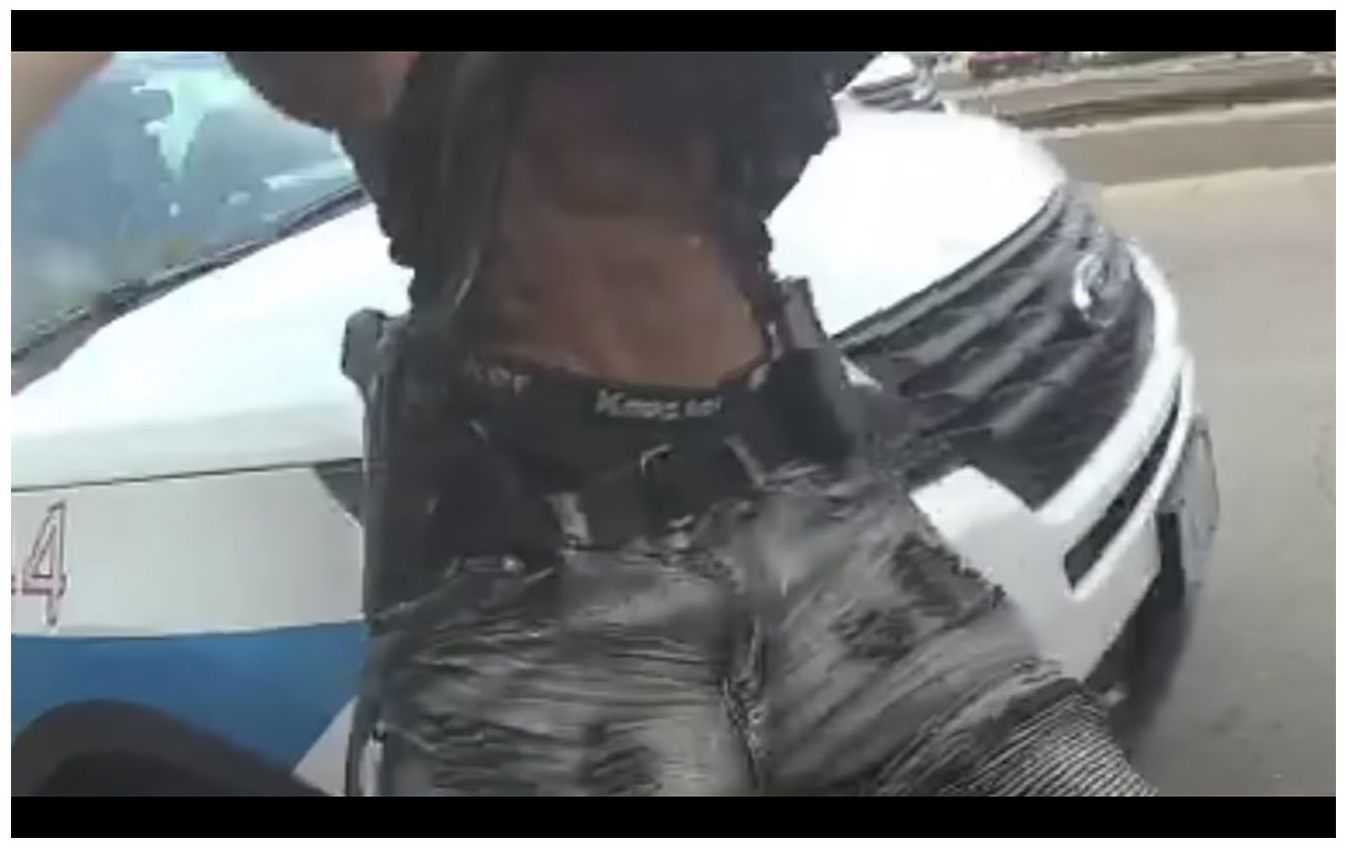
Still from Six Durations of a Split Second: The Killing of Harith Augustus.
On August 16th, a slew of additional pieces of evidence were released, including 18 body camera videos. This broader array of evidentiary material became the building blocks that helped shape and frame the collaborative project between Forensic Architecture and the Invisible Institute, entitled “Six Durations of a Split Second.” Here, the two groups aimed to interrogate and critique the narrative constructed by the police in the immediate aftermath of the event. Their central argument was “that the fatal encounter was caused by aggressive policing rather than any criminal conduct by Augustus” (Invisible Institute, 2019). The result of their work were six video-investigations, “each of which reconstructs the event across a distinct time scale—from milliseconds to years—and exposes different dimensions of police violence” (Invisible Institute, 2019).
As suggested earlier, within such mediated forensic practices there is an understanding that evidentiary forms are not apriori givens, rather they are the results of intentional “processes of production” (Gates, 2013: 244). Thus, at the heart of such work is an interrogation of the actual status of the evidentiary. Here, it is important to note that such forms of “intentional production” can be both top-down; produced by those responsible for (and wishing to conceal) instances of state violence, and ground-up; from those aiming to tactically counter and expose such acts of brutality. Indeed, as the project suggests, the edited CPD body cam video is an example of how an operational evidentiary form is subjected to “intentional” top-down manipulation by those wishing to reframe and partially conceal the deadly violence contained in its images. Thus, counter-forensic practices (whether top-down or ground up) similarly understand the evidentiary as that which must be produced, aesthetically and discursively and placed within a forum for debate. The Augustus project is clearly an example of a practice that attempts to disrupt and invert the dominant logics of state-produced media forensics. Ultimately, the project aims to unpick the CPD’s claim that the “video speaks for itself,” arguing instead that evidence “does not convict, nor does it decide, nor does it settle or conclude or determine” (Keenan, 2018: 113).
What then are the technological and aesthetic techniques taken up by the project, and how do these techniques reframe and augment the truth-bearing capacities of the diverse forms of evidence connected to the killing? As the title of the project suggests, the question of temporality was central to the project. As Kalven and Weizman (2019) argue, whilst the police argument extended primarily from the concept of the “split-second” to try and justify the shooting of Augustus, “Six Durations of a Split Second” aimed to assess the shooting at a variety of different “temporal scales,” precisely as a way to push back against this dominant police framing of the incident: “the law treats the split second as an indivisible unit of time within which great deference must be given the perceptions and judgments of the officer who inflicted the violence”. Here then, the investigation of the shooting and surrounding events from a variety of temporal scales aimed to “bring into focus the totality of circumstances that produced the split second” (Kalven and Weizman, 2019).
A variety of methodological techniques are taken up to try and reconstruct the killing of Augustus at different temporal scales. Two of the key practices we want to focus on here are 3D modeling and audio-visual synchronization. It is arguable that the 3D modeling praxis is the central aesthetic and methodological pillar of the project; structuring and supporting the deployment of the other strategies, including processes of audio-visual synchronization, situated testimony, embedded fieldwork, amongst others. Working with a variety of different architectural visualization and modeling softwares, a digital environment was created that represented the site of the shooting. The 24 pieces of available 2D evidentiary imagery were then mapped onto this 3D space, allowing for the creation of a more “dynamic” version of the location. As Forensic Architecture suggest, these models function as more than just “3D representations of real-world locations,” they also operate as “analytic or operative devices” (Forensic Architecture, 2019a) (Figure 3). As we shall see, in the Harith Augustus project, the techniques of audio-visual synchronization are predominantly structured by, and reliant upon, the creation of the 3D model.
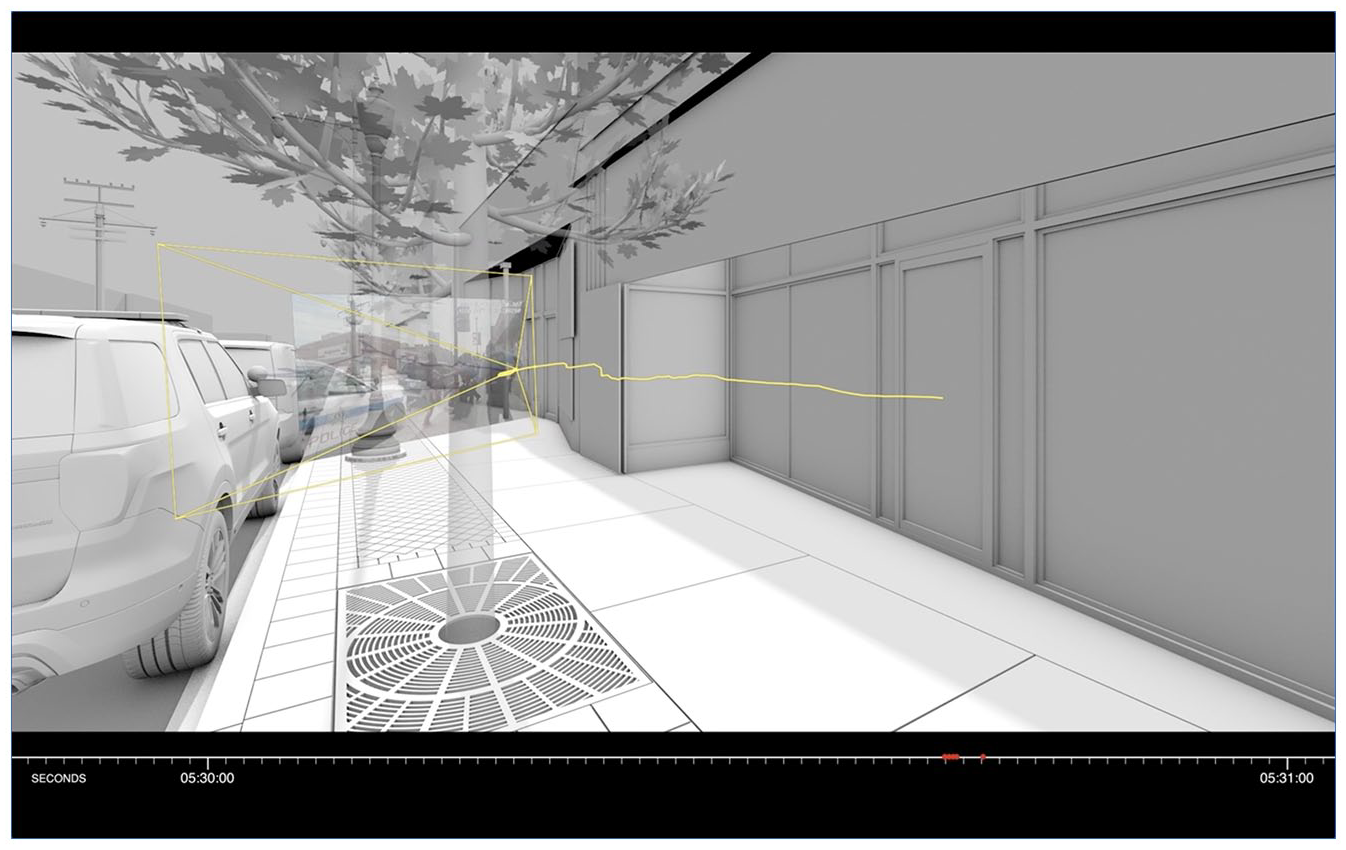
Still from Six Durations of a Split Second: The Killing of Harith Augustus.
The process of audio-visual synchronization involves establishing “the exact relationship between two or more pieces of audiovisual material—knowing when one piece of footage begins, relative to another” (Forensic Architecture, 2019c). As Forensic Architecture has suggested, such a practice is particularly relevant when working with multiple pieces of evidence: “once multiple pieces of evidence are reliably synchronized by reference to their contents, the accurate metadata of one piece ‘anchors’ the others in time and space” (Forensic Architecture, 2019c). Thus, we can immediately see the connections between the processes of audio-visual synchronization and 3D modeling, with temporally synchronized evidentiary fragments placed into the 3D environment’s spatial framework. The spatialization of these temporal fragments thus enhances their cumulative effect; allowing for a different model of evidentiary mediation and investigation to come into being. Consequently, 3D modeling becomes a “spatial anchor” for different temporally inflected techniques to be deployed.
The project’s second short video, entitled Seconds, offers a good distillation of the project’s different methodological strategies. As Kalven and Weizman suggest, the video examines and interrogates the moments immediately before, during and after the shooting, trying to counter the narrative of the police that tends to favor a reading of “the split second as an indivisible unit of time” (Kalven and Weizman, 2019). As the voiceover explains, human renderings of the officer and Augustus were inserted into the 3D model, allowing for an interrogation of “the incident from different perspectives and speeds, revealing nuances of the event’s choreography.” Indeed, the primary focus of Seconds is on the “choreography” of the event’s central protagonists. The aim here was to try and better understand both why Augustus tried to flee and why Dillan Halley fired a total of five times. Thus, for the project’s creators, the dynamic simulation allowed for the 3D model’s virtual camera to offer new and unavailable perspectives on the event; revealing hidden moments of “contact” and “interaction” between the officers and Augustus (Kalven and Weizman, 2019).
Within this virtual environment, the actions of trainee officer Megan Fleming are thrown into sharp relief. As Augustus speaks to Officer Quincey Jones, attempting to show him legal proof of his right to carry a concealed weapon, Fleming approaches Augustus from behind and attempts to grab his arm. This scene is presented in a split screen, the top image showing the body camera footage and the bottom a bird’s-eye view of the virtual simulation (Figure 4). As the voiceover suggests, “her attempt to apprehend Augustus with the use of physical force was unjustified, because Augustus was cooperative and could have been carrying the gun legally.” The split screen continues as the officers crowd round Augustus, grabbing at his arms. He attempts to breakaway and as he does so we can see Fleming grabbing at his shirt, inadvertently lifting it up to reveal the gun. As Augustus breaks away, Halley begins to fire. As the voiceover argues, the 3D model and synchronization allow us to invert a visual field (the body camera) that often structurally reduces the physical presence of the police. Although body cameras allow unique and previously unavailable perspectives on police actions, the officers whose actions we wish to scrutinize are removed from the frame. Moreover, there is evidence that body cameras have actively reduced police accountability; masking the visual presence of the wearer and their actions or leading to subconscious association with their position vis a vis the events captured (Turner et al., 2019). Consequently, within the Augustus project there is a conscious effort to place the officers back into the visual field, affording us the opportunity scrutinize their unjust actions that led to the murder (Figures 5 and 6).
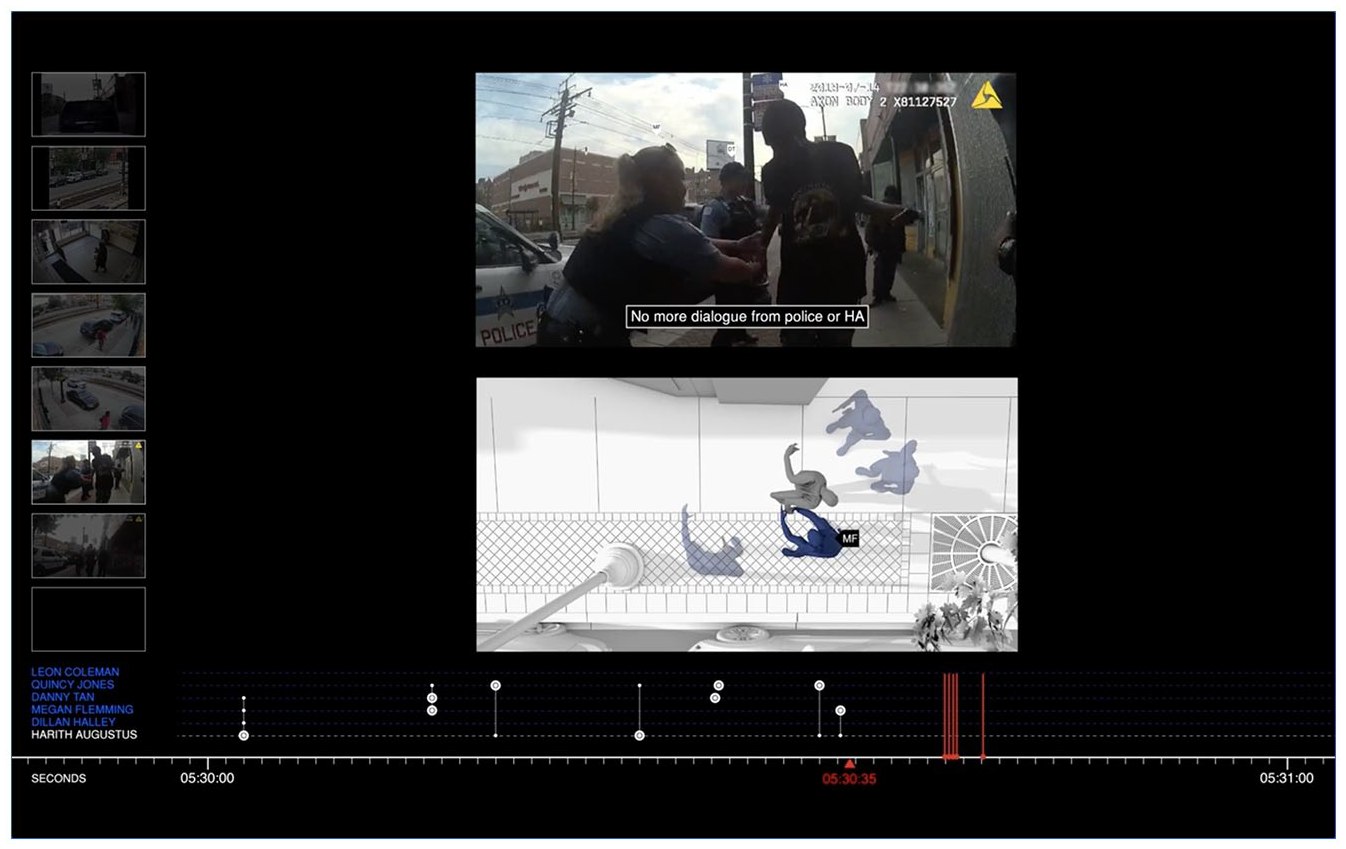
Still from Six Durations of a Split Second: The Killing of Harith Augustus.
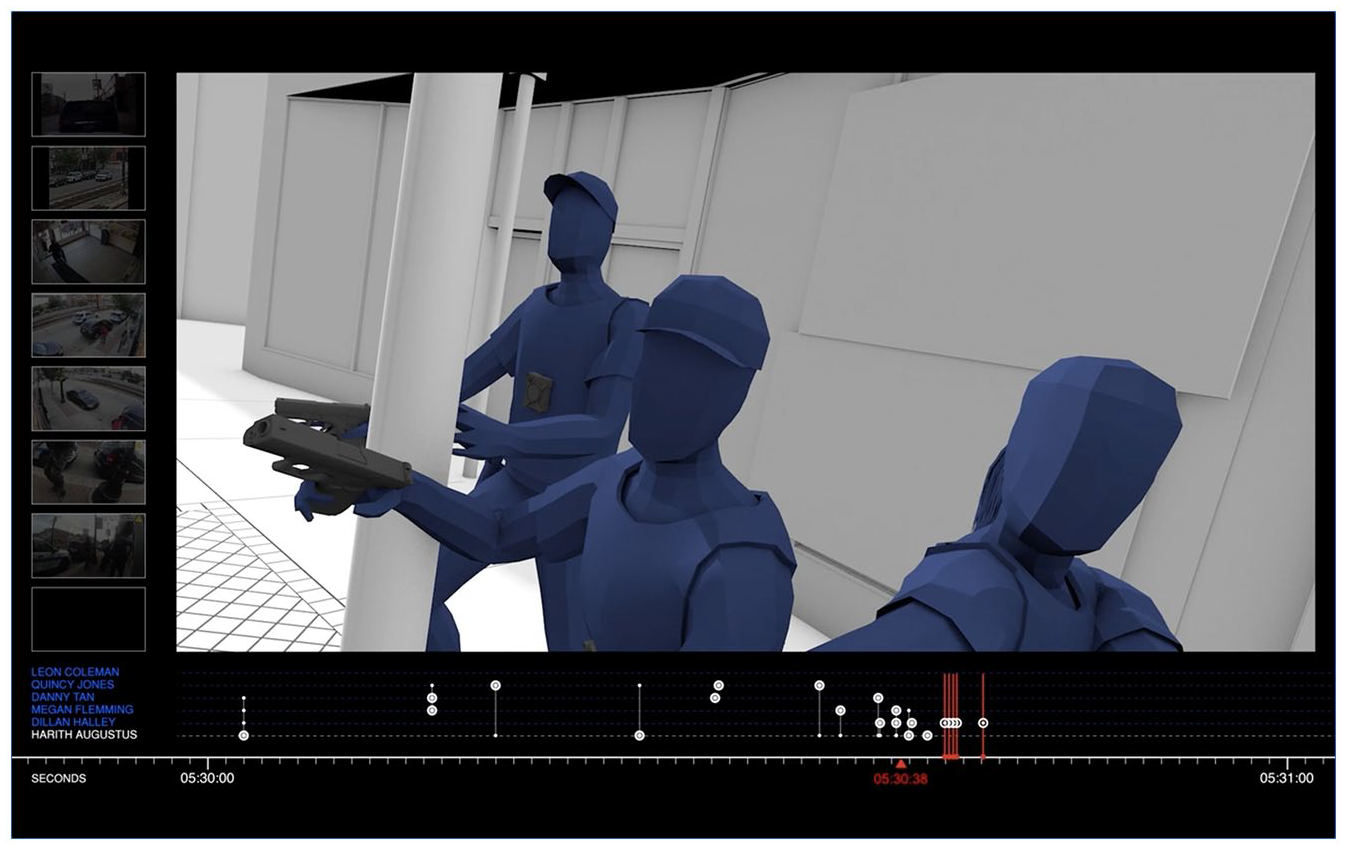
Still from Six Durations of a Split Second: The Killing of Harith Augustus.
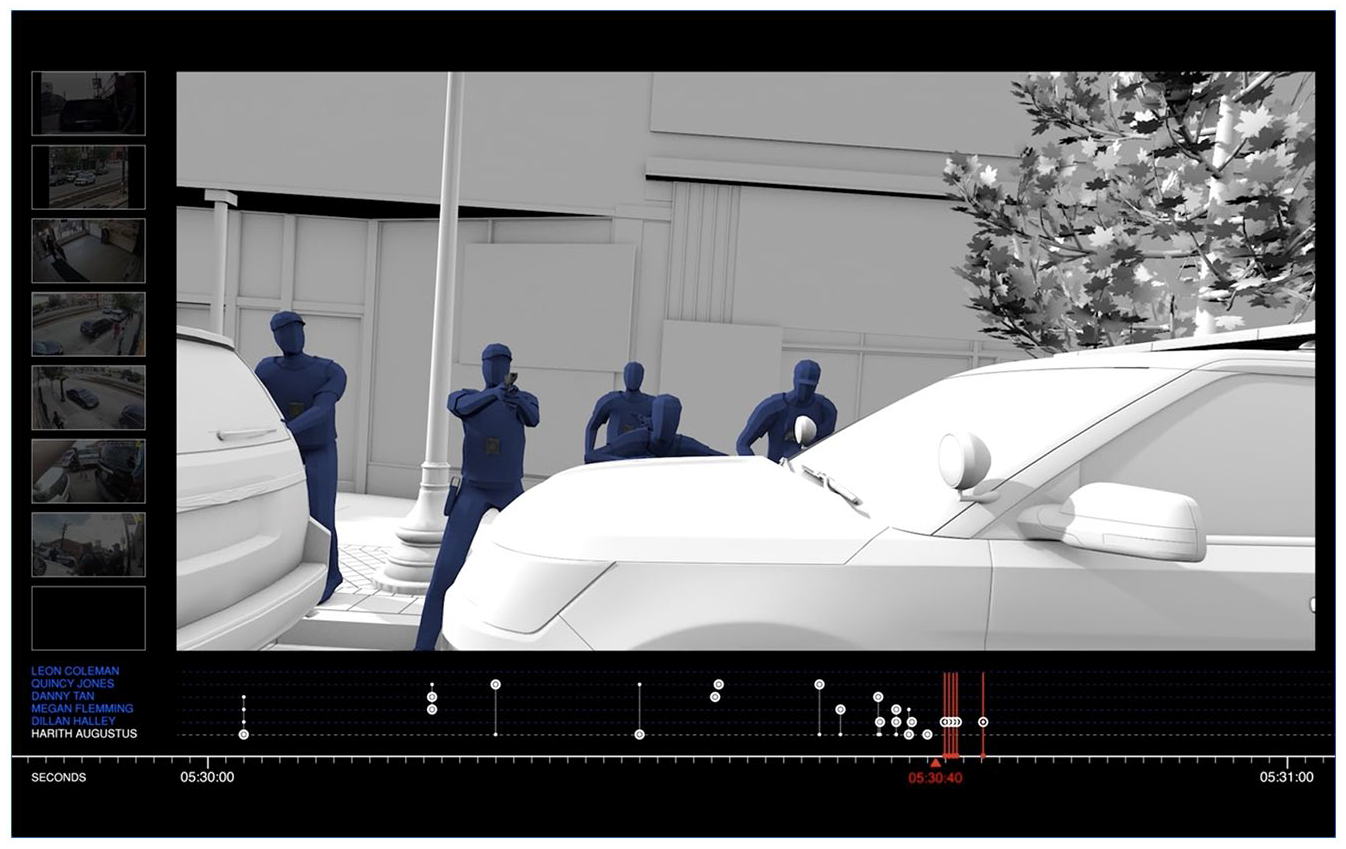
Still from Six Durations of a Split Second: The Killing of Harith Augustus.
As suggested earlier, the notion of the evidentiary is increasingly complicated by these forms of forensic address. Consequently, this shift moves us away from what Keenan (2018) terms a “naive” conceptualization of evidence as simply “self-evident” or “incontrovertible” forms of objective truth. As Keenan (2018) argues, “evidence is what is presented and used to persuade. . . It is that upon which a decision can be rendered about what the facts in a case are. . . In other words, once again, evidence is precisely that which is not self-evident” (p. 113). Thus, crucial to these new counter-forensic practices is an understanding of the role that the aesthetic, performative, and technological play in the mediation of evidentiary forms that are understood along the lines of Keenan’s “non-self-evidence.” As Keenan (2018) continues to argue “if evidence is what is used to persuade, then we also need to attend to the acts and arts of persuasion. . . to the rhetorical operations through which what is presented in evidence is presented to those who decide” (p. 113). Such “acts and arts of persuasion” form part of a “non-naive commitment to a notion of the truth” that informs the aesthetic, performative, and technological operations of these new counter-forensic practices (Keenan, 2018: 120). Within the The Killing of Harith Augustus, Forensic Architecture and Invisible Institute filter the array of different evidentiary forms through new forms of mediation. These constitute the “acts and arts or persuasion” that Keenan speaks of, those “rhetorical operations” that aim to frame the truth-bearing capacities of evidentiary forms within certain discursive and aesthetic frameworks (Keenan, 2018: 113). Within the Augustus project, it is evident that the new aesthetic assemblages, organizations, and techniques of presentation serve to re-contextualize, and forensically mediate these forms of visual evidence. The work takes up, and subverts, operational materials as militant counter forensic evidence, using the tools of state-private oppression against their internal logics.
We now shift to an examination of our second case study, the 2016 project Torture in Saydnaya Prison. Here, 3D modeling is once again the structuring “spatial anchor” of the work; however, as we shall see, it is utilized to frame and support different evidentiary forms and techniques. In this project, a lack of visible evidence allows Forensic Architecture and survivors to come together to produce new and enhanced forms of militant evidence that can counter state narratives of denial. Survivors, Forensic Architecture staff, designers, and artists, utilized a variety of novel audio-based tools and testimonies to create a 3D model of the prison. This modeling was necessary because no publicly available images exist of Saydnaya. The work of Forensic Architecture aided by the militant evidence in the form of testimonies of the prisoners, creates a mediated forensic representation of the prison as a counter-forensic force against the violence, torture, and human rights abused perpetuated by Syrian state at Saydnaya.
Torture in Saydnaya Prison
Saydnaya Military Prison is located 30 km north of Damascus, Syria and has long been a site for the state sponsored torture of political prisoners. In 2008, a massive riot began by detainees brought to light the routine abuses, widespread killings, and overall horrific conditions of the prison. Since the beginning of the civil war and nascent revolution in 2011, the prison has become the “final destination” for those publicly opposed to the regime of Bashar al Assad, such as protestors and military personnel suspected of disloyalty. In Saydnaya, prisoners are denied access to lawyers and endure routine torture and beatings which can occur at any moment, leaving detainees in constant fear. In April 2016, a team from Amnesty International and Forensic Architecture met with a group of Saydnaya survivors in Istanbul, Turkey. Before the meeting, Forensic Architecture constructed a 3D model of the prison based on previously collected testimonies by Amnesty researchers to facilitate a form of “situated testimony,” whereby the Saydnaya survivors became active co-creators in the final project by correcting errors and adding detail to the original 3D model. For survivors, the act of situated testimony led to further recall, sparking deeper insights and memories. As Weizman argues, “this is a kind of ‘art of memory’ for the digital age. The problem we face when engaging with witnesses is that the closer one gets to the essence of their testimony, to the heart of the most violent incidents, the more elusive their memories become. We help witnesses build digital models from memory and furnish them with whatever objects they can remember, then virtually walk through them.” (Bois et al., 2016: 129) Forensic Architecture employed architectural and acoustic modeling as well as introducing survivors to objects and sounds to further refine the 3D reconstruction of the prison while sparking the situated testimonials and experiences of the survivors. As Anna Altman (2018) contends, “at Saydnaya, the architecture functions not as residual evidence, but as a tool of violence” which is seen through the testimonies of survivors and the resulting reconstructions, demonstrating how the architectonics and rules of the prison manifested their own unique torments. The acoustic modeling is also particularly important as the experience of the detainees was in total darkness with a heavily enforced code of silence that forbid prisoners from speaking.
The result of the partnership between Amnesty International and Forensic Architecture produced in collaboration with artist Lawrence Abu Hamdan, is the interactive documentary Saydnaya: Inside a Syrian Torture Prison (2017) (Figure 7). Abu Hamdan used a technique called “echo profiling” that “was able to determine the size of cells, stair wells and corridors by playing different reverberations and asking witnesses to match them with sounds they remembered hearing in the prison” (Wainwright, 2016). These so called “earwitness” testimonies were integral to constructing realistic models of the prison and life inside it (Parker, 2020). In the absence of speech, other mundane sounds such as footsteps, doors opening, or water dripping became important sensory markers that structured experiences of space and time for the prisoners. These fragmented memories, sounds, and feelings are potent forms of evidence but escape visualization or capture by a camera, but the process of architectural reconstruction serves as memory catalyst. As Weizman notes, “Architecture is a conduit to memory. . . As they experienced the virtual environment of their cells at eye level, the witnesses had some flashes of recollection of events otherwise obscured by violence and trauma” (Wainwright, 2016). Forensic Architecture’s process of forensic mediation works to visualize the spaces and effects of trauma, incarceration, and torture the are occluded from view through the rendering of situated testimonials and 3D models.
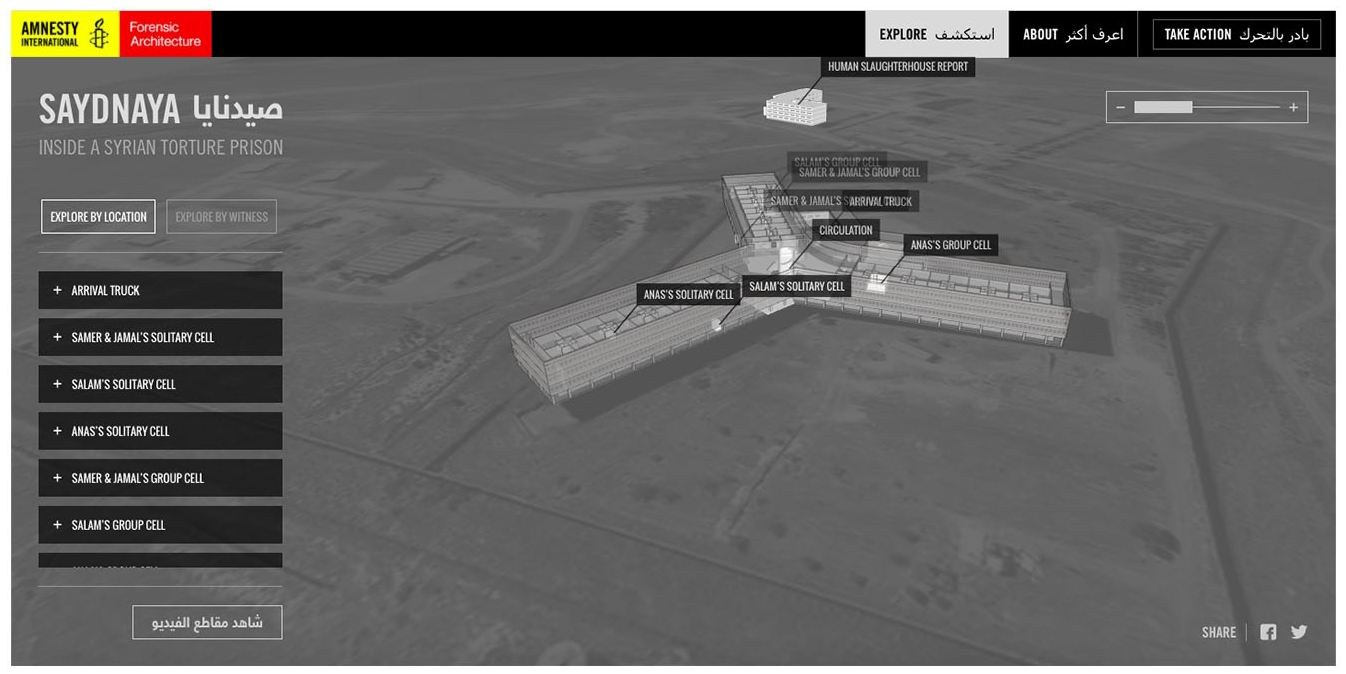
Still from Saydnaya: Inside a Syrian Torture Prison.
Saydnaya: Inside a Syrian Torture Prison features a short, opening contextualizing video that quickly explains the prisons’ function since 2011 followed by overhead satellite images of the prison. “Inaccessible to journalists and independent monitoring groups” states the voice over, “the prison is a black hole of which no recent images exist. The memories of those who survive it are the only available resource with which to understand what happens within Saydnaya.” Like visible militant evidence, these invisible, internal thoughts and feelings function as forms of potent affective and effective evidence when mediated through forensic practices and represented in the interactive documentary form. The interface of the project is a simple black and white overheard 3D modeled image of the prison, marked with identifying information for various parts of the large building. The opening menu is accompanied by sounds that are relatively quiet. They consist of ordinary background noises punctuated by random bursts of gunfire and yelling in Arabic, similar to what detainees encountered in their sonic environments. On the left side of the image is a vertical menu that allows the viewer/user to explore by either Location (“Salam’s solitary cell,” “Circulation,” “Arrival” etc.) or by Witness (“Samer,” “Diab,” “Jamal,” “Salam,” and “Anas”). When clicked, each reveals a set of sub-navigation menus that bring deeper insights into the men’s experiences as well as the prison itself.
For example, in the “Salam’s Solitary Cell” the viewer/user is confronted by the sounds of loud, muffled music that is punctuated by the sharp whack sound of someone being beaten (Figure 8). The music is a pro-Assad song sung by Lebanese singer Najwa Karam with the lyrics “Syria is our country, Hafez (Assad) you are our lion.” 2 The men were held in total darkness and enforced silence with the music played at night hours to disturb their sleep and mentally torture them. Visually, we view the cell from a low angle, as if seated in the small room. In the middle of the image of the cell door is a text box that asks “where are we?” When clicked, the viewer user is taken to a video of Salam describing the terror of being forced into the cell with nine other men that he could not see, where everyone was too afraid to speak. In the totally black video, he recounts the eerie silence that permeated the prison, before the music began. In another section of the project, “Salam’s Group Cell” the viewer user witnesses former detainee Salam Othman give situated testimony aided by the 3D model provided by Forensic Architecture researchers(Figure 9). Sitting in front of the model, Othman recounts how well he got to know every inch of his cell, “we know the cell tile by tile” he states. As Othman testifies about details such as how prisoners would write notes on the walls, the viewer/user is taken inside the model of Saydnaya, and the virtual camera pans right to reveal Arabic script on the walls. “Time stretches out” he recounts, as he notes that the men would repeat conversations, teach each other memorized part of the Quran, and count the tiles, amongst other ways to distract themselves. Without the testimony of the men combined with the new media capabilities of Forensic Architecture are we able to have any visual representation of the prison at all(Figure 10). In the absence of the camera, acoustic and 3D modeling and situated testimony combine to produce a new media representation of unseen state violence.
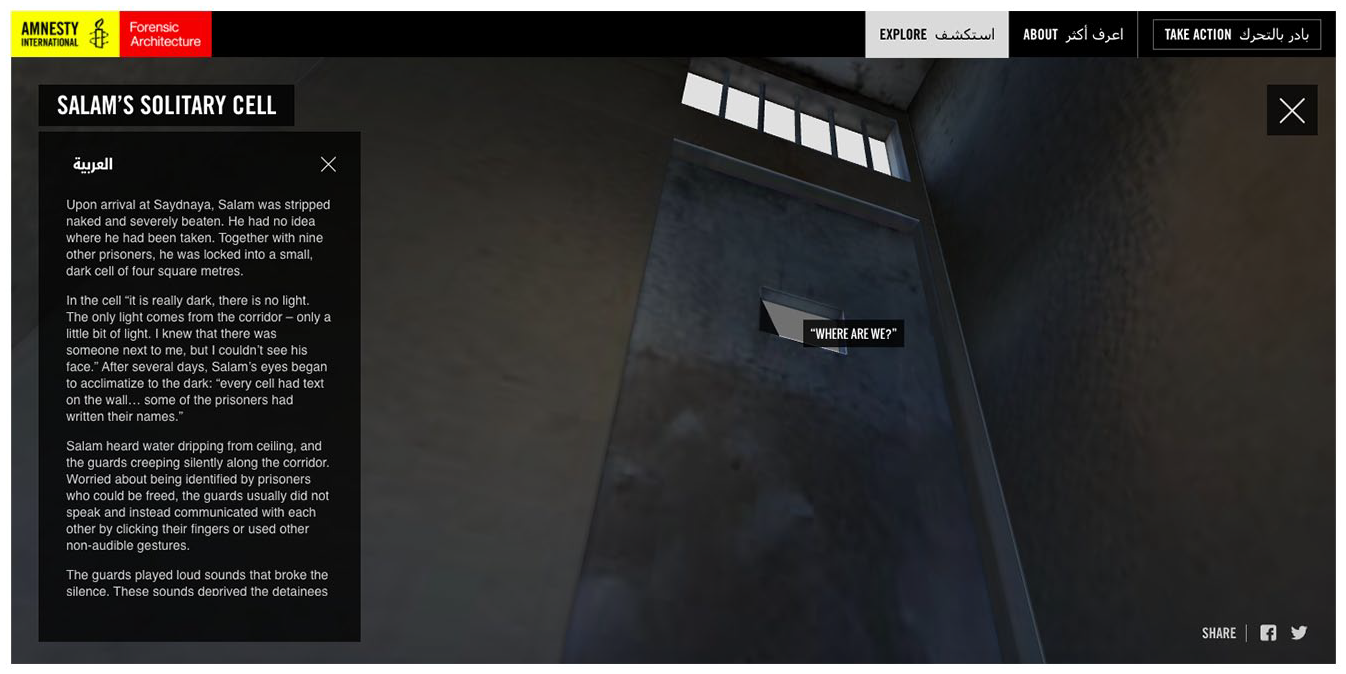
Still from Saydnaya: Inside a Syrian Torture Prison.
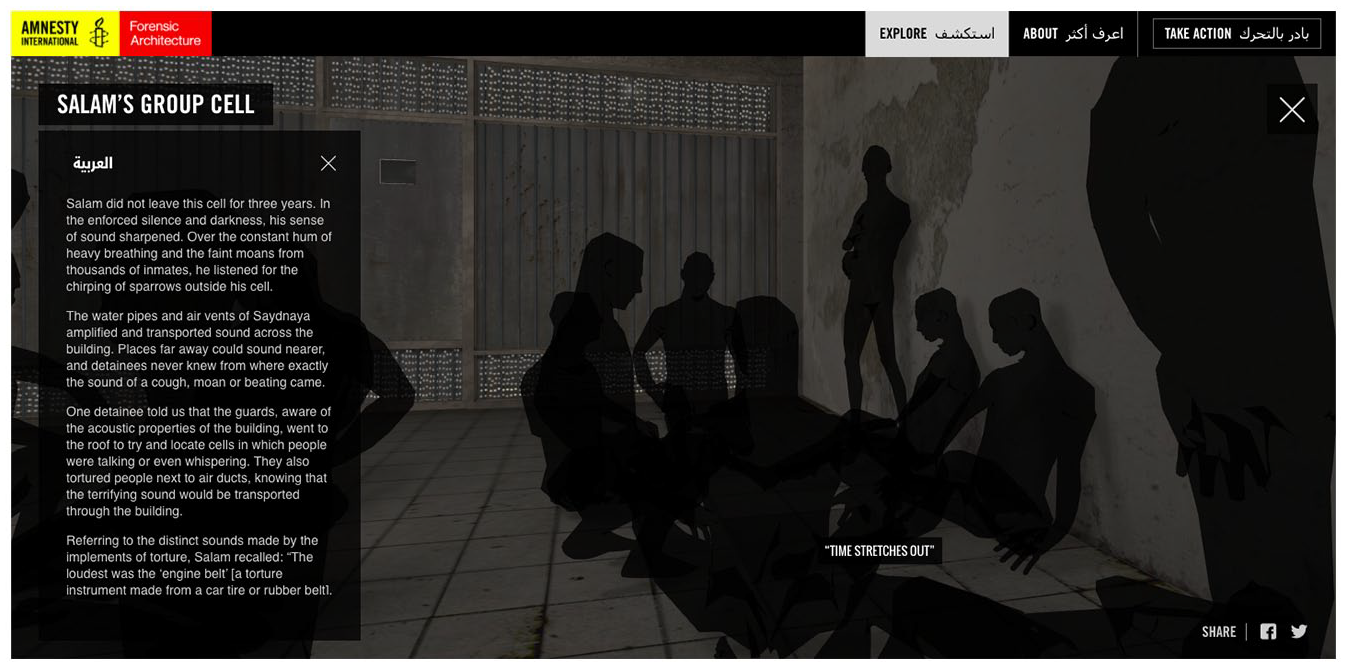
Still from Saydnaya: Inside a Syrian Torture Prison.
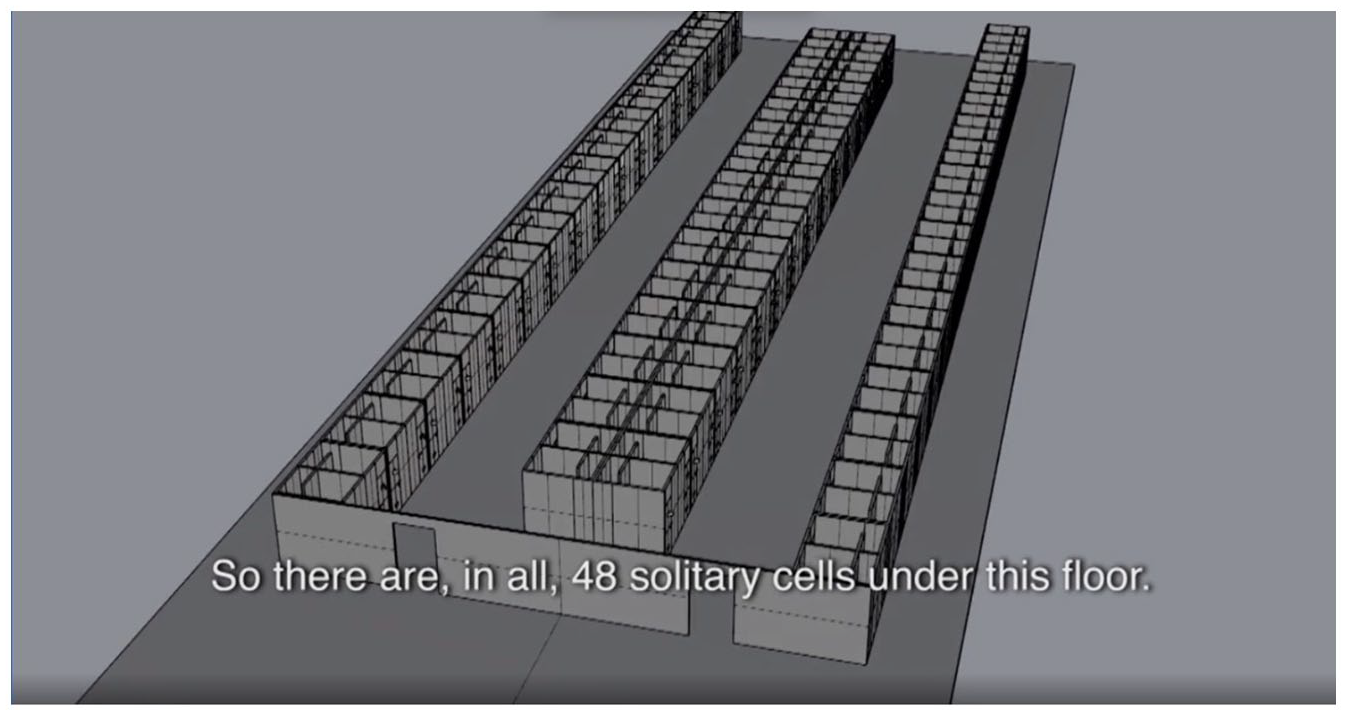
Still from Saydnaya: Inside a Syrian Torture Prison.
The camera (via cell phones) is often the main conduit for people to capture and disseminate, but here we also have sound and the non-visual as crucial forms of evidence in addition to the necessity of human, situated testimony to aid the cutting-edge modeling technologies in a space where images have not been captured. While the camera itself may not be a gun, the power of images has, traditionally, been one where the state competed with everything from non-state organizations to ordinary people to capture, disseminate, and archive images as attestations of veracity and confirmation, appealing to the implied objectivity of cameras and representational technologies and the images they produce. “In contemporary conflicts” Weizman (2017) argues, this continues albeit it an enormous mismatch of power, as “both the killing and its investigation are image-based practices. . .it is the killer who has had access to better optics, data, and information than the investigators” (p. 30). This imbalance of power, heavily weighted toward state violence and away from the people harmed, requires a counter-force, what Weizman calls “counterforensics,” which “turns the state’s own means against the violence it commits. While forensics is a state tool, counterforensics. . . is a civil practice that aims to interrogate the built environment to uncover political violence undertaken by states” (p. 64). In the case of Saydnaya, the built environment needed to be virtually constructed before it could be interrogated, using powerful 3D architectural and acoustic modeling software, to render the prison not from the vantage of the state but rather from detainees, who suffered in darkness and silence.
“Turning forensics against the state is essential” argues Weizman, “because of the intertwined nature of state violence which. . .is both violence against people and things and also against the evidence that violence has taken place at all” (p. 64). At the same time, “[e]vidence never speaks for itself, but speak it does, through its surrogate experts” (p. 68). In the globalized and networked digital age of crises and all manner of state violence, all possible counter-measures, evidence, and media need to be wielded against the state. Everyone, from survivors of trauma and imprisonment, and witnesses, to researchers, investigators, designers, architects, artists, and everyday people have a role to play. It is groups like Forensic Architecture and their practices that forge these productive bonds, re-framing modes of visual power by aiming the powerful, accumulated forces of counterforensics against regimes of state violence.
Conclusion
This article has focused on the recent turn toward a new critical forensic practice in media culture. Operating across different cultural fields, a range of media-journalistic collectives, groups, and labs have explored new technologies, aesthetics, and tactics for counter-forensically harnessing forms of nonfiction media as evidence. Such forms of counter-forensic activist media practice are reshaping how human rights practice and discourse is produced, disseminated, and received. At a broader conceptual level, we have also traced the political, material, and discursive genealogies of how particular forms of media change state. More precisely, through an examination of two works by Forensic Architecture we have examined how particular media forms transition from a state of existence as individuated fragments of raw evidentiary material such as body cam videos, earwitness testimonies and sounds, and toward functioning as constitutive fragments in larger and more complex media assemblages.
In closing, let us turn to Allan Sekula’s original conceptualization of the counter-forensic. He suggests such practices aim to take up forms of forensic evidence and forensic techniques – typically state-created and produced – and turn them into an archive of accountability and resistance against the very same formations of power responsible for generating them (Sekula, 2014). Indeed, as Thomas Keenan suggests – channeling Allan Sekula’s original formulation of the term – counter forensics “refers to nothing less than the adoption of forensic techniques as a practice of ‘political manoeuvring,’ as a tactical operation in a collective struggle, a rogues’ gallery to document the microphysics of barbarism” (Keenan, 2014: 69). The aim of the counter-forensic is thus built around an inversion of the power relations embedded in traditional state-produced methods of visualization, occularcentrism, and evidence gathering. One of the consequences of such a process of inversion is a leveling of the playing field for who can access, witness, and ultimately utilize such forms of media practice. This also returns us to the notion of the camera as weapon. Across the varied historical formulations of this concept, there is a consensus that forms of visual documentation have crucial roles to play in undermining the “manufactured stability” of visual fields that are restrictively managed by different formations of power. Similarly, within the forms of forensic mediation examined here, there is an emphasis on disrupting such forms of visual domination through a retooling of forms of forensic visual praxis that are typically state-sanctioned and produced. Through these new assemblages, forms of sonic and visual evidence are deployed counter-forensically, working against dominant structures of power that have often been instrumental in their creation, either directly or indirectly. Again, we can see the “camera as weapon” methodology in action, but filtered through a more complex, mediated, and saturated digital environment. Moreover, within formulations of the camera as weapon there is a recurring emphasis on its potential to democratize access to such forms of counter-visuality. When the rapidly accumulating forms of militant evidence are increasingly distributed across networks and platforms, they are made more accessible, legible, effective, and affective through multifarious processes of what can be termed “mediated forensics.” We are also seeing such forms of forensic mediation in mainstream journalistic practice, becoming “formalized as product[s] of popular consumption and sense-making,” through such platforms as the New York Times online “Visual Investigations” series (Gates, 2020: 405). Here then, there is an increased ability for citizens to bear witness to – and struggle against – forms state violence and repression, often through a subversion of those same repressive regimes of visuality.
Footnotes
Authors’ note
All authors have agreed to the submission and that the article is not currently being considered for publication by any other print or electronic journal.
Funding
The author(s) disclosed receipt of the following financial support for the research, authorship, and/or publication of this article: This research was partly supported by a British Academy Postdoctoral Fellowship.
