




Abstract
Worldwide, pubic memory initiatives are attempting to memorialize the current COVID-19 crisis whilst it is still ongoing. The Picturing Lockdown collection is one such initiative, led by Historic England (HE), the UK’s statutory adviser on historic environment. Calling out to the public to submit photographed experiences of lockdown to both its website and via social media, HE recruited the public to partake in a national memory-making endeavor. To examine memorialization practices of the present, this research asks: in an era of social media, how is an archive of an ongoing crisis represented? Using a qualitative method for visual and textual analysis, this research compares the official HE Picturing Lockdown archive collection and #PicturingLockdown on Instagram. Analysis reveals tensions in three spheres: the institutional, the temporal, and the spatial. Demonstrating the dynamism and “presentism” introduced by social media, this research illustrates how traditional practices of commemoration are shifting.
In April 2020, Historic England (HE) called out to British citizens to share their personal experiences of lockdown on its official website and via social media. As the UK government’s statutory adviser on historic environment and heritage assets, HE asked the public to help record “this extraordinary moment in history” (Historic England, 2020a). Explicitly stating that the call-out was “the first time the public have been asked to capture photographs for the HE Archive (HEA) since the Second World War” (Historic England, 2020b), this agent of memory (Vinitzky-Seroussi, 2002) thus asked the public to take part in a national effort of memory-making: archiving the present pandemic crisis. Laying aside for the moment the larger compelling sociological question of how this pandemic will be remembered in the future, this research sets out to explore practices of visual memorialization of present, ongoing events. Specifically, we ask: in an era of social media, how is an archive of an ongoing crisis represented?
The sheer magnitude of the Coronavirus, its ramifications on numerous social, political, and economic aspects of life, not to mention its yet-to-be-determined endpoint, suggest that this is a watershed event, one that will reach into and impact the future. In response, numerous public efforts are being made to “remember” the pandemic while it is still very much ongoing, to name a few, the New York Historical Society Museum & Library’s History Responds project, Austria’s Wien Museum’s “Corona in Vienna,” and UNESCO’s Memory of the World (MoW) Program documentary heritage project and blog. While differing in content, form, and practices of collection, these memory initiatives encourage the assembly and documentation of life during the epidemic. Picturing Lockdown is one such initiative. The HE call-out presented the pandemic as a momentous and exceptional event, giving rise to the idea that we are currently living in an unparalleled historical moment, one that requires an active effort to record and document the experiences of those going through it in the present.
This research uses a qualitative method for visual and textual analysis to analyze and compare two digital archives: the HEA Picturing Lockdown Collection (Historic England, 2020a) displayed on the official website, and #PicturingLockdown on Instagram. The analysis demonstrates the inherent tensions in memorialization practices of the present in three spheres: institutional, temporal, and spatial. First, as a public archive that is composed of personal experiences, yet directed and guided by institutional considerations, Picturing Lockdown links between the individual and the institutional. Because the accumulated “digital memories” (Garde-Hansen et al., 2009) are the product of the institutional call-out to the public to act as “documenters,” or perhaps “rememberers,” they are thus subsumed under the institutional sphere as an artifact of the organization.
Second, the practice of documenting a current ongoing crisis entails a temporal discrepancy. Significantly departing from the typical retrospective photo collections of a past event, the documentation of the present for creating an archive that will be used in the future highlights the continual fluctuation between past, present, and future. Third, the attempt to memorialize a global pandemic experience through local efforts highlights the tension between the global and the local. At a time of social distancing, it seems as though the Picturing Lockdown collection is trying to create social proximity. At the same time, when visually memorializing this “unseen enemy” (Sajed and Amgain, 2020; Sonnevend, 2020), personal photographs are captured, exhibited, and further shared on social media. Thus, local experiences are potentially accessible to a global, or at the very least transnational, audience.
Contributing to memory studies, media studies, and visual communications, this research centers on the relationship between memorialization practices as they are represented in two different kinds of digital archives – websites and social media. The analysis demonstrates the inherent tension that arises in institutional, temporal, and spatial spheres. Notwithstanding symbolic elements that adhere to particularistic notions of crisis, shaped, and influenced by an era of social media, visual representations of this worldwide challenge combine both local and global perspectives. This case study thus illustrates how current practices of memorialization are shifting: through the use of social media, local and institutional memory initiatives turn global, providing the opportunity for alternative memory-work, and demonstrating how it is now possible to memorialize the present.
Cultural memory during uncertain times
Cultural memory is a central socio-cultural aspect of how histories are understood (Olick et al., 2011). Through rituals, textbooks, museums, and photo archives, past events are memorialized and commemorated, creating and shaping a narrative and repertoire to establish and consolidate political culture, community tradition, and social identity. To the extent that “shared memories of the past are the product of mediation, textualization, and acts of communication” (Rigney, 2005: 15), cultural memory is an institutionalized and objectified narrative of representations and public communication (Assmann and Czaplicka, 1995), the result of distinctly cultural mechanisms that enable the circulation of memories.
In a “culture of connectivity” (Van Dijck, 2013) in which the pervasive use of networked technologies and social media are increasingly on the rise, the connection between memorialization practices and media is explored (e.g. Hoskins, 2011; Huyssen, 2000) and the term “connective memory” offered to describe real-time and instantaneous messaging between peers, groups, and social media networks. As digital-memory culture transitions toward social media (Ebbrecht-Hartmann, 2020), researchers show how “new media technologies. . . have allowed for novel memory-making practices that transcend established boundaries of space, time and social experience” (Keightley and Schlesinger, 2014: 747). For instance, Reading (2003) shows how interactive digital media technologies take on a prominent role in the construction of “socially inherited memories within public spaces” (p. 68). Hess (2007) demonstrates how digital memorials constitute a unique form of communal and vernacular discourse that can open up space for individual actors to assume the part of key definers of cultural memory. Liew et al. (2014) discuss how grassroots utilization of Web 2.0 technologies by individuals to archive and share memories constitutes a “more fluid, organic and spontaneous recollection process,” (p. 771), pointing to the differences between traditional carriers and producers of memory (the state and the media) and public constructors of a more active society. Benzaquen (2014) explores how individuals’ use of social networks affects the production, distribution, and consumption of traditional sites of memory. Henig and Ebbrecht-Hartmann (2020) show how social media ecologies, such as Instagram, open up new responsive spaces to remember. Although specifically referring to the Holocaust, their analysis demonstrates how users can become self-inscribers through interrelated modes of media witnessing (Frosh and Pinchevski, 2009), suggesting a transformation in the relations between witness, interlocutor, and the media. Thus, digitally mediated practices of memory-making transcend established boundaries, not only giving rise to a “plethora of vernacular memories” (Lohmeier and Pentzold, 2014: 777), but also enabling these digital memories to cross over and between borders and temporalities. Emphasizing the combined action of globalization and digitization, the concept of “globital” memories (Reading, 2012) thus emphasizes the revolution in human communication and memory.
Digital photography has become central to contemporary cultural memory. As a vehicle that externalizes events in an accessible manner (Zelizer, 2002), photographs have the power to concretize memory (Frosh, 2001). They are more detailed; they do not “forget” or become adjusted to the requirements of the present, and thus can be considered “improvements” on memory images. For the same reasons, however, photographs can be seen as “counter-memory” (Barthes, 1981: 91): They can actually block memories, acting in violence as they “fill(s) the sight by force” (Barthes, 1981: 91). At the same time, photographs offer arbitrary, composite, conventionalized, and simplified glimpses of the past. They are “conventionalized, because the image has to be meaningful for an entire group; simplified, because in order to be generally meaningful and capable of transmission, the complexity of the image must be reduced as far as possible” (Fentress and Wickham, 1992: 47–48). Collectively held images thus act as signposts within definitive limitations, directing rememberers to preferred meaning by the fastest if not the most all-encompassing route (Zelizer, 2002: 699).
With the development of technology, “the photograph went from a rare prized possession to a common keepsake” (Jurgenson, 2019: 51), ultimately becoming abundant. This transformation not only makes everyday life ever more mediatized (Frosh, 2019), but can also be used to afford an alternative to recording and documenting life in museums or institutional archives (Benzaquen, 2014; Reading, 2003). As visual representations, particularly photographs, are undeniably a prominent medium through which memory can be established and maintained (Barthes, 1981; van Dijck, 2008), these “tools of memory” (Zelizer, 1998) serve as “frameworks for shaping both experience and memory” (Erll and Rigney, 2009: 1).
When attempting to grapple with current issues, all the more so during periods of risk and uncertainty, memory is used as a valuable tool, with past events called upon for guidance (Khong, 1992; Schuman and Rieger, 1992) and consolation (Simko, 2015). Typically, this happens after an event has been memorialized and consolidated into memory (Adams and Baden, 2020). Practices of memorialization, then, are inescapably connected to the need for the past to be made past (Adams and Edy, 2021). Nevertheless, various institutions worldwide are attempting to collect materials that will be used in future commemorations, through the active engagement of the public. The HEA Picturing Lockdown is one such project. Not only does the collection attempt to memorialize the present for the future, but it does so by calling out to the public to actively take part in this assembly of resources by photographically capturing a week’s worth of experiences during lockdown. Situated in the era of social media at a time of extreme uncertainty, this research thus sets out to explore how a public archive memorializing the present is established and memory is shaped through visual representations.
Picturing lockdown: a COVID-19 public archival effort
On 29 April 2020, HE first launched the Picturing Lockdown initiative. It asked the public to submit photographs documenting their experiences during 1 week in lockdown on the official website and on social media via #PicturingLockdown (Historic England, 2020b). This announcement was inspired by the NBR (National Buildings Record) public call-out during the Second World War. Asking for voluntary help, the English Heritage charity (nowadays Historic England) used the contributions to establish an official record of the nation’s heritage under threat. Similarly, by collecting the public’s experiences and memorializing them through a reflective visual record, Picturing Lockdown is intended to “help us shape what we remember about this time” (Historic England, 2020a).
The final collection was selected by a team of HEA curators and includes 100 photographs out of the 2984 public submissions from across England, with an additional 50 commissioned works by 10 contemporary local artists and 50 more from 5 HE photographers (a total of 200 photographs). Through crowd-sourcing, Picturing Lockdown aimed to visually capture the current crisis. The collection focuses on individualistic experiences of the English lockdown as part of the restrictions brought about by the pandemic. Whether through the public’s submissions; the HE photographers, who were also asked to document their own personal experiences of lockdown; or the various commissioned artists who took part in this endeavor, the collection adheres to its title, picturing lockdown through the eyes of various individuals, capturing the shared experience of restricted life at an unprecedented time.
Method
In this study, we examine how English experiences of COVID-19 are memorialized through the HEA Picturing Lockdown memory initiative. While there are several memory initiatives around the world, this case study includes first, a resonating project led by a prominent public body that does “memory work” (Jansen, 2007), and second, the experiences of a country that is currently significantly impacted by the pandemic (Full Fact, 2020) in comparison to other European countries (OECD, 2020). For the first criteria, HE is an expert advisor to the government and manager of the National Heritage List for England, designated to identify and protect historic places, and thus a prominent agent of memory. Picturing Lockdown received major media coverage in England by publishing selected photographs and interviewing various members of HE. Additionally, it inspired successive projects in England, such as The Victoria and Albert Museum Pandemic Objects Archives (Victoria & Albert Museum Blog, 2020); the @massisolationFORMAT; the Building Centre Empty Streets project (Building Centre, 2020); and projects aimed at visualizing the crisis, such as The COVID-19 Visual Project (2020).
For the second criteria, to date, the UK is considered one of the hardest-hit countries in Europe in terms of confirmed COVID-19 deaths (Full Fact, 2020), also exhibiting a significant rise in unemployment and a worrying forecast that the UK economy is likely to suffer the worst COVID-19 damage in comparison to many other European countries. The UK was also the first country in the West to approve the Pfizer-BioNTech COVID-19 vaccine for public use, preparing for the widest-reaching program of mass vaccination in the history of the UK (Johnson, 2020). Thus, despite the initial unhurried counter-measure practices taken (Morgan, 2020), as polarization grew and government legitimacy declined redressive steps were taken, not only in the form of lockdown.
Relying on the HEA website, we used a qualitative method for visual and textual analysis (Bock et al., 2011) that applies a combination of iconology (Panofsky, 1972) and a social semiotic approach to visual communication (Barthes, 1977). We analyzed the 200 photographs according to each type of submission (public, commissioned artists, and HE photographers), paying close attention to the accompanying text (captions, keywords, and descriptions). Visually, we analyzed the signifiers of each photograph, distinguishing between indoor and outdoor, wide shot or close-up, with people or without, day or night, paying attention to the composition as well. We also determined whether the photograph is part of a series. In terms of image-text, we examined how informative and descriptive the text is, analyzing the keywords, captions, and descriptions to determine the relationship between the texts and the images. Following this analysis, we compared the major themes that arose from each type of submission, cross-comparing both visually and textually so as to further refine the overarching thematic connections among the three.
After analyzing the archive collection on the HE website, we examined and compared the same photographs on social media via #PicturingLockdown. To clarify, we did not analyze the HE accounts on social media, as these constitute the official expression of the institute. While Facebook, Instagram, and Twitter were all available for submissions, we found Instagram to be a rich research site with ample visual materials and textual labeling (i.e. hashtags), their linkage critical for providing a framework for memory-work. Using image-text analysis (Barthes, 1977; Mitchell, 1994), we addressed the contextual differences in the appearance of the collection on the two major platforms (the official HE website and social media, i.e. Instagram), examining the titles, keywords, descriptions, and hashtags. To complete our understanding of the decision-making process involved in the creation and curation of the collection, we interviewed Ms. Tamsin Silvey, the cultural program curator of the Public Engagement Department at HE, and Mr. Gary Winter, the exhibitions and images officer at HE. Finally, as part of the comprehensive in-depth exploration of this memory project initiative, we participated in the Museums in War Webinar hosted by the University of London, in which, among other projects, the collection was presented and discussed in terms of the importance of public engagement when protecting heritage during times of crisis.
Lockdown in image and text
The Picturing Lockdown collection broadly includes images of leisure pursuits, children, and adults at home, the work of NHS (National Health Service) workers, as well as portraits of communities alongside evocations of domestic domain, specific urban landscapes, and nature. For all three submission types the sense of these turbulent times was conveyed through the use of various symbols: emptiness conveyed through pictures of deserted public spaces, such as playgrounds and previously busy high streets; restriction conveyed through depictions of fences, barred windows, barriers, face masks, and other forms of social distancing; hope and appreciation conveyed through drawings, graffiti, photographs of rainbows (now synonymous with support for the NHS), people clapping in a national applause of thanks for health workers, nature in all its glory – gardens, natural parks, and wildlife; safe-keeping conveyed through sanitation and hygiene measures (e.g. face masks and disposable gloves) (see Figure 1) and literal written messages and slogans (such as signs and graffiti of “stay home,” “stay safe”) (see Figure 2).
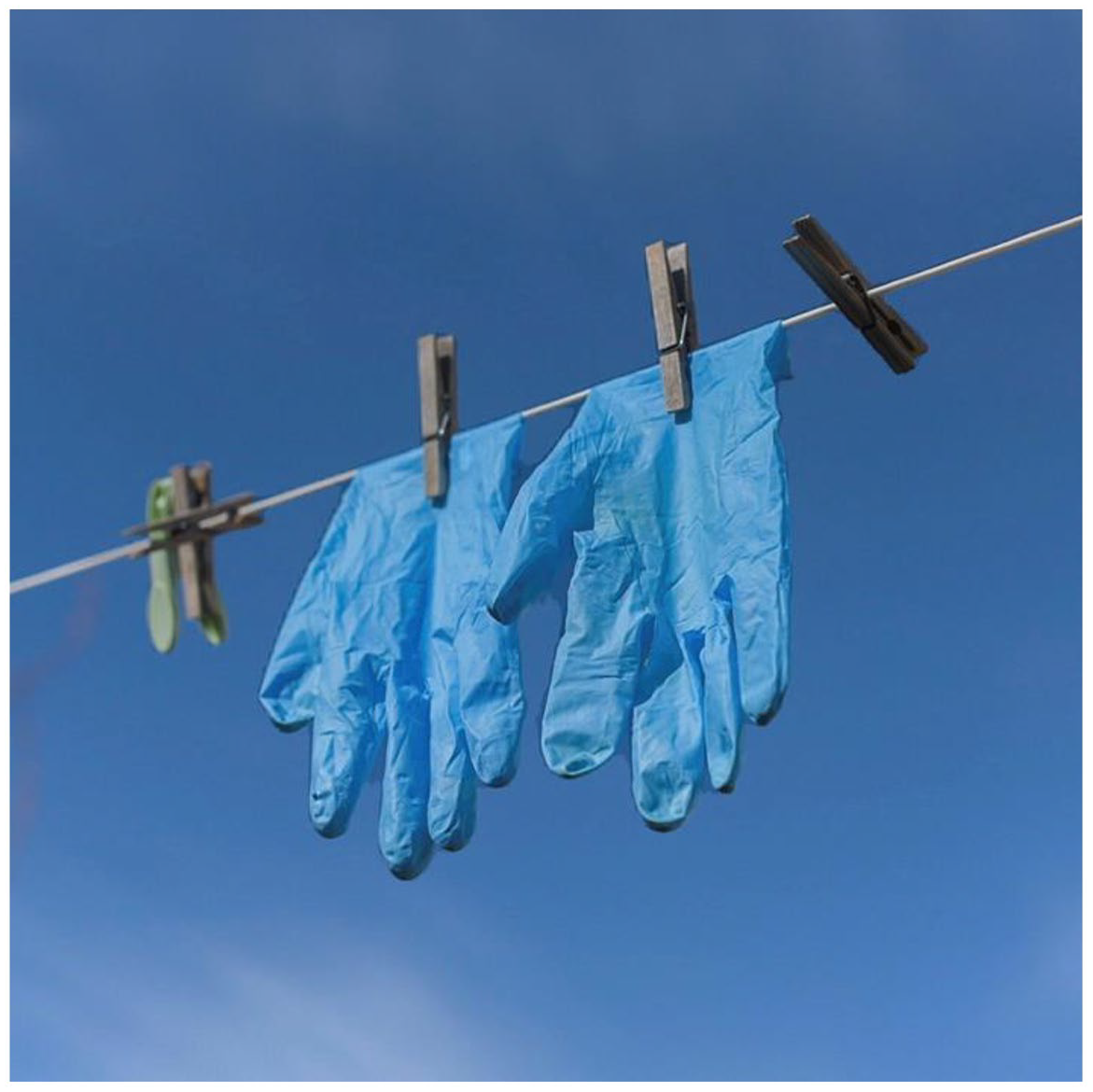
The new normal, 24 April 2020. ©Carl Joyce.
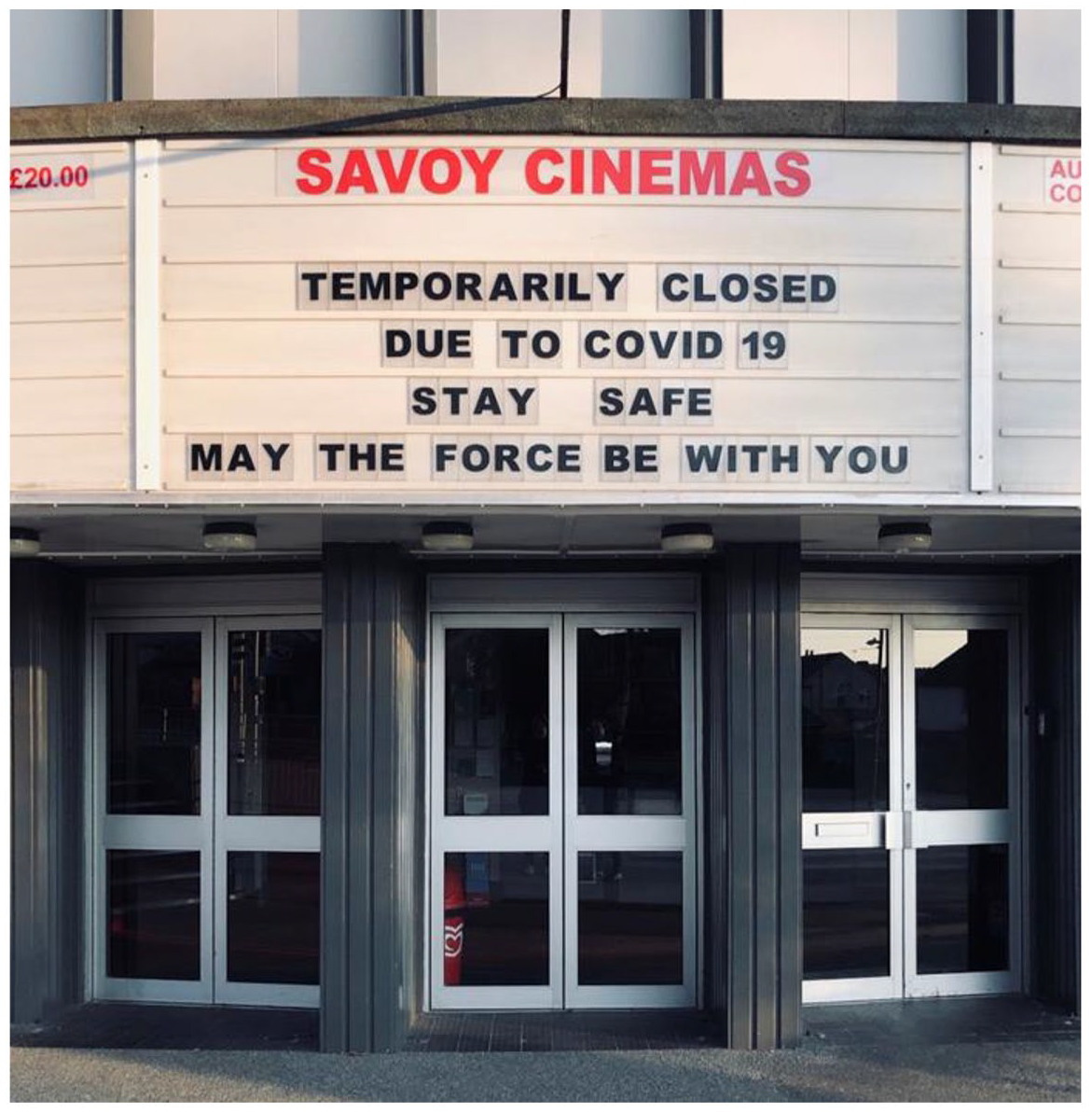
May the force be with you, 27 March 2020. ©Esther Johnson.
While public submissions consisted of one single photograph, the commissioned artists and HE photographers submitted series of 5–7 photographs and 10 respectively. Broadly, these series were constructed around a central theme and could afford the notion of a story unfolding, further strengthened and enhanced through the repetitive nature of the series. For instance, a whole series is dedicated to the depiction of empty spaces, another to photographs of nature. In terms of practices of meaning-making, the photographs of both commissioned artists and HE photographers were mostly metaphoric, poetic in nature, and artistic in structure, whereas the public’s submissions were, as a matter of course, more illustrative.
Overall, each photograph has a caption, description, and keywords. There is a distinction between the more poetic and metaphoric captions of the public and commissioned artists, (e.g. “The New Normal,” “Strength,” or “Light it Blue”), and those of the HE photographers, which contain more informative descriptions of the current situation, for instance, “A man exercising on a turbo trainer while a woman measures material in their kitchen of their home,” as customary in documentary photography (Mitchell, 1994). Whether literal or metaphoric, each type of caption on the website includes the term “COVID-19” (e.g. “during the COVID-19 lockdown” or “part of the COVID-19 lockdown”), noticeably an archival decision. Regarding the description, the archive team attached to each photograph the same description of the project at large. Not every photograph is accompanied by text written by the creator. If existing, the text provides the response of the photographer to the question: “How does this photograph document your experience of lockdown?” as part of the submission process on the HE website. These texts oftentimes include personal and emotional responses. In terms of keywords added on by the archive team, all photographs are labeled “health and welfare.”
Memorialization practices: tensions in three spheres
In an era of social media in which photographic documentation is a daily and routine practice, public initiatives are underway to memorialize the acute ongoing crisis of the present. This intersection of crisis, social media, and commemoration of the present bring to the fore interesting questions regarding current practices of memorialization. Specifically, how can we (if at all) commemorate the ongoing crisis in the social media age? A comparative analysis of how the two digital platforms (the Picturing Lockdown collection and #PicturingLockdown) perpetuate an ongoing crisis demonstrates inherent tensions in three spheres: the institutional, the temporal, and the spatial.
The institutional sphere
Attempting to create a public archive during a time of social restriction, HE used crowd-sourcing. Composed of individual materials yet led by institutional considerations, the resulting archive combines both the participating public’s perspective and the government’s institutional considerations. The institution recruits the personal practices of documentation for creating a collective collection: when memorializing the present (in this case, creating an archive of an ongoing crisis) it turns the private citizen into a potential field agent who, through photographs, is responsible for documentation. The public collection thus seeks to encapsulate a conversation between the public and the official institute, the personal experience and the national one.
Evoking the Second World War, the call-out created a parallel both in terms of the enormity of the current crisis and the practice through which to achieve this archival effort. Portraying the Second World War as an analogy (Edy, 1999) is not limited to this specific public memory initiative, as it is common in the commentary of British politicians and media and seems to be the natural frame to use for guiding the public. In this case it served as the prominent reference point for constructing the threat of COVID-19. A resemblance can be discerned between actions taken during the war, specifically the need to alter daily routines when faced with aerial bombing (the blackout a prominent example of shielding measures) (Mackay, 2003). Such actions closely mirror not only the severe restrictions of the current crisis in the form of lockdown, but also, and perhaps even more, the need to accept a level of responsibility; to mobilize for the needed course of action, for example, social distancing; and to create a commitment to a genuine community of spirit with which to overcome these turbulent times.
Naturally, archival work in the hands of institutions such as museums or universities also depends on the contributions of individuals’ documents and objects. These personal accounts serve to enhance the public collection, infusing it with the biographical memories of a collective (Lohmeier and Pentzold, 2014). Picturing Lockdown, however, is fundamentally different in as much as the submitted photographs are not an enhancement of an existing collection, but rather its very foundation. Situated within the social media era, where most everyone carries around their digital cameras in their back pockets, self-documentation and the documentation of everyday life have become ever-more important in the media-saturated cultures of the global North. For Picturing Lockdown, which builds on this cultural preoccupation with constant photographic documentation, the public were asked to act as though they were active digital witnesses (Frosh, 2019) or social media witnesses (Henig and Ebbrecht-Hartmann, 2020). However, differing from these two constructs, the recruitment of the public in documenting individual experiences during lockdown is not a spontaneous experience of being in the right place at the right time, but rather a strategic endeavor to partake in a national expedition of memory-making. To this extent, the public are relied upon to assemble and document collected experiences of lockdown, in so doing also taking part in memorializing the present.
While the collection is seemingly an accumulation of photographs reflecting individual experiences of lockdown, the selection, curation, and labeling processes are all undeniably institutional. Although relying on the public’s efforts, the collection is accumulated through institutional guidance and according to its perspective. Out of almost 3000 public submissions, only 100 were chosen to represent how English society at large experiences the crisis. This selection abides by the curators’ criteria of representativity and inclusivity, as was relayed to us during the interview. Furthermore, the decision to request photographs from commissioned artists and HE photographers for whom this is their profession demonstrates that Picturing Lockdown as a collection is undeniably institution-led. To this extent, the curatorship process of formulating a photo archive constitutes the inherent power of the institution (Sekula, 1989) in establishing cultural memory.
The tension between the institutional and the individual arises in particular when comparing the photographs on the two different archival digital platforms, that is, the HE website and Instagram via #PicturingLockdown (as this was one of the suggested options in the HE call-out). The photographs of the website collection are limited in number (200 photographs), they are permanent, and thus bounded by a limited range of social experiences of lockdown. In contrast, when searching #PicturingLockdown on Instagram, a different collection is revealed and the number of photographs also changes daily. Thus, the website collection is a closed one, whereas on Instagram the collection continues to “live” (Frosh, 2019) and grow. It is highly interactive, open, and continually updates in real time.
Moreover, the tension between the institutional and the individual is further strengthened due to the different labeling on the platforms. Notably, by using the keywords “health and welfare,” the website collection categorizes this crisis as a health-related issue. Yet many other categories could also come to mind when addressing this current crisis, for instance, “lockdown,” “restriction,” “social distancing,” “Coronavirus,” “COVID-19,” and “pandemic,” to mention a few. In contrast, on Instagram, multiple hashtags are used when labeling the very same photographs. For example, the photograph, labeled “Art And Design,” “Health And Welfare” on the website included the following hashtags on Instagram: #lockdown2020 #covid19 #supermanmural #picoftheday #nhsheroes #nikonz6 #visitlondon #visitbritain and more (see Figure 3a and b).
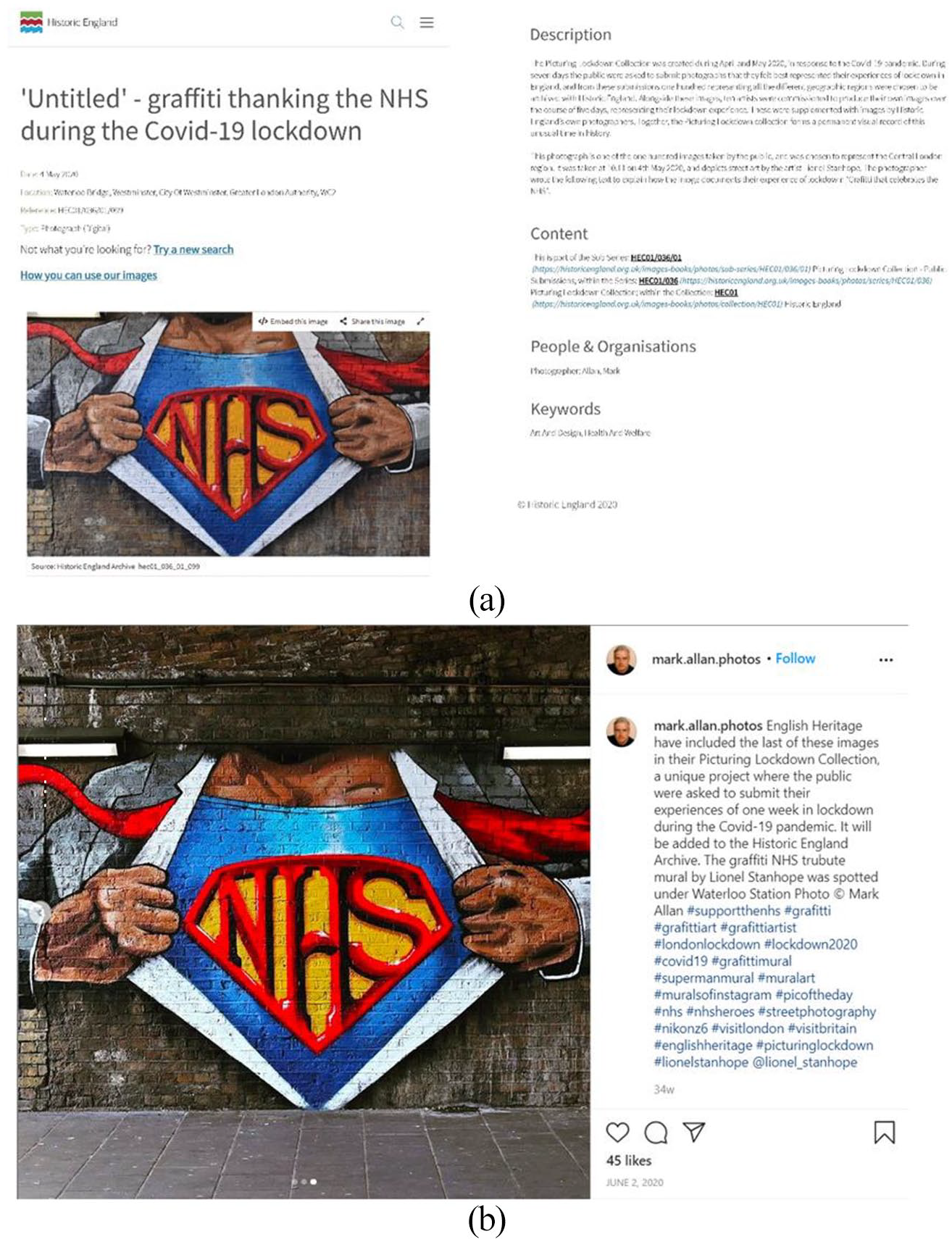
(a) Untitled, 4 May 2020. ©Mark Allan. Source: Historic England Archive (via HE website). (b) Untitled, 4 May 2020. ©Mark Allan (via #PicturingLockdown).
The keywords the HE curators chose are thus an attempt to contain the experience of lockdown within a specific paradigm of how such a crisis should be remembered. It is a selective process: not all aspects of an event are necessarily included (Kansteiner, 2002). To this extent, digital archives such as Picturing Lockdown portray the history of a collective through the work done by institutional mnemonic actors. In contrast, on Instagram, the users themselves become “agents of (social media) memory” (Ebbrecht-Hartmann, 2020: 3) through their photographs and curatorship work via their labeling. Moreover, the multitude hashtags used on Instagram as keywords for categorization and labeling – besides increasing exposure to as large an audience as possible (Manovich, 2016) – point to the fluidity and unboundedness of the present and in so doing demonstrate a completely different framing of the crisis.
The temporal sphere
Commemoration practices are inherently a process within which the past is memorialized. To commemorate an event through monuments, memorials, or any other mnemonic practices, it must first be safely secured in the past. Differing from typical archival collections that are collected and assembled only after an event is over, the Picturing Lockdown initiative allows “the public to create a unique time capsule for the future” (Historic England, 2020b). Realizing the imminent gravity and possible future value of capturing the ongoing present, it thus illuminates the importance of the present, linking to the interconnectedness of temporal negotiations between past, present, and future. Thus, while other archives collect and document events from the past, the Picturing Lockdown collection commemorates the present. In some respect, this memory initiative could be seen as “prospective memory” (Tenenboim-Weinblatt, 2013) in that it may entail a collective prospective-memory task. However, the collection once completed is closed. The task is complete and one can move on.
Could this attempt to memorialize the present be related to the nature of the crisis? Pandemics tend not to be very memorable, as Erll (2020) has shown. The Spanish flu for example, considered one of the deadliest pandemics in history (Barry, 2020), fails to mnemonically premediate the COVID-19. No other pandemic is available as a cultural model or template with which to make sense of the current Corona crisis. Notwithstanding a few monuments erected to commemorate past disease outbreaks (such as cholera, AIDS, 1 and even SARS), they are very modest in comparison to monuments and memorials dedicated to wars and political regimes.
Could it be then that the relative lack of memorability of past pandemics is what creates the need to memorialize this one whilst it is still ongoing? We think not. As this practice significantly differs from typical memorialization practices in that it does not commemorate the past, but rather the present, we suggest explaining the temporal tension to the epochal age within which COVID-19 takes place. Such an initiative as the Picturing Lockdown collection can only happen during this “new media ecology” (Hoskins, 2011) in which memory is shaped by the interaction between media and human beings’ behavior (Brown and Hoskins, 2010). Contrary to past crises, this is “the first worldwide digitally witnessed pandemic, a test case for the making of global memory” (Erll, 2020: 867).
When considering the two different platforms within which memories of the present are made, that is, HEA and Instagram, an additional temporal discrepancy arises. Once the chosen photographs are uploaded to the HEA website, they are instantly bounded, the collection irrevocably closed and the present experiences transformed into past. To use HE’s formulation: “selected entries will be permanently catalogued as part of our archive” (Twitter, 2020). However, the Instagram archive temporally constitutes the present progressive. In an era of mediatization in which every moment is documented on digital media, shared and circulated via social networks, there is constant engagement with the present (Frosh, 2019; Jurgenson, 2019). Living in such a world requires us to constantly document and disseminate our present, while, at the same time, being part of these everyday “archives” captures our lives in an endless present. Put differently, a collection that captures individual experiences of the present for the future would not have been possible if not for this era of social media.
The spatial sphere
The tension between the local and the global can be found in the gap between the experience of lockdown and its visual representation: the photographs’ accompanying text is oftentimes crucial for understanding the context, namely the situation at hand. Photographs of an empty street, a park in full bloom, lighted windows toward evening all could have been taken in any number of places across the world, and during almost any time frame (see Figure 4). It is the text that links the image to the pandemic and accompanying social restrictions. The captions, descriptions, and keywords are thus used to augment a set of connotations already given in the photograph; at times they invent an “entirely new signifier which is retroactively projected into the image, so much so as to appear denoted there” (Barthes, 1977: 26–27). To this extent, images by themselves are too polysemic, too open to a variety of possible meanings (Barthes, 1977). The texts are thus critical for narrating the current situation and for positioning the viewer in relation to a concrete time and place (in this case, to this ongoing crisis and its challenges; Mitchell, 1994). Relying only on visual modes of representations limits the construction of memory, thus necessitating accompanying text to contextualize and enhance meaning.
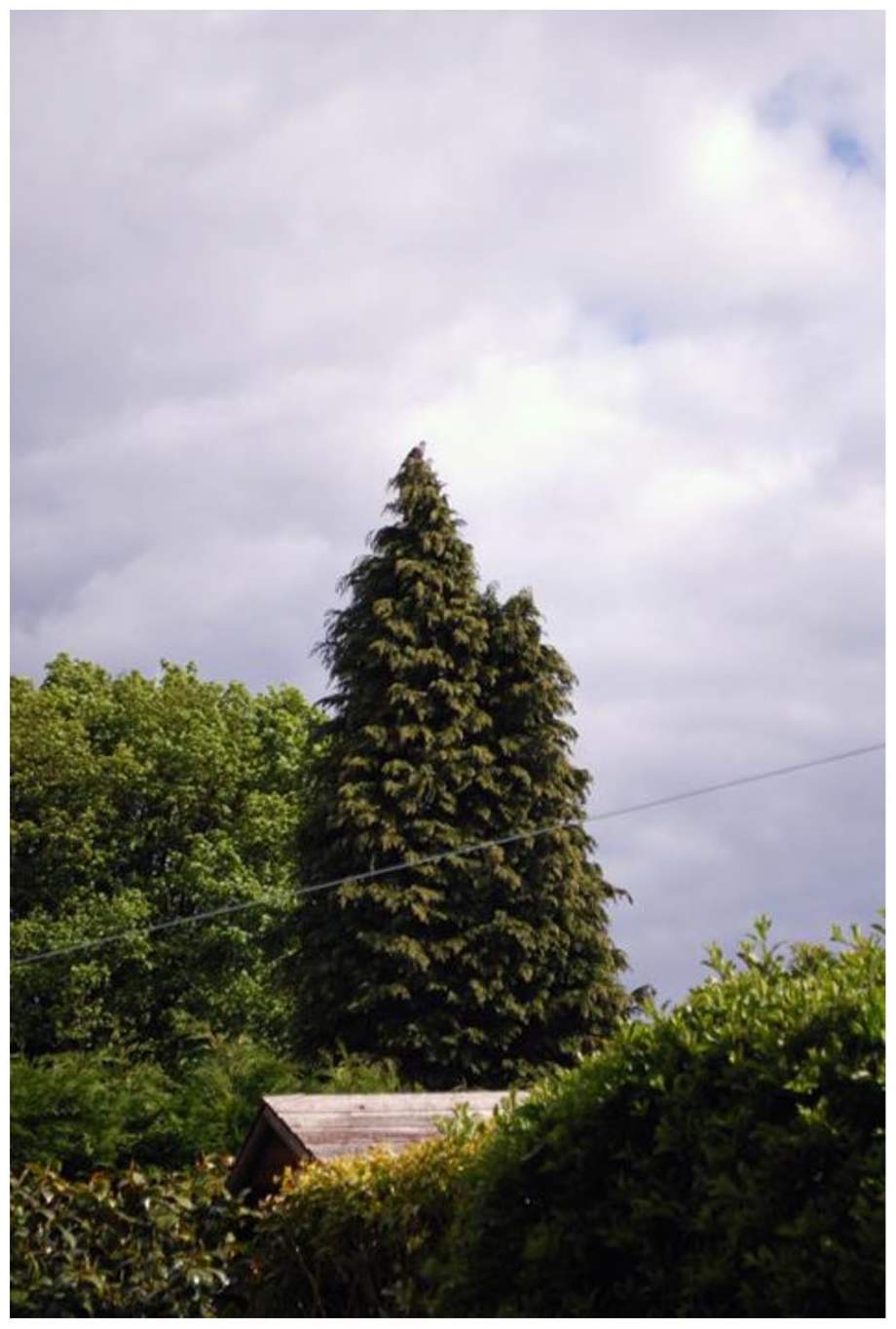
“Local Monument” – Looking down a garden toward a tall conifer tree, 1 May, 2020. ©Bella Milroy.
On the one hand, the mediated memory work that is practiced in the Picturing Lockdown collection is space-bound (Lohmeier and Pentzold, 2014) in that its enactment takes place in a local setting and the portrayed experiences are strongly linked not only to specific places, landscapes, and topography, but are negotiated through a cultural lens. To this extent, the collection relies on shared and normative meanings constructed in the present (e.g. adopting the rainbow to commend the work of the NHS). It is linked to a sense of community and being part of a collective. It is also embedded in the English culture of commemoration and the relationships between its layers of identity, between the local, regional, national, and imperial. Again, raising the Second World War as prominent reference brings to mind the rich legacy of British heroism and how it echoes and resonates in its ongoing centrality in both personal recollections of the past and the widespread range of media. On the other hand, the photographs in the collection depict a global (Western) experience of social restrictions and distancing, one that is shared worldwide. While HE’s archival efforts represent a local (English) experience, the photographs are also stored, shared, and disseminated through social media, thus turning global once again. Borderless photography-based social networks, such as Instagram, rely not only on local “visitors,” but are open to anyone, anywhere. Thus, visual representations do not remain local but rather receive meaning through such interactions with others. Labeling the photographs with #Coronavirus or #Covid19 transforms them into global images, an experience that is shared worldwide. Inversely, anyone from any part of the world can add to their Instagram photographs #PicturingLockdown and become a part of the collection. As an example, @ioannakekatos, from Chicago, Illinois, United States, and @i.mesum_kazmi, from Gilgit, Pakistan both appear on Instagram using #PicturingLockdown.
While the existence of the collection on social media as well opens up English experiences to possibly becoming global, some of the users nonetheless attempt to position themselves. By adding #london, #londontogether, #londonist, and various other locations in England, the text anchors the images to a local space. This is similar to the manner in which the global Coronavirus is experienced. While it is borderless in that it crosses over territories, it is experienced in a very localized manner because borders have become more entrenched and conspicuous because of the different attempts to control the virus. Situated in the era of social media, in which everything turns global, it seems then that people want to remain bound to a certain localized entity. This is all the more exacerbated during crisis, as localized commitments are reinforced and the known and familiar strengthened.
The collection attests to the influence of social media on how public and institutional archives are created (Reading, 2012). In an era of globalization in which memorialization practices are transformed, the “national container” in which cultural memory is embedded is also shifting (Feindt et al., 2014). In the current age of global media cultures, cultural memory seems to be arbitrated less by the nation and is more open to transcultural frames (Erll, 2011). To this extent, while the Picturing Lockdown collection portrays English sites of memory (Nora, 1989), it is not restricted to national memory. The spatial boundaries are thus eroded, becoming ambiguous and fluid.
Conclusion
Unprecedented times call for unprecedented measures. By explicitly referring to the memory of the Second World War, HE recruits the public to be part of the national response to a time of crisis and uncertainty. However, its reliance on the past is not extraordinary, as by and large, the Second World War was undeniably associated with and constantly evoked by both government officials and media when referring to the lockdown. COVID-19 also coincided with the resurgence of isolationist nationalism in the form of Brexit, which also drew on memory narratives of former British greatness (Blagden, 2017). Using battle metaphors and deploying militaristic rhetoric in response to the pandemic (McCormick, 2020), the situation was thus constructed as a crisis. Once invoked, the Second World War helped make sense of the crisis through the revival of symbols and tropes from the past. As British self-perception continues to be shaped and influenced by the UK’s stance and prominence in the Second World War, this reference point thus lingers and remains dominant, in the current crisis as well.
The Picturing Lockdown initiative embodies tensions in three spheres: the institutional, the temporal, and the spatial. Relying on the public’s constructions, these collected memories are combined into a national archive that is driven and guided by institutional concerns; ongoing experiences are memorialized in the present, to be stored and archived for future remembrance; shaping memory of an ongoing global crisis is carried out through local efforts that adhere to particularized considerations, yet manage to disseminate beyond national borders due to epochal considerations of a social media age. By capturing the ongoingness of the current crisis, one can in some respects delimit it, define its boundaries, and thus mitigate its consequences.
The experience of COVID-19 is visually articulated in a symbolic manner. Taking into consideration that the photographs were taken during lockdown and thus do not display hospitals, emergency rooms, or COVID-19 patients, the collection rather presents experience that is represented through a symbolic, poetic, and metaphorical lens. Thus, the submissions at large convey a more positive sense than would perhaps be expected in such a time of crisis and uncertainty. Notwithstanding the array of emotions portrayed, only-negative aspects such as death, anxiety, and doubt seem to be absent – or at the very least only sketchily implied – brought about by the symbols that are used to portray the crisis. Naturally, this is related to the absence of visibility of the virus itself, most of its symptoms, and notably the restrictions used to contain it. In trying to “capture the essence of the moment,” (Sonnevend, 2020: 452) in this “strange visual ecosystem” (p. 452), iconic repertoires can be detected.
However, in a world in which we are constantly and obsessively documenting and digitizing ourselves and others, visually mediating our successes online, the gap between what is real and what is represented steadily increases (Marwick, 2015). Picturing Lockdown, a collection that relies on visual representations of the public in an era of social media similarly conveys an optimistic sentiment that is continued and further expressed through the captions, texts, and keywords accompanying the photographs. Using symbolic captions to portray an experience, descriptive text to relay the interpretation of the photograph, and finally, capturing the entire collection under the archival categorization of “health and welfare” serve to embody an uplifting feeling and maintain morale. Similar to Sonnevend’s (2020) observation, it seems that even during this crisis, people present “a better-than-real-life version of themselves” (p. 459), according to which more positive, romantic perspectives are embraced. An encompassing positive sentiment is thus achieved through symbolic recourse.
What will be remembered after the pandemic ends? That is a sociological question far beyond the scope of this research. We can, however, suggest the following: as the “first worldwide digitally witnessed pandemic” (Erll, 2020: 867), cultural memory of the Corona crisis will be created through different systems and modes in the form of memory-making initiatives similar to Picturing Lockdown. Combining top-down commemorative investment with bottom-up efforts based on shared experience, the photographs in the collection present the “aggregated individual memories of members of a group” (Olick, 1999: 338). Relying on the public’s constructions, these photographs are thus the collected memories of a public combined into a national archive. At the same time, they embody the collective experience of recent events created by many.
Theoretically, trying to memorialize a still-ongoing event illuminates the importance of the present, linking to the interconnectedness of temporal negotiations between past, present, and future. While both digital platforms memorialize the present, the social media archive does so continuously and interactively. Ongoing experiences can thus be memorialized in the here and now, breaking temporal borders and suggesting a revision in commemoration practices. Can traditional archives even exist on social media? Due to the presentist character of social media, the past is fluid and constantly updated. As long as there is an ongoing discussion with the images, the collection remains part of the present. It cannot be made into an absolute past. Due to its immediate availability through social media, the represented crisis receives additional layers of meaning and interpretation through ongoing interaction with fellow Instagrammers. It is thus dynamic, negotiable, and ever more global as it crosses over cultural and national borders.
The global COVID-19 crisis is being memorialized by public memory initiatives that adhere to local and particularized considerations. However, initiatives such as Picturing Lockdown attest to the significance social media has for how public and institutional archives are created and used. Through social media, alternative archives emerge and turn global. The need to overcome the current pandemic and its accompanying restrictions, in particular social distancing, converges with the interactivity and ongoingness of social media, culminating in memory projects that offer the possibility of memorializing the present. As can be discerned by various memory-making initiatives around the world, this shift in memorialization practices is by no means limited to Picturing Lockdown. Analysis of the connection between the ongoing memorialization of the borderless experience of the pandemic and local efforts to visually represent it thus highlights how current efforts of remembrance are realized. As such, at the end of the day, practices of memorialization of an ongoing crisis abide by epochal considerations of cultural memory in a social media era.
Footnotes
Acknowledgements
The authors would like to thank Paul Frosh for his feedback on the earlier stages of this work, and the journal’s editors and reviewers for their helpful comments. A special thank you also goes to Ms. Tamsin Silvey and Mr. Gary Winter, Historic England, for their willingness to answer all our questions and provide invaluable information.
Funding
The author(s) received no financial support for the research, authorship, and/or publication of this article.
