




Abstract
This article explores the role of cultural proximity in the perception of international news channels in Latin America by focusing on the cases of CGTN (China), RT (Russia) and HispanTV (Iran). Instrumental to the public diplomacy strategies of their home countries, the success of international broadcasters depends on if/whether audiences accept them. Based on a series of focus groups conducted in Mexico and Argentina, this article argues that cultural proximity strongly influences viewers’ aesthetic experience. The findings show that international broadcasters from culturally distant countries bridge the cultural gap by evoking the style of western broadcasters while dissociating themselves from perceived negative images of their own countries of origin. At a deeper level, cultural proximity entails inclusionary and exclusionary processes even within subcultural spheres. Finally, the findings also show how issues of representation can undermine channel identification by audiences.
Introduction
This article explores the role of cultural proximity in how Latin American audiences perceive international news channels. While the rise of international broadcasters in non-western countries has been linked to public diplomacy and soft power efforts, their multilingual nature also reveals their capacity for creating not only contraflows of information by targeting the global north (Thussu, 2007) but also new patterns of media imperialism. As the second most spoken language in the world with an estimated 483 million native speakers (Instituto Cervantes, 2019), Spanish unsurprisingly became one of the first languages used by international news channels to reach audiences overseas. As Figure 1 shows, the chronological flow of news broadcasting in Spanish leads in two directions: from Hispanic to non-Hispanic countries; and from developed to developing or emerging economies. Focusing on this latter group of broadcasters based in countries geographically and culturally distant from the region, this study asks a very simple question: would audiences in Latin America even want to watch channels such as RT, HispanTV or CGTN?
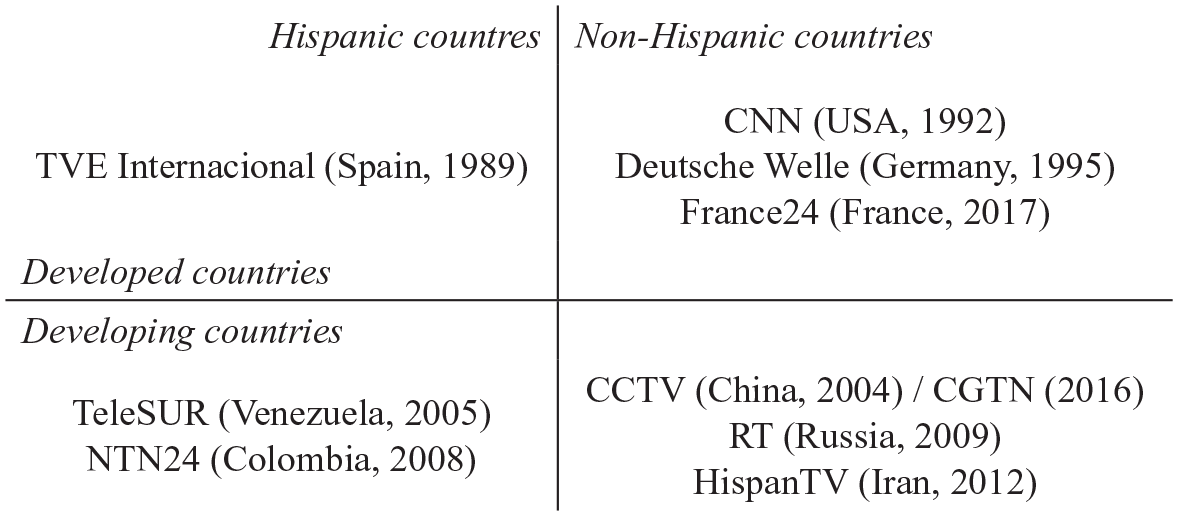
Classification of Spanish-language international news channels according to geographic location.
Even though developing countries can be perceived as sharing similar social challenges and issues of concern, cultural ties from colonial times and the dominant flow of media products from the USA and Europe have created a certain degree of shared ‘media history’ in the western hemisphere. If – as has been argued – Latin America is part of western civilisation (Lamo de Espinosa, 2017), it would be expected that viewers would share values and gravitate towards media products from their own extended culture. In any case, the success of international broadcasters in attracting viewers depends on audiences and how the content speaks to them. On the one hand, the coverage of common social challenges in developing countries can generate a feeling of sympathy and identification among audiences, thus increasing the likelihood of viewers tuning in. On the other hand, cultural differences can jeopardise reception and thwart any chances for these channels to succeed in being appropriated by viewers as sources of information. Thus, how can broadcasters from geographically and culturally distant countries bridge the cultural gap and attract viewers?
Comparative research analysing the reception of CGTN, RT and HispanTV in Latin America is scarce. This is despite the emergence of China, Russia and Iran as new extra-regional actors seeking to challenge the geopolitical influence of the USA (Farah and Babineau, 2019) and the concern expressed by international relations researchers about the implications of such communication strategies by authoritarian countries (Cardenal, 2017). While some studies have addressed CGTN’s targeting of the Spanish-speaking world (e.g. Madrid-Morales, 2015; Ye and Albornoz, 2018), others suggest that its relatively limited availability together with problems of credibility and trust undermine the perceptions of the channel by audiences in Latin America (Morales, 2018).
Based on a series of focus groups conducted in Mexico and Argentina between September and November 2016, this article aims to fill the gap in the existing literature by analysing the role of cultural proximity in audience perceptions of international news channels. The findings show that international broadcasters from culturally distant countries tend to appeal to audiences by following two simultaneous strategies – of association, by evoking journalistic styles of western international broadcasters, and of disassociation from perceived negative images of their own countries of origin. Furthermore, viewers’ preferences show that cultural proximity operates as an inclusionary and exclusionary process at different levels and within subcultural spheres. Finally, the findings also show how representation and the lack of audience identification with the channel can be detrimental if they evoke historical power imbalances.
Geopolitical struggles and the battle for news attention
The proliferation of international media targeting Latin America mirrors a broader context of geopolitical struggles at both global and regional levels. At a global level, China’s rise has been met with different levels of interest and suspicion around the world, Russia is still widely identified with its Cold War Soviet predecessor, and Iran is surrounded by a relatively unfriendly neighbourhood marked by both US-Saudi and US-Israel alliances. In this context, the international communication strategies of China, Russia and Iran are articulated through multilingual news platforms aiming not only to improve their international images but also to influence global conversations. Directly or indirectly supported by their respective governments, media organisations become instrumental in garnering support – or at least sympathisers – in the Global South and creating a contraflow to the Global North (Morales, forthcoming). The ambition to woo audiences in Western countries, however, has been met with distrust and restrictions. For example, Russian and Chinese media were ordered to register under the Foreign Agent Registration Act in the USA (Robinson, 2020), HispanTV was taken off the air in Spain because of links to individuals responsible for human rights violations (Europa Press, 2013), and PressTV’s licence was revoked in the UK for a breach of the Communications Act (Sweney, 2012). At a regional level, political alliances in Latin America have been shifting with the rise and fall of left and right-wing governments. While the establishment of TeleSUR as a multi-government-sponsored channel reflected the ideological alignment of some left-led countries in the 2000s (e.g. Argentina, Bolivia, Venezuela, Ecuador, Nicaragua, Cuba), some governments withdrew sponsorship after political changes (first Argentina, then Uruguay and Bolivia). Despite this, TeleSUR has struck partnerships beyond the region, with media organisations from China (Xinhua, CGTN), Russia (RT, Sputnik) and even Lebanon (Al-Mayadeen). Organisations considered as rivals are often subject to censorship; for example, CNN en Español and Colombia’s NTN24 were taken off the air in Venezuela (Bisbal and Cañizález, 2018).
The imposition of such restrictions is an acknowledgement that international channels can be used to influence audiences. In fact, international broadcasting is widely considered by governments as a way of engaging with overseas audiences and advancing public diplomacy efforts (Cull, 2019). The expectation is that broadcasters will contribute to the creation and expansion of soft power, that is influencing other countries through attraction and co-option, rather than coercion (Nye, 2004). In other words, the strategy’s goal is to influence policymakers in the target country to align themselves with the country exerting soft power. However, soft power as a state-sponsored endeavour has been questioned (Rawnsley, 2015), particularly because if governments are perceived as trying to manipulate, their soft power efforts risk being dismissed as propaganda (Nye, 2011). Indeed, soft power is reliant on public perception, and in the case of international broadcasting this is a transcultural process. The battle for news attention, therefore, depends on broadcasters’ ability to adapt to the sensibilities of the local culture and insert themselves into the media system of the targeted countries (Xie and Boyd-Barret, 2015). However, adopting a tailored approach to appeal to local audiences may prove difficult – if not impossible – when the target regions include several (often multi-ethnic) countries, or even an entire continent.
Conceptualising cultural proximity
According to Ksiazek and Webster (2008), cultural proximity is ‘the intuitively appealing notion that people will gravitate toward media from their own culture’ (p. 485). The concept was first articulated by Joseph Straubhaar following Ithiel de Sola Pool’s line of inquiry (Straubhaar, 2007). Behind this idea lies a strong criticism that shakes the foundations of cultural imperialism. Audiences’ preference for media content generated within their own culture greatly reduces the threat of dependency on content from elsewhere. Indeed, the emergence and growth of regional media production supports the argument for analysing cultural proximity in depth (Ksiazek and Webster, 2008).
In the case of Latin America, Lozano (2008) argues that cultural proximity helps explain why audiences prefer local content, through a more complex analysis of the process of appropriation and negotiation of ideological meaning. Audiences in the region engage actively and creatively in integrating mediated messages into their daily routines, albeit with variations across different segments of society. Cultured elites seemingly show a greater level of engagement with foreign media products, compared with ‘a greater traditionalism and loyalty to national and local cultures by lower or popular classes’ (Straubhaar, 1991: 51). Straubhaar (1991) further suggests that the popular classes prefer ‘nationally or locally produced material that is closer to and more reinforcing of traditional identities, based in regional, ethnic, dialect/language, religious, and other elements’ (p. 51). Although Straubhaar was referring to fiction, Sakurai (2017) identifies similar factors influencing the flow of international news, that is language, colonial ties, ethnicity and geography.
The role of language in shaping preferences for particular media products is a prime focus of analysis in previous studies discussing cultural proximity (Straubhaar, 2003). Ksiazek and Webster (2008) argue that language plays a major role in defining the preferences of monolingual individuals in a multicultural society, and cultural proximity is decisive in defining which TV channels non-English-speaking Hispanics in the USA would choose in comparison to bilingual Hispanics or non-Hispanics. Observing Hollywood film preferences among audiences in different countries, Fu (2012) believes that people prefer their own language, because understanding the dialogue may well be considered a key prerequisite for enjoying watching a movie and ‘even dubbing and subtitling can only moderate but not smooth any linguistic frictions that exist’ (p. 792). t is also worth looking into how nuances and subtleties between different regions within a particular language sphere can affect audience preferences. For instance, within the language sphere of Spanish, films and TV series are often dubbed twice: once into the European version of the spoken language and again into what may be considered a ‘neutral’ version of the language spoken on the other side of the Atlantic. Similar parallels could be drawn with linguistic differences between Québec and France, Brazil and Portugal, or even Taiwan and mainland China. This localisation adds an extra level of analysis when considering language tied to cultural proximity as a factor that may determine a viewer’s preference for a channel with news anchors from either Spain or Latin America. As will be discussed later, in some cases, the news anchors are not native speakers of the language and their accents and fluency can vary substantially. Since clarity is essential to communication, it is worth examining whether this has any effect on the audience’s preferences.
Language is not enough to understand how cultural proximity operates. In fact, the linguistic elements overlap and work in conjunction with other demographic variables such as ethnicity. The perception that mainstream culture in Latin America is experienced and articulated through languages such as Spanish and Portuguese may give a false impression of ethnic uniformity across the region. The complex processes of colonisation – including both voluntary and forced migration – have seen the development of societies with various ethnic makeups and distinct national identities, where indigenous, European and African populations have coexisted, mixed and merged. From the thesis of cultural proximity, it could be argued that audiences would consume media products that resonate with their own personal ethnic identity and local context. However, while ethnic diversity is indeed reflected by the media throughout the region, representation is lagging behind (Van Dijk, 2005). Reflecting power dynamics inherited from colonial times, media ownership in Latin America has traditionally been linked to wealthy elites of European ancestry with both political and economic privilege. Media content in the region tends be encoded in a way that both reflects and reinforces this power structure to the detriment of indigenous, black and mixed populations (Van Dijk, 2005). Since journalists, presenters and anchors employed by international news channels present different ethnic backgrounds, it is important to examine how this element also influences the decoding process by audiences.
A note on Latin American audiences
Without ignoring the long tradition of audience research in the global north, this article intentionally looks at Latin American audiences and their perception process as conceptualised by scholars from Latin America. Since the 1970s Latin American theorists have adopted a more critical approach to understanding audiences in the region, challenging some of the theories developed in the USA and Europe in previous decades (Scolari, 2015). In this context, García-Canclini and Martín-Barbero challenged the perception of audiences as mere passive receivers at the end of the communication model, and suggested that they played a more active role, involving both processes of negotiation and re-signification of mediated messages. Their works became mainstays of Latin American media research and are indeed relevant for the understanding of audiences in this study. Martín-Barbero (1987) believes mediated messages are transformed by audiences, inasmuch they appropriate and re-elaborate messages by charging them with new meaning. His epistemological turn was to displace the focus of attention from the media themselves to the social processes and cultural practices, which Martín-Barbero calls mediations (Scolari, 2015). These operate in a series of dimensions such as ‘sociality’, ‘institutionality’, ‘technicity’ and ‘rituality’, which articulate the relations between communication, culture and politics (Martín-Barbero, 2006). Also placing the focus on culture, García Canclini (1989) looked at Latin American audiences and the hybrid nature of their societies, in which traits of modernity coexist with tradition. He challenged the notion of the ‘public’ as a homogenous mass with a constant behaviour and suggested that diversity allows the coexistence of ‘various styles of reception and understanding, formed in unequal relations with goods deriving from cultured, popular and mass cultural traditions’ (García Canclini, 1995: 100). These multiple styles of reception allow for audiences to produce their own interpretations, which may go beyond the authors’ intentions: ‘All writing and all messages are plagued with blank, silent, interstitial spaces in which the reader is expected to produce new meanings’ (García Canclini, 1995: 100). The complexity of this process becomes even more profound when considering the cultural gap between broadcasters from the other side of the world and viewers in Latin America.
Methods
This article is based on 13 focus groups conducted in Mexico and Argentina between September and November 2016. Located respectively at the North and South extremes of the Hispanic Americas, these states are the sole representatives of Spanish-speaking countries at the G20. Focus groups are not simply a type of semi-structured interview, as Berger (2000) suggests, but actually go beyond the interaction between interviewer and interviewees. The interaction between members of the group can also lead the conversation in a direction that researchers had previously not considered. Similar to other qualitative research methods, focus groups are ideal for exploring a topic and providing context and depth to the ideas and thought processes in which participants are engaging, as well as helping expand interpretation by confronting people with different opinions (Morgan, 1998). It is possible to explore not only how audiences react to audio-visual productions previously unknown to them, but also how they construct their judgement drawing from their own previous knowledge and impressions and from the opinions of other participants (Krueger and Casey, 2009). Focus groups have long been used in general audience research, and in the particular case of international news channels. Wasserman and Madrid-Morales (2018) organised focus groups in Kenya and South Africa to inquire how influential Chinese media are in Africa.
A total of 75 students of international relations and political science were recruited from seven universities: Colegio de México (focus groups M1, M2, M3 and M4), Universidad Nacional Autónoma de México (M5, M6) and Universidad Autónoma Metropolitana (M7, M8) in Mexico; and Universidad de Congreso (A1), Universidad Torcuato di Tella (A2, A3), Universidad de Belgrano (A4) and Universidad Nacional de Buenos Aires (A5) in Argentina. The recruitment process was articulated through local universities that granted me permission to both invite participants and conduct the focus groups on their premises. The participants were informed of the aims of the study both in the invitation and at the start of each session. The gender ratio varied across the sessions but overall remained fairly similar, with 47% female and 53% male participants in Mexico compared with 49% female and 51% male in Argentina. All students were natives of their respective countries, except for one Mexican-US citizen (M1) and one Ecuadorian (M7) in Mexico, and five Mexicans (A1) and one Peruvian (A5) in Argentina.
The sessions were structured in two parts. In the first part, participants were asked about their news media consumption habits, with particular attention to international media. After this, they were invited to watch a series of video clips from RT, HispanTV and CCTV, which were taken from programmes broadcast between April and September 2016 and edited into a compilation lasting no more than six minutes per channel. The excerpts were selected to reflect the variety of content and the ‘spirit’ of the channel, especially regarding the coverage of topics that appeared to respond to the broadcasters’ aim to provide an ‘alternative’ to mainstream Western media (as declared on their websites). Coverage included news exposing human rights issues in the USA, cases debunking freedom of expression in Western media, and reports aimed at rectifying perceived misconceptions about the broadcasters’ countries of origin (e.g. oppression of women in Iran). Other aspects considered for the selection of excerpts were: types of programmes (from news bulletins and interviews to debates and reports), location of reporting (e.g. coverage of and from Latin American countries, the channel’s own country or others), diversity of journalists, reporters, presenters and news readers (gender, language and apparent country or region of origin). Despite this effort to produce a comprehensive and representative selection, participants were still warned that the compilations might display unintentional bias. 1
The rationale behind the use of video clips to prompt the discussion was the assumption that very few participants would have seen these channels. Therefore, it was imperative to explore whether these first impressions had stirred any interest. Since the video clips are polysemic texts that can be interpreted in different ways, it was important not just to understand if the content was interesting to them, but also if the packaging was appealing. Hesmondhalgh (2013) argues that aesthetic experience is crucial in the process of interpretation:
We also need to take into account the aesthetic experiences brought about by texts – their capacity to engage or bore, please or alienate. To think about meaning, aesthetic experience and emotion means addressing questions of form as well as content. By ‘form’, I mean how texts look and sound, their stylistic properties as well as the stories they tell and the assertions they make (p. 50).
Arising from this idea, the participants were encouraged to take notes about their impressions of three aspects: style, presenters and content, which were then discussed, prompted by questions from the moderator. All sessions were audio-recorded and transcribed using pseudonyms to maintain participant anonymity. The data collected was analysed and thematically coded using NVivo.
Bridging cultural distance by association and disassociation
Just as local news channels domesticate international news items by ‘render(ing) them more familiar, more comprehensible and more compatible for consumption by different national audiences’ (Gurevitch and Levy, 1990: 30), RT, HispanTV and CCTV bridge the cultural distance by enhancing associations with the viewers’ own culture. This is often achieved by adopting a broadcasting style that viewers are familiar with, comparable with local and national broadcasters, or even Western broadcasters. For example, Melisa (A4) thought RT ‘looked more like the channels here’ in Argentina. Manuel (A4) agreed, saying it looked ‘very Western’. The strategy of adopting a familiar style seemed to work in favour of RT. Germán (M7) noted RT’s style ‘was quite agile and that agility makes it attractive, interesting to watch’. Hortencia (M8) thought RT’s style ‘helps you stay there’, that is stay tuned. José (A2) thought ‘RT is the most attractive one, besides it is the one that most resembles the Western media’. Juliana (A2) agreed and pointed out that visual aspects such as image quality and brightness gave the impression that it was better ‘designed’ or ‘organised’. Jaime (A2) compared RT to Al-Jazeera as a non-western broadcaster using a western format to generate credibility.
Unlike with RT, the strategy of association appeared to work to the detriment of CCTV. Its visual style made some participants draw comparisons with CNN, arguably partly because of the use of the colour red. ‘CCTV-E is a Chinese CNN’, Estefanía (M5) said. Fernanda (M6) thought it ‘has an image, at least in the logos, in the colour, in the presentation of the names, very similar to CNN’. She believed CCTV-E was trying to deceive viewers visually ‘in order to gain legitimacy’. At the same time Fernanda realised that the colours bore a resemblance to the Chinese flag, giving an impression of nationalism and promoting the country. She recalled one presenter wearing a red dress while the background was yellow. Francisca (M6) agreed, suggesting that CCTV was busier promoting an image than providing interesting news. Gabriel and Gisela (M7) also noticed the colour of the presenter’s clothes. However, following the rebranding of CCTV-E as CGTN Español at the end of 2016, red was replaced by shades of blue. It is a matter of conjecture whether viewers would comment on presenters’ clothing if they were shown video clips from after the re-branding.
All three broadcasters also attempt to bridge the cultural gap by featuring a mix of presenters from Spanish-speaking countries. While most are native speakers from Spain or Latin America, others are non-native speakers. The ratio is relatively balanced at CCTV, with more than half of the presenters being ethnically Chinese (in 2016). However, at RT and HispanTV, non-native speakers are a small minority. These two broadcasters also take advantage of the popularity of some journalists and politicians in the Spanish speaking world and invite them to participate as presenters, for example, Ecuador’s former president Rafael Correa and his show Conversando con Correa on RT; Pablo Iglesias, leader of the Spanish political party Podemos, and his show Fort Apache on HispanTV. In this way, they aim to gain access to audiences that would follow these public figures by association with the values they represent. For example, Pablo Iglesias’ programme made a positive impression on participants such as Helena. Her attention was caught not only by the debate between the host and the guests, but also by the overall content of the clips which she described as ‘trustworthy’ or even ‘looking more credible [than others]’. Natalia (A5) also praised Pablo Iglesias’ programme on HispanTV, because of the perceived professionalism of having guests sitting around a table involved in a discussion.
In the case of HispanTV and RT, this type of association is accompanied by a certain degree of disassociation from their countries of origin, thus making it more difficult for viewers to identify where these broadcasters are based. For example, HispanTV was often associated with Hispanic culture in general. Braulio (M2) said he had doubts about attributing the broadcaster to a specific country because of the ‘many references to countries in Hispanic (Latin) America’. Jacinta (A2) was under the impression that HispanTV was a channel from the USA catering for the Hispanic population there. Manuel (A4) even thought it was from Spain. In the case of RT, the channel was known as Russia Today until 2010, when it started to only use the acronym RT. According to Margarita Simonyan, editor-in-chief of RT’s English-language channel, this was merely a change in the corporate logo to avoid deterring potential viewers who would not be interested in watching news about Russia all day long (Von Twickel, 2010).
The inclusionary and exclusionary power of an accent
As an intrinsic part of culture, a language acts in inclusionary and exclusionary ways by reinforcing a sense of identification and belonging. Kramsch (1998) argues that languages not only express and embody cultural realities but also symbolise them, inasmuch as ‘speakers identify themselves and others through their use of language; they view their language as a symbol of their social identity’ (p. 3). Since the 16th century, the Spanish language has evolved in different ways either side of the Atlantic Ocean, giving rise to two main varieties and many regional and local accents. In respect of this phenomenon of gradual differentiation and divergence, it could be argued that cultural proximity can also refer to subgroups within a single culture sphere, albeit in a more nuanced way. Broadcasters’ choice of a particular variety of Spanish could therefore be key to viewers’ acceptance or rejection of not only particular TV programmes but also an entire channel.
The participants’ preferences seemed to follow two opposing directions: centripetal or inclusionary and centrifugal or exclusionary. Participants were more inclined to prefer presenters speaking their own variety of Spanish, possibly due to the reassurance that the message was understood in full, both at a denotative and a connotative level. Inversely, a certain degree of anxiety - and sometimes even outright rejection – could be sensed among some participants when the message was delivered in an accent that they were not necessarily familiar with.
Inclusionary feelings were directed towards native speakers and more intensely with regard to speakers of the audience’s own variety and accent. Latin American accents were perceived as being closer to home. Mauricio (A4) felt the Latin American accents gave a sense of proximity. Peruvian participant Nancy (A5) remarked that HispanTV was easier to understand because, in her opinion, they had more Latin American presenters than the other two. Nadia (A5) agreed and explained that having people from the region would make her feel closer to the channel. In Mexico, Baltazar (M2) argued that ‘the expressions used by Latin Americans are more understandable (i.e. easier to understand) than (European) Spanish ones, due to a cultural proximity’. Inclusionary feelings were stronger among Mexican participants who showed a greater preference for their own accent, especially if the news was about their own country, as Daniel (M4) pointed out. Gustavo (M7) related this to audiences’ experiences watching telenovelas:
I come from a traditional family. When my grandparents or my uncles watch television –and I don’t have anything against South Americans or other accents-, but sometimes they don’t understand them (i.e. South American accents) and then [say]: ‘they speak too quickly, switch it over’. [. . .] They don’t understand. They think it is too fast, even [people] from other States [in Mexico] that speak [as quickly] as that. That is why, with regards to South American telenovelas, compared to the Mexican culture, our mothers and aunts used to watch them (i.e. telenovelas in general), but right now a lot of them are Colombian, so they are not interested, because they have an accent that is not their own. They use words that they don’t know. [. . .]
From this observation, it could be argued that the idea of cultural proximity can also be applied to subgroups within one culture sphere, albeit in a more nuanced way.
Exclusionary feelings were manifested mostly in respect of what is termed the ‘neutral accent’, the European variety of Spanish, and especially non-native speakers. The term español neutro (neutral Spanish) commonly refers to an attempt to deliver messages in a way that is easily understood by any Spanish speaker (Guevara, 2013). This includes stripping the language of any elements that could cause confusion among listeners, and also finding common ground between different varieties of Spanish. The result of this is difficult to pin down to a specific geographic location. Although some participants valued the idea of a shared language based on common elements, many expressed an open aversion to this hybrid accent, one of the reasons being the association with presenters on Spanish-language broadcasters from the USA such as Univision. Braulio (M2) described this kind of TV station as ‘sensationalist’ and explained that any time he would hear a presenter speaking with this accent, he would automatically – and to a certain extent unconsciously – doubt its credibility. Other participants were also categorical in their rejection of the ‘neutral’ accent, which many described as the ‘Miami accent’. Cristian (M3) was very vocal in explaining the reasons for his aversion to this specific accent, which he recognised as being used by CNN en Español and Telemundo. Arguably devoid of any elements that could be traced to particular regional accents, this neutral accent is an attempt to bring together all the features common to most accents throughout the Spanish-speaking countries in Latin America. Cristian’s antipathy to this accent is partly because of its association with the United States of America and its ‘condescending way’ – as he put it – of ‘transmitting an ideology’ by disguising it in a Spanish that is not the one spoken in Latin America, that is ‘it is a Spanish [that is] a little different; you can tell that it is not the Spanish of someone that you trust’. He saw it as an ‘artificial’ Spanish associated with ‘a vision of imposition’ by the USA.
A few participants in both countries expressed some dislike of the European Spanish accent. Laureano (A3) would even switch over to another channel, especially in the case of dubbing. In Mexico, Gisela (M7) expressed a similar opinion. Fabiana (M6) mentioned that the (European) Spanish accent often reminded Mexicans of historical events such as the Conquista – the colonisation of Mexico and other countries in the Americas by the Spanish crown. Fabiana suggested that Mexicans were relatively sensitive to this, and that a Latin American accent would be differently received. Gisela and Gabriel (M7) echoed this opinion. Natalia (A5) noticed that ‘the three channels would talk about news from Hispanic America, but all had a [European] Spanish accent’. In her opinion it was almost a self-contradiction that news reports about and for Latin America were communicated with a European accent.
A common perception in the focus groups was that non-native speakers were less clear. Ana (M1) specifically mentioned presenters from Iran and China. Daniel (M4) observed that a presenter with a strong non-native accent could undermine the credibility of the news. He believed that people would normally switch over to another channel, saying: ‘I know people that would not listen to the accent more than five minutes if the topic is not that interesting’. Daniel thought this could instil mistrust in some viewers, who would wonder: ‘If you don’t speak Spanish, why are you reporting? [. . .] Why aren’t you a [native] Spanish speaker?’ Other participants said they would prefer subtitles, rather than non-native speakers. ‘If I see that they speak Spanish like that, I would switch over to another channel’, María (M5) said. She did not mind foreign accents but in her opinion, someone presenting the news should have good pronunciation. This suggested that news channels should ensure good quality in both their reporting and their style (clarity in their gestures as well as fluency, for example) and that this was part of being professional. In her opinion, the problem was ‘simply not pronouncing the language well’. Fellow participant Mariana (M5) agreed and explained that she did not like the accent because it did not seem credible.
Representation and identification
Feelings of inclusion and exclusion were not voiced only with regard to how people sounded. The perceived ethnicity of some presenters triggered associations of colonialism and connotations of power imbalance, which seemed to undermine any efforts to bridge the cultural gap. As members of hybrid and diverse societies with multiple styles of reception and understanding (García Canclini, 1989, 1995), participants appropriated and re-signified messages (Martín-Barbero, 1987) by considering multiple layers of interpretation. In Mexico, Fernanda (M6) noticed that most presenters looked ‘foreign’ or ‘not Latin (American)’. ‘(They look) super blond, very white and they speak like Spaniards. I don’t mean that that is not legitimate, but it feels alien to me’. However, when confronted by Francisca (M6), who argued that being ‘Latin’ was not important and that she did not intend to feel represented, Fernanda elaborated:
It’s not that it is important to me that they are Latin [American], that I feel identified, or that that is important in the news. However, it is a way of observing who is saying that to me. I mean, is it a Caucasian that comes to tell me what is happening in Latin America? [Is it a Caucasian] that comes to talk about poverty when [he or she] lives in wealth? Stuff like that. It is just to understand who is there. To me that is important [indeed], not because I would believe them more than another.
Fernanda believed that in Mexico an institutionalised racism had been internalised by the population, whereby rubios (blonds) were desired over morenos (dark-skinned, either indigenous, mestizo or from African descent). ‘In Mexico, you walk on the street and [among] the most spectacular [or fashionable people], the blancos (fair-skinned, from European descent) predominate’, Fernanda explained. A fellow participant, Fátima (M6), said this was the case particularly in the Mexican media, where fair-skinned people were overrepresented:
I believe that has to do with what is not common to see here, so that is why it can also be attractive to them. And [judging] by the programming of the two main television broadcasters here, it is clear that the main characters need to be blond, otherwise they turn them blond. [. . .]
Fernanda’s observation is a sign of the increasing awareness of inequality of representation in the media in Mexico and across Latin America. In order to ensure diversity of structure and performance, McQuail and Deuze (2020) argue that the ‘media should reflect in their structure and content the various social, economic and cultural realities of the societies (and communities) in which they operate, in a more or less proportional way’ (p. 213), and therefore voices of different social and cultural minorities should have relatively equal opportunities to be represented. However, concentrated media ownership in the hands of – and catering for – elites of European ancestry has promoted a distorted version of the complex realities across the continent. In their study of media diversity and social inequality in Latin America, Hugues and Prado (2011) found that, despite accounting for 15% of the population in Mexico, white journalists filled 56% of airtime, and 44% of the people featured in the news were also white. In countries such as Peru, whiteness is often used by advertisers a symbol of aspiration and high quality, while the image of mestizos is associated even by consumers with lower quality and affordability (Aldana-Durán, 2008). If not directly the agents of racism, the media in Latin America have often been accessory to discrimination and racism by perpetuating discriminatory discourses:
Television discourse, images, films, and telenovelas generally tend to ignore indigenous people, marginally celebrate them as being exotic when they are peaceful or as violent when they resist, whereas blacks tend to be invisible and if they are represented at all they are portrayed in negative or subordinate roles, or as being associated with problems, such as poverty of discrimination, as if these were forces of nature (Van Dijk, 2005: 162)
Although there is still a long road to improving the representation of indigenous and black people, it is encouraging to see an increasing number of underrepresented communities discussing the need for better representation (e.g. CHIRAPAQ, 2013), as well as new studies being conducted by researchers in the region (Alarcón Llontop and Torres Mires, 2016; Amalia and Vilain, 2013; Arrunátegui Matos, 2010; Muñiz et al., 2013; Rodríguez Pacheco and Rojas Blanco, 2013; Saez, 2018). Fernanda’s reaction to someone who looks ‘foreign’ speaking with a European-Spanish ‘accent’ talking about ‘her’ space went beyond representation and identification; it triggered associations of power imbalance during colonial times, with native populations subjugated by colonial masters, similar to the observations discussed in the previous section. On a similar note, Héctor (M8) argued ‘people would change [the channel] because, (. . .), [the fact] that a Chinese person would come to tell me what I have to do [or] how my country is. I think people would not accept it because of that’.
Conclusion
This article started with a very simple question and the answer is not necessarily pessimistic. The findings show that Latin American viewers would want to watch international news channels, only if they feel these channels are speaking to them about issues that are important to them and in a way that looks and sounds familiar to them. Considering the cultural differences between Russia, China and Iran and Latin American countries such as Mexico and Argentina, broadcasters such as RT, HispanTV and even CGTN strive to shorten that distance by following two main strategies: copying reporting styles that are familiar to audiences, both visually and aurally, and at the same time dissociating themselves from negative connotations linked to their countries of origin. However, this article showed how similar strategies do not guarantee uniformity of effect among audiences: while RT was seen as a modern and attractive broadcaster, CCTV was perceived as being disingenuous and trying to deceive viewers ‘in order to gain legitimacy’ (Fernanda, M6).
The findings further demonstrate that cultural proximity plays a decisive role in the aesthetic experience in both inclusionary and exclusionary directions. Participants overwhelmingly expressed a higher degree of acceptance of cultural elements that were familiar to them. This also operated within subcultural spheres, with a higher preference for presenters who spoke with accents similar to the local accent. In order to increase the likelihood of audience acceptance, international broadcasters need to learn how to navigate different cultural systems and understand how their messages will be perceived and interpreted by viewers overseas. The challenge is to contemplate multiple layers of interpretation and foresee alternative readings that may go beyond the intended message.
To some viewers it is also increasingly important to feel an affinity with the presenters. This article showed that this is linked to issues of representation in the media in Latin America and the need for under-represented audiences to feel identified. As Kramsch (1998) rightly points out, ‘[t]o identify themselves as members of a community, people have to define themselves jointly as insiders against others, whom they thereby define as outsiders. Culture, as a process that both includes and excludes, always entails the exercise of power and control’ (p. 9). As cultural systems shape the way people interact and communicate with each other, culture also affects the way television programmes are designed, from the format of the programmes to the use of the language and visual elements. As transcultural media, international news channels in Latin America depend for their survival on their capacity to align encoding practices to the decoding habits of audiences in the region. If broadcasters such as CGTN, RT and HispanTV fail to address this issue, they risk being dismissed as cultural outsiders.
Footnotes
Funding
The author(s) disclosed receipt of the following financial support for the research, authorship and/or publication of this article: This research was supported by a Research Studentship awarded by the Communications and Media Research Institute, University of Westminster.
