




Abstract
This study examines peace journalism as manifested toward the Israeli Arab minority in a time of seven security crises from 1996 to 2014 in the Israeli Hebrew sports media. Studies of peace journalism in periods of crises focus mainly on political news and find that the media largely conform to alienation practices. This study argues that sports media encourage a ‘conditional integration’ of all actors that participate in the sport. The sports media have three strategies: acknowledging a notion of ‘normalcy’ in which Arabs encourage the maintenance of the sports season at the national and international levels, curtailing alienation practices such as condemning racism and objection to boycott of Arab teams, and encouraging integration that allows the Israeli-Arabs to have a unique voice, as long as they do not openly adopt anti-Israel political stances such as making pro-Hamas or Hezbollah statements. Therefore, sports sections in the news can deepen our understanding of the diverse role of media in times of security crises.
Media coverage and peace journalism
In conflict zones, the media have a significant role in the mediation of information. The media are important agents for social construction and conflict management, especially during security crises. Different media channels such as newspapers, television, and social networks are constantly evaluating political, economic, and social activities. Media content is a prism through which common perceptions in Israeli society may be explored. Media portrayal is not limited to reflecting reality but is in itself social action and should be understood as a player in the matrix. It is accepted that the constant presence of media in social activity aids us in screening the information and interpreting it (Berger and Luckmann, 1966; Gamson et al., 1992; Gurevitch and Curran, 2005; Van Sterkenburg et al., 2010).
The state of Israel is a conflicted zone. After the 1948 and 1967 wars, the Israeli polity has been composed of a Jewish majority of approximately 80% and an Arab minority of some 20%. Research on the representation of Arabs in Israeli media has yielded two consistent findings: Arabs rarely appear in most fictional genres, and in the news, their portrayal is largely negative. Most appearances of Arabs in the Israeli media have some connection with disorder, violence, demonstrations, and protests (Avraham and First, 2010; Bar-Tal and Teichman, 2009).
The idea of sports is structured as being free of politics; this is the argument behind the cliché that some behavior is ‘unsportsmanlike’. But sports are of special importance as a basis for the identification of individuals and groups. Identification can be with a tribe, a city, or a state. At the national level, sports represent a collective national experience. The state’s symbols and its anthem are expressions for such affiliation. Reporting on sporting events has narrative characteristics and in this story are interwoven myths and heroes, both good and bad. These narrative elements make sporting events and their media coverage a site where collective identities are negotiated and formed. Studies of Israeli sports journalism have found widespread use of gender stereotypes alongside national chauvinism and reliance on myths such as David and Goliath (Hagay and Meyers, 2015). When the Israeli national team plays outside the national arena, there is immediate consideration of the Second World War account. Victory will be described in terms of historical justice and a loss in terms of national defeat (Bernstein, 2007; Harif, 2009). The globalization of sports is a restraining factor on the connection between nationalism and sport. It is difficult to claim patriotism when Israelis move to another country to play or coach other teams.
In the age of globalization, the press discourse has become more professional and national sports teams have lost the status of national emblem (Hagay and Meyers, 2015). Despite the weakening of the links between nationalism and sports in the international arena, when it comes to sports within Israel, the tension between nationalism and universalism maintains its presence. Arab players are involved in most football teams, the sport that has the highest exposure in Israeli media. Research on violence at Israeli football matches found that the Jewish-Arab conflict is the main trigger for violent actions on and off the playing field (Ben Porat, 2016).
The importance of the national media has been identified by many scholars working on conflict resolution. The media can be a double-edged sword. They can encourage integration through the creation of common values and pluralistic society, and thereby emphasize the importance of democracy. At the same time, they can encourage alienation by ‘blaming’ part of the society, portraying a partial picture of events, and serving autocratic regimes (Bratic and Schirch, 2007; Gilboa, 2002). Therefore, the media is an important agent in conflict zones. It can contribute to social alienation or social integration (Bar-Tal & Teichman, 2009). This study examines this dichotomy and suggests that Israeli sports media develop a ‘conditioned integration’ model toward Israeli-Arabs. The study will provide a deeper analysis than the common peace versus war journalism theoretical dichotomy, which is commonly quoted in the academic field.
In the past two decades, there has been a revival of the pioneering work by Johan Galtung and Mari Ruge (1965) on the role of media in conflict resolution. Many scholars (Galtung, 2002, 2006, 2010; Lynch, 2015; Lynch and Galtung, 2010; Lynch and McGoldrick, 2005; Nohrstedt and Ottosen, 2008; Shinar, 2007) created an analytical framework to evaluate the role of the media in what is usually described as ‘peace journalism’. This term is meant to label media coverage that describes the complexities of the conflict, addresses the interests of all players, challenges the conflict as a problem, and humanizes all actors. Peace journalism aspires to uncover all untruths on all sides. Its articles need to give a voice to all people. Finally, it aspires to contribute to the conflict solution and the stages of conflict resolution and reconciliation.
The antipode of peace journalism is war journalism. The term ‘war journalism’ is meant to describe coverage as an agent in the conflict. War journalists’ work tends to create the notion of ‘us-them’ − seeking to put blame on the ‘other’ and sometimes dehumanizing the ‘other’. Therefore, this coverage is propaganda-driven: it seeks to uncover ‘their lies’ while covering ours. It is elite-driven, through justification rhetoric that emphasizes our suffering and their misconduct. Finally, it encourages a decisive act, a victory, or an institutional settlement, such as a peace agreement and a ceasefire (McMahon and Chow-White, 2011).
The influence of peace journalism theory has encouraged many studies in the field. Metin Ersoy (2016) examined the Turkish press reaction to the shooting down of a Syrian plane versus its reaction to the shooting down of a Turkish plane. Barajas (2016) examined peace journalism in the context of post-conflict Cambodia. Shabir Hussain (2017) examined the Pakistani print media on the War on Terror. Hanitzsch and Vos (2018) even developed a model for educating journalists in the practices of peace journalism. Nohrstedt and Ottosen (2015) strove to improve the theory through the adaptation of different methodologies, such as Critical Discourse Analysis (CDA). Lee and Maslog (2005) focused on the coverage of conflicts by Asian newspapers from a peace journalism perspective.
Peace journalism and national sports media in Israel
As a focal point of several intractable conflicts, Israel attracts many studies that adopt peace journalism theory to examine the role of the media in the conflicts. Some studies focus on the Hebrew national media, to examine how they represent the ‘other’ with a special focus on Israeli-Arabs, who are approximately 20% of the population. Israeli scholars such as Dor (2004) and Elbaz (2013) claim that during security crises, Israeli media are intentionally recruited as part of a national public information campaign (hasbara). They explain that the Jewish reporters and editors are caught in a conflictual situation between support of national security and their journalist ethic; that is, the commitment to professionalism, credibility, and careful examination of sources. According to this point of view, the Hebrew press is biased in encouraging the public to adopt an anti-Arab stance. A similar conclusion was arrived at by writers who contributed to a book that examines the media representation of the war between Israel and Hezbollah in 2006 (Dente Ross and Tehranian, 2009). These findings correlate with the theory of conflict resolution expert Berkowitz (2000), that in times of national crises, recruitment of media services is part of a paradigm repair, to restore confidence in national institutions and ideologies that are static, and, in a sense, timeless. However, these studies focus on political media, while social construction by the media also occurs in other spheres.
Sports, through the creation of identities for clubs, players, and fans, can also contribute to alienation from or integration into society (Anderson, 2006; Armstrong and Giulianotti, 1999; Billig, 1995; Young, 2019). Researchers are divided on the role of sports in Israel. Lidor and Blumenstein (2011) and Smooha (2013) perceive football as an instrument for integration or the ‘Israelization’ of Arabs in society, by their adopting modernization in their lifestyles, education, and general aspirations. Other Israeli scholars, such as Ben-Porat (2003), Shor and Yonay (2010), Sorek (2007), arrive at a different conclusion. In their opinion, football merely disguises rights and democracy, and is used by Israeli elites to continue their pro-Jewish policies. Moreover, they maintain that Arab players and teams are unable to lend an alternative voice to the silenced Arab minority.
Shor and Yonai (2010) acknowledge the need to examine the sports media representation of Arabs; however, no study has been conducted on the coverage of Israeli-Arabs in the national Hebrew sports media during security crises. The lacuna in attention to the role of cultural media such as sports during the conflict prevents us from fully understanding how peace journalism and war journalism have a role during security crises.
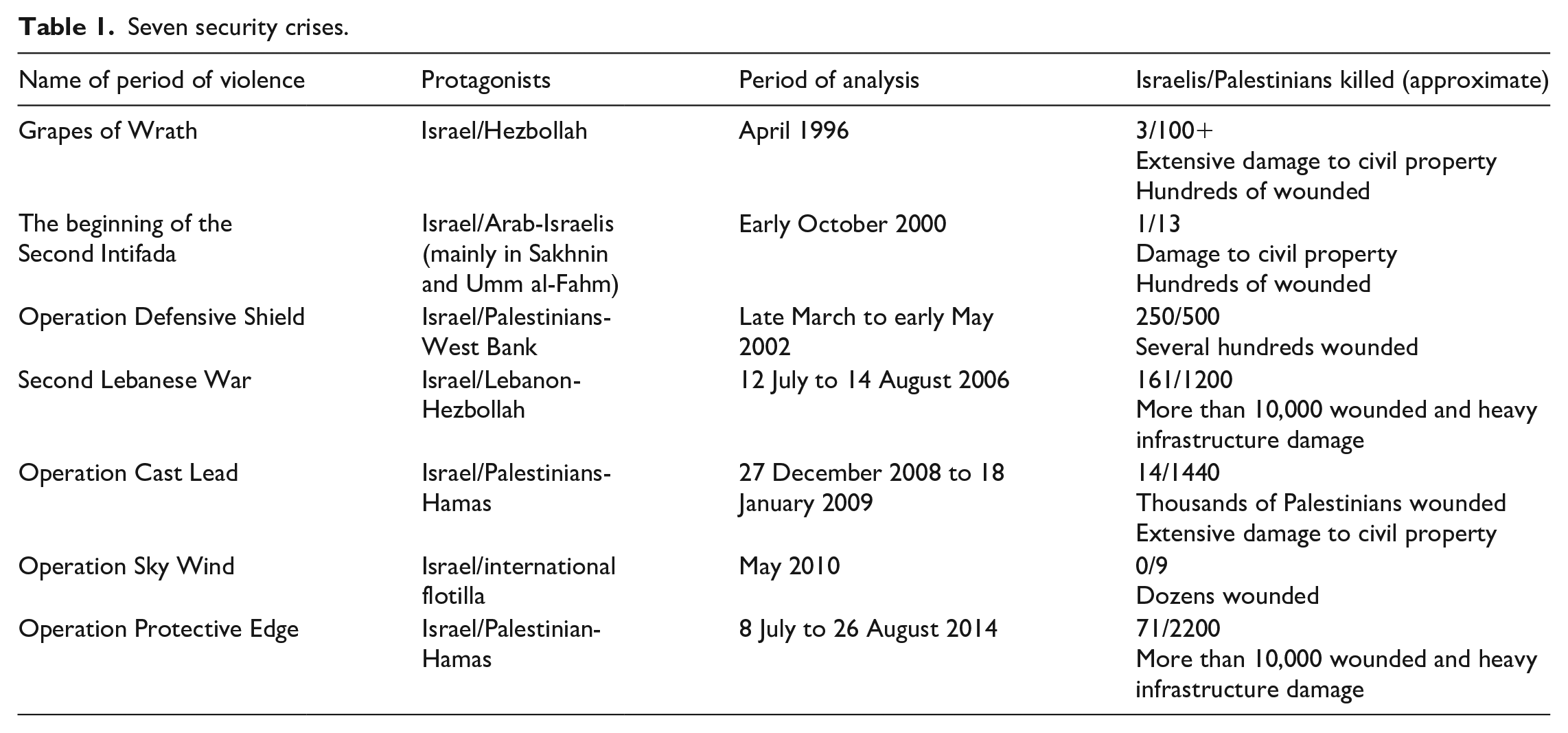
In order to fill the lacuna, this article evaluates the role of Israeli national Hebrew sports media for two decades, from 1996 up to 2014. The question leading the research is whether in times of crisis, sports journalism promotes integration or alienation. To answer this question, seven security crises were selected. In this article, I use the term ‘security crisis’ to describe concrete periods in which the Israeli government used force in a planned military operation that was coherent in terms of its foes, goals, and timespan (see Table 1).
Seven security crises.
The study examined more than 300 news articles from three major Hebrew media sources. The first was the daily newspaper Yediot Aharonot (hereinafter Yedioth), the most popular newspaper in Israel during the period analyzed. The second media source was the daily newspaper Haaretz, which is considered more intellectual in its approach and oriented to the political left. Internet sources were the third media source. These are mainly Ynet, launched in 2000, which has become the most popular Internet site in Israel. In 2011, due to financial cuts, Ynet merged with Yedioth (Abraham Fund Initiative, 2009: 333–360). In addition, the study made use of more than 50 online Hebrew news items, from the period of analysis, that specifically mention the Bnei Sakhnin United Football Club and several top Arab players.
To analyze these data, I adopted the Charmaz (2006) and Cho and Lee (2014) approaches to construction of the grounded theory originally developed by Glaser and Strauss (1967). Through this methodology, I revealed two main categories related to the issue of Arabs and security crises as represented in the media (see Table 2). The first category examines concern for the regular maintenance of the national football league’s routine and the continuation of international tournaments. This category raises issues of normalcy versus disturbances. In it, the Arab teams and players are cast in a Cinderella role relative to normalcy. Moreover, it raises the question of how Arabs are being used in national versus international frameworks, for the Hebrew reader.
Categories of conditioned integration according to each specific medium analyzed.
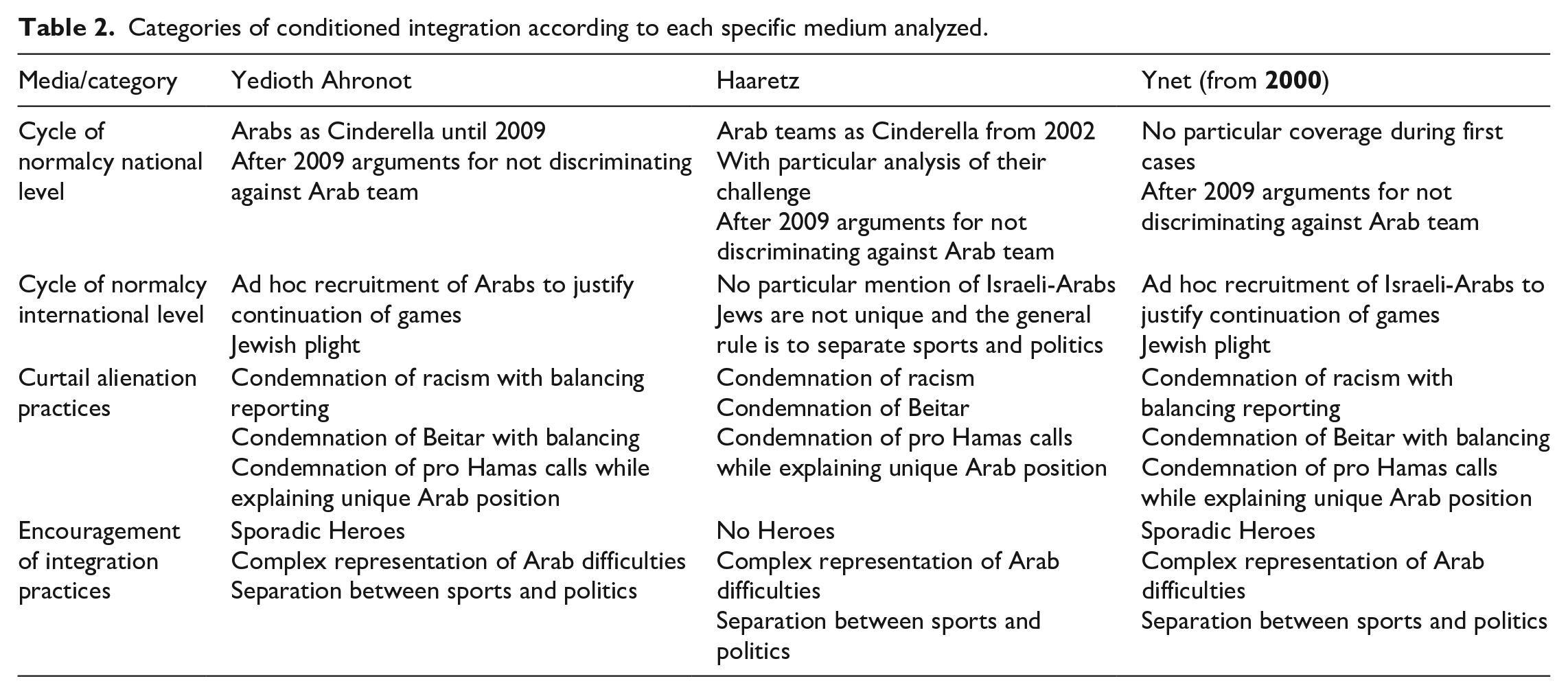
The second category examines cases of curtailing alienation practices in comparison with the encouragement of integration practices. In this category, we can find denouncement of racism and anti-Arabism on one side, and emphasis on the achievements of Arab football players, or validating unique voices or behaviors on the other side.
The Israeli-Arabs’ role in the cycle of normalcy: the national and international challenge
The Israeli sports media’s yearly coverage is dominated by a theme that can be called a cycle of normalcy. The cycle is embedded in the concept of the regular sports season. From this perspective, it is not different from other sports media in the Western world. The sports media are composed mainly of reports on routine weekly games, planning for the games, and analysis afterward. At the end of the season, the main coverage is on the preparation for the new season (Nicholson, 2007: 93–101, 167–178).
The focus of Israeli sports media is the national sports season of the football first division. Minor league games are minimally covered. Moreover, generally, only the top-tier teams receive journalistic interest. Another component of the media coverage is the international tournaments such as the Olympics and FIFA World Cup. Whether or not all these events take place is called into question during security crises.
The Hebrew sports media has had objective difficulties in covering Arab teams. In 2004, 40% of football teams in Israel were Arab teams, although Arabs are only 20% of the population. Despite this fact, only three Arab teams succeeded in participating in the top division: Hapoel Tayibe in the 1996/1997 season, Maccabi Ahi Nazareth in 2003/2004, and again in 2009/2010. The best Arab team in the Israeli football league is Bnei Sakhnin United, who played in the top division for nearly 16 consecutive years – 2003/2004–2005/2006, 2007/2008–2018/2019. It was the only Arab team to receive a substantial trophy when it won the Israeli State Cup in 2004. Unfortunately, in 2019, after 14 years of participation in the primary division, it dropped to the second division.
The possibility of an absence of Arab teams in the top division in 1996, 2000, 2002, and 2006 could have encouraged an exclusion of Arabs from the sports reports. Therefore, it can be expected that during security crises, the media would not represent Arab teams until 2008. Furthermore, Dor (2004), Dente Ross and Tehranian (2009), and Elbaz (2013) claim that during security crises the Israeli media is nationally recruited; thus, it can be expected that Arabs will be represented according to war journalism parameters or not at all.
The national level: from Cinderella story to part of a ‘normal’ Israeli society
Apparently, during the seasons when there were no Arab teams in the first football division, the Hebrew media tried to represent Arab teams through the example of Cinderella stories. This happened during violent security crises that shook Israeli society.
Amid Operation Grapes of Wrath in April 1996, in which Hezbollah launched several hundred rockets at the north of Israel while the Israeli Defense Forces, the IDF, operated in the south of Lebanon, Hapoel Tayibe struggled to be in the top of the second division, a position that entitled the team to join the first division the following year. The media covered a violent incident between two players from Hapoel Tayibe and Hapoel Ramat Gan, which escalated until the referee had to terminate the game. Hit’akhdut Hasport (The Israeli Sports Association, ISA) decided that both teams were to blame.
The security crisis in the north of the country did not infiltrate into the sports coverage. The Hebrew sports coverage in the left-wing Haaretz newspaper used laconic language, and reported to its readers that Tayibe climbed to the first division for the first time in its history (Cohen, 1996a, 1996b). Yedioth, which is more populistic, made Tayibe into a Cinderella story. The reader was presented with the notion of a poor team from a poor Arab town that struggled to reach the top division. They used photographs of players. They interviewed the townspeople, who were generally poor, and pointed out that the mayor would be joining the center-left political party in the Israeli parliament. The newspaper celebrated the Cinderella story with a large photo on the front page of the sports section with the headline: ‘Technical victory for Hapoel Tayibe – It climbs to the 1st division’ (Nathan, 1996; Pohoryles 1996; Yedioth Editorial, 1996).
In 2002, Haaretz was the only newspaper that tried to build hope for a return of the Arabs to the first division, through coverage of the second division Arab team, Kfar Kana. In the end, the Arabs did not succeed in climbing to the first division during the violent period (Bergerfreund, 2002; Bsor, 2002). In 2006, Haaretz did it again with extensive coverage of Bnei Sakhnin United, inspiring hope that it would return to the first division the following year (Buker, 2006; Ghali, 2006). After all, Sakhnin had done the impossible in 2004 and won the Israeli State Cup.
The year 2006 was a turning point in the coverage of Arab teams during security crises. Besides the Cinderella story, a new story emerged. The Arab team Bnei Sakhnin United later became a test case for Haaretz to portray the team as a symbol for Arab difficulties in Israeli society. In 2006, when the entire north area of the country was under threat from Hezbollah rockets and missiles, Haaretz repeated the fact that Sakhnin residents were also under threat from rockets and had no shelters or sirens. The team management feared that foreign players would leave the team. Finally, they also expected Israeli teams in the center of the country to invite them to practice in safety (Buker, 2006; Ghali, 2006). Yedioth also covered the team, hoping for a return of the Cinderella story. However, it also weakened the unique Arab difficulties by comparing them to the conditions of other (Jewish) teams in the north of Israel, who were threatened by the war and who did not have financial resources equal to the rich teams in the first division (Lipkin, 2006a, 2006b).
During the security crises in Gaza from 2008 to 2014, the Hebrew coverage of Arab teams showed more readiness for the integration of Arab teams into Israeli society. There was a permanent presence, Bnei Sakhnin United, in the top division. Sakhnin is a small Arab town in the north of Israel with fewer than 30,000 inhabitants. The town has a history of political tensions with the government and security forces in 1948, 1976 and 2000. It is a center for Arab political activism in Israel (National Commission of Inquiry, 2003). In all three conflicts from 2008 to 2014, the Hebrew sports media addressed Sakhnin through a unique prism, showing a transformation from a Cinderella story to a ‘normal’ team. The maintenance of game routines showed that Jews were not afraid to play against Arab opponents. The media showed that Sakhnin is no different from any other team and that games can be held regularly in its home stadium. They wrote how Sakhnin succeeded despite its limited budget.
1
As one journalist summarized it:
In the end, the atmosphere was not different than at any other game. (Ghali, 2009)
The international level: the absence of Arabs and the Jewish plight
Another aspect that arises from these data is the threat of security crises to international tournaments. Unlike when efforts were made to write about Arab teams at the national level, the objective absence of Arabs at the international level almost made them disappear.
In 2000, during the riots, the Israel national football national team held two international games. Yedioth only reported on the games. Haaretz used an indirect approach to bringing the sides together by mentioning that all national team players were concerned about the violence in all ‘the places that everyone knows’ (Goldberg, 2000). This line is especially interesting since the riots occurred mainly in a few Arab towns that were unknown to the majority of Jews.
Another strategy was provoking fear that the international tournament would be suspended or be played abroad. In 2002, Yedioth and Ynet argued that the level of violence in Israel society did not justify such threats (Gozgel, 2002b; Yukhin, 2002). In 2006, Arab players were ‘recruited’ by Ynet to explain that a decision not to have international games in Israel would be detrimental to Israeli teams (Grosman, 2006; Kaminski, 2006).
A different strategy that was repeated during security crises was the notion that the safety of players and fans abroad would be under threat if the international games were held abroad. This was accompanied by promoting a sense that the Jews, who were few in comparison to the masses abroad, were weak. In 2002, Yedioth published a terrifying headline proclaiming that in one game, fans of a rival team abroad ‘. . . shouted “Arafat” and hoisted Palestinian flags’ (Yukhin and Eisenstadt 2002). The fear of playing abroad caused Yedioth to publish a ‘map of hate’ (Zenzifer, 2009).
From 2000 to 2014, this mode of political recruitment, based on concern for Jews, was absent from Haaretz’s coverage. Usually, Haaretz tried to show that there was no threat to Israelis abroad (Sahar, 2002; Shwidler and Goldberg, 2002). One exception was in 2006, during the offseason when all media were concerned about the cancelation of international games. Haaretz decided that ‘all the world sees Israel as a war zone’ (Haaretz Editorial, 2006). Beginning in January 2009, probably due to many incidents abroad, Haaretz did address the issue, but in a nuanced way. Its readers read articles that compared any politicization of sports events by Jews and Arabs in other places in the world to what was occurring in Israel. For Haaretz, it was better that players and fans not be dragged into showing their political stances at the international level, and that they should stay professional ((Dan, 2009; Ze’evi and Livnat, 2009).
Conditioned integration during security crises
In the 1990s, 4% of the players in the top division were Arabs. In 2018, approximately 15% of all players in the top division were Arabs (Naim, 2016). Arab football players began to be important, mainly in mixed football teams. The desire to succeed caused top division teams to recruit the best Arab players in Israel, and although few in number, they were household names from the 1990s onwards. The rise of Bnei Sakhnin United to the top division increased the Arab presence. Finally, the best Israeli Arab players found teams abroad, and in 2019, 5 of the 11 players on the original Israeli national team were Arabs (Sport5 Editorial, 2019; Naim, 2017).
The increased numbers and importance of Arab players raise the question of how the sports media represent Israeli-Arabs, besides providing factual information on games. As mentioned earlier, the Hebrew political media tend to be more nationalistic, because they aspire to ‘paradigm repair’, which involves using the methods of war journalism. The findings on the Hebrew sports media reveal its two main strategies, which, combined with the pressure to continue the sports season that was described in the first part of the article, create what I term ‘conditioned integration’. The first strategy is curtailing alienation practices, while drawing a boundary around what is allowed and not allowed in the sport. The second strategy is the encouragement of integration practices. As analyzed below, these strategies are neither coherent nor consistent.
Curtailing alienation during security crises
During security crises, the socio-political atmosphere is tense and ripe for incitement, racism, and alienation between Jews and Arabs.
In all security crises that were reviewed, the Hebrew sports media denounced racist calls by team fans. For example, in 2000, the Hebrew sports media condemned such calls made by the Beitar Jerusalem team fans − even when there were no Arab players in the game. The fans used signs to insult Arabs, Arab members of Parliament, and against the inclusion of Arab players in their team (Yedioth Editorial, 1996). Another example of condemnation was in 2014, when an Arab midfielder player, Mahran Radi, who played for Maccabi Tel Aviv, the team that later won the Israeli championship, received racist taunts from the team’s fans. All Hebrew media condemned it and used interviews with players, owners, and fans to show that racism against Arabs should cease. The reporter Zenzifer (2014) captured the spirit in one article in which they claimed that ‘We are not Beitar’.
Not to be identified with Beitar Jerusalem is an important statement in Israel. Beitar is a top team in the Israeli first division. It is also a symbol of Jewish alienation from Arabs. The team management and fans openly identify themselves as Zionist and nationalistic. Part of this stance is the team’s policy not to allow Arab players. This stance is frequently denounced by all Hebrew media. However, aside from demeaning Arabs, during security crises Beitar’s management, players, and fans call for contributions to the military and to civilians affected by security crises – which weakens the criticism against the team. For example, the sports coverage published in 2010 described how the violent and racist fans of Beitar demonstrated against the Turkish embassy for its support of the flotilla aimed at breaking the Israeli blockade on the Gaza Strip. Fans were quoted as saying, ‘We are all proud to be Israelis, beyond being football fans . . . these days it is important to support IDF soldiers’ (Ein Dor, 2010).
The practice of ‘balancing’ and ‘explaining’ did not occur only in the context of Beitar. Despite blunt condemnations of racism by all Hebrew sports media, Yedioth and Ynet sometimes used this practice. The fans and players were often quoted as calling for enlisting in military service or said to participate in humanitarian missions to stricken areas in the country. For Orgad (2002), a racist act ‘. . . was accepted, because of the “situation,” in forgiveness, when a famous fan was killed’. The press praised the willingness of Jewish players on the team to enlist for military service over the aspiration to continue the sports season (Gozgel, 2002a; Khasid, 2002). This strategy is shown mainly by the more popular sports news media and not by Haaretz, which did not publish ‘balancing’ articles.
The strategies to prevent the alienation of Arabs also included efforts to prevent what was perceived as alienation of Jews by Arabs. The most explicit case in this study, according to the Hebrew sports media, occurred on 3 January 2009. Sakhnin’s newly elected mayor, Mazen Ghanayim, arranged an Arab demonstration in the city to end the fighting between the IDF and Hamas in Gaza Strip. It was the largest Arab demonstration in years, with tens of thousands of participants. Ghanayim was also the legendary chair of Bnei Sakhnin United from 1996 to 2008, until he was elected mayor, a position he held until 2018. The Hebrew press, which used to tag him as the speaker for the integration of Arabs in Israeli society, had to decide how to react to the speech in which he said, ‘Long live Palestine, its capital is Jerusalem, and long live the shahids (martyrs) who die in Gaza!’ In late interviews with Ghanayim, he said that he did not hesitate to mix sports with politics (Ghanayim, 2004; Ghanayim, 2011; Schwarz, 2012).
All Hebrew sports media addressed the demonstration in the headlines of their sports sections. From their perspective, the demonstration and declaration that showed more empathy for the people in Gaza than for Israelis were alienating acts by Israeli-Arabs, against coexistence in Israel between Jews and Arabs. However, in a series of articles that used interviews with Ghanayim and with Arab and Jewish players on the team, they presented a more balanced view. They argued that ultimately it was to advance the cessation of hostilities, that the team and Ghanayim always called for coexistence, that Jews and Arabs both play on the team and are safe, that in future games there would be no violence, and finally that sports and politics should be separated (Buker, 2009; Butz, 2009; Butz and Sardis, 2009). The prominent sports commentator Amir Peleg summarized,
. . . There is a reason why Arabs and Jews love Mazen Ghanayim. The Chair of Bnei Sakhnin United is a smart man, a superb manager who any sports fan would wish for his team. He is the antithesis of the racists of Beitar Jerusalem, who are not willing to accept an Arab player. It is his right to protest against the IDF operations in Gaza, which indeed also hurt the innocents . . . What can we do, we are stuck in the most problematic daycare in the world. (Peleg, 2009)
Integration during security crises
The sports media did not focus only on curtailing alienation practices. They adopted active peace journalism strategies, such as citing the heroism of Arabs, showing empathy for their difficulties and tolerance for not singing the national anthem, and strongly encouraged coexistence through a separation of sports and politics.
The first and most obvious strategy of the Hebrew media was to represent Arab players as ‘heroes’ in their Jewish teams’ achievements. One example occurred at the height of the IDF military operations in the West Bank during the spring of 2002, as a response to the deadliest terrorist bombing campaign by the Palestinians. Yedioth decided to write a profile article on Walid Bdir, an Arab football player, with his picture on the cover of the sports section, hailing him as the top player of 2002 and claiming ‘Bdir is a walking symbol of coexistence in these hectic times’ (Hazani and Shaltiel, 2002).
Another kind of representation of Arabs showed empathy for the Arabs’ difficulties while emphasizing that they were part of the nation. Ynet and Yedioth published editorials in which they interviewed several Arab players and managers to show the complexities of their challenges. Ynet called on its readers to be sensitive to Arab players who play on Jewish teams, who are ‘under impossible pressure. On one side, their loyalty to the (Arab) sector, on the other to the team and its fans, while in the background the adversary team’s fans yell racist words at them’ (Khalabi, 2000; Ynet Editorial, 2000).
Finally, it was accepted that Arab players who play on the Israeli national team do not sing the national anthem, which calls for a Jewish homeland (Shoken, 2007; Zenzifer, 2002). This turned into such a norm in Israel that when Salim Jubran, an Arab who was appointed as a judge on the Supreme Court, did not sing the anthem, one reporter remarked that ‘We can be flexible as we are when [the Arab players] Walid Bdir, Abbas Suan, and Salim Tuama score goals for our national team’ (Yoaz, 2012).
Another strategy for achieving the integration of Arabs into Israel is through repetitive calls for separating politics from sports. All Hebrew media tried to encourage the separation. In 2000, during the riots by Israeli-Arabs, Yedioth and Ynet interviewed prominent Arab managers and players, mainly to conclude that football should be separate from politics. (Ynet, Editorial, 2000). Walid Bdir stated that ‘I don’t mess with politics. When I am on the field with the Israeli national uniform, I care only about victory’ (Goldstein and Weiss, 2000). Yedioth initiated the discussion again during the conflict of 2008/2009 between Jews and Arabs, to show the complexities of both sides and to claim that sports and politics should be separated, which would favor continuing their coexistence (Schwartz, 2008). Finally, during the 2014 fighting, Ynet initiated a special editorial on Sakhnin. The headline was ‘Through football we will have peace’ (Peleg, 2014).
Conclusion
This study demonstrates the value and significance of media products in the form of sports journalism during a security crisis. The cumulative body of media research has repeatedly revealed the finding that Arab representation in Israeli media is often negative and scant. Arabs in Israeli media are symbolically annihilated and appear usually through the back door of disorderly events (Avraham et al., 2000). However, an examination of sports journalism in time of national crisis revealed different findings.
Sports events in Israel are potential sites for engaging in populist and violent expressions. The reporting of a sports event in news is absorbed with national narratives and interwoven with mythical characters of heroes and villains. Despite all this, the Israeli sports media have adopted parts of the norms of peace journalism. While the analysis of the Hebrew political media, which used the theory of peace journalism, points to a tendency toward alienation between Jews and Arabs, this study reveals that during security crises, the Hebrew sports media tended toward what I termed ‘conditional integration’. This is a more nuanced representation of a minority during the conflict. It did not consistently act according to peace journalism criteria, which are very difficult criteria to meet. The Hebrew sports media did curtail alienation practices such as racism and try to maneuver between the nationalistic tendencies of Beitar, the Jewish team, and its Arab counterpart, Sakhnin. Moreover, the media encouraged readers to identify with top Arab players as heroes, to empathize with the unique situation of Arab players and teams in Israeli society, and finally, to favor a vision of coexistence in times when the political media were more prone to alienation. Through these strategies, ‘conditional integration’ encourages both Jews and Arabs to adopt narratives, behaviors, and statements during security crises that will help to preserve a framework of normalcy.
Cooperation between Jews and Arabs in Israel takes place in very few areas and arenas. The two groups are estranged from one another, living in different communities, studying in separate primary and secondary educational institutions, and there are very few contact interfaces. The presence of Arab players in mixed sport groups is non-trivial assimilation. The media coverage of Arab groups and players is itself a show of normalization and Arab-Jewish coexistence in a troubled area.
The positive actions were enabled through a conditioned integration strategy. This pattern is linked to several conditions. First, sports routines and professionalism require sports journalists to exert pressure to terminate the security crises and return to national and international routines. In this sense, sports journalists are part of sports institutions, shareholders in encouraging an atmosphere that will facilitate the games.
Another important phenomenon that is linked to a condition integration strategy is the globalization of sports that changed the norms and the way professional players are evaluated. The beam of nationalism dimmed and professionalism rose. The inclusion of Arab players in the journalistic agenda was supported by the globalization of sport. The movement of capital and players all over the world raised the meritocratic value of professionalism and encouraged the perception of Arab players not through their ethnic origin prism but rather through their achievements.
This study demonstrates that sports journalism can play a positive role in moderating national feelings and presenting minorities positively. Indeed, the sports journalism does not undermine the existing and established arrangements. It is impossible to find a reference to the lack of funding or the state of sports infrastructure in Arab towns. Yet, this journalism is nonetheless committed to integrating and maintaining humanistic moral codes.
One of the key findings is the tension between different strategies of coverage. Although Haaretz has a small sports section and a limited distribution, it often found ways to cover Arab teams and players without falling into clichés. Other news agencies, such as Yedioth and Ynet, were less clear on these issues, as shown in their ‘balancing’ acts on racism or their escalation for international games. However, the entire media condemn violence by players or fans as unacceptable due to its detrimental effect on the games. Professionalism counters alienation. All in all, the Hebrew sports media tend more toward integration than alienation.
We are accustomed to examining the negative role that the media play in constructing and portraying stereotypes, but it should be borne in mind that the media can also, with the same potential of power, present audiences with alternative prisms for understanding events.
This study reinforces previous claims that the sports journalism discourse can illuminate changes in national discourse and prevailing ideology. Furthermore, examining the discourse at different times demonstrates the nuanced changes, enabling us to see that the field of communication is not monolithic. Different newspapers took a different approach.
Sports media is an agent of cultural media and as such, it is an active and important actor in divided societies. It abides by its laws, influenced by global norms as well as financial and professional concerns that contribute to an original social stand that differentiates it from a political media stance. These findings should open several venues for additional study.
A further research agenda on this topic should include other sections in the print and virtual news media, such as the cultural section, that which reports on theater shows, music concerts, fashion exhibitions, and others. For as we realized from the sports section, diverse parts of the newspaper bear different messages. An agenda for future research should uncover the autonomous characteristics of each media section and its ‘world’. Globalization and professionalism may be a positive agent in divided societies due to their neutral ethnic or national stance. As this study has shown, the sports section, as compared to the ‘hard’ political news, produces different projections and interpretations of the same events. We are missing an important aspect of the media’s role by continuously looking under the streetlight. Investigating the role of other news sections might widen our vision.
Footnotes
Acknowledgements
The author would like to thank the anonymous reviewers for their comments and ideas. The author would also like to thank Gadi Heimman, Mottie Tamarkin, and Ornat Turin for their comments on an earlier draft of this paper.
Funding
The author(s) received no financial support for the research, authorship, and/or publication of this article.
