




Abstract
This article analyzes the political economy of sexually affective data on the Chinese gay dating platform Blued. Having launched in 2012 as a location-based dating app akin to Grindr, Blued has now become a multipurpose platform providing extra services such as newsfeeds and live streaming. Through the continuous imbrication of old and new functionalities and related affordances, users are transformed from dating subjects into performative laborers. Based on Internet ethnographic research that lasted 2 years, this article focuses on sexual-affective data flows (e.g. virtual gifting, following, liking, commenting, and sharing) produced by gay live streamers within the parameters of same-sex desires such as infatuation, sexual arousal, and online intimacy. It argues that these sexually affective data flows increasingly constitute key corporate assets with which Blued attracts venture capital. This analysis of live streamers and their viewers extends understandings of dating apps in two ways. First, it shows how these apps now function as business platforms on top of being channels for hooking up. Second, it emphasizes that whereas users created data freely, now it is produced by paid labor.
Introduction
Mobile live streaming has become a familiar practice in China. According to Reuters (2017), in 2016, more than 150 streaming apps catered for a market worth in excess of 30 billion Chinese yuan (US$4.3 billion). The value of this market is expected to triple by 2020, potentially surpassing cinema box office receipts (Reuters, 2017). The Economist (2017) has dubbed this market China’s ‘live streaming industry’. In January 2016, China’s largest gay dating app Blued incorporated a live streaming feature into its platform (Figure 1). In trying to solicit virtual gifts from viewers, gay live streamers answer questions, offer advice, sing, dance, and perform in drag for their male viewers. If viewers want to buy gifts for streamers, they first need to purchase beans, the digital currency on Blued. The value of gifts is split between the platform and gay live streamers. Streamers can convert their share of gifts’ value into real money. This functional shift toward monetization has not only increased Blued’s data volume in terms of traffic and user engagement but also generated substantial revenue for the company. According to Blued, live streaming contributes half of the app’s traffic and accounts for the majority of its profits (Wang, 2016).
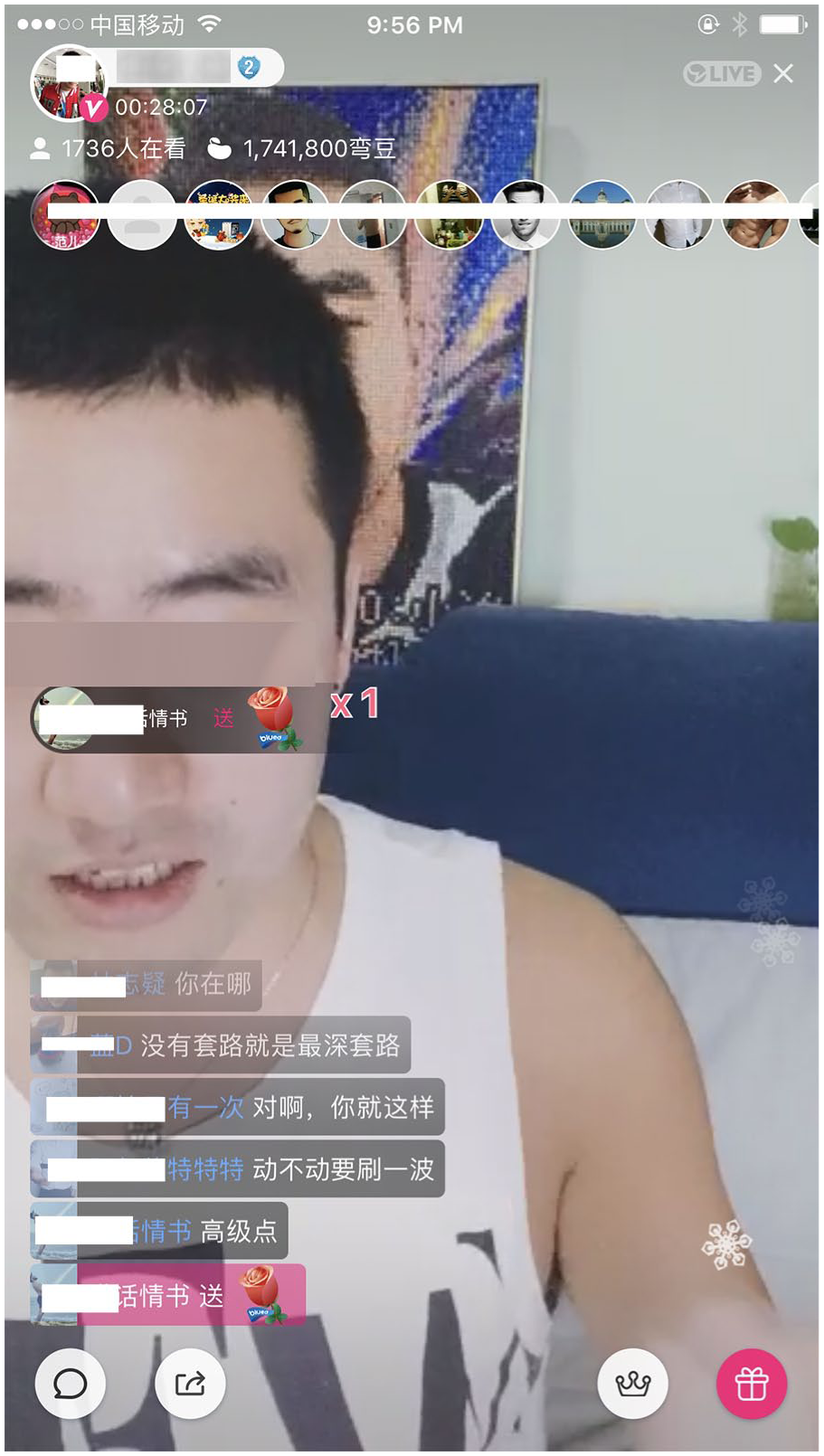
The interviewee Hu was live streaming on Blued on 20 December 2016.
Gay dating apps have been studied as methods of networking and hooking up (Race, 2015a, 2015b); conduits for sharing pornography and soliciting prostitution (Brennan, 2017; Phillips, 2015; Tziallas, 2015); and sites for data production (Albury et al., 2017; Lutz and Ranzini, 2017; Wang, 2018). This body of work explores the ways in which users create digital profiles to make quick information exchanges for sexual or romantic purposes. Until now, the political economy of these apps has only been analyzed in terms of membership subscription and advertisement (Albury et al., 2017). Although digital platforms such as Airbnb, DiDi, and Uber are generating heated debates regarding the rise of a platform economy and calls for institutional and political regulation (Chen, 2018; Helmond, 2015; Kenney and Zysman, 2016; Langley and Leyshon, 2017; Srnicek, 2017; van Dijck et al., 2018), dating platforms do not feature prominently in these debates. Against the backdrop of a Chinese state that enforces sexual censorship while the live streaming economy booms, this article analyzes how performative labor on Blued produces sexually affective data for trade in both domestic and global capital markets.
Blued has evolved from a single-feature location-based dating app into a multipurpose digital platform that includes newsfeeds, live streaming, gaming, online shopping, and overseas surrogacy consulting (Figure 2). Blued’s founder calls the process of adding new features to the basic dating structure as ‘functionality imbrication’ (gongneng diedai). This means that new functionalities overlap rather than replace old ones, so as to cater for multisided markets. The notion of functionality imbrication resonates with the concept of platformization, which, according to Nieborg and Helmond (2018), is informed by a dual process of outward extension into other websites, platforms, and apps and inward integration of third-party plug-ins and tabs. Given that the Blued platform incorporates both sharing buttons that link to other social media platforms (e.g. WeChat and Weibo) and third-party partnered functionalities (e.g. gaming and shopping), this article refers to functionality imbrication (on the empirical level) and platformization (on the conceptual level) interchangeably.
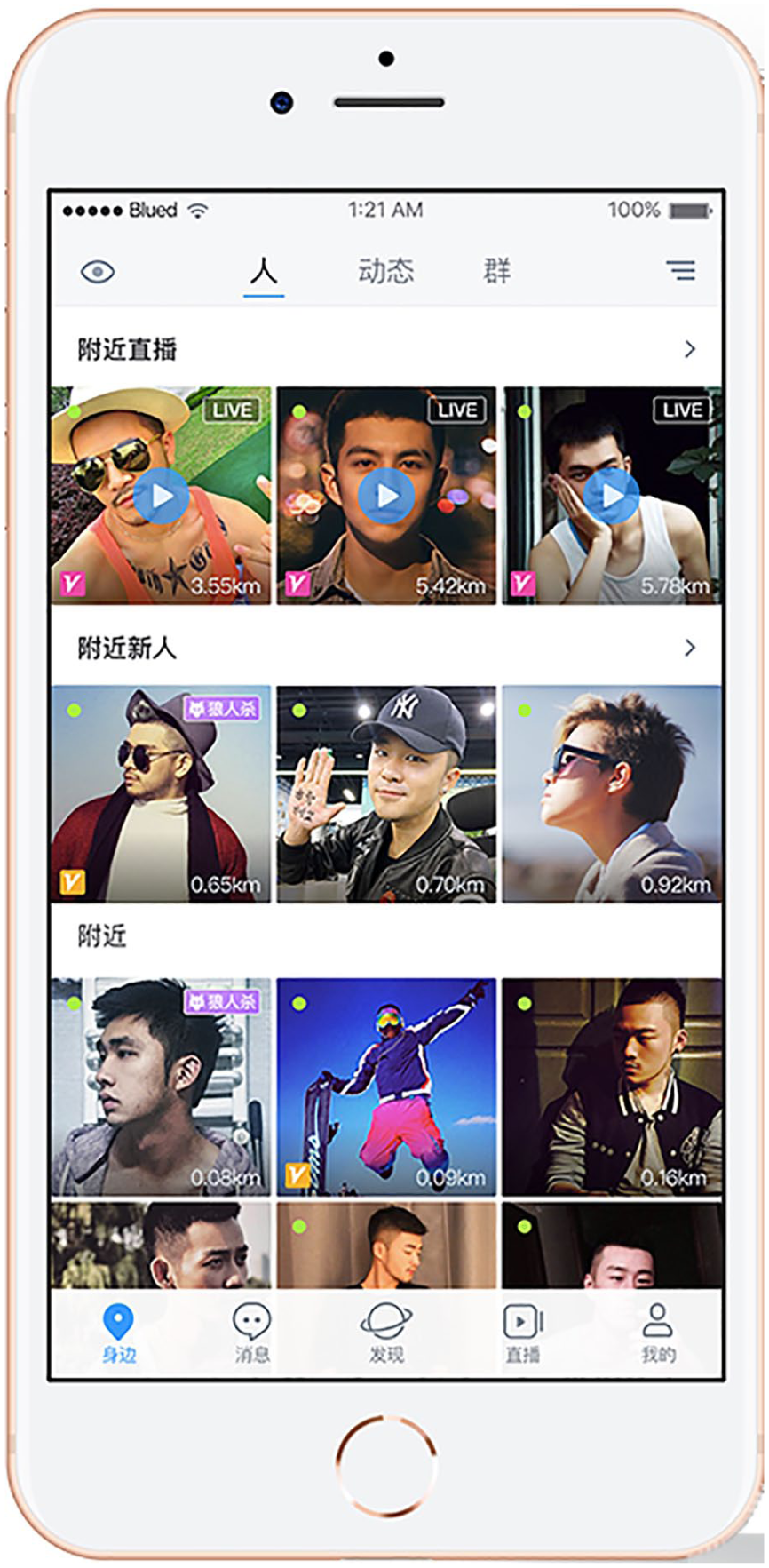
The user interface of Blued
This article focuses on Blued’s two prime functionalities: dating and live streaming. My analysis shows how Blued’s multiple affordances configure a dynamic platform that frames user participation and stimulates value creation. Blued users’ performative labor contributes to the platform’s financial profitability in two ways. The first is the money paid for gay live streamers’ performances, which are often personal, sexually imaginative, and emotionally affective. The second is monetization of the sexually affective data traffic produced by these streamers. Here, ‘sexually affective data’ refers not only to the static quantitative data pertaining to user profiles, which usually includes headshot, age, weight, height, and sex roles (on Blued, inserters are numbered as 1, insertees as 0, and versatiles as 0.5), geographical location, and personality tags (see Wang, 2018). It also encompasses data flows produced by gay live streamers in forms of virtual gifting, following, liking, commenting, and sharing. Unlike service ratings or expressions of attitudes, these data are sexually affective because they are produced within the parameters of same-sex desires such as infatuation, sexual arousal, online intimacy, and the like.
The research data used in this article stem from the author’s 2-year Internet ethnography on Blued live streaming, as well as interviews with the CEO of Blued (Geng Le) and 11 gay live streamers. The remainder of this article is structured as follows. I first demonstrate how functionality imbrication reinvigorates Blued’s platform dynamics and turns users into performative laborers. Then, I examine how Blued’s multiple new affordances frame gay live streamers’ labor practices. After that, I analyze how gay live streamers try to game Blued’s trending algorithms, how they are incentivized to compete for trending status, and how these processes produce sexually affective data. In the last analytical section, I discuss how gay men’s performative labor have been increasingly institutionalized, professionalized, and datafied as corporate assets. Thus transformed, these assets are used by Blued to expand sexually affective data production.
The platformization of Blued and global digital performative labor
Launched in November 2012 and headquartered in Beijing, Blued is a gay dating platform operating in 13 languages and two separate versions: Chinese and International (Blued, n.d.). Assisted by the GPS technology built into smartphones, the app was initially very similar to Western counterparts such as Jack’d and Grindr, which facilitate immediate hooking up encounters according to users’ geographical proximity (Race, 2015a, 2015b). However, Blued has rapidly differentiated itself by incorporating multiple functionalities. Besides the more commonplace ‘Browse’ and ‘Chat’ functions, Blued has added another: ‘Buzz’, a newsfeed generated from users’ posts of pictures and messages. Based on these posts, users are able to imagine the personalities of potential sexual or romantic partners. In this process, social buttons including ‘like’, ‘comment’, and ‘share’ are enabled in newsfeeds. ‘Buzz’ also reshapes the composition of user profiles in that users are now able to follow people on the platform. For Blued, ‘Buzz’ and ‘Browse’ work in tandem to boost the platform’s user engagement rate – a social media metric that measures likes, shares, comments, and the proportion of active users, among other indicators, to assess a digital platform’s performance.
In January 2016, Blued became the first gay dating platform to introduce the live streaming functionality. According to Geng Le, live streaming can be seen as another function imbricated into ‘Buzz’ and ‘Browse’. That is, live streaming combines real-time audiovisual interaction with other communication channels centered on texts and pictures pertaining to digital profiles. Following the introduction of live streaming, Blued created a number of official accounts to recommend popular gay live streamers to users through their browsing interfaces and newsfeeds. Given all these functionalities, it comes as no surprise that Blued is now the world’s largest gay dating platform, with 40 million users worldwide (Blued, n.d.). In Geng Le’s view, Blued’s success stems from the data flows created by its imbricated functionalities: Our data performance in the aspects of the number of daily log-ins, the number of active users, and the number of total users is excellent. These data contain a hidden commercial value. That’s why we’ve attracted so many investments. There is a hefty gold mine yet to be excavated. (Interview on 11 January 2016 in Beijing)
At the time of the interview, Blued has two complementary corporate strategies: monetization and international expansion. For Geng Le, the company’s priority is to monetize the large volume of user data stored on the platform. One reason that live streaming has been integrated into the app is that it visualizes users’ profile data (e.g. looks, personality, age, height, and even weight). By monetizing users’ sexual and emotional expectations in using the app, live streaming not only cashes in on user data through their real-time performances but also expands the scope of data production, such that it now encompasses the audiovisual. Although Blued now dominates the domestic market, the app still requires more users to maintain its competitive edge. International expansion has therefore become equally as important as monetization in Blued’s corporate strategy. Accordingly, in April 2016, Blued opened up offices in Vietnam, Thailand, and the United Kingdom to promote its international version (The Beijing News, 2017).
Both monetization and internationalization have been successful. According to news reports, Blued finally started making profits in 2016, with live streaming contributing to an overall revenue stream amounting to hundreds of millions of Chinese yuan (The Beijing News, 2017). The international version of the app hosted an increased number of live streamers belonging to various ethnicities and nationalities, which made up 30% of its total users (Blued, n.d.). Despite the strict ban on pornography in both versions, live streams on Blued International are more sexualized. Often they involve sexually explicit display (e.g. nudity and seductive body movements). This is because Blued’s international version is only provided in non-Chinese app stores, so adult content there is not subjected to the Chinese law. In addition, Blued International enables an alternative mode of private live streaming, in which a live streamer is able to invite selected users to watch. Invited viewers will receive an adult content warning before entry. The private mode tends to feature explicit practices such as masturbation.
Globally, adult webcam sites such as Chaturbate have drawn large numbers of women and men into the live streaming industry. Performing eroticism online reduces the risks of physical danger attendant on offline sex work (Jones, 2016). The perceived authenticity associated with amateur performing models, moreover, turns out to be the primary reason that draws online viewers (Nayar, 2017). Van Doorn and Velthuis (2018) argue that the digital architecture of Chaturbate creates a competitive environment for models. To entertain viewers, and turn them into regularly paying customers, models play along with Chaturbate’s algorithmic structure and even try to game it. In doing so, they display more sexually explicit/extreme content and use bots to push rankings (Van Doorn and Velthuis, 2018). The business model analyzed in these studies foregrounds the content of performances. This article supplements this strand of scholarship by highlighting the data value of performative labor. That is, live streamers encourage viewers to engage further, which in turn increases both the app’s traffic and its likelihood of attracting venture capital.
Unlike the data structures of platforms such as Uber that are based on customer ratings (Rosenblat and Stark, 2016), sexually affective data can be more complicated. Due to the ephemerality of live streaming, it is perhaps difficult for real-time sexually affective activities to be readily recognized as ‘solid’ data. However, as Geng Le says, live streaming has tremendously increased the app’s frequency of daily log-ins, the duration of use, and the overall number of users. Moreover, these sexually affective activities have been compiled into various rankings, including the highest paid live streamers and highest spending viewers. Much like the ‘like’ button on Facebook, which converts user engagement into tradeable data flows (Gerlitz and Helmond, 2013), these sexually affective data have become core corporate assets through which Blued attracts advertisers and investors. Capitalizing on the active data flows facilitated by live streaming, Blued has secured four large investments from both domestic and global capital markets between 2016 and 2018. This suggests that, in addition to the money compensated live streaming shows, sexually affective data can also generate financial value for Blued. The fundamental questions addressed in this study, therefore, concern the political economic ramifications of Blued’s platformization. It attends to the ways in which Blued incentivizes sexually affective data production through functionality imbrication.
Method
I carried out Internet ethnographic fieldwork on Blued live streaming from January 2016 to January 2018. In developing ethnographic strategies for the Internet, Hine (2015) proposes a framework of embedded, embodied, and everyday Internet to explore how the Internet is made meaningful in different settings. The Internet is not an external agent that impacts upon society but a component part of dynamic cultural practices that shape society from within (Hine, 2015). Observing how user practices enact a digital platform in specific ways, therefore, is important. With that in mind, I have paid particular attention to how gay men perform on streaming with Blued’s multiple affordances and how the unequal affordances available to different types of streamers (e.g. muscular ones and those in drag) regulate and valorize performative labor.
The idea of an embodied Internet emphasizes that users’ bodies are socially situated and materially surrounded when they are on the Internet (Hine, 2015). The intersections among bodily practices, material circumstances, and digital affordances entail multiple productive tensions. To explore how the platform architecture frames streaming activities and how streamers’ bodily performances affect viewers’ virtual gifting practices, it is necessary to experience live streaming in an embodied way. Accordingly, I signed up as a live streamer on Blued and probed what becoming a streamer in the platform architecture entails. By participating in virtual gifting as a viewer on Blued, I took notes on my own embodied experience, particularly when I was sexually and emotionally affected. In this process, I spent 200 Chinese yuan (US$30) on beans for the research purpose. These personal, embodied experiences helped me formulate interview questions for gay live streamers.
The idea of the everyday Internet signals how the Internet has become the infrastructure of people’s daily activities. Often taking it for granted, we tend to overlook the ways in which this infrastructure shapes relations and actions (Hine, 2015). This is of critical importance for this study because Blued is a platform not only for hooking up but also for labor exploitation, which reconfigures user relations and actions in economically significant ways.
On the basis of my ethnographic data, I further gathered firsthand information by conducting interviews with the founder/CEO of Blued (11 January 2016, Beijing) and 11 gay live streamers. Despite observing both versions of Blued closely, I did not interview live streamers on the international version for reasons of feasibility, which included language barriers and the cultural affinity required for building mutual trust online. My analysis in this article therefore focuses on the Chinese version. That said, I highly recommend international collaboration in studying gay live streaming. On Blued International, popular rankings are updated in real-time according to country and region. Covering Indonesia, Thailand, South Korea, Vietnam, Philippine, India, Taiwan, Japan, and the United States, Blued International is full for potential for future research.
Between December 2016 and February 2017, I conducted 11 semi-structured interviews with Blued streamers in Beijing and Shanghai over a duration between 30 and 120 minutes. All the interviewees (aged 21–35 years) are Chinese except Adam (pseudonym, White, New Zealander), who works in Shanghai and streams on the Chinese version. Before the interview, I articulated the aim of this study and guaranteed full anonymity and privacy. I also requested screenshots of their live videos for publication. Four live streamers gave their verbal permission in electronic recordings.
The multiplied affordances of Blued and performative labor
A conspicuous difference between gay live streaming and adult webcam modeling is that the former has more functional features. Blued’s various affordances can be combined in multiple ways. For this reason, the interviewed gay live streamers seldom view live streaming purely as an avenue for making money. More often than not, they use it in conjunction with other technological affordances, such as finding dates. Hence, gay live streamers do not describe their activities solely in terms of labor. In the interviews, ‘curiosity’, ‘fun’, ‘killing time’, ‘finding people to talk to’, ‘displaying good looks’, and ‘making extra money’ are frequently mentioned motives for participation. Monetary compensation and social rewards, therefore, are intimately intertwined on Blued live streaming. The mixed character of the motivations adduced by my interviewees tends to obscure the labor investment of gay live streamers. YouTube game vlogs can help clarify the relations among these entangled factors.
The dual affordances of YouTube (i.e. the technical and the social) are the key to converting commentators’ gameplay into money (Postigo, 2016). More specifically, YouTube’s digital architecture affords both social rewards (e.g. popularity and status) and company revenue (Postigo, 2016). In a similar vein, in Blued’s multiple affordances, social networking subtly overlaps with monetary transactions. This imbrication has profoundly changed the social dynamics of Blued. As Hu puts it, There was no virtual gifting feature on Blued at the beginning. Viewers can only like a live stream. The numbers of likes and viewers in turn produced a trending live streamer chart (renqi paiming). A few weeks later, a gift button was embedded. It was from there that economic motives emerged, which also prompted a surge in the number of live streamers. (Hu, 27-year-old, civil servant, Beijing)
Prior to the introduction of the gifting button, the number of followers served as a barometer of popularity. The feature of gifting, however, redefines followers as potential gift givers who can financially contribute to both gay live streamers and Blued. In this sense, Blued followers are similar to YouTube subscribers, whose numbers constitute a form of currency (Postigo, 2016).
Streamers’ followers increase if they have a presence on Blued’s trending chart (Figure 3). Gay live streamers are therefore incentivized to compete for places on the chart. For example, Huang once live streamed 16 hours non-stop to get a foothold on the chart: I started in the afternoon and planned to stop at midnight. But I was energized. It was super fun to chat with viewers, which encouraged me to continue streaming. At three or four in the morning, I felt like I was about to get onto the trending chart. At seven or eight o’clock, my channel finally appeared on the chart. The reason I went into high gear was because a trending status can boost my number of followers. They will receive a notification if I stream next time, which can substantially increase the number of viewers. (Huang, 27-year-old, hotel lobby manager, Shanghai)
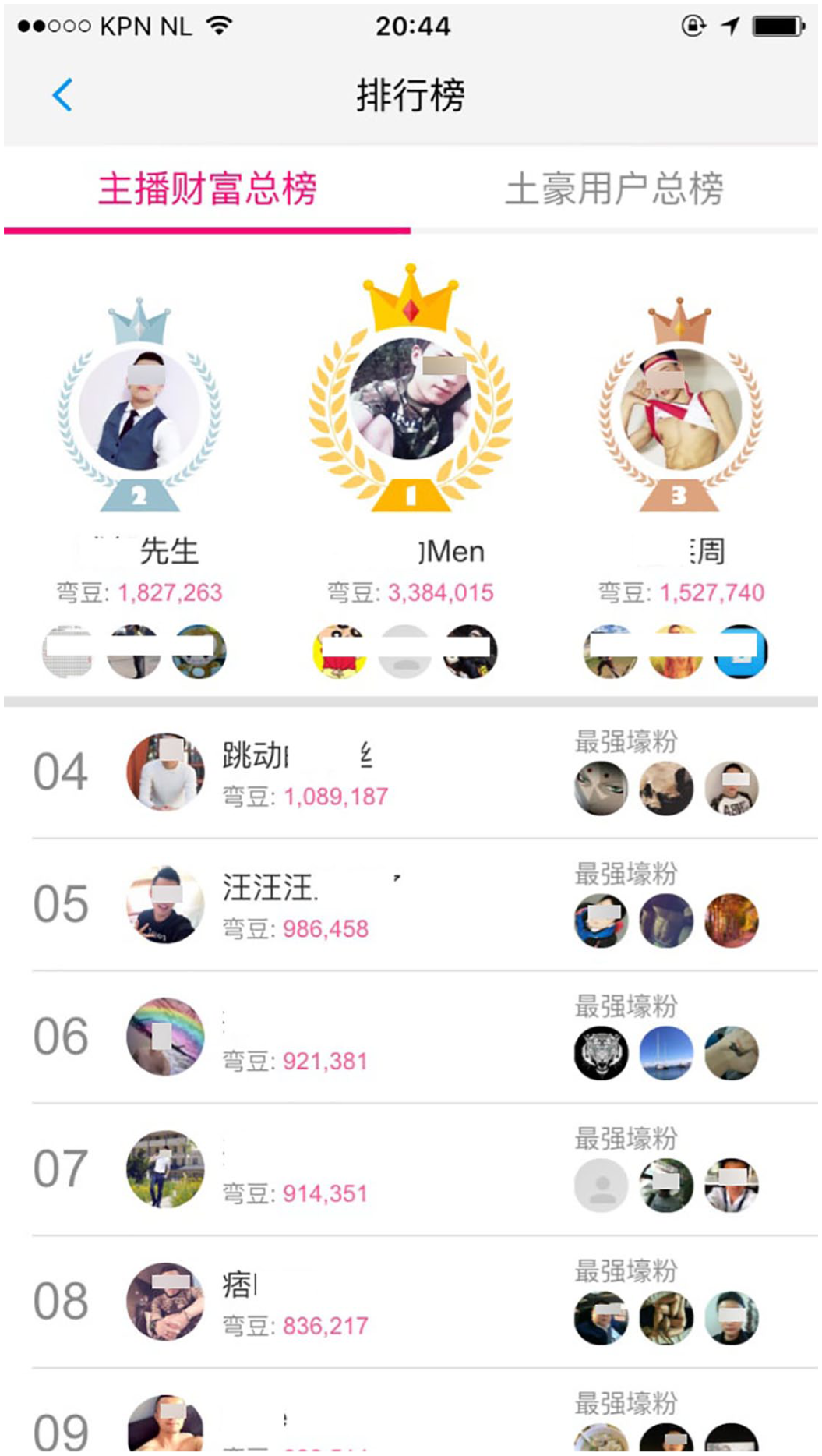
The highest paid Blued live streamers.
Hence, the number of followers not only measures popularity on Blued. Its associated incentive gift system also reconfigures the platform toward an ambiguous mixture of social networking and remunerated labor. On live streaming, then, economic motives and social are closely imbricated. As Huang goes on to explain, I had never thought of live streaming. I did not want to make my face public. But now, I’m bored. One of my friends suggested that I should stream on Blued. He said a live streamer he followed was able to make money by doing nothing but putting himself on camera. How peculiar! Out of curiosity, I started live streaming on Blued, hoping to find someone to talk to. (Huang, 27-year-old, hotel lobby manager, Shanghai)
The blurred boundary between work and leisure/play on digital platforms is nothing new. Past studies have argued that the Internet accumulates monetary capital using freely available content created by unpaid user labor (Fuchs and Sevignani, 2013; Scholz, 2013; Terranova, 2000). What is new in the current platform economy is that digital platforms are remediating existing forms of (sex) service work in technically novel and sophisticated ways (Van Doorn, 2017). Hence, for Blued live streamers, the trending chart has become a site for labor competition. As the chart updates every few hours, gay streamers are motivated to compete for a brief presence. A trending status can eventually turn into monetary gain, as illustrated in rankings that establish a hierarchy among streamers according to earning of virtual gifts. Under the ‘crown’ button at the top-left corner of the live interface, Blued publishes rankings (Figure 3) of the highest paid live streamers (top 50) and the highest spending viewers (top 50).
Although Blued allows for a diversity of gay live streamers, its categories of streamer are not valued as equally as might first appear. ‘Drag’ used to be a category juxtaposed with ‘new stars’, ‘muscles’, ‘bears’, and ‘groups’ in the live streamer catalog on the live menu bar. Subsequently, however, it has been discreetly removed, presumably because drag performers are not welcomed by a majority of users. In Cha’s words, Streamers have their own talents and selling pitch. For me, I specialize in cross-dressing. Probably because I am fat, whoever I intend to perform as, viewers think of me as Yang Guifei (a legendary voluptuous royal concubine from China’s Tang dynasty). So, my live streams have a distinct comic style. But they are not always appreciated. I often get verbally abused for masquerading as a woman on live streaming. (Cha, 25-year-old, costume stylist, Beijing)
Drag performers embody dual values in that they are both objects of pleasure and subjects of self-actualization (Wesling, 2012). Gay live streamers who are not gender/body conforming lean toward this type of performance both financially and subjectively. The consequences of removing ‘drag’ as a proper category are twofold. It renders a group of cross-dressing performers less visible in the trending chart. This limited visibility in turn deprives them of opportunities for social and financial gain. In discussing the case of DiDi, a Chinese ride-hailing app, Chen (2018) argues that algorithms (e.g. customer ratings and surge pricing based on the real-time ratio of supply and demand) play an essential role in labor valorization, particularly in determining the value of certain types of labor and skills. In a similar vein, by altering the classification system and thereby adjusting the trending algorithms, Blued devalues the performative labor of cross-dressing.
In the next section, I elaborate on how gay live streamers compete with each other for a trending status, how their performative labor is shaped by Blued’s trending metrics, and how sexually affective data are produced in this process.
Algorithm-driven performative labor and sexual-affective data
Algorithms have played an increasingly crucial managerial role with regard to labor distribution and competition in the platform economy (Chen, 2018; Rosenblat and Stark, 2016; Van Doorn, 2017; Van Doorn and Velthuis, 2018). The same also holds true for Blued. Algorithms that rank users on digital platforms serve as a technique of incentivizing participation. As studies on Uber and Chaturbate have found, the asymmetry of access to algorithmic information between a platform and its users creates uncertainties that stimulate user creativity for market innovation and value creation (Rosenblat and Stark, 2016; Van Doorn and Velthuis, 2018).
In the interviews, gay live streamers often speculate on the criteria of Blued’s trending algorithms. Assuming that the number of viewers/likes, streaming duration, and the gross value of gifts received are the most significant metrics, gay live streamers enhance these metrics using features afforded by Blued, such as asking viewers to share their live channels to other social media platforms, send gifts, and give free likes if they do not have beans in their accounts. As with other data-intensive real-time performance sites like Chaturbate, this algorithmically configured competitive environment shifts the burden of market competition onto gay streamers themselves (Van Doorn and Velthuis, 2018). Recognizing the pivotal role that these performance metrics play, my interviews indicate two major strategies for getting onto the trending chart (Figure 4).
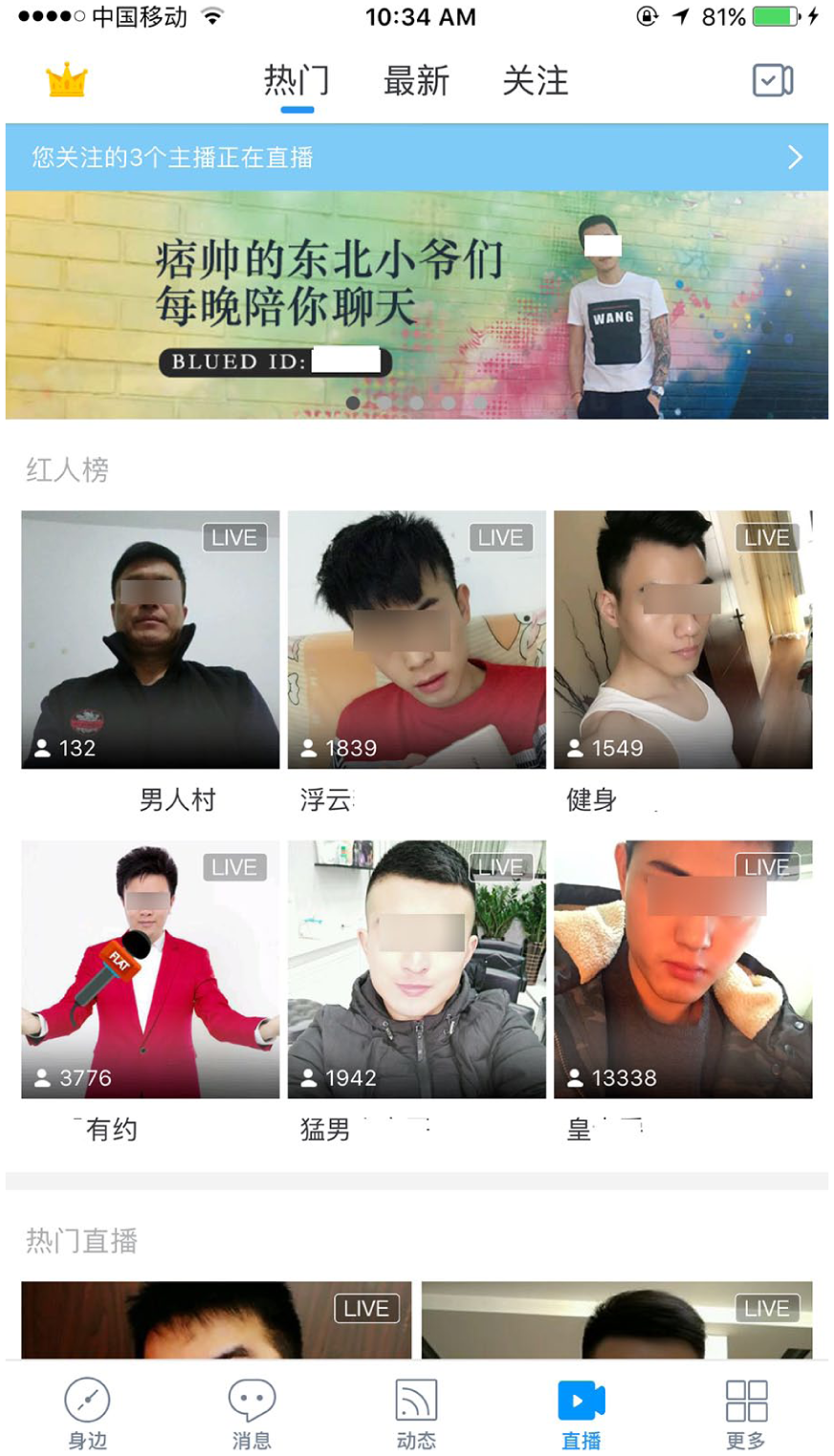
The trending chart of Blued live streaming.
The first focuses on the content of live streams. The viewer’s gaze often reduces gay live streamers to objects of erotic fascination. I encountered explicit sexual comments frequently throughout my fieldwork. For example, ‘Watching you makes me want to touch myself’ (4 March 2016), ‘It will be spicier if you’re naughty’ (6 March 2016), and ‘You’re getting hot. Must because lust burns you up’ (3 September 2016). Given the strict censorship prevents erotic displays from cyber performances (see China’s Ministry of Culture, 2016), these sexual fantasies often result from the connections that viewers make between what they see and how they feel. Gay live streamers therefore strategically present viewers with sexually implicit performances, with which they might construct a virtual sex fantasy. For example, When the atmosphere in my channel is dull, I’ll tantalize viewers to animate the show. The strategies I use differ each time. Sometimes I bare myself above waist, purposely exposing shoulders and chest. (Hu, 27-year-old, civil servant, Beijing)
As Blued live streaming becomes increasingly globalized, the platform also offers viewers racialized sexual fantasies. Take Adam’s experiences as an example: Sometimes I feel like they are not watching me because of me as a person, they are watching because I am a foreigner, an outsider. So, in a way, I feel sometimes reduced me to that stereotype – a foreigner. Sometimes I do get a bit annoyed with all the cock comments. People ask how big my dick is because of that stereotype. And people also love to ask what I like to do sexually, which gets a bit boring. (Adam, 35-year-old, journalist, Shanghai)
According to Adam, Blued intended to make him the first white live streamer on its domestic version, thus capitalizing on the stereotype that white men have big penises. Although Adam never intended to offer such content, the racialized sexual stereotype nonetheless favored him on Blued’s trending chart. Taken together, this reveals that implicit sexual content is essential in attracting viewers and building up a trending status. Like Instagram users’ narrations of their social/intimate lives in images, videos, and comments, these comments also double as ‘the production of data about individuals, their social networks, and cultural worlds’ (Carah and Angus, 2018: 179).
The second strategy involves ‘dishonest’ competition characterized by acts of deception. Interviewees Cha (25-year-old, costume stylist, Beijing) and Tao (21-year-old, waiter, Beijing) both say they have live streaming friends who either purchased robot followers or used gift-giving bait – the former refers to fake users, and the latter fake gift givers – to forge a trending status. Fabricating trending status in this way has real effects in that appearing on the chart can bring in real followers and gift givers. For example, Tao used to co-broadcast on Blued with a friend, but they ceased cooperating after his friend found an affluent boyfriend who bought him robot followers: His boyfriend is willing to lavish him with tons of gifts on live streaming. This generosity often invigorates the streaming atmosphere and stimulates other viewers to follow his lead. Although 80% of his followers were bought, I cannot deny that these fake followers accelerated his rise to fame. Now he is capable of attracting thousands of viewers when he streams. (Tao, 21-year-old, waiter, Beijing)
On the Chinese Internet, it is easy to find online forums that advertise shops selling robot Blued followers. Although this has drawn criticism from gay live streamers who lack economic resources, Blued does not intervene. After all, this skewed competition is to Blued’s advantage in that it facilitates the production of sexually affective data.
Overall, algorithm-driven performative labor has coupling effects on Blued’s data production as a whole. This is illustrated by Hu’s experience: Live streaming remakes Blued. Previously, users only logged in the app when they received a message or wanted to find a sex date. But live streaming makes users stick to the app. If I stream for two hours, my followers would very likely watch and stay for the same amount of time. Their stay has derived outcomes. For example, they will check my profile, comment, like and even share my posts. (Hu, 27-year-old, civil servant, Beijing)
By holding users on Blued for a longer time, live streaming increases activities of commenting, liking, and sharing. Moreover, as Geng Le says in my interview with him: ‘The changing mode of communication entertains viewers, a process in which a desire to pay (i.e. sending gifts) might be instigated’. These intertwined user activities are therefore conducive to Blued’s data production. In essence, these data are sexually affective because their productive forces are underpinned by gay live streamers’ sexual/intimate/emotional investments and viewers’ sexual/affective responses. As Hu (27-year-old, civil servant, Beijing) explains, ‘I have developed an intense attachment to live streaming. You feel like a group of people are desperate for your presence, and you need them as well’. Hence, although live streaming can be profitable in itself, it is the active data flows produced via live streaming that win investors. In Geng Le’s words, We do not count on live streaming for making money. It’s the overall activity and traffic that matter. Live streaming is only one of Blued’s functionalities. It needs to be evaluated by taking Blued as a whole rather than singling live streaming out as an isolated feature. (Zuo, 2016, media interview)
Since its launch, Blued has finished seven rounds of financing. These investments make Blued the most promising gay dating platform for market capitalization (The Beijing News, 2018). On many occasions, my interview included, Geng Le has spoken about how this financial assistance has been vital for Blued’s technological and market expansion. These venture investments prioritize growth centered on user data over profitability. This is especially pertinent given that Blued did not initiate monetization until it captured more than 90% of China’s gay dating market (The Beijing News, 2016). The platform economy is fueled by venture capital, which uses data performance to bet on a platform’s prospects of becoming a monopoly (Kenney and Zysman, 2016; Langley and Leyshon, 2017; Srnicek, 2017; van Dijck et al., 2018). For Blued, data production and capital accumulation are reciprocal: venture investments accelerate data production and data create capital value. Therefore, by facilitating activities of virtual gifting, liking, sharing, and commenting, gay live streamers work as much to animate Blued’s data production as to generate gift-converted profits.
To make this line of data production sustainable, Blued has begun institutionalizing its amateur labor force of gay live streamers through a scheme called Contracted Official Live Streamers (qianyue guanfang zhubo). The hiring process has also been outsourced to newly formed yet burgeoning live streamer agencies known as gonghui (literally ‘guild’). This attests to the institutionalization, professionalization, and datafication of performative labor.
The institutionalization, professionalization, and datafication of performative labor
By contracting official streamers and outsourcing hiring, Blued has streamlined streamer recruitment and management. This has resulted in three interrelated developments: the professionalization, institutionalization, and datafication of performative labor. First, Blued’s incentive gift system has reconfigured gay live streamers into a labor force that is semi-amateur and semi-professional. Second, the rise of mobile live streaming has been accompanied by an emerging form of organization, gonghui, which optimizes the live streamer labor chain. A gonghui functions as a virtual agency that trains ordinary users to become professional streamers. By ‘virtual’, I mean gonghuis do not necessarily have a physical, offline office; they more often operate online. Recruited from all over China, gonghui live streamers are trained and managed through online communications. Third, Blued has invented a classification system to catalog/label gay live streamers in a database. Consequently, the performative labor of streamers is reduced into datafied assets that can be organized and managed within Blued’s algorithmic structure (Rossiter, 2015; Van Doorn, 2017; Wang, 2018).
Blued has a work division specifically dedicated to recruiting gay live streamers. These Blued staff, known as ‘streamer handlers’ (zhubo jingjiren), target those who are capable of attracting viewers and gifts. They offer these gay live streamers an exclusive contract, coach them in skills of appealing to viewers, and label these contracted gay men as official streamers. In this way, live streamers are institutionalized and professionalized in the corporate domain. More specifically, the official live streamer scheme enables what was previously informal performative labor to be economically recognized and corporately organized. This is especially clear if we scrutinize their contracts. The contracts revealed by my interviewees specifically stipulate the minimum working hours per week (normally 10 hours), the minimum value of gifts received per week (varies individually), and the cut of the total gift value (subject to conditions). Blued has developed a tiered withdrawal model for gift value. The claimable share for contracted streamers starts from 50%. The size of this share increases each time their earned gift value reaches certain pre-set bonus limits. The maximum share for gay live streamers is 90%. The share to which non-contracted streamers are entitled, in contrast, is fixed at 35%, regardless of how many gifts they receive. This tiered payment system functions as yet another algorithmic structure that frames performative labor. That is, gay live streamers need more gifts and a contract if they want a higher share. Therefore, this algorithmic model of payment accelerates the institutionalization and professionalization of performative labor. More importantly, the contract is exclusive. If a gay streamer signs a contract with Blued, he is not allowed to live stream on any other platforms. Breaching this clause may result in a streamer being removed from Blued and even lawsuits.
Gonghuis have become another major player in Blued’s live streaming economies. These gonghuis were mostly established in association with Blued. They recruit live streamers in the name of ‘Blued ××Gonghui’. A gonghui badge will be displayed in the profiles of these streamers for identification and management. Similar to Blued handlers, gonghuis train gay live streamers to appeal to viewers and elicit virtual gifts. For example, Xian, one of my interviewees (20-year-old, salesman, Beijing) was under contract with Blued Shuizu Gonghui. According to Xian, his gonghui asked him to prepare for shows that could cheer viewers up and advised him to solicit gifts in an indirect but sweet manner. In his contract, there is even an article saying that he must ask for leave if he cannot stream for over 7 days. These training programs and contractual terms make gay live streaming resemble a professional job.
Contracted gay live streamers (both Blued and gonghui included) enjoy the privilege of inclusion in the trending chart and being recommended in the user interface. As such, Blued’s trending algorithms are neither completely automatic nor independent. Closely curating the trending placements, the interference of Blued handlers makes the algorithmic system, which is already biased (i.e. the removal of the ‘drag’ streamer category), even more unfair. This is particularly the case for those who refuse to sign contracts for fear of losing their independence. For contracted gay live streamers, the privileges come at the cost of handing some control over their performances to Blued and the gonghuis. That is, they are expected to live stream a certain duration and bring in certain values in gifts.
Alongside being institutionalization and professionalization, gay streamers have also been increasingly datafied as corporate assets through a classification system. As previously discussed, Blued live streamers have been cataloged into four major categories: ‘new stars’, ‘muscles’, ‘bears’, and ‘groups’. ‘New stars’ primarily promotes newly joined streamers, encouraging them by providing a featured space. ‘Muscles’ attract viewers who prefer gym-trained and muscle-bound bodies. ‘Bears’ denote gay men with a hefty body shape that embodies rugged masculinity. And ‘groups’ refer to live channels consisting of a number of live streamers with similar age, looks, talents, and even personalities. In a way, the data performance of gay live streamers (i.e. the numbers of likes and viewers they receive, streaming duration, and value of gifts) not only determines their position in the trending chart. It now also defines their identities in Blued’s classification system.
Another aspect to the datafication of gay live streamers is the practice of labeling. Popular gay live streamers have been frequently called nanshen (literally ‘male god’, as opposed to nüshen ‘goddess’) on Blued. The platform introduced the slogan ‘Face to face with nanshen on live streaming’. In newsfeeds, a hashtag topic # my nanshen face # was created to invite users to post selfies. By 6 March 2018, this ongoing activity had generated 57,402 views and 20,465 posts. In addition, the platform curated a nanshen list in which my interviewees Hu and Adam, along with some 167 other streamers, were officially labeled nanshen (observed 7 October 2017). Gay live streamers in this list will be recommended in users’ browsing interface with an alluring slogan, ‘Feast your eyes on selected nanshen’. This labeling practice not only affects data production in terms of soliciting participation but also turns platform-endorsed streamers into datafied corporate assets.
The classification system is still an ongoing project. New labels continue to be invented. Examples include xiao xianrou (literally ‘little fresh meat’, referring to youthful, smooth-skinned, and slim-figured gay live streamers) and wanghong (meaning Internet celebrity, much like social media influencers with large followings). As these tags/labels become a communicative medium for articulating queer feelings and desires on social media (Dame, 2015; Oakley, 2016), they produce specific sexual and emotional expectations. For example, in my chats with viewers, their affective responses of following, liking, and sending gifts tend to be framed and communicated through tags/labels such as ‘muscles’ and ‘little fresh meat’ created by Blued. In this way, Blued’s data structure begets sexual-affective data production, which further transforms gay streamers into datafied assets.
Conclusion
I have discussed the ways in which Blued is transforming users into performative laborers. By continually imbricating old and new functionalities, the platform folds both live streamers and viewers into its algorithmic structure (e.g. the trending charts and the highest paid/spending live streamers/viewers), transforming their activities into tradeable data flows. As such, Blued’s multiple affordances provide a site for both social networking and value creation. Gay live streamers play along with and even game Blued’s algorithms to attain a trending status. In this process, sexually affective data (whether in forms of virtual gifting, liking, commenting, or sharing) are produced, which Blued trades on both domestic and global capital markets.
Digital profile-based user data in dating apps, it has been argued, are of commercial value in terms of membership fees and advertisement (Albury et al., 2017). This article contributes to this strand of scholarship in two ways. First, economic incentives accelerate data production by extending its scope beyond what users would freely create. Second, real-time user activities on live streaming can be converted into data flows about users’ sexuality, desires, and affects, which can be traded on the capital market. Recognizing gay live streamers’ capacity to facilitate data production, Blued institutionalizes, professionalizes, and datafies their performative labor through three interlocking techniques: employment contracts, labor outsourcing, and labeling/cataloging. These developments in turn expand the scale of sexually affective data production for Blued.
Blued frequently updates itself. It reinvents itself much faster in comparison with its Western counterparts such as Jack’d and Grindr, whose functional features remain comparatively unchanged. Blued continues to imbricate old and new functionalities, for example, gaming, online shopping, and overseas surrogacy consulting are three newly integrated features. Although Blued itself is not a game developer, a number of game products embedded in the app require users to log in via Blued accounts. Likewise, its online shop is built with software development kits from other technological service providers. Blued, in other words, has been seeking economic growth and technological expansion through a set of application programming interfaces (APIs), software development kits (SDKs), and plug-ins, accelerating its process of platformization for multisided markets (Nieborg and Helmond, 2018). As this ongoing platformization expands Blued’s affordances, a new form of playful labor, which resembles game streamers on Twitch.tv (see Johnson and Woodcock, 2019), further fuels its data production. For example, the platform has now added a ‘gaming’ category in the live streamer catalog.
Blued has also been optimizing sexually affective data production within the parameters of its label system. In stark contrast to the young people who had initially dominated Blued live streaming, since the second half of 2018, there has been a sudden surge of middle-aged and senior gay men streaming on the platform. ‘Middle-aged’ and ‘senior’ have now become two labels that supplement the current gay live streamer database. It seems likely that more socially and culturally constructed labels will be invented. The removal of ‘drag’ category has demonstrated how unequal affordances shape the trending chart. Accordingly, the changing classification system requires further inquiry into how new labels interact with the old ones in the matrix of trending algorithms, for these are very likely to create new conditions of inequality.
Footnotes
Acknowledgements
The author would like to thank Jeroen de Kloet, Rachel Spronk, and Arjen Nauta for their helpful comments on earlier drafts of this article.
Funding
This project has been supported by a consolidator grant from the European Research Council (ERC-2013-CoG 616882-ChinaCreative).
