




Abstract
This study evaluated LLInC (Leerkracht–Leerling Interactie Coaching in Dutch, or Teacher Student Interaction Coaching), an intervention targeted at teachers’ mental representations to improve dyadic teacher–child relationship quality. Four teachers and eight children from Dutch elementary schools participated in this single case study. Teachers themselves selected two children with whom they experienced a difficult relationship. The results indicated that teachers’ global judgments of relationship quality improved from pretest to posttest for almost all teacher–child dyads. Day-to-day perceptions of conflict, closeness, and self-efficacy improved for a few teacher–child dyads, and especially for teacher-child dyads of the second targeted child. This implies that LLInC is especially helpful when carried out for at least two teacher-child dyads. The results of this study suggest that LLInC is promising, especially with regard to teachers’ global relationship perceptions. However, LLInC should be further evaluated using a larger, representative sample, especially with regard to day-to-day perceptions of relationship quality.
Keywords
Introduction
There is abundant evidence that positive teacher–child relationships contribute to children’s school adjustment, whereas negative teacher–child relationships harm children’s development (Roorda et al., 2017). A subgroup of children shares a long-term negative relationship with their teachers over multiple school years, resulting in poor school adjustment at the end of elementary school (Bosman et al., 2018; Spilt et al., 2012a). Therefore, it seems important to develop interventions that can break this cycle of negative relationships. Relationship-focused reflection by teachers may be effective in breaking these negative interaction patterns in dyadic teacher–child relationships (Pianta, 1999; Spilt et al., 2012b). Following parent–child interventions (Slade et al., 2005), stimulating teachers to reflect on specific experiences and events that occurred in interaction with an individual child may improve relationship quality. In the present study, a relationship-focused reflection program (Spilt et al., 2012b) was evaluated in eight teacher–child dyads using a case study design. This case study design offers a methodology for improving practices that benefit individuals (e.g., Sanetti et al., 2014), and with measurements both before and after an intervention, it is well suited to gain empirical information about intervention efficacy (Borckardt et al., 2008).
Teacher–Child Relationships from an Attachment Perspective
Consistent with parent–child attachment literature (Bowlby, 1969), it is believed that teachers form mental representational models (or internal working models) about relationships with individual children, including internalized affect and cognitions that guide actual behavior within the relationship (Pianta, 1999; Pianta et al., 2003). Teachers are believed to construct these models based on experiences gained in earlier attachment relationships, resulting in representational models that influence social interactions in various domains (Pianta et al., 2003; Spilt et al., 2011). More specifically, mental representations can be relationship-specific, indicating that a teacher develops feelings, beliefs, and expectations that contain information about the teacher’s views of a specific child, and a view about themselves in interaction with that child (Pianta et al., 2003). These relationship-specific mental representations can be highly stable over time as feelings and beliefs about interacting with children may reinforce themselves over time. As such, teachers may be inclined to focus on behavior that is similar to the beliefs they already have (Pianta, 1999). For instance, when a teacher perceives that interactions with a child are predominantly negative, he or she will be more focused on negative (behavioral) aspects of the child, instead of having a more open mindset about the child. In this way, teachers’ mental representations can function as a self-fulfilling prophecy.
Relationship-specific mental representational models of relationships include the formation and quality of affective teacher–child relationships as well as teachers’ self-efficacy beliefs through teachers’ daily interactions with individual children (Pianta, 1999; Pianta et al., 2003). Researchers usually qualify relationship-specific mental representations of relationships using two attachment-based, affective dimensions: Closeness and conflict (Spilt et al., 2011). Representational models that are mostly negative are generally marked by high levels of conflict, and low levels of closeness (Spilt et al., 2011; Verschueren & Koomen, 2012). Conflict refers to negativity, anger, and discordance in the relationship, whereas closeness refers to warmth, trust, and open communication between a teacher and a child. In addition, self-efficacy beliefs are seen as part of representational models that guide relationships with individual children (e.g., Grusec et al., 1994). Using a cognitive-behavioral approach, teachers’ student specific self-efficacy refers to beliefs about their own ability to organize and execute daily teaching activities in relation to a specific child (Bandura, 1997; Tschannen-Moran & Woolfolk Hoy, 2001; Zee et al., 2016a). Teachers’ self-efficacy beliefs are important for various domains of teachers’ abilities to continuously motivate, manage, and emotionally support a specific child (Tschannen-Moran & Woolfolk Hoy, 2001; Zee et al., 2016a). In what follows, when teacher–child relationship quality is discussed, this includes both affective components (i.e., teacher–child conflict and closeness) and cognitive-behavioral components (i.e., teachers’ self-efficacy beliefs).
Reflective Functioning
Pianta (1999) argued that a way of improving teacher–child relationships is to change inflexible or constrained mental representations of relationships into more flexible and differentiated mental representations. When teachers have a flexible mental representation of their relationship, they have both positive and negative emotions about the child instead of only a global, negative characterization. Furthermore, flexible mental representational models include self-efficacy beliefs regarding the teacher’s ability to influence the relationship with a child instead of blaming negative relationships entirely on the behavior of the child. Taken together, these changes may lead to a mental representational model of teachers that is more open to new information about interactions, more integrative and balanced, and more responsive to the child (Pianta, 1999). Therefore, Pianta (1999) argued that interventions should start at the representational level rather than at the level of teachers’ behavior.
Pianta (1999) argued that reflecting on actual feelings, beliefs, and experiences may lead to more flexibility in representational models. From parent–child attachment research, it has been argued that when mothers think about and reflect on their behaviors toward the child, that may be a first step to change their actual parenting behavior (Slade et al., 2005). Reflection, or reflective functioning, refers to the caregiver’s capacity to understand the nature and function of their own mental states, as well as the mental states of the child (Fonagy et al., 1991). Fonagy et al. (1991) hypothesized that a caregiver who can think about the relationships in terms of mental processes and functions, will be more likely to understand the child’s behavior, needs, and their interactions. In contrast, a caregiver with a limited reflective ability may fail to understand that their own behavior contributes to interpersonal stressors. From empirical research, there is evidence that reflective functioning plays an important role in the intergenerational transmission of attachment (Slade et al., 2005; van IJzendoorn, 1995). Recently, it was found that reflective functioning mediated the association between mental representations of caregiving and maternal sensitivity (Alvarez-Monjaras et al., 2019). Based on theoretical ideas and empirical research, we believed that teachers’ relationships with individual children could improve when teachers start to reflect on mental representations of these relationships.
A first step in this process is to uncover and reflect on all conscious and unconscious aspects of the teacher’s representational model of the relationship with an individual child (Main et al., 1985). In parent–child attachment research, interview techniques are most commonly used to assess mental representational models of relationships (Bretherton, 1990). These interviews often include questions that refer directly to descriptions of actual experiences of interactions with the child, because the parent’s affective experiences of the child and the modulation of this experience are related to the specific feelings and beliefs of the parent (Slade et al., 1999). Uncovering teachers’ mental representations through narratives in the context of a semi-structured interview is a first step in improving relationships, as it may facilitate teachers’ reflection (Pianta, 1999). A second step is to focus on teachers’ narratives to observe certain patterns in their representational models. Pianta (1999) proposes that a consultant or coach is necessary to help summarize the mental representation of the relationship in more general terms using scientific theory. The consultant can provide a new framework for understanding the child and the interaction with the child. When discussing this summary of the representational model with the teacher, the teachers’ reflective process may be further activated (Pianta, 1999). More specifically, when teachers fully understand the child’s behavior and how they act in relationship to the child, they may be more willing and able to change their behavior.
LLInC
Based on Pianta’s framework and parent–child research, Spilt et al. (2012b) developed the teacher-based coaching intervention: LLInC (Leerkracht–Leerling Interactie Coaching in Dutch, or Teacher Student Interaction Coaching). LLInC was previously referred to as the Relationship-Focused Reflection Program (Spilt et al., 2012b). LLInC stimulates the teacher to reflect on the relationship with one individual child during two sessions, followed by exactly the same procedure for another child from the classroom. The primary goal of LLInC is to help teachers think about and reflect on their relationship with two children. For an overview of the LLInC intervention, see also Bosman et al. (2021) and Spilt et al., (2012b).
To date, two studies evaluated the effectiveness of LLInC. Spilt et al. (2012b) compared teacher–child relationship quality in a group of kindergarten teachers receiving LLInC and a control group of kindergarten teachers receiving a behavioral intervention. For each teacher, researchers randomly selected two children with relatively high levels of disruptive behavior from the teachers’ classroom to be subject of the intervention. They found that teachers receiving LLInC displayed increased levels of observed sensitive behavior whereas teachers in the control group did not. Teachers with a low level of closeness prior to receiving LLInC reported increases in self-reported closeness in the relationship. Few teachers also reported a decrease in closeness after LLInC. In addition, a subset of the teachers with high self-efficacy reported decreases in teacher–child conflict, whereas teachers with low self-efficacy did not. Overall, these results suggest that LLInC was effective in changing teachers’ sensitive behaviors; however, only a subset of the teachers had increases in closeness or decreases in conflict in the relationship (Spilt et al., 2012b).
More recently, Bosman et al. (2021) evaluated whether LLInC led to improvements in teachers’ relationships with elementary school children, compared to teachers receiving no intervention. Teachers selected four children from their classroom with whom they experienced a difficult relationship. Two of these selected children were randomly chosen to be included in the LLInC intervention. Teachers receiving LLInC reported short-term improvements in closeness and self-efficacy beliefs for emotional support and decreases in conflict, compared to teachers in a control group receiving no intervention. Furthermore, short-term and longer-term improvements were found with regard to teachers’ student-specific self-efficacy beliefs for behavior management, also in comparison with control teachers.
Instead of using a pretest-posttest design, as is common in intervention research, the present study included day-to-day measurements of teachers’ relationship perceptions. By using daily measurements, it becomes clear if and when changes in relationships take place. Daily measurements also give insight in the day-to-day experiences of relationships of a teacher rather than, compared to a posttest after the intervention, focusing on a global level of relationship quality based on a longer time period. Attachment theory originally suggested that people with different mental representational models hold different views about interpersonal experiences and relationships (Bowlby, 1969; Bretherton, 1990) as these models are thought to guide how one interprets, perceives and responds to social interaction. However, there is not much information about how these mental representations contribute to teachers’ perceptions of day-to-day relationship experiences. Pietromonaco and Feldman Barrett (1997) used diary methods to investigate if day-to-day experiences were related to mental representations of attachment. They concluded that mental representations of relationships are related to how people perceive their everyday social interactions; however, they also found that these daily perceptions of relationship experiences were not completely related to retrospective perceptions of relationships. These different patterns imply that memory also plays a role in attachment-related perceptions (Pietromonaco & Feldman Barrett, 1997). Thus, these daily perceptions of relationship experiences may give additional information about mental representations. Therefore, we investigated how daily perceptions of relationship experiences changed under influence of LLInC as well as whether a global judgment of relationship quality changed from pretest to posttest.
Present Study
In this multiple case study we aimed to further evaluate LLInC as a way of improving teachers’ relationships with individual children. This study differed in several specific features from previous research. First, we allowed teachers to select two children for the intervention based on the degree of relationship difficulties they experienced, instead of selecting children based on the degree of disruptive behavior (Spilt et al., 2012b). Although disruptive behavior is an important risk factor for developing negative teacher–child relationships (Nurmi, 2012), this does not automatically mean that teachers also experience relational difficulties with disruptive children. Second, we used both general judgments of relationship quality and daily perceptions of relationship quality to assess changes in teachers’ perceptions.
In sum, the present study examined (1) the effects of LLInC on teachers’ day-to-day experiences of relationships, including the affective components conflict and closeness, and the cognitive-behavioral component self-efficacy, and (2) the effects of LLInC on teachers’ global perceptions of teacher–child relationships. We hypothesized that teachers’ perceptions of daily conflict decreased under influence of LLInC, and that perceptions of daily closeness and self-efficacy increased after LLInC. We further expected that teachers’ global judgment of relationship quality improved by LLInC.
Method
Selection and Participants
Teachers were asked to participate in the present study via social media. Inclusion criteria were that teachers had to teach the same class for at least two days per week and that they experienced difficulties in the relationship with at least two children in their classroom. Prior to selecting teachers for the current study, the principal researcher conducted a short interview by phone with teachers who applied. During this interview, the researcher established whether the teacher experienced difficulties in the relationship or interaction with at least two children in the classroom. Experiencing difficulties could entail various problems, such as interactions characterized by conflict and a lack of positivity, or not knowing how to deal with the child’s emotions. As is common in single-subject designs, intervention effects can be established when multiple participants are included. By including at least three participants, this provides more confidence in intervention effects through replications of effects (Kazdin, 2011). We selected four teachers, in case one of the teachers dropped out. Selection of participants stopped when four teachers met the inclusion criteria (i.e., eight different teacher–child dyads).
Information about the four participating teachers can be found in Table S1. Three teachers were female, and all teachers had a Dutch ethnic background. The teachers had various years of teaching experience, were teaching in different grades, and worked in various school types in the Netherlands. Each teacher nominated two children from their classroom, resulting in a sample of eight children. All children had a Dutch background (i.e., both parents were born in the Netherlands). In addition, half of the children were diagnosed by a psychiatrist or clinical psychologist (Table S2), of which an Autism Spectrum Disorder was the most prevalent disorder (n = 4). Furthermore, teachers reported on children’s behaviors using the Dutch Version of the Strengths and Difficulties Questionnaire (SDQ; Van Widenfelt et al., 2003). Four subscales were included: Hyperactivity/Inattention, Conduct Problems, Emotional Symptoms, and Prosocial Behavior. All subscales consisted of 5 items, answered on a 5-point Likert scale ranging from 1 (definitely does not apply) to 5 (definitely applies). From a different study with a larger, random sample of children in Dutch classrooms (N = 526; Zee et al., 2016b), mean scores and standard deviations were used to assess whether children’s behavior in the current sample were considered problematic. Table S2 showed that the children in the current sample all had problematic behaviors on one or more of the subscales; however, there was large variation in the types and degree of problematic behaviors.
The first teacher, Margret 1 , selected two boys from her classroom: Tony and Scott. She selected Tony because she found it was difficult to communicate in a friendly way with him. She experienced that interactions were mostly negative. Margret thought that Tony does not like her as a teacher. Margret selected Scott because she thought their relationship was shallow and she had difficulties in understanding his emotions. Margret also found it difficult to talk with him in a positive way, because Scott seems unhappy during the day. She found it difficult to stimulate Scott on working together with others.
The second teacher, Anne, selected a boy and a girl from her classroom: Seth and Nadia. She selected Seth because she thought it was difficult to understand his emotions and views, leading to multiple misunderstanding in their interactions during the day. Anne thought she needs to care more for Seth to prevent these misunderstandings. She selected Nadia because she feels irritated about how to correct Nadia’s impulsive behaviors many times during the day. She also felt hesitant about how to interact with Nadia in a positive way, since most behaviors were negative.
The third teacher, Femke, selected a boy and a girl from her classroom: Daniel and Sara. She selected Daniel because she thought their relationship was predominantly negative. She thought that because of his problematic behavior, she is unable to share positive or warm interactions. Femke selected Sara because she thought it was difficult to sense Sara’s changing moods and adjust her responses to these moods. During these changing moods, most interactions were characterized by conflict and emotional outbursts. Femke thought this resulted in overly dependent behavior of Sara towards Femke.
The fourth teacher, John, selected two boys from his classroom: Ralph and Ingmar. He selected Ralph because he felt irritated about interacting with him and does not understand what is going on in Ralph’s mind. John described their relationship as shallow, and had difficulties stimulating Ralph’s on-task behavior. John’s main reason for selecting Ingmar was that he thought their relationship was distant. John felt guilty about their distant relationship, and thought he was not spending enough time with Ingmar.
Study Design
For the daily perceptions, we used a non-randomized multiple-baseline design and for the global judgments of relationship quality, we used a pretest and posttest design (see Figure S1).
Multiple-baseline Design
We used a non-randomized multiple-baseline design with a follow-up phase to evaluate effects of LLInC on relationship quality in dyadic teacher–child relationships. Multiple-baseline phases were used to evaluate whether change was a result of the implementation of the intervention and not of monitoring daily perceptions (Hawkins et al., 2007). Teachers filled in online daily questionnaires about their interactions with the two selected children from their classroom. Because the intervention about the relationships with the two selected children started at different times (i.e., two sessions about the first selected child, and after that, two sessions about the second selected child), the baseline and follow-up phases for the first four teacher–child dyads differed from the second four teacher–child dyads. More specifically, the first four teacher–child dyads were assigned to predetermined baseline lengths of 7, 8, 9, and 10 measurements, which we based on practical reasons such as the workdays of the teachers. Due to scheduling issues, the last teacher eventually had 12 baseline measurements. After this baseline period, the intervention about the first four teacher–child dyads started, consisting of two sessions of LLInC over two consecutive weeks. As a result, the second four teacher–child dyads had baseline lengths of 15, 16, 17, and 20 measurements. Following this baseline phase, the teachers had the two sessions of LLInC about the second selected child. Daily measurements continued until each teacher–child dyad had at least 14 measurements in the follow-up phase.
Pretest-Posttest Design
Prior to starting the baseline, teachers completed questionnaires gathering background information about themselves and the selected children. They also provided information about their global perception of the relationship quality with the two selected children (i.e., pretest). Two weeks after the intervention ended, teachers filled out the same questionnaire (i.e., posttest). Because self-reports in intervention research can be confounded by what is called the response shift bias (e.g., bias as a result of changes in participants’ understanding or standard of measurement; Howard & Dailey, 1979), we added a questionnaire when teachers completed the posttest. This questionnaire, the then-test, consisted of the same questions as the pretest and posttest; however, participants were asked about how they perceived the relationship quality to be prior to the start of the intervention. The posttest and then-test were administered at the same time to increase the likelihood that ratings were made from the same perspective.
Procedure
This study was conducted from February to May. Teachers and students knew each other for at least several months at the start of data collection. Ethical approval was granted from the Ethical Committee of the University of Amsterdam. Teachers and all parents of children gave their informed consent for their participation. When all participants agreed to participate in the study, a schedule was made to ensure sufficient baseline periods and to plan LLInC sessions. The two selected children were randomly assigned as first or second child of LLInC. Teachers received LLInC from a consultant with a master’s in educational psychology. The consultant was extensively trained and licensed to give LLInC to teachers. The training consisted of four sessions in which the consultant practiced and received feedback from the developers of LLInC. The consultant practiced giving the interview to a teacher and audio recorded it. Afterwards, a developer of LLInC gave feedback on this interview. Furthermore, the consultant was shown good en bad practices of LLInC and practiced with asking questions that stimulated reflection in teachers. Daily questionnaires were administered using Qualtrics. Teachers received a daily reminder via email from the researchers at the end of each school day to fill in the daily questionnaire about their relationships with the two selected children. The pre-test, post-test, and then-test were administered on paper during a visit from the researcher. Teachers received a gift card of 20 Euros after participating in the study.
Relationship-Focused Reflection Program
The goal of LLInC (see also Bosman et al., 2021; Spilt et al., 2012b) is to help teachers think about and reflect on different aspects of their relationship with an individual child. LLInC consists of four sessions, lasting approximately 45 min per session. The first two sessions are about the first selected child, the third and fourth session are about the second selected child.
During the first session (first child) and the third session (second child), a semi-structured interview (Teacher Relationship Interview, TRI; Pianta, 1999; Spilt & Koomen, 2009) about the teacher–child relationship takes place. The interview consists of 12 questions and teachers are asked about recent specific situations and related experiences and feelings they have in interaction with the individual child. The TRI gives insight in 4 different constructs on how a teacher interacts with the child, including the more cognitive-behavioral aspects of the relationship (i.e., sensitivity of discipline, secure base, perspective taking, and intentionality), and four different constructs about the teacher’s affective feelings about interacting with the child (i.e., feelings of helplessness, negative affect, positive affect and neutralizing of negative affect; see also Spilt & Koomen, 2009). After the interview, all constructs are coded by the consultant on a 7-point Likert scale. These constructs are then depicted in a relationship profile that represents both strengths and weaknesses of the four constructs on pedagogical practices and the four constructs of teachers’ affect regarding the child.
During the second session (first child) and fourth session (second child), the teacher and consultant talk extensively about this relationship profile. For each construct, the consultant explains why she gave that particular score by giving examples of the teacher’s experiences that were derived from the interview. After each explanation, the teacher asks questions for clarification or simply reacts on the consultant’s interpretation of the constructs. After discussing the eight constructs separately, the consultant encourages reflection by asking questions specifically based on the relationship profile, for instance: “Do you recognize yourself in this relationship profile?”, and “Do you see relations between the four aspects of pedagogical practices and the four aspects of feelings about the child?”. The consultant also gives the teacher the opportunity to reflect on possible changes of the different constructs, for example: “Do you want to change certain aspects in your interactions or feelings regarding this child?”, “When you teach tomorrow, what aspects do you want to be different?”, and “What will this change bring you and the child?”. During this session, the consultant encourages the teacher to make notes.
Finally, at the end of the fourth session, the consultant asks the teacher to compare the relationship profiles of both children. The consultant asks the teacher to explain similarities and differences between the profiles. In this way, the teacher gets a more general view of herself as a teacher and learns about the aspects that are different for the relationships with the two selected children.
Measurements
Daily Measurements
Teachers’ perceptions of Closeness, Conflict, and Self-Efficacy with individual children were included as daily measurements. Teachers received an online questionnaire for each selected child at the end of each school day to report about their experiences of that particular day. One item per construct was selected from well-validated questionnaires and was adapted slightly for the purpose of receiving information about that particular day. The items for Closeness and Conflict were inspired on the Dutch version of the Student-Teacher Relationship Scale (STRS; Koomen et al., 2012). The item for Closeness was “Today, I felt that I was really available for [name child]”, and for Conflict was “Today, I felt angry with [name child]”. The item regarding Self-Efficacy was based on the Student Engagement scale of the Student-Specific Teacher Self-Efficacy Scale (Zee et al., 2016a). This item was “Today, I was successful in motivating [name child] for schoolwork”. All items were answered on a 5-point Likert scale ranging from 1 (Definitely does not apply) to 5 (Definitely does apply). Selected items correlated highly with the original subscales in prior research (r > .77; Koomen et al., 2012; Bosman et al., 2021).
Pretest, Posttest, and Thentest
The pre-, post- and then-test consisted of 6 items comprising closeness, conflict, self-efficacy and general conceptions of relationship quality (see Table S3). The items were based on questions of the STRS. Items with a high factor loading on the construct of interest were selected, based on previous factor analysis of the STRS (Koomen et al., 2012). For the then-test, we placed the following sentence before each item: “In the weeks prior to LLInC, how did you feel about the following”. All items were answered on a 5-point Likert scale ranging from 1 (Definitely does not apply) to 5 (Definitely does apply). All items together gave an indication of teachers’ global judgement of relationship quality with an individual child, with high ratings indicating an overall positive relationship perception. Cronbach’s alphas were .82, .91, and .72 for the pre-test, post-test, and then-test, respectively, indicating adequate internal consistency. These alphas are consistent to those found for the STRS (Koomen et al., 2012).
Data Analysis
Daily Measurements
For analyzing single-case data, researchers suggest that it is important to include both visual and quantitative analyses, which complements criteria regarding practical importance of changing behaviors (Manolov et al., 2016). We first examined the data using the most important aspects of visual analysis to explore the presence of an effect (Brossart et al., 2014). A systematic analysis of variability, trend and level within and between baseline and follow-up phase was performed (Lane & Gast, 2014). We considered a mean and median level change larger than 0.5 on the Likert-scale sufficient to conclude that a meaningful change took place (i.e., standard deviations of 0.5 are common in 5-point Likert scales on relationship quality; Bosman et al., 2018). We did not conduct analysis about the immediacy of effect as it was not expected that an immediate effect took place after the introduction of the intervention.
Furthermore, the calculation of Tau or Tau-U was used to support the visual analysis (Parker et al., 2011). This method is based on the principles of non-overlapping data across phases and is one of the most robust methods for analyzing trend data. TAU-U also controls for trend in the baseline phase (Parker et al., 2011). When baseline trend values were higher than 0.3, indicating a problematic trend, the TAU-U trend correction was applied (Parker et al., 2011; Vannest and Ninci, 2015). The TAU(U) effect size can be interpreted as follows: A TAU statistic of 0.20 is considered small, 0.21 to 0.60 as moderate, 0.61 to 0.80 as large, and above 0.81 as large to very large (Vannest & Ninci, 2015). We analyzed TAU or TAU-U for data of each of the daily measures (e.g., Conflict, Closeness, Self-Efficacy).
After analyzing each outcome for the three constructs of relationship quality separately, a weighted average effect size was calculated for the combined effect sizes for Conflict, Closeness, and Self-Efficacy about the first teacher–child dyads (n = 4) and the combined effect sizes of these measures about the second child (n = 4). In this way, it was examined which construct changed most after LLInC. In addition, a weighted effect size was calculated over the three daily measures for each teacher–child dyad (n = 8). In this way, the overall change in daily interaction per teacher–child dyad could be determined. The weighted effect sizes were calculated by using the inverse of the variance to obtain an omnibus effect size. We consider p-values below .05 as significant and p-values below .10 as borderline significant considering the relatively small amount of daily measurements (Parker et al., 2011).
Pretest-Posttest Measurements
Reliable Change Indices (RCIs) were used to assess reliable and clinically significant change in teachers’ questionnaire scores on pretest, posttest, and then-test (Jacobson & Truax, 1991). RCIs were calculated by dividing the difference between pre- and posttest scores by the standard error of the measurement. An RCI larger than 1.96 indicated a reliable positive change, an RCI smaller than −1.96 a reliable negative change (Jacobson & Truax, 1991).
Results
Day-To-Day Experiences
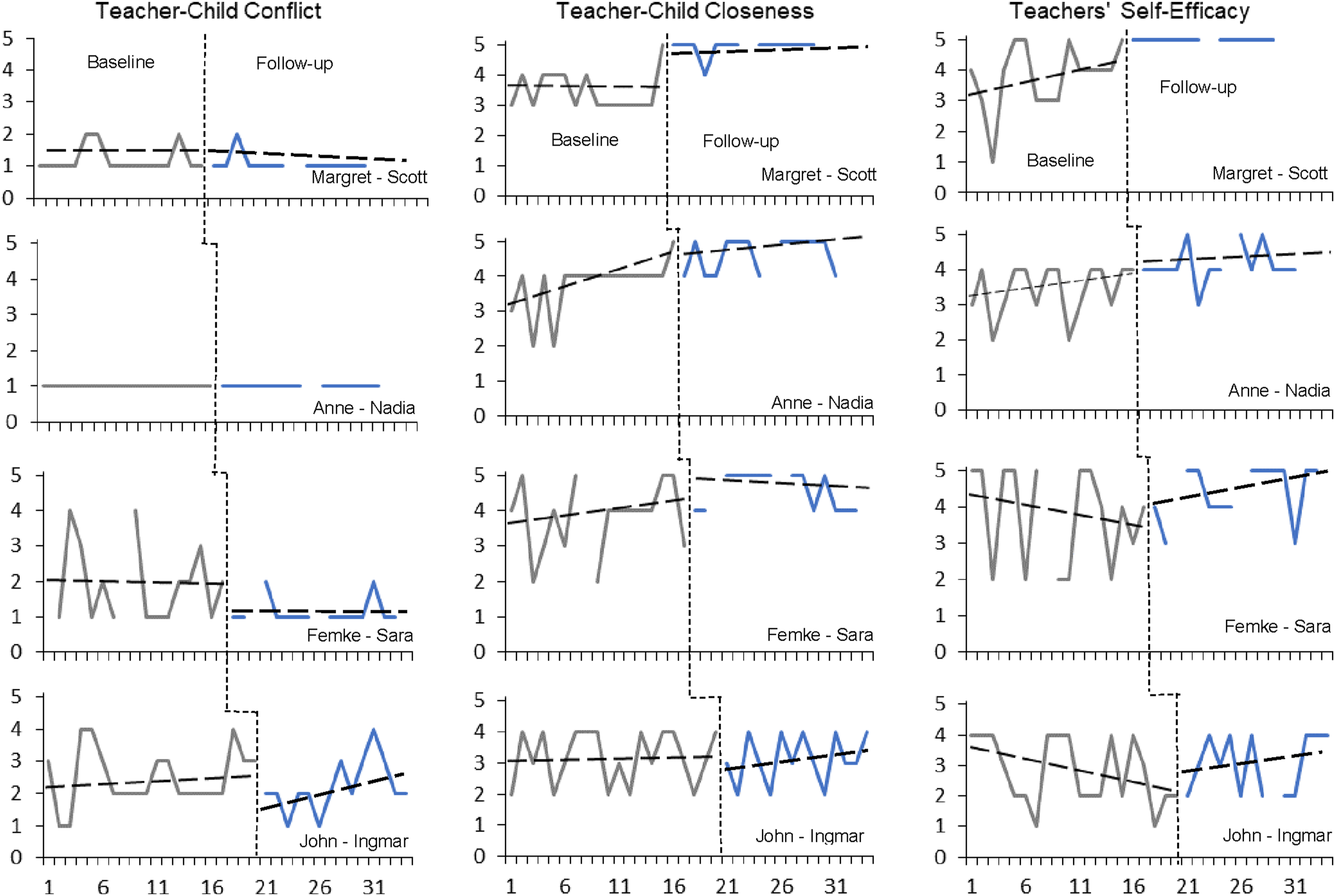
Missing data ranged from one day to three days for each participant. The reason for those missing data was that children were ill these particular days. Missing data were not replaced as this could result in distorted visual analyses. Data on Conflict, Closeness, and Self-Efficacy in teacher–child relationships on each day and the trend over time are depicted in Figures 1 and 2. Daily Data on Teacher–Child Conflict, Closeness, and Teachers’ Self-Efficacy for Every First Teacher-Child Dyad. Dashed Lines = Trend Line. Data on Each X-as Represent the Days, and The Y-as Represents the Degree of Conflict, Closeness, and Teacher’s Self-Efficacy Daily Data on Teacher–Child Conflict, Closeness, and Teachers’ Self-Efficacy for Every Second Teacher-Child Dyad. Dashed Lines = Trend Line. Data on Each X-as Represent the Days, and The Y-as Represents the Degree of Conflict, Closeness, and Teacher’s Self-Efficacy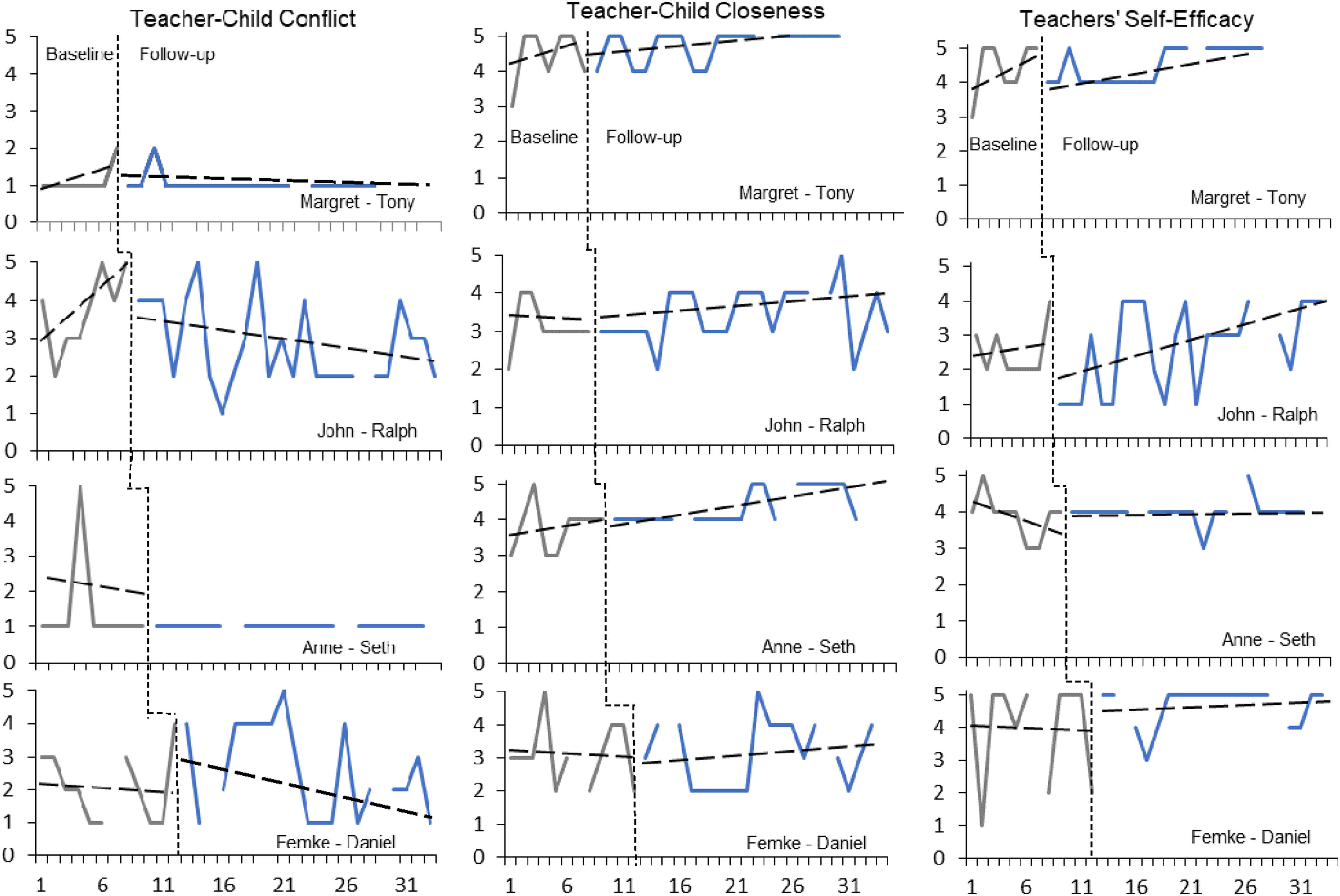
Conflict
To start, four teacher–child dyads (Margret–Tony, Margret–Scott, Anne–Seth, and Anne–Nadia) did not show Conflict in their relationship during the baseline phase and the follow-up phase. Therefore, no change could be expected for these teacher–child dyads and no analyses were done. Trend analysis (as shown by trend lines in Figures 1 and 2) indicated that Conflict decreased in the intervention period for the dyads John–Ralph and Femke–Daniel. There was a stable trend of Conflict in the relationship of Femke and Sara, and a slight rise in conflict during the follow-up phase for John and Ingmar. Visual analysis further revealed that two out of the eight teacher–child dyads had a decrease in the level of Conflict from baseline to follow-up phase (John–Ralph: ΔM = −0.95, ΔMdn = −2; Femke–Sara: ΔM = −0.74, ΔMdn = −1). However, there was also variability between phases, as there is overlap in the level of conflict in the baseline and follow-up phase.
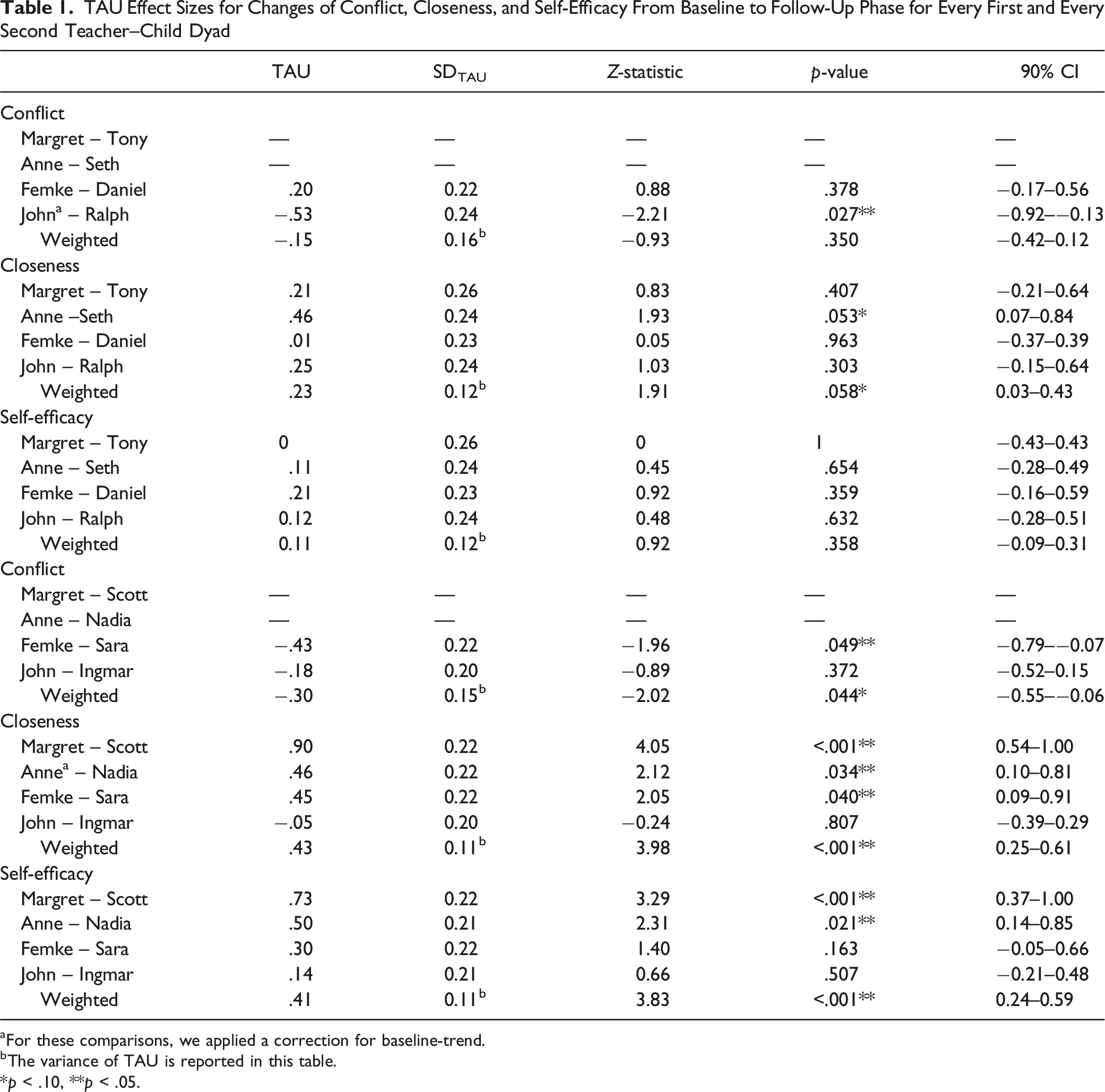
TAU Effect Sizes for Changes of Conflict, Closeness, and Self-Efficacy From Baseline to Follow-Up Phase for Every First and Every Second Teacher–Child Dyad
aFor these comparisons, we applied a correction for baseline-trend.
bThe variance of TAU is reported in this table.
*p < .10, **p < .05.
Closeness
Trend analysis revealed that for all dyads, except for Femke–Sara, the level of Closeness increased during the follow-up phase. Furthermore, visual analysis revealed that four out of the eight teacher–child dyads had an increase in the level of Closeness from baseline to follow-up (Anne–Seth: ΔM = +0.57, ΔMdn = 0; Margret–Scott: ΔM = +1.45, ΔMdn = +2; Anne–Nadia: ΔM = +0.89, ΔMdn = +1; Femke–Sara: ΔM = +0.76, ΔMdn = +1). However, effect sizes are considered small since there was overlap between data points in the baseline and follow-up phase.
For the TAU-analysis, we controlled for the baseline trend in one of the teacher–child dyads (Table 1). Statistical analysis showed increases in Closeness for the same teacher–child dyads (Anne–Seth: TAU = 0.46, p = .053; Margret–Scott: TAU = 0.90, p < .001; Anne–Nadia: TAU-U = 0.46, p = .034; Femke–Sara: TAU = 0.45, p = .040). These effects can be interpreted as moderate to large. For all first teacher–child dyads together the analysis revealed a small, marginally significant increase in Closeness (TAU = 0.23, p = .056). For all second teacher–child dyads together, a significant moderate increase in Closeness was found (TAU = 0.43, p < .001).
Self-Efficacy
Trend analysis revealed that 5 out of 8 dyads showed an increasing trend line during the follow-up period. Furthermore, visual analysis revealed that seven out of eight teacher–child dyads had an increase in feelings of Self-Efficacy at follow-up (Margret–Tony: ΔM = +0.07, ΔMdn = +0.5; John–Ralph: ΔM = +0.17, ΔMdn = +1; Femke–Daniel: ΔM = +0.68, ΔMdn = 0; Margret–Scott: ΔM = +1.20, ΔMdn = + 1; Anne–Nadia: ΔM = +0.70, ΔMdn = 0; Femke–Sara: ΔM = +0.68, ΔMdn = +1; John–Ingmar: ΔM = +0.28, ΔMdn = +0.5). Again, effect sizes are considered small because of the variability between baseline and follow-up phase.
However, based on statistical analyses, only two teacher–child dyads had a significant improvement of Self-Efficacy (Margret–Scott: TAU = 0.73, p < .001; Anne–Nadia: TAU = 0.50, p = .021). These increases in Self-Efficacy can be considered large for Margret–Scott and moderate for Anne–Nadia. The weighted overall TAU for all first teacher–child dyads was not significant, whereas over all second teacher-child dyads, a significant moderate increase in teachers’ feelings of Self-Efficacy was found (TAU = 0.41, p < .001).
Overall Change Per Dyad
When interpreting both visual and statistical analyses, it is suggested that the strongest effects of LLInC were found for teacher–child Closeness, and mixed effects were found for teacher–child Conflict and Self-Efficacy. However, we still do not know how each teacher–child dyad improved from baseline to follow-up when all constructs are added together. Therefore, we computed the weighted TAU for data series of Conflict, Closeness, and Self-Efficacy for each teacher–child dyad. For this analysis, all measurements of daily Conflict were recoded. Consequently, a higher score on the weighted TAU measure represents better relationship quality. We found that 4 out of 8 dyads significantly improved under influence of LLInC. We found moderate increases in relationship quality for Margret–Scott (TAU = 0.58, p < .001), Anne–Nadia (TAU = 0.32, p = .011), Femke–Sara (TAU = 0.37, p = .002), and John–Ingmar (TAU = 0.30, p = .028). Interestingly, all daily improvements were found in teacher-child dyads of the second selected child.
Global Relationship Perception
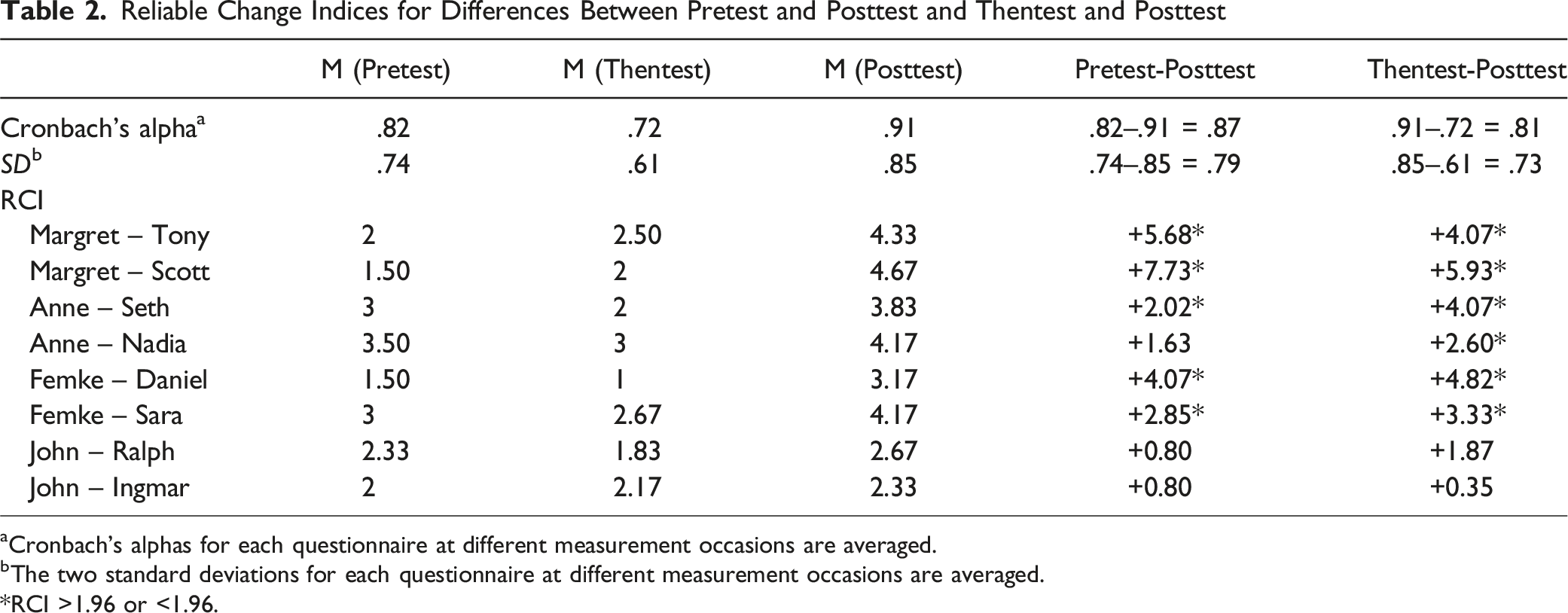
Reliable Change Indices for Differences Between Pretest and Posttest and Thentest and Posttest
aCronbach’s alphas for each questionnaire at different measurement occasions are averaged.
bThe two standard deviations for each questionnaire at different measurement occasions are averaged.
*RCI >1.96 or <1.96.
Next, we calculated the difference between the thentest and posttest. Differences in mean scores of the pretest and thentest ranged from 0.17 to 1 on a 5–point Likert scale, indicating that there was a small response shift bias in teachers’ perceptions of relationship quality. This means that teachers had different references of relationship quality during the pretest compared to the measurement after LLInC. To remove this response shift bias, we compared scores of the thentest with the posttest. RCIs indicated that 6 teacher–child dyads improved in their global judgments of relationship quality.
Intervention Experiences
After the last posttest measurement, all teachers were asked open ended questions about their experiences of LLInC during a short conversation. All teachers said that they appreciated talking about their feelings instead of their behaviors in the classroom. Talking about their feelings resulted in noticing earlier that they had certain negative feelings or too few positive feelings about a child. Consequently, they talked more with the student about how his or her behavior affected the teacher’s feelings (Margret, Femke), and they tried to pay more attention to positive aspects of relationships with both individual children (Anne, John, Femke). Three teachers mentioned that they became more aware of their own influence on the relationship with a child (Margret, Femke, Anne). Regarding the different sessions of LLInC, all teachers argued that the second (and fourth) session were most useful. Reasons were that teachers received new insights in several domains of the relationship, including pedagogical practices and feelings about the relationship with the child. The teachers argued that the interviews (first and third session) were necessary parts to discuss certain specific experiences during the second session (and fourth session). Margret and Femke both indicated that the consultant’s questions during the second (and fourth session) helped them form new ideas about how to improve their relationship. It also helped them in strengthening their capability beliefs about identifying the necessary steps to improve the relationship. All teachers mentioned that they were motivated after LLInC to find out more about the child’s perceptions. Last, John argued that he still needed some additional help to help him regulate the Ingmar’s behavior, and Femke realized that she needed more information about how to deal with children’s conduct problems.
Discussion
In the present study, we evaluated a teacher-based coaching intervention that aimed to improve teachers’ relationships with elementary school students. We used a pretest-posttest design to examine the influence of LLInC on teachers’ global judgments of relationship quality and we used a multiple-baseline design to examine if day-to-day experiences in relationships changed after LLInC.
Teachers’ Global Relationship Perceptions
Regarding teachers’ global judgments of relationship quality, we found for five out of eight teacher–child dyads that LLInC led to a meaningful increase in teachers’ global judgments of relationship quality. This suggests that reflecting on difficult relationships with children may give some teachers the necessary tools to improve their relationship perceptions. Talking about their relationship with a child and focusing on feelings, beliefs, and expectations may have increased teachers’ positive judgments of their relationship with the selected children (Pianta, 1999). From the qualitative part of this study, it became clear that all teachers in general had positive experiences from participating in LLInC and got new ideas about how to change their interactions with the child. However, similar to results of Spilt et al. (2012a), we found that some teacher–child dyads did improve in teacher-perceived relationship quality, whereas others remained stable. Thus, in both studies, a subgroup of teacher–child relationships seems to benefit from LLInC, whereas others do not benefit.
A special feature of the present study was that we tried to remove a possible confounding factor of response shift bias in self-report (Drennan & Hyde, 2008). This response shift bias occurs when respondents reference of the construct to be measured changes during evaluation of an intervention. Including a thentest at the same time as the posttest measurement controls for this responsive bias (Drennan & Hyde, 2008). Comparing the posttest with the thentest, it appeared that teachers’ global judgments of relationship quality significantly improved in six of the teacher–child dyads. Evaluating the intervention effects by comparing posttest and thentest may have provided useful information as teachers had the same judgements of the relationship when both questionnaires were administered at the same time. Howard and Dailey (1979) indicated that thentest-posttest differences are more in agreement with independent behavioral observations than pretest-posttest differences. As independent ratings of feelings and perceptions of participants are impossible to obtain, we think that the then-test provided important information about the effects of LLInC.
Some results in the present study are in line with the study of Bosman et al. (2021) and not in line with those of Spilt et al. (2012b). Whereas Spilt et al. found that LLInC led to decreases of relationship quality for some dyads, we did not find any decreases in teachers’ global judgment of relationship quality. An important difference between the present study and the study by Spilt et al. concerns the selection of the teacher–child dyads. Spilt et al. (2012b) selected children for the intervention based on the degree of disruptive behavior relative to other children in the classroom, whereas teachers in the present study selected children with whom they experienced difficulties in the relationship. Although relationship problems and disruptive behavior are correlated, it is unlikely that all relationships with children showing disruptive behavior are of low quality (Hamre et al., 2008). Indeed, the present study showed that only half of the selected children had increased levels of disruptive behavior (i.e., hyperactive behavior or conduct problems), which indicates that selecting children based on relationship problems may have been better for an intervention study than selecting children based on the degree of disruptive behavior. The different selection criterion may therefore explain differences in findings between the present study and the study of Spilt et al. (2012b).
Teachers’ Day-To-Day Relationship Perceptions
A special feature of our study was the inclusion of daily measurements to evaluate intervention effects. Overall, we found that 17 out of 20 possible trend lines of daily perceptions were in the expected direction (i.e., increased trend lines for closeness and self-efficacy, and decreased trends for conflict). However, not all teachers’ day-to-day relationship experiences (i.e., conflict, closeness, and self-efficacy) for each dyad improved significantly after LLInC. Most improvements were found with regard to closeness, and day-to-day improvements of conflict and self-efficacy were only found for part of the teachers. An explanation for these mixed results is that teachers do not experience difficulties on all three dimensions of relationship quality. This was supported by previous research, which stated that teachers did not mention problems in the relationship with the child on all relationship dimensions (Bosman et al., 2018; Bosman et al., 2022). However, a problem in one of the relationship dimensions can already result in negative student outcomes (Hamre & Pianta, 2001). In the present study, we found that four out of eight teacher–child dyads had floor effects on conflict in the baseline phase. In addition, some teachers reported high levels of closeness or self-efficacy with one of their selected children prior to LLInC. Therefore, we could not expect to find significant effects on all dimensions for each teacher–child dyad.
Four teacher–child dyads showed significant improvements in their overall day-to-day experiences over time (i.e., weighted closeness, conflict, and self-efficacy per dyad). Interestingly, these improvements were all found in the second teacher–child dyad and not in the first teacher–child dyad. It may be that teachers have become more used to reflecting about the relationship with a child when they start with LLInC for the second child. In the first session of LLInC (i.e., about the relationship with the first child), teachers do not know what to expect of the intervention. In contrast, in the third session (i.e., about the relationship with the second child) teachers already know what is going to happen and can use that knowledge to reflect more thoroughly on the relationship. In between the third and fourth session, they may already start to think more about their feelings and expectations in this particular relationship, about expectations of this relationship profile, and about how to improve this relationship. Consequently, teachers had more opportunities to reflect on their relationship with the second child, possibly resulting in increases in relationship quality. If teachers indeed do have to get used to reflecting about the relationship with a child, it suggests that the inclusion of two children in LLInC is crucial.
An additional reason to include two children in LLInC was that teachers can compare the relationship profile of the two selected children, which happens at the end of the fourth session. By comparing relationships of two different children, a teacher may realize that relationships with individual children are also based on a more general expectation of what he or she believes to be important as a teacher. In this way, domain-specific mental representations, instead of only a relationship-specific mental representation (Spilt et al., 2011), may be activated. Teachers may realize that relationship quality also depends on characteristics of the teacher, such as beliefs about themselves as a teacher (Pianta et al., 2003). This raises the question whether the results of LLInC, especially regarding teachers’ global judgments of relationship quality, would also generalize to relationships with other children in the classroom who are not subjects of the intervention. Bosman et al. (2021) provided some first indications that improvements due to LLInC also transferred to teachers’ relationships with other children. However, this could be further studied in research using a within-class comparison group and more domain-specific measurements (c.f., Driscoll & Pianta, 2010).
Almost all teachers had increases in their global judgments of relationship quality, whereas far less teachers had improvements in their day-to-day relationship experiences. This indicates that global judgments of relationship quality differ from teachers’ day-to-day experiences in relationships with individual children. Kahneman and colleagues showed a similar difference between retrospective assessments of affective experiences compared to evaluations from immediate experiences (Kahneman et al., 1993). Based on these and other findings, Kahneman (2011) argued that retrospective assessments may play a more important role in future decision making. This research implies that teachers may direct their future behavior toward individual children based on the retrospective assessment of their relationship rather than on day-to-day experiences. Regarding the present study, it is conceivable that changes in the retrospective assessment of relationship experiences precede changes in day-to-day interactions and experiences, and that, over time, changes in global judgments of relationships may eventually lead to changes in day-to-day interactions.
Limitations
Several limitations of the current study should be noted. First, this study used a convenience sample of four teachers and eight children, which obviously impedes the generalization of the results. Second, we only based the intervention effects on teachers’ judgments and did not ask children about the affective relationship with their teacher. Third, no statistical power analysis was performed. However, we should note that the number of baseline observations in the current study, on average 12.75 observations, was larger than in most single case studies (Smith, 2012). Fourth, we should acknowledge that our questionnaire to assess teachers’ perceptions of relationship quality at pretest and posttest was rather short. It would have been better to use an original version of a psychometrically sound questionnaire. For the present study teachers were asked to complete multiple questionnaires. Because of the high workload of teachers, we decided to construct a shorter questionnaire to limit the completion time as much as possible. Still, our short questionnaire was based on items of larger well validated questionnaires such as the Student-Teacher Relationship Scale (STRS; Koomen et al., 2012), and the selected items had high factor loadings in previous research (Koomen et al., 2012). A similar limitation applies to the daily measurements. We selected only one item per dimension to reduce completion time per day. Only one item might not fully capture the scope of the specific dimension. Conclusions should be drawn with caution. However, it should be noted that analyses of the data from a previous studies in which the full scales were administered (Bosman et al., 2021; Koomen et al., 2012) showed that the scores on the selected items correlated highly with the total score of the scale to which the particular item belonged (r > .78).
Third, the changes in global judgments of relationship quality could not be compared with teachers receiving no intervention. Consequently, we have no information about whether teachers who did not receive LLInC also would have changed their perception of relationship quality. Therefore, adding a control group is necessary in future research. Also the baseline-phase in the daily measures design was non-randomized but naturalistic based on the availability of the teachers. Adding a randomized baseline phase would lead to more robust results of intervention effects. Fourth, we did not investigate how LLInC led to changes in relationship quality. Although we assume that reflecting about the relationship may have altered teachers’ mental representations, we did not investigate that explicitly. Future studies could include measurements of teachers’ quality of reflection and measurements about changes in mental representations to identify intervention mechanisms.
Conclusions and Implications
Taken together, the findings of this study suggest that the teacher-based coaching intervention (i.e., LLInC) positively influences teachers’ global judgments of teacher–child relationship quality and that it improves daily teacher–child interactions only to a small extent. LLInC should consist of sessions about the relationship with at least two children, as most daily intervention effects were found for the second child. As LLInC consists of only four sessions between a teacher and a consultant, the intervention seems feasible to carry out in practice. This is especially true if consultants, such as school psychologists, are already in close contact with teachers. LLInC provides school psychologists or other professionals within schools a tool to help teachers talk about sensitive issues such as their feelings and attitudes about individual children. In sum, influencing teacher–child relationships through reflecting on mental representations of relationships may be an effective tool to improve teachers’ perceptions of the relationship with individual children.
Supplemental Material
Supplemental Material - Improving Teacher-Child Relationships Using Relationship-Focused Reflection: A Case Study
Supplemental Material for Improving Teacher-Child Relationships Using Relationship-Focused Reflection: A Case Study by Rianne J. Bosman, Peter F. de Jong, and Helma M. Y. Koomen in Evaluation & the Health Professions.
Footnotes
Declaration of Conflicting Interests
The author(s) declared no potential conflicts of interest with respect to the research, authorship, and/or publication of this article.
Funding
The author(s) disclosed receipt of the following financial support for the research, authorship, and/or publication of this article: This work was supported by the Netherlands Organization for Scientific Research under Grant 411-12-036.

Supplemental Material
Supplemental material for this article is available online.
Note
References
Supplementary Material
Please find the following supplemental material available below.
For Open Access articles published under a Creative Commons License, all supplemental material carries the same license as the article it is associated with.
For non-Open Access articles published, all supplemental material carries a non-exclusive license, and permission requests for re-use of supplemental material or any part of supplemental material shall be sent directly to the copyright owner as specified in the copyright notice associated with the article.
