




Abstract
To establish the validity of the BHS-20, a sample of 2064 adolescent students aged 14 and 17 years (M = 15.61, SD = 1.05) were invited to participate in the research. Cronbach’s alpha (α) and McDonald’s omega (ω) were computed to evaluate the internal consistency. Confirmatory factor analysis was used to test the dimensionality of the BHS-20. The Spearman correlation (r s ) with depressive symptoms and risk of suicide scores of the Plutchik Suicide Risk Scale were computed to explore the nomological validity. The BHS-20 showed a high internal consistency (α = .81, ω = .93), an adequate one-dimensional structure with an excellent adjustment [χ2 S-B = 341, df = 170, p < .01, Comparative Fit Index = .99, RMSEA = .03] and acceptable nomological validity with depressive symptoms (r s = .47, p < .01) and scores for suicide risk (r s = .33, p < .01). In conclusion, current results suggest that the BHS-20 demonstrates validity and reliability among Colombian adolescent students.
Introduction
Hopelessness is defined as a consolidated set of negative expectations about oneself and one’s future (Campbell, 1987). Aaron Beck (1963) introduced this concept into the clinical context after observing that people with depression reported widespread negative expectations. Understanding hopelessness is crucial as it is part of the cognitive manifestations of a depressive episode (Beck, 1963) and is widely related to suicidal self-injurious behaviors (Andrade-Salazar et al., 2017; Primananda & Keliat, 2019; Rueda-Jaimes et al., 2018; Tonkuş et al., 2022) and other clinical psychological conditions (James et al., 2017).
Beck Hopelessness Scale dimensionality
Beck et al. (1974) designed a 20-item instrument to quantify the motivational, cognitive, and affective manifestations of hopelessness among adults, the Beck Hopelessness Scale (BHS-20). Worldwide, the dimensionality of the BHS-20 has been studied in different samples, and it has been observed that those items can represent a uni- or multi-dimensional scale with two to six dimensions (Aliaga et al., 2006, 2016; Aloba et al., 2015; Balsamo et al., 2020; Beck et al., 1974; Boduszek & Dhingra, 2016; Dyce, 1996; González, 2009; Hermosillo-De la Torre et al., 2020; Iliceto & Fino, 2015; Innamorati et al., 2014; Kao et al., 2012; Kim et al., 2015; Kliem et al., 2018; Kocalevent et al., 2017; Mikulic et al., 2009; Nissim et al., 2010; Pompili et al., 2007; Quiñonez-Tapia et al., 2019; Rueda-Jaimes et al., 2018; Satorres et al., 2018; Spangenberg et al., 2016; Szabó et al., 2016; Tanaka et al., 2018; Zhang et al., 2015). The differences in the dimensional structure of the BHS-20 are possibly due to the heterogeneity of the populations in which the tool has been tested (Keszei et al., 2010) or methods used to extract the scale’s factors (Lloret-Segura et al., 2014).
BHS-20 Nomological Validity
Nomological, or hypothesis, validity is understood as the specific hypothetical predictions that support a theory. This validity is based on multiple supporting tests that evince theoretical assumptions over time (Hagger et al., 2017). Among adults, the BHS-20 has proven its nomological validity against different instruments for measuring depressive symptoms —the Beck Depression Inventory (Aloba et al., 2015; Hanna et al., 2011; Iliceto & Fino, 2015; Kao et al., 2012; Nissim et al., 2010; Quiñonez-Tapia et al., 2019), the Center for Epidemiologic Studies Depression Scale, CES-D (Zhang et al., 2015), the Hospital Anxiety and Depression Scale (Kocalevent et al., 2017), the Patient Health Questionnaire [PHQ-2 or PHQ-9] (Kim et al., 2015; Kliem et al., 2018; Spangenberg et al., 2016), Zung Depression Rating Scale (González, 2009) —, and suicidal risk, including the Beck scale for suicide ideation (Kliem et al., 2018).
Practical Implications
It is important to verify the validity and reliability of the instruments in different populations. The psychometric performance could vary according to the population’s characteristics (Keszei et al., 2010). Moreover, when the scales, generally in English, are translated into other languages, the performance of the instruments must be confirmed in the new language, as inaccurate translations can lead to misconceptions in terms of in the sense or meaning of one or more items (Ramada-Rodilla et al., 2013). Translations cannot be literal as the linguistic equivalence of each item must be preserved. (Ramada-Rodilla et al., 2013). The dimensional structure of the BHS-20 has yet to be studied in an exclusive sample of adolescents. The present study analyzed the dimensionality and nomological validity of the BHS-20 in a large sample of Colombian adolescents.
Hopelessness is an important issue in public health due to its relationship with suicidal self-injurious behaviors (Primananda & Keliat, 2019). Suicidal self-injurious behaviors are widespread among adolescents worldwide, and suicide is the second leading cause of death in adolescents and young adults (Bilsen, 2018). It is necessary to explore the dimensionality and nomological validity of the BHS-20 to measure hopelessness among Colombian adolescents in the clinical context and in epidemiological studies.
The goal of this study was to evaluate the dimensionality and nomological validity of the BHS-20 among Colombian school-age adolescents.
Method
Design and Participants
A psychometric evaluation of the BHS-20 was undertaken. The authors implemented a randomized sample by clusters in three stages in which three cities (phase one), schools (phase two), and students (phase three) were chosen. If a student failed to obtain their parents’ consent, they were replaced by another until the sample size by the city was reached. Similarly, if any of the schools did not want to be involved in the study, they were replaced by another with similar characteristics. The percentage of return of consents was 52%. The statistical power calculated a posteriori was excellent (1-β = 0.99); thus, the probability of committing a type II error was remote (β = 0.01).
The sample was 2064 adolescents aged between 14 and 17 years old (M = 15.61, SD = 1.05), of which the majority were females (n = 1196; 57.95%), studied in public schools (n = 1713; 82.99%), self-identified as heterosexual (n = 1803; 87.35%), and resided in Villavicencio (n = 995; 48.21%); the remaining population resided in Barranquilla (n = 554; 26.84%) and Bogotá (n = 513; 24.85%).
Instruments
BHS-20
The authors applied the BHS-20 (Beck et al., 1974) adapted to Colombian Spanish by Villalobos-Galvis (2009). The BHS-20 has two options for each item: true or false. Items 2, 4, 7, 9, 11, 12, 14, 16, 17, 18, and 20 receive 1 for true; the remaining score is inverted (False = 1). Scores are expected to fall between 0 and 20, so the higher the score, the greater the level of hopelessness (Beck et al., 1974). The BHS-20 showed Cronbach’s alpha of .83 in a sample of Colombian adolescents (Villalobos-Galvis, 2009).
Plutchik Suicide Risk Scale
The Plutchik Suicide Risk Scale comprises nine items grouped into two factors: suicidal risk (3 items) and depressive symptoms (6 items). Each item is a “yes” or “no” question. The score for “Yes” is 1, and for “No” is 0. Scores for suicidal risk are expected to fall between 0 and 3 and between 0 and 6 for depressive symptoms. The higher the score, the greater the suicide risk (Plutchik & Van Praag, 1989). The suicide risk dimension for Colombian adolescents showed high internal consistency (α = .80), and the depressive symptoms dimension showed acceptable internal consistency (α = .72) (Suárez et al., 2019).
Procedure
Psychology students supervised the completion of the BHS-20. They were trained in answering any questions that the participants may have had while completing the BHS-20. Participants’ completed the questionnaire in pencil in classrooms in an average time of 20 minutes.
Data Analysis
Internal consistency was obtained using Cronbach’s alpha (α) and McDonald’s omega (ω) (1999). The latter is more convenient than the former when the Tau-equivalence principle is violated (Ventura-León & Caycho-Rodríguez, 2017).
Confirmatory factor analysis was performed with Lisrel software version 8.8, using the Diagonal Weighted Least Squares Method (DWLS) indicated for categorical variables (Jöreskog et al., 2001). Some models cited in previous studies including the one-Kazdin et al. (1983) and three-factor models (Beck et al., 1974; Mikulic et al., 2009) were tested. The original three-factor model includes a motivational one made up of items 2, 3, 9, 11, 12, 16, 17, and 20; a cognitive factor of expectations towards the future made up of items 4, 7, 8, 10, 17, 14 and 18; and an affective factor composed of items 1, 5, 6, 13, 15 and 19 (Beck et al., 1974). The three factors included by Mikulic et al. (2009) are lack of motivation (items 2, 7, 9, 11, 12, 14, 16, 17, and 20), future expectations (1, 5, 8, 10, 15, and 18), and feelings about the future (3, 4, 6, 13 and 19).
The Satorra-Bentler chi-square test (χ2 S-B), with degrees of freedom, probability value and the Root Mean Square Error of Approximation (RMSEA) coefficients, 90% confidence interval (90% CI), Comparative Fit Index (CFI), Non-Normed Fit Index (NNFI), and Standardized Mean Square Residual (SRMR) were computed to find the goodness of fit of the CFA. The expected RMSEA and SRMR values were p < .06; for CFI and NNFI >.95, and a p-value of χ2 not significant for a good fit.
Nomological validity was estimated by calculating Spearman’s correlation [r s ] (Spearman, 1910). p-values greater than .30 and probability less than .05 were accepted as significant.
Ethical Issues
The ethics committee of a private university in Colombia approved the research project according to Act No. 174 of May 31, 2018. Parents signed informed consent, and students gave assent.
Results
Item Description
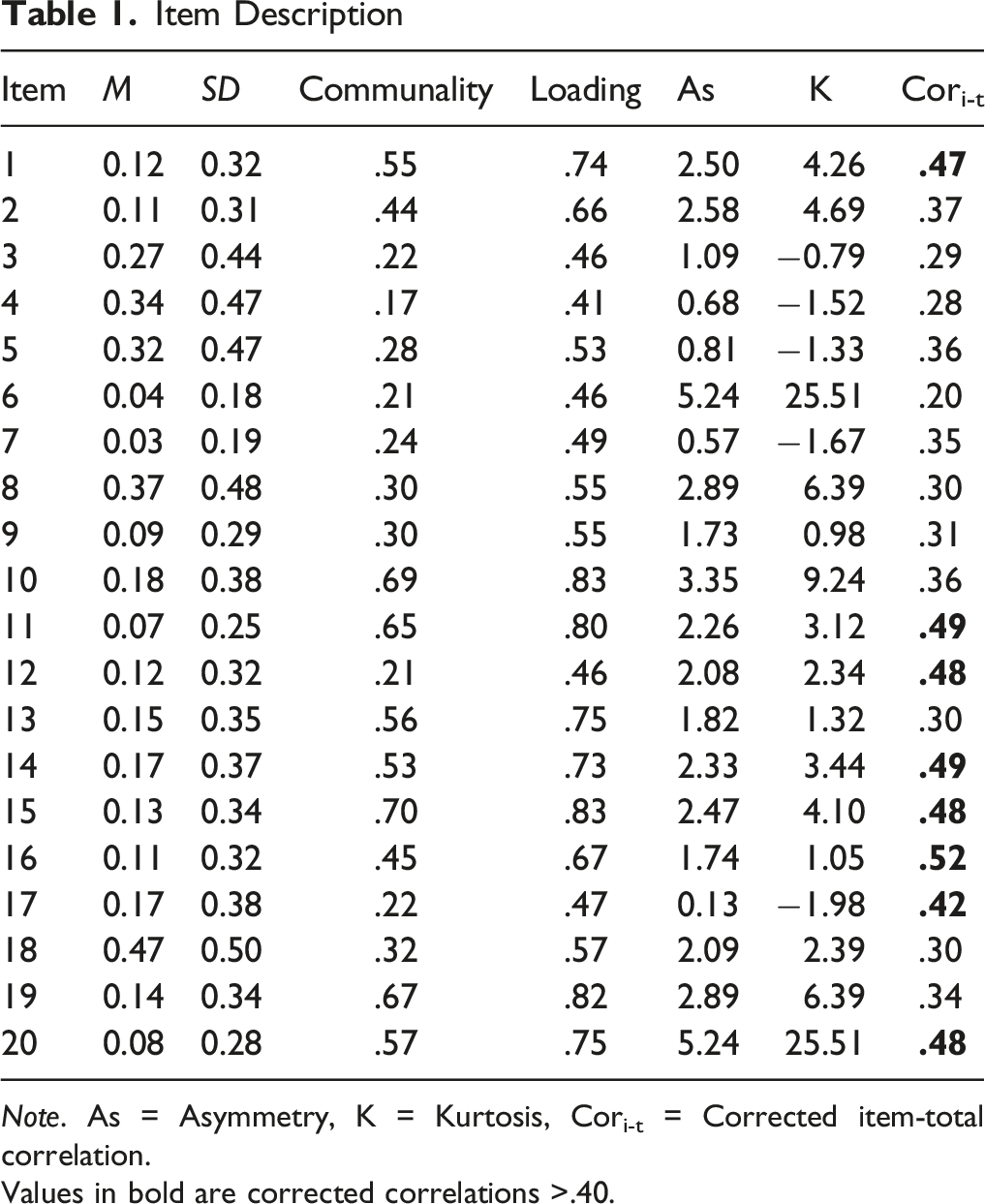
Note. As = Asymmetry, K = Kurtosis, Cori-t = Corrected item-total correlation.
Values in bold are corrected correlations >.40.
The original three-dimensional model of Beck et al. (1974) showed acceptable goodness-of-fit indices (χ2 S-B = 333.70, df = 167, p < .01, NNFI = .99, CFI = .99, SRMR = .07, and RMSEA = .03 [90% CI .02–.03]). Cronbach α was observed between .49 and .70, and McDonald ω between .74 and .80.
The three factors included by Mikulic et al. (2009) presented good goodness-of-fit indices (χ2 S-B = 325.62, df = 167, p < .01, NNFI = .99, CFI = .99, SRMR = .07, and RMSEA = .03 [90% CI .02–.03]); Cronbach α were between .35 and .75 and McDonald ω between .55 and .89.
Finally, the one factor from BHS-20 from Kazdin et al. (1983) reported excellent goodness-of-fit indices (χ2 S-B = 341.14, df = 170, p < .01, NNFI = .99, CFI = .99, SRMR = .07, and RMSEA = .03 [90% CI .02–.03]).
Finally, nomological validity was acceptable; the total score of the BHS-20 showed r s of .47 (p < .01) with depressive symptoms and r s of .33 (p < .01) with the score for the suicide risk.
Discussion
The BHS-20 presents a one-dimensional structure with high internal consistency and acceptable nomological validity among Colombian school-age adolescents.
The one-dimension structure of the BHS-20 in the current study is consistent with the authors who observed a similar structure of the BHS-20 (Aish & Wasserman, 2001; Balsamo et al., 2020; Hanna et al., 2011; Innamorati et al., 2014). However, other researchers found a one- (Kazdin et al., 1983), two- (Kao et al., 2012; Spangenberg et al., 2016; Tanaka et al., 1998) or three-dimension structure for the BHS-20 (Beck et al., 1974; Boduszek & Dhingra, 2016; Dyce, 1996; Kim et al., 2015; Kliem et al., 2018; Kocalevent et al., 2017; Iliceto & Fino, 2015; Steer, Kumar, & Beck, 1993), Szabó et al., 2016). The Spanish versions of the BHS-20 have shown more variation in the dimensional structures, between one and six factors, than those observed in other languages (Aliaga et al., 2006; González, 2009; Hermosillo-De la Torre et al., 2020; Mikulic et al., 2009; Quiñonez-Tapia et al., 2019; Satorres et al., 2018).
In the present study, only the loss of motivation and expectations towards the future dimensions of the BHS by Mikulic et al. (2009) presented acceptable internal consistency indices. Data did not adjust to any of the other proposed dimensionalities. Therefore, this three-dimensional version of the BHS-20 needed to be more reliable, leading to the tool’s validity being more robust (Lloret-Segura et al., 2014).
The differences observed repeatedly in various analyses are probably determined by the sample’s background (Keszei et al., 2010), analysis techniques (Lloret-Segura et al., 2014), or adjustments made in the wording of the items of the English and Spanish versions (Ramada-Rodilla et al., 2013). Thus, paying more attention to such aspects is necessary to reconceptualize hopelessness or the BHS-20 structure (Keszei et al., 2010).
In the present study, the total score of the BHS-20 was highly correlated to the subscales for depressive symptoms and suicidal risk of the Plutchik Suicide Risk Scale. These findings are consistent with preceding studies that showed that the BHS-20 had good correlations with other measures for depressive symptoms and suicide risk (Aloba et al., 2015; González, 2009; Hanna et al., 2011; Iliceto & Fino, 2015; Kao et al., 2012; Kim et al., 2015; Kliem et al., 2018; Kocalevent et al., 2017; Nissim et al., 2010; Quiñonez-Tapia et al., 2019; Spangenberg et al., 2016; Zhang et al., 2015).
The strengths of this present study were its large sample, the fact that the dimensionality was analyzed in different samples, and that two reliability indices were obtained for each of the dimensions found through Cronbach α and McDonald ω. A valid and reliable measure of hopelessness is necessary to measure this factor among adolescents and young people, as it is one of the best predictors of suicidal behaviors in this population (Andrade-Salazar et al., 2017; Primananda & Keliat, 2019; Rueda-Jaimes et al., 2018; Tonkuş et al., 2022). Many deaths could be prevented by means of periodic and early measurements of hopelessness, which could help to avoid suicidal behaviors, one of the serious public health problems in adolescence (Bilsen, 2018). The current study’s limitations include the fact that it is a cross-sectional study conducted on adolescent students in only three Colombian cities. The results may differ in adolescents who do not attend educational institutions and cities with very different demographic profiles. These differences occasionally produce unexpected response patterns (Keszei et al., 2010).
Implementing robust techniques such as factorial invariance and item response theory, among others, is recommended. These approaches increase our knowledge of hopelessness, mainly with data for highly vulnerable youth contexts, such as poverty and violence, common in the Colombian population (DANE, 2020). However, more studies are needed to measure hopelessness in Spanish-speaking adolescents, especially if researchers want to compare various populations. This is down to the fact that the scales tend to show variations that are sometimes significant according to participant characteristics (Caycho, 2017).
It is concluded that BHS-20 demonstrates evidence for its validity and reliability among Colombian adolescent students, however, more psychometric studies involving Colombian and Latin American adolescents are needed.
Footnotes
Authors' Contributions
Carlos A. Pineda-Roa contributed to the study conception and design, data interpretation, and statistical analysis, drafted the article, and revised and approved the final version. Adalberto Campo-Arias and Ana M. Bello-Villanueva contributed to the study conception and design, data interpretation statistical analysis, revised the intellectual content and approved the final version.
Declaration of Conflicting Interests
The author(s) declared no potential conflicts of interest with respect to the research, authorship, and/or publication of this article.
Funding
The author(s) disclosed receipt of the following financial support for the research, authorship, and/or publication of this article: This research was derived from the doctoral research project entitled: “Individual and contextual determinants of suicide risk in young Colombian people.” The Ministry of Sciences of Colombia, former Departamento Administrativo de Ciencia, Tecnología e Innovación, supported Carlos Alejandro Pineda-Roa, which funded his doctorate in psychology (Convocatoria 727 of 2015). The Universidad del Magdalena supported the participation of Adalberto Campo-Arias, and Universidad del Norte supported Ana Mercedes Bello-Villamizar.
Ethics Approval
The Ethics Committee of a private university in Colombia approved the research project according to Act No. 174 of May 31, 2018.
Consent to Participate
The students completed the questionnaires after signing the parents' informed consent in the case of minors. Students agreed to participate or not on the day of the application. Adults signed informed consent by themselves.
Data Availability Statement
The data supporting this study’s findings are available from the corresponding author upon reasonable request.
Code Availability (software Application or Custom Code)
Not applicable.
