




Abstract
Evidence for the validity and reliability of the Turkish version of the Munich Wrist Questionnaire (MWQ), a patient reported outcome measurement tool (PROM) was evaluated. A total of 80 patients (54.1 ± 1.4 years, 68 females) with wrist problems were recruited. The MWQ was translated into Turkish (MWQ-TR). Criterion validity with Patient-Rated Wrist Evaluation (PRWE) and Disabilities of the Arm, Shoulder and Hand (DASH) was tested by using Pearson’s correlation coefficients. Intraclass correlations coefficient (ICC) was used to analyze the test-retest reliability. There was a moderate correlation (r = −0.49, p < 0.001) between MWQ-TR and DASH, while correlations were strong between MWQ-TR and PRWE (r = 0.69, p < 0.001). Test-retest reliability of MWQ-TR was moderate (ICC = 0.67, 95% CI 0.26–0.84). The MWQ-Turkish version demonstrated evidence for its validity and reliability to evaluate pain, work/daily life activities and function in people with wrist problems in a Turkish population.
Introduction
Results after treatment of musculoskeletal injuries and diseases are traditionally evaluated with joint range of motion, muscle strength and radiographic images (Bradham, 1994). Clinical scoring systems have become popular in assessing treatment prognosis in wrist disorders, and numerous physician-based and patient-reported outcome measurement (PROM) tools have been developed. However, physician-based clinical examinations have several disadvantages. For instance; they may not take into account other aspects of the outcome analysis, such as the patient’s ability to perform activities of daily living and return to work or activity or offer a holistic assessment of patient outcomes. PROMs offer a way to overcome this limitation and achieve greater transparency regarding wrist function (Changulani et al., 2008). PROM tools have been developed to assess functionality and degree of disability after musculoskeletal problems (Mellstrand Navarro et al., 2011).
Currently, many scoring systems are suitable for assessing function in patients with upper extremity dysfunction and pain, but there is no consensus about which questionnaire is most appropriate (Hawk et al., 2017). The first disadvantage of many testing systems is that the patient’s physical presence is exposed for evaluation. Second, many patient-reported results only give a certain score, which leads to difficulties in comparing results in the literature. Using various questionnaires to solve this problem reduces patients’ willingness to participate (Mulders et al., 2018) and increases the participant burden (Tayfur et al., 2023). Commonly used valid and reliable PROMs are available such as the Disabilities of the Arm, Shoulder and Hand (DASH) (Hudak et al., 1996) and the Patient-Rated Wrist Evaluation Score (PRWE) (MacDermid et al., 1998). The Munich Wrist Questionnaire (MWQ) was developed (Beirer et al., 2016) as previous upper extremity questionnaires were limited to subjective questions based on patient self-report. The MWQ was designed to evaluate the wrist joint subjectively and objectively by assessing the range of motion with photographs. It was shown that MWQ demonstrated validity, reliability and utility (Beirer et al., 2016). Thus, MWQ is an original tool for self-assessment of wrist problems including quantitative assessment of PRWE and DASH. The PRWE primarily assesses objective function, while DASH focuses on only subjective functions of the upper extremity, but MWQ includes both (MacDermid et al., 1998; Solway et al., 2002).However, the MWQ has not been available for use in a Turkish population and psychometric data was required to establish its utility. The purpose of this study was to test the validity and reliability of the Turkish version of the MWQ (MWQ-TR) through criterion related evidence.
Methods
Participants
Eighty people who applied to Kırşehir Ahi Evran Training and Research Hospital, Physical Therapy and Rehabilitation Department were included in the study. Inclusion criteria were: (i) those with traumatic soft tissue and/or bone injury in the wrist; (ii) those with degenerative disorders of the wrist. People with psychiatric illness, dementia or other cognitive disorders were excluded. Written informed consent was obtained from the patients. A typical participant journey in the study were shown in Figure 1. Study Flowchart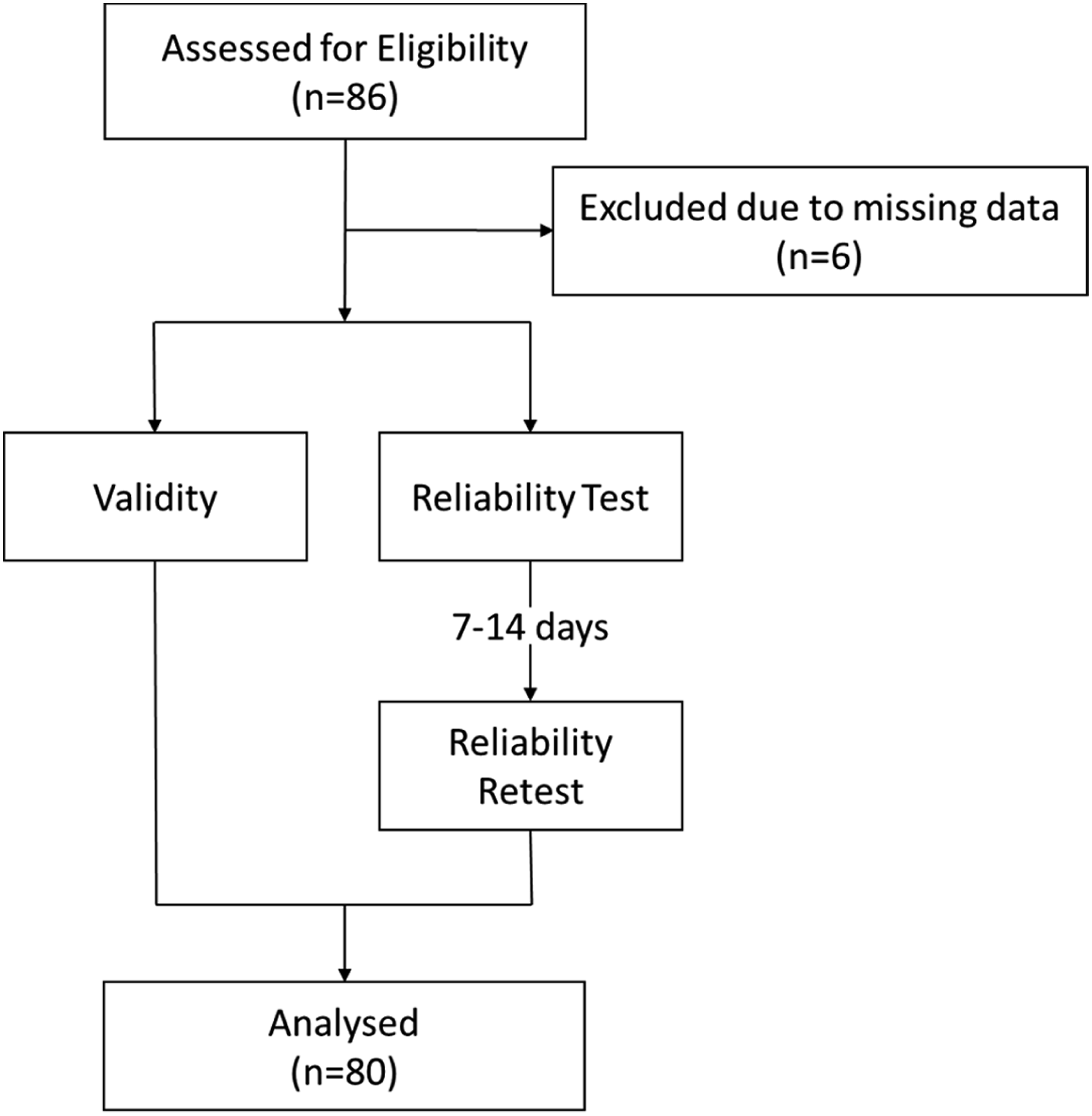
Instruments
All assessments were conducted in person. Participants’ descriptive information including age, sex, dominant side, marital status, injured side, education, occupation and diagnosis were recorded. PRWE, DASH, MWQ-TR were used in the evaluation. These scales were administered by trained physiotherapists experienced in hand rehabilitation. All assessments were completed on the same day. To assess test-retest reliability of the MWQ-TR, it was re-administered twice, the second occurring 7–14 days later (Tayfur et al., 2020).
Patient-Rated Wrist Evaluation Score
The PRWE is a 15-item questionnaire to measure wrist pain and degree of disability (MacDermid et al., 1998). It has two subscales (activities and function) and scored from 0 (no disability) to 100 (severe disability) points (MacDermid et al., 1998). The function subscale is divided into two parts as specific and daily usual activities (MacDermid et al., 1998) which was considered as function and activities of daily living for the subscale comparisons with the MWQ-TR. The Turkish version of the PRWE questionnaire was used in this study (Ozturk et al., 2015).
Disabilities of the Arm, Shoulder and Hand
The DASH is a 30-item questionnaire evaluating the function of the entire upper extremity (Hudak et al., 1996). Each question uses a 5-point Likert system (1 = no difficulty; 2 = mild difficulty; 3 = moderate difficulty; 4 = extreme difficulty; 5 = not at all) (Hudak et al., 1996). Total score ranges from 0 to 100 and higher score indicates higher disability (Hudak et al., 1996). The reason for using the DASH questionnaire in this study is that the Turkish cultural adaptation (DÜGER et al., 2006) was made and tested, and therefore suitable to use for criterion validity.
Munich Wrist Questionnaire
The MWQ was developed to evaluate the wrist joint subjectively and objectively (Beirer et al., 2016). This scale consists of 16 items: pain (five items), work and activities of daily living (seven items), range of motion and grip strength (four items) (Beirer et al., 2016). Depicted with photographs to assess range of motion. The maximum score for subjective parameters (pain, work/activities of daily living) is 120 out of 250 points, while it is 130 out of 250 points for objective parameters (function) (Beirer et al., 2016). The total score is 250 then converted to a percentage. In the total score calculated between 0 and 100, 100 points indicates perfect and 0 points a poor result (Beirer et al., 2016). Cross-cultural adaptation of the MWQ scale in Turkish was made according to the recommended international guideline by Beaton et al. (Beaton et al., 2000). This guideline has been applied in the following order:
Content equalization of MWQ and translation into Turkish (Beaton et al., 2000): MWQ has been translated from its original language into Turkish. The translation of the questionnaire was carried out by a native Turkish translator with a good command of German and a translator with a good command of Turkish. Making the translation process by two experienced translators who are experts in the field can prevent errors that may arise from terms and cause different interpretations.
Consensual version of the MWQ in Turkish and “Back Translate” study: Translators and researchers came to a consensus by comparing the two translated MWQs and named the scale MWQ-TR. Next, MWQ-TR’s “Back Translate” was made by four independent bilingual translators who did not participate in the original translation. At this stage, in order to determine the intelligibility of the MWQ-TR, a comparison with the MWQ was made and errors and inconsistencies were detected.
Content validity: The content equivalence of MWQ-TR was examined by a committee of 12 experts, consisting of orthopedists, occupational therapists and physiotherapists, who are fluent in both languages (German and Turkish) and, experienced in methodological knowledge of the cross-cultural adaptation of questionnaires. Changes were suggested for differences and inconsistencies in the meaning and the final version of the MWQ-TR was prepared (Supplement 1).
Statistical Analysis
Descriptive statistics were calculated to profile the study sample. Mean ± standard deviation were used to report continuous data, while n (%) were used for categorical data. The criterion validity was analyzed by using the Pearson’s correlation coefficients (data normally distributed), classified as <0.3, 0.3 to 0.5 and >0.50 being weak, moderate and strong, respectively (Cohen, 1988). The test-retest reliability was analyzed by using the Intraclass Correlation Coefficient (ICC, two-way random, absolute agreement), classified as <0.5, 0.5 to 0.75, 0.75 to 0.9, and >0.90 being poor, moderate, good, and excellent, respectively (Koo & Li, 2016). Cronbach’s alpha was calculated for each subscale as a measure of internal consistency and a score >0.70 was considered high internal consistency (Terwee et al., 2007). Statistical analyses were performed with the licensed Statistical Package for Social Sciences (SPSS) analysis (version 25.0). A significance level of p < 0.05 was considered statistically significant for all analyses.
Results
Participants’ Descriptive Features
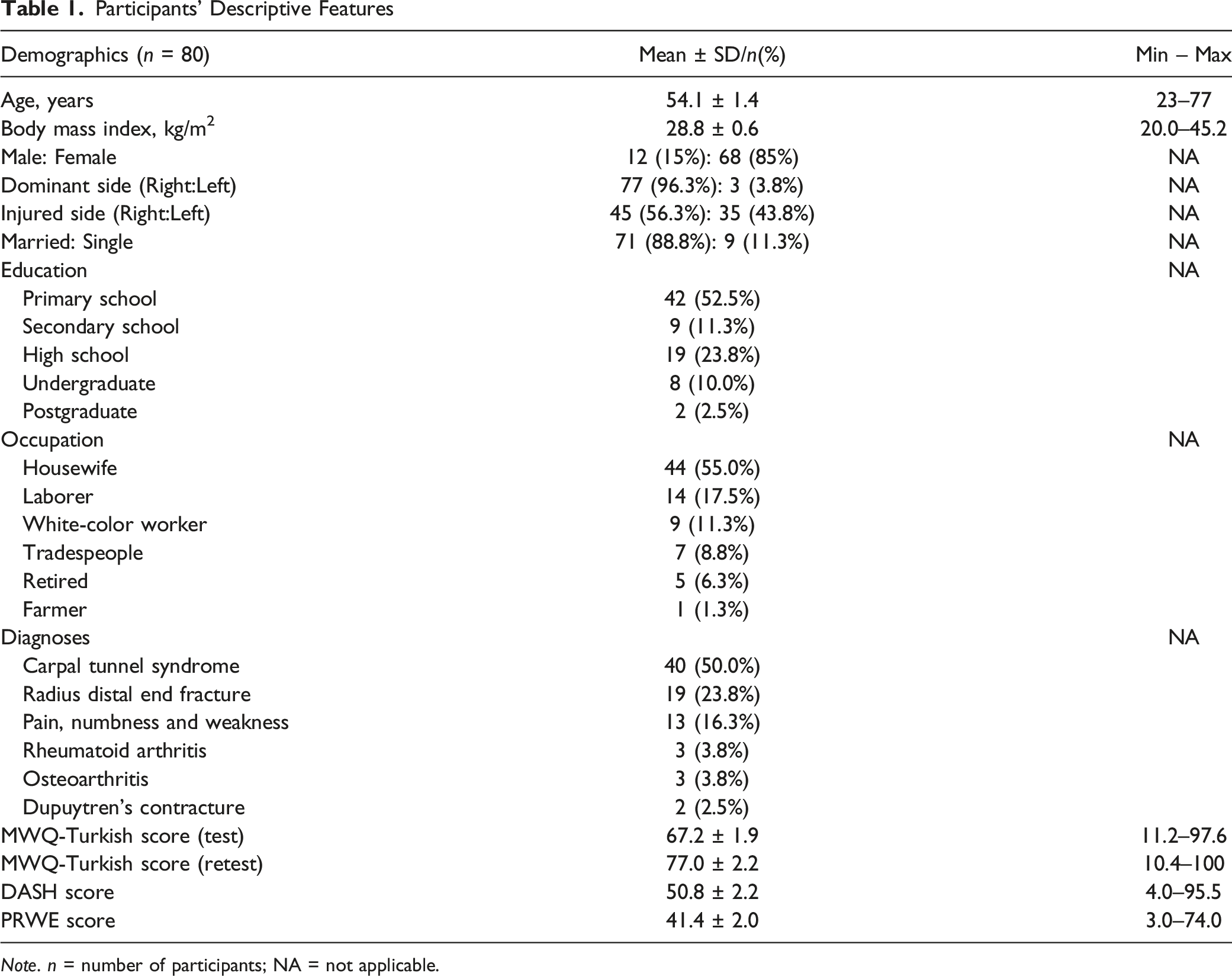
Note. n = number of participants; NA = not applicable.
Test-Retest Reliability of MWQ-TR and Its Subscales

Note. Subscale scores were normalized to 100.
Discussion
This study, carried out with 80 Turkish adults, investigated the validity and reliability of the MWQ developed by Beirer et al. (2016) in Turkish population. The properties of the MWQ-TR was compared with the properties of the Turkish version of the PRWE and DASH. There was a moderate correlation between MWQ-TR and DASH, while the correlation was strong between MWQ-TR and PRWE. Test-retest reliability of MWQ-TR was moderate. The MWQ-TR demonstrates evidence for its validity and reliability to evaluate pain, work/daily life activities and function in people with wrist problems in a Turkish population.
In the original study of the MWQ, it was found to be strongly associated with DASH (r = 0.90), PRWE (r = 0.84), and the Mayo Wrist Score (r = 0.93) (Beirer et al., 2016). Our findings were similar to the original MWQ as MWQ-TR had a moderate correlation with DASH and a strong correlation with PRWE. Beirer et al. (Beirer et al., 2016) also reported correlations between MWQ subscales and PRWE subscales for pain (r = −0.87) and work/ADL (r = −0.87) showing strong correlations which were better than our findings as we found moderate to strong correlations between MWQ-TR and PRWE subscales. The correlation between the Turkish version of the PRWE and DASH was strong (r = 0.92, p < 0.01) (Ozturk et al., 2015) which was better than our moderate correlation between DASH. Overall, MWQ-TR had a lower correlations with other PROMs compared to the original MWQ and Turkish version of the PRWE, but the range of correlations was moderate to strong demonstrating the validity of the patient scores when the MWQ-TR questionnaire was administered.
Recommended time between test-retest is between 2 days and 2 weeks (Marx et al., 2003). To ensure the test-retest reliability of the MWQ-TR, the time interval was chosen as 7–14 days. The test-retest reliability of the MWQ-TR was found moderate (ICC = 0.67). In the original study, Beirer et al. reported a higher test-retest reliability (ICC = 0.82) compared to our study. Similarly, the test-retest reliability of the Turkish version of the PRWE was found good (ICC = 0.88) (Ozturk et al., 2015), while the Turkish version of the DASH scale had an excellent test–retest reliability (ICC = 0.93) (Koldas Dogan et al., 2011) Thus, MWQ-TR had a moderate but lower test-retest reliability than the other PROMs in the literature. In the original version of the MWQ, the internal consistency was evaluated with Cronbach’s alpha for its subscales as pain (0.82), work and daily life (0.93), and functionality (0.75), showing high internal consistency of the subscales (Beirer et al., 2016). Cronbach’s alpha coefficients were also calculated for the subsections of the Turkish version of the PRWE questionnaire, and found as 0.86, 0.59 and 0.71 for the pain, specific activities, and daily activities subsections, respectively (Ozturk et al., 2015). In our study, Cronbach’s alpha values showed high internal consistency (ranged between 0.84 and 0.93) for the subscales of the MWQ-TR, and therefore were parallel to the findings in the literature. Thus, MWQ-TR is a reliable questionnaire but the range of correlations was moderate to strong demonstrating the reliability of the patient scores when the MWQ-TR questionnaire was administered
Findings from this study demonstrate the utility of the MWQ-TR in a Turkish population. There are limitations due to the small sample size as the minimum requirement of 10 events per variable was not reached (Peduzzi et al., 1996). Nonetheless, this study might be the first cross-cultural adaptation of the MWQ and the results are similar to existing tools that have demonstrated their validity and reliability. Another strength of our study is that the diversity of the included diagnoses covering the majority of wrist problems, hence increasing the generalizability and applicability of the MWQ-TR in Turkish population.
Conclusions
In conclusion, a reliable, internally consistent and valid patient-reported result were found in Turkish-speaking patients with wrist problems for the Turkish version of the MWQ. Our study demonstrated that the MWQ-TR offers a psychometrically appropriate and useful evaluation of wrist problems drawing on both objective and subjective parameters.
Supplemental Material
Supplemental Material - Validity and Reliability of Turkish Version of the Munich Wrist Questionnaire in Patients With Wrist Problems
Supplemental Material for Validity and Reliability of Turkish Version of the Munich Wrist Questionnaire in Patients With Wrist Problems by Mehmet Yetiş, İsmail Ceylan, Mehmet Canli, Ömer Alperen Gürses, Mensure Aslan, Levent Horoz, and Abdülhamit Tayfur in Evaluation & the Health Professions
Footnotes
Declaration of Conflicting Interests
The author(s) declared no potential conflicts of interest with respect to the research, authorship, and/or publication of this article.
Funding
The author(s) received no financial support for the research, authorship, and/or publication of this article.
Ethics Approval
Ethical approval was received by Kırşehir Ahi Evran University Clinical Researches Ethics Committee (Number: 2022-10/111).

References
Supplementary Material
Please find the following supplemental material available below.
For Open Access articles published under a Creative Commons License, all supplemental material carries the same license as the article it is associated with.
For non-Open Access articles published, all supplemental material carries a non-exclusive license, and permission requests for re-use of supplemental material or any part of supplemental material shall be sent directly to the copyright owner as specified in the copyright notice associated with the article.
