




Abstract
A primary challenge encountered by students with disabilities in mathematics relates to their inherent limitations in working memory capacities. Memory-strengthening strategies are helpful to students who need to improve mathematics retention. This article discusses enhancing mathematics learning outcomes for students with disabilities in rural settings by implementing an evidence-based and accessible practice—interleaved practice format (IPF)—facilitated through technology. We illustrate the application of this approach using three computer software tools: IXL Learning, KUTA, and ChatGPT.
Mrs. Smith is a math teacher in rural Texas. When her students returned to school after the pandemic, she found that her eighth graders had almost forgotten what they had learned before the pandemic. She teaches the Pythagorean theorem and is frustrated with her students’ performance. Some of her students did not know how to calculate square roots, and at worst, some forgot how to do integer operations, which significantly affected their accuracy. Furthermore, the gap in performance among students with and without disabilities has increased. Mrs. Smith wondered if an instructional strategy could benefit students in inclusive and rural settings.
According to a report from the 2022 National Assessment of Educational Progress (NAEP), mathematics proficiency has seen a concerning decline. One in four fourth graders scored below “basic” in mathematics (NAEP; U.S. Department of Education, Institute of Education Sciences, National Center for Education Statistics, 2022). The average fourth-grade mathematics score decreased by 5 points, lower than all previous assessment years. This decline is the largest since initial assessments in 1990 and was equivalent to that of 2005, wiping out nearly 20 years of national progress. Moreover, the average eighth-grade mathematics score decreased by 8 points compared to 2019, pre-pandemic. Many researchers and educators are worried that the poor learning outcomes of students were exacerbated by the COVID-19 pandemic, which forced a shift in learning environments from in-person classrooms to virtual settings, contributing to widespread learning loss (Kaffenberger, 2021; Sparks, 2020).
Among those most significantly affected by this transition were students with disabilities, who had fallen behind their peers without disabilities (Stenhoff et al., 2020). In the U.S., only 47% and 28% of fourth- and eighth-grade students with disabilities, respectively, scored above basic proficiency levels, compared to 80% of their fourth-grade peers without disabilities (U.S. Department of Education, 2022). Researchers speculated that students with disabilities might experience a greater decline in mathematics performance post-COVID-19 (Sparks, 2020). In particular, rural students with disabilities are at risk, with significantly lower performance than that of suburban students with disabilities (Carlson & Hott, 2017). Furthermore, due to their geographical isolation, they face unique challenges that adversely affect their mathematical learning (Kabel et al., 2021), including difficulty accessing evidence-based curricula and interventions (Rude & Miller, 2018), a lack of access to specialists (Hott et al., 2021), and lower teaching quality (Rude & Miller, 2018). As educators nationwide proactively implement plans to overcome recent learning losses, rural teachers are faced with the substantial challenge of improving students’ mathematics outcomes with additional and unique constraints.
A primary challenge experienced by students with disabilities in mathematics pertains to the limitations of their working memory and memory retention abilities (Swanson et al., 2018). This struggle has a direct impact on their mathematical proficiency, encompassing computational skills and problem-solving abilities (Grigorenko et al., 2020). Teachers often express frustration with the common refrain, “They knew it yesterday, but they don’t remember today,” which underscores the crucial role of memory in students’ knowledge acquisition. Consequently, addressing the challenges associated with memory retention emerges as a potential solution for enhancing mathematics competence among students with disabilities.
However, the conventional approach often centers on the process of imparting information to students, typically through lectures, video presentations, or the distribution of review materials (Agarwal et al., 2021). Students are also encouraged to establish study habits that involve activities like re-reading textbooks, highlighting key information, or reviewing their classroom notes. In these scenarios, the primary emphasis is placed on “putting information in,” which predominantly engages students’ short-term memory (Agarwal et al., 2021). Yet, according to Ebbinghaus’s forgetting curve, a substantial portion of newly acquired information is forgotten over time without review. For instance, 1 hour after learning, individuals tend to forget approximately 56% of the material. A day later, this figure rises to 66%, and after a month, approximately 80% of the content becomes inaccessible (Murre & Dros, 2015; Roediger III et al., 2010). To tackle this issue, teachers should transition from a focus on delivering information to emphasizing the retrieval of information—a crucial aspect often overlooked by instructors (Agarwal et al., 2021).
Retrieval Practice
Retrieval practice, a learning strategy, focuses on the deliberate retrieval of previously acquired information from memory (Latimier et al., 2021). Engaging in retrieval necessitates the act of recalling information, a cognitive process that serves to bolster memory retention and promote long-term learning (Agarwal et al., 2021). According to cognitive load theory, learning is more effective when the cognitive load is appropriately managed. In the context of retrieval practice, a higher cognitive challenge (e.g., recalling information without cues) may impose a moderate cognitive load that promotes better memory consolidation (Sweller et al., 2019). For instance, when students are required to retrieve answers to scientific inquiries, they enhance their memory consolidation more effectively than by passively seeking answers in textbooks. In other words, the greater the cognitive challenge posed by retrieval practice, the more potent its influence on long-term memory formation becomes (Agarwal et al., 2021).
Research on retrieval practices dates back to the early 20th century. Several studies have consistently revealed that retrieval practice enhances long-term retention more than re-reading or re-exposure to the material. Findings from two meta-analyses have shown a stronger positive effect of using retrieval practice during learning than various other methods, including reading, restudying, filler activities, no activity, or a combination thereof (Adesope et al., 2017; Rowland, 2014). Furthermore, a systematic review conducted by Agarwal and colleagues (2021) assessed the feasibility of retrieval practice in school settings, and their findings indicated medium to large benefits in the majority of cases (57%). Many researchers argue that retrieval practice is a powerful yet underused learning strategy in the classroom (Agarwal et al., 2021). However, a question arises: How can teachers integrate retrieval practices into their instruction?
Interleaved Practice Format
Interleaved practice format (IPF) is an instructional approach that mixes up at least three different problem types in an interleaved manner (Dunlosky et al., 2013; Hughes & Lee, 2019; Rohrer et al., 2017). For example, a third-grade session may involve solving a rounding problem, followed by a subtraction problem, and then a multiplication problem. These sessions require students to retrieve previously learned information by deliberately arranging various problems. That is, students will not practice the same type of problem consecutively in a single practice session, enabling them to discriminate between different concepts/skills (Hughes & Lee, 2019). Although IPF is not supported by as long a history of research as other common practice approaches (e.g., distributed practice), it has been proven effective for long-term retention (Hughes & Lee, 2019). The underlying principle is its integration of spacing and retrieval practices (Latimier et al., 2021). Concerning spacing, IPF involves diverse formats (e.g., ABC) instead of massed repetition (e.g., AAA). Specifically, there are two acceptable interleaving patterns: one that follows a regular pattern (e.g., ABC, ABC, ABC) and another that employs a more irregular pattern (e.g., ACB, BAC, CBA). Each pattern is acceptable because research on which pattern is most effective is limited and inconsistent (Hughes & Lee, 2019). In terms of retrieval practice, students are required to assess and select the appropriate skill to apply when faced with various prompts and challenges learners to switch between different types of content (Rohrer et al., 2017). This switching process itself acts as a form of retrieval practice so that it can enhance retention ability and long-term memory.
A contrasting approach to IPF is the blocked practice format (BPF), a method commonly found in textbooks (Rohrer et al., 2017). In BPF, students tackle one identical problem at a time, such as AAAAAA or AAA, BBB, and CCC (Rohrer et al., 2020). For example, in a lesson covering the Pythagorean theorem, a set of problems may only vary in their numerical values. In the blocked format, because students work on the same concept within a block, they typically develop a specific strategy before addressing each problem (Rohrer et al., 2017). This repetitive practice often leads to high initial accuracy rates, which bolster short-term memory retention (Hughes & Lee, 2019). Consequently, students may erroneously believe they have mastered the problems. However, when these same problems are presented in a mixed or cumulative format, students may struggle to select the appropriate solution, resulting in an “illusion of mastery” (Rohrer et al., 2017). In sum, IPF enhances long-term memory, while BPF primarily benefits short-term memory.
Interleaved practice format is simple for teachers to use because it does not require changes in traditional approaches. Instead, teachers can simply adjust the structure of assignments and tests they distribute to their students. Rohrer et al. (2017) proposed three recommendations for teachers to consider before implementing IPF. First, students should receive some initial blocked practice, especially when in the early stages of learning. Second, interleaved practice should be followed by informative feedback to correct any misconceptions. Interleaved assignments comprise various problems, including ones that students may not have encountered recently, necessitating the provision of solutions, error correction, and opportunities for students to seek clarification. Lastly, the benefits of interleaving tests are most pronounced when these tests are cumulative; they are not a quick-fix approach. Using IPF to assess students on recently covered material may not significantly improve their scores because IPF fosters a broader understanding based on diverse skills rather than specific and recently acquired concepts (Rohrer et al., 2017). Namely, IPF equips students with the skills they need to effectively grasp the subject matter.
Researchers have been exploring the application of IPF within the context of acquiring academic skills in reading, mathematics, and science (Karpicke et al., 2016; Rohrer et al., 2020; Samani & Pan, 2021). Specifically, researchers have primarily examined the effects of IPF by comparing them with those of BPF, and the results have typically favored IPF. Even among elementary school students with varying proficiency levels, those using IPF consistently outperformed their counterparts using BPF (Karpicke et al., 2016). Furthermore, among the various IPF studies, mathematics stands out as the most frequently studied subject, with the most promising effects observed (Dunlosky et al., 2013).
IPF Mathematics Research
Several mathematical skills have been studied through IPF, including fractions, algebra, geometry, and statistics (Rohrer et al., 2015, 2020). In a recent study, Rohrer and colleagues (2020) investigated the applicability of IPF to a large and diverse sample in school settings. They assessed IPF with nearly 800 seventh graders randomly assigned to IPF or blocked practice (BPF). The students were presented with a set of mathematical problems, involving linear equations (Problem #1), inequalities (Problem #2), simplifying expressions (Problem #3), and circles (Problem #4). Both groups received the same problems, differing only in the practice schedule, which consisted of eight practice sessions and one final test. The results showed that the IPF group outperformed the BPF group, with accuracy rates of 61% and 38%, respectively, on a final test given after a 14-day delay (Rohrer et al., 2020). Rohrer et al. (2017) argue that IPF facilitates mathematics learning by improving problem-solving discrimination, enhancing the association of relevant strategies, and producing lasting effects.
In an action study conducted in a rural school during the pandemic (Lin, 2023, 2024), IPF was shown to apply to students with disabilities as well. Six ninth-grade students with specific learning disabilities were assigned to two groups: IPF and BPF, receiving the same instruction in a whole-group setting. Practice sessions occurred in their mathematics class eight times per week for 200 minutes. The problems included integer computation, one-step equations, square root, and Pythagorean theorem. On the final test, the IPF group outscored the BPF group with mean scores of 97.2% (SD = 3.9) and 55.4% (SD = 20.7), respectively. This large difference (41.8%) in performance is consistent with the findings of Rohrer et al. (2020), although the sample sizes were small.
To sum up, IPF is ideally suited for mathematics, which demands a synthesis of concepts and skills across grade levels. Additionally, it has been successfully implemented with a diverse range of students, including students with disabilities.
Technology Meeting the Challenge of Rural Schools
Like other schools, rural schools face numerous challenges in providing a free and appropriate public education to all learners, including those with special needs and diverse abilities. Due to their geographical isolation, these schools face unique challenges, including (a) varied contexts of rural communities, (b) local poverty and declining economic development, (c) recruitment and retention difficulties for rural educators, (d) lack of high quality and focused professional development, and (e) unequal access to educational resources (Rude & Miller, 2018). Considering the strong correlation between teacher quality and student achievement, the recruitment and retention of teachers in rural areas is a critical concern, especially for students with disabilities (Rude & Miller, 2018). For example, descriptive evaluations of individualized education programs (IEP) for rural students revealed deficiencies in assessment data, progress monitoring, and specialized instruction needed for academic growth (Hott et al., 2021).
Technology can address the challenges faced by rural schools and students, particularly in providing comprehensive instructional programs (Sundeen & Sundeen, 2013). Rural schools have integrated technology into their teaching methodologies to overcome environmental or resource restrictions. Integrating technology can provide students with access to excellent teachers and a variety of resources they would never find in a school’s media center, enabling them to personalize their learning to meet their own unique needs (Hassel & Dean, 2015). However, rural schools must grapple with having fewer resources than their non-rural counterparts due to decreased funding and budgetary restraints, prompting them to identify and use free instructional resources (Sundeen & Sundeen, 2013).
Interleaved practice format is a highly recommended evidence-based strategy for rural schools for three reasons. First, it can be implemented with or without broadband access and without additional training. Second, it is applicable to students with diverse backgrounds (Rohrer et al., 2020), particularly to those who require specially designed instruction or assessment, because it allows teachers to select skills based on their students’ needs. Lastly, as Rohrer pointed out, effective interventions can be as simple and affordable as IPF, which includes two methods. The first is selecting different topic problems from students’ textbooks. For example, Problem #1 is an addition problem on page 15, Problem #2 is a subtraction problem on page 33, and so forth. The other is to search the Internet for worksheets with the keywords “mixed review” or “spiral review.”
In the past two years, several online tools have emerged and can be used to create IPF. Our selections are centered around IXL and KUTA, which are well-known in the education field and are widely available in school districts for free. We also included ChatGPT due to its widespread popularity and free access.
Crafting IPF with IXL
Nearly one-quarter of students in the U.S. are utilizing IXL for their educational needs (IXL, 2023). Grounded in the principles of learning sciences and rooted in established learning theories and educational best practices (IXL, 2023), IXL offers students adaptive practice questions dynamically adjusted to their proficiency levels that gradually increase in complexity as they progress, which aligns with individualized, specially designed instruction. As IXL has gained prevalence within educational settings, educators and researchers have expressed a growing interest in its impact. Does IXL improve students’ achievement?
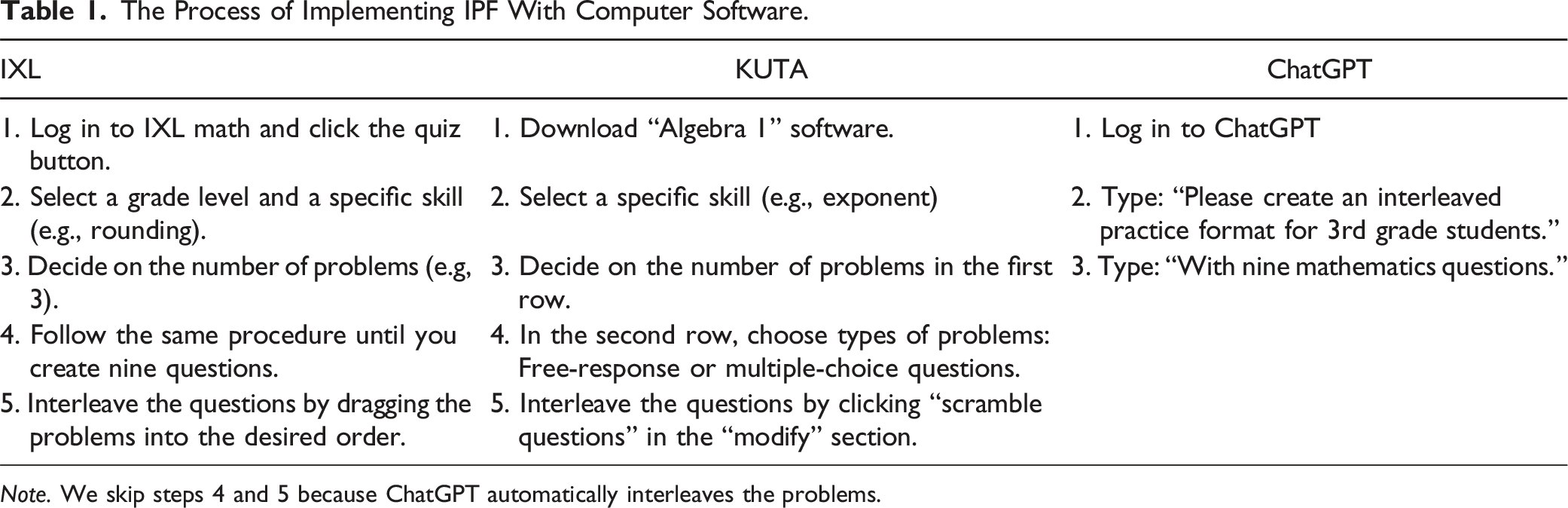
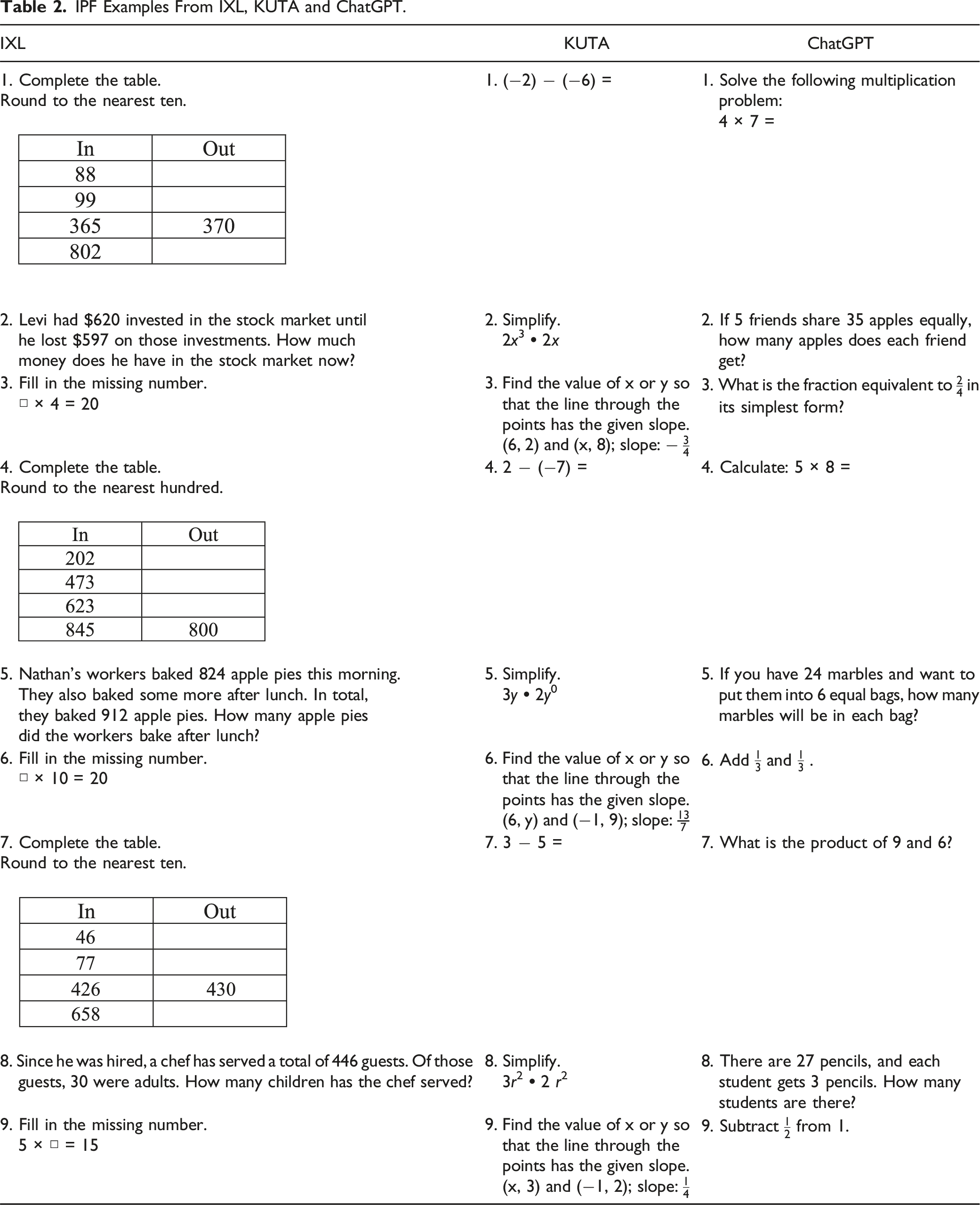
One study compared the impact of IXL Math on second graders’ engagement and achievement in mathematics to that of a traditional paper-pencil method (Schuetz, 2016). While no significant difference in the academic growth of students was found between the two methods, the teacher focus group reported an increase in student independence when using IXL. Additionally, they found it easier to differentiate instruction and provide corrective feedback. By combining the features of the study, we took third grade as an example to provide teachers with an IPF using IXL to enhance student retention. 1. Determine the skills. Teachers should identify mathematical concepts/skills they want students to practice more or areas that students have not mastered yet. For instance, a teacher noticed inconsistencies in rounding, subtraction, and multiplication accuracy among several students, warranting focused attention and practice. Consequently, these three skills are incorporated into the upcoming test they plan to create. 2. Create an IPF test. To create an IPF test using IXL, teachers can follow these steps. (See Table 1). • Log in to IXL Math and access the online quiz creation tool. • Select a grade level (e.g., grade 3) to see a list of available categories. • Choose a specific skill you want students to practice (e.g., rounding to the nearest ten or hundred using a number line). • Decide on the number of questions. • The program will automatically generate questions for the selected skill. If teachers are not satisfied with the questions, they can delete and replace them with new ones. • Teachers can also adjust the difficulty level of each question, ranging from level 1 to level 4 (i.e., easy to more difficult). • Follow the same procedure to generate three questions for the other two skills. • After creating a total of nine questions (three for each skill), teachers can interleave the questions by clicking and dragging them into the desired order (Mathematical problems are shown in Table 2). The Process of Implementing IPF With Computer Software. Note. We skip steps 4 and 5 because ChatGPT automatically interleaves the problems. IPF Examples From IXL, KUTA and ChatGPT. 3. Evaluate students’ results. After students complete the test, teachers can review the results from the IXL platform. The results indicate the proficiency of students in each designed skill and those skills that students require further practice in. It also suggests relevant skills for students to improve or advance by grades. 4. Plan the next step. With IXL automatically analyzing data, teachers can easily plan the next steps for their students, either by following IXL’ s recommendations or by evaluating on their own whether students should practice more or proceed to the next session. 5. Monitor students’ progress. Once students are engaged in the practice cycle, teachers can consistently monitor their progress on IXL that offers the flexibility to customize tests for individual students or groups, empowering teachers to address specific learning needs more effectively.
After reviewing the three fundamental skills necessary for understanding the Pythagorean theorem in the textbooks, Mrs. Smith used IXL to create an IPF test. The platform’s dynamic visualizations and auditory features captured her students’ attention, enhancing their engagement. Upon completing the assessment, Mrs. Smith promptly accessed the results, obtaining a comprehensive overview of the class’ performance. Furthermore, she pinpointed the strengths and weaknesses of individual students across each skill. Using the analytical report, Mrs. Smith not only effortlessly created another test for a group of students who had yet to master specific skills with just a simple click of a button but also gathered data to monitor her students’ progress, including those with disabilities.
Crafting IPF with KUTA
Another recommended software is KUTA, designed specifically to generate mathematics questions for teachers. Unlike IXL, KUTA organizes skills based on mathematical domains rather than grade levels, such as pre-algebra, algebra, geometry, and calculus, ranging from elementary to higher-level, such as early numeracy or Rolle’ s theorem. KUTA features tests customized in terms of problems, layouts, and presentations. We took the seventh grade as an example and selected topics, including integers, slopes, and exponents (e.g., Algebra 1 in KUTA). 1. Determine the skills. 2. Design an IPF test (See Table 1). • Download “Algebra 1” software. • Select a specific skill (e.g., exponents). • In the first row, teachers can specify the number of questions, typically aiming for three or four questions for each type of problem. Additionally, teachers can set the difficulty level (i.e., easy, medium, difficult) or leave it blank for randomization. • In the second row, teacher can choose between free-response and multiple-choice questions to enhance retrieval practice. • In the third and fourth rows, teachers can adjust variables to complex the problems, such as the range of numbers (e.g., ±2 to ±30) and mathematical properties (e.g., product property, quotient property, power property) to create diverse test variations. • To achieve question interleaving (i.e., ABC, ABC, ABC, not AAA, BBB, CCC), teachers should click “scramble questions” in the “Modify” section (More problem examples in Table 2). 3. Evaluate students’ results. Notably, KUTA does not provide assessment analysis in the software as IXL does. Teachers must evaluate outcomes independently. 4. Plan the next step. Teachers can add more skills or replace some skills with those by simply changing any properties for each type of problem. 5. Monitor students’ progress.
Mrs. Smith noticed that her students had mastered the Pythagorean theorem and were ready to learn the exterior angle theorem. However, she observed that some indigenous students required additional practice because they were confused by mathematics terms. She was also keen to ensure they did not forget the Pythagorean theorem after the new lessons. At the recommendation of her colleague, Mr Taylor, she decided to try KUTA. Mrs. Smith discovered that KUTA meticulously broke down mathematical skills, allowing her to customize problems involving terminology and generate as many practice tests as she wanted. With KUTA, she could address students’ different needs, measuring their learned skills and the current topic in an interleaving way.
Exploring ChatGPT for IPFs
A final recommendation is ChatGPT, which is an artificial intelligence chatbot that continuously learns from human interactions and databases. ChatGPT uses several large language models, collectively referred to as GPT-4, to provide tailored and interactive natural language responses to users (Biswas, 2023). Users can interact with ChatGPT via text or voice to generate real-time responses. Since the debut of ChatGPT in 2022, its utilization has experienced explosive growth, amassing 1 million users in just five days. Moreover, the use of ChatGPT has spread into the education field, enhancing teachers’ efficiency and instructional methods. As educators, we explore the possibility of applying this tool to help teachers design an IPF. We took the third grade as an example and modeled how to create IPF problems. 1. Decide the skills. 2. Design an IPF test. Teachers can command ChatGPT to produce problems by typing or speaking. Specifically, they can narrow skills by offering the grade and domain abbreviation (e.g., 3. NBT) based on Common Core State Standards for Mathematics (CCSS-M). • “Please create an interleaved practice format with 9 mathematics questions for third-grade students based on the Common Core State Standards for Mathematics, including 3.OA.A.1, 3.OA.B.5 and 3.NF.A.1” (See Table 1).
Within a few seconds, ChatGPT generated three sets of problems, including addition, subtraction, and multiplication. Among the nine questions, ChatGPT also adapted to the type of question. For example, in terms of addition, it provided a two-digit addition algorithm and two-digit addition word problems (See Table 2). 3. Evaluate students’ results. 4. Plan the next step. 5. Monitor students’ progress.
IXL, KUTA, and ChatGPT are technology-based resources that teachers can use to implement IPF in mathematics with different features. IXL has colorful visual questions and provides teachers with online diagnostic information to track students’ progress. Moreover, it automatically provides customized tests once students complete the quizzes. By comparison, KUTA is known for generating unlimited questions and providing the flexibility to present the worksheet/test, which involves spacing the questions, deriving all the problems from different worksheets/tests, and exporting the questions to the other device. Lastly, ChatGPT generates IPF fastest and enriches problem formats most among these three software. While studies examining the effects of the software are limited, they stand as valuable resources, particularly for rural schools, because they not only simplify accessibility but also open valuable opportunities for improving learning.
As the semester neared its close, Mrs. Smith found herself juggling many tasks. With the looming summative test on the horizon, she devised a plan to help students reinforce the crucial skills they learned in eighth-grade mathematics. Faced with limited time and mounting pressure, she turned to ChatGPT for assistance. She prompted ChatGPT, “Please create an interleaved practice format for eighth-grade mathematics, including explanations of terms in the prompts for students with disabilities and English language learners.” In mere moments, ChatGPT generated a tailored selection: algebraic expressions, linear equations, and Pythagorean theorem, with each problem accompanied by clear instructions. Mrs. Smith could now handpick the rounds that best suited her students’ needs, freeing herself to concentrate on other aspects of preparation.
Conclusion
Rural schools face several challenges, including a scarcity of special education teachers and resource disparities, that directly impact the academic performance of their students and necessitate a more intensive and strategic approach from rural educators. Prioritizing technology-based instruction emerges as a viable solution to bridge the gaps caused by geographical isolation and cater to the unique needs of students with disabilities. IPF is recommended due to its versatility, requiring no additional funding while effectively addressing retention issues encountered by students with disabilities in mathematics. In other words, IPF illustrates how simple and cost-free instruction can improve learning (Rohrer et al., 2020). By seamlessly integrating technologies such as IXL, KUTA, and ChatGPT, IPF promises to enhance both the efficiency of educators and the mathematical learning outcomes of rural students with disabilities.
Footnotes
Declaration of Conflicting Interests
The author(s) declared no potential conflicts of interest with respect to the research, authorship, and/or publication of this article.
Funding
The author(s) received no financial support for the research, authorship, and/or publication of this article.
