




Abstract
The relationships of 10 gifted high-achieving Millennial males and their fathers were the focus of this qualitative research study. Through in-depth interviews, six significant themes were identified: father’s strong work ethic and self-sacrifice, father as teacher of skills and life lessons, father’s design and maintenance of father–son rituals, father’s quiet presence on the sidelines, father’s authenticity and comfort with self, and father’s respect for son’s talents, decision making, and developing independence. Implications for parents and educators of gifted high-achieving males are discussed.
It is not an easy time to be a boy. The challenges facing adolescent males remain difficult and this message is heralded in the popular press (Orenstein, 2020) and reiterated by contemporary cultural influencers (Baldoni, 2021, 2022; McConaughey, 2020). Psychologists and educators claim that the destructive effects of society’s failure to recognize the emotional needs of boys are evident in school (Glennon, 2020; Price, 2017; Reichert, 2019). A review of statistics from any state in the nation or any individual school district provides strong evidence of the problems that young males experience educationally. An examination of any grade level, socioeconomic group, or race indicates that young males are not performing as well academically as their female counterparts (Callahan & Hébert, 2020). The National Assessment of Educational Progress (NAEP) publishes The Nation’s Report Card, the most nationally representative assessment of what America’s students know in various subject areas. Since 2003 the report has consistently documented how boys are lagging behind girls in reading and writing. The National Center for Education Statistics (2012) published a report that noted the gap in writing between girls and boys is most pronounced in eighth grade, with the average eighth-grade girl writing at the level of the average 11th-grade boy.
The challenges continue beyond high school as differences in male and female adult achievement are evident in the attainment of advanced degrees. Women have received the majority of bachelor’s degrees since 1984–1985 and the majority of master’s degrees since 1981 (May et al., 2010). In 2008–2009, for the first time ever, women earned a majority (50.4%) of doctorates (Jaschik, 2010), and the trend has continued. In 2022, the Council of Graduate Schools reported more than half of first-time graduate students at the master’s degree and certificate level (58.0%) and at the doctoral level (56.3%) were women (McKenzie et al., 2023).
Although concerns about adolescent males are becoming part of the national conversation, a parallel phenomenon is occurring. Fatherhood in this country is changing as social, political, and economic influences are reshaping the role fathers play in the development of their children. In response, sociologists, psychologists, and educational theorists are calling for increased paternal involvement in boys’ lives (Farrell & Gray, 2018; Marche, 2014). Although the dialogue regarding the problems facing boys and the role their fathers should play in their lives is flourishing, limited attention is being drawn to issues specifically facing gifted young men. Research on gifted males indicates several psychosocial issues are central to their development including identity, belief in self, emotional sensitivity, empathy, resilience, and limitations of traditional masculinity (Hébert, 2018, 2020, 2021; Kline & Short, 1991; Shephard et al., 2011; Wilcove, 1998). As scholars and educators examine the needs of males in this country, it is critical that we invest our energy in addressing the needs of gifted males. As indicated by the limited research available on this population, more studies are needed to gain a stronger understanding of the intellectual and psychosocial issues facing gifted males. Moreover, studies focusing on parenting gifted males are necessary to develop appropriate interventions. The following study examining paternal influence on gifted high-achieving males is an attempt to address this critical gap in the literature.
Review of Related Literature
Parents’ influence on the achievement of their children may be significant (Freeman, 2000; Matthews & Jolly, 2022; Witte et al., 2015), and parenting styles also shape achievement and psychosocial development. An authoritarian parenting style is characterized by high parental control, unrealistic expectations, and limited nurturing. Authoritative parenting involves setting reasonable expectations, nurturing the relationships with children, and providing supportive feedback and strategies to manage disappointments. Permissive parents struggle to set limits and overprotective parents try to shield their children from whatever may be perceived as painful or disappointing (Garn et al., 2010). Jolly and Matthews (2014) reported that mothers and fathers of gifted children have often described their parenting as authoritative with parents promoting independence and encouraging responsibility while also offering unconditional love and support. They value the inquisitiveness of their children and allow them to be decision makers when appropriate.
Research on parent–child relationships has typically focused on the role of the mother, and there is little doubt that this relationship may be one of the most significant factors in healthy child development. Less attention has been focused, however, on the father’s role and the influence of his parental style, outlook, and behaviors. As boys progress through childhood and adolescence, research has indicated that continued paternal involvement can be a strong predictor of positive outcomes (McKelley & Rochlen, 2016). In their comprehensive review of research on fatherhood, Marsiglio et al. (2000) reported that most studies of fathers in two-parent homes indicated that paternal involvement was related to positive child outcomes such as school success, lower instances of behavioral or emotional problems, and positive social behaviors. Fathers also play an important role in the development of academic achievement for their children (Jeynes, 2015; Whitney et al., 2017), and both parents’ involvement and commitment to school is positively associated with the child’s success in adolescence (Wentzel et al., 2016). A strong bond with both mother and father through childhood may be associated with more affectionate and positive relationships with partners in life (Rauer et al., 2013), and fathers who actively participate in parenting are also able to help their sons develop empathy (Marsiglio & Pleck, 2005; Pleck, 2010). Morman and Floyd (2006) conducted research in which they facilitated independent surveys, the first with a population of fathers and the second with a population of father–son dyads. In each of the surveys, participants responded to the question “What does it mean to be a good father?” Results indicated that fathers and sons had relatively similar conceptions of good fathers, highlighting the same traits but in slightly different orders. The leading traits across all three groups were characteristics such as love, availability, role modeling, involvement, and support. More recently, Shafer and Easton (2021) surveyed 2,500 American fathers and found that fathering has a long-lasting impact on the personal principles of their children. The men surveyed who reported having highly nurturing fathers were much more likely to achieve their life goals in a healthy manner, be emotionally open, and enjoy an equitable partnership with their spouses.
Although significant paternal involvement is associated with a number of positive outcomes for boys, studies have also indicated that a lack of involvement is related to a number of negative outcomes (Raeburn, 2014). Young men who do not receive adequate affection from fathers may be more likely to experience feelings of rejection and despondency (Santrock, 2019), and sons of fathers who are altogether absent tend to have lower self-esteem than their peers (Farrell & Gray, 2018). In addition, paternal absence has been shown to be a strong predictor of depression, violence, and violent crimes in males (Farrell & Gray, 2018).
Psychologists and clinicians have joined fatherhood scholars and contributed to the conversation regarding father–son relationships. Authors of contemporary books on parenting boys have suggested that society should embrace the unique role fatherhood provides in a boy’s development and help men to expand their parenting role in comfortably masculine ways (Glennon, 2020; Price, 2017; Reichert, 2019). They have suggested different approaches to parenting boys and their models have included men sharing their emotional support through joint father–son activities; men becoming their sons’ champion through involvement, affirmation, acceptance, and encouragement; and fathers teaching their sons how to recover when challenged with adversity (Glennon, 2020; Price, 2017; Reichert, 2019).
Both the scholarly and clinical literature on paternal involvement in boys assists the gifted education community in better understanding the experiences of gifted males. Acknowledging the limited research on gifted males and their fathers, scholars understand that more work must be done. One study provided the gifted education community with a place to begin exploring gifted males and their fathers. A qualitative study by Hébert and his colleagues (2009) investigated paternal influence on gifted high-achieving males from the baby boomer generation, born between 1946 and 1964. The study examined the father–son relationships of 10 prominent gifted men of achievement to identify factors that influenced talent development. Through biographical analysis, six themes were identified: unconditional belief in son, strong work ethic, encouragement and guidance, maintaining high expectations and fostering determination, pride in son’s accomplishments, and mutual admiration and respect. The present study extends this research by examining the perceptions of gifted high-achieving Millennial males regarding their father–son relationships.
In designing the present study, I recognized that generational cohorts provide scholars a lens through which to analyze changes over time. They provide a way to understand how different formative experiences such as fatherhood may interact with the life cycle to shape people’s views of the world (Dimock, 2019). Although younger and older adults may differ in their views at any given moment, generational cohorts allow researchers to examine how older adults felt about a particular issue when they themselves were young, as well as to describe how the trajectory of views might differ across generations (Dimock, 2019). With this understanding, I chose to extend the earlier work on baby boomers (Hébert et al., 2009) and examine the perceptions of Millennial males, defined as those born between 1981 and 1996 (Dimock, 2019). Recognizing that generations are complex and diverse groups, I determined that a study of this generation would be beneficial in shedding light on the needs of gifted males. I considered several contextual factors. Most Millennials were between the ages of 5 and 20 when the 9/11 terrorist attacks occurred, and many were old enough to understand the historical significance of that moment. They also grew up in the shadow of the wars in Iraq and Afghanistan, which sharpened broader views of the political parties and contributed to intense polarization (Dimock, 2019). Moreover, most Millennials came of age and entered the workforce facing a serious economic recession. Many of their life choices, future earnings, and early adult milestones have been shaped by this recession in a way that has not been the case for their younger counterparts. The long-term effects of this “slow start” for Millennials may be an influential societal factor for decades (Dimock, 2019).
The following research questions guided the inquiry: What father–son relationship factors do gifted high-achieving Millennial males perceive influenced their talent development? How do gifted high-achieving Millennial males describe their fathers’ parenting?
Research Method and Procedures
Method
To understand the experiences of the 10 males in this study, I implemented a phenomenological interview research design. Phenomenology attempts to understand social phenomena from the participants’ own perspectives and describe the world as experienced by them (Brinkmann, 2018). The goal of this study was to examine the father–son relationship experienced by gifted high-achieving males to understand the role fathers played in their development. The names of the individuals described were changed to protect the identities of the participants involved.
Selection of Participants
Scholars examining fatherhood have established that transitions in fathers’ parenting roles have shifted during historical periods. Fatherhood has been influenced by war, economic upheavals, and sociopolitical challenges, resulting in changes in paternal involvement in child rearing (Gatrell et al., 2022; Marsiglio & Pleck, 2005). With this understanding, I chose to limit this examination to gifted high-achieving males from the Millennial generation, those born between 1981 and 1996 (Dimock, 2019).
The Participants.
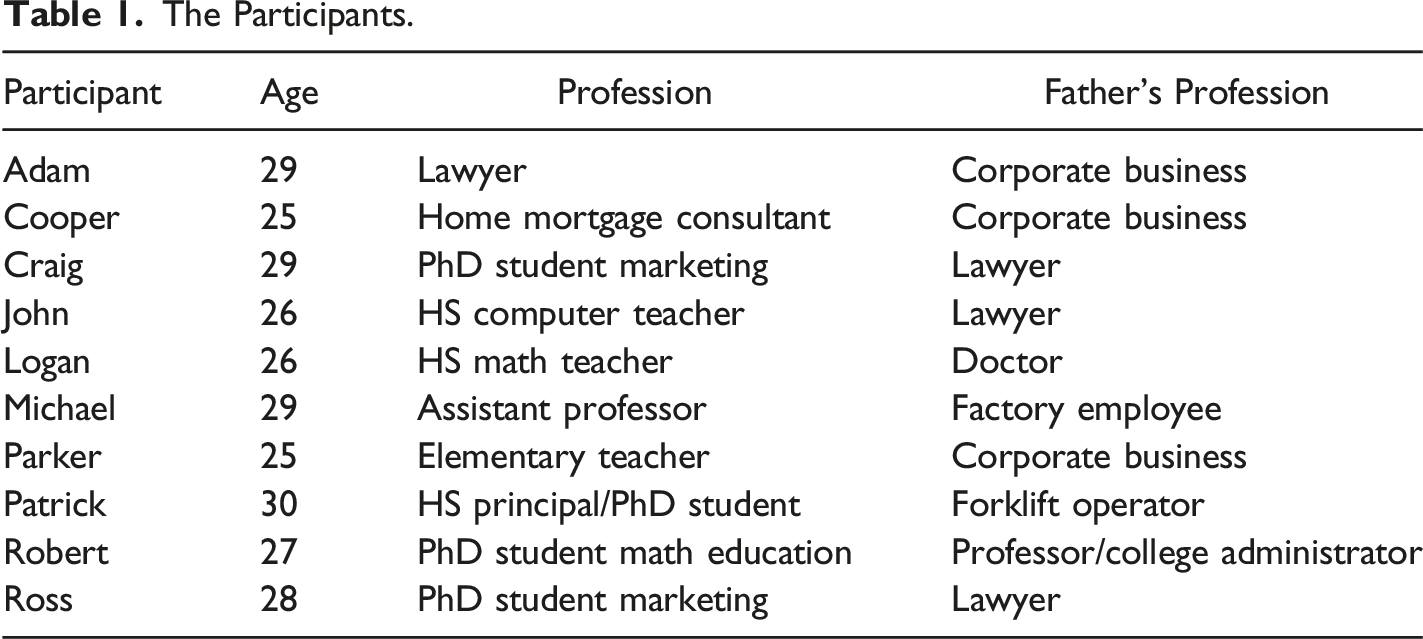
The 10 participants in the study and their fathers were White males. Early in my data collection I conducted an interview with a young man of Indian descent. It became apparent in the conversation that his experiences with his father were strongly influenced by his father’s immigration experience. In his case paternal influence appeared to be quite different from the experiences described by the White males I had interviewed. I realized that I would need to conduct separate studies that focused on specific cultural groups. Recognizing that fatherhood may be different in various cultures, I intend to replicate the present study with gifted Millennial males from diverse culturally specific populations.
The fathers of the participants in the present study represented diverse socioeconomic levels. Two of the fathers had earned high school diplomas and the remaining eight had earned advanced graduate degrees. Three of the fathers had divorced and remarried and their sons enjoyed healthy relationships with stepmothers and siblings. Following his divorce, one father revealed to his family that he was gay, eventually married another man, and his sons benefitted from a supportive relationship with his new spouse.
Data Collection
Two-hour interviews were conducted with each participant and were transcribed verbatim. These in-depth semi-structured interviews involved asking open-ended questions designed to explore the phenomenon under study—the father–son relationship experienced by gifted high-achieving Millennial males. In the in-depth interviews, I used an interview guide, along with the questions that guided the study (Brinkmann, 2018). The guide is featured in the Appendix. In addition, I asked the participants to share informal documents such as examples of preprofessional portfolios and résumés or products from their involvement in extracurricular activities. The review of these artifacts while conducting interviews provided meaningful evidence of the participants academic achievement and talent development (Hodder, 2000).
Data Analysis
Inductive analysis procedures were used to analyze and interpret the data. This process involved examining the data closely in search of themes or categories within the phenomenon under investigation, followed by a search for relationships among the categories to explain the examined phenomenon (LeCompte, 2000). In the initial stages of data analysis, I analyzed all transcribed interviews and artifacts by combing through the data for categories of phenomena and for relationships among the categories. Codes were systematically generated using words or phrases that identified similar patterns, recurring ideas or relationships, and consistencies or differences between and among segments of data (Bogdan & Biklen, 2007). This coding procedure compacted the data into equivalent classes and categories and enabled me to organize, manage, and reconstruct meaningful components (Roulston, 2022).
The preliminary stage of coding was followed by an examination of single instances in the data, and meaning was drawn from them without looking for multiple instances. This strategy moved the data analysis process toward interpretation, as coding enabled me to break apart the information in manageable ways to be able to raise further questions about the data. The next stage of the process involved examining the data through a display of diagrams of the codes to explore the composition of each coded data set (Roulston, 2022). This data display assisted me in structuring the information in a compact, accessible format to analyze the data further. In the next phase of analysis, meaningful patterns and consistencies between two or more patterns or themes within the data were established. To conclude the analyses, these generalizations about the participants’ experiences were contrasted with the published literature on father–son relationships.
The analysis process can be understood through the following example. In the first stage of coding, I recognized similar patterns, commonalities, or recurring ideas in the data that were labeled using terms such as expression of pride, admiration, teaching, coaching, emotional support, listening, and respect. In the second stage of analysis, I searched for single instances in the data and noted that two of the participants described periods in their adolescence where they engaged in rebellious behaviors that may not have been appreciated by their families. As I raised questions of these data and further examined the discussions of the two participants, I realized that the father–son relationship remained strong during those periods. What was described was indeed consistent with the other gifted males in the study in that the two young men experienced a strong bond with their fathers despite their rebellious experimentation. I concluded the data analysis process by establishing consistencies between several patterns in the earlier coding. In the final stage of analysis, it became apparent that relationships existed between and among these concepts and were eventually merged in a theme labeled father’s respect for son’s talents, decision making, and developing independence.
Researcher Subjectivity Considerations
Qualitative researchers pay close attention to the effects that their own personal opinions, prejudices, or biases may have on their data collection, analysis, and interpretation. I examined my subjectivities and their effects on the data, acknowledging Bogdan and Biklen’s (2007) message: Regardless of how much scholars may try, they can never divorce their research and writing from their personal experiences, identities, and values. In this study, whereby I was the primary data collection instrument, it is important to make biases explicit.
I enjoyed a positive relationship with my father throughout childhood, adolescence, and adulthood. As a former K–12 gifted education teacher, I had observed the relationships of my male students and their fathers. In addition, as a university faculty member, I had experience teaching many gifted male undergraduate and graduate students who often discussed their personal experiences with their fathers. To ensure trustworthiness (Lincoln & Guba, 1985) and guarantee that I would interpret the data from the participants’ perceptions and not my own, a bracketing interview was conducted with a university colleague before data collection began (Roulston, 2022). I also maintained a reflective journal to record my feelings, attitudes, and subjectivities throughout the data collection process, which provided a context for understanding my data analysis (Bogdan & Biklen, 2007). To further control for bias in interpretation, I provided the participants the opportunity to verify their transcribed interviews, review the data coding and validate the findings.
Findings
The 10 gifted high-achieving Millennial males in the study benefitted from positive relationships with their fathers. They recognized the strong work ethic their fathers maintained and appreciated all they had sacrificed for their families. The participants benefitted from their fathers’ direct teaching of skills as well as significant life lessons about becoming a man of good character. They appreciated that their fathers created and maintained important father–son rituals in which they were able to bond with their dads and strengthen their relationships. As athletes and scholars, they also benefitted from their fathers’ quiet support from the sidelines and learned how to conduct themselves as respectable men on and off the competitive stage. They appreciated watching how their fathers were authentic men who were comfortable with themselves and who negotiated life’s challenges and dealt with others with dignity and respect. Moreover, the participants were appreciative of how their fathers respected their talents and decision making as they developed their independence in the early stages of their professional lives and began families of their own.
Father’s Strong Work Ethic and Self-Sacrifice
The fathers of the men in the study were industrious men with strong work ethics. Regardless of their level of education, they all worked very hard to provide for their families and modeled self-sacrifice. Their sons recognized this philosophical view of hard work, expressed respect for their fathers’ approach to their professional lives, and were influenced to follow their fathers’ examples. Michael’s father had a high school education and faced challenges with job opportunities in a rural area when the economy fluctuated. He described how his father coped with his situation: I can’t imagine his job. It’s so much worse than anything I’ve ever had to do. He has to do it every day and he doesn’t complain about it. He just doesn’t let it ruin his life. If he has to get up at 4 in the morning and drive 3 hours to get to work, he drives 3 hours to get to work. If he has to go work in a miserable factory in a booth spraying glue and have glue go up in his nose and sinuses and lungs and get sick, that’s what he does because that’s what he has to do and he never complains about it.
Cooper’s father experienced employment challenges during an economic recession and his son admired how he dealt with the situation. He said, “Oh man, I get emotional when I think about this. He’s extremely selfless. When the economy hit the floor, he was working for a logistics company.” Cooper became visually emotional as he said, “They went belly up but instead of getting unemployment checks, he went and flipped burgers at Wendy’s. He went from making $90,000 to making $28,000 a year just to keep our family afloat.” He continued, “Dad broke down in front of me and my brother thinking we were embarrassed by him. That was the proudest we could have been of him.”
Both Adam and John referred to the long hours their fathers devoted to their work and highlighted how the men took time out from their work to be present in the lives of their children. Adam stated, “I don’t know a person who works harder. He’s a workaholic, but he always shifted when he needed to. He was able to leave his office to be there when we needed him.” John described his father’s work ethic and dedication to family similarly, “I know he worked long hours, and he was always working on weekends, but he still made time for us. I can’t imagine any parent that was around their kids more than he was.”
Robert’s father was a university professor at the flagship campus of the state’s university. He had long observed his father’s commitment to higher education and spoke of his dedicated work as a university administrator: He works a ton. He was born to be an administrator. As an associate dean, he does tons of administrative work, writes curriculum, and he is the dean of students and that’s what he loves. The students come to see him and he’s in there 10 hours a day talking with students. . . . As a kid, I always assumed that he was some kind of machine but now I think back and realize there had to be moments when he was frustrated or feeling tired, but I know he has literally decades of sick time saved.
Parker described his father’s focus: “He’s always been working on degrees. Even though he has his doctoral degree, he continues to pursue advanced training in his position.” He elaborated, “He has always focused on rising in the ranks and making a higher salary to provide for his family. He’s always working hard for us.” Logan grew up in a rural community where his father enjoyed a career in family medicine. He described his father’s dedication: “Some of my earliest memories of my dad were hearing or seeing him get up in the wee hours of the night to deliver babies.” He continued, “I’ve always been proud of my dad’s work ethic; just how much work and effort he has put into everything he does to make his family’s life what it is. He’s really incredible.” Ross expressed similar feelings about his father: “He is so loyal to his family and to everything that he involves himself with. He is calm, loyal, and hard working. I don’t know a person who works harder.” As a doctoral student in the final year of his studies, Ross reflected on his pursuit of a tenure-track position in higher education and shared his concerns about how he would meet the challenges involved in consistently publishing his research while also maintaining his responsibilities as a new husband and father. He said, “It scares me to think about how I’ll handle it all because of the model that my father created. He was always willing to put us first.”
Father as Teacher of Skills and Life Lessons
The 10 fathers in the study often provided important instruction for their sons. At times the instruction involved teaching specific skills such as formatting a scientific lab report, playing chess, maintaining automotives, and climbing mountains. Along with teaching skills, the fathers passed on important life lessons through serious conversations and modeling the masculine behavior expected of a self-respecting male. Other times the fathers simply listened closely to their sons and enabled them to formulate their own approaches to facing the challenges in their adolescent lives. Michael described how his father became an important teacher as he shared his skills in auto mechanics with his son: He loves NASCAR so one way we connected was watching the races together. When I was in seventh grade, I asked him to explain how a car works. He spent close to 6 hours with me that day. It was fascinating. He drew these diagrams and explained how the different parts functioned and the next day we went to the local library, and we got books with plenty of diagrams. That week I learned pretty much every component of a car. He’d take me to the garage and raise the hood and point out this and that. From then on, we always had something to talk about. That’s how I learned.
Adam pointed out that his father taught him how to enjoy a reading life and develop an intellectual discipline. My dad is a huge bookworm. He is voracious. To my mom’s chagrin, the amount of money he spends on books is substantial. He has a great library, and I learned that having interests and curiosity was critical. Three fourths of the books I’ve read are books that my father has passed on to me. I’m very much a reader… I’ve often said, “My father taught me how to think and my mother taught me how to love.”
Parker’s father enjoyed cooking gourmet meals and as a result, he received culinary training from his dad. He explained: I’d always spend time with him in the kitchen. When I asked, “How do you cook brussel sprouts?” he taught me it was olive oil and garlic that was critical. I enjoyed learning how he made macaroni and cheese with four different cheeses. That was his favorite dish. He taught me that you learn to cook from experimenting in the kitchen. Today, I do all the cooking at home.
The participants also described times when their fathers taught them important lessons in life. Michael reported a time when he assumed that his girlfriend would be his date for an upcoming school dance. When his father questioned him about his plans, he provided some important guidance. He said, “Son, you have to ask her; it doesn’t matter if she’s your wife, you still have to ask her.” He learned that his father’s advice was right. Logan’s father also guided him when he thought his son was too seriously involved with his high school girlfriend. Logan reported that his father said, Son, I know you probably need to go out and play the field, experiment with female relationships to find out what you’re looking for in a female later on. It’s hard to know what you’re really looking for if you’ve only dated one or two girls. You need to be around other females and have relationships to understand what’s good for you and you’ll be a better husband one day.
Michael also indicated that his father encouraged him to gain knowledge through research. As a young boy, Michael often heard, “That’s a great question. I don’t know, why don’t we go to the library, and you can find out with a book.” Michael continued, “I own this knowledge in a different way because I went out and found it through my effort. That was incredibly important for my development.” Robert shared that his father was strategic in teaching his son how to play chess. His father taught him at an early age and by the time he was in high school, Robert went on to compete nationally. When he complained of being bored in school, his father maintained that it was Robert’s responsibility to discover something that would keep him intellectually engaged and as a result, chess tournaments became an important component of his adolescence.
Patrick referred to his father’s strong listening skills and how he served as a sounding board to help his son think through how to respond to situations. He explained, “Dad might not say anything or respond positively or negatively, but he listened and in that process of listening, he helped me figure out what I needed to understand.” Ross described having a difficult time dealing with his doctoral advisor and later experienced tensions with one of his professional colleagues early in his career. In both situations, he went to his father for advice and discovered that his dad simply listened and enabled him to make his own decisions. He explained: “He’s such a calming influence. Any time I have a big issue, he’s there to say, ‘Hey, it will be fine. Everything works out. Just keep on working and stay focused and you’ll get through this.’” He also reflected on his father’s counsel as he was leaving for graduate school. His father said, “Ross, don’t let people take advantage of you. Not everyone is as forthcoming as you are.” Ross appreciated his father’s guidance: “I think he probably wanted to share that with me because he’d learned throughout the years that you don’t have to say everything that’s on your mind. Don’t assume that someone has your best interest in mind.”
As an undergraduate Craig learned from his father when he made several changes in his college major. His father said, “Look, you’re a smart guy. You’ve done well in all these courses but what does that mean for you? Craig, you need to really think about a plan and decide what you want to accomplish.” He maintained that his father followed a “hands-off” approach in parenting while watching him make his own decisions: “He wanted me to figure things out on my own. He was always willing to let me fall off my bike in order to learn how to ride it. But it was understood that if I fell off the bike, I had to get back on.” Logan also changed his college major several times. He described his father’s advice: He was saying to analyze it, reflect on the possibilities, try to figure out what’s important to you both now and later in life. He was saying follow your heart but also follow your strengths. He wanted me to do something where I was going to have an impact on society and where I would feel rewarded. He always talked about being a physician was rewarding for him and he really encouraged me to pursue something that would make me feel good in my heart and soul.
Robert also reported how his father became an important teacher of life lessons early in his childhood: My father read religiously to both my brother and me. He read The Lorax to me so many times he had it memorized. The Book of Virtues was also an important book. I believe my dad planted these big seeds of unconscious ways to act. I think he taught us how to be ethical. I learned morality through his actions. I learned so much just watching him… He was always so good in helping me grow up. I think he saw a sense of righteousness in me early on and I’m sure he was pleased, and he nurtured that with the readings.
Father’s Design and Maintenance of Father–Son Rituals
The fathers in the study dedicated themselves to their families in a variety of ways. The participants noted how their fathers created experiences that became rituals for nurturing their relationships with their sons. These rituals were designed to guarantee quality father–son time in which the two men could enjoy each other’s company and have meaningful conversations. Several of the participants referred to the rituals as a “time to bond” with their fathers and noted that their fathers insisted on maintaining their traditions for many years. Parker grew up in a coastal community in New England, and he described the father–son ritual his father established: My Dad would make us go on a walk. We would walk around Bradbury Island. As a kid, I hated going on these walks, but once we got there, we always had a great time and good conversations. So now when we travel to Maine, I drag my wife Mary to Bradbury Island. It’s “Okay, Mary, we’re going to walk around the island!” When we do, I’ll call my father and say, “Dad, we’re walking around the island, just thinking of you.”
John explained that he and his father maintained a critical date in their calendars that involved their father–son ritual of watching the annual football game between his alma mater and the neighboring state university. It was understood that he traveled several hours and returned to his hometown every year “because it’s our weekend to watch the game together, father and son. It just goes without saying.” Cooper had the same experience. He and his father were both established golfers. He explained, He always makes sure we watch the [rival college football game] together but more important is watching the Masters together. That Sunday, just sitting on the couch with Dad, having a few beers, and enjoying the final day of the tournament. I can’t remember a time when we didn’t watch the final major championship together. That’s our chill and hang out time.
Craig’s father enjoyed being the family’s chef. Craig explained: He made a point to help with cooking every night. I have a favorite picture taken right after my daughter was born. My parents came for a week, and he took over the kitchen. The picture is of him chopping the vegetables. This has long been the tradition… He loved to grill. Grilling was always a big deal and he wanted me involved. It started out with “come and help me get all of the stuff to light and set up the barbecue pit.” Eventually, he’d ask me to take over. We certainly bonded over that, and that made a difference when we regularly watched [college] football games and tailgating became a huge deal for the two of us.
Logan explained that his father established several traditions with his family that helped to create strong relationships with his children. He described the holidays when dad insisted on videotaping the family “coming down the stairs, and he’d do the ‘Ho! Ho! Ho! routine.’ I remember opening our stockings and all his cameras and video recorder were working.” He continued, “At Easter he would hide our Easter baskets and we’d have to look for them. He’d dye eggs with us and cut Jack-o’-lanterns with us, all those traditions that you treasure.” These holiday traditions were important to Logan; however, one important evening ritual that his father maintained for years was especially significant. He would always tuck me in as a kid …We’d always do bedtime prayers. We’d pray for the family and pray for whoever was on our heart. He taught me the Lord’s Prayer, but we went beyond that…We would have pretty serious conversations. He’d start talking about heaven and eternity and how amazing that was. We’d talk about the wonders of the universe and have weird conversations. I remember him telling me that he knew it was tough on my mind but for me to feel lucky because there were individuals who don’t ever think about some of those ideas, and he thought it was special for me to be analyzing such heavy stuff as a little kid. Later on, in middle school, we’d be talking about relationships with girls and stuff like that.
Father’s Quiet Presence on the Sidelines
Nine of the young men in the study were actively involved in sports from early childhood through high school. Michael grew up in an isolated rural community and did not have access to organized sports; however, he competed in academic programs. All 10 of the participants, including Michael, described how their fathers supported their involvement from the sidelines. They all expressed how “Dad was always there” providing quiet support and they commented on how their fathers conducted themselves as parents on the sidelines. They noted that their fathers were not overzealous in their sons’ athletic involvement, the type of aggressive parent screaming directions from the sidelines and causing embarrassment for the team. Robert noted, “My father was never a coach; he was at my games to support me, and he would complain to my mom about other parents who would yell at their kids.”
None of the fathers interfered with their sons’ coaches, and several volunteered to support the team in a variety of roles. Logan reported he was embarrassed for other kids whose parents “were screaming at the refs or putting pressure on the coaches to let their son play.” He explained, “My dad let things happen as they would, and he taught me a lot about how to respect coaches and how to conduct myself on or off the field.” He referred to his father’s dedication explaining that often his dad would attend his games only to be called away from the field because he had to rush to the local hospital to deliver a baby.
Cooper pointed out that his father was involved in his athletic training at a young age. He said, “He coached me all the way up through middle school but when I got to high school and my coaches took over, Dad never missed a game.” Like many of the young men in the study, Craig pointed out how busy his father was professionally; however, his supportive presence was noted. He said, “My father was always very busy, but he was there for everything. He was always at the games and that is something I hope to model for my children.” Ross had similar memories. He said, “My dad worked long hours, but he always was able to get out of the office in order to be there for me.” Patrick described his father’s parenting that incorporated “unconditional love.” He said, “No matter what I did in any athletic event my dad was going to be supportive of me. He loved to go to all the games and watch me play. It was always about me.” Ross was involved in multiple sports throughout his adolescence and while in college he trained to become a baseball umpire. He summarized his father’s supportive response: There is a photograph that I had enlarged that is framed and hangs in my home. It’s a picture of me making a call at home plate, and sure enough, there is my father in the background. It’s a picture taken by a professional photographer. I think it represents our relationship. He’s there to support, he’s not involving himself.
Parker’s father had not been involved in organized sports as a teenager, and although he did not always appreciate the athletic events his sons were involved in, he remained dedicated to them. Parker smiled as he reported, “I remember him coming to a downhill skiing competition. He seemed so out of place standing there at the bottom of the slopes in his penny loafers, but he made a point to be there to support me.” He reflected on his father’s presence during his Little League years: “He’d bring a picnic basket with lunch and spread out on a blanket. He was comfortable in who he was. He was himself, enjoying the game and the weather. He was there and that’s what mattered.”
John’s father had not been involved in athletics growing up; however, he made a dedicated commitment to supporting his son’s love of sports. He said, “I played soccer in high school, and that became his life. That’s what he lived for—going to my sporting events.” He reported that he also played All Star baseball for the county, and his father would travel with the team: “He really caught the fever. He loved it and looked forward to the games.” His father also served as a “team dad” driving the minivan for the team and eventually volunteered as the score keeper and provided his math expertise in maintaining statistical records for the coaches. John smiled as he reflected, “So Dad was kind of the nerdy guy, the score keeper who was always in the dugout and really enjoyed being out there with us. I can’t imagine any parent who was around their kids more than my dad.”
Michael’s experience with his father’s support from the sidelines included events that were related to science and mathematics. He said, “In eighth grade, I built a robot and he helped me build a chassis that it rode on. He didn’t always understand what I was doing but he appreciated it, and I think that made him proud.” His father attended every regional science fair competition that he entered. When he wrote a complicated program for a computer game and was recruited to his school’s computer programming team, he and his teammates competed in a statewide contest. His father accompanied him on the trip: “He was really proud. I think he saw that was I was doing was extraordinary. There weren’t many kids that were doing what I was doing, and he was really proud of that.”
Father’s Authenticity and Comfort With Self
The participants described their fathers as men with strong interpersonal skills who were down to earth in their approach to dealing with others. They saw their fathers as humble, authentic, and comfortable with their identities. They observed their fathers’ genuine qualities and admired those traits. Cooper described his father’s extroverted personality: He’s someone who can walk into a room, and he may not wow people, but he makes sure everybody else is having a good time. He’s able to get other people to laugh and can bring them into the conversation, even if it’s putting himself down and making a joke about himself. That’s something that he never hesitates to do.
Craig’s thoughts on his father’s authenticity were evident in his experience watching him as a grandfather: I have this picture of him from a few weeks ago. My parents visited us for my son’s birthday, and we were making a cake. I started to make the icing and he took over. He was trying to get the right shade of firetruck red. The picture is of my dad wearing my wife’s apron whipping up this icing. There was so much dye in the frosting… The pictures from the party were hysterical. Even the kids’ teeth were stained red!
Robert held great respect for his father’s authentic approach to helping troubled young people. His younger brother struggled with psychosocial challenges throughout his adolescence and his father dedicated a great deal of time to his conflicted son. In discussing the challenge Robert said, “I admire him the most for how he handled my brother and was supportive. He continues to love him to this day as he’s getting better in recovery and reaching a better place mentally, emotionally, and socially.” He admired that his father saw his brother as a “teenager who was clearly suffering inside and troubled.” He said, “I just admire that my father is this same way with his students, that he understands the personal plight and pain and is very empathetic” He continued, “He has always said the biggest challenge is growing up, and that’s the hardest thing in the world to do. His favorite book is Catcher in the Rye. Doesn’t that say it all?” Michael described his dad’s authentic approach to living: When you’re around him, you just get a sense that everything is going to be okay, everything is going to work itself out. I think in the midst of some very terrible trials that he’s been through, he always has a sense of delight in very simple things… I can remember he’d say, “Come outside and look at this tree!” I remember us staying up late and watching a meteor shower because it was amazing. It wasn’t something you see every day, and you don’t need a lot of money. It’s a free show and here it is. It’s that sense that you can relax and enjoy life. He helped me to see that there are a lot of amazing fulfilling things that you can enjoy regardless of what’s happening to you.
Logan was impressed with how his father conducted himself as a humble individual. “I’d go to events like Super Bowl parties with he and his friends. Even as a little kid, I’d listen to some of the men always bragging, filling you up with their accomplishments, and I saw that my dad was never that way.” He said, “I was always proud that he was my dad and not one of those guys. He was never a showboat. He was always honest and a very genuine guy.” He described experiences when he would return to his hometown and adults would recognize him as the doctor’s son: They’ll start talking about what a great guy he is, one of the greatest guys they’ve ever met and just how caring he is as a doctor and what he did for them. In so many of these conversations, the word genuine comes up… just how genuine he’s been in different situations. I’ll smile and say, “Yeah, I know he’s a great guy. I hope I can be half the man he is.”
Authenticity and comfort with self was an important issue for Parker’s father. Shortly after his divorce from Parker’s mother, his father announced to his three sons that he was gay. He later found a new partner, eventually married him, and created a new family with Parker and his brothers. He shared his perceptions of his father’s experience: I think it must have been very hard for him. Being gay was what led to the divorce. It must have been exhausting, just devastating, and I cannot imagine living that lie for so long. Not that he didn’t love my mother… just having the courage to say, “I need to be somebody else”… I remember when he told me just how nervous he had been about breaking the news to us, I realized it took real guts to come out to your kids. And of course, it was a non-issue for all of us. My dad has always been very accepting and taught us to “always be yourself.”
Father’s Respect for Son’s Talents, Decision Making, and Developing Independence
Adam said it best when he reported, “My father has agreed to be my best man when I get married.” This statement is representative of how the 10 fathers in the study respected their sons. They admired their sons’ intellectual abilities, athletic talents, interpersonal skills, and character. They were proud of their sons and viewed them as accomplished young men. As their sons matured their admiration grew and they expressed pride in the decisions they made in their lives and the sense of independence each young man had acquired. Ross pointed out that his father expressed his respect and admiration for his son in quiet ways: “I think he’s most proud of me when I accomplish things that he thinks he’s unable to do. For example, my pursuing my doctoral degree. I remember him saying, ‘Wow! I couldn’t do what you’re about to do.’” Ross went on to discuss a conversation with his mother in which she said, “The way I would characterize your relationship with your dad is respect. I know he respects you so much, and I believe you respect what he’s all about.”
Parker described his father’s conversations with his three sons: “Whenever we’d be together, he was saying, ‘I’m so proud of you. I just look at you guys and how you turned out. I’m just so pleased at what fine, outstanding individuals you’ve become.’” He highlighted two examples of his father’s expression of pride for his sons. He explained he had enjoyed a semester studying art history in Florence during his undergraduate program and his father had visited him. He reported, “At my graduation, he’d gotten me a beautiful leather-bound photo album engraved with “Florence, Italy” on the front so that I could preserve all my pictures from that experience. His gifts are always so thoughtful.” He said, “For my older brother’s graduation, he had printed out all their e-mail correspondence and bound it into a book and given it to him as a gift. E-mails and notes and post cards and letters are lost nowadays.” He grinned as he said, “I just thought that was so cool.”
Michael discussed how excited his father was when he, as a doctoral student, published his first research article in a professional journal. He said, “Dad took it to work with him and showed it to the people he worked with.” Patrick reported how proud his father was of his professional appointments. “I remember him telling me when I was teaching and coaching, ‘I want a cap from every school where you’ve taught or coached.’ When I became high school principal in [Milledge] County, his first request was, ‘You’re bringing me a hat this weekend, aren’t you?’” Patrick’s father celebrated his son’s success in school administration. He said, “I took him on a tour of the high school. To see him walk around the school and see the kids interact with me, to watch those interactions, you could just tell how pleased he was. He was blown away by those conversations and how the kids responded to me.” Patrick understood his father’s pride in his accomplishments and the decisions he had made in life. He was very fond of Patrick’s fiancé. “When I proposed to Cathleen, I asked him to come with me to buy the engagement ring. I took him with me, so he’d be part of the experience.” John’s father was very proud of his son who was somewhat embarrassed as he shared one experience during his junior year of high school: I didn’t know this, but my SAT scores had arrived in the mail. My father said, “How about we go out to dinner tonight?” I said, “Sounds good to me!” My parents and my girlfriend Becca are in the middle of the restaurant, and he takes out a printout. “Look at this, John. Congratulations!” I earned a 790 in math and my verbal score was also quite high. It was rather embarrassing to me and Becca, but I understood that evening just how proud and happy he was.
Craig’s father’s showed pride in his son’s decision making in several ways: “The conversations we enjoy now are related to where I am in life. Over time he started to seek me out for my expertise. I’m a certified financial planner, and he has sought me for professional advice.” He also reported how his father admired him for moving his wife and children to another part of the country. Craig recognized that as newlyweds his parents had lived independently from their families and built a strong marriage, and his father was pleased to see his son do the same: “Our moving away and creating our own unit. I believe he is proud of that.”
Logan’s father openly expressed his admiration for his son: “He tells me he’s proud of me for doing what I’m doing in my profession, doing something that I find rewarding.” He continued, “My teaching and helping others is important to him. He’s proud that I’m an active citizen, coaching tennis and cross country. He says that to me all the time.” Robert reported an experience in which he understood his father’s admiration: I had a friend in our doctoral program, an international student, who was having a hard time getting his wife and daughter here. He had to mail all the paperwork to get a visa for his family. He needed to get to the post office and didn’t have a car, so I swung by my father’s office on campus and asked for his car keys. Later I learned from my mother that he had mentioned this to some of his colleagues… Just being nice and helping other people is what he really appreciates. He may be proud of my achievements, like the chess championships, but he’s more proud when you help someone in need.
Discussion
In reviewing the experiences of the participants in this study, six significant themes emerge from the data that inform our understanding of relationships between fathers and their gifted high-achieving sons. The fathers featured in this study have provided a model that highlights effective parenting of gifted males. The themes emerging from the study serve as important components of the model and may be thought of as important ingredients for successful parenting.
The foundation of the model is seen in the fathers’ strong work ethic and self-sacrifice. A relationship exists between a father modeling a strong work ethic and his son maintaining high standards. As evident in the study, a father works hard to provide for his family, and his son follows his father’s example and strives to work hard in his academic and athletic life and later in his chosen profession. Fathers serving as good providers and sacrificing for their families has been a societal expectation in our culture for generations and remains a critical ingredient of effective parenting (Christiansen & Palkovitz, 2001). The fathers in this study became teachers of specific skills and also passed on important lessons regarding interpersonal relationships, negotiating life’s challenges, remaining focused on one’s goals, and building strong masculine character. In providing direct instruction, passing on life lessons, or listening to their sons and delivering guidance, the father’s approach matched the particular needs of the son. Two additional themes are related to fathers as teachers of skills and life lessons. The fathers’ quiet presence on the sidelines of their sons’ athletic and academic competitions served to teach additional lessons. Not only were they there to provide emotional support to their sons when competing, they sent an important message regarding how to be good men, conducting themselves in a dignified manner and being respectful of others. Boys look to their fathers to be sources of consistency. Because boys are experiential learners (Reichert & Hawley, 2010), a father’s actions will speak louder than words, and this phenomenon was evident in this study as the participants acknowledged they were appreciative of how their fathers conducted themselves on the sidelines. The young men also benefitted from observing their fathers’ authenticity and strong male identities. They enjoyed watching their fathers being down to earth, celebrating a youthful approach to having fun, being genuine in their dealings with others, and celebrating the joys of becoming grandfathers. These fathers were successful in modeling masculinity for their sons that would benefit them in their professional domains as well as when they too became fathers.
Another significant component of the parenting approach that emerged in this study was how fathers designed and maintained father–son rituals that provided them quality time and enabled them to communicate openly with their sons. The fathers were clever in their design of rituals. Whether it was bedtime conversations, the tradition of walking around Bradbury Island or watching the Masters golf tournament on television together, these men created important moments that remained embedded in their sons’ memories. The final theme emerging in the study, the fathers’ respect for their sons’ talents, decision making, and developing independence, completes the parenting model. The fathers admired their sons’ abilities, talents, and character; viewed them as accomplished young men; and expressed their pride. When a father encourages, guides, and teaches his son lessons that enable him to become successful and his nurturing results in his son’s success, it is not surprising that he openly shares his pride in his son’s accomplishments. Consistent with the findings of Levant et al. (2018), the participants perceived their fathers as supporting their authentic selves without having expectations that were unattainable and they were grateful.
The findings of this study reinforce the work of researchers in gifted education who examined parents of gifted students and their positive influence on the achievement of their children (Garn et al., 2010; Jolly & Matthews, 2014; Matthews & Jolly, 2022) and noted the significance of an authoritative parenting style. The fathers in this study exemplified authoritative parenting as they maintained reasonable expectations, nurtured relationships with their sons, offered unconditional love and support, provided helpful feedback, and allowed their sons to become decision makers.
The findings of this study are consistent with earlier research on father–son relationships. The ingredients for successful parenting delivered by the 10 fathers support the work of Morman and Floyd (2006) who found that love, availability, role modeling, and support were seen as important characteristics of good fathers. The findings are also consistent with the scholarship highlighted by Marsiglio et al. (2000), Pleck (2010), Shafer and Easton (2021), and Whitney et al. (2017), indicating that paternal involvement was directly related to positive outcomes such as academic success, emotional health, and appropriate social development in young males.
This study of gifted high-achieving Millennial men was an extension of the study of gifted males from the baby boomer generation conducted by Hébert and his colleagues (2009). The findings of the present study were consistent with the earlier findings and extended them in important ways. Consistent themes between the two studies were strong work ethic, encouragement and guidance, pride in son’s accomplishments, and mutual admiration and respect. The present study examined a generation of fathers who faced challenges that differed from the baby boomer fathers. The boomers had enjoyed economic prosperity following World War II with mothers remaining at home to care for the children. The Millennial males were from dual-income families as the economy shifted and both parents worked to provide for their families. As a result, parenting became more of a partnership, and fathers took on greater responsibilities in nurturing their sons. Similar to the boomers, Millennial fathers from diverse socioeconomic situations were effective in their parenting roles. Unique to the present study was the experience of one gay father who enjoyed success in his parenting three sons, consistent with the research by Goodfellow (2015), Leland (2017), and Neresheimer and Daum (2021) of gay men and the families they have formed. In the present study, a new understanding of fathers’ specific parenting strategies emerged including the design of father–son rituals through which important conversations were enjoyed. Fathers provided another strategy through their quiet presence on the sidelines where they provided emotional support for their sons and important role models. The Millennial fathers helped us to understand a third strategy—their willingness to have their sons observe their authentic masculine behaviors in a variety of contexts and experience how genuine they were in a variety of contexts. One young man delighted in his father whipping up firetruck red birthday cake frosting, while another enjoyed seeing his dad show up for his athletic event with a picnic basket and blanket, and another watched how his father conducted himself with his friends at a Super Bowl party. Father–son rituals, quiet presence on the sidelines, and sharing one’s authenticity are significant new lessons that are important ingredients to effective parenting.
Recommendations for Future Research
This investigation calls for replication. In designing the study, I conducted an initial interview with a gifted male of Indian descent and realized the immigration experience of the young man’s father added a complex dimension to the case. I recognized that a separate qualitative study of the father–son relationship within specific cultures would be required to shed understanding therefore I chose to focus the present study on the experiences of White males. An important consideration is the possibility of replicating this study and focusing on specific culturally diverse groups. A compelling question to raise is would the same findings would emerge from a study of gifted high-achieving African American males? Hispanic males? Indigenous males? It should be noted that I purposefully recruited participants who enjoyed positive relationships with their fathers. Scholars may want to replicate this study with gifted high-achieving young men who did not have positive father–son relationships or whose fathers were absent from their lives. Such a study would examine how single mothers may have maintained similar approaches for successful parenting. Scholars may also want to replicate the study with fathers of gifted gay young men and examine whether the son’s homosexuality played a significant role in shaping the father’s parenting. Replicating this study with fathers and their gifted high-achieving daughters would also serve the field of gifted education well.
Limitations of the Study
When considering the findings in this qualitative study, it is understood that transferability is left to the reader to judge the applicability to other populations. The parenting experiences of fathers of gifted males may be distinct because of their sons’ advanced abilities. Therefore, it is difficult to ascertain if all experiences shared in the interviews were unique to fathers of gifted males or could be experienced by all parents. In-depth interviews with the gifted Millennial males were the primary data source in this study, which limited the study to only representing the sons’ perceptions. Extended findings could be uncovered by including the voices of mothers and fathers of the participants as well as other family members.
Implications
Researchers and psychologists maintain that fathers serve their sons as the most significant source of information regarding what it means to be successful males (Farrell & Gray, 2018; Levant et al., 2018; Reichert, 2019). Consistent with this view, this study offers important implications for fathers of gifted males and their role in talent development. By closely examining the father–son relationships of the gifted high-achieving males, fathers may gain new insights on how to support their sons. Moreover, educators, counselors, and athletic coaches need to examine the lessons learned from this study and support the fathers of gifted males who want to follow the parenting approach offered by the men in this study. Teachers, counselors, and coaches can certainly reinforce how fortunate gifted boys are when their fathers support them emotionally, serve as models of a strong work ethic, respect them, and take great pride in their achievements. In addition, educators may wish to emphasize these same practices in the classroom, in hopes of reinforcing the important lessons delivered at home.
The insights gained from the 10 participants in this study inform us regarding how paternal influence may shape the lives of gifted males. This close examination of the gifted young men and their fathers helps to shed light on the importance of nurturing the psychosocial well-being of gifted males along with supporting their intellectual development. Through the positive models provided by the fathers in this study, we may begin to conceive of more suitable approaches to fostering the development of gifted young men.
Footnotes
Declaration of Conflicting Interests
The author(s) declared no potential conflicts of interest with respect to the research, authorship, and/or publication of this article.
Funding
The author(s) received no financial support for the research, authorship, and/or publication of this article.
