




Abstract
This study explored the affective outcomes students perceived from participating in a summer program and the program components that contributed to participants’ perceived affective development. Participants were 55 middle school students (29 girls) with intellectual gifts who participated in a 4-day-long residential program conducted in a western state in India. Participants wrote descriptive reflections responding to a 16-item open-ended survey. Matrix coding was used to code affective outcomes and the associated program components. Thematic analyses of responses revealed five themes that depicted improvement in participants’ (a) confidence and courage, (b) self-awareness, (c) social awareness, (d) social skills, and (e) inspiration. Leadership workshops and group activities, rural experience, and camp structure were discussed most frequently in relation to specific affective outcomes. Findings indicated that a direct and well-planned affective intervention can provide opportunities for social and emotional learning. Implications for holistic talent development programming have been discussed.
Educators in gifted education and talent development have historically focused on the cognitive development of gifted and talented students (Gensley, 1973; Moon, 2009; Rakow, 2020; Silverman, 1993). Although educators need to understand and support the cognitive development of students with gifts and talents, they also need to know about and foster social and emotional or affective development to support talent development in the contexts of school, home, and the larger community (National Association for Gifted Children [NAGC], 2019). A substantial body of research has emphasized the importance of social and emotional skills in the manifestation of giftedness over the entire lifespan (e.g., Bloom, 1985; Gagné, 2005, 2009; Subotnik et al., 2011, 2018; Tannenbaum, 1986, 2003). Bapat (2017) posited that “the affective development [should] be seen as a necessary prerequisite in the education of the highly able for them to become competent, motivated problem-solvers, and creative builders of society and nation” (p. 218). To that end, NAGC (2019) has recommended educators design interventions for students with gifts and talents that are based on research on effective practices to develop social and emotional skills. However, few researchers have explored affective interventions with gifted and talented youth; only 17 empirical studies have been published between 1984 and 2015 on this topic (Jen, 2017). Thus, a clear need exists to design and evaluate affective interventions to provide research-based practices that can be incorporated into talent development programs (Jen, 2017; Subotnik et al., 2011, 2018). The present study aimed to fill this gap in the literature by examining the affective outcomes of a residential summer talent development program for adolescents with intellectual gifts and talents. Adolescence marks an important transition in terms of the social, emotional, and motivational development of children (Erikson, 1968, 1994). Therefore, adolescence is an opportune time to provide affective programming for students with gifts and talents. The following research questions guided our inquiry: 1. What affective outcomes did students perceive from participating in the residential summer program? 2. What program components and underlying processes contributed to participants’ perceived affective development and in what ways?
Theoretical Framework
Affective Development as an Integral Part of Talent Development
Based on Moon’s (2009) work, we define affective development in terms of emotional and moral (intrapersonal), social (interpersonal), and conative (motivational) development. Affective skills and attitudes include emotional skills and attitudes such as self-awareness, reflexivity, resilience, growth mindsets, optimism, and hope; social skills such as leadership, teamwork, communication, and presentation skills; and various aspects of motivation such as self-competence beliefs, self-determination, and interest.
Talent development is defined as the gradual development of natural abilities/gifts into domain-specific talents over time (Gagné, 2005, 2009; Subotnik et al., 2011). Under a talent development framework, abilities are viewed as malleable, and affective skills play a critical role in developing childhood potential/gifts into adulthood fulfillment or achievement (Bloom, 1985; Gagné, 2005, 2009; Subotnik et al., 2011, 2018; Tannenbaum, 1986, 2003). Honing students’ affective skills may catalyze talent development and substantially contribute to students’ later success despite failures, setbacks, and challenges. Conversely, a lack of appropriate affective skills may impede talent development in many ways such as motivational loss and development of depression, anxiety, or fear and may restrain individuals who possess immense potential for advanced performance from fully actualizing their talents (Desmet et al., 2020; Desmet & Pereira, 2022; Peterson, 2006; Peterson & Jen, 2018).
Adolescence is a transformative developmental stage, marked by numerous challenges and opportunities for growth. It is a time of gaining self-awareness, where young individuals explore and define their identities (Erikson, 1968, 1994). Adolescents often experience heightened emotional intensity during this phase (Siegel, 2015). Forming friendships, navigating social hierarchies, and understanding social norms are critical aspects of this stage (Siegel, 2015). Adolescents seek greater autonomy and independence from their families during this stage.
Although the previous descriptions of adolescence apply more generally to adolescents with gifts and talents, this group may also have unique affective needs emerging from a dynamic interaction between their advanced abilities and the environment (Hébert, 2011; Papadopoulos, 2020; Subotnik et al., 2011, 2018). Gifted early adolescents may exhibit heightened emotional intensity, deeper introspection, moral maturity, a higher sense of justice, and a drive for a mature and adult understanding of human problems and values (Hébert, 2011; Olszewski-Kubilius, 2010; Rakow, 2020). These aspects of adolescence call for systematic and proactive affective interventions that can address the challenges of adolescents with gifts and talents and help them grow into healthy, well-adjusted, and socially contributing adults (Olszewski-Kubilius, 2010; Peterson & Jen, 2018).
Affective skills and attitudes are teachable and can be developed through deliberate interventions such as enrichment programs (Olszewski-Kubilius et al., 2016; Subotnik et al., 2011, 2018). In general, enrichment programs and, especially, summer programs are particularly effective in developing students’ affective skills (Kim, 2016). Enrichment programs can be instrumental in enhancing students’ independence and confidence (Desmet et al., 2022; Desmet & Pereira, 2022; Lee et al., 2015), openness (Jen et al., 2017), friendships (Cross et al., 1991; Jen et al., 2017; VanTassel-Baska et al., 1984), academic self-perceptions, planning skills, self-monitoring (Desmet et al., 2023), resilience and mental health (Armstrong et al., 2019), and social interactions and motivation (Chowkase et al., 2022; Wu & Gentry, 2014), as well as reversing underachievement behaviors (Desmet & Pereira, 2022; Matthews & McBee, 2007). Enrichment programs take multiple forms; however, summer enrichment programs are especially popular among middle and high school students. However, as few as 17 studies have been published on affective interventions for youth with gifts and talents from 1984 through 2015 (Jen, 2017). Also, there is an expressed need in the field for more focus on studies involving the structured components of summer programs that influence affective development (Jen et al., 2017; Lee et al., 2015).
Using design-based research, Jen et al. (2017) studied high-ability students’ perspectives on an affective intervention in a university-based summer residential program in the United States. Their intervention focused on one-hour small-group meetings among 8–12 camp participants to facilitate conversations regarding affective topics such as stress, competition, bullying, perfectionism, change, self-esteem, and stereotypes. Through these group meetings, participants learned more about values, other group members, different cultures, and themselves. Long-term effects included stronger self-confidence and being more open to people. These researchers concluded that a direct affective intervention could enhance the participants’ summer program experiences and provide opportunities for social and emotional learning, and therefore, recommended educators to incorporate well-planned affective interventions in summer programs for youth with gifts and talents and empirically investigate their outcomes.
Methods
We used a qualitative, inductive thematic analysis approach (Braun & Clarke, 2006; Nowell et al., 2017) to examine 55 students’ perceived affective outcomes after participating in a residential summer program conducted in 2019. Thematic analysis is well-suited to organize and analyze larger qualitative datasets such as ours. This method allowed us to summarize and examine our participants’ perceived affective outcomes for similarities and differences.
Setting
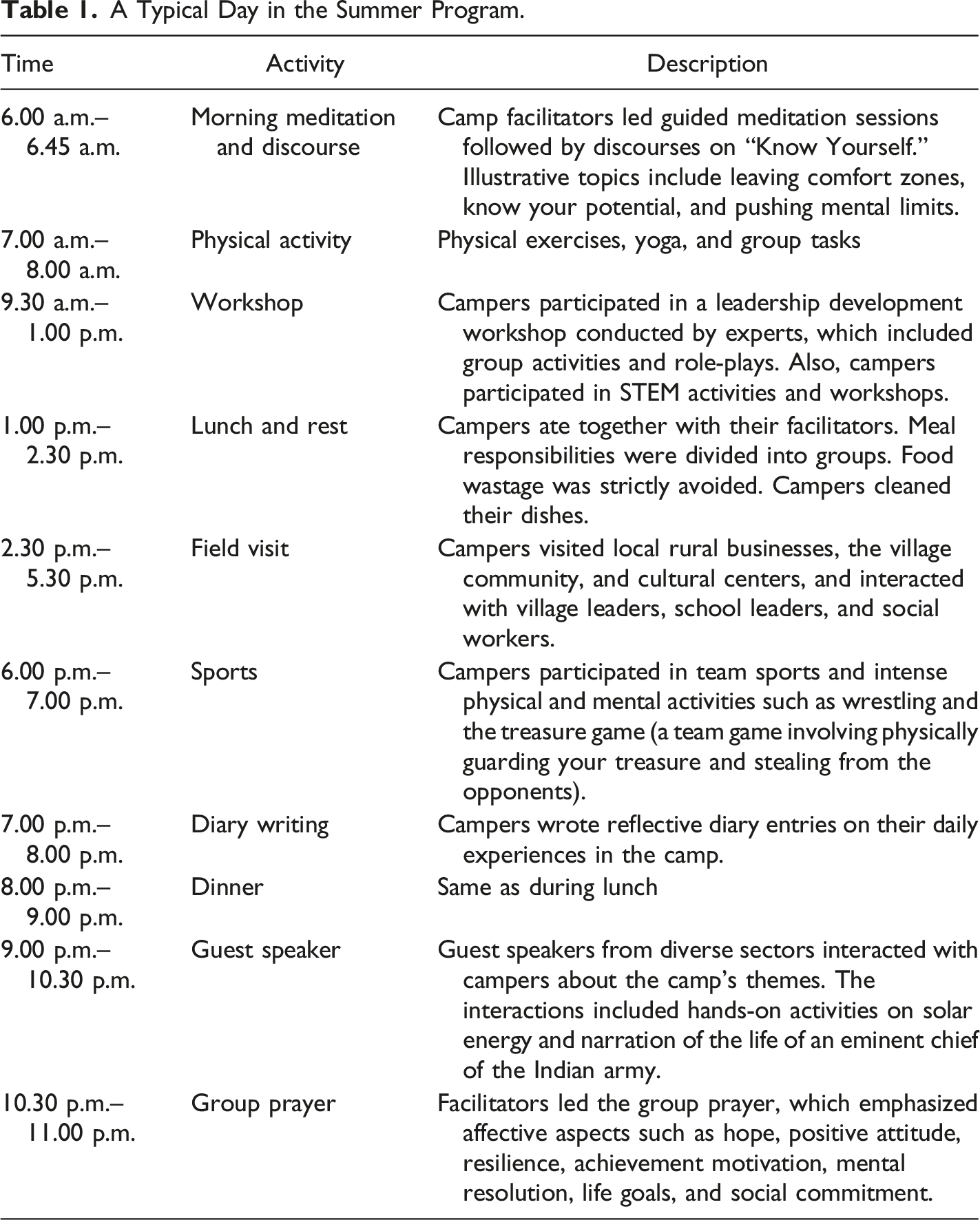
Our data were collected at an outside-of-school talent development program in Western India. The program enrolls children with intellectual gifts and talents from urban middle- and high-income families in Grades 6 and 7. The program component being researched involved a 4-day-long residential summer program. The 4-day residential program targets two themes, namely, know yourself (self-awareness and self-management) and know your society (social awareness and social responsibility). The program aligns with the Peterson Proactive Developmental Attention (PPDA) model (Peterson & Jen, 2018) and emphasizes affective services should be made available to individuals in anticipation of challenges they may face and prepare them to develop appropriate affective skills that promote individual growth and positive development (Colangelo, 2003; Erford, 2010; Hébert, 2011; Neihart et al., 2002; Peterson, 2002; Peterson & Jen, 2018).
A Typical Day in the Summer Program.
Participants
Fifty-five students in Grades 6 and 7 (Ages 11–13; 26 boys) participated in this study. The program required above-average or higher intellectual performance on three different standardized intelligence measurements: (a) the Prajna Shodh Test Battery (Jnana Prabodhini’s Institute of Psychology, 1992), (b) Raven’s Standard Progressive Matrices (Raven et al., 2000a, 2000b), and (c) the Indian Child Intelligence Test (Khire et al., 1992). Participants came from middle- and high-income families who had at minimum a college degree. Ninety-four percent of participants attended school in English, and the others studied in Marathi schools. None of these schools offered any exclusive gifted education programming, but most students attended additional outside-of-school programs besides the program being studied to pursue curricular and extracurricular interests.
Data Sources
Participants’ written, descriptive responses to the end-of-program reflection questionnaire were collected for analysis. The 16-item questionnaire (see Appendix) was designed for students to reflect on their camp experiences and what they learned. Example prompts included “If anything, what did you learn in the camp?” and “Tell us about the things that you think you are capable of doing now, which you could not do before you came to the camp.” This questionnaire was developed based on Jen et al. (2017) interview protocol, which served a similar purpose in their study of affective outcomes of students in a high-ability summer program. The use of written essays is particularly appropriate in the assessment of affective outcomes and has therefore been recommended by NAGC (2019).
Data Analysis
Participants’ written responses to the reflection questionnaire were thematically analyzed by the first and second authors (Braun & Clarke, 2006; Nowell et al., 2017). Specifically, we followed the six steps outlined by Braun and Clarke (2006) and coded the data collaboratively throughout the process. The authors met 34 times for a total of 54 hours to complete the data analysis. The decision to code collaboratively was made to establish an ongoing audit process and bias check for both authors. Because the first author was familiar with the program and culture of the participants and the second author was not, the collaborative process allowed them to critically examine the data from different perspectives and achieve consensus at each point of the analysis process. Throughout the data analysis process, the first and second authors documented analytical decisions clearly to keep track of the development of all concepts and themes (i.e., analytical memos). We have interwoven the discussion of other measures taken to enhance the trustworthiness of our findings (Lincoln & Guba, 1985; Madill et al., 2000) in the description of our analytical approach presented below.
Step 1 of our thematic analysis involved familiarizing ourselves with the data by reading the data multiple times and discussing and documenting our initial thoughts. We also used this time to organize the data in Nvivo.
Step 2 involved generating initial codes. We used brush coding to classify student responses in one of three general affective outcome categories: “emotional,” “social,” and “motivational.” We also brush-coded responses to classify responses per survey question. This allowed us to compile similar data excerpts from all participants into separate categories.
Coding References by Themes and Program Components.
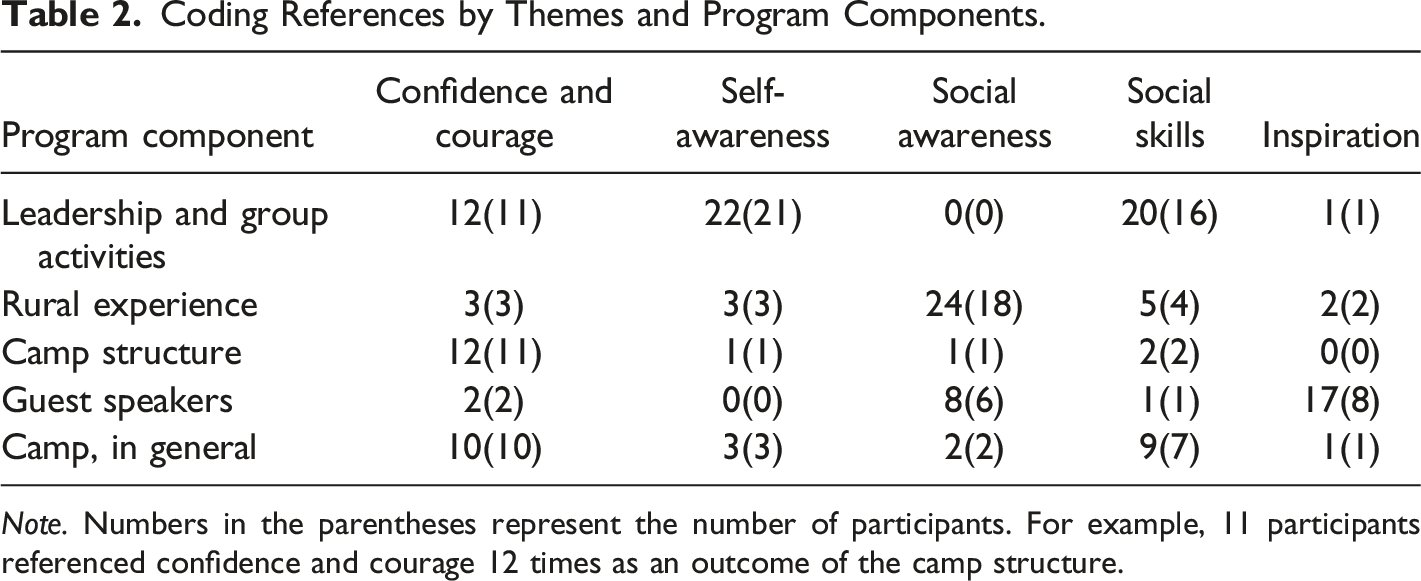
Note. Numbers in the parentheses represent the number of participants. For example, 11 participants referenced confidence and courage 12 times as an outcome of the camp structure.
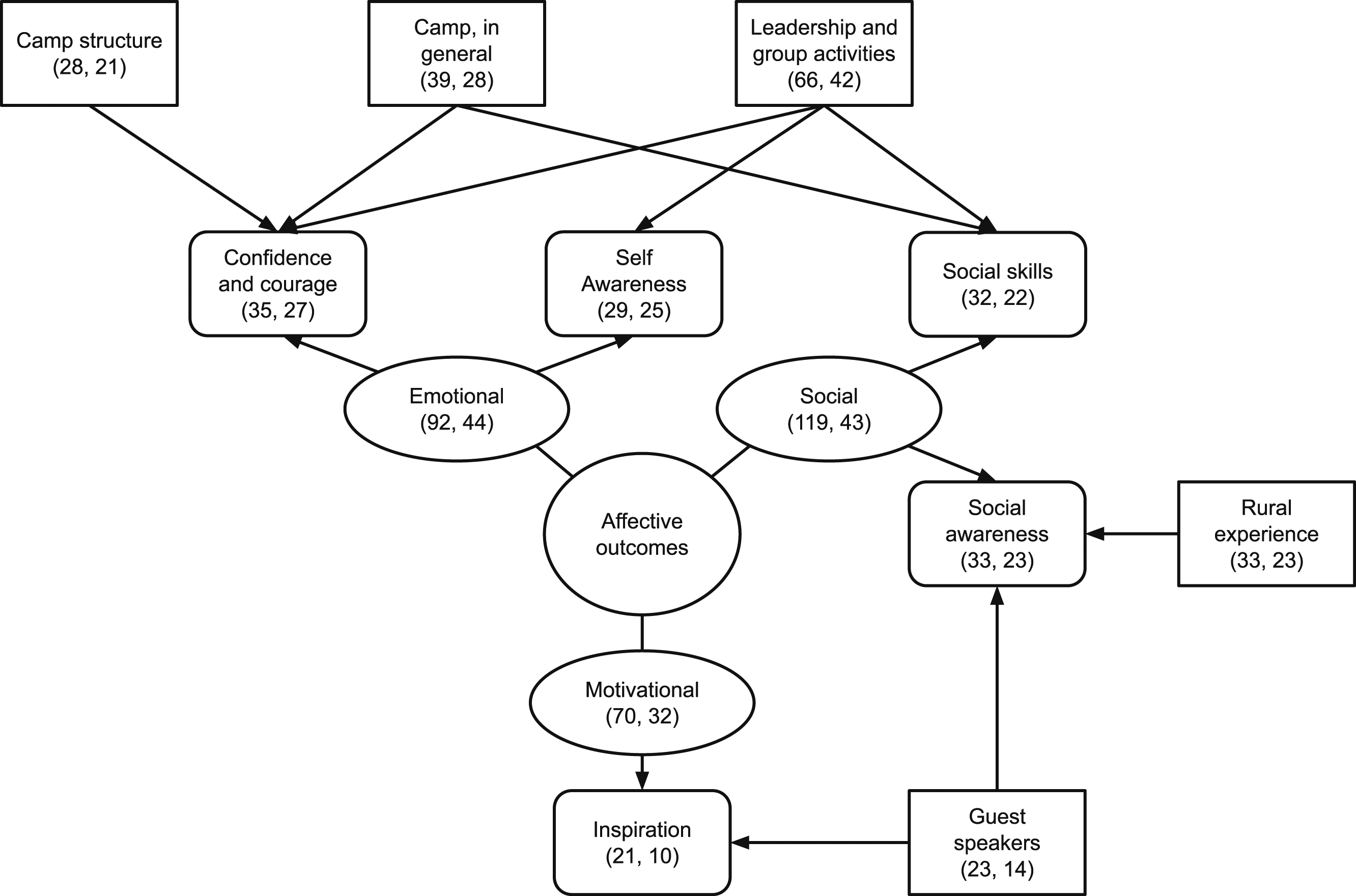
The final mind-map of affective outcomes and associated program components.
Step 5 then involved refining and finalizing the themes. At this stage, we critically examined all coded pieces within themes and across themes to ensure their fit. Once the first and second authors reached a consensus, the first author presented the analytical memos along with the final themes to the other authors for an additional audit process. After achieving consensus among all authors about the final themes, the first author reanalyzed the data with those themes in mind to locate additional evidence to identify the final, salient themes.
Our data analysis concluded with a final integrity check in which the first author presented the final themes to participants to verify they agreed that our themes represented their perceptions. This process is also known as member checking. Participants agreed that our final themes represented their perceived outcomes well. The sixth and last step of our analysis process involved selecting pertinent illustrative data extracts and writing up the results.
Results
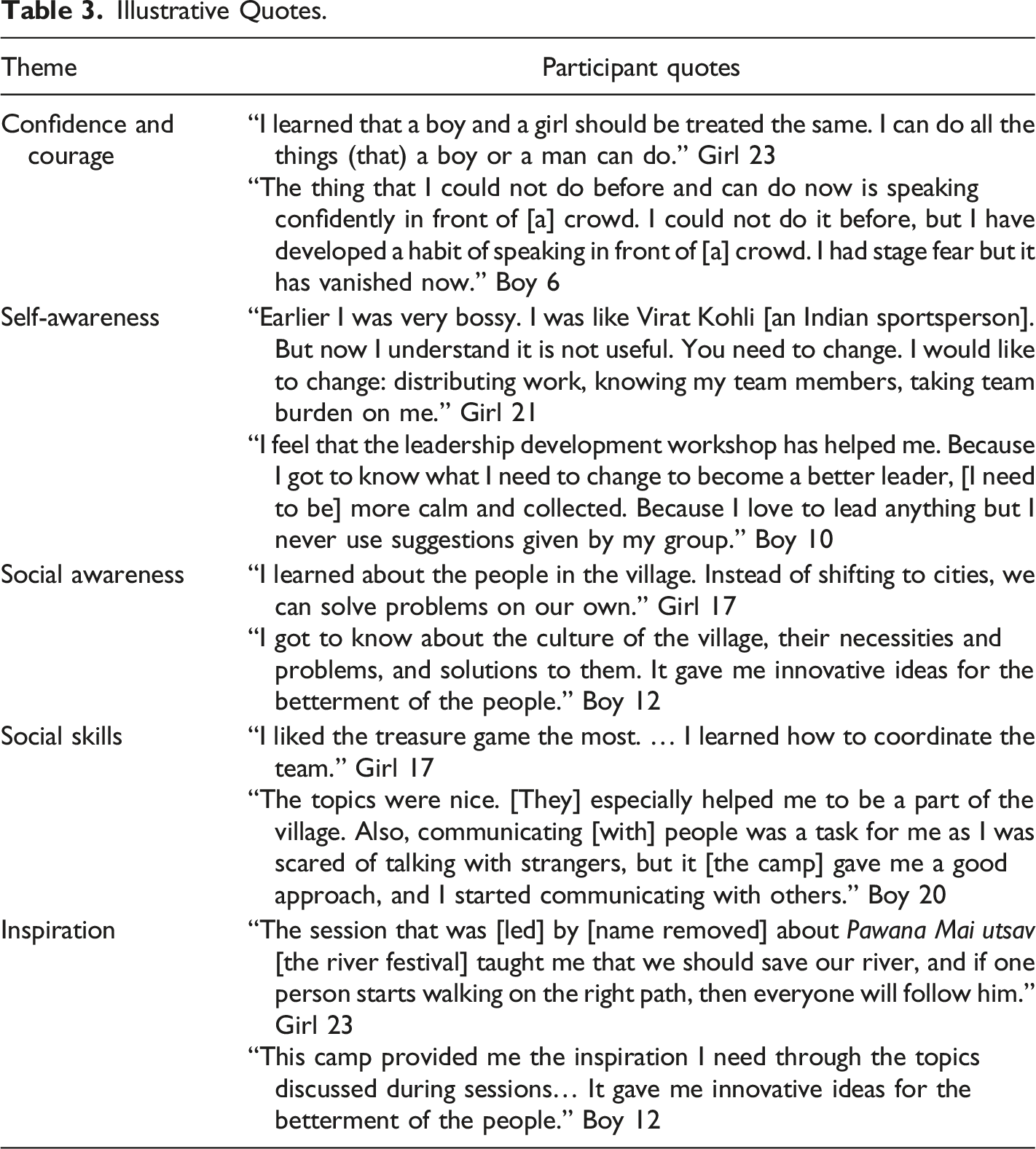
Illustrative Quotes.
Theme 1: Confidence and Courage
Participants most prominently discussed and showcased increased confidence and courage (35 references across 27 participants) due to their participation in program activities. Participants described instances from the camp that helped them develop courage, self-competence beliefs, and a sense of independence. For example, Girl 2 suggested: “Now I can independently live anywhere and take my own responsibilities. Due to this [program], I can adapt myself to any place. … Also now I am independent.” Later, she added: “I learned to be independent and take responsibility . . . eat everything everywhere, living with fewer facilities.” Girl 1 illustrated her enhanced self-competence beliefs: “I liked the electronics activity very much. By that, I came to know that I am capable of doing it.”
Our matrix coding shows that participants discussed confidence and courage most in relation to camp structure (12 references) and leadership and group activities (12 references). For example, one participant discussed how self-reliant behavior expectations as part of the camp structure improved his confidence: “I became confident of leading a self-dependent life in which we wash our own plates and eat food we dislike” (Boy 21). Many camp responsibilities, such as serving food, were divided among campers, and the campers cleaned their own dishes and made their own beds. In addition, all campers were grouped into four groups and were given various group activities throughout the camp, which created opportunities for group leadership roles. Boy 21 further wrote: “I had never wondered to become a leader or captain of any group. But using these qualities [discussed in the leadership workshops] and after becoming the group leader for [4] days in the camp, I have had enough experience that can definitely cheer me up to become a good leader,” illustrating the direct impact the leadership workshop and group activities had on his confidence and courage.
Theme 2: Self-Awareness
The second theme we identified captured participants’ discussion of increased self-awareness (29 references across 25 participants). Generally, participants were increasingly able to identify areas for personal growth. For example, Girl 2 wrote: “I would like to change the habit of getting angry at the people in the group for silly reasons. … Also, I would enhance my positive thoughts and be confident.” The camp provided numerous opportunities for participants to reflect on their habits, attitudes, and behaviors, which seemed to help develop better self-awareness. A majority of the participants (22 references; 21 participants) discussed their increased self-awareness in relation to the leadership workshops where reflection was central: “To be a leader, I must be cool-minded because at home if I don’t find something I get frustrated and angry. … I should have a positive attitude because I think negatively” (Boy 3).
Theme 3: Social Awareness
Participants (33 references across 23 participants) frequently acknowledged and showcased social awareness in their post-camp reflections. A key part of the curriculum was oriented toward increased understanding of rural life, which encouraged participants to become aware of rural settings including people and places. For example, Boy 8 wrote: “the program gave us an insight at the rural lifestyle and also the small discussion with the Sarpanch [head] of Darumbre [name of the village] was a glance at the rural government.” Nineteen participants wrote the rural experience contributed to their improved social awareness. For example, Girl 1 wrote: “I learned the difficulties in the rural areas [and the] schedule of people over there” and Boy 9 concurred: “I learned … how the outside world really is. What are the problems faced by people and their solutions.”
Theme 4: Social Skills
The program’s emphasis on leadership development and group work resulted in participants reporting increased social skills (32 references across 22 participants). Sixteen participants identified improved social skills as a direct outcome of participating in leadership workshops and group activities during the camp. Boy 8 reported: “Working in a group certainly enabled me to practice my leadership skills and allowed me to get along with people to whom I spoke with less in the past. This helped me to understand that cooperation is the topmost priority while working in a team.” Girl 14 concurred: Working in the group was enjoyable. ... We had to work in teams, so everyone had to help and support everyone. I learned to work in teams properly, which is a change in me. Even while playing, if someone made a mistake, no one complained about it. Instead, everyone would motivate [the team members] to do better. That was a sign that the group was working properly and together.
Theme 5: Inspiration
The fifth and final theme we identified was that participants (21 references across 10 participants) reported they left the camp inspired. Most of these inspiring experiences came from participants’ interactions with guest speakers (17 references across eight participants). For example, Boy 4 reflected on his experience listening to guest speakers: “These people who [give] the sessions inspire me. They tell us about their hard life, like what work they did. . . . I was like wow you did that?” Boy 23 concurred: “The session topics covered in this camp were quite good. Rather, they were a perfect blend of inspiration, aspirations, and motivation. For example, the work schedule was just astonishing and greatly inspiring.” Girl 15 found herself inspired to pursue social work: “The talks held by the people were very inspirational and gave us a different way of thinking. The inspirational words have made me think of social work which is very beneficial for people.”
Discussion
In the present study, we explored the affective outcomes students perceived from participating in a residential summer program and the program components that contributed to participants’ perceived affective development. Our findings indicate that a direct and well-planned affective intervention can enhance gifted and talented students’ summer enrichment program experiences and provide opportunities for social and emotional learning. Previous research (Jen et al., 2017) established the positive effects of a small-group discussion-based intervention administered as a separate component of an academic summer enrichment program. We are one of the first to examine the effects of a holistic approach to affective interventions in which the affective intervention is integrated with the cognitive and physical components. Our positive findings indicate the potential effectiveness of such a holistic approach to the development of affective interventions. Hence, our findings extend previous research on affective interventions and, in particular, holistic approaches such as the one studied here and confirm that targeted interventions implemented as part of summer enrichment programs may be particularly effective in developing students’ affective skills (e.g., Desmet & Pereira, 2022; Jen et al., 2017; Lee et al., 2015; Matthews & McBee, 2007; Wu & Gentry, 2014).
Specifically, our findings indicate students’ perceived increases in confidence, courage, and inspiration. Previous research conducted with U.S. populations found similar results (Jen et al., 2017; Lee et al., 2015; Wu & Gentry, 2014). Because our study was conducted in India, our findings suggest an enhanced transferability of previous research findings on the affective outcomes of summer programs across countries. In addition, our findings show that the summer enrichment program may have helped students develop self-awareness, social skills, and social awareness, which are among the key competencies of social and emotional learning (SEL; Collaborative for Academic, Social, and Emotional Learning, 2018; Dusenbury et al., 2019; Payton et al., 2000). This finding is particularly notable given that the vast amount of research showing SEL competencies can positively influence academic outcomes (January et al., 2011; Corcoran et al., 2018; Durlak et al., 2010; Sklad et al., 2012), school success (Zins et al., 2007), mental wellness (Cook et al., 2015; Taylor et al., 2017), healthy relationships (Crooks et al., 2015; Wolfe et al., 2012), and life success (Oberle et al., 2016).
Most notably, the present study extends existing research on affective interventions by exploring specific program components and processes that contribute to students’ perceived affective outcomes. For example, participants described the self-reliant behavior expectations and physically challenging group games as the biggest boosters of confidence and courage. This implies the residential nature of the program and the opportunities to engage in challenging tasks can be useful in developing confidence and courage (Lee et al., 2015).
Further, participants associated increased social awareness with their interactions with guest speakers and exposure to rural experience. Therefore, our findings provide some support for experiential learning activities to promote gifted students’ affective development (Desmet, 2022; Keen & Howard, 2002; Lee et al., 2007). In our study, guest speakers from diverse sectors interacted with campers about their work in the rural sector. These interactions included hands-on activities on solar energy, the narration of life experiences of social service, and conversations with the village head. These camp activities may have enhanced students’ social awareness by giving them opportunities to socially interact with places and people in real contexts. Therefore, summer programs aiming to develop social awareness may benefit from planning for community engagement and service learning (Desmet, 2022; Desmet & Roberts, 2022), especially with people and places that reflect different realities than the campers’ regular life experiences.
Our findings also showcase the perceived benefit of a well-designed and intentional leadership development program to enhance the leadership and group skills of students with gifts and talents. The finding is critical to gifted education given the strong association between typical traits of giftedness (e.g., high intellectual functioning, advanced emotional and social interests, civic awareness, and civic engagement) and leadership functions (Bruce-Davis et al., 2017; Lee et al., 2021; Lee & Olszewski-Kubilius, 2016; Matthews, 2015). Researchers (Feldhusen & Kennedy, 1988; Lee et al., 2021) have suggested that leadership training may be a useful addition in summer programs—and programs, in general—involving youth with gifts and talents; however, leadership development has not received much attention in the field (Matthews, 2015). Finally, our findings reaffirm that a summer program offers opportunities for students to develop new friendships (Cross et al., 1991; Jen et al., 2017; VanTassel-Baska et al., 1984) and engage in social interactions (Wu & Gentry, 2014).
Limitations
The research involved analyzing existing data, namely students’ written reflections in response to a program evaluation survey. This presented several limitations. First, the depth and quality of our data were dependent on students’ ability to express themselves in written English. Although a majority of the students attended school in English, they were not native speakers of English, which may have interfered with their ability to express their thoughts in written English. Several students occasionally used Marathi (their native language) terms in their reflections and a few students completed the entire reflection in Marathi.
Second, we did not have the opportunity to ask students clarifying or follow-up questions. At times, students would imply growth or change without explicit detail, making it challenging to accurately interpret the meaning behind their words. Therefore, the first and second authors carefully monitored the coding process, to ensure we did not infer meaning beyond what was written. This resulted in not coding some pieces of data because they were simply too vague. However, based on our member checking procedures, this did not interfere with accurately representing students' perceived affective outcomes.
Third, the data involved critical self-reflection. The ability to self-reflect develops over time and with practice. Our participants were in Grades 6 and 7 at the time of data collection. Typically, at this age, students are improving their ability to self-assess and becoming increasingly self-regulated. So, not all participants may have mastered critical self-reflection skills yet. However, self-reflection was a key objective of the program, so students did have some practice.
Fourth, some of the program evaluation questions were designed to solicit explicit feedback regarding program components. Therefore, readers should note that in some cases students were asked to directly reflect on camp components and the outcomes they had.
In addition, this research has some general limitations that are inherent to qualitative research and should therefore be acknowledged as well. The purpose of a qualitative inquiry is not to generalize conclusions, but rather to transfer meaning to similar contexts. Therefore, readers should note the unique program that was evaluated and the context in which it was evaluated. In particular, readers should note that this study was conducted in Western India with students in sixth and seventh grades who participated in a yearlong program together. Similarly, the participants were from middle- and high-income and moderate- to high-education households. A different sample, even within India (e.g., Chowkase, 2022), may have yielded different results, and the findings of this study can only be transferred to similar contexts, programs, and participants. Additional research on perceived affective outcomes of enrichment programs is necessary to generalize findings.
Implications and Future Directions
The findings of this study offer valuable insight for researchers and educators interested in holistic talent development programming and contribute to the limited literature on designing and evaluating affective interventions for gifted youth. Our results show that a short, yet intense summer program focused on affective skills may contribute to increased emotional, social, and motivational development in students. The present study also indicates the triadic framework consisting of a proactive and holistic approach to affective development, underlying our intervention has the potential to be successful. Future studies should further explore the effectiveness of the triadic framework, especially by focusing on the prolonged aspect of the framework, and our specific intervention with a variety of participants and in a variety of contexts to further establish the transferability of findings. Additionally, it may be of interest to conduct follow-up studies or conduct longitudinal studies to establish the long-term effects of participating in this affective intervention.
A unique contribution of our findings lies in the exploration of what specific program components resulted in each of the various affective outcomes as experienced by our participants. Therefore, the findings of this study may help future researchers and educators to design effective affective interventions. For example, our findings indicate several benefits of implementing residential programs, experiential learning experiences, and leadership development training for addressing various affective objectives. Educators should carefully consider the possible benefits of these program components when designing affective interventions. Moreover, future studies could further explore additional camp components and may want to quantitatively establish the added value of various camp components to create concrete, evidence-based suggestions as to how best to address various affective learning objectives.
Footnotes
Acknowledgments
We thank Kameryn Graham and Rosieana Johnson at Valdosta State University for their help with identifying relevant literature and quotes and formatting the manuscript.
Declaration of Conflicting Interests
The author(s) declared no potential conflicts of interest with respect to the research, authorship, and/or publication of this article.
Funding
The author(s) received no financial support for the research, authorship, and/or publication of this article.

Appendix
Student Questionnaire: Feedback on the Residential Summer Camp 1. Tell us about your overall experience at this camp. 2. What did you like the 3. What did you like the 4. Was there something you wanted to do at the camp that we did not plan? 5. What is your opinion about the topics discussed in the camp? 6. What is your opinion about the activities/sessions conducted in the camp? 7. Tell us about a moment in the camp that you will probably remember for a long time. 8. Tell us about your experience in the leadership development workshop. What would you like to change/develop in you to become a better leader? 9. Describe your experience of working in your Pathak (group). 10. What is your opinion about the routine of the camp? 11. Tell us about your experience of the morning Upasana (Meditation). 12. Tell us about your Tai and Dada (facilitators). How would you describe them as facilitators? 13. If anything, what did you learn in the camp? 14. Tell us about the things that you think you are capable of doing now, which you could not do before you came to the camp. 15. What challenges, if any, did you face in the camp? How did you overcome them? Whom did you approach, if you needed help in that? 16. What would have made this camp a better experience for you? What would you like us to change about this camp? Activities? Topics? Routine? Place?