



Abstract
This exploratory study investigated the perceived waiting time of gifted high-achieving honors students at their university and compares this to the perceived waiting time these students experienced in secondary schools. The study aimed to find reasons for, experiences with, and coping strategies for waiting time in classes at these two types of institutions. Interviews with gifted university students were conducted and qualitatively analyzed. Results show that waiting in classes is common both in secondary schools and at the university level, and students usually attribute this to poor quality of teaching. However, students also highlighted differences in the amount of time, reasons, and coping strategies for waiting due to the different nature of the institution types. Experiences of waiting depended on a variety of reasons outlined by students participating in our study. According to this, students preferred behavioral-avoidance strategies for coping in waiting situations. They rarely asked their teachers for extra tasks, even if they felt bored or underchallenged. This highlights the importance for teachers to recognize and respond to coping strategies of gifted students.
Waiting causes inconvenience, reduces productivity, and leads to frustration and stress (Nie, 2000). Nevertheless, it is an inescapable part of life, and this waiting phenomenon is also common in classrooms (Coleman et al., 2015; Peine & Coleman, 2010). This might be even more true for gifted students. Gronostaj et al. (2016) showed that gifted students have above-average abilities that, among other issues, allow them to acquire new knowledge quickly and to understand new concepts at once. Moreover, nearly all gifted students were disappointed in school and felt like they were wasting their time because they already knew the content that was being taught (Gronostaj et al., 2016). This is in line with research that gifted students often know 40–60% of the content that is being taught (Coleman & Cross, 2005). Additionally, gifted students are usually fast learners, need minimal instructions, and have excellent memories (Harrison, 2004). Keeping these research findings in mind, it is reasonable to assume that gifted students have long periods of waiting in their classes. DeLandtsheer (2011) observed that the majority of gifted students spent nearly 20% of their time waiting in regular classrooms. This agrees with the research conducted by Hinterplattner et al. (2020), which showed that the gifted students on average were waiting 26% of their time in class. In comparison, regular students waited in average 8% of their class time (Hinterplattner et al., 2020). Unfortunately, research about gifted students’ waiting in classes is rather limited (Peine & Coleman, 2010). To contribute to this gap in research, this study investigated experiences of gifted high-achieving honors students and their perceived waiting.
In this study, the terms gifted, high achieving, and honors are used and defined as follows: Gifted students are defined as having above-average abilities. High-achieving students show academic performances such as good school grades or strong results at academic competitions. Honors students are participants in special honors programs at a university, designed for students those who are both willing and able to go beyond their regular program (Clark & Zubizarreta, 2008; Wolfensberger, 2012, 2015).
To further explore the experiences of gifted high-achieving honors students and their perceived waiting, it would be helpful to know the reasons students are waiting in their classrooms. It is also necessary to understand these reasons to be able to conduct further research, exploring means of reducing possible waiting for gifted and regular students alike. Therefore, this study aimed to fill this research gap by investigating the reasons behind waiting in classes. These reasons can be further investigated to deepen our understanding of the effects of different waiting occurrences on students and their connections to boredom. According to various studies, if students experience boredom, it can lead to unsatisfying behaviors; for instance, Raffaelli et al. (2018) found that boredom is consistently related to negative psychological effects. Nevertheless, only a few researchers have addressed students’ experiences with waiting in secondary schools. After reviewing the literature about students at the university level, there is not much focused on their experiences with waiting. Therefore, it was necessary to initially explore students’ experiences with waiting in secondary schools. If these experiences relate to the literature on waiting in secondary schools, a transfer of these results from known literature onto the experiences with waiting of university students might be possible. It is important to take into consideration that all students in this study were high achievers, which means that if they had to handle waiting it would be reasonable to assume that they have found strategies enabling them to achieve highly in school. Therefore, it would be necessary to examine which strategies were used in secondary schools and at university when students are confronted with waiting.
Consequently, one of the purposes of this study was to describe and categorize reasons for, experiences with, and coping strategies for waiting time of gifted high-achieving honors students in classes. In particular, the differences that students mentioned between these aspects at university and looking back to secondary school will be examined. Thus, this study aims to close a gap in research by contributing to the following questions: 1. Reasons for Waiting: Which reasons do gifted high-achieving honors students give to describe for waiting in secondary schools and at university? 2. Experiences With Waiting: What are the perceived experiences of gifted high-achieving honors students with waiting in secondary school and at university? 3. Coping Strategies for Waiting: Which strategies do gifted high-achieving honors students use to deal with waiting during classes in secondary school and at university?
Waiting in Classrooms
Reasons for Waiting in Classrooms
Peine and Coleman (2010) categorized the reasons why gifted school students waited in classrooms into three clusters: School/Classroom Structure, Instructional, and Assignment. The School/Classroom Structure cluster includes all waiting situations that occur due to the nature of the school and the classroom, like waiting for the teacher to come to class, discussing organizational issues in class, or rearranging chairs to form a circle. Instructional Waiting happens when new content or a new process is introduced that is already known for students, especially gifted students. Assignment Waiting is the time in class when students are required to wait because they have already finished their assigned tasks faster than other students and no additional tasks are available (Peine & Coleman, 2010).
Hinterplattner et al., 2020 discussed these three clusters with 15 gifted students from secondary schools. These students could confirm findings of Peine and Coleman (2010), but results showed that, based on student data, these clusters were not sufficient. Categories then were changed from School/Classroom Structure to Organizational Issues, Instructional to Advantages in Knowledge, and Assignment to Higher Task Speed. Moreover, explanations of content in general or a process not needed for the students were added in the cluster of Advantages in Knowledge. This does not have to be new material like in the Instructional Waiting reasons described by Peine and Coleman (2010), but it also includes materials that are repeated without students themselves finding it useful. For example, explanations by teachers that are repeated without any additional information or many similar exercises that should be done by students. Additionally, students described reasons that, in their opinion, were not assigned to one of the clusters, such as watching movies in classes without any connection to the class or listening to teachers telling private stories (Hinterplattner et al., 2020).
Experiences With Waiting in Classrooms
Peine and Coleman (2010) interviewed 16 gifted students ranging from elementary to middle school. In these interviews, two thirds of students described waiting as a negative experience. Similar results were found by Hinterplattner et al. (2020): Hinterplattner et al., 2020: All students reported negative experiences with waiting in their classrooms. In sum, students described that 74% of their waiting time was perceived as negative; in contrast, just 7% of their waiting was described as positive and 19% as neutral experiences. Students mentioned that their negative experiences led to a loss of motivation for going to school or to feeling bored (Hinterplattner et al., 2020).
Other research confirms that the outcome of waiting can be boredom (Adams-Byers et al., 2004; Peine & Coleman, 2010). In fact, boredom is the most frequently word used by gifted students when they think about waiting in classrooms (Kanevsky & Keighley, 2003). Boredom can lead to unsatisfactory behaviors, underachievement, and school dropout (Craig et al., 2004; Forbes-Riley et al., 2011; Piske et al., 2016). Boredom is consistently related to negative effects, task-unrelated thoughts, overestimation of elapsed time, and reduced agency, as well as over and understimulation (Raffaelli et al., 2018). It is universally conceptualized as “the aversive experience of wanting but being unable to engage in satisfying activity” (Eastwood et al., 2012, p. 482). Research shows that boredom arises if students perceived themselves as having too much or not enough control over their situations and/or if they perceive a situation as being of low value, meaningless, or irrelevant for their needs (Pekrun et al., 2007, 2010). This principle is also visible in the theory of the three pillars of honors education. A successful honors student support structure needs the creation of a community, the offer of bounded freedom, and the enhancement of academic competences (Wolfensberger, 2012).
Coping Strategies for Waiting in Classrooms
Overview of the Four Basic Categories of Coping Strategies for Boredom With Explanations and Examples.
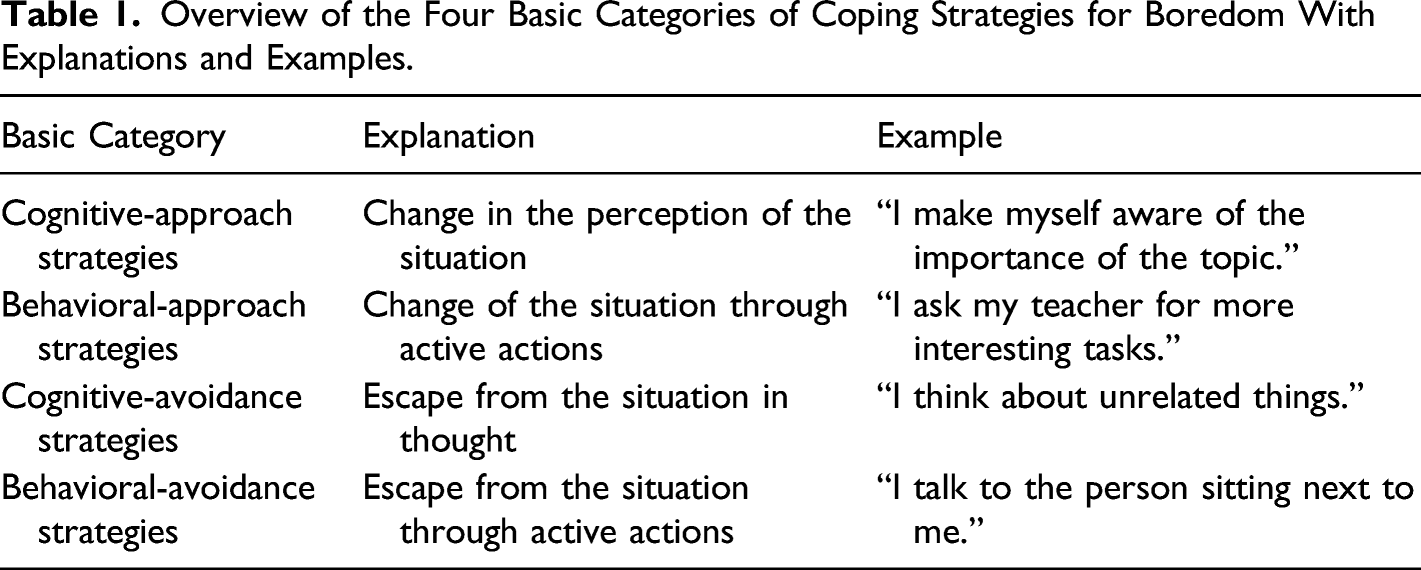
Research on coping strategies for boredom shows that Cognitive-Approach Strategies are the most effective strategies in decreasing boredom (Götz et al., 2018; Nett et al., 2010). Students who primarily use Cognitive-Avoidance and Behavioral-Avoidance Strategies report the highest levels of boredom (Nett et al., 2010). Götz et al., 2007 asked students in their study what they would have liked to do when they experienced boredom in classes and what they really did to cope with the boredom. Students preferred to escape the boring situations with avoidance-coping strategies even though these strategies are not seen as beneficial for decreasing boredom or to increase learning and achievement outcomes (Götz et al., 2007).
This paper contributes to this body of knowledge by providing insights from gifted high-achieving honors students to identify the reasons for waiting in secondary schools and at university, the perceived experiences with waiting at both institutions, and the different strategies they have been using to deal with waiting during classes in secondary school and at university.
Methodology
Participants
Overview of the Participants of the Study.
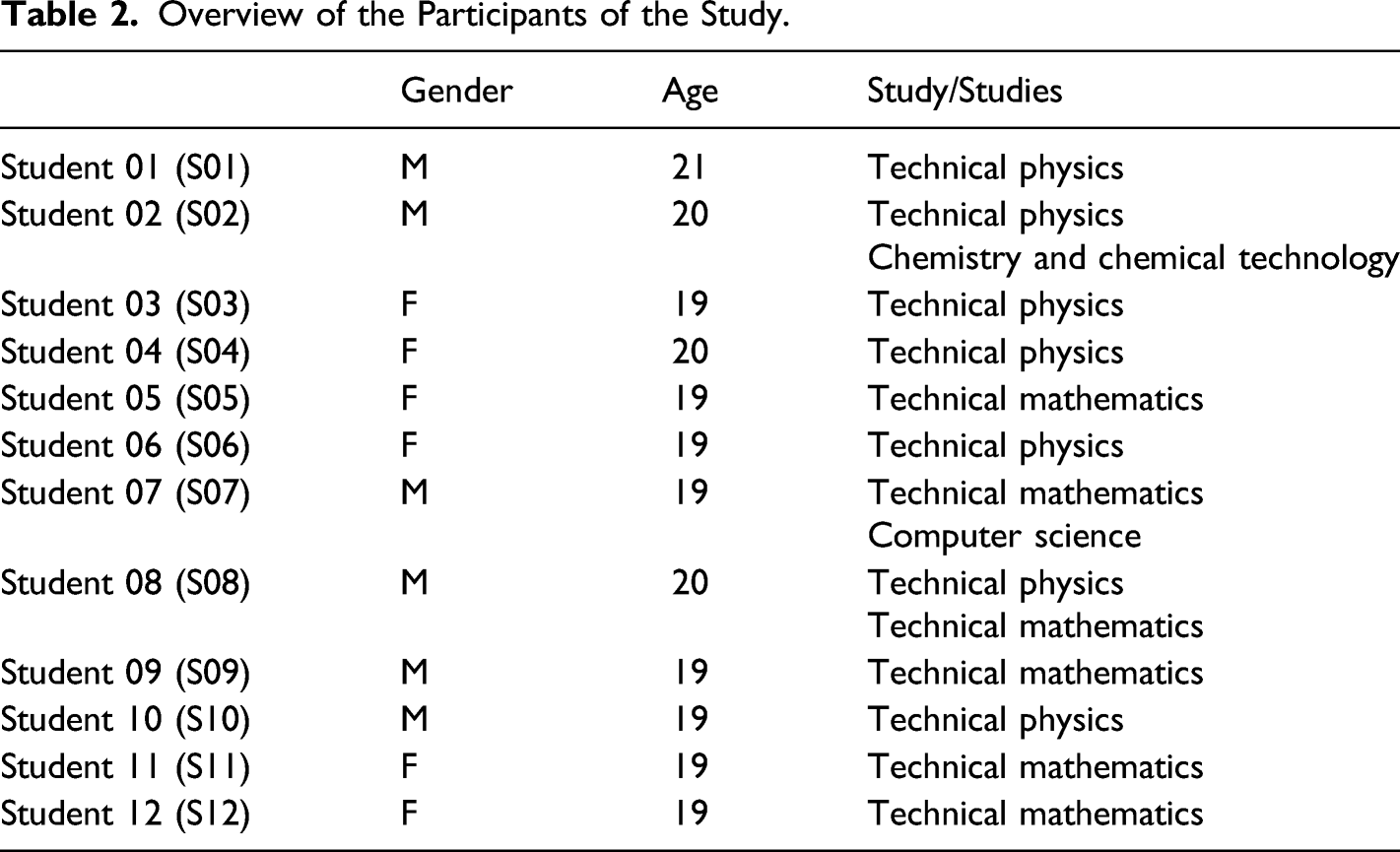
Students were asked for their permission to be included in this research and all signed a written consent. All data were handled anonymously and kept confidential in line with ethical considerations described by Jennings (2012).
Context
Students selected for the interviews were all members of the university’s honors program. An honors program is designed for gifted university students who have the motivation and ability to work beyond what their regular programs offer (Clark & Zubizarreta, 2008; Wolfensberger, 2012, 2015). This includes not only academic challenges, but also aspects that contribute to their personal development and their interdisciplinary thinking. These programs have clear admission criteria and clear goals (Wolfensberger, 2015). To become part of the honors program at the university, students have to apply with a short essay about their motivation for joining the honors program. After applying, all suitable candidates are invited to individual interviews. Students are seen as suitable when their essays show motivation for the program, but their grades or other test scores are not taken into consideration. The interviews were performed by experts in the field of gifted and honors education. The purpose of these interviews was to get to know the students and to understand their motives behind applying for the honors program. The deciding factor in the selection process to the honors program was based on the motivation for doing additional and challenging work that would not be necessary for students who just have the goal of finishing their studies. The honors program at the university open for students from all study fields. They receive information about the program in their introductory classes when starting at university. However, all applications were from students studying in the STEM field even though there are three other majors at this university. This may be attributed to the fact that the majority of talent development programs in secondary schools in Austria focus on STEM fields. In fact, all students who applied for the honors program at the university have participated in talent development programs in their secondary schools and viewed the honors program as a continuation of these programs. The program offers additional classes to the students’ regular classes at university making up 10% of their total classes. Attendees of the additional classes are all participants of the honors program. In their regular classes, the students from the honors program are together with non-honors-program students.
Data Collection
All participants from the second year of the honors program were asked, and accepted, to participate in this study. Details about the methodology, research questions, and ethical issues were shared beforehand. The participation was voluntary and without any acknowledgment in their honors program or their regular studies. The interviews took place at the university in a quiet atmosphere and were conducted and recorded by the first author of this paper, who has the responsibility for the honors program at the university. Therefore, all students knew the interviewer and were used to discussing their experiences with her. A qualitative approach was chosen to get deeper insights into the topic than a questionnaire can offer (Hennink et al., 2010). The structure of the study was discussed with experts in educational research. The number of interviews was considered sufficient given that the aim of the interviews was to understand the common perceptions and experiences of a rather homogeneous group of individuals (Guest et al., 2006). The expectation of homogeneity was based on the facts that all students are gifted high-achieving students with very ambitious goals in the STEM field. This assumption was seen as sufficient at the data analysis after discussion with experts in educational research because of the saturation of the answers (Guest et al., 2006). Each interview was semistructured, starting with inviting students to talk about their experiences in secondary school. If they did not mention the reasons or the coping strategies for waiting, they were asked to elaborate on these topics. After talking about these experiences in secondary school they were asked the same questions about their experiences at university and about the differences to their experiences with, reasons for, and coping strategies for waiting in secondary school. The interviews lasted around 45 min, varying due to differences in the level of details given in the answers. The questions were in line with the methodology of grounded theory and accordingly exploratory semistructured interviews (Glaser & Strauss, 2005). Every interview included the following topics that were discussed in different depths: associations with time in school/at university, experiences with waiting in school/at university, reasons for waiting in school/at university, coping strategies for waiting in school/at university, perfect situation in school/at university, and differences between time in school and at university.
Data Analysis
The data analysis was conducted by the authors and supported and supervised by experts in the field of educational research and gifted education. This approach was chosen to ensure the study’s relevance and scientific value. In this process, recorded interviews were transcribed verbatim and subsequently subjected to content analysis. To categorize the transcripts, a codebook was developed. For this, a standard iterative process was used in which a code was defined by six basic components: the code, a brief definition, a full definition, guidelines for when to use the code, guidelines for when not to use the code, and examples (MacQueen et al., 1998). Transcripts were coded and categorized by the three authors based on the literature review to get the information relevant to this study: reasons for waiting in classes, experiences with waiting in classes, and coping strategies for waiting in classes. These categories exist for both students’ waiting in secondary school and at university. Discrepancies between the coders were discussed within the author group and to identify the reasons for disagreements. These reasons for disagreements were then analyzed by experts in the field of educational research and gifted education, resulting in adaptions of the codebook to clarify these discrepancies. To answer the first research question with regards to reasons for waiting in classes, the data connected to this category were used. In line with the clusters of reasons for waiting, as described in the literature review, the reasons were categorized under these four clusters: Organizational Issues, Advantages in Knowledge, Higher Task Speed, and Other. These categorizations were analyzed to show which reasons and/or which categories occur in secondary school and at the university and moreover which reasons and/or categories occur only in one of the institutions or not at all. To find answers to the second research question, the codes connected to experiences were used. It turned out to be useful to categorize the experiences under the clusters for waiting reasons (Organizational Issues, Advantages in Knowledge, Higher Task Speed, and Other) because experiences substantially varied for different reasons. Furthermore, it was necessary to define if the described experience was positive, neutral, or negative. Because of the clarity of the honors students’ statements, discussions about the characters of individual experiences were assumed obsolete. So, if students added, for example, that they liked the situation of waiting it was characterized as a positive experience. Codes connected to coping strategies were categorized in line with the research about coping strategies for boredom as described previously: Cognitive-Approach Strategies, Behavioral-Approach Strategies, Cognitive-Avoidance Strategies, and Behavioral-Avoidance Strategies. It was examined if the coping strategies for waiting fit in the categories of coping strategies for boredom or if there were (serious) differences. Moreover, it was examined if the students chose the same (category of) coping strategies for boredom and waiting or if they preferred other (categories of) coping strategies for waiting than for boredom. Furthermore, the institutions’ influences on coping strategies were examined. Interviews were conducted in German and quotations used in the results were translated by the first author of this study.
Transcribed text that could not be related to any of the codes or to a new code that would be relevant for this study were removed from further analysis. The qualitative analysis software MAXQDA (2018) was used to assist in the qualitative content analysis. VERBI Software, 2018
Results
Interviews showed that all students connected their secondary school time with waiting. In fact, all students described experiences with waiting in secondary school classes: “School was a lot of doing nothing” (S01), “School is waiting” (S02), “Math was just waiting” (S05), “I waited 90% of my school time” (S06), or “The main thing I learned in school was being patient” (S12). This waiting was an everyday phenomenon in secondary school. However, unlike their time in school, waiting was not the main association when the students described their university life. Moreover, reasons for, experiences with, and coping strategies with waiting in classes were described as different between secondary school and university.
Reasons for Waiting in Classes
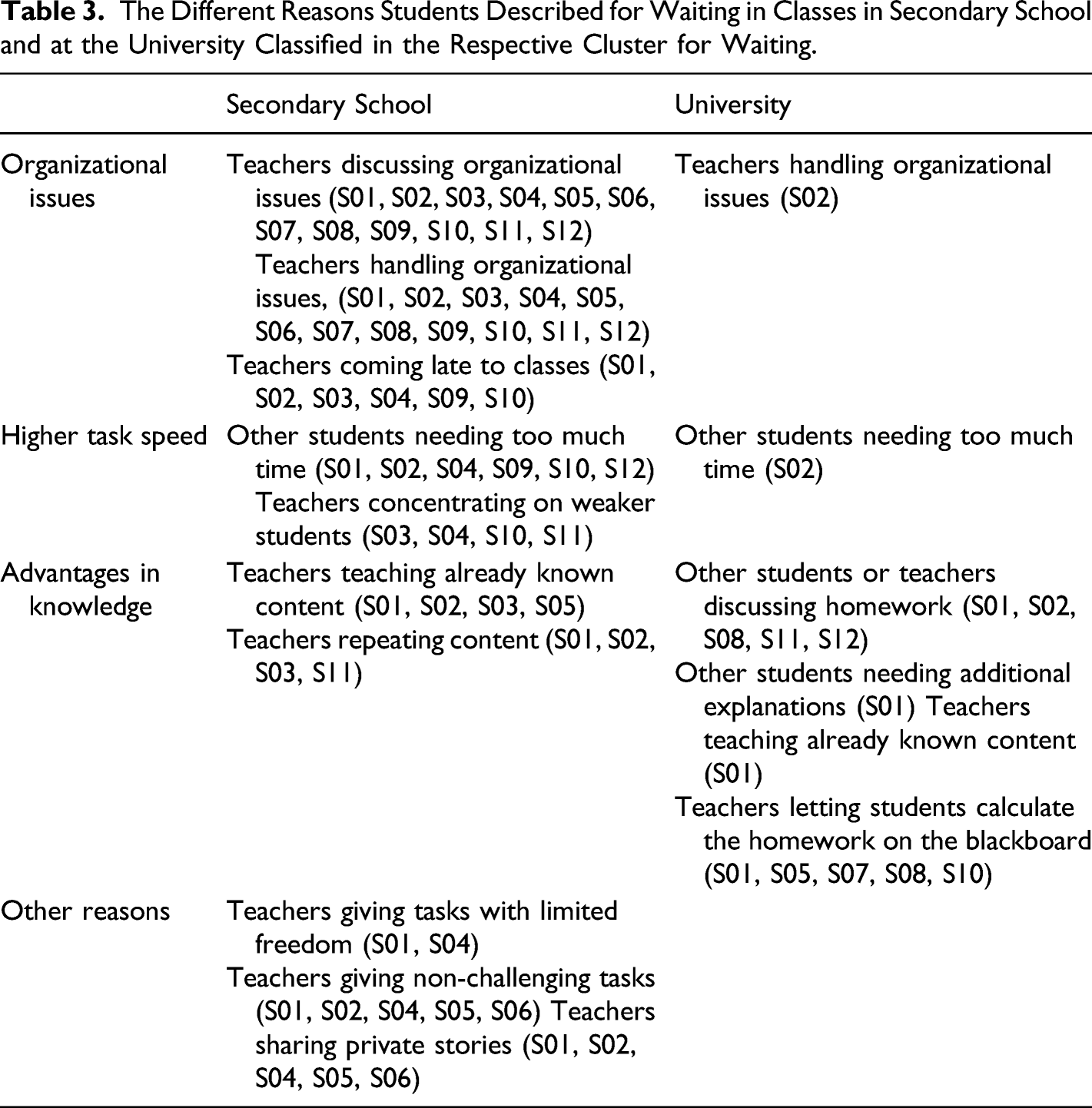
Students described that they had to wait because of poor teaching (S01, S02, S03, S04, S06, S07). For example, “The teacher did not aim to challenge students, he wanted to teach us all the same” (S01). This happened in secondary school as well as at university. But the main difference was that this phenomenon occurred very often in secondary school, but rarely at university. That was attributed to the voluntary attendance of the classes at university. In Austria, voluntary attendance is possible in most university-level classes. If a lecture was experienced as negative because of waiting, students simply stopped attending that lecture. Therefore, fewer waiting situations were perceived, resulting in waiting not being the main association with their university life. Students described various situations where poor teaching was the reason for waiting. These situations were all assigned to one of the clusters for waiting reasons: Organizational Issues, Advantages in Knowledge, Higher Task Speed, and Other Reasons.
Organizational issues
Waiting because of organizational reasons was mentioned by every student when talking about their time in secondary school. It was a common experience to wait for teachers to come to classes (S01, S02, S03, S04, S09, S10) or to discuss or handle organizational issues in classes (S01, S02, S03, S04, S05, S06, S07, S08, S09, S10, S11, S12). In contrast, while talking about university, organizational issues for waiting were only mentioned once by a student complaining about a teacher handling organizational issues in classes (S02). This can be attributed to the nature of the institution and was summarized by one student: “At the university no professor is late. Usually they are in the classes 10 min before the beginning, and they look at the watch to start exactly at the right second” (S03). It was also notable that none of the students initially mentioned organizational reasons for waiting when they were asked why they had to wait in secondary school or at university. All these statements occurred after specifically asking questions regarding organizational reasons for waiting.
Higher task speed
Similar to the organizational issues, waiting situations because of higher task speed were mentioned very often in secondary school by students (S01, S02, S03, S04, S09, S10, S11, S12). Examples included: “In math I waited 60% of the time, because it took so long for the others” (S02) or “We had a lot of diversity in the class and the teacher decided to focus more on the students with less abilities and follow their speed” (S11). However, these situations were not common at the university. This can be attributed to the voluntary attendance of classes at the university. Waiting because of higher task speed at the university was only mentioned once by one student: “I have one lecture with mandatory attendance, and I really wait there. We have not done anything where I had to think about the solution” (S02). In contrast to the organizational issues, the situations for waiting because of higher task speed were all reported by the students themselves without specifically asking questions about the different task speeds in class.
Advantages in knowledge
Waiting because of advantages in knowledge were mentioned by all the students when they were talking about their time in secondary school. For example, students said, “Most of the things were so obvious. I waited because the content we were taught was so easy” (S01) or “In mathematics (in secondary school) you do all the same over and over again. It is the same you already did 3 weeks before” (S02). Waiting because of advantages in knowledge was often connected to boredom: “We had to watch so many boring movies all the time” (S03) or “This course was awful. I could have read the content in 1 hour, but we spent 2 years in school for it. I was just bored” (S11). One student mentioned that the mathematics class in secondary school was always a combination of waiting because of higher task speed and waiting because of advantages in knowledge: “Math was waiting. Usually I knew half of the new content before and the other half I understood faster than the others, so I had to wait a lot” (S05). At the university repetitions were an uncommon experience, summarized like this by one student: “The lectures I am attending at the university run as follows: first 5 min summary of the last lecture and then new content. There is no repetition, so I do not have to wait” (S03). But it is wrong to assume that all the lectures at the university were experienced like that. As mentioned earlier, if a lecture was experienced as negative because of advantages in knowledge, the students stopped attending this lecture (“The teacher was so bad, it is really not useful to attend this course, I would just wait” [S01] or “The content of this lecture could have been cut to a quarter, wasted time to go there” [S12]). Hence, no waiting situations occurred due to these situations, making waiting because of advantages in knowledge an uncommon experience at the university. However, there did indeed occur waiting situations in classes with mandatory attendance, because of advantages in knowledge. This did not happen because of repetitive explanations by teachers but occurred because of poor teaching or the behavior of other students in the classes: “Sometimes in the lecture it happens that a student asks a question and I feel like: ‘Come on, that’s so logical!’” (S01), “I really have to wait when others are calculating their homework at the blackboard” (S08), or similar quotes about discussing homework where either the reviewing of the homework during classes was seen as useless (S01, S05, S07, S10) and/or the discussion about the homework itself was seem as useless (S01, S02, S08, S11, S12).
Other reasons
Students described no waiting situations that could be assigned to the cluster of other waiting reasons at university. However, students described other reasons in secondary school, such as waiting because teachers shared private stories (S01, S02, S04, S05, S06). Students also mentioned situations about their time in secondary school where the examples did not match the traditional definition of waiting, because the students had tasks to do, but felt restricted or like they were wasting their time and therefore experienced this time as waiting: “Arts [in secondary school] was just waiting. Even though I had something to do, I wanted to do something else, so I was just waiting for the lesson to be over” (S01), and “In arts [in secondary school] we got a checklist for every painting: which paper size, alignment, border, colors, percentages for elements. Every painting looked the same, I felt so restricted, I was just waiting to get out of this situation” (S04).
The Different Reasons Students Described for Waiting in Classes in Secondary School and at the University Classified in the Respective Cluster for Waiting.
Experiences With Waiting in Classes
“Waiting in school was the reason I did not want to go to school anymore” (S07). This and similar quotes from students (S02, S03, S04, S06, S07, S08, S09, S10, S11) showed that students had a lot of negative experiences in secondary school with waiting. However, positive and neutral experiences were mentioned as well: “It was very relaxing in school, because of waiting” (S01). Comparing the different institutions, secondary school and university, it was seen that the acceptance for waiting at secondary school was high, but not at the university. Still, the students’ experiences varied in nature and depended upon the reasons for the occurrence.
Organizational issues
Experiences with waiting in secondary school because of organizational issues were all described as neutral experiences: “I did not care if a teacher was late” (S01), “Happened, but that was not a problem” (S02), “This waiting was okay, I just did other things” (S03), and similar quotes (S05, S06, S07, S09, S10, S11, S12). Experiences of waiting at university because of organizational issues were never mentioned. That can be attributed to the differences in teachers’ behaviors, as mentioned earlier in the section on organizational reasons for waiting.
Higher task speed
Experiences with waiting in secondary school because of higher task speed were mainly described as negative. However, students showed a lot of tolerance for these situations as this student’s comment shows: “I did not like the waiting, but I could understand that we had to wait for the others” (S10). One student described her experience as neutral and told that she was challenged to find her own tasks: “The waiting was okay, because I am very perfectionistic, so I always did more or went more in depth than the others did” (S03). Similar were the experiences from other students: “It was not a burden, that’s too harsh to say, but I would have loved to do something else” (S11) and “Waiting because of higher task speed was worse than the ones because of organizational reasons, but I would not say too bad” (S12). Some students mentioned getting extra challenges from teachers (S01, S03, S09, S10), but the reactions were not always positive: “I got extra challenges from some teachers, but that was very unamusing. This was just very stupid work, and not an additional challenge, just so that I was occupied and would not distract other students” (S01). However, most of the students would have preferred a class with more able students, so that they could learn more and therefore not have the feeling of always wasting their time (S02, S03, S05, S07, S08, S11, S12). At university they all felt challenged or, like one student commented: “At the university it is your own fault if you feel unchallenged. You can always do more or go more in depth in the classes” (S05). Experiences with waiting at university because of higher task speed were never mentioned. That can be attributed to the lack of waiting because of higher task speed at the university.
Advantages in knowledge
Waiting situations because of advantages in knowledge were very common in secondary school, but also here, the students showed acceptance for these waiting situations as far as the other students were concerned. However, students would have preferred to gain more academic knowledge (S02, S03, S04, S05, S07, S09, S10, S11, S12) and their experiences with waiting because of advantages in knowledge were mainly described as “boring” (S02, S03, S04, S05, S07, S09, S10, S11, S12). If waiting occurred because the students had more knowledge than their teachers, it was not accepted. One student described her experiences: “The teacher did not know more about the subject than me, it was awful” (S04). At university waiting situations due to repetitions were rare, because of the institution itself, as a student noted: “I really enjoy the subjects at the university, because you learn content that you have not heard before” (S12). If repetitions or other situations resulting in waiting would occur students did not attend these classes anymore similarly as another student described: “The benefit of university is that you do not have to go to the classes that do not have that much content. I do not go for example in one lecture now, because why should I? I mean I know this!” (S02). But waiting because of advantages in knowledge did occur in classes where there was mandatory attendance. Here, all the students did not show acceptance for the situation, including the two students who described: “I am interested in exercises, but not in sitting in class watching somebody else calculating exercises where I know that I know it” (S02) or “I really have to wait when others are calculating the homework at the blackboard. I mean, I calculated it by myself, I know how it is going and then I have to listen to a solution that is worse than my own” (S08).
Other reasons
Experiences of gifted students waiting because of other reasons were all negative. The feeling of being restricted, bored, or wasting their time was seen as a burden in secondary school. At university no experiences were mentioned.
When asked to compare, all students saw the benefits at the university. One student summarized these benefits as follows: Waiting was not unpleasant, but it is more pleasant at the university where you get challenged. At the university it is more focused, and that is where it is getting interesting. There are connections between subjects; this was never the case in school. (S01)
Another student noted, “I am really glad that I am out of school. I did not have the freedom to do what I wanted. The university is great, I do not have to wait any longer and can take any class I want” (S07).
Coping Strategies for Waiting in Classes
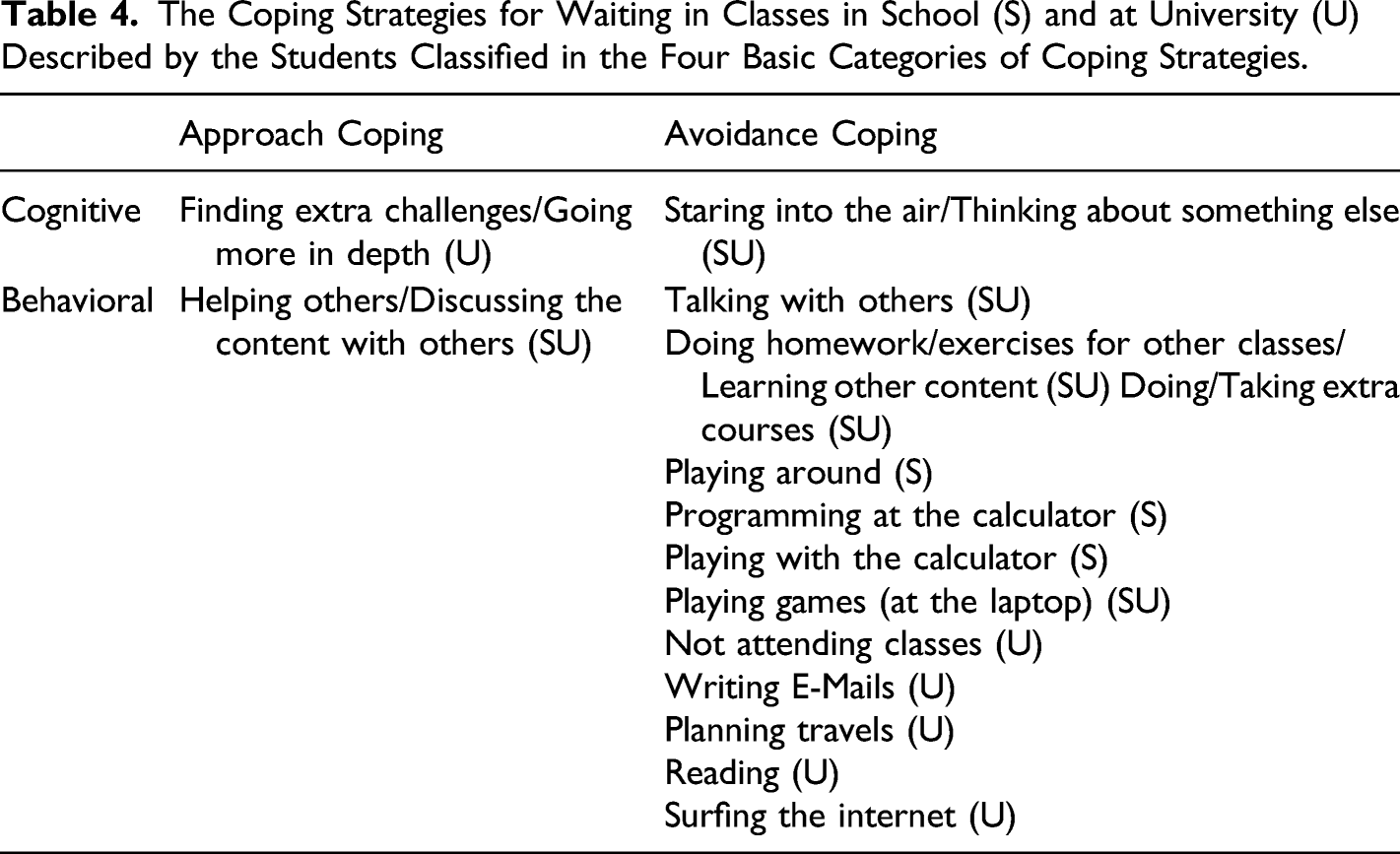
Coping strategies mentioned in secondary school were helping others (S05), talking with others (S01, S05, S06, S09, S10), doing homework (S02, S04, S09, S10), doing extra courses (S08, S09), playing around (S04), programming the calculator (S02), playing with the calculator (S02), playing games (S04), and staring into the air (S03, S05). At the university similar strategies were mentioned: discussing content with others (S02, S03, S08), talking with others (S01, S02, S03, S09, S10, S12), doing exercises for other courses (S02, S03, S08, S09, S10), learning other content (S07, S08), taking extra courses (S01, S08), playing games on laptop (S01), or thinking about something else (S01, S09, S10). However, the most common strategy at university, mentioned by all the students, was to not attend the classes where they would have to wait, if the attendance was voluntary: “The question is: Is it worth going to the lecture for one and a half hour or can you learn it by yourself faster?” (S02). This strategy was mentioned in secondary school by the student who was already studying at the university on the side, during his school time. He often used this excuse to avoid going to secondary school. For all other students this was not a possibility and they therefore had mandatory attendance in secondary school of every class. Students explained that more than 50% of their university classes had voluntary attendance. If they had to wait there, they would skip it. That was the case in 10% of their classes. In the classes with mandatory attendance, waiting situations occurred occasionally. Consequently, coping strategies for waiting in classes were not as necessary at the university as in secondary school. But if these situations happened at university, students had more possibilities than they had in secondary school because “at university no one cares what you are doing” (S02): writing e-mails (S02), planning travels (S08), reading (S05, S07), or surfing the internet (S01).
The Coping Strategies for Waiting in Classes in School (S) and at University (U) Described by the Students Classified in the Four Basic Categories of Coping Strategies.
Summary of Findings
This study offers an insight in reasons for waiting, experiences with waiting, and coping strategies for waiting in secondary school as well as at university. It considers the connection to the above-average-ability students. Results show that waiting is often linked to the giftedness of students who had to wait because of advantages in knowledge or higher task speed. Moreover, it was shown that waiting causes boredom. The outcome described was a loss of motivation for going to classes in secondary school as well as at university. Students expected less waiting time at the university and therefore looked forward to enrolling to university.
In summary, contributions to research questions of the study are as follows: Waiting situations were reported in secondary school as well as at university. However, there were differences between the amount of time, reasons, experiences, and coping strategies for waiting. In secondary school, waiting caused by organizational reasons, higher task speed, and advantages in knowledge occurred often. Notably, organizational reasons were only mentioned after specifically asking about them. At the university, students described fewer waiting situations. Waiting because of organizational reasons and higher task speed were only mentioned once by a student in each case. Waiting because of advantages in knowledge occurred more often, but only in classes with mandatory attendance.
Experiences varied depending on the reasons for waiting situations. Waiting because of organizational reasons was accepted and described as positive or neutral experiences. Waiting because of higher task speed was mainly connected to negative associations. Students very often felt that they were wasting their time, and they would have preferred to be challenged more. However, students could handle waiting situations and accept them as a regard to other students. Experiences with waiting because of advantages in knowledge were described similarly. Students felt fairly bored because of these situations, and they would have preferred to gain more academic knowledge. Again here, all students showed tolerance for the needs of students with lower abilities than themselves.
Strategies for coping with waiting in secondary school were similar to strategies described by Nett et al. (2011) for coping with boredom in school and can be cataloged into four basic categories for coping strategies: Cognitive-Approach Strategies, Behavioral-Approach Strategies, Cognitive-Avoidance Strategies, and Behavioral-Avoidance Strategies. There were no coping strategies mentioned that could not be assigned to one of these four basic categories. The main strategies that students mentioned for dealing with waiting time in secondary school could be defined as Behavioral-Avoidance Strategies. As for school situations, strategies for coping with waiting at university can be cataloged into four basic categories of coping strategies. Also, at university there were no coping strategy mentioned that could not be assigned to one of the four basic categories of coping strategies. In schools, the main strategies that students mentioned for dealing with waiting at university could be defined as Behavioral-Avoidance Strategies. Ultimately, it was easier to cope with waiting at university because students could do something else, such as working on other topics.
Limitations
This study has some obvious limitations. The exploratory and nongeneralizable nature of this study confines the conclusions to be considered reflections that should motivate further research. Regular students were not asked about their experiences with waiting, although comparisons of the experiences with waiting of gifted students and regular students would be interesting. Also, comparisons with gifted students from other fields of studies would be a useful addition because in this study all students were studying in the STEM field, most of them technical mathematics or technical physics. These experiences might be different, because of different fields of studies or because of different interests of the students. Furthermore, it must be taken into account that students were reflecting on their actual situation as well as their past experiences. The elapsed time and their new experiences might have changed their views on waiting situations in school. Further research with students still in secondary school would be beneficial. Moreover, the organization and structure at secondary schools and at universities differ, what can lead to different perceptions. Finally, the study was carried out in Austria and exploring issues of this study in other cultural contexts or countries would offer new insights into students’ experiences with waiting.
Discussion
Waiting in Classrooms
The study supports earlier research that showed that gifted students often experience waiting in secondary school (DeLandtsheer, 2011; Peine & Coleman, 2010) and found that this is also true for waiting at universities. However, it was important to look at the experiences of the students with waiting to determine if known negative experiences in secondary school (Hinterplattner et al., 2020; Peine & Coleman, 2010) can be transferred to university. Moreover, it was important to find out if waiting caused boredom.
Experiences With Waiting
All participants of this study were high achievers and had already experienced waiting in school and must have learned to deal with this. All students described situations where they had to wait in secondary school but felt okay with it. This tolerance might be a reason why their self-reported motivation for school only partially decreased when having to wait for others. If students would have lost all their motivation, they might not have managed to achieve highly in school. Moreover, they all developed strategies to avoid waiting situations, further helping to sustain their motivations for academic their achievements. However, this tolerance for waiting for others was not shown at university. From this study and earlier research, it is not known what effects this will have on students’ achievement. Moreover, it is important to note that not all gifted students are high achievers or expose their talents, unlike the ones participating in this study. It seems reasonable to assume that experiences of gifted underachievers may be worse when confronted with waiting in the classroom. These situations might be a reason why their performances remain below their abilities. It would be beneficial to see if the experiences of gifted underachievers are different to gifted high achievers regarding waiting. However, it was seen in this study that a lot of waiting is linked to negative feelings what matches with previous research about negative experiences from gifted students with waiting in secondary schools (Hinterplattner et al., 2020; Peine & Coleman, 2010). Moreover, it was shown that boredom is very closely connected to waiting, supporting previous research (Kanevsky & Keighley, 2003). Given the negative effects of boredom (Adams-Byers et al., 2004; Craig et al., 2004; Piske et al., 2016; Raffaelli et al., 2018), it would be essential to examine if gifted students would reach even higher achievement levels if they experienced fewer waiting situations. It is a common misconception that gifted students do not need special support—that they can make it on their own. However, students with exceptionally high abilities require encouragement and fostering to unfold their full potential (Gagné, 1995; Neubauer & Stern, 2007; Park & Steve Oliver, 2009; Preckel & Vock, 2013). Rinn and Plucker (2019) showed in their systematic review that supporting honors students lead to positive student outcomes. However, the situation of waiting in classrooms was found in this study as common for gifted students, showing that inclusion did not work in these classrooms. These experiences show an indication that the needs of gifted students were not met at a satisfying level, and there is a need for change. Further research to answer these questions would be necessary.
Reasons for Waiting
It was important to examine the reasons why students waited in classes to see if waiting is connected to student ability. The results of this study show that waiting linked to higher abilities (higher task speed and advantages in knowledge) occurred often. This supports previous research stating that gifted students have more potential to wait in classrooms (Hinterplattner et al., 2020; Peine & Coleman, 2010). Also, the reasons described by the students is in line with these previous research (Hinterplattner et al., 2020; Peine & Coleman, 2010) adding information about time of gifted students at universities. Moreover, it was essential to find out if experiences in waiting situations differ because of the respective reason and this was indeed the case. Although waiting situations that were not connected to the high abilities (organizational issues) were described as neutral or positive experiences, waiting connected to high abilities was mainly described as negative. As proposed in previous research (Gronostaj et al., 2016), gifted students did not need that much time for understanding new content or repeating content. Especially interesting is that students in these situations never asked their teachers for extra tasks, even if they felt bored or underchallenged. A reason for this behavior could be bad experiences such as not getting necessary support as expressed by some students. This makes it even more important for teachers to know the coping strategies of gifted students for waiting and to be able to recognize potentials of their students as well as to support gifted students’ education. It was often mentioned by gifted students that they would have preferred to be in classes with more able students, because they understood waiting as wasting their time. This is in line with research conducted by Gronostaj et al. (2016). However, further research for the effectiveness of ability grouping concerning waiting for gifted students in inclusive classrooms is needed.
If students felt underchallenged or felt that they could use their time in a better way, they described the situation as unnecessary waiting. In addition to these situations, students also felt that they had to wait when their creativity was restricted. This supports research stated in the introduction that showed that boredom arises in students due to an unfitting level of control in a situation, be it too much or too little, or the perception of pointless tasks (Pekrun et al., 2007, 2010). As proposed in the theory of the three pillars of honors education (Wolfensberger, 2012), the evidence found in this study point to the importance of offering bounded freedom to students and the enhancement of academic competence. Rinn and Plucker (2019) showed in their systematic review that honors programs lead to positive student performances. Effects of these pillars on waiting would be interesting explore in future research.
Coping Strategies for Waiting
Results of the use of coping strategies also offer opportunities for further research. Götz et al. (2007) found that the most used coping strategies for boredom during classes are the Avoidance-Coping Strategies. Similarly, it was shown in this study that gifted students’ preferred coping strategies were escaping from their waiting situations through active avoidance actions rather than changing their perceptions of the situation, changing their situation through active actions, or escaping the situation through thought. Nett et al. (2010) called this group of students with this preference Evaders. It would be interesting to see if gifted students are more likely to be Evaders in boredom coping situations than regular students. Nevertheless, Cognitive-Approach Strategies are seen as the most effective strategies in decreasing boredom (Götz et al., 2018; Nett et al., 2010). However, students participating in this study only used these strategies at university—and quite rarely. If Cognitive-Approach Strategies would also be the most effective strategies in decreasing waiting, it would be interesting to find out why students do not use them or to examine if they use them without being aware. Because of the high achievements of these students, it sounds reasonable to assume that they use coping strategies for waiting successfully. However, it is not known how much more students could have achieved when using other coping strategies or when experiencing no waiting at all. Further research would be necessary to look deeper into this topic.
Differences at the Institution Types
Students described that they waited less at university than in their secondary school years. This was due to the nature and organization of the institution itself. At university most classes had voluntary attendance in contrast to mandatory attendance in school. If a lecture was seen as meaningless, students did not attend it. This happened in 10% of their classes. It is, however, not possible to conclude that more waiting occurs in secondary schools than at universities in general. At university, waiting occurred less, but only because students avoided some classes. If they would have attended all classes, they would have experienced more waiting at university as well. The main reason behind skipping classes was that students felt like they would be wasting their time, either because they could learn the content faster on their own or because they already knew the content. When students use their gained time beneficially, skipping classes can be seen as useful. However, research shows that skipping classes has a statistically significant and quantitatively relevant effect on students’ learning (Stanca, 2006) and attending classes develops an ability in students to understand perspectives of others and help them to interact with their peers in more adaptive ways (Cheruvalath, 2017). This should not lead to the conclusion that mandatory attendance would be a better solution. In this case, more waiting situations could occur. Instead, it would be reasonable to question the success of the support for gifted students at universities in this context.
When looking at the differences between secondary school and university, it was interesting that asking students the question “Do you experience waiting at university?” was not sufficient to determine whether waiting occurs at universities or not, because of the students’ use of coping strategies. Students were used to using their avoiding strategy of not attending classes with waiting situations, and that could lead to a wrong conclusion about the amount of waiting at universities. It is therefore important to note the extend of this behavior, as uses of such strategies is a sign that inclusion of gifted students in regular classes was not successful. Finally, it must be considered that the aim of this study was to investigate the students’ views and perceptions. The amount of actual waiting time and therefore the experiences with actual waiting time may differ from the experiences with perceived waiting time.
Footnotes
Declaration of Conflicting Interests
The author(s) declared no potential conflicts of interest with respect to the research, authorship, and/or publication of this article.
Funding
The author(s) received no financial support for the research, authorship, and/or publication of this article.
