



Abstract
Innovation is regularly depicted as the answer to regional socioeconomic decline and deindustrialization. Yet, the results of regional innovation strategies are frequently underwhelming and contested, leading citizens to question the promises of innovation and policymakers to doubt constituents’ willingness to embrace change. This paper investigates how innovation-centered revitalization policies land in “Rust Belt” regions—the supposed lost hinterlands of innovation—in uneven, fragmented, and occasionally crude ways. We analyze Upstate New York as a site where the US CHIPS and Science Act (CHIPS Act) was envisioned to counter chronic decline and irrelevance with investments in innovation and high-tech jobs. Drawing on scholarship on regional innovation cultures and postindustrial futures, we show how the CHIPS Act—couched in a desideratum of innovation—casts a penumbra of “others” in the form of undesirable regions, histories, and ways of life that clash with locally grounded understandings of resilience, worth, and hope. Postindustrial communities associate the CHIPS Act with previously broken policy promises of revival, and resist having their social value tethered to innovation productivity. We argue innovation policies for Rust Belt regions should invoke elements of regional worth and identity beyond jobs and competitiveness, and be legible as social and economic policy.
Innovation in “the Other New York”
In 1999, Hillary Clinton launched her campaign for the Senate with a “listening” tour through New York State. Visiting all sixty-two counties with a sizeable press entourage in tow, Clinton made a point to host small, informal events and ask questions in rural Upstate New York (UNY) communities. This “other New York” (Kober 2022)—a label echoing Michael Harrington's influential 1966 book The Other America (Harrington 1997)—was disenchanted with the perceived lack of care for a region often overshadowed by New York City and overlooked by state and federal policymakers. The listening tour not only helped secure Clinton's senate seat but also brought the economic struggles of UNY to national newspapers (allpolitics 1999; Perez-Pena 1999; Zremski 1999; CBSNews 2000; Eaton 2000; NY Times 2000). The stories often focused on lacking job opportunities, growing poverty, out-migration, and other forms of social and infrastructural decline (Burke 2024; Churchill 2024)—all familiar themes that today have become tropes in discourses about postindustrial or “Rust Belt” regions across the United States (US).
Clinton's listening tour was recognized by UNY citizens as an important and hopeful gesture. During her travels, Clinton even visited Cherry Valley, the small, rural hometown of Schneider (see Figure 1).

Hillary Clinton pictured with Schneider’s family in Cherry Valley, New York in 1999. Senate candidate Clinton is looking down at Schneider.
As an UNY resident recalled, Clinton's “visits—including town halls; unmediated Q&As; small group meetings—to struggling rust-belt cities like my hometown of Utica changed hearts and minds” (Feeley 2020, 20-1). Yet, it also fit a broader pattern of intermittent attention from politicians with national ambitions, who habitually grace the rusting hinterlands of the US and tread a delicate path between projecting shock, empathy, and a vision for a brighter future.
Just seven years after Clinton's tour, Eliot Spitzer, during his campaign for New York State Governor, observed that when “you drive from Schenectady over to Niagara Falls, you see an Upstate economy that is devastated. It looks like Appalachia. 1 This is not the New York we dream of” (Medina 2006). Likewise, in 2016, during his presidential campaign, Trump went so far as to call UNY a “ghost town” (Cleeton and Leland 2019), suggesting that UNYers should abandon their homes in search of better futures: “When you have an area that just isn’t working like upper New York state, where people are getting very badly hurt…you can leave. It's OK. Don’t worry about your house” (Mickle and Nicholas 2017).
To echo Chloe Ahmann's (2024) book Futures after Progress, this “story [is] not about Trump”—or, if so, then only superficially. Rather, it is about the places that have been “unceremoniously ejected from the American dream” and landed in “the limbo of a postindustrial no-man's-land, heading no-where” (Walley 2013, 68, as cited in Ahmann 2024; see also Berardi 2011 and Edelmann 2004). Trump's verdict, like many others, speaks to a profound sense of hopelessness and crisis in postindustrial regions around the globe, often tied to a diagnosis that “there is nothing for you here” (Hill 2021; see also Campbell 2016 and Pager 2019). The notion of a “Rust Belt” 2 has become shorthand for a diverse set of US postindustrial regions, which experienced rapid industrial growth during and after the Second World War, followed by widespread shutdowns and corollary social ruptures and urban decay in the wake of increased globalization and concentration during the 1980s. A sizable body of literature chronicles the distinctive mix of social, economic, political, and identity concerns of these regions in a context where global competition has undermined local opportunity and self-worth, and where that absence regularly translates into populism along the lines of Brexit and Trump (see Rodríguez-Pose 2018; Hill 2021; Schaller and Waldman 2024). These places have also been characterized as “left behind regions,” “flyover country,” “wastelands,” or “places that don’t matter” (Rodríguez-Pose 2018; Pike et al. 2024)—“the kind of place that critical theorists have in mind when they instruct us to ‘abandon the illusion of a future’” (Ahmann 2024, 2). Such spatial labels have often been roped together with political constituencies, for example, in the expressions “white rural rage” (Schaller and Waldman 2024) 3 and “blue-collar backlash” (Cowie 2010) that perform a link between postindustrial struggle and resentment toward policymakers among formerly heavily democratic, working-class demographics, which lends an unsavory stigma to Rust Belt regions and those who inhabit them (Rodríguez-Pose 2018; Schaller and Waldman 2024).
Strategies to revitalize regions, including Rust Belt regions, often focus on innovation as the key to an economic future from which everything else ought to derive (Pfotenhauer, Juhl, and Aarden 2019; Armstrong 2021). They frequently invoke the contrast to objectively successful regions, such as Silicon Valley and Route 128, as both a reference point and potential blueprint for creating innovation ecosystems (Braczyk, Cooke, and Heidenreich 2004; Saxenian 2006; Pfotenhauer and Jasanoff 2017b; Clark et al. 2018). This invocation has typically meant shifting away from more traditional forms of economic activity, such as agriculture and manufacturing (e.g., steel, automobiles), to high-tech visions and a piece of the digital economy that remade regions and futures in real time (Dincer 2016; Neumann 2016; Laurent 2019; Rentrop et al. 2025). More recently, policymakers in the US and elsewhere have specifically focused on the idea of “bringing manufacturing back” (from abroad, from major urban areas) to Rust Belt regions to restore their economic base, often by offering firms significant funding or tax breaks to relocate. These pushes for reindustrialization can have national strategic implications, particularly in so-called “critical” high-tech industries, often with dual-use implications (Scott and Storper 1987; Dincer 2016; Santos et al. 2017; Laurent and Violle 2024). In political cultures characterized by stronger state involvement, like the European Union or parts of Asia, such endeavors have been additionally amplified by policies focusing on strongly curated innovation systems under such labels as “smart specialization,” “mission-driven innovation,” or a “New Deal”-type strategies tying local capabilities to local transformations, niches within globalized value chains, and “grand societal challenges,” such as sustainability or public health concerns (McCann et al. 2012; Mazzucato 2018).
Semiconductors embody this mix of high-tech industrial vision and bringing back manufacturing in strategic sectors. Originally developed and commercialized primarily in Silicon Valley in the 1960s, semiconductors were both a staple of US high-tech leadership in the post-Second World War and a touchstone of the fierce offshoring dynamics that shaped industrial production since the 1970s (Morris 1990; Brown, Linden, and Macher 2005). According to the Semiconductor Industry Association, the US share of global chip manufacturing declined from 37 percent in 1990 to 12 percent in 2020 (Ravi 2021). At the same time, semiconductors are integral to many commercial and consumer products today, and essential for most domains of innovation, from basic computation to automobile to defense to artificial intelligence, rendering them critical for national and global industries (Miller 2022).
In response to this decline and the criticality of semiconductors for US industries and security, Biden signed the US CHIPS and Science Act (henceforth CHIPS Act) 4 into law in 2022. The bill was supposed to provide USD54 billion 5 in funding, of which USD39 billion were allocated to manufacturing. The language of the bill straddles a range of global, national, and local goals, including the promotion of US global technological supremacy; national security concerns; pledges to repair regional economies by providing jobs and infrastructures; “A Future Made in America” by rebuilding manufacturing hubs; and boosting semiconductor research and development (R&D).
In this paper, we analyze how innovation-centric revitalization strategies, such as the CHIPS Act, unfold in Rust Belt regions. We take UNY as a prominent example of how innovation strategies are imagined to solve a wide range of issues for these regions. Our key argument is that innovation policies like the CHIPS Act can be easily, perhaps predictably, at odds with locally grounded imaginaries of better futures, achievement, and self-worth—even if they tap into established cultural tropes and industrial legacies. More than that, they have the potential to deepen the social and political disconnect between regional concerns and national policies trying to address them, by invalidating local forms of reasoning about desirable futures and past experiences of failed economic experimentation (Bauman 2013; Jasanoff and Kim 2015; Claisse and Delvenne 2017; Pfotenhauer and Jasanoff 2017b; Engels, Wentland, and Pfotenhauer 2019; Ahmann 2024). We show how innovation policies, including the CHIPS Act, thrive on modes of “othering,” both by treating remote innovation hubs such as Silicon Valley as aspirational role models, and by diagnosing certain local populations, ways of life, and problems as irrelevant or even the root cause of social and economic struggles. For those affected, this deficit model of innovation (Pfotenhauer, Juhl, and Aarden 2019) produces subjectivities that cast current promises in light of previous disenchantments, which explains why the framing of innovation-as-revitalization sticks neither imaginatively nor materially. Simply put: politicians repeatedly tell Rust Belt regions that their only path to an economically viable future depends on becoming a Silicon Somewhere (Florida 2002; Hospers 2006)—places that embrace their geographically untethered identities as high-tech innovation hubs and harbingers of national objectives, over daily communal experiences of crisis and hope.
Our theoretical point of departure is recent Science and Technology Studies (STS) scholarship at the intersection of critical studies of innovation, postindustrial transformations, and maintenance and care (Claisse and Delvenne 2017; Godin and Vinck 2017; Irani 2019; Pfotenhauer, Juhl, and Aarden 2019; Vinsel and Russell 2020; Ahmann 2024; Cuevas-Garcia, Pepponi, and Pfotenhauer 2024). These works offer a critical lens through which to unpack the language of innovation and its modes of othering, which shapes political economies, material artifacts, and the production of innovation subjects. Some of these studies have foregrounded how innovation logics regularly fail to be locally legible and grounded, which is increasingly seen as a major challenge of current innovation policy (Claisse and Delvenne 2016; Delvenne 2017; Pfotenhauer and Jasanoff 2017a; Haddad and Benner 2021; Irwin, Vedel and Vikkelsø 2021; Pfotenhauer et al. 2022).
Empirically, our paper offers a qualitative (single case) study (see Yin 2007) of UNY and the CHIPS Act based on various episodes of ethnographic research (see Candea 2009) conducted between April 2021 and November 2024. Our research includes twenty-seven semistructured interviews, several extended stays in the UNY region, and extensive document analysis of news media articles, policy reports, and White House and New York State press releases. Interviewees were found via snowball sampling, which provided the opportunity to engage with a wide variety of stakeholders, mostly residing in the UNY region, including university faculty, employees at semiconductor firms, activists, a mayor, a journalist, and UNY residents. These interviews also provided multiple opportunities to visit UNY cities (including Albany, the capital, and Utica), two college campuses with close ties to semiconductor firms, and the Albany Nanotech Center. Press releases and both national and local news coverage revealed alternative perspectives as well as policy narratives and political positions. Using MAXQDA, we performed inductive coding (see Flick 2009) on interview transcripts and documents, supplemented by fieldnotes and photographs from site visits, to detect themes, patterns, and various discourses across sites and data sources. 6
Theoretical Inroads
It has become a common observation in STS scholarship that innovation is regularly heralded as the go-to solution to pressing challenges in the world, rendering it synonymous with growth, progress, and good (Godin and Vinck 2017; Pfotenhauer and Jasanoff 2017b; Irwin and Pfotenhauer 2024). In the past several decades, there has been a substantial rise in “innovation speak” (Vinsel and Russell 2020, 11) and a proliferating “innovation imperative” across public policy and management (Pfotenhauer, Juhl, and Aarden 2019). One common consequence of this “panacea” rhetoric of innovation is the rearticulation of social problems and acceptable solutions in the logics of innovation, supported by a range of devices that reconfigure social, material, and epistemic orders in significant ways (Laurent 2019; Pfotenhauer et al. 2022; Asdal and Huse 2023; Rentrop et al. 2025). As we have argued elsewhere, “complex social challenges that, a decade ago, might have been framed differently—from low literacy rates to sluggish economic growth, rising inequality, obesity, traffic congestion, environmental degradation, all the way to climate change—now all demand innovation-centered solutions” (Pfotenhauer, Juhl, and Aarden 2019). What is more, the gradual narrowing of broader notions of “progress” to “innovation” by policy elites has rewritten the role of governments, companies, and citizens in the production of the common good, favoring logics of technoeconomic fixes over social and political ones (Morozov 2013; Pfotenhauer and Juhl 2017; Macq, Tancoigne, and Strasser 2020; Godin, Gaglio, and Vinck 2021; Frahm, Doezema, and Pfotenhauer 2022). Vinsel and Russell (2020, 27) suggest that “advocates for innovation…often acted as if technological change—and the new industries that went along with it—would (at least indirectly) produce the necessary social goods on its own.” Within this contemporary political economy of innovation, Silicon Valley, Massachusetts Institute of Technology (MIT), and a handful of other triumphant innovation regions have been touted as role models to guide the way toward bright futures despite their own histories of controversy, inequality, and disillusionment (Saxenian 2006; Irani 2015; Russell and Vinsel 2016; Pfotenhauer and Jasanoff 2017b; Wisnioski, Hintz, and Kleine 2019).
STS and other social sciences regularly challenge the epistemic underpinnings and material devices that enable a seemingly friction-less, overly optimistic, and often elitist understanding of innovation today. Several studies have documented different regions and communities struggling with innovation imperatives in their own situated ways, attaching to them distinct hopes, potentials, fears, and operationalizations. In their book “Does America need more innovators?” Wisnioski, Hintz, and Kleine (2019) call innovation a distinctly “American imperative” that has shaped the aspirations, creativity, and hubristic overreaches of generations, which has been absorbed by American culture as “a way of life” (Wisnioski 2025). Wisnioski and his collaborators trace the role of specific sites and initiatives that became paradigmatic; how these paradigms reverberated around the globe, and the heroic depictions (and the often overlooked, much less heroic failures and limitations) underwriting innovation. Other authors have analyzed the rise and fall, successes and disappointments of initiatives trying to produce innovative regions and strategies to secure futures by becoming innovation hubs—each witnessing the clash of seemingly universal models with local rationalizations and sociomaterial legacies (see, e.g., Van Agtmael and Bakker 2016; Delvenne 2017; Pfotenhauer and Jasanoff 2017b; Sigl and Leišytė 2018; Laurent 2019; Haddad and Benner 2021; Macq 2021; Parthasarathy 2022; Pfotenhauer, Wentland, and Ruge 2023).
Thus, innovation is part of wider sociotechnical imaginaries that determine “the manner in which ideas and practices not only travel but also emerge, develop, and are in different ways domesticated” (Jasanoff and Kim 2009, 120) while remaining “contested, changeable, flexible and loose around the edges” (Sismondo 2020, 505). In political cultures, imaginaries of innovation serve as “epistemic and political resources for defining a community that shares a common (and hopefully better) sociotechnical future, and that is on its way to attaining it through innovation” (Pfotenhauer and Jasanoff 2017b, 788). In their analysis of “regional innovation cultures,” Pfotenhauer, Wentland, and Ruge (2023) trace the fine line between familiarity and novelty that innovation initiatives need to propose to be deemed both locally plausible and transformative, and, in turn, how the framing of innovation impacts legibility, acceptance, and resistance. Many of these discussed works share a coproductionist underpinning, holding that “the ways in which we know and represent the world (both nature and society) are inseparable from the ways in which we choose to live in it” (Jasanoff 2004, 2).
This paper draws together STS insights and literatures that have explored innovation in “peripheral” contexts (Dagnino and Thomas 2001; Virkkala 2007; Rajan 2015; Bortz and Thomas 2017; Delvenne 2017; Kuhlmann and Ordóñez-Matamoros 2017; Van Oudheusden, Charlier and Delvenne 2017; Macq, Parotte, and Delvenne 2021; Parthasarathy 2022) and applies them to so-called “Rust Belt” regions. While there is a flourishing body of economic geography literature engaging with innovation's role in reviving Rust Belt regions, this literature generally does not bring critical attention to the ambivalent effects of innovation initiatives in the making and framing of the regions themselves (Van Agtmael and Bakker 2016; Rodríguez-Pose 2018; Clark and Doussard 2019; Makkonen et al. 2020; Clark 2022).
Since the 1980s, regions considered part of the Rust Belt, mostly located in the US Midwest, have faced industrial and economic decline with the loss of key manufacturing industries including coal, steel, and electronics, resulting in waves of rising unemployment, poverty, and depopulation (McQuarrie 2017). The Rust Belt overlaps both territorially and culturally with other cultural signifiers such as “America's heartland” 7 and “Appalachia,” two terms that evoke a homogenously white, regional population despite considerable internal diversity. Halvorson and Reno (2022, 13) explore how the heartland came to be “coded as white,” while Devadoss (2023, 2) examines the narratives that sustain the heartland as “home to the white working class.” They feature in discourses about The Other America, referencing a widely received 1966 book by Harrington that inspired a speech by Dr. Martin Luther King, Jr. in 1967, and War on Poverty (Sarnoff 2003). Both describe the existence of two Americas: one in which people have prosperity and opportunity, and one wherein people are impoverished and robbed of both. As Dr. King (1967) notes, “Millions of those living in this other America are Appalachian whites.” People from this “other America” have regularly been reduced to “hillbillies,” “rednecks,” or “white trash”—provincial, uneducated, white, rural folk (Sarnoff 2003; Vance 2016)—providing a discursive backdrop against which certain regions have come to be understood as home to the white “other.” These references are essential when unpacking how and for whom innovation ought to produce benefits in certain regions and populations, recognizing that revitalization might link to the perpetuation of existing “settler colonial narratives of belonging” (Devadoss 2023, 8). They also help explain why prominent homogenizing innovation policies like the CHIPS Act do not reach voters in the same way as divisive political figures like JD Vance (2024) when speaking about, to, and for America's heartland.
Similar stories exist elsewhere, of course. In There is Nothing for You Here, Hill (2021) writes about growing up in a former mining region of Northern England and how the neglect of postindustrial places ultimately contributed to a rise in brain drain as well as right-wing populism. Hill (2021, 154) observes a “lack of a direct relationship between ordinary people and prominent intellectual elites” in the United Kingdom and the United States alike. Goldstein (2017), in her work on Michigan, examines identity and legacy in a single-industry community decimated by the loss of a General Motors manufacturing facility and ensuing difficulties in rebuilding livelihoods. Rodríguez-Pose (2018) emphasizes the need to tend to the struggles “of the places that don’t matter,” arguing that the observed “revenge” of these places should prompt us to abandon lofty innovation projects altogether and prioritize more place-sensitive development policies. Similarly, Vinsel and Russell (2019, 252) have suggested replacing political desires “to make themselves the next Silicon Valley” with regional forms of ethics of care.
We share these views on complex, often disheartening entanglements of hope, disenfranchisement, and contested identities in a rocky history of regional innovation initiatives. While this paper, too, foregrounds how innovation policy regularly goes awry and fails those in whose name it is ostensibly enacted, we think that it would be a mistake to discourage regions from claiming space in, and investments and attention from, the powerful machinery of future-making attached to innovation logics. This is not a matter of being for or against innovation policy in a black-or-white fashion, but rather of learning to articulate better, more meaningful and careful innovation policies. Better versions of policy are possible when forced to confront, in regionally sensitive ways, the inequalities and normative assumptions inscribed in innovation logics. Thus, we call for more reflexive, humble, and culturally situated innovation policies that acknowledge, and speak to, complex local histories of dignity, downfall, and discontent.
Innovation, Identity, and the Promises of Semiconductors in UNY
“Ever Upward”: A History of Innovation in UNY 8
In October 2022, the semiconductor manufacturing company Micron announced that it would invest USD100 billion in memory chip manufacturing near Syracuse, in UNY. The announcement arrived on the heels of the Biden administration's passing the CHIPS Act two months earlier, and approximately one month after Intel pledged to spend upward of USD20 billion on a chip fabrication plant (fabs) in Ohio. Both were seen as early major wins of the CHIPS Act. 9 Micron's investment was of national significance, as it vowed to bring the US market share of memory chip production from under 2 percent to up to 10 percent over the next decade (Tampone 2022). President Biden, standing in front of banners promising “A future made in America,” stressed how UNY is “poised to lead the world” in semiconductor technology (White House Briefing Room 2022b). The announcement was also a much-awaited win for a region that had been under mounting pressure to turn things around after it was snubbed by an earlier Intel investment. Kathy Hochul, Governor of New York, suggested that this “largest private-sector investment in state history” would “secure our economic future, solidify New York's standing as a global manufacturing hub, and usher the state into another Industrial Revolution” (Governor Kathy Hochul Press Office 2022).
Newspapers greeted the announcement with headlines heavy with expectations, including “New York State is becoming a US Semiconductor Hub” and “Could Micron help reinvent Upstate New York?” (Barron 2022; Tremayne-Pengelly 2022). One news article detailing Micron's announcement stated: “Local leaders have called the project a chance at generational transformation. Micron officials and others have said children not even born yet will one day work on the plants” (Tampone 2022). Senate Majority Leader Chuck Schumer from New York underscored the investment's historical and geographic importance calling it an “Erie Canal moment” (Governor Kathy Hochul Press Office 2022): Just as the original Erie Canal did centuries ago, this 21st Century Erie Canal will flow through the heart of Central New York and redefine Upstate New York's place in the global economy for generations to come…. This investment leaves no question that the future of microchip manufacturing will remain not just in this country, but in Syracuse specifically, and that our future will be built in Upstate New York, with Central New York as a global center of the chip industry.
Hopeful narratives about a high-tech revival and return to a place of pride within the nation's economy are not new in UNY. Many UNY residents recognize the Erie Canal reference, a hugely significant public works project in the history of New York and the US (Shaw 2013). Built in 1825, the Erie Canal was an essential “route of power” that fueled national economic growth and regional development in the North and Mid-Atlantic regions through shipping fossil fuels (Jones 2016), and established New York as the US “leader in population, industry, and economic strength” (Erie Canalway National Heritage Corridor 2024). It became an aesthetically and politically laden symbol of progress and modernity—a “technological sublime” (Nye 1996)—and the theme of a popular song (Shaw 2013). As one interviewee said, “There were thriving manufacturing towns built, paper mills, lumber mills, all throughout Upstate New York, along the canal system. Utica, at one point, was a major hub on the Erie Canal. [It was] the only way to move goods from 1820 to 1860.” 10 Another interviewee, who grew up in UNY, pointed with pride to catalytic effects and symbolic meaning that the Erie Canal had for the US as a modern nation full of ingenuity: “So when I think Upstate New York and innovation, what is the first thing that comes to mind for me? The Thruway…. What it took to go from the Erie Canal to build an interconnected roadway that is pretty much a straight line from point A to point B took extraordinary innovation in a technical sense, civil engineering and planning and everything else, but also political alignment, commitment, vision, resources. All the things that innovation requires to be successful.” 11
In the 1950s, tech firms founded in UNY, such as IBM and General Electric (GE), became nationally and globally significant. In the 1960s, IBM (“Big Blue”) made up to 70 percent of computers worldwide, almost completely dominating the global computer market (Reed 2020) and rendering UNY a tech hub with entire IBM “company towns” (Hughes 2021). For one interlocutor working on community development, this heritage forms part of an alternative origin story of high tech in the US—one tied to a different welfare model—that is increasingly invisibilized by the dominant obsession with Silicon Valley. It is a history many now brush off as mere postwar dust: “It was New York who had the innovation before Tech Valley started. It was IBM, GE—we had the powerhouse! The big blues were all here.” 12 This first wave of semiconductor success still features prominently in the self-imagination of UNYers, who attached their biographies to the rise of the industry and to being part of a region that had historically been a “leader of manufacturing and innovation, [which] gave birth to a lot of major companies.” 13
The reliable growth and economic stability experienced by New York State for about a century came to a grinding halt in the 1970s and 1980s. “Utica was at one time a very thriving manufacturing and defense contractor city…. But that all died 30, 40, 50 years ago,” a journalist in UNY noted. 14 Major technology firms began relocating or downsizing as part of growing competition and globalization (Leslie 2001). Similar to other Rust Belt 15 regions, UNY experienced multiple waves of closure and loss, including the downsizing of IBM (which devastated entire communities) (Murphy 2009), and later GE (Leslie 2001), and Griffiss Airforce Base near Utica (US Air Force 2012). Giving some insight as to why former Governor Cuomo's political slogan was “jobs, jobs, jobs,” one interviewee explained the “main problem of Upstate New York” as follows: “The jobs went. To the south…. And when you have these kinds of mega shifts in the economy like take Schenectady—they had a big GE plant. When those jobs shifted overseas to China, when they shifted to the south, it just left behind a wasteland, an economic wasteland.” 16 With the disappearance of jobs followed an outmigration of youth looking for opportunity elsewhere, and a decrease in small businesses serving the regional population (Leslie 2001). A popular bumper sticker in the region during this time said “Last one to leave Utica, turn the lights off.” 17
UNY thus began its now-prominent phase of decline, with the 1982 recession representing a first culmination (Thomas 2003; Reis 2019). In Albany, the state capital, the population peaked at 134,995 in 1950; by 1990, it had shrunk to 100,000 and has stagnated ever since, with growth only in number of people in poverty (Pendall 2003). An UNY resident described this period: “the 90s were looked upon as a really dark time for all population loss and unemployment, and…this huge shift in the economy.” 18 In the early 2000s, UNY was still in the top three slowest growing regions in the United States (Hutchins 2007), with consistent records of decline in national statistics of economic performance, labor force participation, and manufacturing employment (Thomas 2003; Abel and Dietz 2016). Within one generation, UNY had transformed from one of the best and most promising places in the country to one of the least desirable places to live. Especially against the continued radiance and wealth of New York City, the “other New York” 19 suddenly appeared hopeless and forgotten (Kober 2022). A former UNY resident recounted an event from his childhood: “I do remember this clear memory of playing soccer in a park in Utica. I remember seeing these flumes of smoke coming up. Later on, I learned it was the brewery that was on fire. The joke about that was ‘the brewery is on fire, there goes the last big employer in Utica. Alright, let's move!’” 20
The absence of a future also materializes in lack of opportunities for young people, which creates intergenerational rifts. An interviewee born in UNY in the 1960s noted: “I was part of a generation where everyone told you, there's nothing here, you have to go somewhere else,” 21 eerily reminiscent of Hill's (2021) There Is Nothing For You Here. An interviewee working in the technology sector told us she hopes not to have to give her children the same advice she was given by her own parents after leaving for college: “don’t stay here, don’t come back.” 22 Even at the State University of New York Polytechnic (SUNYPoly), the university designed to bring people to, and keep them in, the region, one professor encourages her students to “move on and do something better.” 23 Against the promise of guaranteed employment at the fabs (Tampone 2022), citizens may interpret “promise” as a message that there will neither be children nor employment at all. It is similar to the experience Goldstein (2017) describes about the afterlife of company towns that created a future for children—an entrapping future limited to one industry, so when that industry left, so did entire livelihoods.
The experience of a broken ever-upward trajectory produced a “sense of nostalgia and sadness for it,” 24 as many interviewees noted. An UNY resident working at SUNYPoly stated, “You drive through all those…old manufacturing towns that are just decimated.” 25 Another reflected on what it feels like to spend time in formerly proud towns these days: “it looks like half the stores are abandoned and the other half should be.” 26 This sentiment is further heightened by the constant drumbeat of external diagnoses that tell inhabitants that their region is “devastated,” “not working,” a “ghost town,” worth “fleeing” (Medina 2006; Cleeton and Leland 2019; Pager 2019).
From Panacea to Diagnosis: Constructing Rust Belt Identities as Innovation Deficits
Against this tangible experience of decline, UNY has leveled a counternarrative of innovation promise, of which the CHIPS Act and the heavily subsidized Micron investment are the latest installments. Since the 1980s, policymakers at federal and state levels alike have allocated significant resources to (re)establish UNY as a microchip hub through the creation of research institutions (such as SUNYPoly) and the renewed attraction of prominent semiconductor firms (such as IBM, Tokyo Electron, Applied Materials, and Global Foundries near Albany, and Danfoss and Wolfspeed near Utica) (Tucker 2008). These efforts were, in part, a self-conscious emulation of contemporaneous developments in Silicon Valley, trying to establish UNY as a “Tech Valley” in its own right and to connect to the pre-Silicon Valley history of high-tech prowess around organizations like GE, Kodak, and Rensselaer Polytechnic Institute (Leslie 2001) and the legacy of the Erie Canal. This Tech Valley corridor indeed traces the historical route of the canal, westward from the state capital Albany through Utica, with a few SUNYPoly campuses sprinkled throughout the region (see Figure 2).
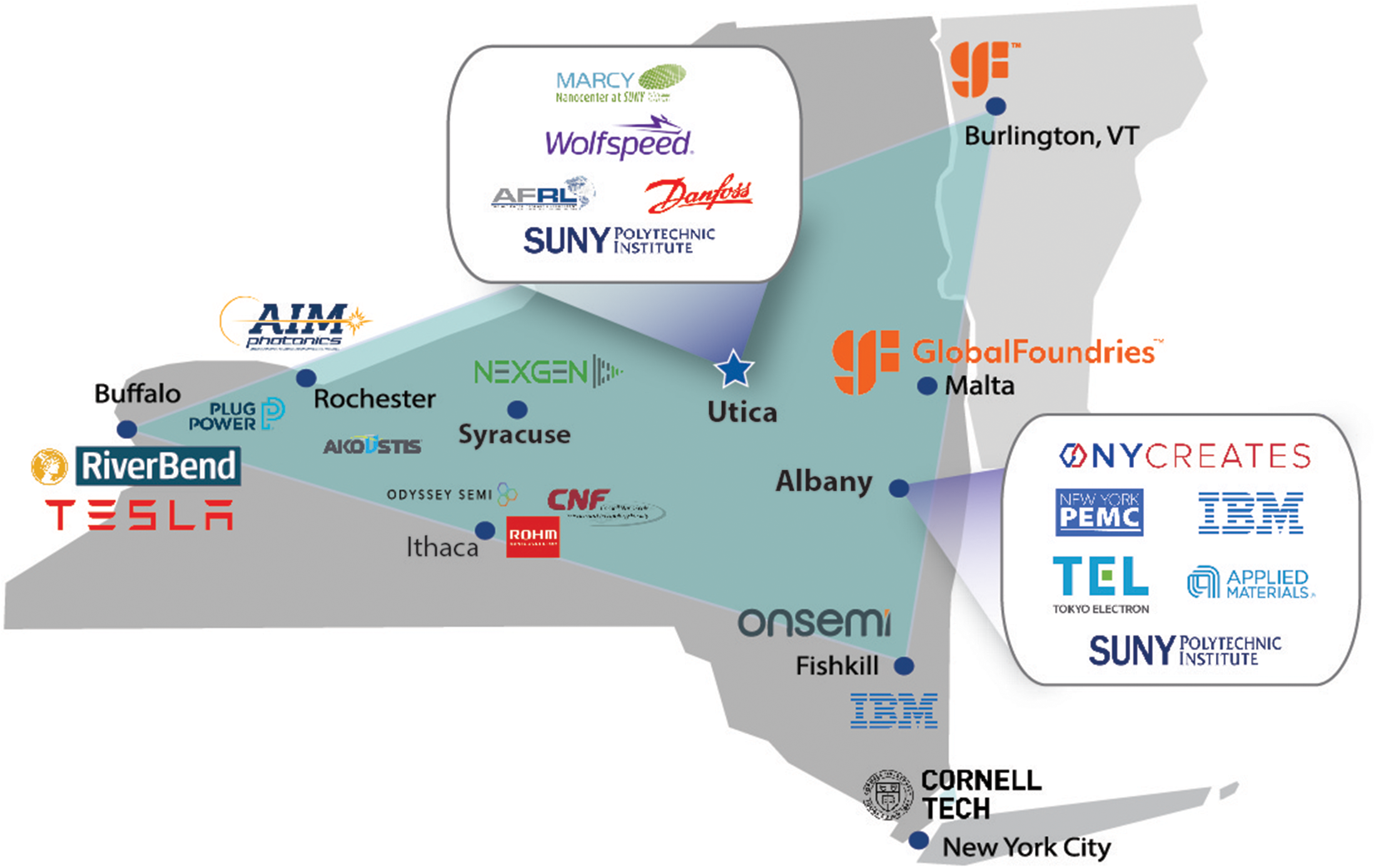
Marcy Nanocenter at SUNYPoly ecosystem map, accessed 2022. This map shows the dispersion of semiconductor firms across UNY, with most clustered in and around Albany and Utica. Two major firms (Global Foundries and Micron) are located within 50 miles of these cities. SUNYPoly = State University of New York Polytechnic; UNY = Upstate New York.
An interviewee working in regional development reflected on paying homage to legacies of innovation and tech in UNY with Tech Valley endeavors: “Are we gonna let that history die or are we gonna build it back up? [The former SUNYPoly president's] idea was CNSE [College of Nanoscale Science and Engineering at SUNYPoly] would be the launch of building the nano pearl necklace all the way out to Buffalo and rebuild Upstate's infrastructure to support the emerging nanotechnology, and it [the industry] was emerging and still is.” 27 In the process of repopulating the region with tech, UNY developed its own innovation culture centered on a “unique co-location model,” as described by Wessner and Howell (2020) in Regional Renaissance: How New York's Capital Region Became a Nanotechnology Powerhouse. This colocation model entails, among other things, that some machinery and materials necessary for R&D are funded and owned by the state and located on the university campus, but are made available to various semiconductor firms. It also entails public–private partnerships, for example in the nonprofit NY CREATES (located on the Albany campus of SUNYPoly), which operates the Albany Nanotech Complex and contributes to SUNYPoly's study programs to ensure a pipeline of skilled workers directly to the firms (see Figures 2 and 3) (Wessner and Howell 2020).
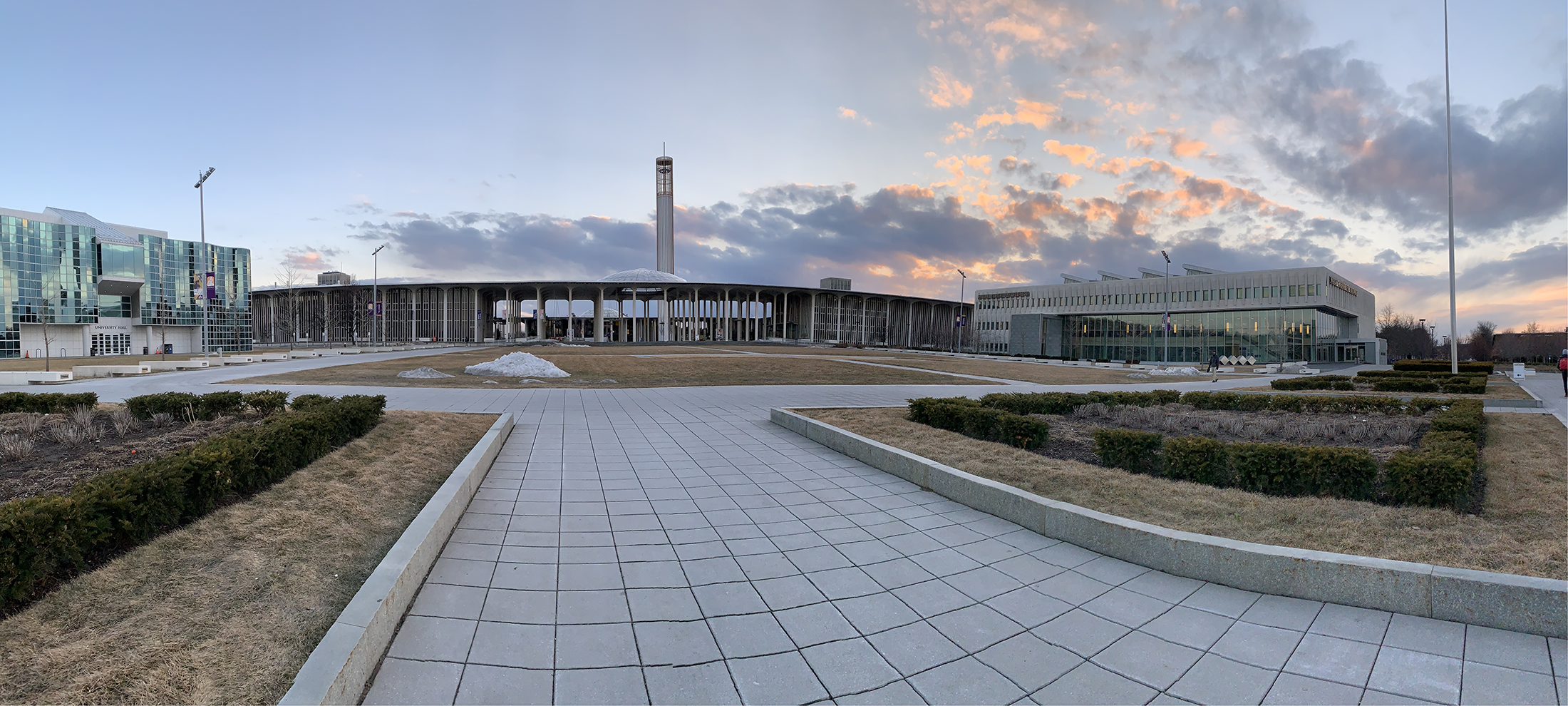
SUNYPoly Albany campus, Albany, New York, 2021. Own photo. SUNYPoly = State University of New York Polytechnic.
Some interlocutors, especially workers from institutions connected to SUNYPoly or the semiconductor industry, were positive about Tech Valley, both in what it has accomplished thus far for the region and its continued potential. They consider the promise of well-paid jobs from semiconductor companies incentivized through state government investments a reasonable strategy to attract people to UNY. One person working in community development praised the state government's Tech Valley strategy: “Upstate has never had the investment from the state perspective like it's had under Cuomo now. Like it or not, he's put a lot of money into Upstate New York where in the past, governors have really kind of left Upstate behind. The Albany region, because of Nanotech, has boomed.” 28 A former UNY resident said, “It's fantastic that Cree [a semiconductor company] is in Utica because they’re hiring to Utica. They’re bringing people to Utica with the promise of great-paying jobs.” 29
To many working in the tech sector, the situation is not as bleak. In their opinion, people should recognize what is good about the region and its prospects, and capture the new economic opportunities of the rising tech industry. One interviewee recalled meeting youths of an underserved community, where someone claimed “we don’t even know what a chip is”; reflecting on this, she said “They’re just so unaware of the opportunities. We need to fix that.” 30 This interviewee observed what she called a gradual manifestation of a “psychology of demise,” 31 that is, an experience of ruination that increasingly translates into self-deprecating and partly self-destructive attitudes. A similar observation was made in JD Vance's memoir, couched in neoliberal rhetoric of individual bootstrapping and a culture of “hillbillies,” for which the book was strongly criticized (Harkins and McCarroll 2019). The same interviewee went on to describe how this “psychology of demise,” stemming from experiences of deindustrialization, impacts UNYers’ ability to imagine or welcome new possibilities: “People in the Upstate area are not accustomed to growth, they’re not positive about investment. They’re critical of it. So if somebody wants to do something entrepreneurial, you don’t get a bunch of cheerleaders or support…you get mostly ‘that’ll never work here.’” 32 Silicon Valley entrepreneur Victor Hwang, in a presentation about Tech Valley's potential, brought home the same message when noting the economy will only thrive when “culture overcomes social barriers,” suggesting that UNYers “break out of old, pre-conceived ideas and see themselves as part of a system” to embrace their future (Post 2012).
Many working in the ecosystem close to the tech industry share this hopeful outlook. One interviewee employed by SUNYPoly noted: “I see this region as having infinite potential and opportunity. That was what attracted me to SUNYPoly…. What we’re doing in semiconductors, you’d be hard pressed outside of Silicon Valley, to find the kind of investment New York State has made in growing the semiconductor manufacturing capabilities.” 33 Similarly, an interlocutor working in regional development in UNY described Tech Valley as “playing to what we think are some key strengths,” including a strong education system, from K-12 to community college to public and private universities, alongside a history of manufacturing—infrastructures he believed give UNY “a chance to build off of that legacy [of tech and innovation] and build a stronger, more robust economic future for the region.” 34 These opinions, though, came almost exclusively from people working within institutions directly involved with Tech Valley efforts.
At the same time, many local actors point out the mismatch between the promises of a thriving new economy and the realities of local employment. One interviewee, who works closely with refugees, shared that a semiconductor job fair, which advertised 500 positions, did not have the type of jobs suitable for the UNY population—and nobody who attended ever got called back. 35 Another interviewee, reflecting on what it means to relocate a semiconductor company, explained that usually, companies bring their own management and thus, available jobs are at a lower level, including service jobs (like janitorial staff). 36 At the same time, the pursuit of an UNY Tech Valley has come with a hefty price tag for the state. UNY policymakers have offered billions in subsidies to semiconductor firms in addition to fab capacity, educational institutions, and other forms of economic development (Wessner and Howell 2020). These state funds were regularly complemented by funding from the federal level and the private sector. For example, UNY was selected as one of three CHIPS Act funded National Semiconductor Technology Centers (Ngo and Swanson 2024) and as an Investing in America Workforce Hub (White House Briefing Room 2024). Recent academic books such as Jump Starting America and The Smartest Places on Earth explicitly reference UNY's microchip innovation hub as evidence of how innovation policy can fix the Rust Belt (Gruber and Johnson 2019; Van Agtmael and Bakker 2016).
Yet, the longue durée history of revitalization remains rather mixed (Leslie 2001). The history of targeted tech investments notwithstanding, UNY demonstrates many markers of chronic underinvestment, with funding proposals for public infrastructure, culture, and welfare—such as extensions to commuter and high-speed rail, broadband internet access, highway networks, paid medical leave, or environmental infrastructure—being regularly passed up. Many actors outside the tech sector note that the years of state-led innovation-centric transformation efforts have had little effect on what UNY citizens consider their most pressing issues: as described by an UNY resident “Affordable housing, transportation, good jobs” 37 ; and poverty, social and cultural programs, decent healthcare, and K-12 education, as described by reporters (Zremski 1999; Kober 2022; Churchill 2024). Far from an abstract policy diagnosis, these are palpable in street corners and, in fact, have been throughout the lifetime of most current citizens. Visits to downtown Utica reveal empty and boarded up former factories, minimal local businesses, and little public green space (see Figure 4). New York State has one of the highest income inequalities in the US (Gusdorf and Perry 2022). Studies find that UNY is also plagued by racism (The Southern Poverty Law Center 2022), outmigration (Parsnow 2024), a persistent opioid crisis (Office of Budget Policy and Analysis 2022), and a profound sense of uncertainty. One interviewee illustrated the mixed realities of revitalization efforts (see Figure 4): “When you drive on I-90 there, there isn’t a lot of population density. Smaller communities. There's obviously visible evidence of the Rust Belt era. Some of those communities are struggling to find their new place in the world.” 38
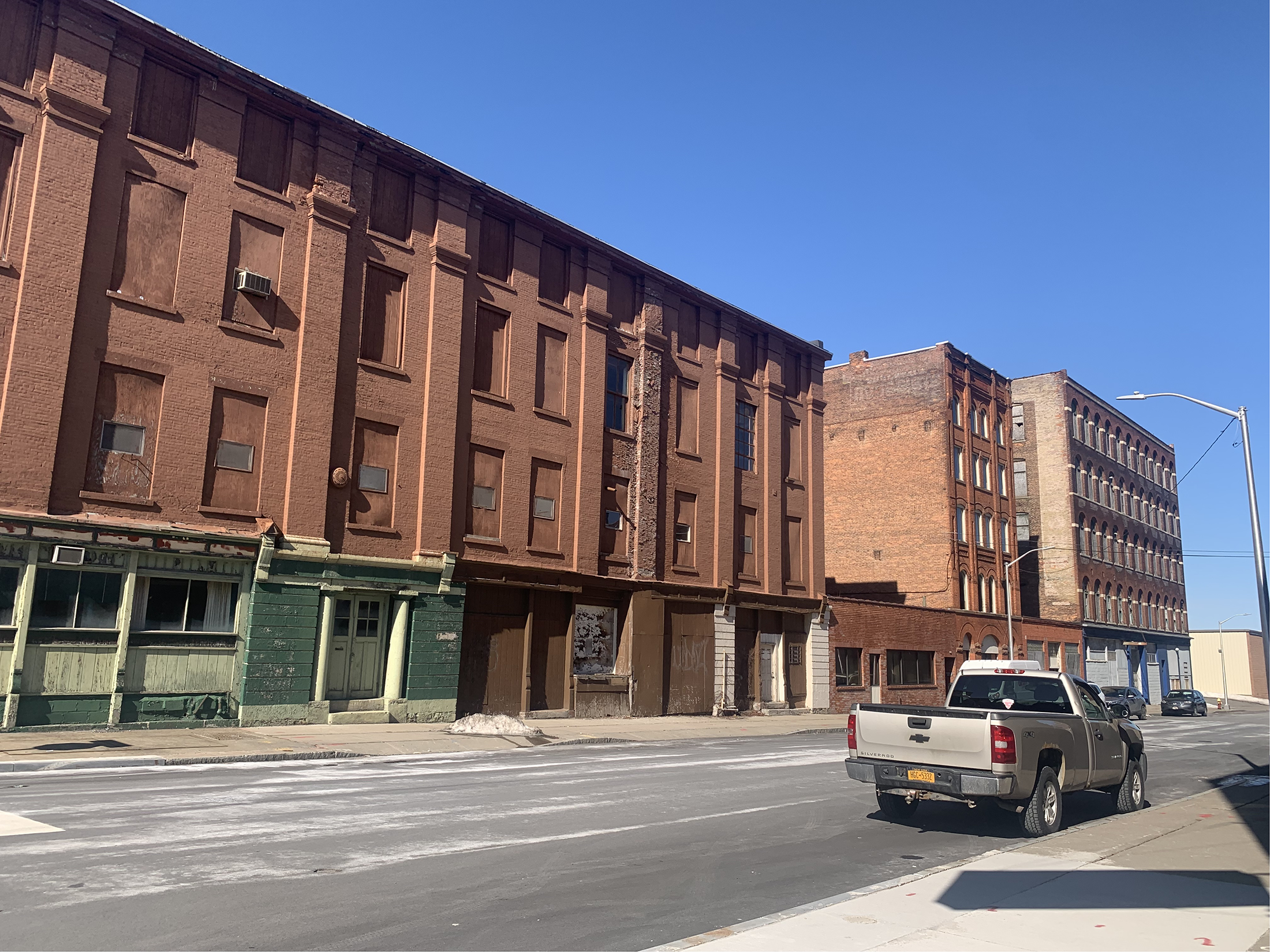
Genesee Street, Utica, New York, 2021. Photo taken by the author.
Understanding Innovation Disaffection
This history of failed resuscitation attempts is essential for understanding how citizens view current innovation initiatives. On the one hand, it begets a circle of blame where residents feel hopeless, disappointed, and neglected despite billions of dollars in investment; meanwhile (in step with Vance), UNYers are held partly responsible by elites for their own downfall, with those promoting transformation efforts blaming a lack of public awareness, interest, and effort for the modest local employment gains produced by semiconductor firms. On the other hand, UNYers, especially those who grew up there, intuitively interpret current guarantees of a better future against the backdrop of past failures of industry and government to deliver on said commitments. A (now former) resident of UNY noted: “That's part of the history of Utica and the Rust Belt writ large: broken promises. Company says they’ll relocate here, government says we have this great transformative idea, you get burned so many times, we’re not going to keep touching the stove.” 39 Since the 1980s, UNYers have been told that Tech Valley is going to solve their problems but this promise has remained mostly unfulfilled. A local university employee asked about the supposed UNY semiconductor hub: “Where are the jobs? When is it coming? When is it coming? When is it coming?” 40 In this light, the Micron investment as a “100 billion bet that a postindustrial US city can reinvent itself as a high-tech hub” (Rotman 2023) is also a circular reference to UNY's social and economic trauma: UNY is one of the places where US technological and economic supremacy was established, where outsourcing manufacturing as part of growing globalization (including in microchip and computer industries) hubs first manifested, but also where the subsequent rise of Asian chip manufacturing and merciless neoliberal competition logics led to a tangible devastation of what is now known as the Rust Belt.
Paradoxically, it is alongside these failed high-tech visions—and perhaps even in spite of them—that many interviews also reveal optimism and hope, as observed in several Rust Belt communities (Goldstein 2017; McMillan Lequieu 2017). The future imagined by “ordinary people” (Hill 2021, 154) does not automatically link the technical with the social. These “ordinary people” do not see UNY primarily as a microchip innovation hub, much less their own worth and social future deriving from narratives built around semiconductors. Similarly to what Schneider experienced growing up in the region, Rust Belt communities’ desired future is a departure from this semiconductor lock-in—built on more opportunity and diversity of choice than was possible in the past (Debraggio 2016; Hill 2021). One interviewee reflected on the diagnosis of “Rust Belt” as a mode of empowerment: Whether it's your parents or a politician, if you’re up there talking about how we’ve got all these problems, we don’t know what to do, don’t be here because I can’t promise you a future, that's what you’re going to believe. But when you start to see and have people standing up and saying “There is a future here. Here's how we’re going to build it together. Here's how I need you as a resident to contribute to that!” and you start to see that in action. With those words come actions that make your city look and feel better. I think that can spiral up the barometer, temperature and perspective of the residents of your community. If you want to give, if you believe, you do more.
41
Interviewees also mentioned Utica's robust refugee community (approximately one quarter of the city's population), who face unsafe housing conditions, language barriers, and racism (Hartman 2022; Stam 2023), but continue to contribute to UNY's economy by settling there. Another interviewee mentioned a self-taught local Armenian ceramicist who is “an amazing artist and he does a lot of great work there and works with a lot of populations to introduce them to art as well. So those things should really be fostered and those things should really be supported.”
44
One informant spoke about the Midtown Utica Community Center (MUCC), which provides a support system for the refugee community and offers glimpses of hope among the ruin that she sees in her daily life: If you drive through east Utica, it's all boarded up and half of the houses are falling apart and empty and half of the houses are brand new housing projects that are beautiful. I see people having house parties, sitting outside drinking beer. Half are gardening and fixing their homes and trying to do things. I think there are just a ton of social problems at least in the city of Utica. I also see Utica as a paradise. The richness of the culture in Utica is so great. That includes everything from dance, to music, to language, to culture to ideas to generosity, community. What I see at MUCC is magical, I would never say it's lost. People are so grateful and grounded and happy to be here. The outside world has been nice enough to let them thrive. Not great but ok. Most of them don’t have relatives with lead poisoning, most have cars and jobs. What seems from the suburbs, where I live, when I drive from here to there, and I say, my god, this place looks really run down and kind of awful, and then you go into the community center and it's a bunch of really hopeful, happy people who are getting nursing and AA degrees and having their kids do really well in school. There's so much opportunity in the fact that it's a lost place.
45
What are you known for? Tech city? Second Silicon Valley up here? Is that what we want to be? Who's making those decisions as to what we want to be?
46
I don’t think it's going to be what they [policymakers] were telling us…this is going to be the Silicon Valley of the east… It feels a little bit false to me—this thing they’re trying to sell. It doesn’t take advantage of the best things we have to offer.
47
Reimagining Postinnovation Politics
On November 5, 2024, two key districts in the CHIPS Act geography—Oneida County, NY, and Licking County, OH, both of which feature incipient chip hubs—voted deep red. It is evident that the promises of even the most future-oriented high-tech policies of the Biden administration failed to reach crucial demographics, both materially and imaginatively. As a result, regions like UNY and the intersection of policy concerns they represent remain squarely in the spotlight of national debates about identity and future-making, especially for the Democratic Party. Innovation, it turns out, is not a convincing answer when left to its own devices.
Pfotenhauer and Jasanoff (2017b) argue that local frictions ensuing from the implementation of preconceived innovation models invite us to invert the homogenizing panacea logic of innovation into a diagnostic that reveals what supposed deficiencies innovation is meant to address, both externally imposed and self-ascribed. In the case of UNY, these deficiencies have long been cast in the language of demise and recovery through innovation, particularly tied to the semiconductor industry. As we have seen, these diagnoses have relied on various modes of “othering”—of undesirable regions that are not innovative enough when compared to idealized hubs and valleys; of communities and ways of life that are “rusting,” “devastated,” or “not working”; and of competing imaginations of what constitutes regional success. Current innovation initiatives, like the CHIPS Act, promote a better future that looks radically different from the present of these places and, in the case of UNY, ostensibly connects this present to a virtuous past. Yet it does so against decades’ worth of harm experienced from deterritorializing modes of producing innovation economies and Silicon Valley-type extraction, at the hands of the very same industry that is now being heralded as the solution. Rust Belt identity, in this sense, is constructed vis-à-vis a specific understanding of economic and political worth tied to cycles of innovation promise and dismissal. Alternatives seem not to be part of the conversation at all.
Our study suggests that current innovation policies aimed at so-called “left-behind” and “peripheral” regions, where innovation centers serve as the benchmark against which peripheries’ worth and future lives should be measured, do not just miss the mark. Rather, they perform hegemonic narratives of linear progress in which the state can experiment with, and discard, ways of living deemed obsolete in the name of national progress (Laurent and Pfotenhauer, forthcoming 2026). Moreover, they suppress the right to understand the pathways into one's own future in one's own terms, especially if these pathways run counter to the universal promise of innovation (Visvanathan 1997, 2005). Innovation policies act as powerful valuation devices that perform specific versions of prosperity and a good life, from which populations and regions can legitimately be ejected unless they assimilate and accept a certain positionality (Callon, Millo, and Muniesa 2007; Muniesa 2014; Asdal et al. 2023). In today's public policy logics, left-behind regions like UNY receive little state support unless they aspire to turn into the next Silicon Valley. If they choose a different logic of worth, this might mean that they have literally nowhere to turn.
Innovation policies are here to stay, though the form they take may vary greatly. Against this backdrop, it might be worth asking what could be done to make these policies serve disenfranchised regions better. Our research suggests, first, that innovation policies directly referencing past innovation successes of regions currently plagued by decline may connect less to local populations than policymakers imagine, and may partly undermine revitalization efforts. Although much of the CHIPS Act was deliberately grounded in local history and meanings, referring to legacy points like the Erie Canal or the semiconductor industry, this grounding also inextricably linked the CHIPS Act to a history of repeated failure and disappointment. Promises of another Erie Canal moment have repeatedly not come to fruition and, in the meantime, pressing social needs were not addressed. Meaningful innovation policies should acknowledge such immediate needs and repeated experiences of disappointment. They may fare better if flanked by social policies aimed at communal well-being, for which innovation policies and the promise of future jobs are no substitute. In Rust Belt regions such as UNY, innovation policies serve as a proxy for “bringing back” more than just jobs and technological leadership (Virkkala 2007; Van Agtmael and Bakker 2016; Clark 2022); these policies entail a hope for social stability, purpose, and dignity. It is the full range and depth of lost qualities that innovation needs to address explicitly, head on. As Ahmann (2024, 2) notes, current disaffections are “about the mess of want and mourning weighing down the dream of ‘what we were going to become.’” Embedding innovation strategies in the sociocultural–political specificities of a place is thus an ambivalent endeavor that requires nuance beyond iconic reference points or folkloristic monikers.
Second, the relationship between regional and national goals is no simple win–win—in fact, it may be precisely what exacerbates social and political rifts. As we have seen, the CHIPS Act blends national targets with regional struggles, identities, and experiences. However, while a multibillion chip investment in Ohio is a win for one region and a national strategy, that win can feel like a kick to the curb for other struggling regions whose hopes have been pegged to the same promissory strategy, thus contributing to the reification of Rust Belt identities. As argued by Pfotenhauer, Wentland, and Ruge (2023), regional innovation narratives rub up against national imaginaries in complex ways, in the process making visible persistent, underlying conflicts that usually have little to do with innovation.
Third, policymakers must acknowledge that skepticism toward innovation policies seems at least partly well-founded. As policymakers continue to reinforce the idea that the future is tied to innovation, and as promises of innovation repeatedly do not pan out (in UNY and elsewhere), communities may see policymakers as not acting as stewards of a common good that includes them. However, distrust and disappointment are not universal, either. Some informants were optimistic about new, or renewed, hope for the UNY region in the form of semiconductor technology and innovation that comes with Tech Valley and the CHIPS Act. In contrast to the contested conclusions drawn in JD Vance's Hillbilly Elegy, our research shows that UNYers do not naively blame the government or ambitious innovation strategies for causing their problems. But based on experiences, they do not trust it to fix them either (Wynne 1992).
Finally, our study underscores that the benefits of innovation policies like the CHIPS Act are neither self-evident nor universal. Instead, they are premised on various modes of othering, including assertions from political and business leaders that certain local communities are problematic and stand in the way of a better future for everyone, including for themselves. Politicians using rhetorical devices like “Rust Belt” and “Heartland” in conjunction with innovation models like “Silicon Valley” or “Tech Valley”—creating hybrids such as “Silicon Heartland” along the way—should be wary of what types of regional imaginaries they are contributing to, especially considering the racial, gendered, and classist undercurrents of this terminology. In this sense, innovation policies, especially in disenfranchised regions, will only make sense to local polities—and create political pay-offs—if treated as political projects that need plausibilization, not rational-progressive projects that everyone can automatically subscribe to. Where citizens can legitimately ask and have an answer to questions like: Innovation for whom? By whom? With whom? And why not something else?
Footnotes
Acknowledgments
Schneider is grateful for the opportunity to present earlier versions of this paper at the Spring 2023 STS Circle at Harvard, the 2023 Science Democracy Network conference, and the 2023 4S Conference in Honolulu. The authors thank two anonymous reviewers for their crucial suggestions for improvement, the STHV editorial collective, and interlocutors who contributed to this research.

Funding
The authors disclosed receipt of the following financial support for the research, authorship, and/or publication of this article: Schneider acknowledges the Hidden Regions project sponsored by the Dieter Schwarz Stiftung. Pfotenhauer acknowledges support by the TUM Innovation Network Governing Transformative Technologies and the DFG Cluster of Excellence TransforM(EXC 3137/1, Grant No. 533801653).