



Abstract
“Cocreation” has emerged as a prominent discourse and set of participatory practices in innovation that aims to engage diverse actors in supposedly inclusive, egalitarian, and empowering ways to jointly produce better innovation outcomes. In this article, we explore how such cocreation practices shape subjectivity—producing what we call a mode of “cocreative citizenship”—by linking technological innovation to an implied duty for citizens to participate in innovation processes and ensure that said innovation will contribute to the common good. Building on recent literature and an in-depth case study of a participatory smart lighting initiative in the Netherlands, we show how cocreation practices constrain the available range of relationships between citizens and the common good by assigning specific roles and responsibilities within narrowly conceived and often technosolutionist innovation purposes. Our findings suggest a need for a wider debate about how to articulate citizenship–state relations and visions of the common good in the innovation-centric societies, underscoring the limits of participatory processes as a form of responsible stewardship.
Introduction
On September 21, 2017, a group of about fifty people consisting of a range of actors such residents, students, designers, entrepreneurs, researchers and city officials, followed an invitation to gather at a local design library to brainstorm how to make Eindhoven, a mid-size city in the Netherlands, a safer and more pleasant place to live through applications of smart lighting technology (Figure 1). This “bootcamp,” as it was called, was organized by “Lighting Up the City” (LUC), a multimillion-euro project established by the Eindhoven municipality in collaboration with researchers from the local university, representatives from the lighting department of a multinational tech firm, and a local construction company. During the bootcamp, multiple rounds of discussions were organized to jointly develop ideas for five broad social goals: Contact and Connection, Social Safety, Traffic Safety, Outdoor Activities, and a Safe and Future-proof Auto District. At the end of the bootcamp, the organizers collected a total of seventy-nine ideas across these five topics, not all of which seemed directly related to lighting. Proposed solutions ranged from low-tech interventions such as a playground that would cater to people of all ages, to high-tech ideas such as an electronic bulletin board where people can leave messages for fellow citizens to read and thus combat social isolation.
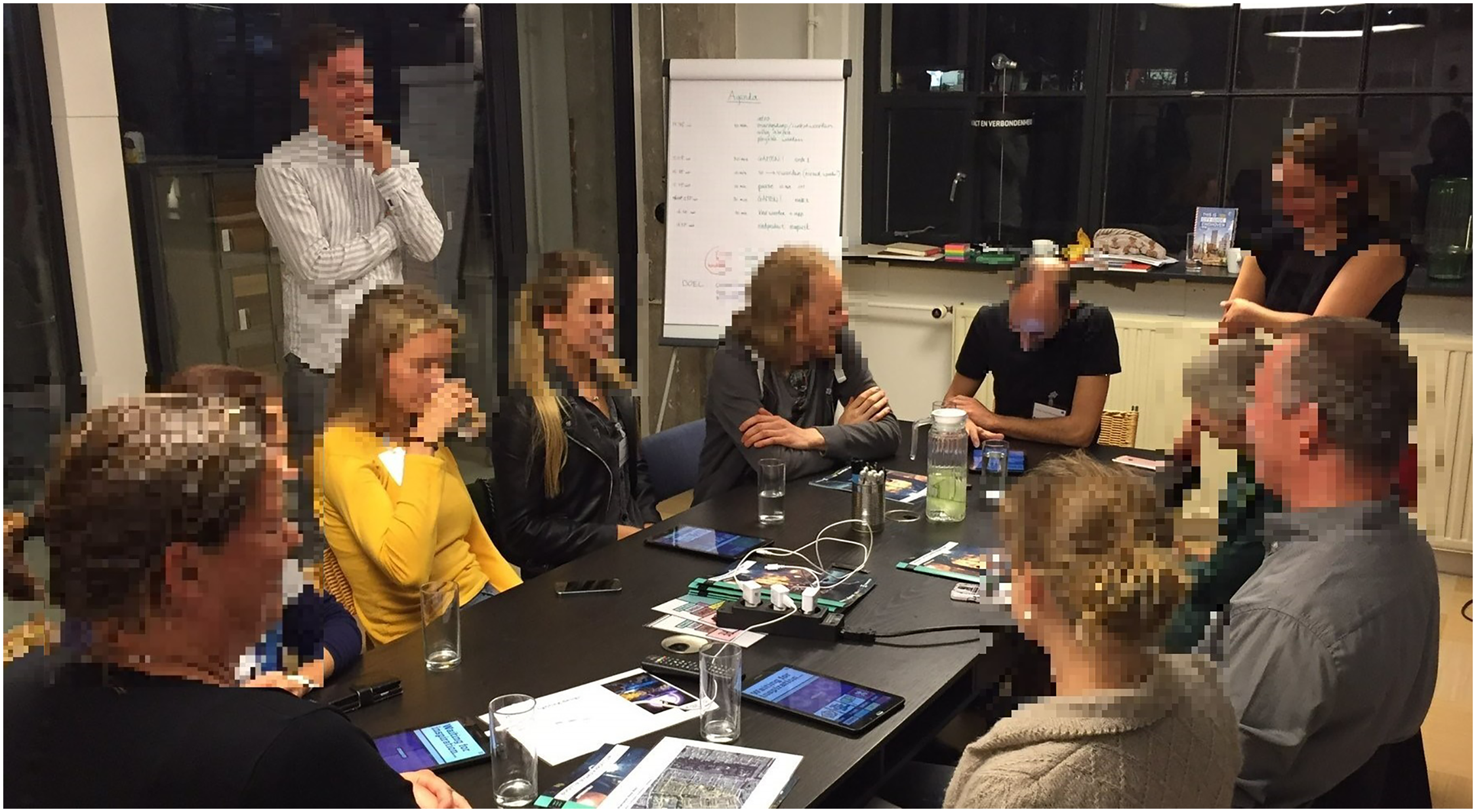
Participants Interacting During the Bootcamp, Eindhoven (Photo Credit: LUC, 2017).
The LUC project is but one case in a surge of initiatives that call upon citizens to participate in hybrid public–private innovation activities tied to specific localities, which try to actively elicit citizen input while also finding applications for emerging technologies (Brandsen, Verschuere, and Steen 2018; Chilvers and Kearnes 2019; Cuevas-Garcia, Pepponi, and Pfotenhauer 2023; Irwin 1995). Many of these initiatives invoke “cocreation”—a term used to refer to a range of collaborative participatory processes whereby diverse actors come together to jointly engage in innovation activities (European Commission 2024; Ruess, Müller and Pfotenhauer 2023; Van Gestel, Kuiper and Pegan 2023). Cocreation frequently includes forms of public experimentation, a central focus on user experience, and, more importantly, the aspiration to produce collectively desirable outcomes that can overcome some of the inequalities and corporate profit biases commonly associated with traditional modes of innovation (Ansell and Torfing 2021; Frahm, Doezema and Pfotenhauer 2021; Torfing et al. 2021). “Cocreation” overlaps with other participatory innovation practices, for example living labs (Bergvall-Kåreborn and Ståhlbröst 2009; Engels, Wentland and Pfotenhauer 2019), hackathons and makerspaces (Davies 2017; Irani 2015), responsible innovation (Stilgoe, Owen, and Macnaghten 2013), or the much longer tradition of public engagement in science and technology (Irwin 2014; Stilgoe, Lock, and Wilsdon 2014)—all concerned, in one way or another, with countering the traditionally technocratic tendencies of technology development, and enabling ordinary citizens to voice concerns or ideas in innovation processes alongside expert actors such as designers, scientists, policymakers, and entrepreneurs.
Our goal in this paper is not to define “cocreation” or insist on sharp boundaries to these other formats. Rather, we aim to explore how cocreation (and related practices) perform specific visions of citizenship and statehood through participatory innovation processes focused on individual citizens as stewards of the common good. We define such “cocreative citizenship” as an imagined set of citizen duties to individually contribute to ongoing innovation processes for the sake of the common good, to which they have a democratic obligation as part of a political collective. In practical terms, cocreative citizenship consists of an increasingly normalized set of expectations, articulated by both public and private sector actors and inscribed in cocreation formats, about how citizens should support innovation processes and accept innovation outcomes. This production of cocreative citizens is typically neither an explicit nor a primary objective of cocreation processes, which focus on epistemic pluralism, market creation, user enrollment, and a mix of acceptance and legitimacy. But paying close attention to the citizenship dimension is important, we believe, because the logic of cocreation quietly cuts to the constitutional heart of our technical democracies: Where is sovereignty located in innovation economies? What rights and protections should citizens have vis-à-vis new technologies that impinge on their lives, including in relation to the state? And who represents the communities potentially disrupted by technological advances?
Our study is guided by the following two research questions: (1) how do cocreation practices shape citizens’ roles and responsibilities in public–private innovation settings, and (2) what implications do these practices have for articulating the common good in relation to innovation? Through our case study, we illustrate how cocreative innovation reframes citizen engagement as limited to soliciting specific inputs into preconfigured innovation processes in ways that supposedly render innovation outcomes both desirable and legitimate. Expressed in the form of various “expectations” toward citizens discussed below, we argue that the increasing reliance on cocreation in public settings is part of a broader shift in public policy that envisions collective futures through the narrow lens of innovation and, by extension, reducing political subjectivity to individual creative inputs as part of an innovation process that links emerging technologies to markets (Doganova, Laurent, and Violle, forthcoming; Juhl, Aarden, and Pfotenhauer 2025; Pfotenhauer and Juhl 2017). Publicly legitimated innovation practices such as cocreation thus coproduce certain forms of social, political, and economic subjectivity that affect the balance of power in consequential ways.
Our notion of cocreative citizenship partly draws on Lilly Irani's (2015, 799) figure of “entrepreneurial citizenship.” Derived from her study of hackathons in India and the United States, Irani argues that “hackathons sometimes [sic] produce technologies, and they always, however, produce subjects.” She highlights how participatory approaches to innovation not only give structure, speed, and direction to innovation processes (as claimed by its proponents), but also simultaneously introduce new forms of subjectivity and subjugation. Irani's focus on visions, barriers, and vulnerabilities associated with a self-reliant entrepreneurial individual befits the hypercapitalist contexts of her study in postcolonial India and North America. To that, our research adds a focus on the remaking of political subjectivity and imaginations of the common good in relation to democratic statehood, which particularly speaks to innovation settings where public institutions are envisioned to play a more active and explicit role in both the definition of innovation purposes and the execution of innovation activities (see e.g., Jasanoff 2005; Pfotenhauer and Jasanoff 2017). As we see it, imaginaries tied to a tacitly shared understanding of the common good do not fully dissolve in individualized or extractivist forms of capitalist-entrepreneurial subjectivity, even if the notion of statehood is thoroughly rearticulated in the process (Boltanski and Chiapello 2018; Bombaerts 2023; Brown 2015; Ezrahi 2015; Mirowski 2013). Rather, the common good is being reconfigured as attainable through new products, services and corollary governance regimes entering society, toward which citizens are assumed to have a civic responsibility. A similar point has been made by Delvenne and Macq (2020, 245), who observe that participatory approaches have started to shift “from participation in decision-making to participation in innovation-making, as well as a shift from civic values to productivist values with the pervasive expectation that publics should increasingly act as innovators and entrepreneurs.”
Our contribution is to highlight how cocreation and related participatory innovation approaches do more than merely entrepreneurialize citizens in the name of democratizing innovation. Taking inspiration from notions of citizenship found in STS work on constitutionalism (Hurlbut, Jasanoff, and Saha 2020; Jasanoff 2005), scientific citizenship (Bickerstaff et al. 2010; Elam and Bertilsson 2003; Irwin 2001), the construction of mini-publics in technoscientific deliberations (Felt and Fochler 2010; Voß and Amelung 2016), and the political economy of public engagement with science (Delvenne and Macq 2020; Thorpe and Gregory 2010), we argue that cocreation discourses and practices actively recast democratic duties of citizenship as productive of both innovation and legitimacy. This results in situations where citizens are expected to assume the role of guardians of the common good within technocapitalist dynamics over which they have limited control, thereby taking on responsibility—sometimes involuntarily—for the governance of innovation, a task traditionally accorded to the state. A key question is therefore whether the implied governance function of cocreation complements and augments, or partly side-steps and subverts, the imagined social contract between citizens and the state in technical democracies.
The paper is structured as follows: we first provide some background on theories of public engagement and cocreation, with particular attention to different modes in which subjects are configured. This is followed by an overview of our methods and empirical material. Thereafter, we present our case study, examining how expectations placed upon citizens are coproduced through structures and assumptions within the innovation process. We particularly analyze how cocreation promotes an individualization of responsibilities to care for the production of societally beneficial outcomes in the design of new sociotechnical systems. Finally, we reflect in the discussion on the implications of cocreation's subtle reconfiguration of the relations between the state, citizens, and the creation of the common good.
Citizen Engagement in Science, Technology, and Innovation
The recent history of debates about citizen participation in science and technology (S&T) can be traced back to the early 1990s, where participation was initially seen as a remedy against controversies and unruly publics commonly ascribed to a knowledge gap between experts and the lay public. This “deficit model” of public understanding was countered by research emphasizing the sociopolitical and institutional embeddedness and limitations of all forms of knowledge, including expert knowledge (Lewenstein 1992; Wynne 1991; Ziman 1991), as well as the role of controversy closure for the social construction of facticity and dominant technology designs (Jasanoff 1987; Latour 1988; Pinch and Bijker 1984). This body of critical scholarship gave rise to more nuanced and deliberate accounts of the role of publics in S&T and the differences in knowledge and power between experts and the public (Epstein 1995; Nowotny 2003; Ottinger 2009).
Different bodies of literature have focused on varied rationales for public engagement—including democratic, instrumental (e.g., commercial or political), epistemic and normative aspects (Stirling 2007)—related to, for example, questions of trust in scientific expertise and authority (Wynne 2006), the social robustness of knowledge (Nowotny 2003), the pooling of external knowledge for innovation and creation of nascent user communities and markets (Chesbrough 2003; Prahalad and Ramaswamy 2004; Von Hippel 2006), legitimacy and responsibility (Irwin 2006; Pretorius et al. 2024; Stilgoe, Owen, and Macnaghten 2013), the scientization of democracy (Macq, Parotte, and Delvenne 2021; Thorpe and Gregory 2010; Voß and Amelung 2016) or the explorative nature of technological controversies (Callon, Lascoumes, and Barthe 2011). This diverse literature has been paralleled by an ever-growing diversity of participatory instruments with regard to S&T, including citizen panels, consensus conferences, living labs, or participatory technology assessment (Hagendijk and Irwin 2006; Hennen 1999; Lengwiler 2007; Rowe and Frewer 2005).
The prominence of participatory and “open” innovation formats has prompted critique of solutionist tendencies in how the perceived democratic gap in innovation policy and governance is addressed (Ansell and Torfing 2021; Frahm, Doezema, and Pfotenhauer 2021). As Laurent (2011, 2017), Voß et al. (2016, 2021) and Chilvers, Pallett, and Hargreaves (2018) and Chilvers and Kearnes (2019) have argued, such deliberative and participatory formats have become increasingly standardized—a ready-made “technology of democracy” deployed across contexts that produces and performs a specific version of democratic politics vis-à-vis science and technology, reconfiguring rather than overcoming the power asymmetries in the political economies of S&T. For example, Voß, Schritt, and Sayman (2021) highlight how “deliberative mini-publics” such as citizen panels, polls, and consensus conferences serve to control how knowledge is created, shaped, and disseminated. Likewise, Thorpe and Gregory (2010) observe how public engagement practice itself becomes a domain of expertise and an instrument of control, placation, and extraction in the name of vested political-economic interests.
The Rise of the Cocreation Paradigm
In public policy, the notion of “cocreation” has become particularly prominent since the 2010s, especially in the context of hybrid public–private innovation settings. The term cocreation was originally coined in marketing and management studies, where it refers to an interactive process whereby firms invite individual customers or lead user communities to actively engage in the design and testing of a new product or service as part of a joint value creation paradigm—for example through beta-testing, open organization approaches, or the mainstreaming of mass customization approaches (Prahalad and Ramaswamy 2004; Ramaswamy and Gouillart 2010). As the concept has become more widely adopted outside of corporate settings, cocreation is generally understood as a collaborative process whereby relevant stakeholders come together to achieve mutually desirable outcomes through what Voorberg, Bekkers, and Tummers (2015, 1334) call a “social innovation journey.” In these journeys, citizens are actively recruited to provide ideas, feedback, and other forms of labor in the name of democratizing innovation for both economic and social progress (De Jong, Neulen, and Jansma 2019;Jansma, Dijkstra, and De Jong 2021;Krzywoszynska et al. 2018;Leino and Puumala 2020; Robinson, Simone, and Mazzonetto 2020). Many cocreation settings thus blur public- and private-sector goals and approaches, emphasizing their utility for public-sector innovation (Ansell and Torfing 2021; Bentzen, Sørensen, and Torfing 2020; Broekema, Horlings, and Bulder 2021).
Because of its roots in commercial business practice, existing studies of cocreation often foreground the role of citizen-participants as potential users or consumers of a new innovation-in-the-making. Ruess, Müller, and Pfotenhauer (2023) analyzed the frequent slippages between framings as users, consumers, and citizens in European cocreation discourses, in which the economic rationales (e.g., increased acceptance of a new technology) for cocreation in public and policy settings regularly seem to trump other rationales (e.g., justice or democratic legitimacy). This slippage points to tensions between a productive and deliberative or corrective role for citizens in cocreative innovation. Thus, alternative rationales for participation in S&T mentioned above (e.g., procedural or distributive justice, democratic representation, precaution) are always at risk of being subjugated under, or displaced by, a principally economic rationale in an emerging hierarchy, shifting the purpose of citizen engagement from “a deliberative process … [to] a productive one, geared toward the production of innovation, technology, and scientific knowledge” (Macq, Tancoigne, and Strasser 2020, 490).
Many of these reconfigurations and ensuing tensions are not new. They have been observed for a range of innovation instruments like hackathons (Irani 2015) and living labs (Engels, Wentland, and Pfotenhauer 2019; Laurent and Tironi 2015), where participation serves to obtain buy-in for certain forms of technoeconomic development. Importantly, however, this emerging hierarchy between different imagined citizen roles focuses squarely on the individual as a political and economic actor. Here, the common good (e.g., public infrastructures and services) is being reconfigured as attainable through individual choices about new products and services that enter society with the participation of select groups of citizens who are coresponsible for their production. The problem, of course, is when no one shows up to take that responsibility (Ruess and Müller 2024). Or, more mundanely, when practitioners of participatory processes are unable or unwilling to discern different logics and normative ideals of participation, or how these logics interact in concrete enactments of cocreation. In many instances, cocreation activities blur these different identities into one, whether for strategic-instrumental purposes or due to lack of awareness (Lipp et al. 2022; Ruess, Müller, and Pfotenhauer 2023).
A number of scholars have begun to explore the broader implications of these subtle transformations in the relationship between citizens, the state, and the presumption of a common good that connects them in the pursuit of innovation. For example, Frahm, Doezema, and Pfotenhauer (2021) demonstrate that the emphasis on responsibility and inclusiveness in innovation within international policy settings serves to maintain, rather than challenge, established market-liberal capitalist orders. Delvenne and Macq (2020) also observe that participatory experiments have increasingly pivoted toward maximizing value extraction as efficiently and intensively as possible, often at the expense of addressing salient political concerns. Similarly, Irani (2015) suggests that distributed IT labor and the steady rise in the “entrepreneurial citizenship” embody characteristics such as optimism, fast-paced development of solutions, and manufactured urgency (with time being treated as scarce), with strongly neoliberal overtones. For her, entrepreneurial citizenship represents both a shift in who gets to participate in economic activity, and who is responsible for economic productivity. Entrepreneurial visions of productivity and innovativeness often fail to include those who do not perform the “right” kind of attitudes and behaviors, ultimately leading to new forms of exclusion.
In line with this recent critical scholarship, we understand “cocreative citizenship” as specifically highlighting the reconfiguration of citizens’ role in the public good dimensions of innovation and in innovation–state relationships particularly through participatory instruments. As we see it, cocreation and related approaches represent a crucial shift—not only in rationalizing public engagement as necessary for stewarding the common good in innovation settings, but also in framing the common good itself as primarily attainable through innovation. This shift has implications for what it means to cast a dutiful and active citizen as someone who is bound to participate in the collective shaping of their society by engaging in innovation.
The citizen dimension of participatory innovation processes provides a link between STS research on public engagement, and studies of innovation discourses and practices, particularly regarding the role of the state in innovation policy. As Pfotenhauer and Juhl (2017) have argued, most current innovation policies suffer from a historical lack of attention to the political dimensions of statehood. Vannevar Bush's influential post-Second World War manifesto Science, the endless frontier, building on a long-standing narrative of seemingly objective, value-free science, prominently depicted innovation as a “seemingly apolitical and conflict-free space between objective science and technology, on the one hand, and efficient rational markets, on the other” (Pfotenhauer and Juhl 2017, 69), where the role of the state is limited to front-end investments in education and basic research and rear-end (post-hoc) regulation of technologies in an imagined pipeline. By reducing the role of the state to a toothless “facilitation of technology-based economic growth … other state responsibilities like the expression of political will through collective decision-making, democratic representation, distributive justice, or the guarantee of basic constitutional rights remain squarely outside the notion of innovation in mainstream innovation theory” (Pfotenhauer and Juhl 2017, 69). This sidelining of substantive political and cultural dimensions has persisted throughout the history of innovation models, including contemporary versions of innovation systems, entrepreneurial statehood, and mission-driven innovation (see also Godin and Lane 2013; Kuhlmann and Rip 2018; Mazzucato 2013, 2018; Pfotenhauer, Juhl, and Aarden 2019). In this sense, our study of “cocreative citizenship” equally speaks to critical studies of innovation, emphasizing how innovation is always already embedded in political cultures, subject to locally situated forms of delegation and contestation, and enacted through public institutions that determine the purpose of innovation in relation to the common good, including by funding innovation or by providing specific guardrails around it.
Research Design, Empirical Material, and Methods
Our analysis is primarily based upon an in-depth case study of a Dutch public–private innovation project (2016–2019), LUC, based in Eindhoven, which we studied and observed between late 2018 and mid-2019. 1 Eindhoven is well-known for its dense network of high-tech companies (Fernandez-Maldonado and Romein 2010). In the last two decades in particular, the Eindhoven municipality has focused on transforming the city into a “smart city,” which in practice means that the city readily makes itself available as a testbed for new digital products and services developed by local technology companies.
Cocreation initiatives such as our case study are one of many in the Netherlands, Europe, and beyond (Bentzen, Sørensen, and Torfing 2020; Laurent and Tironi 2015; Leino and Puumala 2020). The project aimed to bring together various stakeholders such as citizens, businesses, public officials, and scientists to jointly develop ideas for how to use smart lighting–based solutions to improve the quality of life in residential and urban areas. From a range of available study sites, we selected LUC to explore the relationship between cocreation and citizenship. First, the project was an explicitly collaborative, a “cocreative” endeavor, assembling a presumably representative mix of stakeholders like many contemporary cocreation projects: a municipality, a mix of local and global businesses (industrial consortium consisting of TechCo and ConstructionCo), researchers from the nearby technical university (TechUni), and, most importantly, local citizens. While technical experts were brought in repeatedly to provide expertise and resources for “technical” elements of the project (e.g., development of a smart lighting grid connected to the public lighting infrastructure, prototype solutions, or specific technical knowledge), the project was explicitly narrated around citizens’ needs and inputs as the baseline against which outcomes would be judged. Second, the project had the triple purpose of addressing societal problems and challenges, creating and testing potentially marketable solutions, and at the same time trying to develop new policy approaches and innovation processes for linking technology experiments to public good aspects by including citizens. This hybrid public–private setting posed an interesting opportunity for us to study how competing rationales and associated forms of subjectivity would play out vis-à-vis one another, and specifically how they affect notions of the common good.
To understand how cocreation conceptualizes citizen engagement in common good innovation, we took a qualitative, semigrounded, constructivist approach that combines case study research, discourse analysis, interviews, and ethnographic observations 2 (Esin, Fathi, and Squire 2014; Lichtman 2014; Yin 2014). Our aim was to extract and interpret narratives of citizen engagement as envisioned by the project participants and the tensions arising from conflicting understanding of goals, roles, and responsibilities in practice. To understand this, we adopted a discourse analysis approach to understand how certain phenomena and power relations surrounding the notion of cocreative citizens were produced through the ideas, statements, and information in the documents, ethnographic material, and the observable material practices of the Eindhoven lighting project (Kendall and Wickham 1999).
We followed, as observers, the project between late 2018 and mid-2019. Our fieldwork was mostly conducted as short-term (“focused”) ethnographic engagements centered on key states and events in the LUC project. Our observational data includes quarterly supervisory board meetings about the progress of the project, current challenges, and following activities (2018) and a public presentation of the proposed solutions (2019) for one of the test-zones (explained in the next section). In addition, we conducted seven in-depth separate interviews with project members that consisted of representatives from the industrial consortium, policymakers, and researchers to learn more about their perspective on the project (e.g., Whose initiative was this? What is it for? Who was involved and why?). We developed a narrative of cocreation practice by noting down when and how citizens were engaged in various activities (e.g., meetings, workshops, responding to surveys, and so forth). Our empirical data also included many secondary sources such as publicly available documents (e.g., descriptions of project activities or progress reports from the project's website), policy documents, publications by the involved partners, an end-of-project evaluation that critically reflected on aspects such as successes, challenges, and learning outcomes, media publications as well as a range of gray literature pertaining to the broader context in which the project took part (such as policy reports and media publications on cocreation in Eindhoven, the Netherlands and Europe). We organized and analyzed our data and identified emerging categories and themes using Qualitative Data Analysis coding software.
Configuring Cocreative Citizenship
Three Birds, One Stone: The LUC Project Vision and Goals
In recent years, technology-centric innovation strategies have been increasingly coupled with urban redevelopment strategies aimed at improving the quality of life for city residents. This was the case for the LUC project, which connected recent developments in lighting technology, particularly public lighting infrastructure, to several ongoing urban development challenges the Eindhoven municipality was dealing with. One of the initial driving questions behind LUC was how best to replace the existing 21,000 streetlights across the city with new energy-saving and otherwise advantageous LED lamps (from visual esthetics to neighborhood safety). The LUC project was one of many examples of how Eindhoven, from the perspective of the municipality, can use lighting technologies to contribute to a more sustainable city, as well as generate business for and partnerships with local technology companies.
With these broader redevelopment goals in mind, the municipality commissioned researchers from TechUni to devise a long-term strategy and development plan that would tackle these concerns comprehensively (Eindhoven Municipality 2012a). In 2012, researchers from TechUni delivered a roadmap report containing a summary of the current challenges and opportunities for the city, including research gaps and technological trends. Among other things, the report made two recommendations for the municipality. First, due to the open-ended nature of the request to use lighting to improve quality of life, the municipality was advised in the roadmap to ensure an experimental, collaborative process with different stakeholders to drive technology development and diffusion. Second, as the objective of using lighting innovation in public settings to drive development would directly affect Eindhoven citizens, the municipality had to ensure that it would set up processes to prioritize public interest (Eindhoven Municipality 2012b). In the roadmap, shared futures and the common good were reflected by specific sections that highlighted diversity of values, needs, and commitment of an equally diverse population under headlines such as “What people say about Eindhoven in 2030,” “Basic values in the scenario,” “The potential of people,” or “The perception of value.”
After the roadmap was formally adopted in late 2012, the municipality issued a public tender in search of suitable business partners to carry out the municipality's plans in exchange for Eindhoven being an early adopter of their public lighting technology and acting as the experimental site to develop these novel technologies and services with a view toward commercialization. Specifically, the tender called for proposals related to the development of a new smart city grid, a city-wide digital network linked to the Internet of Things, allowing real-time access to data points relating to issues around the city (e.g., traffic congestion, air pollution, and so forth) (Eindhoven 2012b). In the imagination of the municipality, the smart (lighting) grid was intended as a collaborative innovation platform that different stakeholders can use to jointly develop smart city solutions. The municipality envisioned that this network would support and facilitate the development of novel facilities and services with and for its researchers, businesses, and especially citizens, the largest group of users of the city's infrastructure and facilities. At the end of 2015, it was announced that the consortium consisting of TechCo and ConstructionCo won the tender and would join as a project partner alongside TechUni researchers, citizens, and the municipality), and the contract cementing the public–private partnership was signed on 13 October 2016.
In this preparation stage, cocreation was primarily understood as a policy tool aimed at achieving a three-part goal for the municipality: the project was part regional innovation and economic competitiveness strategy, building on and supported by local industrial strengths (e.g., through early adoption and subsidies); part technological pilot experiment for new, smart technologies of unknown transformative power; part democratic technique as an inclusive and urban problem-centric initiative that hoped to involve citizens in the redevelopment process of their city together with other actors. Against this background, the involvement of citizens in innovation was simultaneously seen as useful for technical, social, political, and economic reasons. Yet there was an unmistakably optimistic tone about how the smart city future would play out in Eindhoven and benefit citizens as a way of shaping the quality of urban life through empowering democratic innovation trajectories and realigning citizen–government relationships. As the Eindhoven Municipality's (2016, 3) document containing the Smart Society Implementation Program strategy noted: But in fact, it is less about realizing the “smart city” and more about the transformation to a “smart society”mpa#rdquo;.…In a smart society, the quality of life is central. The same goes for the people and companies that come up with up with the smart solutions to issues in their daily lives and to major social issues that present in society. Solutions should not be given top-down by the government, but should arise in co-creation with the people and organizations that are affected (our translation).
Inviting Cocreative Citizens
While the LUC project did not formally start until 2016, in reality it was already well underway by 2014, and certain key decisions were made even earlier. In particular, the form and purpose of citizen engagement were largely determined in the prior preparatory phase, entirely without the involvement of the citizenry, who entered the project only in late 2016. Key decisions from which citizens were absent included, among others, the choice of the technological domain (lighting); the framing for improving life in Eindhoven through technology (as opposed to other forms of public policy or investment); the relevant expert participants (companies, university researchers, city officials); and the legal, strategic, and organizational set-up through which the goals were to be realized, especially in regard to citizen participation itself.
Especially the decision to pursue questions about the common good through a specific technology—smart lighting technologies and related services developed for the smart grid—proved consequential for the cocreation process. From the outset, this choice locked the project into a path dependence whereby social problems identified by citizens would have to be translated into technical and economic considerations about lighting. It also created pressure to demonstrate that at least some “right” problems could be addressed with this technology, rather than alternative, including nontechnological, approaches. The emphasis on lighting was driven primarily by concurrent developments and ambitions surrounding Eindhoven's urban and regional development, not by citizen input about existing problems. While the municipality was explicitly committed to aligning innovation with problems and needs citizen identified by the citizenry, planning documents also stressed pragmatism and efficiency. In order to save time, money, and other important resources, priority would be given to “already existing or envisioned solutions from the consortium partners [TechCo and ConstructionCo] that meet a certain need” (Eindhoven Municipality 2012b, 3).
Asymmetry in participatory processes related to technology is not uncommon. It reflects long-standing assumptions about agency in innovation processes, where citizens are often at the receiving end of expert and corporate decisions, and consulted mainly at times and on issues preconfigured by others (Irwin 2001; Wilsdon and Willis 2004). Such asymmetry undermines the ostensibly egalitarian promise of cocreation, which at least on the surface connotes encounter on a more equal footing than engagement (of whom, by whom) or participation (in whose predefined project). However, while the roles of the municipality, the researchers, and the industrial consortium—the initiators of the project, selected as a consortium partly due to their established prior networks and working relationships—mpa#mdash;were established, that of the citizens was not. Citizens joined the project as individuals living in a certain neighborhood without any previous ties to the consortium and its goals.
Navigating Cocreation Processes
In their proposal, the industrial consortium had broadly described a cocreative innovation process that outlined how citizens, businesses, and other local stakeholders would contribute to the ideation process and development of solutions. First, the development of solutions was to take place in five designated test zones, which were to pilot the envisioned city-wide transformation. These test zones, selected by the industrial consortium based on their fit with certain research criteria, consisted of three residential areas (Neighborhood 1, Neighborhood 2, and Neighborhood 3) and two major strips of road (Road 1 and Road 2). Following the selection of the test zones, the strategy had to be translated to fit local conditions and to structure the cocreation processes at each site. This cocreative process was termed the Smart City Continuous Innovation Process (SCCIP) and was developed by the industrial consortium together with the TechUni researchers. The SCCIP configured cocreation as a four-part sequential series of phases: (1) Replace old luminaires to LED; (2) Identify needs and opportunities (from citizens); (3) Directions and solutions; and (4) Implementation and assessment (see Figure 2). Each phase was linked to distinct goals, activities, and expected forms of input from the project partners and stakeholders. It was through this highly specified and preplanned process that the participating stakeholders were to jointly contribute, produce, and eventually test and evaluate the smart city solutions for the smart grid—how cocreation was to be enacted.
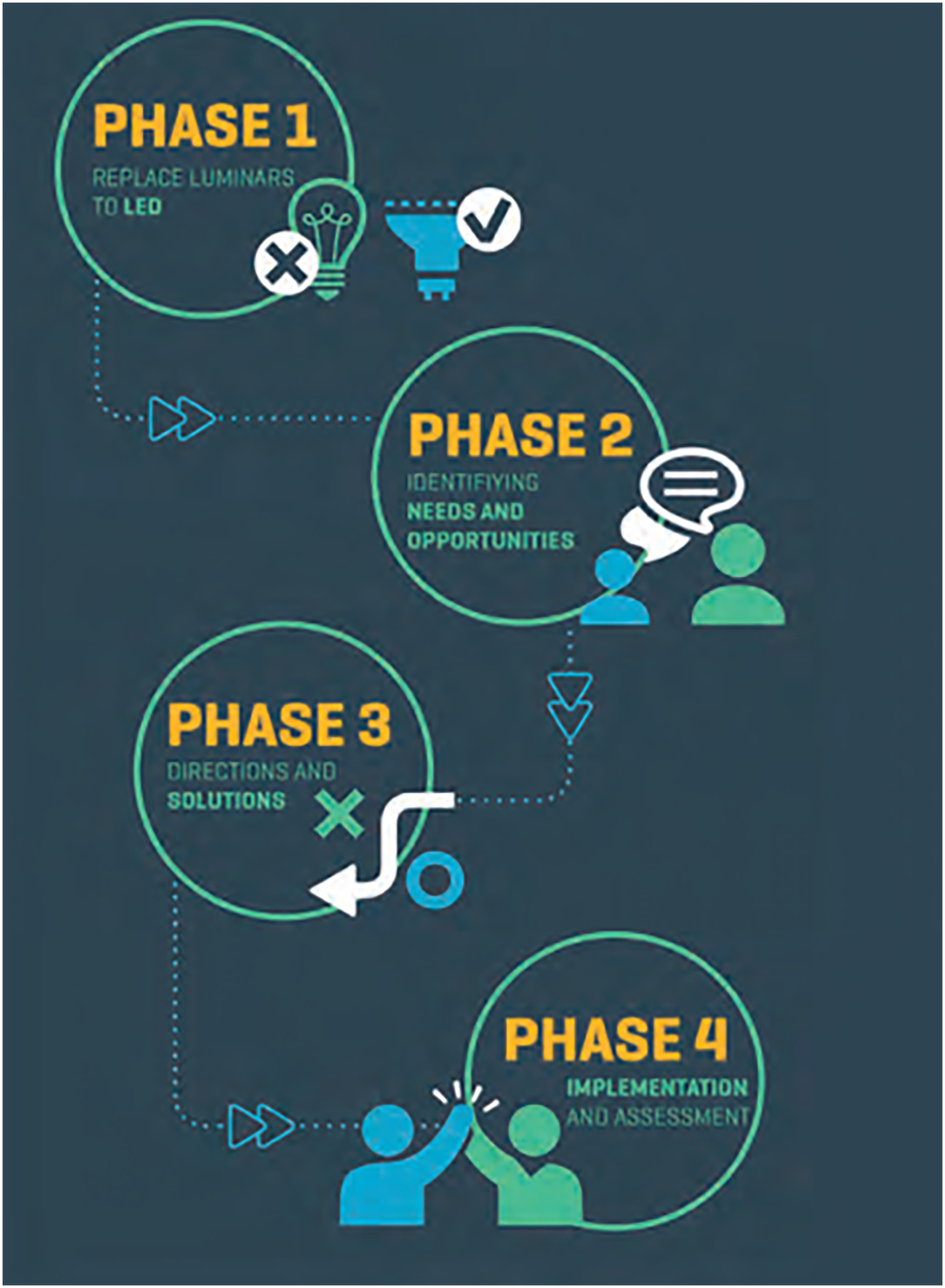
The Collaborative Process (Smart City Continuous Innovation Process) for Each Pilot Area as Devised by the Industrial Consortium for the LUC Project.
The stated aim of
These activities were intended to give residents an opportunity to act as knowledgeable authorities that could speak to a range of issues in their surroundings. However, the translation of this input into tangible LUC project deliverables and solutions happened mostly outside the purview of citizens. Once the input was collected, the task of transforming the input into concrete solutions was left to the university partner and industrial consortium. Both oversaw the data collection and fieldwork and wrote up the input into public reports to summarize stakeholders’ concerns, and also serve as the basis for the industrial consortium to develop technical solutions. According to the partnership agreement signed with the municipality in 2016, the industrial consortium was the principal actor responsible for the research activities after these workshops.
The needs-based workshops reify the previous logic: citizen input mostly served an instrumental purpose that worked within the confines of the goals and parameters set by the project coordinators, and ceded control over cocreation outcomes to other parties. The needs-based workshop provided the opportunity to provide input and suggest change (in limited form), but did not guarantee which issues would be taken up or turned into a solution. In practice, citizen input would be considered relevant only if it could possibly be solved through smart lighting applications. The needs-based workshops, despite being the crucial moment for residents to voice their problems and concerns, were highly curated activities that did not leave room to challenge any of LUC's basic premises. They are reminiscent of what Arnstein (1969, 217) in her work on the “ladder of participation” calls “tokenism”—where citizens are made to feel as if their input matters, when in reality “they lack the power to ensure that their views will be heeded by the powerful.” They also resonate with experiences from public consultation exercises on science and technology (e.g., Britain's infamous GM Nation, see Irwin 2001) and what Felt and Fochler (2010) call “machineries for making publics,” that is, the fact that material practices of structuring engagement solicit specific kinds of responses and perform their own kinds of “publics,” which in turn reflects certain ideals of what coordinators envisioned as cocreative, democratic and useful participation in the first place (Laurent 2011).
Once there was final overview of all developed solutions, the coordinators would arrange for a presentation to display and explain each solution. This was followed by a voting process of which all four stakeholder groups (municipality, industrial consortium, researchers, and local residents) participated in, to decide which solution would be implemented in the designated test-zone. The voting process was organized by the coordinators, who used a Dragon's Den-style of pitch to “sell” the best solution. Following the presentation, all stakeholders voted through an online survey. The survey contained an overview of the identified needs and wishes, and a brief description of each proposed solution. Respondents were prompted to consider the solution against two criteria: (1) Will the [name of test-zone] be made a better place by the solution, and (2) Will you actively make use of the solution? Stakeholders had to mark the relevant boxes “Yes” or “No” in the two questions and submit. Alternative or “second-most-voted for” options were not disclosed or considered.
One interesting feature was that the municipality, who might otherwise be taken to act on behalf of citizens’ interests, had a separate vote from the involved residents. An alternative voting set-up could have arranged for the city to defer to citizens—or even give citizens a majority (or sole) vote in the implementation decision—given that the cocreation processes related to lighting in Eindhoven was intended to improve the quality of life for residents. Yet by granting each institutional partner equal voting rights, the decision allowed for various interpretations of what residents needed that did not necessarily align with citizen's self-assessment.
In the final
The abrupt and premature stop came as a shock to some of the citizens who had invested considerable time and effort. From the beginning, the logistical aspects of the project, including budget and time resources, had been challenging. Each test-zone experiment had been envisioned to be completed within six months to one year, which meant that residents were expected to be available and committed to participating in activities exactly during this timeframe, subject to timelines not defined by themselves and potentially in conflict with other responsibilities. Especially for citizens engaged from beginning to end—which coordinators envisioned as a way to ensure consistency and alignment between the needs and the eventual solutions—this posed a considerable challenge. Citizens had to attend various events during working hours or late in the evening. This implied that citizens had arranged free time and planned their day around these cocreation activities if they wanted to join, and once they did, they were expected to follow through with the entirety of the process to ensure collective outcomes would be realized. Besides availability, this also required that they remained motivated and enthusiastic about the project, and stayed alert with regard to new planned activities. Residents were not financially compensated for their participation in these activities (often lasting between 1 and 3 h per activity), as the latter were understood as a form of democratic engagement toward common good aims that were envisioned to directly improve residents’ lives. As with most aspects of the project (aims, locations, budget, parties involved), the time limits and (lack of) compensation were boundary conditions set by the coordinators to which citizens had had no input and that did not consider residents’ actual circumstances, including whether residents would still be interested in participating down the line.
Cocreative Citizenship: Reconfiguring Subjectivity Between Innovation and the State
When tracing the role of citizens in the LUC cocreation process, a familiar picture emerges. Public- and private-sector actors—in this case, the city of Eindhoven, a university, and a mix of multinational and local companies—joined forces to drive the local introduction of technologies under the banner of addressing societal problems and enhancing regional competitiveness. Citizens were called upon to give this transformation direction, to ensure that these technologies addressed actual needs and to render the resulting solutions socially acceptable. Their inclusion in the innovation processes, however, was highly selective, largely prestructured and late to the game, excluding them from some of the most fundamental decisions about the project and avoiding clear commitments about what would become of their input, especially after the project's discontinuation. At no point did the coordinators explicitly distinguish between users, consumers, coinventors or citizens as separate categories—and hence between political, social and economic rationales for cocreation. Accordingly, the enactment of cocreation in practice strengthened certain aspects of democratic participation while undermining others. In the end, considerably more power over the process rested with the city and the companies than with affected residents. So far, so unsurprising.
Yet for us, these observations point to deeper, largely tacit reconfigurations in the stewardship of the common good in relation to innovation, enacted through the deployment of cocreation practices. The proliferation of cocreation activities partly shifts the locus of common good debates in democracies, and hence the responsibility to care for said common good, into the innovation process itself. Moreover, as seen in the LUC example, cocreation proponents typically do not question the link between innovation and the common good, and may even frame the common good as principally attainable through technological innovation (see also Pfotenhauer, Juhl, and Aarden 2019)—as in the assumption that the pursuit of smart lighting solutions would necessarily address relevant social problems. By displacing the center of gravity for common good debates, cocreation initiatives assign citizens a number of new duties that deviate from traditional representative modes of collective will-formation such as voting or delegation. In the LUC project, four such duties stand out.
First, citizens are expected to accept a largely preconfigured and highly individualized participatory process as a pathway for articulating and deliberating matters of collective concern. As we have seen, citizens were brought in only after key decisions had been made, including which larger problems were to be considered through innovation (urban redevelopment, smartification, economic competitiveness, civic engagement); which technology domain would provide the solution for these problems (smart lighting technology); where exactly these problems should or should not be solved (five preselected neighborhoods); who their cocreation partners would be (industrial consortium, municipalities); and how the innovation process was structured (in the linear SCCIP). Moreover, despite cocreation being largely promoted as an egalitarian, democratic, and inclusive practice, citizens were strategically included and excluded at critical moments, based on a process established prior to their involvement. For the success of the project, citizen participation was framed as both voluntary and necessary: participation was instrumental in shaping innovation outcomes through input from local populations and legitimizing these outcomes as aligned with popular will.
Second, citizens were expected to contribute expertise in the form of ready-made packages that fit into the predefined cocreation process and thereby sovereignly straddle multiple roles as hybrid political–economic–epistemic actors. Citizens had to identify discrete, relevant, and solvable problems in their neighborhood; translate these social problems into innovation-relevant information for other project stakeholders (i.e., researchers, industry representatives, city officials), ideally as opportunities for products and services; understand the role of smart lighting in relation to said problems and imagine how the latter could become a viable solution; resolve various forms of conflicts; know how to utilize and advocate for said solution once put in place; and keep up with the pace of the project by quickly synthesizing various aspects and following the project's envisioned stages. These ready-made packages created power asymmetries between citizens and project organizers, as well as pressure on the project coordinators to make up for perceived deficits and to contain “unruly behavior” (Horst and Michael 2011; Michael 2011). At various points, residents had to digest a lot of technical information in relatively brief periods. For example, two workshops for a test zone were organized to inform residents about how lighting can be used to create certain ambiances, as well as to improve visibility and safety. They also placed substantial demands on citizens’ lives—such as attending repeated workshops at preset times over a months-long cocreation process—while staying on top of their regular lives.
Third and related, in accepting participation as a democratic duty, citizens implicitly agreed to provide free labor and other productive resources to support an innovation strategy. The cocreation process was characterized by an intensive, continual sequence of productive activities maintained over several years, punctuated by irregular bursts of required involvement according to a preconfigured timeline. This amounted to a type of voluntary labor that not all citizens were equally able to contribute to, creating further asymmetries and forms of self-selection bias. What is more, when the LUC project came to an unexpected halt, many citizens were left disappointed by the limited achievements of their unpaid work and the uncertainty of how results would (or would not) be used in the future. These dynamics raise broader questions of equity and accountability on which democracies depend: To what extent can cocreation as an avowedly democratic activity premised on extended availability and free labor claim socioeconomic representativeness? And what can those who provide input in this democratic process reasonably expect in return?
Fourth, citizens were expected to accept the cocreation process as a meaningful, democratic way of exerting control over their own future—one that would allow them to shape the introduction of new technologies in their neighborhoods and address certain local problems such as traffic safety or sustainability. By extension, the cocreation process assumed that said citizens would accept the resulting transformations as democratically legitimized. The underlying logic was that even those who chose not to participate would still consent to whatever outcome was selected by the participants as legitimate, with an implicit expectation being that responsible citizens would therefor make every effort to enable their participation. In this way, the cocreation outcome was legitimized as collectively binding and promoted a sense of citizen duty to see the project through successfully, thus lending support to the project and its stakeholders. Democratic agency, in this conception, was exerted through volunteering cocitizens who served as a stand-in for the collective, and were cast as guardians of the common good. Yet this implied representativeness was at odds with the reality that, at all points, citizens’ input was framed around technical and functional questions—matching solutions with problems in a preconfigured innovation process—rather than as a democratic mandate to speak for entire neighborhoods. The result was an occasionally bizarre democratic enactment in which citizens voted alongside city representatives and companies on strategic decisions, without accounting for the deeply tangled relationships and competing interests that exist between these different actor groups—including questions of balancing public and private interests. Broader deliberations about the legitimacy dimensions of cocreation in general, or alternative pathways through which citizens could have shaped the common good aspects of innovation, were entirely absent in the LUC project.
While these four implied citizen duties are certainly not an exhaustive list, they nevertheless point to important elements of how “cocreative citizenship” is enacted. Public problems are being recast as problems of innovation, including by public institutions, and solutions attainable through the pursuit of (often preconfigured) technology design choices. Citizens are expected to volunteer and serve as guardians of the public interest in innovation settings in a selective, ad-hoc fashion, appearing to act on equal footing with other innovation actors, some of whom (like the city) are already supposed to act on behalf of citizens, while others (like the multinational company) have vested economic interests. The resulting enactment of cocreation is a heterogeneous assemblage of epistemic, economic and political elements that for the most part lacks any standardization or accountability. What is more, the traditional function of the state to safeguard and coordinate the pursuit of the common good—for example by countering power imbalances in with a view to justice—is reduced to mere participation as one actor among many. The relocation of the nexus of democratic engagement into the innovation process therefore thus also marks a significant reordering in citizen–state relationships and, by extension, the imagined social contract by which innovation actors are given leeway by the state and the state is partly constituted as a result of innovation (Guston 2000; Jasanoff 2004; Juhl, Aarden, and Pfotenhauer 2025).
In the case of LUC, this reconfiguration was not incidental but rather intentional, as described in the municipality's document on the Eindhoven (2016, 14) Smart City strategy: We observe that tension arises as we transition from a world of laws and regulations—where everyone is treated equally and the government organizes everything from the top down, with the council as the highest authority—toward a world where people are in control themselves, where we aim to provide tailor-made solutions, and where co-creation and the needs of our residents and businesses take center stage as we seek the best solutions through action….The government becomes more of a bridge-builder and connector of interests than a director of society….We not only want to involve our residents more closely in our policies (citizen participation), but also want to better respond, as a government, to the questions and requests posed to us in order to make things possible (government participation). [Our translation].
The “tension” mentioned in the quote is on full display in our case study, though perhaps less as a wholesale transition between two incongruent political orders as imagined by the authors than in the fractured enactment of expectations placed on citizens. For example, in situations where both the city and individual citizens had voting rights, it was unclear who actually represented the public interest with regard to innovation, and what constituted “standing.” That is, is cocreation an addition to other forms of democratic action, a replacement, or a competing model of sovereignty enacted in parallel in a world where the most important societal questions are increasingly are increasingly articulated in the language of innovation? Does one's ability to show up to (ir)regular cocreation events compete with, or even outweigh, other forms of democratic representation guaranteed by a passport or the ability to elect a city government? What we observe, then, is more than just an imperfect job at organizing participatory processes for greater inclusion and deliberation vis-à-vis technical and political elites. Rather, it is a relocation of the locus of democratic will-formation and stewardship for the common good to ad-hoc polities created in and through innovation processes—reconfiguring the relationship between citizens and state authorities in fundamental ways.
To put this last point even more provocatively: if cocreation is emerging as a critical site of enacting democracy and ensuring the safeguarding of the common good, then should citizen participation in innovation perhaps be treated as a legally enforceable duty—similar to compulsory voting or jury duty in some countries—rather than a voluntary, economically constrained choice by individual citizens? Conversely, should the evident common good dimension of innovation entail a mandate for companies to embrace co-creation in certain rigid, publicly monitored forms so that they can be held accountable for the broader transformative consequences of their products and services? What does corporate social responsibility look like under a cocreation paradigm?
The relocation of the democratic nexus into cocreative innovation processes thus opens up broader questions about the reconfiguration of the social contract between innovation actors and the state, the exact contours of which have yet to emerge. It would be misguided to blame the LUC project for the observed shortcomings, all of which reflect asymmetries and hierarchical relationships that have been observed in public engagement practices for decades (Chilvers and Kearnes 2019; Felt and Fochler 2010; Thorpe and Gregory 2010; Wynne 2006). However, they point to a need for deeper theoretical engagement with the implications of cocreative citizenship in a world in which innovation is increasingly framed as requiring citizen input for its success, and where representative democracies are increasingly pushed beyond their breaking points by innovation actors. At a minimum, these questions raise doubts about whether cocreation is, or indeed wants to be, qualitatively different from, and perhaps more egalitarian than, other modes of public engagement, whether in ambition or actual practice.
Footnotes
Acknowledgments
The authors would like to thank the editors at the journal and the two anonymous referees for their constructive feedback and support throughout the publication process. We would also like to acknowledge that this research was supported by the European Union's Horizon 2020 research and innovation program within the action “Scaling up Cocreation: Avenues and Limits for Integrating Society in Science and Innovation—SCALINGS.”

Funding
The authors disclosed receipt of the following financial support for the research, authorship, and/or publication of this article: This work was supported by the Horizon 2020 Framework Programme (Grant No. 88359).