



Abstract
Blackouts, though typically dismissed as momentary disruptions, can catalyze sweeping shifts in energy governance and public consciousness. In examining the 2016-2017 blackout in South Australia and the 2021 Texas Freeze, we introduce transitional electropolitics to capture how these infrastructural crises reveal both the fragility of incumbent fossil-fuel regimes and the potential for rapid transitions. We show how blackouts, as “cascades of un/becoming,” illuminate divergent trajectories. One event in South Australia galvanized new policy commitments and grid-scale batteries, accelerating a more resilient, renewables-based system; the other in Texas laid bare deep structural risks while reinforcing entrenched carbopolitical interests. Drawing on in-depth analyses of engineering reports, social media debates, and community experiences, we highlight how storms themselves become key actants in energopolitics, eliciting new forms of public engagement and political maneuvering. Rather than isolated failures, blackouts operate as charged inflection points, revealing the contradictions of a climate-challenged world and offering surprising opportunities for transformative change.
Introduction
Energy infrastructure has long been a focal concern of politics. From the oil shocks of the 1970s through to the Russian invasion of Ukraine in 2022, competing states have used energy supply as political leverage; indeed, seen historically, control over energy production and fuel supplies has constituted critical infrastructure of empire building (Barak 2020; Daggett 2019). Yet, in the context of climate change, controlling energy becomes a more complicated matter. As weather systems deliver less predictable and more intense events, instances of energy infrastructural failure and near-failure abound. It seems inevitable that more frequent energy disruption will have some kind of political impact; but what consequences exactly require further investigation. This represents the central research question of this study.
This question is particularly relevant in the context of electricity; all energy infrastructures may be contingent upon climate impacts to some extent, but the ubiquitous infrastructural elements of electrical systems have exhibited special precarity in their exposure to extreme temperature swings, droughts, wildfires, floods and, of course, the falling limbs of storm-broken trees. At the same time that climate change is already creating intensified environmental precarity for electrical bulk power systems (“grids” in common parlance), a massive societal transformation is gaining speed with the aim of rapidly electrifying whole sectors like transportation and heating to limit greenhouse gas emissions. Added to this is the rise of data centers and artificial intelligence (AI) technologies with projections of hundreds of additional terawatt-hours of electrical demand in the decades to come (IEA 2025). The bottom line is that after a decade or more of relatively stable electricity demand across much of the Global North, electricity is now poised for a new surge of relevance to both energy and politics.
In this article we explore the conjuncture of climate-induced energy precarity and what we are terming transitional electropolitics. Transitional electropolitics are the infrastructural politics of an electricity-oriented energy transition. One front of these politics centers on recent enthusiasm for “electrify everything” proposals (e.g., Barnard 2023) which argue that the rapid electrification of high energy use sectors like transportation and household climate control will be the most realistic and effective pathway toward rapid greenhouse gas reduction and climate change mitigation. Another front involves battles over the ideal electricity generation mix, whether wind/solar/hydro or natural gas dominant or even nuclear renaissance. Still another front involves arguments about the limits of electrification and the spotlighting of “hard to electrify” sectors like heavy transportation and steel production and the “need” therefore to invest in fossil fuel industry-favored energy futures like hydrogen.
Since it is hard to summarize transitional politics (across countries and issues), part of the work of this study is to show how these frontlines activate, especially in moments of energy crisis. But it is worth emphasizing that most serious proposals for energy transition involve a much greater role for electricity in the future energy system. A recent report from the French grid operator RTE puts this mainstream electropolitical transition position plainly: “Direct electrification coupled with energy efficiency and the growing share of renewable generation are the primary tools for decarbonising the energy sector” (RTE 2021, 1). Our contrasting cases of blackouts in Texas and South Australia serve to illustrate how moments of systemic energy failure can reinforce entrenched fossil fuel dependencies and catalyze transformative shifts toward renewable, electricity-based systems. This article investigates these divergent responses—one marked by persistent carbopolitical inertia, the other by rapid, policy-driven innovation—to advance our understanding of transitional electropolitics and its pivotal role in shaping a decarbonized energy future. Blackouts, we argue, remind us that the path toward a truly transformative energy transition is as much about reimagining politics (Latour 2007) as it is about managing technological risks.
Theorizing the Infrastructural Politics of Climate Change and Energy Transition
The politics of energy transition is inevitably a question of infrastructure. That is to say, transitional electropolitics are enabled by infrastructure of various kinds, including epistemic and media infrastructures that guide discourse and debate over electrification as well as material infrastructures like fuel supplies, generation and distribution technologies that set certain conditions of possibility on transition speeds and directions. Studies of infrastructural politics have become a vibrant area of research within science and technology studies and related fields like anthropology. Building on studies of information and media infrastructures dating back to the 1990s (e.g., Bowker 1997; Bowker and Star 1998), STS studies of infrastructural politics have both surged and diversified over the past decade (e.g., Barry 2013; Bruun Jensen 2015; Carse 2012; Chalfin 2017; Corsín Jiménez 2014; Von Schnitzler 2013). Scholars have also begun to apply infrastructural analytics to the environmental challenges of our times (e.g., Hetherington 2019) spotlighting “the promise of infrastructure” (Anand, Gupta, and Appel 2018) as a response to a variety of urgent social problems including climate change. Larkin (2013) argues for the general theoretical value of infrastructure as a way of making sense of the complex relations and scales of modern social experience because the “peculiar ontology” of infrastructure lies in “that they are things and also the relation between things.” Larkin (2013, 329) identifies electricity as an exemplary form of infrastructure in that it enables so many other aspects and artifacts of modernity to operate. True to this promise, electrical grids have offered scholars a valuable lens through which to analyze the historical evolution of political systems. Coleman (2017), for example, has studied the grid as a “moral technology” shaping civil society debates on state structures in India while Bakke (2017) has traced the history of the US electricity grid as an “essential American artifact” whose history and development is reflected in broader trends of US cultural politics.
We seek to augment this scholarship on infrastructural politics with greater attention to the powers and vulnerabilities of energy systems in the context of climate change. Specifically, we utilize the conceptual rubric of “energopolitics” (Boyer 2015, 2019; Folch 2019; Daggett 2019) to show how events of infrastructural failure and near-failure can create political pressure for accelerating transitional electropolitics. Under certain conditions and in certain places, this does happen. Yet, inconvenient and even deadly though it may be, infrastructural failure does not always catalyze political change. We thus document in this article how systemic rupture also generates resistance, both institutionally and ideologically, to energy transition. Transitional electropolitics engages many kinds of expertise and incorporates many kinds of agency; everything from grid engineers and power providers to political representatives and policymakers to end consumers, who often feel in the dark, sometimes quite literally, as to the technical assemblage guaranteeing the smooth functioning of their lights, heating, and appliances. We also attend here to the more-than-human dimension of electropolitics in the context of climate change. As the anticipatory expertise of grid management is increasingly challenged by extreme weather events and systems, we cannot ignore how weather becomes a key actant in transitional electropolitics.
To best spotlight the conjuncture of climate change and transitional electropolitics we focus on blackouts because they are events of energy infrastructural disruption that are widely felt (Haes Alhelou et al. 2019) and whose impacts quickly exceed the technical. As Jane Bennett (2005, 457) has characterized them, blackouts are “cascades of becoming” which cast “intentionality as less definitive of outcomes.” This decentering of human agency is pivotal to the idea that there is infrastructural agency in the electrical assemblage; its switches “tend to follow a habitual trajectory; action in a material world tends to form grooves and follow patterns” (Bennett 2005, 457). To be sure, according to Nye (2010), the meaning of blackouts is not exhausted by considering them as dramatic examples of infrastructural agency. In his view, we need to: [U]nderstand the blackout in multiple ways: as a disruption of social experience, as a military tactic, as a crisis in the networked city, as the failure of an engineering system, as the outcome of inconsistent political and economic decisions, as a sudden encounter with sublimity, and as memory, aestheticized in photographs. One must understand the blackout in all these ways and more. The subject here is not simply power outages, but different social constructions of artificial darkness, whether due to warfare, strikes, accidents, shortages, market manipulation, terrorism, or the voluntary actions of environmental organizations. (p. 2)
This question is particularly relevant to recent events in Texas and South Australia, our two case study sites. In South Australia, the experience of the whole state going without power for at least a few hours in 2016 catalyzed an accelerated commitment toward renewable energy and grid modernization despite the powerful incumbent fossil fuel interests that have dominated Australian energy politics for decades. 1 Meanwhile, in Texas, despite experiencing the United States’ largest emergency load shed event in 2021, the state legislature and governor's office resisted expert recommended grid safety measures in deference to the state's tradition of grid independence and the dominant Republican party's stubborn political prioritization of fossil fuels (Gold 2023). Both cases generated fervent political attention and drama, highlighting the rising importance of energy infrastructure within political debates, which we may understand as part of enhanced public attention to multiple and emergent relations with a destabilized and transforming nonhuman world. Heightened infrastructural awareness and even infrastructural citizenship (Anand 2017; Boyer 2024; Lemanski 2020) have also followed in the wake of blackouts. Middle-class consumers have invested in redundancy infrastructure such as backup batteries or generators fueled by diesel. Texans have become increasingly concerned and vocal about low reserve margins, a hitherto technical bordering on arcane issue. The blackout in South Australia similarly raised public awareness about the need for a more resilient and reliable energy grid. Distrust of state and government is also evident in both cases, with politicians frequently criticized for inaction and mismanagement. Placing the 2016 South Australian blackout alongside Texas' 2021 winter grid failure sets two liberalized electricity markets under a common analytic lens. We see how distinct electropolitical settlements shaped by regulatory histories, coalition building, and narrative repertoires translate the same technical rupture into divergent transition trajectories.
We argue here that focusing analytical attention on the impact of systemic failures and near-failures on transitional energopolitics offers valuable insight into the new pressures and uncertainties many infrastructures face under Anthropocene conditions (Boyer 2022; Degens, Hilbrich, and Lenz 2022; Edwards 2017; Hetherington 2019; Tsing et al. 2020). Unpredictable and more intense weather conditions challenge critical water, waste, power, and data systems at a material design level, but also in terms of expert cultures of risk assessment and preparedness (Collier and Lakoff 2015). If indeed “a fundamental shift is afoot in the relationship between human and natural systems” (Allenby and Chester 2018) then infrastructural politics and “anticipatory governance” (Boyd et al. 2015) become central concerns of world-making and preservation. So too does comparison help us understand the pace and conditions of institutional change in the face of climate-fueled disasters. Our case studies show how the cascading impacts of climate disruption can force what is normally considered a “mature technical system” (Sovacool, Lovell, and Ting 2018) to question assumptions, designs, and practices. They also show how other political institutions seek to leverage crisis conditions in order to challenge transitional electropolitics, overwhelming technopolitical risk assessment and solution strategies in the name of preserving (petro)status quo relations and hierarchies. Whatever the outcome, when critical infrastructure becomes compromised, assumptions, and worldviews are exposed (Gupta 2015). And end users who have been encouraged to think of themselves simply as passive energy consumers are prompted to explore a more active mode of energy democracy (Ryghaug, Skjølsvold, and Heidenreich 2018).
Adelaide Goes Dark
South Australia's 2016-2017 storms and blackouts ignited a national shift toward renewable energy and modernized transmission infrastructure. By linking technical failures with broader political debates, this case underscores how infrastructural disruptions can accelerate energy transitions and reshape public discourse on energy policy. After the state endured its second wettest winter, a once-in-50-year storm on 28 September 2016, brought tornado-force winds that severely damaged critical transmission lines and isolated wind farms in northern Adelaide. This rare cascading blackout not only disrupted power supply but also symbolized a turning point in energy governance. While media coverage quickly downplayed the event—with familiar vox pops trivializing the outage—its aftermath spurred widespread debate. Power was restored later that day for 80 percent of the state's 850,000 electricity customers, yet the blackout's symbolic weight grew as citizens and policymakers contested conservative claims about renewable energy's unreliability (Lucas 2017). South Australia, positioned at the edge of the National Electricity Market (NEM) and serving as its legal center, saw business losses estimated at AUD367 million, prompting national discussions about energy vulnerability and transition. 2
The system black incident illustrates the multilayered nature of transitional electropolitics. The official reconstruction by the Australian Energy Market Operator (AEMO 2017) revealed how severe thunderstorms and tornado-strength winds—recorded by meteorological data as indicative of a warming climate—caused critical failures. Two tornadoes, with wind speeds between 190 and 260 km/h, damaged key 275 kV transmission lines, triggering a series of voltage dips and prompting nine wind farms to reduce output for safety. The combined overload of interconnecting wires ultimately led to a full-scale blackout.
This bureaucratic timeline concludes with an acknowledgment of systemic failures. The blackout-inducing storm was unexpected by many energy planners and policymakers (AER 2018), just like Winter Storm Uri in the United States discussed below. The severe storm warning belied the severity of what followed; thus, the Market Operator subsequently hired a meteorologist to provide in-house forecast interpretation—a small acknowledgment that transitional electropolitics requires a greater sensitivity to the terrestrial.
However, a second timeline played out contemporaneously, shaping the first. The concept of transitional electropolitics highlights the intertwining of technological and epistemic infrastructures through events like blackouts. In Adam Lucas' (2017) analysis, the controversy following the South Australian blackout shows how media framing and political strategies can distort public understanding and influence policy direction. Lucas argues that the Liberal-National Party Coalition Government's antirenewable energy campaign, despite evidence to the contrary, served to protect fossil fuel interests and distract from broader policy failures. The intertwining of political interests with the epistemic and media infrastructure of blackouts is evident, as noted by Bennett (2005), writing before the advent of Twitter and Facebook. Bennett's account of the blackout assemblage begins with a poetic account of a major New York blackout published in the International Herald Tribune. The journalist describes downed poles and wires with the wonderment of a person discovering treasure on a desert island. Accounts of blackouts like Uri or the South Australian events relying solely on such media would neglect the significant role of social media, where causal claims about each part of the cascading assemblage carries political weight.
The epistemic infrastructure of the transition extended far beyond the formal expertise of agencies like AEMO or the commentary of established conservative figures. Public debates on forums like Whirlpool and social media—especially Twitter—revealed an emergent public actively dissecting the blackout's causes and questioning the role of renewable technologies (Rodriguez 2022). As Rodriguez (2022) documents, Twitter functioned as a critical space where images were shared, evidence was assembled, and frames were collectively negotiated. These online discussions of folded transmission towers, wind readings and, later, jokes about batteries, shows that politics does not reside solely in the established machinery of government but emerges in the unexpected interstices between human and nonhuman actors (Latour 2007). Latour's shifting of politics—from a realm defined by formal institutions to one characterized by the dynamic interplay of issues and the materiality of technological infrastructures—helps us understand transitional energopolitics as a process in which technology actively produces new forms of subjectivity and political order. Infrastructural disruptions yield “lumpy” assemblages of power (Barry 2001) that unsettle established orders and open up spaces for transformative change. Thus, debates over the reliability of fossil fuels versus renewables are not merely technical or economic evaluations; they are politically charged articulations of contested futures. Technological systems, like electricity grids, are not just means of achieving power but are themselves products of power relations (Boyer 2019).
Policy and media entwined on Twitter in the aftermath of the South Australian blackouts. A wager in March 2017 between tech billionaires Mike Cannon-Brookes and Elon Musk led to the creation of Tesla's big battery. The battery performed at least three important roles: as a counterpoint to the Australian conservative Prime Minister's coal triumphalism, as a significant hedge against frequency instability, and as a public investment in the Frequency and Ancillary Service market (Rodriguez 2022). The battery was a key subject of a vocal group of electricity users on Whirlpool, Twitter, and Facebook groups interrogating policy and media responses. These discussions went well beyond frugality and benchtop mixer references punctuating the response from the Electric Reliability Council of Texas (ERCOT) to Winter Storm Uri discussed below. In Rodriguez's (2022) analysis of the Whirlpool discussion forum, discussion about the acute blackout subsided in a South Australia's Power Crisis thread in the days following the major blackout, and contributors did not return to posting in a Causes and Solutions to Renewables Crisis in SA thread until the next major blackout event (Rodriguez 2022, 116). This stop-start timeline highlights the lumpy and often contradictory nature of transitional electropolitics, where assemblages of humans, blackouts, internet forums, and lumps of coal create new political situations (Barry 2001).
Internet-connected news-consumers are an important form of “material public” (Marres 2015) who apprehend technological events like blackouts differently from individuals recalling their personal experiences. In the latter half of 2020, Kuch conducted interviews and a focus group with Australian electricity users on emerging automated technologies for household resources like batteries to the grid, solving issues such as blackouts, voltage fluctuations, and enabling bidding into electricity markets. One focus group held with South Australian residents evoked diverse memories of the 2016 blackout. Some individuals recalled the heat and their attempts to cope with it, while others had vague memories, uncertain which blackout was being referred to. Participants shared concerns about their household appliances during a blackout, particularly the fridge, and the fear of spoiled food. One participant recounted their experience during the blackout, which lasted around three to four hours, and the discomfort it caused them. Social stratification was also a theme, with one participant suggesting that the electricity company ordered power cuts to working-class areas before other places. Evan*: They won’t admit it, but the electrical bloke at Smithfield told me that they always order to cut electricity to lower-class areas first, and that was straight out the guy's mouth. As soon as it hits 42 degrees, you can see all the power network trucks driving around Andrews Farm, Devon Park in Smithfield, looking to cut all the power off wherever they can. I delivered pizzas around the area, and as soon as it got hot, you would see them coming around checking up where they can cut all the electricity off. They won’t cut electricity to people at Blackwood. (Fieldwork interview)
The Texas Freeze
Winter Storm Uri (February, 13-17, 2021) became Texas's most expensive disaster—with damages exceeding USD195 billion—by exposing critical vulnerabilities in an islanded electrical system. Unlike Hurricane Harvey, Uri caught the state largely unprepared; advance weather coverage focused on icy roads and pipe protection rather than the impending grid crisis. On 13 February, as record-low temperatures were recorded in Dallas (–2 °F or −19 °C) and Houston (11 °F pr −28 °C), generation faltered across all energy sources. Natural gas wellheads froze, and critical equipment at coal, nuclear, and wind facilities was disabled—though the natural gas supply collapse proved most destabilizing (see Figure 1).
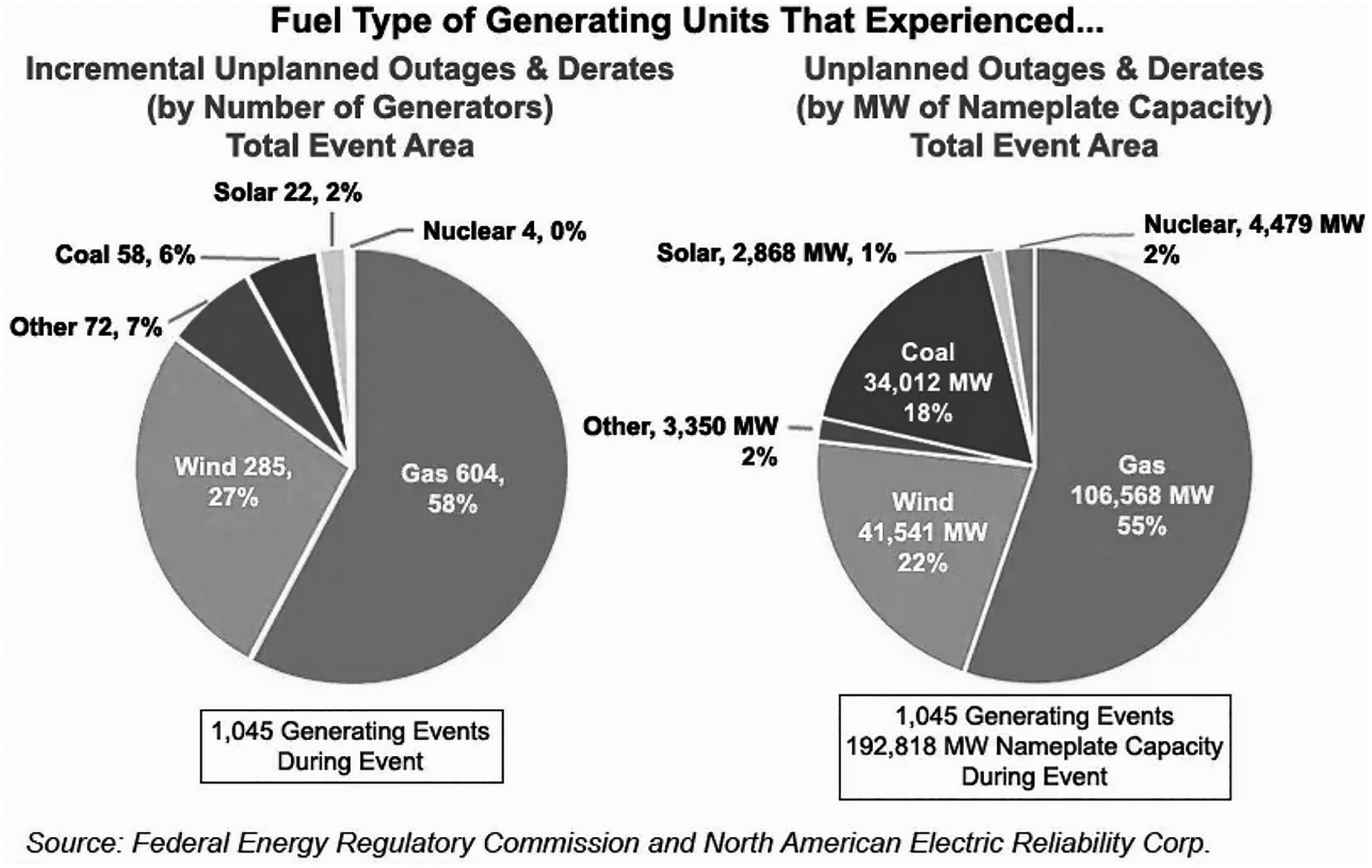
Fuel Type of Generating Units That Experiences Outages in Texas During and Following Uri.
At 8:37 PM on 14 February, ERCOT announced a new winter peak demand record of 69,150 MW, 2 GW worse than the worst-case scenario ERCOT had gamed out (Gold 2022). Within hours ERCOT instituted rolling outages. Grid frequency had dropped below 59.4 Hz for four minutes and twenty-three seconds. At nine minutes below 59.4 Hz, a wide swath of additional generating units would have automatically tripped offline creating a real threat of systemic collapse of electrical supply during the coldest weather Texas had seen in more than thirty years. Facing the prospect of an excruciating weeks or months-long “black start” scenario in a state filled with guns and libertarian fantasies, the actual 10.5 GW of emergency load shed that took place between 1:23 AM and 1:59 AM on February 15, 2021 (impacting 3.6 million homes and businesses) might seem like a victory for the engineers who barely held the state's electrical supply together. Over the next two days, ERCOT averaged only 34 GW of generation, less than half of its peak winter electric load. It was, according to a subsequent FERC analysis, “the largest controlled firm load shed event in US history” (FERC 2021, 9). Meanwhile leading Texas Republicans like incumbent Governor Greg Abbott, Lieutenant Governor Dan Patrick, and former Governor Rick Perry took to cable television news shows to blame the crisis (falsely) on the intermittency of renewables and on the specter of the “Green New Deal” (Gold 2022). The agents of the Texan petrostate saw an opportunity to distract from the greater failure of natural gas at a fragile electropolitical juncture when the interconnection queue for ERCOT is already almost entirely wind, solar and battery storage projects (Douglas and Ramsey 2021).
Without denigrating the obvious grace under pressure of ERCOT's engineers, it is hard to interpret the unfolding of the Texas Freeze as anything other than an epic failure of Texan electropolitics writ large. In total, 69 percent of Texans lost power during the storm, with outages averaging forty-two hours. At least 246 people and possibly as many as 700 (Tilove 2021) died because of hypothermia, carbon monoxide poisoning, and problems resulting from the loss of power to critical medical equipment. According to a report by the University of Houston's Hobby School (2021) 75 percent of Texans had difficulty obtaining food and 63 percent had difficulty obtaining water. Electricity bills soared, especially for those customers whose bills were tied to real-time power prices. One customer of the rapidly bankrupted firm Griddy received an electric bill for USD17,000 for 5 days’ service. Meanwhile, gas suppliers enjoyed about USD11 billion in windfall profits despite their poor service record: a 50 percent regional decline in natural gas production between 8 February and 17 February (FERC 2021, 12). Energy infrastructure company Kinder Morgan alone made USD1.41 billion, its best quarter ever (Gold 2022). Within Texas' islanded electricity market, “power companies aren’t required to produce enough electricity to get the state through crises…In fact, they are incentivized to ramp up generation only when dwindling power supplies have driven up prices” (Schwartz et al. 2021).
Jane Bennett (2005, 462) wrote the 2003 North American power disruption that, “the electrical grid, by blacking out, lit up quite a lot.” As discussed above, blackouts tend not to be the neatly bounded events media and politicians portray them to be, but rather ragged assemblages of infrastructural politics often many years in the making. In the next section we look backward to highlight the electropolitical circumstances that made possible the “fraying wires” (Bakke 2017) of the Texas Freeze, and the near collapse of the ERCOT ISO zone. We also discuss what the subsequent three years of transitional electropolitics reveal about how unbecomings can also cascade as political forces seek to leverage disaster in the name of maintaining petrostatus quo conditions, a key front of transitional electropolitics in Texas.
Texan Electropolitics, Past and Present
To understand what happened and did not happen in Texan transitional electropolitics after Uri, it is important to understand the idiosyncratic history of the making of the islanded Texan electric grid itself. As Thomas Hughes (1993) has argued convincingly, energy security looms large in grid emergence and design. Grids tend to emerge in the context of wartime industries as a redundancy hedge against power outages from rapidly expanding demand. The Texas Interconnected System (TIS) was founded in 1941 with just such a purpose, to guarantee adequate power supply to wartime aluminum smelters along the Gulf Coast (Dyer 2011, 18). But the TIS also materialized in opposition to the 1935 Federal Power Act, which authorized the US federal government to regulate the transfer of electricity between states. Recognizing that this would sooner or later become a challenge to Texan energy sovereignty, most Texas utility companies agreed not to send any electricity out of the state, severing their interstate lines and creating the core of what would later become the ERCOT zone. “Freedom from federal regulation was a cherished goal…So eager were the Texas utilities to maintain traditional Texas independence that they memorialized the policy of isolation into a written agreement, binding themselves to intrastate operation” (Cohn and Jankovska 2020; Cudahy 1995).
The massive November 1965 blackout in the Northeast catalyzed the 1968 creation of the North American Electric Reliability Corporation (NERC), a voluntary membership of electrical utilities organized to create standards and guidelines for reliability and adequacy in the bulk power system. In keeping with NERC guidelines, the Texas Interconnected System created ERCOT as an independent not-for-profit corporation with advisory rather than regulatory functions. Headquartered in Austin, ERCOT's initial staff consisted of only two retired utility employees (Dyer 2011, 19). A Public Utilities Commission of Texas (PUC) followed in 1975 with regulatory authority over electricity rates and services. TIS transferred its operational functions to ERCOT in 1981. Though ERCOT remained a voluntary membership organization (now composed of 80 investor-owned, municipal, and cooperative utilities), it became the technical operator and rule-maker for a wholesale electricity market that involved 85 percent of Texan electricity generation, including 40,000 miles of transmission lines and more than 22 million customers.
The mid-1990s saw a national push for the “deregulation” of electricity markets that found very warm reception in Texas. In 1995, Texas Senate Bill 373 allowed independent wholesale generators, power marketers and utility affiliates to compete to supply wholesale power. In 1999, Texas Senate Bill 7 allowed electric retailers to compete for business and expanded ERCOT's functions to include switching customers between retailers on a timely basis, and overseeing transactions in the wholesale spot market for energy. The transition to the deregulated market in the early 2000s was difficult and marred with technical problems and organizational scandals at ERCOT (Dyer 2011). In time, deregulation pushed power prices higher, one of many neoliberal policy broken promises. Before 1999 Texans had electricity prices consistently below the national average. By 2008, Texans taking power from competitive suppliers paid 29.3 percent above the national average (Dyer 2011, 75). At the same time, rolling blackout became more frequent as ERCOT's market fundamentalism led to the lowest reserve margins of any region covered by the North American Electric Reliability Corporation.
ERCOT's low reserve margins, combined with Texas' enthusiasm for deregulated electricity markets, created the conditions of possibility for the 2021 crisis. An investigation led by the Texas Tribune concluded that the PUC, which oversees the state's electric and water utilities, “repeatedly ignored, dismissed or watered down efforts to address weaknesses in the state's sprawling electric grid” (Schwartz et al. 2021), especially the lack of weatherization of energy supplies. Instead of acknowledging these planning and regulatory deficits, the state government sought to activate electropolitical conflicts over the most reliable sources of electricity supply.
This speaks to the seemingly paradoxical energopolitics of Texas as an oil and gas petrostate with one of the most impressive renewable energy sectors in the United States. Texas leads the nation in oil production. But at the same time Texas has the greatest installed capacity of wind power and leads all states in the pace of residential solar and grid-scale battery installations (Maguire 2025). The paradox speaks to Texas' exceptional energy resources. But it also worth recognizing the strong presence of evangelical ideology in state resource politics, an ideology that has made energy something of a “civil religion” (Dochuk 2019) in Texas. What is certain is that considerable renewable energy achievements have rarely been driven by environmental, or even conservation, concerns. Instead, they have been dictated by a sense of the teleology of industrial, technological progress (Boyer 2023), and the falling price of renewable energy.
Although the ERCOT zone design emerged in the context of oligarchical petropolitics, it has been amenable to low carbon energy sources so long as they abide the deeper ideological commitments of Texan energopolitics to the decomposition of democratic accountability and the strengthening of corporate power. “Unbecoming” thus has by and large ruled the roost since 2021. Regulatory reform over energy providers is scarcely mentioned, and indeed Governor Abbott continues to press for theatrical displays of electropolitical competence over real safety and reliability measures. This is not to underestimate the seriousness and fierceness of the struggle within transitional electropolitics. The plummeting cost of solar PV and wind power have eaten away at the dominant petropolitical interests of the ERCOT zone and the Texan petrostate, which earned a record USD24.7 billion in tax revenues from oil and gas sales in 2022.
In July 2024 Governor Abbott called for a USD10 billion fund to support new natural gas generation to meet ERCOT's growing demand. He also lent his support to a (failed) 2023 ERCOT plan to revive so-called “zombie plants,” coal-fired facilities that had recently been shuttered for cost and pollution reasons (Walton 2023). Abbott also strongly supported adding more “dispatchable generation” to the ERCOT zone in the form of “peaker plants,” natural gas facilities that fire only when there is high demand on the grid (and high profits to be made). Without mandating the weatherization of such facilities, of course, they would likely suffer similar outages to those that occurred during Uri. Once again, in the Texas Republican state government's exclusion of renewable resources like batteries from the category of “dispatchable generation,” we see the doubling down on petrologics interrupting the potential becoming of a postfossil ERCOT zone. Meanwhile, a cold snap in December 2022 brought nearly 30 GW of coal and gas powered electrical supply offline, roughly equivalent to the fossil power losses during Uri (Lewin 2023), with ERCOT once again drastically underestimating power demand. The anticipation of blackouts has now become a frequent and very vivid feature of Texan life: “The freeze was a fucking nightmare,” interviewee Kelly C. put it bluntly, “I was very disappointed in how ERCOT handled it. It would have been so much easier for us if they had just prepared better. And done their jobs basically. But that's probably why they all got fired…There have been a lot of blackouts since then. And I didn’t used to be someone who worried a lot about the power going off. But now I am.” Another interviewee Ethan R. commented, “It used to be the case that we worried about power outages only for a few days each summer. Now, I find myself worried in the winter too. It's like the whole system is breaking down.”
Texas grid expert Doug Lewin (2023) estimated in November 2023 that “If we do see another Winter Storm Uri next year, the likelihood of at least some rolling outages is probably close to 100%” because of state agencies’ failure to require the gas industry to weatherize its supply system. Yet Lewin noted with more optimism that ERCOT's 15-fold increase in battery storage and 10 additional GW of solar capacity since 2021 would likely make the duration and magnitude of Uri-style outages less severe. Lewin sees progress in transitional electropolitics toward a more reliable and resilient system through added renewable and battery resources; “the grid is not fixed; but we’re in better shape.”
The most recent catastrophic episode in Texan transitional electropolitics arrived in the form of Hurricane Beryl, which struck Houston in early July 2024, knocking out power to over 60 percent of Houston's homes for at least twenty-four hours with some areas taking nearly two weeks for power to be restored. Public wrath was visited this time on Houston's electrical utility, CenterPoint, and a graffiti meme “CenterPointless” went viral in the days that followed. Abbott's administration castigated CenterPoint leadership while quietly allowing the company to recoup losses from Beryl through securitization, whereby ratepayers will be charged to pay the infrastructural costs for climate catastrophes for many years or even decades to come. Lewin (2024) commented, “This has become the state's de facto climate policy: rather than fight climate change or prepare for its impacts, the state is simply passing the costs to future generations.” The cascade of unbecoming endures for now.
Transitional Electropolitics
The 2016-2017 South Australian blackout was far more than a temporary loss of power—it became a transformative juncture for reimagining energy governance. On the one hand, the incident laid bare longstanding vulnerabilities in the state's grid, as detailed by the cascading voltage dips and technical failures reconstructed by the Australian Energy Market Operator. These findings demonstrate that extreme weather events, intensified by climate change, can swiftly upend entrenched infrastructural legacies. On the other hand, the blackout sparked a vigorous public debate, with traditional media and social platforms alike reconfiguring the narrative around renewable energy. What began as a series of trivialized vox pops evolved into a broader, critical discussion about grid reliability and energy justice.
This dual dynamic—the simultaneous exposure of technical frailties and the emergence of a robust discursive contestation—epitomizes the novelty of transitional electropolitics. In South Australia, the rapid deployment of grid-scale batteries and the institutionalization of virtual power plants are not merely technical responses; they signal a profound rearticulation of regional identity and public expectations. This “cascade of becoming” disrupts established carbopolitical regimes by unleashing localized forms of political agency that reframe the role of electricity in society.
Our comparative analysis further underscores this argument. While Winter Storm Uri in Texas revealed similar infrastructural vulnerabilities, the state's political response was markedly inert—state authorities implemented only minimal, market-driven measures that reinforced a deep-seated reliance on fossil fuels, particularly natural gas. In contrast, South Australia's proactive and transformative response illustrates how a systemic rupture can catalyze a shift toward a resilient, renewable future. We would argue that the relative adaptive success of South Australia supported by a rare alignment of state-level political ambition (a bipartisan 100 percent-renewables target by 2030), an already-dense cluster of wind and solar developers eager to de-risk battery pilots, and an engaged public that frames renewables as an economic development project rather than an ideological wedge (AEMO 2017; Lucas 2017; Rodriguez 2022). In Texas meanwhile, the de facto single-party state government and its close affiliation with incumbent fossil fuel interests has deformed and restricted transitional electropolitics.
Transitional electropolitics transcends the realm of technological fixes or isolated policy adjustments. It encapsulates both the material force of extreme weather and the evolving epistemic practices through which societies come to understand and respond to energy crises. The contrasting trajectories of Texas and South Australia foreshadow a future in which blackouts act as critical inflection points. However, if energy transitions are often imagined as linear processes of advancement, blackouts remind us that they can just as easily signal the persistence of older regimes as they can catalyze new ones. It is in these moments of systemic failure that we see both the possibility of transformation and the resilience of the status quo.
Conclusion
What we have argued in this article is that blackouts are not only events of power failure but also key inflection points in infrastructural politics. In our analysis, we have shown how blackouts illuminate the competition between energy regimes to claim the future, particularly the future of electricity governance. Within this space of infrastructural politics that we are terming “transitional electropolitics,” blackouts reveal and intensify political positions and processes even where transitions do not actually occur.
In Texas, for example, despite experiencing the worst power outage event in state history, there has been surprisingly little action taken to prevent its repetition. Ignoring massive public outcry for accountability after Uri, as well as expert calls for greater regulation of power providers to force them to weatherize their equipment, the state government opted to institute a voluntary weatherization program. Even though natural gas supply emerged as the biggest culprit for the near-collapse of bulk power during the storm in 2021, the Texas Governor and legislature have subsequently sought to leverage the crisis to defame renewables and foster even greater dependency upon gas within the ERCOT zone. They may well succeed. Renewables meanwhile continue to expand in Texas at the expense of coal—which could be understood as a transition of sorts—but only because their low cost fits well within the market fundamentalism of Texan politics. Notably, Texas received the second most funding of any state from Biden government infrastructure investment programs (USD33.2 billion as noted in White House n.d.), many of which favor postfossil policies. Still, under Republican rule, for the foreseeable future, the political imagination of Texan electropolitics will very likely center on natural gas rather than renewables, thus quite literally freezing a transition away from fossil fuels.
In South Australia, meanwhile, we do see a blackout acting as the catalyst for a “cascade of becoming” in Bennett's sense. At the very least it was an accelerant for the deployment of technologies and policy measures that were being resisted by Australia's hegemonic carbopolitics. We see grid-scale batteries and (a now increasingly mature) Virtual Power Plant marketplace, for example, being institutionalized as rapid responses to the events of 2016 (Adams et al. 2021). Having now passed its ninth summer since the 2016 blackouts, South Australia has emerged with both very high renewable energy penetration in its grid and high reliability, as well as high electricity prices, further stoking concerns about equity (Arena 2020). Viewed together, the cases show that a blackout's aftermath turns less on engineering constraints than on the crisis stories and institutional path-dependencies that actors mobilize. Tracing these cascades of un/becoming explains why one jurisdiction could leverage failure to accelerate decarbonization while the other redeployed it to re-entrench fossil incumbency, offering a comparative grammar for future studies of infrastructural breakdown.
We stress that transitional electropolitics involves more than the combination of technology and policy. Storms themselves matter in terms of their material qualities and capacities for infrastructural disruption. They reveal the precarity of human shelter and reconfigure relations of power and vulnerability through forced exposure (Hamilton 2017). The slow strangle of the freeze disrupted frozen wellheads and stymied wind turbines, while sodden land sparked the fierce Australian winds that toppled transmission wires. Also, beyond policy there are complex epistemic cultures grappling with conditions for which there are no reliable precedents. The epistemic apparatus of anticipation is itself fragile, and will become increasingly so as rising amounts of energy in atmospheric systems seed new and intensified storm pathways. Hazards are now apprehended through increasingly complicated organizational and insurance logics that invariably see an increasing role for states (Collier and Cox 2021). And, as hedges against these uncertain futures, we find a remarkable number of energy utopias jostling for relevance and attention.
For every encouraging story of energy transition, there is one of dissimulation and refusal. “Never let a good crisis go to waste” is an effective mantra for both sides. Fossil fuel interests continue to demonstrate remarkable imaginative capacities to resist infrastructural transformation. Hydrogen refineries and deep geothermal projects seem to have replaced CCS (carbon capture and sequestration) as a new “obscure object of desire” for continued fossil fuel extractivism. Gas and coal power station failures also point to a fragility inherent in the oil-based system (Haarstad and Wanvik 2017); as private owners slash maintenance schedules (The Australia Institute 2019) to extract value for shareholders. Furthermore, economization remains the dominant terrain of transition energopolitics in most parts of the world. Whatever happens “must make economic sense.” Economization not only refers to the work of economists themselves but wider “economists at large” (Çalışkan and Callon 2009) who develop and institutionalize concepts like reliability metrics. These are critical to the rationale for grid interconnectors as well as investments in things like weatherization of power stations.
By way of closing, we pose a utopian consideration of our own: Do the new climate contingencies facing bulk electrical power supply suggest the need for even more radical electropolitics in the future? According to Hughes (1993), grids evolved historically from the need for redundancy to serve industrial and especially military manufacturing. Now in an era of climate change new resiliency needs have emerged. The conditions of felicity for performing electropolitics—often taken as a salvational impulse for climate politics (e.g., “electrify everything!”)—are challenged as blackouts compromise traditional grid-based designs of electricity governance. The 2025 Iberian grid blackout owing to voltage regulation struggles is a recent case in point (Timmer 2025). One possible, and arguably desirable future is an autarkic one where grids are fragmented. But fragmentation can also favor the petrostatus quo. After Hurricane Beryl, the New York Times reported that Houston became the hottest market in the country for diesel generators, a private infrastructural response to public infrastructural precarity chosen by elites across the world (Goodman 2024). European discourse on “energy communities,” by contrast, envisages a rising ecoliberal regime of hyperlocal energy supply co-evolving with direct democracy (European Commission 2025). What is clear is that the imagination and discussion of energy futures is coming out of the shadows of technopolitics and into the public sphere (Aronoff et al. 2019). It is the competition between different electropolitical imaginations and regimes which drives our cascades of becoming and unbecoming.
Footnotes
Declaration of Conflicting Interests
The authors declared no potential conflicts of interest with respect to the research, authorship, and/or publication of this article.
Funding
The authors disclosed receipt of the following financial support for the research, authorship, and/or publication of this article: This work was supported by the Australian Renewable Energy Agency (grant number ARENA's International Engagement Program).
