




Abstract
Energy transitions are knowledge-intensive processes where a multitude of actors are trying to cope with inevitable knowledge gaps, surprises, and uncertainties. In this context, we focus on two techno-physical phenomena that are gaining practical relevance with the expansion of wind and geothermal energy extraction, and are surrounded by significant unknowns: wake effects and temperature plumes. Both phenomena can potentially affect the efficiency of energy production, but the extent of their impact is not yet known. Based on 28 semi-structured interviews with experts in the fields of wind and geothermal energy, we explore how different central actors perceive and interpret non-knowledge of wake effects and temperature plumes, and how they deal with it. We show that there are strategies for either using non-knowledge as a basis for action or simply ignoring it and sweeping knowledge gaps under the rug. Both strategies serve the function of protecting agency and keeping things going.
To secure a sustainable energy supply and meet various emissions targets, the expansion of alternative energy sources is becoming a key element worldwide. However, the expansion and large-scale implementation of renewable energy technologies are fraught with uncertainties and surprises. The increased use of wind turbines offshore, for example, has led to the emergence of wake effects between wind parks: because wind turbines extract kinetic energy from the wind, they make downstream wind turbines less productive. The behavior and strength of wake effects had long been largely unexplored or underestimated, but they now are an important component in the modeling of wind energy development and energy production (e.g., Lundquist et al., 2019).
A surprisingly similar effect was also found with the increased use of shallow geothermal energy technologies, which extract or add heat from/to the underground, and consequently might reduce the efficiency of neighboring geothermal systems. While the resulting temperature plumes seem to be becoming more relevant, especially in the planning of residential areas, their behavior in the subsurface and how to deal with them is still subject to many uncertainties and areas of non-knowledge (e.g., Meng et al., 2019). As several studies have shown, uncertainties, unintended side effects, ignorance, or ‘non-knowledge’ generally play a significant role in the development of renewable resources (e.g., Büscher & Sumpf, 2015; Gross & Mautz, 2015; Lösch & Schneider, 2016; Magnani & Carrosio, 2021; Gross & Sonnberger 2022). The situation is becoming normalized, because non-knowledge will not simply go away and uncertainties exist not only at the level of ‘major politics’, but also at the level of concrete implementation of renewable energy projects (Bornemann et al., 2016).
Not knowing in everyday life is normally understood as a problem, to be overcome with generally accepted knowledge. Sometimes, not knowing leads to postponed decisions, while actors wait for clarity. Sometimes, unknowns are ignored, bracketed out or simply swept under the rug. However, as important as approaches to closing knowledge and data gaps are, it must be remembered that gaps cannot always be closed, and decisions need to be made. In the case of energy transitions, acknowledging uncertainties and ignorance can thus be rendered key to the successful implementation of novel technologies (Gross & Mautz, 2015). As the field of ignorance studies has shown in the past decade, non-knowledge can have multiple manifestations and constituent functions in processes of knowledge generation and decision-making (Gross & McGoey, 2023). By building on these insights, this paper aims to empirically analyze and reconstruct how policy advisers, engineers, geologists, and other experts working in the field of renewable energies deal with perceived uncertainties, knowledge gaps, and non-knowledge with regard to wake effects and temperature plumes. We focus on the effects that non-knowledge about wake effects and temperature plumes has on the governance of wind and underground heat as energy resources. Through this we aim to develop a deeper understanding of the dynamics of active and passive non-knowledge.
Conceptual considerations
Whereas the notion of the knowledge society (e.g., Stehr, 1994) of the 20th century aimed to explain how (scientific) knowledge had become fundamental to all fields of everyday life, recent decades have also added research on the phenomena of non-knowledge and ignorance as central to decision-making and everyday life. This has led to the establishment of the new interdisciplinary academic field of research: ignorance studies (Gross & McGoey, 2023). 1 While ignorance and non-knowledge are related analytical categories and typically appear in conjunction with one another, ignorance is often used as the broader category, referring to the general limits of knowing. Non-knowledge should not merely be understood as the absence of knowledge, but also as a specific kind of expertise and awareness about what is not known. Addressing the function of non-knowledge in governance is essential for holding policy actors accountable for their actions as well as drawing attention to wider institutional arrangements and developments that either legitimize, reject, or support information actors themselves may have produced (Paul et al., 2022).
In the context of this study, we consider non-knowledge as both a problem and a strategic element that can be distributed to amplify interests, keep information secret, foster research questions, or avoid fear. As other research on ignorance has shown, non-knowledge is not simply the opposite of knowledge, but can have a cultural, social, or political life of its own. Unlike the ambivalence in the term ‘ignorance’, with its additional connotation of actively ignoring something, non-knowledge points to knowledge gaps that are sufficiently well defined so that they can be used to shape decisions for an uncertain future and point to mechanisms about what ought, or ought not, to be known. Against this background, we focus on the dynamics between different forms of non-knowledge and the intentionality and temporality attributed to them. We distinguish between ‘active non-knowledge’, which can be defined as a type of unknown in which the limitations and the boundaries of knowing are acknowledged and consciously influence further action, and ‘passive non-knowledge’ as a type of unknown in which the perceived limits of knowing are intentionally not taken into account and are rather ignored or ‘swept under the rug’. The latter can remain latent or develop into active non-knowledge later—and vice versa. Finally, we use the notion of nescience. This term is an epistemologically different category from the other terms we use, since, in accordance with its medieval usage in theology, it has been called ‘absolute or intransitive ignorance’ (Martin, 1985, p. 24). Unlike in theology, where nescience once was rendered the absolute form of not knowing things that only God could or was allowed to know, we use the term as a type of unknown of which actors can be aware in hindsight, at best (Gross, 2010). Thus, unknowns of this type cannot be specifically or ‘mindfully’ taken into account in decision-making and thus cannot be part of strategic considerations. Actors can only become aware of those knowledge gaps retrospectively, e.g., when surprising developments occur or when someone else points out an omission.
If non-knowledge is to serve as a strategic resource (McGoey, 2012), statements or claims need to refer to the acknowledgment that some things are unknown but are nevertheless rendered useful to enable action. In many cases of environmental management there is usually a strategic regulation between, on the one hand, active non-knowledge, where the unknown is specified enough to be used for further action and, on the other hand, passive non-knowledge, where the unknown may be specified but is rendered unimportant and does not generate any further interest at that point in time. Non-knowledge can be actively unexplored, for example, if it cannot be dealt with within a definable period or is rendered dangerous to even talk about. In short, there are strategies that are different in terms of the level of desirability of not knowing. This can have crucial implications for the ability of actors and their institutions to cope with unavoidable uncertainties and limits of knowing more generally. In addition, the intentionality of not knowing and the temporality of the unknown can be seen as major analytical categories in what Kates and Clark (1996, p. 32) once called the ‘“skeptically welcoming” of unconventional views.’ The former refers to decisions guided by an (un)willingness to know, whereas the latter refers to the possibility of transforming knowledge gaps into forms of knowledge within a certain time span. In this article we use the basic distinctions between active non-knowledge, passive non-knowledge, and nescience as elaborated by Gross (2019). 2 This provides us with a perspective on how actors use non-knowledge either to generate knowledge or to prevent the generation of knowledge. Table 1 summarizes the types of non-knowledge discussed above and divides them into the analytical categories of intentionality and temporality.
Types of non-knowledge in their dynamic relation to temporality and intentionality.
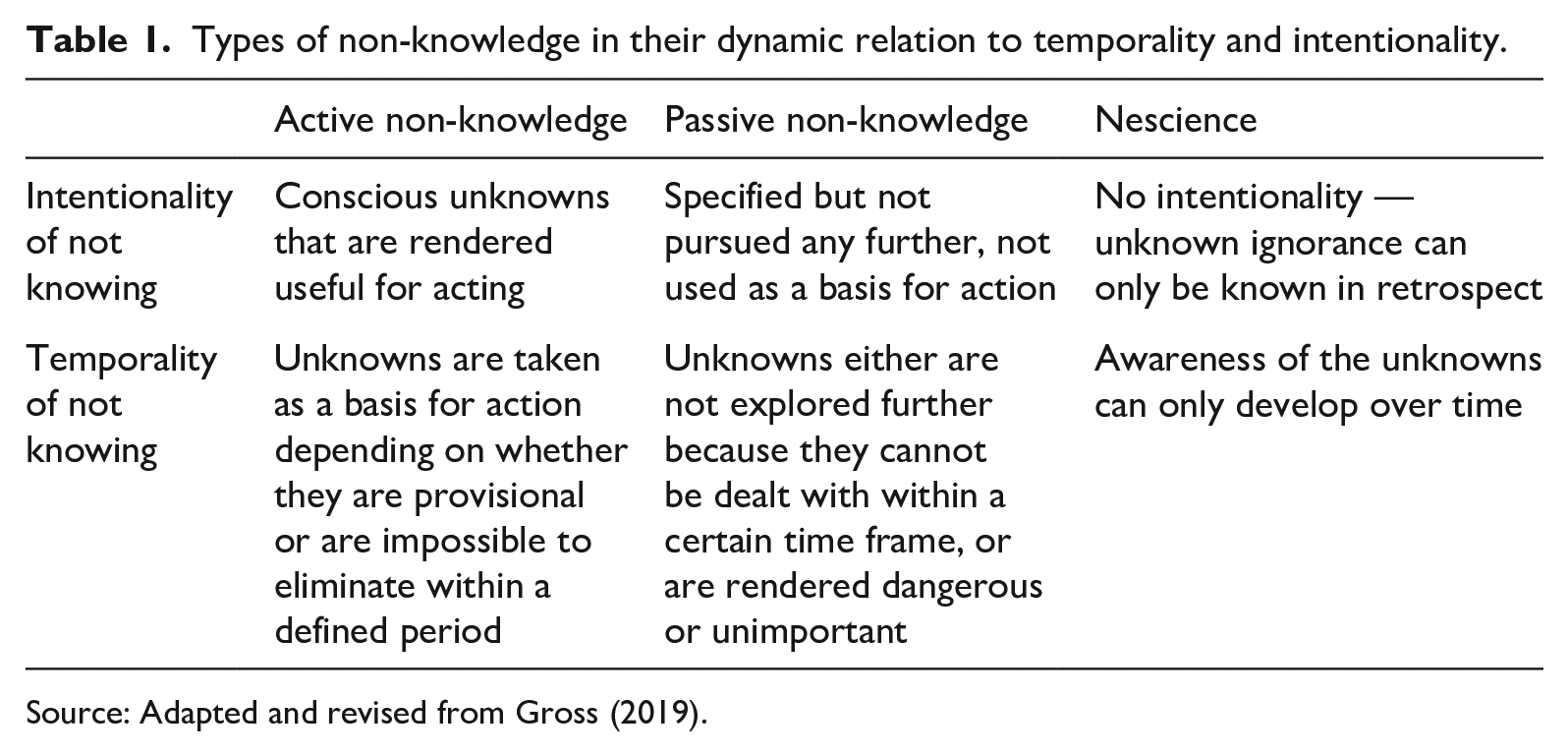
Source: Adapted and revised from Gross (2019).
We note two things central to our empirical analysis. First, non-knowledge is the result of an active process of negotiation of boundaries. Second, human actors can shape the dynamics between knowledge and non-knowledge, set priorities for knowledge generation, and determine which knowledge gaps will be maintained. Thus, non-knowledge can be regarded as a construct produced by social dynamics.
Our interest is to understand how experts in the field of geothermal energy and wind energy interpret what is not known (non-knowledge) and what relevance non-knowledge has for them in (a) their decision-making and (b) the governance and management of renewable energy technologies. The following research questions form the starting points of our (empirical) analysis: How do experts in the fields of wind energy and geothermal energy (scientists, engineers, planners, policymakers, administrative people, representatives of interest groups, etc.) interpret and perceive non-knowledge related to wake effects and temperature plumes? How do they deal with non-knowledge? What kinds of dynamics are there between active and passive non-knowledge? Which conditions and factors influence whether non-knowledge is considered active or passive?
We have chosen wind and geothermal heat because energy production from these resources has continuously increased over decades, and the increased concentration of corresponding facilities provides new insights into the behavior of these resources. This is especially evident with respect to wake effects and temperature plumes, which are associated with many unknowns that actors in the field have to address. Although these observed phenomena are similar to some extent, certified experts, administrative bodies, interest groups, etc. come to different conclusions about how to deal with them.
Background
The phenomena of wake effects and temperature plumes are surrounded by crucial uncertainties, as we will show in the following. We aim to contribute to understanding the challenging situation that, while scientists, practitioners, and engineers appreciate that non-knowledge is unavoidable and normal, this normalcy is very difficult to communicate to a critical outside world for which scientific knowledge is the basis of decision-making about and trust in new technologies.
Wake effects
For decades, the engineering and natural sciences have discussed wake effects in the context of wind energy exploitation (Lissaman, 1979). Wake effects occur because wind turbines remove kinetic energy from the wind as it hits the rotor blades. The downstream wind is more turbulent and carries less energy (Pryor et al., 2019; van der Horst & Vermeylen, 2010, p. 67). Such wake effects can occur both within wind farms and between them (Nygaard, 2014; Pryor et al., 2020). The wind ‘recovers’ from turbulence a certain distance from the wind turbine and returns to its ‘normal’ state. Thus, wake effects fade with increasing distance from the turbine. The length of these plumes, and thus the distance required for the wind to regain its full energetic potential, depends on factors such as the amount of energy extracted, the topography of the landscape, and characteristics of the atmosphere. Due to the flatness of the topography offshore, wake effects there are significantly longer than those onshore.
Offshore wind farms typically have bigger turbines than do onshore wind farms. In addition, onshore wind farms vary in size from a small number of turbines to several hundred. Connected to these differences, while offshore wind farms are usually owned by large investors, ownership structures are much more diverse in the case of onshore wind farms, ranging from citizen energy cooperatives over municipal utilities to big energy companies (Markard & Petersen, 2009). Thus, the type of actors affected by wake effects may vary between offshore and onshore wind farms.
Although researchers and professionals in the field have been aware of the possibility of wake effects for decades, it was not until large wind farms were constructed close to each other that wake effects between wind farms could be empirically identified. With the ongoing expansion of wind energy all around the world, this phenomenon is becoming more relevant. In 2018, Platis et al. (2018) published the results of the first direct in situ measurements of wind farm wake effects. At the time, the only other studies of wind farm wake effects were based on modeling tools or remote sensing observations. However, the causes and consequences of wake effects between wind farms are still not well understood. The wind industry and policymakers need more knowledge in this area because wake effects have become crucial for the financial success of wind farms and the effective spatial planning of wind farm zones. Consequently, Veers et al. (2019) identify wake effects as one of the top research priorities in the field of wind energy.
Temperature plumes
Similar to wake effects are the temperature plumes that occur in the context of shallow geothermal energy systems. Temperature plumes result from heat pumps’ extraction and sometimes addition (for cooling) of energy from the subsurface. Ground source heat pumps are increasingly used for cooling or heating individual buildings and facilities. They are typically owned by the owners of these buildings (i.e., individuals or organizations).
Geothermal technology is considered mature but always needs to be tailored to the specific local conditions (Bleicher & Gross, 2016). When the heat pump is used for cooling purposes, the underground is heated, and when it is used for heating the underground is cooled. This applies to single heat pumps and, more importantly, clusters of heat pumps (Meng et al., 2019). As such, interferences among neighboring heat pumps can occur, reducing their efficiency and increasing electricity consumption (Clotworthy et al., 2010; Ionescu & Montagne, 2013). In addition, changes in the underground temperature regime are likely to affect microorganisms that provide important ecosystem services such as filtering or cleaning the groundwater (Hähnlein et al., 2013). This is especially the case for heat plumes.
The occurrence and extent of temperature plumes varies considerably with the specific characteristics of the subsurface: ‘soil characteristics, moisture content, building load, initial ground temperature, borehole spacing, etc.’ (Ionescu & Montagne, 2013, p. 222). Temperature plumes also follow the direction of groundwater streams. This means that the velocity of the groundwater affects the persistence of the plumes (Hähnlein et al., 2010). As in the case of wake effects, the conditions of their formation but also the consequences of temperature plumes are still surrounded by knowledge gaps.
Wakes, temperature plumes, and non-knowledge dynamics
These two cases show how the expansion of new energy technologies brings about real-world effects that may have been vaguely anticipated but could not have been precisely forecasted. Additionally, these cases serve as examples of how the empirical manifestation of such effects is surrounded by uncertainties, as their extent and consequences are disputed. Governing such complex systems as the exploitation of wind and geothermal energy involves human actors who have different interests (e.g., environmental protection, extracting energy, providing energy, etc.), different sets of knowledge and expertise, as well as different levels of involvement ranging from outside stakeholders to certified experts (e.g., scientists with PhDs in soil physics) and the hands-on engineers and workers on the ground. Furthermore, the systems also involve non-human entities such as the atmosphere, the groundwater, and geological structures, as well as manifold technological devices that enable the extraction of energy. The interplay of these factors and their governance is complex and time-consuming—and unknowns, perhaps as much as knowns, play a crucial role.
Methods and materials
Following Bogner and Menz (2009, p. 55), we understand an expert as a person who ‘has technical, process and interpretative knowledge that refers to a specific field of action, by virtue of the fact that the expert acts in a relevant way’. Through our empirical analysis, we aim to reconstruct the specific configuration of knowledge and non-knowledge that experts in the field hold. We are particularly interested in how experts perceive knowledge gaps, and the conclusions they draw from them for action and decision-making.
We developed a semi-structured interview guide that was tailored to the specific background and expertise of the interview partners and mainly contained questions about how wake effects and temperature plumes are dealt with on a practical level, as well as the role of uncertainties and knowledge gaps in relation to their causes, extents, and consequences. In the context of geothermal energy, the interviews explicitly focused on shallow geothermal energy. The interviews were carried out by three of the authors.
Our empirical research followed a cyclical and contrasting approach based on the idea of theoretical sampling from grounded theory (Flick, 2018, p. 21; Strauss, 2003 [1987], pp. 38–39). We conducted interviews, performed a preliminary analysis of the responses, and then recruited additional interview partners based on novel assumptions and questions that emerged from the analysis of the previous interviews. We selected consecutive interview partners from those areas that were highlighted by other interview partners as being particularly important in the implementation of wind and geothermal energy projects (snowball principle). This cyclical process continued until no further novel and relevant aspects of our subject of study emerged from the interviews. We conducted 28 semi-structured interviews with scientists, engineers, policymakers, lawyers, policy advisers, as well as representatives of professional associations, municipalities, planning and environmental agencies, and energy companies. Most interview partners were located in Germany, two in Switzerland, and one in Austria. The interviews lasted between 46 and 83 minutes, with an average duration of 61 minutes. All interviews were recorded and then transcribed. Since anonymity had to be guaranteed to all interview partners, neither their names nor their institutional affiliations can be listed in the article. However, in order to point out the scope covered by our interviews, we state the number of interviews per case and institutional field in Table 2.
Number of interviews per case and institutional field.
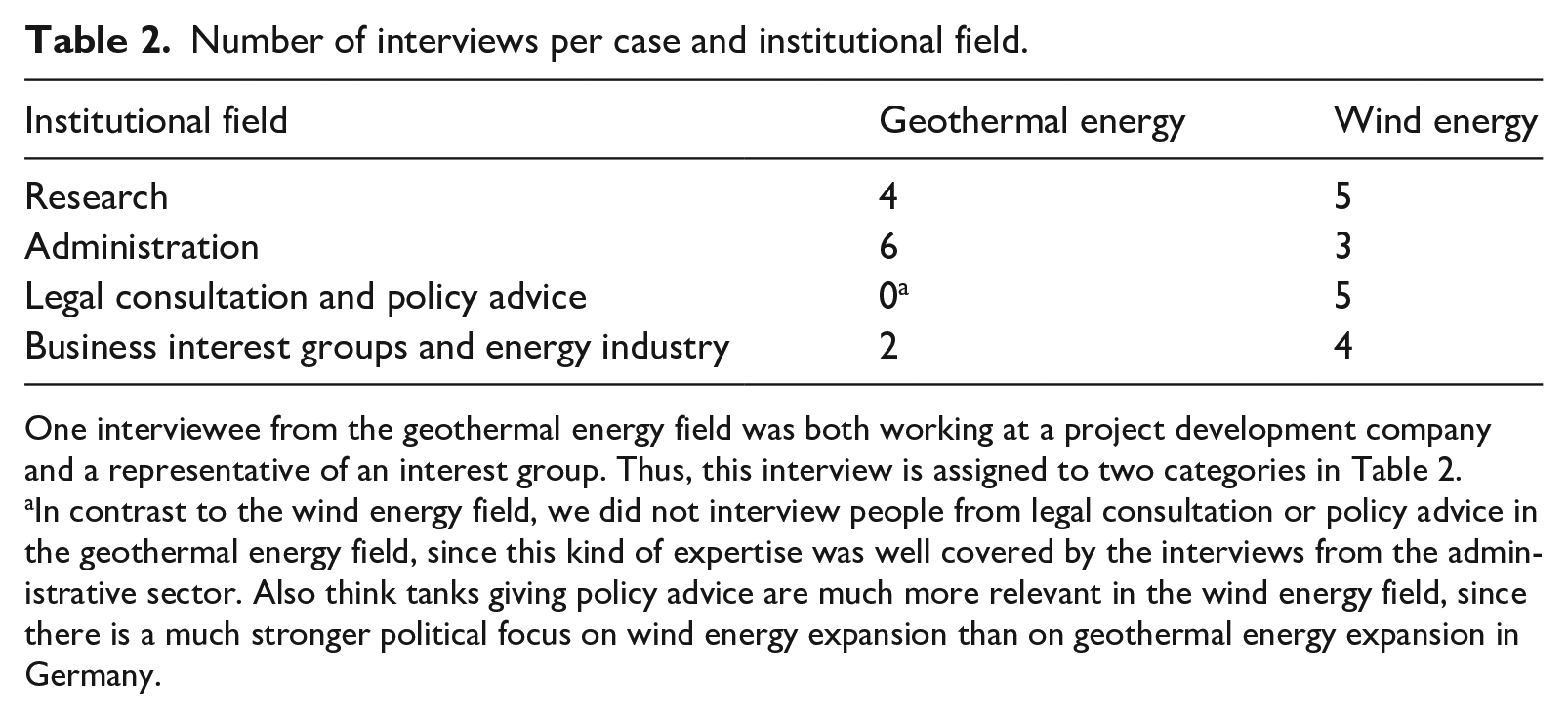
One interviewee from the geothermal energy field was both working at a project development company and a representative of an interest group. Thus, this interview is assigned to two categories in Table 2.
In contrast to the wind energy field, we did not interview people from legal consultation or policy advice in the geothermal energy field, since this kind of expertise was well covered by the interviews from the administrative sector. Also think tanks giving policy advice are much more relevant in the wind energy field, since there is a much stronger political focus on wind energy expansion than on geothermal energy expansion in Germany.
The analysis of the interview transcripts was based on the grounded theory coding paradigm and was carried out with the help of the MAXQDA software (Kuckartz, 2014). We applied the techniques of open, axial, and selective coding to the interview material (Strauss, 2003 [1987], pp. 58–74) in order to identify core themes. The concept of non-knowledge as elaborated above served as a ‘sensitizing concept’ (Blumer, 1954) for both the development of the interview guide and the coding process. Thus, the concept of non-knowledge and its differentiation introduced above served as starting points for our research and informed our interpretations during the research process. Initial codes were discussed in several sessions by the whole research team, including researchers who did not participate in the interviews and researchers who were not involved in coding. By so doing we aimed to avoid biases and to broaden the scope of interpretation and ultimately increase the credibility of the interpretations. With the final code system, 475 text passages relevant to non-knowledge were coded in the interview transcripts. With the help of mapping techniques (Daley, 2004), we established the central themes of the coded text passages and the associations between them, which structured the interviewees’ interpretations of and dealings with non-knowledge (see Figure 1). In the presentation of our results along the identified themes, we quote particularly illustrative text passages to support our interpretations of the empirical material.
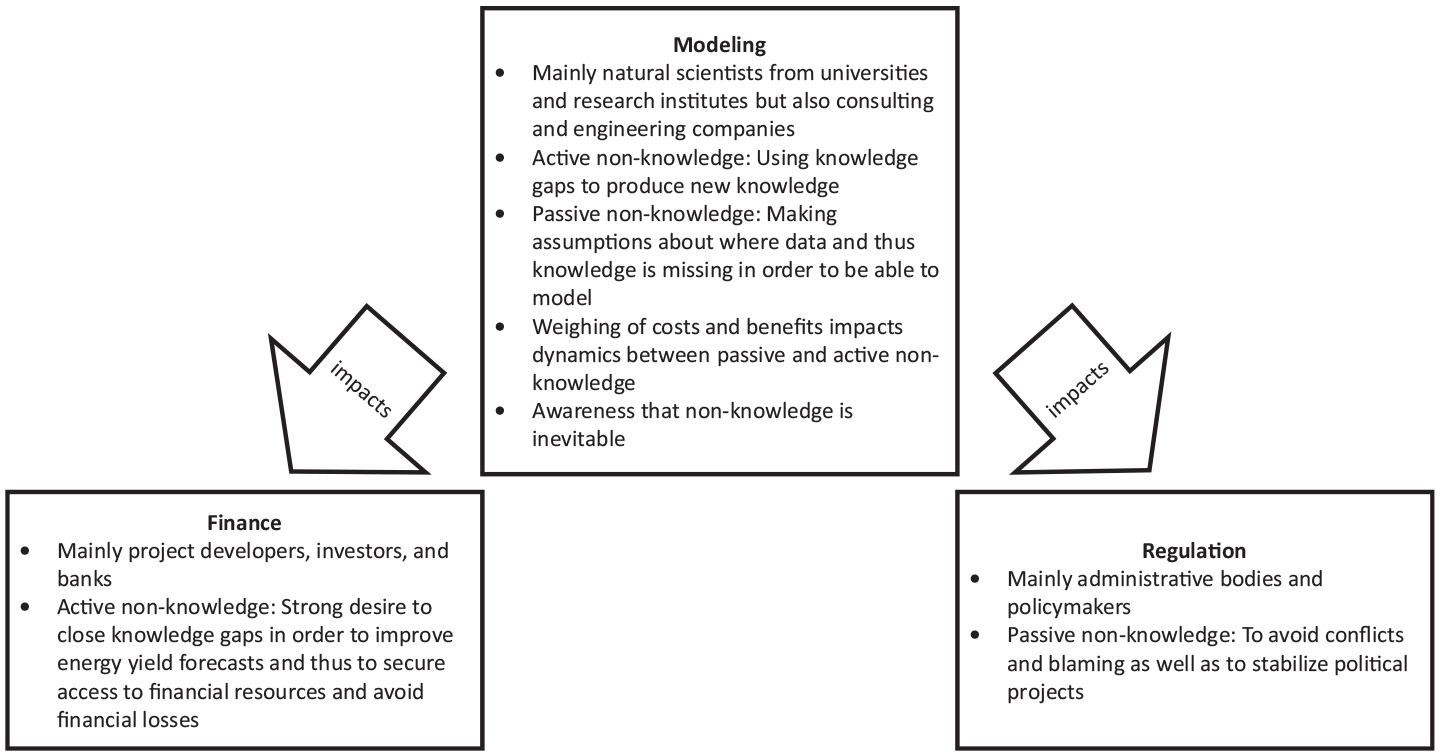
Schematic illustration of empirically identified non-knowledge dynamics.
Findings
In the analyses of our empirical material, we identified three central activities related to how actors deal with wake effects and temperature plumes: modeling, regulation, and finance (see Figure 1). Modeling and measuring in both fields are relevant practices for identifying and dealing with these phenomena. In both fields, regulatory and financing activities rely heavily on modeling. Activities related to (environmental) regulation were empirically more prevalent and important when it came to dealing with temperature plumes, and activities related to financing were more relevant in the field of wind energy. All three activities (modeling, regulation, and financing) are shaped by specific non-knowledge dynamics on which we will elaborate. In terms of structure, we orient ourselves using the schematization of findings presented in Figure 1.
Modeling: The question of what can be known
We found that most non-knowledge related to wake effects and temperature plumes can be traced back to uncertainties and unknowns that are inherent in practices of modeling and measuring. According to the interviewed researchers, the scientific understanding of both wind and the subsurface are characterized by significant areas of non-knowledge, making modeling of wind and underground heat a complex and challenging endeavor. Not surprisingly, all interviewed researchers stated that knowledge has expanded in both fields and models for predicting the behavior of wind and the underground are constantly improving. Nevertheless, the planning of both geothermal installations and wind turbines relies heavily on computer-generated models, which are inevitably burdened with non-knowledge. Knowledge gaps occur, for example, when data are gathered and concepts for modeling are developed. They are referred to as (different forms of) uncertainties by modeling experts (see the quote below; see also Chong et al., 2018; Paasche et al., 2020). Empirically measured data, like all data, are interpretations and thus contain uncertainties in the form of imprecise or even incorrect measurements, as well as conflicting evidence concerning specific issues (Knorr-Cetina, 1981; Paasche et al., 2022).
In the context of geothermal energy, a researcher in the field of applied geology sees the low quality of modeling tools as closely related to the fact that the underground is not observable. If the underground were directly observable, the modeling tools would be more precise: That is, we have data uncertainty, in the description of site-specific data, and we have, in very simple models also, a conceptual uncertainty, in that we do not map processes. But actually, if you’re honest, it’s actually because we can’t see into the underground enough. Otherwise, we would certainly have much better modeling tools. (Emphasis in original)
‘Conceptual uncertainty’ as used by the interviewee refers to knowledge gaps in considerations about the structure of the subsurface which are taken up in models. In order to make models as accurate as possible, they need to be calibrated with a large amount of data that can only be collected through measurements. The same interviewee also stated that these data are missing in the context of geothermal energy, since data about the underground cannot be gathered without drilling a borehole and influencing the biophysical structure of those subterranean spaces. Thus, in the researcher’s eyes, the underground seems to be an unruly object of research. However, this does not mean that knowledge about the subsurface is stagnant. A researcher in the field of applied geology explained that underground spaces had long been modeled two-dimensionally, until temperature plumes were detected that could not be explained by two-dimensional models. This discovery pointed researchers to non-knowledge previously considered not relevant and thus turned passive non-knowledge into active non-knowledge. Researchers are now trying to model the subsurface as a three-dimensional space in order to more accurately predict temperature plumes. Although researchers are inherently interested in dealing with non-knowledge, and they are optimistic that more answers can be delivered, the geologist we interviewed emphasized that it will never be possible to ‘see into the underground’ and if so, only in snapshots. Thus, the temporal dimension of non-knowledge is situational and very broad—some unknowns might be provisional while others will remain for a long time. Underground spaces, the processes therein, and their effects are still largely unexplored, as the interviewee above points out, which is why virtually all the researchers interviewed frame it as ‘the great unknown’. Thus, there seems to be some kind of shared understanding about the significance and persistence of knowledge gaps concerning the underground among the researchers we spoke to from the field of geothermal energy.
Additionally, effects of human interventions, such as underground constructions, and unintended events, such as a spillover of large amounts of warm water, have long-term effects on the subsoil. Some of these long-term effects can be plausibly assumed based on existing knowledge, but directly measured data will only be available in the long-term future. Therefore, modelers have to rely on assumptions, as the same geologist explains: Even with very simple models, we have to put representative data in there, and that was the reason for the great uncertainty, actually, that we can describe the subsurface too little and the whole processes … too little. That means that we always have great models, but the hunger for data is much, much greater. And that leads to the fact that, of course, if we have models, we need data, if we don’t have the data, we have to assume them …. But actually, we would have to map the uncertainties in the assumption just as it is.
Thus, wherever data is missing, knowledge gaps have to be and are filled with estimates, guesswork, and assumptions. These are based on previous experience, theoretical assumptions, and geological models. However, the quote above reveals that estimates and assumptions in the modeling practice produce additional non-knowledge that is not always made explicit (‘we would have to map uncertainties in the assumption …’, and becomes what we conceptualize as passive non-knowledge. Thus, non-knowledge that could be active remains passive or made passive because making uncertainties in the assumptions explicit is currently rather unusual in modeling practices (Paasche et al., 2023) and because knowledge about uncertainties is not welcomed in permitting practices or in some political debates, as we will elaborate further in the following sections.
The status of non-knowledge as active or passive also depends on financial resources, as an interviewee from a geothermal energy project development company told us: Your model can only ever be as precise as the data you feed in. You need to find a compromise between costs and benefit.
Collecting data is, among other things, a question of financial resources. If a downhole heat exchanger is to be installed for a household, for example, it is necessary to weigh whether the costs of data collection are in proportion to what the heat exchanger is to achieve. Thus, the above quote nicely reveals that the amount of data collected and consequently the accuracy of the modeling results depend on a weighing of ‘costs and benefits.’
Wind energy use suffers from similar issues. Models are fed with data, which are at best collected through direct measurements. The more measurements are taken into account, the more accurate the models become. This is explained by a modeler from an offshore wind development company: And as we understand more and more of the physics, those uncertainties come down. … [S]o, yeah first is to understand the uncertainties, make sure it’s based on real data rather than just a kind of gut feeling about what we think they might be (laughs) and then figure out what we are missing in modeling this practice and by including that try to drive the uncertainties down and that’s an iterative process over years.
Measurements help modelers to better understand physical dynamics but also to specify what is not known. This helps with understanding uncertainties and figuring out what is not captured in models so far. Thus, non-knowledge is actively dealt with; specified unknowns are considered provisional and are gradually replaced by new knowledge. Still, uncertainties have always been part of modeling, and models have been proven to be wrong in the face of reality, as an interviewee from an energy company explains with reference to a specific case of wake effects at a wind farm: The calculation was simply not correct, because one or another of the weather phenomena was not captured. And this may still happen today that you model something but you’re not able to model a specific local phenomenon at that moment. … Probably all consultants would have come out with a similar result anyway, because you can only rely on what you have at a specific moment.
This quote also demonstrates a typical case of nescience: The relevant conditions for a robust forecast of the energy production were unknown when the respective wind farms were planned, and this non-knowledge was only revealed as such in hindsight. It is also interesting to note the emphasis on what one could not have known: ‘all consultants would have come out with a similar result anyway’. This community of experts on wind energy share an understanding of how to measure, model, and interpret knowledge gaps (as relevant or not). The shared horizon of expectations within this community can be seen as one reason for nescience and related surprises.
Regulation: The role of threshold values in governing knowledge gaps
Based on our interviews, it appears that dealing with non-knowledge in the context of geothermal heat is particularly relevant when it comes to regulation. Since many actors are concerned with the regulation of geothermal heat—planners, construction companies, specific interest groups such as regional water boards, and diverse administrative bodies on the local and regional level—governance processes are complex and knowledge transfer between the different actors is an important task. Our interviews show that knowledge can be lost or is not communicated between these entities. This is particularly evident in the example of distance regulations and thresholds. In Germany, geothermal energy is considered a common good and, according to the German Federal Mining Act, a non-minable resource. This means that theoretically every property owner has a right to use geothermal energy for their own heating and cooling purposes. However, temperature plumes create problems: In order to avoid any interference from neighboring geothermal systems, regulations are in place that differ from one federal state to another. These include minimum distances between geothermal facilities and maximum amounts of energy that can be extracted from the ground.
The most common rule in German federal states is that geothermal systems must be installed at least three or five meters, depending on the state specific regulations, from the property line, which results in a distance of six to ten meters between neighboring facilities. The distance rule is drawn from a guideline by the Association of German Engineers (VDI), which sets standards for engineering work in Germany. Its guideline 4640 sets the technical standards for geothermal systems, specifying the distance between borehole heat exchangers—i.e., between the devices to extract the heat from underground—as follows: Geothermal systems can interact where the distance between them is too small. It is vital to ensure that the installation and operation of a geothermal system on the neighboring property remains possible at all times. Therefore, the minimum distance to the neighboring property that is capable of development should be chosen as large as possible. In order to avoid adverse effects, it is advisable in the case of borehole heat exchangers to maintain a minimum distance of 10 m to borehole heat exchangers on neighboring properties. Exceptions are possible where there exist appropriate, mutually coordinated planning and agreements between neighbors. (VDI—The Association of German Engineers, 2010, p. 21)
The states used this guideline to make regulations for the extraction of geothermal energy. However, when we questioned our interviewees, we were confronted with various assumptions about how the engineers of the VDI came to settle on this distance rule. Some interviewees claim that the decision by the VDI was somewhat arbitrary. For example, in one federal state the official guidelines for the installation of geothermal systems stipulate that systems with a power output of up to 30 kW must be at least 5 meters from the property line. When asked about why this specific rule was chosen, a hydrogeologist from a state environmental agency explained: The 30 kW comes from the VDI guideline 4640 and that has … exists since 2001, 2002. At that time the VDI guideline committee decided more by a show of hands, ‘that’s where we draw the line’.
Thus, if the scientific evidence underlying this regulation is unclear or potentially even non-existent, the question arises as to why it continues to be adhered to and why it is still assumed to be effective. Here, the concept of black-boxing, as described by Latour (1999), can provide an explanation. Latour defines black-boxing as follows: ‘When a machine runs efficiently, when a matter of fact is settled, one need focus only on its inputs and outputs and not on its internal complexity’ (Latour, 1999, p. 304). From the moment when the VDI guideline 4640 was established, its basis became invisible, concealed, and unquestioned, since it stated that there is no interference between borehole heat exchangers as long as they are placed at a distance of at least 10 meters from each other. The quote also reveals that the threshold is a partly fluid object (Laet & Mol, 2000) that is modified in the contexts in which it is used. For example, the facility size—30 kW—was added to the distance rule when it was translated into a guideline for geothermal systems at the state level. A scientist specialized in the field of geothermal heat management described this as a simple lack of questioning on the part of the regulatory actors in the field: Of course, these are somehow guidelines. And these are then used as a basis, and of course it is said, ‘Yes, we have complied with the rules, the technical ones, we do not expect any interaction now.’
Relying on distance rules and thresholds without questioning them makes the existing unknowns about the expansion and impact of temperature plumes passive—non-knowledge is not a spur to generate new knowledge.
Guidelines, even though not grounded in robust scientific evidence, can also serve the function of avoiding conflicts. This is underlined by a geologist from a public geological agency with reference to the VDI guideline 4640: If the borehole heat exchanger is at least 3 or 5 meters away from the border to the neighboring property, then there is no thermal influence on the groundwater under the neighboring property. That was a pure assumption that cannot be verified, cannot be verified in individual cases. Or could be, but won’t be. That was sort of a simplification to say, we can’t do that in each individual case. We’ll just say, if you stay 5 meters away, then you won’t have any impact on your neighboring property anymore.
This statement shows why distance rules potentially based on assumptions and guesswork, and not grounded in evidence, are usually not contested: because the impact of neighboring facilities ‘cannot be verified in individual cases’, as this would be far too costly. This turns non-knowledge into a passive state in a long-term perspective. Ultimately, the impossibility of verification secures the continuity of this distance rule. In terms of non-knowledge, the impossibility of verifying the distance rules in individual cases is strategically employed to avoid conflicts. A scientist specialized in the field of geothermal heat management also highlights how distance regulations serve to avoid conflicts, even though they may not actually prevent interferences: Of course, the legislator also wants to avoid such strong cooling [of the ground] or competition between users. And as a result, there are legal regulations that should be adhered to. For example, distances from downhole heat exchangers to the property line in order to guarantee a minimum distance [from the next heat exchanger]. But the potential influence basically depends on soil and on patterns of use, and you can’t make a blanket statement about them either. Of course, you can say, based on experience, okay, if you keep a distance of ten meters between the installations, that is … twenty meters, then the risk of interaction is naturally lower. But it is perhaps not possible to rule it out. And in some cases, maybe five meters to the property line would be enough, or two meters.
From the perspective of public authorities, it seems important and rational to have general distance rules that enable a conflict-free and thus effective governance of geothermal energy use. The actual efficiency of geothermal energy production, which could be increased if non-knowledge were actively dealt with, seems to be of secondary relevance. Therefore, authorities have an interest in keeping non-knowledge concerning temperature plumes in a passive state. They have little interest to learn about the scientific unknowns and uncertainties potentially underlying applied guidelines and established threshold values. This puts scientists communicating with practitioners and authorities in a difficult position. On the one hand, (active) non-knowledge is understood to be a normal part of the everyday practice of scientists in the field of geology (see also section above on modeling). But on the other hand, it is rendered a problem in communications with the outside world (e.g., public authorities, engineers concerned with the construction of geothermal facilities), as it carries with it a decision-making responsibility that other actors do not want to deal with. Bureaucratic institutions such as permitting authorities, which officially have to rely on clear-cut rules, find non-knowledge particularly problematic because, as a hydrologist explained, it raises the question, ‘How should I decide in light of all of this uncertainty?’ In this situation, discrete threshold values play a crucial role as they are used in permitting processes and planning in order to keep things going. Even though—as elaborated above—the origin of the threshold values and distance rules used for regulations and in planning is rarely questioned or remains unknown, they are translated into practice. The interviewed scientists argued that unknowns mapped as uncertainties are often not welcomed and even ignored in permitting practices because actors concerned with these tasks prefer to have knowledge that is free from any uncertainties. The hydrologist introduced above explains this: That is often always the discrepancy with the engineers who say ‘I need the value, what is the value now?’ Then I say, ‘but I can’t provide that, it’s just these ranges’. And that’s just the same for permitting practices. There is a threshold value. But we can’t necessarily always exactly calculate that threshold value.
Another scientist, a geologist, made a similar comment: We geologists and environmental scientists always argue that the environment is diverse. And here again, the practice of the authorities does not provide for this [diversity], [they say] ‘We need a threshold value, and we work with that.’
Practitioners from public authorities or engineers from construction companies need clear-cut rules to be able to act. Ranges of values would more accurately reflect the state of scientific evidence, but they would make decision-making more complex and potentially contestable, thus creating conflicts.
This points to another major reason for keeping non-knowledge passive: to avoid the blame when it is disclosed. Administrative actors, in particular, need guidelines and threshold values to which they can adhere, so that they cannot be blamed for any adverse outcomes, e.g., inefficient geothermal systems or negative impacts on elements of the subsoil (e.g., groundwater). The planning, implementation, and commissioning of geothermal systems pass through several official bodies and the actors in this process seem to be mainly concerned with the requirements for their own areas of responsibility. As long as they act within the set limits and comply with regulations, the responsibility for the effective extraction of geothermal energy can be passed on to other entities in the field. This state of affairs also makes it possible to further the expansion of geothermal energy use as a politically desired endeavor, since clear regulations help to prevent conflicts (e.g., Bundesministerium für Wirtschaft und Klimaschutz, 2022). Thus, keeping non-knowledge concerning the effectiveness of regulations passive also serves the function of stabilizing the desired trajectories of political transformation projects.
We found evidence that political needs play a similar role in the context of wind energy. A researcher in the field of meteorology shared his observation that there is no interest in studying wake effects, as such research might jeopardize the political project of the German energy transition, for which wind energy plays a central role. Similarly, a representative of an authority responsible for wind energy planning said that investigating wake effects is not considered the authority’s task, and so is difficult to do. Thus, non-knowledge concerning wake effects is also turned into passive non-knowledge by political actors in the field, since they know that the thematization of wake effects could provide arguments for the critics of the energy transition.
Overall, in connection with the regulation of temperature plumes, relevant actors (mainly from administrative bodies) interpret lurking non-knowledge and the absence of scientific evidence as dangerous because they might lead to blame or conflicts. One way of dealing with this situation, which is mainly prevalent in our study of geothermal energy use, is to strategically ignore knowledge gaps by using concrete threshold values and distance rules for which the scientific basis remains unknown or is simply unquestioned. Paradoxically, one could say that in order to construct certainty, non-knowledge is ignored and becomes passive. Knowledge gaps are maintained. Certainty for action and decision-making is thus constructed and amplified through passive non-knowledge where the presumption is that what is not known or communicated will not harm the actors involved.
Finance: How to prove future profitability
Wind farm operators have a vital interest in constantly improving the models for forecasting wind yield, in order ‘to significantly reduce uncertainties and thus make the financing conditions for the wind farms better’, as a meteorologist from a research institute specialized in wind energy explained. (Offshore) wind farms, unlike geothermal systems, are not financed by individuals but require large-scale investments: Depending on the size of the wind farm, costs can exceed one billion euros. This is reflected in interviews: Uncertainties and non-knowledge with an impact on project financing were almost exclusively related to wind farms and hardly ever to geothermal systems. That is not to say that investors in the field of shallow geothermal energy are uninterested in uncertainties related to models predicting energy yield. One expert in applied geology emphasized that investors are interested in the unknowns associated with geothermal energy extraction. However, this was only mentioned by one interviewee. Investments in shallow geothermal energy are seldom made on a large scale but instead tend to be made by private households which are motivated by aspects other than financial gain (see Bleicher & Gross, 2015).
Concerning wake effects, most knowledge gaps described in our interviews can be traced to the planning of wind parks and the effects of other nearby parks, which must be modeled or measured as accurately as possible in order to apply for financing, as a modeler from an offshore wind development company explains: You know, you must analyze any other wind farms nearby, when you are predicting the power of the wind farm … [so] that you have an accurate prediction of how much you will generate and therefore how much revenue you’ll generate and therefore whether you can justify borrowing the money to build a wind farm in the first place. So, an awful lot of the need to understand this, is actually driven by the financial community. … Every bit of uncertainty on the energy yield that you can expect feeds into financial risk. So, part of the purpose of refining models and understanding all of the phenomenon better, is to reduce that risk.
Proof of profitability must be provided by means of the best possible projections—and thus knowledge gaps are undesirable. The more uncertainties there are and the bigger the risks, the lower the loans from the bank to finance the wind park, as an expert from an energy think tank points out: ‘[Y]ou want to finance a project through a bank, at least in parts. So, to get this bankable, you should reduce your uncertainties if you can.’ Thus, reducing financial risk and thereby being able to secure financial resources is an important incentive to improve models and create knowledge.
The financing of wind farms requires forecasts and wind assessments, both of which are mainly based on modeling. One industrial engineer explains: ‘If you go to a bank, you need at least a 12-month measurement [of wind] and two independent wind experts.’ However, how wind behaves, especially once wind turbines are added, has not yet been fully explored and is only partially understood. This became apparent in 2019, when Ørsted, a Danish energy company and global leader in the offshore wind energy market, publicly announced in a press statement that wake effects have a bigger impact on turbine efficiency than their models had shown. As they explain in their press release: There is a wake after each wind turbine where the wind slows down. As the wind flow continues, the wake spreads and the wind speed recovers. This effect, with wind turbines shielding and impacting each other, has been subject to extensive modeling by the industry for many years, and it is still a highly complex dynamic to model. Our results point to a higher negative effect on production than earlier models have predicted. (Ørsted, 2019, p. 1)
Ørsted publicly acknowledged that their models had systematically overestimated the energy production. In the aftermath of this press release, the company’s stock price dropped, revealing the close connection between the ability to model and thus forecast energy yield and the ability to acquire and secure financial resources. The potential relevance of wake effects has been publicly known at least since the publication of this press release. The surprise of unexpected low energy production made knowledge gaps (nescience) apparent and formed the basis for active non-knowledge—i.e., non-knowledge deemed relevant for future actions. Consequently, Ørsted stated in the same press release: ‘[W]e will, of course explore how the recent findings may translate into improvements to our design and lay-out of future wind farms.’
The interviewed scientists consistently highlighted that models can only include what is already known about wind behavior under specific circumstances and thus cannot accurately portray real life conditions that are ridden with many unknowns. Wind park developers can only take into account what is measurable or expressible in numbers (e.g., uncertainty levels) when they apply for money. Thus, what is consciously not known in terms of impacts on the wind energy production either has to be treated as a numerical parameter so that it can be included in forecasts and later be replaced by solid knowledge, or as passive non-knowledge that is ignored. By making general assumptions about potential losses in energy production, non-knowledge is translated into a numerical parameter that will potentially be validated in the future. This is illustrated by the following quote from a representative of an energy company that is responsible for offshore wind energy planning: So, I evaluate this effect [the effect of negative electricity prices] in the same way as the wake effect, just something that comes from outside, an external influence that I can’t change. I can only try to estimate it as well and conservatively as possible, so that at the end of the year I can say that my revenue planning was quite exact.
There is a constant effort to improve the models for predicting wind energy production, not only among scientists who have an inherent interest in knowledge production, but also among wind industry professionals. Improved models and forecasts promise lower risks of financial losses. Such risks have to be kept at a minimum through research, i.e. the production of novel knowledge. Thus, here non-knowledge is mainly treated as active non-knowledge that builds the basis for further actions and research. However, as the case of Ørsted revealed, surprises can always unveil nescience and passive non-knowledge present in models.
Conclusions
As we have shown, wake effects and temperature plumes are characterized by non-knowledge, which is particularly evident in the activities of modeling, regulation, and financing. In our investigation we relied on the typology of non-knowledge dynamics suggested by Gross (2019), in order to be able to differentiate between active and passive non-knowledge. This distinction enabled us to highlight the different ways in which unknown aspects are dealt with in these three areas of activity (see Table 3).
Summary of empirical findings on non-knowledge dynamics.
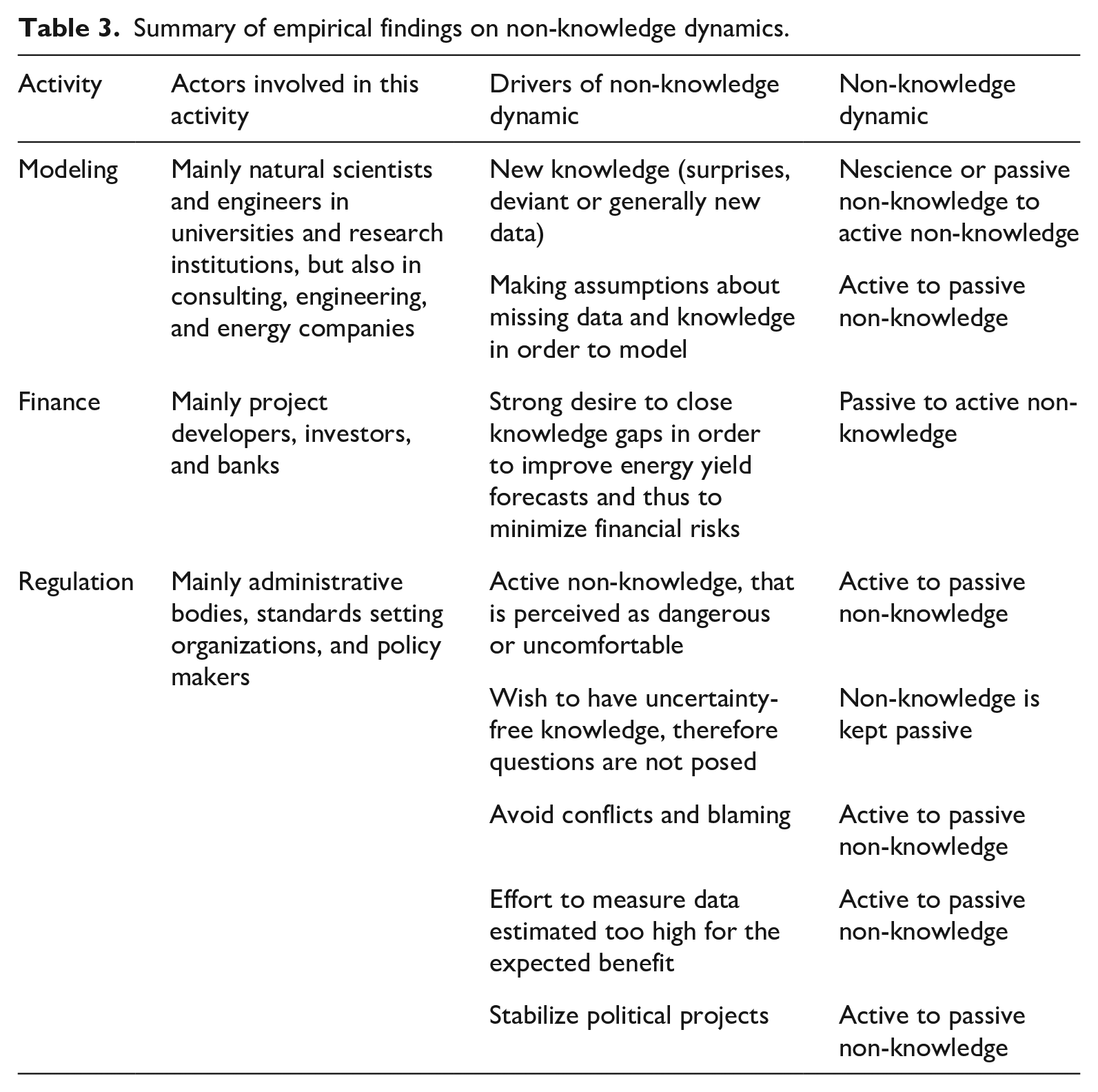
The category of nescience was not particularly apparent in our empirical cases. The most significant incidence was the moment when the relevance of the wake effect phenomenon became publicly known, as the magnitude of their impact was not expected beforehand. The other two categories, however, were very visible in our material.
Modeling is a central activity that actively deals with non-knowledge. It is generally based on the assumption that what is unknown is provisional and can be converted into knowledge. However, modeling also involves acknowledged ways and procedures of combining known (measured data) and unknown aspects (knowledge gaps filled with assumptions and guesswork) about the natural environment in order to translate non-knowledge into margins of uncertainty for estimated parameters and quantifiable risks. This is not unique to modeling in the context of wind and geothermal energy. Similar phenomena associated with non-knowledge have already been highlighted in the context of hydrological modeling (Chong et al., 2018) and modeling earth systems (Paasche et al., 2023). Filling knowledge gaps through guesswork and quantifying risks can be interpreted as turning active non-knowledge (at least temporarily) into passive non-knowledge. Passive non-knowledge can turn into active non-knowledge, for instance, when measurements deviate from expectations.
Active non-knowledge is particularly important for the financing of wind energy. In the case of wake effects, passive non-knowledge is considered dangerous, since potential profits are put at risk when wind yield forecasts are too imprecise. Thus, non-knowledge concerning wake effects is considered provisional and handled actively by investors so that the models can be improved. However, as long as knowledge is lacking and models cannot be fed with additional or improved data, non-knowledge is translated into the epistemic category of risk. This practice is driven by investors’ fear of future financial losses due to having kept non-knowledge about wake effects passive. Similarly, Chong et al. (2018) have shown for a case of hydrological modeling that processes of calibration and validation are more formal for commercial models than for scientific applications.
Passive non-knowledge plays a prominent role in the regulation of geothermal energy. There is a lack of strong attempts to fill knowledge gaps with knowledge. For example, we have shown how geothermal energy threshold values and distance rules take the form of fluid objects that become enriched by assumptions in different regulatory contexts. Moreover, as Jasanoff has prominently shown, threshold values, standards, etc. result from a process of negotiation between scientists, stakeholders, and policy-makers (Jasanoff, 1992, 1999). Despite this, in our case of geothermal energy, threshold values and distance rules are assumed to be based on sound and undisputed scientific evidence, thereby turning non-knowledge into a passive state and rendering it unimportant for future action. We could identify several reasons why non-knowledge becomes or stays passive. The main reason is the avoidance of conflicts and blame that would otherwise result in additional time investment and bureaucracy. Another reason is the pursuit of political goals that could be jeopardized by the open acknowledgement of non-knowledge. However, this also means that actors do not worry about the temporality of non-knowledge; it doesn’t matter in which timescale non-knowledge could be turned into knowledge. As we have shown, regulatory authorities in the field of geothermal energy can only keep non-knowledge about temperature plumes passive as long as their governance practices are uncontested and unquestioned.
Based on our research, actors can have different understandings of the relevance of non-knowledge: While regulatory authorities, political actors, and even engineers tend to understand non-knowledge as passive, scientists and actors from the field of finance perceive the need to deal with non-knowledge. Based on our empirical material, however, we could not comprehensively explore these dynamics of different relevancies of non-knowledge for different actors and how these relevancies are negotiated. This should be investigated in further studies.
While we could show and verify the relevance of intentionality in keeping non-knowledge passive or turning it into active non-knowledge, the temporality dimension proved to be of minor explanatory relevance for non-knowledge dynamics. We have shown that the temporal dimension can be uncertain (short- or long-term), as in the case of modeling, but modelers still actively deal with non-knowledge. Or the temporal dimension might not matter at all, as we found in the case of regulation. Thus, in our cases, temporality seems to be at best a mediating factor in the context of intentionality but does not occur as a dimension independent of intentionality. We thus suggest understanding temporality as a mediating factor within the category of intentionality and not as a separate category. This could also be examined in future research drawing on other empirical examples.
Existing research considers the acknowledgement of uncertainties and non-knowledge as vital for the successful implementation of novel technologies in energy transitions (Gross & Mautz 2015) and sees open communication of knowledge gaps as key for successful decision-making and trust-building (e.g., Bleicher & Gross, 2016; Green, 2009; Gross & Hoffmann-Riem, 2005; Parviainen et al., 2021). Based on our findings we can add new aspects. We confirm that dealing with non-knowledge is important and actors rely on different strategies in order to avoid non-knowledge becoming a problem for decision-making. We have shown how both keeping non-knowledge passive and using non-knowledge as a basis for acting serve to achieve the same goal: securing legitimacy and thus protecting organizational interests and keeping things going. Therefore, the different non-knowledge dynamics depend on the interests, established working routines, and liabilities of dominant actors in the field. In the case of wind energy financing, losing legitimacy would mean that energy yield forecasts would be questioned by financiers and in the case of geothermal energy regulation, it would mean that governance practices would be contested. This would clearly run counter to the interests of wind energy developers and public authorities. Thus, successful decision-making and trust-building can be facilitated not only by actively dealing with non-knowledge in order to generate knowledge, but also by making non-knowledge passive by black-boxing it.
Footnotes
Acknowledgements
We would like to thank our interviewees who openly shared their thoughts with us, our student assistants Cecilia Boesche and Charlotte Heidebrecht who in particular supported the data gathering and analyzing process, the three anonymous reviewers for their helpful and constructive comments as well as Brianna Summers for the language editing.
Funding
The author(s) disclosed receipt of the following financial support for the research, authorship, and/or publication of this article: This work was supported by the German Research Foundation (DFG) under grant number 424638267.
