



Abstract
Electricity systems are changing in response to three important trends: decarbonization, decentralization, and digitalization. However, these changes have done little to disrupt unsustainable patterns of consumption and production. Consumer electricity markets are still awaiting a fourth D: disruption. Digitalization has enabled disruptive business models in many other sectors, but there are reasons to critically examine promises that connect disruption and environmental sustainability. This article compares how decarbonization, decentralization, and digitalization are invoked in promises to disrupt unsustainable patterns of consumption and production. It conceptualizes disruption as value propositions that enact alternative consumer–retailer relationships. Empirically, it examines Sweden, where initial signs of disruption are coming from new entrants in the electricity retail market, and uses the websites of electricity retailers to compare their value propositions and identify disruption inductively. The comparison shows five dimensions of disruption, where no single value proposition is disruptive along all five dimensions. This inductive approach contributes to the theorization of disruption within and outside electricity markets through two insights: (1) that a value proposition is not necessarily sustainable or disruptive as a whole and (2) that a value proposition can be disruptive in some dimensions while lagging behind incumbents in others.
Introduction
Electricity systems are changing in response to three important trends: decarbonization, decentralization, and digitalization. Decarbonization includes not only a shift to renewable electricity sources but also the electrification of other sectors such as mobility and heating (Markard 2018; Rosembloom 2019). Decentralization is a consequence of decarbonization where electricity production becomes more geographically dispersed, as in the case of wind turbines, but also increasingly located at sites of consumption, like solar power (Verbong and Geels 2010; Brown, Hall and Davis 2019). Digitalization is a parallel trend where the spread of smart meters, and more recently smart grids, facilitates a shift of consumption away from times of peak demand, thus adapting to the variability of renewable electricity production (Strengers 2013; Skjølsvold, Ryghaug and Throndsen 2015). These trends—which I refer to as the three Ds—hold potential to re-shape electricity systems (Engels and Münch 2015; Skjølsvold, Ryghaug and Throndsen 2020).
However, these changes to electricity systems have done little to bring about a more environmentally sustainable relationship between consumers and electricity retailers. From the perspective of electricity retailers, also called “electricity suppliers,” there is little to gain when consumers shift their electricity consumption, and company revenues decrease when consumers reduce their consumption (Steinberger, Van Niel and Bourg 2009). While electricity markets are designed to create price signals, these signals are targeted exclusively at consumers (Breslau 2019; Darby 2010). There has been academic interest in alternative business models like the energy service company (ESCo), but this model has failed to spread to consumer markets (Hannon, Foxon and Gale 2013). Despite the three Ds, consumer electricity markets are still awaiting a fourth D: disruption.
In other sectors, much attention has been given to new business models that promise to disrupt unsustainable patterns of consumption and production. Digitalization is a common ingredient in these promises, which range from enabling the sharing economy (Frenken and Schor 2017), facilitating the circular economy (Piscicelli 2023), reducing car ownership (Guyader, Friman and Olsson 2021), promoting smart cities (March and Ribera-Fumaz 2016), reducing food waste, and promoting innovations in sustainable agriculture (Kolk and Ciulli 2020). While decentralization and decarbonization are not universally applicable to other sectors, they have similarities with other new business models. Like some forms of decentralization in the electricity sector, the sharing economy blurs the boundary between producers and consumers (Mont et al. 2020). Servitization and product-service systems promise to reduce the consumption of resources and the amount of waste (Tukker 2015), analogous to decarbonization.
However, there are reasons to critically examine promises that connect disruption and environmental sustainability. Digitalization can lead to tensions between sustainability and other public values such as reliability and privacy (Niet, Dekker and Van Est 2022). While digital mobility platforms address gaps in existing infrastructure, they are less permanent solutions and more subject to the whims of for-profit companies and venture capitalists (Stehlin, Hodson and McMeekin 2020). There can also be tensions between sustainability benefits and scalability (Öberg 2024), and new discourses like the sharing economy can act as discursive cover for business as usual (Martin 2016). Furthermore, sustainability is recognized as a contested topic that is subject to redefinition (Connelly 2007; Miller 2020). There is a need to better understand which claims are invoked in promises to disrupt unsustainable patterns of consumption and production, clarifying which sustainability benefits are attributed to digitalization, how claims of disruption might redefine sustainability, and how digitalization is combined with decarbonization and decentralization. These tensions about the role of technology are well-suited for an analysis inspired by theories from science and technology studies (STS). It also provides an opportunity to extend STS interventions into research on digital capitalism, where political economic perspectives pervade (Nowak 2023; Faulkner-Gurstein and Wyatt 2023).
This article compares how decarbonization, decentralization, and digitalization are invoked in promises to disrupt unsustainable patterns of consumption and production. While all three trends can contribute to disruption, they can be combined in different ways. The Swedish electricity market provides an excellent opportunity to examine such promises. Some initial signs of disruption have emerged recently in the form of new electricity retailers that claim to offer a radically different approach to selling electricity: they promise to help consumers reduce and shift their electricity consumption, while still promising profits to investors. Furthermore, these new electricity retailers draw on the three Ds: fossil-free electricity (decarbonization), solar panels (decentralization), and smartphone apps (digitalization). They promise to re-shape the relationship between consumers and electricity retailers and in doing so provide the most significant disruption to electricity markets since liberalization in the 1990s.
The article begins with a review of the three Ds in electricity markets and then explores how disruption can be conceptualized to analyze value propositions. The research design is then described, outlining an approach of analyzing value propositions in the websites of electricity retailers by using an incumbent as a baseline for comparing with other retailers. The empirical analysis reveals five dimensions of disruption, where no single retailer is disruptive across all five dimensions, with a subsequent discussion exploring how disruption across multiple dimensions results in different approaches to the disruption of unsustainable consumption patterns. Finally, the conclusion reflects on how the three Ds are involved in disruption and how the theoretical perspective contributes a new STS-inspired approach to the study of disruption within and outside electricity markets.
Electricity Retailers and the Three Ds
There are diverse ideas about how to disrupt unsustainable patterns of consumption and production in the electricity sector. This section reviews the role of electricity retailers, one of several actors in the European electricity sector. In competitive electricity markets like in Europe, electricity retailers must produce or purchase enough electricity to match the consumption of their customers. Retailers can be contrasted with electricity distributors who have a regulated monopoly over the physical electricity infrastructure in specific jurisdictions. While decarbonization, decentralization, and digitalization—the three Ds—also have implications for electricity distributors, among others, this study focuses on the implications for the relationship between consumers and electricity retailers.
The most well-established role for European electricity retailers relates to decarbonization. It is common for retailers to sell so-called green electricity contracts that guarantee renewable sources of electricity (Herbes and Ramme 2014; Herbes et al. 2020). Building on such contracts, electricity retailers could also contribute to the decarbonization of other sectors, for example, with the new electrifier business model where the retailer helps consumers switch to electric heat pumps and electric vehicles, which contributes to decarbonization while increasing the amount of electricity purchased (Gaur, Fitiwi, and Curtis 2021; Hall et al. 2021). However, these contracts maintain a consumer–retailer relation where the consumer pays per unit of electricity.
For many years, energy researchers have argued that decarbonization could be facilitated by a shift to energy services (Steinberger, Van Niel and Bourg 2009). The ESCo archetype is one example, consisting of two alternatives: energy supply contracts that include systems like district heating but rely on the same throughput model where customers pay per unit of energy (Roelich et al. 2015) and energy performance contracts that charge customers for a service, such as fixed indoor temperature, and constitute a more radical change to the consumer–retailer relationship (Bolton and Hannon 2016). However, there are few examples of ESCo contracts in the context of households (Britton et al. 2021). A shift to energy services is particularly difficult for incumbents because of organizational structure and a lack of trust from consumers (Apajalahti, Lovio and Heiskanen 2015; Helms 2016). However, some electricity retailers offer a fixed monthly cost, up to a certain maximum consumption (Chasin et al. 2020; Numminen, Ruggiero and Jalas 2022).
Digitalization also promises to reframe the consumer–retailer relationship, but the benefits for consumers and retailers are unclear. Many investments into smart meters and smart grids have been justified by discourses of flexible consumers who shift their electricity consumption (Ballo 2015; Schick and Gad 2015; Wallsten and Galis 2019). However, the flexibility of many consumers is limited by household practices and material characteristics (Nicholls and Strengers 2015; Christensen et al. 2020; Fjellså, Ryghaug and Skjølsvold 2021). For retailers, some benefits of digitalization come from demand response, which can add a new revenue stream, decrease costs for imbalances, or increase customer loyalty by providing savings (Behrangrad 2015; Ruggiero et al. 2021). For customers, the benefits of digitalization appear to be greatest for those who can combine dynamic pricing with automation (Rommetveit, Ballo and Sareen 2021; Numminen, Ruggiero and Jalas 2022). However, there are few examples of retailers that combine these benefits into a new consumer–retailer relationship.
More radical changes to this relationship combine digitalization with decentralization. The spread of smart meters and solar panels has enabled the electricity prosumer (a consumer who is also a producer). Prosumers can interact individually with the existing electricity grid, and there are digital platforms that organize prosumers in models that resemble the sharing economy, such as peer-to-peer electricity sales or micro-grids (Parag and Sovacool 2016). The most radical forms of prosumption would eliminate the need for electricity retailers; in other models, consumers continue to have a separate retailer, or the platform itself combines the roles of marketplace and retailer. While digital electricity platforms can facilitate decarbonization, they also have potential downsides: e.g., monopolization or a death spiral for existing infrastructure (Kloppenburg and Boekelo 2019).
Digitalization and decentralization can also be combined into less radical changes where the retailer remains central. Retailers could provide solar panels and batteries, either by leasing or charging per unit of electricity (Bryant, Straker and Wrigley 2018; Specht and Madlener 2019). Altunay, Bergek and Palm (2021) find that incumbent retailers in Sweden engage in a variety of business activities related to solar production; turnkey sales of solar panels are quite common, as is premium reimbursement of prosumers’ excess solar production—an activity that seems counterintuitive but is easy for incumbents to adopt. Some incumbents facilitate ownership in community solar projects, which reduces electricity sales for the retailer but locks the customer into a contract. These findings suggest that there are several ways for incumbent retailers to adapt their consumer–retailer relationship.
In summary, there are many ideas about how to change the role of electricity retailers to disrupt unsustainable patterns of consumption and production through decarbonization, decentralization, and digitalization. Some of these ideas are prevalent but less disruptive, such as green electricity contracts and the sale of solar panels. Other ideas are more disruptive but less prevalent, if they exist at all, such as energy performance contracts for heating or fixed-price contracts. Digitalization enables new patterns of consumption and production: some can be more easily adopted by electricity retailers (e.g., dynamic pricing with automation); others could replace retailers entirely (e.g., peer-to-peer electricity trading). However, there is little empirical research documenting the extent to which digitalization has been incorporated into the offerings of electricity retailers.
Dissecting Disruption
The concept of disruption has become popular in media when describing digital technologies, but it has several potential meanings in relation to the sustainability of electricity systems. In popular usage, usually in reference to new technology, it is said that a company can disrupt a market just as Uber disrupted taxi markets or AirBnB disrupted hospitality markets. Research on sustainability transitions has explored several aspects of the concept, with particular attention coming from a 2018 special issue of Energy Research & Social Science (ERSS). This research explores the scale of disruption, its radical character, and how disruption can be studied empirically. I propose a theoretical perspective that conceptualizes disruption as value propositions that enact alternative consumer–retailer relationships.
Perspectives from sustainability transitions raise questions about the scale at which disruption can occur. The ERSS special issue discusses Christensen’s (1997) concept of disruptive innovation. While Christensen describes disruptive innovation as “low-cost, low-end goods and services which appeal to consumers marginalized or excluded from mainstream markets” (Wilson and Tyfield 2018, 211), some authors criticize his exclusive focus on low-end goods, pointing out examples of low-carbon technologies that began in a high-end market niche (Geels 2018; Wilson 2018). Others are critical of the Christensen's focus on firms, pointing out the importance of practices and communities (Dütschke and Wesche 2018; Sprei 2018). Others argue that the concept of disruption should refer to the reconfiguration of socio-technical systems instead (Johnstone et al. 2020; Kivimaa et al. 2021; McDowall 2018). Systemic perspectives would be difficult to apply to the analysis of individual electricity retailers, but these perspectives are relevant in how they conceptualize business models as interdependent with technologies, actors, consumer practices, and regulation.
The radical character of disruption has also been debated. Geels (2018, 226) argues that disruption in a socio-technical system does not require radical change because “a multitude of successive gradual changes can also have transformative effects.” Dixon, Lannon and Eames (2018) present a different set of concepts, calling technologies radical when they require reconfiguration of the socio-technical regime, and instead defining disruptive change as technological breakthroughs that do not require regime change. Wilson (2018) provides yet another dichotomy, drawing on Christensen's distinction between innovations that are disruptive and those that are sustaining. Wilson explains that disruptive low-carbon innovations create new value propositions, while sustaining innovations fit with existing business models and allow consumers to maintain established practices. This distinction is useful for the study of electricity retailers because it is more directly applicable to the analysis of individual firms. Kuokkanen, Uusitalo and Koistinen (2019) build on this distinction and present a framework for disruptive sustainable innovation with two dimensions that help to specify the object of study: first, disruption introduces either new practices (e.g., shifting electricity consumption based on hourly prices) or more sustainable attributes for existing practices (e.g., green electricity contracts); second, it comes in the form of either new value propositions or new value capture strategies.
The concept of value propositions is useful for characterizing disruption at an early stage. According to some definitions, disruption can only be identified ex post, by looking at the past (Wilson 2018). Concepts like business models, value capture strategies, and value propositions are possible to analyze ex ante, before change occurs, but the first two come with analytical challenges. Business models and value capture strategies are not necessarily descriptions of actual conditions; often they are performative statements whose purpose is to enroll investors or partner companies (Doganova and Eyquem-Renault 2009). While they might be empirically accessible through interviews, they must be conceptualized as promises that can be realized in the future—potentially years into the future, if at all (Van Lente 1993; Borup et al. 2006). Admittedly, value propositions are also performative, because their purpose is to enroll prospective customers, as in the case of electricity retailers (Summerton 2004). But value propositions can be realized immediately, not years later; the company must deliver the service described in the value proposition as soon as the prospective customer becomes an actual customer.
Value propositions, in the form of texts, can be analyzed to understand how alternative consumer–retailer relationships are enacted. Woolgar and Lezaun (2013, 331) provide an approach to analyzing ontological enactment in texts which calls attention to “the ways in which the text depicts the character of the entities mentioned and, crucially, of the ways in which they relate to each other.” In this approach, “the organization of the text is to be understood as enacting a moral universe comprising all its constituent elements” (Woolgar and Lezaun 2013, 331). In the case of electricity retailers, a start-up company might enact a moral universe in which it has a financial incentive to reduce electricity consumption, as in the case of an ESCo with an energy performance contract. By contrast, an incumbent company might enact a moral universe where it promises a stable price per kilowatt-hour but has no incentive to reduce customers’ consumption. Because of the differences in these moral universes, it cannot be assumed that all electricity retailers work with the same, stable set of entities. As Woolgar and Lezaun Woolgar and Lezaun (2013, 334) write, “the ontological status of the entities involved is an accomplishment.” The analysis should not take any objects or technologies for granted, but rather trace how they are enacted in value propositions. For example, a smart meter might be enacted as a device that produces data for billing; alternatively, it could be enacted part of hourly electricity pricing that encourage consumers to shift their electricity use from daytime to nighttime.
In summary, this theoretical perspective conceptualizes disruption as value propositions that promote new practices or transform existing practices with new attributes. This perspective makes it possible to analyze new services as they are introduced into a market, rather than waiting to see whether the market has actually changed. A focus on value propositions avoids the analytical challenges related to the performativity of business models and value capture strategies. It is a socio-technical perspective that allows the analysis to include entities suggested by systemic perspectives. This theoretical perspective can be applied empirically to texts in which companies present their value propositions to prospective customers. The following section describes how it is applied to the analysis of company websites.
Research Design
The starting point for the research design has been to compare value propositions in the Swedish electricity market. As noted, value propositions are claims by companies about what they offer to consumers. The research design aims to analyze the content of these claims, not whether companies actually do as they claim. It uses an empirically derived baseline from which to compare whether the value propositions are disruptive or sustaining—or even lagging.
The choice of companies builds upon an initial review of the websites of the almost 130 electricity retailers active in the Swedish consumer electricity market in February 2023. 1 While this approach includes a large diversity of electricity retailers, it also excludes more radical alternatives that that might exist in small numbers, e.g., collective purchasing in housing associations, digital peer-to-peer platforms, and privately owned micro-grids (the latter recently became legal in Sweden; see Envall and Rohracher 2024). However, the exclusion of these more radical alternatives is justified based on two assumptions. First, until recently, they have been limited to certain types of consumers (homeowners who can install solar panels, housing associations) and they are still uncommon (Envall and Rohracher 2024). Second, as such alternatives become more common, existing retailers will adapt to them by offering similar services or adapting their value propositions to distinguish them (cf. Markides and Charitou 2004). If the value propositions of existing retailers show no signs of adapting to these more radical alternatives, it is a sign that they are not yet of much importance in the electricity market.
The analysis encompasses six retailers that were chosen to represent four types of value propositions, summarized in Table 1. These types were identified by examining all websites to categorize how the value propositions dealt with decarbonization, decentralization, and digitalization. More specific categories were identified inductively (e.g., source of electricity, sale of shares in wind parks, smartphone app). This research design allows mapping the diversity of disruptive value propositions at this point, but not identifying any dynamics over time. While the offerings of individual retailers are likely to change over time, the snapshot is still able to represent the overall diversity of disruption in the market.
2
The first of the four types, large incumbents and their subsidiaries, acts as the baseline; the characteristics of the large incumbent's value proposition are used to determine whether the value propositions of other retailers are disruptive. It is a moving baseline, acknowledging that incumbents change over time too, but assuming that changes made by incumbents are compatible with existing business models, and can thus be classified as sustaining (cf. Wilson 2018). While there are many retailers operating in the Swedish electricity market, three large incumbents (one state-owned, two publicly traded) have by far the most customers (Stattin 2024). Fortum was chosen to exemplify this type because it had the most advanced value proposition related to digitalization (smart charging in the app), setting the highest possible baseline from which to identify disruption. This baseline is used to compare the three other types of value propositions that were identified inductively from the review of websites. The second type is companies with apps and algorithms, of which there are two similar companies; Tibber was chosen as an example because it integrates the largest diversity of digital technologies. Third is hourly tariffs only, where two companies were chosen as examples because of their different approaches to decarbonization: Ikea (yes, the furniture company) sells renewable electricity; Kärnfull sells electricity from nuclear power plants. The fourth type is different forms of decentralization, where two companies were chosen because of their unique offerings related to decentralized renewable electricity: ETC Electricity (ETC El in Swedish), which sells a place for solar panels in its solar parks, and Jönköping Energi, which allows consumers to shift the value of their solar production between seasons.
Summary of Swedish Electricity Retailers’ Value Propositions Reviewed in This Study.
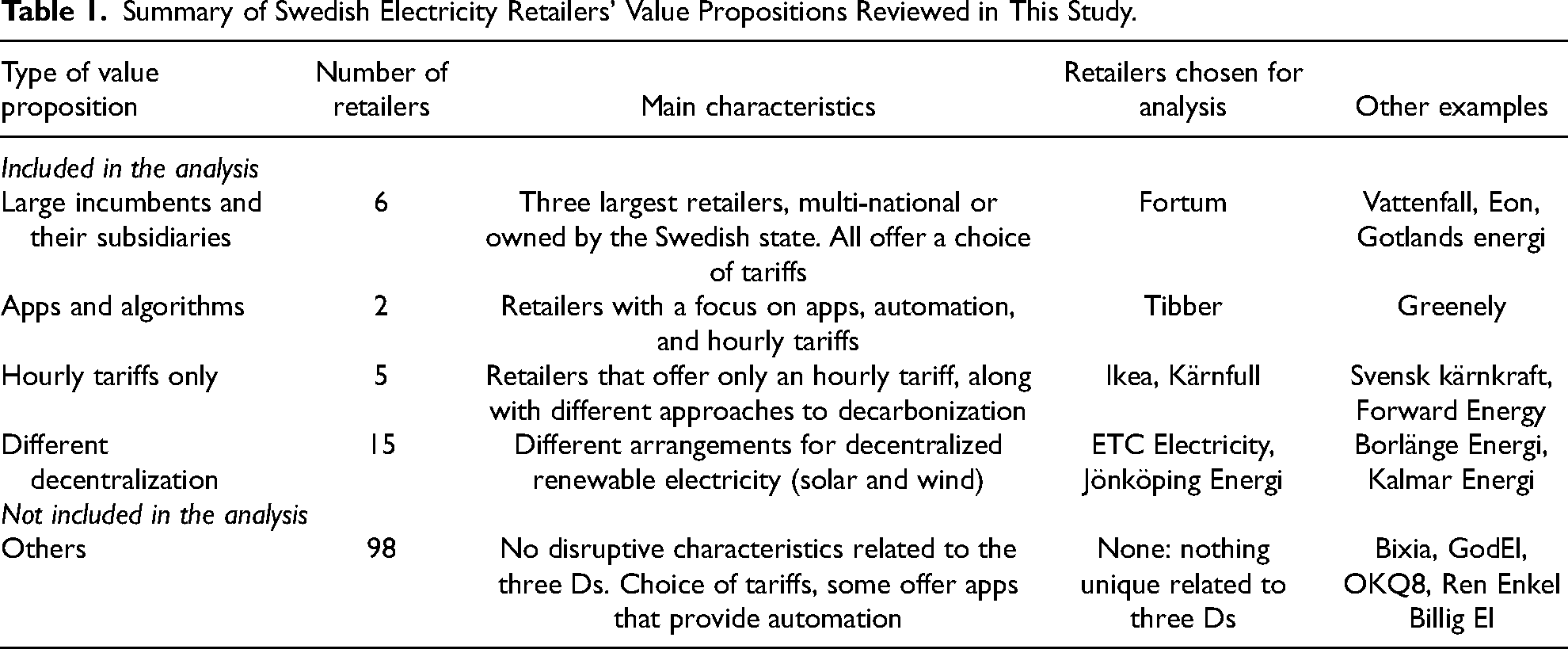
Whereas the large incumbent represents a baseline, the value propositions of the remaining five retailers (types 2–4) represent the overall diversity of disruption in the Swedish electricity market.
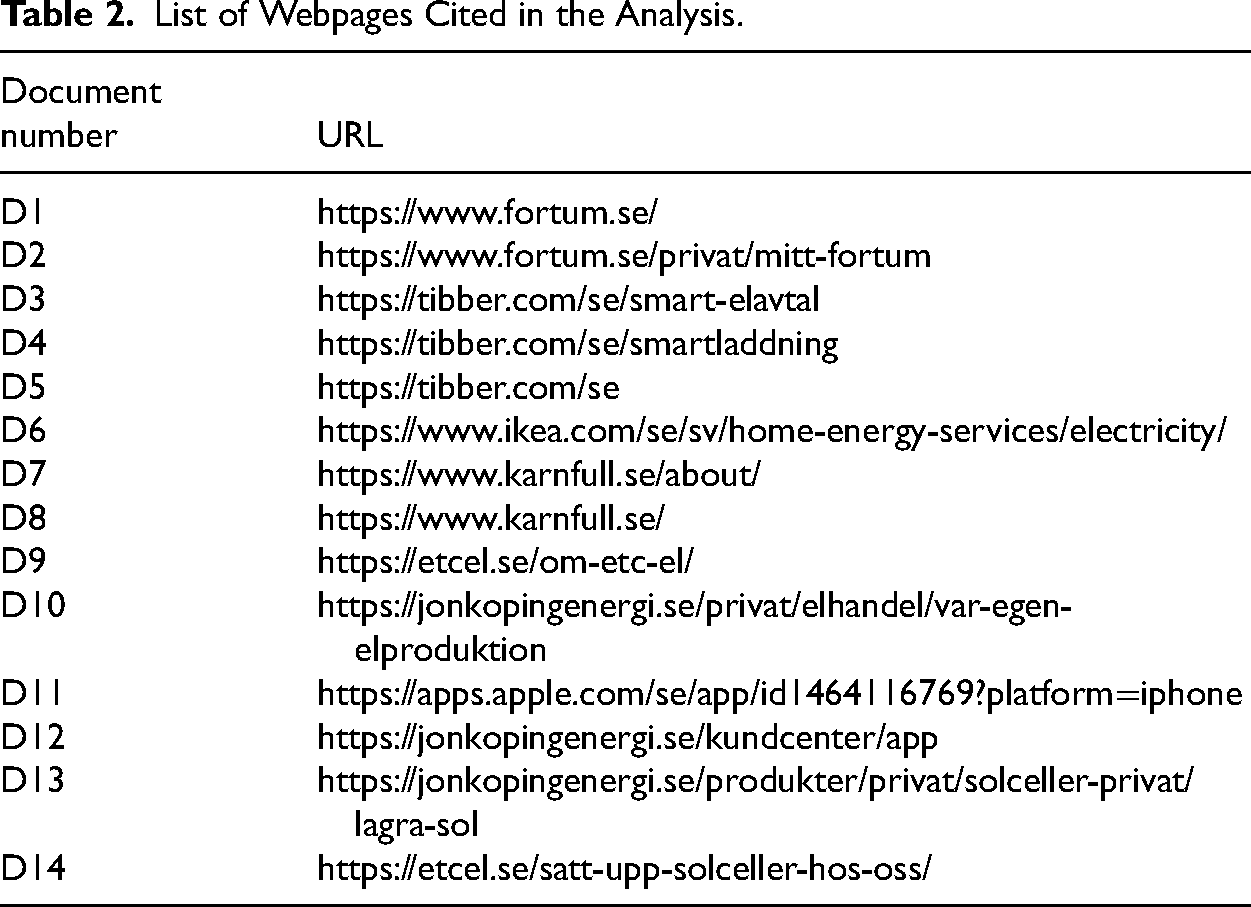
The empirical material consists of websites and pages on the Apple App Store, collected in February 2023 using an automated tool called browsertrix-crawler. 3 A full list of cited pages is shown in Table 2, and the webpages themselves are available as supplementary material (.wacz files viewable in ReplayWeb.Page). Analysis of the empirical material focused on the socio-technical relations used to enact alternative consumer–retailer relationships. Figure 1 illustrates the analysis performed in ATLAS.ti 23 by coding entities (e.g., hourly contract, app) and the phrases in which entities are enacted (e.g., “Use electricity in a smarter way with our hourly contract and our smart app”). In tandem with coding, the entities and phrases were connected with relations in a visual network so it would later be possible to list all enactments related to a specific entity, as illustrated in Figure 2. Both types of codes were unique to the retailer being analyzed, a necessity given the assumption that the same entity (e.g., an app) can be enacted through different relations by different retailers. Because the resulting networks were overwhelmingly complex, the entity codes for each retailer were then grouped according to decarbonization, decentralization, and digitalization, and a separate network diagram was created for each group of codes, 4 providing a more manageable overview from which to base the analysis. These simpler network diagrams were used to compare the value propositions to the baseline and make judgments about which aspects of the value propositions were disruptive, sustaining, or lagging. 5
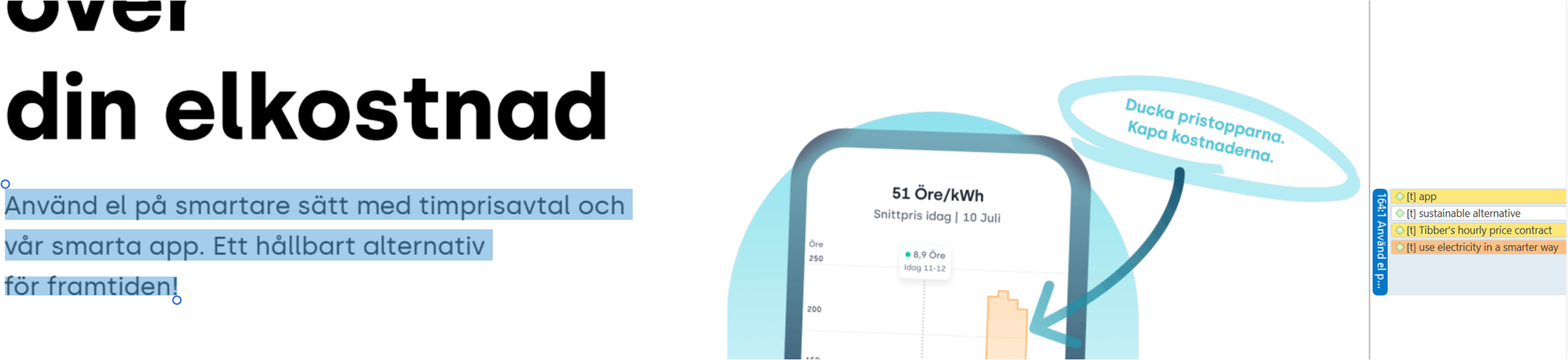
Research design. Example of coding the website of a Swedish electricity retailer in ATLAS.ti. The coding indicates enactments (“Use electricity smarter”) in orange; entities (App, hourly price contract) in white and yellow (where the yellow codes are more central entities identified in the analysis). The [t] label specifies the electricity retailer (Tibber), as all codes are unique to each retailer. The diagram has been simplified for illustrative purposes.
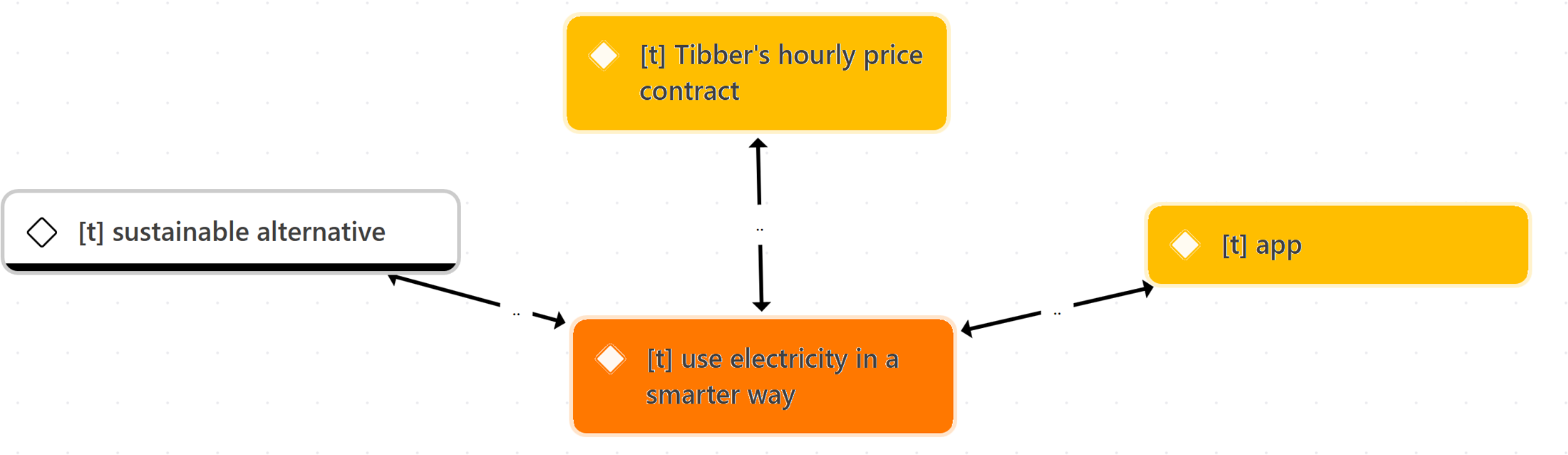
Example of relations in a visual network in ATLAS.ti. The visual network is created in tandem with coding. It shows relations between an enactment (orange) and entities (yellow, white). The [t] label makes each of the enactments and entities unique to the electricity retailer (Tibber in this example), allowing for unique sets of relations.
List of Webpages Cited in the Analysis.
Analysis
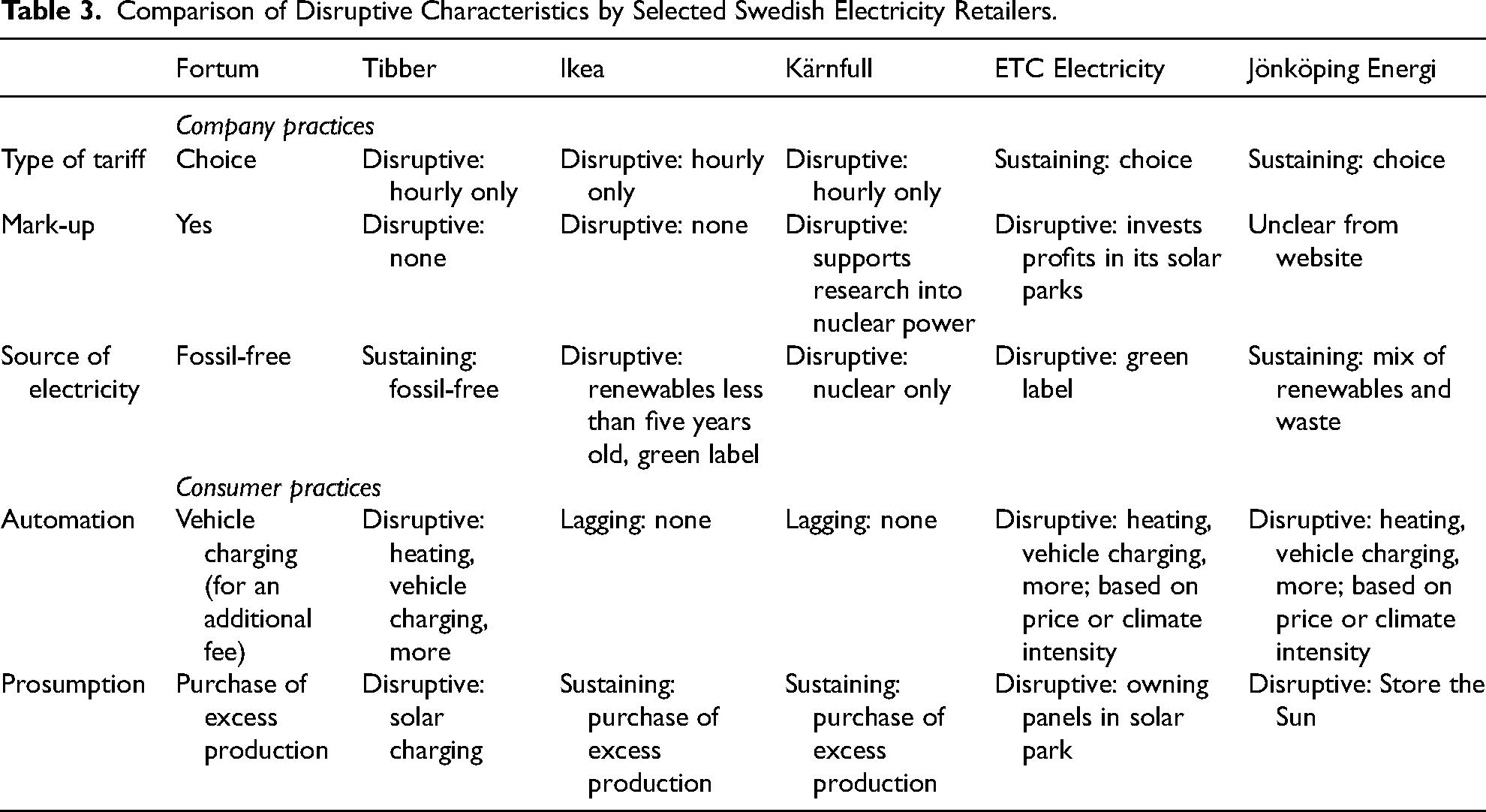
The overwhelming majority of Swedish electricity retailers offer electricity contracts that somehow combine decarbonization, decentralization, and digitalization. However, there is significant diversity in how retailers combine these trends. The analysis begins by setting a baseline from which to identify disruption: Fortum, one of the longstanding large incumbent retailers. The analysis then contrasts the large incumbent with Tibber, one of the most radical new entrants that promise apps and algorithms. The analysis subsequently turns to Ikea and Kärnfull, new entrants who are not as invested in digitalization, but instead provide unique forms of decarbonization. Finally, the analysis turns to retailers who draw on decentralization in different ways. Table 3 summarizes the comparison of value propositions, pointing out how they are disruptive, sustaining, or lagging in relation to the large incumbent.
Comparison of Disruptive Characteristics by Selected Swedish Electricity Retailers.
Fortum: Small Steps for a Large Incumbent
Fortum illustrates how large incumbents are making small steps toward digitalization. Its website calls on the prospective customer to “Switch to a smarter electricity contract. Our app helps you get insight into your electricity costs” (D1). As with many retailers, it offers choices to its customers: not just which type of tariff, but also which kind of decarbonization.
Fortum offers the same three tariffs that Swedish electricity retailers traditionally offer. Most common is the monthly tariff (rörligt elpris in Swedish), where the price of electricity is determined at the end of the month, but the price is constant for the entire month (all times of the day, all days of the week). Second is the fixed tariff (fast pris), where the customer signs a contract for a fixed electricity price and a fixed term (often 1–3 years). Finally, there is the hourly tariff (timpris) where customers pay the hourly spot market rate for electricity (i.e., real-time pricing), plus additional fees determined by the retailer.
Fortum explains that consumers are provided with “100% fossil-free energy: the electricity you buy is fossil-free and comes from sun, wind, water and nuclear power” (D1). But it also offers different types of decarbonization for an additional fee. First, it sells an Environment Package, which provides customers with renewable electricity (i.e., no nuclear power) for an extra fee. Along with renewable electricity, this package gives access to an energy advisor and includes a donation to an environmental organization. Second, it offers a Smart Charging Package (also for an extra fee) which optimizes the charging of electric vehicles according to hourly electricity prices and also includes a rebate on charging via Fortum's public charging network.
In terms of digital technologies, Fortum's main offering is its app. It claims that its app helps to “Get insight into your electricity and reduce your costs” (D2). The app's main features provide information such as visualizing consumption and micro-production and showing spot market prices (the latter of which can also be shown on an Apple Watch). There are two exceptions where digitalization goes beyond providing information. One is the smart charging feature, where Fortum automates charging according to electricity prices. The second is “climate challenges” shown in the app, which encourage the customer to adopt environmentally friendly practices (e.g., recycling) where the consumer is rewarded with some hours of free electricity.
In summary, Fortum's value proposition includes some aspects of decarbonization and digitalization: fossil-free electricity, plus renewables, and hourly pricing if the customer chooses it. The most advanced feature in its app is smart charging for electric vehicles, which provides automation but for an extra fee. Decentralization is mostly absent from Fortum's value proposition, except for the visualization of micro-production in its app; it does not sell solar panels. Fortum shows that incumbent electricity retailers are changing, but with small steps.
Tibber: Electricity at Cost
Tibber contrasts itself with traditional electricity retailers. Unlike Fortum, it offers only an hourly tariff, and it is explicit about its pricing scheme:
With Tibber you get electricity at cost. No mark-up and no frills. That's good because we want to encourage more sustainable electricity consumption. If we don’t charge for electricity, how do we earn money? You can read about that
Tibber depicts its smartphone app as central to its value proposition: it sells a “digital electricity contract in a smart app” (D3). It calls on the consumer to “Lean back and let the app steer. Our app is full of smart features that optimize your consumption while also matching your life puzzle” (D3). In contrast with Fortum, Tibber does not enact its app as a source of information, but rather as a way to control the algorithms that optimize electricity consumption. These algorithms help consumers shift their electricity consumption to times when electricity prices are low. In one sense, Tibber's approach to decarbonization is not dependent on digital technologies, as it promises fossil-free electricity like Fortum, without any choice for the customer. But beyond that, its app facilitates decarbonization of heat and mobility through algorithms that control home heating systems and the chargers of electric vehicles. 7
Unlike Fortum, digital technologies contribute to Tibber's approach to the decentralization of electricity production. Tibber partners with a company that sells solar panels and offers to buy its customers’ excess solar power. In addition, it offers a feature called “smart charging with sun:” Normal smart charging assumes that it is “smart” to charge by looking at the electricity price so that your charging is as cost-effective as possible. Smart charging with sun also includes predicted excess production of solar electricity, grid costs, electricity fees and tax rebates. [sun emoji]. (D4)
While Tibber's app is the gateway to its main features, the company's value proposition offers many digital technologies. For charging and heating, the app allows users to set the time when the vehicle needs to be charged, set schedules for heating, and enable vacation mode for heating. But Tibber offers other technologies through its online store, many of which can be enabled as “power-ups” in the app: In our app you can connect parts of your home to make it smarter (and more comfortable). We have many smart devices for your home in Tibber Store, read more and get the products you need! Then our algorithms will help you control heating, electric vehicle charging and more! (D5)
In contrast with Fortum, a large incumbent, Tibber's value proposition enacts an alternative consumer–retailer relationship quite explicitly, by contrasting its revenue model with that of traditional electricity retailers. It is disruptive by offering only an hourly tariff and through its claim to not profit from electricity consumption. Other disruptive aspects of Tibber's value proposition are its app, which it enacts as a tool to control algorithms that optimize electricity consumption, and smart charging with solar electricity. Its app and algorithms are not separate features, but rather integrated into how the value proposition enacts decarbonization and decentralization. Tibber's value proposition stands in stark contrast to traditional electricity retailers with the exception of its source of electricity, where it is sustaining: fossil-free electricity, which includes nuclear power, is just like Fortum. But as shown in the next section, Tibber's approach to disruption is not the only one.
Ikea and Kärnfull: Hourly Tariffs but Little Digitalization
Ikea and Kärnfull are new entrants in the Swedish retail electricity market who stand apart from incumbents like Fortum, but do not provide Tibber's wealth of digital features. Ikea and Kärnfull share two characteristics: they offer only an hourly tariff, and they each have a unique approach to decarbonization. Yet their value propositions enact decarbonization in completely different ways: Ikea through renewables and Kärnfull through nuclear power.
Both value propositions enact decarbonization through their purchase of electricity, specifically guarantees of origin for certain forms of electricity production. Ikea explains that its electricity comes from “the sun, wind, and when necessary, hydro power” (D6). This statement is in turn explained in more detail: The electricity comes primarily from Swedish solar and wind power facilities. If the price for these guarantees of origin is ever 10% above average, [we]
8
buy guarantees of origin for solar and wind power from another Nordic country. If these guarantees of origin also become too expensive, we buy certificates for Swedish hydropower. When we prioritize electricity from solar and wind power, we also create demand and thus potential for further expansion of these energy sources. All electricity [we] offer is labelled Good Environmental Choice.
9
…The guarantees of origin [we] purchase from solar and wind power facilities are never more than five years old. By purchasing guarantees of origin from newer facilities, we support that production of more but also constantly new electricity from solar and wind power. (D6)
This approach to decarbonization differs from Fortum's Environment Package, partly because it comes at no extra cost, but also because Ikea has more specific requirements for the renewable electricity it purchases: the age of facilities and the Good Environmental Choice label, which excludes nuclear power and places extra requirements on the production of renewable electricity.
In contrast, Kärnfull purchases guarantees of origin for only nuclear power—and even allows customers to choose which Swedish nuclear power plant they want to buy power from. It claims to be the first electricity retailer to offer 100 percent nuclear power (D7) as part of what it calls “Sweden's most rational electricity contract. For minimal emissions, lower electricity prices, more research, and untouched nature” (D8). Its electricity price includes a small fee per kilowatt-hour to support research into “the next generation of nuclear power” (D8). While these two retailers support completely different electricity sources, their value propositions both enact decarbonization as a way to support specific sources of fossil-free electricity.
Despite their differences, both retailers share similar approaches to decentralization and digitalization. In a basic sense, they both rely on smart electricity meters to enable their hourly tariffs. Ikea uses hourly tariffs to sell its electricity at cost, “without any profit margins” (D6). Kärnfull explains that “an electricity contract with an hourly tariff is cheaper than a fixed rate over time—and especially smart if you use the cheapest hours of the day” (D8). But beyond the hourly tariff, these retailers do little with decentralization or digitalization. Their value propositions do not incorporate much decentralization, aside from showing micro-production data in their apps and buying excess production from consumers; Ikea, which even sells solar panels, writes little about solar panels on the webpage for its electricity contract. Both offer smartphone apps, but these apps are limited to showing information, with no algorithms like Tibber. When it comes to electric vehicles, they are even lagging behind Fortum because their apps cannot automate charging.
The value propositions of these two retailers are disruptive in a way that at first resembles Tibber: they offer only hourly tariffs. Ikea even uses the same disruptive pricing scheme as Tibber, with a flat monthly fee and no mark-up on the electricity price; Kärnfull's pricing scheme is disruptive in a different way, by supporting research into nuclear power. But where Tibber's source of electricity is sustaining, Ikea and Kärnfull's are disruptive: they use guarantees of origin to support specific sources of electricity. Neither digital technologies nor decentralized electricity production is central to their value propositions; they are even lagging behind Fortum in terms of automation.
ETC Electricity and Jönköping Energi: Different Forms of Decentralization
ETC Electricity and Jönköping Energi are two small incumbents; ETC Electricity is privately owned, while Jönköping Energi is owned by a municipality. Like Fortum, they both offer a choice of tariffs and renewable electricity from a mix of sources. Both provide apps—the same app developed by a third-party and used by over a dozen retailers. But they differ in their approaches to decentralization.
Their value propositions approach decarbonization and digitalization in similar ways, with some differences. While ETC Electricity is privately owned, it belongs to group of companies run by a Swedish newspaper publisher with a public engagement in social and environmental issues, and it claims that “we started ETC Electricity to do more for the climate” (D9). Its electricity uses the Good Environmental Choice label, unlike Fortum but like Ikea, and it promises to “also invest all profits in new solar panels” in its own solar parks (D9). Jönköping Energi, owned by the municipality of Jönköping, also produces some of its own electricity through wind turbines, hydropower on small rivers, and a combined heat and power plant that runs on biomass and waste (D10). In terms of digitalization, both retailers offer an app that is more advanced than Fortum's, providing algorithms to control electricity consumption. In contrast with Tibber, whose app focuses on saving money, the app provided by ETC Electricity and Jönköping Energi also provides information about the climate impact of electricity consumption (D11). Jönköping Energi explains that the app can control algorithms to “charge your electric bicycle or mobile phone when there is more renewable electricity in the system” (D12). In this way, these retailers enact their apps and algorithms not just as a way to save money, but also as a form of climate action that is relevant even for customers with a monthly tariff.
These value propositions differ even more from Fortum's and others when it comes to decentralization. Jönköping Energi offers two alternatives: first, membership in a wind turbine association which sells electricity at a fixed cost; second, a service to owners of solar panels called Store the Sun:
With our Store the Sun service, you can save the value of the electricity that is produced during the summer, when the sun is most effective. You can then use the value of the excess electricity you stored, plus a premium, during the winter, when your consumption and costs are usually higher. Electricity consumption is often low during the summer. With this service, you can make the most out of your solar panels and even out your costs during the year. (D13)
Through this service, the value proposition enacts Jönköping Energi as aiding the decentralization of electricity production. It contrasts this service with batteries, which it notes require financial investment, and cannot shift electricity between seasons.
ETC Electricity's value proposition also enacts a role for the company in decentralized solar power. Unlike Jönköping Energi, ETC Electricity targets customers who cannot install solar panels on their roofs:
We can set up solar panels for you in our solar parks. They are your panels. You buy them through us and we install them. You can visit them, and if you ever want to, you can move them. Simply put, you help us build our solar parks by having your solar panels with us. (D14)
This arrangement allows customers like apartment dwellers to benefit from ownership of solar panels. ETC Electricity charges only a one-time fee for purchase and installation of the solar panels, promising to maintain them for 25 years; in return, it receives the guarantees of origin and electricity certificates related to the electricity produced (D14). 10 In turn, the owner of the solar panels buys back the solar electricity for the very low rate of SEK 0.01/kWh (less than €0.001/kWh based on 2023 exchange rates, D14). However, this arrangement requires the owner of the solar panels to be a customer of ETC Electricity (D14). Thus, compared with Jönköping Energi, ETC Electricity's value proposition enacts an even more central role for itself in decentralization; for the customer, the solar panels are a 25-year commitment. To break the commitment would require the customer to remove the solar panels from ETC Electricity's solar park—and find a new place for them.
The value propositions of these two retailers, both small incumbents, fall somewhere between the large incumbent and new entrants in the market. ETC Electricity's use of a green label makes it disruptive, while Jönköping Energi provides a mix of electricity sources that is sustaining. They offer a choice of tariffs that is sustaining, but like Tibber, they are disruptive by offering digital technologies that include an app and algorithms. However, they are also disruptive in a different way, providing algorithms to shift consumption according to the carbon intensity of the grid. Their value propositions are also disruptive by offering alternative arrangements for decentralized solar power, where both value propositions enact a role for the companies.
Discussion
The analysis of value propositions identified five dimensions of disruption, where no one value proposition is disruptive along all five dimensions (see Table 3). This section discusses how disruption across multiple dimensions results in different approaches to disrupting unsustainable consumption patterns. Digitalization is central to some approaches but not all.
While many value propositions provide automation, there is no clear pattern of which types of companies rely on it the most. While Tibber (a new entrant) appears to provide the most advanced automation technology, the automation provided by Fortum, ETC Electricity, and Jönköping Energi (incumbents of various sizes) is more advanced than Ikea and Kärnfull (two other new entrants). This automation is in line with previous research on digitalization in electricity systems (Rommetveit, Ballo and Sareen 2021). These similarities can be distinguished from other sectors such as mobility, where the asset-light platforms of new entrants differ quite substantially from the capital-heavy public transportation or motor vehicles offered by incumbents (Stehlin, Hodson and McMeekin 2020). Thus, the electricity sector provides a counterexample to the common disruption narrative where a new company's digital technologies are the basis for disrupting the market. It could indicate that incumbents now have the capacity to invest in digital technologies, so that new entrants must add additional dimensions of disruption, such as pricing schemes.
Another approach enacts disruption through different sources of electricity. There are new entrants and small incumbents that claim to disrupt unsustainable patterns of consumption and production using characteristics like the type of electricity production (e.g., nuclear, solar, wind), the age of production facilities, and the use of third-party “green” labels. Contestation about what constitutes sustainable electricity is not surprising on its own; sustainability has long been acknowledged as a contested concept (Miller 2020; Connelly 2007). However, over the past decades, electrification has become a dominant imaginary for the sustainability of sectors like transportation and heating (Rosenbloom 2019; Mutter and Rohracher 2022) but also energy-intensive industries (Lechtenböhmer et al. 2016). The analysis shows that within the dominant electrification imaginary, there is still potential for contestation about which forms of electricity production are sustainable.
Depending on how value propositions combine different dimensions of disruption, there are potentially distinct implications for consumers. The most striking example relates to type of tariff, where the disruptive value propositions rely on real-time pricing. This tariff builds upon the longstanding digitalization of electricity infrastructure, where smart meters make it possible to measure electricity consumption at ever shorter intervals. While real-time pricing is part of several value propositions, only Tibber combines it with digital technologies to automatically shift electricity consumption. For Ikea and Kärnfull, whose customers might be attracted by disruptive sources of electricity, dynamic pricing can result in higher prices if consumers are unaware or unable to shift their consumption. While the tensions around flexibility are not new in the electricity sector (Wallsten and Galis 2019), dynamic pricing has also found its way into the mobility sector, as with Uber's surge pricing (Mercier-Roy and Mailhot 2019), congestion charging on roads, and even dynamic fares in public transportation. But in the mobility sector, there are no technological fixes to shift consumption to different times of the day, leaving many commuters in a situation similar to electricity consumers who lack the technologies to automate their electricity consumption. When sustainability benefits are coupled with dynamic pricing, there is a risk that customers become subject to a “nightmarish form” of sustainability that requires them to upend their everyday routines, unless they can afford to pay for their inflexibility (cf. Martin 2016).
Disruptive approaches to prosumption have their own distinct implications for consumers. Tibber, ETC Electricity, and Jönköping Energi all offer value propositions with different spatial and temporal arrangements of solar electricity production. While Tibber and Jönköping Energi have similar spatial arrangements, where consumers put solar panels on their own property, their temporal arrangements differ: Tibber's solar charging focuses on immediate use of solar electricity to charge electric vehicles, whereas Jönköping Energi shifts the value of solar electricity from summer to winter. ETC Electricity's value proposition provides different spatial and temporal arrangements, allowing consumers to own solar panels but place them at the company's solar parks for a 25-year term. The value propositions of Jönköping Energi and ETC Electricity help consumers overcome material constraints (owning a battery to store electricity, having a roof on which to place solar panels) but risk locking in consumers to their existing retailer. The risk of lock-in differentiates these value propositions from those of the sharing economy and many mobility services, where the costs of switching services are often low (Stehlin, Hodson, and McMeekin 2020; Öberg 2024). This lock-in resembles servitization and product–service systems where consumers avoid the burden of ownership but accept long-term contracts. This servitization of sustainability introduces its own potential nightmare: a 25-year commitment to a company whose sustainability promises might decrease over time, if they were ever more than discursive cover at all.
Conclusion
This article compares how decarbonization, decentralization, and digitalization are invoked in promises to disrupt unsustainable patterns of consumption and production in the context of the Swedish electricity market. The concept of disruption has been operationalized by comparing value propositions, where a large incumbent has been used as the baseline from which to identify disruption inductively. The analysis has identified five dimensions of disruption, four of which rely on digitalization (automation, hourly tariffs), decarbonization (source of electricity), and decentralization (prosumption) and one dimension does not (mark-up).
The analysis shows that digitalization holds no hegemony in promises to disrupt unsustainable patterns of consumption and production. While some value propositions rely on digital technologies like apps and algorithms, others eschew these technologies and instead promise unique approaches to decarbonization. Decentralization is combined with digitalization and decarbonization in many value propositions, except for one that promotes the benefits of centralization instead. With these combinations of digitalization, decarbonization, and digitalization, sustainable consumption is defined in varied ways. Some adopt the traditional definition of green electricity in the electricity market, i.e., renewables; others combine that definition with flexibility to real-time prices; others still redefine green electricity to include both renewables and nuclear power. Perhaps the most surprising redefinition of consumption is in terms of hourly carbon intensity, rejecting economic rationality while adopting the temporal logic of flexibility.
The inductive approach used in the analysis contributes to theorizing promises to disrupt unsustainable patterns of consumption and production within and outside electricity markets. The study illustrates how value propositions can be used to analyze disruption ex ante, and it extends Wilson’s (2018) sustaining/disruptive dichotomy in two ways. First, the analysis shows that a value proposition is not necessarily sustaining or disruptive as a whole; instead, multiple dimensions can be identified so that a value proposition can be disruptive in some dimensions but not others. Second, the analysis shows that there is more to the sustaining/disruptive dichotomy: a value proposition may be disruptive in one dimension but lagging behind incumbents in another. These insights show the utility of studying ontological enactment of value propositions, in line with Nowak's (2023, 473) call to go beyond the “macro political economic analyses” of digital capitalism. But where Nowak's research introduces the perspectives of workers, a focus on ontological enactment shifts focus to how claims such as sustainability result from enacting a moral universe of entities such as apps, algorithms, and pricing schemes. This approach shows the potential for STS to contribute to the study of alternative business models, a field largely dominated by instrumental research on one side, and political economy critique on the other.
Footnotes
Acknowledgments
I would like to thank the anonymous reviewers for their constructive comments and the editors for their guidance. Thanks are due as well to the STRIPE seminar group at Linköping University for the comments on an early draft, as well as the participants and organizers of the 2023 workshop on Crises of the Energy Markets for their comments.
Data Availability
The data that support the findings of this study are openly available at https://doi.org/10.6084/m9.figshare.c.7186425.
Declaration of Conflicting Interests
The author declared no potential conflicts of interest with respect to the research, authorship, and/or publication of this article.
Funding
The author disclosed receipt of the following financial support for the research, authorship, and/or publication of this article: This work was supported by the Swedish Energy Agency (grant number: P2020-90117).

Supplemental Material
Supplemental material for this article is available online.