



Abstract
Based on textual analysis of publicly available documents published by the Food and Agriculture Organization, Bayer, and its partner delivery start-ups, this paper provides insight into the data-driven processes and technologies that are transforming agriculture into digitally standardized precision farming. Digitalization and biotechnology are intertwined within an “agriculture by algorithm” directed toward eliminating site-specific variations on the farm and optimizing efficiency for increasing yield. This new agriculture, through measurable indicators, calculative metrics, and algorithmic modeling, relies on a commensuration process that converts agroecologically and experientially diverse ways of knowing into standard data units within Big Data. Supported by multistakeholder platforms, blended cofinancing, and venture capital, “agriculture by algorithm” is expanding the epistemic dominance of quantification into village farming, rendering local farming knowledges and assessments invisible and/or irrelevant.
Introduction
Under current climate change conditions, there is an emergent, powerful trend in the remaking of global agriculture. It embodies a simultaneous conjuncture of distinct but interrelated, data-intensive processes of digitalization and biotechnology innovation that are algorithmically reorganizing agriculture. This trend marks the epistemic ascendancy of a productivist capitalist logic, quantitative rationality, and computational thinking, as well as digitally standardized knowledge and procedures that undermine locally diverse farming ways and cultural practices. The restructuring of agriculture through algorithmic modeling in this particular climate-change context is entrenched within multistakeholder governance that expands private–public schemes under the leadership of Big Data corporations, corporate agribusiness, and agro-biotechnology firms working alongside multilateral public institutions.
In this paper, based on a textual analysis of publicly available documents from FAO (the Food and Agriculture Organization), Bayer, and Bayer's partner start-ups, I explore the epistemic dominance of quantitative rationality and data-driven processes and technologies 1 in reorienting agriculture under climate change. My focus is on commensuration processes that conceptualize agriculture as a measurable, quantified activity tied to algorithmic modeling. I refer to climate change as context only.
I have two goals: (1) to uncover the making of a normative context for change in farming by exploring FAO's promotion of data-intensive technologies; and (2) to clarify, through the example of Bayer and its partner start-ups, the experimental redesign of biological relations and processes, and the entry of these innovations into farming. My analysis explicates how FAO public-policy advocacy and Bayer's biotechnology innovations expand computational processes that support commensuration in agriculture.
FAO and Bayer do not explicitly align their activities, nor is there a cause-and-effect relationship in their ideas and actions. Nevertheless, there is a mutual focus of attention on digital farming and biotechnology innovation in organizing high-efficiency precision agriculture. These technologies are increasingly intertwined within data processes for predictive modeling, to optimize bioprocesses and biological efficiencies (Oliveira 2019), and to manage site-specific variations in farming. This entanglement represents a precision-technology “system” for agriculture under climate change (Clapp and Ruder 2020).
FAO and Bayer consider climate-change adaptation in terms of “computational thinking” (Bridle 2018, 4) grounded in calculative metrics, standardization, and rationalization. It constitutes the backbone of a more precise, tailored management of farming and its natural cycles, entwined with gene editing for drought-resistant, saline-tolerant, and rapid-maturing crop varieties and climate-resilient livestock. This precision technology extends into agrochemical/industrial input development for use at the finer scales of individual plants, animals, and soil structure, and for site-specific data harvesting through internet-connected farm equipment (e.g., John Deere's new tractors) (Rotz et al. 2019a; Clapp and Ruder 2020; Carolan 2020b).
How does computational thinking shape ways of knowing and doing in farming? How is commensuration established between digitally standardized precision-farming techniques and farmers’ agroecologically and experientially diverse ways? These central questions concern how commensuration processes that favor a focus on quantified rationality extend data-driven insights into agriculture, not whether commensuration is technically being created. I explore FAO policy advocacy and Bayer's biodigital innovations as a commensuration project that facilitates the algorithmic reordering of agriculture. FAO was selected because it advocates policy through informal talks, discussions, and partnerships. Bayer was selected because, after purchasing Monsanto in 2018, it developed the largest database of farmers and field-trial seed performance (Gullickson 2021).
In what follows, I elaborate on the notion of an agriculture by algorithm in relation to commensuration. I then provide the methodological details of my research, followed by an empirical analysis and conclusion.
Agriculture by Algorithm: Commensuration for Efficiency/Productivity Optimization
Espeland and Stevens (1998) define commensuration as the comparison and valuation of different qualities according to a common metric. Creating indicators converts different qualities into commensurable categories based on quantification (Merry 2016, 28). Unlike other forms of quantification that numerically mark phenomena, Espeland and Stevens (2008) view commensuration as a socially transformative form of quantification. This is reminiscent of Marx's (1954 [1887]) explanation of capitalist value creation as relations of production measured through abstracted socially necessary labor time expressed in money. For Lohmann (2011), for example, the selection of an tCO2e indicator (tons of carbon dioxide equivalent) as a common metric creates commensurability between different greenhouse gases (GHGs) for carbon trading as measurable objects. This reduces multiple differences between emission reduction and tackling the climate crisis to the “foundational equation ‘a better climate = a reduction in CO2 emissions’” (Lohmann 2011, 107). Similarly, for Freidberg (2014; 2017), life cycle assessment (LCA) constitutes the metrification of the farm-to-landfill environmental impact of different food products. The selection of LCA relegates sustainability to an eco-efficiency measurement of food in terms of GHG emissions and energy and natural resource use, regardless of tremendously diverse agroecologies and foodways.
Commensuration is not merely a technical matter for experts to develop indicators and equivalences, but it is a normative strategy directed at generating a meaning system (Van Bommel, Rasche and Spicer 2023) for quantification. I consider the normative significance of commensuration in upholding quantitative rationalization for computational decision-making in agriculture. FAO's public policy advocacy and Bayer's biotech innovations support commensuration in seeing agriculture as technically manageable based on computationally generated equivalences and algorithmic insights in the context of climate change.
Commensuration's meaning generation expresses a culturally persistent modernist imagery of capitalist development (Rostow 1960) that relies on quantitative rationalization (Crosby 1997). This rationality was not meant to render a quantitatively accurate accounting, but represented “the taming of human subjectivity” and “administration of nature” (Porter 2020, 21) to achieve predictability and control. It has limited (or eliminated) variation and ambiguity while privileging equivalences and commensuration within standardization. In the name of objectivity and certainty, this view has gained “epistemic authority” (Wright 2016), reorganizing nature as a resource-base for capital accumulation (Moore 2015).
Quantitative rationality positions productivity increase within the frame of efficiency optimization in input/resource use to maximize output. This imaginary extends an agro-industrial model in the use of inputs such as synthetic fertilizer, pesticides, herbicides, and hybrid/engineered seeds, along with farm machinery—with claims to increase “productivity” of labor and “yields” of specialized crops. Starting in the 1920s in the United States (Fitzgerald 1993), it expanded globally during the Cold War, specifically through the practices of the Green Revolution (Patel 2013). Since the 1980s digital technologies are the latest iteration of rationalizing input/resource use within the capitalist industrial model (Wolf and Buttel 1996). Adopted by a few farmers in the Global North, mostly in relation to Variable-Rate Technology application of fertilizers and herbicides, digital farming technologies remain experimental.
Farmers’ production and market-engagement trajectories and assessments/evaluative judgments are vastly varied within and between villages and regions throughout the world and may not be amenable to quantification (Freidberg 2014; 2017). Small-scale peasant-like farmers 2 may partially integrate into commodity-input markets as producers of market crops (Jansen 2015; Harriss-White 2023), and their practices may not necessarily be in tandem with “agroecology” (Rosset and Altieri 2017). Still, their productivity generally abides by a sense of “enough” and the principle of sufficiency in production and consumption which values tacit, experiential knowledge, and the “ecological wealth” of locally available natural resources (Princen 2005; Glover et al. 2019). With an emphasis on efficiency/productivity optimization for market/export-oriented economic growth, large-scale commercial farming operates according to market rules of competitiveness that expand processes of industrialization and commodification in agriculture.
Given the vastly varied trajectories in farming, commensuration is a significant factor for envisaging standard high-tech precision agriculture under climate change. As a normative strategy, commensuration embodies the “economization” logic of neoliberalism (Çalışkan and Callon 2009; Berman 2014; Laruffa 2022) in its reordering of agriculture. While neoliberalism escapes clear definition (e.g., Harvey 2005), “economization” conveys an episteme that brings a market-economic calculus to all cultural, social, and biological relationships in re/producing capitalist tendencies at multiple sites and scales (Polanyi 2001 [1944]). It expresses a value orientation to viewing previously noneconomic domains as economic objects for investment that can be measured, compared, and evaluated in relation to their contribution to economic growth (Ronca 2019; Laruffa 2022). What counts here as “economic” is distinguished from an instrumental reasoning of effective resource use and cost-cutting to boost incomes. Cost-cutting and productivity enhancement are not new concerns: farmers throughout history have continually renewed their farming practices to ensure subsistence and reproduction through the scaling-up of farmer-to-farmer science, technology, and local and traditional knowledge systems (Rosset and Altieri 2017).
A normative attachment to economization supports a quantitative orientation in science and technology (S&T) research for “positing measurable equivalencies” between different things in different places and times (Berman 2014). This process serves to create categories of climate benefits/disbenefits as previously untapped investment objects (Lohmann 2010, 241; Laruffa 2022). Corporate agribusinesses have increased their investment in S&T and data collection and management (Rotz et al. 2019a), as they explore “undiscovered” and unused social and biological relations in farming to find new correlations in existing production systems (Lechler, Sjarov and Franke 2021).
This work does not attend to the lived experience of farmers nor to technical commensuration practices, which require more systematic interpretive ethnographic research. However, it does attend to how commensuration deepens a normative orientation to quantification that converts diverse farming qualities into a form amenable to data-making for precision agriculture.
Data Processes and Algorithmic Indicators
According to Stone (2022), Big Data technologies “appropriate decision-making” based on extraction, accumulation, and aggregation of data that flows from large-scale industrial farms/farmers and abets an infrastructure of “surveillance agriculture,” where farmers become increasingly dependent on digital information generated from predictive algorithms. Research has only recently begun to explore how farmers’ behavior is modified within an infrastructure of data processes that may create new patterns of control in agriculture (Higgins and Bryant 2020; Montenegro de Wit and Canfield 2024).
The intensification of an industrial pattern of control, notably described by Braverman (1974), is now pivoting toward what Johns (2021) calls “governance-by-data.” Research shows that digital-farm technologies decouple sensing from its human orientation, and reorganize perceptions and sense-making through computational sensors, biotech organisms, and satellites (Gabrys 2019). This generates new forms of standardized knowledge that rearrange data (Geampana and Perrotta 2023) in ways that devalue and substitute human judgment in decision-making (Stone 2022; Sugawara 2023), making them increasingly redundant (Zuboff 2019). A tendency toward “governance-by-data” contains tension over the distribution of algorithmic and human judgments in knowledge production, heightened by an exaggerated trust in data (Lee and Helgesson 2020). Such tension concerns the extent to which particular ways of seeing disparate qualities and their conversion into commensurate forms are stabilized (Henry 2017). Although they cannot be fully stabilized into standard paths (Busch 2011), within the commensuration infrastructure a meaning system is generated in algorithmic governance of farmers’ behavior within expanding markets—a process which Stone (2022) captured as “surveillance agriculture.” 3
I use algorithm based on the operational definition developed by Levy, Chasalow and Riley (2021). Because not all algorithms include machine learning, which fundamentally describes statistical techniques for fitting models to data, Levy et al. define algorithm by referring to all data-intensive technologies that rely on machine-learning techniques or explicitly programmed rules. Agriculture by algorithm relies on commensuration that creates equivalencies for quantification to produce insights for high-tech digitalized schemes. Digital technologies have greatly increased the mass collection and commercial use of data for algorithmic modeling (Zuboff 2019; Montenegro de Wit and Canfield 2024).
My concern here is with the formalized solidification of Big Data into “authoritative” models through data bundling (Lampland 2010), forcing qualitatively diverse farming onto certain digital pathways. With respect to small-scale farming, this involves the conversion of farmers’ experiential, tacit, communally shared public knowledge into quantified digital units. Tacit knowledge is hands-on, informal, and implicit, generated through sociocultural and agroecological interpretive processes of learning that result from engagement with long-enduring practices and natural cycles of farming (Netting 1993; Henrich 2001; McElreath 2004; Stone 2016; Glover et al. 2019). Questions about how to define tacit knowledge when gathering large quantities of data from different contexts, and how to align tacit knowledge within algorithmic modeling, remain difficult to answer (Zuboff 2019; Richardson et al. 2022). This highlights the significance of indicators for commensuration (Zimmerman 2008).
The development of indicators is typically a slow, incremental process taking two or three decades, and the difficulty of collecting new data results in the selective use of existing data as proxies for making indicators that build on models (Merry 2016). Selective choice promotes “ignorance” of other knowledges and practices (Elliott 2012). These models tend to be developed in more affluent societies, typically in the Global North where resources are available to gather and analyze data. As a result, data used to develop algorithmic predictions tends to be biased due to context dependency. Bias also arises from the unequal representation of large-scale commercial farmers in Big Data, because these farmers can generate mass data using smartphones, apps, computers, sensors, and drones (Kenny and Regan 2021). In fact, digitally standardized information includes “data only on a small selection of major commodity crops, those grown on large farms” (Bronson 2022, 3). In the absence of data from small-scale farming/farmers, algorithmic modeling depends on computerized simulations and correlations from biased data. Rettberg (2022) defines such data biases as “algorithmic failure.” 4 Faulty algorithms cannot capture variations in farming, but would render different social contexts invisible (Gerdon et al. 2022), displaying a strong tendency toward homogenization in equivalency. Below I explore the governance structure of algorithmically modeled paths and their potential users.
Multistakeholder Governance, Digitalization, and Potential Users
Various concepts are used to describe digitalization, including data-driven farming (Mehrabi et al. 2021), smart farming (Carolan 2020a), agriculture 4.0 (Da Silveira, Henrique Lermen and Amaral 2021), digital agriculture (Basso and Antle 2020), and precision agriculture (Wolf and Buttel 1996). I refer to “digitalization” to capture the data-driven processes employed within algorithmic modeling for systematizing high-efficiency precision agriculture.
It is too soon to speculate on emerging outcomes; not all farmers have access to digital technologies to generate data flows and implement data-driven insights. Many small-scale farmers in the Global South are unaware of such technologies (Jones and Pimdee 2017).
While precision-agriculture technologies are experimental across the world, the governance infrastructure that would bring these technologies to diverse farming contexts is also preliminary. In the current impasse in global rule-making (Friedmann 2005), “multistakeholderism” is increasingly replacing postwar multilateralism in managing the global agri-food system. Multistakeholder governance is evolving under the leadership of private transnational agrobiotechnology firms, agro-input suppliers, food processors, and retailers through various partnership arrangements working alongside multilateral public institutions that have increasingly sidelined national governments (Gleckman 2019; Schwab 2021; Canfield, Duncan and Claeys 2021a; Canfield, Anderson and McMichael 2021b; McMichael 2023). This system of governance anticipates the “crowding out” of diverse values and evaluative judgments (Lohmann 2010; Berman 2014; Van Bommel, Rasche and Spicer 2023), ultimately leading to increased power for large-scale industrial agricultural operations, corporate agribusiness, and Big Data corporations (Wolf and Buttel 1996; Bronson and Knezevic 2016; Miles 2019; Rotz et al. 2019a; Gardezi and Stock 2021; Clapp 2022; Stone 2022; McMichael 2023; Montenegro de Wit and Canfield 2024).
Existing research generally focuses on digitalization in large-scale commercial farms in the Global North. Higgins et al. (2017) demonstrate that farmers in Australia adopt new technologies by tinkering over the asymmetrical relations they have with machinery firms and the merits of investment in high-cost technologies. However, farmers do not make decisions individually (Stone 2011; 2022; Schomers et al. 2015; Glover et al. 2019; Charatsari et al. 2022). Their decision-making occurs within the social relations of wider networks. Based on interviews with farmers in the United States and Canada, Carolan (2020a) offers insight into power relations within data-intensive platforms that promote a context for “seeing like an algorithm.” Gardezi and Stock (2021) show that in the US agri-tech firms are major players in building “moral trust” in algorithmic rationality—which they present as “superior” to farmers’ experiential knowledge, and promoting farmers’ use of precision-agriculture technologies as akin to good land stewardship. Commercial farm advisors play a significant role as sense-makers of algorithmic rationality, as Charatsari et al. (2022) illustrate in the case of Greece; as conveyors of information on standards and procedures related to natural resource management and biodiversity conservation, as Schomers et al. (2015) show for the European Union; and as mentors steering farmers to invest (or not) in a specific technology, as Townsend and Noble (2022) document for Scotland. Different dynamics emerge in parts of the Global South where digital farming is largely absent. In India, the state connects farmers to government-appointed scientists acting as farm advisors by expanding information-communication technologies through the e-agriculture website, rural Internet kiosks, and telecenters (Stone 2011). In Ghana, Kenya, Mali, and Nigeria, businesses providing digital services facilitate farmers’ adoption of cell phones and access to information, input/commodity markets, and finance (Baumüller et al. 2023).
Small-scale producers are less likely to push for high-tech, as evidenced by critical evaluations of state developmentalist narratives on agrarian restructuring in Turkey (Atasoy 2023). Given that farm inputs are costly and farmers have no control over the price of their crops, digital technologies can also lead to debt/income crises for smaller-scale farmers (McMichael 2013; Isakson 2015) and a more generalized displacement from lands (Duncan et al. 2022). Moreover, various precision-farming technologies reduce the amount and type of labor needed, and intensify the exploitation of migrant labor (Rotz et al. 2019b). Thus, small- and medium-scale farming which tends to be more labor-intensive is less likely to adopt digital technologies. Furthermore, high-tech processes can create new social-cultural tensions and deepen existing inequalities, as evidenced by increased suicide rates among farmers in India (Vasavi 2012) (Figure 1).
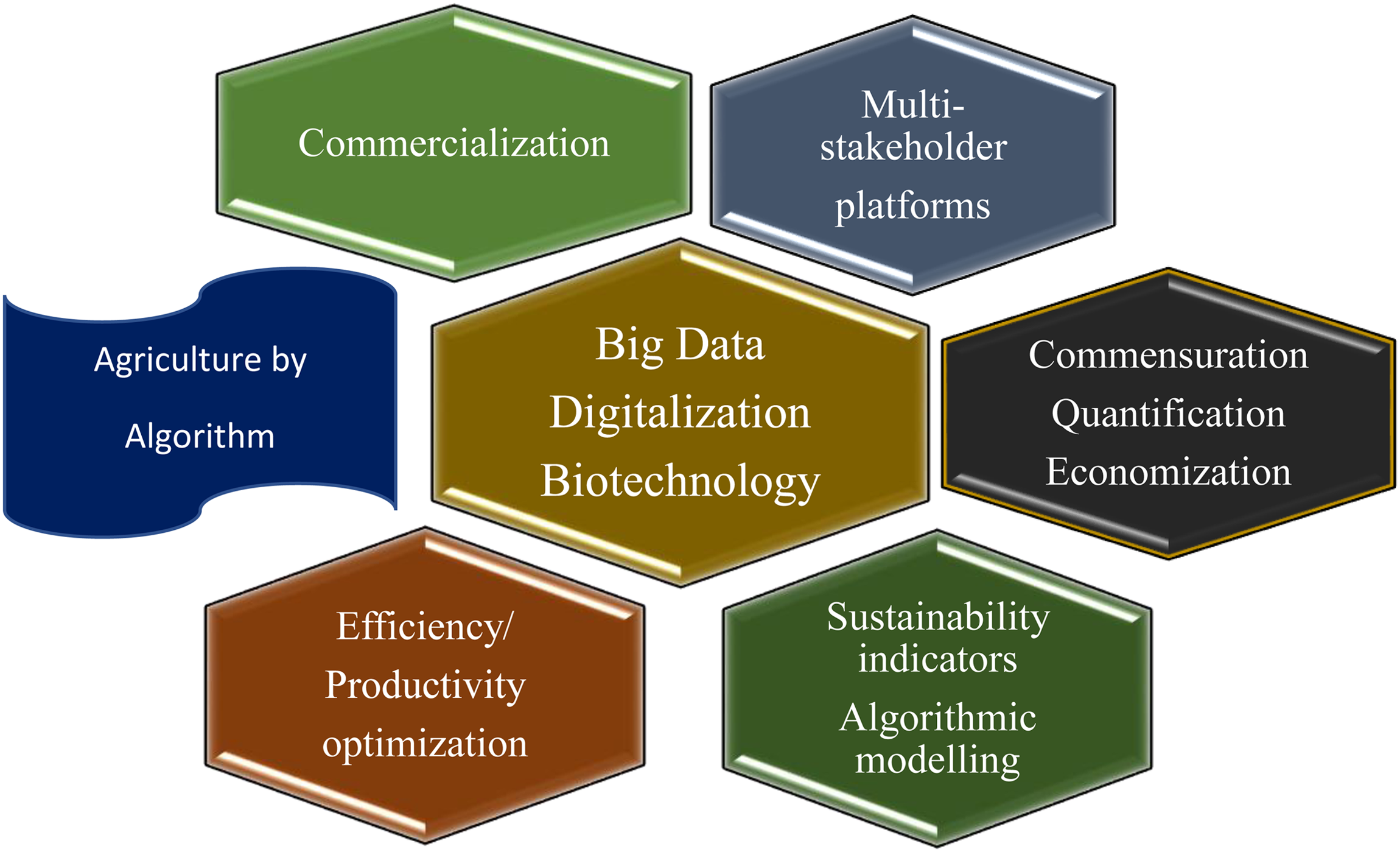
Agriculture by algorithm.
Methods
My data are drawn from publicly available documents published by FAO, Bayer, and Bayer's partner delivery start-up companies. These documents assist in identifying actors and activities within various multistakeholder platforms, and the sociotechnical arrangements that pivot toward algorithmic reordering of agriculture under climate change. I have excluded documents on the technical aspects of algorithm development, sustainability indicators, and Big Data processes. Because I do not compare how FAO and Bayer evaluate these techniques, I have not gathered documents which reveal their similarities and differences in relation to commensuration creation. The place-specific complexities of algorithmic modeling and FAO and Bayer activities are not considered. Moreover, I do not trace how FAO and Bayer developed their ideas or how their documents expanded over time.
My data were collected in three stages between 2020 and 2021: the first two stages involved gathering documents from FAO, and the third from Bayer and its partners. I accessed the documents by Bayer and its partners on their websites, using Google as my search engine. In accessing FAO documents, I first identified FAO's English-language documents published between 2013 and 2020, using FAO's search engine located on its website under “resources” and “publications.” I began my search in 2013 when FAO published its Climate-Smart Agriculture Sourcebook. I initially restricted my search to categories generated by FAO's search engine, including agriculture, climate change, migration, agroecology, sustainable development, and climate-smart agriculture (CSA). The search yielded thousands of overlapping publications. For easier access, I prepared an Excel sheet to view the title, publication year, abstract, and web link of the documents under their designated categories. 5
As my initial search displayed thousands of documents, I conducted a follow-up keyword-based search of the documents on the Excel sheet. Keywords included data, quantification, digitalization, sustainability indicators, algorithms, and biotechnology. As this search also revealed a large number of documents, I used a snowball approach to determine which documents to read, using keywords listed above and document abstracts from FAO's website. Based on my review of these abstracts on the Excel sheet, I selected policy and strategy reports, guidelines, and other documents where FAO describes its data platforms, statistical tools, and concept schemes. After identifying the documents, I prepared an annotated bibliography to establish the relevance of each document in relation to my research. I then undertook an in-depth interpretive reading of the documents to determine how FAO described its initiatives with reference to the keywords listed above. I did not engage in quantitative content and/or framing analysis based on coding.
The method I employed is an in-depth interpretive reading of texts. This enabled a comprehensive understanding of FAO's perspective on data-driven changes in agriculture. I complemented my analysis with other UN reports prepared by the Independent Group of Scientists Appointed by the UN Secretary-General, High-Level Panel of Experts, Committee on World Food Security, UNFCCC, and a coauthored report by FAO, IFAD, UNICEP, WFP, and WHO.
Food and Agriculture Organization as Globalizer: The Making of a Normative Context of Change
Founded in 1945 as a public organization responsible for global food governance, FAO has played a diminished role within the market-oriented reorganization of global agriculture since the 1970s (Jarosz 2009). FAO does not act like “the globalizers” 6 (Woods 2006) which produce policy enforceable through the conditionality requirements that countries structurally adjust their economies to participate in the global economy. The FAO Strategy for Private Sector Engagement 2021–2025 report lists six FAO roles: (1) as a “knowledge broker for governments,” (2) “a ‘matchmaking hub’ bringing Members and relevant private sector entities together,” (3) a “broker of multidisciplinary alliances,” (4) “an advocate for innovation and digitalization,” (5) “a provider of global norms and standards,” and (6) “a mobilizer of public and private networks, supporting the reinforcement of data, information and knowledge through its ability to rally and convene diverse stakeholders” (FAO 2021a, 9). This report emphasizes “the organization [FAO] and the private sector working as equal partners in achieving SDGs” (FAO 2021a, 4; emphasis added). 7 The priority partnership areas include: harnessing science, technology and innovation; scaling up technical expertise; capitalizing on data and data science; data sharing and dissemination; SDG alignment in technical support; mobilizing, blending, structuring public and private financing; SDG advocacy to broaden multistakeholder partnerships, and strategic alignments with private-sector-led coalitions (FAO 2021a, 11–13). Private-sector-led coalitions include the World Economic Forum (WEF), the UN Global Compact, and the World Business Council for Sustainable Development (FAO 2021a, 21).
Multistakeholder initiatives have become a method of governance in agri-food, subordinating governmental decision-making to corporate initiatives (Freidberg 2017; Canfield, Duncan and Claeys 2021a; Canfield, Anderson and McMichael 2021b; McMichael 2023). This form of governance has been established within the UN since the 2019 signing of a memorandum of understanding that initiated the WEF/UN private–public partnership (Gleckman 2019), and expressed in the epistemic framing of the 2021 UN Food System Summit. 8
The Global Alliance on Climate-Smart Agriculture (GACSA) founded in 2014 within FAO is a multistakeholder platform which mobilizes data-based initiatives and technologies (FAO 2021a; GACSA n.d.). By June 2021, GACSA had 525 members, 498 of which are listed on its website. Research and academic institutions have the greatest representation within GACSA (31 percent), followed by private sector (22 percent) and NGOs (20 percent). Private-sector members include biotechnology corporations (e.g., Syngenta); technology evaluation companies (e.g., Global Biotechnology Transfer Foundation); Big Data corporations (e.g., Global Open Data for Agriculture and Nutrition); and third-party certification agencies (e.g., GLOBALGAP). The Global Environment Facility (GEF) 9 facilitates the multistakeholder coordination of financial flows on the GACSA platform through blended cofinancing that recirculates existing private funds within the public financing of projects. 10 These platforms produce voluntary guidelines for stakeholders, but FAO's commitment to connect diverse actors within such a framework enables corporate agribusiness and other private-sector players to participate in public decision-making and gain access to public monies (Canfield, Anderson and McMichael 2021b) (Table 1).
Global Alliance on Climate-Smart Agriculture (GACSA) Membership (June 2021).
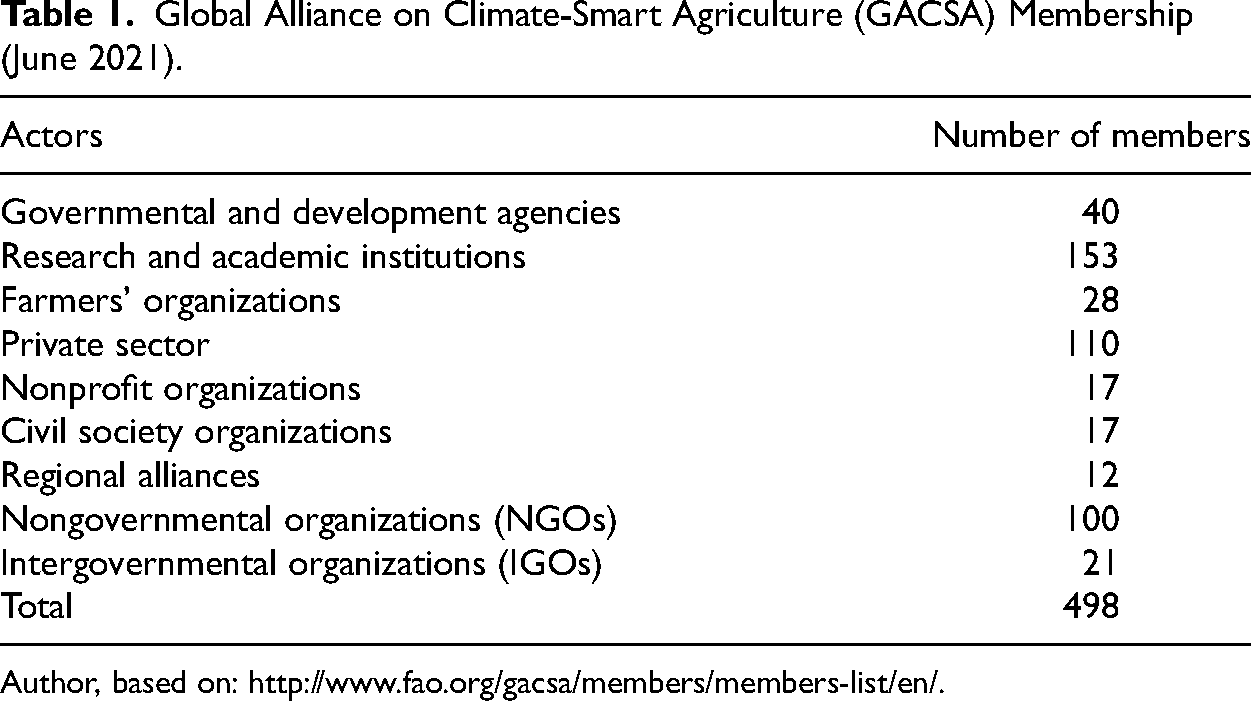
Author, based on: http://www.fao.org/gacsa/members/members-list/en/.
FAO coordinates different actors within these platforms through activities ranging from informal talks and discussions to fully fledged partnerships entailing funding (FAO 2021a, 7). Backed by its Voluntary Guidelines (FAO 2004, 2022a, 2022b), this form of policy coordination encourages the data-driven implementation, monitoring, and evaluation of agri-food systems transformation at various levels and between multiple administrative zones.
A Quantitative Mentality: “AI for Good”
FAO (n.d.1, 2017b, 2017c) conceptualizes climate adaptation through a Malthusian lens: climate change and population pressure on scarce resources intensify food insecurity which, in turn, leads to hunger, conflict, and stress migration. Clearly, farming is vulnerable to changes in climate and weather conditions, but not all farmers are equally affected. Agroecological farming provides a wide array of options for small-scale farmers to support their livelihoods (Van der Ploeg 2008; Altieri et al. 2015; Rosset and Altieri 2017; Atasoy 2023; Harriss-White 2023). Nevertheless, FAO, together with other UN institutions, has identified science, technology, and digital innovation as a key enabler for transforming agri-food systems in the context of climate change (UNFCCC 2022; FAO, IFAD, UNICEF, WFP and WHO 2023, 122). The Independent Group of Scientists Appointed by the UN Secretary-General (IGS) who prepares the Global Sustainability Development Reports (GSDRs) describes GSDRs as “a process for advancing collaboration across science-policy-society interface across the world in order to identify and realize concrete pathways for transformation” (IGS 2019, 3)—a description shared by the High-Level Panel of Experts on Food Security and Nutrition working within the Committee on World Food Security (HLPE-FSN 2020, v, 13).
In tapping into scientific and technical knowledge development, FAO promotes standardization in agricultural techniques, crops, and inputs for increasing yields within a quantified sustainability framework. For FAO (2021b), CSA is an enabler of sustainability designed to achieve the four betters in agriculture: better production, better nutrition, a better environment, and a better life. It also identifies four accelerators to realize them: (1) innovation, (2) technology, (3) data, and (4) complements (governance, human capital, and institutions). The first three accelerators connect efficiency optimization with Big Data, digitalization, and biotechnology including gene editing and synthetic-biology innovations. FAO (2021b, 19) proclaims: “Helping farmers take full advantage of new technologies such as digital agriculture, biotechnologies, precision agriculture, innovation in agroecology, 5G, and Artificial Intelligence (AI) to increase food production whilst respecting the environment, is of paramount importance.” However, these technologies are untried computational and lab-based innovations, often carried out through open-field trials on farms by biotechnology corporations without governmental guidance (Atasoy 2017, 73–83).
Many experts, professionals, scientists, policymakers, and practitioners operating within multistakeholder platforms privilege techno/scientific knowledge for policy-making (Di Gregorio et al. 2020). Privileging this form of knowledge is based on the assumption that it is technical, apolitical, objective, and neutral (Berman 2014). “Development” thereby becomes a depoliticized technical category for converting natural resources into inputs for economic growth (Ferguson 1994). It is difficult to trace how these experts/practitioners set policymaking goals; it is also difficult to know exactly how corporate private-sector interests advance these technologies within the politics of multistakeholder governance, and for what ends and purposes (Gleckman 2019; Schwab 2021). Nevertheless, FAO (2021a) epitomizes a depoliticized representation of CSA informed by “science-policy-society interface” that is valued for designing pathways to sustainable development (IGS 2019; 2023; cf. Freidberg 2017). This results in a simplified, reductionist understanding of sustainability as a measurable activity, pursued through globally harmonized data-production processes and algorithmic predictive modeling.
Online social media, crowdsourcing, crowdsensing, and other mobile applications are the main sources for collecting farming data to be stored within Big Data and cloud computing. The linking and integration of disparate data relies on machine learning for bundling and harmonization to permit comparability over time and across contexts. FAO has developed AGROVOC 11 as a tool for data to be classified homogeneously and for the standardization of indexing processes based on technically defined concepts and definitions. AGROVOC is a schema which consists of more than 41,000 concepts and 1,151,000 terms in 42 languages, hierarchically organized under 25 general main concepts. Each concept has at least 1 preferred descriptive term and 0 for nonpreferred terms. These terms are linked to categories of “relatedness” or “more refined relations.” Algorithmically grouped expressions within data constitute the “Agrontology vocabulary” based on which the AGROVOC.rdf file is generated. This file is not built to be read by humans but by machines, then parsed by IT people for equivalency creation in farmers’ expressions/evaluations for use in predictive modeling. Thus, creating equivalency for the formalized classification and homogenization of data is outsourced to technicians (e.g., engineers), coders, and statisticians who develop standards, indexes, procedures, and technologies that enable the interoperability of data between diverse food and agricultural systems.
On their website under the logo AI for Good, FAO (n.d.6) identifies eight project areas in which to produce data for predictive modeling. They rely on satellite-based technologies, remote sensing, cloud computing, algorithm development in pilot regions, and monitoring platforms to map data collected from farms by mobile apps. FAO (2021b, 20) gives priority to the Hand-in-Hand Geospatial Platform which captures farmers’ practices in real-time digital aggregates. Launched in 2019, the Hand-in-Hand Platform (FAO n.d.2, n.d.3, n.d.5) provides a basis for generating, measuring, and categorizing quantities of information during algorithm production that can be applied in similar situations for policy development. It acts as a tailored matchmaking arrangement between farmers and the SDGs framework through the flow of policy, investment, finance, and innovation. It is a business model based on PPPs between governments and private-sector investments, and multilateral and bilateral development banks and agencies (FAO 2021a). Its partners include the Gates Foundation, Danone, Google, and the International Fertilizer Association.
Hand-in-Hand relies on Data Lab for Statistical Innovation, using Big Data and text-mining methods. It operates a monitoring and evaluation dashboard (FAO n.d.4), and a Geospatial Platform (launched in 2021) that provides advanced data analytics and geospatial modeling for sustainable impact assessment. The Geographical Information System data platform also provides shareable data on agroecology, water, land, soils, and GHGs. Moreover, FAO's data platforms incorporate datasets from UN statistics on SDGs and reports from the Intergovernmental Panel on Climate Change. This data is used to determine climate change impacts, global GHGs pathways, and timeframes for climate change adaptation policy development and implementation.
FAO does not define farmers’ discrete agroecological knowledge as irrelevant but as insufficient for food to be produced within a standard pattern of efficiency maximization. FAO (2018a, 10) claims that “increased resource-use efficiency is an emergent property of agroecological systems” and enhances growth in productivity (FAO 2013; 2018b). 12 However, there is a lack of data from small-scale agroecologically oriented farms/farmers to compute indicators of efficiency/productivity (HLPE-FSN 2022). In 2019 the FAO Committee on Agriculture (2020, 2–4) designed the Tool for Agroecology Performance Evaluation to populate the global database and develop methodologies and indicators for computational assessment of agroecology's resource-use efficiency. It aims to scale up agroecological initiatives within national policymaking, supported by GEF's blended-financing projects. Among these projects are farmer training in climate-change adaptation and Farmer Field Schools located in Angola, Burkina Faso, Mali, and Mozambique (FAO 2018a, 12).
FAO (2018a, 8) has long argued that agroecology can be a pathway to achieving SDGs. Citing the examples of Kenya and Senegal, FAO (2020c, 45–46) promotes the use of agroecosystem resilience indicators to generate data and measure climate resiliency. It advocates for the SHARP app (Self-evaluation and Holistic Assessment of climate Resilience of Farmers and Pastoralists)—an interactive learning, monitoring, and assessment tool that uses tablets to combine indicators (used as proxies for a “resilient” system) with participatory self-assessment from farmers and pastoralists across regions. As resilience is complex and difficult to measure, there is no consensus on how to measure it (Choptiany et al. 2017). The SHARP tool remains experimental and is continually updated based on field tests. Earlier tests were conducted in Angola and South Sudan.
Sustainability Indicators and Bigger and Better Data
FAO (2019b, 2013, 383, 393, 398, 417, 423, 436) proposes that agriculture's climate smartness be measured against SDGs indicators. The 2030 SDGs agenda includes 17 SDGs, 169 targets, and 232 indicators. To facilitate the development of these indicators, the UN Statistical Commission created the Inter-Agency and Expert Group on SDGs Indicators in 2015. It has developed a methodological framework for SDGs targets, metadata-making, sharing of experiences, and best practices on SDGs monitoring (UNESC 2018). The UN Statistics Division—the permanent secretariat of the UN Statistical Commission—has prepared an E-Handbook as a reference for national governments to develop country-specific indicators, measuring indicators, associated targets, and goals. The E-Handbook is continually updated based on data produced by national statistical systems (SDGeHandbook n.d.).
As a measure of agriculture's climate-adaptation according to SDGs indicators, FAO (2016a) has developed a Global Agriculture Perspectives System. It rests on computerized simulations of future global agri-food supply requirements, designed by modeling teams using Shared Socioeconomic Pathways (FAO 2016a, 21) based on General Algebraic Modeling System software and other measurement strategies (FAO 2020b, xvii). FAO (2016b) has also developed an E-agriculture Strategy Guide as a reference for governments implementing SDGs in agriculture, with a built-in comparison with these computational scenarios. Statistically measured performance indicators demonstrate the country's progress (FAO 2016b, 153–166). In order to minimize result ambiguity, indicators are selected based on whether they are observable, reliable, controllable, ongoing, and comparable.
FAO (2016b, 166) sees “little value in defining a set of indicators where the data do not exist or cannot be regularly collected, analyzed and reported.” FAO (2019b, 32) asserts that “what gets measured, gets done.” It thus aspires to realize “bigger and better data.” The UN-based Inter-Agency and Expert Group on SDGs Indicators regularly reviews the global indicator framework to reclassify, adjust/replace, remove, and add new indicators for the creation of commensurable categories. It develops proxies where indicators cannot be measured and proposes possible targets without significantly deviating from the original framework (UN Statistics Division n.d.).
For livestock farming, FAO (2020b, xi, 7, 40) established the Technical Advisory Group in 2017, recommending that as much farm-based information as possible be collected and analyzed. The Group designs guidelines for “a harmonized international approach for assessing the impact of livestock on biodiversity,” based on a methodological consensus on how to quantify GHGs and other environmental impacts (FAO 2020b, 4–5). Using technical expert knowledge, the Group develops large-scale LCA and pressure-state-response (PSR) assessments for the metrification of environmental impacts at global, regional, and local scales (FAO 2020b, xix, 8; cf. Freidberg 2014; 2017). The LCA assessments involve a cause–effect chain between inventory flows in livestock production on the farm (e.g., land use, nutrient inputs, water use) and resulting biodiversity impacts. The LCA measures translate inventory flows into specific biodiversity indicators, expressed as a functional unit (e.g., m2 land × years or kg of protein). The PSR assessments consist of all indicators related to “procedural checks” on data collection (FAO 2020b, xxii, 48, 51–52, 105–108). For example, animal manure used by small-scale farmers as a natural fertilizer is assessed as a proxy measurement of methane pollution, undifferentiated from the pollution caused by large-scale commercial livestock farming.
For FAO (2020a, xx–xxi, 94–95; 2019b, 10–13, 16–17, 22, 32; 2018), SDGs implementation requires rural diffusion of techno-scientific knowledge. For this to occur, governments “should ensure that societies are networked from field to town to city” (FAO 2019b, 6). FAO (2019a, 12–17) has developed 26 new tools to support farmers’ internet connectivity to access suppliers; build strategic partnerships; and access training, financing, legal services, and markets. FAO (2019d, 8) asserts that smallholder farms “without reliable access to high-quality IT infrastructure are disadvantaged in virtually every aspect of business.” Most small-scale farmers’ use of digital technology is limited, 13 so their data-readiness appears tenuous. Nonetheless, Microsoft's FarmBeats program from 2015 facilitated farm-based data-gathering, using low-cost sensors, drones, and vision- and machine-learning algorithms (Microsoft n.d.). If farms lack internet connectivity and electricity, Microsoft's FarmBeats can utilize TV white space powered by solar panels to transmit farm data to a central computer where “an edge device stitches everything together into a data map” (Gates 2018).
To quantify heterogenous global practices and knowledges, data-collection agencies (i.e., governments) and algorithmic system designers must decide which variables to include, how to establish criteria and define the problem. Even slightly different definitions of a problem lead to entirely different categorizations and prioritization of factors in data-making (Levy, Chasalow and Riley 2021, 316–317). Nevertheless, the development of commensurable categories usually occurs within machine-learning parameters, often with an overfitting of data in problem definition and the removal of discretion, ambiguity, and uncertainty (Garip 2020). Machine-learning models are trained and evaluated using data. “[They are] unlikely to perform well in the wild if [their] deployment context does not match [their] training or evaluation datasets” (Gebru et al. 2021, 1). The binary categories of algorithmic modeling provide aggregate descriptions often inapplicable to subsets of farmers in the world and introduce geohistorical and representational biases into farm-level predictions. In the absence of documentation on the provenance, creation, and use of machine-learning datasets, these models are difficult to evaluate (Gebru et al. 2021).
In farming, many things cannot be easily quantified with clockwork precision. Small-scale farming embodies highly divergent, ambiguous, and indeterminant linkages between the histories of nature and climate, the state and its development projects, farmers’ sociocultural and experiential knowledge, and communal creativity in crop development, as well as ecological management, food cultures, and marketing strategies (Netting 1993; Henrich 2001; McElreath 2004; Stone 2016; Atasoy 2017; Glover et al. 2019). These histories do not overlap along neatly aligned axes. FAO (2017a) is aware that for each crop system, there are countless climate change adaptation and mitigation options which differ for each farming household, depending on its adaptive mechanisms. Therefore, FAO's AGROVOC tool as a concept scheme for harmonizing existing vocabularies aims to link and aggregate qualitatively different practices into commensurate categories.
Agrobiotechnology: Bayer and its Start-up Partners
CropLife International 14 is a key global network of 91 diverse associations and partners advocating for the plant-science industry and innovative technologies including gene editing. 15 Its member companies are BASF, Bayer Crop Science, Corteva AgroScience, FMC, Sumitomo Chemical, and Syngenta. 16 CropLife International encourages governments to create an international trade environment for new innovations to be brought to market quickly and reach the field in a timely manner. 17 In addition to crop protection (e.g., through pesticides), innovations include plant biotechnology such as genetic engineering (e.g., GMOs) and genome (gene) editing (e.g., CRISPR-CAS clustered regularly interspaced short palindromic repeats sequences and associated enzymes) for the creation of new plant varieties. 18 Below I describe gene-editing research as central to commensuration in agriculture. I then discuss some of Bayer's innovations and their entry into small-scale village farming. I also provide a few illustrative examples from BASF and Syngenta.
Experimental Gene-Editing Research
Introduced in 2013, CRISPR-CAS involves the deletion of “detrimental” traits and addition of specific genomes in a “predictable” and “precise” manner. The research is experimental, and the deployment of crop-gene editing is in its infancy. 19 There is continuous research-based upgrading in the design of plants for heat/drought tolerance, pests/pathogen resistance, nutritional content, high yield, and long shelf-life. Other research involves altering seed biochemistry for designing new plants equivalent to their wild varieties for use as industrial substitutes. In gene editing for climate change, research focuses on carbon capture, squestration, 20 and increasing plant photosynthetic efficiency (Gao 2021). CRISPR-CAS techniques provide vast amounts of data generated from many variants of a plant that is used to optimize computational analysis models for designing a plant. This involves quantification of CRISPR-CAS genome editing products, algorithmically decoding raw sequencing data, and algorithmic next-generation sequencing by even deeper quantification of targeted sequences (Li et al. 2023, 115–119). However, different computational programs are based on different datasets and criteria, and work differently for different organisms (Yan et al. 2018). Predicting and testing CRISPR-CAS experiments in the algorithmic modeling of plant design is a relatively new development, and predicting future impacts is also speculative and uncertain (Lindberg, Bain and Selfa 2023).
CRISPR techniques unite research in plant-genetic resources with research in systems and synthetic biology, engineering, mathematics, statistics, and data analytics. The partnership works to fragment, standardize, edit, and refine natural biological “components” at the molecular level so they will behave in predictable and controllable ways according to computerized algorithmic models. The process transforms biological materials and processes into an information state which makes them amenable to commodification (Calvert 2008), governed within the intellectual property rights (IPR) regime established by the WTO in 1995. Significantly, the IPR regime excludes whole biological systems but includes their components, fragments, and chemical constituents, involving microorganisms, microbiological and molecular-biological processes. This thoroughly reductionist genome-editing and augmentation via efficiency algorithms decontextualizes and disembodies biological entities from their myriad nuanced, complex networks of biological relationships. CRISPR techniques apportion natural processes into privately owned and patented “fictitious commodities” (Polanyi 2001 [1944], 71–80), tradeable within the IPR regime. Anticipating such commodification, especially in feed/fuel/fiber crop production, research is evolving through rapidly developing computational tools and genome-editing efficiency prediction and specificity targeting algorithms.
There is no globally agreed-upon regulatory framework for CRISPR-CAS innovations and their entry to market. 21 The European Union has adopted a process-based approach, and the United States, Canada, and Argentina a product-based one. The process-based approach asserts that gene editing creates GMOs and must be regulated through governmental monitoring/oversight required for GMO crops (Lindberg, Bain and Selfa 2023). In a product-based approach, the final products of genetic engineering are the perceived source of risk, and thus the appropriate target of regulation (Kuzma 2018). 22 Other countries have no regulatory structure and generally hold the view that gene-edited plants do not need to be regulated as GMOs. 23
Often bypassing governmental oversight, computational and lab-based plant-design research is tested in breeding stations and through experimental field-testing by farmers’ growing high-tech crops on their farms. Atasoy (2017, 61–92) illustrates this in the case of Syngenta's open-field trial-based planting of never-before-tried seeds comprising 43 different lettuce and 24 different spinach varieties in Kayabükü village in the town of Beypazarı, Turkey. 24 These seeds were designed to be drought/disease resistant and capable of optimizing yield, especially for climatic conditions in the Middle East, North Africa, and southeastern Europe. The village was chosen because its summertime temperature exceeds 40 Celsius. Syngenta officers interviewed by Atasoy during open-field crop demonstration days in May 2014 were not transparent about the methods used to produce these seeds, and no governmental approval was received for planting them.
In the absence of globally agreed-upon rules, CropLife International has developed “harmonized stewardship activities” 25 which its member companies have adopted to suit different contexts, working closely with service providers, extension workers, and farmers. These activities connect R&D and manufacturing to storage, transportation, and delivery to farmers, as well as ensure the effective use of plant science innovation. The stewardship activities are pursued in multiple ways with the use of digital technologies that support data collection.
Because many small-scale farmers in the Global South have limited internet access and lack advanced computational technology, BASF, for example, relies on Ardena in Egypt (a free messaging service) to access real-time reports from the field in tomato production via SMS or WhatsApp on mobile phones. Through Ardena, BASF manages farmers’ data via a website and app using algorithmic modeling and AI for path prediction. 26 Trust-based, personally cultivated relationships, face-to-face communication, and peer-to-peer knowledge transfer have also been a priority for member companies.
Bayer and its Start-up Partners
Bayer defines its breakthrough innovation in agriculture as a convergence of biology, chemistry, and data sciences, with an emphasis on real-time farm-data collection and analytics for algorithmic agronomic modeling. 27 In 2021, Bayer partnered with Bushel and Amazon Web Services on Project Carbonview to track farmers’ carbon emissions. It also partnered with Microsoft in 2021 to build cloud-based digital programs as the infrastructure for its Climate FieldView—available to start-ups and established firms for use in agriculture and adjacent industries in food/feed/fuel/fiber value chains (Gullickson 2021). Project Carbonview streamlines on-farm data collection with Climate FieldView, toward building a scalable digital carbon-footprint data platform. These initiatives are especially piloted with US corn and ethanol producers, but Bayer plans to expand into other grains and global regions (Successful Farming 2021).
Bayer develops partnerships with start-up research companies through a program called Leaps-by-Bayer. Financed by venture capital investment, Leaps-by-Bayer supports breakthrough innovations which are not yet part of Bayer's ongoing research and development portfolio. The program has invested more than USD1.9 billion in over 60 ventures (Leaps 2023). Its 2023 Annual Review Report (Leaps 2023) lists Bayer's start-up partners. Bayer's gene-editing partners on the list include Pairwise, CoverCress, Pivot Bio, AgBiome, Oerth Bio, and Joyn Bio. Pairwise uses CRISPR and other gene-editing techniques including RNAi technology to breed hybrid fruits, vegetables, and grain crops (e.g., corn, soy, wheat, cotton, and canola). It has developed the first CRISPR-edited salad (a new type of mustard greens) to be sold in the US market and is currently working on developing a short-stature “smart corn system” for biofuel production. CoverCress
28
develops rotational biofuel-generating pennycress for diesel and jet fuel. Pivot Bio develops zero-waste nitrogen fertilizers. AgBiome profiles metagenomic environments and develops specific classes of microbes. Oerth Bio develops protein degraders for crop protection. Joyn Bio, a joint venture between Ginkgo Bioworks and Leaps-by-Bayer, specializes in microbe engineering to enable cereal crops to convert nitrogen from the air into usable form (Ginkgo Bioworks n.d.). These partnerships involve gene-editing in corn, soybeans, wheat, cotton, sorghum, canola, cassava, and pennycress, tailored to increase production largely in fuel/feed/fiber crops. This has the potential to displace food crops and transform farming practices and cultures
29
(Figure 2).
Leaps by Bayer. Diagram by the author, based on Bayer's Website, Gullickson (2021), and https://leaps.bayer.com/LeapsbyBayer_AnnualReview2023.pdf.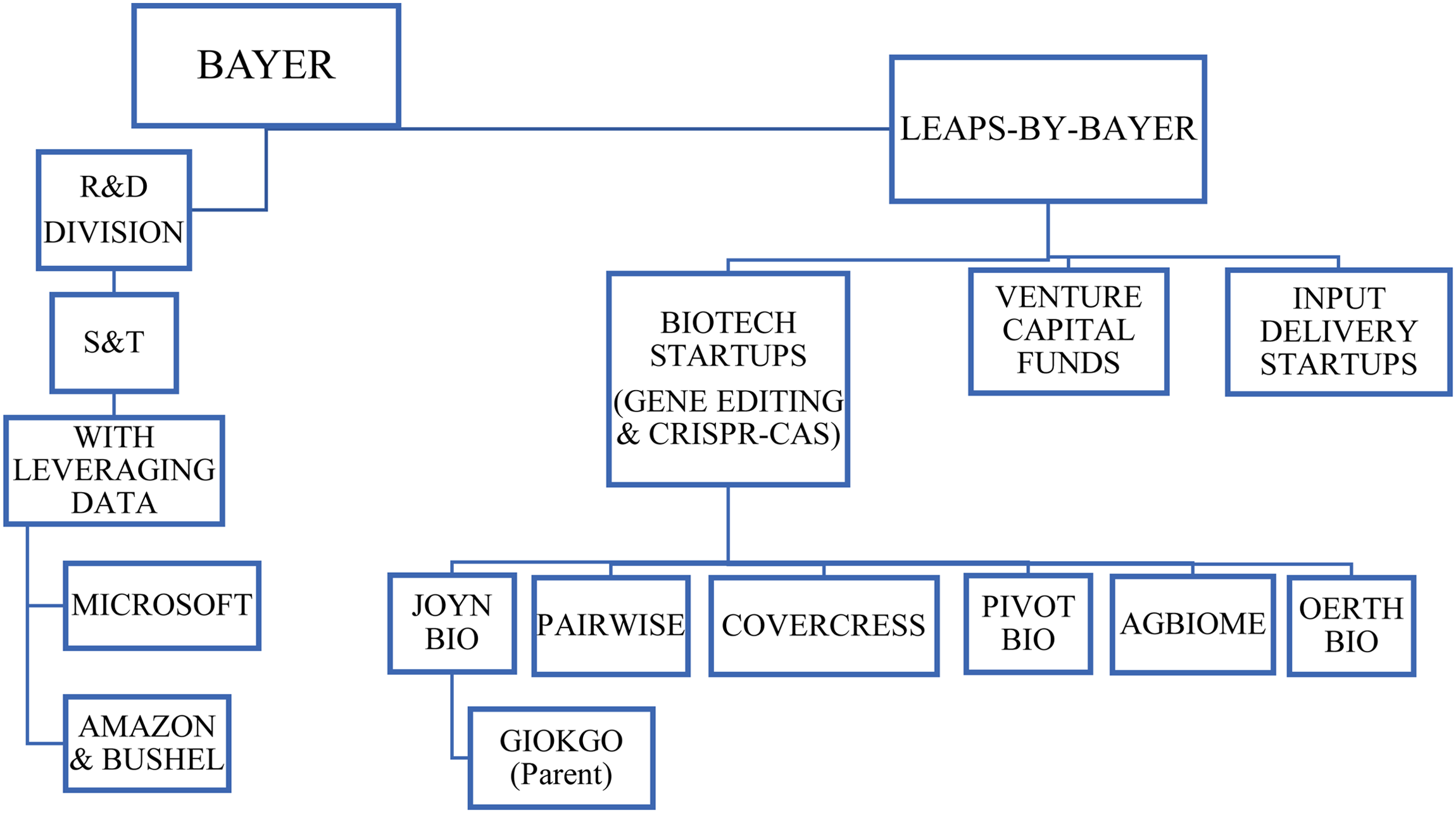
As data collection via Project Carbonview and Climate Fieldview occurs mainly in the Global North, Bayer collects information in the Global South through mobile phones and social media. Bayer also connects its biotech innovations developed in research labs to remote field locations by providing farmers with digitally tailored instructions for evaluating field conditions and farming practices. It applies these innovations via its delivery start-ups. The start-ups, including One Acre Fund, MyAgro, and Pula integrate farmers through their “rural field officers” into an extensive input and service delivery network for Bayer's experimental products. These officers also crowdsource information into Bayer's field-trial seed database.
The start-ups partnering with Bayer generate finance from farmers’ own small savings, bundling them with delivery services in index-based insurance, climate information, agro-advising, and technology. These are mobilized to assist farmers in changing their customary practices toward high-tech adoption. Such initiatives expand “financialization” at the smaller scale of farming, exposing farmers to even greater risks associated with dependence on commercial inputs, precision techniques of defining, measuring, and pricing risks, and consequent debt (Duncan et al. 2012; McMichael 2013; Isakson 2015).
There is a lack of transparency as to whether delivery start-ups “sneak in” gene-edited crop seeds and whether farmers are actually planting these seeds for field experimentation. The One Acre Fund website indicates that they focus on delivering varieties that “farmers need most in their changing environments—high yielding, disease resistant, drought tolerant or early maturing.” 30 However, it is unclear whether the experimental planting of these seeds is for use in feed/fuel/fiber or food-crop production. My research shows that these delivery officers build “trust” with farmers, boosting the potential for farmers’ acceptance and use of innovation—hence offering a crucial link in expanding the commensuration process at the village level of small-scale peasant-like farming. Below I demonstrate how trust-based interpersonal relations contribute to the corporate harnessing of data from farmers in villages in Africa.
The One Acre Fund (OAF n.d.1), founded in Kenya in 2006, has expanded its reach from an initial 38 farmers to one million in Kenya, Tanzania, Malawi, Uganda, Rwanda, and Burundi. It also conducts pilots in Nigeria, Zambia, and Ethiopia. Emulating the Amazon business model, the OAF (n.d.2) comprises a network of input and service-delivery enterprises based on warehouses and rural field officers. It views agricultural productivity as a matter of input delivery, financing, and farmer training. Farmers become clients, connected to the delivery network via credit with a “One Acre Fund Client ID” number. The OAF purchases inputs in bulk, stores them in its 20 warehouses across Africa, and delivers preordered packages on credit. Repayment in small amounts is made throughout the loan term. These packages include newly innovated high-yield and drought-resistant seeds and matching synthetic fertilizers. During delivery times, the OAF hires 2,000 field officers and hundreds of 10-ton trucks. The OAF (n.d.2) defines these officers as “humble delivery guys,” each reaching out to 200 farmers annually. Officers are often from the same villages as the farmers, with long-established informal relations. These “guys” are key actors, capable of influencing farmers to adopt high-tech based on informally established relations. Trained by the OAF, the “delivery guys” in turn instruct farmers in micro-precision input application, soil-management, and carbon-sequestration techniques, as well as in reorienting their food production from family subsistence to market sale and asset-based financing of loans on credit (OAF n.d.2; n.d.3). They also sell soil-health products (OAF n.d.4). Since 2020, the OAF has instituted a digitized Warehouse Management System supported by the Development Innovations Venture of USAID, which requires farmers to purchase mobile phones or tablets (USAID 2021). The OAF utilizes mobile phones and tablets to register farmers, tailor precise efficiency-modeling, and loan and repayment arrangements for each farmer. Farmers’ purchase of mobile phones, training in digital technologies, and mobile money-payment services are added to the delivery packages sold on credit (USAID 2021, 19). Although the OAF (2020) claims a 94 percent repayment ratio, there is no available data to assess whether these bundled packages sold on credit create debt for farmers.
MyAgro, established in 2011, provides farmers in Kenya, Rwanda, Senegal, and Mali with in-person and remote training in seed innovation, fertilizer use, and agricultural techniques tailored to specific regions and crops. Bill Gates promotes MyAgro as an innovative social-business model. Given that only 7 percent of small-scale farmers have access to financing through traditional banks (Bayer n.d.1), MyAgro has developed a credit system based on scratch cards purchased from village stores. After scratching the card and finding the “secret code,” farmers send the code via text message to the MyAgro platform, which validates it and allocates the value of the card to the farmers’ account. Farmers then receive an SMS response confirming both payment and new account balance (Everett 2017). This process integrates the small monies which farmers hold outside regular financial transactions into a “mobile layaway” to accumulate bit-by-bit for future purchases of inputs and training services. Begun in 2012 in Mali and expanded into Senegal and Tanzania, the system currently covers 115,000 farmers (MyAgro n.d.1). After 6–8 months of payments through mobile layaway, MyAgro rural field officers deliver preordered input packages to farmers in time for planting. This delivery system provides a venue for open-field trial plantings of high-tech seeds. The test fields consolidate 30–100 small-scale farms into larger pilot projects for growing climate-resilient crops. In this way, MyAgro (n.d.2) completes 2,000 field measurements annually for experimental crops developed in research labs. In-soil field experimentation provides information on how these crops “perform” under locally varied farming conditions. MyAgro monitors the findings and its Measure and Evaluate teams assess their impact under the climatic growing conditions of Africa. MyAgro's website lists 400 individuals involved in such teams. There are no data indicating whether MyAgro or Bayer assumes any contractual responsibility to protect farmers against possible crop failure or damages that may occur during trial planting, nor is there any indication that farmers are aware they are planting experimental crops, or of governmental approval. It is also unclear whether farmers are actually purchasing these experimental inputs on credit through the scratch cards program.
Founded in 2015 as an insurtech company, Pula is working with 611,000 small-scale farmers in Kenya, Rwanda, Uganda, Nigeria, Ethiopia, and Malawi. It “educates” farmers on the need for crop and livestock insurance, and develops and sells algorithmic sensemaking and decision-making techniques. Pula divides each country into agroecological zones, then uses satellite-based remote sensing, geolocating technologies, machine learning, and automated data analysis to predict climate impacts. Pula (n.d.1; n.d.2) applies these to verify its index/parametric insurance 31 schemes tailored to agroecological zones. Pula (n.d.3) has also innovated with “field senses,” including FieldSense Monitor, FieldSense Advise, and FieldSense Engage—algorithmically designed, monitored, and indexed products for remote monitoring, sense-making, and predicting outcomes in agriculture. Pula sells these as a service provider, linking clients (farmers, governments, NGOs) and partners with parametric insurance. Among its partners and investors are 57 input/service distribution companies, including Fortune 500 companies, development agencies, philanthropic donors, and credit lenders (Pula n.d.4) (Figure 3).
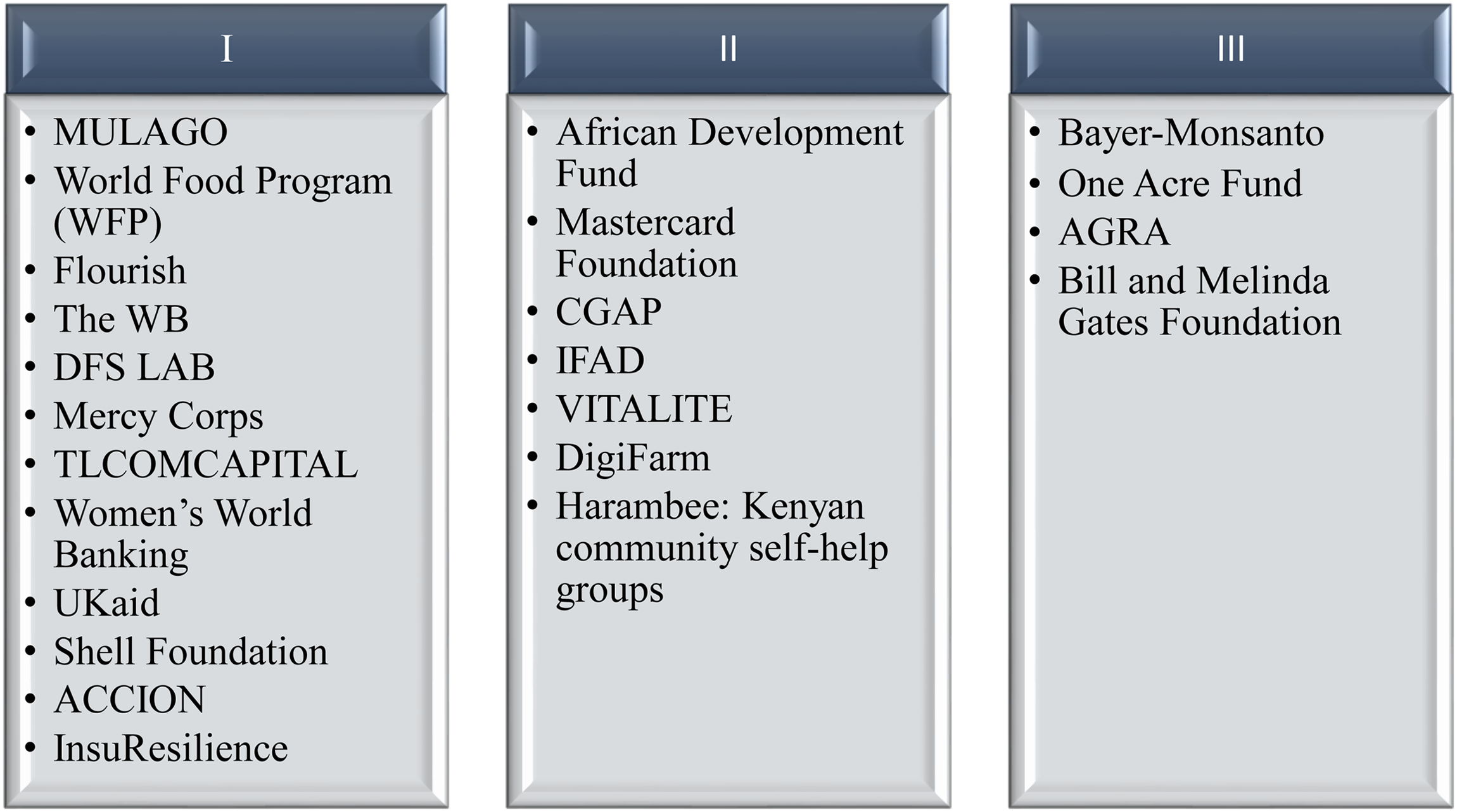
Pula's top-tier investors. Author, based on https://energy.pula.io/.
My analysis reveals an increasing dissociation of farming from its local conditions within the fold of data-driven, standard high-tech precision agriculture directed toward efficiency/productivity optimization. Although consequences may not be uniform across the world, farmers’ behavior is increasingly tied to algorithmic modeling of standard digital schemes that abates farmers’ knowledge, sense-making processes, and land/resource use relations.
Conclusion
This work was inspired by questions about the growing role of data-intensive processes and high-tech precision technologies in reorienting agriculture within algorithmic modeling. These processes and technologies rely on measurable indicators, calculative metrics, standardization, and rationalization for computational decision-making. My research sheds light on the transformation of existing farming qualities into commensurable categories of quantified correlations and predictions, targeting the control of farming behavior for efficiency/performance optimization. High-tech approaches to quantified sustainability cultivate algorithmic precision/predictive modeling within a Big Data and analytics context that greatly strengthens governance-by-data in a market economy. Such governance is directed at technically managing and ultimately collapsing the context-specific qualitative diversities of farming into computational artifacts, thereby establishing the foundational framework for an agriculture by algorithm.
Although agriculture by algorithm remains experimental and indefinite, it continuously expands standardization of practice based on historically biased data that privilege large-scale commercial farming. Moreover, its epistemic authority of quantification renders other local knowledges and assessments invisible and/or irrelevant. It is not possible in the space of this paper to address what happens to small-scale farming and its embeddedness in local ecologies, cultures, and farmers’ experiential knowledge when data-driven evaluations conceptualize agriculture as a quantified activity tied to algorithmic modeling.
The melding of farming into ways of knowing shaped by a quantitative mentality is continuous with the “economization” logic of neoliberal capitalism. It rests upon a depoliticized representation of sustainability understood as an entirely calculable, predictable activity informed by a science–policy–society interface. Commensuration embodies a neoliberal economization logic that supports extracting data from previously noneconomic cultural, social, and biological relationships—turning them into measurable equivalencies within data-driven processes that recast them as economic objects. Further, this creates a condition of deeper quantification in gene editing, which generates ever more data to optimize computerized algorithmic modeling for producing new objects and eliciting value instrumental for corporate investment. It is within the commensuration infrastructure that digital technologies are entwined with experimental biotechnology research to organize precision agriculture, tried out in the lab and through field-testing on farms. Governance-by-data establishes a norm-setting model for codified knowledge in agriculture, subjecting farming and its natural cycles to procedural rules that facilitate the dominance of a singular market-economic metric in value creation. It reduces the relevance of context; precludes other ways of knowing based on tacit, interpretive knowledge, collective sharing, and experiential sense-making; and elevates the notion of efficiency enhancement to epistemic dominance.
At stake is what algorithmically designed paths to knowing do ontologically to farming and farmers. Governance-by-data is anchored in a productivist ontology within the capitalist industrial model that privileges productivity/efficiency optimization. This ontology expands a commodity lens as the epistemological basis of algorithmic modeling. Dominant in this ontology is the developmentalist assumption that large-scale industrial farming is more efficient in the use of commodified inputs/resources, and thus more productive in producing food to feed the world under climate-change conditions. A number of questions have yet to be addressed concerning the algorithmic remaking of agriculture under productivist ontology. Most notably: What constitutes the epistemological basis of what counts as farming and as farmers within an agriculture by algorithm that relies on globally harmonized data production? And how are the different positionings of farms and farmers between productivist and agroecological ontologies translated into epistemological frameworks that conceptualize farming as a characteristically measurable, quantifiable activity? Integral to these questions is the alteration in farmers’ sense of being, and implicit, collectively engaged and shared understanding of farming and its socioecological content—a sense that expresses normative, cultural, evaluative, and emotive aspects of farmers’ lives, knowledges, practices, and histories (Atasoy 2023). My view is that commensuration ultimately “remakes” farming through a drive to bring a calculative episteme to all relations and processes in agriculture. Thereby undermined are the nonstandard features of peasant-style farming whose ontologies imply diverse social–cultural–ecological contexts that underpin an autonomous existence. We know little about the conversion of diverse farming qualities into thoroughly rationalized economic objects and the reconstitution of what it means to be a farmer within computational predictive scenarios; hence, the critical need for further investigation of an emerging agriculture by algorithm.
Footnotes
Acknowledgments
The author’s deepest thanks to Ken Jalowica for his inspiration, thoughtful comments, and critical observations. The author would like to thank Gabriela Arana Zelaya, research assistant at Simon Fraser University, for her assistance locating and organizing the documents used in this work. The author thanks the participants of the Sociology of Agriculture and Food Roundtables, organized by Matt Comi and Steven Wolf, at the XX World Congress of the International Sociological Association in Melbourne, Australia (June 2023). The author also thanks the two anonymous reviewers, as well as Matthew Kearnes and Courtney Addison, members of the editorial collective of this journal, and Carolina Caliaba, managing editor, for their instructive comments and helpful feedback.
Declaration of Conflicting Interests
The author declared no potential conflicts of interest with respect to the research, authorship, and/or publication of this article.
Funding
The author received no financial support for the research, authorship, and/or publication of this article.
