




Abstract
Given the invisible complexities of new food technologies, citizens oftentimes rely on the media and heuristics to form their judgments. Thus, citizens are at risk of believing in misconceptions that undermine technology acceptance and consequently hinder innovative solutions to global problems. The present study examined whether agreeing with widely spread misconceptions about biotechnologically produced food (BTF) predicts more negative attitudes among citizens. Three common misconceptions were identified: BTF is believed to be (a) unhealthy and unsafe, (b) unsustainable, and (c) unnatural - despite scientific consensus that BTF are not worse than conventional food. Descriptive statistics of a pre-registered, large-scale online-survey (N = 2,925) conducted in November 2022 revealed that misconceptions are still widely spread. Multiple block-wise linear regression analysis showed that believing in misconceptions plays a dominant role in citizens’ attitudes about such innovative technologies and therefore contribute to public skepticism. Science communicators should develop diligent communication strategies to address these misconceptions, as reducing them would enable more people to participate in a well-prepared fashion in discourses about how BTF can be integrated in future governance frameworks that foster sustainable, socially fair food supply and consumption.
Citizens face inevitable challenges when making judgments about complex, invisible, or intangible technologies such as biotechnologically produced food (BTF), which can generally be defined as food from production that applies processing technologies to alter plants or animals, including genetic modification (GM), genetic engineering (GE) or other new breeding techniques (NBT) in plant breeding such as gene editing, CRISPR/Cas9 or Cisgenesis (Beghin & Gustafson, 2021; Mahgoub, 2016; Singh et al., 2014). However, the terms GM and GE food are often used interchangeably (Zahry & Besley, 2019). Given that they lack profound knowledge about such food technologies (Linnhoff et al., 2017; Mielby et al., 2013), citizens often rely on the media and public discourse, in which the acceptance and assessment of such technologies are controversially debated (Linnhoff et al., 2017; Lusk et al., 2014; Mahgoub, 2016). Diverse actors compete for attention and support of their positions towards these technologies. For instance, large corporations oftentimes have an interest in promoting the understanding of benefits of (their) technological innovations (e.g., Clapp, 2021), whereas non-government organizations (NGOs) oftentimes try to establish opposing views (Doh & Guay, 2006; Paarlberg, 2014), that emphasize risks, normative problems, or social costs of those innovations (Friedrich et al., 2019; Lusk et al., 2018; Marangon et al., 2022; Sandler & Kay, 2006). Furthermore, the complexity and invisibility of high technology disenable citizens to verify the claims that such institutional actors make. Which is why rules of thumb, or heuristics, such as trust in science or perceived naturalness of a product, also influence citizens’ opinion formation (Siegrist & Hartmann, 2020).
As a result of controversial public and media debates, there is considerable variation among citizens regarding their knowledge about and attitude toward these food technologies. This is because of their selective exposure to and acquisition of information and the great variation in how people form judgments based on individual dispositions and heuristics (e.g., Feindt & Poortvliet, 2020; Valkenburg & Peter, 2013). Because of the inherent complexity of biotechnology, such judgments may oftentimes bring up conflicting views; for example, citizens may perceive both an urge to follow religion-based moral dispositions to object against GE as ‘playing god’ and at the same time want to make rational choices as suggested by good science (e.g., Rothman, 1998). In sum, parts of a given population are likely to form biased or even factually incorrect evaluations of new technologies, because they have – intentionally or accidentally – not acquired a valid set of information from public (media) discourse or apply general heuristics for making judgments that result in invalid (fact-opposing) attitudes.
Problematic discourse dynamics such as aggressive agitation in social media by lobby organizations or activist groups and citizens’ heuristic information processing such as overgeneralizing a specific criticism to holistically negative views of a technology will oftentimes play a role in the chronification of biased judgments. Given that much biased or blatantly wrong information about industry-driven technological innovation is circulating (Linnhoff et al., 2017; Scheufele & Krause, 2019), citizens are thus at risk of believing in misconceptions of complex technologies, that is, factual beliefs that are false and refer to understandings or explanations that contradict what is widely acknowledged to be scientifically correct (Heddy et al., 2017; Leonard et al., 2014).
Such beliefs can have undesirable consequences (Van Stekelenburg et al., 2021). For instance, they may distort opinions on important social issues (Flynn et al., 2017) and thus undermine citizens’ support of viable solutions, hence preventing important accomplishments or progress of societies as overall result. In other words, such misconceptions may cause citizens to form biased (negative) evaluations of the technology in question, with potentially severe consequences of a society's willingness and capability of leveraging the potentials of the technology. In case of BTF, the widespread public scepticism (Lusk et al., 2018; Sandler & Kay, 2006; Scott & Rozin, 2020) of the application of GE to food in the context of biotechnology is a fundamental barrier for its market acceptance (Lü & Chen, 2016; Sandler & Kay, 2006; Siegrist & Hartmann, 2020). Public scepticism may thus block the potential of biotechnological innovations to combat current global challenges such as climate change or world hunger (McFadden, 2016; Siegrist & Hartmann, 2020; Vega Rodríguez et al., 2022).
Therefore, this study investigates the prevalence and strength of misconceptions among citizens concerning BTF and aims to clarify the role of such misconceptions in public scepticism about BTF. We identify (potentially) common misconceptions about BTF based on the prevailing literature. A large-scale survey study with German citizens examines whether agreeing with misconceptions about BTF predicts more negative attitudes.
Biotechnologically Produced Food and its Public Acceptance
Biotechnology in general belongs to those classes of innovation that have been debated controversially in public discourses for decades. Invisible and intangible to citizens, they seem to have acquired a negative image in (at least) parts of the population (c.f. BMU, 2020; Frewer et al., 2013; Lucht, 2015; Scott et al., 2018; Siegrist, 2003; Siegrist & Hartmann, 2020). Compared to other application areas (Lusk et al., 2015; Pakseresht et al., 2017), citizens tend to be particularly sceptical toward BTF (Dannenberg, 2009; Hess et al., 2016; Lusk et al., 2018; Scott et al., 2016; Scott & Rozin, 2020). One apparent reason for this increased concern is that BTF is oftentimes produced from organisms (plants or animals) whose DNA has been altered through biotechnological processes, such as GE or GM (Beghin & Gustafson, 2021; Mahgoub, 2016; Singh et al., 2014). The anticipation of eating genetically modified products seems to trigger negative affect such as anxiety or disgust in many citizens, which fuels scepticism and sentiment. The fact the BTF is not and cannot be produced by small and local organizations, but only by remote and distal high-tech corporations reduces consumers’ ability to verify characteristics of production and products and hence to build up trust. As a consequence, perceived information asymmetry is likely to contribute to consumers’ resentment (e.g., Caswell & Mojduszka, 1996; Hobbs & Plunkett, 1999), and the long-standing debates over (mandatory) labeling of BTF have most likely validated many citizens’ perception that producers have ‘something to hide’ (Nep & O'Doherty, 2013). In Europe, opponents of food produced with GMOs outnumber supporters by the factor of three (Gaskell et al., 2011). In Germany, a clear majority of citizens opposes the use of GMOs in agriculture. This constellation of public opinion has been persistent for many years, as have concerns about GMO consumption (BMU, 2020).
Due to the controversial debate surrounding the application of new technologies in food production (Lusk et al., 2014), it is not surprising that biotechnological crops and foods have been the subject of various studies that have addressed, among other things, citizens willingness to pay for, acceptance of, and attitude toward BTF (for reviews and meta-analyses see, e.g., Bawa & Anilakumar, 2013; Bearth & Siegrist, 2016; Beghin & Gustafson, 2021; Dannenberg, 2009; Frewer et al., 2013; Hess et al., 2016; Lucht, 2015; Lusk et al., 2005; Scott et al., 2018). Similarly, there is extensive literature investigating determinants of acceptance of new food technologies (for reviews see, e.g.,: Frewer et al., 2011; Gupta et al., 2012; Lusk et al., 2014; Rollin et al., 2011; Ronteltap et al., 2007; Siegrist, 2008; Siegrist & Hartmann, 2020). The central findings of this body of research may be summarized by stating that knowledge, trust in science, and involvement are key factors that influence citizens’ attitudes (Lucht, 2015; Lusk et al., 2014; Scott et al., 2018). However, because perceptions of food technologies have been found to be most relevant, thematic research has often differentiated these perceptions into perceived risks and benefits (Bearth & Siegrist, 2016; Gupta et al., 2012; Lucht, 2015; Lusk et al., 2014; Scott et al., 2018).
Misconceptions Toward Biotechnologically Produced Food
One striking and persistent finding of past research was that many citizens hold considerable misconceptions about the benefits and risks of BTF. While there are of course serious and important arguments to remain sceptical about BTF, research has demonstrated that in terms of negative effects on health BTF do not differ from conventional food (Nicolia et al., 2014). Moreover, there is a widely held consensus among scientists about the safety of GMOs and the products created from them (Economidis et al., 2010; McFadden, 2016). Against this background, certain negative beliefs that citizens hold about BTF can legitimately be framed as misconceptions, as they stand in contrast to scientific experts’ consensus (Heddy et al., 2017; Leonard et al., 2014) and they are based on flawed understanding of this technology rather than a flawed perception. From past research, three domains of misconceptions of BTF can be identified that have been and might still be prevalent among non-scientist populations.
First, citizens may believe that
Second, past research found citizens to believe in the misconception that
A third misconception found in previous studies is the belief that
Summary, Research Questions and Hypotheses
Citizens’ acceptance of novel technologies such as BTF is crucial for market success and opportunities to leverage the problem-solving potentials of innovations. In the case of food technologies, many citizens display particular concern, especially when biotechnologies of genetical modification are involved. Based on past research, citizens’ concerns can plausibly be explained by misconceptions, that is, wrong assumptions about the characteristics and effects of BTF. It is therefore imperative to better understand the prevalence and consequences of (potentially) common misconceptions about BTF on citizens’ general attitudes towards this branch of technological innovation.
With a focus on Germany, the present study was therefore designed to explore the contemporary prevalence of three misconceptions about BTF among citizens: RQ1: Which portion of the German population does believe in misconceptions of BTF (a) being unhealthy or unsafe, (b) damaging the natural environment or being unsustainable, and (c) being unnatural?
Furthermore, building on the considerations above that misconceptions are likely to distort citizens’ opinions (Flynn et al., 2017; Van Stekelenburg et al., 2021), we posit the following hypotheses: H1: Greater belief in the misconception of BTF as unhealthy or unsafe will predict a more negative attitude towards BTF in citizens. H2: Greater belief in the misconception of BTF as damaging the natural environment or being unsustainable will predict a more negative attitude towards BTF in citizens. H3: Greater belief in the misconception of BTF as being unnatural will predict a more negative attitude towards BTF in citizens.
Research Design, Method and Data Analysis
An online-survey was conducted in November 2022 in Germany with support by a commercial access-panel provider. The survey was pre-registered on the OSF. 1 A demographically diverse sample was drawn applying quotas for age, gender, and region of residence that reflect the distribution of the German population (N = 2,925; 49.3% female; M = 47.07 years; SD = 14.70). Since probably only a few citizens were familiar with the term BTF, the more widely used term genetically modified food (GMF) was used during the survey. Before participants were questioned about GMF, they were briefly informed that these are foods produced from animals, plants or microorganisms (bacteria) whose genetic characteristics have been intentionally altered, to ensure a common understanding among all participants. A pre-test (N = 263) had confirmed the comprehensibility of the questionnaire as well as the reliability of the scales used. Table 1 displays all descriptive statistics.
Overview of all Variables and Item Statistics.
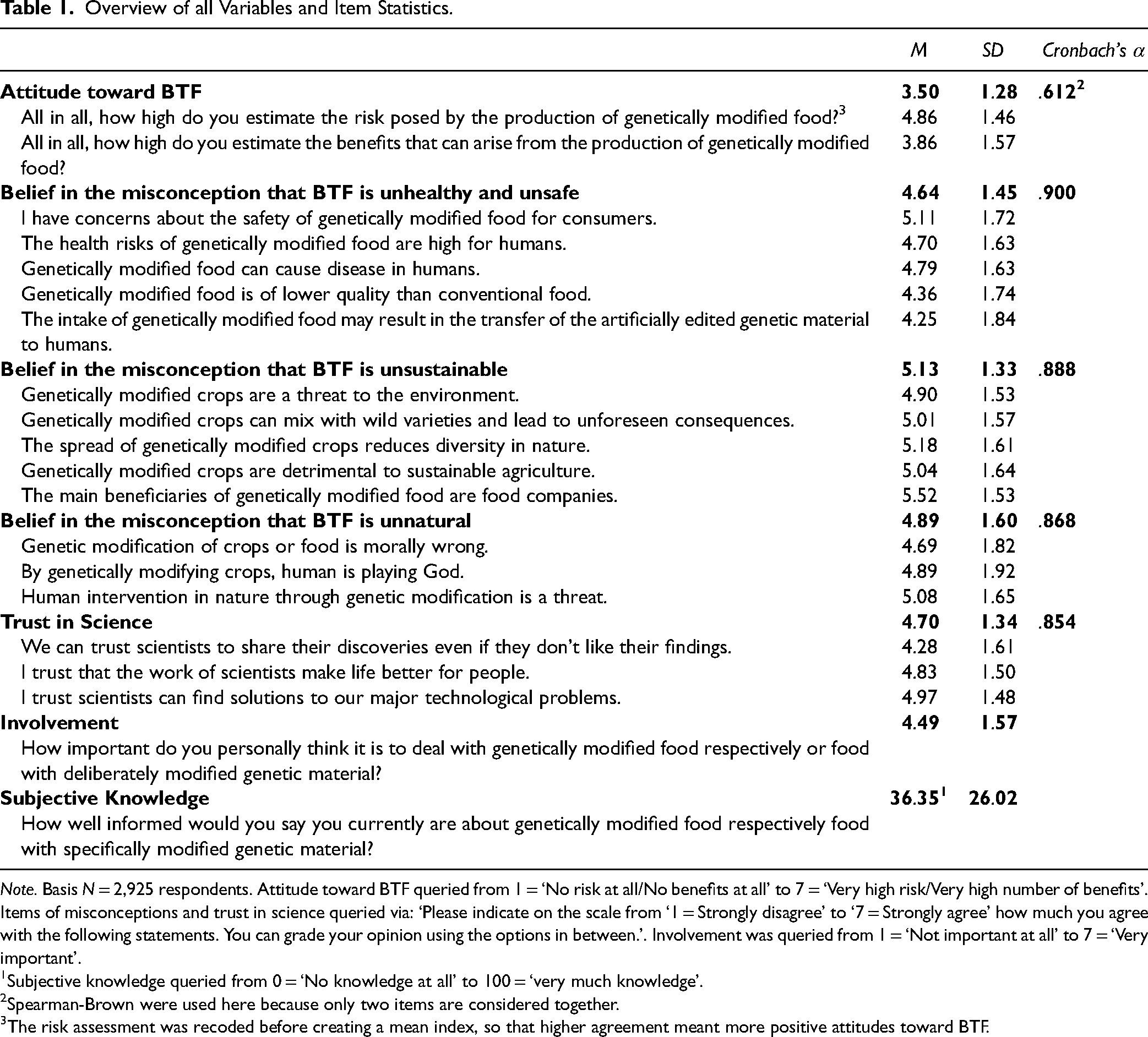
Note. Basis N = 2,925 respondents. Attitude toward BTF queried from 1 = ‘No risk at all/No benefits at all’ to 7 = ‘Very high risk/Very high number of benefits’. Items of misconceptions and trust in science queried via: ‘Please indicate on the scale from ‘1 = Strongly disagree’ to ‘7 = Strongly agree’ how much you agree with the following statements. You can grade your opinion using the options in between.’. Involvement was queried from 1 = ‘Not important at all’ to 7 = ‘Very important’.
Subjective knowledge queried from 0 = ‘No knowledge at all’ to 100 = ‘very much knowledge’.
Spearman-Brown were used here because only two items are considered together.
The risk assessment was recoded before creating a mean index, so that higher agreement meant more positive attitudes toward BTF.
Attitude towards BTF was assessed by a two-item, two-dimensional measure of perceived benefits and risks of BTF following Kahlor (2010). Participants were asked how they estimate risk and benefits of using biotechnology for food production and to respond on seven-point Likert-scales ranging from 1 (no risk (benefit) at all) to 7 (very much risk / very many benefits). The risk assessment was recoded before creating a mean index, so that higher agreement meant more positive (benefits > risks) attitudes toward BTF.
The strength of belief in the three common misconceptions about BTF were measured by how much participants would agree with several false statements that had been elaborated from literature (Kubisz et al., 2021; Scott et al., 2018; Vega Rodríguez et al., 2022) and from past research on misconceptions about BTF (Bode et al., 2021; Bode & Vraga, 2015; Dixon, 2016; Rose et al., 2019). Five items, for example, ‘Genetically modified food can cause disease in humans’, were used to measure the belief in the misconception that BTF is unhealthy and unsafe. Likewise, five items, for example, ‘The spread of genetically modified crops reduces diversity in nature’, served to measure the belief in the misconception that BTF is unsustainable, and three items, including ‘Human intervention in nature through genetic modification is a threat’, were used to assess participants’ belief in the misconception that BTF is unnatural. Participants indicated on seven-point Likert-scales ranging from 1 (do not agree at all) to 7 (fully agree) how much they agree with each item/statement (for all statements with statistics see Table 1).
Beyond these variables, trust in science, subjective knowledge, and involvement were accessed as relevant co-determinants of citizens’ attitude toward BTF. These variables were added to the study as controls to prevent an overestimation of the actual effect of misconception beliefs. Trust in Science were measured using three Items from Nadelson et al. (2014). The following items were rated on a seven-point Likert-scale, ranging from 1 (do not agree at all) to 7 (fully agree) on items like: ‘We can trust scientists to share their discoveries even if they don't like their findings.’. Participants subjective knowledge was determined following Kahlor (2010) by asking how well informed participants currently are about GMF (M = 36.35; SD = 26.03; Mo = 50; Mdn = 30; Q1 = 15; Q3 = 50). The level of knowledge was answered on a scale from 0 (no knowledge at all) to 100 (very much knowledge). Following Fowler et al. (2018), involvement was measured by asking how much importance participants assign to elaborating on GMFs, ranging on seven-point Likert-scale from 1 (not important at all) to 7 (very important).
Descriptive statistics were employed to assess the prevalence of the three identified misconceptions about BTF (RQ1). The effect of the belief in the misconceptions on citizens’ general attitude toward BTF (H1 to H3) was analysed using multiple block-wise linear regression. In the regression model, beliefs in the three misconceptions about BTF (as per the hypotheses) served as independent variables and attitude towards BTF as dependent measure. Prior to testing their effects, a first block of control variables was entered which contained trust in science, subjective knowledge and involvement as relevant predictors. The belief in the three misconceptions about BTF was hence included in the second block.
Results
Overall, the survey among German residents revealed that misconceptions about BTF are widely spread (RQ1): Average agreement was relatively high for each misconception. The majority of citizens believe that BTF is unhealthy and unsafe (M = 4.64; SD = 1.45; Mo = 4.00; Mdn = 4.60), unsustainable (M = 5.13; SD = 1.33; Mo = 7.00; Mdn = 5.20), and unnatural (M = 4.89; SD = 1.61; Mo = 7.00; Mdn = 5.00). In terms of relatively high levels of agreement (a score of 5 or more), the data revealed that 58 percent agreed with the misconception that BTF is harmful to the environment. Fifty-five percent were convinced that BTF is unnatural, and 44 percent agreed strongly that such foods are unhealthy and unsafe for human consumption. Correlational analysis (see Table 2) uncovered that beliefs in the different misconceptions are strongly related to each other.
Correlation Matrix of Attitude toward BTF and all three Types of Misconceptions against BTF.

Note. N = 2,925; *** p ≤ .001, ** p ≤ .01, * p ≤ .05.
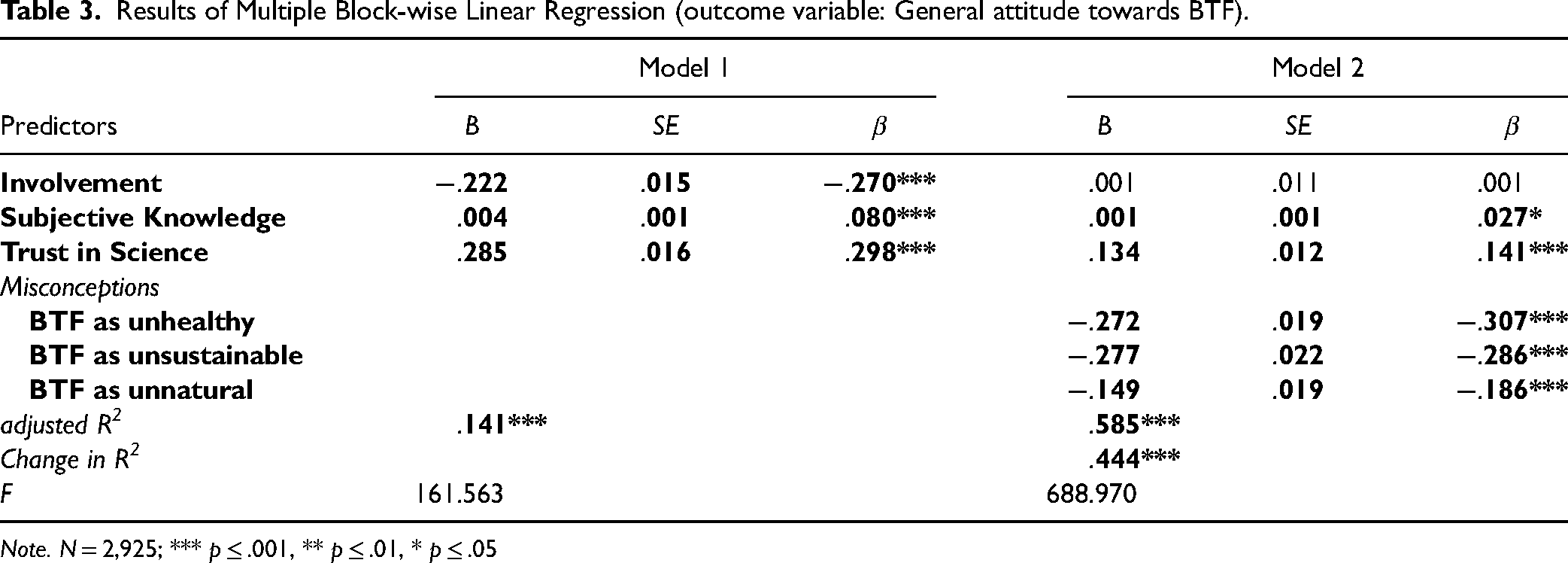
Results of a block-wise linear regression model explaining attitude towards BTF (H1 to H3; Table 3) showed that the overall model explained 58.5% of the variance within the attitude toward BTF. The first block, with involvement, subjective knowledge, and trust in science as predictors (control variables) explained 14.1%. Trust in science β(β = .298; p ≤ .001), involvement (β = -.270; p ≤ .001) and subjective knowledge (β = .080; p ≤ .001) turned out to be significant in their influence on forming attitude toward such innovation. By including the belief in misconceptions about BTF as being unhealthy and unsafe, unsustainable, and unnatural, the overall model was improved substantially (Change in R2 = .444; p ≤ .001). The effect of involvement was egalized (β = .001; p = .958) and the effects of trust in science (β = .141; p ≤ .001) and of subjective knowledge (β = .027; p = .029) were reduced substantially.
Results of Multiple Block-wise Linear Regression (outcome variable: General attitude towards BTF).
Note. N = 2,925; *** p ≤ .001, ** p ≤ .01, * p ≤ .05
Furthermore, the regression model revealed that all types of misconceptions about BTF were negatively associated with attitude toward BTF. Thus, a higher belief in each of the three misconceptions led to more negative overall attitude toward BTF. The strongest predictor was the belief in the misconception that BTF is unhealthy and unsafe (β = -.307; p ≤ .001), followed by BTF as unsustainable (β = -.286; p ≤ .001), and as unnatural (β = -.186; p ≤ .001). Thus, all three hypotheses were supported by the data.
Discussion
Misconceptions are Common and Drive Citizens Attitudes Towards BTF
Given citizens limited understanding of new food technologies (Mielby et al., 2013), they rely on the media and heuristics to form their judgments (Lusk et al., 2014; Siegrist & Hartmann, 2020). Thus, citizens are at risk of believing in misconceptions of complex food technologies. Attitude formation based on such misconceptions can lead to undesirable consequences (Flynn et al., 2017; Van Stekelenburg et al., 2021), such as public scepticism of BTF (Lusk et al., 2018; Scott & Rozin, 2020), which impedes market acceptance and can thus block the potential of biotechnological innovations (Lü & Chen, 2016), such as combating current global challenges (McFadden, 2016; Vega Rodríguez et al., 2022). Therefore, this study investigated the relevance of belief in misconceptions in citizens’ attitude toward BTF.
This study first found that misconceptions about BTF are still widely spread (Lusk et al., 2014; Scott & Rozin, 2020). Despite the fact that BTF can provide solutions to current challenges and scientific evidence, a large part of citizens believes that BTF is not healthy and safe for human consumption, damaging natural environments and is unsustainable, and BTF is an unnatural food product with normative and ethical problems implied. Furthermore, the study secured evidence that especially the misbelief in poor food safety and in negative effects of consumption on human health play a relevant role in citizens’ overall scepticism toward BTF. Citizens thus seem to be most concerned about their own well-being and articulate their fear that they might suffer from health hazards as a result of eating BTF. In contrast, the belief in the misconception regarding BTF consequences for the environment seem to be somewhat less important.
The results replicate earlier research findings that indicated health risks to be more important than environmental risks in citizens’ reasoning about biotechnology products (Butkowski et al., 2017). In turn, the pattern of results also implies that acceptance of BTF will improve if citizens recognize direct, tangible benefits like better nutrition, rather than indirect benefits, for instance, advantages for food producers (Lusk et al., 2015; Scott et al., 2018).
Interestingly, the misbelief that BTF is an unnatural food product because of human intervention turned out to be the least relevant for citizens’ overall judgement. This observation contradicts previous studies that emphasized perceptions of naturalness as important reason for rejecting BTF (Lucht, 2015; Lusk et al., 2014; Scott et al., 2018; Siegrist & Hartmann, 2020). The authors of these studies argued that naturalness of food is of great importance to a large number of consumers (Román et al., 2017) and is a relevant motive in food choice and food preferences (Lusk et al., 2014; Román et al., 2017). The discrepant finding from the present study may thus indicate that citizens’ view on biotechnology is shifting – not necessarily towards greater acceptability, but towards a more tolerant view about naturalness. Further, especially longitudinal, research will be required to understand this observation in more detail, as it holds both conceptual and applied implications (see below).
Overall, findings underline a dominating role of misconceptions about BTF in citizens’ general attitudes about such innovative technologies. The key role of the belief in misconceptions also became evident in the fact that their inclusion in the regression model reduced the effects of the control variables (trust in science, subjective knowledge and involvement), which were identified as relevant factors in previous studies (Lucht, 2015; Lusk et al., 2014; Scott et al., 2018). The influence of involvement was, in fact, completely neutralized when the beliefs in misconceptions were entered into the regression (see Table 3 again). One potential explanation for this finding pertains to the motivational drivers of involvement (which had been measured with an item on assigning importance to deal with BTF, see Table 1). One such driver is likely to be concern or worry about BTF or GM/GE technologies in general (McHughen, 2007). Citizens who are concerned about BTF are likely to find the issue important (in the present context: to display greater involvement), and they might be concerned precisely because of their belief in misconceptions – that imply BTF to represent greater risks to people and society. So, if beliefs in misconceptions actually motivate people's involvement with BTF, the actual undesirable effects of misconceptions is even worse than the direct effects observed in the current survey: Worry-driven involvement is likely to result in negatively biased elaboration of fact information (Petty & Cacioppo, 1986) and thus in self-reinforcing scepticism.
Implications
The fact that beliefs in misconceptions – wrong assumptions – determine citizens’ attitudes towards BTF to a large extent should certainly irritate innovators and communicators of science and technology. Obviously, science and technology communication has still not yet achieved population-wide correct knowledge about basic qualities and characteristics of BTF and GMOs used for their production. However, the optimistic perspective on the current findings suggests that if communicators succeed in correcting citizens’ belief in misconceptions, they will see great opportunities to promote greater overall acceptance of BTF. Given the observed profound statistical effect size of beliefs in misconceptions, correcting (‘busting’) them promises to have significant downstream consequences on technology acceptance.
Therefore, stakeholders in biotechnology and science communicators should be more agile in addressing and combating the misconceptions discussed here. Reducing misconceptions among the population at large could plausibly help to create better conditions for bringing biotechnological food innovations into markets and thereby to set free their potential to cope with global challenges such as famine and climate change.
Addressing citizens’ misconceptions requires diligent communication strategies and the willingness of researchers and corporations to participate in authentic dialogue with the public (Brossard & Nisbet, 2007). In this sense, providing ‘myth busting’ information (Lewandowsky et al., 2012; Lewandowsky et al., 2020; Peter & Koch, 2019; Walter & Murphy, 2018), e.g., by tailored information campaigns countering prejudices (e.g., Williamson, 2020), is a necessary, yet not sufficient condition to promote public acceptance of BTF; trust-building efforts, especially by large corporations who have been involved in (food) scandals in the past and hold special responsibilities (Oke, 2020) must accompany such educational communication about common misconceptions. Likewise, research experts should meet high standards in transparency about potential conflicts of interest when commenting on BTF safety, naturalness, or health and environmental impacts, because such transparency is also an important base for citizens’ trust-building. Cross-country survey research will both broaden the knowledge base on current public opinion towards BTF and allow piloting novel message design approaches for addressing widely-spread misconceptions.
Research Outlook
Future studies should both augment the present work to overcome its limitations and push the horizon of insight about citizens’ attitudes further. One limitation of the present study pertains to the measurement of misconceptions. As Flynn et al. (2017) discussed, the extent to which respondents agree with a statement that they indicate on a Likert scale may not validly reflect their actual belief in a misconception. Although this study followed the widely used type of measurement, future research should start here and develop better methods to examine misbeliefs related to BTF (Flynn et al., 2017). Such work could also address the current finding that beliefs in the different misconceptions are correlated substantially (see Table 2). While coefficients do not imply a severe problem of multicollinearity for the present regression analysis, both methodological and conceptual questions arise from them, especially the perspective that some (groups of) citizens seem to acquire strong belief in all misconceptions, whereas others do not ‘buy’ any of them (i.e., misconception belief as a person factor, see below).
In terms of generalizability, it is necessary to keep in mind that the sample is not fully representative of the German population because it was only drawn by quota (i.e., a non-randomised procedure). Future work should of course extend the scope and investigate belief in misconceptions as well as attitudinal dynamics about BTF in populations of additional, diverse regions. Discourses and priorities regarding BTF differ significantly across the globe (e.g., Lü & Chen, 2016), and the present observations from Germany may apply to similar Western industrial countries, but not to various other regions of the world. Likewise, follow-up research should identify segments within populations that display a pronounced propensity of believing in (any, several, or all) misconceptions in order to better understand both the reasons of these beliefs and strategic means to address them with a focus on better-defined target audiences.
In addition, future research should equally consider and analyze socioeconomic factors in attitudes toward BTFs, such as ownership of BTFs by large corporations as well as trust in such firms. This is because research suggests that the producer of the food and those who benefit from the food technology may also have an influence on attitudes and acceptance (Lusk et al., 2018). Multinational corporations have been investing heavily in influencing agricultural politics, gaining market access, and promotion elite acceptance of their inventions and business models, which oftentimes conflicts with the interests of local food producers (e.g., Newell, 2007) and brings up questions of credibility and authentically good intentions behind BTF (e.g., Kumar & Mallick, 2020). It is therefore necessary to investigate the extent to which concerns about (large, international, financially powerful, market-listed) corporations as key drivers of BTF innovation and application function as intervening factor in citizens reasoning and attitudes toward the technology and derived food products. In other words, the present observation of citizens’ widespread skepticism may in part be caused by negative judgments of (global) BTF corporations and not (only or primarily) by perceived properties of BTF technologies. The outcome perspective of such research would be that future communication of science and technology could understand the means to assist citizens in differentiating between the perceived attributes of BTF and underlying technologies on the one hand and perceived attributes of (capitalist) actors who invent and sell those technologies on the other.
And finally, beyond studying prevalences and effects of belief in misconceptions on technology acceptance, research on science and technology communication is required to understand the means and strategies of correcting misbeliefs in various segments of society. Effective, evidence-based communication that helps to reduce misconceptions about novel technologies such as BTF will be crucial in empowering more citizens to make informed product choices. At the same time, citizens’ expectations and motivations that underlie their belief in misconceptions (e.g., the desire for safe, healthy, and sustainable food), should be taken very serious by researchers, technology actors, and regulators. While the misconceptions are an epistemic problem, citizens’ underlying normativities are part of the solution. In this sense, attempts to correct misbeliefs should always connect to frameworks of responsible innovation and citizen-focused regulation of BTF (e.g., Merck et al., 2022). In this broader sense, reducing the belief in misconceptions will also enable more citizens, but also industry and regulation actors, to participate in a well-prepared fashion in discourses about how BTF can be integrated in future governance frameworks (see Jasanoff, 2003) that foster sustainable, socially fair food supply and consumption across the world.
Footnotes
Declaration of Conflicting Interests
The authors declared no potential conflicts of interest with respect to the research, authorship, and/or publication of this article.
Funding
This research was funded by the Ministry of Science and Culture Lower Saxony and Volkswagen Foundation, project "Agile bioinspired architectures", grant no. ZN3822.
