



Abstract
Data have become a vital device of border governance and security. Recent scholarship on the datafication of borders and migration at the intersection of science and technology studies and critical security studies has privileged concepts attuned to messiness, contingency, and friction such as data assemblages and infrastructures. This paper proposes to revisit and expand the analytical vocabulary of script analysis to understand what comes to count as data, what forms of data come to matter and how “drawing data together” reconfigures power and agency at Europe’s borders. Empirically, we analyze controversies about the practices of asylum decision-making and age assessment in Greece. We show that agency of “users” is unequally distributed through anticipations of subscription and dis-inscription, while asylum seekers are conscripted within security scripts that restrict their agency. Moreover, as a multiplicity of inscriptions are produced, migrants’ claims can be disqualified through circumscriptions of data and ascriptions of expertise.
Introduction
“Some police stations still take fingerprints with ink,” one of us was told in conversation with a civil society organization in Thessaloniki, Greece. We were discussing how digital data are collected and used by the police and the effects this has on migrants. The comment was surprising but not unique to Greece, as we encountered similar multiplicity of data forms—both digital and analogue—in Spain, Italy, and France. 1 Digital and nondigital data continue to coexist despite the European Union’s (EU) aim of datafying border and migration control and making digital databases interoperable. One form of data often needs to be transformed into another in order to circulate, or data need to be produced in standardized form in order to be exchanged between national authorities and EU agencies. For instance, in the example above, ink fingerprints would need to be sent to another police station to be digitized and read computationally so they can be uploaded into the national police database. Other organizations keep both digital and paper files so that the same data exist in multiple forms.
As data have become a vital device of border control and migration governance, much of the academic attention has focused on its digital form, on data that can be algorithmically processed. Interdisciplinary scholarship on borders and security in critical security studies (CSS) and science and technology studies (STS) has challenged the discourse of technological innovation, security, and efficiency through digital data and database interoperability. This critical literature has highlighted the performative effects of digital data and automation processes, which reconfigure power and control at borders (Pollozek and Passoth 2019; Chouliaraki and Georgiou 2022); produce disorientation and uncertainty for migrants and refugees (Tazzioli 2020a); and expand surveillance, exploitation, and injustice (Leese, Noori, and Scheel 2022; Metcalfe and Dencik 2019). Statistical, biometric, and big data have received extensive analytical attention in CSS and STS scholarship. Biometric data in particular, with their aura of objectivity and authenticity, have long been mobilized for the identification, “social sorting” (Lyon 2003), and exclusion of people on the move.
However, data come in many forms, and they need to be brought together and combined for governing purposes. Digital, biometric, statistical, and transactional data are often entangled with papers, documents, and qualitative data extracted from migrant testimonies and so-called debriefings, but how are these different data forms drawn together? What data can and cannot be drawn together enables migration and rights claims to be enacted differently. For instance, when decisions need to be made on an asylum application, on the level of vulnerability of a person, or on the identity of a minor, many different forms of data need to be assessed, combined, and hierarchized. What counts as data—or whether something counts as data at all—is often a contested question (Gitelman 2013). These heterogeneous data forms exceed and escape the promises of database interoperability, which remain focused on the “management, re-organisation and re-purposing of datasets” of biometric and biographical data (Bellanova and Glouftsios 2022).
This paper draws on conceptual and methodological intersections between CSS and STS to explore the heterogeneity of data forms at Europe’s borders, how various data forms are combined, and with what effects. We call “drawing data together” what happens after biometric and biographical data are collected, when some data need to be combined with other forms of data, information, or evidence. We stress that different forms of data are deployed to govern people on the move and argue that which data come to matter, what counts as data, and how data forms are combined makes a difference to how power and agency are reconfigured between national and European authorities, and migrants themselves. 2
We propose to trace and conceptualize these differentials of power and agency by revisiting the analytical vocabularies of “inscriptions” and “scripts” developed by Madeleine Akrich and Bruno Latour (Akrich 1992; Akrich and Latour 1992). Recent STS work on data has mobilized the language of “inscriptions” (Denis 2018) and “traces” (Boullier 2015; Diminescu 2016; Flyverbom, Madsen, and Rasche 2017) to understand how data are enacted, and how they can enact novel social relations. For us, script analysis offers a varied analytical toolkit to investigate the heterogeneity of data forms, power relations, and agency, thus furthering the existing research agenda at the intersection of CSS and STS (e.g., Amicelle, Aradau, and Jeandesboz 2015; Bellanova, Jacobsen, and Monsees 2020; Leese, Noori, and Scheel 2022). Script analysis deploys an extensive vocabulary, from description, inscription, prescription, proscription, subscription, transcription to dis-inscription, ascription, circumscription, and conscription. We return later in the article to these concepts, which attune us to the messiness and the contingencies of agency, as well as the obduracies of power.
We argue that this expansive analytical vocabulary based on scripts is relevant to how data are deployed in border governance and how they shape authorities’ and migrants’ agency. Moreover, by expanding less used concepts in the script toolbox (ascription, circumscription, conscription, or even proscription), we show how power asymmetries become hardened and entrenched. Revisiting and expanding “script analysis” enables a two-fold contribution: bringing a conceptual toolbox from STS to debates about data, borders, and security and drawing out concerns from CSS to reformulate aspects of the script toolbox to better attend to the obduracies of power beyond the “continuum of contingency” in practices of securitization (see the Introduction to this Special Issue) that enable agential dis-inscriptions. In other words, the script toolbox contributes to a more granular understanding of the multiplicity of data forms and the specificities of agency and power mechanisms present at borders.
Empirically, we analyze what comes to count as data and how data forms are drawn together in asylum decision-making and age assessment in Greece. Greece has been the scene of many controversies, where the practices of European agencies or national authorities involved in border control and migration management have been challenged as violent or abusive. The violence of pushbacks, migrant deaths in the Aegean Sea or at the Evros land border, and conditions of detention have been amply documented by investigative journalists, activists and academics (e.g., Bellingcat 2020; Karamanidou and Kasparek 2022). Here, we focus on controversies about the practices of asylum interviews and age assessment. At stake in these controversies is the failure of EU and national authorities to comply with their own regulations and guidelines or to put it in the vocabulary of scripts, the issue of the extensive “dis-inscription.” These sites of data collection and processing are heavily “scripted,” with multiple guidelines and standards prepared by the EU Agency for Asylum (EUAA, formerly known as EASO) or by “Best Interest Assessment Checklists” and forms provided, for instance, by Greek national authorities (Ministry of Migration and Asylum 2022). 3
Methodologically, we follow Akrich’s (1992) description of the specific conditions required for script analysis, which entail that researchers look into “disagreement, negotiation and the potential for breakdown,” with methods such as following engineers and designers; following controversies over devices and artifacts that “go wrong” or following a device “as it moves into countries that are culturally or historically distant from its place of origins” (Akrich 1992, 211).
Taking disagreements as our methodological orientation, we follow two different controversies in Greece: the first controversy concerns asylum decision-making and the second one age assessment. These controversies were made public by civil society actors through complaints before the European Ombudsman, the Greek Ombudsman, as well as litigation before the European Court of Human Rights (ECtHR). In following these controversies, we analyze documents submitted by nongovernmental organizations (NGOs) to Ombudsman authorities and courts, reports, and related decisions: the guidelines, standards, and training prepared by EASO and Greek authorities. We supplement these materials with insights from interviews conducted remotely between 2020 and 2022, participation in online events organized by civil society actors, and fieldwork conducted in July and September 2022 in Greece. While we focus here largely on the documentary materials produced and gathered by the actors in the controversies, we have also supplemented these with relevant insights from our interviews and fieldwork. 4 In the context of asylum seeking, controversies allow us to draw out the kinds of scripts at work and how they shape the process of “drawing data together.”
The paper’s argument is structured in four sections. We start with the interdisciplinary scholarship in STS and CSS, which has analyzed the datafication of borders and migration and discuss the main conceptual apparatuses used in the literature. Second, we introduce script analysis and its complex analytical vocabulary to show its differences from approaches that deploy “assemblage” or “infrastructure” as analytical lenses. Third, we turn to a controversy about EASO’s role in Greece and show how a script analysis of drawing data together helps to shed light on the authorities’ and migrants’ agency. Lastly, we analyze controversies about age assessment to trace how drawing data together renders power asymmetries between migrants and authorities more obdurate. We conclude with reflections on how the analytical toolkit of scripts can contribute to debates about security and border practices.
The Datafication of Borders: From Data Assemblages to Drawing Data Together
Borders and migration are increasingly enacted through data practices (Dijstelbloem and Broeders 2014; Scheel, Ruppert, and Ustek-Spilda 2019). Through biometrics (facial images, fingerprints, or iris scans), biographical records, interviews, and official documents, data take many forms at the border. Datafication has come to name not just the extensive use of data, but the transformation of bodies, actions, and things into data that can be processed by algorithms (D’Ignazio and Klein 2020, 12-13). The literature in CSS and border studies has offered nuanced analyses of how datafication transforms border security and migration governance. Scholars have investigated how it entrenches or amplifies power inequalities (Leese, Noori, and Scheel 2022; Leurs and Shepherd 2017) and how it shapes the practices of border actors and even humanitarian organizations who are increasingly tied into transnational infrastructures of data brokerage and digital expertise (Bigo 2014; Lemberg-Pedersen and Haioty 2020; Martin et al. 2022).
If “biometric borders” (Amoore 2006) names the preeminence of biopolitical practices of governing mobile bodies through biometric data, other terms indicate further transformations in border control and migration management: digital borders (Broeders 2007; Chouliaraki and Georgiou 2022), iborders (Pötzsch 2015, 106), deep borders (Amoore 2021), big borders (Metcalfe and Dencik 2019), and virtual borders (Van Den Meerssche 2022) diagnose these transformations through big data, interoperability, and artificial intelligence (AI) / machine learning algorithms. Pötzsch (2015, 111) summarizes these dynamics, saying that iborders are enacted through a “sociotechnological apparatus that employs techniques of biometric and algorithmic bordering to validate, establish, and indeed produce, identities and patterns of life.” Databases that record biometric data such as Eurodac can be seen as “technology work that breaks down the body of migrants into data streams” (Tsianos and Kuster 2016, 236). Moreover, fingerprints and palm prints “come to act as a spokesperson for the whole body” (Pelizza 2021, 501).
Whether focusing on biometric data, big data, or machine learning, scholars have emphasized their performativity and political effects, with data practices enacting lines of inclusion/exclusion, and people on the move being classified along race, gender, and class lines (e.g., Magnet 2011; Ajana 2013; Kloppenburg and van der Ploeg 2020). Thus, “technologies that seem indifferent to racial differences” in fact come to enact race “in specific practices” (M’charek, Schramm, and Skinner 2014, 471). Datafication produces new forms of “associative inequality” and makes legal redress more difficult (Van Den Meerssche 2022). According to the UN Rapporteur on Racism, Racial Discrimination, Xenophobia, and Related Intolerance, “[d]igital borders have the effect of enhancing the racialized operation of borders by bringing greater precision to and expanding the reach of racial borders” (Achiume 2021, 336). Biometrics renders complex identities into a simple standardized identity and reproduces power asymmetries between categories of actors (Madianou 2019, 592).
More recently, scholars working at the intersection of CSS and STS have highlighted the messiness of data: the need for tinkering, maintenance, and repair of data infrastructures. They draw on concepts of (data or information) assemblage and infrastructure to scrutinize practices that do not follow linear logics of technology implementation. In entangling heterogeneous human and nonhuman actants, assemblages account for the mobility and mutability of security knowledge (Frowd 2018, 178); assemblages are characterized by contingency, friction (Glouftsios and Leese 2022), and “a creative muddling through that connects wider forces, spaces, bodies, materials and imaginaries” (Lisle and Bourne 2019, 698). Although infrastructures have been associated with large sociotechnical systems often characterized by “ubiquity, reliability, and especially durability” (Plantin et al. 2018, 296), recent literature on border and migration infrastructures has focused on the multiplicity of systems that make up infrastructures and result in a “bricolage” of border activities (Dijstelbloem 2021, 151). Data infrastructures of border control rely on the mundane work of maintenance and repair. For instance, the EU Visa Information System is an “unruly, failing, and insecure infrastructure that requires maintenance and protection to function 24/7” (Glouftsios 2021, 9). This messiness, unruliness, frailty, and bricolage bring data infrastructures and assemblages conceptually and empirically closer (Meissner and Taylor 2021). Alongside the human work of maintenance and repair, “translation” has been mobilized to trace the fraught dynamics of data production and movement, especially regarding the registration and the identification of “border-crossers” at the internal and external EU borders (Pollozek and Passoth 2019; Pelizza 2021; Scheel 2021).
The emphasis on failure, friction, and frailty can be explained by the multiplicity and heterogeneity of data collected at borders. Data come in many forms, both digital and analogue, both quantitative and qualitative, and both structured and unstructured. Data can include identity documents, medical reports, legal judgments, biometrics, age assessments, DNA or satellite data, and more. When different forms of data are brought together in the biopolitical government of people on the move, digital and biometric data appear to subdue or even suppress other forms of data. For instance, data (particularly biometric data) can be used as “evidence that supports or falsifies claims made by travelers or asylum seekers” (Leese, Noori, and Scheel 2022, 13). Yet, what happens when digital data need to be brought together with nondigital or qualitative data and paperwork? Recently, Georgios Glouftsios and Matthias Leese (2023, 125) have proposed the concept of “epistemic fusion” to understand how “data-driven knowledge” is brought together with “more traditional forms of investigatory knowledge and expertise” and localized demands for actionable intelligence.
Along similar lines, we want to understand how different forms of data are drawn together at borders to produce obdurate forms of power despite multiplicity, heterogeneity, and messiness. We talk about “inscriptions” to render the multiple forms that data can take at the border, from biometrics to migrant narratives, statistical data, biographies, medical certificates, and so on. In the next section, we revisit script analysis to help us understand how certain inscriptions come to count as data, how they can be combined, and how the inscriptions reconfigure power relations and agency between various authorities and migrants.
Variations on Scripts: Tracing Power and Agency
Scholars analyzing the making of data have used the language of data traces or inscriptions (Boullier 2015; Denis 2018), which have a long lineage in STS and the making of facts. Inscription is a general term for all operations that produce a text or a visualization, generated by people or through devices. Inscriptions do not a priori differentiate between analogue and digital, qualitative and quantitative data. All data forms are inscriptions bearing a script, which subsequently orient users’ engagement with the script’s prescriptions and proscriptions, what is allowed and disallowed.
In analyzing technical objects, Akrich (1992, 208) connects inscription and script and argues that the “work of innovators is that of ‘inscribing’ this vision of (or prediction about) the world in the technical content of a new object.” Through the detailed analysis of these inscriptions (or description by the researcher), the script can be brought to light. The script refers to how technologies define “a framework of action together with the actors and the space in which they are supposed to act” (Akrich 1992, 208). The script approach has been productive because it has made possible an expansive analytical vocabulary built on variations of “scripts,” which includes description and inscription as well as prescription, proscription, subscription, dis-inscription, ascription, conscription, and circumscription (Akrich 1992; Akrich and Latour 1992). Indeed, this analytical-descriptive vocabulary, that enables tracing variations in and differences between entities, has been most productive for Actor-Network Theory's (ANT’s) material semiotics (Mattozzi 2020, 94).
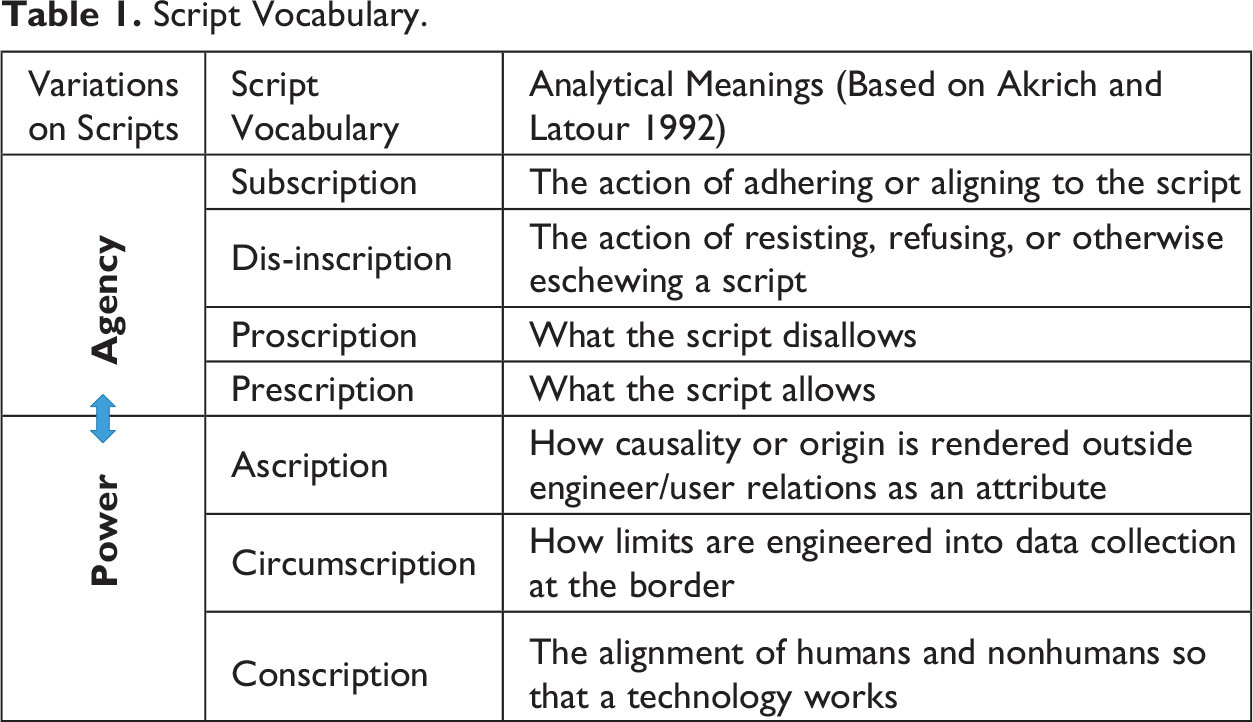
Script Vocabulary.
Yet this vocabulary of script has somewhat faded from STS scholarship, partly due to its perceived limitations. For Paula Jarzabkowski and Trevor Pinch (2013, 584), the script approach is limited because it does not account for the “complicated social situations within which most material objects are embedded, where it is hard to discern sequences of actions and impute functionality and accompanying intentions.” This means that script analysis simplifies the multiplicity of actants and devices by focusing on engineers and users. Moreover, it relies on an “overrationalized figure of the designer as actor, and an over-estimation of the ways and extent to which definitions of users and use can be inscribed into an artifact” (Suchman 2007, 192). Another point of critique has been the relative stability of scripts, which privileges operations of ordering and pays little attention to the messiness of activity and the fragility and ephemeral dimension of traces (Denis 2018, 62). These critiques can shed some light on the waning of script analysis in favor of concepts more analytically disposed toward multiplicity, messiness, and contingency. Even as inscriptions have been recently revisited to understand data (Denis 2018), the fragility and messiness of inscriptions are set in opposition to what is rendered as the stability—however tentative—of scripts.
Yet, when analyzing border control and migration management, we need to account for obduracies of power alongside friction, fragility, and contingency. At borders, control, exclusion, and disqualification of claims are entangled with messiness and contingency. We argue that analytical variations on “scripts” help attend to both the obduracy of power and the contingencies of agency through data inscriptions at the EU borders. In that sense, scripts can be complementary to infrastructures and assemblages, because variations on scripts help us understand asymmetries of power and agency. Through its expansive analytical vocabulary (Akrich and Latour 1992; Latour 1990), script analysis can render different socio-technical practices of making, unmaking, and combining data for governing borders and migration. While many of these concepts of inscription/description, subscription/dis-inscription, prescription/proscription have been mobilized in ANT scholarship, some terms such as conscription, ascription, and circumscription have only sporadically appeared in subsequent work (see Table 1).
Borders are spaces where inscriptions proliferate. At the EU borders today, we can say that anything can be transformed into inscriptions. In a laboratory, Latour (1990, 22) tells us, inscriptions “were combinable, superimposable and could, with only a minimum of cleaning up, be integrated as figures in the texts of the articles people were writing”. Yet, unlike laboratory inscriptions, inscriptions at borders are not easy to combine and superimpose, despite the promise of interoperability repeated by the EU and national authorities (Bigo 2020). On the one hand, biometric data are extracted from the body through standardized devices that capture, encode and process information, such as Automatic Border Control (ABC) Gates at airports using fingerprints or/and facial recognition, or the digital collection of fingerprints taken from people seeking asylum in the Eurodac database. 5 On the other hand, a medical or psychological report requires different devices and standards to be produced and circulated. It can be digital, but it is not necessarily computationally readable and algorithmically processable. These devices can range from ink to stationary and mobile ones.
The vocabulary of prescription/proscription and subscription/dis-inscription can help trace “variations” or differences in relations and agency (Mattozzi 2020). Prescription entails the possibility of permissible agency, while proscription is the suspension or denial of such agency (Latour 1992). Subscription and dis-inscription name two other movements of agency—that of aligning to, adopting, and abiding by these prescriptions and proscription or the agency of distancing from these, either directly or indirectly. As Akrich and Latour (1992) argue, users can adhere by subscribing to the script or they can resist it through dis-inscription. Data inscriptions can be accepted, challenged, adapted, or reinscribed by users. But who counts as a user at borders is ambiguous. Users can range from different authorities to migrants who are increasingly scripted as users of data and digital technology (Aradau 2022; Tazzioli 2020b). Migrants often must become users of digital platforms and apps to access the asylum system; they often must use mundane devices such as Skype (now discontinued in Greece), Viber or WhatsApp to contact the authorities, while being excluded, scripted as nonusers of other forms of data and digital technologies such as the EU databases.
Other variations of conscription, ascription, and circumscription map power relations. Conscription was initially defined as “the series of actors that have to be aligned for a setting to be kept in existence” (Akrich and Latour 1992, 261). Henderson (1991, 456) has conceptualized visualizations by engineers as “conscription devices” that “enlist group participation and are receptacles for knowledge created and adjusted through group interaction aimed toward a common goal.” As we will see, people and devices are conscripted in the making of asylum decisions, while data become a conscription device. Ascription refers to the “attribution process” through which a decision is made about “[w]ho or what is the designer of a setting” (Akrich and Latour 1992, 262). At borders, attributions are key for claims to rights and to challenge actions by authorities. Finally, circumscription names the boundaries, limits, or “walls” of a device. On the model of a text circumscribed by “the dust cover, the title page, the hard back” (Latour 1992, 237), data are circumscribed by being held in databases, hard disks, on paper, or, more recently, in the cloud. Moreover, as we show below, what counts as data is also circumscribed by what counts as information, facts, or evidence.
In the following two sections, we unpack how these variations on scripts allow us to redescribe controversies over asylum decision-making and age assessment in Greece. Both controversies reveal disagreements and negotiations over how data are drawn together, what counts as data, and who or what can draw data together.
Prescription, Dis-inscription, and Conscription at the EU Borders: Making Asylum Decisions
In 2017, the German NGO European Center for Constitutional and Human Rights (ECCHR) filed a complaint against EASO before the European Ombudsman (2018), followed by another one from Advocates Abroad (AA) (2019). The ECCHR complaint concerned EASO’s role in “hotspots” in Greece (first reception facilities for implemented for asylum seekers and other migrants at the external EU borders after 2015) and particularly its involvement in admissibility interviews, 6 while the AA complaint emphasized the “misconduct by experts in interviews with asylum seekers organized by the European Asylum Support Office (EASO) in Greece” (European Ombudsman 2019). In the wake of the EU–Turkey Statement in 2016, EASO has been involved in admissibility and eligibility interviews with asylum seekers in Greece. Both complaints highlighted violations of asylum standards and policies and highlights the key role played by EASO’s agents or national authorities in the definition of what counts as legitimate data. The first complaint is not upheld, even as the Ombudsman Emily O’Reilly (2018) finds “very serious concerns, that have been voiced in particular by civil society, about the extent of the involvement of EASO personnel in assessing asylum applications in the Greek hotspots.” In the second complaint, the Ombudsman (2019) finds a case of maladministration by EASO and makes suggestions for “systematic improvement” through communication with the Greek Asylum Services when “significant errors” are discovered in interviews.
EASO’s (2021b) mission has been to support and standardize national practices across member states by “performing its duties as a service-oriented, impartial and transparent organization within the EU legal, policy and institutional framework.” Although it began as a designer of standards and guidelines, in 2011, EASO started playing an operational role in Greece and saw the greatest extension of its operational activities across Europe in 2021 (EASO 2021a). A key element of EASO’s role in Greece is to ensure that “sufficient information has been collected” so that the Greek Asylum Office can take a “reasoned decision” (European Ombudsman 2018, 4). In so doing, EASO designs what counts as “sufficient information” and is also a user of inscriptions of this “sufficient information” in its operational role.
An NGO’s report submitted with the ECCHR complaint to the Ombudsman outlines that asylum interviews entail extensive collection and processing of different forms of data: “EASO staff are currently responsible for conducting the registration of the asylum application, where the applicant’s personal data, information about family members in other European countries, vulnerability and reasons for flight from the country of origin are recorded” (Greece Refugee Rights Initiative 2018, 2). EASO is thus involved in making and drawing inscriptions together. Moreover, EASO “formulates and asks the questions and applies the interview techniques they consider necessary” (Greece Refugee Rights Initiative 2018, 2). Therefore, ECCHR and the Greek Refugee Rights Initiative identify EASO as having control over asylum decisions in Greece but, importantly, failing to subscribe to its own prescriptions—standards and guidelines—about the conduct of interviews and the assessment of information.
As both designer and user, EASO appears to dis-inscribe from rather than subscribe to its own prescriptions. For instance, the ECCHR complaint pointed out that EASO staff did not seriously consider inconsistencies and produced all reports in English, thus making it more difficult for Greek officials, lawyers, and judges to fully understand the details of a case (Greece Refugee Rights Initiative 2018, 3-4). Moreover, staff failed to seriously attend to questions of vulnerability and discouraged applicants from talking about incidents in the countries of origin, arguing that admissibility claims are not concerned with the merits of the case (Greece Refugee Rights Initiative 2018, 6). Nonassessment of vulnerability can change the result of an asylum claim, both because vulnerable applicants are exempted from the border procedure under the EU–Turkey agreement and because vulnerability can affect the evaluation of credibility. AA similarly highlighted that “interviewers had been abusive and/or poorly prepared,” whereas EASO’s main prerogative in Greece is to ensure that “sufficient information” is collected (European Ombudsman 2019, 2).
While producing prescriptions for data collection, information processing and the assessment of evidence, EASO is dis-inscribing from its prescriptions on asylum decision-making. These two complaints emphasize the discordances between prescription, subscription, and dis-inscription. Starting from a sociotechnical object, Akrich and Latour rely on the assumption that the script prescribes a sequence of inscription and subscription, with dis-inscription emerging only in relation to certain user behaviors and leading to the re-inscription of the object. What if border scripts anticipate dis-inscription—or at best—only partial subscription? This is, however, not a generalized assumption of dis-inscription, because migrants are expected to become faithful uses of technologies and data. As users and producers of data, migrants’ agency is inscribed through subscription to border and asylum processes. They must subscribe to the technology and produce data inscriptions.
One of authors of the report accompanying the ECCHR complaint argued that this blurring of EASO’s roles has led to a reduction in standards for asylum decisions in Greece, with 98 percent of admissibility decisions finding Turkey to be a safe third country. 7 Other interlocutors also noted that opinions on admissibility are repetitive, copying and pasting the same rationale. This suggests that some prescriptions are not intended to be followed or underwritten by (some) users. While in principle everyone can dis-inscribe from sociotechnical devices, drawing data together at borders inscribes expectations of subscription by migrants, but not by all users.
According to EASO (2015, 1) guidelines, data are drawn together as part of the “evidence assessment” process. Most data are collected during the personal interview, as are “material facts,” defined as “facts that are directly linked to the definitions of a refugee or a person eligible for subsidiary protection” (EASO 2014, 2). In its practical guide on evidence assessment, EASO (2015, 6-9) emphasizes that understandings of what could be considered evidence can differ depending on EU member states’ “legal traditions and varying practices.” Even if member states try to follow the three-step methodology described under the “Evidence” heading (“Gathering Information,” “Credibility Assessment,” and “Risk Assessment”), national officers might consider different kinds of data as “sufficient information”—as EASO argued before the European Ombudsman. Unlike evidence, data and information are not explained. Beyond “the pieces of evidence related to the material facts,” the guidelines list passports or national identification documents, different reports by experts or professionals on country of origin, both medical and psychological certifications, language, or the testimony of other persons. But the most important piece of evidence and in the first step of “gathering information” is the applicant’s testimony (EASO 2015, 6-7).
In Greece, EASO plays a key role in drawing all these inscriptions together, whether digital or analogue, information or facts, and datawork or paperwork. To do so, data work as “conscription devices” (Henderson 1991) by enlisting the—more or less forced—participation of many organizations, devices, and individuals, including migrants and interpreters. Given this multiplicity of enlisted users, EASO appears to have a supporting role to help data inscriptions become “sufficient information” accepted as evidence for an asylum decision. Conscription, however, is not just the “mobilization of well-drilled and well-aligned resources” (Latour 1992, 178), but it also implies constraint and even coercion. From the sixteenth century, conscription came to mean soldier enrolment in the military rather than writing things together (Oxford English Dictionary, 2014). For instance, migrants are forcefully conscripted to give and make data. At the same time, other potential users of data inscriptions are dis-enrolled or “un-conscripted,” as in the case of non-English speaking Greek lawyers who become un-conscripted because EASO’s opinions are only produced in English.
Moreover, when its dis-inscription was successfully challenged by AA, EASO produced new prescriptions in the form of feedback reports on selected asylum interviews, which it shared with the Greek Asylum Service. The European Ombudsman found maladministration in the case of an Algerian asylum seeker, Mr. X, who was deported after his asylum application was rejected based on a “serious error” made by the EASO interviewer and was at the time “presumed dead” (European Ombudsman 2019). Following this finding, EASO pledged to put in place measures “to prevent, reduce and respond to mistakes made during the interviews” (European Ombudsman 2019).
These controversies show how script analysis can help shed light on the differentials of agency—asymmetries of subscription and dis-inscription from the prescriptions for drawing data together in asylum decision-making—and the asymmetries between conscripting allies, forced conscription of some actors, and un-conscription of others. The controversy around EASO’s role in Greece also highlights that dis-inscription can be integral to the script through differential prescriptions. In the next section, we turn to different controversies over what counts as data, how it is circumscribed, and who is ascribed the capacity to make and draw data together.
Tracing Proscription, Ascription, and Circumscription in Age Assessment
Age assessment in asylum processes has been another site of controversy in Greece. Many legal cases have focused on the illegality of detaining minors and conditions of detention in police stations and camps. By contrast, the Greek–German human rights organization Equal Rights Beyond Borders has pursued complaints and litigation concerning age assessment of unaccompanied minors, which test the drawing together of data (Equal Rights Beyond Borders). Age assessment is a particularly controversial practice, where medical data such as hand and wrist X-rays, which are deemed to certify the age of an individual (Malmqvist, Furberg, and Sandman 2018, 815), often take precedence over narratives or even identity documents. Unlike asylum decisions, age assessment only occurs where there is “doubt” about whether a migrant is a child or an adult. In Greece, “doubt” leads to the triggering of age assessment procedures, which include “special attention…to the particular characteristics of the minor, especially those related to their gender or cultural peculiarities” (AIDA 2022, 110).
In cases where there is no such doubt, identification is declaratory based on a person’s statements. 8 Paper-based declarations, which are subsequently digitized or datafied, then become inscribed as objective and overriding data. Authorities and migrants need to subscribe to these data, which is to say they act based on these data. Yet, when an asylum seeker’s identity is in doubt or challenged, only original documents are accepted by the asylum authorities. 9 Thus, specific situations require digital or paper-based documents. Original documents often need to be obtained by families in the country of origin and sent to Greece. In the context of contested identity, original documents need to be received within fifteen days, a time frame that is often impossible given the time it takes for international mail to reach its destination. Neither certified paper copies nor digital copies are accepted for identification purposes, although other certified paper copies or digital documents can be accepted as evidence of persecution and risk within an asylum claim. 10
If there is a discrepancy between a person’s declaration and the views of the authorities conducting the reception and identification procedure, then a series of steps need to be followed. The Greek procedure of age assessment follows a hierarchical set of actions and attributions based on doubt about the credibility of results. According to the report by the Greek Council for Refugees (AIDA 2022), the first step produces data inscriptions from “body-metric data,” starting with “height, weight, body mass index, voice, and hair growth, following a clinical examination” (AIDA 2022, 119). In a second step, “psychosocial assessment is carried out by a psychologist and a social worker to evaluate the cognitive, behavioural and psychological development of the individual.” Only if doubt persists will X-rays of wrists, other dental examinations or “any other appropriate means” be mobilized to reach a “firm conclusion” (AIDA 2022, 119-20). EASO also explains that when authorities are in doubt about someone’s age, the assessment can include a wide range of data sources such as “documentary evidence, interview, X-ray, physical or other form of medical examination” (EASO 2013, 8). In the guidelines for age assessment in Europe, EASO highlights that: All the methods in use have their advantages and disadvantages, however no method currently available can tell with certainty the exact age of an individual.…Before resorting to medical examination, consideration should first be given to documentary or other forms of evidence available. (EASO 2013, 6)
How, then, do certain inscriptions of age become “firm confirmation”? Ascriptions of expertise draw distinctions between inscriptions that hold with more or less certainty. In 2021, several civil society organizations reported cases in which “documents held by individuals are disregarded on the grounds that the authorities cannot access the documents’ authenticity, and the authorities assign a new date of birth to the applicant” (Refugee Support Aegean et al. 2021, 10). For example, Frontex agents involved in the identification procedures through the “hotspot approach” have had several complaints about systematically registering “children as adults” (Refugee Support Aegean et al. 2021, 10-11). According to the report, medical methods are used, such as “an X-ray examination…without prior assessment by a psychologist and a social worker” (Refugee Support Aegean et al. 2021, 20-21).
Following a complaint by Equal Rights Beyond Borders, the Greek Ombudsman for Children’s rights found several problematic practices in the conduct of the age assessment procedure on a young Afghan refugee at the Retention and Identification Center (RIC) of Kos based on methods qualified as “intrusive” and “unreliable” for determining the age. After his arrival on October 30, 2021, the unaccompanied minor submitted copies of his Afghan identity documents, namely copies of his passport, “(new) Afghan identity card (called taskera) with an English translation document.” However, between this time and the receipt of the original documents on December 20, 2021, an age “verification procedure” was initiated and a doctor of the National Health Service concluded that the young man was between twenty and twenty-two years old (Greek Ombudsman 2022). The age examination included an “examination of his genitals” by “the doctor from the so-called ‘assessment unit’…without the presence of an interpreter” (Greek Ombudsman 2022). These kinds of practices had also been reported by UNHCR, which observed that “the medical and psychosocial assessment in the RIC is skipped and a referral takes place directly to the hospital for an x-ray assessment, which usually concludes that the child is an adult” (UNHCR 2019, 6). Ascriptions of expertise result in inscriptions produced by migrants (even in the form of documents) having less certainty and value than data produced by experts, which appears endowed with more certainty—even if produced through invasive and scientifically dubious methods.
Moreover, alongside ascriptions of expertise, data are circumscribed by facts, evidence, and information. Even in a heavily data-driven practice such as age assessment, data are rarely mentioned directly in EASO guidelines and tools, even when there is a reference to “Eurodac fingerprint matches” (EASO 2015, 9). EASO (2015) standards for evidence assessment use a range of vocabularies to refer to different forms of data: “information gathering,” “material facts,” “evidence,” “documentation,” “sufficient information,” “court/police records,” “Country of Origin Information,” and “medical and psychological reports.” Although age assessment requires the use of particularly sensitive data, the various “methods” are not directly seen as producing data inscriptions. Data are relegated to the bottom of a hierarchy of inscriptions where evidence and facts are at the top. Thus, inscriptions labeled as data do not trump other inscriptions such as facts, documents, reports, or evidence. As institutions are deemed to produce facts, information, evidence, and records rather than data, there emerges a hierarchical script about which knowledge counts and who can be taken seriously as a knowledge. Therefore, these data circumscriptions enact restrictions of rights and epistemic agency for migrants and those supporting their claims.
Conclusion
The use of biometric data, big data, interoperability, and machine learning/AI at borders has attracted increased public and academic attention. Many data forms are produced, circulated, and are used to identify or authenticate migrants’ identity, to make asylum decisions, to categorize migrants, and even to deport them. We have proposed to revisit and expand the script toolkit as formulated in the early 1990s by Akrich and Latour to conceptualize practices of “drawing data together.” By drawing data together, we name the practices of combining different forms of data that are not commensurable or interoperable but are produced through varied devices, in different circumstances, and by multiple actors. Yet data forms need to be connected and combined as “sufficient information” for an asylum decision and to reach a “firm conclusion” regarding the age of unaccompanied minors.
Recent scholarship on the datafication of borders and migration at the intersection of CSS and STS has privileged concepts such as data assemblages and infrastructures, which are attuned to messiness, contingency, and friction. We have argued that the toolkit of scripts can attend to differences and asymmetries of power and agency—between diverse border authorities, EU and national actors, migrants, and asylum authorities. “Variations on scripts” have enabled redescriptions of several controversies over asylum decisions and age assessment in Greece in order to trace how users’ agency is unequally distributed through anticipations or expectations of subscription to and dis-inscription from data, while power asymmetries become more obdurate through conscripting and un-conscripting. Moreover, we have shown that datafication is a partial process, where digital and biometric data do not necessarily silence, displace or replace other forms of data. Testimonies or paper documents produced by migrants, interpreters, or case officers play a different role depending on the context and the person’s perceived credibility. As a multiplicity of inscriptions are produced, only some will come to count as data, depending on how they are circumscribed by information and evidence, and how they acquire or lack ascriptions of expertise.
The analytical vocabulary of scripts helps shed light on practices that go beyond the blurring of boundaries between asylum and security, for instance, through the increased access to asylum databases by law enforcement agencies or the generalization of suspicion in asylum practices through securitization. Through the script toolkit, we can trace how scripts of security underpin the proliferation of inscriptions at the EU borders and drawing data together. Rather than scripts of asylum preceding scripts of security, we have shown that insecurity effects and security prescriptions are intrinsic to drawing data together for the purposes of decision-making on asylum. Furthermore, inscription, ascription, and circumscription situate data as relational, where records, documents, facts, evidence, and information continue to undergird asylum practices. These manifold inscriptions vie for certainty and value.
Revisiting and expanding script analysis is not intended to displace or replace other concepts but to supplement analyses of data at borders and its implications for migrants’ agency and access to rights. At the same time, a CSS perspective has also led us to recast concepts in the script toolkit, such as conscription and dis-inscription. Although Latour holds that nothing can prevent a “user” from dis-inscribing, borders are sites where the subscription/dis-inscription and prescription/proscription are differentially anticipated for migrants than for EU and national migration authorities.
Footnotes
Authors’ Note
Authors have been listed according to their inverse order of seniority in academia, a choice intended to promote the visibility of early career scholars.
Notes
Declaration of Conflicting Interests
The authors declared no potential conflicts of interest with respect to the research, authorship, and/or publication of this article.
Funding
The authors disclosed receipt of the following financial support for the research, authorship, and/or publication of this article: H2020 European Research Council (SECURITY FLOWS, No 819213) and Agence Nationale de la Recherche (ANR-19- P3IA-0001, PRAIRIE 3IA Institute).