



Abstract
This paper describes the trials and tribulations of drawing on Latour’s work on ontological pluralism (An Inquiry into the Mode of Existence) to make sense of a series of recordings collected by participants in a sensorial urban walk focused on bacterial “field marks” that I developed with artist-researcher Louise Mackenzie. I explore the possibility that our inability fully account for the recordings should not be seen as failure but instead could be related to the generative power of compound intersections between modes of ordering. I propose that specific arrangements of mode of existences deploy the confusion that we experienced in listening to the microbial walk recordings. Drawing on Serres’s sensorial philosophy of knowledge, I suggest that caring for “neglected things” might entail attending also to incomplete, confused ways of being.
I remember that when I received news of Bruno Latour’s passing, I had just been listening and trying to make sense of a number of sound recordings collected by participants during a “sensorial walk” I had organized with artist and researcher Louise Mackenzie. 1 The idea of the walk was to engage participants—recruited through a local arts organization, the Newbridge Project—in rediscovering a familiar area of Newcastle’s industrial heritage (Ouseburn Valley) by sensing—smelling, listening, and so on—to its microbial content. The original concept of this walk had been suggested by biophysicist Wilson Poon, 2 as a tour of macroscopic field marks of bacterial presence around Durham City: how ammonia-oxidizing beta-proteobacteria stain and erode walls in stone buildings, for example (Figure 1). The tour had an immediate affinity with my passions as an amateur underwater photographer—where I often use organism-specific markings to help me find the critters I want to photograph—and as a casual bird spotter and cheese lover, but it linked more specifically to some of my recent science and technology studies (STS)-focused interests.
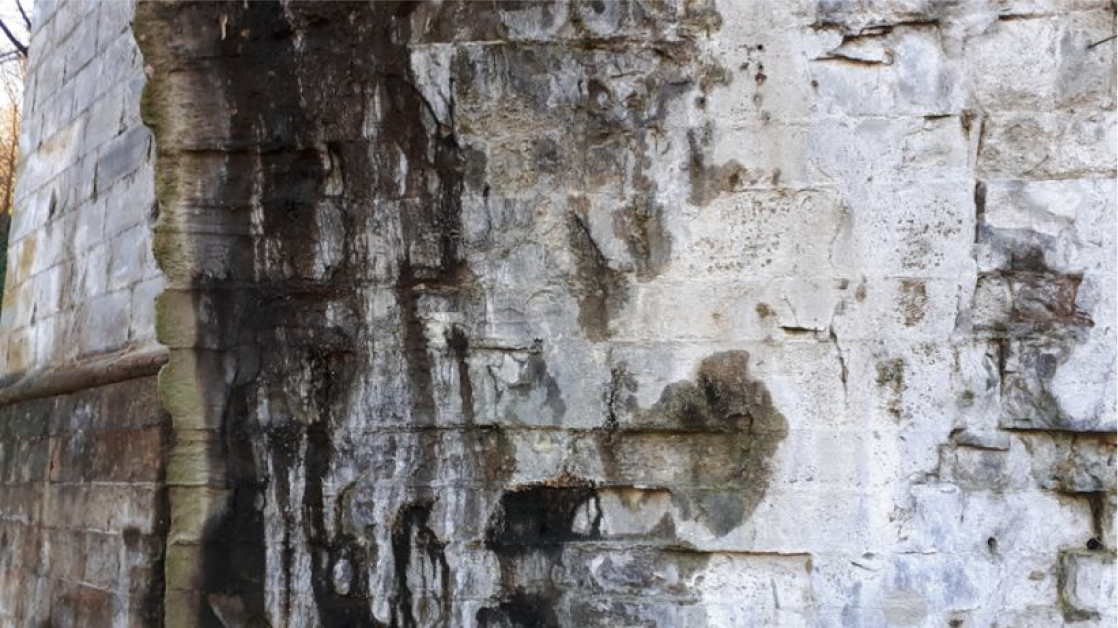
Possible ammonia-oxidizing beta-proteobacteria markings on Prebends Bridge (MET-TEC), Durham. Source: Author.
In particular, the tour spoke directly to my interest in Lenton and Latour’s (2018) call to find ways to requalify the “sensors” that might guide a politics of environmental care. It also linked to my exploration of the dialogue between Latour (2017, 138) and Haraway (2016, 77) on the legacy of Margulis’s (1998) reconceptualizing the role of—and our relationship to—microbes in the Anthropocene. This led me to approach Louise, whose art practice often engages with our relationship with microbial life to develop the microbial tour as a walking methodology (Springgay and Truman 2017). The idea we developed together was to investigate whether we could mobilize the senses to recognize—and even relate to—the action of nonhuman others and consider how that would change our inhabiting of familiar, urban places. Would our passage under the arches of the Victorian-era Ouseburn Viaduct—or Durham’s Prebends Bridge (Figure 1), itself directly linked to the Cathedral and St Cuthbert’s legacy—be transformed by touching the slime produced by ammonia-oxidizing beta-proteobacteria on its walls? If so, how? What sort of conversations, queries, passions, and attachments—if any—would the bacterial walk activities prompt? Could these be seen as forms of sensorial caring engagement (Calvillo 2018)? Could they be tools for “an ethico-political commitment to neglected things” (Bellacasa 2017, 100)?
Because of this loaded conceptual scaffold, and the news of Latour’s death, I wanted the recordings made during the walk to be somehow Latourian in character, perhaps as a gesture toward recognizing the legacy of his work. I wanted to be able to demonstrate empirically, through the recordings, how the walk was instrumental in tuning people’s bodies to the feel, sounds, and smell of bacteria as sensorial markers of microbial transformation of the environment, as a sort of Gaian detector. Not surprisingly, that did not turn out to be the case: most of the recordings didn’t even qualify as “data” in this particular framing, some merely recorded Louise’s preambular instructions on how to use the digital recorder, and others appeared to be registering participants’ movements from the inside pocket of a jacket. In discussions with Louise, the question was whether to consider these as “errors” or, as Louise argued, to take this noise as a point of departure for further experimentation, drawing on the artistic practice of manipulating field recordings. Could people’s interactions with recorders themselves during the walk lead toward an artwork further down the line? In other words, were these to be analyzed or played with?
Our discussions deployed a particularly important junction in Latour’s (2013) An Inquiry into the Mode of Existence (AIME), that between the work of science (REF) and the world of aesthetics (FIC). This is an especially productive, generative intersection in linking detailed inscriptions to stories and in devising narrative and form through images, sounds, and other “scientific data.” These passages are well institutionalized and easily recognized. For instance, during my fieldwork in a cell biology of aging laboratory (Moreira 2021), the principal investigator (PI) liked to start lab presentation sessions with the question “what’s the story we are trying to tell?” The question sought to focus the team’s attention on working out together this crucial hermeneutic circle between data and narrative, an account that he knew was always fictional to start with. Conversely, the meticulous preparation of images of specific cell structures was often likened by lab members to artistic craft, balancing saturation, vibrance, light, and so on to obtain a “high-quality” image which would be accepted by reviewers and journal editors. This entailed special observance of the representational conventions of objectivity because, as one of the biologists I worked with once observed, it is easy to be carried away, such is the aesthetic power of fluorescent microscopy pictures. This power is well exemplified in their use in many bio-art pieces since the late 1990s 3 and has itself become a focus of critique as an art practice (e.g., Mackenzie 2020).
The reason why Louise and I could/cannot agree on the ontological standing of the microbial walk recordings, I have slowly come to realize, is that we were/are doing that crossing in two different directions, almost like ships passing in a particularly foggy night: Louise generating source material to create sound art, and I drawing on aesthetic public engagement to produce data. 4 Of course, one solution to the impasse would have been to categorize and divvy up the recordings into “data” and “art” between the ones I could analyze with my sociological lens, expanded to include nonhuman activity, and the ones that Louise could develop as an artistic intervention. This solution is well established in situations such as interdisciplinary collaborations, where amid the confusion and tensions of working together we are able to recognize customary values—of objectivity, productivity, beauty, and so on—and resort to a “regional ontology” (Mol and Law 1994), a remedy that Latour (2013, xxvi) thought was acutely flawed in the way Moderns describe their own activities. It was indeed to address this Modern weakness that Latour, Callon, Law, and others proposed the concept of the actor-network, which “despite the criticisms to which it has been subjected” enables a powerful and insightful understanding of what makes action—such as the recordings we convinced participants to produce—possible (Latour 2013, 31).
But the concept of network has its own distinctive problems, some acknowledged by habitual users of the concept such as myself, that it could, for example, lead to what some have described as a “flat ontology,” not providing insight into the boundary making—the important pragmatic differences—that both actors and social scientists constantly engage in (important/trivial, sacred/profane, etc.). To introduce contour and discontinuity without relying on the idea of regional boundaries, AIME’s proposal was an elegant “compromise solution” of both being able to attend to the association of heterogeneous elements that make up the network and to understand specific modes of ordering value, their distinct internal passages, trajectory, and so on (Latour 2013, 35-37, 488-89). This compromise also enables the ethnographer—a reliable figure (FIC) throughout Latour’s work (Latour 2013, 34; Latour 2005; Latour 1987; Latour and Woolgar 1979)—to both map the circuitry and understand the different types of substances that flow within it. With her reliable empiricist drive and attention to conceptual detail, the ethnographer is able to do this because she notices points of “intensification of cross-border traffic between foreign elements” (Latour 2013, 30). Like her, we are invited to contribute to the project by “distinguish(ing) different modes whose paired intersections, or crossings, can be defined empirically and can thus be shared” (Latour 2013, xx, my emphasis).
Like Latour’s ethnographer, I was able to confidently identify the intersection where our recordings were located (above) and was also prepared to envisage “diplomatic” problematizations (Stengers 2005; Latour 2013, 304) to avoid the regional apportion interdisciplinary projects normally resort to. This consisted of a series of listening sessions where Louise and I attempted to redescribe the recordings together from a variety of perspectives in different conceptual languages, imageries, and so on (work still in progress). However, this solution also appears to let down the empiricist focus that the figure of the ethnographer aims to endow. By doing this, I often feel like I am getting away from the case (which could be perhaps entitled “the strange case of the microbial recordings”), betraying the one piece of academic advice Latour has ever given me, during a walk, in one of the few times I had the privilege to meet him. Unlike Latour’s figure of the ethnographer, I am rising hastily in generality, making the quality of the recordings hang on big valuation forms: science, art, technology, economy, and so on. By doing this, the recordings become less significant in themselves, as we struggle to make them pass as works of art or turn them into data for a research paper. In the process, paradoxically, they become un-relatable because we are unable to decide which passage to make with/through them.
This is an issue I have myself focused on when trying to make sense of the power of the “little stories” so commonly used in health activism: the personal, human-interest cases that mysteriously articulate and propel the causes of health movements (Moreira 2012). Taking inspiration from Tarde’s (1893) analysis of the exceptional—the least social of sociological topics?—I suggested that such stories could deploy new collectives not exclusively because of their power to relate a particular form of the good, but primarily because of how they gather in tension multiple, sometimes contradictory realities. Their generative effect was linked to the effective breaking of links between specificity and generality, done through sociotechnical unravelling and detailing of personal, fuzzy concrete uniqueness. They were inventive in their unrelatedness, or to put it more exactly, their ability to make the new social and technical ties (NET) health activists sought to build was reliant on not fitting neatly in any of the available formats or value regimes, including that of narrative fiction itself. They were at the intersection and that was what made them powerful, as Latour’s figurative ethnographer recognizes time and again in her detection of “border crossings” as empirical hot spots.
In this, such little stories, and perhaps the recordings we collected, challenged the compromise solution proposed in AIME. Staying with the case meant attending to the generative power of compound intersections not merely as crossings between recognizable modes of orderings but as moments of uncertainty. Speaking of uncertainty is the bread and butter of STS. One of its key distinctive orientations—and attractions in my perspective—is that unlike most other social science fields that take uncertainty as a context/condition with different types of rationality or symbols aim to reduce in sense-making, in STS, uncertainty can be conceptualized as an outcome of the process of making credible facts or useful artifact (e.g., Callon, Lacoumes, and Barthe 2009). From this perspective, uncertainty at the crossing is not the result of a weakening of structures or cognitive scaffolding but the effect of their overlap and interference. What characterizes them is that they are turbulent and confusing as an outcome of our inquiries, not as a starting point, as our struggles to make sense of the bacterial walk recordings attest. How can we take this confusion seriously as an effect? This is where we might have to extend the aims of AIME.
As we know, in AIME, boundaries/crossings have special methodological quality as intersections where types of values clash. Theoretically, this might be one of the many ways in which ethnomethodology’s program focus on the power of “bracketing” in losing/gaining the cognitive recognizability of the orderliness of the world (Rawls 2002, 32) has impacted on Latour’s work. In this regard, perhaps via Garfinkel, there is also some similarity between AIME’s crossings and how Boltanski and Thévenot (2006) conceptualize situations where actors strive for equivalence drawing on different Modern “orders of worth.” For them, as for Latour and Garfinkel, the cognitive element is paramount. For Boltanski and Thévenot, disputes build the conditions for the placement of people or things in modes of coordination, a situation where actors aim to reduce uncertainty by making different understandings comparable/compatible (see above). In AIME, disputes serve as methodological probes to identify modes of existence, which strive to capture each other (Tarde [1895] 2012) lead to misdescriptions (PRE) such as “scientism” or “constructivism” and for which ontological pluralism is a possible remedy. The possibility of (diplomatic) peace is underpinned by careful redescriptions of each mode of existence extracted from crossing and understood within their own institutions (Latour 2013, 480-85). This focus on uncertainty reduction and the cognitive is not inevitable, however.
Responding to Star, Haraway, and other feminist critiques of actor-network theory’s insensitivity to difference (see above), Mol, often in collaboration with Law, articulated a program of empirical research that has come to be known as “ontological constitutionalism” (Verran 2017) or “multiplicity realism” (Zuiderent-Jerak 2015). The aim of this program has been to identify and trace the different modes which enact a specific object and to investigate their pragmatic relationships (Mol 2002). Multiplicity realism proposes a different approach to the question of difference than that recommended in AIME—although the latter was inspired by the former—by suggesting that relationships between ontologies might not be visibly articulated in an open—discursively, cognitively articulated—dispute format and might even confusingly overlap in discourse and not require an agonistic-type solution (war, compromise, peace, diplomacy, etc.). Importantly, it suggests that there might be more than two ontologies at play in any given situation. This shift away from duality and the cognitive—and their associated (ethno)methodological qualities—opens our inquiries to the idea that ways of combining differences are a pragmatic requirement to situations, and of empirical interest: it is possible to trace, identify, and label their arrangements. Also, it enables the realization that different solutions—including those of compromise—have different consequences.
That ontologies might be arranged in different pragmatic configurations is hinted at by Latour in his own formulation of “ontological pluralism” in AIME (Latour 2013, 142, 181-83) in a way that has particular bearing on the microbial walk recordings (above). When discussing “domesticated bacteria,” among other examples, as “beings of technology” (Latour 2013, 225-27), Latour argues that their existence is articulated as composites of two different types of crossing, because they maintain themselves (REP-TEC) through change (MET-TEC), a specific type of movement that cannot be captured by the word “object” and for which “[we] could have used the word project…but we would have needed another mode, that of organization, a [third] crossing that we shall not learn to master until much later [TEC-ORG]” (Latour 2013, 227). Recognizing and describing this compound configuration would, admittedly, take AIME’s project in a different direction. In relation to “domesticated bacteria,” it would most likely have entailed discussing how the processes of lateral gene transfer have been used in numerous biotechnological projects and, in particular, discussing the hypothesized alignment of bacteria’s own transmutation processes to “the specific demands of post-Fordist production” (Cooper 2011, 33; also Roy 2018). While Latour does warn us away from equating the trajectory of beings of technology, on the one hand, and of technological capitalism, on the other, with the “inventiveness of matter,” presumably because it prevents us from understanding exactly how bacteria might become technology, the key reasons is that focus in AIME is not on exploring the topological configurations or compound crossings that enact “domesticated bacteria,” but of deploying domesticated bacteria as exemplars or windows to the paired intersection of different modes of existence.
What would happen if we would take the topological focus seriously? What specific arrangement of modes of existence makes “domesticated bacteria”—and their controlled, targeted metabolism—possible or in turn profitable? What configuration, on the other hand, deploys the confusion I experienced in listening to the microbial walk recordings? The juxtaposition of these two questions is deliberate here because in both cases, we are dealing with specific microbes: Latour’s figure was likely some sort of modified E. coli strain—the “workhorse of molecular biology and biotechnology”—versus the methanogens (anaerobic archaea) whose gas production we were trying to capture with our noses, and as bubbles popping on tape in our microbial walk. It is also deliberate because one of the most common questions I have been asked about the sensorial walk methodology Louise and I are trying to develop focuses on the extent to which it could be likened to how biotechnological projects capture bacterial/microbial action as labor. Were we just using—that is, exploiting—bacterial action in the making of techno-economic expectation in the life sciences through science education? To what extent were we rendering microbial action merely as resource production (gas, warmth, bioactive compounds, etc.) rather than, as intended, as procedures of sensorial caring engagement? Was drawing on aesthetic engagement with bacterial action adding—unintentionally—to the alignment between science and capitalism? What would make the participants walk in one rather than another mode of engagement? What situation would enact different ways of sensing microbial presence?
I think the answer to these questions lies exactly in the attention to the topological configuration of modes of existence. Let’s return to the recordings and our puzzlement over them. Of the possible, multifarious interactions between ontologies, only some entail uncertainty-as-confusion as a key outcome. But a key problem in thinking about this possibility is that confusion has a bad name, a reputation that might undermine the very idea of conducting an inquiry (Boltanski 2014). At best, it can mark the starting point of the investigation—the Gordian knot, for example (Latour 2013, 19; also Kelty in this volume)—rather than its result and main finding. Seen from the middle of the turmoil, Serres (2009, 161) argues, this epistemological standing is unfair because “[to] confuse means, first of all, to pour together, to conjoin several streams into one [which] a thousand noble practices [have done] for practical purposes or merely for pleasure, often for knowledge.” He suggests that these practices should be the basis of a “philosophy of confusion,” one that if treated symmetrically would enable the creation of a “multiple, vibrant, complex map, more complete than clear.”
It is of no coincidence that Serres formulates this alternative, neglected philosophy of knowledge when investigating the noncognitive forms of knowing deployed by sensorial engagement. Seen from this perspective, the unrelatedness of the recordings, their not passing easily through any of the modes of existence identified in AIME, might be indicative of the diversity of styles of practice articulated at the junction of multiple ontologies. In the same way that beings of technology should not be taken to be a version of matter, so should not beings of the senses be taken to be aesthetic in some way or another (FIC) or to constitute potential “data” (REF) or unrecognized labor. Not all of them lead to “clear maps,” and, importantly, should not be confused with AIME’s (NET), where cognitive clarity can be obtained through detailed tracings by the conscientious ethnographer (FIC). The recordings instead might have a distinctive character that cannot be drawn and is incomplete. Might not caring for “neglected beings” exactly entail this “noble practice” of attending to these beings in their own right; in their incomplete, confused way of being; and incapable of passing, of permanence (REP), not qualifying to belonging to a world?
Beings such as these are more common than we like to admit: we often describe them as half-formed, fuzzy, indistinct, obscured, in between, and so on. But they are everywhere; they have a specific type of existence that makes them “not interesting enough” because they do not pass as particular forms of being, but we share our lives with them, even when we do not notice or appreciate them. They are more than prompts for thinking; indeed, they often defy our procedures of inquiry and investigation, the methods and concepts, the “aims and objectives,” and the capacity for obtaining cognitively and seeing clearly. These incomplete, confused beings deserve to be looked at again in a different way: not as the result of a failure of translation processes, or of an unsuccessful crossing, but as evidence of the generative power of compound, simultaneous intersections, as originally proposed by Tarde (1893) in his theory of innovation. Latour’s figurative ethnographer might need to pay more attention to these weakly defined, cognitively defiant new actors, entities, or relations if they are to be able to collaborate fully in AIME. In this, they might have to extend the inquiry to include beings that do not (yet?) have their own trajectory, felicity conditions, and institutions. How can this be done? How to talk about those near-beings? I do not know, but I think I might start by listening to those recordings with Louise again.
Footnotes
Acknowledgments
I am grateful most obviously to Louise Mackenzie but also to Wilson Poon, Margarita Staykova, Kimberly Jamie, Alexandra Carr, Laura Forlano, and Suzie Protiere for their contribution to the development of the bacterial walk. Thanks are due to the participants/recordists of the bacterial walk in the Ouseburn in the summer of 2022. Thanks are also due to Madeleine Akrich and Noortje Marres for comments on an earlier version of this paper and to the editors of Science, Technology, & Human Values for the invitation to write this paper and for the guidance on drafting and revising it.
Declaration of Conflicting Interests
The authors declared no potential conflicts of interest with respect to the research, authorship, and/or publication of this article.
Funding
The authors received no financial support for the research, authorship, and/or publication of this article.
