



Abstract
This article focuses on key features of the use of sex and gender in titles of articles about women, science, and engineering over an important forty-six-year period (1965–2010). The focus is theoretically and empirically consequential. Theoretically, the paper addresses science as a critical case that connects femininity/masculinity to social stratification; and the use of sex and gender as an enduring, analytical issue that reveals perspectives on hierarchies of femininity/masculinity. Empirically, this article identifies the emergence, development, and stabilization of published articles about women, science, and engineering that use sex and gender in their titles. The distinctive method involves search, retrieval, and review of 23,430 articles, using intercoder reliabilities for inclusion/exclusion. This results in a uniquely specified and comprehensive set of articles on our subject and the identification of titles with sex and gender. Findings point to (1) the growth of gender titles, (2) their increase in every field, (3) differing concentrations of sex and gender titles in journals, (4) a span of telling topic areas, and (5) higher citation rates of gender, compared to sex, titles. Broader implications appear in reasons for the growth of gender titles, meanings of topic areas that occur, insights into social inequalities and science policies, and emerging complexities of nonbinary categories of sex/gender.
Introduction
Issues of sex and gender are fundamental to understandings of individuals, groups, organizations, and institutions. In examining these issues, science is a strategic research site for the following reasons. First, for societies at large, scientific activity has a powerful influence on institutions, including higher education and the state (Hackett 2008). Scientific fields have shaped graduate education, specialized curricula, decentralized departments, and research autonomy within universities (Montgomery 1994). Science and the state connect through the public funding of scientific research and education, and “national interests” in scientific progress and prestige (Marginson and Van der Wende 2007). Second, scientific activity is marked by vast disparities in research funding, equipment and materials available, discoveries made, and rewards received (see Stephan 2012). Third, categories of femininity and masculinity form broad and pervasive systems of stratification, reflected in economies, social structures, and behaviors built around women’s and men’s statuses (see Blair-Loy 2003; Lorber 1994). Fourth, these general societal systems of stratification of women and men are particularly evident in the hierarchies of women and men in scientific fields, documented in ranks, recognitions, rewards, and other areas (see Fox, Whittington, and Linkova 2017; Gaughan, Melkers, and Welch 2018; Miller, Duque, and Shrum 2012; Sonnert and Holton 1995). In sum, because science is influential and hierarchically structured, and because societal inequalities of women and men manifest themselves in internal scientific hierarchies, science then reflects, reproduces, and legitimizes inequalities of women and men in societies (Fox 2006).
Therefore, the nexus of sex, gender, science, and engineering becomes an important research site for this article. We focus on a telling aspect: key patterns of the use of sex and gender in titles of articles about women, science, and engineering 1 over an important forty-six-year period (1965–2010). The period encompasses the mid-1960s when few articles existed on the subject, subsequent years in which sex, gender, and equity were at the center of social tensions, and finally, the first decade of the new millennium. We identify patterns of the growth, locations (fields, journals), topical areas, and impact of titles with sex, compared to titles with gender. More broadly, this study addresses issues in the growth and dissemination of titles in a revealing research area that connects sex and gender with science and engineering and has implications for perspectives on hierarchies.
The use of the words sex and gender is a consequential and enduring issue because the terms link with perspectives on femininity/masculinity (see Archer and Lloyd 2002; Lorber 1994). Current definitions of sex and gender vary and have become complex. At the same time, a continuing perspective is that sex is associated more closely with biological influences on femininity/masculinity even though sex is not necessarily natural or stable (Kessler and McKenna 2000) and that gender is associated more closely with social/cultural influences (Muehlenhard and Peterson 2011). Authors’ use of the one term or the other can then reflect their decisions about the terms and the connotations they convey. We focus on use of terms in titles because titles have a crucial signaling function for articles. However, meanings may conflate in actual content (Glasser and Smith 2008), and we acknowledge this limitation. In addition, we are sensitive to categories that transcend binary definitions of sex and gender, as in transgender (Johnson and Repta 2012). The present data do not permit us to address transgender because the term does not appear in the titles of articles in this study. Our analyses provide a baseline for future studies that address transgender terms as they begin to appear in the subject area.
In scholarly social science publications broadly, the term sex appeared earlier than gender. Allport’s (1924) classic textbook on Social Psychology contains numerous entries about sex and none on gender (see Biernat and Deux 2012, 475). Parsons (1942) used “sex role” in a classic, early paper on social stratification. The term “gender role” initially appeared in Money, Hampson, and Hampson’s (1955a, 1955b) papers, using gender to refer to psychological characteristics and behaviors and sex to refer to physiological characteristics. These two papers were the first formally distinguishing between sex and gender. Subsequently, Unger’s (1979) paper was influential, especially within psychology (see Biernat and Deaux 2012). Unger argued, basically, that sex implies biological/physiological factors and that gender refers mainly to social factors. She advocated the distinction for political and social reasons: “A major problem appears to be the too inclusive use of the term sex” (p. 1085) and “many so-called sex differences may actually be gender differences” (p. 1093). Consequently, she argued that ambiguity prevails about questions such as “what does finding a given sex difference in behavior tell us? What are the mechanisms that produce such [sex] differences?” (p. 1087).
Here, we investigate the use of sex, compared to gender, in titles of articles about women, science, and engineering, using a precise method to identify them. The focus is on titles in published articles, sometimes called “explicit” knowledge (Rousseau, Zang, and Hu 2019, 11). Other forms of knowledge that are oral and/or more informal certainly exist. However, scholarly (peer-reviewed) articles are archived, retrievable, and widely available. They serve as a standard of dissemination of knowledge and evaluation of scholarly performance. These features make them important for our inquiry.
Focal Questions
Our focal questions address the growth and spread of titles using sex and gender in a revealing research area of women, science, and engineering.
What are the patterns and forms of growth (growth models) in the use of sex and of gender titles in our subject area? Does a rise in the use of gender titles reflect journals’ editorial policies and guidelines?
In which locations (fields and journals) do these titles appear? Do the distributions (concentration, dispersion) in journals vary for sex titles compared to gender titles and over time?
What are the leading topic areas/themes for sex and gender titles? Do these areas evolve (or persist) over time?
What is the impact of sex and gender titles in citations, and does it vary over time?
What are broader implications of findings for perspectives on hierarchies of femininity/masculinity in science, and strategies to address them?
Previous Research on the Use of Sex and Gender
Previous research on the use of sex and gender falls into three categories. In the first category is Haig’s (2004) study using three sources to assess the use of sex and gender across all academic titles. The search is largely undifferentiated, relying on occurrences of “sex” and “gender” in titles without filters for inclusion/exclusion. This study points to patterns (1945–2001) of (1) rare use of gender (other than for grammatical references) up to and including the 1960s; (2) growth, “in tandem,” of both sex and gender terms during the 1970s; (3) rapid rise in the use of gender, relative to sex, during the 1980s; and (4) a constant plateau (rather than growth) in the use of sex after 1990 and of gender after 1995. Haig (2004) attributes the rise in the use of gender to “feminist adoption” but does not measure this.
The second category focuses on the use of sex and gender in psychology and social psychology. Basow (2010) points to the shift from sex to gender in psychology textbooks published, 1975–2010. In an analysis of the most commonly adopted textbooks on the psychology of women, Muehlenhard and Peterson (2011) report also that authors typically provide a section distinguishing between sex and gender. Relatedly, Biernat and Deaux (2012) report increasing use of sex, and later gender, in the psychological literature. They also identify prevalent topical areas in annual reviews, selected textbooks, and in two specialty journals in psychology. The areas are “sex differences/comparisons,” “gender stereotyping,” and “gender and achievement.” Of these areas, the most enduring is “sex differences/comparisons.”
In the third category are two related bibliometric analyses of the extent and features of articles on women in science and higher education (Dehdarirad, Villarroya, and Barrios 2015) and gender and technology (Arjunan and Surya 2010; related and not equivalent to our focus on women, science, and engineering). These do not address the use of sex and gender. Based on 1,415 articles and reviews published between 1991 and 2012, Dehdarirad, Villarroya, and Barrios (2015) identify an exponential, upward trend in articles on women and higher education. They show that articles disperse among journals (61 percent of the journals published only one article) and that a small core of journals publish the preponderance. Arjunan and Surya (2010) report growth in articles on gender and technology, especially in the mid-2000s. The study does not specify a method for including the 1,819 articles represented.
Another bibliometric study reports that gender is an area appearing in both quantitative and qualitative handbooks in science and technology studies and, thus, is a “shared area” across these handbooks. This study does not address the use of sex terms compared to gender terms (Milojević et al. 2014). An additional bibliometric approach, based on a Swedish database, analyzes the growth, impact, and other features of articles in gender studies, not specific to science and engineering (Söderlund and Madison 2015). This study also compares articles in gender studies with those appearing in journals on women’s health from a medical perspective.
Present Study: Distinctions and Contribution
Our study is distinctive in identifying key features of articles (growth, places, topical areas/themes, impact) on the subject of women, science, and engineering using sex, compared to gender, in titles, over time. This focus is important because (1) science is a critical case in connecting femininity/masculinity to social stratification and (2) the use of sex and gender is a consequential, enduring analytical issue that reflects perspectives of femininity/masculinity and social dynamics associated with them.
Our method specifies the articles on women, science, and engineering in a crucial forty-six-year period (1965–2010), which encompasses the emergence, growth, and stabilization of the body of published articles on women, science, and engineering. Prior to 1965 (1900–1964 2 ), only fifty-two articles exist in the Web of Science (WoS) that have terms of women or sex or gender and science or technology (focal keywords here), and only thirty-three exist in the Social Science Citation Index. A longer period (beyond 2010) would be a span for continuing inquiry. Nonetheless, the analyses reported here establish that changes appeared in the use of sex and gender at the midpoint of the 1965–2010 period. In this way, our span of time is wide enough to understand trends before and after these changes occurred.
Our method involves systematic search, retrieval, and review of 23,430 articles, and means of establishing intercoder reliabilities for inclusion/exclusion. In doing this, we identify a uniquely specified and comprehensive set of 3,174 articles on women, science, and engineering, and from those, the titles with sex and gender. Our study provides nuanced findings and insights—not previously known—about the growth and features of titles on sex and gender in articles, connected to women, science, and engineering. Broader implications, addressed in the Conclusions section, encompass reasons for the rapid growth in use of gender; meanings of the topical areas that occur; and useful insights for science policies addressing social inequalities.
Method
Data
Data source: WoS
The source of our data is the WoS’s Social Science Citation Index. The index was well suited to our analyses in three ways. First, it provides access to peer-reviewed articles within 1,700 indexed, continuously published social science journals. Articles in the social science index are a strong source of articles about women, science, and engineering although science journals also contain articles on the subject. Second, the long time span (1958–) permits analysis for a key forty-six-year period (1965–2010). Third, the index covers articles in English, which allows a research team competent in this language to determine whether these articles meet specified criteria for inclusion (as described below).
Search process and retrieval of articles
In the search for articles, we iteratively developed a set of terms for inclusion and exclusion of articles to compile a uniquely specified and comprehensive set of articles in our subject area. This is critical because bibliometric indicators need to be selected carefully for the aims of a study (Andrés 2009, 9). Our search and retrieval process involved two stages: (1) broader identification of publications within our subject area and (2) review for valid inclusion or exclusion. The third stage focuses on titles using sex and gender, detailed in the following section.
The first stage deliberately cast a wide net for retrieval of articles on women, science, and engineering with a set of search terms (see Figure 1). The search applied to titles for all years and to author abstracts and keywords from 1990s onward (in the Social Science Citation Index, abstracts are available starting 1992, and keywords starting 1991). The search identified publications with terms for girls, women, sex, gender, and/or female and terms for specific scientific fields and subfields, as well as “science” and “engineering.” Additionally, because our interest encompasses scientific “professions” or “careers,” the search included those terms.
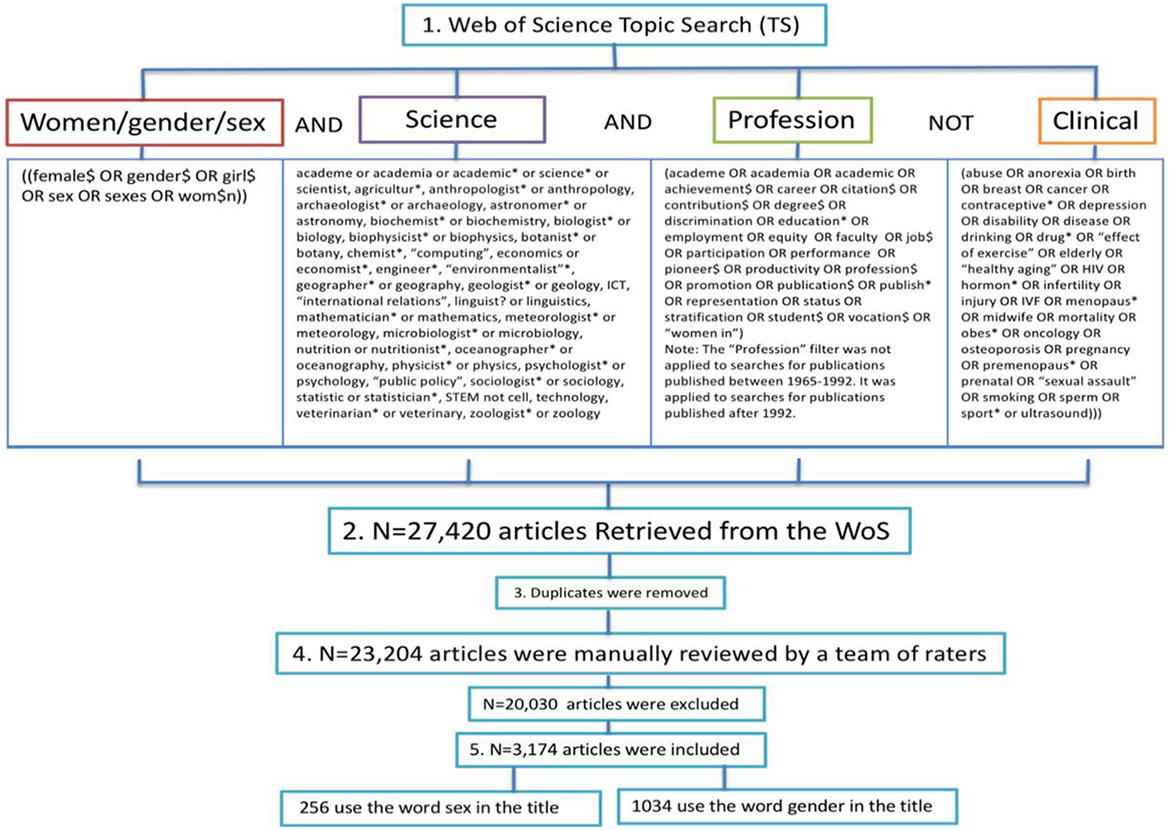
Search string of terms for identification of articles (stage 1).
For search terms for fields and subfields, we used categories in the Scientists and Engineers Statistical Data System of the National Science Foundation (NSF 2015). Fields and subfields are important because simply searching for “science” or “engineering” excludes publications in subareas. For example, articles about women in chemistry would not necessarily show up unless the field of “chemistry” appeared in the search query; the same applies for other specific fields. Next, we created terms for exclusion of articles beyond our specified area such as clinical areas of drugs, smoking, obesity, fertility, birth, contraceptives, menopause, and related (see Figure 1). Clinical areas are interesting (and potentially extensive) subjects for a different study, beyond the scope here. For these reasons, we explicitly excluded the clinical terms at this first stage, so that they did not reoccur in the second, detailed review.
Review for inclusion
The second stage was a close review to confirm whether publications belonged in the focal subject of women, science, and engineering. For this, we used interrater/coder reliabilities. After extensive and systematic training, two coders, who were experienced members of the research team, examined the title (all years) and abstract (available beginning 1992) for each item retrieved in the first stage. The coders independently rated each as “include,” “exclude,” or “consider further,” described below. The training and experience of the coders, and the protocols followed, support reliable inclusions and exclusions.
The criteria for the coders’ ratings were the extent to which a given article addressed (a) women and (b) science (where, as noted, science encompasses natural, biological, and physical sciences, computing, engineering, mathematics, and social sciences, the NSF classifications; Figure 1). If at least one-third of a relevant set of terms about the group(s) at focus (or their characteristics) addressed women (or girls, sex, gender, female), it met the first criterion for inclusion. Thus, for example, if a given article addressed gender, age, and parental level of education, it is included. In addition, if at least one-third of the relevant terms about the field(s) at focus addressed science, it met the second criterion for inclusion. Thus, if a given publication addressed women studying biology, mathematics, economics, and business, it is included (three-fourths of these fields are scientific fields/classifications). The comprehensive summary of terms for inclusion and exclusion appears in Figure 1.
If rater 1 and rater 2 differed in their include/exclude ratings or if at least one of them coded the item as “consider,” we reviewed the publication at a weekly research team meeting. We also tagged as “check” those articles that remained unclear. In this way, we examined 23,420 publications in WoS—comprising articles, proceedings, reviews, and research notes but predominately articles—for the years, 1965–2010. We identified 3,174 articles, after inclusions, exclusions, and removal of duplicates. Among these, our focus here is on the terms sex and gender appearing in titles, explained below.
Variables and Means of Classification
Sex and gender
In a more specific search, we identified the titles containing sex and gender, using a text search among all the titles in the database. The focus on titles aligns with our aims because titles have a signaling function about the use of sex and gender in the articles retrieved in the first stage and verified in the second stage. Operationally, gender titles are those that use the words gender, genders, and engendered. Sex titles are those that use the word sex and sexes; but not sexy, which appeared in one title.
Analyses based on words in titles is an established protocol in studies of the use of sex and gender, broadly (Haig 2004) and in studies of psychology publications (Whissel 2012), the field in which prior research on use of sex and gender is most extensive. The basic rationale is that each article has a specific title that previews content (Nair and Gilbert 2016) and that titles trigger attention and capture interest (see Milojević et al. 2011). Titles are key to our analysis for these reasons because they trigger attention and capture interest about use of sex compared to gender related to women, science, and engineering. Further, titles are consistently and uniformly available for the full forty-six-year period of inquiry. Titles are not free of inaccuracies about content but they indicate how the focal use of sex and gender evolved in our subject area.
Places: Fields and journals
Using the WoS subject areas as a guide, we classified the fields of journals in these ways. First, we grouped the journals into eight categories based on WoS subject areas. Second, we reviewed each journal’s website for its field, using the journal’s “About” tab for the statement of purpose and the professional organization (if any existed) that published the journal. When multiple fields appeared in the “About” tab, the first listed informed coding. Third, when the primary field did not appear on the journal’s page, or the fields did not match with our classifications, we coded the journal as “other.” A second coder then reviewed these fields to determine whether they fit into a given field (or not). The second coder also identified journals for discussion and resolution of their fields.
The resulting fields are as follows: (1) economics, business, and management (including human resources and personnel-related); (2) education (teaching, learning, training-related within scientific areas excluding medicine, which appears in the following category); (3) health and medicine (including nursing, psychiatry, health services, veterinary medicine, and education in these areas); (4) psychology (excluding psychiatry, which appears in medicine); (5) social sciences other than psychology (anthropology, demography, geography, policy, political science, public administration, sociology); (6) STEM (science and technology fields outside of education); (7) women’s studies (interdisciplinary study of women/gender); and (8) other fields and multidisciplinary areas. 3 Other fields (not in the first seven listed above) include science and technology studies, ethics, information and library sciences, and linguistics. The multidisciplinary areas fit within more than one of the first seven listed. Separately, each of the “other fields” and each of the “multidisciplinary areas” are of insufficient size to constitute their own categories.
Topic areas/themes
We classified eight topic areas or themes in titles: (1) attainment, (2) career, (3) differences, (4) justice, (5) teaching-learning, (6) participation, (7) stereotypes, and (8) other. Table 1 shows the areas, the words associated with them, and their underlying meanings.
Topics/Themes: Categories, Words, and Underlying Meanings.
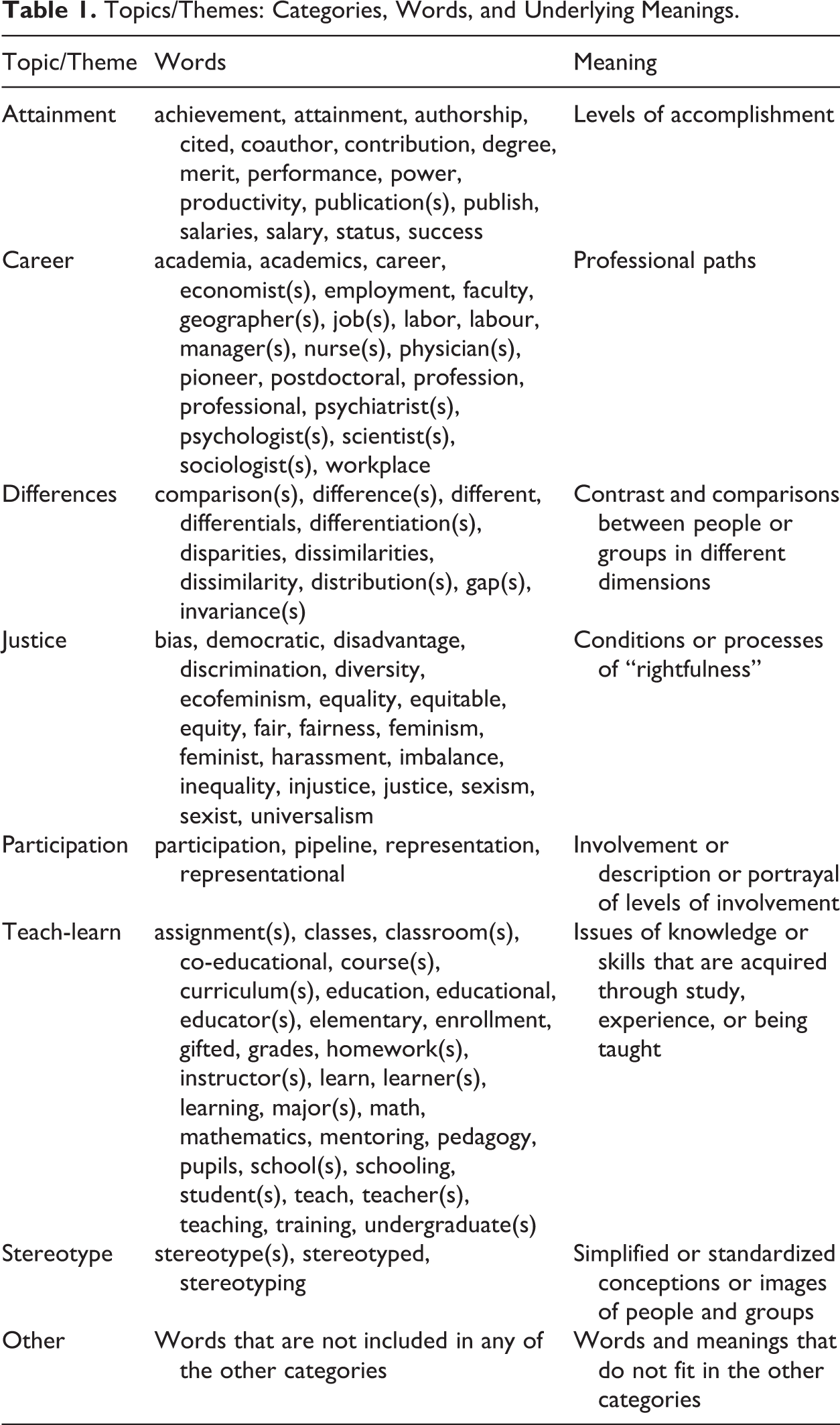
The method for coding themes involved these steps. Initially, we created a list of themes in titles, using the autocode function in NVivo (Version 11) software. We identified the most frequently occurring words (appearing twenty or more times) in titles and based on these, automatically mapped titles into topic areas. Next, we reviewed the titles that did not map automatically. We individually coded these into the existing topic areas or classified them as “other.” 4
We coded a title only once for a given topic area (whether or not an area occurred more than once in a given title). However, a title may encompass more than one area (depending on the words that appear). The coding reflects this with, potentially, multiple themes for a given title. For example, the title “Competency beliefs, positive affect, and gender stereotypes of elementary students and their parents about science versus other school subjects” is coded in the categories of both stereotypes and teaching-learning. Because titles may have multiple themes, the percentages of titles containing themes will not sum intuitively to 100 percent in the tables presented.
Impact: Citations
We use citations as indicators of “influence,” “impact,” and/or “utility,” recognizing that controversy exists about meanings of citations (Todeschini and Baccini 2016, 49). A technical issue is that citations do not assume a normal distribution. Rather, they are skewed so that, for a given topic, a small number of the articles have a high number of citations and the preponderance have few (or none). Therefore, we include both total citations to articles and proportions of total citations that owe to the highest cited article within a period (explained in Means of Analysis section). The citations to articles are those downloaded from the WoS from date of publication through 2010, categorized into five-year periods based on publication date.
Means of Analysis
Growth models
We investigated the form of growth that the sex and gender titles exhibited, using linear, exponential, power, and Gompertz models. 5 We compared these models with the data collected on sex and gender titles and assessed the fit between the theoretical (model) and the actual (observations) form of growth.
Role of editorials
We assessed the role of journals’ editorial statements in potentially prompting a distinction between, and in the use of, sex and gender. This involved examining the (eleven) journals that have thirty or more articles in our subject area. For the period of particularly strong growth (1986–1990) in gender titles, we determined whether statements about the use of sex and gender appeared in these journals: (1) editorial guidelines, (2) submission guidelines, (3) masthead page, and (4) other areas. Analogously, we examined the (twelve) journals that have sex and or gender in the journal name (one of these journals appeared also in the group with thirty or more articles). 6 The assumption was that journals with sex or gender in their name might be particularly outspoken leaders of publication policy about use of the terms. Journals were coded with a yes/no for any (and which) of these four types of statements (above). We also included date and the actual statements that appeared.
Distribution of articles among journals
To analyze the distributions of articles among journals, we use Bradford’s law, appearing widely in sources on bibliometric methods (Andrés 2009; Sugimoto and Lariviere 2018). Bradford (1934) stated that for a given topic, a few journals predominate in publications. The results can be presented in two ways: Bradford zones and an S-shape curve. First, the zones are a chosen number of groups (p) that contain the same number of articles and an increasing number of journals. The law states that the number of journals in these groups increases in a geometric progression with a constant k, known as the Bradford multiplier. This multiplier is defined in the equation below where Y is the highest number of articles in a single journal and p is the number of zones:

The number of zones with the best fit for a given set of data may vary, but the first zone (also known as the nucleus or core) contains the most relevant journals (Pulgarín and Gil-Leiva 2004). Second, the S-shaped curve results from plotting the natural logarithm of the cumulative number of journals (also known as rank) against the cumulative number of articles.
Using Bradford’s law, we found that three zones (each with one-third of the articles) provided a good fit for the sex and gender titles. This means that with p = 3, the theoretical number of journals and articles in each zone is the closest to the real number for all zones. We also compared the distribution of titles within the S-shape of the Bradford’s Law and report these in Findings section.
Citation measures
Because citations have a skewed distribution, a common approach involves the analysis of proportions as well as counts of citations (Abramo, Cicero, and D’Angelo 2012; Aksnes, Langfeldt, and Wouters 2019; Todeschini and Baccini 2016). These proportions are “scaling factors,” also called Article Impact Indices (Todeschini and Baccini 2016, 51) and include ratios between the highest cited article in a group of articles and the sum of citations for the same group of articles in a time period. Our measures of citations to sex and gender titles encompass (1) the total number of citations (citation sum, S); (2) the highest cited article of a group (H); and (3) the ratio (H/S) for articles in our sampling frame within five-year periods.
The citation measures chosen are those appropriate to the intellectual purposes of our analysis, as emphasized in analytical approaches to citations (Aksnes, Langfeldt, and Wouters 2019). Our measures align with the aim to understand the influence of sex, compared to gender, titles reflected in total citations and in the impact of the most “influential” (highly cited) article. The ratios of highest to total citations give insight into the extent to which the highest cited articles are “drivers” of research influence in our developing subject area. 7 The temporal dimension is important, and the span of five years is revealing for a study addressing “evolving knowledge” (Aksnes, Langfeldt, and Wouters 2019).
Findings
Articles with Sex and Gender in Titles, over Time
Of the 3,174 documents identified for inclusion, 256 (8.1 percent) used sex and 1,034 (32.6 percent) gender in their titles. A small subset of articles (n = 30) used both sex and gender, and these are coded in both categories. This section reports fundamental findings on growth in the use of sex and gender terms, including formal models of the shape of growth; and whether growth of gender titles reflects editorial, journal policies about the use of gender, compared to sex.
The use of sex and gender divides into four distinct periods (Table 2). First, in the early years, only a small number of titles in this emerging subject area contained either sex or gender. Before 1970, three titles contained sex, and none contained gender. During the first part of the 1970s (1970–1974), thirteen titles appeared with sex and one with gender. In the latter 1970s (1975–1979), gender titles continued to be rare, with only one found. Sex was more common, appearing in eighteen titles. Thus, in the decade of the 1970s, sex titles occurred and gender titles were rare.
Total Number and Percentage of Articles with Sex and Gender Titles, by Five-year Period.
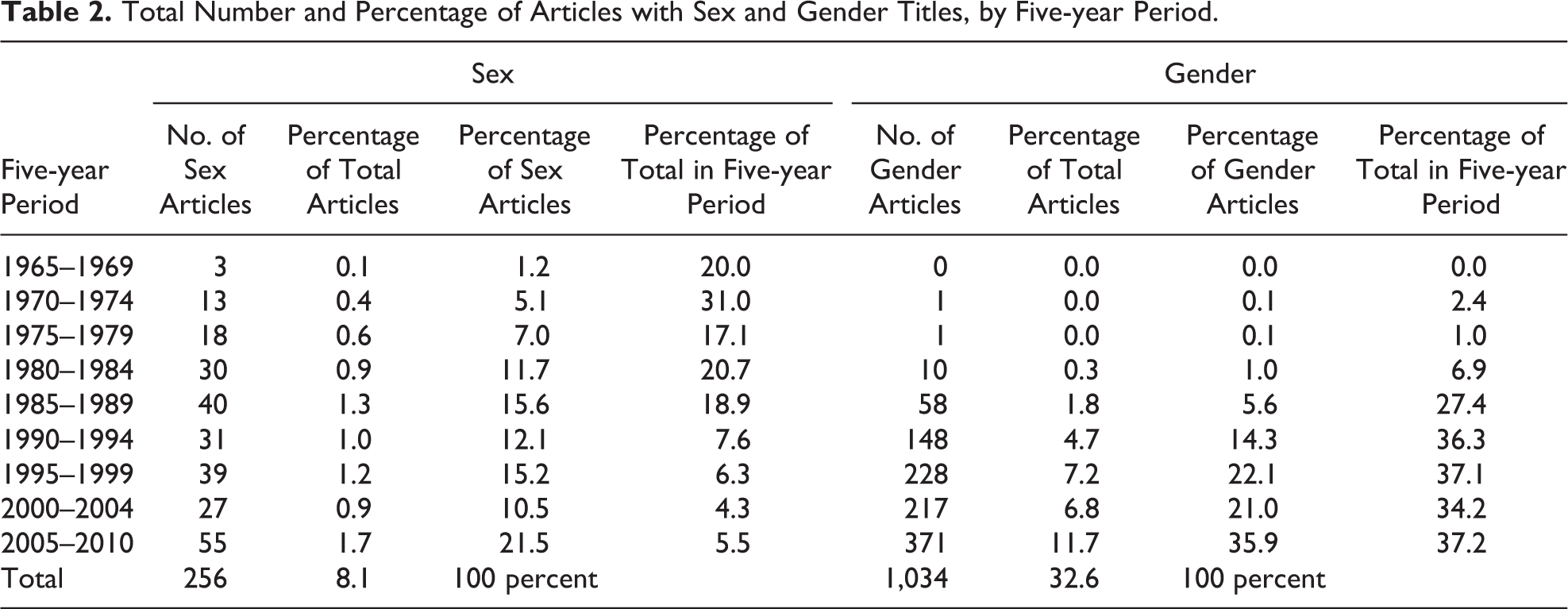
Second, in the early 1980s (1980–1984), gender titles began to appear with ten gender titles in this period. However, sex titles were three times more prevalent with thirty, representing 21 percent of articles in our subject (Figure 2). Then, in the late 1980s, gender titles took off. Fifty-eight gender titles appeared, representing close to a third (27 percent) of all articles. Between the early and late 1980s, the number of sex titles actually increased from thirty to forty. However, sex titles began to diminish in share of the total articles. This means that the total number of articles in the area increased, and the greater share of the titles now used gender.
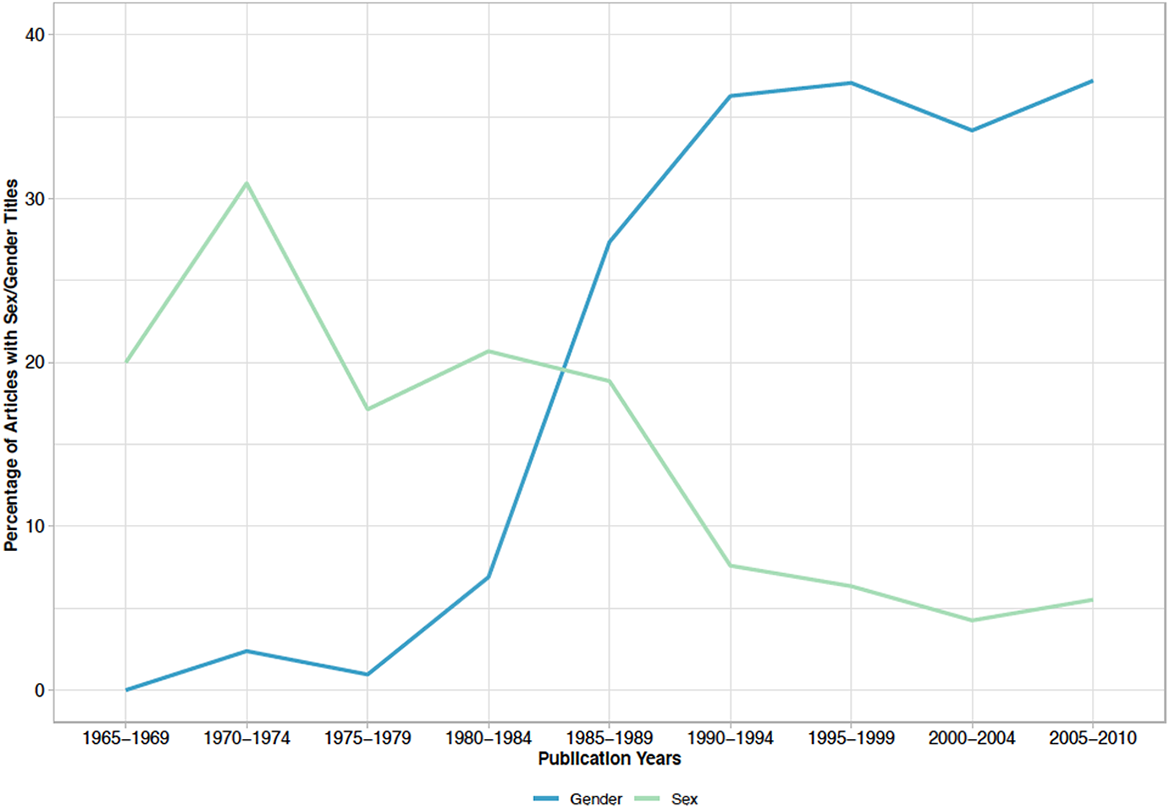
Percentage of articles with sex and gender in title, by five-year period.
Third, in the 1990s, the patterns observed in the late 1980s became more pronounced. Between the 1980s (1980–1989) and the 1990s (1990–1999), the number of articles in our subject area grew substantially, increasing threefold. Further, in the late 1990s (1995–1999), about 6 percent of all titles used sex, and 37 percent, gender. Thus, the proportion of titles with sex decreased, and a rising proportion appeared with gender.
Fourth, in the recent decade (2000s), the proportion of all titles with sex declined further (to 4.9 percent), and the proportion with gender remained stable (at 36 percent). By this time, the use of gender clearly predominated.
Formal models further specify the shape of the growth of sex and gender titles. These appear in regression models showing the relationships between the use of sex terms and gender terms, respectively (dependent variables), and time (independent variable), applying the linear, power, exponential, and Gompertz models of growth (Table 3). We find that the highest R 2 values are for Gompertz models, where the value is somewhat higher for gender (0.995) than for sex (0.849; Table 3).
Summary of Fit of Regression Models for Growth in Use of Sex and Gender in Titles of Articles, Counts and Percentages of Total, Over Time.
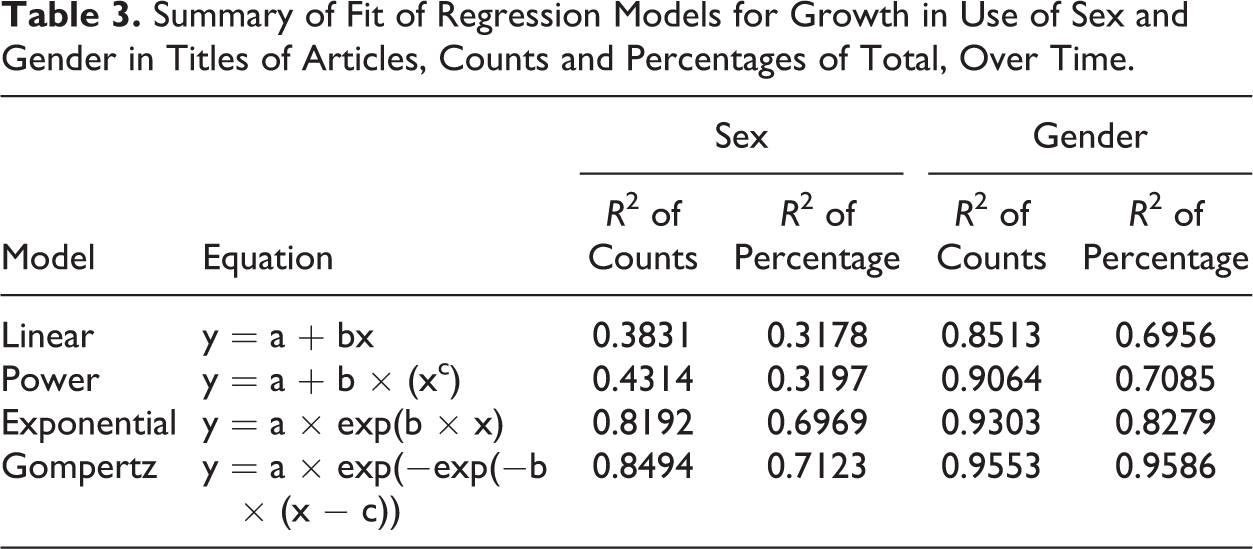
More specifically, the Gompertz model implies that the growth in sex and gender titles fits most closely to an S-shaped curve with (1) slow initial growth, (2) then faster growth, (3) followed by a slow (asymptotic) growth that reduces toward an upper bound. For both counts and percentages, this form fits especially well for gender titles (Table 3 and Figure 3), and it is the best fit for sex titles. The pattern suggests that, after a period of rapid growth, a phase of relative stability and continuity occurred.
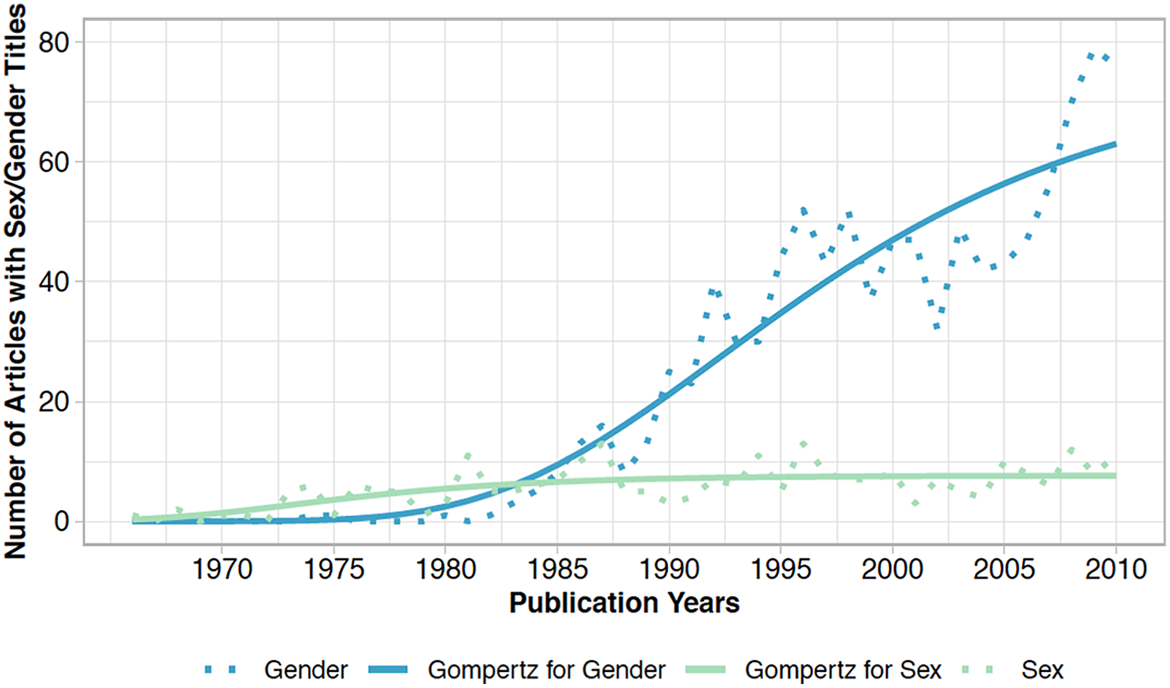
Gompertz models of fit for articles with sex and gender titles, over time.
We now come to the question: do editorial policies of journals bear on the growing use of gender reported here? Does the rise in gender titles reflect journals’ guidelines? With two exceptions, we find that journals publishing most of the articles in our subject area had no explicit policies, beyond general statements about using unbiased language. The first exception is the journal, Gender & Society. At the onset of the journal’s publication in 1987 (volume 1, issue 2), the inaugural editor wrote: Some readers will have noticed that gender, gendered, and gender roles are used in this journal rather than sex, sex-typed, sex roles, and women and men, rather than females and males. This style has been deliberately chosen to indicate that our focus is gender as a social construction, rather than a biological manifestation, like sex. Where sex is used, it connotes a biological or physiological category. I have also, in many instances, changed male-dominated to dominated or monopolized by men because I believe that feminists have too often used the former term as a catchword, without clear analysis of its implications. (Lorber 1987, 123) …we ask our authors to use the term “gender” because its implications are clearly broader and more inclusive than those of the term “sex.” This policy was developed by Sue Rosenberg Zalk during her editorship. As she routinely wrote in her letters to authors: Please use the word “gender” not “sex” (unless referring to ‘sexual’ behaviors/feelings). Sex (e.g., sex roles, sex differences) implies biological distinctions and causes, while “gender” recognizes cultural and experiential factors (S. R. Zalk, pers. comm., July 1989; Frieze and Chrisler 2011, 689-90).
Apart from these two explicit statements, other journals were more general in their statements. For example, Women’s Studies International Forum printed that “authors should use non-sexist language. ‘Man,’ for example, is not acceptable as a generic term” (appearing in volume 5, number 2, 1982). Gender and Education stipulated that “contributors use…non-sexist and non-racist language” (appearing as early as volume 9, number 1, 1997).
Thus, we find very little evidence that the rise of gender in titles connects with explicit editorial policy. Editors may have been exercising authority in their letters to authors, and reviewers may have been recommending the use of gender. However, clear editorial policies were largely absent for decisions about use.
Places: Fields
Interesting patterns occur in the use of sex and gender by field. 8 Findings point to fields that have led in the use of sex, compared to gender, terms; to time periods in which this occurred; and to noteworthy, as well as unexpected, use of the terms by field.
First, education clearly leads in numbers of gender titles (N = 345). Following at a distance are psychology and other social sciences, with nearly equivalent counts (181 and 175, respectively). In numbers of sex titles, on the other hand, psychology leads (N = 87). Education follows (N = 70), and then, with some lag, other social sciences (N = 39; Table 4).
Articles with Sex and Gender in Titles, Counts and Percentages, by Field.
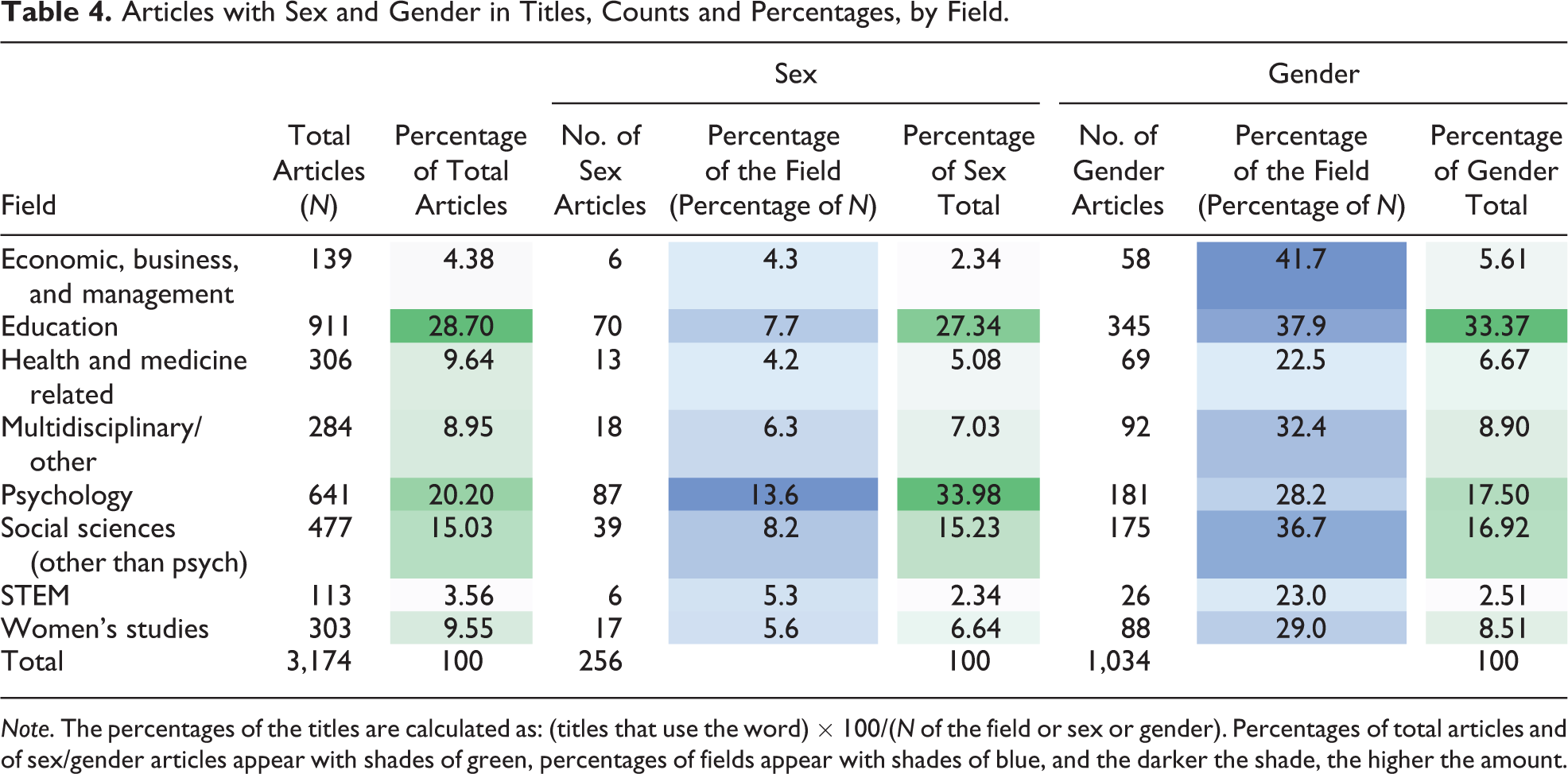
Note. The percentages of the titles are calculated as: (titles that use the word) × 100/(N of the field or sex or gender). Percentages of total articles and of sex/gender articles appear with shades of green, percentages of fields appear with shades of blue, and the darker the shade, the higher the amount.
Also revealing are the percentages of articles using sex and gender terms among the fields 9 (Table 4). These do not sum to 100 percent because the total articles contain those with neither sex nor gender in the title, as indicated in the Method section. The field of economics, business, and management leads in percentage, with 42 percent of articles having gender in titles. Education and social sciences follow, with 38 percent and 37 percent, respectively (Table 4). In percentages of articles with sex in titles, on the other hand, psychology leads with 13.6 percent. The field with one of the lowest percentages of sex titles (4.3 percent) is economics, business, and management (Table 4). Thus, the field with the highest percentage of titles with gender is also the field with the lowest percentage of sex in titles (notable because, as indicated in the Method section, not all articles in our subject area of women, science, and engineering have the term sex or gender in their titles). The question may arise whether this pattern reflects the timing of articles published in this field. Do articles in the field tend to appear more recently, when gender is used more commonly? This is not the case. Overall, 89 percent of all articles in our subject area appear after 1985 (broken down by field, 76 percent to 94 percent of articles appear in that latter period). Economics, business, management is nonexceptional in timing of its articles, with 90.6 percent after 1985.
Second, in more general patterns over time, we find that prior to 1990 education was the leading field for sex titles, followed by psychology. After 1990, psychology had the highest share (percentage) of sex titles (Figure 4). This continued in later years. Psychology is a field that was early to identify explicitly a sex/gender distinction in its literature, broadly, as referenced in the Introduction section. In our subject area, psychology may also be a field that has continued to make a distinction with a sustained lead in sex titles, an issue to which we return in the Conclusions section.
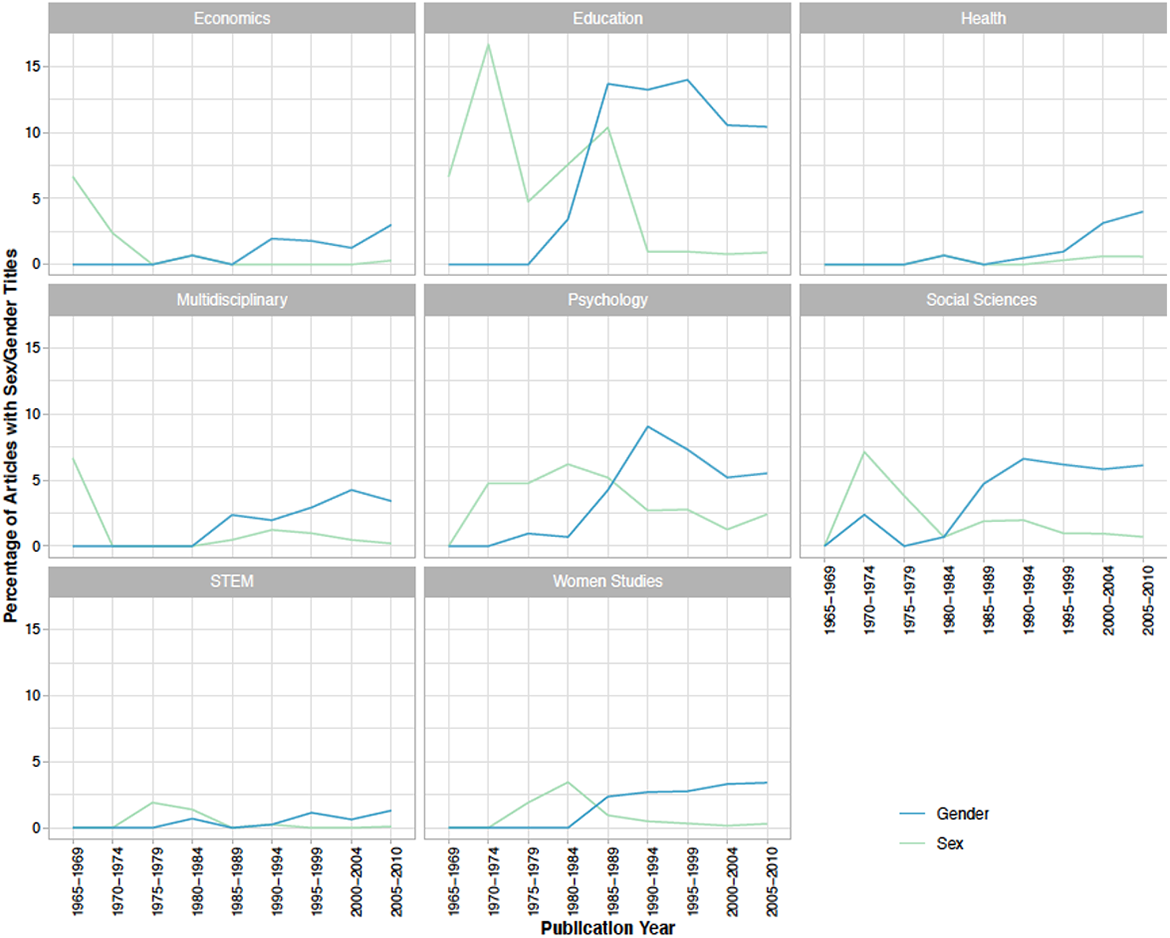
Percentage of articles with sex and gender in title, by field and five-year period.
In percentage of gender titles, education took the lead as early as 1976; psychology and social sciences followed. This pattern continued until the late 1980s, when psychology surpassed social sciences. In the 2000s, education retained the lead in percentages, and social sciences and psychology switched positions again as second and third. Health and medicine, which was at the bottom in proportions until the late 1990s, has been the fasting growing field and ends fourth in the ranking (Figure 4).
Third, and somewhat surprisingly at first sight, a low percentage (4.2 percent) of articles in health and medicine have sex in titles (Table 4). One might expect that references to biological sex would be higher in these fields. However, our “filter terms” did exclude clinical words (diseases, disorders, bodily functions). Hence, titles in medicine/health analyzed here are outside of clinical areas in which the use of sex may be more common. Overall, a χ2 test shows that the relationship is significant between sex and gender titles and the fields in which they appear, (χ2 = 44.26, p = .000).
Places: Journals
The journals relate to fields and journals are yet more specific places in which articles appear. Examining journals sharpens our understandings of “where” the knowledge appears. We identify the journals in which sex, compared to gender, titles predominate; and the ways the titles disperse (or concentrate) among journals. This analysis of dispersion is based on the classic Bradford zones and shapes (explained in the Means of Analysis section).
First, sex titles appear in 137 journals and gender titles in 390 different journals. Of the top 12 journals with five or more sex titles, the majority (7/12) are specialty journals in psychology, followed by education (4/12; Table 5). Exceptional and notable is that the general and flagship journal in sociology, American Sociological Review (ASR), appears among the 12 journals with the highest use of sex titles. One might ask whether sex titles in this journal are just part of a set of demographic terms (such as sex, race, ethnicity, and/or age) within titles. This is not the case. Of the ten articles with sex titles in ASR, none includes race, ethnicity, or age. Nor are these articles published in the earlier period, reflecting use of sex at that time. Rather, nine of the ten articles appear after 1994. This finding for the ASR also applies generally: the use of sex clearly does not owe to its connection with demographic descriptors. Across all journals, merely fifteen of the articles use the words race, ethnicity, or age, along with sex, in their titles.
Journals with Highest Use of Sex (Five or More) and Gender (Ten or More) in Titles.
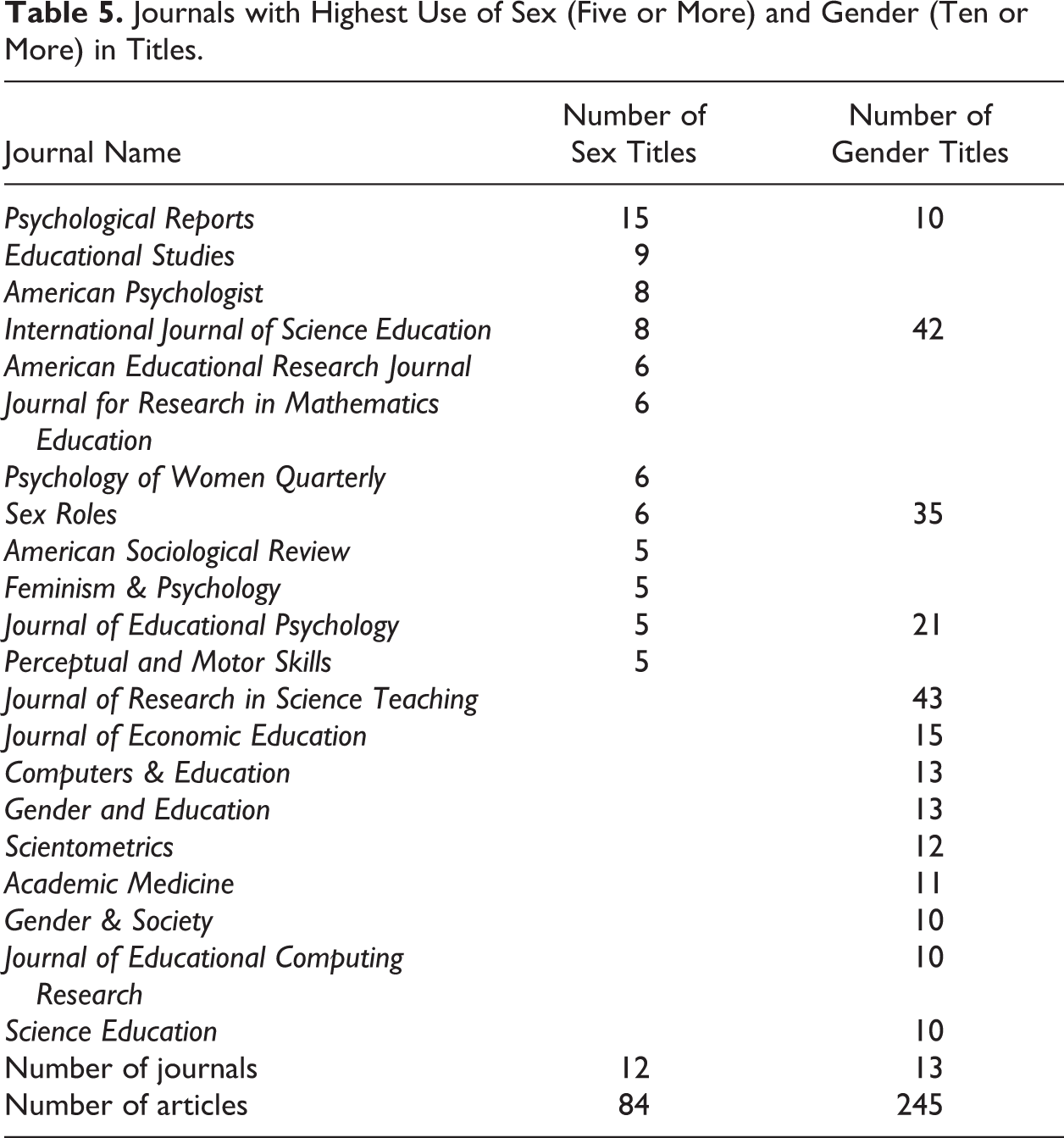
Second, of the thirteen journals with ten or more numbers of articles with gender titles, the majority are specialty journals in education (seven of thirteen), followed by psychology (two of thirteen; Table 5). This is consistent with the fields that predominate as well (journals are categorized within fields). However, the journals reveal more: in these top thirteen, the journals that follow those in education and psychology are Scientometrics, Academic Medicine, and Gender & Society. These are journals within bibliometrics, medicine, and sociology.
Third are the more formal analyses of distribution patterns. Figure 5 shows the distributions of the natural logarithm of the cumulative number of journals (x axis) against the cumulative number of articles (y axis) with sex in titles and the cumulative number of articles with gender in titles, respectively. If the distributions of articles among journals were comparable for sex and gender titles, the curves would be the same. However, the curves differ at the onset of the distributions and the distance between them grows. The articles with sex titles disperse more than those with gender titles and occupy more journals for the same number of articles.
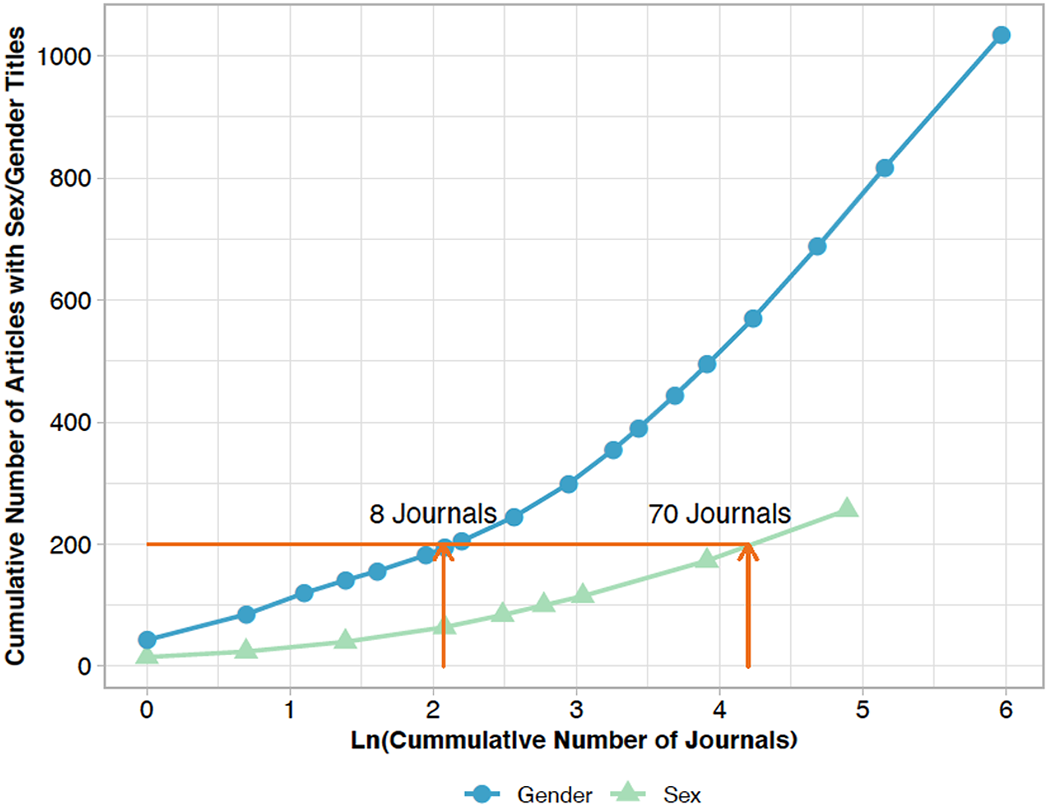
Comparative dispersion of articles with sex and gender titles among journals, applying Bradford’s law.
Figure 5 also shows the horizontal line at 200 representing the first 200 articles in each distribution (for sex and gender). The point where the horizontal line crosses the distribution corresponds to the number of journals that published the 200 articles. The crossing point for those articles with sex corresponds to seventy journals; the point for those with gender corresponds to eight journals (Figure 5
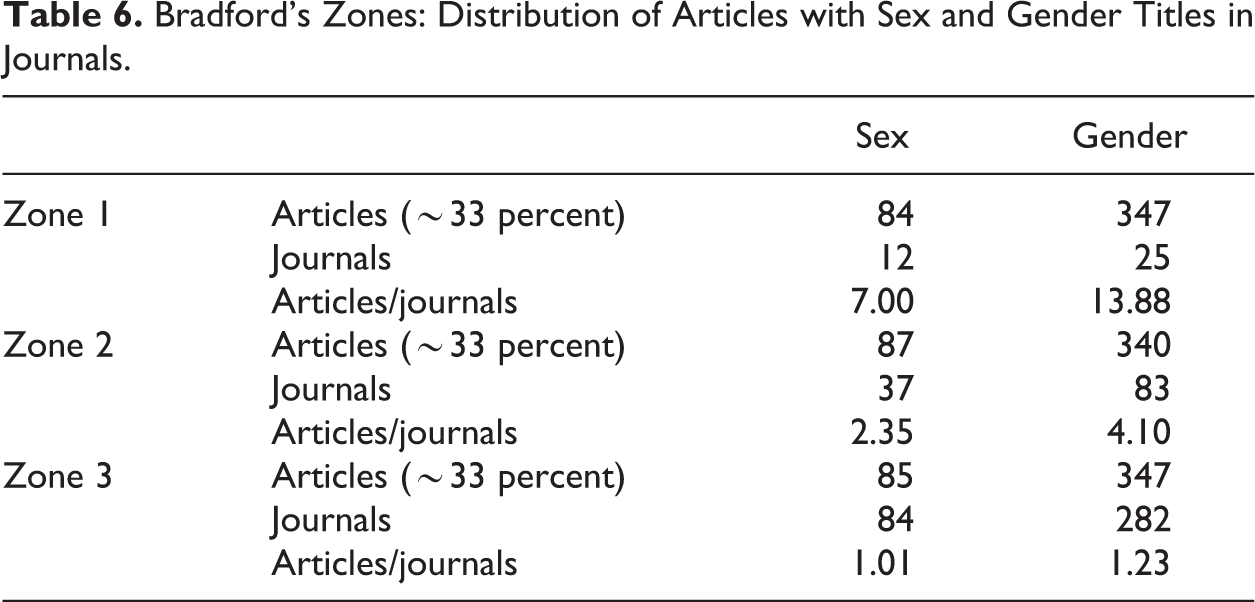
To control for the difference in the numbers of sex titles and gender titles, we examine the three Bradford zones of articles and journals (Table 6). Each zone corresponds to about one-third of the articles and the journals that published them. Both sex and gender titles appear in about three times as many journals in zone 2, compared with zone 1. Comparing zone 3 with zone 1, sex titles appear in seven times, and gender titles in eleven times, as many journals for zone 3. The rapid increase in the number of journals between zones is expected, based on the Bradford law. We see that two-thirds of the gender titles are concentrated in 21.3 percent of the journals, whereas two-thirds of the sex titles appear in 27.8 percent of the journals. In addition, the ratio between the number of articles and the number of journals allows us to compare the dispersion of sex and gender titles in journals. The ratio for sex titles is always lower. This indicates that sex titles disperse more among journals than do gender titles or, conversely, that gender titles are more concentrated than sex titles.
Bradford’s Zones: Distribution of Articles with Sex and Gender Titles in Journals.
Topic Areas
Topic areas represent key themes in titles and are central to the meanings of sex and gender titles. As explained in the Method section, a title was coded only once in a given topic area (even if words associated with a particular topic occurred more than once in a title). However, a title may encompass more than one area (depending on the words in the title). Because multiple topics can appear in a given article, the percentage of articles containing the topic areas do not sum, intuitively, to 100 percent in tables.
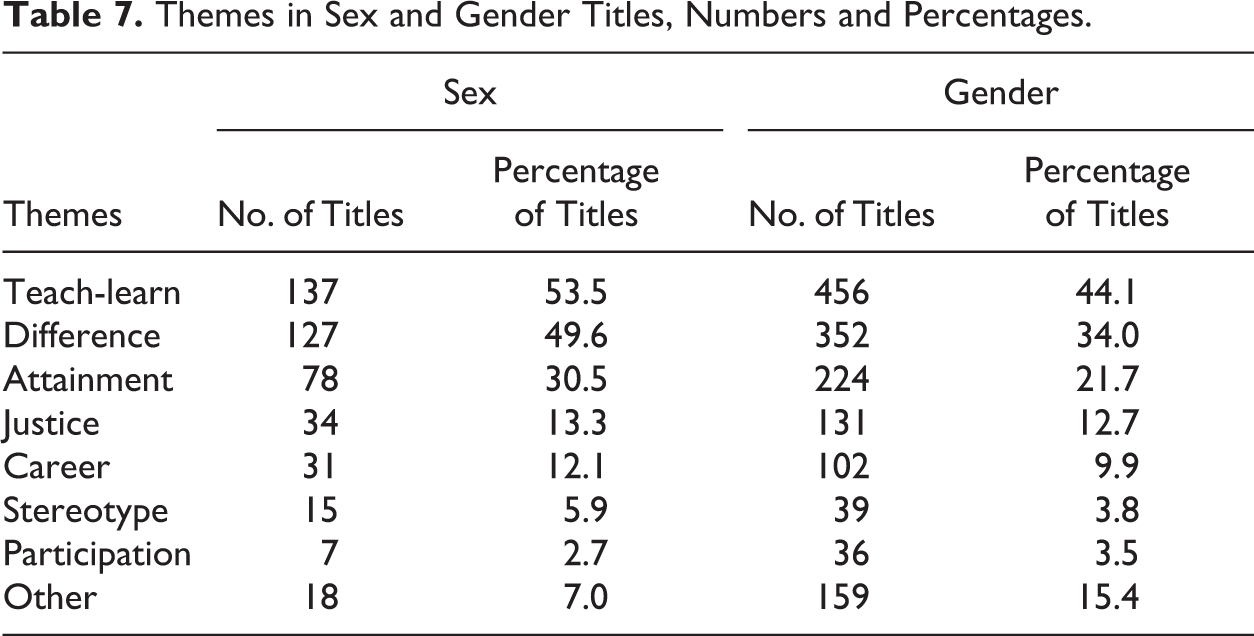
First, findings point to the prevalent themes. In articles with sex titles, teaching-learning is most prevalent. This theme appears in over half (53.5 percent) of sex titles (Table 7). Teaching-learning encompasses a range of associated words, including classrooms, curricula, schooling, training, students, and teachers that reflect study and instruction (see Table 1). Nearly as prevalent is the theme of difference, appearing in half of the sex titles (Table 7). Words associated with difference include comparison, distribution, and gap. Difference is conceptually important because it involves contrasts and comparisons between individuals and groups. This often involves differences of women from masculine norms, as discussed further in the Conclusions section. Next most prevalent is the theme of attainment, appearing in nearly a third (30.5 percent) of the sex titles (Table 7). Attainment encompasses words such as achievement, contribution, performance, productivity, and success that reflect levels of accomplishments, not necessarily connected to study and instruction (which appear in the teaching-learning category) (see Table 1).
Themes in Sex and Gender Titles, Numbers and Percentages.
The predominant themes are not simply a reflection of the prevalent fields of titles with sex and gender, reported in the section on fields. The theme of teaching-learning is the most common theme for gender titles within the field of education, as might be expected. It appears in 43 percent of gender titles in education. However, it is also the most common theme for gender titles in psychology, health and medicine, and women’s studies. The theme appears in 32 percent, 30 percent, and 27 percent of the gender titles in these fields, respectively. This indicates that themes provide further, fine-grained information about these titles on women, science, and engineering that is not redundant with findings about fields.
Second, the order of prevalent themes has persisted over time, with variations in proportions for sex compared to gender titles. Among sex titles, three themes (teaching-learning, difference, and attainment) have predominated in counts over time (Figure 6). Notably, the theme of difference persists in sex titles from the mid-1970s onward. Differences and teaching-learning alternate between first and second place, and attainment maintains a constant third place. After 2000, a rise occurs in the justice and career themes, while a decline occurs in stereotypes.
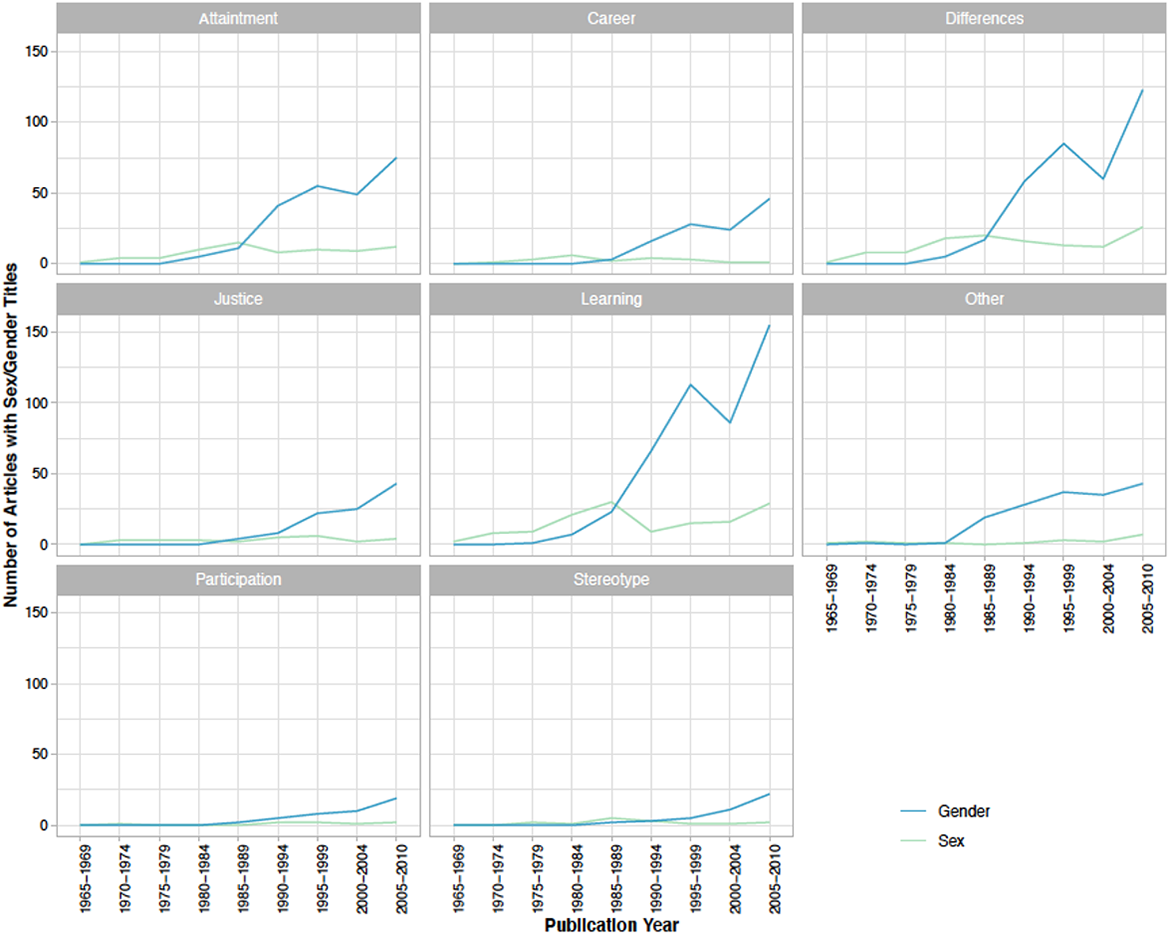
Number of articles with sex and gender titles, by themes and five-year period.
For gender titles, the order of themes is the same as for sex titles (Table 7). However, for gender titles, the percentages of articles with these themes are lower: teaching-learning appears in less than half (44.1 percent), differences in a third (34 percent), and attainment in a fifth (21.7 percent) of these titles. Notably, difference appears in half of sex titles, compared to only a third of gender titles. Further, this theme shows signs of greater prominence in the wording of sex titles. Twenty-seven percent of sex titles begin with the words “sex differences,” compared to only 14 percent of gender titles that begin analogously. The pattern is particularly strong in psychology, with 37 percent of its sex titles beginning with “sex differences.” Gender is also more likely to be associated with “other themes” (the residual category); these appear in 15.4 percent of gender, compared to 7 percent of sex, titles. We address conceptual and theoretical implications of these patterns in themes, particularly those about differences, in the Conclusions section.
Gender titles are infrequent until the second half of the 1980s, as depicted in findings on growth. The leading themes assume the order that appeared in sex titles about a decade earlier. From the 1980s onward, the leading theme in gender titles is teaching-learning, except for the 1995–1999 period, when difference has higher counts (Figure 6).
Third, in patterns over time, themes in gender titles vary from those in sex titles (Figure 6). For gender titles, the themes beyond the top three grew faster than for sex titles after 2000, and especially in 2005–2010. This indicates that, during the recent period, gender titles veered somewhat away from the three dominant themes.
Impact in Citations
We address impact in two ways: (1) the number of total citations to articles with sex titles and articles with gender titles, respectively (S) and (2) the number of citations to highest cited article as a proportion of citations to total articles with sex titles and articles with gender titles, respectively (H/S; and graphical representations of distances between these; Table 8 and Figure 7). 10
Citations to Articles with Sex and Gender Titles, by Five-year Period.
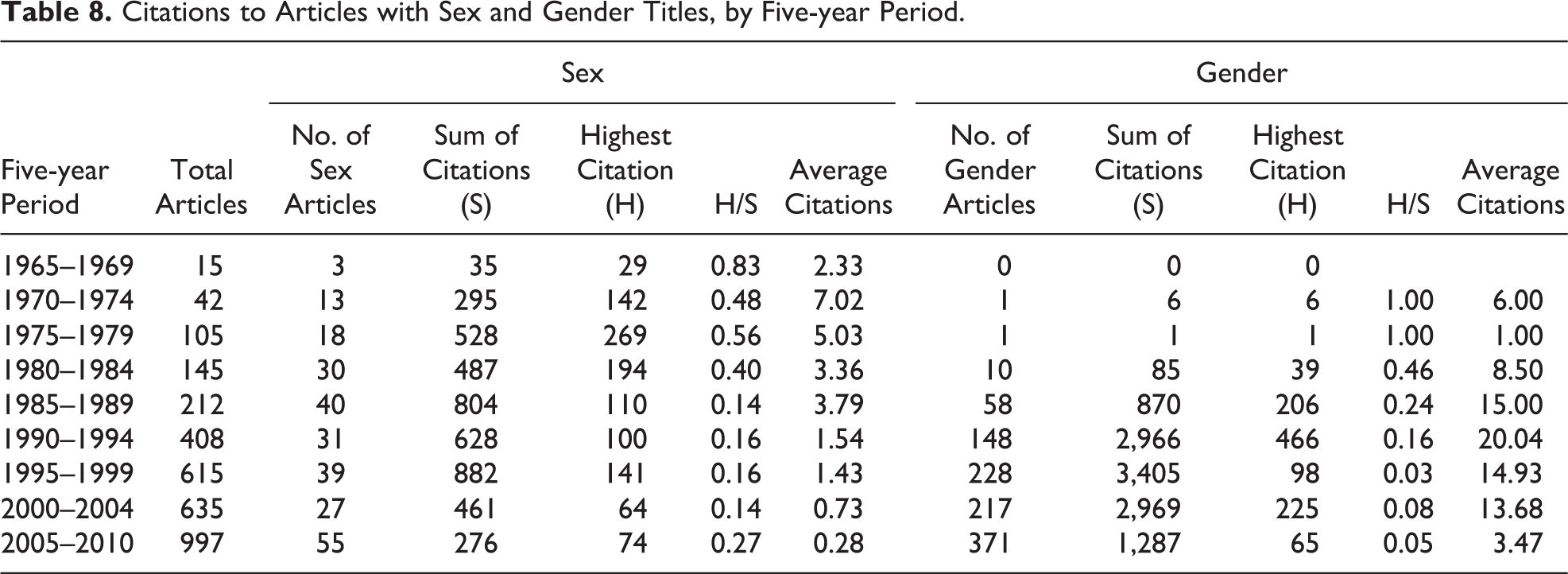
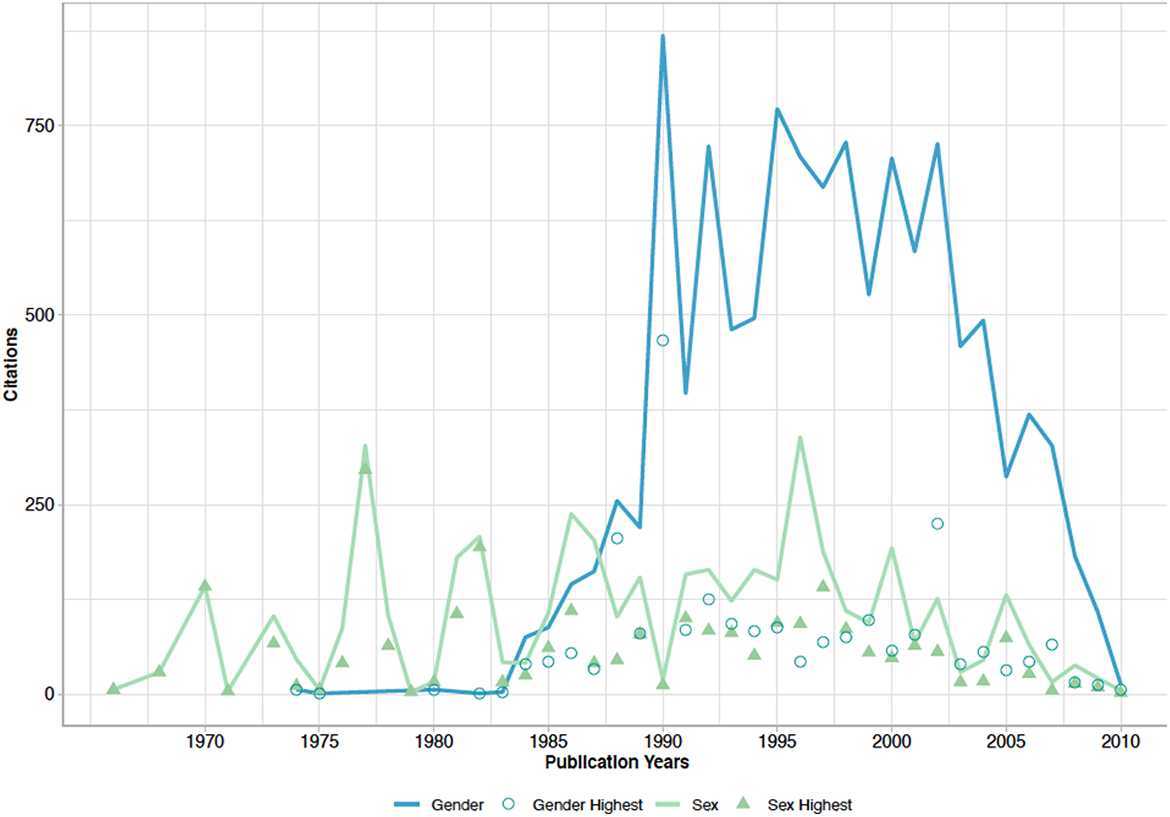
Citations to articles with sex and gender titles: Total citations and citations to most highly cited, by five-year period.
Before 1980, gender titles were so infrequent that little can be said about H/S for gender compared to sex titles. In 1980–1989, the single highest cited title represented 0.40 of total citations for sex and 0.46 for gender. Then, in the post-1994 period, a pattern emerges of a single highest cited article accounting for a larger proportion of total citations for sex than for gender titles. Specifically, for sex titles appearing between 1995–1999 and 2000–2004, the highest cited article accounted for 0.16 and 0.14 of all citations in these periods; whereas for gender titles, the proportions were 0.03 and 0.08 (Table 8). The knowledge in our subject, represented by gender titles, increased substantially, as shown in the earlier section on growth. We now find that increasingly multiple gender titles are being cited, while the most-cited article is less dominant in its share of citations. Compared with sex titles, this citation pattern for gender titles suggests a more distributed impact over time. However, interestingly, this corresponds to a more concentrated group of journals for gender titles (as noted above).
From the mid-1980s onward, the sums of citations for gender titles have increasingly exceeded those for sex titles during the five-year periods (Table 8). The graphical representations also show year-by-year patterns in total citations (Figure 7). Some specific highly cited titles are associated with the peaks. For sex titles, two years (1977 and 1996) appear with close to 300 total citations (Figure 7). In the first year (1977) with a total of 296 citations, the icon for the highest citation and the line for total citations are close, reflecting a dramatic impact of the highest cited article (Figure 7). This title is on sex differences in mathematics (Fennema and Sherman 1977). By contrast, in the second year (1996) with 300 total citations to sex titles, the total owes much less to a single highly cited article. Correspondingly, the distance between the icon and line is greater for this latter year.
For gender titles, total citations increase slowly in the mid-1980s, a time in which the term gender was also becoming more prevalent (Figure 7). In 1990, a peak in total citations occurs. This owes to a highly cited article on gender differences in mathematics that had 466 citations by 2010. Both the highly cited sex title (Fennema and Sherman 1977) and the gender title (Hyde, Fennema, and Lamon 1990) are about differences in mathematics, and one of the authors is the same in both articles. However, the 1990 article has already adapted a gender narrative, a remarkable change.
Conclusions
The comparison of sex and gender titles about women, science, and engineering reveals patterns in their (1) growth, (2) locations (fields, journals), (3) topic areas/themes, and (4) impact in an important forty-six-year period. Here, we highlight the findings about the growth and features of this published knowledge and insights they provide about sex and gender, connected to women, science, and engineering. 11 We address broader implications of findings for explanations of the rapid increase in gender titles; perspectives on hierarchies of femininity/masculinity, related to science policy; and complexities of non-binary people and social inequalities in science.
To summarize, first, the growth of sex and gender titles in our subject area divides into four periods: (1) In the 1970s, a small number of articles appeared with sex titles and none with a gender title. (2) In the early 1980s, gender titles begin to appear, and in the late 1980s, they represented more than a quarter (27 percent) of all titles. (3) In the 1990s, the patterns became more pronounced and only 6 percent of all titles used sex, while 37 percent used gender. (4) In the recent period (decade of 2000s), the proportion of articles with sex titles declined further (to 4.7 percent) and gender titles remained at 36 percent. The formal models of growth show a Gompertz form that is especially strong for gender titles: initial growth, then faster growth, followed by slow growth.
Second, over time, gender titles increased in every field, with education taking an early lead. For sex titles, psychology took the lead in percentage of articles from 1991 onward. Journals are the specific venues that publish articles, and sex titles disperse more among journals (for a given number of articles) than do gender titles. Furthermore, sex is not used simply as part of a set of demographic descriptors in titles in our subject area.
Third, for sex titles, the most prevalent topic area is teaching-learning, and nearly as prevalent is differences, followed by attainment. For gender titles, the order of themes is the same, but the percentages are lower. Particularly notable is that difference appears in half of the articles with sex titles, compared to only a third of gender titles.
Fourth, in impact (citations), total citations become increasingly higher for gender than for sex titles over the five-year periods. Furthermore, after 1994, the single-highest cited article accounts for a larger proportion of the total citations among sex titles.
Thus, gender titles have grown in number and share of total articles. Over time, they also (1) increased in every field, (2) appeared in a wider range of topic areas, (3) have higher citations, and (4) a broader span of articles cited than do sex titles. These are markers of the increasing predominance of gender titles in our subject of women, science, and engineering.
What accounts for the rapid growth in gender titles? Does the increasing use of gender reflect explicit editorial policy of journals guiding authors? With two exceptions, it did not. The exceptions are Gender & Society and Sex Roles. It may be that editors and reviewers gave informal advice about the use of gender, but the use of gender in titles does not reflect explicit editorial policy guiding authors.
The rise in use of gender may reflect scholarly and social norms about gender as a more generic or even popular term. To the extent that this occurred in our subject area, the rise would reflect some “drift” toward use of gender, along with a “differentiating shift” in meanings conveyed. More specifically, a differentiating shift implies that increasing use of gender reflects distinctions between social and cultural aspects of femininity and masculinity (gender) and those more biologically determined (sex). A drift, on the other hand, implies that the increasing use of gender resulted from the exchange of synonymous terms, with gender simply replacing sex (Glasser and Smith 2008; Haig 2004; Muehlenhard and Peterson 2011). Methods of assessing these go beyond title-based analyses and include means that identify the use of one term in the title and the other in the text (Pryzgoda and Chrisler 2000); use of a term in the title and its absence in the text (Haig 2004); or use of two terms in the same paragraph, without distinguishing between them (Glasser and Smith 2008).
Although analysis of titles does not lend itself toward firm conclusions about shift and drift, our findings point to psychology as a noteworthy example of the process. Psychology was early to establish journals on sex and gender with Sex Roles in 1975 and Psychology of Women Quarterly in 1976. Psychology was also early to distinguish between sex and gender in classic articles (depicted in our Introduction). In our data, psychology took the lead in proportions of sex titles in 1991, and this continued. Further, 37 percent of the sex titles in psychology begin with the words “sex differences,” indicating predominance of the term (this compares with 27 percent of sex titles, across fields). Moreover, for the recent periods (2000–2004 and 2005–2010), 63 percent and 32 percent, respectively, of the sex titles in psychology begin with the words “sex differences”; overall (across fields), the percentages are 22 percent and 24 percent. These data point to the continuing strength of the term sex in psychology. Finally, compared with other fields, psychology was also more likely to have both sex titles and gender titles. This does not necessarily mean that drift toward gender is absent in psychology. However, the field shows comparatively stronger indicators of differentiating sex and gender and of using both terms in titles in our subject area.
A broad implication also lies in meanings of themes among sex and gender titles, and theoretical perspectives on hierarchies as well as policies related to them. Notable is the theme of difference, referring to disparities, dissimilarities, and gaps in science and engineering. This theme appears in half of the sex titles, compared to a third of the gender titles. Applied to sex, difference has stronger links to biological influences on femininity/masculinity and applied to gender, stronger links to cultural and social influences. Difference in sex/gender is one of the earliest topic areas in the study of women and men (see Rosenberg 1982 on studies of intelligence and personality). It has remained an important and consistent theme in scholarly literature, broadly (see Biernat and Deaux 2012, 478; Söderlund and Madison 2015, 1350).
In our subject area of women, science, and engineering, the theme of difference has occurred frequently, and more so, in sex than in gender titles. Notably, sex differences tend to link to biology. Biology is not necessarily fixed, but it is more likely to be regarded in this way than is culture/society. Thus, differences that connect with biology are thought to be likely (or even inevitable). By contrast, gender differences tend to connect to culture and society and, hence, are considered to be more variable. This discourse around sex differences, compared to gender differences, is long-standing in theory and applications (addressed in the Introduction section). In our subject area, the issue is also important because it bears on science policy decisions to support equity in participation and performance.
Toward these policy decisions, the more the differences are thought to be grounded in gender rather than in sex, the more they are perceived as malleable and subject to initiatives for change at the individual level and/or at the level of institutions. However, an emphasis on differences—whether malleable or not—can still legitimize the prevailing hierarchies of masculinity/femininity (Reskin 1988), including those within science. This is because legitimation based on differences can be quite flexible, with underlying motives to preserve existing hierarchies. Thus, if one set of differences dissolves, such as mathematical achievement among women compared to men, it may be replaced with another set, such as inherent “brilliance” (see Leslie et al. 2015). Moving the goalposts thus protects the status quo of who is more or less dominant in scientific fields. On the other hand, the very act of bringing up difference (in titles of articles or elsewhere) can implicitly bring such distinctions into question. This may add to the burden of proof for those legitimizing difference in status and hierarchy. More specifically, if expectations of justice exist, then equity is the default, and social systems (including education, workplaces) may incur the burden of proof for deviating from it (see Sonnert 2018). A burden of proof for gender hierarchies may exist in scientific fields because these fields are high cost, rely on public funding, have an ethos of universalism, 12 and garner support (in part) through an argument about being “open to talent” (Fox 2006).
We also reiterate the limitation regarding the complexities of nonbinary people. People who are outside of the traditional sex and gender categories (as intersex and transgender, for example) have identities and experiences beyond categories of women/men or femininity/masculinity associated with sex or gender (Johnson and Repta 2012). Within the forty-six-year period of our study, nonbinary identities are absent from the titles about women, science, and engineering. Further, information on the range of nonbinary and transgender experiences is also nearly absent in global reports on science, medicine, and health, as recently as 2018 (Global Health 2018). Studying nonbinaries is an issue for future analyses of titles on women, science, and engineering. This is because inequalities in education and the workplace that exist for nonbinary and trans-people (Restar and Operario 2019) are an aspect in our subject area, connected to understandings of inequality.
Our study provides new insights about articles on women, science, and engineering and key patterns in their use of sex compared to gender titles that appeared as this subject area emerged, developed, and stabilized over time. In turn, it provides insights about perspectives legitimating and/or challenging hierarchies, as explained. Attention to the broader implications here will develop this research further through continuing consideration of shift and drift in the use of gender; meanings of topic area/themes that appear; and sensitivity to nonbinaries of sex/gender that emerge in this subject area. Fundamentally, attention to these will enrich understandings of the social inequalities that mark relations of sex/gender and scientific institutions, an underlying rationale for our study.
Footnotes
Acknowledgments
For their reading and comments on earlier versions of this article, we thank Staša Milojević; two reviewers; and Edward Hackett, Editor, and Katie Vann, Managing Editor, of Science, Technology, & Human Values.
Declaration of Conflicting Interests
The author(s) declared no potential conflicts of interest with respect to the research, authorship, and/or publication of this article.
Funding
The author(s) disclosed receipt of the following financial support for the research, authorship, and/or publication of this article: This study received funding from National Science Foundation (Grant ID 1015877).
