



Abstract
Over the past few decades, significant advances have been made in public engagement with, and the democratization of, science and technology. Despite notable successes, such developments have often struggled to enhance public trust, avert crises of expertise and democracy, and build more socially responsive and responsible science and innovation. A central reason for this is that mainstream approaches to public engagement harbor what we call “residual realist” assumptions about participation and publics. Recent coproductionist accounts in science and technology studies (STS) offer an alternative way of seeing participation as coproduced, relational, diverse, and emergent but have been somewhat reluctant to articulate what this means in practice. In this paper, we make this move by setting out a new framework of interrelating paths and associated criteria for remaking public participation with science and democracy in more experimental, reflexive, anticipatory, and responsible ways. This framework comprises four paths to: forge reflexive participatory practices that attend to their framings, emergence, uncertainties, and effects; ecologize participation through attending to the interrelations between diverse public engagements in wider systems; catalyze practices of anticipatory reflection to bring about responsible democratic innovations; and reconstitute participation as constitutive of (not separate from) systems of technoscience and democracy.
Keywords
Introduction
Concerns about public participation and democratic engagement with science have animated the field of science and technology studies (STS) since its inception (e.g., Nelkin 1977) and have remained central in its efforts to attend to the social dimensions of science and innovation (Lezaun, Marres, and Tironi 2017). While such studies have produced important strands of interpretive analysis, much of this work has been interventionist in emphasis and rooted in normative and instrumental traditions of STS. This has brought about a rich tapestry of frameworks and approaches that seek to improve relations between science and society (e.g., Funtowicz and Ravetz 1993; Irwin 1995; Joss and Durant 1995; Rip, Misa, and Schot 1995; Nowotny, Scott, and Gibbons 2001; Wilsdon and Willis 2004; Callon, Lascoumes, and Barthe 2009; Guston 2014; Miller and Wyborn 2018). These developments have converged with a mushrooming of experiments and practices in public participation with science and democracy the world over. 1
Even though these diverse practices have brought some successes in reconfiguring relations between science and society (Stilgoe, Lock, and Wilsdon 2014), initiatives designed to enhance participation and inclusion in science and innovation have also become focal points for social and political critique (Irwin, Jensen, and Jones 2013; Meyer 2017) and have often struggled to build more socially responsive, just and equitable forms of science and technology (Wynne 2006a; Macnaghten and Chilvers 2014; Stirling 2015). While themselves being a response to widespread challenges to the authority of science and institutions of representative democracy in late modern societies, these moves designed to encourage forms of democratization are undergoing their own legitimation crises in a “post-truth” era (Jasanoff and Simmet 2017; Sismondo 2017). Established forms of public representation and participation are struggling to reflect, contain, and account for the ever-increasing multiplicity of diverse and emergent publics—and their associated concerns, values, epistemic claims, and ontological commitments. This is fueled by the proliferation of new spaces of both online digital and off-line participation, material entanglements, and distributed patterns of issue formation (Marres 2012). Seen in this light, contemporary crises of democracy and expertise, commonly rendered as matters of public deficits, can be seen as problems of too much (not too little) participation which lacks recognition by and overflows dominant institutions, methods, and ways of seeing.
Against this backdrop, in this paper we argue that an important reason why the democratization of science (and democracy) has faltered is because many existing approaches to engagement harbor what we call “residual realist” understandings of participation, democracy, and the public. As we argue below, despite the fact that the participatory impulse in STS has been prompted by constructivist studies of technoscience, this constructivism has not been symmetrically applied to the practices and technologies of participation and democracy themselves. This has allowed a residual realism in literatures on participation to go unchecked, where both democracy and “the public” are rendered as highly specific, pregiven, and external categories imported into the design and evaluation of participatory practices. This is most evident in the methodological and evaluation-focused work that dominates participatory democratic practice, that has become established in parts of STS, and forms the focus of the three most highly cited papers in Science, Technology, & Human Values (Fiorino 1990; Rowe and Frewer 2000, 2005). 2 However, as we detail below, the way this work relies on highly specific pregiven meanings, forms, and qualities of participation is not endemic to deliberative/dialogic models of participation. It is also evident across multiple fields of participatory engagement practice, from citizen science, science communication, knowledge coproduction, and codesign through to digital participation, activism, social innovation, and more.
What is striking about this interventionist and instrumentally oriented work is its lack of engagement with STS insights on the coproduction of technoscience and social order (Latour 1993; Jasanoff 2004). This is despite important developments in STS and cognate disciplines that have, over the past decade, brought forward coproductionist accounts of the construction, performativity, circulation, and effects of participation and democratic practices across cultures and in relation to political power (e.g., Irwin 2006; Lezaun 2007; Marres 2007; Chilvers 2008; Felt and Fochler 2010; Jasanoff 2011; Laurent 2011; Soneryd 2016; Voß and Amelung 2016). Such studies show that, far from being external pregiven categories, the subjects (publics), objects (issues), and models (political ontologies) of participation are actively co-constructed through the performance of collective participatory practices, both shaping and being shaped by wider social, political, and technoscientific orders (Chilvers and Kearnes 2016a; Chilvers and Longhurst 2016).
While this work has produced important conceptual and analytical insights, radically altering perspectives on the material practices, technologies, and broader constitutional settings of participation, this coproductionist turn in social studies of participation has thus far remained largely confined within the analytical-interpretive tradition of STS. Notwithstanding notable exceptions (e.g., Horst and Michael 2011; Marres 2015; Gabrys 2016; Michael 2016), studies in this interpretive vein have tended to shy away from the necessary work of intervening and reflexively engaging with systems, institutions, and practices of participation. This has allowed residual realist perspectives to linger. The aim of this paper is to move beyond this impasse by setting out what relational and coproductionist perspectives might mean for interventionist-oriented STS and other disciplines seeking to reimagine and remake participation in science and democracy.
In the next section, we locate and summarize the key assumptions of a residual realist imaginary of participation evident in various fields of participatory scholarship and practice (including parts of STS), before articulating the alternative assumptions, sensibilities, and virtues of a coproductionist and relational imaginary of participation more in keeping with constructivist STS perspectives. In viewing participation and “the public” as natural, pregiven, and highly specific categories, residual realist perspectives significantly underplay the ever-increasing multiplicity and multivalence of contemporary public engagements and close down forms of inclusion, representation, and transformation in science and public affairs. We argue that an STS-inspired, coproductionist and relational perspective is more in keeping with the constructed, emergent, diverse, systemic, and interconnected realities of contemporary participation and how they relate to transformations in scientific, democratic, and political orders.
In the sections that follow, we then proceed to set out a new framework 3 comprising four interrelating paths for remaking participation in science and democracy grounded in relational and coproductionist perspectives, namely, the need to forge reflexive participatory practices, ecologize participation, prompt responsible democratic innovations, and reconstitute participation. This includes the identification of pathways and emblematic approaches in each of the four paths, some of which are established or emerging in STS scholarship, while others open up new possibilities and horizons for interventionist-oriented STS. In the spirit of cultivating constructive forms of reflexivity and critique, we then further elaborate the overarching framework in the form of criteria—presented as sensitizing questions—which can be applied in the analysis and performance of participation. In doing so, our intention is to take the crucial step of offering a new alternative to residual realist frameworks for valuing, accounting for, and transforming participation. Importantly, our framework does not take for granted (but rather opens up to critical reflection and experimentation) the a priori meanings, normativities, and productivities of participation and can thus be symmetrically applied across diverse participatory practices and democratic situations. We conclude with a discussion of how this framework and associated criteria might be taken forward in future research and practice to cultivate more experimental, reflexive, anticipatory, and responsible forms of participation in science and democracy.
Beyond Residual Realism
In an analogous manner to the ways that popular understandings of science view nature as preexisting in a natural state waiting to be discovered through rigorous scientific inquiry (Haraway 1989), it has been common to understand both democracy and the public as singular, external, and pregiven (Brown 2009). Inasmuch as this often-tacit assumption constitutes a dominant and largely unquestioned democratic imaginary, we term this a residual realist view of participation in science and democracy. 4 As we now outline, this residual realism is common to methodological and interventionist-oriented work that seeks to affirm participation and to studies that adopt a more critical stance.
A dominant theme in scholarly work on participation has been the development and extension of methods and their evaluation (e.g., Guild 1979; Joss and Durant 1995; Rowe and Frewer 2000). In STS, a predominant frame in this regard has been rooted in normative theories of discursive and deliberative democracy (e.g., Habermas 1984), which in turn has underpinned an evaluative paradigm that seeks to adjudicate practices of public participation against theoretically defined and pregiven procedural standards, for example of inclusiveness, representativeness, social learning, and so on (e.g., Fiorino 1990; Renn, Webler, and Wiedemann 1995; Webler 1995). Such work seeks to demarcate the limits of participation and establish the specific characteristics of “good” or “successful” participation.
Partly in response to these drives toward methodological revisionism, a body of more critical work has highlighted the (seemingly paradoxical) potential of participation to exclude, disempower, and oppress (Cooke and Kothari 2001; Mouffe 2005). These studies often stress the persistence of uneven power relations and strategic behaviors throughout participatory processes that both undermine and are obscured by consensual deliberative ideals (Pellizzoni 2001). Many scholars writing from this standpoint have pointed to the often profoundly antidemocratic implications of public participation, where opportunities for substantive public contestation are evacuated by a consensual, postpolitical populism (Swyngedouw 2010; Thorpe and Gregory 2010).
In STS, across both of these areas of scholarly work, there has been a tendency to import and/or reify established democratic norms and models from political theory (de Vries 2007; see also Lövbrand, Pielke, and Beck 2011). This appropriation of pregiven definitions of the democratic is common to both deliberative and agonistic models of participation, despite both accounts deploying differing theorizations of political order through emphasizing either the constitutive role of deliberative reflection and communicative rationality (Habermas 1984; Dryzek 2000) or of hegemonic discourse and social conflict in shaping participatory outcomes (Mouffe 2001; Mouffe 2005). Crucially, both accounts share a commitment to normative models of democratic politics external to the materially situated practices and performances of participation (Marres 2012). This tendency to rely on pregiven meanings and normativities as external guides for participatory practices and their value is not limited to frames of deliberative, discursive, and linguistic engagements in quasi-public spaces, but can be evident in any mode of participatory engagement—whether it be material and mundane engagements with digital technologies in everyday life, activism and protest associated with more autonomous political philosophies, or “bottom-up” grassroots and social innovations, and so on (see Chilvers and Longhurst 2016).
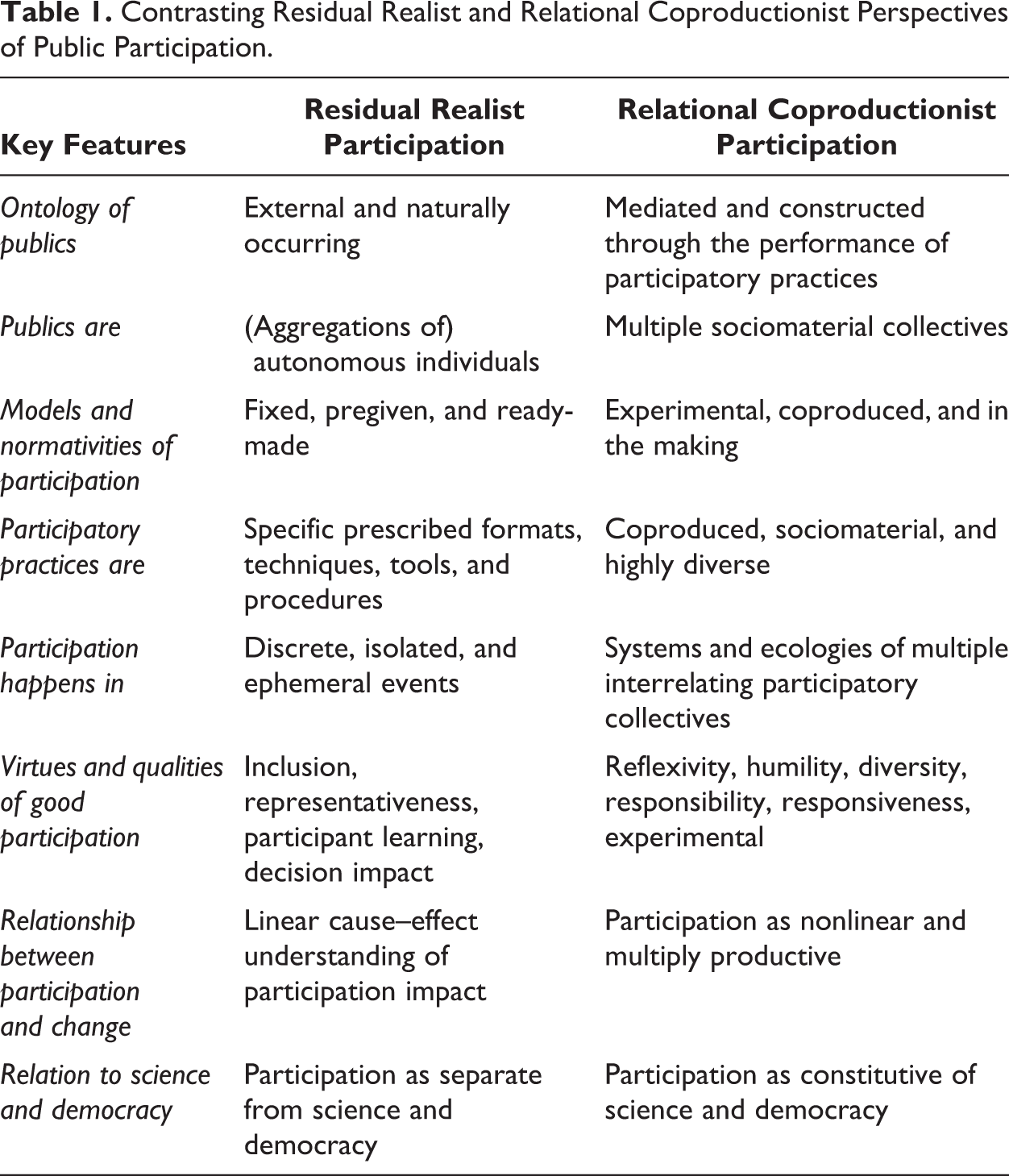
Despite their differences, we have identified in both affirmative and critical discourses a residual realist imaginary of participation (Chilvers and Kearnes 2016a), key dimensions of which are manifest in the often-tacit commitments summarized in the middle column of Table 1. A residual realist imaginary assumes publics preexiting in a natural state external to the practices of participation (cf. Marres and Lezaun 2011), comprised of (aggregations of) largely autonomous individual human subjects (Wynne 1991; Proctor 1998). From this perspective, models and normativities of participation are presented and enacted in specific, pregiven, and idealized forms, with limited accounting for the translational work required in the replication of participatory formats, designs, and technologies (see Lezaun 2007; Chilvers 2008; Soneryd 2016). This emphasis on decontextualized methods and technical procedures relates to a dominant imaginary of participation as confined to discrete, isolated, and ephemeral events and time-spaces, often linked to particular “decision moments” (Chilvers and Kearnes 2016a). The qualities of participation are evaluated against specific external idealized norms of “good practice” and linear understandings of the relationship between participation and its impact on actions, decisions, and outcomes (e.g., Rowe and Frewer 2000). In this view, participation is imagined as being external to science and democracy, with debates centering on issues of demarcation, “extension,” and “scaling up” public engagement (e.g., Collins and Evans 2002).
Contrasting Residual Realist and Relational Coproductionist Perspectives of Public Participation.
Over the past decade or so, constructivist and coproductionist STS perspectives have been turned to deliberately consider participation and democratic practice as objects of study and intervention in their own right (Irwin 2006; Lezaun, Marres, and Tironi 2017). As we introduced earlier, this work suggests that the subjects, objects, and formats that make up the constituent elements of participation emerge and are coproduced through the performance of carefully mediated collective participatory practices (Lezaun and Soneryd 2007; Marres 2007; Felt and Fochler 2010; Chilvers and Kearnes 2016b). Instead of prescribing what participation is and should be in advance, this work seeks to openly consider how participatory experiments and practices as highly diverse sociomaterial collectives are constructed, performed, lead to exclusions, and have multiple effects that are both shaped by—and in turn shape—technoscientific, political, and social orders. This orientation has in turn precipitated a rich body of descriptive work and deployed the tools of ethnomethodology and constructivist analysis to produce situated accounts of participatory practices in the making (e.g., Irwin 2001; Callon, Lascoumes, and Barthe 2009; Laurent 2011).
Allied strands of work have explored the circulation and standardization of technologies and expertises of participation across space, time, and cultural–political contexts (Fortun 2004; Chilvers 2008; Soneryd 2016; Voß and Amelung 2016), moving beyond a residual realist focus on downstream impacts to prompt anticipatory insights into the future implications, ordering effects, and possible downsides of democratic innovations (Chilvers 2013; Voß 2016). A further line of enquiry has emphasized the relational and systemic qualities of participation, opening up to the complex and multivalent ways in which diverse participatory collectives interrelate in wider spaces of controversy (Latour 2005b), issue formation (Marres 2007), systems (Braun and Könninger 2018), and ecologies of participation (Chilvers and Kearnes 2016b). Finally, relational coproductionist accounts have shown how participatory experiments relate to political cultures and constitutional relations between citizens, science, and the state, where certain participatory practices and knowledge-ways become more authoritative than others with respect to democratic orders in particular settings (Jasanoff 2011; Ezrahi 2012; Pallett 2015; Laurent 2017).
Compared to residual realist perspectives, as summarized in the right-hand column of Table 1, a relational coproductionist perspective of participation views publics as being actively mediated and brought into being through the performance of participatory practices (Mahony, Newman, and Barnett 2010; Chilvers and Longhurst 2016). “Individual” publics do not exist in isolation but always as part of sociomaterial collectives through which they know and act (Marres and Lezaun 2011). Attending to the coproduction of the social, normative, cognitive, and material in all practices of participation serves as a means of opening participatory scholarship up to the sheer diversity of what participation is and could be (Chilvers and Kearnes 2016a). Meanings and models of participation thus go beyond the deliberative, discursive, public, and invited to encompass material, embodied, private, digital, uninvited, everyday, mundane forms of public engagement, and so on (Marres 2012). Rather than focusing on discrete isolated participation “events,” a relational perspective emphasizes multiple, diverse, entangled, and interrelating collectives of public involvement that are approached ecologically by attending to their relational interdependencies, connectedness, and overflows. Instead of the a priori normative and linear evaluation of participation, a coproductionist perspective seeks to attend to the closures, exclusions, effects, and openings precipitated by participatory formats as matters of collective reflection, openness, and responsibility. Rather than being separate from, bolted on, or instrumentally integrated into science and democracy, from a relational perspective participation has always been a crucial part of how science and democracies operate (see Table 1).
Four Paths for Remaking Participation in Science and Democracy
We now consider what this alternative relational and coproductionist way of seeing might mean for remaking participation in practice. In the following four subsections, we set out the elements of a new framework comprising four paths in this regard, namely, the need to forge reflexive participatory practices, ecologize participation, prompt responsible democratic innovations, and reconstitute participation. These paths should not be seen as separate endeavors but, rather, as interdependent and interrelating efforts to remake participation in science and democracy in more deliberately experimental, reflexive, ecological, and responsible ways.
Reflexive Participatory Practices
A commitment to reflexive participatory practices and experiments means critically attending to closures (framing effects) and/or deliberately opening up with respect to the objects, subjects, and models of collective participatory practices in terms of their construction, performance, and publicity. Of the four paths in our framework, this first one is the most established in STS scholarship and practice to date. As summarized in Table 2, it is possible to identify a number of approaches that deliberately seek to enhance the reflexivity of collective participatory practices.
Pathways and Example Approaches that Deliberately Seek to Enhance the Reflexivity of Participatory Practices.
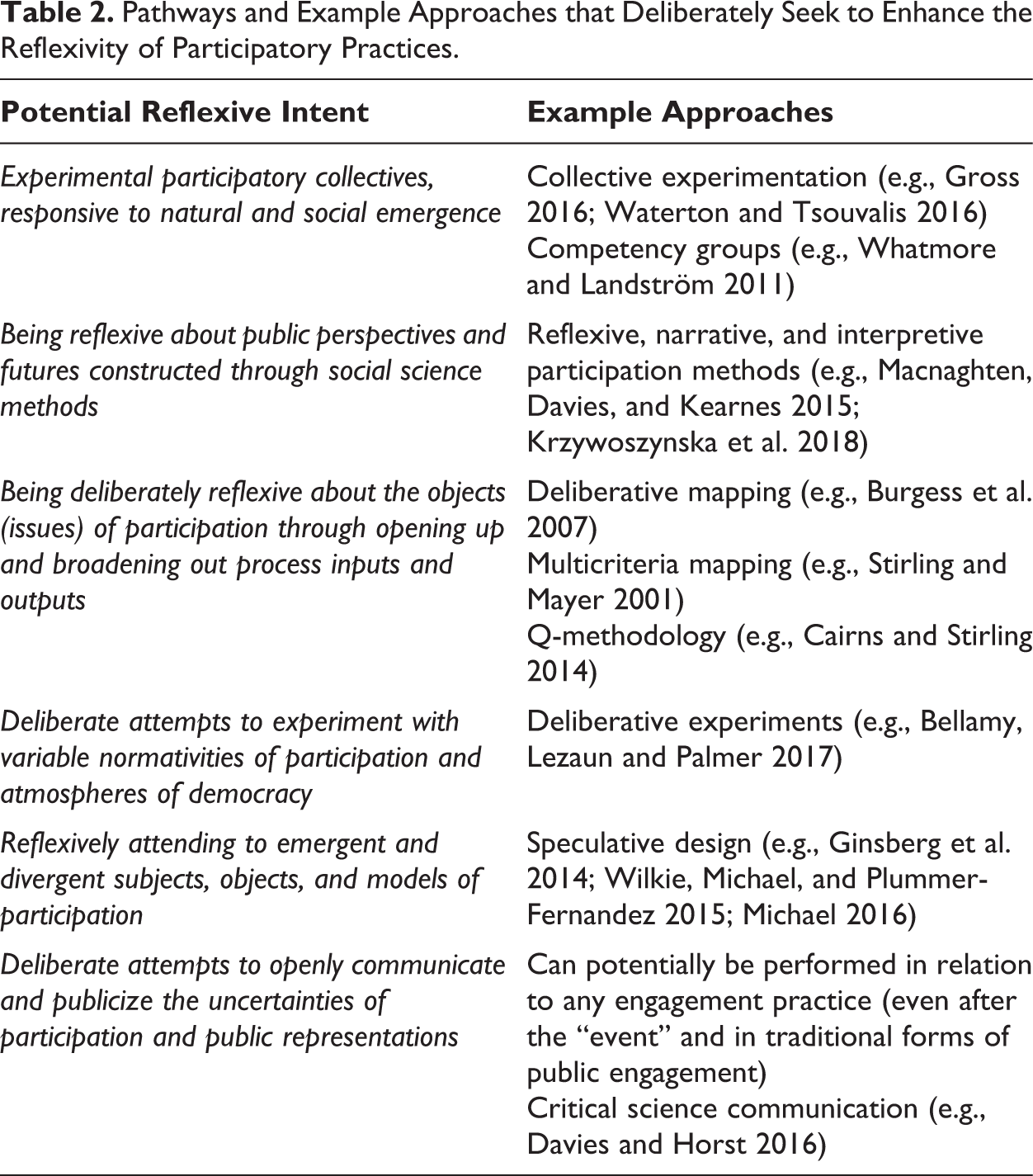
One of the most concerted efforts to date in building reflexive participatory practices lies in attempts to develop more explicitly experimental modes of participation. STS scholars have been at the forefront of devising new forms of “collective experimentation” (Felt and Wynne 2007) in ways that “make it possible to curate novel forms of participation, eliciting expressions or accounts of public issues that would otherwise remain under articulated or exist only in potential” (Lezaun, Marres, and Tironi 2017, 195). Important examples of collective experimentation include Waterton and Tsouvalis’ s (2016) work with Loweswater Care Project and Whatmore and Landström’s (2011) competency group experiment on flood risk management, each of which translated the works of Latour (2004a) and Stengers (2000), respectively, to form experimental collectives open to ongoing emergence and hybridity in terms of expert and public identities, human/nonhuman relations, and the objects or matters of concern.
Alongside such experiments with new participatory configurations, another approach has been to repurpose existing participatory formats to imbue them with reflexive intent. Brian Wynne’s (1996, 2006b) seminal work has demonstrated this in the case of interviews and focus groups, for example, showing how even well-established social science methods can be rendered reflexive and open to the ways in which research interventions construct publics and public concerns (see Wynne 2016). Work in this vein remains sensitive to the ways in which sociotechnical imaginaries and publics are framed and performed through participatory practices (e.g., Macnaghten, Kearnes, and Wynne 2005; Macnaghten, Davies, and Kearnes 2015; Pidgeon et al. 2017). Openness to revealing rather than obscuring the performativity of method in constructing publics and public representations can in principle be applied to the analysis and enactment of any participatory collective or social science method (Asdal and Marres 2014).
As shown in Table 2, STS scholars have played a leading role in devising new methods that seek to deliberately “open up” the objects (or issues) of participation, through approaches such as multi-criteria mapping and deliberative mapping (Stirling and Mayer 2001; Burgess et al. 2007). One dimension that has received less critical and reflexive attention, however, is implicit models and normativities of democracy, which continue to be a significant blind spot in participatory practice and STS scholarship (de Vries 2007; Lövbrand, Pielke, and Beck 2011). A relational coproductionist orientation problematizes how particular “atmospheres of democracy” (Latour and Weibel 2005) and “political ontologies” (Marres 2013) are produced through the performance of participatory practices to the exclusion of others. This can be addressed through actively attending to the “experimental normativities” of participation (Van Oudheusden and Laurent 2013), and being open and transparent about the particular models and atmospheres of democracy produced through participatory experiments. A further potential response is to deliberately cultivate multiple alternative atmospheres of democracy within participatory processes to open up normativities of democracy and make them a focus of experimental comparison (Bellamy, Lezaun, and Palmer 2017).
Taken together, then, reflexive participatory practices demand continual reflexive openness and responsiveness to emergent subjects, objects, and models of participation. In this regard, Horst and Michael (2011) evoke the notion of “the idiot” as a way of being open to how actors can act in unexpected ways and thus problematize prior framings of these dimensions through the performance of participatory practices. Such reflexive sensibilities can also be enacted through more open-ended, speculative, creative, and designerly approaches that allow for and actively prompt multiple attachments, framings, and purposes through participatory experiments (Michael 2016).
We further suggest that these sensibilities need to be carried through after the event, by actively acknowledging, publicizing, and making transparent the inherent uncertainties of participation and the public as part of or alongside the outputs and productions of participatory processes (see Table 2). Such thinking could be applied to any engagement practice or social science method but requires the development of practical steps to openly communicate and “make public” their assumptions, contingencies, and exclusions with respect to: the underlying purposes; the object of participation and the alternative framings that were left out; the construction and exclusion of particular subjectivities and public identities; the particular normativity of participation produced (to the exclusion of others); and so on.
Ecologizing Participation
From a relational coproductionist perspective, ecologizing participation means recognizing, attending to, and/or mapping the diversities of, and interrelations between, sociomaterial collectives of participation and public involvement that make up wider spaces such as systems, issues, and constitutions. This second path for remaking participation responds to the impossibility of involving all relevant actors and so-called stakeholders within a single collective experiment or participatory practice, no matter how reflexive it is (Chilvers and Kearnes 2016c). It also addresses the increasing multiplicity and multivalence of public engagements with(in) contemporary technoscience and democracy, as highlighted in the Introduction to this paper. Approaches to ecologizing participation are less established but have begun to emerge in STS, the social sciences, and humanities in recent years as summarized in Table 3.
Pathways and Example Approaches that can Ecologize Participation.
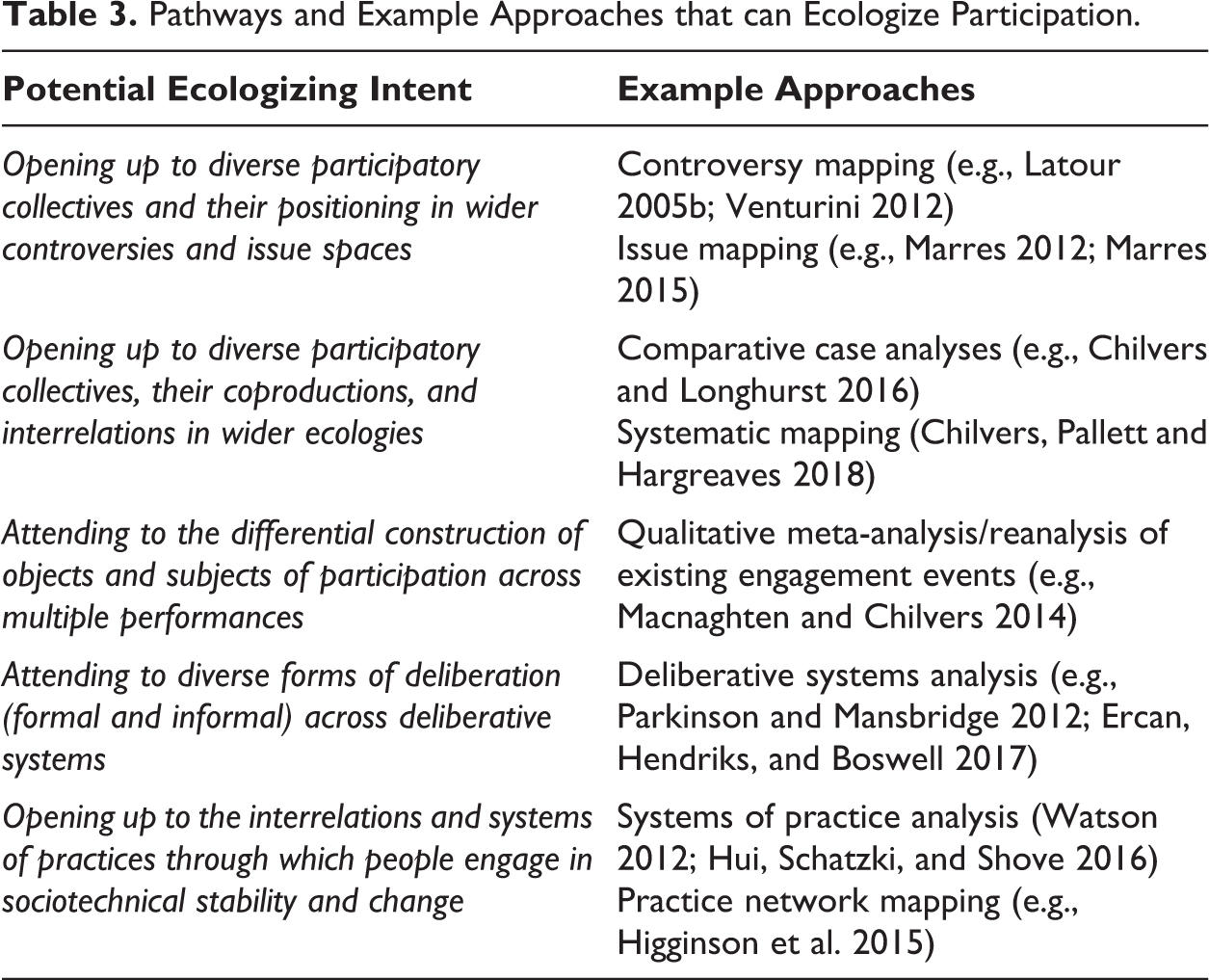
Ecologizing participation moves beyond the discrete event-based focus of most participation studies, toward understanding diversities of participatory collectives across wider systems. However, attending to such diversities poses novel methodological and empirical challenges. One response is to deploy mapping techniques in ways that are centered in the pragmatics of the formation of issue spaces (see Table 3). STS scholars have made important contributions to the development of digital methods such as Issue Crawler and Google Scraper, for example, that enable the identification of diverse collectives of participation and their relative positioning and relations within wider controversy and issue spaces (Marres and Rogers 2005; Rogers 2013; Marres 2015). While establishing broader patternings, however, these approaches do not zoom in on and reveal the specific coproductions and effects of situated participatory collectivities. Approaches that seek to reveal situated coproductions while mapping across diversities of participation have been developed in STS and beyond, including systematic mapping (Chilvers, Pallett, and Hargreaves 2018), comparative case analysis (Jasanoff 2005; Chilvers and Longhurst 2016), meta-analyses (Macnaghten and Chilvers 2014), and the possible application of multisited ethnography (Marcus 1995). Aside from coproductionist conceptions of participation, as shown in Table 3, complementary approaches to analyzing and mapping systems of participation are also emerging in the areas of deliberative theory and social practice theory.
While attempting to reach beyond the partialities of discrete participation events and practices, however, it is important to recognize that any mapping is itself a participatory collective. Mapping methods, digital or otherwise, are always framed in particular ways, are partial, and are subject to overflows and ongoing emergence in wider ecologies (Chilvers, Pallett, and Hargreaves 2018). Attempts to map systems and spaces of participation should thus remain attentive to the wider ecology of issues that make up the “political situations” (Barry 2012) in which they are entangled. Furthermore, it is crucial that such mappings acknowledge endangered or depublicized (Marres 2007) participatory collectives, including those that are fleeting ephemeral happenings, expressions of resistance, public ambivalence, silences, refusals to participate, and so on (Scott 1985; Wynne 2016). The uncertainties and indeterminacies of participation and publics again become apparent and need to be openly acknowledged and rendered transparent in approaches to ecologize participation. Yet, this second path for remaking participation is about more than mapping tools and methods. It emphasizes a disposition and way of being whereby collective actors and distributed agencies—from institutions and practices to publics—actively attend to otherness and their relational interdependence with other diverse forms of participation, people, and things.
Responsible Democratic Innovations
The framework developed in this paper calls for a new wave of social technology assessment, that has been largely absent in STS, directed specifically toward social and democratic innovations (Chilvers 2013; Voß 2016). This opens up new horizons, sites, and possibilities for interventionist-oriented STS through reflexively engaging with technologies, institutions, and expertises of participation in order to render them “technologies of humility” (Jasanoff 2003). Beyond the narrow, instrumental and downstream evaluative concerns of residual realist perspectives, more careful and anticipatory approaches are needed, capable of accounting for future sociotechnical implications, downsides, imaginaries, and ordering effects of democratic innovations. These commitments to making responsible democratic innovations (Chilvers and Kearnes 2016c) can constructively link up with emerging approaches in responsible research and innovation (RRI) (Owen, Bessant, and Heitz 2013; Stilgoe, Owen, and Macnaghten 2013), productively extending the objects of RRI beyond controversial technological developments from the natural and physical sciences on to social technologies emerging from the social sciences and from society. Some possible courses of action for such real-time constructive engagement with emerging technologies of participation and democratic innovations are outlined in Table 4 and the remainder of this subsection, while acknowledging that others will be necessary.
Pathways and Possible Approaches for Prompting Responsible Democratic Innovations.
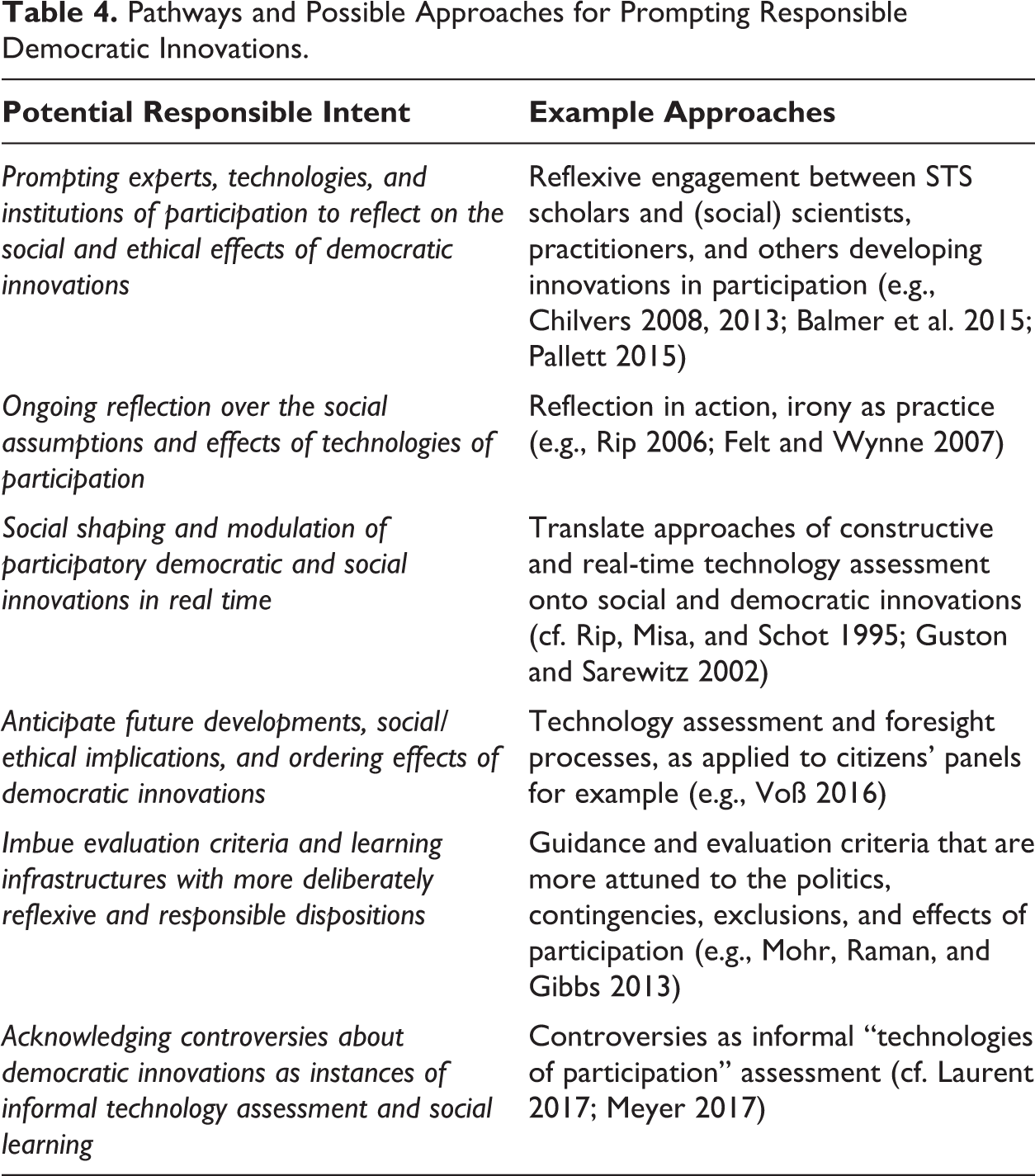
In much the same way that STS scholars have sought to engage scientists in reflecting on and taking responsibility for the possible social and ethical implications, imagined futures, and ordering effects of their work (Kearnes, Macnaghten, and Wilsdon 2006; Doubleday 2007; Balmer et al. 2015; Fisher et al. 2015), social scientists can engage in similar forms of reflexive engagement with the mediators, designers, experts, entrepreneurs, innovators, and institutions devising new forms of participation and democracy. STS scholars have already formed such interactions in relation to deliberative and dialogic forms of democratic innovation (Chilvers 2008, 2013; Pallett 2015), but this should be extended to the actors and organizations associated with diverse forms of participation identified in wider ecologies, whether lab-based or in the wild, ranging from social science research groups, consultancies, behavior change programs, digital platforms, activist and grassroots community groups, and so on. Reflexive learning for responsible participation should also be ongoing, distributed, and embodied, ranging from reflection in action and “irony as practice” (Rip 2006; Felt and Wynne 2007) through to catalyzing spaces for learning and reflection, including those that are more outward looking, informal and experiential, or so-called “shadow spaces” (Pelling et al. 2008; Plumwood 2008; Pallett and Chilvers 2015).
Moves toward responsible democratic innovations can also constructively build on and repurpose STS frameworks for assessing, anticipating, and socially shaping emerging areas of technoscience (Rip, Misa, and Schot 1995; Guston and Sarewitz 2002; Guston 2014). Through linking technology assessment and anticipatory foresight with the aforementioned reflexive engagements with actors and institutions of participation, such approaches can help anticipate future implications, socially shape and modulate innovations in participation and democracy as they are developed in real time. In keeping with this approach, Voß (2016) has successfully applied technology assessment and foresight techniques to the global development of citizen panels (see also Voß and Amelung 2016). This demonstrates that the translation of anticipatory governance and technology assessment procedures to social and democratic innovations is possible and should be extended beyond deliberative methods to diverse technologies of participation in assisting their responsible development.
Beyond particular actors or innovations, moves toward processes and practices of responsible participation should also attend to wider infrastructures and systems associated with technologies of participation, their standardization, and governance. Learning infrastructures for public engagement most often have a residual realist tendency to close down on particular fixed models of participation, the public and instrumental learning about “best practice,” obscuring more reflexive forms of learning, responsibility, and wider scrutiny (Chilvers 2017). It is thus important to consider how these existing infrastructures for valuing, learning, and governing participation can be reconfigured, sensitized, and imbued with a more responsible disposition. One very promising possibility is to transform burgeoning frameworks and methods for evaluating public participation by introducing coproductionist inspired criteria that are more deliberately reflexive, ecological, and responsible in disposition and intent (see Table 4). This is a move we consider more broadly in the penultimate section of this paper. In addition to formal frameworks and procedures, as with the first and second paths, moves to responsible participation can also be informal, distributed, and ongoing. In this sense, moments when participatory practices and democratic innovations become the source of controversies (e.g., Chilvers and Burgess 2008; Joly and Kaufmann 2008; Laurent 2011; Kearnes, Motion, and Beckett 2014) and third-party critique (Irwin, Jensen, and Jones 2013) should be seen as important opportunities for informal technology assessment (Rip 1986), social learning, and ongoing social appraisal of democratic innovations, rather than as situations to be denied or avoided.
Reconstituting Participation
While the previous three paths focus on participation as an object of analysis and reflexive intervention in itself, it is important to go beyond this frame to situate spaces of participation within wider sociotechnical systems and constitutional relations between citizens, science and the state (Jasanoff 2011; Chilvers and Kearnes 2016c). Reimagining participation in this way opens up three further implications within our framework, which take the form of broader dispositions and sensibilities rather than specific example approaches (as presented in Tables 2 –4).
Firstly, this fourth path for remaking participation focuses attention on the ways that diverse participatory practices, technologies, and ecologies of participation are shaped by, and in turn shape, more durable constitutional relations between science, democracy, and society. Such constitutional stabilities evident in political cultures and sociotechnical systems cannot be wished away by discrete insulated participatory practices and techniques, nor by the kind of methodological essentialism that characterizes residual realist approaches to participation. Rather, the ways in which situated experiments, technologies, and ecologies of participation are relationally entangled with and mutually shaped by wider constitutional formations and political cultures in particular settings needs to be openly acknowledged, exposed, and actively attended to. This demands a certain responsiveness and openness of participation in all its forms to (a) the cultural–historical antecedences and constitutional relations between citizens, science and the state that have evolved over time (Jasanoff 2011), (b) political cultures in which certain knowledge ways and forms of participation become collectively deemed as more credible than others in particular settings (Jasanoff 2005), and (c) the driving forces of neoliberal globalization and science-led progress (Ong and Collier 2005; Stirling 2008; Sunder Rajan 2012; Wynne 2016). Such attentiveness to these dynamics of political closure and power should feed into and sensitize the three paths for remaking participation outlined above.
Second, reconstituting participation means turning participation around at a fundamental level. The problem of participation must be reconceived from a problem of individual publics (not) engaging, linked to notions of “extension,” demarcation and control (Collins and Evans 2002), to a problem of relevance (Marres 2012), where attending to diverse forms of participation and public relevance becomes a central concern and a critical responsibility for incumbent powers and institutions. The challenge becomes one of opening up to diverse sociomaterial constituencies and collectives of participation through which publics make meaning, know and act in the world (Irwin and Horst 2016). It is not simply a matter of aggregating the preferences of individual citizens, but rather one of institutions and system actors valuing, nurturing, and responding to diversities of sociomaterial collectives through which publics express concerns, knowledges, and actions (cf. Stirling 2011) and addressing questions of justice, equity, and public accountability at more systemic levels.
Third, reconstituting participation challenges residual realist assumptions about learning, transformations, and the productive effects of participation as being understood in linear or instrumental terms (see Table 1) with respect to individual actors, decisions, or institutions. From a coproductionist perspective, reflexivity is seen as relational and distributed, rather than something that is held. This suggests a commitment to recognizing and nurturing relational-reflexivities produced through multiple distributed agencies and their interrelations across wider systems (cf. Stirling 2016). Again, this relates back to all three paths for remaking participation outlined above, emphasizing that while example approaches and procedures can be identified for each path (see Tables 2 –4), reflexive learning goes beyond formal or centralized control. It requires strategies and tactics to enhance systemic reflexivities through prompting all sociomaterial collectives of participation to critically reflect on their own coproductions and those of others, in terms of the subjects (participants), objects (issues), and models (normativities) of democratic engagement.
A Framework and Associated Criteria for Remaking Participation
We now consider how the four paths for remaking participation outlined above are interdependent and should interrelate and work together as part of a wider framework. In doing this, we propose a new set of criteria for the constructive analysis, evaluation, and performance of participation in science and democracy that are imbued with the sensibilities and dispositions of our relational coproductionist approach. Remaking participation in the terms set out in this framework depends on the interpretive, normative, and instrumental research traditions in STS being brought together in constructive tension. Furthermore, remaking participation also depends on forming constructive interactions between STS and the diverse actors, sites, and spaces involved in coproducing practices, innovations, and systems of participation and democracy.
While the participatory impulse in STS is often oriented toward “opening up” technoscientific innovation through diverse forms of social appraisal (Stirling 2008), the above four paths for remaking participation offer a framework for opening up participation and democratic innovations themselves in ways that bring forward new avenues for research and experimental practice in STS and beyond. These paths not only represent new directions in themselves. Interrelations and interactions between them become crucial in the wider framework. For example, moves to ecologize participation (path 2) can help nurture reflexive participatory practices (path 1) through revealing multiple and overlapping publics, issue framings, and models of participation that are excluded from or exist outside of discrete participatory collectives. While attempting to be deliberately reflexive, the first and second paths we outline themselves bring forward new waves of methods and designs—such as deliberative experiments, competency groups, speculative design, issue mapping, digital methods, and so on (see Tables 2 and 3)—that themselves will become reified, circulate, and applied across settings and cultures. These emerging approaches should thus be equally subject to processes of responsible democratic innovation outlined in the third path for remaking participation in order to anticipate and attend to their possible effects, downsides, unintended consequences, imagined social and democratic futures, and so on.
Yet paths 1–3 focus on the object of participation itself and thus need to be interwoven with responses under the fourth path in attending to the constitutional stabilities and distributed reflexivities of the systems of science, democracy, and political culture within which they are situated. In this respect, the framework sensitizes practices and practitioners to the powers of constitutional relations and political cultures in shaping and framing situated participatory practices (path 1), which forms of participation—and thus public knowledges and ontological commitments—are collectively deemed to be more authoritative in wider ecologies (path 2), and how acceptable meanings and procedures for responsible innovation and participation (Path 3) become institutionalized in different ways in different settings. In addition, the fourth path in our framework focuses attention onto how the production of public knowledges and ontological commitments through diverse participatory practices (Path 1) and their circulation in wider ecologies (Path 2) does (and possibly could) relate to wider institutions and democratic ordering—generating renewed opportunities for transforming the reflexivities, responsiveness, and accountabilities of institutions and systems to diverse forms of public relevance, values, knowings, and doings.
Table 5 summarizes the qualities and sensitizing questions put forward by the framework developed in this paper. The four paths for remaking participation (and associated tables) outlined above have been formed into themes, each containing three criteria, worded as questions. These criteria do not assume a narrow pregiven meaning of participation and can thus be applied to diverse practices and systems of participation—such as those opened up in this paper—in order to help cultivate their reflexive analysis and/or performance.
Criteria for the Reflexive Analysis and Performance of Participation in Science and Democracy.
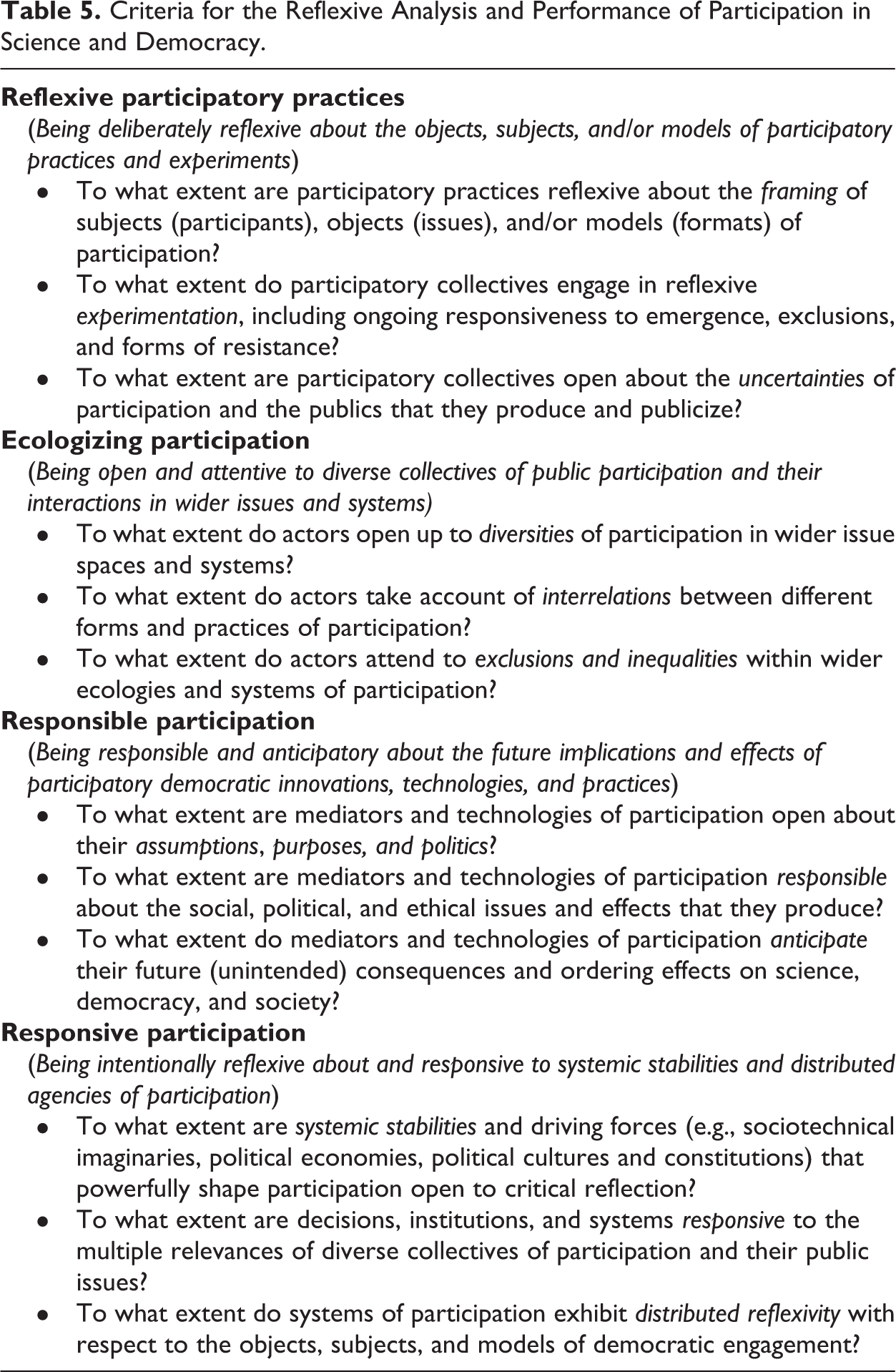
In line with the constructive version of critique (cf. Latour 2004b) that underpins our framework, these criteria and paths for remaking participation do not simply mean replacing existing forms of public engagement (whether science communication, deliberation, codesign, citizen science, social innovation, etc.) and evaluation frameworks with alternative models, approaches, and methods. Instead, they are additive in serving to reconfigure and imbue existing imaginaries, models, practices, institutions, and ways of judging participation with the virtues of relationality, humility, reflexivity, anticipation, and responsibility. Such considerations, grounded in an STS relational and coproductionist way of seeing participation, are currently omitted from dominant residual realist frameworks for guiding and evaluating public participation across diverse fields. We suggest that criteria like those summarized in Table 5 need to be urgently introduced into the analysis and performance of diverse forms of participation in science and democracy, in addition to—or in reconfiguring—those that are already institutionalized. This takes one beyond only attending to, for example, questions of inclusion, representativeness, participant learning, and linear impacts of discrete participation moments to also attend to, for example, questions of framing effects, emergence, exclusions, and uncertainties over the objects, subjects, and models of participation, at the level of discrete collectives, interrelations in wider systems of participation, and of underlying assumptions, future consequences, and effects. These dimensions represent serious omissions from existing residual realist frameworks, which undermines their efficacy. While eschewing a reductive vision of methodological revisionism, we suggest the criteria in Table 5 can act as catalysts for bringing forward new experimental practices, models, and approaches of participation in science and democracy that are more deliberately reflexive, experimental, ecological, anticipatory, and responsible.
When considering what forms of participation lie within the scope of the agenda we have set out, attending to diversity is a key touchstone. As stated in Table 1, what counts as “participation” under a relational and coproductionist perspective is open to practices beyond formal spaces of public deliberation (that have predominated in STS interventionist work to date) to include the so-called uninvited, informal, citizen-led, material, digital, mundane, private, everyday, and so on. For example, beyond public deliberation and traditional forms of public engagement with science, the framework we have presented can be symmetrically applied to models of participation associated with activism and social movements, grassroots and social innovations, consumer engagement and behavioral change, everyday engagement with digital technologies, and more (see Chilvers and Longhurst 2016). Opening up to the construction, responsibilities, and effects of diverse forms of participation in the ways that we have suggested above is, we emphasize, not an attack on “the illegitimacy of such activities,” like “citizens’ panels and other participatory activities” (Guston 2015, 243). In fact, it is the exact opposite. In opening up to the potential legitimacy and value of diverse forms of participation, some of which would otherwise be excluded, denied, or ignored, our framework advocates a symmetrical approach to assessing and responding to the actual performances, exclusions, effects, and potential responsibilities of participatory democratic practices in situ and in relation to wider systems. In doing this, we seek to avoid the residual realist trap of imposing exclusive, pregiven, externally prescribed norms and assumptions about what forms of participation and public involvement in science and democracy are better or more legitimate in advance of the performance of participatory practices and public issue formation.
Rather than being prescriptive or defined by method, our framework is guided by an alternative relational coproductionist sensibility; a way of seeing and being with participation that is grounded in—and seeks to nurture—qualities and dispositions of reflexivity, diversity, and responsibility. There are many possible pathways and approaches by which this might be realized, which will necessarily reach beyond those identified in this paper as experience and experimentation in reflexive participation grows. While we have identified multiple roles that STS scholars might take up in relation to the four paths we have articulated for remaking participation, ultimately the framework depends on the reflexive engagement of a diversity of distributed actors in other disciplines, other fields of practice, and in wider society. Indeed, in the interests of reflexivity, there should be many positions, roles, and forms of intervention taken up by STS scholars and others in opening up to a participatory politics of possibility.
Conclusion
In this paper, we have sought to open up a new agenda and broaden the possibilities of interventionist-oriented STS when it comes to matters of participation, democracy, and public relations with technoscience. We have set out how relational coproductionist sensibilities and dispositions can transform the analysis and performance of participation and democratic practice, moving beyond prescriptive criteria under a residual realist perspective that adopt narrow pregiven meanings and normativities of what participation is and should be. Our framework can thus provide the foundation for a necessary move from effective practice to reflexive and responsible practice in matters of participation in science and democracy. We have argued that the future vibrancy of this field—in both scholarship and practice—depends on remaking participation and public relations with science as coproductive, relational, and emergent. This is not only about being more reflexive and responsible vis-à-vis the forms of participation and the publics that we and others bring into being. It is just as much about attending to the systemic and constitutional stabilities that always shape the politics and practices of participation in powerful ways. Through aspiring to be more deliberately coproductionist, reflexive and responsible about participation and democracy in the ways outlined in this paper, in addition to STS’s more familiar focus on technoscience as traditionally known, the democratization of science and innovation in contemporary societies can once again become possible.
Footnotes
Acknowledgments
The research presented in this paper was made possible by a UK Economic and Social Research Council seminar series grant (ESRC award number RES-451-26-0623). Jason acknowledges beneficial support from related projects funded by the UK Engineering and Physical Sciences Research Council (EPSRC award number EP/K005316/1) and the UK Energy Research Centre Phase 3 research program (EPSRC award number EP/L024756/1), including constructive collaborations with Helen Pallett, Rob Bellamy, Tom Hargreaves, and Noel Longhurst as part of these projects. Matthew acknowledges Australian Research Council funding for projects that provided a venue for developing the ideas outlined in this paper. These include an ARC Future Fellowship (award number FT130101302) and the ARC Centre of Excellence in Convergent Bio-Nano Science and Technology (award number CE140100036).
Declaration of Conflicting Interests
The author(s) declared no potential conflicts of interest with respect to the research, authorship, and/or publication of this article.
Funding
The author(s) disclosed receipt of the following financial support for the research, authorship, and/or publication of this article: UK Economic and Social Research Council (Award Number RES-451-26-0623).
