



Abstract
The COVID-19 pandemic triggered an unprecedented disruption to global education systems, with over 50 million K–12 students in the United States affected by prolonged school closures. This disruption amplified longstanding inequities for low-income students, students of color, and multilingual learners. This Teachers College Record special issue explores the “COVID effect” with three aims: (1) to examine the multifaceted educational impacts of the pandemic, particularly for historically marginalized students in the United States and United Kingdom; (2) to identify emerging patterns and gaps in research that can guide future interventions; and (3) to offer actionable recommendations for research, policy, and practice to address the cumulative effects on school-age youth. To ground the volume, this opening article presents findings from two California-based studies. The first includes interviews with educators—teachers, principals, counselors, and psychologists—highlighting the pandemic’s emotional and academic toll on students and families, especially in communities of color. The second analyzes survey data from school leaders, focusing on perceptions of student learning loss during peak remote instruction years (2019–2021). Although geographically bounded, the studies echo national and international patterns of disrupted learning and systemic strain. These findings offer an early lens into how large public systems attempted to manage unprecedented challenges while revealing the need for sustained, equity-centered responses five years since the height of the pandemic.
COVID-19: The Potential Return of Jim Crow Era Education
The COVID-19 pandemic has resulted in the deaths of approximately 7 million people globally, including over 1 million Americans (World Health Organization, 2024). At the height of the crisis, in-person instruction for more than 50 million K–12 students in the United States was suspended during the 2019–2020 and 2020–2021 school years (U.S. Department of Education, Office for Civil Rights, 2023). This disruption was not unique to the United States—globally, more than 1.6 billion students experienced interrupted learning due to widespread school closures (United Nations Educational, Scientific and Cultural Organization, 2021).
The pandemic brought with it deep emotional, economic, and psychological strain. Students, families, and educators faced prolonged isolation, heightened anxiety, economic insecurity, and profound uncertainty about the future. Research continues to reveal the disproportionate impact of the pandemic on low-income communities and communities of color, with Indigenous, Latinx, Black, and Pacific Islander populations bearing the brunt of both the virus and its socioeconomic effects (Davis et al., 2020; Fahle et al., 2023; Horsford et al., 2021; Tai et al., 2022). People of color were more likely to contract COVID-19, be hospitalized, and die from the virus compared to their white counterparts.
The onset of the pandemic in March 2020 ushered in an unprecedented moment in U.S. history—the immediate closure of public schools nationwide due to public health concerns. Within days, school systems were required to pivot to remote instruction with little preparation or advance notice, initiating a radical transformation in how educational services were delivered to millions of students.
Historically, public schools in the United States have failed to equitably serve millions of low-income students and students of color—a pattern that spans decades (Bishop, 2023; Howard, 2020). Unsurprisingly, the academic disparities that already existed between students of color and their white peers became even more pronounced during the COVID-19 pandemic (Ho, 2022; U.S. Department of Education, Office for Civil Rights, 2021). A national analysis found that during the 2019–2020 and 2020–2021 remote learning periods, academic growth declined across all student groups, but the declines were particularly severe for students in high-poverty schools (Goldhaber et al., 2022). More recent research confirms that although all students have experienced setbacks due to the pandemic, the most significant losses have been concentrated among low-income students and students of color (Ishimaru & Rodriguez, 2025; Kane & Reardon, 2023).
The pandemic’s impact extended beyond academics. It disrupted an already fragile ecosystem of support services for youth, contributing to instability across education, child welfare, and the juvenile legal system. Compounding these challenges, school systems faced severe staffing shortages and diminished capacity to support students’ social, emotional, and mental health needs. Widespread increases in student stress, anxiety, and other indicators of declining well-being have been well documented in the wake of COVID-19 (Krause, 2022; Osher et al., 2025).
One of the first obstacles for students in March 2020 in the immediacy of school closures was inadequate access to technological devices for teachers, schools, and curricula (Darling Hammond et al., 2020). Much in the way that academic gaps have existed in schools, technology gaps are just as stubborn and persistent, as countless numbers of students did not possess Chromebooks, laptops, tablets, or smartphones to log in to learning platforms (Gallagher & Cottingham, 2020). A report estimated that 16.9 million students did not have access to adequate internet access across the nation (Alliance for Excellent Education et al., 2020). Even if youth did have access to devices, it was not a guarantee that they could access classroom lessons remotely, because large swaths of areas in urban and rural communities lack the necessary hotspots that would allow connectivity to occur (Gross & Opalka, 2020). As a result, schools provided millions of devices to students and were asked to deliver Wi-Fi hotspots to tens of thousands of areas across the country, merely for students to log in to see their teachers, get access to content, interact with their peers, and attempt some degree of learning.
The rollout for technology was uneven and inconsistent; many students went through extended periods without access to technology, missing out on valuable instructional time (Onadeko et al., 2024). Teachers, many of whom had never delivered content via technological platforms, struggled to connect and engage students (Gandolfi et al., 2021). Many of the most disenfranchised students, a disproportionate number of whom are low-income students of color, had parents and caregivers who served as essential workers and did not have the luxury of working remotely (Novoa & Jessen-Howard, 2020). Hence, many students were required to do school at home alone; others had to monitor the learning of younger siblings, along with their own learning. Looming over the entire educational debacle was the serious threat of COVID-19.
In many ways, the COVID-19 pandemic could result in one of the biggest detractors to educational equity since racially segregated schools. The mantra of education as the proverbial equalizer has come into serious question in recent years. New data reveals growing chronic absenteeism and declining enrollment (Dee, 2024), mental health needs for students and staff (Lopez et al., 2024), and staffing shortages (Wharton-Beck et al., 2024). These patterns parallel national trends around the state of education as we continue to rebound from COVID (Irwin et al., 2023). Alarming educational and student health patterns are surfacing as one-time federal and state COVID relief investments are ending (Pitts et al., 2023), simultaneously creating a fiscal cliff and a sense of moral urgency for education decision-makers. Federal education relief packages have totaled more than $189 billion (Dewey, 2024). The California Cayla J lawsuit, which centered on inequitable remote learning conditions during COVID and recently led to a record $2 billion settlement (Fensterwald, 2024), represents a rare exception of new COVID money in a COVID financial fiscal desert. Even that settlement requires districts to spend unencumbered funds. There are few examples of new, significant investments of resources dedicated to dismantling the inequities accelerated by COVID-19.
The expansion of separate, but unequal, learning communities for some students will have dangerous consequences for students of color in places where there are existing economic disparities for years to come (Kuhfield et al., 2020). From a historical standpoint, when the nation legally sanctioned racially segregated schools under the mantra of separate but equal, it became quite apparent that separate was not equal. Could we be witnessing a repeat? In many ways, COVID-19 exposed deep-seated inequities that have plagued the nation for decades, and at a time when the nation’s schools are more racially and culturally diverse than ever before, the consequences have national ramifications. Furthermore, having students of color, a disproportionate number of whom happen to be low-income, struggle academically may very well take us back to policies and practices of the Jim Crow era.
The election of President Trump for a second term and a Republican super-majority in Congress present further challenges for young people, families, and schools still not completely recovered from the negative educational effects of the pandemic in the United States. Trump has remained firm in his position regarding eliminating the U.S. Department of Education and/or reducing federally funded programs like the Individuals with Disabilities in Education Act (IDEA), Migrant Education, and Title III for English Learners (Lieberman, 2025). Education is again “caught in the crosshairs of a societal war,” as one superintendent explained, amid broader efforts to erode our democracy and fuel political and economic instability (Rogers et al., 2024). The past several years have witnessed an incessant amount of attacks on diversity, equity, and inclusion (DEI) related programs and interventions in schools, an undermining of social and emotional learning (SEL) programs, and an increase in book bans. All of these efforts further undermine the educational prospects and possibilities of Black, Indigenous, and people of color (BIPOC) students (Howard, 2024).
Actions taken to eliminate agencies and programs like Head Start, a comprehensive set of services geared for low-income children ages 3–5 years, and Medicaid, the single largest insurer for youth (Alker & Roygardner, 2023), not just the U.S. Department of Education, could further complicate the already fractured education equity landscape (Bishop & Willis, 2025; Inskeep & Haney, 2024). A federal shift to stronger states rights and defunding essential federal programs that prioritize children could also remove existing policy mechanisms to monitor, support, and maintain education civil rights protections that have taken decades to establish. It remains to be seen what the consequences will be of an extraordinary global health crisis, followed by national and state GOP-led leadership eager to remove educational safeguards for school-age students. This special issue is a testament to a shared commitment to scholarship that seeks to identify existing education patterns tied to the pandemic and to help remedy efforts that prioritize unlocking the potential of an entire generation of learners. Readers will be reminded that the challenges accelerated by the pandemic will exist far beyond any political terms, requiring great political urgency and an unwavering focus on public education.
The COVID Effect: TCR Special Issue
The goals of this special issue for Teachers College Record centered on the COVID effect are three-fold: (1) to outline the multiple levels of how COVID-19 has profoundly affected the educational opportunities and life chances of millions of students across the United States and the United Kingdom, most of whom are students of color, low-income, or multilingual learners; (2) to identify common patterns across issues or new areas of scholarship to inform an evidence-based path forward for public schools and systems serving young people; and (3) to provide actionable recommendations for research, practice, and policy to address the cumulative effects of the virus on school-age youth.
Scholars contributing to this special issue examine a range of critical issues related to the impact of COVID-19 on students, educators, and school systems. Topics include the effects of the pandemic on our youngest learners (Markowitz et al., pp. 66–86) and multilingual learners (Santibañez & Saint Martin, pp. 124–156), the contextual conditions that shaped school reopening processes (Singer, pp. 46–65) and student learning outcomes (Fahle et al., 2025), and the ways in which educational leaders navigated the crisis (Lu et al., pp. 22–45). Thompson and Daniels (pp. 179–199) explore how patterns of school exclusion were not only sustained but also intensified postpandemic in England. Ho (pp. 157–178) introduces an innovative framework for measuring student learning over time with greater precision than most current state assessment systems—particularly important during periods of extraordinary disruption like the pandemic.
Our own contribution examines how COVID-19 affected educators across California. Grounded in ecological systems theory (Bronfenbrenner, as cited in Darling, 2007) and the ecology of equity (Bishop & Noguera, 2019), we explore how various systems—districts, states, and governmental agencies—shaped the development and well-being of young people during the crisis. In many cases, large systems such as school districts were left to manage an unprecedented public health emergency and deliver instruction with limited coordination or federal guidance (Bishop & Howard, 2024). Together, these papers offer new insights and frameworks for understanding the pandemic’s impact and advancing more targeted, equity-driven responses moving forward.
Conceptual Frameworks
Both Darling’s (2007) ecological systems theory, and Bishop and Noguera’s (2019) ecology of equity are adapted from Bronfenbrenner’s (1979) human development theory. This special issue further reinforces the idea that a number of interrelated factors are furthering gaps in education opportunities for young people spurred by the pandemic. It remains difficult to pinpoint how each factor relates to one another. Scholars have referred to this phenomenon as an “accumulation of disadvantage” (Noguera et al., 2019), or a complex interplay of underlying social mechanisms (Chetty et al., 2024). What remains clear is that systems that serve young people have an outsized role to play in recasting a path for young people centered on their education, health, and well-being. Darling and Bishop and Noguera’s frameworks address major conceptual holes in Bronfenbrenner’s work by acknowledging that systems and structures are the drivers of an ecology of human development and that race, inequality, and the anatomy of equity (race, gender, income, sexual orientation) can help reshape an understanding of the policy and political conditions that mold the social landscape for young people. This is particularly evident when considering the focus of this special issue—if and how COVID accelerated pre-existing inequities for youth of color.
Methods
To set the stage for other special issue scholarship and papers, the authors have included a summary of the combined findings of two California studies we led. The first study is based on interviews with educators (e.g., teachers, principals, school counselors, and psychologists) documenting the traumatic impact of COVID-19 on students, families, and communities of color in California. The second study is an examination of survey data of administrators who are members of statewide professional organizations for school leaders. Both studies are guided by a central research question of if and how student learning had been affected during the 2019–2020 and 2020–2021 school years, the peak time of remote instruction. These findings were exploratory and limited to the perspectives of educators in California; however, they are consistent with national (An et al., 2023) and even global patterns (Flack et al., 2020) examining the potential impact of remote instruction on young people. California educates 5.8 million of the 49.6 million public school students in the United States, with the largest overall enrollment of young people and total number of schools (National Center for Education Statistics, 2024). Our findings can provide a window into similar findings in other states and jurisdictions that were pushed to educate students during an extraordinary time period, dominated by uncertainty and social instability.
Study 1: Educator Perspectives in California
Empirical data for study 1 on educators’ perspectives for this report was collected from December 2021 through February 2022. Eleven educators serving at different levels within school systems were interviewed based on a standardized protocol (see Appendix A), exploring the relationship between the pandemic and student learning, especially student learning for historically marginalized student groups. Interviewees included classroom teachers, school psychologists, school counselors, site principals, and district leaders. Two of the 11 respondents are presidents of statewide professional organizations representing thousands of members, meaning they not only understand local challenges associated with the pandemic but also have insights on statewide patterns based on relationships with other statewide members.
The sample of interviewees was geographically diverse, from border districts as well as Southern, Central, and Northern California. Educator interviewees were also representative of the state’s diverse student population, most identifying as Black, Latinx, or Chicana with a balance of men and women.
Study 2: Perspectives from Administrators
The Association of California School Administrators (ACSA), one of the state’s largest professional organizations, serves 17,000 school administrators, and its 19 regions divide the state geographically, allowing the voices of members to be heard at the local level (see Figure 1).
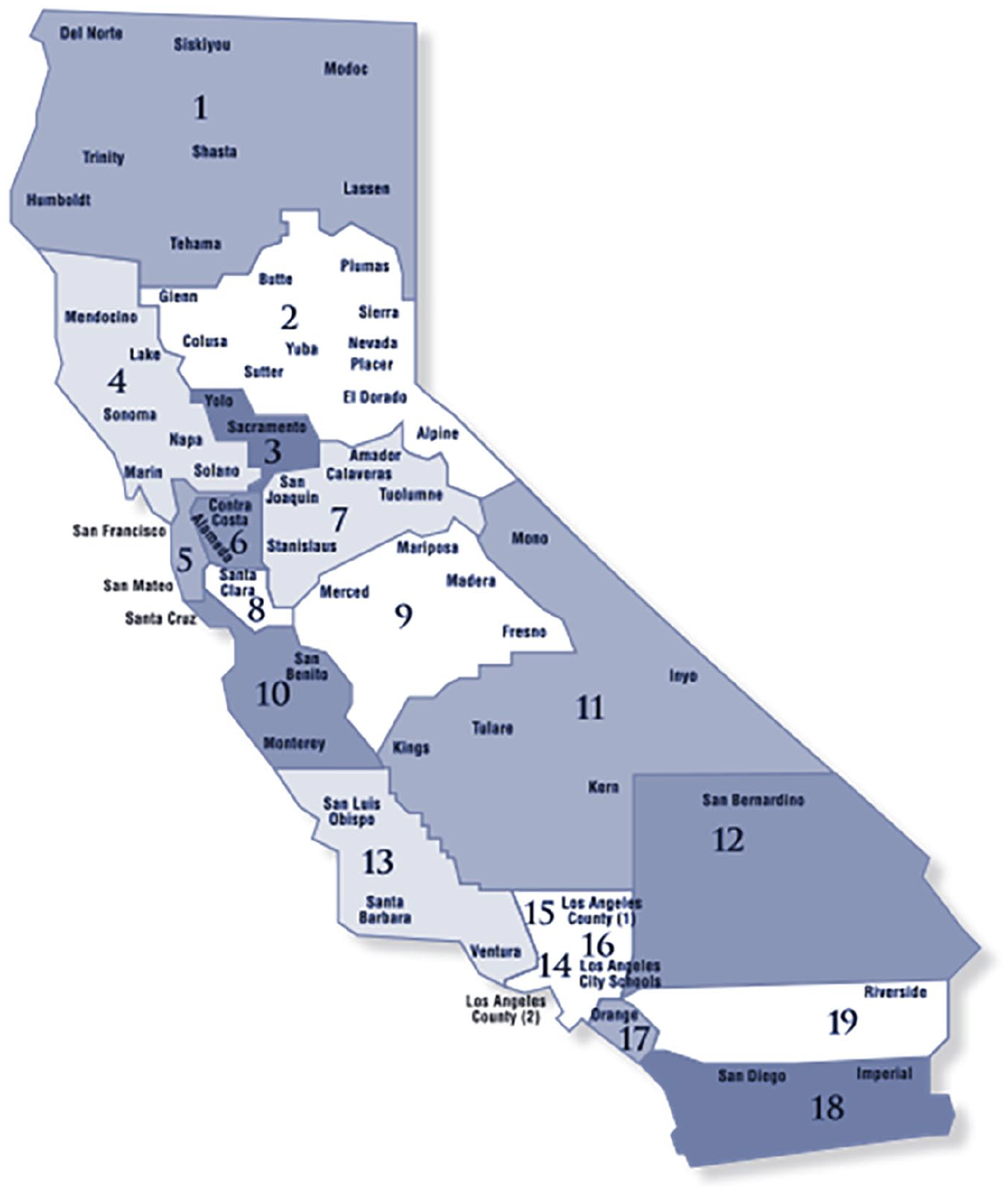
ACSA Regions.
The following questions guided the authors’ interest in understanding if and how the pandemic has impacted school leaders and their school communities:
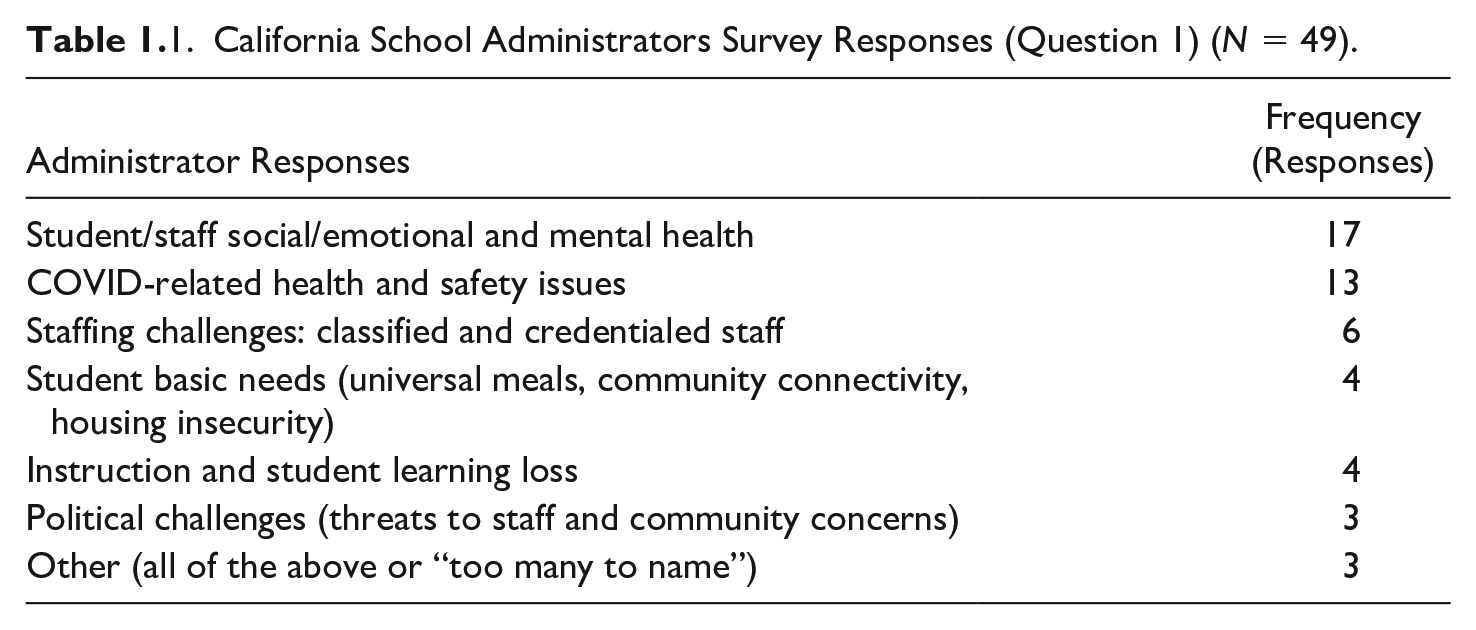
Question 1: What new responsibilities have you taken on as a school or school system in recent years?
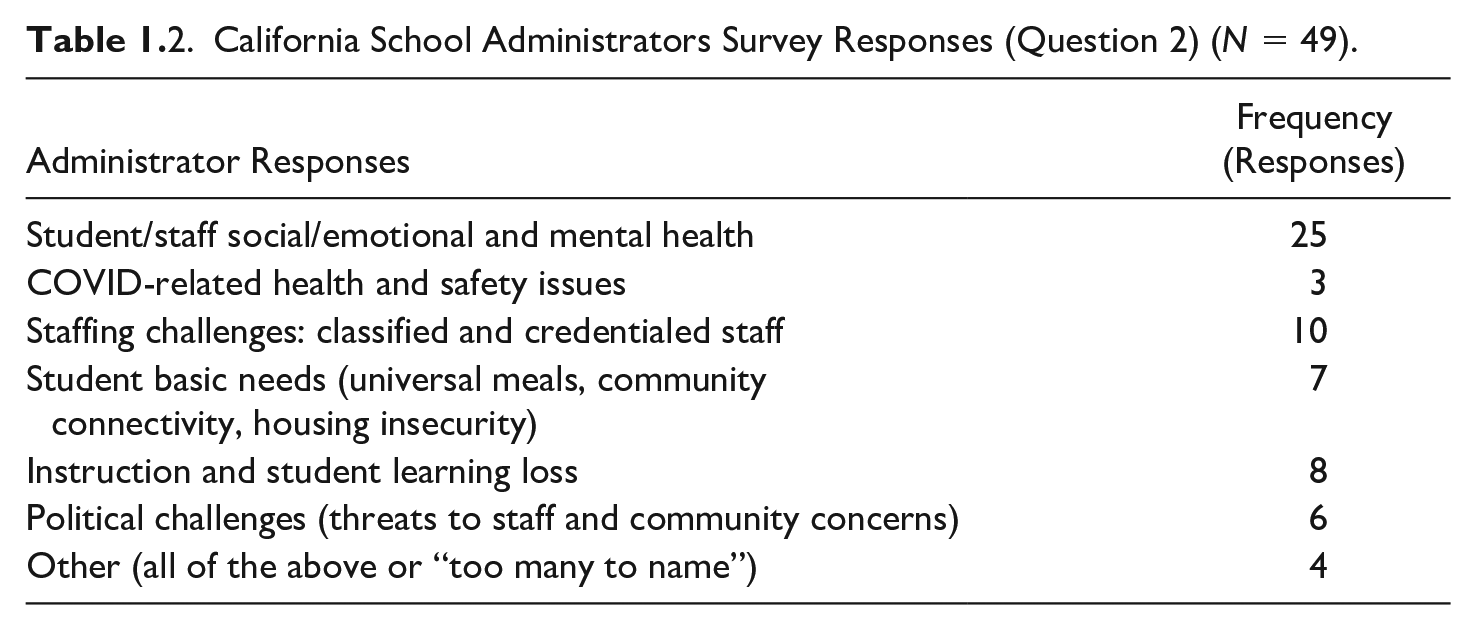
Question 2: What issues have been magnified or accelerated because of the pandemic?
Responses from both survey questions, which were administered to ACSA regional leaders, were coded and organized into a set of themes based on their frequency, which can be seen in Tables 1.1 and 1.2. Responses to both questions were based on an open-ended survey. Some administrators identified several of the categories as high priorities. The frequency of responses does not equal the total number of respondents or N size who received the online survey.
California School Administrators Survey Responses (Question 1) (N = 49).
California School Administrators Survey Responses (Question 2) (N = 49).
Results
This section presents eight core findings from the study. These findings reflect the lived realities of California’s school communities and highlight the ways in which the pandemic has reshaped student learning and educator capacity, and further reinforced systemic inequities. Although the quantitative data above offer a sobering picture of a new reality for school leaders, the qualitative voices of educators bring those statistics to life—pointing to the daily challenges and moral dilemmas faced by those tasked with supporting students through a period of profound upheaval. Each of the following findings is illustrated by direct quotations from the educators interviewed, revealing the way in which the pandemic has raised urgent questions about the system’s stability specifically and public education broadly in California.
Finding 1: Inequities in Remote Learning Conditions Were Widespread
The quality of remote instruction during the 2019–2020 and 2020–2021 school years varied greatly depending on the community, with school systems serving mostly low-income students and students of color largely left alone to figure out how to deliver remote instruction with inadequate technology, connectivity, and capacity. The compounding effects of dealing with pre-existing education inequities and new inequities presented by remote instruction were significant. This led to major challenges in supporting core, grade-level instruction for students in subjects like mathematics, especially for low-income students of color. In some cases, young people struggled to build foundational knowledge required in core subjects, having a cascading effect on future instruction and adding pressure on students and educators to play catch-up.
We have a number of students coming back this year that recognized that they didn’t learn much last year in subjects like math, which scaffolds on top of each other. They’re coming back and the fluency is not there for the next level. However, we put them in the next level because of the no-harm grading policy two years ago. And then last year the work was there but it wasn’t what it would be in a normal school year, nor did they have that day-to-day practice. So, all of that really upticked the stress levels for a number of students as they were realizing the deficiencies in their own knowledge acquisition. (District leader)
Finding 2: Remediation, Student Learning Acceleration, and Socialization Are Universal Challenges After Lost In-Person Instructional Time
Data from qualitative interviews revealed the three most salient themes to better understand how the pandemic affected student learning due to minimal in-person instructional time over several academic years and, in some cases, remote learning that was lacking in quality: (1) a need to develop remediation and learning acceleration strategies because of academic struggles, (2) behavioral challenges for young people, and (3) cases of students needing to relearn grade-level social norms and developmentally appropriate behavior in school settings. As the following quote from a math teacher suggests, it is hard to accelerate any learning strategy because students must attain foundational skills and concepts before taking on more complex tasks in a particular subject. And if students aren’t socialized to succeed in their grade level with peers, then that may act as an initial barrier to student learning.
How am I supposed to teach this current standard when they [students] don’t even know the other standard and I’m having to teach that first before they can get to this, and now I’m behind. And so, the added stress of just doing that is catching up to them. (High school mathematics teacher)
Finding 3: Pre-pandemic Differences in Achievement Patterns Are Accelerating for Students of Color
Historically, strong achievement patterns have existed across race and income in the United States (Hung et al., 2020). Progress was made in the years before the 2019–2020 school year, the year the pandemic began, including in California (Podolsky et al., 2019). However, according to California statewide data, student learning outcomes for historically marginalized students, including Black, Latinx, Indigenous, and multilingual learners, took a concerning decline in statewide achievement data. This was reflected in the comments of educators interviewed to inform this study. In the eyes of some interviewees, pre-pandemic educational patterns have only accelerated for students of color. A district leader explained the landscape she is seeing as it relates to achievement for historically marginalized students. She noted that key student groups, including low-income students, students in foster care, and multilingual learners, the priority of the state’s Local Control Funding Formula (LCFF), have been profoundly impacted by the virus.
The student populations that we have worked so hard to support: youth of color, our students in foster care, students living in transitional contexts like those experiencing homelessness, multilingual learners and students with disabilities. . .. All of the students whose identities are the other, I would say, are most impacted by the outcomes of COVID and during COVID because I think those inequities existed before and they just have been highlighted with COVID. (District leader)
Finding 4: The Social, Emotional, and Mental Health Needs of Students Are Far Exceeding the Capacity of Staff
Most respondents shared examples of how they are navigating complex territory in today’s COVID-era education landscape, one that is impacting countless young people and adults. Many schools are being asked to take on issues at a scale never experienced before in response to social, emotional, and mental health patterns in schools. Student mental health needs have grown to unprecedented levels. One district official explained further:
I can tell you right now, our suicide rate numbers, assessment numbers are off the chart. I mean, they have increased by say 60–70%, and we’re only in December. I have never seen the number of suicide assessments come in at this rate with the level of support and need from DMH [Department of Mental Health]. (District leader)
Finding 5: Little State Guidance or Support Was Provided to Schools to Deal with an Unprecedented Education Crisis
In the wake of vast challenges for schools across California, educators working at all levels in school systems navigated a once-in-a-lifetime crisis. This included making schools the headquarters of education, health, and social services during the pandemic. One district official acknowledged that the state had done little to guide school systems during the pandemic. This includes advising schools on how to spend resources in a fashion that will optimize learning, especially for students who may be struggling. Although district leaders’ interviews indicate they weren’t looking for mandates that would limit locally driven expertise and decision-making, more support from the state was desired: “I know our schools have money. I think most districts have money. They even know they don’t even know how to truly spend that money.”
That same district leader identified a growing need for guidance from the state after talking about the little direction provided regarding the strategic use of state COVID-19 resources:
When our students started losing their housing, we were doing their housing applications for renters’ relief. And when their parents lost their jobs, we were applying for new jobs for them. When family members passed away, we were trying to figure out how to help parents navigate through what it looked like to get a death certificate, to make arrangements, and to try and figure those things out and to get them started on a GoFundMe page. (Principal)
Finding 6: Basic Needs Are More Fundamental to Student Learning than Ever Before
Poverty and inequality profoundly shaped the California education landscape long before the onset of the COVID-19 pandemic. Almost two-thirds of the 5.8 million K–12 students in California are economically disadvantaged (California Department of Education, 2024). Before COVID, 270,000 K–12 students in California were experiencing homelessness—enough to fill Dodger Stadium almost five times (Bishop et al., 2020). Of those students, 7 out of 10 were Latinx. State data shows the number of students experiencing homelessness is actually exceeding pre-pandemic numbers, now totaling over 286,000 students (California Department of Education, 2025).
These patterns point to a much larger issue around how foundational it is for schools to help young people and families meet their basic needs as a learning strategy—a recurring response in the interviews we conducted. Students who lack access to food and a safe place to call home are more likely to struggle in school. In many cases schools have risen to the challenge, something that surfaced repeatedly in interviews. But more must be done to support schools that are operating as centers of care. A site principal described the types of challenges her students have faced and how home visits provided a window into what her students need:
I went to do a home visit. And then she [student] was holding this little nine-month-old. And the toddler’s pulling on her. And the nine-month-old is crying. And I went to knock on her door to ask her why she hadn’t submitted her work. At that point, the conversation changed. It was, “I’ll be back. I’m going to get you some diapers. I’m going to get you some food.” (Principal)
Finding 7: A Weak Pipeline of Educators and Staff and Ongoing Retention Challenges Are Negatively Affecting Schools
Recent analysis based on a survey conducted across 12 California districts (Carver-Thomas et al., 2022) shows that subject-area teaching shortages are becoming more widespread than before the pandemic. A combination of increases in teacher retirements and resignations, coupled with a limited supply of candidates and a need for more teaching positions, is driving unusually high levels of vacancies in several districts in California. Shortages are extending beyond the classroom in education, including critical staff positions. According to a national survey from Ed Week, more than three-quarters of district leaders and principals say they’re experiencing at least moderate staffing shortages in their school buildings this year (Lieberman, 2021). These patterns are impacting the ability of educators we interviewed to prioritize not only student academic success but also staff health and retention. One teacher explained her moral dilemma of having so few substitute teachers available and her worries about her own health during the pandemic:
There are no teachers in the teaching pools. You can barely get a sub if you ask for one. You have to really, really make real efforts to try and get a sub if someone is absent. (Teacher)
Finding 8: An Aggressive State Policy Response Is Needed to Support Racial Justice and Equity
State policy surfaced in most interviews as an area that deserves further attention to address educational inequities broadly, and to more specifically address racial educational inequities that have grown during the pandemic in California. Educators identified four types of policies as critical to helping the state rebound from historic education inequities, especially those accelerated in the past several school years due to COVID: (1) real-time data to inform school implementation; (2) equity standards for implementation of state learning goals and the LCFF; (3) predictable, long-term, whole-child investments that are not one-time state allocations; and (4) changes to how schools are funded, based on enrollment, not average daily attendance (ADA), as a way to bring missing students back to school. On the topic of policy change related to funding, several respondents spoke to the need for more strategic, focused, long-term investments to build upon the momentum the state has gained as a result of more robust state spending packages. One school counselor called for more long-term thinking from the state, not one-time priorities in the budget:
We are hitting a windfall of money in education to fix a problem that isn’t just a one-time problem. These problems have been there for years and will continue to be here even into the next crisis or the next pandemic or whatever comes our way. COVID absolutely has exacerbated it for this one moment in time, but those problems don’t go anywhere. (School counselor)
Discussion
The findings from this study reveal the depth and complexity of the educational challenges exacerbated by the COVID-19 pandemic. Although the virus served as a singular global crisis, its impact on schools, students, and educators in California revealed longstanding structural inequities that were intensified under emergency conditions.
Exacerbation of Structural Education Inequities
The inequities in remote learning conditions (Finding 1) reflected a broader failure of systemic preparedness for emergency instruction. School districts serving predominantly low-income students and students of color faced greater barriers due to limited access to technology, connectivity, and instructional infrastructure. These challenges were not isolated; they reflected and deepened pre-existing disparities in educational access and quality, particularly in core academic subjects like mathematics. The inability to build foundational knowledge in key subjects had a cascading effect on student learning trajectories and heightened stress levels among both students and educators.
Acceleration of Learning and Social-Emotional Gaps
The dual burden of academic remediation and social-emotional resocialization (Finding 2) underscores the need for a more integrated approach to postpandemic recovery. Students struggled not only with academic gaps but also with behavioral challenges and developmental disruptions after prolonged school closures. Importantly, educators noted the difficulty of accelerating learning when foundational concepts had not been mastered—an issue compounded by social-emotional instability that hindered classroom engagement.
Moreover, disparities in academic performance that existed prior to the pandemic have accelerated for students of color (Finding 3), suggesting that without targeted interventions, the pandemic will leave a long-lasting legacy of racialized educational inequality. California’s LCFF, which prioritizes high-need student populations, was designed to address these gaps. However, interviewees expressed concern that the very students the LCFF aims to support—such as foster youth, multilingual learners, and students experiencing homelessness—were among those most deeply impacted by pandemic-related disruptions.
Mental Health Crisis and the Expanded Role of Schools
Findings also reflect an urgent crisis in student mental health (Finding 4). Educators reported unprecedented increases in suicide risk assessments and emotional distress, and an overwhelming demand for social-emotional support. Simultaneously, schools have been asked to serve as frontline providers of not only education but also basic services such as food, housing support, and grief counseling—responsibilities that extend far beyond traditional educational roles (Findings 5 and 6).
Despite this expanded scope of responsibilities, district leaders noted a lack of clear guidance or strategic support from the state (Finding 5). In the absence of centralized leadership, school systems were left to devise ad hoc responses to complex challenges. This response, although often heroic, placed significant burdens on educators and administrators.
Staffing Challenges and Policy Urgency
An additional barrier to recovery is the fragility of the educator workforce (Finding 7). Staffing shortages—both in the classroom and across support roles—have hampered efforts to address learning loss, provide mental health services, and deliver consistent instruction. These shortages also place undue pressure on remaining staff, contributing to burnout and turnover, which further destabilize school communities.
Taken together, these findings point to an urgent need for a comprehensive state policy response (Finding 8) that moves beyond temporary relief funds and toward sustained, equity-driven investment. Key recommendations from practitioners include: (1) real-time data systems that guide implementation; (2) equity standards tied to existing state priorities such as the LCFF; (3) long-term, whole-child investments; and (4) reforms to funding structures, such as shifting away from ADA to enrollment-based models that reflect actual need. These priorities reflect not only a recovery agenda but also a call to redesign education systems to be more resilient and just.
Conclusion
The results from the authors’ study and other contributors represent different dimensions of the effect of COVID-19 on our education systems. Those dimensions span different developmental, educational, organizational, social, and systemic patterns that ultimately have impacted the current state of learning for an entire generation of young people. This special issue has intentionally recruited scholars who can help uncover not only the traditional metrics used to assess the education landscape, like student achievement differences, but also factors like school exclusion, examining how community conditions arrive at the schoolhouse door, reopening strategies, and practices like high-dosage tutoring. A lack of focus on the COVID effect in national and local elections doesn’t represent closure for the lingering challenges still impacting school-age students and their families. Nor does this special issue represent old research that has no relevance in today’s world. Rather, this special issue is a reminder that unless we carefully examine our past and its impact on young people, especially youth who continue to shoulder disproportionate burdens for generations, justice and liberation will continue to be denied.
Our collective responsibility at this time should be clear with research, policy, and practice implications. First, we must take a look back, as we are doing in this special issue, and take full stock of the educational patterns of the past informing today’s post-COVID landscape. It is essential to understand where district, county, state, and federal efforts fell short in making sure that all students, but in particular those most vulnerable, were provided with the essential support to learn in the days, weeks, and months after the pandemic. Second, there needs to be a full and rigorous assessment of where U.S. students are now, like we are doing for this paper. Unprecedented resources have been allocated for schools related to COVID-19. The American Rescue Plan allocated $122 billion for K–12 schools to be distributed through the federal Title I formula for funding schools and districts with concentrated poverty. Third, a plan must be chartered with great urgency at the local, state, and federal levels that ensures there are adequate supports to address learning loss and the social-emotional and mental wellness of students and educators, and a nationwide strategic plan that responds to the ongoing fallout of this unprecedented pandemic.
The slashing of federal budgets amid unprecedented and growing educational disparities at the state and local levels is deeply concerning. As the special issue will further reinforce, our collective mission was not accomplished with an influx of one-time dollars through the American Rescue Plan. Instead, we’re just beginning to understand what is needed to unlock the educational potential of an entire generation of learners. It is our hope that this special issue will spark new conversations, scholarly endeavors, and courageous policy actions from lawmakers committed to addressing the cumulative, negative effects of the virus on young people.
Footnotes
Appendix A: Research Protocol (Study 1)
Declaration of Conflicting Interests
The author(s) declared no potential conflicts of interest with respect to the research, authorship, and/or publication of this article.
Funding
The author(s) disclosed receipt of the following financial support for the research, authorship, and/or publication of this article: Authors Joseph Bishop and Tyrone Howard were supported by the Stuart Foundation: Grant 2023-4851 to the UCLA Center for the Transformation of Schools. The opinions expressed are those of the authors and do not represent views of the Stuart Foundation.