




Abstract
Background:
African American Language (AAL) refers to a rich, widely used, and extensively researched language variety. Despite its importance, AAL remains widely stigmatized in the United States due to anti-Black linguistic racism. Many colleges offer courses with AAL content, and these courses have the potential to help disrupt anti-Black linguistic racism by promoting understanding and respect for this language.
Purpose:
Simply increasing students’ knowledge about AAL is unlikely to disrupt anti-Black linguistic racism. College instructors must also attend to a wide range of challenges involved in teaching this content. Instructors’ knowledge of such challenges, as well as strategies for addressing them, constitutes a form of pedagogical content knowledge (PCK). This study contributes to the emerging scholarship on PCK for teaching and learning about AAL.
Research Design:
In this qualitative study, we analyze open-ended survey data from college instructors to identify challenges faced when teaching AAL content. We also add depth and nuance to discussion of these challenges by analyzing qualitative interview data and qualitative survey responses from college students enrolled in courses with AAL content. Finally, we outline pedagogical recommendations that could potentially address these challenges.
Conclusions:
We identify three major categories of pedagogical challenges that commonly arise when teaching AAL content: protecting Black or AAL-using students from harm; managing other students’ knowledge, ideologies, and/or resistance; and addressing instructor positionality. We present six research-based recommendations to help instructors address these challenges, and identify key directions for future research on the teaching and learning of AAL.
Keywords
Introduction
African American Language matters. We define African American Language, or AAL, as a set of spoken and signed language varieties used in the United States and historically and culturally associated with descendants of formerly enslaved persons; these varieties have been given names such as African American English (AAE), African American Vernacular English (AAVE), Black English, Ebonics, Black ASL (BASL), or Black Language (Baker-Bell, 2020a, 2020b; King, 2020; McMurtry, 2024). AAL features prominently in American speech communities and in American literature, drama, music, and public discourse, as it has for many generations (Rickford & Rickford, 2000). Research on these varieties has played a central role in the development of sociolinguistics, particularly the development of quantitative analyses of variation (Rickford, 1997). AAL also plays an important role in fields such as education, English, and communication sciences (Sedlacek et al., 2023).
Despite AAL’s importance and its centrality to numerous academic disciplines, it is still heavily stigmatized in many sectors of U.S. society. Many Americans (including many White
1
Americans, Black Americans, and non-Black Americans of Color) continue to believe that AAL is somehow deficient or inferior to purportedly Standardized English, and that it lacks systematic rules or principles; however, linguists long ago reached a consensus that such beliefs have no basis in fact, and are instead merely an ideological manifestation of linguistic bias and anti-Black racism (Rickford & Rickford, 2000; Smitherman, 1972). Although several court cases or government policies have attempted to challenge this stigmatization (Peele-Eady & Foster, 2018), anti-Black linguistic racism (Baker-Bell, 2020a) remains widespread. Contesting anti-Black linguistic racism is a moral and ethical responsibility of scholars working in language-related fields; after all: We cannot say Black Lives Matter if decades of research on Black Language has not led to widespread systemic change in curricula, pedagogical practices, disciplinary discourses, research, language policies, professional organizations, programs, and institutions within and beyond academia. (Baker-Bell et al., 2020)
For the better part of a century, scholars have sought to inform the public about AAL and undo the stigmatization of Black communities’ language practices. Carter G. Woodson famously argued that African American students should not learn to “scoff at” or “despise” AAL and should instead have opportunities “to understand their own linguistic history” (1933/2006). Labov (1982) argued that linguists have an ethical and professional responsibility to correct popular falsehoods about language. In the mid- and late-twentieth century, linguists and educators worked to combat racist falsehoods about AAL by documenting the systematicity of this variety, advocating for students’ right to their own language(s) (National Council of Teachers of English and the Conference on College Composition and Communication [NCTE/CCCC], 1974/2014; Smitherman, 1995), and teaching about AAL in colleges and universities (Webber, 1985; Weldon, 2012). Over 150 colleges and universities now offer courses that include at least some content focused on AAL (Sedlacek et al., 2023). These range from courses that include a single AAL-related discussion or assignment to courses that are fundamentally “about” AAL or that center AAL content in order to teach key disciplinary ideas (Sedlacek et al., 2023; Calhoun et al., 2021).
However, it is not enough to merely “correct errors” in the public’s understanding of AAL. Americans’ beliefs about language are often deeply intertwined with beliefs about race and racism (Flores & Rosa, 2015), and beliefs about language and race are notoriously difficult—but not impossible—to change (see, for example, Denson, 2009; Lewis, 2018). Thus, effective teaching about AAL requires not only teaching facts but also challenging deeply rooted ideologies of language. It also requires us to carefully and critically interrogate our own scholarly, intellectual, and pedagogical goals for teaching about linguistics and particularly about AAL.
For example, many scholars advocate for completely decentering and deconstructing so-called Standardized English in K–12 schools in order to recenter marginalized language varieties, but many AAL-using 2 parents and AAL-using K–12 teachers often have more complex views about language; many believe in the existence of a “Standardized English” and want their children to achieve fluency in this variety, in part as a way of coping with pervasive anti-Black linguistic racism in our society (Greene, 2021; Hoover, 1978). At the same time, Baker-Bell (2017) notes that as an African American, she “can switch my language, but I can’t switch my skin” (p. 97), and internalizing negative attitudes towards AAL as a coping mechanism is arguably self-defeating in the long run because it does nothing to contest the anti-Black racism at the root of anti-Black linguistic racism. As educators, we must do more than merely help students cope with racism, because this continues to place the burden of change on marginalized persons rather than on the systems and institutions engaged in marginalization. Rather, we want to help students heal from and empower themselves to challenge racism in both external and internalized manifestations, and we want to transform systems and institutions in ways that prevent marginalization from happening in the first place. Doing so arguably requires raising “Black Linguistic Consciousness that works to decolonize the mind (and/or) language, unlearn white supremacy, and unravel anti-Black linguistic racism” (Baker-Bell et al., 2020), and requires overcoming stigma by deliberately celebrating and/or using AAL (McMurtry, 2021, 2024). Clearly, teaching effectively about AAL at the university level raises complex normative and empirical questions.
One such normative question is: what goals are we trying to achieve through teaching university students about AAL? As mentioned above, our answers go beyond simply correcting misconceptions about AAL, yet our answers will likely differ depending on our student populations and our disciplinary contexts. For example, in an undergraduate or master’s-level teacher education course, our goals might be to develop teachers’ ability and inclination to adopt teaching strategies such as critical language pedagogy (Baker-Bell, 2013; Godley & Minnici, 2008) that support learning and identity development among AAL-using students, sustaining AAL while additively teaching new language practices that parents want their children to learn. We may also want preservice teachers to learn and implement pedagogical practices that will disrupt anti-Black linguistic racism among all students, including non-AAL-using students and non-Black students. Meanwhile, in a doctoral-level course in linguistics or another field, our goals might be to develop students’ knowledge of AAL and their ability to effectively facilitate classroom conversations about AAL (and about language, race, and racism more broadly). On the other hand, in a general education course open to undergraduates across disciplines, our goals might include disrupting hegemonic language ideologies and teaching college students how to recognize and disrupt specific manifestations of anti-Black linguistic racism (Baker-Bell, 2020a, 2020b).
Identifying our goal(s) for AAL instruction raises accompanying empirical questions. What pedagogical choices will effectively achieve our specific goals for our specific students in our specific settings? Students’ responses to specific instructional strategies or curricular choices may vary depending on their language backgrounds, experiences of racialization, racial and linguistic ideologies, and prior knowledge and preconceptions about AAL, as well as their perceptions of instructors’ own racialized identities (Weldon, 2012) or linguistic backgrounds (Sedlacek et al., 2023). In order to achieve our goals, we must explore these complexities and continue to develop the scholarship of teaching and learning about AAL.
We are far from the first to recognize this need. Crucial work has already been done, including Webber’s (1985) typology of AAL course features and Weldon’s (2012) survey of faculty teaching about AAL, to name only a few of the many relevant studies. At the same time, much work remains. Although AAL as a variety has been extensively researched, the scholarship of teaching and learning about AAL remains underdeveloped, and the fields of linguistics, education, English, and communication sciences would all benefit immensely from such scholarship. Such research may also prove useful in helping combat the stigmatization of marginalized language practices around the world. The sheer volume of AAL research, combined with the large number of courses where this content is taught (Sedlacek et al., 2023), means that AAL coursework can provide a valuable context for designing, testing, researching, and replicating instructional strategies. Although many of these strategies may be specific to AAL and to U.S. university contexts, it is possible—even likely—that at least some of these strategies may transfer well into other national contexts. By the same token, the scholarship of teaching and learning about AAL may be able to learn a great deal from the contributions of international scholars and students. The Linguistic Society of America (LSA) has recently acknowledged the value of developing a scholarship of teaching and learning linguistics content through the creation of a special interest group (LSA, 2020). Unfortunately, despite the valuable and growing efforts to develop the scholarship of teaching and learning about linguistics, about marginalized language varieties, and about AAL in particular, a recent survey of college instructors who teach AAL content found that many express relatively low confidence for teaching about African American Language or Culture, especially (though not exclusively) instructors who do not identify as Black or African American and those who do not have personal experience using AAL (Sedlacek et al., 2023).
In this qualitative study, we contribute to the emerging scholarship of teaching and learning about AAL in several ways. First, we analyze data from a 2021 survey of college instructors in order to create a typology of pedagogical challenges faced when teaching AAL content. These included protecting Black or AAL-using students from harm; addressing the knowledge, ideologies, and/or resistance of non-Black, non-AAL-using students; and managing instructors’ concerns about their own knowledge or legitimacy for teaching AAL content. Second, we examine interview and survey data collected in 2016 and 2017 from college students enrolled in courses with AAL content. We investigate which challenges identified by instructors are also reflected in student interviews and surveys, and explore how student data can add nuance or reveal strategies for addressing these challenges. Finally, we offer recommendations to address the challenges grounded in our data and in extant research on effective teaching in higher education. We end by offering recommendations for instructors who teach (or want to teach) AAL content and for researchers working for racial and linguistic justice in higher education and beyond.
Theoretical Framework
By adding to the scholarship of teaching and learning about AAL, we are documenting and adding to pedagogical content knowledge (PCK) about the teaching of this language. The term PCK was coined by Shulman (1986, 1987), who advocated for a distinction between content knowledge of a particular topic, curricular knowledge of the resources available to support teaching of a topic, pedagogical content knowledge that dealt with the intricacies of teaching a topic, and other types of teaching-related knowledge. Shulman argued that one crucial dimension of PCK relates to teaching strategies and representations of key knowledge: “the ways of representing and formulating the subject that make it comprehensible to others. . .some of which derive from research whereas others originate in the wisdom of practice” (1986, p. 9). In other words, part of knowing how to effectively teach particular content is knowing multiple ways of representing and explaining that content, and these multiple representations and explanations should ideally be derived both from research (which can document whether, when, and why certain representations or explanations are effective) and from instructors’ creative ideas and professional expertise (which can innovate new representations or explanations that may be even more effective in a particular context or for particular learners).
In the specific case of teaching AAL content, extensive research has already been done to develop this type of PCK, going back at least to Webber (1985)’s invaluable (yet rarely cited) article, “Teaching About Black English: An Annotated Syllabus.” Webber outlined a typology of course objectives, lecture topics, and assignment types that might be used to teach AAL content, and how these might vary across disciplines such as linguistics, education, or ethnic studies. More recently, numerous other scholars have taken up this work to document and study strategies for teaching AAL content across various disciplines. 3
However, pedagogical content knowledge includes more than merely knowledge of specific teaching strategies. It also includes an understanding of learner cognition—of how students respond to particular teaching strategies or to particular content, and what obstacles may arise when teaching this content. Shulman (1986) characterized this dimension of PCK as: . . .An understanding of what makes the learning of specific topics easy or difficult: the conceptions and preconceptions that students of different ages and backgrounds bring with them to the learning of those most frequently taught topics and lessons. If those preconceptions are misconceptions, which they so often are, teachers need knowledge of the strategies most likely to be fruitful in reorganizing the understanding of learners. (pp. 9–10)
The literature on student preconceptions and misconceptions when learning AAL content, and other obstacles to the teaching of this content, is smaller than the literature on strategies for teaching this content. Invaluable scholarship has detailed structural obstacles to teaching AAL (Boutte et al., 2021), societal resistance to teaching this content (see, for example, Rickford & Rickford, 2000), and passive or active opposition from professional organizations (Smitherman, 1995), university administrators (Lamos, 2011), and K–12 educators (Gupta, 2010; Smitherman, 1972). However, relatively little research has sought to systematically document the range of preconceptions, misconceptions, or other types of pedagogical challenges that arise within college classrooms where AAL content is taught and where instructors are already supportive of teaching this content. Metz (2021) argues that greater attention must be paid to documenting and developing PCK for the teaching of critical linguistics content, lest such teaching fail to achieve its goals or even backfire.
Many scholars have researched student sensemaking in courses designed to change language ideologies, but these often focus on specific disciplines such as teacher education or communication sciences, and/or focus on oppressive language ideologies writ large rather than focusing specifically on AAL. To date, the primary study that focused narrowly on AAL while simultaneously focusing broadly on college classrooms across many disciplines was Weldon (2012, based on data collected in 2002). This survey of 49 college instructors revealed important insights about the teaching of AAL content at the college level; for example, it documented the importance of positionality, finding that over 80% of Black instructors and over 70% of White instructors felt their “racial/ethnic background” shaped the advantages or challenges they faced in teaching AAL content. AAL-using Black faculty reported being able to bring their own experiences and insights into the classroom, whereas White faculty, non-AAL-using Black faculty, and other faculty of color worried about their “outsider status. . .lack of native speaker intuitions. . .[and] the need to monitor carefully their own attitudes and beliefs for prejudices, so as not to offend black students” (Weldon, 2012, p. 236).
Weldon (2012) also identified several strategies White instructors used to mitigate these challenges, such as inviting Black (and perhaps AAL-using) guest lecturers into their classes. Weldon also asked whether instructors ever witnessed conflicts among students in their classes or between students and instructors themselves. Responses often focused on classroom discussions of offensive language or the legitimacy of AAL as a language variety, as well as students’ voicing of racist comments or stereotypes in class or students’ critiques of instructors themselves as “racist.” Weldon organized a typology of challenges, disaggregated by whether they were reported most among Black or White instructors (lightly edited and reproduced in Table 1).
Weldon’s (2012) Typology of Challenges Reported by College Instructors Teaching AAL Content.
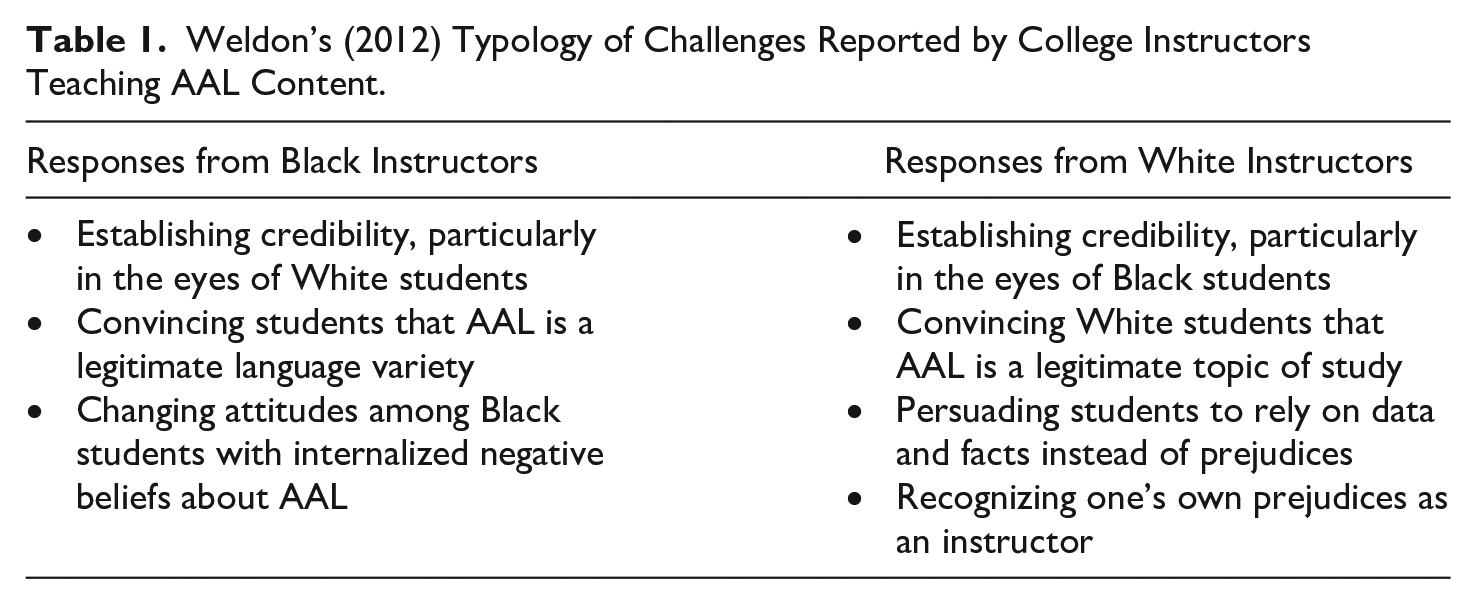
Hundreds of instructors across the United States already have a wealth of experience and expertise teaching AAL content (Sedlacek et al., 2023), and Weldon (2012) began the invaluable work of documenting and aggregating some of the pedagogical content knowledge these instructors have amassed. Today, we seek to update and build upon Weldon’s work to advance the development of PCK for teaching AAL. We do so through an analysis of previously unpublished qualitative data from a nationwide survey of 149 college instructors teaching AAL content (Sedlacek et al., 2023), focused on instructors’ descriptions of the challenges they face in teaching about AAL. To help substantiate the prevalence and significance of these challenges while also identifying useful guidance for educators and researchers, we cross-reference instructor survey data with interviews and surveys of college students enrolled in similar courses with AAL content. We then use insights from these complementary data sources to help identify strategies for productively addressing some of these challenges.
Positionality
Our own racialized identities, language backgrounds, and accompanying life experiences shape our research in important ways. For example, our experiences may shape the types of research questions we ask (Medin & Bang, 2014), while our racialized identities may shape the types of information that participants feel comfortable sharing with us in interviews that discuss race and racism (Mizock & Harkins, 2012). In terms of racialized and gendered identities, we self-identify as a gay White man, a Hispanic woman, a bisexual White man, a White woman, and two non-AAL-using Black suburban women. Our shared interest in racial and linguistic justice springs from a variety of experiences, including working in and learning from majority-Black communities and witnessing or directly experiencing linguistic oppression in education.
We sought to follow the Charity Hudley Rule for Liberatory Linguistics in our work (Charity Hudley et al., 2022), which argues that researchers with etic or “outsider” positionalities studying marginalized populations and their language practices should strive to include emic, “insider” voices in the research process and should describe their efforts to “increase the participation of [insider] community members at your university, in your department, and in your research area” (p. 136). We received support in study design, recruitment, analytical decisions, and manuscript revision from numerous scholars who teach college AAL coursework, including Black scholars and AAL users. We strove to support Black writers through our work by offering faculty survey participants a choice between two forms of compensation, one of which was a gift card to the African American Literature Book Club (an online bookseller that centers Black writers and Black perspectives). Finally, with permission from our institutional review board (IRB) and consent from participants, we extended follow-up invitations to many faculty survey participants, including Black scholars and AAL users, to collaborate on additional research focused on AAL instruction.
Methods
This manuscript primarily draws on responses to open-ended items from a 2021 survey of college instructors (N = 149) who teach about AAL, with the goal of identifying challenges that arise when teaching AAL content. To a limited extent, we also include qualitative data from a separate study conducted in 2016 and 2017 that collected surveys and interviews from undergraduate and master’s degree students enrolled in courses with AAL content at several different colleges and universities. We analyze student data in order to link particular challenges identified by instructors with students’ accounts of similar challenges, and to identify strategies mentioned by students that could help address these challenges.
Importantly, there was no overlap between classrooms whose instructor survey data are included in this analysis and classrooms whose student interview data are included in this analysis. (There was some overlap between classrooms with instructor survey data and classrooms with student survey data, but this overlap was small—fewer than 10 participants in the 2016 or 2017 student surveys had an instructor who also participated in the 2021 survey.) Using complementary yet mostly non-overlapping datasets has important limitations (discussed below), but also affords us the opportunity to identify qualitative patterns that may recur across time and across contexts while protecting students’ and instructors’ confidentiality.
Instructor Surveys
Our first data source consisted of qualitative data on the challenges and considerations instructors face when teaching about AAL, drawn from a 2021 survey of college instructors (N = 149) in linguistics, education, English, communication sciences, and other fields who teach (in the words of our survey recruitment criteria) “any university course that includes at least one reading, assignment, discussion, and/or lesson on African American Language.” 4 This study was approved by the Southern Methodist University Institutional Review Board under Protocol 21-080. A detailed description of the survey sampling methods (snowball sampling through social media and professional organizations) and the quantitative findings can be found in Sedlacek et al. (2023). Here, we share a previously unpublished qualitative analysis of instructors’ responses to an open-ended survey question: “Please describe any challenges you face in teaching about African American Language.”
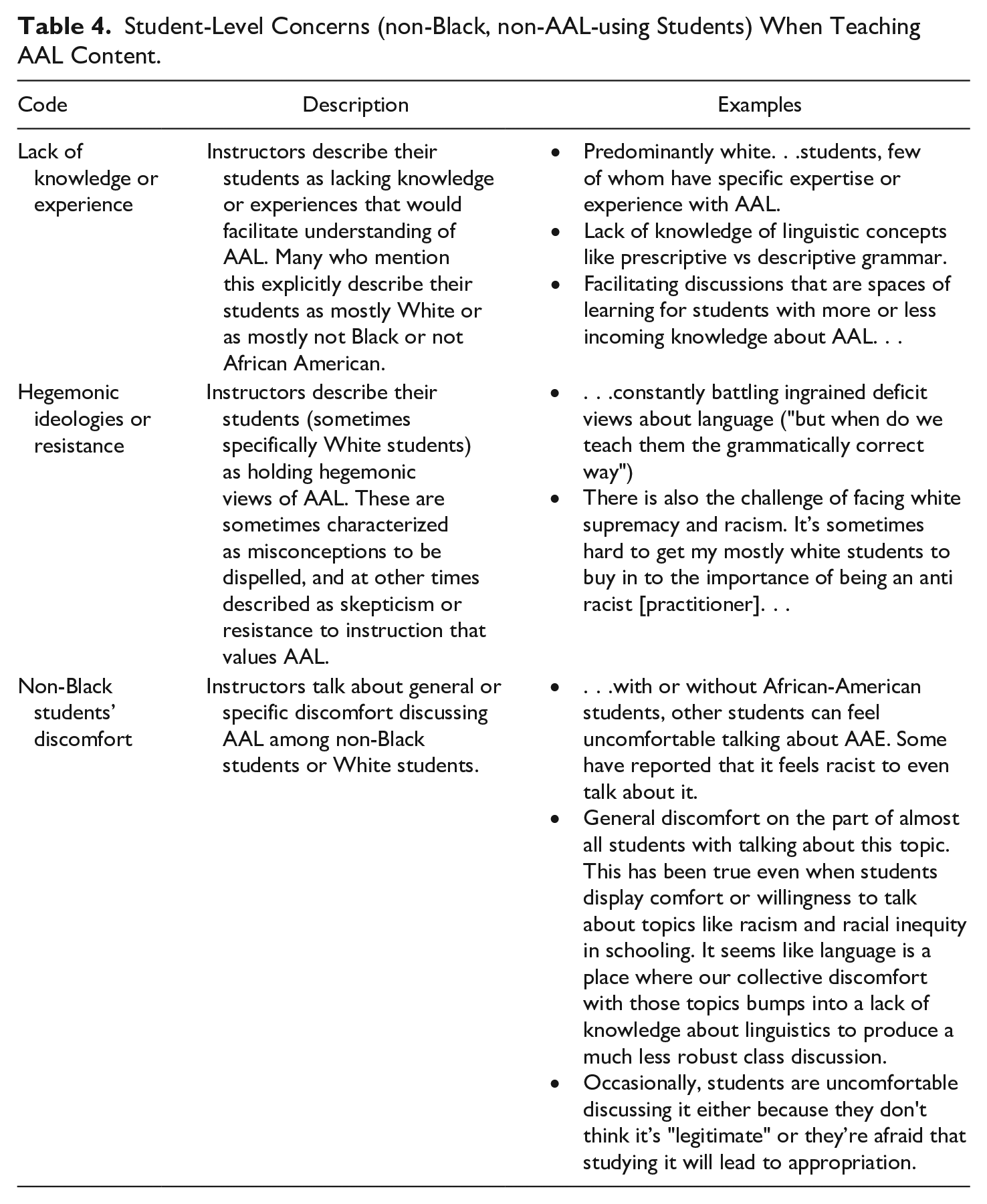
One hundred thirty-nine instructors (93% of the sample) wrote responses to this question. Seven responded that they did not face any challenges teaching about AAL (e.g., “None that I can think of” or “I don’t face any challenges teaching African American Language”). Our analysis focused on the remaining 132 responses. Author Grey engaged in initial inductive coding of approximately 33% of the data and compiled a list of any in vivo codes that recurred in three or more responses. Author Sedlacek developed a provisional codebook based on these data, and Authors Grey and Sedlacek then separately coded the remaining 66% of responses and met to discuss disagreements. Next, Author Sedlacek made revisions to the codebook based on these discussions, and Authors León and Sedlacek each recoded the entire corpus using the revised codebook, meeting afterward to discuss and resolve any disagreements. The final version of the codebook, including definitions and examples of each code, is shown in Tables 3, 4, and 5. (As will be described below, one additional section of the codebook is not included because it focused on systemic challenges to AAL teaching rather than pedagogical challenges.)
Student Surveys and Interviews
Our supplementary data sources are surveys and transcripts of phone interviews conducted in 2016 and 2017 with undergraduate and graduate students enrolled in college courses with AAL content. These surveys and interviews were part of a larger, as-yet-unpublished, multisite study of college students’ experiences learning about AAL. This study was approved by the Stanford University Institutional Review Board under Protocol 36950. To identify courses with AAL content, Author Sedlacek conducted Google searches combining the term “syllabus” with “African American English” and related terms. Search results were used to identify the instructors of recently taught college courses with AAL content, and Author Sedlacek contacted these instructors to explain the study and ask for institutional approval to recruit, survey, and interview students. Seventeen instructors at different U.S. colleges and universities were contacted, and nine ultimately agreed to allow IRB-approved recruitment for the study to take place in their classes.
Pre-course and post-course student surveys asked numerous questions about students’ language backgrounds; educational backgrounds; identities; beliefs about language, race, and racism; and knowledge of AAL. One hundred twenty-five students completed either a pre-course survey, a post-course survey, or both; in this manuscript, we focus on the subset of post-course surveys (N = 60) that included answers to the following questions: “How would you describe your instructor’s racial/ethnic identity?” and “To what extent do you think your instructor’s racial/ethnic identity may have affected your experience learning in this course? Briefly explain your answer.” These questions were inspired by Weldon (2012)’s finding that many instructors felt their own racial identity and positionality influenced students’ responses to AAL instruction. Sixty students spread across all nine institutions responded to these questions, with between 2 and 13 responses coming from each institution. Author McLarty and a student researcher engaged in inductive coding of responses; Author Sedlacek then developed a codebook based on initial inductive codes, and Author Sedlacek, Author McLarty, and a student researcher then recoded all responses and met to resolve disagreements.
Forty-seven of these 60 respondents described their own racialized identities as White or as White and another identity; eight described their own racialized identities as Asian or as Asian and another identity; eight described their own racialized identities as Hispanic or Latina/o/x or as Hispanic or Latina/o/x and another identity; and five described their own racialized identities as Black or as Black and another identity. Several also listed additional racialized identities that are excluded here to protect student confidentiality. Fifty-four of these 60 respondents described their instructors’ racialized identities with terms such as “White,” “Caucasian,” or with various European or European American nationalities. Four described their instructors’ racialized identities as “Black” or as Black and an additional racialized identity. Two declined to ascribe racialized identities to their instructors. Several instructors, including both Black and White instructors, were specifically described as immigrants to the United States.
A total of 45 semistructured interviews were conducted, including 26 pre-course interviews and 19 post-course interviews. Post-course interviews were used for the current analysis because pre-course interviews were conducted too early in the semester to include substantive information about students’ perceptions of course pedagogy. Three of the 19 post-course interviews were excluded from the present analysis because the interviewees learned about AAL in an asynchronous online course; although these interviewees and their perspectives are important, their experiences of pedagogy may be quite different from those of students enrolled in synchronous or in-person courses. Demographics and geographic distribution of the 16 post-course student interviewees included in this analysis, spread across 7 of the participating institutions, are shown in Table 2.
Demographics and Geographic Distribution of Post-course Student Interviewees.
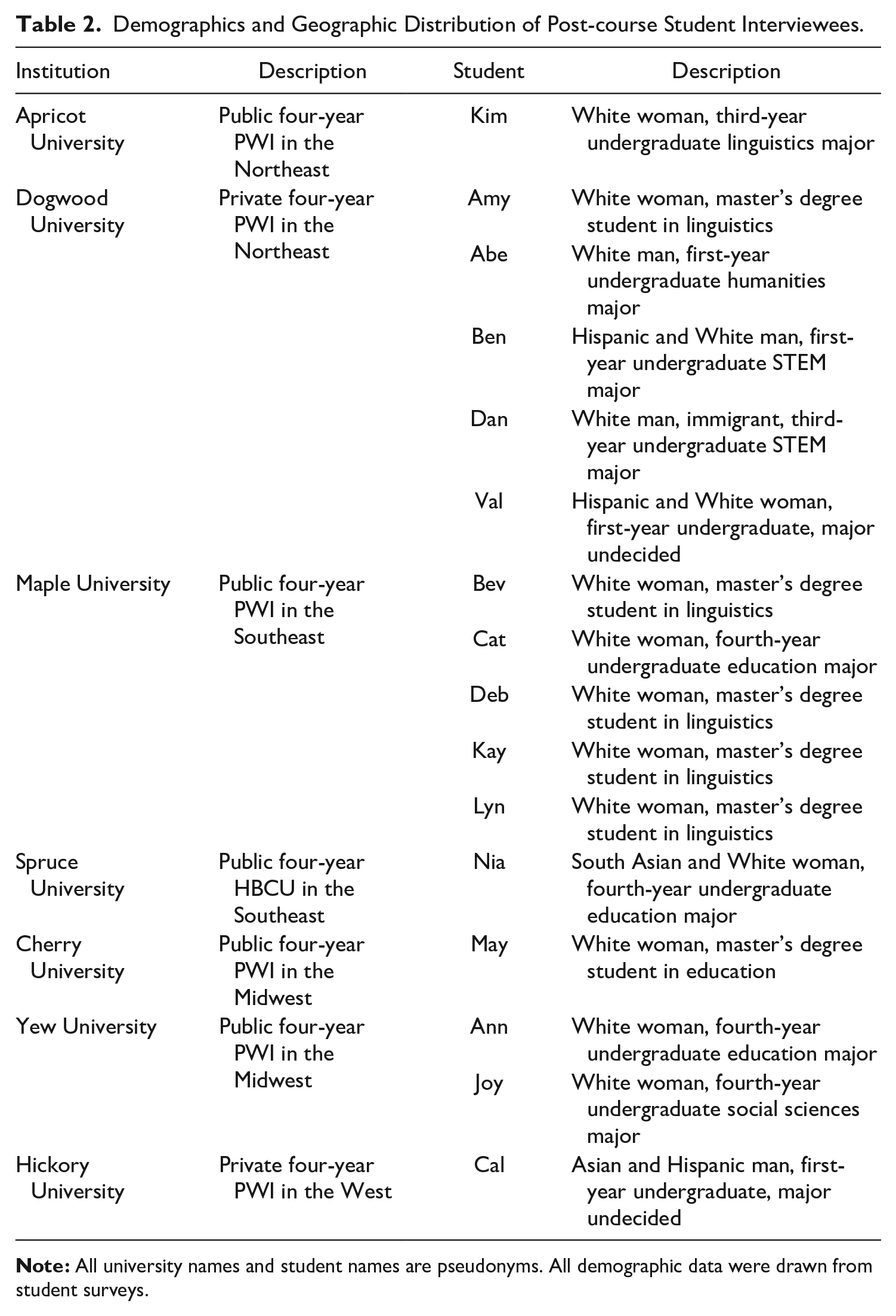
Importantly, narrowing the sample to the 16 post-course interviews conducted with students taking in-person courses also narrowed the range of racial and ethnic identities and language backgrounds included in the analysis. Most of these 16 interviewees were non-Hispanic White individuals and were native speakers of English, and none identified as Black or as a user of AAL. This is an important limitation and partially motivated our decision to center our analysis on instructors’ survey responses; because our sample of instructors was much larger and more racially and linguistically diverse, including numerous Black scholars and AAL-using scholars, it arguably provides a more complete portrait of the range of pedagogical challenges that can arise in courses with AAL content. Meanwhile, we use our interview data as a tool for understanding how some students—specifically non-Black, non-AAL-using students—experienced particular pedagogical challenges and how they made sense of actions their instructors took to mitigate these challenges. Further research is needed to explore how Black students (both AAL users and non-AAL users) make sense of similar types of college experiences; at the same time, invaluable work in this area has already been done by Calhoun et al. (2021), Charity Hudley et al. (2022), Franz et al. (2022), and Meacham (2000), and we direct readers to explore these works.
Interview transcripts were generated by automated transcription software, then reviewed for accuracy and manually cleaned and de-identified by Author Sedlacek. Because the focus of this manuscript is on identifying pedagogical challenges and strategies for addressing them, Author Sedlacek engaged in protocol coding (Saldaña, 2009) to identify transcript excerpts where students were asked to describe “uncomfortable” experiences and/or to describe their instructors’ pedagogical practices. Author McLarty and a student researcher then engaged in Emotion Coding and Process Coding (Saldaña, 2009) to identify students’ affective responses to challenges, as well as any accompanying description(s) of instructors’ pedagogical practices. Author Sedlacek, Author McLarty, and a student researcher then engaged in iterative discussions and re-readings of the coded excerpts, ultimately identifying four major sources of student discomfort: offensive language, cultural appropriation, dissonance or disagreement, and feelings of inauthenticity. In the present study, we discuss these findings only insofar as they parallel challenges reported by instructors, in order to link instructor-identified challenges with student experiences and strategies to address these challenges.
Findings
Our findings point to several pedagogical challenges that instructors face, as well as several strategies instructors can use to address these concerns and considerations. These included student-level considerations such as protecting Black or AAL-using students from harm; managing the knowledge, ideologies, and/or resistance of non-Black or non-AAL-using students; and instructors’ concerns about their own (self-described) lack of knowledge, expertise, or perceived legitimacy for teaching AAL content. We explore the specific challenges that instructors reported in order to help other instructors and researchers recognize, prepare for, and ethically address these challenges. We also suggest possible strategies to address some of the instructor and student concerns voiced in our data.
Challenge #1: Protecting Black or AAL-Using Students From Harm
Several instructors’ survey responses described ways that discussions of AAL content might—if not taught carefully and critically—result in harm to Black or AAL-using students. As shown in Table 3, instructors sought to avoid retraumatizing Black or AAL-using students by exposing the class to many stories of linguistic racism; to avoid “spotlighting” Black or AAL-using students (Carter Andrews, 2012) in ways that made them feel singled out or burdened; to avoid exposing the class to offensive language that could directly harm Black or AAL-using students who were present, or could indirectly harm others in the future; and to avoid invalidating or devaluing the beliefs of Black or AAL-using students with internalized negative attitudes toward AAL.
Student-Level Concerns (Black or AAL-Using Students) When Teaching AAL Content.
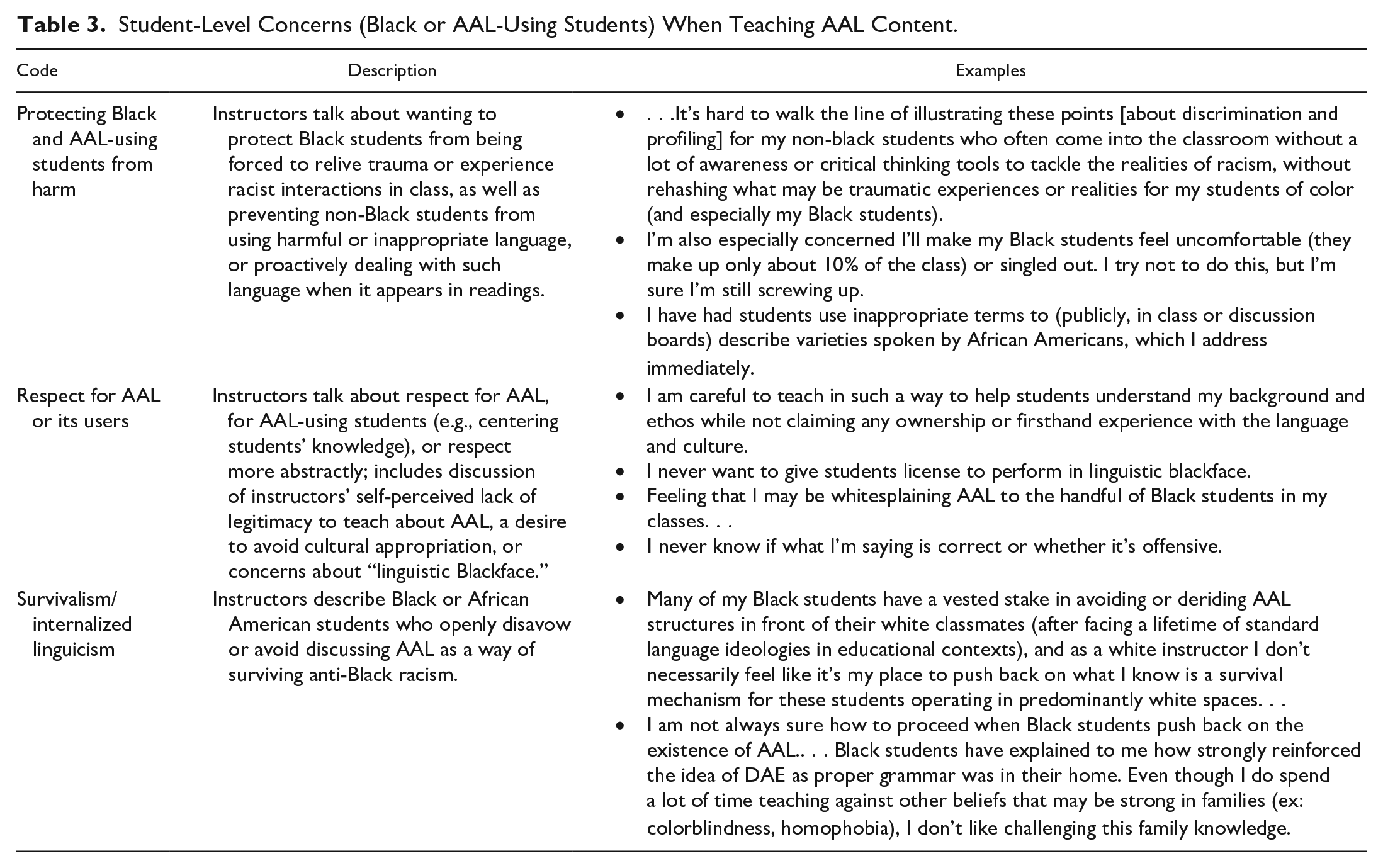
As mentioned above, none of the 16 student interviewees included in the current analysis identified as Black or as an AAL user; thus, their interviews did not reflect the same diversity of perspectives and experiences as the instructor survey data. Nevertheless, there were numerous moments when student interviewees mentioned challenges that paralleled those identified in the instructor surveys. Six student interviewees at five different campuses mentioned issues of cultural appropriation, linguistic appropriation, or offensive language. For example, Cal (a first-year Asian and Hispanic male undergraduate at a predominantly White institution [PWI] in the West) described vague feelings of anxiety about appropriation when asked to read aloud from texts that included AAL: When [course readings] were in African American Vernacular English. . .[the instructors] would ask us to read [aloud], and I personally felt a little uncomfortable reading these passages. . . It seemed. . .almost like an unspoken rule that only the Black kids can read aloud in class, if it is in African American Vernacular English. . . [Instructors] would ask for volunteers. . .but kids who weren’t Black would never volunteer. . .
In this case, Cal expresses discomfort with the idea of non-Black students using AAL in class and argues there is an “unspoken rule” against this practice. Although this discomfort may be driven by Cal’s desire to avoid acting or appearing racist, rather than driven specifically by a desire to protect Black or AAL-using students, it nevertheless intersects with some of the concerns voiced in the instructor survey data. Notably, Cal’s unease does not seem to stem from the rule itself, but rather from the unspoken-ness of the rule and the potential for its violation—the risk that a non-Black, non-AAL using student might be called upon to read AAL aloud or might volunteer to do so. Doing so might be perceived as linguistic appropriation and may harm Black or AAL-using students. At the same time, the combination of an unspoken rule against linguistic appropriation and a pedagogical practice of frequent read-alouds in class could also generate harm by imposing an extra burden on Black students to participate more in class, even if those students are not users of AAL or do not wish to read aloud in class—arguably a form of spotlighting. Indeed, Cal’s narrative implies another unstated and harmful assumption—that most or all Black students in Cal’s class are necessarily users of AAL or feel comfortable reading AAL aloud in class. This assumption, if held by non-Black students or instructors, could harm non-AAL-using Black students by creating implicit or explicit pressure to “perform” a language variety that is not their own. In the next section, we share strategies for addressing this challenge and related challenges focused on protecting Black and AAL-using students from harm.
Recommendation #1: Engage in Explicit Norm-Setting
Cal’s interview points toward a straightforward step college instructors could take to address concerns about preventing harm to Black or AAL-using students: make unspoken rules into spoken rules by engaging in explicit norm-setting. Norm-setting plays an important role in teaching strategies that focus on equitable student discussions (see, for example, Cohen & Lotan, 2014). Our findings suggest several norms that may be useful in discussions of AAL:
Speak in your own voice, not someone else’s. Several instructors voiced concerns about “linguistic blackface,” and Cal’s interview showed that students sometimes feel similar concerns. Instructors may be able to alleviate this student anxiety by explicitly stating such a norm aloud—that students will not be asked to read aloud in (or otherwise mimic) a language variety they do not already use, unless learning to use this variety is the explicit instructional goal of the class. For related research, see Cabral (2022).
Meanwhile, in order to avoid burdening AAL users with extra labor in class or creating an environment where Black non-AAL users feel pressured to “perform” a language variety that is not their own, instructors could substitute audio or videorecordings in place of read-aloud activities. In Cal’s class, read-alouds of AAL came from August Wilson’s play Fences; many recorded performances of this work exist online, and such recordings could potentially be used in class as an alternative to read-aloud activities. Instructors could poll their classes at the beginning of the semester to gather information about students’ language backgrounds and comfort reading aloud, and could use this data to inform decisions about course pedagogy.
Some words are off-limits. Two student interviewees at different institutions seemed to share instructors’ concerns about offensive words being used in class, either in the context of viewing documentary films that contained offensive language or engaging in instructor-facilitated discussions focused on offensive language. Although there may be contexts in which such activities can be meaningful and productive, there may also be contexts in which they can be harmful. Instructors who feel unprepared to facilitate such discussions—but who still wish to discuss language, race, and racism with their students—could simply announce a norm that neither instructors nor students should speak such words aloud during class. For thoughtful and nuanced discussions of this pedagogical challenge, see Thomas (2013) or Charity Hudley and Mallinson (2016).
We do not argue that either of these norms is inherently good, nor that they are appropriate for all classroom contexts. We simply argue that they pose possible solutions to some of the instructor and student concerns voiced in our data, and encourage instructors to consider these as possible solutions to specific pedagogical dilemmas. Alternative norms are possible; indeed, Lee (2022) has designed and described an invaluable classroom activity that specifically subverts the norm of “speak in your own voice,” and by doing so she is able to build constructively on the classroom discomfort sometimes experienced by non-AAL-using students (discussed further in the next section). Lee asks her teacher candidates—most of whom are White non-AAL-users—to read AAL text aloud to each other in pairs, and grade each other on their performance. By doing so, she works to help non-AAL-users develop empathy for AAL-using students. Further research is needed to explore the impact of various norms and activities in courses with AAL content; for readers interested in learning more about norm development and the teaching of norms to students, we recommend Cohen and Lotan (2014).
Strategy #2: Center Students’ Voices While Avoiding Spotlighting
Another way instructors may try to address some of the concerns mentioned above is to center student voices and perspectives. However, certain methods of centering students’ voices can carry risks. Several instructors in our survey reported wishing that they taught more Black or AAL-using students or other students of color in their courses because of the invaluable insights and lived experiences these students can bring to class. We applaud the value these instructors ascribe to student insights and experiences that have historically been ignored or devalued; however, we also worry that in some cases instructors may be inadvertently “spotlighting” Black or AAL-using students, forcing them to take on the emotional and cognitive labor (and risks) of educating their peers (Carter Andrews, 2012).
Fortunately, educators have already identified strategies to center student voices while avoiding spotlighting. Lin and Kennette (2021) recommend that instructors collect, curate, and share anonymized questions or insights from students, which could be used as prompts for classroom discussion. Ben, Val, and Dan—three students attending the same Northeastern PWI—reported their instructor using this practice, and described it favorably. In Ben’s words: One thing [our instructor] did that was kind of cool, was he used this. . .[phone app for collecting student responses anonymously]. . . What he would do, is on particularly like uh, questions that people might have gotten shy about, like talking about out loud, he allowed people to submit their responses anonymously. . . There was one where we were talking about Iggy Azalea and like whether her use of, of African American dialect features is considered like cultural appropriation or if it’s, if it’s disrespectful to people who use the dialect and that was one of those opportunities where we could say yes or no. . . On the board [the instructor] was able to see. . .how the class was feeling as a whole, but people. . .didn’t necessarily have to expose themselves in that way, which was pretty cool. . .I think it really. . .decreased the excuses that people have for not participating.
The practice of sharing students’ (instructor-curated) ideas anonymously has been recommended in past research on equitable teaching and learning. For example, at the K–12 level, teachers with strong reputations for supporting LGBTQ+ inclusion sometimes use this practice to facilitate class discussions about LGBTQ+ identities and experiences (Kavanagh, 2016). Such practices could also prove useful in courses with many students unfamiliar with the context of race and racism in the United States (e.g., recent immigrants or international students who may be as-yet unfamiliar with specific local understandings of cultural appropriation, of “reclaiming” derogatory language, etc.). We argue that instructors teaching AAL content at the college level should strongly consider the use of this practice and argue that researchers should explore the impact of such practices in order to further develop the scholarship of teaching and learning about AAL.
Recommendation #3: Amplify Multiple Voices, Including Multiple AAL Users
Students may bring many different beliefs about AAL and other forms of language into the classroom. It can be complicated to show respect for students’ beliefs without necessarily agreeing with these beliefs—especially when Black or AAL-using students may themselves hold oppressive beliefs that stigmatize AAL. One strategy for respecting student beliefs without necessarily agreeing with them could involve amplifying multiple voices in the curriculum, perhaps by assigning readings written by authors with a diverse array of racial and linguistic positionalities, and by specifically including the perspectives of multiple authors who identify as AAL users. Asante (1991) made similar recommendations more than 30 years ago, arguing that centering African American perspectives in the curriculum allows Black students to “[see] themselves as the subjects rather than the objects of education” (p. 171). More recently, Baker-Bell et al. (2020) stated in the Conference on College Composition and Communication’s 2020 Demand for Black Linguistic Justice that “Black dispositions [must be] centered in the research and teaching of Black Language.”
Several instructors’ survey responses suggested such strategies: One said, “I have put a lot more effort into weighing different readings (and assigning multiple readings, so that no one reading is the definitive word on the subject),” while another commented, “I try to use Black-authored texts/examples, and to remain aware of potential problematic stereotypes in examples.” Providing students with multiple readings might reduce the risk that students see the curriculum as promoting a single “correct” viewpoint, even if some readings contain problematic content that the instructor does not necessarily agree with or approve of. For example, instructors could have students explore Hoover’s (1978) study of the diverse perspectives on AAL among Black parents and community members, Greene’s (2021) study of diverse perspectives on AAL among African American teachers, or Charity Hudley et al.’s (2022) study of diverse perspectives on AAL among Black college students. Assigning such readings could convey to students that instructors find value in exploring a wide variety of beliefs about AAL, including both positive- and negative-valence beliefs, while potentially reducing the risks generated by having students voice these ideas (or the risks of instructors validating them) in whole-class discussions. Several participants in our survey also mentioned the documentary Talking Black in America (Hutcheson & Cullinan, 2017) as another invaluable resource; this film, available for free to stream online, includes interviews with AAL-using researchers.
Another approach to amplifying multiple perspectives might be to organize guest lectures by scholars who have written about AAL from emic, lived-experience perspectives, as previously recommended by Weldon (2012) and Sedlacek et al. (2023). Such invitations could focus not only on senior scholars in the field, but also on early-career scholars, contingent faculty, or graduate students engaged in AAL-related research or teaching. This would greatly expand the pool of potential guest lecturers instructors could draw upon, while also facilitating networking, community-building, and the sharing of expertise among the growing community of experts on AAL. In conjunction with such efforts, it may also be useful to invite international or U.S.-based guest lecturers who research other stigmatized language varieties from emic, lived-experience perspectives; these guests could provide useful comparative perspectives, perhaps especially if such varieties are used by (or are at least familiar to) students in the course. Polling students about their language backgrounds and language varieties at the beginning of a course (see “Recommendation #1: Engage in Explicit Norm-Setting” above) could help identify languages and varieties that may be especially fruitful topics for guest lectures and comparative analysis. Importantly, because academia is notorious for burdening racially marginalized scholars with unpaid and unrecognized labor (Hirshfield & Joseph, 2012), instructors should both compensate guest lecturers (e.g., with honoraria) and recognize them (e.g., by collecting student feedback that guests could use in job application materials or in tenure portfolios).
Although the three recommendations listed in this section are not comprehensive or universal solutions to the challenge of protecting Black and AAL-using students from harm, they do offer several possible starting points for instructor decision making and for further research. For additional suggestions, we recommend readers explore Baker-Bell et al. (2020).
Challenge #2: Managing Other Students’ Knowledge, Ideologies, and/or Resistance
Many instructors’ survey responses also described challenges involving non-Black and non-AAL-using students. Some characterized their students as lacking experience using, hearing, or signing AAL, and many who mentioned this challenge explicitly described their students as mostly White or as mostly not Black or not African American. 5 Many instructors reported that it was challenging to confront students’ preexisting beliefs or ideologies of language. Sometimes these preexisting beliefs or ideologies were framed as misconceptions to be dispelled, but at other times instructors reported active resistance or skepticism from students. Some instructors also specifically referenced discomfort that non-Black students (or White students in particular) may experience when discussing AAL. For example, one referenced an ideology of color-blind racism (Bonilla-Silva, 2006), remarking that their students “see talking about racial differences as potentially racist (they want to be color blind!).”
Student-Level Concerns (non-Black, non-AAL-using Students) When Teaching AAL Content.
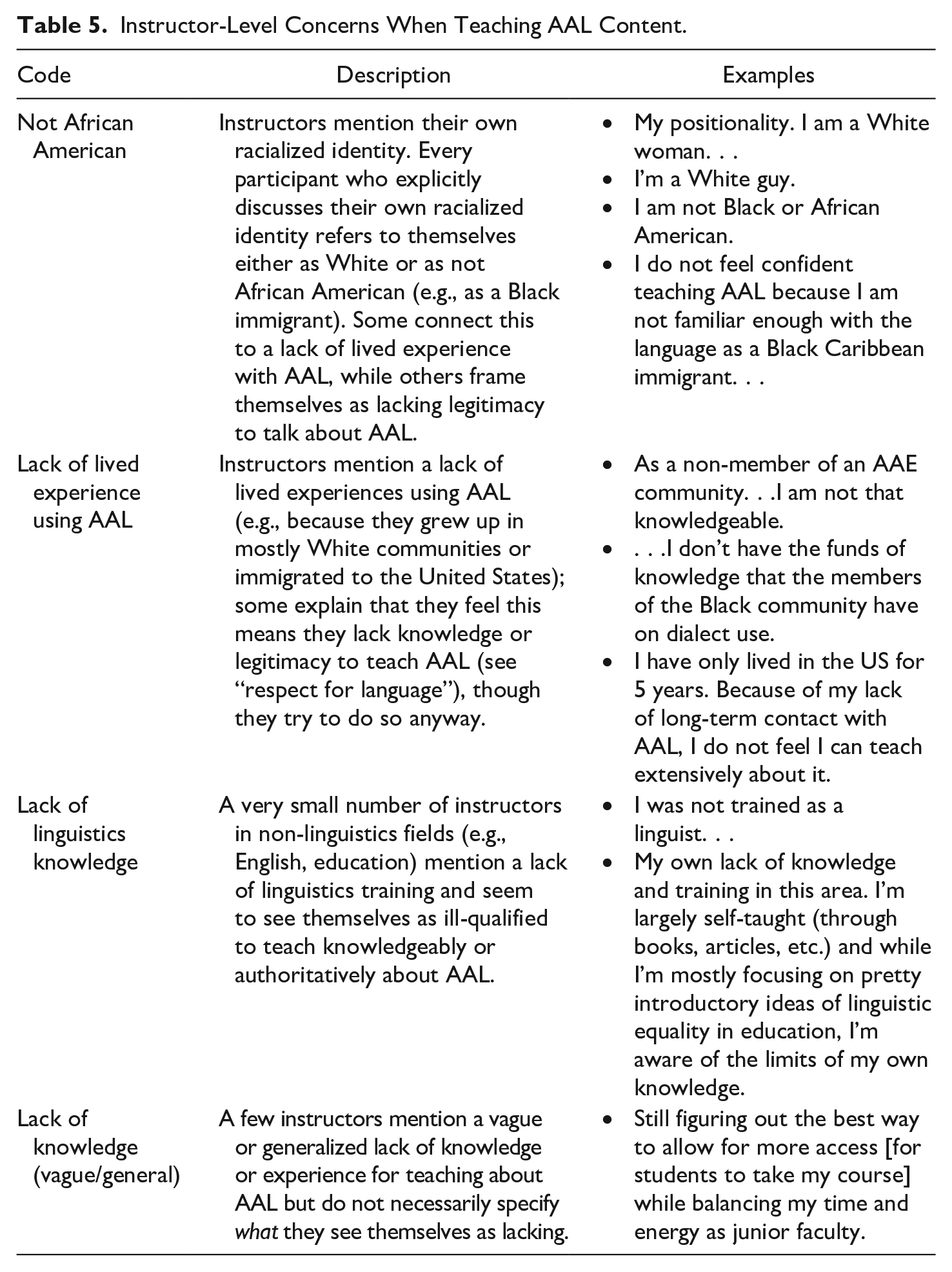
Instructor-Level Concerns When Teaching AAL Content.
In the student interview data, four student interviewees at three different campuses mentioned issues of discomfort or resistance to learning about AAL or other stigmatized language varieties. For example, Joy, a fourth-year undergraduate White woman majoring in social sciences at a Midwestern PWI, explained that it was “kind of hard to admit” that she had once held negative beliefs about African American Language: Because that’s, like, almost implying that you’re racist. . . No one wants to admit anything that might be perceived as racist or judgmental, especially not on a liberal campus like [ours]. . . When my TA would ask questions, like. . . “Did any of you guys, like, look negatively about the stuff?” Most people would kind of like, look down and kind of. . .[give] cues that they don’t really want to talk about it.
In this passage, Joy highlights a common source of internal discomfort that may arise in lessons on AAL. Because linguistic racism might be less widely recognized compared with overt racism, many students may have personally espoused these or similar prejudiced attitudes at some point in their lives. Confronting this fact can create cognitive dissonance for students by associating their own beliefs and actions with racism and threatening their positive self-concept. This anecdote raises important questions about how instructors can facilitate students’ critical (re)evaluation of their own beliefs about language.
Several of the recommendations shared above may help to address these concerns. For example, centering students’ voices while avoiding spotlighting might create opportunities to directly engage with students’ hegemonic beliefs while perhaps mitigating feelings of shame or defensiveness that might arise. Additional recommendations are discussed in the following sections.
Recommendation #4: Discuss Positionality With Students
One strategy that could help address students’ lack of knowledge, their discomfort, or their hegemonic language ideologies could be to engage them in reflecting on their own positionality. These reflections could help students recognize moments in their own lives when they or their loved ones may have perpetuated linguistic marginalization, but also times when they may have experienced linguistic marginalization; these reflections could serve as a foundation for building feelings of solidarity with speakers of AAL. In Talking College, Charity Hudley, Mallinson, and Bucholtz (2022) explain the use of “linguistic autobiography” assignments as a tool for launching discussions of positionality with students. Hercula (2020) provides a similar “language and literacy narrative” assignment, which many students use “to acknowledge and explore their linguistic privilege. . .[and] address their affective connections to their language beliefs” (p. 101).
Autobiography assignments avoid the pitfall of assuming that students do (or do not) have prior knowledge of AAL, and can instead provide instructors with direct information about students’ own linguistic repertoires and lived experiences. This can inform the design (or redesign) of lessons that draw on students’ funds of knowledge (Kiyama & Rios-Aguilar, 2018; Moll et al., 1992). Linguistic narratives or autobiographies may also help students to empathize with and attempt to understand the experiences of AAL users and users of other oft-stigmatized language varieties.
Instructors can provide their own narratives or autobiographies as models for students. Instructors who use AAL or other stigmatized language varieties could share (if comfortable doing so) their experiences of linguistic discrimination and marginalization, while instructors who may have stigmatized AAL in the past could share their experiences overcoming and moving productively beyond these harmful beliefs and practices. These could provide a model for students to reflect on and process discomfort with their own beliefs or prejudices related to language. As one student remarked in Hercula (2020), “[the instructor’s] willingness to share [her] personal experiences. . .relaxed any anxieties so that we [students] were comfortable in sharing our own personal frames of reference” (pp. 114–115). Although reflecting on one’s own experiences is, on its own, likely insufficient to generate ideological change among many students who hold hegemonic views about AAL, it may provide a useful starting point for student learning, pedagogical decision making, and further research.
Recommendation #5: Engage Students With Authentic Knowledge-Creating Tasks
Another strategy that could help address students’ discomfort, hegemonic ideologies, or lack of knowledge could be to engage them in authentic knowledge-creating tasks. Doing so could help students resolve the cognitive dissonance of confronting one’s own oppressive beliefs by providing them a productive strategy for gradually adjusting their own self-concept, from person who knows relatively little about language and perpetuates anti-Black linguistic racism to person who is knowledgeable about language and helps others disrupt anti-Black linguistic racism. There are numerous ways to structure such tasks. For example, Mallinson (2018) describes an assignment in which students researched a topic of their own choice related to linguistic diversity, sometimes including AAL, and recorded a podcast episode presenting their findings to audiences beyond the classroom. Meanwhile, Dunstan and colleagues (2018) have engaged students in service projects educating the university community or general public about linguistic diversity. Alim and Smitherman (2012) describe a classroom project they call “Language in my life” (p. 181), in which students are trained in ethnographic methods and then engage in studies of their own language practices as well as those of peers and others.
Student research projects could have added benefits for the field. Projects that document AAL or other language varieties could add to our collective knowledge of heterogeneity and linguistic diversity across the United States (and beyond—for example, international students could conduct valuable research with friends or family in their home countries or in U.S.-based diasporic communities). Research projects that examine specific linguistic features across multiple populations could explore how racialized identities are indexed, (re)imagined, and (re)constructed through language and vice versa. Both types of projects address key outstanding issues in linguistics research (King, 2020). AAL-focused projects could also create up-to-date, high-quality resources that could support AAL teaching.
We call on our colleagues at research-focused institutions (who often have greater resources available to support research) to form partnerships with colleagues at teaching-focused institutions, collaborating to support student research projects and dissemination of findings. The University of California—Historically Black Colleges and Universities Initiative (University of California Office of the President [UCOP], n.d.) provides one useful model for such partnerships. We also call on scholarly societies and philanthropic organizations to fund such collaborations.
Challenge #3: Addressing Instructor Positionality
One-third of instructors (N = 47, 34% of valid responses) discussed their own racialized identity as a potential challenge when teaching AAL content. All of these respondents referred to themselves either as White, as not African American (e.g., as White or as a Black immigrant), or in some cases more generally as an “outsider” to Black or African American communities. A largely (but not entirely) overlapping group of respondents (N = 38, 27% of valid responses) argued that their racialized identity mattered because it was related to a lack of lived experience using or hearing AAL. A few instructors also equated their non–African American identity with a lack of legitimacy to talk about AAL with their own students (e.g., they feared “Whitesplaining” this content to African American students); these latter comments were coded as student-level concerns (see Table 3 above).
Interestingly, responses from student surveys complicate these findings. In one series of survey items, we asked students to explain how (if at all) they believed their instructor’s racialized identity influenced students’ learning experiences. A plurality of students expressed some form of “colorblind” ideologies, stating that their instructors’ racialized identity was unrelated to their experiences in the course (e.g. “his background was never a factor in supporting our learning”). Notably, however, all four students who described their instructor(s) as Black or as Black and another identity commented that this identity was beneficial to students and/or relevant to the class; for example, one wrote: My instructor occupies her space in the world as a black person, and would occasionally reference how painful [hearing racist slurs] is, or she would reference police brutality cases. . .. These references. . .came from a place of pain, compassion, and meaning. Listening to her experiences opened my eyes to the reality of race in the United States.
Responses focused on White instructors were more mixed, but still more positive than negative. A few negative responses focused on White instructors’ (real or assumed) lack of firsthand knowledge or lived experiences using AAL (e.g., “he’s white so he’s not going to know all the ins and outs of AAE, and sometimes it showed. It’s different for people who don’t speak it natively”). However, only two students in the entire corpus asserted that it might feel inherently “strange” or “uncomfortable” to learn about AAL from a White instructor, and both students framed such statements as hypothetical rather than as being about their own courses. More commonly, students referenced White instructors’ identities in positive ways. For instance: I think our professor, a white woman, was thoughtful in her approach to teaching a class on AAE. Consistently, this professor named and unpacked her own privilege inherent in teaching the subject. I think her racial identity affected my experience learning in the course in that she didn’t try to hide the fact that identities and experiences with racism matter, and in the classroom was no exception.
Several students also expressed enthusiasm for White instructors teaching about AAL. One remarked, “I think that it felt empowering to have an old White man recognize that [AAL] is English because typically that is the type of person who in my experience has had negative things to say about it,” while another said that “I consider it important that white professors are taking an interest in teaching about race outside of the context of African American Studies.”
A few students who were taught by international scholars also commented on this element of instructors’ backgrounds. As with students’ perspectives on White instructors, there were rare cases where instructor backgrounds were framed in deficit terms—for example, one student with a British instructor worried that “his understanding of American slurs and minority dialects left things to be desired—namely not understanding how slurs are reclaimed and by whom, what reclamation means and so on.” On the other hand, several students mentioned their appreciation for the comparative perspective that international instructors could bring. For instance, another student with a British instructor remarked: While he is also white, he explained that he has experienced difficulties and people making judgments due to his accent (being from a stereotypically working-class part of Britain).
Meanwhile, another student with a different international instructor remarked: She is from the Caribbean, so I felt she might have first-hand knowledge of some of the dialects of English that she taught us about in class, especially the ones that developed in the Caribbean.
We were surprised by how little students seemed to share instructors’ concerns about the perceived illegitimacy of White instructors, non-Black instructors, or international instructors teaching about AAL. We do not claim that this finding generalizes to most or all college students; at the same time, we share these findings to convey to our readers that students felt it was important that professors of many racial positionalities and language backgrounds are “taking an interest” in teaching this content. However, because this concern was widespread among instructors, we do share one recommendation for addressing it: decentering instructor expertise.
Recommendation #6: Decenter Instructor Expertise
One strategy for addressing concerns about positionality among non-Black or non-AAL-using instructors is to explicitly decenter one’s own expertise, positioning oneself as a co-learner alongside students. Our interview data suggested that at least some students noticed and appreciated such acts. Ben, a White Hispanic male first-year undergraduate STEM major attending a private four-year PWI in the Northeast, described an instructor who “actually admitted that, before the class, he knew nothing about [that week’s content]” and that “he actually had gone in and done a bunch of research.” Ben expressed that he “was really happy that [the instructor] was willing to, kind of delve into it with us. . .and he kind of shared it with us and let us interpret in different ways.” Similarly, Cat, a White female fourth-year undergraduate education major attending a public PWI in the Southeast, remarked that in her course: It felt like more, like not just like teacher and student, but more people who were trying to work together and talk together about something that, you know, we obviously didn’t have the answer to. . .it was that level of exploration together, and not having the teacher as like the higher power that kind of made that space, like, more free.
In these narratives, students comment favorably on the ways in which instructors positioned themselves as co-learners alongside students.
Decentering one’s own expertise as an instructor could conceivably be done in several ways. Engaging students in authentic knowledge-creating tasks, as described above, might implicitly advance this goal. More explicitly, instructors could directly acknowledge their own limited expertise; as one instructor in our survey explained, “Sometimes the students are the experts, and I say that.” Of course, there are potential drawbacks to such acknowledgements—for example, racial, gender, or linguistic biases may shape the ways that students evaluate instructor pedagogy (Bavishi et al., 2010). A closely related yet slightly different strategy was suggested by another instructor survey respondent, who remarked that “I always try to frame such discussions [of AAL] as me relaying the work of better informed scholars.” Author Sedlacek uses a similar framing to introduce AAL content in courses and in conference presentations. He briefly describes the stigmatization of AAL by White supremacists and segregationists in the mid-20th century, characterizes research on AAL as (in part) an effort to combat this stigmatization, and briefly shares names and photographs of a racially diverse assortment of linguists who have studied AAL from the 1960s to the present day, drawing particular attention to the contributions of Black women and other women of color to this field of scholarship. We recommend that instructors teaching AAL content try out varied ways of conveying this information. We also recommend researchers study the effects of different framings on interest in (and receptiveness to) AAL content among students of varied racial and linguistic positionalities.
Other Considerations
Many instructors described structural factors outside their direct control that shaped AAL instruction. These ranged from a lack of support from colleagues or a perceived lack of instructional time to a lack of teaching resources or a lack of confidence in their own ability to manage the challenges discussed above. Given space constraints, and given our primary goal of advancing the scholarship of teaching and learning about AAL, we have elected not to present these findings in the current manuscript. Instead, we direct readers to our quantitative discussion of structural factors and ideas for addressing them in Sedlacek et al. (2023).
Limitations
Like all studies, ours has important limitations. Some of these limitations are derived from our sampling methods. Instructor surveys were distributed widely via email lists, social media, and snowball sampling procedures, making it impossible to quantify the response rate or measure any biases introduced by participants’ self-selection into the study. Furthermore, our recruitment criteria necessarily excluded any instructors who could teach about AAL but have not done so recently nor have plans to do so in the near future. Thus, our findings may have missed some uniquely serious challenges or obstacles to the teaching of AAL content.
The same critiques apply to the student survey and interview data. Because we did not collect data on the total number of enrolled students in all participating courses, we cannot quantify the response rate or measure self-selection biases in student participation. For example, students who felt especially strong discomfort while critically (re)evaluating their beliefs about language may have avoided participating in the surveys or interviews, thereby downplaying the strength of this discomfort in our data. For this reason, we focused primarily on qualitative findings in our analysis, drawing on quantitative results of the student surveys only to provide occasional existence proofs that certain ideas are indeed expressed by multiple students.
We must also acknowledge that our varied data sources were collected separately, at different times and in different classroom contexts. Although we believe the two datasets are complementary and mutually informative, these data were not originally designed to be collected and analyzed together in this way. Thus, we may have missed important patterns—or important evidence supporting or disconfirming certain findings—by using student data from one set of classrooms and instructor data from a different set of classrooms.
Discussion
Perhaps the most serious challenge raised in our data is the issue of potential harm to students who are racially marginalized or who are users of racially marginalized language varieties. How might Black students, AAL users, other students of color, or other students with stigmatized dialects or accents feel when exposed to narratives that openly engage in racial and/or linguistic marginalization? Furthermore, how might this risk of harm be compounded by actions that an instructor may take to address other challenges?
This important and very real tension may lead some instructors to hesitate or even avoid explicit discussions of anti-Black linguistic racism in class. Yet we argue it is essential for all college instructors in linguistics, education, English, communication sciences, and related fields to develop proficiency in facilitating these discussions. This is essential both because of our moral responsibility to combat anti-Black linguistic racism and because critical discussions of racism—when facilitated well—can enhance student learning across multiple disciplines (Dee & Penner, 2017; Sleeter, 2011). Graduate programs that seek to prepare the next generation of scholars in these fields should set explicit program goals for ensuring students both learn AAL content and develop skills to facilitate classroom discussions of this content.
The strategies we have recommended above, along with strategies found in the studies we refer to throughout this manuscript, could help advance these goals. For example, discussing positionality with students using linguistic autobiographies could help students recognize and critically reflect on the origins of their own hegemonic beliefs about language, while also providing an opportunity for instructors to model the process of grappling with (and moving productively beyond) such beliefs. As an added benefit, these same activities can help instructors elicit funds of knowledge their students bring to class, supporting effective instruction. Further research could explore the impacts of autobiography activities across varied student populations, building on the work of Charity Hudley et al. (2022), Hercula (2020), and others.
We encourage readers to try the practices and explore the references cited here, to share their own teaching practices, and (whenever possible) to research student experiences and outcomes from these teaching practices. We also call on our colleagues at research-focused institutions to partner with educators at teaching-focused institutions, using the (often greater) time and research resources of the former to complement the (often greater) pedagogical experience and expertise of the latter. Through collective effort that builds on the work of those who came before us, we can further develop the scholarship of teaching and learning about AAL.
Conclusion
Our findings show that college instructors who teach AAL content experience a variety of pedagogical challenges. These included the importance of protecting Black and AAL-using students from harm by avoiding offensive language, cultural appropriation, or spotlighting; addressing the knowledge, ideologies, and in some cases resistance of non-Black and non-AAL-using students; and addressing some instructors’ concerns about their own lack of knowledge or legitimacy for teaching AAL content.
Importantly, none of these concerns stopped instructors from teaching at least some AAL content. (Teaching this content was an eligibility requirement for our survey.) Thus, we encourage readers who wish to teach AAL content to not be deterred by these challenges. Instead, we recommend exploring some of the strategies recommended above, and researching the impact of these and other strategies across varied contexts and with varied student and instructor populations—including not only the teaching of AAL in the United States, but also the teaching of Black Diasporic languages and stigmatized language varieties in colleges and universities throughout the world. By doing so, we can further develop the scholarship of teaching and learning about African American Language and advance racial and linguistic justice.
Footnotes
Acknowledgements
The authors would like to thank: Anne Charity Hudley and Christine Mallinson, for their invaluable help in designing the instructor survey, collecting the data, and providing advice and feedback on the development of the manuscript; Lamisa Ali, for her contributions to the analysis of student interview and survey data; all of the participants in the instructor surveys, student surveys, and student interviews, for generously sharing their valuable time and insights; Kendra Calhoun, Anthony Muro Villa III, and Kara Seidel, for their feedback on the manuscript; and Arnetha Ball, Bryan Brown, Aris Clemons, Sarah Hercula, Rachel Lotan, Joy Peltier, John Rickford, and the members of the Stanford Black Academic Development (BAD) Lab, for their feedback and suggestions at various stages of one or both projects.
Declaration of Conflicting Interests
The author(s) declared no potential conflicts of interest with respect to the research, authorship, and/or publication of this article.
Funding
The author(s) disclosed receipt of the following financial support for the research, authorship, and/or publication of this article: This work was supported by Southern Methodist University but did not receive any specific grant. Additional research that informed this work was funded by Spencer Foundation grant #10029826 to Quentin Sedlacek. Additional research that informed this work was also conducted with support from Anne Charity Hudley and Christine Mallinson through the National Science Foundation AGEP grant #1820886, REU grant #175765, Build and Broaden 2.0 grants #2126405 and #2126414, EAGER award #2210011, and an NCTE CCCC Research Initiative grant.