




Abstract
Background or Context:
Amid a backdrop of increasing deprofessionalization of teaching and teacher education, education researchers and reformers continue to highlight the complexity and expertise of these professions. Expertise-as-process (Bereiter & Scardamalia, 1993) is a conception of expertise that eschews the traditional focus on accumulated knowledge, emphasizing instead expertise as a process of identifying new challenges and using challenges to continue learning. Although this conception has been used to inform thinking regarding expertise more broadly, it has rarely been applied in empirical studies of teaching and teacher education.
Purpose, Objective, Research Question, or Focus of Study:
Using expertise-as-process as a framework for analysis, this instrumental case study focuses on one expert literacy teacher/teacher educator who enacted expertise as a continual learning process.
Research Design:
The case study draws from 18 months of data collection to examine the lived enactment of expertise-as-process through praxis. The study focuses on the focal participant’s planning, teaching, professional learning, collaborative discussions, and recollections of her 20+-year career as a high school English teacher and teacher educator.
Conclusions or Recommendations:
The focal participant enacted progressive problem-solving by engaging in complex thinking about teaching and students, actively seeking opportunities to improve her teaching, and involving collaborators in these pursuits. This approach to teaching was accompanied by diverse emotions: passion, care, anxiety, and dissatisfaction. This case study provides a detailed picture of an expert teacher’s practice across domains through a theoretical lens rarely used to understand expertise in the teaching profession, and adds a needed emotional dimension to the research on teacher expertise and on expertise more broadly.
Keywords
Following a brief period of being celebrated for their expertise during the COVID-19 pandemic, teachers have continued to face heated challenges to their autonomy, judgment, and professionalism (Jaffe, 2022). Political attacks on K–12 and university educators’ professionalism and agency have come in many forms, including book banning, restrictions on critical race theory (a term employed as a catch-all for discussions of race and diversity), and challenges to teachers’ job security (Oltmann, 2023). These movements have caused educators a great deal of mental and emotional stress, with many choosing to leave the profession (Steiner & Woo, 2022). These challenges do not exist in a vacuum; renewed assaults continue a long history of deprofessionalizing the work of teachers that has gained momentum through right-wing attacks, accountability measures, test-based curricula, and privatization movements (Zeichner, 2010). Such movements contrast with a long history of research on teacher expertise that has emphasized the intellectual, social, and performance dimensions of teaching (Berliner, 2004; Ladson-Billings, 2009; Lortie, 1975; Raduan & Na, 2020; Shulman, 1986). Instead of conceptualizing teaching as an intellectual endeavor that requires fluid thinking, careful planning, and individual agency, teaching from an accountability perspective is reduced to the successful enactment of predetermined “core” practices (Philip et al., 2019). Within this cultural and policy context, it is essential for educational researchers to examine the nature of teacher expertise and elevate the voices, experiences, and knowledge of expert educators.
In this study, we explore how teacher expertise was enacted across the work of an experienced teacher/teacher educator. To do so, we draw on Bereiter and Scardamalia’s (1993; Scardamalia & Bereiter, 2010) conceptualization of expertise not as a static quality that can be achieved, but as an ongoing process defined by continual learning. In this view, although experts do possess broad knowledge, the quality that defines expertise is a stance on learning and challenges: experts seek out puzzling problems, see their fields as complex, and invest energy into tackling progressively more complex problems. Using an instrumental case study, we explored the nuances of one expert teacher/teacher educator’s approach to her work, drawing upon both her current teaching environment (teacher education at the university level) and her experiences and recollections from 20 years as a K–12 teacher.
Theoretical Framework: Expertise-as-Process
The construct of expertise first became relevant to educational researchers with the constructivist revolution of the 1970s. When learning was described as relying on learners’ prior knowledge, the focus turned to descriptions of knowledge, its organization, and how it was used, accessed, and updated. As Chi et al. (1988) argued, it was not only the amount of knowledge but also its more coherent hierarchical organization that served to define expert knowledge. Reviews of expertise research have continued this focus on experts’ prodigious amount and felicitous organization of knowledge (Tan, 1997), with acknowledgement that expertise is also defined by the social recognition afforded to experts and the social and professional networks that support its development (Berebitsky & Andrews-Larson, 2017).
Bucking this well-established tradition of conceptualizing expertise as accumulated knowledge underlying adept performance, Bereiter and Scardamalia (1993; Scardamalia & Bereiter, 2010) framed expertise not as something possessed like an object, but as something enacted in a process. They named this conception expertise-as-process, a term that encompasses two closely related aspects: progressive problem-solving and reinvestment. Progressive problem-solving refers to a disposition toward one’s work that is continually enacted; progressive problem-solvers welcome complexity in their work, eagerly identify new challenges that require applying knowledge in novel ways, and use the process required to address these challenges as a means to learn more, thereby increasing their expertise. Key to progressive problem-solving is reinvestment, a process by which experts reinvest the energy they have gained through becoming better at their work into tackling new and increasingly complex issues in their field. In this view, having more experience or knowledge, then, is not what characterizes an expert, nor does applying knowledge accurately and successfully in recurring professional situations. Knowledge and experience, even when applied by competent practitioners, make someone an experienced nonexpert. Rather, expertise-as-process is defined by the habit of approaching and looking for challenges with a progressive problem-solving attitude and reinvesting energy into this process.
Bereiter and Scardamalia’s (1993) conception, proposed as a general approach to expertise rather than one developed specifically for teaching, has been heavily cited and their views echoed in many arenas. Within education, for example, the National Council of Teachers of English (2021) recently defined teacher experts as “mak[ing] a commitment to intentional professional growth that is sustained over time” and “continually hon[ing] the art and craft of teaching by studying their own practice.” Yet, these ideas have rarely been used to guide empirical research on teaching. Although many studies have examined the knowledge, contexts, and abilities of teachers identified as experts in traditional ways (e.g., Berliner, 2004; Tsui, 2009), only a handful have drawn upon this framework to examine expert teachers’ thinking and planning (e.g., Asaba, 2018; Bullough & Baughman, 1995; Soslau, 2012). In this study, we conducted a detailed empirical examination of the dispositions, processes, and emotional experiences of a teacher/teacher educator who fit the traditional qualifications for being considered an expert and whose approach to teaching reflected expertise-as-process.
Literature Review: Conceptions of Teacher Expertise
Conceptions of teacher expertise have traditionally emphasized two forms of knowledge: content and pedagogical knowledge. Responding to policymakers pushing for a focus solely on content knowledge, or the ideas and skills central to established disciplines, Shulman (1986) argued for the importance of pedagogical knowledge (required to teach) and pedagogical content knowledge (required to teach discipline-specific content; see also Borko & Livingston, 1989). For all its value in emphasizing the importance of the knowledge involved in teaching, Shulman’s conception still framed expertise as the extent of a teacher’s knowledge. A process approach to expertise also values knowledge, but trains its lens on the processes by which, and attitudes with which, teachers develop and advance their knowledge.
The Knowledge Tradition
Reflecting this traditional emphasis on knowledge, more recent work on teacher expertise has continued to conceptualize expertise primarily as the possession and application of well-developed pedagogical knowledge. Researchers have highlighted the ways in which teachers draw upon existing knowledge in curriculum design, instruction, and technology engagement (Gatbonton, 2008; Kali et al., 2019; Li & Zou, 2017). Cochran-Smith and Lytle (1999) characterized teacher knowledge as representing three types: knowledge-for-practice, or content knowledge, and knowledge-in-practice and knowledge-of-practice, both forms of pedagogical knowledge. Day (2005) emphasized the degree to which expert teachers develop largely unarticulated craft knowledge through their experience. Across studies, researchers have presented similar findings, using various terminology (e.g., tacit knowledge, practitioner knowledge, knowledge-in-action) to describe how experienced teachers apply knowledge in nuanced and sometimes difficult-to-recognize ways (e.g., Davis & Renert, 2013; Schon, 1983).
Researchers have examined the application of pedagogical knowledge through actions in classrooms, asserting that expert teachers draw upon experiential knowledge to recognize and respond to classroom situations (Hogan et al., 2010; Wolff et al., 2015), using extant knowledge to adapt to changing situations (Hayden et al., 2013; Warren & Kersten-Parrish, 2022). Berliner (2004), for example, emphasized the ways teachers apply pedagogical knowledge during instruction, acting with flexibility and automaticity in response to changing conditions, quickly recognizing scenarios that less expert teachers must devote time and effort to puzzle through.
Although research on teacher expertise has maintained its focus on knowledge, this does not mean that researchers have failed to account for the fluid, intellectual processes involved in teaching. Contemporaneous with the work of Shulman (1986), Giroux (1988) framed teachers as intellectuals. Following the publication of Bereiter and Scardamalia’s Surpassing Ourselves (1993), in which they outlined their general theory of expertise-as-process, Bullough and Baughman (1995) detailed the importance of adaptation to local context in conceptualizing teacher expertise, and Cochran-Smith and Lytle (1999) highlighted how teachers draw from both practical and theoretical knowledge in the development of contextual knowledge in the classroom via inquiry. Since then, others have detailed the importance of teachers at differing levels engaging in reflective thinking as they teach (Leijen et al., 2020; Zeichner & Liston, 2013) and using reflective thinking to inform curriculum design (Asaba, 2018). In a study critiquing the practices of beginning teachers, Soslau (2012) drew upon Bereiter and Scardamalia (1993) to argue for the importance of in-the-moment adaptation as central to expertise. Although there are overlaps between these approaches and a process-oriented conception of expertise, these conceptions have not explicitly focused on the processes expert teachers use to advance their learning in the field. We employ expertise-as-process as a framework for this study because it provides a powerful lens through which to examine the processes by which an expert continued to learn and expand her understanding, even at an advanced stage in her career and abilities.
Teacher Expertise Regarding Diverse Student Populations
Teacher expertise has also been discussed through culturally relevant and sustaining lenses, with a particular emphasis on teachers working in diverse school contexts. In this view, expert teachers need sociocultural knowledge of students’ cultures, as well as the ability and willingness to design instruction that is responsive to students’ cultural realities and funds of knowledge (Bartolomé, 1994; Ladson-Billings, 2009; Moll, 2019; Paris & Alim, 2014). These scholars have framed quality teaching as necessarily responsive to students’ culture and grounded in awareness of the historical inequities that influence learning outcomes in schools.
Addressing another form of student diversity, researchers have highlighted the importance of distinct skills and actions for expert teachers as they support students with disabilities, including advocacy, relationships, high expectations, emphasis on continual improvement, and commitment to strong principles (Ruppar et al., 2017). Others have argued for the need for intersectional approaches that consider ability in relation to other identity categories and more nuanced professional learning for teachers (Waitoller & Artiles, 2013). These bodies of research have showcased the learning that happens in classrooms of successful teachers who attend to students’ identities, cultures, ability levels, and ways of engaging.
Conceptions of teacher expertise as involving complex sociocultural dimensions have been advanced against a backdrop of a push to simplify and commodify what counts as good teaching in public schools (Taubman, 2009). In the view embodied by this movement, teaching becomes reduced to a collection of mechanical rituals focused on technical aspects of teaching enacted by teachers who are framed as lacking in expertise. This approach is characterized by a focus on fidelity to externally produced materials, pre-scripted curricula, and an emphasis on implementing standardized practices divorced from local contexts, particularly in schools that serve students from minoritized and marginalized populations (Philip et al., 2019). From this deskilling view, teacher expertise, if even ever mentioned, would entail the ability to master standardized practices disconnected from particular classroom contexts (Zeichner, 2010). Such views have been criticized for ignoring cultural, racial, and linguistic diversity and have been framed in contrast to culturally relevant/sustaining models of teaching (Philip et al., 2019).
Emotions and Teacher Expertise
A central concern of this study was the extent to which emotions accompanied the learning and adaptation processes of an expert teacher/teacher educator. We use the term teacher emotions to refer to a complex array of psychological and physiological processes that include, but are not limited to, affective states that arise in relation to teaching (Frenzel, 2014). Teacher emotions comprise a range of feelings within a range of contexts, including feelings of being connected to students, being overwhelmed by competing mandates, anxiety related to planning and instruction, or satisfaction with meaningful work. Such emotions might be expressed through myriad actions, including expressing excitement or frustration during class, crying in the car after work, or celebrating the culmination of a successful unit.
We frame emotions as interdependent with one’s social context and meaning-making processes. We distinguish this conception from a related view based in poststructural accounts of affect focused on preconscious felt intensity (Leander & Ehret, 2019). In doing so, we follow Nichols and Coleman (2021), who stressed the interdependence of emotions and meaning-making in culturally and contextually situated spaces. (See Zembylas [2021] for a more detailed account of emotions in educational research.)
Having explained these distinctions, we turn to the research examining the emotional experiences of teachers within the context of their work (Frenzel et al., 2018; Hargreaves, 1998; Schutz & Zembylas, 2009; Uitto et al., 2015). These studies have described diverse forms of emotion, including the challenging emotions teachers experience as they work in difficult circumstances (Atmaca et al., 2020; Yin et al., 2019), emotions related to in-the-moment classroom experiences (de Ruiter et al., 2019; Fix et al., 2020), and emotions experienced in teachers’ professional development (Gaines et al., 2019; Nash, 2022). Winograd (2003), for example, in a self-study, highlighted the ways in which both challenging and productive teacher emotions were situated within larger structural problems that contribute both to the emotional nature of teaching and to the specific, often self-accusatory, emotions teachers may feel. A decade later, Frenzel (2014) opined on the “relative scarcity” (p. 494) of research on teacher emotions. In the time since, and particularly since the COVID-19 pandemic, interest in the emotional dimensions of teaching has increased in both the popular and academic spheres (e.g., Jones & Kessler, 2020).
Although researchers have studied the emotions of veteran teachers (Carrillo & Flores, 2018), few, if any, have detailed the emotions experienced by expert teachers engaged in processes we would identify as representing expertise-in-process. More common in the literature is an emphasis on teachers feeling challenged or overwhelmed by the emotions that accompany a systemically challenging and overwhelming job (Yin et al., 2019) and the emotions experienced during teaching, such as those related to classroom management or maintaining student relationships (Evans et al., 2019; Valente et al., 2019).
The Current Study
It is within the context of these literatures that we conducted this study of one expert teacher/teacher educator’s practices. Drawing on Bereiter and Scardamalia’s (1993; Scardamalia & Bereiter, 2010) concept of expertise-as-process, we looked to explore not so much her accumulated knowledge, her ability to apply knowledge in the classroom, or even her stellar curriculum or instructional practices, but rather her conceptions, actions, and experiences as she consistently worked to learn and improve within her field. The following research questions guided this study:
• How did an expert teacher/teacher educator conceptualize the work of teaching?
• How did a teacher/teacher educator enact expertise-as-process through her planning, professional learning, curriculum design, and instructional practices?
• How did an expert teacher/teacher educator experience this process on an emotional level?
Method
To examine these questions, we employed a qualitative instrumental case study design (Stake, 2005). Case study allows for intensive examination of an individual’s conceptions and practices with “detail, richness, completeness, and . . . depth” (Flyvbjerg, 2011, p. 301). By analyzing a particular case, instrumental case studies seek to highlight larger issues and themes (Stake, 2005). We undertook a study of Sophia’s (a pseudonym) practices as a teacher, learner, planner, and collaborator for university courses over three semesters, alongside her perceptions and experiences as a K–12 educator for 20 years, to develop an in-depth picture of expertise-as-process within the field of education.
Focal Participant and Context
This case study emerged from a larger ethnographic study of how teachers and university instructors incorporated new pedagogies into their teaching. While conducting that study, we noted the ways in which Sophia’s attitudes and processes as a teacher overlapped with Bereiter and Scardamalia’s (1993; Scardamalia & Bereiter, 2010) conception of expertise-as-process. We selected Sophia for this case study through purposive sampling (Merriam & Tisdell, 2016), extending the period of data collection to include university classroom observations, interviews, and other data Sophia shared with us related specifically to her processes as a teacher.
Although in this manuscript we apply a distinct definition of expertise focused on process, Sophia also met many traditional criteria used to conceptualize expertise (e.g., experience, external accolades, advanced degrees, etc.). At the time of the study, Sophia was a clinical faculty member in a teacher education program, a position she had held for six years. She previously had taught for over 20 years in public schools that primarily served working-class families and students of color. She was a certified Master Reading Teacher with a master’s degree in literacy and had worked as an instructional coach and curriculum specialist. She had won numerous teaching awards, including Teacher of the Year at the school and district levels.
In her current role, Sophia was teaching university courses to prepare preservice teachers in the same city in which she had taught. Although now a teacher educator, Sophia continued to identify as a teacher and lived this identity through her work: she continued to partner with the public schools, holding some of her university courses at field-based sites in public schools, supervising teaching interns in public schools, collaborating with local teachers, and leading professional development at K–12 schools. As an example of her ongoing involvement in K–12 schools while working for the university, Sophia explained in a social media post:
Today I’m at an urban school. . .helping teachers and students, read, write, speak out, make change. This has been my activism for about 25 years, and today more than ever I am cherishing this beloved profession. I am so grateful to be a teacher today. (Fall 2019)
This kind of heavy involvement in K–12 schools was common in the university program in which she taught—many of her teacher educator colleagues worked closely with the local K–12 schools on teacher preparation. Her program was specifically focused on preparing students to work in the same city schools in which she had worked, which largely served diverse, working-class communities. The university students in her courses identified as White (60%), Latinx/Hispanic (25%), Black (10%), or other; nearly all identified as women.
Sophia identified as a White, working-class woman with roots in the urban centers of both the east coast and the southwest of the United States, and she was highly cognizant of her own race, class, and gender positionality in relation to the diverse school communities she served. She lived in the same community as the schools in which she worked and that her child attended, and she remained closely connected to school life, even after shifting her role to that of teacher educator. Sophia was reflective about her role as a White-identifying woman working in schools that largely served students of color; her lengthy career in these schools deeply informed her asset-based perspective on teaching. She fiercely criticized White savior mentalities toward teaching, instead framing teaching and learning as a collaboratively constructive process that flourishes when done in community with students. Sophia’s teaching was grounded in asset-based pedagogy, a form of antiracist teaching that frames learning as beginning with the gifts students bring to classrooms (Muhammad, 2020). In her K–12 experiences, this approach was manifested through her selection of diverse texts, allowing student choice in texts and topics, assigning critical inquiry projects in which students examined power within their school, and the way she established student relationships and classroom community. As a teacher educator, she regularly drew upon these experiences, detailing specific strategies she had used when teaching in the same district in which her university students were now learning to teach.
Authors’ Positionality
The authors of this piece are two university professors (one in teacher education and one in educational psychology) and a practicing high school teacher with a doctorate in Curriculum and Instruction. We collectively brought to this study over 70 years of teaching experience and shared a sociocultural theoretical orientation toward teaching and learning. The authors identify as White, two as women and one as a man, and two as transnational. We each had longstanding professional contacts with Sophia through shared involvement at the same university and in the same school district within which she worked.
Data Sources and Collection
Occurring over three semesters from spring 2019 through spring 2020, data collection focused on Sophia’s current teaching at the university level and her narrative accounts of her experiences as a K–12 teacher. Representative of case study methodology (Stake, 2005), data sources included three 90-minute semistructured interviews and two half-hour interviews, over 40 hours of classroom observations in undergraduate teaching methods courses, 30 hours of collaborative planning sessions, field notes and memos based on these observations, and teaching artifacts such as lesson plans, drafts of syllabi, assignments, and social media posts Sophia shared with us from 2011 to 2019, including posts made while she was a K–12 teacher and those made while she was a university teacher educator. This range of sources allowed for a multidimensional view of Sophia’s beliefs, practices, and experiences as a teacher/teacher educator. In the findings, we use the term UC Observation to index observations in university classrooms.
Conducted by the first author, semistructured interviews occurred in the spring as Sophia planned a teacher education class, during the fall semester as she was in the midst of teaching, and at the close of data collection to capture her reflections after the semester ended. Questions drew from the expertise-as-process framework and focused on Sophia’s planning processes, approach to problems and challenges, and philosophy of teaching, and included content about both her current teaching and her recollections from her K–12 teaching. Sample questions included “Why/how do you change your syllabus each semester?,” “How do you go about implementing new ideas in your curriculum?,” and “How does a great teacher approach challenges or problems?” Observations occurred over the course of three semesters; the first author acted as a participant-observer in a planning group in spring 2019 (six two-hour sessions), and Sophia’s fall 2019 (13 three-hour sessions) and spring 2020 (three three-hour sessions) courses, taking detailed, open-ended field notes without the use of a specific protocol.
Data Analysis
We engaged in a three-step analysis process using a constant comparative approach (Corbin & Strauss, 2008). Our approach was heavily informed by our expertise-as-process framework; these ideas were present in our thinking as we coded. However, we did not use Bereiter and Scardamalia’s specific language or terms as starting points for coding. Rather, we began with open coding, because our purpose in data analysis was not to confirm Sophia’s expert status but to apply and expand this conception in the context of teaching, a process we believed could lead to unexpected findings. Importantly, our focus in this study was not to explicate the content of Sophia’s teacher education curriculum, which focused heavily on asset-based, antiracist, and student-centered approaches to teaching, but to examine Sophia’s stance toward her own learning and growth as an educator. (See Nash and Kelt [2023] for more details on course content within this program.) After an initial round of open coding, consensus discussions helped us consolidate, define, and revise initial codes that we used for a second round of coding. This process consisted of five meetings and further revisions and adjustments via a shared spreadsheet. Further discussions and revisiting of the data led us to consolidate codes under three overarching findings subsuming 14 subcodes. Table 1 illustrates our movement from open codes (derived from analysis of all data) to thematic categories.
Example Shifts from Open Codes to Thematic Categories During Three Phases of Data Analysis.
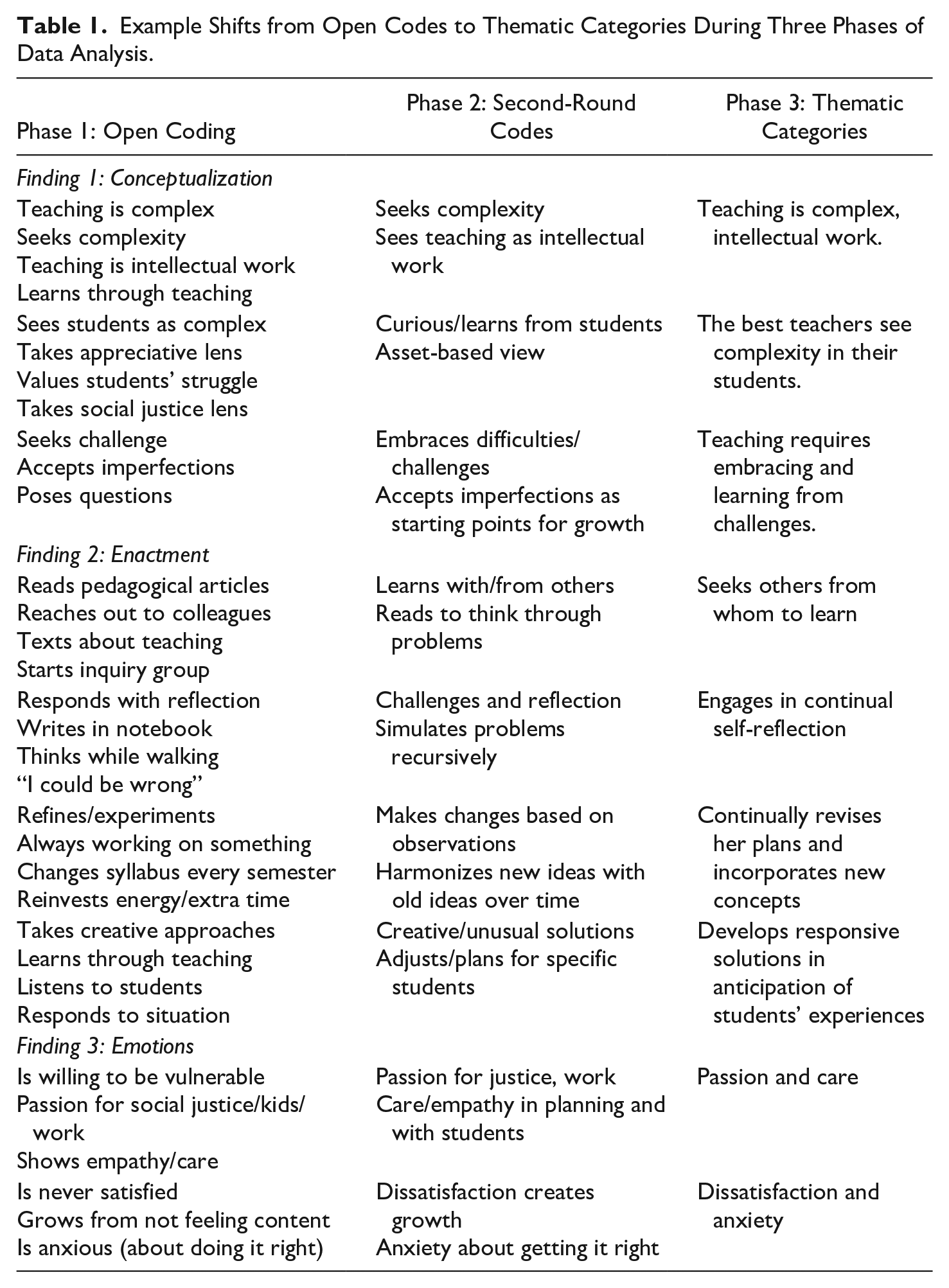
Once the final coding scheme was established, we recoded all data sources and wrote analytic memos that became the basis for our findings. As we composed the findings, we returned to the literature and framework regularly, placing data in conversation with our framework iteratively.
Trustworthiness and Ethical Considerations
We took several steps to establish trustworthiness, including triangulation across sources, peer debriefing, and member checking. To triangulate, we constructed a spreadsheet listing each finding in the leftmost column and each data source in the top row; we then excerpted quotations and examples to ensure that each finding was supported by multiple data sources. We held discussions to check our interpretations, seeking counter-examples and alternative hypotheses. As data analysis progressed, we shared transcripts, codebooks, and initial memos with a colleague for peer feedback, using her insights to clarify and add nuance to the findings. Addressing both methodological and ethical considerations, we shared interpretations, initial findings, and relevant questions with Sophia, who clarified and confirmed details. As two brief examples of the kinds of clarification Sophia added, she clarified details regarding an example of how she used a student’s writing notebook to welcome him into class and helped to clarify the relationship between anxiety, passion, and continual learning in her work in our findings regarding teacher emotions.
Findings
Our research questions guided us not simply to confirm Sophia’s expert status, but also to examine how expertise-as-process was manifested in her conceptions of, and approach to, teaching. We drew findings from her perceptions and experiences as both a university teacher educator and a K–12 teacher, though observations occurred exclusively within university courses and a professional learning group. Addressing our research questions, we identified three findings regarding Sophia’s enactment of expertise-as-process: (1) her conceptualization of teaching as requiring complexity, (2) the particular manifestation of expertise-as-process through her actions as an educator, and (3) the emotions that accompanied her enactment of expertise-as-process.
Finding 1: Conceptualizing Teaching, Students, and Learning
We identified three ways in which Sophia conceptualized the work of teaching. These findings not only highlight the extent to which Sophia’s approach to teaching aligns with the framework of expertise-as-process, but also illustrate the ways in which these conceptions apply specifically to the intellectual work of teaching.
Teaching is Complex, Intellectual Work
Sophia conceptualized teaching as a complex endeavor involving problem-solving, assessment of changing situations, and dedication to ongoing learning. Contrasting her views with deficit conceptions of the field of teaching, she described great teachers as those who consider teaching “an intellectual endeavor that requires reading and thinking and talking and learning,” akin to that of “any scholar, any doctor, any researcher, any scientist” (Interview 2). Sophia connected the intellectual nature of teaching to the need for teachers to solve problems, both immediate ones and those spanning entire school years. Speaking with preservice teachers in her practicum course, she described teaching as the constant negotiation of “problems with no easy solutions or answers,” in which teachers must “look at what’s happening, what’s difficult, [and] figure it out” (UC Observation), even when figuring it out might take extended time.
The best teachers, in Sophia’s view, enact the inquiring stance of scientists while approaching their work with care, passion, and creativity. Sophia repeatedly emphasized this intellectual complexity. In a planning session, Sophia mused on how teaching “is so damn complicated, there’s so much to think about,” when thinking about curriculum, as well as when working with students. On social media, Sophia described teachers as “absolutely working in a field that requires creativity and thinking outside the box.” In another post from her time as a K–12 teacher, Sophia described the complexity of teachers’ work, including
the hours and hours of work at school and at university—a lifetime of work, really. Grading, phone-calling, researching, learning, writing, planning, meeting, purchasing, making do, making the best with what we’ve got, staying positive, encouraging, heart-connecting, motivating, collaborating, reading and writing. . .reading and writing every single day. (Social media post, Spring 2013)
Following this long list of the multifaceted nature of her work, she lamented the degree to which the state’s accountability systems only relied on the simplistic results of standardized tests, which she described as a “piss-poor way to treat both students and the adults who advocate for them.”
The Best Teachers See Complexity in Their Students
Sophia’s sense of the complexity of teaching was mirrored by her view of students as complex individuals. In contrast to the dominant deficit framing of students in urban classrooms, Sophia expressed an appreciation of students’ complexities and sophistication, particularly those who had been positioned by schools as incapable or “at risk” (Brown, 2016). Reflecting on her relationships with adolescent students, Sophia explained that “to be your best self as a teacher, you have to trust that the students are complex” (Interview 2). As an example of this belief applied in her K–12 teaching, Sophia designed a unit in which secondary students explored their own, rich, out-of-school literacy practices, and explicitly compared the results of their inquiries to the limited conception of success valued by their school and standardized exams (Interview 1). She saw it as teachers’ responsibility to inquire into students’ complexities, particularly when students displayed resistance in class, a form of asset-based thinking that Sophia saw as essential, particularly for White-identifying teachers working in schools that largely serve students of color. As she explained in her third interview, great teachers respond to the resistance students may display toward school by seeing complexity:
No matter what, you see asset in that child, and see asset in the struggle that’s happening. When kids put their heads down in class—that’s a powerful form of passive resistance. It’s like Gandhi. You’ve got to see it that way, to lift it up and see their struggle as an asset. They’ve figured out how shitty it is.
Sophia framed student resistance, often perceived as an indication of deficit, as a strength, noting that resistance is a bold and rational choice in the face of systems designed to oppress. As an example of this belief, we noted how this conviction informed Sophia’s teacher education courses as well. Sophia repeatedly asked student-teachers to push back against the way K–12 students are perceived through deficit lenses in schools. Instead, she encouraged them to inquire into the nuances of the students in their field placements, identifying and “naming assets, all of the things our students are brilliant at” (UC Observation). For example, in one lesson, she asked the student-teachers to call out strengths and assets they had observed in the students they had met in their placement. She wrote their responses on a whiteboard, listing such responses as: “polite,” “creative,” “thoughtful,” “brave!,” “funny!,” “want to know things,” “want to try new things,” “imaginative,” “verbally gifted,” and “know how the system works” (UC Observation).
Sophia’s complex conception of students highlighted the ways in which a progressive problem-solving orientation toward teaching, one in which expert teachers perceive complexity where experienced nonexpert teachers might rush to simplifications, overlapped with justice-oriented, asset-based approaches to pedagogy. In this instance, and throughout her work with preservice teachers, Sophia evidenced the asset-based philosophy she had practiced as a K–12 teacher, purposefully designing teacher education curriculum in which student-teachers inquired into diverse K–12 students’ strengths and funds of knowledge as a basis for classroom discussion in her university teaching.
Teaching Requires Embracing and Learning from Challenges
Sophia explained that teachers cannot rely on simple solutions or previously learned routines, but instead must push to remain continually open to complexity. Her teaching practicum syllabus emphasized ongoing inquiry and intentional engagement with the most challenging aspects of teaching, as she explained in the opening paragraph:
How can we grow as reflective practitioners? How can we sharpen our “kidwatching” lenses? How can we tackle struggles or challenges with a reflective stance? How can a reflective stance help us catch our best teaching moments, so we can grow them further?
Sophia’s syllabus, though not designed explicitly with expertise-as-process in mind, showcases Bereiter and Scardamalia’s (1993) emphasis on welcoming and exploring challenges within one’s professional domain. She regularly framed each new day of teaching as bringing challenges and opportunities for learning, explaining “every day gives you a new question to think about for the next 10 years [laughs]” (UC Observation). She assigned her preservice teachers to “keep bringing up stuff that’s difficult” from their field placements to serve as material for classroom discussions and to “expect it to be difficult” because “it’s the nature of the work.” The majority of time in class each week was devoted to students inquiring into challenges in their student-teaching semesters and developing problem-solving strategies for growing as thoughtful practitioners (UC Observations). In an email to her students early in the semester, she encouraged them to keep their eyes open for the most interesting, puzzling, and challenging situations: “Be on the lookout for difficult issues. When problems arise, pay close attention. What happened? What do you make of it? How did it get resolved?” (Email). Throughout the semester, Sophia devoted extensive time to students discussing these challenges collaboratively. She framed this kind of inquiry as an ongoing process that continues throughout a teacher’s career: “Something this complex is not gonna be solved in one day” (UC Observation).
In sum, Sophia’s conceptualization of teaching is one that applied the central concepts of expertise-as-process. She approached teaching and students as almost infinitely complex, a manifestation of progressive problem-solving as an asset-based lens on teaching. By taking a stance as a continual learner, she increased the complexity of her thinking and embodied this philosophy in her preparation of teachers in the university courses she taught.
Finding 2: How Sophia Enacted Expertise-as-Process
Having described Sophia’s conception of expert teaching, we now turn to the ways she enacted these ideas through her approach to planning, learning, and teaching. We describe how her actions operationalized expertise-as-process within the domain of teaching specifically. Reflecting the expertise-as-process framework, we do not focus on Sophia’s expert pedagogical moves or curriculum, but rather focus on the things she did in order to enact expertise as a process, to continue learning and developing ever-more-complex understandings.
Seeking Others from Whom to Learn
Sophia regularly sought other sources to support her continual learning about teaching. She frequently read books by teachers and education researchers, explaining that “reading and re-reading helps me have a sense of what I want to push into in the classroom” (Interview 1). Sophia also drew on the thinking of teachers and scholars in her community. For example, to explore a K–12 teaching concept that she wanted to introduce in her teacher education courses, she created and led an informal inquiry group composed of two professional colleagues—a local high school teacher and a doctoral student in literacy education. During semimonthly meetings, she proposed articles for the group to discuss as they developed their thinking about the new material. She regularly pushed the group during discussions to “find the hard places” where new, initially sensible ideas might hit snags when enacted in practice (Learning Group Observation).
Such collaboration was not a singular occurrence; we noted numerous examples illustrating how Sophia sought others from whom to learn. She emailed colleagues on several occasions to request relevant readings, seeking to expand her knowledge of topics such as antiracist pedagogy, second language acquisition, and early literacy (Interview 3). Across this single interview, Sophia mentioned five different teachers and scholars with whom she had discussed ideas for classroom practice. She was regularly in touch with local teachers, sharing ideas and learning from them. She often visited others’ K–12 classrooms, observing or teaching guest lessons to try innovative pedagogical strategies. Lastly, she drew on the expertise of fellow teacher educators and former mentors, applying concepts from their syllabi in her own teaching (Interview 3), often describing using the resources of others as spaces to “begin experimenting with new material.” Describing the desire to think with others about new teaching ideas, Sophia explained, “I have a lot of questions. . .and (exploring them) is how my best teaching always unfolds” (Interview 3). Thus, a central way in which Sophia enacted expertise was by framing herself as a learner, establishing reciprocal relationships with others to inform a teaching practice that was under continual revision.
Engaging in Continual Self-Reflection
Sophia intentionally created space to reflect on her teaching. Across her career, Sophia took many intentional steps to create reflective space that would provide distance to think about challenges in creative ways, with particular emphasis on what it means to teach in schools that serve working-class communities of color (Interviews 1, 2, 3). To do so, she had to find time within the context of busy days. She took walks or worked in her garden while mulling over her teaching, and regularly wrote memos about teaching in a designated reflective notebook (Interview 2). In a social media post during the fall 2019 semester, she highlighted the importance of reflection for teachers, despite their hectic schedules: “The times I’ve solved a teaching problem doing absolutely nothing is astonishing. . . . We need to carve out time to not do a damn thing. This is incredibly hard for most [teachers] who don’t even have time to pee.”
Moreover, she saw the creation of reflective space as essential to enacting the asset-based approach that was at the center of her philosophy of teaching and students. She described many teachers as reacting ineffectively to students they did not understand, particularly when facing challenges in the classroom (UC Observation). Describing the importance of responding to challenges from a reflective stance, she explained, “It’s not about you or your feelings getting hurt. . . . It’s about saying, ‘this is super interesting.’ . . . If you can inquire rather than react, it’s easier to find solutions” (Interview 1). For Sophia, then, reflection was both a general underlying process in which she engaged regularly and an intentional means of engaging with the challenges of working in schools through inquiry and productivity. It also served as an enactment of the asset-based beliefs regarding students described in Finding 1, as Sophia saw reflection as a central means by which teachers could respond to the complexity of students’ experiences, behaviors, and ideas, even when they posed challenges to teachers.
Continually Revising Plans and Incorporating New Concepts
Sophia’s individual and collaborative reflection was part of an ongoing process of refining and experimenting. She revised her syllabi heavily each semester, taking into consideration student feedback and often reorganizing entire classes around new ideas (Interview 1). For example, having discussed with a colleague a course she wanted to make more relevant to preservice teachers’ field experiences, Sophia reduced readings to a minimum and recentered each class around inquiry-based discussions of students’ field experiences and challenges (Fall 2019 Syllabus; UC Observations).
Sophia’s sense of never being finished extended to her professional learning. She described how she continually worked toward “the next thing I want to figure out. . . . I’m always trying to get better . . . always trying to dig deeper . . . always trying to work on something” (Interview 3). This unceasing drive to improve her teaching led her to start an inquiry group devoted to exploring a topic of shared interest: the role of social imagination and freedom dreaming in K–12 and university teaching. At group meetings, she regularly pushed the discussion in deeper and more nuanced directions. As Sophia stated to the group, “I’ve really got to know the work we’re going to do, we really need to understand this if we’re going to do it” (Learning Group Observation). Throughout the inquiry group’s six-month tenure, Sophia held herself to a high standard, pushing herself to develop increasingly nuanced understandings. Moreover, she framed herself as a novice and learner despite being the most experienced teacher in the group.
This attitude extended into her teacher preparation classes. For one course session, Sophia asked her students to interview their cooperating teachers about “what they’re working on and trying to get better at in their teaching” (UC Observation). In the following class, as students reported their findings, she framed such inquiry as central to being a great teacher: “How can we be teachers that are always looking for ways to learn?” She not only adopted this view for herself, but also created an environment in which her students could practice this thinking and envision themselves as teachers who continually learn and develop.
Developing Responsive Solutions in Anticipation of Students’ Experiences
Across her career, Sophia’s commitment to making her teaching responsive to students led her to adopt creative solutions to problems. During the fall semester, while planning, Sophia engaged in imaginative practices as she worked to make instruction suited to particular students: “I’m always trying to imagine. . .what do I know about Lana, what would Michael think of this? . . . I try to really imagine them, like . . . what are they thinking? What are they feeling? . . . Who are they?” (Interview 2). In one interview, Sophia explained this imagining as central to her planning process as both a K–12 and university educator:
I’m at my best when I meet them where they are . . . when I have a feeling about what a first-year student-teacher may encounter, and try to build content around that. . . . [W]hen I create enough space for . . . idiosyncrasies I can’t predict. (Interview 2)
As a consequence of anticipating students’ responses to her decisions, Sophia intentionally created space in her curriculum for students’ agency, accepting their input on syllabus topics and readings, continually adjusting her teaching to align with her observations of their learning, and devoting extensive class time to peer-facilitated discussions of student-chosen topics drawn from experiences in their field placements (Interview 3; UC Observations).
Such imagining took center stage during her professional learning group when the group was considering a new instructional activity related to the teaching of poetry. Sophia proposed the group try the activity themselves in the role of students: “Our work, in doing this,” she explained to her collaborators, “is a way to imagine what the kids experience in class” (Learning Group Observation). Thus, one aspect of Sophia’s creative problem-solving in teaching relied on empathy for what students might be experiencing.
Addressing the second research question, these findings highlight expertise-as-process in action. This process surfaced through an ongoing cycle of reflection, experimentation, learning, and adaptation, showcasing specific dimensions by which even an experienced teacher continued to push boundaries in her field. Already an accomplished teacher, she reinvested energy into continuing to learn and expand her own thinking while developing innovative curriculum and instruction, and she taught her current students, future teachers themselves, to do so as well.
Finding 3: Emotions That Accompany Teaching as Expertise-as-Process
Data analysis revealed an unexpected finding: Sophia’s expertise was enacted on an emotional as well as an intellectual dimension. We emphasize four emotions: passion, care, anxiety, and dissatisfaction, discussing them in pairs (passion/care and anxiety/dissatisfaction) because of their intertwined expression.
Passion and Care
Sophia was driven by a strong passion for teaching and a deep concern for students who had traditionally been marginalized and minoritized by schools. She explained that she aimed to reach “every student in the classroom” because she “couldn’t stand it any other way . . . couldn’t sleep any other way” (Interview 2). A common refrain repeated in interviews, planning sessions, and as she taught preservice teachers was that “these are people’s kids!,” and teachers needed to approach students with the same care and concern often reserved for one’s own children. As she explained to her student-teachers in class, “You can’t expect some kids not to engage, you have to expect every kid to engage.” This manifested in her belief that “every child in the room deserves our very best efforts. No exceptions” (UC Observation).
Such care was not apolitical but was deeply connected to her beliefs about social justice: “If you believe in stopping the school-to-prison pipeline . . . then it has to be every kid” about whom a teacher should passionately care (Interview 2). Built on her conception of students as complex, these views led Sophia to champion students who found school difficult and troubled other teachers. “I had many kids like that,” she explained, “kids who were angry because they had figured out how shitty it was. These are my kinda kids, you know?” (UC Observation).
This passion and care fueled Sophia’s drive to learn continually and develop creative approaches within teaching at both the secondary and university level. Sophia often described thinking deeply about each of her university students as she planned classes (Interview 2). She also went beyond the expectations of her position, visiting them in field placements, talking them through challenges on the phone over the weekend, and spending time between semesters to bring her thinking about pedagogy to new edges (Planning Sessions, Interview 3).
As one extended example of how this manifested, drawn from Sophia’s time as a secondary teacher (Interview 2), she recollected a student who had recently transferred into her high school but seemed resistant to the new environment. Having tried several unsuccessful ways to approach the student, she remembered that she knew his former teacher at his previous school. She contacted the teacher, who told her about the student’s interests, and she asked to pick up his writing notebook, which contained many personal compositions. Although she did not read his work before asking permission, she used the new information about the student to spark conversations, presenting his writing notebook to him in class and encouraging him to continue adding to it. As she told us, her intention was to help him feel known in the classroom, and her actions successfully facilitated his transition into the new school. Sophia described the emotional charge that accompanied her work as she sought to address any problem she encountered. Our inclusion of this example is not meant to focus simply on her care toward students, but to highlight the passion and care that drove her actions and infused her problem-solving process.
Passion and care energized Sophia as a teacher, helped sustain her career, and motivated the development of her expertise over time. “Get(ting) energized from the kids in the room” and “basking in the gifts the kids bring” were essential to her drive to develop curricular responses to challenging systemic issues in K–12 schools (Interview 2). Across interviews and planning sessions, she described being motivated to develop effective pedagogies for her university courses by her concern for the important work of the future K–12 teachers in her classes.
Dissatisfaction and Anxiety
Sophia’s continual drive to improve was also accompanied by an ongoing sense of dissatisfaction with her teaching. This feeling was not the result of a lack of confidence, but rather a deep sense of responsibility to her students: “My teaching is driven by not being okay with things. It’s good and bad. I beat myself up a lot, but I know that . . . helps me grow” (Interview 3). Field notes highlight this process in action:
She seems to experience frustration and anxiety because of the high standard she sets for herself. Sophia feels a deep responsibility to her students that drives her to refine her teaching and think around any question or issue extensively.
Although she did not experience these emotions as pleasant, she explained that they “really help[ed] her” develop new ideas and see “new angles” in the classroom (Interview 2). Commenting on an extensive guide she created and continued to revise for field supervisors at her university, she quipped: “This is the product of my neuroticism about teaching [laughs]” (Planning Observation). Similarly, within her informal learning group on social imagination, Sophia drew on her anxious feelings about her grasp of the topic to guide the group to reconsider what was meant so as to create the richest lessons possible (Learning Group Observation). She often entertained multiple lesson plans even when she already had an acceptable one, driven by overlapping anxiety and dedication. Throughout data collection, we noted that feelings of dissatisfaction led her to read more, write reflectively, seek input from other teachers, and develop nuanced approaches to instruction. When discussing the ceaselessness of her thinking about teaching, she explained, “it’s a part of my brain that never gets quiet” (Interview 3).
Fueled by dedication to her students, Sophia’s passion and care dovetailed with dissatisfaction and anxiety, motivating her to improve her practice through her actions. And yet, though Sophia described some negative emotions, she emphasized the joy students brought her, a joy that supplied a pervasive backdrop to her teaching and ongoing professional growth. In these ways, Sophia’s emotions undergirded the ways in which she experienced expertise-as-process, the central concern of our third research question.
Synthesis of the Three Findings
The three findings presented above are summarized in Figure 1. The left side illustrates the relationship between different emotions, the right side lists aspects of expertise enacted through process, and arrows between them indicate their reciprocal influences.
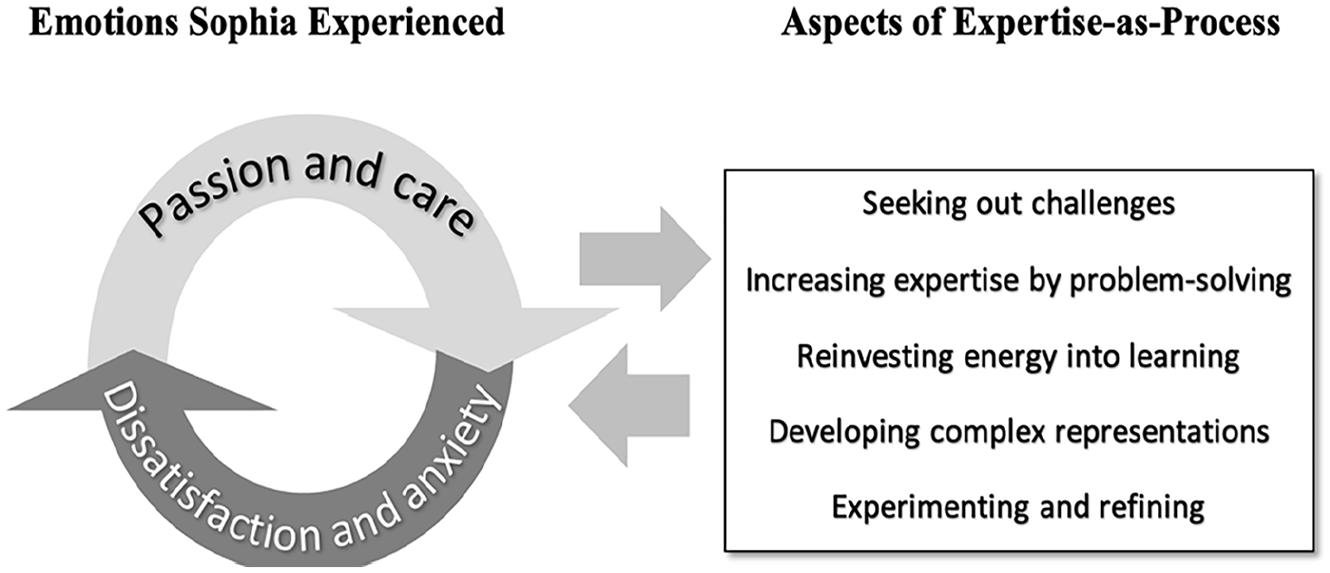
The Relationship Between Sophia’s Emotions and Expertise-as-Process.
Our intent in this figure is to show that emotions were the constant companions of Sophia’s striving to better her practice. This process was mutually reciprocal: as she engaged in the processes involved in expertise-as-process, seeking to refine, experiment, and transform her work, she experienced powerful emotions that fueled her work.
Discussion
At a time when teaching and teacher education remain under threat from policies that impose simplified, technocratic conceptions of teaching (Philip et al., 2019), it is imperative to highlight the complexity of teaching and all that goes into the work of expert teachers. In the following sections, we explore (1) how this case study elucidated and expanded expertise-as-process within education, and (2) how Sophia’s enactment of expertise-as-process contributes to the field’s conception of teacher expertise, with particular emphases on asset-based perspectives and emotions. We then discuss limitations, directions for future research, and implications for teacher educators.
Operationalizing Expertise-as-Process Within Educational Arenas
The concept of expertise-as-process was originally offered as a contrast to extant views of knowledge and expertise across multiple domains (Bereiter & Scardamalia, 1993; Scardamalia & Bereiter, 2010). Our case study brought the power of this perspective to the field of teaching more specifically. Sophia’s case exemplified expertise as going beyond the more common focus on the application of knowledge (Davis & Renert, 2013; Kali et al., 2019), bringing to life a view of expertise as a continual striving to better one’s thinking and practice. Although Sophia regularly enacted knowledge gained from decades of experience as a more traditional view of expertise would claim, our focus on expertise-as-process led us to highlight the thinking and actions of an expert teacher/teacher educator who continually pushed at the edges of her thinking. She did so by seeking out other educators to learn with and from, using reflection in the face of challenges, continually revising and iterating on her plans, and engaging her imagination of student perspectives to develop new and responsive instructional plans. These actions were guided by her conception of teaching and of students as complex, and by the explicit belief in embracing and learning from challenges in the field. These actions and beliefs helped elucidate and operationalize what the notion of expertise-as-process can look like within a teaching life. Our third finding, focused on Sophia’s emotional experience of these processes, adds an emotional component to the literature on expertise-as-process, something that was not considered in the initial development of the framework, which had framed this stance in more cognitive and intellectual terms. Later in this discussion, we delve more deeply into what this focus on emotions adds to the literature on teacher expertise more broadly.
Expertise-as-Process and Teacher Expertise Literature
This conception of teacher expertise adds to existing movements within research on teaching toward more fluid conceptions of how knowledge is applied across settings, within and outside of classrooms at the K–12 and university level. Recent literature on teacher expertise has emphasized the way teachers apply pedagogical knowledge (Davis & Renert, 2013), make adaptive decisions during instruction (Warren & Kersten-Parrish, 2022), and revise curriculum in relation to diverse student populations (Ladson-Billings, 2009). Other work has emphasized teachers’ reflection and inquiry associated with teaching (Cochran-Smith & Lytle, 1999; Leijen et al., 2020; Zeichner & Liston, 2013). There is, of course, overlap between the findings regarding Sophia’s processes and this literature: Sophia and teachers in these studies both applied years of accumulated knowledge and engaged in thoughtful reflection regarding their practice. However, by focusing specifically on Sophia’s progressive problem-solving and reinvestment, or the varied ways in which she went about continuing to develop as an educator even while retaining the traditional hallmarks of expertise, we highlight these dimensions of expertise that have been generally elided within the existing literature on teacher expertise.
Our inquiry took us across multiple spaces and data sources, including Sophia’s planning sessions, professional learning group, social media posts, emails, text messages, and curricular documents. In Sophia’s case, expertise was a continually enacted process, one that was not only the result of applying accumulated knowledge (Berliner, 2004), but also the manifestation of a ceaseless process of thinking and rethinking about her own classes and about the nature of teaching. In this sense, the findings develop a picture of expertise-as-process within education, a frame for thinking about expertise not simply as a static state one can reach but as a learning process that must be continually enacted. In the next sections, we elaborate on two additional contributions that our case study makes to the literature on teacher expertise.
Expertise-as-Process and Asset Perspectives
In perceiving her work and her students (both her current students at the university and her previous adolescent students in K–12 settings) as possessing unceasing complexity, Sophia’s example both exemplifies the characteristics of an expert from a process orientation and brings expertise-as-process into conversation with asset-based approaches to education (Brown, 2016; Muhammad, 2020). Her complex, asset-based conception of her students and her teaching motivated Sophia to learn, question, and extend her current understandings. She sought to learn from her students and to learn for her students. To use her own words, her dedication to “disrupting the school-to-prison pipeline” led her to be “always trying to dig deeper” and “always working on something” new. These findings indicate that an asset-based perspective on teaching is deeply intertwined with a view of expertise as a continual process of working at the edge of one’s knowledge and ability. This angle positions asset-based views of students as central to conceptions of teacher expertise and extends work on culturally relevant, asset-based teaching that focuses on the content of curriculum (Ladson-Billings, 2009; Muhammad, 2020).
This conjoined emphasis on asset-based perspectives and continual learning aligns with recent equity-oriented critiques of initial teacher preparation that have highlighted the need for teachers, if they are to disrupt oppressive pedagogical traditions, to experience inquiry-oriented learning in relation to their practices, rather than approximating established methods (Hoffman, 2020; Nash et al., 2021). Sophia’s work brings this teacher education literature, developed with a focus on beginning teachers, into conversation with research on expert teachers.
Expertise-as-Process and Teacher Emotions
Despite a long-standing tradition of sidelining emotions in educational research (Schutz & Zembylas, 2009), more recent work has firmly established the emotional aspects of teaching (Uitto et al., 2015; Zembylas, 2021). Teaching is emotional work—full stop. Few studies, however, have examined how emotions inform the practices of expert teachers as they strive to refine their craft. Although Sophia experienced teaching as highly relational and emotional, as is common in studies of teacher emotions (Fix et al., 2020), the findings here focused on the emotions that accompanied the process component of expertise, the ways in which she pushed herself to learn and refine her teaching, even at an advanced stage in her career. This finding highlights the challenging emotions that can accompany even the work of expert teachers.
This distinction is a subtle but important one—one that strongly implies that even expert teachers experience emotions in their work. The most common emphases in research on teacher emotions are on struggles, relationships with children, and subjectification within oppressive systems—all important experiences in teachers’ lives (Atmaca et al., 2020; Yin et al., 2019). However, given the gendered history of the profession and the fact that the current teaching force identifies predominantly as women (Moreau, 2019), the lack of research on the emotions of expert teachers may implicitly frame emotions exclusively as obstacles or as gendered expressions. Our case study illustrates how Sophia’s emotions were tied to the empowering work of intellectual boundary-pushing, and thus, it provides an opportunity to reframe both positive and negative emotions as part of a productive and meaningful career.
Limitations and Implications for Future Research
As a qualitative case study, generalizability is not an aim of this study (Stake, 2005). An important question is whether Sophia’s experiences were unique to her, and future research with larger participant populations should examine this topic. Studying the emotions of teachers who engage in the processes of progressive problem-solving and reinvestment may reveal to what degree emotions, especially the unpleasant emotions of anxiety and dissatisfaction, are common or critical to the enactment of expertise-as-process in teaching at both the K–12 and university level. Although research on asset-based perspectives is becoming more common, additional research could specifically examine how expert teachers conceptualize diverse student populations, address differences related to (dis)ability, and engage in ongoing learning to better their practice in these respects. Such research may uncover contradictions or challenges that researchers focused on expertise have previously overlooked.
Moreover, this case study focused on a teacher educator who possessed the hallmarks of teaching expertise in a traditional sense (e.g., experience, knowledge, accolades). Further research could examine expertise-as-process in the work of early or mid-career K–12 teachers. Although we touch upon the way in which Sophia’s stance informed her teacher education courses, the current study did not explore in-depth the application of these ideas to the content of teacher preparation curriculum. Future research could examine how applying this framework explicitly to the curriculum of teacher education courses influences preservice teachers’ learning.
Implications for Teacher Educators
The brevity of most teacher preparation programs necessitates teachers taking stances as continuous learners after they begin teaching (Finsterwald et al., 2013). Teacher educators could introduce expertise-as-process to preservice teachers explicitly as a strategic approach to ongoing professional learning. Given that this framework places learning and growth at the center of how expertise is conceptualized, it could, when applied to teacher education pedagogy, create invitations for beginning and preservice teachers to contribute to a growing knowledge base of contextualized, pedagogical practices.
The emotional investment Sophia displayed served as an important motivator for her development over a career spanning nearly 30 years, suggesting the importance of attending to emotions within teacher education coursework, both those emotions that inspire by their appeal and those that goad by their pain. Such work may help preservice teachers prepare to manage the early years of their careers, which are often accompanied by challenging emotions. Such preparation is especially important as schools remain the focus of highly charged public discourses (Jaffe, 2022), which may necessitate additional emotional preparation.
Lastly, teacher educators may take inspiration from the connection between asset-based pedagogical thinking and expertise-as-process. Sophia’s thinking about social justice and equity was furthered through her dedication to ongoing learning and complex thinking: she unearthed, questioned, and fought against dominant, deficit conceptions of students that a less hungry consciousness may have left alone. In this way, Sophia’s case highlights the potential value of enjoining notions of teachers as experts and intellectuals with antideficit approaches to teacher education. Teacher educators may frame the journey of learning to teach as one that entails continual, ceaseless movement toward more complex, contextualized understandings and subsequent enactments of more just and equitable curricular and pedagogical practices.
Footnotes
Declaration of Conflicting Interests
The author(s) declared no potential conflicts of interest with respect to the research, authorship, and/or publication of this article.
Funding
The author(s) received no financial support for the research, authorship, and/or publication of this article.