




Abstract
Background or Context:
Teachers knowing their students is consequential for students’ participation and learning. Evidence in mathematics education points to the ways that knowing the details of students’ mathematical thinking supports teacher and student learning. What it means to know students and what teachers learn about their students are situated in the everyday practices of schooling.
Purpose, Objective, Research Question, or Focus of Study:
This study investigates how teachers characterized their students mathematically and how they considered meeting students’ needs in math class.
Research Design:
This qualitative study focused on interviews conducted over four years with 61 teachers of kindergarten through second grade across two school districts.
Conclusions or Recommendations:
This study found that rather than describing what they knew about the details of their students’ mathematical thinking or detailing specific tasks, tools, or teacher moves that supported their students, many teachers characterized students in ways that were in line with practices that organize districts, schools, and classrooms. Our data raise questions about the ways in which the structures and common practices of schools are shaping teachers’ descriptions of their students in mathematics, and the corresponding classroom practices then engaged.
Teachers start each school year with the task of getting to know their students. Elementary school teachers typically benefit from being with the same group of students much of the day, each day. This enables teachers to get to know their students across the school day in different spaces: during lesson activities, in transitions, and on the schoolyard. However, they also have the challenge of getting to know students as people, writers, readers, mathematicians, scientists, historians, and more. Knowing each student in all of these ways is not a luxury; knowing students in these ways is consequential for students’ participation and learning (Erickson, 2003; Hiebert & Carpenter, 1992; von Glasersfeld, 1987).
Knowing what students know mathematically is seen as an essential component of productively engaging students in learning mathematics (Franke et al., 2007; Sowder, 2007). Many researchers have argued that teachers’ understanding of students’ mathematical thinking can lead to more effective teaching practices (Carpenter et al., 1996; Fennema et al., 1996; Franke et al., 2001; Jacobsen & Lehrer, 2000; Schifter & Fosnot, 1993). Knowing students’ mathematical thinking enables teachers to choose productive tasks, ask follow-up questions, coordinate classroom conversations, and facilitate the supportive use of tools and representations (Bishop et al., 2016; Carpenter et al., 1998; Cobb et al., 1993; Fennema et al., 1996; Hiebert & Wearne, 1993; Stockero et al., 2020). Webb and colleagues (2009) have consistently found that when teachers attend to the details of students’ mathematical thinking, they support student participation and learning (Franke et al., 2009, 2015; Webb et al., 2009). Noticing students’ mathematical strengths along with responsive teacher moves (in which teachers explore the details of students’ ideas) can support students’ intellectual work (Bishop, 2021) and promote positive relational interactions that have the potential to support more participation by all students in the classroom (Bartell et al., 2017; Battey & Leyva, 2016).
Studies of professional development that focus on students’ mathematical thinking have long documented the benefits of attending to students’ mathematical thinking for both students and teachers (Sowder, 2007; Wilson & Berne 1999), and, importantly, this is the case for students from diverse racial, socioeconomic, cultural, and linguistic backgrounds (Turner & Celedon-Pattichis, 2011; Villaseanor & Kepner, 1993). Researchers have documented the need to consider understanding students’ mathematical thinking in relation to students’ varied resources (Turner et al., 2013). Because learning is situated, cultural histories and experiences shape how one engages in any setting, and one’s experiences and histories have been shaped by political, economic, and social structures (Gutiérrez, 2002; Lave, 1988; Nasir et al., 2008; Rogoff, 2003). Students have established ways of participating in mathematics, in conversation, and in learning outside of school that often shape how they participate in school (Nasir, 2002). Getting to know students mathematically, then, is a complex task; it involves considering the varied and rich resources of language, knowledge, gesture, and talk that students bring to the math classroom, which shape how they show what they know.
What teachers know about their students mathematically can also be shaped by schooling practices (Datnow et al., 2018; McDermott, 1997). Schooling practices do not often press teachers to know the details of students’ mathematical thinking. For instance, schools, districts, and states regularly require a range of assessments, yet typically these assessments focus on correctness and content mastered and provide no detail about the students’ mathematical thinking (Penuel & Shepard, 2016; Shepard, 1991). These mandated assessments, intentionally or not, frame what it is teachers should know about students mathematically and imply what is valued. Assessment practices, as well as other school practices such as grading, report cards, grouping practices, curricular choices and so on, rarely focus teachers’ attention on the details of students’ mathematical thinking. All the various schooling practices that teachers participate in shape what they know about their students mathematically.
A larger study of coherence in mathematics from preschool through second grade in two districts provided the opportunity to capture what teachers, across grades, would tell us about their students mathematically. We investigated the extent to which teachers articulate students’ mathematical thinking and how they then conceive of supporting the students in their classroom practice. We posed open-ended questions that allowed teachers to describe their students and their practice in their own ways, and we were struck by what teachers shared and how that varied across grades. Rather than describing what they knew about the details of their students’ mathematical thinking or detailing specific tasks, tools, or teacher moves that supported their students, we found many teachers’ characterizations of students to be in line with the practices that organize districts, schools, and classrooms. Our data raise questions about the ways in which the structures and common practices of schools are shaping teachers’ descriptions of their students in mathematics, and the corresponding classroom practices then engaged.
Methods
Overview
This study is part of a longitudinal study of coherence in early mathematics in two large school districts. The districts were selected for the larger study because they were working to create coherence in mathematics from preschool through early elementary school. Each district identified three elementary schools with preschools on their campuses to participate. The longitudinal study followed students from preschool into second grade. While data collected as part of the overall study included interviews, observations, and artifacts at the district, school, classroom, and individual teacher and student levels to examine coherence, this study focuses on just the fall teacher interview data from kindergarten and first- and second-grade teachers. Drawing from these data, this study specifically examined how teachers described their students mathematically and how they described supporting their students during math instruction.
Participants
The teachers were from two large school districts in the same state. Before engagement with the research team, both districts were engaged in creating coherence in mathematics from preschool through second grade. Almond Valley Unified School District 1 serves more than 70,000 children from pre-K through Grade 12. According to the U.S. Census Bureau (2021), nearly half of the city’s children live in poverty, and 87% of the students in Almond Valley Unified qualify for free or reduced-price lunch (California Department of Education, 2021). The district serves a predominantly Latinx population; nearly 70% of students are Latinx, followed by Asian American (11%), White (10%), and African American (9%) students. A little more than 10% of the population receives special education services, and 18% of the population are English language learners. Cypress Unified School District serves just over 50,000 students from pre-K through Grade 12. The district has a highly diverse student population in terms of ethnicity, language, and socioeconomic status. The largest racial group is Asian American (35%), with Latinx (27%) close behind, followed by White (14%), African American (7%), Filipino (4%), and students who identify as multiracial (6%). Just over 50% of students qualify for free and reduced-price lunch. A total of 44 languages are spoken by Cypress Unified’s students; 24% of the students are English language learners. We worked with three schools in each of the two districts. Each of the schools selected served predominantly low-income students and were working on issues of alignment and continuity in mathematics.
The 61 participating teachers were kindergarten (23), first-grade (22), and second-grade (16) teachers at each of the six schools. The teachers were predominantly female (95%); 44% were White, 39% were Latinx, 11% were Asian American, 3% were African American, and 3% were other. On average, they had been teaching for 14 years, with 26% having taught for 20 or more years, and 37% having taught for five years or less. Many of the teachers were fairly new to their schools (44% 0–2 years), whereas 20% of the teachers had been at their school for 20 years or longer.
Procedures
In the fall, approximately two months into the school year, we interviewed teachers as a part of a weeklong visit to the school. Over a three-year period, we interviewed teachers whose students we had been following since preschool. Because students transitioned to kindergarten in different years, we had longitudinal students across two grades for some of the years of the study. Teachers were interviewed in the year that they had longitudinal students in their classroom. No teacher is in the sample more than once.
The interviews followed the teachers’ fall classroom observations and took approximately 15–20 minutes. The interviewers were researchers, graduate student researchers, or experienced teachers from the local community. All the interviewers also conducted the observation in the teacher’s classroom before the interview. Although all the interviews were conducted in English, the interviewer and the teacher occasionally spoke Spanish together.
Measures
The fall teacher interview asked teachers about their students mathematically and how they support them. The interview was structured so that all teachers were asked the same series of questions, with follow-up questions designed to encourage teachers to be more specific (see Figure 1). The interview began by asking teachers to tell us about two predetermined students. The two students were chosen because their scores varied on the mathematics assessment that the project had administered the previous spring. Teachers were asked to describe how each student “was doing in math,” why they thought that was, and how the teacher was responding to that student in their instruction. The teachers were specifically prompted about mathematics. To get a sense of their support for students outside these two students, teachers were asked more generally how they supported students who were having trouble keeping up or who already knew the math they were teaching. The interview ended with a question about how they learned about their students’ math understandings at the start of the school year.
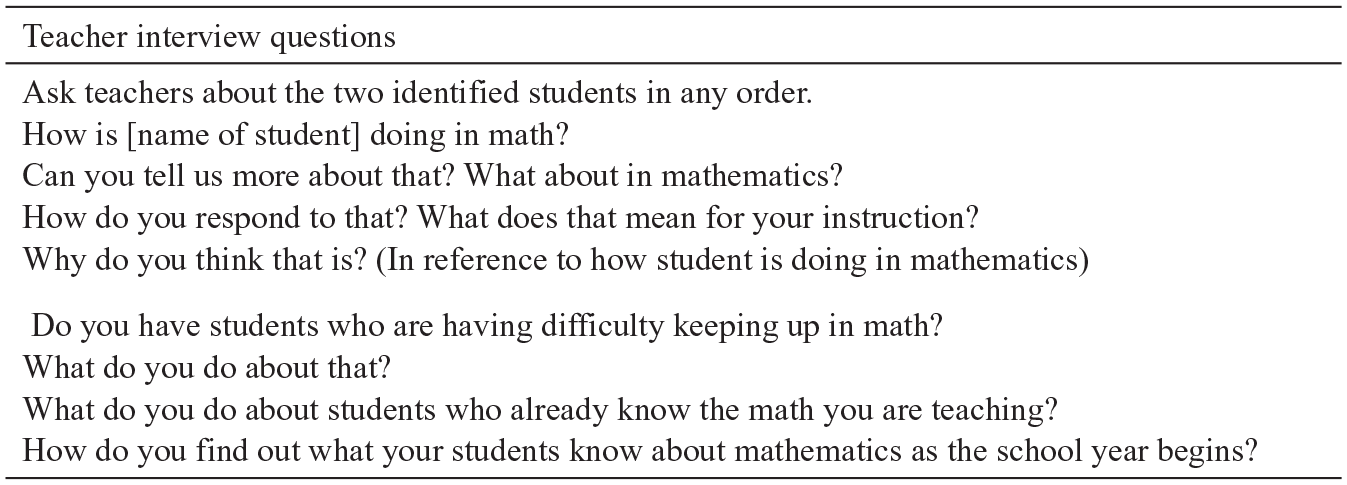
Fall interview questions.
Analysis
For the purposes of this study, we did not compare teachers by districts or schools. While we recognize that the school and district play a role in teachers’ work in a variety of ways, there were no clear patterns by district or school in relation to the data for this study, so we collapsed the data and focused on the teachers as the unit of analysis. We also do not compare teachers by demographic characteristics because we did not have enough teachers within different demographic groups to make this viable.
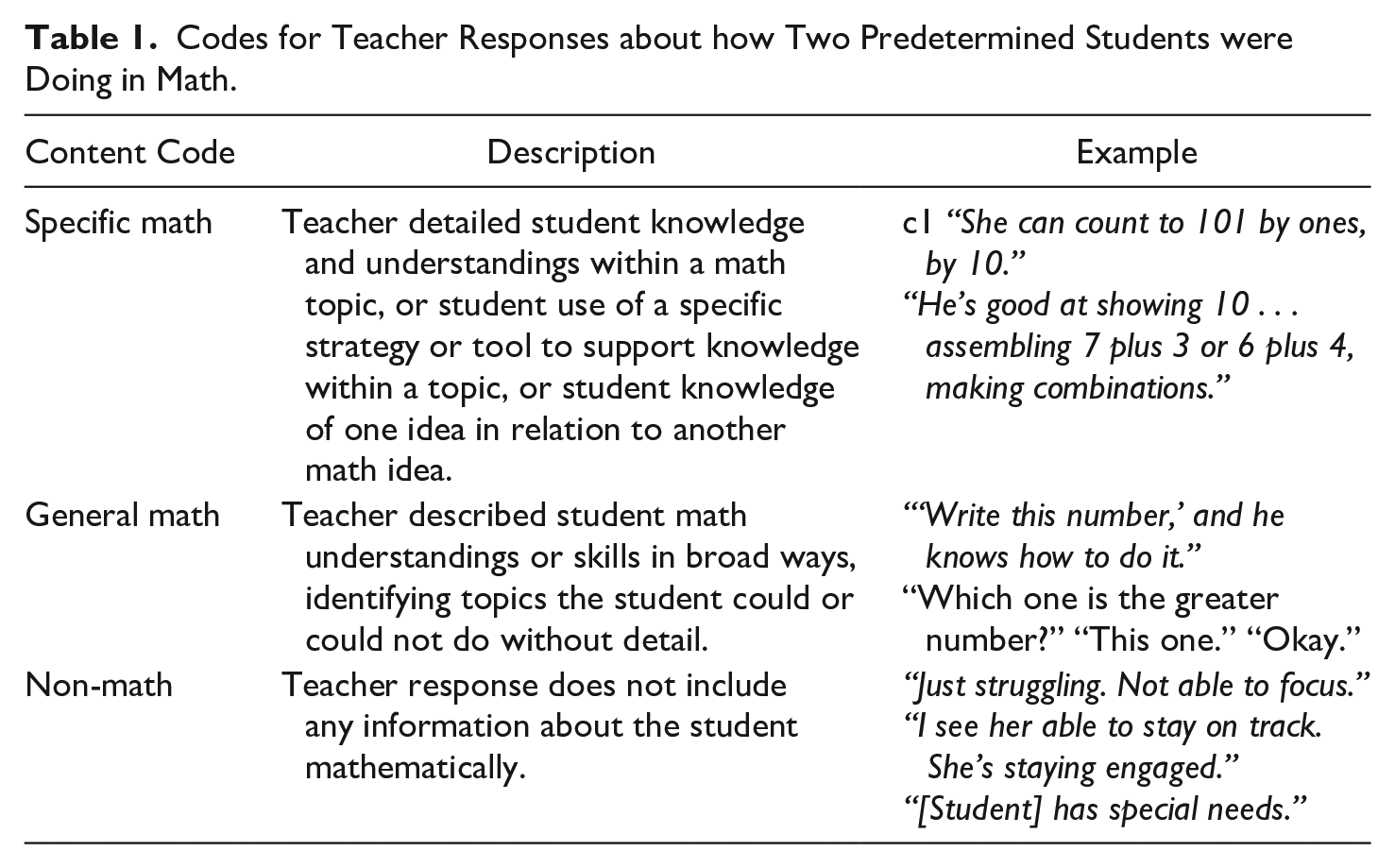
We applied two sets of codes to the transcribed fall teacher interview teacher responses: (1) how teachers described their students’ mathematical understanding, knowledge, and skills, and (2) how they reported meeting their students’ mathematical needs. Tables 1 and 2 show these two sets of codes. Regarding the first set, we were interested in whether teachers talked generally or specifically about the students in relation to the mathematics or only shared non-math information about the student. General responses involved referencing the students in relation to mathematics but referring to the mathematics they know in broad ways, such as noting math topics (e.g., can count) or aspects of doing math (e.g., problem-solving). The specific math characterization code was used when teachers noted what students knew about counting (e.g., naming or describing one of the counting principles or describing how the student counted) or in discussing what they knew about problem solving (e.g., the teacher naming a strategy or describing exactly what the student did to solve a problem). The non-mathematics code included comments not related to the student in mathematics. These included how they participated in class generally (e.g., good listener or cannot focus), the student’s level (e.g., grade level, on standard without specifying the standard), or other perceived aspects of the student (e.g., struggles with language). All codes were applied across the interview, so the non-math category included what teachers said even after they were prompted about the mathematics.
Codes for Teacher Responses about how Two Predetermined Students were Doing in Math.
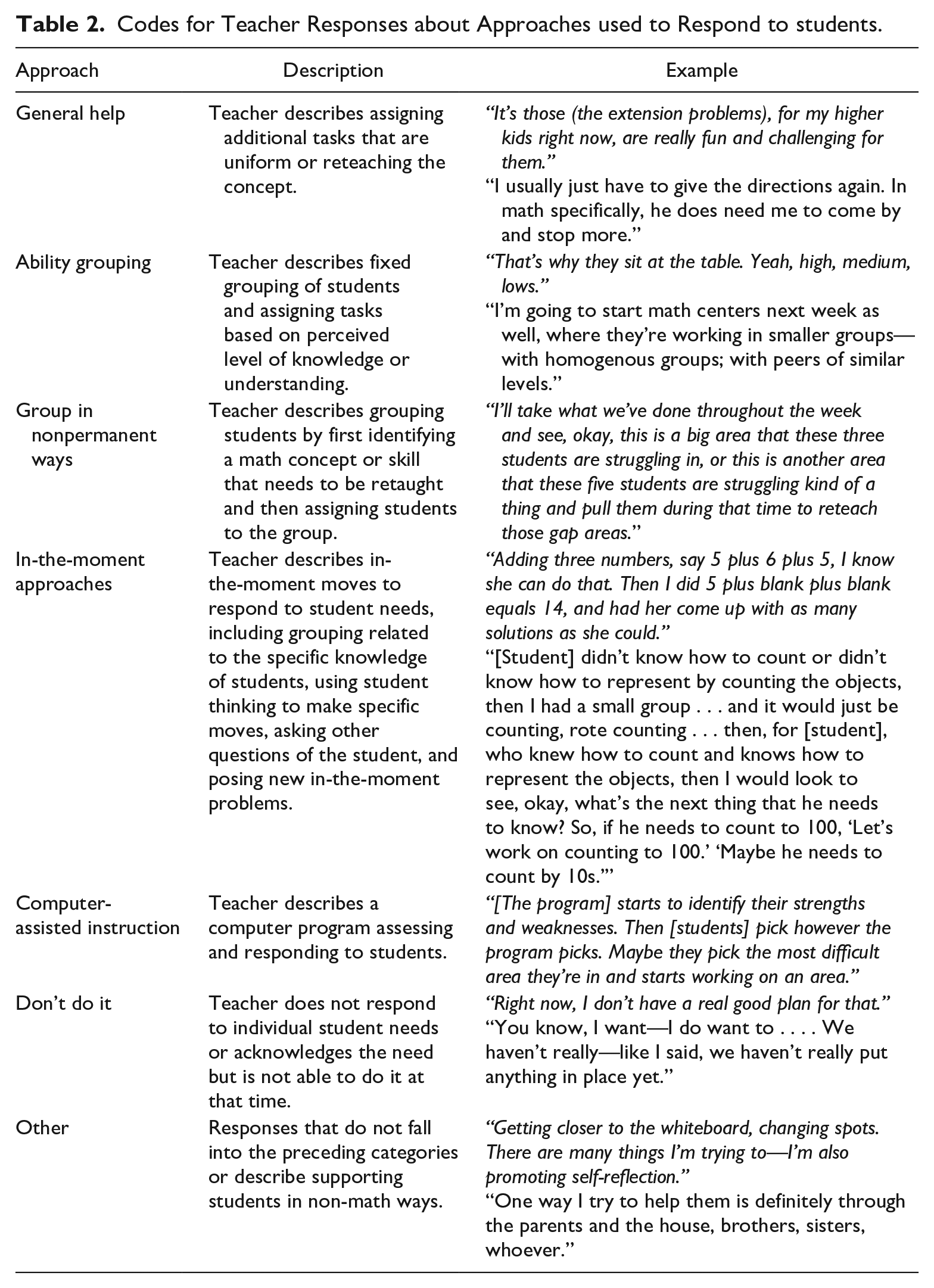
Codes for Teacher Responses about Approaches used to Respond to students.
In coding how teachers described their students, we focused on the teachers and how they characterized students, not on how particular students were characterized; thus, we took a holistic approach to coding across what teachers said about their students, capturing any mathematical descriptions they offered. We assigned the code that best represented all of what the teacher said, and when teachers shared equally across two categories, we made sure to code for the most specific mathematical comments they offered. For instance, if the teacher shared some specific details of the student mathematically along with a general comment, we coded the response as specific math. Because teachers responded about two different students and were coded for each response, if the responses varied, we assigned that teacher the characterization with the most mathematical detail (i.e., if one student response was coded non-math and the other general math, we gave the teacher an overall general math code), aiming for the most mathematical code. 2 We conducted a second pass of coding to capture any instance of non-math characterizations for each teacher to enable looking at how often those characterizations occurred even if they were not the most prominent.
In coding how teachers reported meeting their students’ mathematical needs, we collected all the teacher responses and categorized those responses to reflect both what was commonly stated and particularly coding for any approach that involved meeting the students’ need in the moment. The categories (as described in Table 2) included teachers reporting grouping students, or supporting a student by asking a follow-up question. To best capture the full range of teachers’ support of students, we counted all of what teachers shared; thus, teacher responses could fall into more than one coding category. The coder justified their coding choices using details from the interview transcript in reference to each category coded.
Coding proceeded by first having each member of the coding team code the same teacher interview transcript. Coding was then compared and calibrated. The justifications were used to see how coders were making decisions and to refine the coding scheme. We repeated this process until all coders agreed. Each interview was then coded by one member of the team, and then all interviews were coded by one single coder so that any disagreements could be identified and rectified through discussion. Following this initial coding, as we attempted to make sense of the data, we found that we needed additional coding. This coding involved collecting all the actual words and phrases that teachers used to describe their students mathematically so that they could be categorized more specifically as they related to non-math and to ensure that we were using the language the teachers used to describe students and how to meet their needs.
The data were summarized by counting the number of responses in each category, looking for patterns in responses within and among categories, and organizing responses by teacher for those who attended to the details of student thinking, those focused on general content, and those focused on non-mathematical responses. The teacher quotes from the justifications in coding were used to elaborate differences across the categories and provide evidence of what teachers were saying and the context in which they said it.
Results
We first asked teachers to describe how particular students in their class were doing in mathematics. Table 3 outlines the types of responses we heard. Overall, teachers did talk about mathematics in some way: A total of 91% of kindergarten teachers mentioned either general math or specific math knowledge in describing their students; 68% of first-grade teachers and 50% of second-grade teachers did so. The majority of teachers talked in general ways about students in mathematics; many fewer teachers made specific math comments in relation to their students. In each of the grades, fewer than half of the teachers who mentioned math when describing their students mathematically articulated with any detail what their students knew or could do.
Percentage of Teachers’ Responses to How Students Are Doing in Math.
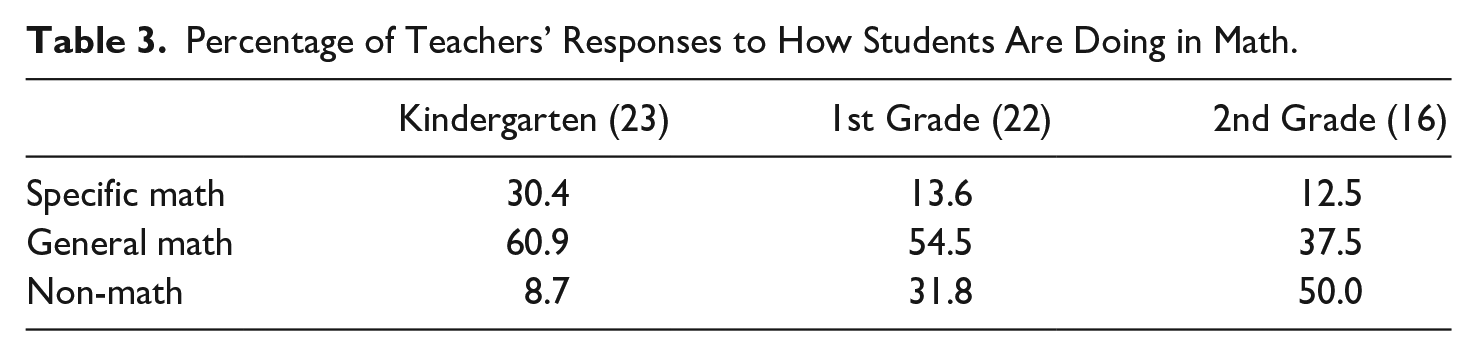
Although it is heartening to see that teachers were able to describe their students in relation to either general or specific details of what students know and can do, it was worrisome to see that some teachers never talked about mathematics even when prompted to do so. Half of the second-grade teachers and about a third of the first-grade teachers never mentioned mathematics. When asked about their students’ mathematical thinking, the teachers referred to strengths or concerns related to behavior (e.g., the student is a good listener) or positioned them in relation to a general standard (e.g., the student is below grade level).
Of note is the grade level pattern in teachers’ descriptions of their students in mathematics. Both specific and general math comments were less common as teachers’ grade level increased. Focusing on specific math, 30.4% of kindergarten teachers described their students in mathematically detailed ways, as compared with 13.6% of first-grade teachers and 12.5% of second-grade teachers. Conversely, non-math descriptions increased as grade level increased. Across grades, teachers increasingly referred to non-math aspects of students and their participation. Notably, 8.7% of kindergarten teachers responded with non-math descriptions, as compared with 50% of second-grade teachers.
Teachers’ Responses
The details of teachers’ responses about their students in relation to mathematics provided clarity and insight into what teachers were referring to and the differences in their responses. We selected examples by gathering all examples within each category and choosing those that best represented what most teachers shared.
Specific Math
The teachers who shared specific details described their students’ mathematical knowledge, skills, and understandings around a particular mathematical idea. Sometimes the teacher shared information about how students’ ideas were developing, such as the following response by Mabel, a kindergarten teacher: In math, [student] is doing awesome. I tested her in the first quarter. At the end of the first quarter, she can count to 101 by ones, by 10. She knows how to count on, but not, hasn’t reached it with hundred percent accuracy yet, but most of the time depending on the number I give her, she, I actually just finished testing her on comparing. She can tell me which number is greater, which number is less, and if they’re equal to, and then she can identify numbers from 0 to 20. If I tell her to write any given number, she can. She actually can identify 0 to 30, but I only told her to write down to count, and to write down from 0 to 20. She can count objects [unintelligible] correspondence, and then she—if I tell her, “If I give you one more how many would it be?,” she could do that. We just started adding, but I already see it, she will say, “Oh that’s 7,” or “That’s 5,” so she knows the skill.
Mabel’s response illustrates a level of detail that represents specific math as she describes a student’s developing understandings around counting and number. Mabel knows and can speak to their student’s knowledge in counting beyond the ability to rote count. They describe their student’s understanding of counting by different amounts, being able to count with one-to-one correspondence, and note that the student’s understanding of counting on as a strategy is in progress and fluid, depending on which number the student is given and how many the student is counting on by. Mabel is also able to speak to their student’s understanding of numbers in relation to each other, specifically in comparing numbers and their value as greater than, less than, or equal to each other.
Other times, teachers shared one specific detail within one aspect of mathematical work, such as Xander’s description of a first-grade student in their class: I do know he’s good at showing 10. He’s very comfortable, at least from what I’ve seen with the number 10 in terms of building it, either with bears using a 10 frame, or unifix cubes and assembling 7 plus 3 or 6 plus 4, making combinations.
Here, Xander’s response is more focused on the student’s specific understanding of the number 10, which is a core mathematical idea for young people in early grades and plays a central role in their mathematical understandings. Xander is able to speak to their student’s knowledge of 10 in deeper ways than recognizing the numeral alone. Xander details the ways their student can make and represent 10 using a variety of tools, as well as the student’s understanding of 10 as a quantity that can be composed of different combinations of numbers.
All the descriptions in this category shared what the student knew mathematically in specific and detailed ways. In addition to the degree of specificity, the descriptions in this category also reflected mathematical work that a student was working on based on standards and frameworks. That is, teachers in this category were able to describe their students’ mathematical knowledge and understandings as related to the specific concepts they were exploring or had explored in their class at the time of the interview.
General Math
In contrast to the responses presented earlier, teachers in the general math category described their students in relation to mathematics, but at a broader level of topic or skill identification without any detail. We highlight two examples that are also about counting and number to illustrate the difference between specific and general math.
Berenice, a K/1 teacher, described their student as really, really good. He came in not really knowing how to write his numbers, and now it’s like I can tell him, “Write this number,” and he knows how to do it. Then, he’ll look at it, if he writes it wrong, and he’ll know that, “Oh, no, that’s not the right way,” without me even telling him.
Federica, a kindergarten teacher, shared how their student is doing in math: [Student] can add one-digit numbers, but she is barely learning the strategies. She’s just learning how to count on, it’s taking her a long while.
Federica continued to share that the student was unsure of herself in math and required additional prompting: c2 Okay, which one is the greater number? This one. Okay. Circle it. Now let’s count on.
Both teachers speak to their students’ knowledge around number and counting, but in ways limited to identifying what the student could or could not do. We categorize these as general math comments because they reflect knowledge of students around a stand-alone particular idea or skill (e.g., choosing larger number), as opposed to specific math comments in which teachers are able to detail their students’ knowledge in relation to other ideas or how their students’ ideas support understanding of other concepts. Comparing Berenice’s response with Xander’s, for example, we can see that both teachers describe their student’s understanding of number. However, Berenice’s response is limited to number recognition and writing the numeral as more of a static skill, whereas Xander is able to further detail their student’s understanding of number as quantity in different ways. These details reflect teachers’ deeper understandings of what their students know and differentiates from general math comments.
Federica’s general math response sounds in some ways similar to Mabel’s specific one noted earlier. Both teachers speak to their students’ knowledge of counting and comparing numbers, but Federica’s response is an isolated statement that identifies the general skills, alone, as compared with Mabel’s statement of their student’s understanding that is connected to other ideas about what the student knows. Because Mabel’s statement is embedded within a larger and more detailed response, they speak to their student’s knowledge of counting and comparing numbers in more nuanced ways than Federica does. Federica’s assessment of their student is that of identifying the student being able to circle the larger number. Their comment is about the completion of the task rather than the concept as related to the student’s knowledge of mathematics. Similarly, Federica states that the student can add one-digit numbers and has trouble with strategies, but does not provide insight into what strategies the student uses and what is challenging within the strategy. Federica’s response is reflective of what schools ask teachers to know and can say about their students: naming what students can and cannot do in topical or categorical ways.
As noted in Table 2, the majority of teachers responded with general math comments. These responses described students in broad ways that were often at the level of identifying knowledge or skills that students either did or did not have, and without details of student thinking that reveal their understandings of the particular content.
Non-math
The remaining teachers—9% in kindergarten, 32% in first grade, and 50% in second grade—used non-math ways of describing how their students were doing in mathematics. We found the responses to relate student math knowledge to broader schooling and classroom structures and the ways that these structures shape what is expected of students.
In this category, teacher responses related how students were doing in math to individual characteristics or behavior. For example, the following responses focused on students’ abilities to focus and remain engaged: If I had a scale, a zero to a 1 to 10, she’s like a 1. Just struggling. Not able to focus. Depending on her afternoon and her attitude, her whole demeanor, sometimes I get nothing. I see her able to stay on track. She’s staying engaged. I did notice that when, yeah, when we did the word problem she had an error, but then she recognized it and went and tried again and solved it. [Student] is doing good, but you know what, she tends to be lazy sometimes.
In the three examples of non-math responses presented earlier, behavior was described in positive and negative ways that then related to how the teacher characterized their student as a “strong” or “struggling” math student. What teachers are noting here are students’ personal attributes, characteristics, or behavior, as opposed to what the students know and can do mathematically.
Teacher responses related math knowledge to students’ individual characteristics and behavior in other ways, such as the following examples: She seems to pick up on concepts faster, which helps her work through them faster. [Student] has special needs. He understands, but he doesn’t do much unless you go and sit with him, and then he works. He gets it really quickly sometimes, and other times he’s totally lost.
In these responses, the ability to keep up with the pace of the classroom, the speed at which students can “pick up concepts,” and task completion contributed to teachers’ characterizations of students as “successful” or “struggling” in math. In the second response, the teacher related ability to the particular student having special needs. Similar to the examples previously shared in this non-math section, these responses do not reveal details of what students know or can do mathematically.
Teacher responses also related how students were doing in math to broader schooling structures, such as these: So, [student] is working more than two grade levels behind. He is lower in math. A lot of it I see is tied to his reading level. He’s very low in reading compared to grade-level standards, and so that causes him to, especially on a reading math prompt, he won’t read it. He completely misses what he’s supposed to do. I think [student] does okay, but her Spanish is—she learns a lot better in Spanish than English, and obviously I don’t really know Spanish, so it makes it difficult. She was a little hesitant at the beginning. I’m trying to get her to communicate. She has a hard time communicating. She does a lot of grunting.
These responses were not rooted in what students know and can do mathematically, but based on a binary view of whether a student meets an idea of what is normalized in schools and classrooms. That is, students were constructed in relation to classroom and schooling structures as an either/or, for example: either the student is on grade level or not; either a student can read or not; either a student has a learning disability or language need or not; either a student can communicate verbally or not. These structures then “explained,” for the teacher, why a student was where they were mathematically, either as “successful” or “struggling.”
We raise these responses because of their prevalence in the interviews, especially as grade level increased, with one third of first-grade teachers and half of second grade teachers responding in these non-math ways. Though we coded responses to best represent what the teacher said with priority to their math-related statements, we also found that 93% of all teachers shared non-math comments about their students, indicating that it was common even for teachers who made general or specific math comments to also make a non-math comment. We want to emphasize in this section that these descriptions are not rooted in what students know and can do. Instead, they mirror much of what has been normalized in schools to determine success—was the student on grade level, can the student read, does the student have language skills, does the student have special learning needs—as well as the personal qualities that schools typically value, such as effort, attention, and keeping up with pacing of instruction. It is common practice in schools to classify and label students in ways not often tied to the details of their engagement or knowledge. The teachers’ descriptions also invoked behavioral expectations, such as students being able to work independently or not able to focus, and another set related to expectations based on a student being below grade level or a high academic student.
Responding to Student Needs
We asked teachers how they supported the two predetermined students they had discussed in relation to how they were doing in mathematics. We followed that with asking more generally how they responded to students in their class who they perceived already accomplished what they hoped for in a math lesson, and those students they saw as struggling to keep up. A total of 90% of teachers reported that they made decisions in their practice to meet their students’ needs. Six of the 61 teachers (10%) reported that they currently did not or could not manage modifying their practice in relation to particular students; however, when specifically probed later in the interview about how they respond to students, all but one provided an example of what an instructional adaptation would be like in their classroom. Table 4 provides a summary of teachers’ responses in each grade level.
Percentage of Teachers’ Responses to Supporting Students in Classrooms.
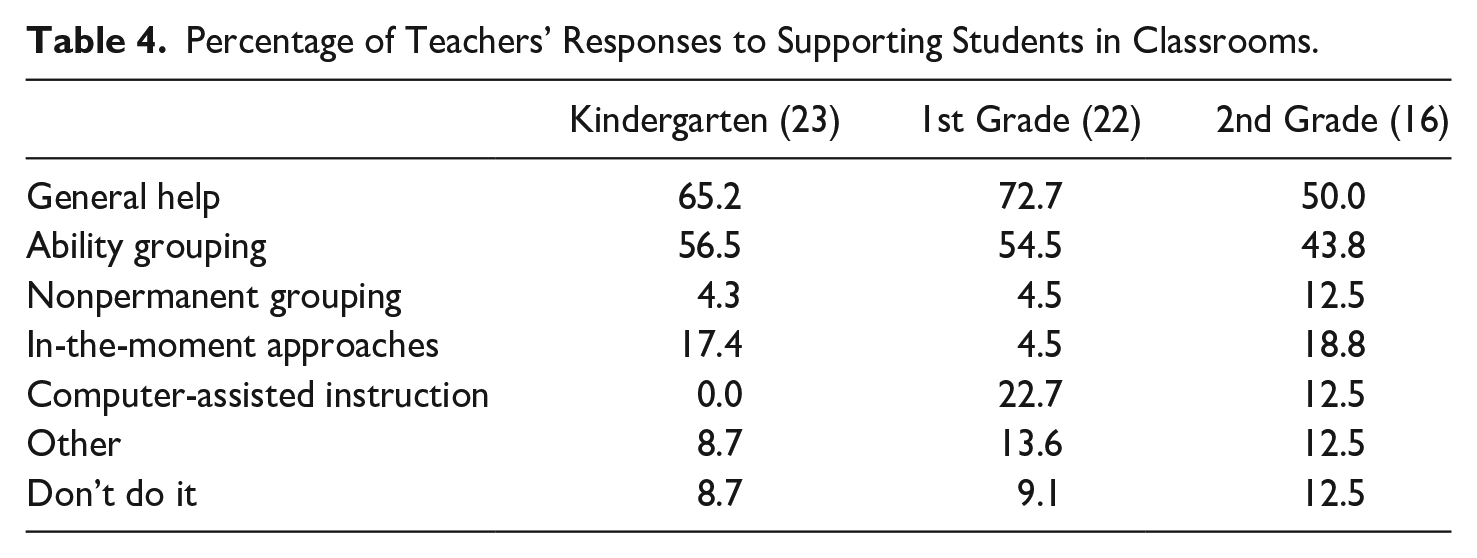
Across grades, a majority of teachers reported that they responded to students’ needs by either giving general help or ability grouping. Many fewer teachers reported making specific moves related to their student’s thinking or posing a problem in the moment. First- and second-grade teachers reported using computer programs to support their students.
We further analyzed these data to examine patterns in responses in relation to teachers’ characterizations of non-math, general math, or specific math and grade level. We found that teachers’ reports of responding to struggling and accomplished students corresponded to their descriptions of their students. Given the research on the advantages of attending to children’s thinking, we examined responses that described supporting students in the moment or focused support based on the student’s mathematical needs. These responses included “group in nonplanned permanent ways,” “group based on knowledge of students,” “use details of student thinking to make specific moves,” and “pose in the moment problems.” We also further examined responses around ability grouping, given the prevalence of grouping as an approach for differentiating instruction and how frequently we heard it across teacher interviews.
Responding to Student Needs: In the Moment
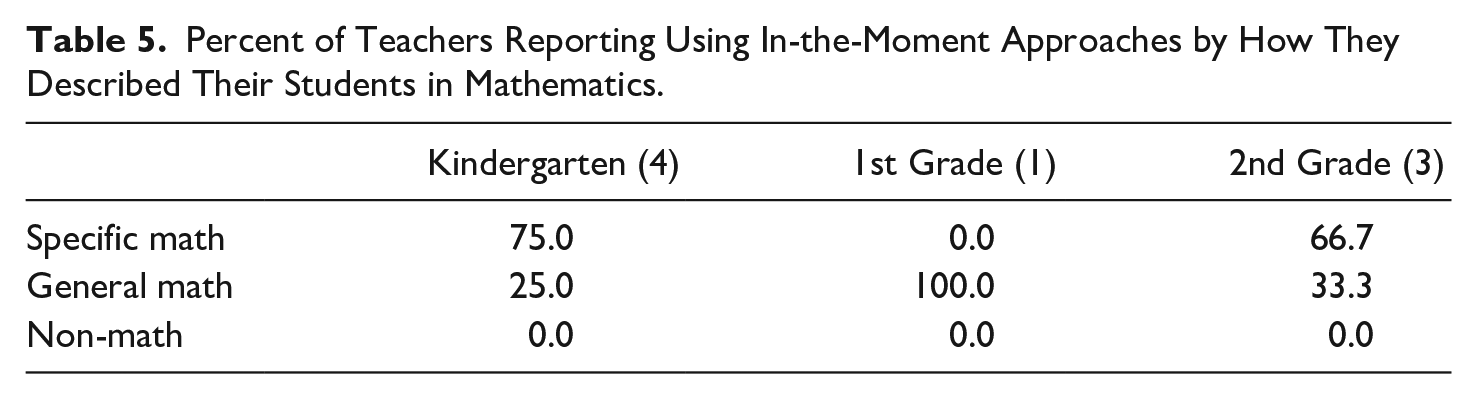
Table 5 shows the percentage of teachers who talked about using an in-the-moment approach to respond to students’ needs in relation to how they described their students in mathematics. Teachers overall did not provide much in-the-moment mathematically focused support (see Table 4). Those teachers who did provide in-the-moment support talked about their students in either specific or general math ways (see Table 5). None of the teachers who provided in-the-moment support talked about their students in non-math ways. It is important to note that not all teachers who characterized students in specific math ways also reported supporting them in in-the-moment ways.
Percent of Teachers Reporting Using In-the-Moment Approaches by How They Described Their Students in Mathematics.
We highlight two responses that illustrate the kinds of responses in this category and how they relate to teachers’ specific knowledge of their students. Elisha, a second-grade teacher who described their students in specific math ways, shared how they supported one student: Elisha: When I was getting one time adding three numbers, say 5 plus 6 plus 5, I know she can do that. Then I did 5 plus blank plus blank equals 14, and had her come up with as many solutions as she could. Giving her some challenge problems once in a while to push her a little bit more ‘cause I know she’s gonna finish her math like that, very quickly. Interviewer: You come up with problems. Elisha: Trying to use the same standard, but just make it a little bit more difficult.
Elisha knows the student can add three numbers to find the sum and, based on that knowledge, extends the student’s thinking by posing a different problem in the moment. Instead of finding the sum of three numbers, Elisha gives one number and the sum, and asks the student to determine the other values in the number sentence. As Elisha stated, they are supporting the student in the same content, but engaged the student in a different way of problem solving.
Zayda, a kindergarten teacher in the specific math category, described how they provide support when working with a small group of students: So, for example, when I knew that [student] didn’t know how to count or didn’t know how to represent by counting the objects, then I had a small group where I could help her count, and it would just be counting, rote counting. “Let’s practice together.” And then, for [student], who knew how to count and knows how to represent the objects, then I would look to see, okay, what’s the next thing that he needs to know? So, if he needs to count to 100, “Let’s work on counting to 100.” Maybe he needs to count by 10s. “Let’s count by 10s,” so that it will help, knowing, what’s the next decade, it will help him be able to count all the way to 100.
Zayda used the common approach of working with a small group of students to provide targeted support. Zayda’s response above illustrates how Zayda uses knowledge about the students and the content to make instructional decisions about which students to work with and what to do with them while in a small group. Zayda details the students’ varying needs with counting and what they do to support them to understand number and deepen understanding of counting in different ways. Zayda’s in-the-moment decision to group students is rooted in the students’ thinking, consideration of the types of support students need, and how they can provide that support based on broader mathematical goals.
We emphasize in this section that teachers who talk about their students in specific ways have knowledge about their students that support their specific instructional decisions. These decisions, often spontaneous, are ones that teachers make based on what they know about their students mathematically to either deepen or extend their thinking about a particular idea.
Responding to Student Needs: Ability Grouping
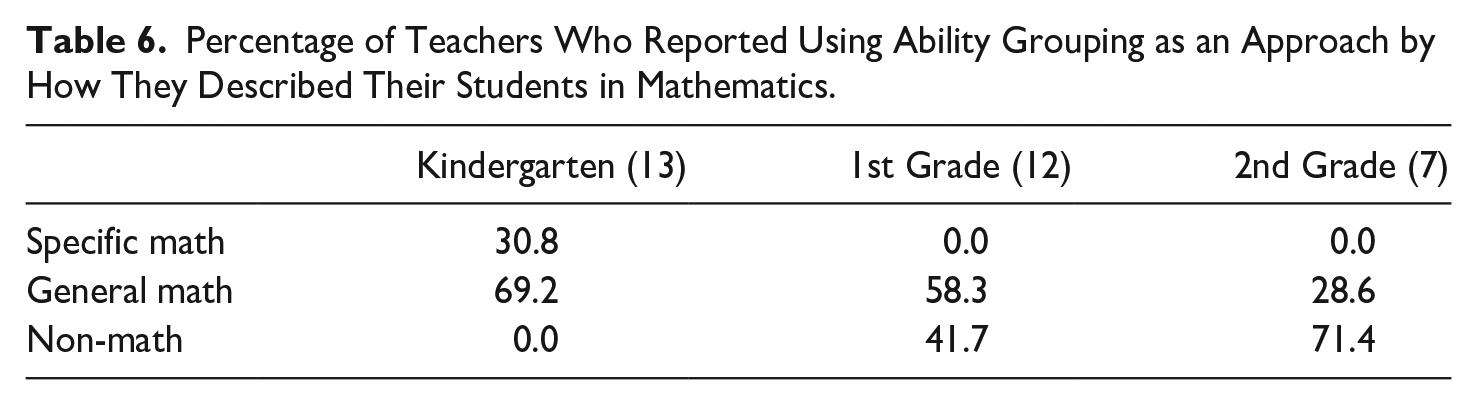
We focus on ability grouping because of how often we heard the teachers talk about this as an approach and how prevalent it is in schools. Overall, just over half of the teachers reported responding to students by placing students in what they described as low, medium, and high groups (57% of kindergarten teachers, 55% of first-grade teachers, and 44% of second-grade teachers). Whereas the previous section noted that teachers who knew their students in mathematically specific ways often made in-the-moment moves to support them, teachers who grouped by ability were primarily those who described their students in either general math or non-math ways (all of the first- and second-grade teachers and 69% of the kindergarten teachers; see Table 6).
Percentage of Teachers Who Reported Using Ability Grouping as an Approach by How They Described Their Students in Mathematics.
When we asked Eleanor, a kindergarten teacher, to describe their students, we found that their descriptions of students mathematically were strongly based on notions of what it meant to have grade-level appropriate knowledge. For example, when asked to describe how students were doing in math in the first part of the interview, Eleanor talked in general percentages, such as, “She’s at about 77%” or “She’s at 45%.” This notion of grade level corresponded to how they responded to students: For the ones that are below grade level, then those get more one-on-one time with the aide or with me depending on what our time frame is throughout the day. Then, the ones that are above grade level, ‘cause we have those as well, those we kind of try to find extension activities, or have them take their math to some kind of writing.
Like Zayda, Eleanor also described grouping students and assigning varying tasks for different students; however, we see several differences in Eleanor’s and Zayda’s responses. Whereas Zayda was able to articulate an intentional grouping based on specific student understandings around a particular content, Eleanor’s grouping was based on the idea of being “below” or “above” grade level; this is not informed by what the students know and understand, but solely as a summative number that then defines whether they are “below” or “above” grade level. Further, when in the groups, Eleanor was not able to specify what was done to support students—for example, what students who were “below” grade level were working on in one-on-one time to deepen their knowledge and, similarly, what types of extension activities were used or how writing was used for students who were “above” grade level to extend their knowledge.
We share first-grade teacher Blaire’s response to illustrate how their non-math descriptions corresponded to opportunities for support. When asked to describe their students mathematically, Blaire’s responses focused primarily on behavior. For example, their response about one student focused on the fact that “he doesn’t bring his homework. He doesn’t bring anything” and another student who “seemed like she was getting it when she’s not talking to her neighbors.” Blaire also described how they used ability grouping: Well, pairing him up with someone who needs that extra help. He’ll even ask, “I’m done, can I—” because he’ll get everything done. I said, “Okay.” I’m usually busy with a little group or something. He’s like, “Can I help someone?” I’m like, “Yeah, but you know the ones to help?” He’s like, “Yeah.” He knows the ones to target around the room. Uh-huh, at his table. That’s why they sit at the table. Yeah, high, medium, lows.
We get a sense of the salience of ability grouping in Blaire’s classroom because it is physically organized with students sitting at specific tables according to ability groups. The student described in the preceding quote, whom Blaire identifies as a “high” student, “knows the ones to target around the room” to give help to, indicating that peers are aware of students’ math status in the class. Further, there is a sense that these groupings are fixed because students know of the organization, as compared with teachers in the previous section, who described student groupings in fluid and intentional ways based on the support that particular students needed in the moment. Similar to Eleanor’s quote earlier, we do not get a sense of what is being done in the groups to support students, such as help at each table, or how students like the one Blaire described help their peers. However, the idea of helping as a way of supporting students is based on how students are categorized, where “low” students are in need of help, and one way to provide help is to rely on “high” students to do so. In this example, Blaire discusses ability grouping as a way of engaging a student who is “doing well”; they attribute the student’s ability in math based on the speed of task completion, noting that “he’ll get everything done.”
We emphasize again that teachers in our study frequently grouped students. We are not suggesting that teachers should not group students. Rather, we are teasing out how teachers are conceiving of grouping as a way to meet student needs and what the teacher and students are doing while in a group. The teachers who reported knowing their students in mathematically specific ways shared the intention behind choosing which students to work with in a small group, as well as specific instruction that supported their students as related to their mathematical needs. In contrast, the preceding quotes from Blaire and Zayda, while also noting the use of grouping, are informed by broader notions and constructions of schooling rather than the details of students themselves.
Summary of Findings
The findings presented earlier illustrate the ways that teachers characterize their students and how those characterizations inform the decisions they make to support their students mathematically. In the first section, we shared how teachers described their students in mathematical and non-mathematical ways. Teachers who described their students in specific mathematical ways were able to detail what their students knew and understood in relation to particular math ideas. Other teachers described students in mathematically general ways that focused more on broad ideas or skills that the student either had or did not have.
As grade level increased, teachers reported more and more non-mathematical descriptions of their students. These responses attributed students as “successful” or “struggling” in relation to broader constructions of what the school valued. What teachers noted about their students was their behavior—such as whether they focused in class, were independent, or showed effort. Other teachers’ responses spoke to what has been normalized in schools as a successful student: one who meets constructed standards of a given grade, who speaks and communicates in English, and who does not have other learning needs, or who can keep up with the general pacing of classroom instruction to meet task completion. For up to half of the second-grade teachers in our study, whether students possessed or met these perceived criteria informed how they described their students’ mathematical knowledge.
The second section focused on two types of support that teachers described: using in-the-moment moves and ability grouping. These data revealed that characterizations of students in terms of specific math, general math, or non-math, for some (but not all) teachers, showed consistencies in how teachers reported support they provided students. Teachers who shared supporting their students in ways that deepened or extended their thinking were most often the teachers who described their students in mathematically specific ways. Teachers who described specific instructional strategies typically did not use language that sorted students. Rather, they talked about instructional decisions based on the students’ thinking. In contrast, teachers who employed ability grouping used language that sorted their students as “high,” “medium,” or “low.” Consequently, teachers’ instructional decisions were not supportive of students specifically, but rather what they thought “high,” “medium,” or “low” students needed.
In addition to a pattern related to teachers’ characterizing students in specific, general, or non-math ways, there was also a pattern across grades. We saw an increase in non-math characterizations over the grades, as well as more general practices being used, such as ability grouping, to support students. This raised questions about what was shaping teachers’ descriptions of students, as well as how those characterizations related to the types of support students were offered as they progressed through the grades. We offer considerations around this in the discussion section.
Discussion
We set out in this study to understand how teachers characterized their students mathematically and how they considered meeting students’ needs in math class. We were driven in part by evidence that knowing one’s students matters for student learning. We drew from a research base in mathematics education that delineates how knowing the details of students’ mathematical thinking supports teachers in engaging students in ways that enable participation and learning (Franke et al., 2007; Sowder, 2007). While few teachers shared details of their students’ mathematical thinking in our interviews, what was striking was the number of teachers who did not talk about mathematical ideas at all, even when prompted, how that increased by grade level, and how closely tied their student descriptions were to the structures of schooling.
The striking patterns across the 61 teachers led us to examine closely what teachers said and the language they used to describe students when asked about them in relation to mathematics. We found, whether talking mathematically or in non-mathematical ways, that teachers often described forms of behavior and instructional moves to support students using language that was universal in schooling. That so many teachers across the two districts shared the same details about their students (i.e., ability to focus, lack of language) and named the same practices they rely on to support students (i.e., grouping) shows how ubiquitous these ideas are and points to the role that schooling plays in what teachers share mathematically about their students and how they act on that knowledge. That the non-mathematical characterizations increased across grades potentially indicates that the longer you are in school, the more prevalent these structures of schooling become in how classrooms are organized.
Teachers were asked to describe their students in mathematics. They were left to decide for themselves what this meant. We did not ask specific questions about their students’ understandings or provide examples of student work. We wanted to know how teachers would choose to describe students mathematically because it opens space for the range of ways one can conceive of students mathematically and shows us what sits at the surface for teachers. We are not claiming that teachers do not have specific knowledge of their students mathematically, only that they did not choose to share it or discuss it when describing how they would support students. Because so many teachers shared non-mathematical conceptions of students, and those perceptions increased across grades, we were pushed to consider our data in relation to long-standing literature on labeling and perceptions.
The ways in which students are framed by teachers is inherently a social process and shaped by a long history of marginalization and racism (McDermott, & Vossoughi, 2020). Teachers’ perceptions have been shown to be related to socioeconomic status, race, and gender (Diamond et al., 2004; Hughes et al., 2005; Riegle-Crumb & Humphries, 2012) and influence not only students’ current classroom experiences but also their schooling in the future (McLaughlin & Talbert, 1993). Research has shown that teachers’ perceptions of student ability shape the decisions they make about instructional practices (Jackson et al., 2017; Oakes et al., 1997; Wilhelm et al., 2017). Our findings are in line with much of the existing research, and while our data would require further investigation into specific social dimensions of race, gender, class, ability, and so on, given that each of the six different schools all served predominantly low-income students of color, our findings raise concerns about how teachers talk about their students in relation to their students’ language backgrounds, special education status, and home environment.
By asking open-ended questions and providing space for teachers to respond in whatever ways they chose, we were able to hear the language teachers used to describe their students and see how that language paralleled the work of schools. When teachers shared general mathematical information about their students, they characterized their students in relation to topics covered (i.e., they can count or use greater than) or how students use resources (i.e., they can use manipulatives or counters well). These general descriptions of students fit well with the work that teachers are asked to do: navigate topics in the curriculum, assess students, and mark report cards. Consequently, many of the conversations that teachers have with each other and the administration (and even parents) would also be framed in these general ways. When teachers shared non-math characterizations of students, many talked about students as below grade level or unable to focus, again reflecting the way schools operate and what schools expect of students. When asked how they then supported their students, teachers responded again with general and common school-based approaches, such as grouping students by high, medium, and low ability levels. While we asked teachers about their students a month into the school year, and note that their ideas could change, there is evidence that these dominant schooling practices and structures shape teacher perceptions throughout the school year (Scott & Philip, 2023). How schools operate and what they expect of students can help us understand why teachers characterize and respond to students in the ways we found here and explain why those characterizations are difficult to change. Typically, few spaces exist in schools where details of students’ mathematical thinking would be required or even expected.
One implication of this study could be to recommend professional development that supports teachers to get to know their students mathematically, and notice and take up the details of their ideas in supporting classroom practice. While potentially productive in supporting teachers to see the value in and develop practices that enable them to know their students mathematically in nuanced and detailed ways, the professional development would not necessarily put an end to the more behavioral or non-math characterizations of those same students. The data here showed that almost all teachers, even those with detailed knowledge of their students, shared behavioral descriptors of their students. There is evidence that creating collective opportunities for teachers to engage with each other around the teaching and learning of mathematics in relation to their views of their students can help influence how teachers frame students (Diamond et al., 2004; Horn, 2007; Scott & Philip, 2023). However, this is an individual teacher solution that ignores the school structures that press teachers to characterize students in general and non-math ways. If the school structures remain the same, it will be difficult for teachers to maintain and operate on their detailed mathematical knowledge of their students.
Another implication of this study is related to the ways in which assessment shapes how teachers see and characterize students. Each of the teachers in this study reported that they had assessed their students in mathematics since the school year began. However, few teachers shared details about students’ thinking from these assessments when asked about their students mathematically. It is likely that the assessments were not helpful in enabling teachers to know the details of their students’ mathematical ideas (Kazemi, 2002; Penuel & Shepard, 2016). Often, the assessments chosen by schools, districts, and states sort students into categories (i.e., proficiency levels, above or below grade level), characterize students in general mathematics terms (i.e., adds to 20), or tells the percentage of items solved correctly. The teachers’ characterizations of their students clearly reflected this type of information. A number of the teachers characterized students, for instance, as below grade level by naming general math topics they could “do,” or as fast or slow. Supporting teachers to use their data better may only lead to more characterizations that do not focus on students and their mathematical understandings, and leave the same students to be seen as mathematically incapable (Hatt, 2012; Louie, 2017; Shepard, 1991).
Creating new assessments that provide teachers more information about the details of their students’ ideas could support change in both what teachers know about their students mathematically and how they characterize students. Yet, math assessments sit in relation to other aspects of schooling, such as report cards and behavior systems, which continue to ask teachers to sort and characterize students in general terms. All of these varied aspects of schooling act together to make attending to students and what they know very difficult and thus lead to classroom practices that sort and isolate based, at best, on general knowledge of students’ mathematical thinking (Louie, 2017).
Our tendency is to fix children rather than recognize the school structures that lead us to view them as needing fixing (Hatt, 2012; McDermott, 1997; Spencer, 2006), and the same could be said for teachers. We ask teachers to learn to adapt their practice and may even ask them to examine their assumptions about their students, but that leaves the burden of change to teachers and does not address the underlying contributing factors that continually shape their characterizations of their students. While we can ask teachers to push back on the status quo and create learning spaces that acknowledge and support the strengths of each of their students, we must examine the institutional practices that continually reproduce the status quo as students are sorted and labeled (Anyon, 1981; Bowles & Gintis, 1976; Oakes, 1985). Rather than asking teachers to carry the burden of change, we must look to challenge the school structures that contribute to teachers’ characterizations of students. What we propose is an examination of school structures, along with the associated policies and practices, in relation to each other; this would allow assessment practices to be adapted at the same time that teachers are engaged in professional development focused on understanding their students’ mathematical thinking, while also interrogating student classroom placements, revising grading practices, evaluating discipline policies, and so on.
We recognize that more data across more schools and teachers are needed that directly link what teachers report about their students in mathematics and their classroom support of students. Data are also needed that connect teachers’ characterizations to particular students to further examine the racialized, gendered, ableist, and linguistic ways in which schooling shapes teachers’ views. Yet, this study serves as evidence that we cannot continue to expect that addressing teachers alone—changing their mindsets, beliefs, and actions—will create schools where all students are known in productive ways, mathematically and beyond.
Footnotes
Declaration of Conflicting Interests
The author(s) declared no potential conflicts of interest with respect to the research, authorship, and/or publication of this article.
Funding
The author(s) disclosed receipt of the following financial support for the research, authorship, and/or publication of this article: This research was funded by a generous grant from the Heising-Simons Foundation to the Development and Research in Early Math Education (DREME) Network, of which the authors are members. Grant numbers: 2018-0680, 2020-1777.