



Abstract
Background/Context:
Ethnic Studies is an umbrella term for a group of academic disciplines attentive to identifying oppression, restorying history, and creating liberatory futures. These disciplines were born from social movements, with students, educators, and community members demanding educational spaces guided by people who looked like them, curriculum that told their stories, and pedagogies that could transform their communities. Around the country, elementary and secondary schools are expanding Ethnic Studies offerings at the school, district, and state levels. Ethnic Studies work is deeply local, and, as such, different approaches to expanding access to Ethnic Studies have been taken across localities and states. The power and potential of Ethnic Studies to shift social reality beyond the classroom is both a strength in the struggle for just, liberatory futures and a factor that draws the disciplining eyes of the state.
Purpose/Objective/Research Question/Focus of Study:
Like the discipline of Ethnic Studies, Ethnic Studies research is activist, transformative, and community embedded. In this article, we illustrate the ways that our research about the movement for Ethnic Studies in Texas is inextricable from our community-based work to expand access to Ethnic Studies, which is itself woven in and guided by the theories that ground the disciplines of Ethnic Studies. We write with the theories, thinkings, and actions of feminists of color, sharing vignettes that braid together our research and advocacy, highlighting community fostered organic third spaces, in what we call decolonial policy praxis.
Research Design:
We use digital and auto-ethnography methods to build our vignettes.
Conclusions/Recommendations:
We note the critical importance of building coalitions and of remaining committed/connected to the liberatory theories of Ethnic Studies in our research and in the collaborative development of culturally sustaining policy. This means building with community, in community, and for community in pursuit of liberatory, Ethnic Studies futures.
“Ethnic Studies” is an umbrella term for a group of academic disciplines attentive to identifying oppression, restorying history, and creating liberatory futures. Disciplines like Mexican American Studies, Black Studies, Chicana/o/x/@ Studies, African American Studies, Asian American Studies, Native American Studies, and Indigenous Studies were born from social movements in the late 1960s. Students and educators around the country walked out of schools and universities, demanding educational spaces guided by educators who looked like them, curricula that told their stories, and pedagogies that could transform their communities (Barrios, 2009; Lye, 2010; Wing, 1999). The scholars who continue to shape these disciplines ground their work in the ways of being and knowing that have sustained their ancestors for generations (Cuauhtin et al., 2019).
At the K–12 level, Ethnic Studies courses take a systemic, critical approach that is interdisciplinary, centers identity, draws on the notion of curriculum as counternarrative, and engages communities to humanize and transform (Sleeter & Zavala, 2020). This is a building up, as opposed to a taking down. Interrupting the curricula and pedagogies that bury the logics of Whiteness and Eurocentric ways of knowing—the curriculum cemented into most U.S. schools—could not be a more urgent matter (San Pedro, 2019; Sleeter, 2011; Urrieta, 2009).
Extant scholarship has confirmed the benefits of Ethnic Studies courses for academic achievement, including higher GPAs, attendance, engagement, and program completion (e.g., Bonilla et al., 2021; Cabrera et al., 2014; Dee & Penner, 2017). Around the country, elementary and secondary schools are expanding Ethnic Studies offerings at the school, district, and state levels. Ethnic Studies work is deeply local, and, as such, different approaches to expanding access to Ethnic Studies have been taken across localities and states. The power and potential of Ethnic Studies to shift social reality beyond the classroom is both a strength in the struggle for just, liberatory futures and a factor that draws the disciplining eyes of the state. In places such as California, Texas, Oregon, and Washington, as Ethnic Studies courses moved from localized projects to programs organized by state-level policies and White supremacy logics, they encountered state surveillance, racism, and pushback.
But the social movements and organizing that birthed these disciplines are ongoing. Demands continue for culturally sustaining pedagogy and content; for educators who learn with, rather than lecture at; for classrooms that make visible the coloniality of schooling and foster resistance to it; for liberatory, humanizing, and healing educational spaces. The Ethnic Studies movement came to be because the world oppresses. But Ethnic Studies is without being defined in opposition to. Ethnic Studies is not confined to a classroom in a given semester. Ethnic Studies is itself an onto-epistemic project. And research for/with/through Ethnic Studies is the same. In this article, we share two vignettes from our research that reveal the way we see Ethnic Studies being lived, and live Ethnic Studies ourselves, through the research-to-policy process. We conclude with a discussion of emergent observations and continuing efforts to foster Ethnic Studies futures.
Grounding Our Work
Important in the writings and scholarship of feminists of color are issues of politics and policy, together with positionality, decolonization as a critical praxis, cultural intuition, and community cultural wealth (e.g., Anzaldúa, 1987; Collins, 1990; Delgado-Bernal, 1998; Dillard, 2000; Foley & Valenzuela, 2005; Hurtado, 1997, 2003; Perez, 1991; Sandoval, 2000; Valenzuela, 2005; Yosso, 2005). We draw on this body of scholarship to advocate for the vital role of a “theory of the flesh” (Moraga & Anzaldúa, 1981), a type of knowing emergent from understanding “how the physical realities of our lives—our skin color, the land or concrete we grew up on, our sexual longings—all fuse to create a politic born out of necessity” (p. 23). These theories of the flesh give rise to what we as scholar-activists have theorized as organic “third spaces”—spaces that simultaneously and collectively hold and challenge theories of liberation within existences of oppression, that inform our research focus and highly effective approach to community agency (Bhabha, 2012).
One such third space, Academia Cuauhtli, a Saturday school that serves fourth- and fifth-grade children and their families in East Austin, opened its doors as a community–school district partnership in 2014. While it is physically located on the downtown shore of Lady Bird Lake on the grounds of the Emma S. Barrientos Mexican American Cultural Center (ESB-MACC), the organization that runs the academy is named “Nuestro Grupo,” or “our group.” Members of Nuestro Grupo cofounded the academy, composed of graduate and undergraduate student volunteers, elders, parents, teachers, and university faculty from the University of Texas at Austin and Texas State University in San Marcos. The ESB-MACC itself is a community cultural arts institution that has been in existence since 2006. Before we had any language about third spaces, we were guided by the work of the National Latino Education Research and Policy Project (Valenzuela, 2016) that advances the concepts of grow-your-own Latina/o critically conscious teachers and a partnership approach that disrupts the top-down model for education in which schools overwhelmingly subscribe to official knowledge (Apple, 2002), deficit discourses (Valencia, 2010), and subtractive schooling (Valenzuela, 1999).
Our theory in the flesh impels us to anchor our research agendas in the institutions we build via the spaces we intentionally create (Valenzuela, 2021). Through our work—in the academy, the capitol, and the community—we observe how what we term a “decolonial policy praxis” bridges theory, advocacy, and critical community reflection in policy development (Fanon, 2000; Freire, 1996; Leonardo & Singh, 2017). This is a means of sustaining our lives with/through/alongside our research, a taking up of Campt’s (2017) instruction for black futurity, to live “the future real conditional,” to do “that which will have had to happen” in order for liberatory futures to be. This maps well onto the concept of the decolonial imaginary in Chicana feminism (Perez, 1991).
We further see our work as operating within pedagogies of creation resistance (Cintli, 2021), an approach to decolonization that resists the weight of colonial violence and oppression and creates ways of being and living that exist beyond the limits of Western frames. We aspire to work that lives at the tip of the pyramid, “a metaphor for an outcome vetted by Our Community” (Diaz, 2022, p. 20). The tip of the pyramid is a place produced by and host to community, collective work; “If you stand [at the tip of the pyramid], it is because of all the steps leading there” and all the people with whom you walked (Diaz, 2022, p. 20). Ethnic Studies policy struggles rely on the organic voices, constituencies, and, as argued herein, third spaces for collective action (Valenzuela et al., 2021). By merging Chicana feminist ways of knowing with policy advocacy, we highlight how our approach affords researchers critical insights to issues of power, privilege, and the politics of knowledge at the same time that it provides insights on how to be agentic and collaborative in power-laden spaces. Our work as scholar-activists pushes our thinking into the interconnected, interwoven dynamics of third spaces as essential to the kind of creation resistance (Cintli, 2021) that takes us to the tip of the pyramid where love, liberation, and community power are found.
Represent’n’ at the State Board of Education
A recent collaboration between the authors and another scholar, the brilliant doctoral candidate María Del Carmen Unda, demonstrates the work of scholar-activists in doing decolonial policy praxis, as well as the work of scholar-activists in shaping methodological interventions in research (Valenzuela et al., 2021). The decades-long fight to codify Ethnic Studies courses in Texas’s public schools has carried organizers to the tip of the pyramid, and it has brought moments of deep pain and institutional violence. In 2014, Mexican American Studies advocates collaborated with newly elected State Board of Education (SBOE) member Rubén Córtez to bring an agenda item requesting the development of a Mexican American Studies course. While the board voted that down, they did include a call for Ethnic Studies instructional materials, “including, but not limited to, Mexican-American Studies, African-American Studies, Native-American Studies, and Asian-American Studies” (Proclamation 2016, 2014).
In response to that call, a former board member submitted a draft of a deeply racist textbook entitled Mexican American Heritage. In an act of decolonial policy praxis, historians, community members, and cultural accelerators (Diaz, 2022) came together to author a formal report, demonstrating that the book was grounded in racist theory, rife with factual misrepresentations, and plagued by errors of omission—not the least of which was the erasure of women and, ironically, Mexican Americans themselves (Carmona et al., 2016). Members of the ad hoc committee who authored the report then spent two days in Austin, holding a press conference and testifying before the board. On their first day, they centered their professional training and scholarly expertise, providing the board with substantive justifications to reject the text (“Texas Education Agency,” 2016). On the date of the second hearing, the team engaged theories of the flesh, channeling their righteous rage, bringing their cultural heritage, and represent’n’ (Blackwell, 2011) their ancestors. Through this work, these scholar-activists were Ethnic Studies (see Sleeter & Zavala, 2020, for seven hallmarks of Ethnic Studies)—living theories of the flesh, delivering testimonio, and engaging community in efforts for transformational change. And they succeeded in influencing policy—in this case, the rejection of the text—through their efforts.
While the authors spend hundreds of hours a year sitting in state houses and government buildings waiting to deliver public comment and expert testimony, we have encountered little scholarship that takes up public testimony in an analytical way (see Chang, 2022, for a recent example). For this project, we engaged the public testimony of our beloved colleagues through the lens of testimonio, because we know that in their lives, they live this theory of the flesh (Moraga & Anzaldúa, 1981). In our research, we drew on the Chicana feminist methodology of testimonio to read the testimony of the scholar-activists before the State Board. Evading a single definition, testimonio springs from one voice, though it is commonly built from collective memory and strives to strengthen solidarity (Beverley, 2005; Latina Feminist Group, 2001; López & Davalos, 2009). Testimonio is always explicitly political and restories experience(s) in pursuit of liberation from violence and oppression (Anzaldúa, 1987; Cervantes-Soon, 2012; Delgado Bernal et al., 2012; Elenes, 2013; Pérez-Huber, 2010; Yúdice, 1991).
Our analytical methods included watching the testimony over and over again, making notes of what we heard, but, perhaps more important, feeling—in our memories and in our souls—what our colleagues shared, bringing us again to the tip of the pyramid. We had intended to source a transcriber for the job, but pandemic conditions and bureaucratic hiccups forced our hands and blessed our ears (and beings). We were able to hear our colleagues and recognize the righteous rage that flowed out of them—the shifting of their tone, the way they invoked their ancestors, revealing the personal in the political, that may have been lost if we had just read through transcripts. We also would not have been nourished in the same way.
At the 2022 meeting of the American Educational Research Association, we presented this work to our audience using the same methods, editing excerpts of testimony from our participants and bringing their voices and faces into the room through the conference audiovisual setup. Our session hosted two of the scholar-activists we featured in our article, though the room was predominantly filled by younger scholars and students who shared stories during the discussion about the ways that they could foster creation resistance on their own campuses. We invite the reader to view the presentation from the day and to listen to the words of the scholar-activists we featured (Valenzuela et al., 2022). You may just need this trip to the top of the pyramid.
Community-Powered Transformations
Eliza’s dissertation research examined the implications for the fidelity of Ethnic Studies courses to their disciplinary theories during the policy-making process as they faced state surveillance, racism, Whiteness, and institutionalized power. I (Eliza) spoke with scholar-activists, educators, district personnel, and organizers about how they felt Ethnic Studies fit into their story of public education, how they thought about approaching Ethnic Studies policy “institutionalization,” and the challenges they faced in their work. I built off Leonardo and Singh’s (2017) call for a decolonial policy standpoint, in which they asked scholars to elucidate colonial logics when doing critical policy analysis and educational policy design. I sketch a portrait of decolonial policy praxis, in which organizers, educators, scholars, and youth cultivate Ethnic Studies futures in/with/through/during/outside of the state policy process through the making visible of and challenging logics of coloniality—being Ethnic Studies. A dissertation is a solitary project, but the work is never done alone. 1 In what follows, I share some of the story of decolonial policy praxis as it pertains to Ethnic Studies policy development at the state level in Texas, highlighting the importance of community-powered work and the need to build solidarity in the process.
Dallas, Dallas Independent School District, and African American Studies
In April of 2018, the Texas SBOE made history by becoming the first state to adopt standards for a Mexican American Studies course. On the day of the vote, it also created a pathway for additional Ethnic Studies courses, putting out a call for groups to bring forward courses in “Native American studies, Latino studies, African American studies, and/or Asian Pacific Islander studies” (Texas State Board of Education, 2018). Just a few weeks before this call, the Dallas Independent School District’s (DISD’s) new Racial Equity Office had formally begun its work. Jamila Thomas, inaugural director of the office, invited community members to collaborate on writing an African American Studies course as one of the office’s first projects. Formally convened as the Multicultural Studies and History Advisory Council, they were hosted by the Pan African Connection, a bookstore, art gallery, and resource center in the Oak Cliff neighborhood of Dallas (see Figure 1). Akwete Tyehimba, cofounder with her husband Bandele of the Pan African Connection, spoke about why they had opened the space. She shared that it was always her husband’s desire to create an institution, to build a vehicle, a place to organize our people around Africa, around Pan-Africanism and also as a tool to educate people about their history and culture, to get them closer to loving themselves, and in turn loving other people and humanity as a whole. You first need that really strong foundation of identity, and history, and culture, which is your strength. (Oak Cliff Documentary, 2020)
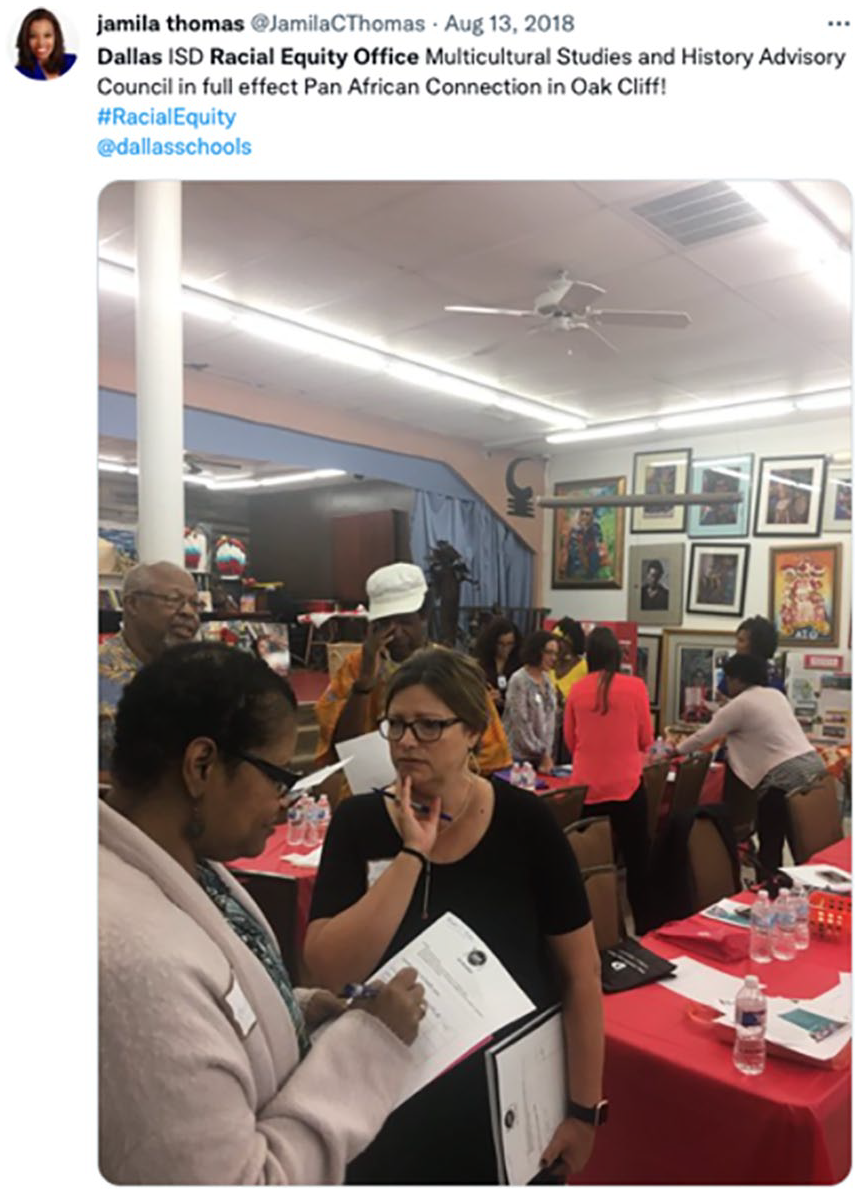
Community members at the Pan African Connection in Dallas, Texas, working on the African American Studies course on August 13, 2018.
This place, a third space grounded in cultural love, brought forth the African American Studies course. The Multicultural Studies and History Advisory Council included educators, community elders, and people from the NAACP and LULAC. Folks showed up for the next six months, where “conversation happened, drinking coffee, breaking bread,” Director Thomas shared. In framing the importance of this course, Director Thomas said, Liberation comes from education. We need to stand in solidarity with each other. Systems of oppression play a role in dividing and conquering. In order to have liberation, you have to have consciousness. In order to have consciousness, you need education. . . . We as elders have to do our job to train them up, to understand good trouble. (Thomas, 2020)
Elder knowledge fed into the standards, bringing consciousness to students and educators, first in DISD, and later to the whole state. And at the same time, community was strengthened. Akwete Tyehimba shared, “We need our people to know they come from greatness” (Oak Cliff Documentary, 2020). The success of this project is evident not only because the SBOE approved the course, but also when reading the dreams of Akwete Tyehimba alongside the testimony of Dallas youth, who woke up before sunrise to ride a bus to Austin and share their learning from the pilot course. Jada Chivers, a DISD student at L.G. Pinkston Collegiate Academy, testified to the importance of learning about her ancestral greatness (see “Texas Education Agency,” 2019, for the complete testimony from that day). She spoke: Having an African American studies class has provided me an avenue to better understand the African American experience. Specifically, the coursework emphasizes that African culture and identity did not begin with slavery. This has been significant in developing my cultural perspective because it has provided me more information about my forefathers. Knowing that my ancestors founded entire kingdoms, were conquerors of land, and discovered medical practices that are still used today has elevated the way I see myself and altered the way I see and engage with other African Americans. Having a sense of identity based on greatness and not on suffering has changed everything for me. (“Texas Education Agency,” 2019, Part 1, 3:04:55)
This “identity based on greatness” was manifested through the community-powered work generated in this third space of the Multicultural Studies and History Advisory Council at Pan African Connection. And the power of that space achieved the “community transformation” that Akwete Tyehimba said they were seeking (Oak Cliff Documentary, 2020). Jada Chivers demonstrates this in the concluding words of her testimony: Finally having this African American studies course has helped me to cultivate a deeper relationship with the matriarch of my own family—my great-grandmother. When my grandmother would speak about social injustices or challenges that she faced, like not being able to complete high school, only being able to obtain a job cleaning White people’s homes, not being able to practice ministry because she was a Black woman, it seemed outdated. Her challenges were in the past. Now, because of this class, I have a better understanding of the context and how her experience connects to African American history. . . . This course has the power to change communities. (“Texas Education Agency,” 2019, Part 1, 3:04:55)
While this course has the power of community transformation, we found that through the sheer process of building out the policy and developing it, the communities had already changed. This is the way of decolonial policy praxis. This is the wealth that resides in third spaces. This is what carries us to the top of the pyramid.
Enduring the Rest, Fostering Liberatory Futures
This time at the top of the pyramid also allows us to endure the rest. Ethnic Studies advocates in Texas have been on an institutional violence rollercoaster for the last year. The Texas Education Agency (TEA) turned down an American Indian/Native Studies (AI/NS) course application from Grand Prairie Independent School District (GPISD). GPISD leadership brought together a community-based collective of Native, American Indian, and Indigenous peoples from around the state and region who contributed thousands of hours to developing draft standards. TEA argued that because the state was beginning a Social Studies TEKS 2 review cycle, the AI/NS course design should be put on hold for a year to ensure that it would reflect whatever changes were made to the broader social studies framework. Rightfully dejected, the AI/NS Committee was conversely elated just three months later when, seemingly on a whim, the SBOE called for the immediate development of a Native Studies course and an Asian American Studies course as a part of the Social Studies TEKS review process. TEA invited Ethnic Studies scholars, educators, and community members in each of the four Ethnic Studies disciplines to gather in Austin for 10 days to make edits to existing standards (MAS and AAS) or completely draft new Ethnic Studies courses (AI/NS and Asian American Studies).
Hotel conference rooms policed by bureaucratic monitors are not generative third spaces, but the lunch breaks and hallway coffee conversations they allow for are. The rollercoaster crashed back down on September 1, 2022, when the SBOE crumbled under pressure from right-wing counter-movements and cowardly, criminal government agents and punted on the entire Social Studies TEKS review process, pushing it down the line for two years. 3
But through this ride, a nascent coalition emerged, bolstered by relationships that emerged from what we are calling micro-third spaces, as well as other networks strengthened by this decade-long state policy process. The new Ethnic Studies for Texas Schools Coalition became a virtual third space for community building, strategizing, and healing. Solidarity was centered. Heart emojis abounded. And while the state serves up coloniality, the coalition continues the struggle, countering colonial logics.
Eliza’s place as a convener of this coalition, as well as a core organizer with the Ethnic Studies Network of Texas (ESNTX), allows her the opportunity to, at once, do policy, research, and community building. It also permits her to see what was sacrificed in the efforts to get Ethnic Studies courses approved by the state. In February 2022, ESNTX Advocacy Committee members—many of whom were on the AI/NS Committee—schemed a spring of creation resistance, looking to make connections statewide through organized activities, such as cooking with an elder or doing a community run (Rodriguez, 2012). We were inspired by a presentation given at the ESNTX’s Annual Summer Convergence in 2021, where a group of students from the Houston Collective for Reimagining Education shared a visual art piece about the lived experience of Asian American students in Texas (AAPI Voices, 2021). The ESNTX Advocacy Committee’s creation resistance project got pushed aside by the state board circus. It will return, though; as Chicano activist and elder Juan Tejeda, founder of the annual Tejano Conjunto Festival—entering its 41st year—and the Center for Mexican American Studies at Palo Alto College in San Antonio, stated, “Until there is justice and equity for all, none of us are going to be free. Our liberation and justice is in the fight. That’s all we can do is continue the struggle” (J. Tejeda, personal communication, 2021).
Looking Forward
In short, our third space “theory of the flesh” powers on and is flourishing under colonialism. Angela is cofounding an initiative titled “Black-Brown Dialogues on Policy,” which brings our Black and Brown communities, organizations, advocates, legislators, coalition leaders, and civil rights groups together in virtual, physical, and hybrid formats to address policy topics of mutual concern. It will be launched in the context of the 2023 88th Texas legislative session with a national town hall meeting to address the legislative attack on diversity, equity, and inclusion in higher education institutions throughout the state.
Eliza is collaborating on an oral history project about the Mexican American Studies program at Austin Community College. In a recent meeting, the research team talked about the way that this work allows us to see where we are in a generations-long struggle for Ethnic Studies. In listening to our elders talk about the movement and its intersections—specifically in a piece about Chicana movidas, the actions fostered by and stemming from the third spaces in the “backrooms and bedrooms, hallways and kitchens” (Espinoza et al., 2018, p. 2), where those in the know about institutional resources redirected them to attend to community needs—we are lifted to the tip of the pyramid and sustained in our struggle for liberation.
Footnotes
Declaration of Conflicting Interests
The author(s) declared no potential conflicts of interest with respect to the research, authorship, and/or publication of this article.
Funding
The author(s) received no financial support for the research, authorship, and/or publication of this article.