



Abstract
In this commentary, we identify a phonics-first ideology and its polemical distortions of research and science to promote legislation that constrains and diminishes the teaching of reading. We affirm our own, and a majority of reading professionals’, commitment to teaching phonics. However, we argue that phonics instruction is more effective when embedded in a more comprehensive program of literacy instruction that accommodates students’ individual needs and multiple approaches to teaching phonics—a view supported by substantial research. After summarizing the politicization of phonics in the United States, we critique a legislated training course for teachers in Tennessee as representative of how a phonics-first ideology is expressed polemically for political purposes. We contrast it with a more collaboratively developed, balanced, nonlegislative approach in the previous governor’s administration. Specifically, the training course (a) makes an unfounded claim that there is a national reading crisis that can be traced to insufficient or inappropriate phonics instruction; (b) distorts, misrepresents, or omits relevant research findings and recommendations, most prominently from the report of the National Reading Panel; (c) inaccurately suggests that “balanced literacy instruction” is “whole language” instruction in disguise; and (d) wrongly claims that its views of phonics are based on a settled science of reading.
Keywords
When we do not have definitive research to answer a question about policy or practice, we can easily slip over the line and privilege ideology and belief over evidence . . . When research travels to the land of policy, often only the headlines make the journey, leaving the details and the nuance behind. (Pearson, 2004, p. 238)
Since 2015, 47 state legislatures have enacted, or are currently considering, a remarkable total of 145 bills that address reading and reading instruction in public schools. 1 Many of these bills are relatively routine appropriations, procedural issues, licensures, and so forth. However, an increasing number define, endorse, and sometimes mandate instructional approaches—a legislative excursion into matters that in other fields of practice, such as medicine or law, are left to certified professionals and the standards set by their professional organizations or accrediting agencies. In that sense, the existence of such laws suggests a perception of a problem with the teaching of reading of such consequence that it demands legislative action. In so doing, it moves professional practice into the political realm, subject to all the forces and vested interests inherent to that domain.
More specifically, it moves the teaching of reading into ideological territory, at least in the narrow pragmatic sense suggested by Fine and Sandstrom (1993; see also Seliger, 1970/2019). They defined ideologies as uniting individuals around shared beliefs and offering “diagnoses of what is and is not problematic in the sociopolitical world” (p. 24). Ideologies, they say, motivate ameliorative action, create affinity by energizing emotional reactions, and set boundaries of acceptable belief, inoculating members against outside influences and helping to recruit new members. Further, ideologies, so conceived, naturally generate a dissimulating rhetoric in which “speech about topics of public controversy, including political and ‘scientific’ speech . . . is subject to slanting and shaping when those treatments seem beneficial to [ideological] groups” (p. 30).
Few would argue that political arguments are dispassionately analytical. But, when aimed at promoting ideologies through legislation, they are more likely to be polemical. In that sense, they accept no compromise, present preferred views as self-evident or unmitigated scientific truths (see Gieryn, 1983; Seliger, 1970/ 2019), and take a distinctly adversarial stance toward anyone who does not fully agree (Foucault, as cited in Rabinow, 1998).
We believe that legislating how reading must be taught based on narrowly bounded ideological positions, expressed polemically, and aimed at establishing an uncontested orthodoxy is inappropriate and counterproductive. First, it contravenes political power and its whims over professional practice, in effect arbitrating differences among scholars in matters of professional practice. Second, it sanctions reading instruction, in both senses of the word. That is, it sanctions what must be taught, and, at least implicitly, imposes sanctions against any deviation from mandated practice, even if alternatives are recognized as reasonable and sound professional practice supported by research. Third, it usurps the professional flexibility and judgment that are necessary to meet the diverse needs of individual students; instead, one approach may be prescribed for all. Finally, much current legislation focuses on phonics (i.e., teaching children how to decode letters into speech sounds), suggesting that it is of such importance that it overrides all other aspects of learning to read.
A common example of such interference in the teaching of reading is legislation that inappropriately, and contrary to existing research and widely accepted professional practice, narrows the range of options for how phonics is positioned and taught. Such legislation has been promoted by activists who are guided by what might be called a phonics-first ideology, with “first” denoting two related meanings fundamental to the ideology: phonics as being of foremost importance in learning to read, and phonics mastered before other aspects of reading are addressed. More specifically, outspoken influencers and their followers promote those instructional imperatives grounded in a set of beliefs, assumptions, and assertions that are more or less shared among those who subscribe to a phonics-first ideology (e.g., see Foorman & Moats, 2004, and Moats, 2000, 2020 in the academic literature, and Hanford, 2018, in the news media). For example, the following themes are frequently encountered in the published writings of these influencers:
Phonics is not just an essential component of learning to read; it is the essential component.
Therefore, phonics should dominate early reading instruction, and it should be mastered first and foremost without distraction. Other aspects of reading (e.g., vocabulary development, fluency in reading, comprehension, motivation) can be attended to after competency in phonics is achieved.
All children should move lockstep through a well-defined sequence of phonics skills. There is little, if any, need to differentiate instruction to meet the differing needs of individual students. Once children master the content of phonics, almost all of them will become successful readers.
Among several established approaches to teaching phonics, a synthetic approach (teaching letters and their sounds, blending them to pronounce words) is preferred and emphasized.
Virtually all difficulties in learning to read are attributed to and remedied by phonics.
There is a crisis of reading achievement in the United States. It is explained by a failure of mainstream educators to fully invest in the primacy of phonics.
Phonics instruction is emphasized through the primary grades and, if necessary, beyond.
A settled science unassailably supports these beliefs, assertions, and assumptions.
In this commentary, we elaborate on these claims and illustrate how they are used polemically to promote and implement legislation based on half-truths, distortions, and falsehoods. As researchers in literacy education, we are particularly concerned when research is appropriated selectively, or misrepresented, to argue for a scientific certainty about how to teach every child to read—a certainty that, given the nature of science, the complexity of reading, and individual differences, is never likely to be warranted. As teacher educators and professionals who work closely with teachers, we are dismayed to see their options to teach phonics limited, their flexibility to differentiate instruction in response to their students’ individual needs undermined, and their professionalism implicitly questioned and diminished by political decisions based on polemical arguments. As parents and grandparents, we observe and experience personally the numbing and often frustrating effects of lockstep commercial phonics programs designed to fit legislative mandates driven by a phonics-first ideology.
Yet, like the overwhelming majority of our colleagues who are considered experts in teaching reading, we are not anti-phonics, neither are we devotees of whole language, the long-standing foil of strong phonics advocates, as detailed in a subsequent section. One of us published a critique of whole language for having an agenda grounded in a political ideology and for its unwillingness to submit to empirical comparisons with more conventional approaches (McKenna et al., 1994). We endorse, and have consistently endorsed, teaching phonics as an important aspect of learning to read, and we acknowledge research that offers support for doing so.
However, we are also convinced by research suggesting that phonics is more effective when embedded in a more comprehensive and balanced program of reading instruction; that multiple approaches to teaching phonics can be effective; and that there is a need to fine-tune all reading instruction to meet individual students’ needs (e.g., see Snow et al., 1998; Wixson et al., 2019). Although there are reasonable professional differences regarding various aspects of teaching phonics, including many issues that have not been resolved definitively by research, we would be hard-pressed to identify a colleague in the field today who would disagree with the general point that phonics is an indispensable component of learning to read.
Yet, we, and many of our colleagues, become uncomfortable and concerned when phonics is promoted as an ideological cause célèbre, with its strongest supporters using polemics to gain political advantage. Those who promote a phonics-first ideology and press for legislative action represent a diverse coalition comprising a few outspoken academics who view learning to read as essentially a technical endeavor and achieved essentially, if not exclusively, by mastering specific phonics skills (e.g., Moats, 2020); frustrated or concerned parents desperately looking for definitive and straightforward answers and solutions to their children’s reading difficulties (e.g., Stark & Education Week, 2019); professional organizations created to promote a phonics-first ideology 2 ; commercial interests vested in selling teaching materials or services for teaching phonics (e.g., Heath, 2020); and sympathetic (or opportunistic), though unqualified, politicians and journalists (e.g., Emily Hanford; see Baumhardt, 2019).
That coalition often engages in strategic activism zealously promoting a phonics-first ideology, both inside and outside the political realm, to gain advantage over opponents. A transparent example is when Hal Malchow (n.d.), a president of the International Dyslexia Association, encouraged members to adopt structured literacy instruction as a term developed specifically to gain support for what is essentially a euphemism for lockstep phonics instruction and to put opponents on the defensive (see Gabriel, 2018). Who, he asked, can argue with instruction that is structured?
Examples of how those invested in a phonics-first ideology have promoted their favored instructional approaches toward the enactment of ill-advised legislation are well-documented. They include justifications that are claimed to be supported by definitive scientific research, although selectively and without mention of conflicting findings, and, when research is lacking, there are appeals to common sense (see Allington & Woodside-Jiron, 1999; Pearson, 2004). One example is an analysis of how a Texas law mandating the use of more decodable texts (texts carefully constructed to use phonetically regular words, often at the expense of coherent meaning) influenced the content of commercial reading series submitted for state approval (Hoffman et al., 2002). 3 Yet, no definitive research has suggested that such texts are necessary or effective (e.g., Mesmer, 2009; Pearson 2004), and there is some evidence that young children better comprehend texts that are more natural and authentic, even if less decodable (Price-Mohr & Price, 2020).
Another example is Orton-Gillingham instruction, which uses a multisensory approach focused exclusively on teaching phonics in a prescribed sequence and drawing attention to individual sounds as they appear in words. It originated in the 1930s and currently entails significant fees for assessments, training, and certification (Heath, 2020). In a recent investigation, Stevens et al. (2021), motivated by legislative mandates for Orton-Gillingham in many states in response to pressure from parents’ advocacy groups, conducted a meta-analysis (statistical synthesis of effects across multiple studies) of its effectiveness for children with decoding difficulties. They found no definitive evidence supporting this approach to teaching phonics. That conclusion is consistent with its conspicuous omission from a list of approaches for teaching reading based on experimental research compiled by the U.S. Department of Education’s What Works Clearinghouse. 4 Yet, many practitioners are required to use Orton-Gillingham instruction by legislative mandate, as a result of successful lobbying by the coalition dedicated to a phonics-first ideology.
The greater problem is that limiting such legislation to narrowly conceived beliefs and practices related to phonics excludes other important components of early reading instruction, wrongly suggests that students are failing because they are not taught enough phonics (thus the need for legislation), and implies that all difficulties in learning to read can be attributed to insufficient or inappropriate phonics instruction. It also mutes dissenting views, well-informed by research and by extensive experience, among qualified professionals who are less inclined to engage in polemics and political jockeying, nor organized to do so. 5
Here we challenge those who use ideological polemics on behalf of legislation to advance phonics. Our intent is to show that several common assertions offered to justify legislating and implementing restrictive policies regarding phonics are ideologically inspired distortions, half-truths, or falsehoods. We will also show that these assertions do not fully align with available research, nor do they reflect an unmitigated consensus among qualified experts in the field. Our motivation is not purely argumentative; instead, our intent is to resist unwarranted and unjustifiable political influence that is advanced through polemical arguments and not grounded in conclusive data. We also wish to counter legislative interference in professional practice, because that interference is detrimental to students and undermines the effective reading instruction it aims to promote. Finally, we hope to mitigate the ideological distortions of research used polemically to promote phonics legislation.
As a representative case that anchors our critique, we subsequently deconstruct several common assertions and themes from an online phonics course for teachers developed, promoted, and incentivized by the Tennessee Department of Education (DOE). The course is an offspring of state legislation fomented by the ideologically driven legislation that we challenge. Further, it illustrates how such legislation can inspire initiatives that are aimed more at proselytizing teachers to embrace a narrow, circumscribed, and indeed ideological view of phonics, instead of providing them with the sound, constructive support and resources necessary to help them integrate phonics into a comprehensive, multidimensional curriculum to develop reading ability. Nor does it help them manage phonics instruction in a way that accommodates individual differences. First, we provide some background for readers not well-versed in the history of disputes about phonics and how it came to be politized.
A Brief History of Politicizing Phonics
In the United States, disagreements about the role of phonics in learning to read and in accounting for reading difficulties can be traced to the origins of educational psychology in the early 20th century. However, in the mid-1950s, these mostly academic disputations spilled into the public sphere. That shift can be traced to the publication of a best-selling book entitled Why Johnny Can’t Read, authored by Rudolph Flesch, who had recently received a doctorate in librarianship from Teachers College Columbia. He argued that the difficulty many children in the United States experienced in learning to read, when compared with European countries, was rooted in being taught to read whole words instead of using phonics to sound out words. 6 Flesch’s book moved phonics controversially into the public consciousness, although legislative responses were rare (see Sparks, 1968, for an exception).
During the 1980s and 1990s, whole language emerged as a distinctly different approach to teaching children to read. Although grounded in psycholinguistic theory and analyses of how children constructed meaning while reading texts, it was referred to and promoted as a theory, perspective, philosophy, movement, or set of principles (see Reinking & Yaden, 2021). It gained some, mainly grassroots, influence (Goodman, 1986), although it precipitated no widespread systematic implementation and virtually no legislative support (California being a controversial exception; see Krashen, 2002). Whole language conceptualized reading and writing as a holistic, organic extension of oral language. It rejected, sometimes confrontationally, the explicit teaching of phonics skills isolated from engagement with meaningful texts. Phonics was there, but in a decidedly subdued, supplemental, incidental role often introduced at teachable moments while reading such texts. As a consequence, debates about phonics became more strident and acrimonious, initiating what became known as the “reading wars.” The public again became engaged with these wars through coverage in prominent media outlets (e.g., Kantrowitz & Hammill, 1990, in Newsweek).
Dedicated phonics advocates mobilized to counter whole language’s growing influence, including through legislation. Paterson (2000; see also Allington, 2002) tracked and analyzed 101 bills addressing phonics instruction introduced in 28 state legislatures between 1990 and 1997. Those bills ranged from encouraging phonics to requiring a specific type of phonics instruction and, in some cases, even proposed punitive measures for educational institutions that did not commit fully to phonics instruction. For example, two bills in Tennessee proposed negating teaching certificates granted by colleges and universities that did not offer a full course on phonics. In Washington State, a proposed bill allowed parents to initiate legal proceedings against school districts that did not teach phonics.
By the early 2000s, whole language had declined because of an array of internal and external developments. The latter included a resurgence of an experimental paradigm for reading research, an emphasis on measurable outcomes (phonics skills in isolation being more readily measured), and the politization of research and policy agendas related to teaching reading—all of which favored phonics over whole language (Pearson, 2004). That decline allowed balanced literacy instruction, a more moderate view that arose during the reading wars, to gain ground. It claimed a middle ground standing on the belief, supported by research, that authentic and meaningful language activity and explicit instruction of phonics skills and strategies were not mutually exclusive (Gambrell & Morrow, 2014; McIntyre & Pressley, 1996). In one sense, phonics had won the reading wars. However, strong phonics advocates, now deprived of whole language as an adversarial nemesis, were undeterred and began to disparage balanced literacy instruction. As Pearson (2004) stated, ironically, “voices from the middle have found themselves responding not to those who hold a radical whole-language position but to those who hold steadfastly to the phonics first position” (p. 224).
That relentless drive for ideological domination continues to animate contemporary efforts to politicize phonics through legislative policy. In recent years, those promoting a phonics-first ideology have taken the stance that their position is based on a settled science of reading, often drawing on esoteric neurological and psychological studies. Such an appeal to an obscure, but supposedly certain, science suggests that those who take more nuanced view of phonics are science deniers, a position we confront in a subsequent section.
A Representative Case In Tennessee
Tennessee illustrates how polemical arguments justifying a phonics-first ideology meld with politically influenced legislation, and thus promulgates narrowly defined reading instruction inconsistent with mainstream views supported by research. As an example within the larger case, we subsequently critique an online course entitled Early Reading Training for Teachers (2021, hereafter “the Course”). The Tennessee DOE developed the Course in response to a provision in the Tennessee Literacy Success Act (2021) promoted by the current governor.
In its final form, the Act’s stated aim was to promote foundational literacy skills—a phrase that is often a code for phonics among those who subscribe to a phonics-first ideology. That interpretation is consistent with (a) the bill’s original title, “Building Better Readers With Phonics,” and the governor’s remarks to a special session of the legislature emphasizing phonics in promoting the bill; (b) an initiative that immediately followed its passage, “Reading 360,” which provided funding “to help more Tennessee students develop strong phonics-based reading skills” ( “TDOE Announces $100 Million Initiative,” 2021); and the Course’s focus on a single approach to teaching phonics. Similarly, the Course’s three modules are all entitled “Sounds First, a Research-Based Approach to Foundational Literacy.” The Course is offered free online 7 and was incentivized in the summer of 2021 with a $1,000 stipend for teachers who completed it (“TDOE Announces Stipends,” 2021).
In our critique, which follows, we show how the Course is less a resource for teachers than it is a polemic that promotes a narrow and an overly simplified view of phonics and how it is positioned in teaching and learning to read. As such, it risks not just overselling phonics, but also neglecting or subordinating equally important aspects of learning to read, including oral language development, vocabulary, fluency, and motivation, among others (e.g., see Almasi & Hart, 2019; Duke & Cartwright, 2021), therefore undermining optimally effective instruction that is more flexibly differentiated to meet individual students’ needs.
To justify this narrow view, as we document in the subsequent sections, the Course manufactures a crisis in reading to justify its zealous advocacy, falsely portraying more research-supported, balanced approaches to phonics instruction as siding with whole language in a continuation of the reading wars. It cites questionable sources (e.g., columns by Emily Hanford, a journalist with no bona fide expertise in education or reading instruction who has crusaded for phonics); it distorts findings, conclusions, and recommendations from research (including the report of the National Reading Panel it lauds); and it fails to acknowledge published peer-reviewed research that questions or contradicts its assertions. The Course unconvincingly and inappropriately invokes a science of reading that is supposedly settled, even though the key sources it cites make no such claim.
The phonics-first ideology encapsulated in the Course, the legislation that spawned it, and the larger Reading 360 initiative of which it is a part are brought into sharp relief when compared with the immediately preceding governor’s approach. He created an unlegislated education initiative called “Read to Be Ready,” aimed at consolidating and expanding Tennessee’s improved scores on national measures of reading achievement (Tennessee Department of Education, n.d.-b). The initiative was not created or implemented through legislation. Instead, the Tennessee DOE was charged with implementing the initiative under the direction of its commissioner of education, a former teacher and dean of a college of education (Tennessee Department of Education, n.d.-a). In stark contrast to the current legislation’s stance, the DOE’s foundational report for the initiative analyzing reading instruction in the state concluded that “teachers are spending considerable time teaching students word recognition skills [mostly phonics], but they are far less often helping students connect decoding skills to the act of true reading” (p. 14).
Further, unlike the top-down implementation of the current legislation, the DOE staff hired a literacy coach for each elementary school in the state and met regularly with those coaches. The result was a jointly designed framework and professional development materials for early literacy instruction that accommodated multiple approaches to teaching phonics (e.g., supplementing decoding with making sense of meaningful texts) within a more comprehensive curriculum of foundational skills in the areas of language, vocabulary, background knowledge, and comprehension strategies. DOE staff also consulted with literacy professors and researchers in teacher education programs, including one of the authors of this commentary, to develop tools to identify individual students’ needs and differentiate instruction accordingly.
We do not mean to suggest that the phonics-first ideology expressed through legislation and policies in Tennessee is necessarily more, nor less, politicized, well intentioned, effective, or ill-advised than in many other states; it is simply an example with which we are more familiar and that reflects similar developments in other states. 8 It also illustrates how politicizing reading instruction can lead to an about-face in instructional approaches and emphases when political leadership changes (e.g., in New York City; see Zimmer et al., 2022). Some candidates may even include differing views of reading instruction to leverage their campaigns (e.g., “Thurmond Rejects,” 2022). Teachers and students, and the entire hierarchy of education leadership in a state, can be buffeted between two very different views of what constitutes foundational skills and, as in Tennessee, move from a program developed collaboratively to one that is legislatively mandated. The political developments and influences on legislation, policies, and classroom instruction in Tennessee are far more extensive and complex than the relatively narrow example we focus on here. For a deeper, multidimensional analysis of politics and phonics there, see a series of articles written in collaboration with the University of Memphis’ Institute of Public Service Reporting (Waters, 2021a, 2021b, 2021c, 2021d).
Questionable Assertions
In this section, we critique four assertions in particular because they are common tropes used to promote a phonics-first ideology, and they frequently exert influence in motivating phonics legislation and its implementation in many other states. 8 Specifically, we critique the Course’s claims (a) that there is a crisis of reading achievement in the United States that is due to insufficient phonics instruction, (b) that the Report of the National Reading Panel provides irrefutable evidence that phonics should be at the center of all early reading instruction, (c) that a balanced approach to reading instruction is whole language in disguise, and (d) that there is a settled science of reading that unequivocally supports extensive prescribed phonics instruction as the epicenter for all success or failure in learning to read.
Is there a reading crisis? (if so, is phonics the cause and the solution?)
A perceived crisis demands attention and creates an impetus for urgently needed solutions. The Course takes that tack, arguing that there is a national crisis in reading and then promoting phonics as the cause (there is not enough of it) and the solution (more of it is needed). As we argue here, there is no indisputable evidence of a national crisis in reading, and even if there were a crisis, there is no evidence that the amount of phonics in classrooms is necessarily the cause or the solution.
Evidence for a national crisis
The Course offers the National Assessment of Educational Progress (NAEP), often called “The Nation’s Report Card,” as evidence of a crisis in reading. NAEP is the most logical and appropriate source of data to address that issue, given its regular tracking of achievement of students in Grades 4, 8, and 12 in several school subjects, including reading, dating to the 1960s. What is particularly remarkable is that, as shown in Figure 1, plotting reading scores on the NAEP across decades results in essentially a flat line, although with a slight upward movement since the outset. 9 Figure 1 (from Hussar et al., 2020) does reveal some notable discrepancies at the national level among various minority groups—although even there, some encouraging progress can be seen, with a slight narrowing of the gap between Black and White students.
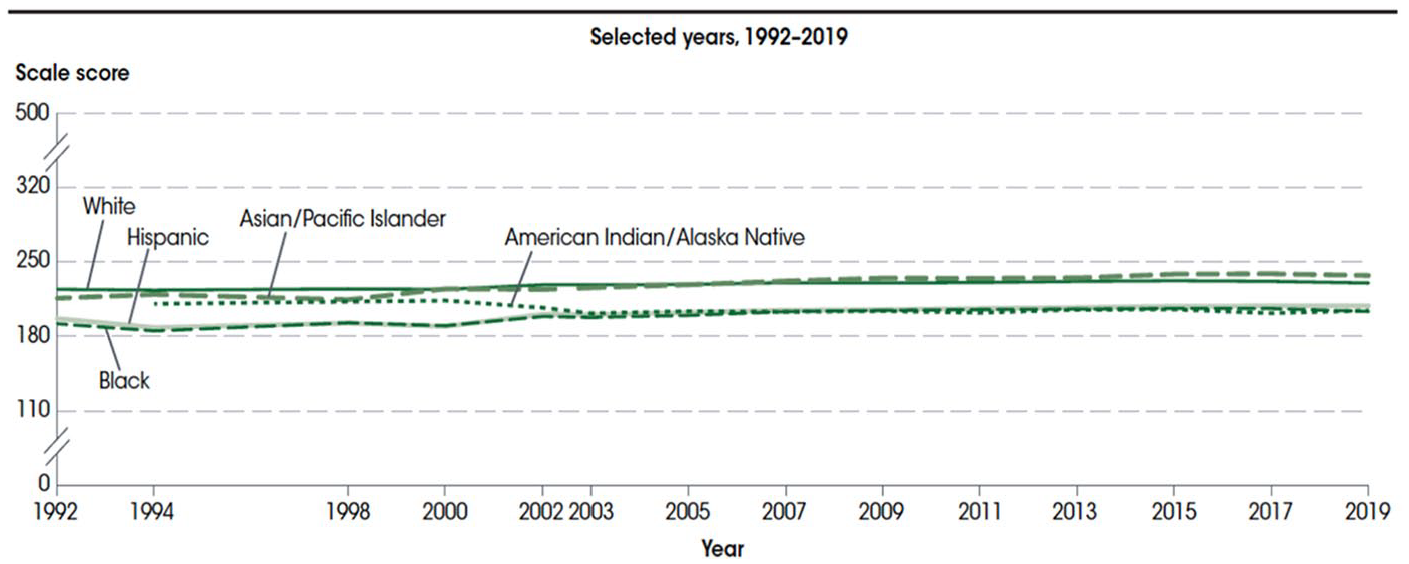
Average national reading scale scores for Grade 4 students by group on 1992–2019 administrations of the National Assessment of Educational Progress (NAEP).
There is no reason to believe that students in Tennessee were doing significantly worse than the national average. In fact, the graph in Figure 2, copied directly from the Course (Tennessee Department of Education, 2021), shows that the percentage of its students reaching NAEP’s designated level of “proficient” in reading has been close to the national average, with a relatively small gap disappearing between 2009 and 2019. In the previous decade, students in Tennessee moved from just below to slightly above the national average.
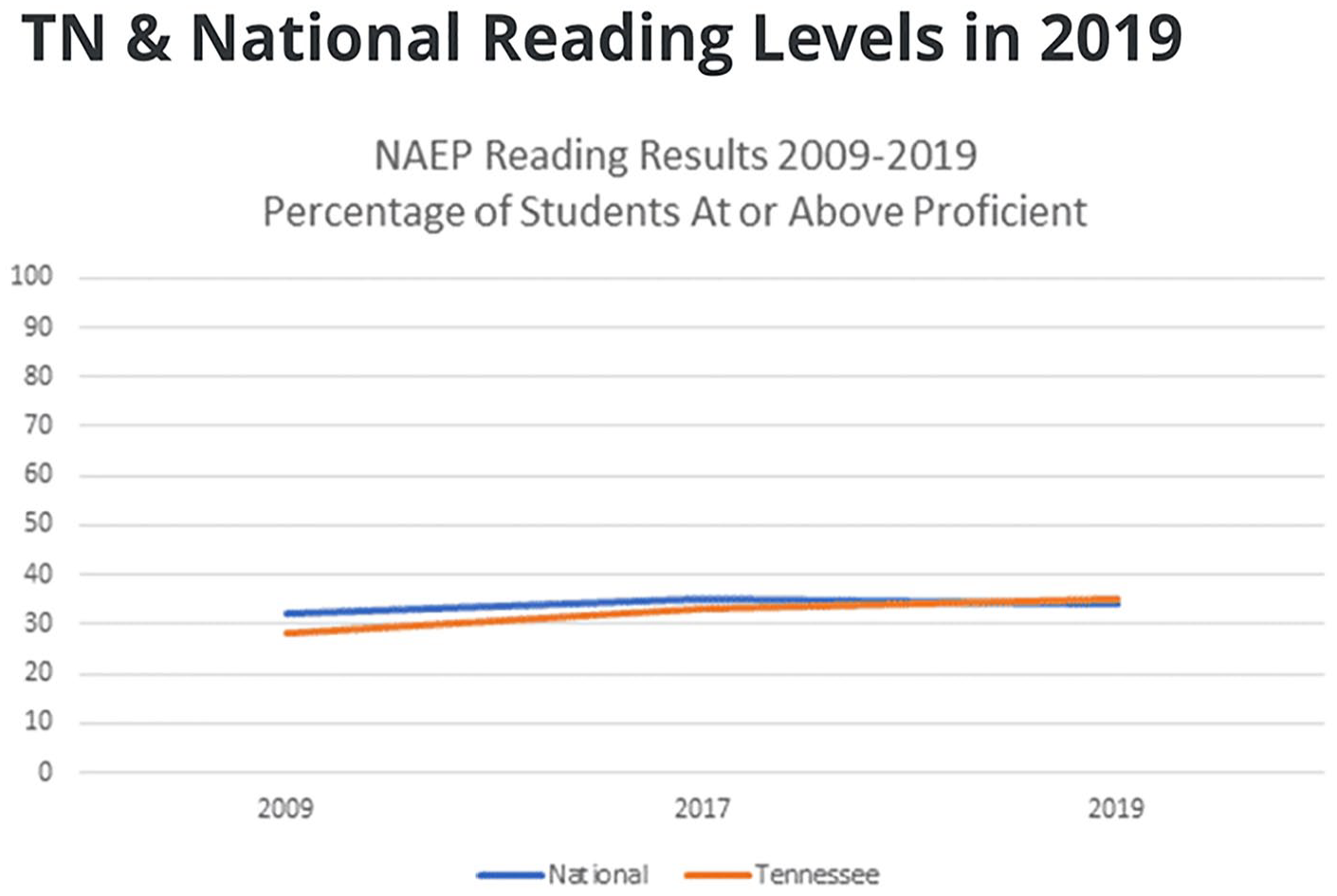
A figure used in Tennessee’s Early Reading Training for Teachers (Module 1, Lesson 1).
So, even the data presented within the course (Figure 2), offered to justify an emphasis on phonics, provide no evidence of a crisis. Is essentially no change, or only a little improvement, a crisis? It might be, if we can assume that we should be doing much better. That perspective guided the development of proficiency levels reported first in the NAEP data in 1992, when reading scores began to be grouped into categories: below basic, basic, proficient, and advanced. How were those levels determined? The cut scores used to define these categories were set arbitrarily by a small group of hand-picked, politically appointed experts—reportedly against the recommendations of psychometricians (test experts) who had been contracted to advise the development of this approach but who were overruled when they argued against doing it at all (Bracey, 2008).
Proficiency levels created a custom-made crisis. Using the 2019 NAEP reading scores, a typical argument goes something like this: “Only 34% of fourth-grade students nationally scored at or above the proficient level in reading.” That sounds alarming, suggesting that only about a third of readers are proficient. Some might even interpret this to mean that two thirds of students are hardly reading at all. But, if “basic” means something closer to “average,” which it does, and readers in that group are combined with “proficient” or above, as shown in Figure 3 (National Assessment of Educational Progress [NAEP], n.d.-b), approximately two thirds of all fourth-grade students are reading at or near grade level, with slight increases over the year. There was a statistically significant drop by 1 point in 2019; although that drop is worth watching, it is not a trend indicating a crisis. Further, the flat trend across decades begs many possible interpretations, including the changing demographics of test takers who are more culturally and linguistically diverse. The one third below basic is still a concern, because it includes a disproportionate number of disadvantaged students, although that discrepancy has been slowly narrowing. Nonetheless, there will always be a bottom 30% in any distribution of scores.
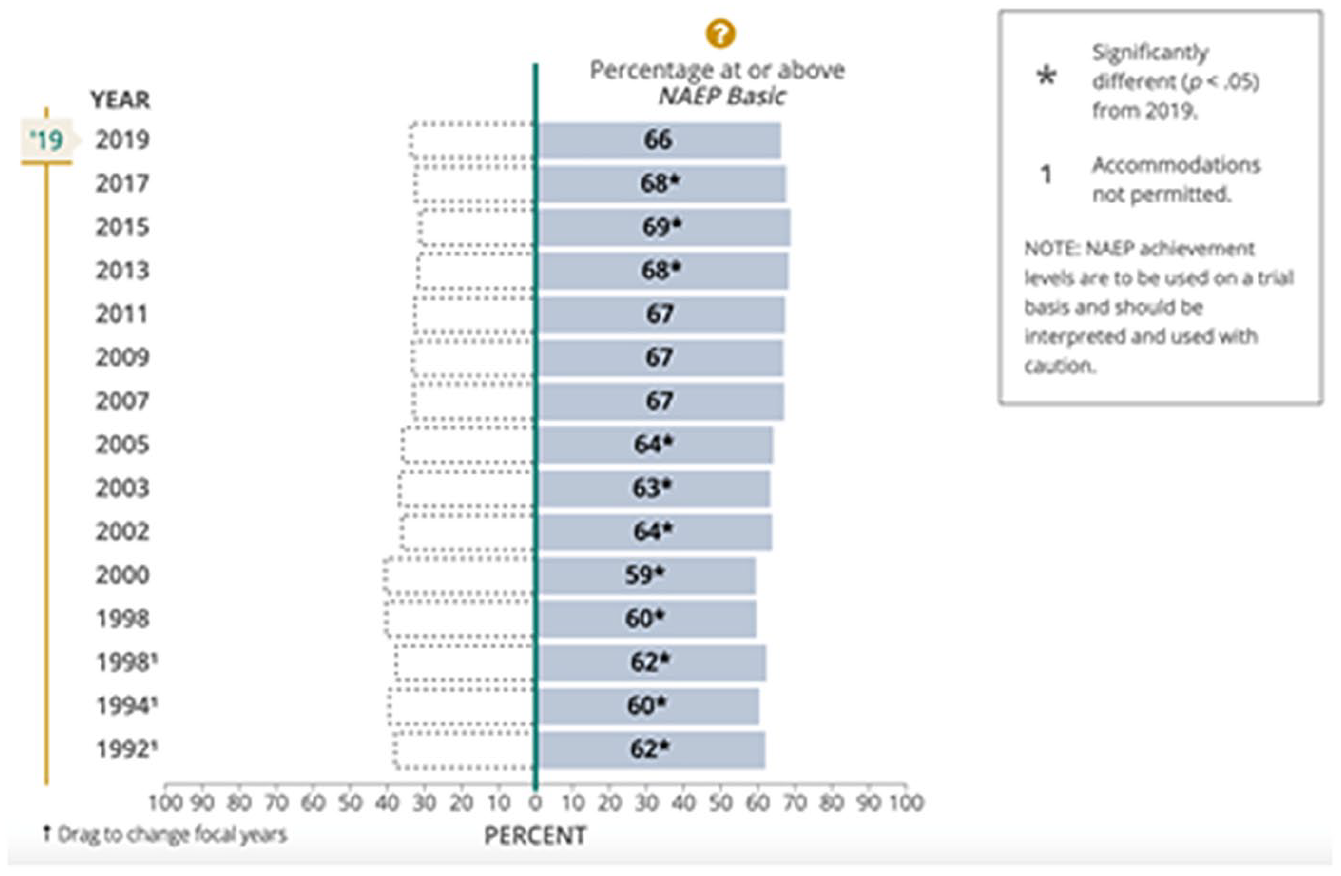
Percentage of fourth-grade students scoring basic level or above on reading on the National Assessment of Educational Progress (NAEP), 1992–2019.
Given these categorical percentages, is basic unacceptable, and how bad is below basic? Diane Ravitch (2012), previously a seven-year member of the National Assessment Governing Board that makes decisions about NAEP, described the proficiency levels as follows: “Advanced is truly superb performance, which is like getting an A+ . . . proficient is akin to a solid A. Basic is akin to a B or C level performance . . . And, below basic is where we really need to worry.” Given that interpretation, the NAEP scores now begin to look more like a normal distribution of achievement—far from a crisis. On the other hand, Ravitch’s interpretation of the levels is no more valid than anyone else’s. There is no indisputable operational or broad consensual understanding of what these levels mean beyond the arbitrary cut scores.
Evidence that phonics is the primary cause (too little phonics) of, and the main solution (more phonics) to, a presumed crisis in reading achievement
We can find no such evidence. In fact, there is much evidence over decades that among school-related factors, the approach to teaching reading, phonics-centric or otherwise, may be less influential than other factors, such as teachers’ experience and dedication, the availability of materials, instructional leadership, context, and a variety of out-of-school factors—for example, the massive national first-grade studies (see Bond & Dykstra 1967) and subsequent analyses (e.g., Almasi & Hart, 2019; Bowers, 2020; Stahl & Miller, 1989), all supporting that conclusion. Arguably, and consistent with that research, the most important factors instructionally are teachers who are well informed, not just about phonics but about all aspects of reading development; who know their students’ individual needs and strengths and are prepared and supported in their response to those differences; who have a large repertoire of instructional options; and who supplement that knowledge with lessons learned from firsthand professional experience (Bondie et al., 2019).
Social, cultural, and demographic factors that vary over time also undoubtedly influence education achievement in general, and reading achievement in particular. For example, the racial and ethnic diversity of the United States has steadily increased over the decades during which the NAEP assessment has been administered, with, for example, many more non–native speakers of English. Economic disparities have likewise increased. Income inequalities have been argued to be much more influential on all education achievement than any in-school factors (Berliner, 2013). Without overwhelming evidence to the contrary, it is unlikely that any single in-school factor, let alone one instructional variable such as phonics, can be so powerful that it is the single cause of virtually all variation in reading achievement. It is even less likely that that inappropriate or insufficient phonics instruction is a significant explanation of societal ills such as crime and incarceration, as suggested in the Course.
What does the national reading panel report say (and not say) about teaching phonics?
The Course, consistent with a phonics-first ideology, bases much of its case for phonics on the report of the National Reading Panel (NRP; National Reading Panel, 2000). In 1997, Congress charged that panel with examining the experimental evidence in several areas of reading instruction, including Alphabetics, which was divided into phonemic awareness (the ability to distinguish individual speech sounds in spoken language) and phonics instruction. The NRP report is a relevant authoritative source to cite, and it provides solid, if not unequivocal, support for teaching phonics to enhance the ability to identify words. It is consistent with the virtually unanimous consensus in the field today that phonics instruction is an important component of early reading instruction. The Course, however, both ignores and contradicts relevant details, interpretations, conclusions, and recommendations in the report. For example, the report’s findings were derived collectively from studies that used several distinctly different approaches to teaching phonics, none of which proved superior to the others. 10 Yet, the Course promotes only one approach to phonics: a “synthetic” approach (teaching individual letters and their sounds that are then blended into words) without acknowledging that other approaches may be equally effective. In this section, we point out other omissions and inconsistencies that emerge when comparing the Course and the NRP report.
For those unfamiliar with the NRP report’s analysis of research on phonics instruction, it is important to note that the panel analyzed only 38 experimental studies (resulting in 66 treatment vs. “control” comparisons) that were conducted in Grades K–6. That is a remarkably small number of studies that met the NRP’s minimum standards of rigor from among the approximately 100,000 published studies considered. 11 The panel then used a statistical approach called “meta-analysis” that synthesizes “effect sizes” across diverse experimental studies to compare systematic phonics instruction with either less systematic instruction or no phonics instruction. Thus, the analysis was limited to quantitative data from assessments of reading performance after phonics instruction, broadly considered to be systematic (the treatment), compared with instruction with no phonics or less systematic phonics instruction (the control).
Nonetheless, the NRP broke down the overall analysis, digging below the surface of its general findings and conclusions. Doing so revealed much nuance; many caveats, unanswered questions, and unresolved issues; and much room for differing interpretations that are not acknowledged or addressed in the Course. Following are a few examples of findings and the unanswered questions they suggest:
The overall statistically significant effects in favor of phonics versus no systematic phonics instruction were “moderate.” What does it mean that the effects were not strong? What other factors come into play beyond phonics? What might be done instructionally to increase the effects of phonics instruction? Or, should the focus be on other factors that might be contributing a stronger effect?
The strongest of these overall moderate effects were in kindergarten and first grade, before most, although not all, children have acquired the ability to read independently. Are the effects notably diminished in Grades 2–6? Does this suggest dwindling significance for phonics in reading instruction after first grade? To what extent? In what circumstances? Would the effects remain strong when controlling for other factors, such as socioeconomic background? Does some other aspect of teaching reading in K–1 amplify the effects of teaching phonics?
Further, there were no statistically significant effects for low-achieving readers in Grades 2–6 on word identification. Does that mean that teaching phonics to those readers is of little or no value? Or, does it suggest that other approaches to teaching reading (i.e., beyond phonics) may be more beneficial to those children, or perhaps that even more intensive phonics would be helpful? Or, as the report indicates, there may have been too few comparisons, suggesting the need for more research.
Approximately two thirds of the comparisons reviewed were conducted with students experiencing difficulties in learning to read. To what extent can findings be generalized to higher achieving students? Is it valid to make strong claims about teaching phonics to all children, given an analysis based primarily on students experiencing reading or other academic difficulties?
In teaching phonemic awareness as a precursor to phonics, the strongest effects were between 2 and 18 hours of instruction, with weak or no effects for longer periods. Can phonemic awareness—taught to students just beginning their school years and unaccustomed to the protocols of schooling—be achieved with so little instruction? What approaches to teaching phonemic awareness are efficient or inefficient?
A total of 76% of the comparisons assessed accuracy in reading regularly spelled words or pseudowords in isolation. That is, what was assessed were the skills taught to children in the experimental groups but not taught, or not taught systematically, to children in the control groups. Might the effects of systematic phonics be weaker if assessments included less-regular words or when identifying unfamiliar words embedded in a meaningful context? Further, are the effects stable when children are asked to read connected texts instead of isolated words? When those texts use regularly decodable words? When they are asked to read authentic texts that include irregularly spelled words?
Tutoring individual students compared with providing instruction in small groups or whole classes did not produce statistically different effects. Does that suggest that whole-class instruction is as valid and as useful as individual or small-group instruction? Or, does it mean that further research is needed?
The NRP report also offers important caveats relevant to, but not considered or addressed in, the Course, such as in these direct quotations:
• “Programs that focus too much on the teaching of letter-sounds relations and not enough on putting them to use are unlikely to be very effective.”
• “In implementing systematic phonics instruction, educators must keep the end in mind and ensure that children understand the purpose of learning letter-sounds and are able to apply their skills in their daily reading and writing activities.”
• “Usually [in the studies reviewed] the term ‘intensive’ is not defined, so it is not clear how much teaching is required to be considered ‘intensive.’”
• “The role of the teacher needs to be better understood. Some of the phonics programs showing large effect sizes are scripted in such a way that teacher judgment is largely eliminated. . . . Thus, one concern is how to maintain consistency of instruction and at the same time encourage unique contributions from teachers.”
• “As with any instructional program, there is always the question: Does one size fit all? Teachers may be expected to use a particular phonics program . . . yet it quickly becomes apparent that the program suits some students better than others.”
• “[We need] phonics programs that provide guidance in how to place students into flexible instructional groups and how to pace instruction.” (NRP, 2000, Section 2, pp. 96–97)
In short, as these points illustrate, the Course cites claims from the NRP report out of context and misrepresents its findings, and qualifications.
We are not aware of any comprehensive and authoritative analyses that definitively resolve many of the issues and questions the NRP findings raise. There is evidence, however, that mitigates even the NRP’s overall finding of moderate effects for systematic phonics instruction. For example, Bowers (2020; see also Wyse & Bradbury, 2022) synthesized findings across 12 meta-analyses totaling hundreds of studies, and he examined the outcomes of systematic phonics instruction, concluding that an emphasis on phonics was not clearly justified. He rejected the idea that this finding offered support for whole language and related methods, arguing instead that it suggested a broader consideration of instructional approaches.
Mitigating findings also include the results of the Reading First Impact Studies conducted in 248 schools in 13 states for 3 years with $1 billion in federal funding each year (Gamse et al., 2008). Reading instruction in those schools was designed to follow closely the NRP’s categories and findings, with a considerable emphasis on systematic phonics instruction and extensive training of teachers. Despite this massive investment in implementing reading instruction in accordance with the NRP findings, including a heavy dose of phonics instruction (varying between 1.5 and 3 hours per day, depending on the district), there was no statistically significant improvement in reading comprehension—the overarching goal to which phonics instruction is dedicated. Further, an analysis of NAEP scores in large urban districts between 2015 and 2019 (NAEP, n.d.-a) revealed statistically significant losses in those with heavy emphasis on phonics (e.g., Baltimore and Jefferson County, KY) and gains in those with more balanced approaches (e.g., San Diego and Fresno, CA).
Is a “balanced approach” to early reading instruction “whole language” in disguise?
The Course admonishes teachers as follows, directly quoted from one of its lessons: “
However, the same survey reveals that the Course’s claimed popularity of whole language is incorrect. Only 3% of the teachers and 4% of the teacher educators who responded claimed whole language as their “teaching philosophy.” As noted earlier, whole language was most prominent in the 1980s and 1990s and declined quickly thereafter. However, as we also noted, that decline left strong phonics advocates without a nemesis against which they could advance their case and rally support for their phonics-first ideology.
The Course clearly illustrates a not uncommon rhetorical strategy among those who promote that ideology. That is, it portrays balanced literacy instruction as the wolf of whole language in sheep’s clothing (e.g., see Moats, 2000). That claim is used to continue the reading wars, reinforced by a sense of crisis in reading achievement that, as we have already argued, is difficult to justify. It is also promoted to suggest that balanced reading instruction is simply perfunctory phonics instruction loosely tacked on to what is essentially a full-fledged whole language approach. Instead, balanced literacy instruction has always been considered an alternative distinct from whole language, an explicit systematic teaching of phonics being one of the key distinctions (e.g., Pressley et al., 2002).
Although balanced literacy instruction is not always defined precisely and is not a formulaic curriculum, its general components are firmly grounded in research (e.g., the report of the National Research Council’s Committee on the Prevention of Reading Difficulties in Young Children; see Snow et al., 1998, and Wixson et al., 2019). Beyond explicit attention to teaching phonics skills, those components include language and vocabulary development, comprehension strategies and monitoring, extensive practice in reading texts, building background knowledge, engaging in writing, and creating motivation to read (see Pressley et al., 2002). Another distinguishing aspect of a balanced approach is that it allows for flexibility of instructional approaches to address students’ needs in these areas.
In fact, the aforementioned NRP report, which the Course promotes as justifying its stance toward phonics, endorses balanced literacy instruction and cautions against overemphasizing phonics. Note the following statement, quoted directly from the report’s conclusions (italics added for emphasis): It is important to emphasize that systematic phonics instruction should be integrated with other reading instruction to create a balanced reading program. Phonics instruction is never a total reading program. In 1st grade, teachers can provide controlled vocabulary texts that allow students to practice decoding, and they can also read quality literature to students to build a sense of story and to develop vocabulary and comprehension. Phonics should not become the dominant component in a reading program, neither in the amount of time devoted to it nor in the significance attached. It is important to evaluate children’s reading competence in many ways, not only their phonics skills but also their interest in books and their ability to understand information that is read to them. By emphasizing all of the processes that contribute to growth in reading, teachers will have the best chance of making every child a reader. (NRP, 2000, Section 2, p. 91)
To us, that statement is consistent with our and many of our colleagues’ conception of a balanced approach to early reading instruction—one that gives phonics a distinct, but not an overwhelmingly dominant, role in creating a useful balance.
The second incorrect statement from the Course with which we began this section is to state unequivocally that whole language and a balanced approach, indeed any rational approach, to teaching reading “doesn’t work.” Whole generations of people have learned to read with approaches that are now discredited and that included virtually no phonics instruction; we include ourselves. Like the majority of our elementary school classmates, we learned to read with our teachers using Scott-Foresman’s Dick and Jane reading series that emphasized the now discredited look-say approach (repeated exposure to whole words toward automatic recognition). There is also evidence that the most experienced and successful teachers of reading use a balanced approach (see Pressley et al., 2002, who interviewed and followed teachers nominated as exemplary by their peers and supervisors).
Is there a settled science of reading?
Among the common misrepresentations the course uses to advance a phonics-only ideology, the most revealing is the claim that teaching reading is based on a settled science. It reveals a stance that is decidedly polemical—and political—when it is used to develop, pass, and implement laws aimed at restricting reading instruction essentially to teaching phonics, especially a single approach to teaching phonics. In that regard, the psychologist Adam Grant (2021) has argued, based on his and others’ research, that the essence of thinking like a scientist is continually rethinking. He uses the metaphors of preacher, prosecutor, and politician as contrasting alternatives to scientific thinking and to capture the more prosaic, and often misguided, everyday thinking most of us are inclined to embrace—especially when we believe passionately in our own version of the truth. We see much evidence of these latter three metaphors in the Course’s posture of certainty with none of the skepticism, equivocation, collegial debate, and deeper explorations characteristic of the rethinking that defines a scientific mindset. Many scientists and philosophers of science would regard a settled science as the antithesis of authentic science and of the role of research that can inform practice (e.g., Bryers, 2011; Kampourakis & McCain, 2019).
Is there science that informs our understanding of reading? Yes, there are scientists who have expertise in the areas of cognitive, social, or developmental psychology, cognitive neuroscience, cultural anthropology, and psycho- and social linguistics, and who study reading. They have developed sophisticated tools and approaches for collecting and analyzing data, generated replicable findings, and crafted intriguing theories. Thus, there is no one uppercase Science of Reading. Instead, there are multiple lowercase sciences of reading, each contributing interesting and relevant findings to our understanding. But, to suggest that they constitute a settled science of reading is to ignore the history of science, or, for that matter, reading research (Alexander & Fox, 2019; Hruby et al., 2016). If there were such a settled science of reading, it would not be possible to find reputable scientists in those areas who continue to study reading, to refine or develop new tools for collecting and analyzing data, testing existing theories or developing new ones, and so forth. And, there would be no journals publishing such work.
But is there a science of teaching reading? That is less clear, and perhaps an inappropriate question. Even research that provides generalizations about effective practice across many individuals can break down at the level of a particular case or context (Joyce & Cartwright, 2020). We see physicians because we expect them to know the latest science and the evidence about effective practices in general, but we want them to apply professional judgment that includes clinical experience and a deep understanding of our individual case. Anything that might be considered standard practice in general is not necessarily best practice in every particular case. In practice, there is much room for professional judgment and variation, even to the point of rejecting findings from generalizations in light of the specific circumstances of unique cases. Neither is a science of practice entirely settled for every specific case.
The Course devotes considerable attention to brain research. Claiming evidence from brain research is a common tack in arguing for a phonics-first ideology, as well as a wide range of other instructional issues and pronouncements (e.g., dyslexia remediation). Most teachers and researchers addressing issues of reading instruction are not qualified to assess the validity of findings, theories, and interpretations of brain research. Thus, it can readily offer a veneer of scientific respectability (Vandenbroeck, 2017). Yet, there is little unanimity among brain researchers, either theoretically or in the interpretation of findings (Poldrack et al., 2017; Price, 2017; Ramus et al., 2018; Szücs & Ioannidis, 2017), and many are reluctant to speculate about, let alone apply, their data toward instructional issues (Katzir & Pare-Blagoev, 2006; Peters & Ansari, 2019). To favor its narrow assertions consistent with a phonics-first ideology, the Course truncates the diversity of interpretations among brain researchers, suggesting that behaviors, cognitive processes, and neural activity are isomorphic. For example, in a recent comprehensive review of brain research from an evolutionary standpoint, Ellis and Solms (2018) observed that the hardwired emotional/motivational brain functions that mediate all learning are consistent with the underlying rationale for a whole language approach (see also Hruby & Mitra, 2023).
Perhaps the most obvious example that the Course is a polemic is the statement that “the [research] results were so conclusive in favor of systematic phonics instruction that the Institute of Education Science [IES] no longer funds research on whether systematic instruction is effective. It is considered ‘settled science.’” We would challenge the authors of the Course to provide evidence of any such IES policy.
Associating settled science with instruction is also telling. Neither the NRP report, nor any research since, suggests that there is a settled science that establishes an indisputable boundary between scientific and nonscientific instructional practice in every context, for every student. Consistent throughout the report, and summarized in its conclusions, are many unanswered questions and unresolved issues that need clarification through more research, and most of these remain unanswered.
More generally, settled science might be considered an oxymoron. Scientists are never entirely comfortable that their current data and explanations are fully explanatory. They are continually testing the veracity and utility of current theories, findings, and interpretations. They look for anomalies in their data, and they set an extremely high bar for any conclusions that might approach certainty. What attracts them to science is that nothing is entirely settled. They live in the realm of perpetual ambiguity and what-ifs. Scientists seek final truths only in the abstract, knowing that the best they can do is reduce ignorance (Wagner, 1993).
In the previous section, we noted the problem with the Course claiming that whole language and balanced instruction don’t work. We might also ask how scientific evidence would substantiate that they don’t in any absolute sense. No evidence is cited in the Course, and we are not aware of any. More important, working or not working also begs the question: What scientific evidence would clearly relegate any approach to instructional practice cleanly into one or the other of those mutually exclusive categories for every case? Scientists aren’t satisfied with determining what works or not. They want to understand how, why, and in what circumstances different approaches may or may not be a good fit. Multidimensional continua, not binaries, are the stuff of science, especially when science is applied to real-world decisions in the realm of instructional practice (see Yaden et al., 2021). In stating that balanced instruction doesn’t work, the Course implies that phonics does, which is unscientific in conception and inaccurate in fact.
In short, the Course, similar to legislatively inspired efforts in other states, uses science as a rhetorical tool to promote a preferred orthodoxy or, as some have argued more forcefully, as a bludgeon to silence discussion or debate (Ayres, 2006). Science, used this way, is not a means of inquiry toward better understanding or to obtain better results, but something that requires uncritical deference and genuflection. It suggests that the aim of science is to reach a state where no further understanding is possible, where no more questions need to be asked, where no more evidence needs to be considered, where no other perspectives or interpretations can be reasonably offered, and where anyone who thinks otherwise is a misguided, if not a heretical denier of immutable truth. Such perspectives are not science, especially in matters of teaching and learning, which are always embedded in an incredibly complex social system that entails cultural norms, values, and beliefs, including issues of equity and justice.
Conclusion
The Tennessee Department of Education’s Early Reading Training for Teachers is the offspring of an orchestrated political movement that inordinately elevates the role of phonics in learning to read to an ideology advanced with polemics. There is widespread agreement that teaching phonics is an important component of early reading instruction. However, that general truth hides much nuance and relevant detail, including equivocation that is found within the key sources often cited by the most avid supporters of phonics. As we have documented—indeed, as the Course itself establishes—there is no justification for phonics being at the epicenter of a reading crisis. Neither is there justification for suggesting that there is a settled science of reading that provides final answers about how reading should be taught to every child, particularly among those who live in poverty and who experience institutional inequities and injustice. The Course also illustrates how contrary scientific evidence is too often conveniently omitted and how more moderate alternatives that position phonics within a more balanced approach to teaching reading are unfairly equated with whole language and categorically claimed not to work. In short, the movement to promote phonics in the political realm is neither a neutral nor an unbiased arbiter of a final, nor unequivocal, truth.
In our view, the claims of strong phonics advocates that their position is based purely on objective empirical evidence has been disingenuously compromised, with the Course being a representative example of a larger trend that turns research into a polemical tool for advancing ideology through legislation. Ironically, the promotion of phonics has become more of a movement, much akin to whole language in its heyday. Therefore, it can be accused of the same questionable tactics leveled against its historical adversary. It uses evidence rhetorically, not scientifically, despite its claims. Consequently, its stance is promotional, not neutral. It broaches no compromise or eclecticism, having the air of religious fervor and suggesting that those who disagree or who have more moderate views are heretical deniers of an ultimate truth. It draws support from anecdotal cases and arguments sometimes dispensed by journalists and media outlets, and it ignores or discounts unfavorable evidence. It engages in polemics for the sake of political lobbying driven by a fervent, and often emotional, commitment to and belief in an unmitigated truth, not a dispassionate consideration of what might effectively serve the needs of those who teach reading and, more important, the students they teach.
These polemically charged distinctions are not simply academic, limited to differing interpretations of research or harmless disagreements among scholars. Neither are they simply matters of intellectual or political malfeasance, perhaps excused by good intentions. A manufactured ideological truth argued polemically and dedicated to gaining advantage politically through legislation has real consequences that are not in the best interests of children, their families and communities, and the dedicated teachers who serve them.
Footnotes
Declaration of Conflicting Interests
The author(s) declared no potential conflicts of interest with respect to the research, authorship, and/or publication of this article.
Funding
The author(s) received no financial support for the research, authorship, and/or publication of this article.