




Abstract
Background:
Nationally, there is an overwhelming body of research that has revealed a systemwide underpreparedness of both pre- and in-service teachers who are predominantly White and monolingual for teaching English language learners (ELLs) throughout the United States. Despite various responses to address preservice teachers’ underpreparedness to teach ELLs, there has been a lack of transformative change in White mainstream preservice teachers’ preparation to teach ELLs, due to teacher education programs’ indiscriminate, pan-diversity approach to diversity as inclusive of all forms of difference, without explicitly attending to any form of difference such as those confronted by ELLs. This pan-diversity approach endorses generic fairness as sameness practices that may lead to equity traps that shape preservice teachers’ patterns of thinking and behavior that hinder the possibilities for creating equitable schools for children of color, including ELLs.
Purpose:
The widespread underpreparedness of teachers for ELLs suggests an urgent need to reexamine how teacher education programs are providing opportunities for learning about ELL-related knowledge and practice. The goal of this study is to understand 433 preservice teachers’ experiences of learning to teach ELLs in a predominantly White teacher education program under a pan-diversity framework.
Research Design:
A mixed-methods design that includes surveys and interviews was used to address two central research questions: What are preservice teachers’ perceptions of learning to teach ELLs in a predominantly White teacher education program that utilizes a pan-diversity framework? How do their opportunities to learn ELL-related content differ across subprogram groups? Quantitative and qualitative data analysis methods were used to analyze the data generated from the survey and interviews.
Findings:
Triangulation of our quantitative and qualitative data revealed systemic neglect of ELLs in both coursework and field practice in the teacher education curriculum, resulting in underpreparedness among the preservice teachers across the subprograms. The results indicate that the current pan-diversity integration approach has served as an “equity trap” that will preclude the preservice teachers from becoming successful with their future ELLs.
Conclusion:
This study demonstrates the critical need to eliminate the pan-diversity equity trap to systemically incorporate ELL issues within teacher education to not only transform preservice teachers’ deficit thinking about ELLs but also fill their knowledge and skill gaps for working with ELLs. The study has significant implications for teacher education programs to transform ELLs’ status from invisibility to rightful prominence in the program.
Keywords
Preparing preservice teachers for increasingly diverse learners in K–12 schools has become a concern for educational organizations globally. In the United States, a considerably high number of English language learners (ELLs) struggle in comparison to their non-ELL mainstream peers. The term ELLs (also called English learners, multilingual learners, dual language learners, limited English proficient pupils, and emergent bilinguals) refers to K–12 students whose primary or home language is other than English and who are eligible for services based on the results of an English language proficiency assessment (Education Commission of the States, 2020). Nationally, ELLs have persistently lower reading and math achievements (National Assessment of Educational Progress, 2019), disproportionately higher dropout rates, and lower graduation rates (National Center for Education Statistics, 2019) than their non-ELL peers and therefore are confronting persistent social inequities in education. And these gaps are steadily widening (Polat et al., 2016) and being amplified due to the COVID-19 pandemic (Sayer & Braun, 2020). Considering this exacerbation faced by ELLs, the issue of teacher preparation for ELLs has become a national imperative. This urgent need is buttressed by an overwhelming body of research that points to a systemwide underpreparedness of both pre- and in-service teachers, who are predominantly White and monolingual, for teaching ELLs throughout the United States (Coady et al., 2016; Durgunoglu & Hughes, 2010; Greenberg et al., 2015; Li et al., 2018).
Across the United States, university-based teacher education programs have responded to increasing diversity and teacher underpreparedness to teach ELLs by adding related content to existing courses or creating new courses to the existing programs (see Florian, 2017; Li, 2018; Villegas et al., 2018). Despite these various responses to address preservice teachers’ underpreparedness to teach ELLs, there have been consistent reports of a lack of transformative change in White mainstream preservice teachers’ preparation to teach ELLs, suggesting an urgent need to reexamine how teacher education programs are providing opportunities for learning about ELL-related knowledge and practice (Li, 2021; Téllez & Waxman, 2006; Villegas et al., 2018). Currently, the majority of teacher education programs take a “just good teaching” approach to integrating general diversity content, such as multicultural education and culturally relevant/responsive teaching, to orient students to all forms of diversity (de Jong & Harper, 2005; Ladson-Billings, 1995). The underlying belief is that teachers can just make some modifications to their usual teaching to address all forms of diversity issues in the core curriculum, including those confronted by ELLs.
In this article, we call this approach a “pan-diversity” integration framework—which we coined from “pan-ethnicity” (Okamoto & Mora, 2014)—to refer to teacher education programs’ indiscriminate approach to diversity as inclusive of all forms of difference, without explicitly attending to any form of difference. A pan-diversity integration approach focuses on constructing metagroup commonality through consolidating subgroup distinctions and differences. This approach requires preservice teachers to develop “intersectional competence” that encompasses the ability to clearly identify different sociocultural group categories and markers of difference (e.g., race, ethnicity, gender, sexual orientation, nationality, language, and disability), recognize the interlocking and simultaneous effects of multiple markers of difference, and understand the systems of oppression and marginalization that occur at the intersection of multiple differences. It also includes the ability to collaborate to best assess and address the needs of all diverse learners and develop efficacy in their ability to effect social change for all diverse learners (Boveda & Aronson, 2019, p. 250). Due to its all-inclusive nature, a pan-diversity approach endorses generic fairness as sameness practices that “in effect flatten out differences and histories” (Gutierrez, 2019, p. 2) and may lead to equity traps that shape preservice teachers’ patterns of thinking and behavior and hinder the possibilities for creating equitable schools for children of color, including ELLs (McKenzie & Scheurich, 2004). These equity traps sustain and reproduce inequities for minoritized students and, in turn, result in opportunity and outcome gaps (Barton & Tan, 2020).
To date, empirical evidence regarding the outcomes of this pan-diversity approach for specific groups of diverse learners such as ELLs is limited. Existing studies examine either the learning gains due to special groups of preservice teachers’ intersectional competence in diversity (e.g., Boveda & Aronson, 2019 for special education; Michael-Luna & Marri, 2011 for minoritized urban preservice teachers), general perceptions of diversity (e.g., Silverman, 2010), or the impact of short-term diversity courses on preservice teachers’ beliefs about diversity (e.g., Dyce & Owusu-Ansah, 2016). Few studies have examined whether preservice teachers’ pan-diversity training prepared them for teaching students with specific markers of difference or educational needs (i.e., language, culture) such as ELLs. In fact, few teacher education institutions require specialized preparation for mainstream teachers regarding ELL education. Franco and Hendricks (2013), for example, found that only 10% of the 43 institutions in their study had designated courses (often only one) about ELLs. Even among those that had the requirement, provision is often embedded within the pan-diversity framework in which ELLs comprise one of the diverse populations being addressed (Ballantyne et al., 2008). In these programs, a lack of attention to ELL-specific differences in racialization, ethnicity, primary language, and social class “renders invisible those educational needs that set ELLs apart from U.S.-born, fluent English-speaking students,” leading to ineffective classroom practices in meeting the needs of ELLs (de Jong & Harper, 2008, p. 129).
Furthermore, due to the add-on approach to responding to the increase in ELLs (i.e., adding new course content or new courses to existing programs), existent research focused overwhelmingly on how these short-term, course-based add-on interventions change teacher beliefs about ELLs, resulting in a limited knowledge of their holistic learning experiences at the program level. Based on their comprehensive review of studies between 2000 and 2016 on mainstream preservice teacher preparation for ELLs, Villegas et al. (2018) noted a striking finding that “virtually all of the studies focused strictly on what transpired within a single course in a single semester, little to nothing is known about the persistence of learning gains made in those courses over time” (p. 152). This finding was also corroborated in another review of studies on how teacher educators prepare preservice teachers to teach multilingual learners (see Solano-Campos et al., 2020). In the absence of a comprehensive view of mainstream preservice teachers’ experiences of learning to teach ELLs across their teacher education programs, it is likely that the same fragmented efforts and surface-level teacher education reform will continue to enact a pan-diversity approach to teacher learning that reproduces color-blind, culturally incompetent, and linguistically unskilled preservice teachers (Andrews et al., 2019).
It is against this backdrop that the current study sets out to understand preservice teachers’ experiences of learning to teach ELLs in a predominantly White teacher education program under a pan-diversity framework. We seek to answer two central research questions:
We consider preservice teachers’ (N = 433) self-reported opportunities for learning to teach ELLs in the entire training period across the program.
Pan-Diversity and Equity Discourses in Teacher Preparation for ELLs
According to Cochran-Smith et al. (2016), an equity-centered teacher education must aim for the twin goals of preparing preservice teachers who have the knowledge, skill, and dispositions “to enhance the learning of students historically not well served by the system and, at the same time, to recognize and challenge the intersecting systems of inequality in schools and society that reproduce inequity” (p. 70). To date, inequity in teacher education has been addressed through the discourses of equity as equality and equity as inclusion, both of which enact a pan-diversity approach that serves to maintain the status quo for minoritized students (Barton & Tan, 2020; Cochran-Smith et al., 2016; Tan & Barton, 2012).
Teacher education operating under the equity as equality discourse aims to provide the equal or same access to good teachers, knowledge, curriculum, and other resources to minoritized students to achieve equity or distributed justice for these students (Cochran-Smith et al., 2016; Tan & Barton, 2012). For ELLs, this discourse has been endorsed by the belief that ELLs need “just good teaching” (de Jong & Harper, 2005; Ladson-Billings, 1995). Based on two major national studies, the Center for Research on Education, Diversity and Excellence (CREDE) and National Literacy Panel (NLP) reports, Goldenberg (2013) concluded that “what is known about effective instruction in general ought to be the foundation of effective instruction for English learners” (p. 6). Goldenberg further concluded that these approaches, including explicit teaching, collaborative learning, and others, must be modified when conducted in English to account for ELLs’ language limitations. The implication of these conclusions is that teaching ELLs is “a matter of pedagogical adaptations that can easily be incorporated into a mainstream teacher’s existing repertoire of instructional strategies for a diverse classroom” (de Jong & Harper, 2005, p. 118).
In line with this perspective, one common practice in teacher education programs is to treat general cultural diversity requirements as sufficient for ELLs, assuming that general cultural diversity preparation enables teachers to teach all diverse learners including ELLs (Lucas & Villegas, 2011). Teacher education under such a framework often treats “linguistic and cultural diversity as one largely undifferentiated set of factors” or as “one of many aspects of culture” (Lucas & Villegas, 2011, p. 56). In an earlier survey study of diversity coverage in 142 public university elementary and secondary teacher preparation programs across the United States, Jennings (2007) revealed that the majority of the programs prioritized race/ethnicity over other diversity topics such as special needs, language diversity, social class, gender, and sexual orientation. In a more recent study on diversity 1 exposure in required core courses in 14 southeastern public teacher preparation programs in the United States, E. King and Butler (2015) found that only 4 of the 14 institutions required their undergraduate education majors to have 20% or more of their courses in a class with an explicit diversity component. Among the programs that had an explicit diversity component, the number of courses that structured content about diversity/multiculturalism varied widely, with 9 of 25 courses in one program and 2 of 35 courses in another. Further analysis showed that “nearly 86% of the sampled institutions prioritized cultural diversity within its teacher education curriculum” and “none of these institutions explicitly addressed the topic of immigration/immigrant within its required courses” (E. King & Butler, 2015, p. 49). Although the content codes of linguistic diversity and ELLs were identified in six programs, the coverage of the two aspects combined in each program was minimal. Specifically, one institution had 10% course coverage, one institution had 7.9%, one institution had 4.9%, and three programs had less than 3% coverage (E. King & Butler, 2015).
Another discourse dominating teacher education in the United States is equity as inclusion of the voices and knowledge traditions of nondominant groups in the construction of commonly valued content in teacher education (Cochran-Smith et al., 2016). However, this approach, involving decisions on whose voices and what knowledge to include, often rests upon the power of the teacher education program in extending its benevolence to minoritized groups and providing resources and approaches to preservice teachers for making participation in the current constructions of classrooms and disciplines possible without radically changing the status quo (Barton & Tan, 2020). One central problem is a persistent lack of a clear conceptualization of diversity (i.e., whose voices and what knowledge to include), which often leads to programs adopting one single marker of human difference as pan-diversity or diversity for all (Pollock et al., 2016; Silverman, 2010). In a study that examined three dual-degree teacher education programs in general education and special education that aimed to prepare their teachers for “the full range of diversity in their student populations,” Pugach and Blanton (2012) discovered that in these programs, diversity was “more frequently defined as disability,” with little attention to issues such as language, culture, race, or social class (p. 265). In fact, in these programs, “neither issues of working with English language learners, nor issues of language and power are addressed in greater depth” (p. 262).
As a result of such one-for-all constructions of diversity within teacher education as well as the performative nature of the implementation (Dixson, 2021), mainstream preservice teachers develop a limited understanding of diversity without learning to differentiate specific constructs of diversity. In a survey of 88 predominantly White preservice teachers’ conceptions of diversity, Silverman (2010) found that preservice teachers’ understandings of diversity and multiculturalism were ambiguous and undifferentiated. For example, participants in the study did not differentiate “race” as a diversity construct and conflated Whiteness and the English language with the mainstream American identity. These conceptualizations suggested a “traditional . . . unitary approach to diversity” and “an overreliance on terms such as diversity and too little attention to its many potential meanings” (Silverman, 2010, p. 324).
Such conceptualization can also cause mainstream teachers to “caricature” the phantom demands of addressing all forms of oppression and diversity as “superhuman tasks,” thereby leading them to “not just settling for inaction, but also judging themselves permanently inadequate” (Pollock et al., 2016, p. 667). Many mainstream preservice teachers were obliged to voice “abstract commitments to diversity” without gaining any fundamental understanding of diversity (Pezzetti, 2017, p. 131). When transitioned to real classrooms rich in multiple forms of diversity, these teachers become “overwhelmed” and lose idealistic beliefs about diversity, reverting to “old stereotypical notions about [minoritized] students” (Causey et al., 2000, p. 43).
In sum, a pan-diversity conceptualization often leads teacher education to either treat ELLs’ needs as the same as those of all students or consign ELLs as part of one form of the diversity marker chosen by a particular program. This practice may serve as an equity trap that produces teachers who unintentionally participate in sustaining social injustice and reproducing inequity (Andrews et al., 2019; McKenzie & Scheurich, 2004; Souto-Manning, 2019). The resulting “miseducation” (J. King, 1991) may explain why there has been little or no change in both school education and teacher education praxis (Barton & Tan, 2020; Gay & Howard, 2000; Ladson-Billings, 1999). To undo these potential equity traps, there is a need to “make present . . . those made missing by the systemic injustices” inherent in teacher education (Barton & Tan, 2020, p. 436). The current study addresses this need by presenting a holistic, programmatic view of mainstream preservice teacher preparation for ELLs within the central tasks of learning to teach across different subprograms and cohorts. This investigation will help clarify what is present and what is invisible and missing in teacher education regarding teaching ELLs. We see this as a critical first step for ELLs in moving toward gaining “rightful presence” in teacher education (Barton & Tan, 2020, p. 433).
Locating Preservice Teachers’ Preparation for Ells in the Central Tasks of Teacher Learning
Feiman-Nemser’s (2001, 2018) concepts of five central tasks of teacher learning were used to guide our exploration of preservice teachers’ preparation for ELLs. The five central tasks of preservice preparation center on supporting future teachers as they analyze beliefs and form new visions, acquire subject matter knowledge for teaching, foster understandings of learners and learning, gain a beginning repertoire, and develop the tools to study teaching.
According to Feiman-Nemser (2001, 2018), the beliefs and attitudes toward learners and learning that prospective teachers bring to their preparation can serve as barriers to the acquisition of new knowledge and the formation of new ideas, thoughts, and actions. Therefore, preservice teacher preparation must focus on helping preservice teachers examine their taken-for-granted beliefs. Given that successful ELL teaching practices can be based only on positive attitudes toward ELLs, preservice teachers’ ELL preparation must address preservice teachers’ attitudes toward ELLs (Lucas & Villegas, 2013).
Feiman-Nemser (2001, 2018) argued that teachers must know and understand the subjects they teach from a pedagogical perspective. For ELL education, this knowledge base includes not only a basic understanding of second language acquisition (SLA) principles (Lucas & Villegas, 2011) but also a foundation in linguistic features of academic genres in different disciplinary subjects (Viesca et al., 2019), in addition to subject-area knowledge.
Feiman-Nemser (2001, 2018) also emphasized the need for learning about the cultures that students bring to school in addition to taking a pedagogical stance rooted in knowledge of students’ developmental and learning needs. In this study, this area was examined in preservice teachers’ understanding of ELLs’ families and communities. Connected to negative attitudes toward ELLs, deficit views of ELL students’ families can also affect teachers’ ability to teach ELLs.
Another central task for preservice teachers is to develop a basic repertoire for teaching. For ELL education, preservice teachers must become familiar with a limited range of curriculum, programs, and resources for ELLs; methods for scaffolding instruction to support ELLs’ learning; specific modification strategies in subject areas; and approaches to assessment that tap student understanding (Li, 2018, 2021; Lucas & Villegas, 2013).
Finally, Feiman-Nemser (2001, 2018) proposed that preservice teachers must learn to reflect on teaching and learning. For ELLs, this means that teachers need to develop the ability to recognize an assemblage of complex linguistic, sociopolitical, and sociohistorical factors that influence their teaching of ELLs (Lucas & Villegas, 2013; Viesca et al., 2019).
In this study, preservice teachers’ beliefs and cultural learning were examined through understanding their attitudes toward ELLs and their families. An umbrella term, ELL-related knowledge, was used to refer to preservice teachers’ knowledge of ELLs, subject area language knowledge, and a beginning teaching repertoire in ELL. The teachers’ reflection on their learning to teach was examined through their sense of self-efficacy in teaching ELLs as well as their recognition of the strengths and weaknesses of their preparation.
Method
Context of the Study
This study was conducted in a teacher education (TE) program at a U.S. university that offered traditional licensure programs in elementary, secondary, and special education. The TE program consisted of 4 years of undergraduate studies with the requirement of classroom field experience and a 1-year postgraduate internship in the fifth year. Similar to many other teacher education programs around the country, this program was characterized by “racial demographics disproportionality” (Souto-Manning, 2019, p. 3) and “overwhelming presence of whiteness” (Sleeter, 2001, p. 94), despite the program’s continual efforts to recruit students of color in recent years. During the time of the study, about 85% of the students admitted into the program identified as White; those who identified as Black, Hispanic, Asian American and Pacific Islander (AAPI), or multiracial each made up about 3%; and about 3.5% were international. Approximately 80% were female and 20% were male.
The TE program took a pan-diversity approach, with the stated goal of helping preservice teachers build inclusive learning communities for diverse learners. This goal was supported by several required foundational courses in professional education studies in the first 2 years: one on understanding learners and their experiences, one on the social construction of diversity and inequality in schools and other institutions, and one on learners and learning in context. The senior-level courses aimed to support instruction in their specialized content courses in elementary, secondary, or special education. During the practicum, preservice teachers completed fieldwork in conjunction with on-campus courses. These courses did not require any specific coursework or embedded core assessments focused on teaching English learners, and issues of diversity for these courses were left to the discretion of individual instructors or mentors.
Similar to many traditional teacher education programs that adopt an add-on approach to ELLs, this program created a TESOL minor endorsement option to address the changing demographics in K–12 schools. The preservice teachers could also join two cohort program options, urban or global education. Students in the urban education cohort spent their freshman and sophomore years taking courses that focused on sociocultural issues, cross-cultural differences, and structural issues of power, poverty, and privilege in urban settings. Students in the global education cohort learned the tools they needed to teach with a global view in today’s culturally diverse classrooms.
Method and Instruments
A mixed-methods combination of surveys and interviews was used to both triangulate and complement data from different sources (Creswell & Clark, 2017). Surveys were used to understand preservice teachers’ background, knowledge, and perceptions in their preparation for ELLs, and in-depth interviews provided insights about their beliefs, experiences, and opportunities that were specific to their courses and field practices.
A three-part online survey consistent with Feiman-Nemser’s (2001, 2018) framework was used to collect data for the study. The first part (Questions 1–7) gathered participant background information such as degree programs (undergraduate/postgraduate), licensure programs (elementary, secondary, or special education), and cohort groups (global or urban education).
The second section (see Appendix A) included 14 questions (Questions 8–22) regarding knowledge about ELLs and their needs, knowledge in SLA, teaching repertoire for working with ELLs, their perceived preparedness to teach ELLs, and their interactional experiences and learning opportunities in relation to ELLs before and after they entered the TE program, as well as four questions (Questions 23–26) regarding their suggestions for further learning and program improvement.
The last part of the survey adapted with permission questions from the Knowledge, Attitude, and Self-Efficacy about English Language Learners (KASELL) survey (Durgunoglu & Hughes, 2010) aimed to elicit preservice teachers’ perceptions about teaching ELLs based on four factors: attitude toward ELLs, attitude toward ELL families, ELL-related knowledge, and self-efficacy. The instrument contained 19 question items on a 5-point Likert-type scale, ranging from strongly disagree (1) to strongly agree (5).
To complement the survey questions, a semi-structured interview protocol with 12 open-ended questions was developed to cover topics such as participants’ ELL-related experiences in teacher education courses and field placements (see Appendix B for the full protocol). The protocol began with a question about participants’ backgrounds, their majors and minors, their year in the program, and the courses they had taken. This was followed by three questions on knowledge regarding teaching ELLs (i.e., What knowledge about teaching ELLs was introduced in the courses? What knowledge and skills do you believe you currently have to effectively teach ELLs? and What knowledge or skills do you want to know more about?) Two questions following were related to their exposure to ELLs prior to the program and opportunities to interact with ELLs within the program (i.e., Since you’ve been with the program, have you had the opportunity to interact with English language learners? In what contexts?) Another three questions were asked to triangulate what they knew about teaching ELLs (i.e., program models, teaching strategies, and assessments); for example, “List the kinds of teaching and learning strategies that you would use with English language learners in your classroom.” Finally, we asked three questions regarding their concerns and suggestions for improvement of the curriculum and program for preparing them to better teach ELLs.
Data Collection
The online survey was sent out using the Qualtrics software program to all of the 1,273 preservice teachers enrolled in the program. Several steps were taken to reduce social desirability biases in responses (Krumpal, 2013). First, the survey was administered by a third party through the program’s central office, rather than by the study’s authors. Second, because the presence of other people could impact the responses, the survey was conducted online and participants could fill it out in their own chosen space and at their own pace. Third, the introduction of the survey, in addition to stating the purpose of the survey (which was to gain an understanding of their experiences of learning to teach ELLs), emphasized that responses would be kept confidential and would not be shared with any of the program instructors or administrators, and would not affect their grades or progress in the program in any way.
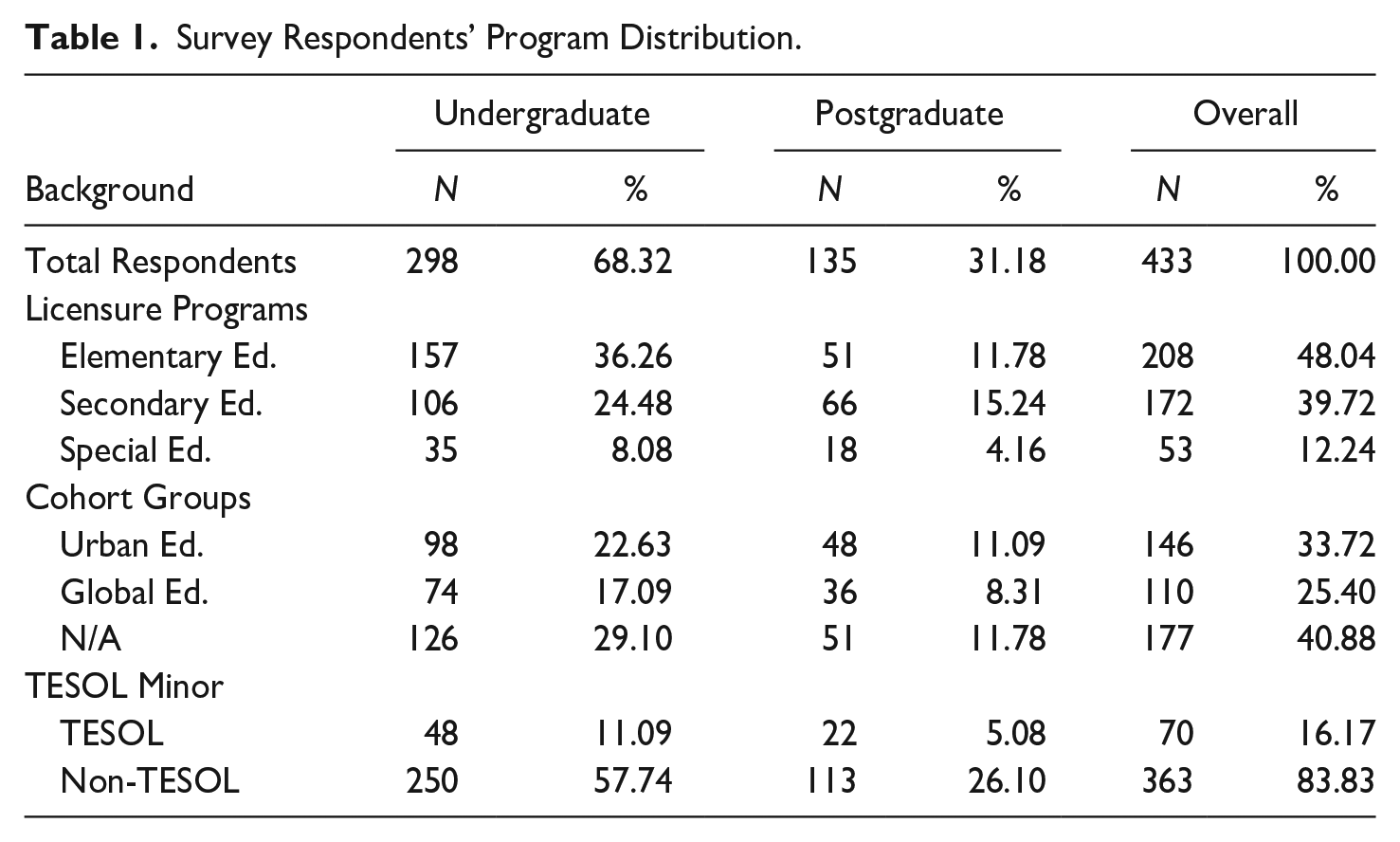
A total of 561 responses were received, and data from 433 valid responses were used for analysis (see Table 1). The sample included 68.3% (n = 298) preservice teachers in years 1–4 of the program and 31.2% (n = 135) fifth-year interns (postgraduates). Of the 433 respondents, approximately 48% (n = 208) were in elementary education, 39.7% (n = 172) were from the secondary education program, and the remaining 12.2% (n = 53) were studying for a special education specialization. In terms of their cohort groups, 33.7% (n = 146) were in the urban education cohort, 25.4% (n = 110) were in the global education cohort, and the remaining 40.9% (n = 177) did not belong to either of the two groups. Finally, 16.2% (n = 70) had selected Teaching English as a second language (TESOL) as their minor; the remaining 83.8% (n = 363) had not.
Survey Respondents’ Program Distribution.
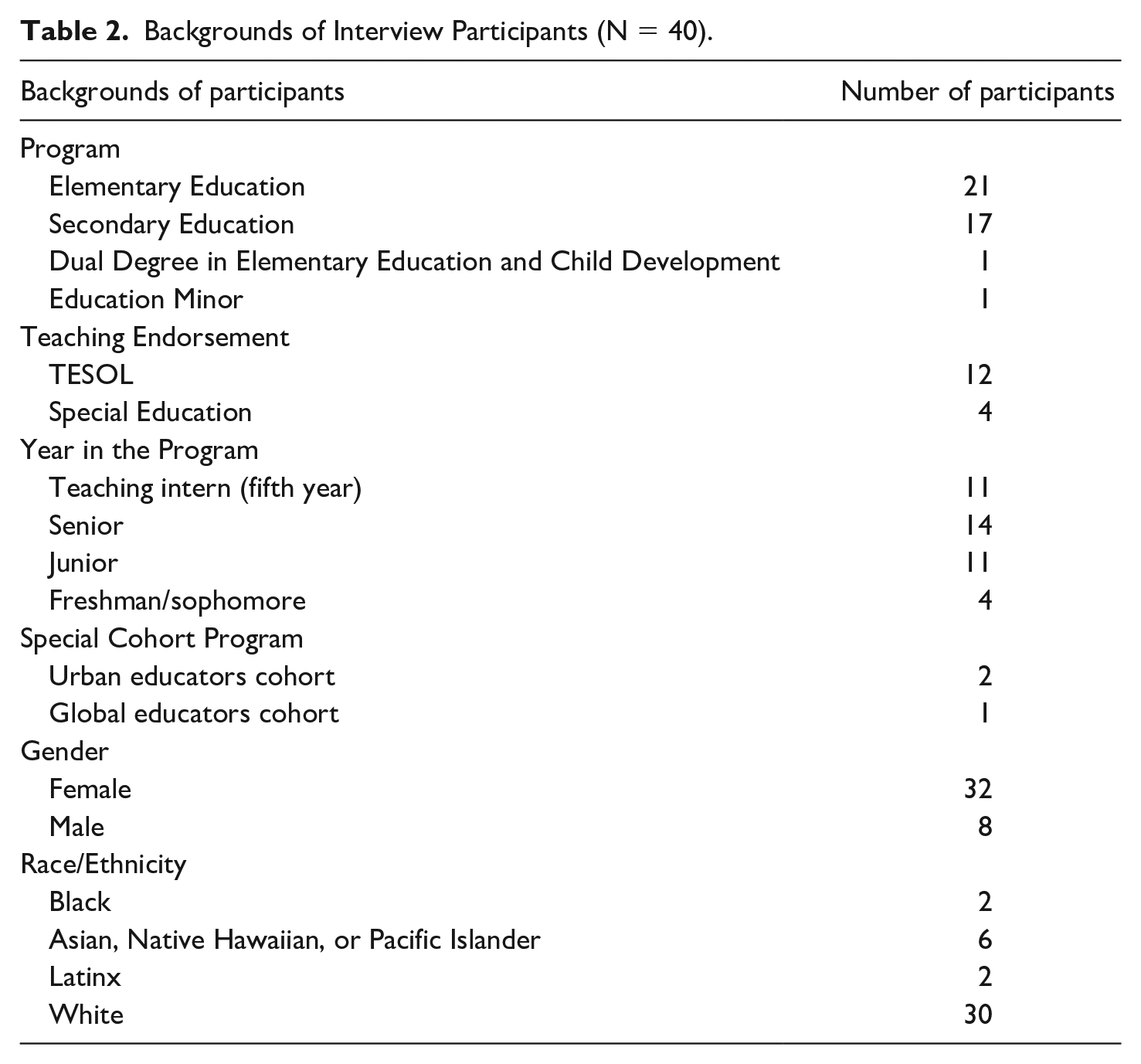
Using purposeful selection (Maxwell, 2013) to ensure a representative sample from the program, we identified a total of 40 preservice teachers to be interviewed (see Table 2): 11 were postbachelor interns, 14 were in their fourth year (seniors), 11 were in their third year (juniors), one was a sophomore, and three were in their first year of study (freshmen). Twelve of them were enrolled in the TESOL minor option, four in special education, two in the urban education cohort, and one in the global cohort. Thirty-two of them were female, and eight were male. Thirty of them were White, two were Black, two were Latinx, and six were AAPI. This sample was roughly proportional to the diversity of the overall program.
Backgrounds of Interview Participants (N = 40).
The interviews were conducted by four trained doctoral research assistants who came from diverse backgrounds: One was a White American woman, one male and one female doctoral student were from Latin America, and one doctoral student was from Asia. The research assistants (and the study authors, who are of AAPI backgrounds) were not instructors in the program; therefore, there were no conflicts of interest with the interviewees. The interviews took place in mutually agreed-upon locations in the program building in the research assistants’ offices, classrooms, or meeting rooms. Prior to the interviews, preservice teachers were told the purposes of the study and the interview and were informed that the information and perspectives they shared would remain confidential and would not be shared with any of their instructors or administrators. Also, their real names or identities would not be revealed in any published reports of the study. All participants received a small honorarium for their participation. Each interview lasted between 20 and 40 minutes, and all the interviews were transcribed verbatim for the analysis.
Analysis
Different methods were used to analyze the data generated from the survey and interviews. For the survey data, descriptive analysis was first used to understand participants’ backgrounds and learning experiences in relation to ELLs across the different licensure programs, cohort groups, and TESOL minor groups. Second, the frequency and percentage of participants’ responses on closed questions were calculated. Third, we conducted reliability analyses and descriptive analyses of the four factors in the KASELL scales. Reliability analyses indicated good reliability for KASELL questionnaires (Cronbach’s α = .85). The mean scores for the four factors were compared according to participant programs (e.g., licensure program, cohort groups, and TESOL minor groups) using SPSS 26.0. To determine whether there were significant differences across different program groups, a multivariate analysis of variance (MANOVA) was conducted to compare the factor means of program groups. When the results of the Wilks’ λ multivariate test showed significance, Tukey post hoc tests were conducted to further identify differences across groups.
Preservice teachers’ responses to open-ended questions in the survey and interview transcripts were analyzed using the Rigorous and Accelerated Data Reduction (RADaR) technique using Excel described by Watkins (2017). Excel was chosen as a tool for analysis because it allowed rapid and rigorous data processing through data organization, reduction, and coding, and it was user-friendly and easy for team sharing of data and analysis results (Watkins, 2017).
First, the study authors and the research assistants worked as a team to develop a preliminary codebook related to the preservice teachers’ perspectives on their experiences and opportunities to learn to teach ELLs in the program (see Appendix C for a complete codebook with data excerpts). After a preliminary codebook was established, the research assistants were divided into two teams to do the initial coding. Two assistants coded the interview transcripts of those who were in the TESOL minor program and two coded those who were not. Each assistant coded the transcripts using Excel separately and then compared their coding with their teammate.
Coding began with creating Excel tables or “data reduction tables” (Watkins, 2017, p. 3) that included large segments of text taken directly from the transcripts that were of primary interest to the research questions and excluded those that were irrelevant. Once these tables were created, the assistants then coded the relevant segments using the coding book and added new codes as they emerged from the included data segments. Specifically, the relevant excerpts were open coded first by the major tasks of learning: knowledge, attitudes, disposition, and perception of program preparation (reflection). Under the code “knowledge,” we further coded the excerpts according to what they indicated they already knew (existing knowledge) and what they expressed that they wanted to know (gaps). After the open coding, we then moved to more “focused” coding (Watkins, 2017) of segments directly related to our research focus. For example, under each learning task coding, we were also interested in where in the program they (dis)engaged in the learning task, so we further coded them by contexts such as “coursework,” “field experience,” “service learning,” and “other contexts.”
Once these segments were open and focus coded, the Excel table display enabled us to see three emerging themes related to our concerns for equity related to preservice teachers’ preparation for ELLs (i.e., knowledge gaps, opportunity/exposure gaps, and sense of underpreparedness/efficacy gaps; see Appendix D for a screenshot of a sample Excel table). These themes were then triangulated with the quantitative results from the survey to determine how well they mapped onto one another (Watkins, 2017).
Findings
Triangulation of our quantitative and qualitative data revealed a powerful and consistent account of the systematic invisibility of ELLs throughout the program, with an absence of ELL-related content in the coursework and inattention to opportunities to work and interact with ELLs in the field placements. This systemic erasure of ELLs resulted in a low level of self-efficacy in teaching ELLs, with the majority of the preservice teachers feeling unprepared to teach ELLs.
“I Haven’t Been Taught a Lot of It”: Preservice Teachers’ ELL Knowledge Gaps in Pan-Diversity Coursework
We asked preservice teachers to report the areas of knowledge related to ELLs in which they felt adequately prepared and how they gained the knowledge. These areas of knowledge included their knowledge of ELL student characteristics and their learning needs; knowledge in SLA; their teaching repertoire in general methods for ELLs; ELL methods in subject areas; ELL standards and assessments, curriculum and programs, and resources to support ELLs; and knowledge of ways to engage and work with parents and communities. The majority of preservice teachers (including TESOL minor students) reported not feeling adequately prepared in all the areas asked (Table 3). Preservice teachers reported feeling most confident about ELL characteristics and needs and least confident in ELL standards and assessment, ELL programs and curriculum, and second language acquisition theories and processes. The preservice teachers also reported the contexts in which they gained these experiences related to ELLs: 84.8% learned through class reading materials, followed by group discussions (76.2%), and lectures (67.4%). However, fewer than 20% reported learning experiences through classroom visits or microteaching (see Table 4).
Areas of Knowledge Participants Feel Adequately Prepared for Teaching ELLs (Percentage by TESOL, Cohort Groups, TE Licensure Program).
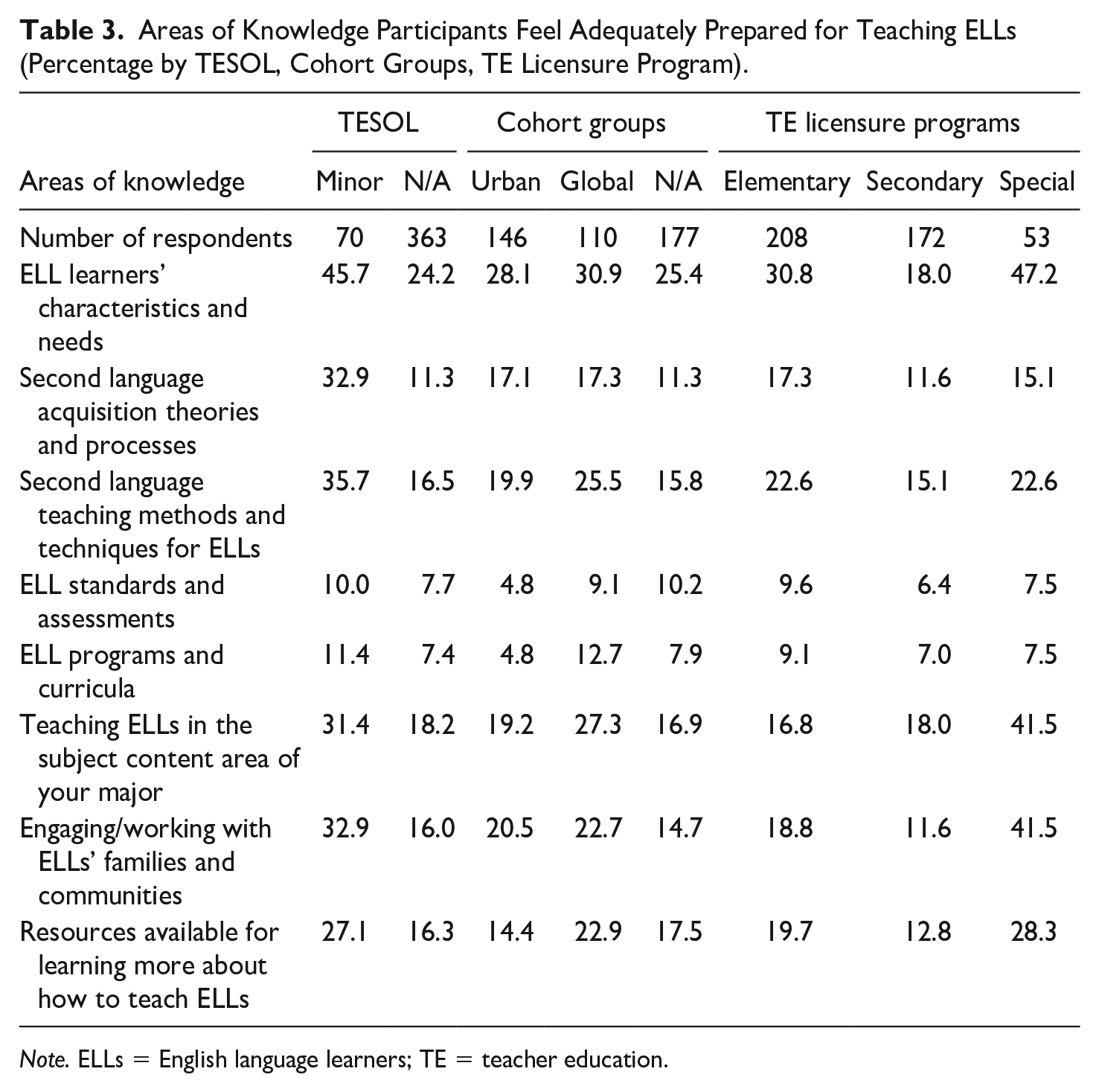
Note. ELLs = English language learners; TE = teacher education.
Types of Learning Experiences Related to ELLs Provided by Instructors.
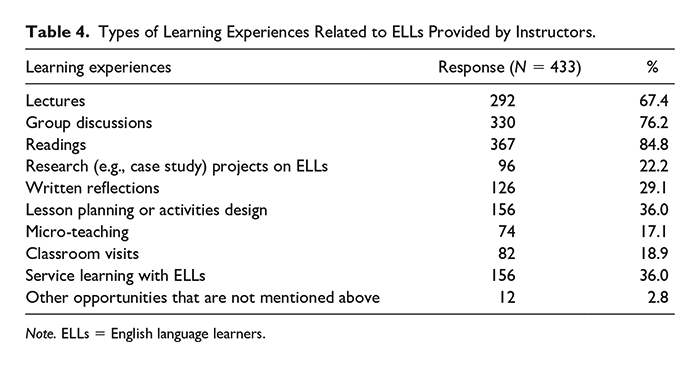
Note. ELLs = English language learners.
Interview data revealed that almost all of the preservice teacher interviewees recognized gaps in their knowledge about ELLs. Many noted that they knew one or two aspects of “just good teaching” such as “[ensuring they] get the teacher interaction and student interaction,” “how to break down a text to make it easier for people,” “do gestures or pictures,” “lower the pace of your speaking,” “writing things down,” and so forth, but confessed that they had not been “taught a lot about it . . . feel . . . missing out on it.” One senior stated, “I don’t know a lot at this point apart from differentiation.”
The interns were most concerned because many of them were teaching in schools with ELLs. An intern with a math major felt “very underprepared” because he had “no skills or anything to fall back on to communicate with ELLs.” Another intern majoring in biology noted that she had ELLs in her class, but she did not know how she could help: “I had no experience before the internship year . . . When you were asking me to take the survey, I was like, wow, I wasn’t even gonna do it, cuz I know nothing about it . . .”
When they were asked to reflect on the ELL content covered in their courses, the preservice teachers recognized the limits of the pan-diversity approach throughout the program and attributed their knowledge gaps to the lack of specific attention to ELLs. In their only foundational course about diversity in their first year, ELL-related content was “kinda branched from a topic of diversity. . .not necessarily, let’s specifically talk about ELLs.” One junior explained, I feel like a lot of that class was just in general pointing out a lot of cultural misconceptions that you could go into the classroom having, and how to just correct those things . . . But I don’t really remember anything for ESL students.
Others shared the same marginal treatment of ELL-related knowledge in another foundation course in their freshman year as well as in the methods courses later in their program. One senior in the secondary program recalled, We might spend one or two class periods covering strategies for ELLs in each TE class, but often times these conversations were redundant, or only glazed over the surface . . . I feel like I was made aware that ELLs exist, but nothing other than that.
Another senior in the elementary program who was also in the urban cohort and the TESOL minor option shared that I do remember . . . discussing ELLs, but we didn’t specifically know about methods, specifically . . . it’s kinda the same for [the course on understanding learners] as well. We got some methods in [literacy course] about just adapting literacy practices for ELLs, and it’s been the same through the [four upper-level content methods courses], we have a short discussion about how to modify lessons for ELLs, but it hasn’t really been emphasized.
The preservice teachers revealed that in some courses, there were no readings on ELLs included in the syllabus, whereas in others one or two articles about ELLs (often very short) were assigned. One intern addressed this problem, “I think just having one article about ELL students for science teachers is not enough . . . OK, I’ve read 4 pages. That doesn’t tell me what to ask for, what to look for, or how to help any students.” The exception, however, was the TESOL minor students’ required placement course in the senior year, which “[obviously] . . . that’s what we talked about, it’s like THE methods, assessments, practices, everything you got.” However, only 16.2% students chose the TESOL minor option.
“I Don’t Have Really a Lot of Ell Experiences Through [The Practicum] . . . Honestly”: Lost Opportunities Due to the Pan-Diversity Approach to Field Placement
Consistent with the predominantly White demographic characteristics of the program, the majority of the preservice teachers (close to 70%) reported having no experience with ELLs before coming into the program. In their open responses in the survey, as many as 195 of them indicated that they knew “little” or “nothing” about ELLs before joining the program, which made experiences with ELLs in the program critically important for their preparation.
In the survey, the majority of them reported having interactions with ELLs after joining the program. Specifically, 82.9% of TESOL minor students, 66.9% of non-TESOL minors, 70.7% of urban cohort students, 79.7% of global cohort students, 67.8% of elementary students, 70.3% of secondary students, and 73.6% of special education students reported having direct interaction with ELLs in the program. However, the analyses of the interview responses revealed that these opportunities were by default due to the diverse nature of the placement schools for their practicum. Except for the students in the TESOL minor option, no other placements required any intentional placements with ELLs. As a result, preservice teachers’ opportunities to interact with ELLs were unequal, with some having direct experiences with ELLs and others having none in their entire preparation program. One secondary intern stated, I think everyone’s experiences with ESL students, in terms of where they go and placement-wise and internship-wise, is completely subjective. Every situation is going to be unique. Every school is unique. So with that, I can see why it is sometimes overlooked or it’s not a major focus, which is too bad, because that’s kind of the direction that public education is going.
Another biology intern’s experiences confirmed this random nature of experiences with ELLs in field placements: “I had an ELL student in my placement . . . [in] my senior year, but I really don’t know any opportunities that the program specifically gives you opportunities to be able to do that.”
One junior-year chemistry major mentioned that although in the first 2 years of her program, several courses had included a service-learning component, she did not have a chance to work with ELLs because “there [were] no ELLs in my placement.” Similarly, another intern recalled that her only time in an environment with ELLs was her service learning in her second year, but she had not been paired up with any ELLs. Other than that, “all [her] other service learning haven’t been with ELLs.”
Those who had ELLs in their placements all noted that these firsthand experiences were “the most useful learning experience [they] have had relating to ELLs” and “very eye-opening.” However, preservice teachers were left to their own devices to learn how to teach ELLs because most of these opportunities were not intentionally supported. One elementary intern illustrated the frustration when he was asked to go through a workbook with an ELL, “I was given no skills or anything, so I think it was frustrating for them and me, because I couldn’t translate anything. If they were stuck on a word, I couldn’t help them.”
Others with ELLs in their placements noted that even if they had acquired some knowledge base about ELLs, they rarely had a chance to apply it in their fieldwork. One senior majoring in math stated that he did not “have chances to actually do [ELL teaching practice] in placement,” and as a result, he did not “know how to actually teach ELL students.” Similarly, another secondary intern shared that he “didn’t really have much experience working with the [ELL] kids” because he “did a lot of sitting in the back of the classroom.”
Such neglect of ELLs in their field practices can lead to “miseducation” of preservice teachers about ELLs (J. King, 1991). One secondary intern shared her confusion about an ELL in her practicum class: My mentor teacher, [ELL] is not her thing. She thinks he is just a distracted student. And my question always is, is he distracted because he doesn’t understand or because he has got a lot of energy?. . . I don’t know where the breakdown is, in the sense of if the student is confused, I don’t know if it’s a language barrier or science barrier. . .
“I’m Scared That I Am Not Prepared Enough”: Differences in Preservice Teachers’ Sense of (Under)Preparedness Across Programs
When asked how courses in the TE program contributed to preservice teachers’ overall preparation for teaching ELLs, the majority (69.1%) of preservice teachers responded that they were not well-prepared. Specifically, 69.3% of elementary, 77.3% of secondary, and 49.1% of special education preservice teachers felt the program did not prepare them well to teach ELLs. Similarly, 68.8% of urban education cohort students, 69.9% of global education cohort students, and close to 71% of students in neither cohort felt unprepared. Strikingly, 71.9% of non-TESOL minor students felt unprepared, whereas 54.3% of TESOL minor students felt unprepared.
Results from comparing means of the KASELL scales suggest that preservice teachers differed in their sense of self-efficacy based on participant program affiliation, namely, the TESOL minor, cohort groups, or licensure programs. The TESOL minor preservice teachers scored the highest in all four areas. For the knowledge factor, those in the TESOL minor (M = 3.56, SD = 0.68), urban cohort (M = 3.36, SD = 0.68), and global cohort (M = 3.38, SD = 0.71) scored higher than those not in any of these groups. For the factor of attitudes toward ELL parents, the findings were similar: Preservice teachers in the TESOL minor (M = 3.71, SD = 0.77), urban cohort (M = 3.67, SD = 0.71), global cohort (M = 3.60, SD = 0.71), and special education (M = 3.59, SD = 0.68) had a higher sense of preparedness than those not in these groups. In terms of attitudes toward ELLs, preservice teachers in the TESOL minor (M = 4.11, SD = 0.66) and those in special education (M = 4.11, SD = 0.80) had the highest scores followed by those in the global cohort (M = 3.96, SD = 0.67). Finally, for the self-efficacy factor, the TESOL minor preservice teachers had higher scores in self-efficacy related to teaching ELLs (M = 3.40, SD = 0.57) than other groups.
The results of the Wilks’ lambda multivariate test showed significant differences in preservice teachers’ involvement in the TESOL minor at a 0.05 significance level as well as preservice teachers’ involvement in the cohort group at a 0.10 significance level. Specifically, participants in the TESOL program scored significantly higher on average for one factor: ELL knowledge (F = 9.69, p = .00). In terms of cohort education groups, significant effects existed between groups at a 0.05 significance level for one factor—self-efficacy (F = 3.98, p = .02)—and at a 0.10 significance level for two factors—knowledge (F = 2.53, p = .10) and attitude toward ELL parents (F = 2.53, p = .08).
With relation to these two factors, a Tukey post hoc test (Table 5) further compared the differences among preservice teachers in the three cohort education groups: urban cohort, global cohort, and those who belonged to neither cohort. For the knowledge factor, results revealed that participants in the urban cohort (p = .06) and global cohort (p = .06) scored significantly higher than those who did not belong to either cohort at a 0.10 significance level; however, no statistically significant differences were found between participants in the urban cohort and the global cohort (p = .98). For the self-efficacy factor, significant differences were observed at a 0.05 significance level between the global cohort group and the noncohort group (p = .01), and moderate differences were observed at a 0.10 significance level between urban and noncohort groups (p = .09).
Between-Subjects Effects on KASELL Scores for Preservice Teachers.
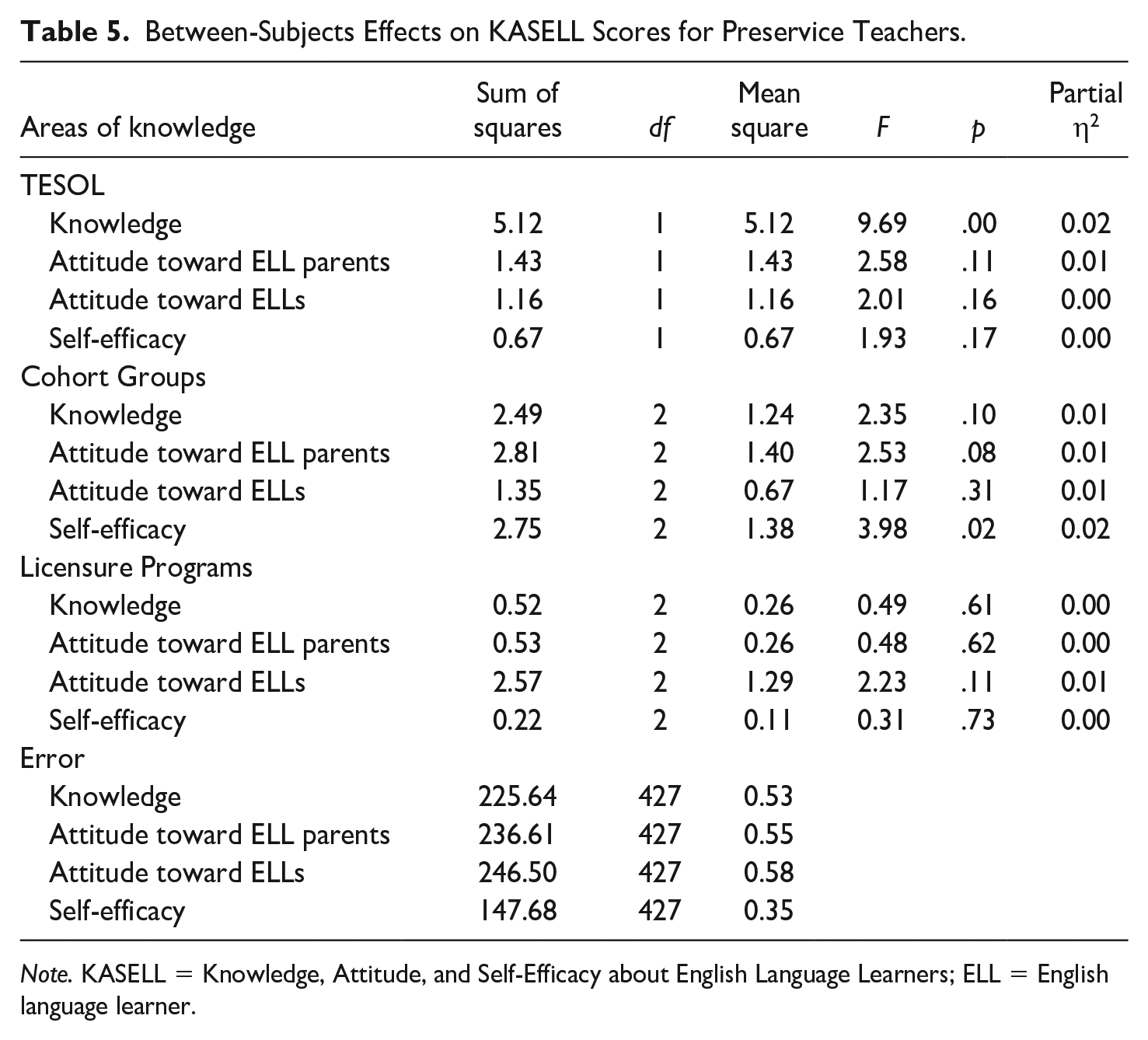
Note. KASELL = Knowledge, Attitude, and Self-Efficacy about English Language Learners; ELL = English language learner.
For licensure programs, significant effects were observed in attitude toward ELLs. Results of a Tukey post hoc test for the three licensure programs (elementary, secondary, and special education) revealed significant differences at a 0.05 significance level between the secondary program and special education program (p = .03); however, no significant group differences were observed for other factors (see Table 6).
Tukey HSD Test Result on KASELL Scores for Preservice Teachers.
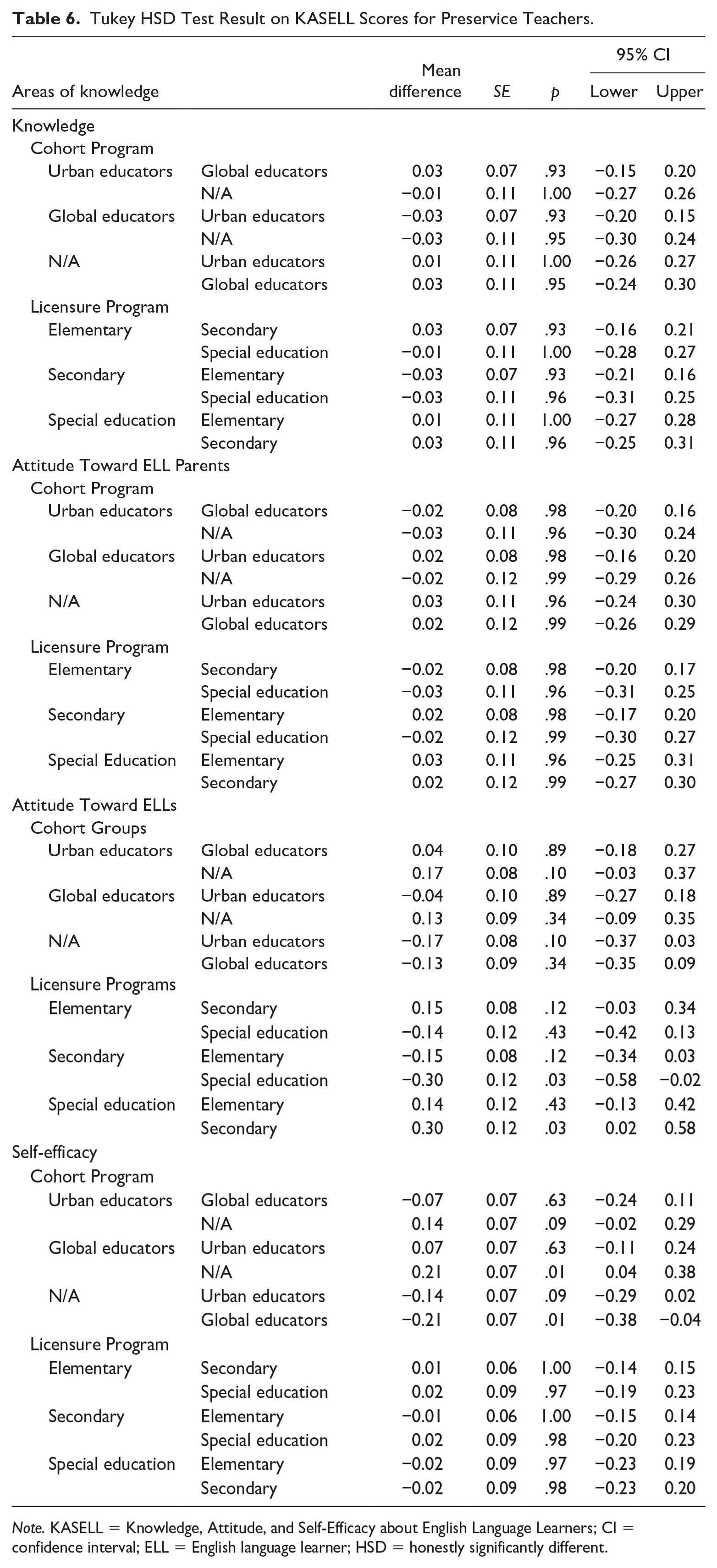
Note. KASELL = Knowledge, Attitude, and Self-Efficacy about English Language Learners; CI = confidence interval; ELL = English language learner; HSD = honestly significantly different.
Furthermore, undergraduates’ and postgraduates’ scores in the four factors were compared through an independent sample t test to analyze group differences (Table 7). Overall, undergraduates (M = 3.49, SD = 0.44) and postgraduates (M = 3.57, SD = 0.46) had similar scores, and no significant group difference was observed at a 0.05 significance level (t = −1.65, p = .10). Specifically, undergraduates showed slightly higher mean scores in attitude toward ELLs (M = 3.94, SD = 0.70), whereas postgraduate participants who were doing their field internship showed slightly higher mean scores in domains of knowledge (M = 3.37, SD = 0.78), attitudes toward ELL parents (M = 3.66, SD = 0.75), and self-efficacy (M = 3.35, SD = 0.63). However, these group differences were not significant at a 0.05 significance level.
Descriptive Statistics and Independent Samples T-Test of KASELL Factor Scores for Undergraduate and Postgraduates.
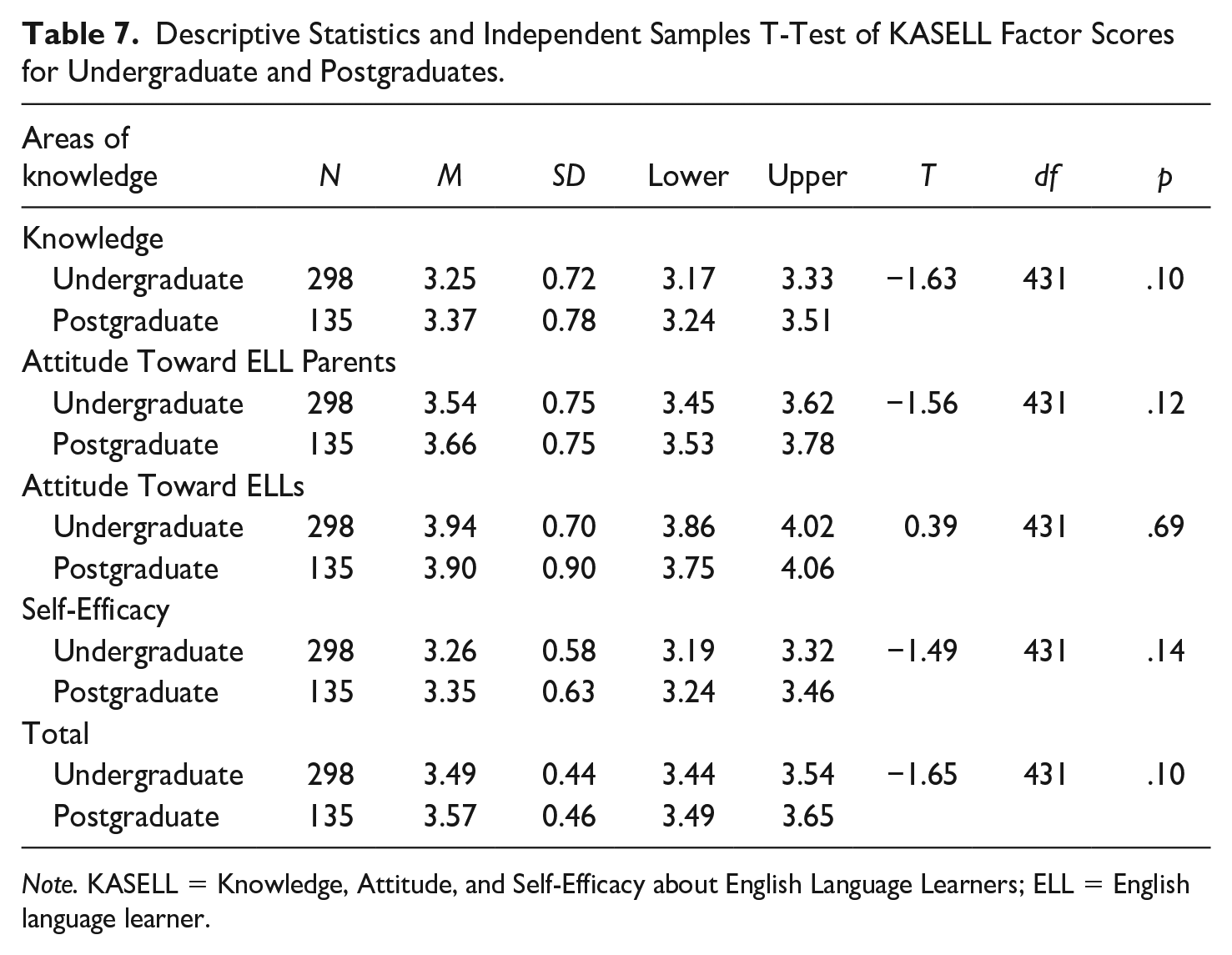
Note. KASELL = Knowledge, Attitude, and Self-Efficacy about English Language Learners; ELL = English language learner.
These findings were corroborated in the interviews. One postgraduate interning in a predominantly White high school in a class with a high percentage of ELLs noted that he “had to learn a lot on [his] feet.” Some of the interviews revealed persistent deficit views about ELLs. An elementary junior-year participant who was enrolled in the TESOL minor option noted that she had to lower her standards for ELLs: You can’t really expect to [stop] on the entire class for one or two students who are struggling with the language. I am not sure how to keep my standards high for the [ELL] students without compromising my standards.
Another intern majoring in social studies shared similar views of ELLs in her classroom: It’s sad to say that those Spanish students can’t do that high level thinking not because they are not intellectually “smart enough” but sometimes the language that you have to use can be very tricky for those students to pick up on. My ELL students tend to come and not participate simply because they can’t hold this conversation, forming an opinion and properly articulating that in an argumentative way requires very specific set of speech skills; I almost want to say you can just say it in Spanish.
Other interns saw ELLs as irrelevant in their teaching. One intern in secondary social sciences confessed, “as an educator, you don’t want to say that’s not your job. Though, sometimes, it’s not your job.”
Pan-Diversity Integration as an Ell Equity Trap: A Discussion
The present study reveals systemic neglect of ELLs in both coursework and field practice in the teacher education curriculum, resulting in underpreparedness among the preservice teachers across the subprograms. The results indicate that the current pan-diversity integration approach has served as an equity trap that will preclude the preservice teachers from becoming successful with their future ELLs (McKenzie & Scheurich, 2004).
The findings in this study suggest that some minimum, “seat-based” ELL knowledge (Feiman-Nemser, 2001, p. 1020) was covered in a few course readings and discussions but not in the majority of the courses in which ELL-related content was often construed as one aspect of a general diversity. Similarly, there was no attention to providing preservice teachers with firsthand experiences with ELLs in their field practice, leading to lost opportunities to gain a teaching repertoire. Such systemic erasure of ELL issues from the teacher education curriculum serves to reproduce teachers who will continue to overlook ELLs’ learning needs.
Consistent with previous studies (Coady et al., 2011; Durgunoglu & Hughes, 2010; Greenberg et al., 2015), the findings in this study revealed an overwhelming sense of underpreparedness of preservice teachers in teaching ELLs. Subprogram differences indicated that urban and global cohort preservice teachers and those in special education scored higher in ELL attitude and knowledge than those not in the cohort groups, suggesting that attention to some forms of diversity had some positive effects on preservice teachers’ self-efficacy in teaching ELLs, but it was far from being sufficient. As Florian (2017) argued, The problem is that including all learners by differentiating for some can serve as a barrier to, rather than facilitation of learning, for different groups. At the same time, ignoring difference by treating everyone the same, overlooks the importance of individual differences between people that can also lead to exclusion. (p. 11, emphasis in original)
As the results showed, the preservice teachers held persistent deficit views of ELLs as being incapable of learning and achieving high standards, echoing many previous reports (Pettit, 2011) on mainstream in-service teachers’ perspectives about ELLs’ “built-in deficits” that teachers could not be expected to overcome (McKenzie & Scheurich, 2004). The erasure of ELLs within the teacher education curriculum fails to transform the preservice teachers’ deficit thinking about ELLs and therefore sustains the cycle of the equity trap. The consistent invisibility of ELLs across the subprograms normalizes such erasure, thereby enforcing a “collective equity trap” (Skrla et al., 2009) that hinders mainstream preservice teachers from learning beyond “just good teaching.”
It must be noted that although the preservice teachers enrolled in the TESOL minor option demonstrated higher levels of self-efficacy in teaching ELLs than those in other subprograms, close to half of them did not feel prepared. This finding further suggests that the common add-on approach to the teacher education curriculum is not sufficient to remove the equity trap for teaching ELLs, and there is an urgent need for transformative change in the normalized pan-diversity approach in teacher education.
Conclusion and Implications
This study demonstrates the critical need to eliminate the pan-diversity equity trap to systemically incorporate ELL issues within teacher education to not only transform preservice teachers’ deficit thinking about ELLs but also fill their knowledge and skill gaps for working with ELLs. First, a new conceptualization of ELLs as a central requirement within all preservice teachers’ learning-to-teach tasks is needed (Lucas & Villegas, 2013). Therefore, supporting the teaching and learning of ELLs should not be conceptualized as modifications of “just good teaching” or as optional add-on work but as a required area of knowledge that all preservice teachers are expected to gain. Only by so doing can we reauthorize ELLs’ status from invisibility to rightful prominence in the program. Such a new conceptualization is vital for ensuring equitable learning experiences for ELLs in this era of accountability.
Second, there must be transformative structural changes in the teacher education curriculum to ensure systemic integration of ELL-related issues in coursework and field placements. Teacher education must abandon the piecemeal approach of revising a few selected courses or adding a standalone ELL certificate or endorsement program because these approaches have proven to be ineffective in bringing fundamental change to preservice teachers’ beliefs or practices (Akiba et al., 2010; Ballantyne et al., 2008; Li, 2018; Lucas et al., 2018). Rather, systemic integration in the main teacher education curriculum is needed. Several existing frameworks, such as Cochran-Smith’s (2003) eight-dimension framework for multicultural teacher education and Au’s (1998) diversity constructivist framework, can be drawn upon to restructure the curriculum and delivery to ensure preservice teachers gain the knowledge and skills they need to effectively teach ELLs. Particular attention must be given to the training of content-area teachers due to the unique challenges that ELLs face in content-area learning. Bunch’s (2013) pedagogical language concept, Lucas and Villegas’s (2013) linguistically responsive pedagogy, and Viesca et al.’s (2019) three-dimension quality content teaching for ELLs that considers context, orientations, and pedagogy can serve as foundations for teacher education to plan coursework, field placements, and other enhancement learning opportunities.
Specialization programs such as special education teacher preparation or subject-specific (i.e., science, mathematics, and social studies) teacher preparation programs can also undertake such structural change. In special education teacher preparation programs, for example, More et al. (2016) presented a model to systemically and intentionally incorporate both knowledge of ELL characteristics and theories of instruction and evidence-based instructional techniques and approaches to address students’ sociocultural processes, cognitive and academic development, and linguistic experiences in program coursework and field experiences. Stoddart et al.’s (2017) Secondary Science Teaching with English Language and Literacy Acquisition (SSTELLA) project model can serve as a good example of similar intentional, systemic integration of ELLs in subject-specific teacher preparation.
Third, teacher education programs must support teacher educators who have uneven expertise and commitment to making such structural changes for ELLs. In the majority of teacher education programs in the United States, most teacher educators are trained in their specific disciplines and therefore may not have the awareness or expertise in general diversity or ELL-related backgrounds. This knowledge gap among teacher educators has contributed to the erasure of ELL content in this study as well as in many other studies (de Jong et al., 2018; Li & Bian, 2021; Li et al., 2018, 2019). In some instances, faculty either resisted the integration of ELL content or superficially complied with mandates of ELL content in their courses (i.e., de Jong et al., 2018). Therefore, teacher education restructuring efforts must include intentional professional development for teacher educators. Such support may include intentional recruitment of faculty with ELL training backgrounds, incorporation of diverse models of instruction such as pairing ELL faculty with subject area faculty, provision of faculty professional learning workshops, or forming faculty learning communities.
Finally, there is an urgent need for systemic change at the policy level. Currently, state agencies and national organizations governing teacher education institutions, such as the Association of Teacher Educators and the American Association for Colleges of Teacher Education, have paid little attention to preparing teachers for ELLs. Therefore, systemic changes must also be made at these higher level organizations in order to end the pan-diversity equity trap.
Limitations and Future Directions
There are several limitations to this research. First, the study focused exclusively on preservice teachers’ perceived experiences. Further studies can include preservice teachers’ situated experiences through the course and field-placement observations as well as syllabus analysis. Second, further studies might also aim to provide a more nuanced understanding of preservice teachers’ developmental trajectories in ELL through longitudinal research. Finally, future research could aim for more enactment-oriented research through design experiments with proposed structural changes to systemically integrate ELL content in the teacher education curriculum.
Footnotes
Declaration of Conflicting Interests
The author(s) declared no potential conflicts of interest with respect to the research, authorship, and/or publication of this article.
Funding
The author(s) received no financial support for the research, authorship, and/or publication of this article.