




Abstract
With increasing attention to sexual misconduct on university campuses, universities have focused attention on campus safety, but safety systems are based on assumptions that people who live and work on campuses are able-minded and able-bodied. Any contemplation of campus safety needs to consider the intersectional experiences of students and staff. Considering the experiences of people from minoritised groups can provide insights into socially constructed notions of safety on campus. One such minoritised group is deaf women. Using the broader concept of safety to mean ‘the state of being ‘safe’ and the condition of being protected from any harm or other danger’, this paper reports on interviews conducted with five deaf women who work or study at one UK university to examine whether they feel safe on the campus. Four key themes were identified: (i) safety as a woman, (ii) safety as a deaf person; (iii) intersectional experiences of safety as a deaf woman; and (iv) accessible safeguarding. These five deaf women reported having more concerns because they are deaf rather than because they are women, but noted that the intersectional experience of being deaf and a woman create deeper safety concerns. Recommendations are made for university campuses to ensure that their safeguarding practices are accessible.
Personal Reflexive Statement
This positionality statement is included in the article:
Any researcher exploring feminist issues must acknowledge their positionality (Franks, 2002) particularly in considering the ‘insider-outsider’ dichotomy (Harding, 1992), which also applies in deaf studies (Kusters, et al., 2017). As such, it is imperative for me to outline my positionality with respect to this study of deaf women’s experiences of safety on the Talent University campus.
I am a hearing, white, middle-class, PhD educated woman who grew up in a multigenerational deaf family with BSL as my home language, and I am an academic that conducts research at the intersection of deaf studies, applied linguistics and interpreting studies. I also identify as a ‘survivor researcher’ (Westmarland & Bows, 2018) as I am a survivor from a former abusive relationship.
So, I could be considered as an ‘insider’ because I am a woman, based in a university and a BSL user, but I could also be considered as an ‘outsider’ because I am not deaf myself. I also have a dual role as an ‘academic activist’ (Westmarland & Bows, 2018), as I often take on positions inside and outside of academia where I am involved in campaigning or influencing policy change. In this case, I am hoping that this study may lead to positive policy changes in universities to support feelings of safety among deaf women.
Introduction
There are many studies on incidences of sexual misconduct in higher education (Bondestam, & Lundqvist, 2020). There has also been increasing attention on sexual misconduct on university campuses with studies showing that sexual assault is more prevalent than originally thought (Zeilinger, 2015). The introduction of university anonymous reporting systems has led to higher disclosure of incidents of sexual misconduct (Olufemi, 2018). In the UK, organisations such as the 1752 Group 1 have pointed out the need for a profound culture shift in the ways we teach, learn and use university space in relation to sexual misconduct. In the UK context, a January 2022 report 2 revealed that there had been 400 sexual misconduct claims at Scottish universities in the preceding 5 years: 308 reports were made against students, and 68 were made against members of staff.
In efforts to improve safety, universities have increased police or security presence on campuses with the view that more visibility of security leads to less occurrences of sexual misconduct and women feeling safer (Williams, 2020). Other visible institutional ‘solutions’ on campuses have included increased use of CCTV cameras, blue light emergency boxes, and campus enclosed fencing (Ellcessor, 2019). Various training measures have also been introduced for staff and students to promote preventative safeguarding practices (Bondestam & Lundqvist, 2020), for example active bystander training. 3 The use of technologies can enhance women’s safety (Cardoso, et al., 2019), for example, by women texting each other to check they are home safe or signing up to a safety app that sends GPS coordinates to family and friends.
Women report experiencing a “chilly campus climate” in relation to their safety on campus as they do not feel that campuses are designed with their safety in mind, which perpetuates a culture of fear on campus (Kelly & Torres, 2006). A gap between the administrative discourse on campus safety and the actual perceptions and experiences of women about their safety on campus has also been documented (Currie, 1994).
Notions of safety (especially from sexual misconduct) on university campuses is socially constructed (Abu-Odeh, Khan & Nathanson, 2020), especially as the institutionalised response has typically been pushed by white feminist groups that may not take into account what is necessary for black students (and staff) to feel safe (Williams, 2020). Foster (2018) contends that the constructs of safety, health and wellbeing are positioned through an ableist lens, assuming that people are able-bodied. According to Read, Parfitt and Bush (2020, p.1) universities: “systemically perpetuate a value of the ‘able-mind’ and ‘able-body’, thereby viewing disabled people as less worthy or valuable than ‘able-bodied’ individuals. Disabled people have been and continue to be excluded from academia and are required to navigate ‘ableist’ barriers, in order to ensure that they can simply participate, let alone do so in ways that protect their health and well-being”.
Thus, any contemplation of campus safety needs to consider the intersectional experiences of students and staff. Intersectionality is a framework that was originally developed to consider how the intersections between being black and female lead to experiences of marginalization, power, inequality and oppression (Crenshaw, 1989). Intersectionality studies now more broadly consider how the interactions between additional sociocultural factors such as sexuality, disability, nationality, social class, socioeconomic status, geographical location, political leanings, or religion (as well as gender, race and ethnicity), can lead to a better understanding of the dynamics of power, privilege, and oppression in society (Cho, Crenshaw & McCall, 2013). This allows us “to account for the fact that intersections can produce opportunities, choices, options and empowerment” (Kusters, 2019, p.5).
Deaf people in the UK who use sign language occupy an intersectional position of disability under the UK Equality Act 2010 and as members of a minority linguistic-cultural community (WFD, 2018), which is recognised through the BSL (Scotland) Act 2015 and the UK BSL Act 2022. Deaf people in universities often experience barriers to participation and progress because of the audist constructs of university systems (Robinson & Henner, 2018). ‘Audism’ is a deaf studies theory that draws on the concept of ableism and describes how society is audiocentric, and as such inherently discriminates against deaf people and sign language (Eckert & Rowley, 2013). Deaf people can experience audism on an individual and an institutional level (N. O’Connell, 2022). Universities are run by hearing people according to hearing cultural norms (O’Brien, 2020a) and deaf academics often have to adapt their workspace to feel safe, for example by moving office desks so they can face the door (O’Brien, 2020b). There are estimated to be up to 70,000 people in the UK who have British Sign Language (BSL) as their first or preferred language (Turner, 2020).
From interviews with various stakeholders in the UK, Bull and Rye (2018) suggest that further research is needed with staff and students who are minoritised in the university context (e.g., who identify as black and minority ethnic, disabled or LGBTQIA+) to give insight into their experiences of safety on university campuses. As such, this timely study seeks to explore the perceptions of deaf women who work or study at one UK university about their perceptions of safety on campus.
Literature Review
In order to consider the perceptions of deaf women about their safety on one university campus, I reviewed relevant literature on deaf women’s experiences of sexual misconduct, and also of safety on university campuses. There is very little research on these topics (Anderson, Leigh & Samar, 2011), and the majority is in the United States.
Rates of reported sexual violence from partners are higher among deaf women than hearing women (Anderson, 2014). Although it is commonly reported that 25% of women in the general population experience domestic violence in their lifetime, estimates within the American deaf community are closer to 50% (Anderson, Leigh & Samar, 2011). Experiences of violence are exacerbated for deaf people who have other disabilities or are refugees (Admire & Ramirez, 2017). Furthermore, rates of psychological, physical, and sexual victimisation among deaf college students are significantly higher compared to hearing college students (Anderson, Leigh & Samar, 2011; McQuiller Williams & Porter, 2014).
Crowe (2017) found that there is increased risk for deaf women in experiencing sexual misconduct, with prevalence rates of intimate partner abuse at 30-57% for physical abuse and 72% for emotional or psychological abuse. She asserts that their inability to hear may be a factor that contributes to vulnerability or a perceived barrier to communicate (e.g., to report to police). Issues that appear to be specific to the deaf population concern the navigation of barriers to: communication with families, reporting abuse to authorities, assessment of abuse, and accessing services that are designed to meet their needs in sign language (Mastrocinque, et al., 2017, 2020).
Deaf survivors may not label their experiences of sexual misconduct as they may lack information on what constitutes misconduct and whether such behaviour is acceptable (Anderson & Kobek Pezzarossi, 2012). This may be due to a number of factors: limited communication with hearing family members who cannot sign; reductions in incidental learning; and lack of health education programs provided in sign language. A study on experiences of sexual misconduct among deaf female college students in the USA found that more than 50% of survivors did not label their experiences of psychological aggression and physical assault as misconduct, even when these experiences included severe harm (e.g., death threats, choking) (Anderson & Kobek Pezzarossi, 2012).
Additionally, deaf survivors experience significant barriers to seeking help. Many agencies for hearing survivors of sexual misconduct are inaccessible for deaf survivors (e.g., there is no interpreting provision and hotlines are not accessible). As deaf communities are small and well networked, survivors may avoid treatment due to concerns about confidentiality among sign language interpreters or deaf service providers who may know their perpetrators (Barber, Wills, & Smith, 2010; Napier, et al., 2023).
The few studies conducted have focused primarily on deaf women’s experiences of sexual misconduct, but none have concentrated on perceptions of deaf women about their safety in general on university campuses, illustrating the importance of this case study. We can assume that deaf women experience the same general safety concerns as other women on university campuses and as women from other minoritised groups. However, deaf women might experience a ‘double disadvantage’ due to additional barriers being created because they are deaf in addition to being a woman (Altıntaş, 2020; Becker & Jauregui, 1985; Napier, et al., 2023).
Inequalities due to being both deaf and female have been explored in other contexts in relation to educational attainment and occupational status (Barnartt, 2006), accessing state services and education in the Bedouin (Kisch, 2007), and understanding healthcare needs (Koçak, et al., 2019). But as far as I can tell there are no studies to date that have explored this intersection in relation to feelings of safety on university campuses.
Research Question
For the purposes of this study, I use the broader concept of safety to mean the state of being ‘safe’ and the condition of being protected from any harm or other danger, not just sexual misconduct. Having access to a group of deaf women who work or study on one UK university campus, which I have given the pseudonym Talent University, presented the perfect opportunity to conduct a case study on their perceptions of their safety on campus.
The over-arching research question is: Do deaf women feel safe on the Talent University campus? With the following sub-questions: • What are the safety considerations for deaf women on campus? • Are deaf women aware of the Talent University safety procedures and app? • Is the Talent University safety app accessible to deaf women? • What can be learned from the experiences of deaf women as a minority group on campus that could more widely benefit all women on all university campuses?
Methodology
Adopting feminist principles to the study of gender, violence and sexuality, the goal of this study is to spotlight deaf women’s lived experiences, whilst recognising the intersectionality of their experiences (Beckman, 2014) and amplify their marginalised voices (Westmarland & Bows, 2018). As a researcher who works with deaf communities (see positionality statement below), I have been able to draw on my networks and the trust I have built with deaf female colleagues to conduct a qualitative interpretive case study (Bhattacherjee, 2012) of one university. In order to ensure an ethical approach to obtaining consent, which is paramount when working with women from minority communities (Westmarland & Bows, 2018), and when dealing with sensitive topics in deaf communities (Obinna, et al, 2005), I ensured that participant information was made available in BSL (Harris, Holmes & Mertens, 2009). 4 As per O’Brien (2020b), I reassured participants that information about individuals and the institution will be anonymised in the publication of results, but I could not guarantee they would not be identified through their involvement in the research given the small size of the UK deaf academic community. All participants were happy to accept that risk once I had outlined how I would mitigate this risk.
I carried out this study as part of the Justisigns 2 project 5 on deaf women’s experiences of accessing support from service providers and sign language interpreters in reporting gender-based violence. I also submitted the data analysis for assessment purposes towards a Postgraduate Certificate in Gender, Sexuality and Society. As such, I received ethical approval from the Department of History, Classics and Archaeology at Birkbeck, University of London on 28 March 2022, who confirmed the study as ‘routine and non-sensitive’.
My Positionality
Any researcher exploring feminist issues must acknowledge their positionality (Franks, 2002), particularly in considering the ‘insider-outsider’ dichotomy (Harding, 1992), which also applies in deaf studies (Kusters, et al., 2017). As such, it is imperative for me to outline my positionality with respect to this study of deaf women’s experiences of safety on the Talent University campus.
I am a hearing, white, middle-class, PhD educated woman who grew up in a multigenerational deaf family with BSL as my home language, and I am an academic that conducts research at the intersection of deaf studies, applied linguistics and interpreting studies. I also identify as a ‘survivor researcher’ (Westmarland & Bows, 2018) as I am a survivor from a former abusive relationship.
So, I could be considered as an ‘insider’ because I am a woman, based in a university and a BSL user, but I could also be considered as an ‘outsider’ because I am not deaf myself. I also have a dual role as an ‘academic activist’ (Westmarland & Bows, 2018), as I often take on positions inside and outside of academia where I am involved in campaigning or influencing policy change. In this case, my goal is that this study may lead to positive policy changes in universities to support feelings of safety among deaf women.
Context of the Study
Talent University is a UK university that has several campuses: one main campus and several smaller satellite campuses in other parts of the UK and in overseas countries. The focus of this case study is on the main campus.
Talent University has a concentration of deaf and hearing researchers based in one particular department, which is housed in one building. At the time of the study, the team was comprised of permanent academic staff, postdoctoral researchers, research assistants and PhD students, which included nine deaf women.
Talent University merged its security and health and safety services to rebrand as a SafeGuarding Service (SGS) in order to reframe the service to more than just property protection. SGS operates 24/7 all year globally on all campuses. Talent University was the first university in the UK to rebrand in this way. An average of 11% of security service workforces in UK higher education institutions are women, but 38% of Talent University SGS officers are female. Talent University has specific targets to recruit younger and female officers, in order to build closer relationships with the student population.
Talent University has also taken other steps to ensure safety on campus by having SGS officers patrol the campus on foot or in a vehicle, rolling out a programme of installing more CCTV cameras around campus, and providing ‘no bystander’ training.
Talent University has a code of conduct that outlines what is expected in terms of behaviour on campus. The university has also introduced a specific scheme, whereby ‘ambassadors’ can be approached informally to discuss incidents witnessed that make people feel unsafe and the ambassadors signpost where they can get support. Various safeguarding procedures are outlined on the SGS website along with a reporting form, which allows anyone to submit information confidentially, and if need be, anonymously, in the event of unacceptable behaviour. Members of the SGS team proactively attend university applicant and open days to give presentations to potential students and their parents to promote safeguarding policies and procedures to ensure Talent University is a safe campus, in particular in relation to their safety app.
Talent University’s safety app “Secure Sector” (pseudonym) is a free app for students and staff to enhance their personal safety. It provides a quick and easy way for users to alert SGS by sending a location-based alert from their smartphone or tablet when they need an immediate emergency response, first-aid or other general assistance. The app was sourced and tailored for Talent University in 2015 and developed to ensure that it could also meet the needs of people with physical or sensory disabilities.
The safety app has three main buttons for requesting assistance: (i) first-aid, (ii) Covid-19 and (iii) emergency. After tapping on any of these options, there is a timer countdown so that if the button was tapped in error it can be tapped again to cancel the alert. If the alert goes through, then the person’s location is displayed on a map of the campus for SGS officers to see. The person is then given the option to call SGS and if that does not happen an SGS officer calls the person who sent the alert to determine what is happening. For deaf people there is also the option to communicate via SMS using an inbuilt two-way messaging system. If someone hits the red button on the app and they are on campus, SGS officers will be with them in under 4 minutes whether they reply to the call/text or not.
Talent University SGS works with student disability services, student wellbeing and human resources, in order to create a personal care plan for individuals if they disclose that they have a disability. So, if a person with a plan sends an alert, it is flagged on the system that they have a plan and SGS will know how to make the necessary accommodations (e.g., sending texts rather than calling a deaf person). Every incident is recorded in a cloud-based system so that Talent University can monitor safety on campus. An average of 11,000 incidents are reported a year, and approximately 100 are genuine emergencies (e.g., as opposed to being locked out of an office).
The Talent University safety app is promoted through posters and on-screen notifications around the campus, by email to staff, and on Talent University social media accounts, such as X (formerly Twitter) and Instagram.
Participants and Procedure
Profiles of Interviewees.
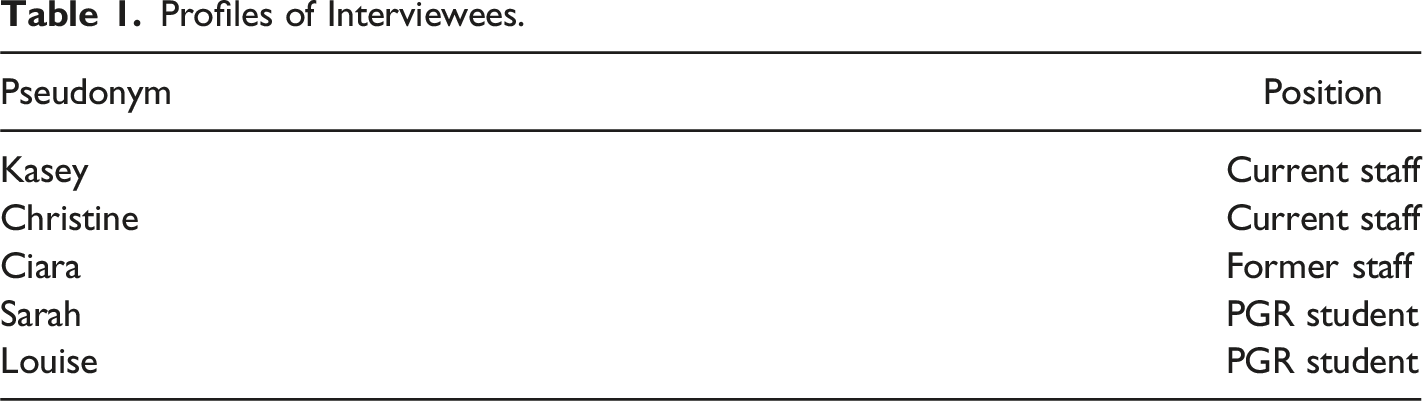
The interviews used prompt questions (see Appendix) and were conducted online using Zoom in BSL. The screen was video recorded so that all interviews could be translated from BSL into written English for the purposes of analysis. The interviews ranged in length from 11.44 – 24.14 minutes, giving a total of 96.02 minutes of interview data across the five interviewees.
The deaf women were asked to consider their perceptions based on their typical work patterns pre-Covid when they were more likely to have spent more time on campus. It is interesting to note that the interviews were shorter than expected, which I observe is primarily for two reasons: (1) because the women often had not really thought about safety issues concerning sexual misconduct so did not feel they had a lot to say about it; and (2) thematic saturation was reached rather quickly in each interview, so the interviews ended naturally when the questions had been fully explored.
The interviewees were current or former academics or researchers employed at Talent University or current/recent PhD students. Each interviewee has been allocated a pseudonym to protect their identity. I conducted a ‘within-case’ analysis (Bhattacherjee, 2012), focusing on key themes that emerged from the data through an iterative process of thematic analysis (Braun & Clarke, 2006).
Results
The initial focus of the analysis was on how deaf women on the Talent University campus feel about safety as women. It became clear, however, that perceptions of safety are strongly linked to being deaf and not able to hear what is going on around them, and the strong intersections between being deaf and being a woman. Four key themes were identified: (i) safety as a woman, (ii) safety as a deaf person, (iii) accessible safeguarding; and (iv) intersectional experiences of safety as a deaf woman.
Safety as a Woman
The perceptions of safety were influenced by the work patterns of the deaf interviewees, who mostly worked Monday-Friday 9-5, so they were rarely on campus outside of conventional work hours when it is quieter or when it is dark. Nevertheless, the point was raised by several interviewees that their feelings would be different if on campus later at night or on weekends when there are less people around.
All deaf interviewees commented that they only really feel conscious of their safety as women in relation to having to walk on the campus in the dark: 1. I was apprehensive about going out because I went to the car park which is not that busy. I felt okay about it, the only thing is it is quite dark. I know I shouldn’t have been staying too late but sometimes you just have to get the work done…When walking outside in the dark, most people go to the right to catch the bus and I had to go the other way… I mean it’s not that far, but that area is quite dark. (Ciara) 2. I usually walk over to the [name] building and I have been looking around for the CCTV but there doesn’t seem to have any at all in that area. Maybe I’m blind I don’t know, but I haven’t been able to see any. This is worrying, especially when there are a lot of students and it’s not their fault, but when the young students walk about with their hoods up, it can make people feel a little bit uncomfortable, a bit nervous… I think I’d be more comfortable walking at the university if they had more CCTV. It is such a small thing but it has an impact on me, especially in the winter when I started going back to the office, it was often raining and dark which would make me nervous walking from the car park to the building. I would just be like let’s focus on getting to the building and then back, it is not too bad now because obviously it is lighter and I can see everyone and what’s going on. I feel like they don’t have enough CCTV and lighting. (Christine) 3. One time I did go to campus to do a presentation as it was streamed in America meaning I had to account for the time difference. For that presentation… I worked until 11 o’clock in the evening. I will admit I was a little bit nervous leaving… and obviously it was quite dark and then I was having to walk for the bus, the walkways are well lit but there was nobody around. It was completely empty. (Louise)
Louise admitted that she had been nervous about being a woman late on campus, and highlighted how women use text messaging as a safety strategy: 4. I was worried about a male approaching me, to be honest. If they did, what would I do? I’m quite vulnerable. I would not know what to do if someone did target me. I think all women do have that thought in the back of their minds, especially in the evening. If there were a lot of people around, then I wouldn’t have had any concerns. I think it was mainly because I was on my own… that time I did stay late a colleague of mine texted to say congratulations as the presentation went well and I texted her back because I knew if I didn’t, she would become worried. She knew I had to walk to the bus on my own to get home since the other people attending were elsewhere in the world. Another colleague actually texted me as well to check I got home safe.
These findings correspond with research on women’s experiences on campus generally and notions of a “chilly campus climate” where women report not feeling safe (Kelly & Torres, 2006), and how they develop (sometimes technological) strategies to support one another to feel safe (Cardoso, et al., 2019).
Interestingly, age was also a factor about whether some of the interviewees felt safe as women: 5. Of course, I’m a woman, but I’m not in my 20s so there are fewer concerns about that aspect as I don’t look young anymore. (Kasey) 6. I think with my age, it is more linked to me being deaf. You hear stories about young women in universities that have been sexually assaulted and it’s quite scary but if you add a deaf woman on top of that, it’s even worse. However, I’m older now, I don’t have… I don’t go to parties, so I don’t have that concern. I would be more kind of worried about someone approaching me and not being able to hear them. Or, if it was my daughter, I would have concerns about her, but I don’t think anyone wants to do that to me! (Ciara)
This is interesting to consider in that reflecting on safety for women, the older participants referred to their age and their feeling that they would be less likely to be bothered. So, there is a perception that sexual misconduct relates to the age of women and perhaps would be more of an issue for students than staff. It is widely reported that female students experience sexual misconduct on campus and students are more likely than others to experience sexual assault on campus (Bondestam & Lundqvist, 2020), but staff are not immune to the experience (Henning, et al., 2017). Nevertheless, it is known that sexual assault does not only happen to young women (Lea, et al., 2011). Yet there seems to be a dearth of research on the experiences of women (of all ages) who are staff on campus to confirm whether this is in fact the case. Furthermore, it should also be acknowledged that sexual misconduct does not only happen towards women and men’s experiences of sexual violence are understudied (Peterson, et al., 2011). In fact, small proportions of men on university campuses do report sexual victimization (Lane Forsman, 2017).
For the participants in this study, however, perceptions of safety as a deaf person appeared to overshadow experiences as a woman.
Safety as a Deaf Person
Although age was considered a factor, participants suggested that safety as a woman was compounded by being deaf: 7. I think with my age, it is more linked to me being deaf. You hear stories about young women in universities that have been sexually assaulted and it’s quite scary but if you add a deaf woman on top of that, it’s even worse. However, I’m older now… so I don’t have that concern. I would be more kind of worried about someone approaching me and not being able to hear them. (Ciara)
A comment from Sarah aligns with what Ciara said, and reveals that for these deaf women their safety concerns are exacerbated because they are deaf: 8. I’ve not had any concerns specifically because I am a female, it is more so because I am deaf.
This highlights how not being able to hear might intensify deaf women’s feelings of (lack of) safety (Crowe, 2017) and the ‘double disadvantage’ created due to the intersection between being a woman, and also being deaf (Altıntaş, 2020; Becker & Jauregui, 1985; Napier, et al., 2023).
With respect to feeling safe as a deaf person, the primary issue reported by participants was being able to control their office environment so they can see the door and who is coming in. 9. There are several deaf people in my office, and no one has their back to the door. We planned it so that we are facing each other and can see the door from where each of us sits. We are not really comfortable having our back to the door as we want to be able to see who comes into the door and be aware of our surroundings. (Kasey) 10. My office isn’t very deaf-friendly, they do not have a doorbell with a flashing light and where my desk is located it means that my back is to the door if someone came in. As I am deaf there’s a good chance that I will not be able to protect myself if an intruder did come in. I’d rather that they installed a doorbell with some sort of a flashing light so that I know someone’s outside, and I can let them in myself… I mean, I’m comfortable working away, but in the back of my head, I do have that sort of nagging thought about the door. (Christine)
Several of them also mentioned safety with respect to not being able to hear the fire alarm: 11. I guess one thing linked to campus safety would be the fire alarm, I used to work with Sarah in the same office and she explained that they do have a sort of pager that you have to wear… But I mean come on we have to wear that all the time!? I usually just rely on hearing people let me know that we need to evacuate the building, but if it is just me and Sarah in the office that is an issue as we’re both deaf… It would be more efficient if they just use the flashing fire alarm lights instead. (Louise) 12. I have actually been to the library to work… and I remember 1 day looking up and there was nobody around and someone did approach me, a staff member and another student who wrote on a bit of paper to tell me the fire alarm went off… It was early in the morning, but I did still wonder why there were not many people around. Obviously, I was the last person left in there. (Sarah) 13. With my experience at [name of other university], I know it is important to ensure that people know I am on campus. This was because there was an incident where I was upstairs having lunch in the staff room which was full of people, and I had looked down just for 5 minutes to read something and by the time I looked back up everyone had left. I just assumed everyone maybe just went back to work as it was around 2 p.m., so I went over to the lift to go down and it arrived so quickly which was quite surprising since I was on the fourth floor. Usually I have to wait for ages. Once I went in, it went all the way down to the bottom floor when normally it would stop at every single floor. Anyway, when I got down to the basement, I could see that there were many people outside, so I thought there must have been a fire alarm. I had to go back up to the ground floor to get out and when I tried to go outside the security officer approached me and was quite angry that I was still in the building. I did explain I am deaf, and no one told me that the fire alarm was going off. (Ciara)
And what would happen if they were to get stuck in a lift: 14. Can they guarantee that someone will come if I’m stuck in a lift? There used to be no Wi-Fi in there, although I have noticed that the Wi-Fi has improved so you can text in there now. This is a concern, especially as I cannot use the emergency button in the lift to call for help. I have also had that fear of being stuck in a lift without the ability to text someone for help, so it is important to know what to do if something does happen and know where to go for help. In terms of safety, knowing how to get out of a situation like that… that’s quite difficult. (Ciara)
Kasey observed that as a deaf person, she has a strategy to always stay alert: 15. I am still aware of my surroundings… just, I want to know who’s around and who’s there. I am naturally just quite observant of who is around as it's just something I need to do to know if someone’s speaking to me or trying to get my attention. So, I do look around a lot.
This chimes with the experiences of (mixed gender) deaf academics from other universities in the UK who discuss changing their office environment or lobbying for an appropriate fire alert system to feel safe because they cannot hear (O’Brien, 2020b).
Another theme that emerged in relation to safety as a deaf person was the accessibility of the safeguarding app on the Talent University campus.
Accessible Safeguarding
Deaf interviewees’ awareness of Talent University safety procedures ranged from none to some, and there was consensus that the notion of safety was not just about feeling threatened by sexual misconduct.
The deaf interviewees were asked if they felt that Talent University SGS and the “Secure Sector” safety app are accessible to them as deaf people. When asked specifically about familiarity with the app, how it works and how and when they could use it, the responses were varied: 16. I met the person who was responsible for the campus space in [my School]… he was very friendly and helpful in making sure that I was comfortable. He showed me the new app ‘safe space’ or…something. (Christine) 17. I will be honest I don’t know how it actually works. (Louise) 18. I never actually had any training on how to use it… I know that if I am concerned about my safety, I can press the button to alert them as to where I am, I think they can track it somehow, like a big brother type of thing. (Ciara)
It is notable that none of the women referred to the app by its name, so despite the visual promotion of the app across the campus it is not embedded within the consciousness of these interviewees.
Most of the deaf women did not know that there is an SMS feature in the app, so that you can communicate with a safeguarding officer via text messaging. 19. It’s interesting about the [safety] app because I am sure [Talent University] have emailed me encouraging me to download it, but I just disregarded it as I just automatically assumed it was inaccessible for deaf people. But now that you’ve explained that they have access using the text feature I want to download it. So, they should add a short statement at the bottom of any advertisement detailing how it is accessible to deaf people as most would assume it is inaccessible without even trying it. (Louise)
And even with a text messaging facility, Ciara noted that it still might not meet the needs of deaf people: 20. The issue with that is texting can be quite slow and if you’re in a situation where you are scared, you can become quite shaky which will make it difficult to text.
But having the app still creates feelings of safety: 21. I was really impressed with that [app]! I was told that you don’t actually have to pick up the call, all you have to do is press the button. So, I felt happy knowing that I had something there on my phone if something did happen. (Christine)
A couple of the interviewees suggested that it would be good to have the app linked to a video relay service (VRS)
6
, so that they could talk more easily through BSL interpreters to safeguarding officers: 22. Because when you’re nervous sometimes you can’t text properly. Especially if someone’s asking you to clarify details, it can make you more anxious and agitated. I think it would also put off the perpetrator to see that I’m signing with someone, they might actually back off… So, that would be perfect if it was linked to a VRS service (Ciara) 23. It’d be nice if they could update the app and have a BSL version and if any hearing person bumps into a deaf person, they can use that app as well to tell them what process to follow or who to contact to help deaf people feel safer. That way we all have equal access to information. Also, if we press the alarm, it would be nice to have two choices to speak or sign, so whoever is on the video call can see what is wrong with me and contact the emergency services if need be… The interpreter from [the VRS] can call the emergency services. (Christine)
The safeguarding system at Talent University is not entirely based within an institutional audist framework (N. O’Connell, 2022) due to attempts the make the app accessible to deaf people on campus. Nevertheless, there is still a gap (Currie, 1994) between the administrators’ understanding of what makes an accessible app and the perception of deaf sign language users. This is because the app has been developed based on hearing cultural norms (O’Brien, 2020a), still relies on written text, and there is no attempt to meet needs for access in sign language (Mastrocinque, et al., 2017, 2020).
It was also felt by interviewees that safeguarding information could be made more accessible by having BSL video translations of the information on the Talent University website, and making it clear that the app is accessible for deaf people: 24. They could even add a picture of an interpreter as well to show that it is accessible to deaf people because if it is just a poster with English text many deaf people will ignore it. (Louise)
Another proposition was that safeguarding staff should be given basic deaf awareness/sign language training so they would know what to do when assisting a deaf person: 25. It would be nice to have security staff that have extra qualifications to work with deaf people such as deaf awareness training. I know that may be a lot for them to take on, but it’s a good opportunity for them to learn about the deaf community and more about us… if security could even learn some basic sign language like “hi, are you okay?”, “what’s your name”, or “how are you feeling?”. You know, basic phrases so they can assist us better. (Christine) 26. One time I did forget my key. That was one thing that I noticed with the communication it was quite difficult as I could kind of tell that the person I approached had a bit of a bad attitude. They appeared to be frustrated with having to write things back and forth, so I feel like they should have a little bit more deaf awareness. (Sarah)
Although Talent University does provide training to staff and students to promote safeguarding and prevent and manage inappropriate behaviour (Bondestam & Lundqvist, 2020), it is clear that a more tailored solution is required for them to understand how to support deaf women on campus.
Sarah went on to suggest that deaf awareness training could be complemented by having posters around the university with some basic signs to raise the awareness levels of communicating with deaf people: 27. Similar to what is in the [name] building, there are posters there with the BSL alphabet and basic phrases such as “hello, how are you?” and “thank you”. It would be good to put some of those in the security office as well… so they can maybe have some posters with fingerspelling or more visual information available.
And finally, Sarah felt that it is important for deaf women to have accessible training about safety: 28. It would be a good idea to have workshops for deaf women on what exactly a safe space is. It would be interesting to look at what safety means for hearing women as they have more privilege and access to information compared to deaf women. It may be that deaf women would not have as much information about what a safe space is or have even experienced a safe and accessible environment, so it would be interesting to compare those two perspectives.
It has been highlighted elsewhere that deaf women need access to information about healthcare, safety and gender-based violence in sign language (Crowe, 2017; Mastrocinque, et al., 2017, 2020; Napier, et al., 2014; Napier, et al., 2023) and this should be no exception in a university context. This theme regarding accessibility, however, reiterates that the burden of ensuring that academia is an accessible place to work/study tends to rest on the shoulders of deaf people themselves (O’Brien, 2020a; 2020b).
An additional issue in relation to accessibility highlights the barriers for deaf women who may also have other disabilities. For example, Christine who identifies as having a disability, notes that: 29. I am deaf and have [a condition that may lead to fainting
7
] so if I pass out or feeling woozy how do I text someone or read the screen?… I may see enough to press the red emergency button but not to respond to messages. It would be great if they had a system that asked for my consent to share my information with them such as, I am deaf, I communicate using BSL, I have [condition]. They should do this for those with conditions that may cause them to pass out like deaf people with vertigo, epilepsy, nut allergies or whatever other health condition it may be. So, they need to think about how to accommodate that.
Interestingly, although Christine had said she was impressed with the safety app (see quote 21), she was not aware of the fact she could disclose her additional disability through a personal care plan, which could be taken into account by SGS when responding to an emergency call. Regardless, Christine’s point reinforces the fact that deaf people’s experiences of violence can be intensified if they have other disabilities (Admire & Ramirez, 2017).
The deaf women’s recommended changes for safeguarding would likely benefit everyone on a university campus. Making such changes would correspond to principles of universal design and design justice that promotes the position that if something works for marginalised communities it enhances the experience for everybody and challenges structural inequalities (Costanza-Chock, 2020).
Although the participants tended to distinguish between their feelings of safety based on being a woman, or being deaf, there was also some recognition of how intersections between these two characteristics could compound their feelings of safety.
Intersectional Experience of Safety as a Deaf Woman
Even when referring to feelings of safety because of being deaf, the interviewees could not entirely separate out the fact that they are women, as they did make reference to men: 30. I don’t know if [feelings of safety] is linked to… the time of day that I tend to work and the campus. Also, the building I am in has a lot of females there, it is not really a male-dominated space but perhaps if I worked in the science or technology buildings, I might have a different experience. But I would say yes, probably more because I am deaf. (Sarah) 31. I would say definitely it is linked to being deaf rather than the fact that I am a woman. Then again, I do feel that deaf males would feel safer on campus. (Ciara)
This circles back to the notion of ‘double disadvantage’ of being deaf and a woman, as Ciara notes that even if deaf men experience the same challenges about not being able to hear they may not experience the same concerns about their safety.
For Sarah, the idea of what it means to be in a safe space for a deaf woman is paramount: 32. For deaf women, it may be that we do not have the right understanding of what a safe space is so we can do more on that to provide more awareness to deaf women so they have a better understanding of what is appropriate. I think most women do have a good understanding of this but there is not much research on whether deaf women do. For example, if a male does something and a female is not comfortable with their actions, we need to ensure deaf women know what they can do and who to report it to. Same with if a hearing person does something a deaf person is not comfortable with, we need to think about how that can be addressed. I think generally we need to provide more deaf awareness, it is similar to when males know what makes females uncomfortable but they still do it anyway. So, training on what a safe space is and what safety means [to a deaf woman] is one area that could be improved.
Sarah goes on to acknowledge the potential parallel intersectional experiences on university campuses of women who are deaf and women who are black: 33. It would be interesting to have a look at what a safe space actually means for different people as we could all have a very different perspectives on this… we can draw some parallels between [experiences of black women on campus] and the experiences of deaf women and safe spaces, especially when you consider issues with communication. It’s interesting because I have worked in many workplaces, but when you have a mix of hearing and deaf people working together like at [Talent University], there can be a lot of communication breakdowns and misinformation, so that’s one thing that I have noticed… it is interesting to think about dealing with the problem rather than dealing with the consequences of the problem.
So, for these deaf women the notion of safety is not straight forward. Although they recognised that their feelings of safety relate specifically to being a woman or to being deaf, the intersection of both characteristics compounds their experience and affects their feelings of safety generally, not only about safety from sexual misconduct. Other intersections have also been mentioned in relation to age (quotes 5, 6, 7), disability (quote 29) and race (quote 33), which may in fact create a ‘triple’ or ‘quadruple’ disadvantage for deaf women rather than only a ‘double disadvantage’. Mention of these other characteristics demonstrates the complexity of the experience for deaf women that warrants being explored in more depth. Table 1
Conclusions
To conclude, deaf women on the Talent University campus generally have mixed feelings regarding their safety. In revisiting the research sub-questions, we can see that: • Deaf women’s safety considerations on campus include accessible safeguarding technology, workspaces where they can see who is entering a room, and visual fire alert systems, in addition to the typical safeguarding practices for women. • Deaf women at Talent University have mixed levels of awareness of the safety procedures and app, with assumptions that it is not accessible for deaf sign language users. • Deaf women at Talent University perceive that the safety app has limited accessibility that could be enhanced with adding sign language features, but the key issue is the lack of promotion of the app’s current accessibility features. • The experiences of deaf women as a minority group on campus, and their suggestions for improving accessibility, could more widely benefit all women on all university campuses through correspondence with universal design principles.
Interviews with these five deaf women at one university reveal that they have a more general view of safety on campus that is wider than just safety from sexual misconduct. Their perceptions of safety are heavily influenced by the fact that they cannot hear, which intersects with the fact they are women and their age or disability. Perceptions of safety also relate to their working environment, the accessibility of safeguarding services to them as deaf people, and the understanding that safeguarding officers have of their information access and communicative needs as deaf BSL users.
Despite best efforts to promote the app, the level of awareness of the safety app was not as high as would be desired and was assumed by most to be inaccessible. Although the safeguarding team have taken steps to ensure that the safety app is accessible through text messaging, there is more that could be done to enhance the feelings of safety for deaf women in terms of providing access to information in BSL and ensuring that safeguarding officers have at least a basic understanding of how best to communicate with deaf BSL users.
Some of the issues discussed by the interviewees are female specific (risk of sexual assault) and others are deaf specific (e.g., fire alarms), but essentially, they report experiencing concerns about safety because of the intersectional experience of both being women and being deaf. These intersectional identities cannot be separated and treated as two binary distinctions.
Universities are set up and run according to hearing/audist norms, and many deaf academics already “feel ambiguous about their position in the wider academy and in their own [universities] specifically” (O’Brien, 2020a, p.754). These findings reveal that this university case study may be illustrative of the social construction of the lack of value of deaf women and their safety on university campuses. The (in)ability for these deaf women to work/study and move around their campus safely illuminates how this ‘disabling environment’ (O’Brien, 2020b) has implications for considering whether university campuses are safe spaces for deaf women. Although we have some understanding of the concept of deaf academic spaces (O’Brien, 2020a) the notion of what it means to have a safe space for deaf women on campus needs to be further examined, as currently the notion of a safe space is socially constructed based on hearing norms.
The perceptions reported by these deaf women are only with respect to the Talent University main campus. Yet this may not be the experience for deaf women on the other Talent University campuses, or at other universities. Like O’Brien (2020b) with his study of five deaf academics, I do not make any attempt to generalise the findings of this case study, as it only reveals the experiences of a small group of deaf women at one university.
This study has focused on deaf women who are staff and postgraduate research students, who do not live on campus and are more likely to be on campus during standard working hours, so their experiences may not reflect those of undergraduate students living and spending time on campus 24/7. Nevertheless, being afraid to work/study late may potentially affect the career progression of deaf women, especially compared to hearing or deaf men if they cannot ‘put the hours in’ needed to get ahead. Although it could be argued that this would also be an issue among hearing women (see for example, O’Connell & McKinnon, 2021), deaf women do have the double disadvantage of having to make decisions about safety because of these two intersectional characteristics.
Some of the scenarios described by these deaf women may resonate with minority ethnic or disabled women experiencing sexism, racism or ableism. But the bulk of the issues described in this study are directly relevant to deaf women as a result of institutional audist safeguarding procedures that rely on written English and sound. Nevertheless, the perceptions of safety and accessibility to safety apps based on intersections between being a deaf woman who also identifies as having another disability have also been acknowledged.
Chapple, Bridwell and Gray (2021) note that the lived experiences of black deaf women on campus can be very different from others. The insights shared in this study are all from white deaf women, which may not reflect the feelings of black and minority ethnic deaf women; another layer of intersectionality that has not been considered in depth in this study but would be important to follow up.
Another intersectional experience not discussed in this study is in relation to class. One participant mentioned that hearing women have what Eckert and Rowley (2013) refer to as ‘audiocentric privilege’ (quote 28). But there was no mention of the class-related privileges that could be experienced by educated, deaf academics who are more likely to have higher levels of literacy than deaf people experiencing safety concerns in other contexts (e.g. because they can read safety literature).
The importance of critically considering intersectional characteristics when examining experiences of safety and sexual misconduct on campus has been emphasised (see Rondini, 2018), but the focus has typically been on intersections between race, gender, sexuality, class, and other social identity dynamics, and intersections with disability and/or deafness has been overlooked. As such, this case study makes a small contribution to intersectionality literature in considering the experiences of deaf women, and to literature concerning safety on university campuses by considering the perceptions of minoritised women.
Footnotes
Acknowledgments
Thank you to all the five deaf women who participated in the interviews for their time and insights.
Declaration of Conflicting Interests
The author(s) declared no potential conflicts of interest with respect to the research, authorship, and/or publication of this article.
Funding
The author(s) disclosed receipt of the following financial support for the research, authorship, and/or publication of this article: This work was supported by the European Commission (2019-1-IE01-KA202-051558).
