




Abstract
This essay began as a keynote I delivered at a sociology teaching conference in the summer of 2023. It focuses on my experiences of right-wing harassment and as both a scholar and teacher working in Florida under recent legislation that targets various foundational sociology concepts and challenges various inclusion practices on college campuses. I offer an assessment of these attacks on our academic freedoms and lay out three skills that sociology specifically can provide students as they navigate learning in environments like Florida.
Personal Reflexive Statement
I am an openly queer cisgender Black woman first-generation academic working at a large public state university in the U.S. South teaching both sociology and African American studies courses. Though this list of identities and activities provides a sense of my social positioning, it also informs how I navigate my teaching and research. Yet, I think it more relevant to this essay to state my ideological and methodological commitments as a multidisciplinary scholar. As a qualitative researcher of identity, racism, family, intimate relationships, digital life and other areas of social inequality, I engage with critical race theory, post-colonial theory, and Black Feminist Thought among other critical literatures on sexuality, gender, and multiraciality. I am committed in both my research praxis and classroom pedagogy to an intersectional and historically contextualized approach. These commitments make me a prime target for harassment in the current political landscape.
I imagine that for many readers, especially those who use social media, there has been at least one negative encounter with folks who are politically or ideologically at odds with you, likely not even for anything you actually said but merely because of the topics that you teach. In the last few years, my personal experience with ending up on the radar of right-wing individuals or entities seems to primarily result from the fact that since 2018, I have been teaching a graduate-level sociology theory seminar previously titled Critical Race Theory and currently titled Sociology of Race and Ethnicity. In this essay, I discuss several of my specific personal experiences with one conservative activist and his supporters, and how these experiences have informed how I think about the valuable skills that sociology can teach our students.
In July 2023, I yet again had the pleasure of being a target of right-wing ire. This pain in my side is a repeat offender: the conservative activist, would-be journalist, and newly minted Board of Trustee to the New College of Florida, Christopher Rufo. Some may have never heard of Mr. Rufo, despite his many infuriatingly kind profiles in papers of record (see Wallace-Wells 2021; Gabriel 2022). However, many readers are likely very familiar with the negative rhetoric around critical race theory, diversity, equity, and inclusion, and even the rights of transgender people and drag queens to exist in public that he has helped to embed within U.S. public consciousness. As Sarah Jones wrote for New York Magazine in (2021), Rufo has played a central role in manufacturing a moral panic over public education in the United States and elsewhere.
One of several outlets Mr. Rufo utilizes to drum up backlash is his subscriber-supported newsletter and his contributions to the conservative magazine, City Journal. On July 14th, 2023, he sent out a newsletter titled “The ‘Chilling’ Effect” with the subheading stating, “Florida’s tenured radicals say that my reporting is making them ‘nervous.’ Good.” It is evident he is quite pleased with the so-called “chilling effect” his efforts and those of his bedfellows have reportedly achieved (Moody 2023; Zou and Kao 2021). This particular newsletter was in direct response to one segment from a July 14th, 2023, episode of the NPR radio program, This American Life, titled “The Florida Experiment.” Act Two of the episode, “Their Eyes Were Watching Tallahassee,” discussed the impact of recent legislative changes around diversity, equity, and inclusion on Florida State University faculty and students. I was interviewed for the piece due to my employment at Florida State, though I am not featured in the final version of the 25-minute segment at all. My name apparently was mentioned by some other faculty who participated in interviews, but only one tenured faculty member was included in the final version of the segment. The journalist who developed this segment had contacted me before Rufo’s newsletter was published to reassure me that I would not be included in the final version and to let me know he had contacted Rufo for a comment and received no reply. This precaution was likely because Rufo had named me in other “reports” before. Therefore, Rufo’s mentioning of me by name in his July 14th newsletter came as a bit of a surprise to both myself and the journalist. Especially surprising was that Rufo seemed to believe I am a “tenured radical” when in fact, I am still an untenured assistant professor. Rufo took shots at several Florida faculty, including scholars who do not work at Florida State; effectively his arguments amount to calling me (and the other faculty) a hypocrite who engages in ideological propaganda. Though I cannot claim a direct connection, Rufo’s newsletter appeared to encourage a few readers to send emails to my university email address instructing me to resign. These individuals did not indicate any ties to Florida State or even the state of Florida, and I had not participated in any other recent news media that would have merited angry emails. Surprisingly, none of these individuals called me a racial slur unlike in my past email or social media run-ins with disgruntled right-wing conservatives. So, I felt these few emails inspired by Rufo’s newsletter were a pretty benign response and could be easily ignored. Even with the lack of direct threats of violence, I did share the newsletter and other emails with my department chair and college dean.
As I have already stated, this July 2023 newsletter was not my first rodeo with Rufo. Mr. Rufo’s February 2023 posts on X, the social media website formerly known as Twitter, (see Figure 1) about my course and other alleged diversity, equity, and inclusion (DEI) programming at Florida State take issue with some select parts of my syllabus. First, he points out that I assign an article from a psychoanalysis journal titled “Whiteness as Pathological Narcissism.” Second, he notes that I include a line in my course philosophy that encourages graduate students considering careers in academia to not wait to be the radical scholars they want to be until later in their careers. Graduate students in my courses or under my mentorship are supported to pursue the topics and interests that are meaningful to them. I create space for graduate and undergraduate students to share the things they believe in during class provided those perspectives are rooted in empirical and theoretical scholarship. That the syllabus Rufo posted was from 2021, as well as the fact that I took that specific psychoanalytic article off the syllabus for 2023 because neither I, nor my students, felt it developed their assessment of whiteness to the extent other readings did, was of no consequence for Rufo’s alleged “reporting.” That this one reading out of the dozens assigned across a 15-week semester was enough to merit complaint is also interesting. He, of course, never reached out to me for comment on my pedagogy. Curiously, the conservative attention to my pedagogy and course content by these external actors are not being bolstered by complaints from my students nor are the concerns related to my undergraduate course offerings.
1
In fact, in the 7 years I have worked at Florida State University I have managed to defy nearly all empirical evidence we have of the racist, sexist, fatphobic and ableist bias of student evaluations (see Heffernan 2022) and receive some of the highest evaluations of any faculty in my department. I also have a bevy of teaching awards. Screenshot of a post from Rufo targeting my graduate theory seminar.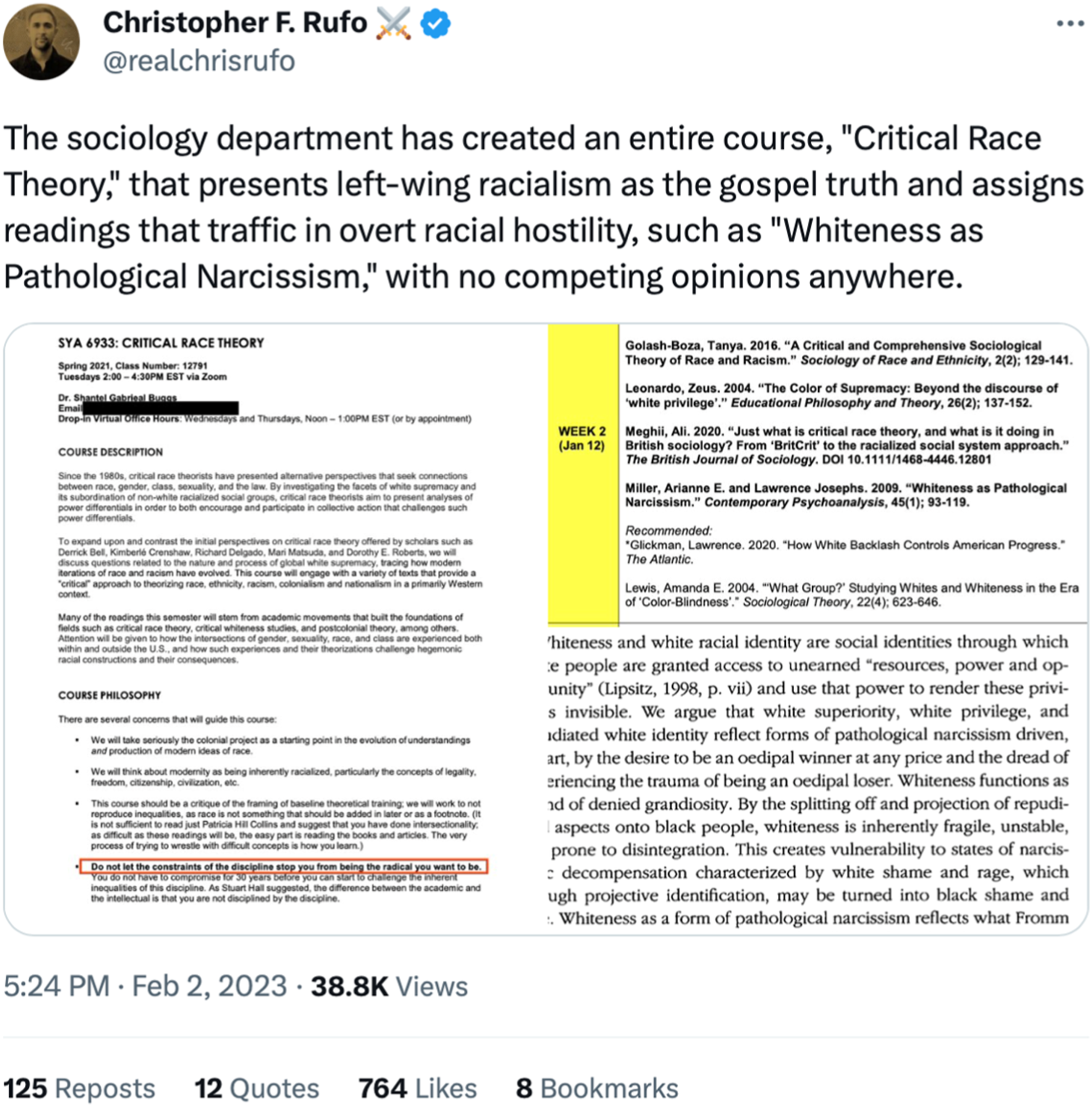
Rufo maintains in his July 2023 newsletter that his investigative report of Florida State – which was effectively a laundry list of any publicly-available document he considered to be DEI or critical race theory – is necessary criticism of left-wing radicalism on behalf of Florida taxpayers. In regard to his February 2023 social media posts, Rufo reduces the concerns my colleagues expressed about not redacting names for fear of targeting to empty complaints from fraudsters who do not want to be subject to the robust criticism and scrutiny of the taxpaying public. While I had no personal concerns about my name being on the documents included in his February posts and accompanying report, I personally found it laughable he did redact my email address as though that was not already public information and easily locatable. Rufo ignores that I already post all my syllabi publicly on my professional website as a practice established well before he gained political prominence. He ignores that people responded to his posts with photos of me (see Figure 2). To what end would knowing what I look like serve if not to potentially target me for violence or otherwise comment on my appearance? My friends and colleagues who reached out to me in a panic to make me aware of my photos being posted had an understandable reaction of fear and anxiety. Rufo and his ilk are knowingly disingenuous when it comes to acknowledging the risks of their rabble rousing. His July newsletter came only mere weeks after a University of Waterloo professor and two students were stabbed during a gender-studies class (Shetty 2023). If he were a true journalist doing his due diligence, he not only would have noted these potential threats, he also would reach out for comment from the very scholars he critiques. Screenshot of a reply to Rufo’s posts.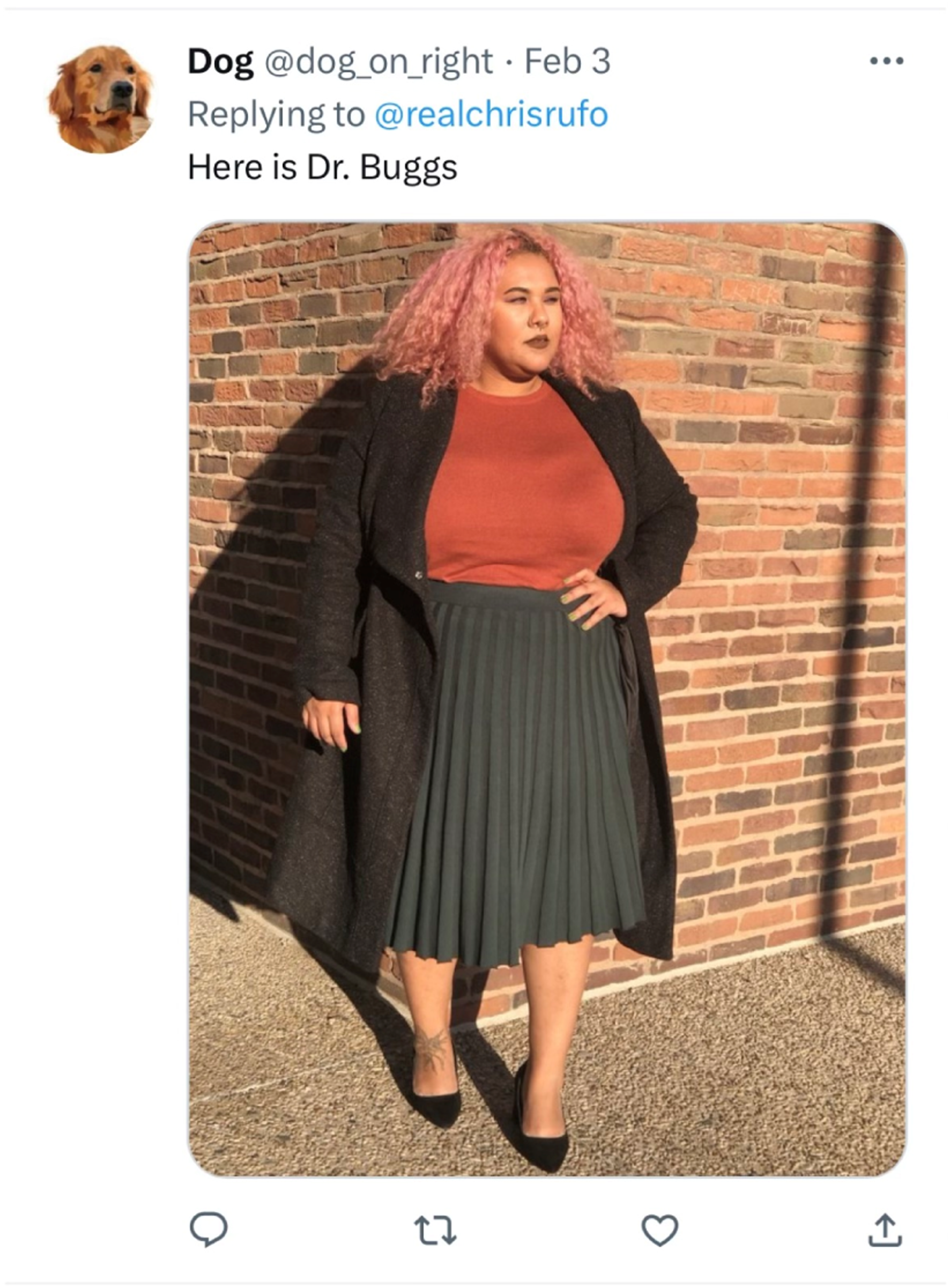
What these encounters have affirmed for me is the serious importance of the work we do in our classrooms every day. In my view, sociology provides the tools for our students to not just understand the world they live in, but to thoughtfully engage with what they hear and see around them. There are many skills that sociology can teach. In the remainder of this essay, I will focus on just three: attention to detail, nuance, and critical thinking. These skills make an important contrast to the faulty arguments perpetuated by the fascists who would completely undermine not only our discipline, but education – especially public education – as a whole.
Developing Attention to Detail
First, I argue that sociology teaches students to pay attention to detail. Sociologists love their data and their methods. As a field, we dedicate a lot of time to considering how to collect our data and analyze it ethically and well. Because we are scientists, we put significant energy into assuring the claims we make are based on what we have observed or measured. Given the encouragement to distribute our findings to the broader public, it is likely you have seen a mainstream news outlet attempt to report on a study’s findings. Perhaps like me, you immediately go to look up the dataset and methodology to see if the news outlet or random social media personality got it right, which they overwhelmingly did not. It has become increasingly clear that politicians do not hold themselves to any standards of accuracy nor do the commentators, bloggers, TikTokers, and independent journalists like Rufo.
An excellent example stems from the recently approved guidelines for teaching African American history in Florida for 6th through 8th graders (Hahamy 2023). Much ado has been paid to the claim that enslaved Africans “developed skills” that they could use to their “personal benefit” after slavery. 2 Asking students to “examine the various duties and trades performed by slaves” such as agricultural work, domestic service and blacksmithing is not necessarily an issue in of itself. But to suggest enslaved Africans only learned these skills via enslavement – rather than bringing them with them and literally being enslaved because they possess these skills – is egregious. The supposed experts (neither of whom are historians by trade) who headed the development of these guidelines were cherry-picked by Governor DeSantis to serve on the Florida Department of Education committee. In response to the public backlash, these experts provided the names of enslaved who allegedly benefited from their highly specialized trades (Solochek 2023). It did not take long for experts to illustrate how nearly the entire list of names provided were people who had never been enslaved in the first place or who had developed their trades after emancipation (Najarro 2023), therefore negating claims that their skillset developed as a result of enslavement.
Students may not know what details are accurate and which are misrepresented. Our students are what some might call digital natives – young people who have come of age while immersed in technology, lending them high level technical skills and learning preferences (Bennett, Maton and Kervin 2008). They are increasingly doing a lot of their learning via social media and online video content (Sivakumar, Jayasingh, and Shaik 2023). We not only have to compete with the kinds of content they are consuming elsewhere from people who are likely to not have expertise, we also must contend with how the actions of policymakers make the news and then get synthesized into soundbites via social media. I have spent more time in my classes these past few years going point by point through TikToks or other social media content that students share with me to fact-check in an attempt to model for them how they can do their own fact-checking. This not only draws in students as fellow contributors to everyone in the classroom’s learning, but it might also be one of the few takeaways that stick with a student who is not as interested in doing the readings.
Not all students will aspire to become sociology majors or attend graduate school in the social sciences. Many are probably in our classroom to fill a graduation or medical school requirement. However, we should still strive to help them think more deeply about what they are consuming and provide them the skills to research it further and specifically, to understand what they find when they do that information gathering. Fostering a healthy attention to detail and being able to recognize willful inaccuracy is one way to accomplish this. There is not much to be done about public figures who intentionally lie because either no one will check them or those that do will be ignored. Students will need to be able to parse this information themselves as they navigate lies from all directions.
Developing Nuance
Next, I believe sociology offers students the capacity to understand nuance. A constant refrain in my sociology courses is that the issues we are discussing are messy and do not always have clear-cut, black and white answers. We are trying to understand individual choice, structural and systemic constraints, and historical influence all at the same time. Because of this, many things can be “true” at once and depending on the issue, there may be very small, subtle differences that for us as sociologists mean we must come to largely different conclusions. If you are teaching a theory course, you may ask students to question what even constitutes the truth in the first place. Students often look to us for the answers not only about course topics, they often want answers about current events. Sometimes they ask questions that require us to speak to many angles rather than our specific opinions, lest we be called biased. Some of us will be or have been working under state legislatures that explicitly require we address “all” sides (see Horowitch 2023). These dynamics force instructors to spend more time considering different causes for social inequality and the evidence that supports or does not support why such inequality exists in comparison to our students.
One way I try to present multiple sides of an issue – even if the difference between positions is small – is to assign competing opinion essays from experts in outlets like Time Magazine or elsewhere that address topics like gendered burdens of domestic household labor or whether rape culture exists. Students read multiple positions on an issue and then come into class ready to discuss. I then can use class to explain various sociological concepts that illustrate whatever social issue we are covering and bring in specific studies that have examined some part of that topic. Some examples include the CDC’s report on racial differences in father involvement with children (Jones and Mosher 2013) or various surveys on trends in self-reported victims of sexual violence. I break the findings and data down in detail during class. I use a lot of graphs and charts to back me up to encourage students not only to look for data to support their own arguments but to also understand how data can be used to tell different or potentially biased stories. This not only develops students’ capacity for understanding subtleties, it also hones their attention to detail.
I find this practice of explaining research data most effective when discussing issues like police brutality with my students. Many of my students come in with an idea about how many Black people are killed by police every year and are shocked when I pull up data from various police violence tracking projects that show large numbers of white people are also victims of police violence. We talk about what it means to be disproportionately represented, while not necessarily being the largest number. We talk about why various stakeholders might have an investment in presenting this problem in different ways. Through that discussion, I help them understand violence in ways that avoid strict binary thinking that suggests it is not a serious concern if unarmed people or people of color are not the largest numbers of victims. We should not necessarily expect to change our students’ thinking, but we can hopefully assist them in being more thoughtful about why they think they things they do, and what they might leverage to explain their position on an issue.
I have often been accused by people on social media or even by my family of splitting hairs when it comes to some issues, such as whether the state of Florida has wholly banned the teaching of Black history – which for the record, has not happened. Imposing regulations that favor a biased or incomplete history is not a ban and yet, banning discourse is all that has dominated our media landscape. This is exactly what we need to combat, even when it comes from well-meaning entities who believe they are on the side of teachers and students. I believe very strongly in making sure that we are accurate in what we mean and the terminology we use. We also must acknowledge how slight differences, say in the phrasing of questions, can get us very different findings. We need our students to leave our classrooms able to “split hairs” and be attentive to small differences.
Developing Critical Thinking
Lastly, sociology offers our students the opportunity to hone their critical thinking. So, what do I mean here by critical? Critical in some settings means the situation is life-threatening or disastrous, that the stakes are high and intervention must be rendered immediately, so people need to think strategically. Critical can also mean critique, an evaluation of strengths and weaknesses but oftentimes, simply manifests as negative judgement. Most education assessments that claim to measure critical thinking are striving to determine the degree to which students are able to engage in objective analysis of an issue and come to a conclusion, naming skills such as problem-solving and open-mindedness. That definition, of course, does not really acknowledge that objectivity is nearly impossible to achieve. More importantly, sociologists have written fairly extensively on critical thinking and whether it is even measurable at all (Grauerholz & Bouma-Holtrop 2003).
Sociology seemingly has its own term for critical thinking: the sociological imagination (Mills 1959). We aim for students to make connections between the personal and broader society, to, as Grauerholz and Bouma-Holtrop (2003) argue, “develop specific sociological knowledge and skills and the ability to use this knowledge to reflect upon, question, and judge information while also demonstrating a sensitivity to and awareness of social and cultural contexts.”
Chris Rufo, Governor DeSantis, and their fellows claim to be invested in “debate” and “robust criticism” as well as purported “classical Western intellectual traditions” (Ceballos and Brugal 2023). Rufo even argues in his aforementioned July 2023 newsletter that there is nothing more American than the right of the people to criticize. But as we have seen, criticism does not necessarily require critical thinking. Class debates can devolve into hostility and hurt feelings if there are not guidelines. So-called Western intellectual traditions do not recognize that there are other ways of knowing and certainly do not set up students to engage with other perspectives in ways that are not antagonistic. This tension is certainly something that comes to mind any time my culture class discusses cultural appropriation. Threading the needle between providing students the chance to provide their perspectives but constraining it by asking them to root their opinion in sociological concepts can be difficult, especially in political contexts where sociological thinking has been reframed as CRT or DEI bogeymen.
How then, can sociology teach our students critical thinking? I have focused much of this essay about teaching our students how to parse information that may be biased or inaccurate and helping them to see multiple sides of an issue. That is certainly part of the work required to develop critical sociological thinking. Professors often use pedagogical tools like in-class discussion or prompted discussion boards to attempt to facilitate this kind of thinking. One thing that stands out for me is that it can be most difficult to get students to understand, synthesize, and explain their readings or other course material, let alone to evaluate something else through the lens of something they read.
Being able to regurgitate facts from a reading or lecture is not the same as having engaged in critical thinking and yet so much of teaching at the college level revolves around this evaluation design! Where sociology perhaps can differ is that we do not need extensive labs or resources to help students apply course concepts to the real world. I have personally had students engage in their own brief observation exercises of public spaces around campus where they try to analyze what people are doing or what their relationships are to each other using concepts from class. I have colleagues who ask students to engage in an analysis of the social worlds of fantasy universes like Harry Potter or Game of Thrones. I have even heard of folks using short video essays or TikTok formats in lieu of written papers or essay exams. There are many creative ways to get students to engage with sociological concepts beyond knowing the definitions of said concepts. However, these kinds of assignments can add extra grading burdens that may be hard to manage for large course sizes or without help from a teaching assistant. To do these assessments well also requires scaffolding over the course of a semester, with consistent modeling of what it means to support an argument sociologically or how a concept can be applied. This necessitates finding a balance between developing our students’ sociological skills and not burning ourselves out with labor-intensive assignments.
Conclusion: Fighting the Fascists Going Forward
We are rapidly seeing the manifestation of decades of political organizing around control of U.S. public education. Florida and Texas will not be the last stops for antagonistic policymaking that demonizes educators and attempts to make teachers at all education levels afraid of stepping out of line. The narrative being perpetuated about professors being ideologues who force students to follow our way of thinking completely misrepresents what it means to teach at the college-level. In striving to give our students the tools to understand data and methods, to unpack long histories of theorizing and conceptualization, to see how concepts can be debunked, to read things they do not agree with and discuss what merits the argument may have with others, to appreciate how there are no singular or simple answers to any question, we are already doing the work that the Chris Rufos and Ron DeSantises of the world argue we should be doing. We are not telling students how or what to think, but we are showing them things that might help them to revise their positions on social issues. We also might not change anything about how they see the world, but we have opened them up to different perspectives. That, too, has value.
That we might assist students in reconsidering what they know to be true, in itself, is the threat. If we continue to produce students who are thoughtful, they are going to question what these politicians and corporations have to offer. They will make demands of the people who are supposed to represent them. It is crucial that we do our part to support our students in this effort not only for the sake of keeping our jobs: we should all resist the misrepresentation of our discipline and our industry because it matters! We should all be invested in learning for learning’s sake and not making our colleges into worker mills that produce only people who will get “good jobs.” Much can be said about how sociology is useful beyond a job in academia or working for the Census Bureau or a think tank. But I caution against prioritizing thinking about how sociology can be useful for employment or writing social policy and the like. We should be equally invested in developing our students as compassionate human beings who will be part of society. I like to believe that sociology can excel at that, too.
Footnotes
Acknowledgements
I am thankful to my many colleagues both in- and outside of Florida for their support, which aided in the drafting of this essay.
Declaration of Conflicting Interests
The author(s) declared no potential conflicts of interest with respect to the research, authorship, and/or publication of this article.
Funding
The author(s) received no financial support for the research, authorship, and/or publication of this article.
