




Abstract
In the United States, the years following the Great Recession were pivotal to the advancement of sustainability solutions to current climate and inequality crises. Despite marked gains in renewables and energy efficiencies following the 2009 American Recovery and Reinvestment Act (ARRA), crises and warnings from the IPCC continue to grow direr. Drawing on James Jasper’s players and arenas strategic perspective, we examine how the context for sustainability action has shifted since ARRA. Much of the context appears favorable. External pressure from climate change, the COVID-19 pandemic, and social unrest intensified the need and resources to act. Market conditions for renewable and efficient energy greatly improved, and public support for government investments increased. Despite the coexistence of many positive trends, a countervailing context exists, including a legacy of inaction, greenwashing, and recalcitrance, which is thwarting the speed in which change is happening.
Personal Reflexive Statements
Jon Shefner’s involvement with green economy scholarship and activism began in 2011. At that time, the Brookings Institute released a report labeling Knoxville, TN as the largest per capita, and second fastest growing, green economy employer. Jon used that data to begin working with UTK, the City of Knoxville, Oak Ridge National Laboratory, TVA, and non-profit organizations to advocate that these institutions collaborate on the creation of good green jobs. Jon’s work in this area benefited from his (then) 30 years of experience not only as a sociologist, but as a labor and social movement organizer. With colleague Jenna Lamphere, they organized several cross-sector forums, and pushed to elevate the green economy higher as an alternative employer. In addition to working with those institutions, Shefner used his connections with the Highlander Center for Education and Research to further push the position, long articulated by coalitions such as the Blue-Green Alliance and the Apollo Alliance, that the ravages of deindustrialization suffered by the US working class could be reversed by a green re-industrialization process that would also help resolve some of the damage of climate change and environmental degradation. Shefner continues in that role.
Jenna Lamphere is an assistant professor of environmental sociology at Texas A&M University at Galveston (TAMUG). Her research and teaching are motivated by the catastrophic effects of climate and social inequity crises. As a graduate student, she became interested in these issues when she started working with colleague Jon Shefner at the University of Tennessee Green Economy Initiative (UTGI). UTGI, as a research and engagement initiative, provided opportunities for both traditional research and public sociology. The work entailed collaboration with the City of Knoxville, the Tennessee Valley Authority, and non-profit organizations, as well as conducting a local green jobs assessment and co-organizing two green economy forums. Lamphere continues her community engagement work as coordinator for the TAMUG Tourism and Coastal Community Development program. As program coordinator, she works with local organizations to provide students with experiential learning opportunities that advance their knowledge and skills in areas related to socio-ecological sustainability of coastal communities.
Introduction
Since early days of climate concern, economic development and environmental sustainability were considered incompatible. Beginning with the 1992 birth of the U.N. Framework Convention on Climate Change (UNFCCC) and the goals espoused in the Rio Declaration, global leaders continually failed to enact change that meaningfully addressed major environmental and social equity problems. Every follow-up meeting, including the 1997 Rio+5 conference and subsequent U.N. Climate Change Conferences, reported the deepening of global problems, yet failed to produce significant policy improvements. Global sustainability efforts largely became seen as a failure. 1 Yet even as global policy failed to advance, academics and activists argued that economic development can be both socially and environmentally beneficial, that there can indeed be green economic growth that addresses working class concerns, such as good jobs with decent pay, benefits, and job ladders (BlueGreen Alliance 2022; Lamphere 2016; Lamphere and Shefner 2015; 2018; White, Dresser, and Rogers 2012).
Paralleling international efforts, over 30 years of national climate policy in the United States has produced modest results. Climate change first entered the public purview in 1988 when climate scientist James Hansen delivered an impassioned speech before a U.S. Senate committee, declaring with 99 percent certainty that climate change was real. Vowing to become the “environmental president,” George H.W. Bush ratified UNFCCC, committing the United States to the voluntary reduction of greenhouse gas (GHG) emissions. While the Bush administration enjoyed bipartisan support for climate action, shortly after President Bill Clinton entered office, Republicans took control of both houses for the first time in 40 years and Congressional attitudes shifted against regulation, emphasizing harm to U.S. competitiveness (Peterson 2004). Clinton’s proposed energy tax, which would have reduced GHG emissions and the federal deficit by US$72 billion was thwarted by Congress (Rosenbaum 1993). Clinton also failed to secure Congressional support for ratification of the Kyoto Protocol, and he left office in 2000 having failed to meet UNFCCC commitments to reduce emissions to 1990 levels.
The greatest gains in U.S. climate policy occurred under the Obama administration. George W. Bush served as president for two terms prior to Obama, but his environmental record was so abysmal that he got dubbed the “anti-environmental president” (see Brechin and Freeman 2004). Believing that there was no greater “threat [than climate change] to our children, our planet, and future generations,” Obama vowed to invest US$150 billion in clean energy (Obama White House Archives 2017). Although initially dismissed as “standard goody-bag politics,” the 2009 American Reinvestment and Recovery Act (ARRA), the stimulus package passed by Congress in response to the Great Recession, got him three-fifths of the way there within 1 month of taking office (Grunwald 2012:39). The US$90 billion in clean-energy investments funded a bit of everything: renewables, efficiencies, transit, grid modernization, clean energy equipment manufacturing, and more (U.S. Executive Office of the President [EOP] 2016). While most funding went towards “shovel-ready” projects, US$400 million was allocated to the newly established Advanced Research Project Agency- Energy (ARPA-E), which supports high-risk, high-reward research. While success will ultimately be measured by outcomes yet to come, indicators are promising; ARPA-E (2019) has funded over 800 projects with US$2.3 billion, resulting in 385 patents, 82 new companies, and US$3.2 billion in private follow-on funding.
ARRA clean-energy investments laid the foundation for a long-term transition towards sustainability, despite the Trump administration’s rollback of nearly 100 environmental regulations and withdrawal from the UNFCCC Paris agreement, which Obama had signed onto in 2015 (see Popovich, Albeck-Ripka, and Pierre-Louis 2021). Since ARRA, clean energy technology costs plummeted and electricity generation from non-hydro renewables increased three-fold, with solar having increased thirty-fold (EOP 2016). Just as importantly, ARRA also demonstrated that clean-energy investments can benefit workers. Over 900,000 job-years were generated throughout ARRA, with annual wages averaging well above the national median of US$44,000 (EOP 2016; Muro, Rothwell, and Saha 2011). While ARRA succeeded in building up new industries and creating green jobs, GHG emissions continued to rise. In order to avoid the critical 2°C threshold set by the Intergovernmental Panel on Climate Change (IPCC), the United States will have to achieve a 50 percent reduction in GHG emissions from 2005 levels by 2030 (The White House 2021a).
What can the past and current moments of U.S. national climate policy tell us about future efforts to address the global climate crisis? In this paper, we examine the political contexts, market shifts, and business responses to understand where this contentious moment in U.S. politics may lead us. The paper proceeds as follows. In the next section, we discuss James Jasper's (2012) players and arenas strategic perspective, which we use to guide our analysis. We then discuss major contextual changes, including: the confluence of major crises and how that impacts policy, government openness, market change, climate activism, and public support. We end with a critical discussion on what these major contextual changes could mean for future climate action in the United States. The major contribution of this investigation is not only that it provides a current diagnosis of policy efforts but also suggests a roadmap for future advocacy and policy design. In particular, we find that the greatest potential for diminishing GHG emissions lies with federal legislation, technological innovation, especially with the growing economic power of renewables and clean energy, and the political power of social movements.
Context, Arenas, Structure, and Players
To examine the political and economic context of U.S. climate policy, and understand how it has changed, we adopt Jasper’s (2012) advice to distinguish the players, arena, and structures that contextualize a field of struggle. Although Jasper’s audience is social movement scholars, we argue that his approach is useful to understand climate policy, which is shaped by geographically and administratively dispersed agents of the state, and actors ranging from fossil fuel corporations, to policymakers, to social movements, and to those who see economic opportunity in climate change response. We are consistent with other scholars in applying theoretical tools often used to explain social movements in explaining other political action and vice versa. Resource mobilization borrowed heavily from organizational studies (Jenkins and Perrow 1977), and the contentious politics paradigm marshaled a variety of conceptual tools to explain multiple forms of political action (McAdam, Tarrow, and Tilly 2001). In this spirit, we use Jasper’s concepts to explain a political and economic arena in which states, social movements, corporations, and others act strategically in ways that include but are not limited to social movement action.
Jasper (2012, 2015a, 2015b) suggests that we recognize the complex strategic conditions and interactions among actors and structure. This provides a route from political opportunity structure models, which Jasper critiques for their inability to differentiate between grievances and opportunities, as well as their conceptual fuzziness in addressing short-term opportunities for action, and the longer term, harder to change, structures that give rise to grievances. For both movements and policy, thinking in terms of complex strategic conditions and interactions allows us to recognize change over time among actors, opportunities, and structures. Thinking in terms of a wider arena and the actors within them also helps us make comparisons about political moments. Examining interactions demonstrates that the state is not static or a monolithic actor, that movements change strategy in response to interactions with adversaries, and that opportunities may expand and contract as markets and ideologies change. Jasper asks us to examine how the players change, and how that influences the strategic context in which they act. How do players’ actions, both favorable and unfavorable to policy, help us understand the current climate policy context? What strategic opportunities have emerged from these actions? Using Jasper’s perspective allows us to give “equal and symmetric weight to protestors and to the other players whom they engage, and by focusing equally on players and the arenas in which they interact” (Jasper 2015a: 9). We argue that the current context of, and potential for, new climate policy can be best explained this way.
The players and arenas strategic perspective has been used to examine movement factions and their interactions with other players (Polletta and Kretschmer 2015), foundations as strategic actors within social movements (Walker 2015), and the contributions of multiple key actors in counterglobalization protests (Scholl 2015). Milkman (2015) finds the perspective promising for labor studies because it lends itself not only to movement emergence and expansion, as previous models have, but also to decline through assault by other powerful players. Milkman warns us, however, that “Players vary in the nature and extent of their power and influence, and unions are at the weak end of the spectrum” (2015, p. 173), and players’ legitimacy varies, both necessary caveats to the perspective. Milkman also reminds us that players’ profiles within the political arena can change over time, a finding consistent with Jasper. Polletta and Kretschmer (2015) use the perspective to help us understand social movement factions, and how they influence movement strategic orientations, interplay, audience, and support, but also how the players those factions interact with also have influence on decision-making. Polletta and Kretschmer, however, find the application of Jasper’s strategic dilemmas less useful in examining movement factions. Probably those using the player and arena strategic perspective closest to our concerns in this paper are Cordner, Brown, and Mulcahy who “provide a more nuanced understanding of how players operate in response to relevant scientific and regulatory constraints, notably the mandatory role of scientific evidence and scientific uncertainty in science policy, and how health and science are understood and constructed” (2015, p. 224). 2
The predominant crisis impacting climate policy is, of course, climate change. Because climate change provides the overwhelming context for policy, we take this as a structural factor, one that impacts every political and economic context, let alone policy, in the foreseeable future. Another structural aspect of the climate policy arena, as in all arenas of U.S. politics, is the relatively closed political system. U.S. politics have long been closed to less powerful members of the polity, through obstacles to voting, the heavy influence of money in electoral politics, the disproportionate impact of low-population states in the Senate, and the absence of a popular vote for the presidency. These features of U.S. politics shape how players can participate and strategize. Ideology too has structural implications, yet demonstrates a speedier propensity to change. 3 We think of markets the same way – while long-lasting, markets change in response to consumer ideologies, technological innovations, and actors embedded in both corporations and the regulatory entities of government. Naming the closed U.S. political system as structural does not suggest these facets of the context are unchangeable but that they are long-lasting and have powerful implications for policy.
In contrast to what we see as structural features, a variety of players participate in the climate policy arena. Notwithstanding the structural elements of the U.S. political system, Jasper and others make clear that not only is the state not a unitary actor, but a variety of state actors may act in contradictory ways over time and place (Jasper 2015b; Krimmel 2015). Because of their longstanding dominance of energy policy, we see fossil fuel corporations as possessing great power as actors, demonstrating a long-lasting ability to influence the state and consumers into resource extraction, despite evidence demonstrating its danger. In this way, the fossil fuel industry is sufficiently powerful that they also serve as arenas for internal action, process, and decision-making, as Jasper remarks, “Players are also arenas” (2015a:12). Other players we refer to are those that make up a changing market, climate activists, and the public.
Jasper’s suggestions prove useful for a current and historical examination of the actors who are shaping climate policy and the structures within they work. Actors change and shape structures, just as structures change and shape actors. The interactional nature of structure and actors means no particular context has either sufficient power or inertia to inevitably create or withstand change. Equally important, though, is the recognition that thinking through the arenas of political change means confronting contradictions. Structures may display contradictions, and actors act in contradictory ways responding to and trying to change structures. Contradictions characterize the kinds of political arenas that we are examining, which makes it difficult to chart a clear path forward for policymakers, researchers, and activists.
A Confluence of Crises
Since 1992, international recognition of the climate crisis created a new policy arena. Jasper writes, “Arenas are where politics occur, at least in Sheldon Wolin’s (1960:16) expansive definition of politics as the place “where the plans, ambitions, and actions of individuals and groups incessantly jar against each other – colliding, blocking, coalescing, separating” (2015a:15). The last 6 years provided a striking confluence of crises that influence how climate policy can be shaped. The most significant, of course, is the escalating climate crisis itself. A recent study measured the economic costs of GHG emissions across the globe and found the United States responsible for US$1.8 trillion of losses suffered in other nations (Callahan and Mankin 2022). As we mentioned, we see this as structural in nature. Again, structures are not stagnant. The speed in which climate impacts have intensified makes that abundantly clear. Other contextual elements have simultaneously made it difficult to respond, including both the closed U.S. political system and corporate dominance of energy provision act against climate policy. Neoliberal governance of the past 40 years additionally manifests in a general aversion to regulation; the Trump administration’s incompetence added substantially to previous administrations’ neoliberal tendencies and weakened climate policy. First, the singular policy triumph of the Trump presidency, its tax policy diminishing payments by the wealthy, continues the neoliberal trend of cutting government revenues. 4 Second, the inaction and gutting of governmental offices further followed a neoliberal path by diminishing personnel committed to a variety of regulatory policies. Finally, as we have seen in the recent Supreme Court ruling diminishing the U.S. Environmental Protection Agency’s (EPA) ability to regulate emissions, the appointment of three business-friendly and regulation-averse justices will impact climate and other regulatory policy for years to come. As Jasper writes, “A society’s history as well as its patterns of inequality shape arenas, as well as shaping what happens in those arenas by affecting what players can bring to those arenas” (Jasper 2015a: 17).
Recent shorter-term crises have impacted climate policy in contradictory ways. The COVID-19 pandemic, for example, demonstrated the agility of the U.S. government in its ability to drive the creation of a vaccine in record time through sweetheart deals with pharmaceutical companies. The capacity to act was again demonstrated with the COVID-19 relief payments made to millions of U.S. citizens, which allowed for family survival and forestalled economic stagnation. Indeed, during the payments, child poverty diminished in unforeseen ways via the child credit tax policy (Drake and Williams 2022). Simultaneously though, the focus on COVID-19 treatment and economic recovery displaced the primacy of climate policy. The Biden administration pursued climate policy through economic development policies that prioritized green economic growth, as we discuss below. But until recently, other climate efforts stymied. Economic recession may also mean that climate policy will again fall victim to another period of deprioritization, as traditional perceptions of economic growth retain primacy.
Again, however, the demands posed by climate change continually define the policy arena in undeniable ways that command resolution. Blackouts in both Texas and California demonstrate that climate extremes are wreaking increasing havoc on energy systems across the United States, regardless of local politics or the particulars of regional grids (Nateghi 2021). Nateghi (2021) points out that grid operators have not paid sufficient attention to climate extremes, nor to the linkages in uses of water, electricity, and gas. The latter inattention creates compounded problems, as outages cascade from one resource to another. Floods and heatwaves across the United States during Summer 2022 confirm the insufficiency of infrastructure to address climate change. The structure of climate change means that strategies, costs, benefits, and risks all shift as a result of interactions with other players in climate policy as an arena of political struggle. Despite the increasing harm experienced across the nation, crises provide opportunity in the climate policy arena. Hardships and grievances matter, both to climate activists, as we see below, but also to policymakers. Recent legislation demonstrates a unique government openness to addressing climate change that may prove crucial.
Government Openness
President Joe Biden campaigned on promises to tackle the climate emergency, rebuild the middle class, and bolster national competitiveness by investing US$1.3 trillion in infrastructure over 10 years. Dubbed the ‘Build Back Better’ Act, the Biden Administration’s framework was a shift from neoliberal doctrine towards economic nationalism (Scheiber 2021). The framework proposed major economic transformation through federal government expansion via large-scale efforts to build up particular industries with the intent of diminishing climate threats, while also rebuilding economic opportunities for U.S. workers. After Biden entered office, his plan ballooned to US$2.6 trillion, including US$1.64 trillion for traditional infrastructural investments in transportation, utilities, and buildings, as well as US$966 billion for less traditional investments in R&D, manufacturing, and human infrastructure (Bhatia and Bui 2021). Although lauded as the “largest effort to combat climate change in history” and as “the most significant effort to … strengthen the middle class in generations,” (The White House 2021b), the bill was opposed by all Republican senators, which prompted bipartisan collaboration on a pared down bill. Democrats also drafted a US$2 trillion budget reconciliation bill that included the human and climate provisions omitted from the bipartisan bill. The reconciliation bill, however, which needed to be passed by a simple majority in the senate, was initially torpedoed by West Virginia senator Joe Manchin III, who has strong ties to the coal industry.
In November 2021, Congress passed the bipartisan Infrastructure Investment and Jobs Act (IIJA), opening a window of opportunity for job creation and climate readiness. Albeit a much scaled-back version of earlier ambitions, the US$545 billion IIJA was still widely hailed as a “once-in-a-generation investment” (The White House 2022). Figure 1 depicts IIJA funding allocations, along with funding priorities for the Build Back Better Act. About half of IIJA allocations are earmarked for transportation (51 percent), with the majority allocated to roads and bridges (39 percent) and the least to connecting isolated communities- mostly communities of color- to major modes of transport (.35 percent). The rest is earmarked for pollution remediation (4 percent) and utilities (44 percent), with the majority of the latter allocated to broadband, power, and water infrastructure (∼12 percent each). These investments are expected to have significant macroeconomic benefits that include GDP contributions, business cost reductions, and increased national competitiveness and productivity. Moody’s Analytics estimated that IIJA will create 650,000 new jobs (Zandi and Yaros 2021), many of which will have low educational barriers to entry and offer good pay and long-term career pathways. Funding Allocations for the ‘Build Back Better’ Act. Adopted from Bhatia and Bui (2021).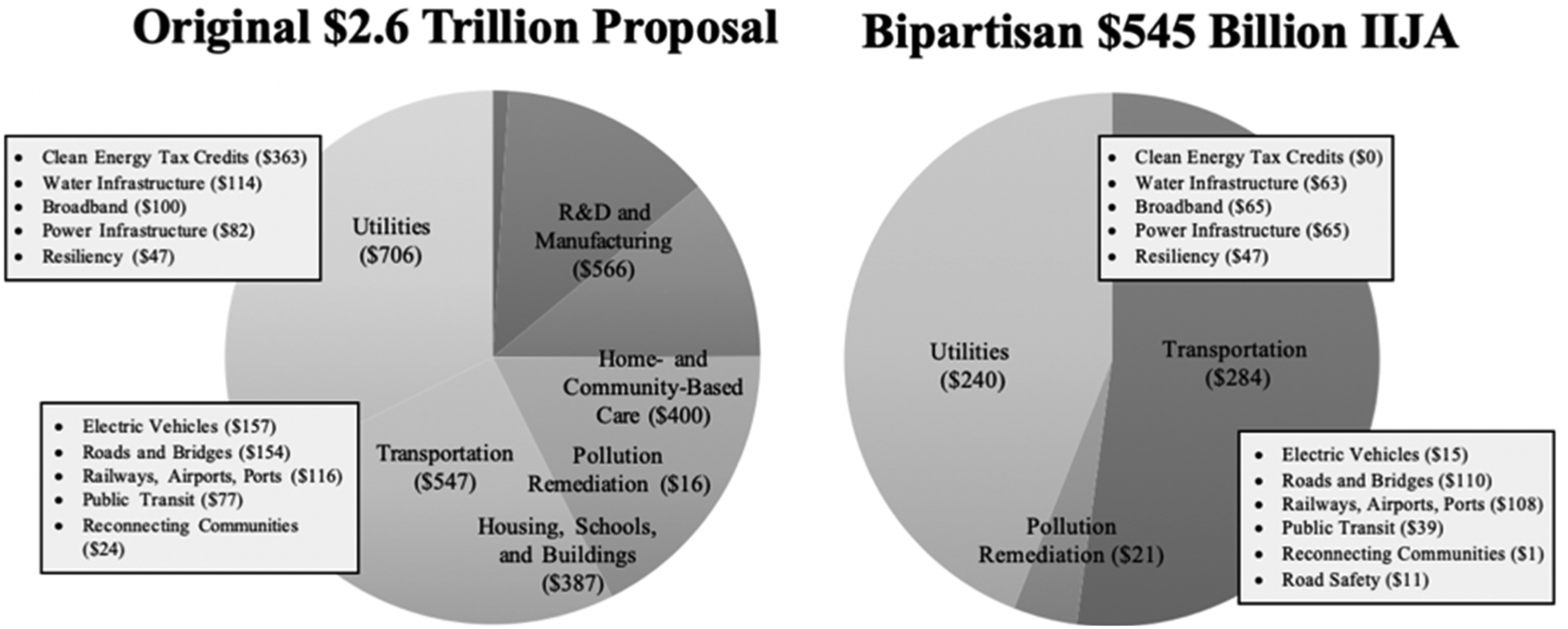
After several concessions to Senator Manchin, in a stunning 11th hour legislative victory in August of 2022, Democrats passed the Inflation Reduction Act (IRA), which although providing a smaller expenditure than planned in the defeated Build Back Better Act, still allows hope for progressive climate policy. The Inflation Reduction Act addresses climate change through infrastructure, consumer, and industry-targeted spending. Although still remaining expensive, the US$370 billion legislation expands the potential of the electric vehicle industry by subsidizing costs for consumers. The legislation also subsidizes electric chargers and the cost of green trucks and buses (Ewing and Penn 2022). When added to previous legislation addressing supply chain issues of vehicle computer chips, the costs of electric vehicles should eventually reduce. The legislation also provides: rebates for purchase of energy efficient and electric appliances; tax credits to firms building new sources of emissions-free electricity; and billions of US dollars meant to “encourage clean energy manufacturing and penalties for methane emissions that exceed federal limits” (Ewing and Penn 2022). Other important elements of the law include requirements that components be produced in North America, which bolstered support by unions (Ewing and Penn 2022). Milkman (2015), using Jasper’s perspective, reminds us that unions can play both insider and outsider roles; certainly, unions representing U.S. manufacturing jobholders have been strong supporters of Bidens green economy policies. The law also funds the EPA with billions of US dollars “to reduce emissions from power plants and helps to fund the development of wind, solar and power sources that don’t emit carbon dioxide” and “also encourages states to adopt California’s aggressive climate plans” (Friedman 2022).
Up to now, lower levels of government have responded to federal inertia by playing an outsized role in addressing climate and inequality crises. Over 600 U.S. cities and 28 states have climate action plans (Georgetown Climate Center 2021; Markolf et al. 2020), and of them, 22 percent and 65 percent of cities and states, respectively, have enacted 100 percent clean energy legislation (U.S. Climate Alliance 2019). California’s recently passed legislation is considered as one of the most far-reaching climate policies passed in the United States. In addition to previous legislation banning sale of gas-powered cars by 2035, California “legislators approved a record US$54 billion in climate spending and passed sweeping new restrictions on oil and gas drilling as well as a mandate that California stop adding carbon dioxide to the atmosphere by 2045” (Plumer 2022). The legislation further mandates the state to cut GHG emissions by “at least 85 percent by 2045, while offsetting any remaining emissions by planting more trees or using nascent technologies like direct air capture” (Plumer 2022).
There is also hope that bottom-up approaches to climate action will produce more just solutions grounded in real-world understandings of localized priorities and constraints to adaptive capacity (Harlan et al. 2015). Environmental justice advocates have long demonstrated the disproportionate exposure of low-income and marginalized communities to harms from toxic waste, industrial pollution, and other unwanted land uses (see Brulle and Pellow 2006; Bullard 2000). In a similar vein, climate injustice is driven by political, economic, and cultural inequalities, whereby the wealthy disproportionately contribute to GHG emissions, the impacts of climate change are felt unequally by the rich and poor, and the policies that guide climate action have unequal consequences (Harlan et al. 2015). Failure to explicitly and comprehensively address such inequalities risks their reproduction. According to Salleh (2010), what is needed is an integrative socio-ecological approach to justice that prioritizes democratic decision-making about resource allocation. Rather than relying on abstract models and generalized knowledge produced by IPCC scientists and others, the focus of decision-making would be based on local struggles over social and environmental justice issues. The intent is that localized decision-making processes, grounded in justice, would result in climate solutions that better reflect the assets and constraints bore by frontline communities.
Although localization of climate action is a positive change from international and federal inertia, relying on cities and states to address crises of this size comes with challenges. First, partisan divides exist at all levels of government. Research by Hess (2012) and others (Basseshes et al. 2022; Coley and Hess 2012) demonstrates that Democratic controlled locales tend to facilitate the adoption of green measures, whereas action in locales dominated by Republican party leadership have been limited. Second, while lower levels of government have a real opportunity to lead, they are limited in reach, authority, and funding (Bream-McIntosh et al. Forthcoming). There is also serious concern as to whether this patchwork approach will add up to meaningful climate action (see Angelo and Wachsmuth 2020; Castan Broto 2020).
Duyvendak and Jasper (2015) and Krimmel (2015), among others, make it clear that the state is not a unitary actor. One need only look at state and federal contradictions on any number of policy issues to demonstrate that, from marijuana to Medicare. Within the state we find instead a variety of “actors sometimes indeed defending the policies of the governance unit, but at other times they or other state actors are found allying with certain specific incumbents against those policies, and at still other times they or other state actors are joining challengers to reshape the entire field” (Goldstone 2015:246). What we have suggested in this section is that clear distinctions in climate policy orientation define recent federal administrations, with the current administration arguably the most pro-green economy in history. Yet because government is not a unitary actor, the accomplishments of this federal administration can be reversed. Local government players, as well as the bottom-up approaches, may provide greater reinforcement to climate policy if the federal administration, and its priorities, change.
Market Change and New Actors
It is clear that technological innovations have significant momentum and are driving market change, having significant impact in the climate policy arena. For example, renewable power is now cheaper to produce and use than that derived from fossil fuels. Falling costs have resulted in increased production of renewables by power plants (Our World in Data 2022). In October 2020, “the International Energy Agency [IEA] declared solar power to be the cheapest new form of electricity in many places around the world, and in particularly favorable locations, solar is now “the cheapest source of electricity in history” (Manjoo 2021). Declines in prices and rates of innovation and adoption in industries such as solar have far outpaced expectations of institutions, such as the IEA (Teske 2020). Indeed, innovations in capturing renewable energy guarantees increasing value compared to fossil fuels, which become more difficult and costlier to extract as resources declines. The renewable energy think tank Carbon Tracker now estimates that renewable energy can fully replace fossil fuels by 2050 (Bond 2021). Infrastructural change, such as grid renovation, are lagging behind renewable energy development, but those kinds of changes can also be prioritized by activist states (Griffith 2021). So too can carbon capture, with advocates working in ARPA-E, as well as in the U.S. Department of Energy’s Office of Fossil Energy and Carbon Management (Tullis 2022). Energy storage remains an issue with renewables, but innovations such as the sand battery continue to emerge more rapidly than before (McGrath 2022).
Even as insufficient cooperation continues to plague U.S. policymakers, businesses increasingly see climate action as an economic opportunity. The IEA estimates that “new activities and investment in clean energy,” as well as “spending on more efficient appliances electric and fuel cell vehicles and building retrofits and energy efficient construction,” would net 25 million additional jobs by 2030 (Teske 2020:17). The investment community appears to have somewhat recognized this potential boon, as sustainable bond investment in 2021 was double that of 2020, while “green bonds – instruments specifically raised for climate and environmental-related projects – rose by more than 400 percent year-on-year to reach an all-time quarterly record of US$131.3 billion” and equity issuance by sustainable companies doubled” (Toole 2021).
Despite both rhetoric and the recognition of the money to be made by business interests, and the growing financial infrastructure to support a green transition, the energy production sector in the United States is lagging behind. In a comprehensive Sierra Club report examining electricity producers that “own half of all remaining coal and gas generation in the US”, not only is this sector continuing to build new gas plants, the renewable plants that they currently plan to build are “equivalent to only 19 percent of their current coal and gas generation and is therefore wholly inadequate to bring about a swift transition to a zero-carbon grid,” leaving those efforts far short of not only their pledges but also of the amount needed to decarbonize the planet (Romankiewicz, Bottorff, and Stokes 2020).
Although the United States is lagging in a green transition, evidence suggests that an impending climate competition with China may accelerate development of green technologies, as well as the reduction of GHG emissions. According to Telang (2023), increased geo-political tension between the two countries, coupled with decades of failed climate negotiations, may have thwarted meaningful cooperation to reach bilateral climate goals set by the 2015 Paris Accord. However, China’s ambition to become a leader in green technologies, including solar, wind, smart grids, and battery technology, is negatively impacting the long-term outlook of the U.S. in such markets. The green transition presents massive economic opportunities that are difficult to quantify but are expected to reach multi-trillions (Tsafos 2022). In response to China’s climate strategy, the Biden administration declared that China should expect “extreme competition” (Associated Press 2021), and recent investments by IIJA and IRA are expected to not only advance climate solutions but also enhance competition with China. In addition to greater funding, U.S. green tech sectors have also received greater policy prioritization from both political parties, as research suggests that Republicans are more likely to support climate policy when framed as outcompeting China (Telang 2023).
Despite the current and prospective boom in the green economy, largely in employment in new transportation and energy sectors, it is reasonable to fear a bust. Some powerful players, specifically the fossil fuel industry, will do their utmost to retard the green transition. As Balsiger (2015), following Jasper, recognizes that when challenged, corporations strike back using a number of strategies. In climate change, denial of responsibility of the fossil fuel industry is a longstanding but now difficult strategy, but certainly that industry has used greenwashing extensively to divert criticism. Other corporate actors genuinely involved in green production are seeking similar strategic position long enjoyed by fossil fuel industries, seeking subsidies for production, application, and marketing of new green products and technologies.
At least two reasons suggest a bust in the green market is not on the horizon. First, the openness of a green economy transition is enormous. If one thinks of the need for new, non-methane producing building materials and subsequent new energy-efficient building construction, as well as energy production, storage, and new grid production alone, the potential is extremely large. Another reason is the potential for government regulation and subsidies to further nurture the green economy. We are cognizant that subsidizing traditional large firms in the deindustrialization age often fails to make employment secure in cities and states. Multiple experiences of auto plants and sports complexes taking large infusions of public cash and then leaving for more moneyed pastures demonstrate that taking public money must be accompanied with enforceable industry promises to stay in place (Shefner and Blad 2018). Subsidies must also be used to maintain buildings in place as well as entice new building, as energy-efficiency driven construction regulations may add substantially to already skyrocketing construction costs (Penn 2021).
Climate Activism
As the window to avoid a 2° Celsius increase closes, there is even greater pressure on not just states and cities but also activists to advance climate solutions. In the United States, climate activism is relatively nascent, with public mobilization beginning with the climate justice movement in the mid-2000s. The early climate justice movement primarily involved indigenous and frontline communities who sought to influence climate policy by engaging in large-scale demonstrations, often in parallel with international climate proceedings (Dunn 2021). Within the last decade, as international negotiations have also stalled, climate activism has become more decentralized and differentiated in terms of strategies and points of leverage (de Moor and Wahlstrom 2019). As argued by Jasper (2012), activists work to pursue their goals in a variety of institutional arenas, sometimes pursuing them directly using extant rules and resources or indirectly by working to change rules and the distribution of resources. While climate activism seldom directly impacts GHG emissions, activists engage in myriad tactics that target nodes of power, particularly policymakers and corporate leaders (Fisher and Nasrin 2021).
According to Tokar (2014), the corporate arena is one of the main venues in which climate activists pursue their goals. Shareholder activism, in particular, is becoming increasingly popular among investors concerned about risks from climate change (Aguirre 2022). While shareholder activism has occurred for decades (O’Rourke 2003), 2021 became a watershed year when Engine No. 1, a small sustainability-driven investment firm with a .02 percent stake in ExxonMobil, launched a proxy battle against the company and won, having convinced three of its biggest institutional investors (i.e., BlackRock, State Street, and Vanguard) that climate inaction was threatening shareholder value (DesJardine and Bansal 2021). While the campaign outcome- the installment of three climate-friendlier directors on the board of ExxonMobil- was unprecedented, Phillips (2021) argued that more importantly, “Engine No. 1’s victory shows there is a path for shareholder activism to change how companies approach issues like racial diversity and the environment, often considered distractions from producing profit.” The victory is also likely to impact how other companies address climate concerns. BlackRock, State Street, and Vanguard collectively cast 25 percent of all votes for directors in S&P 500 companies (Bebchuk and Hirst 2019).
The fossil fuel divestment movement, launched in 2011 by Swarthmore College students and later popularized by Bill McKibben’s 350.org, has been especially successful at indirectly reducing emissions via a variety of strategies to pressure institutional investors to divest from fossil fuels. From the start, the movement worked to delegitimize the industry, effectively revoking their social license to operate, by focusing public attention on the financial system that supports their political aggression to thwart climate action (Hestres and Hopke 2020). From 2016 to 2019, the five largest oil companies (i.e., BP, Chevron, ExxonMobil, Royal Dutch, and Total) spent over US$1 billion on misleading advertising campaigns and lobbying efforts to block climate policy (Influence Map 2019). Over the last decade, the movement has expanded beyond college campuses to include cities, states, investment firms, and more. Since the movement’s first summary report in 2014, publicly committed divestments have grown over 75,000 percent to include 1,485 institutions, representing US$39 trillion in assets (Lipman 2021). The divestment movement has become a market force, with investors increasingly recognizing heightened risks posed by fossil fuel holdings.
The divestment movement also helped create a model of distributive action for youth climate activism (Dunn 2021). Until recently, youths played a limited role in climate movements (Fisher 2019). That started to change in 2018 when over 200 Sunrise Movement activists demanded federal climate action by occupying the office of U.S. Speaker of the House of Representatives, Nancy Pelosi. Sunrise, which became a chief architect and champion of the Green New Deal (GND), reoriented climate activism towards the state. Around the same time that Sunrise was gaining national recognition, two other youth movements came to the fore: Fridays for Future (FFF) and Extinction Rebellion (XR). The former was coined by then 15-year-old Greta Thunberg shortly after she started skipping school to protest climate inaction by the Swedish parliament. FFF quickly gained momentum, having engaged over 14 million activists in climate strikes across 8,600 cities in 224 counties (FFF 2022). Also, in 2018, XR, which engages in nonviolent direct-action tactics and civil disobedience, emerged by announcing a Declaration of Rebellion against the UK government. Like FFF, XR (2021) rapidly grew to over 1,200 active groups across 84 countries. Within the United States, 90 XR (2021) groups have formed and FFF (2022) has held 3,273 strikes. The growing number of youth activists is likely to have important consequences worldwide. The latent effects of youth activism are well documented, including increased political engagement among both parents and peers, as well as greater civic engagement over the life course (Fisher 2019).
While political and economic pressure is mounting, the fact is that less than 1 percent of registered voters in the United States have participated in a climate action campaign (Roston 2022). This may help explain why U.S. climate action has been limited. The strategic project that climate activists are undertaking is a change in the arena itself (Jasper 2015a). So too may concerted efforts by the climate change countermovement (CCCM), a loosely coordinated coalition of fossil fuel companies, affiliated trade associations, conservative think tanks, philanthropic foundations, and public relation firms. Here too Jasper’s strategic perspective is useful in recognizing the opposition of other players who may have greater power in the climate policy arena. “The positions they hold in arenas can help or hinder players, just as their resources and skills can. Like positions on a field of battle, positions in an arena . . . allow players to do certain things by providing them with a distinct bundle of rules and resources … Some positions, like the high ground on a battlefield, are more advantageous than others, and a great deal of contestation centers around getting into good position” (Jasper 2015a:16). The CCCM began to mobilize almost immediately after Hansen’s dramatic congressional testimony in 1988 (Brulle 2014; 2021). This was also the year that the IPCC was formed. In an extensive examination of the CCCM, Brulle (2021) found that since its start, a core group of 179 organizations have participated in multiple coalitions that have lobbied extensively to thwart climate policy, as well as sought to misdirect public understanding by promoting uncertainty in climate change science. As detailed by Oreske and Conway (2010), heeding lessons notably from the tobacco industry, the CCCM has worked to “manufacture uncertainty” about climate science and has been reasonably successful, in large part due to its interdisciplinarity and complexity. Additionally, over 40 years of neoliberal ideology and an even longer expansionist mindset (Catton and Dunlap 1980), furnished the CCCM with “a rich cultural toolkit (Swidler 1986) that allows them to label efforts to reduce GHG emissions as threatening economic growth and prosperity, the free-market system, individual rights, the American way of life, and even Western civilization” (Dunlap and McCright 2015: 303–304). The result has been a rich array of discursive resources that the CCCM readily employs to rally public and political support for their side.
Although CCCM impacts are difficult to quantify, as such organizations routinely work to conceal financial information (Brulle 2018), researchers found that Charles and David Koch, conservative petrochemical magnates, gave over US$145 million to climate-denying think tanks between 1997 and 2018, while ExxonMobil gave nearly US$37 million (Pierre and Neuman 2021). Conservative think tanks, such as the Heritage Foundation, Hoover Institute, and Competitive Enterprise Institute, have developed into a powerful political force that has not only created the illusion that there is a major scientific debate over climate change but also shifted U.S. politics significantly to the right (Dunlap and McCright 2015). Over the last three decades, key CCCM actors, such as ExxonMobil, the American Petroleum Institute, Western Fuels Association, and U.S. Chamber of Commerce (see Brulle 2021 for a more complete list of CCCM actors), have wielded ideological and financial resources to misinform the public and gain privileged access to policymakers (Brulle 2018). CCCM actors has worked to sustain climate inaction, including, for example, having blocked ratification of the 1997 Kyoto Protocol, stymied cap-and-trade legislation in 2009–2010, and more recently having led to the withdrawal from the Paris Accord under the Trump administration.
Public Support
Given the challenges encountered by climate activists and the Biden Administration, it may be surprising that energy and climate action has widespread bipartisan support. Numerous public opinion polls have demonstrated that a growing number of people believe that climate change is a problem and support government action to address it (Energy Policy Institute 2018; Deiseroth and Blank 2021; Leiserowitz et al. 2020). According to a recent poll conducted by Yale researchers, nearly three-fourths (71 percent) of U.S. adults believe climate change will harm people in the United States, with over half (59 percent) of adults believing it already is (Marlon et al. 2022). Similarly, a recent survey by the Pew Research Center found that over two-thirds (69 percent) of U.S. adults want to prioritize developing alternative energies over fossil fuels and favor the country working towards carbon neutrality by 2050 (Tyson, Funk, and Kennedy 2022). Even the so-called controversial GND is overwhelmingly supported by the U.S. public. At least two-thirds of U.S. adults support every major tenet of the GND: lowering utility costs, reducing pollution, increasing sustainable farming, enhancing community resilience, and investing in frontline communities (Deiseroth and Blank 2021). Although partisan affiliation remains the dominant divide, the GND is nonetheless highly popular, enjoying support from nearly all Democrats (83 percent), a majority of Independents (57 percent), and over one-third of Republicans (36 percent) (Deiseroth and Blank 2021).
Despite widespread support, there is concern that the current energy crisis, which is in large part wrought by Russia’s unprovoked invasion of Ukraine, may hinder climate action. According to a recent New York Times/Siena College poll, only one percent of U.S. adults identified climate change as the greatest issue facing the country (Weisman and Ulloa 2022). U.S. adults instead overwhelmingly expressed greater concern over the direction of the economy and rising inflation (Weisman and Ulloa 2022). The Biden Administration’s reaction to the global energy crisis aligns with public sentiment. In addition to passing legislation aiding the transition towards cleaner, domestically-produced power, the Biden Administration also released record amounts of oil from the Strategic Petroleum Reserve, pleaded with oil and gas companies to increase production, and opened public land to additional drilling (Davenport 2022). The United States is not alone in investing in the fossil fuel industry to help weather economic instability. Worldwide, governments have struggled to squeeze opportunity for a zero-carbon transition from the energy crisis. From the European Union to Canada to Japan to Egypt, governments are working to appease public concern by expanding fossil fuel production and infrastructure, which is posed to either lock the planet into a warmer future or contribute to what will become sunk assets (Climate Action Tracker 2022).
It is difficult to assess the impact of public opinion on the national climate policy arena, in part due to the relatively closed and elite character of U.S. politics, as we argued previously in this article. Although we take heart in the public’s increasing concern over climate change, we recognize public opinion is changeable and subject to players’ power and resources. Oreske and Conway (2010) make it clear how corporate power has used its massive resources to mold public opinion. The power of these players in this policy arena make it difficult to assess whether public opinion will continue to bolster climate policy advocates. However, the fact that climate policy advocates embrace capitalist ideologies of economic growth through focusing on greening the current economy suggests that as those corporate powers grow, their influence on U.S. public opinion may provide resources to contest the greenwashing by fossil fuel ideologues.
Conclusion
The major contribution of this paper is that it provides a diagnosis of past U.S. climate action and offers a roadmap for future advocacy and policymaking. Jasper’s model is useful in directing us to recognize the wide arena of policy change and the numerous players involved. Despite that perspective’s avoidance, we continue to integrate the structural elements that are resistant but possible to change. This application adds to Jasper’s model by recognizing contradictions and countervailing tendencies in the context of U.S. climate policy. We also have added analyses of markets and technology within the discussion of Jasper’s arenas. Our analysis of the political moment helps us understand why climate change efforts in the United States have not progressed quicker.
But change has occurred. Applying the players and arenas strategic perspective allows us to see differential and shifting power among players as they strategize to make and resist change in climate policy. The implications of this analysis of players in the climate policy arena are varied. The first possibility, and the one we both heartily hope to avoid, and have worked against, is that the power of the fossil fuel industry remains entrenched enough that climate policy goals are stymied. We believe this is unlikely, but the efforts to roll back Biden infrastructural policy by Republicans during the debt ceiling conflict suggest this remains a possibility. Second, the power of green infrastructural players may increase to such an extent that technological progress may retard and eventually reverse climate change, without winning the progress for U.S. workers that we and others have advocated for. Third, and what we have argued for in other examples of our work, is that climate activists, unions, and government are able to coalesce sufficiently to not only successfully push for progressive climate policy, but also for increased worker rights, wages, and security. We elaborate on what will determine those outcomes below.
The countervailing tendencies are evident in different levels of state policy. Were California’s policies to be adopted nationwide, we would be looking at much more favorable climate outcomes and could even claim some leadership in the global fight against the climate crisis. As we have seen, national policy, with the exception of ARRA, has lagged behind. The recently passed IIJA and Inflation Reduction Act raises hopes for a climate policy that not only cuts emissions but also promises attention to the labor market. The political question is how various actors, from movements, to unions, to fossil fuel lobbyists, to voters in Congressional, local, and presidential elections will respond to the new policy arena. The greatest obstacle to continuing remediation of climate change in the United States remains the political and economic power of the fossil fuel industry. That industry, through massive lobbying expenditures and ideological warfare (East 2017), continues to do its utmost to control federal climate policy. As our examination of the arena suggests, continuing crises that hurt U.S. citizens (e.g., floods, heatwaves, power outages, forest fires), combined with the increasing economic power of new energy industries and the political power of activists and organized labor, may shift the context in such a way that diminishes the power of fossil fuel advocates. Can the alternative energy political power match the power of the fossil fuel industry? Upcoming elections will answer that question. It is likely that Democratic party strengthening will further drive progressive climate policy. It is a much surer bet that if Republicans win the next national elections, climate progress will stymie. Between the ongoing power of the fossil fuel industry, which often manifests in greenwashing, the legacy of previous inaction, and supply chain issues, climate policy advocates continue to be up against a very stubborn foe.
The technological moment is contradictory. The huge increase in clean energy products and processes is notable, but pre-existing grids are insufficient to exploit the new technology. Additionally, the power of the fossil fuel industry continues to define the focus of even emerging energy technology. A question we cannot resolve here is: how important are market conditions and lowering costs to the advancement of sustainability solutions, versus the power of the fossil fuel industry? A positive sign is the readiness of green energy firms to capture U.S. US dollars preceding the Inflation Reduction Act. A 2015 analysis suggests that the likelihood of large corporations using those incentives is very real: “The largest recipient of grants and allocated tax credits is the Spanish energy company Iberdrola, which acquired them by investing heavily in U.S. power generation facilities, including wind farms that have made use of a renewable energy provision of the 2009 Recovery Act. Iberdrola’s subsidy total is US$2.2 billion. Other top grant/allocated tax credit recipients include NextEra Energy (parent of Florida Power & Light), NRG Energy, Southern Company, Summit Power and SCS Energy, each with more than US$1 billion” (Good jobs First 2015).
We know that neoliberal policy militates against progressive climate policy by its very willingness to continue to profit off human needs. Froud and colleagues (2017) demonstrate that once neoliberal tactics such as outsourcing become embedded in national economic policy, the possibility of achieving social needs or disrupting neoliberal state policy diminishes. This finding suggests that if we are to progress climate policy in the manner needed, there will have to be new waves of regulation with state enforcement backing it up. It has become only too clear that, for the most part, private interests will not back away from fossil fuel energy unless forced through rigorous regulation by the state.
Here too we find contradictory possibilities. Democrats have promised bills that would ease and speed the building of large facilities aimed at clean energy production. Language used in the new Inflation Reduction Act was carefully designed to withstand challenge by fossil fuel industries and sympathetic judges who are challenging decades of established law, such as the Clean Air Act: “according to legal experts as well as the Democrats who worked it into the legislation, explicitly gives the E.P.A. the authority to regulate GHG emissions and to use its power to push the adoption of wind, solar and other renewable energy sources” (Friedman 2022). The extreme anti-regulation status of the current Supreme Court increases the importance not only of this kind of legislation, but also players such as social movements, states and cities, and market innovators. Yet the potential for speedy action may put movements in the uncomfortable position of having to accept the easing of some regulatory processes and environmental law to facilitate widespread new use of green energy. In sum, we believe our analysis suggests that great potential exists to diminish GHG emissions through legislation, technological innovation, and the pressure of social movements. There is a clear path to a positive outcome. But that path faces tremendous obstacles from powerful actors with a great deal to lose.
Footnotes
Declaration of Conflicting Interests
The author(s) declared no potential conflicts of interest with respect to the research, authorship, and/or publication of this article.
Funding
The author(s) received no financial support for the research, authorship, and/or publication of this article.
