




Abstract
Pickens County, SC residents experienced disruptions to the state of their household food security status during the COVID-19 pandemic. Through job losses, work hour reductions, and the increased responsibilities of childcare due to school closures, low-income households were forced to adjust their food provisioning habits and food budgets in order to maintain food security. As national and regional food insecurity rates rose from pre-COVID-19 pandemic rates, a need arose to research how households managed their food security status. In order to address this research, the National Science Foundation (NSF) provided funding for qualitative research. As a result, thirty-nine semi-structured interviews were conducted with sixteen low-income Pickens County, SC residents. Through these interviews, and subsequent coding procedures, several themes emerged suggesting how these households attempted to maintain food security during the COVID-19 pandemic. These themes include the use of supplemental government support payments such as P-EBT, the expanded Child Tax Credit, and Economic Impact Payments. These themes also include the use of an improved emergency food system, such as school meal deliveries and drive through food pantry services. Through these mechanisms, it is believed that the Pickens County, SC food insecurity rate was able to remain stable during the COVID-19 pandemic.
Personal Reflexive Statement
My research interests focus on the food insecurity status of Pickens County, SC residents; and the ability of county residents to navigate reduced food access opportunities. These research interests coincide with studying the local emergency food system and the local government, and their capacity to provide increased food access opportunities through legislative action and/or simply transporting food to low-income residents. I have employed a mixed-methods approach to review these concepts, including survey research; focus groups; and semi-structured interviews. I have written this paper, specifically, in order to capture the ‘real-time’ struggles faced by low-income households during the COVID-19 pandemic. Every household in the U.S. has experienced the difficulties of daily life during the COVID-19 pandemic, and this article is my attempt to provide insight on how a set of low-income Pickens County, SC households were able to survive during one of the greatest crises of the recent past. As this research relates to me, I have developed a deep connection with Pickens County, SC food systems participants. Through this research, I believe that I am able to give back to this community in meaningful way. I have had the pleasure of working with low-income residents, food distribution leaders, community organizers, and academics on the task of improving the Pickens County food system. These interviews with sixteen low-income residents are a portion of the work I have engaged in to study local food systems. It is clear from this research that at the household level, government/social supports such as the Child Tax Credit, Economic Impact Payments, the emergency food system, P-EBT, and unemployment benefits were significant forces that provided low-income households with the tools needed to manage their food security status. Without these supports, many of the households under study in this research would have become food insecure during the COVID-19 pandemic. This research, in part, allows me to show my appreciation toward the community and the help that the community has provided me with over the last four years.
Introduction
Food insecurity is defined as the inability to consistently access healthy and affordable food (Feeding America, 2022). It is important to emphasize that the definition of food security includes the capacity of individuals/households to access food so they can live an active and healthy lifestyle. Thus, when considering an individual's food security, the individual should have access to enough food (quantity) and to healthy, nutritious food (quality). To review the effects of the COVID-19 pandemic on the food security status of low-income families, this research reviews semi-structured interviews with food insecure households. Specifically, through coded theme analysis, this article examines the ability of these food insecure households to manage limited resources during the COVID-19 pandemic. Examples of household practices to secure resources can include government support, the emergency food system, and finding part-time or temporary work in order to feed the household. The main themes that emerge from interviews are that the COVID-19 pandemic directly or indirectly reduced the employment incomes and/or increased the childcare responsibilities of these households, making it difficult for interviewees to consistently obtain healthy and affordable food for every household member.
This research focuses on the food access behaviors of low-income Pickens County, SC residents. Specifically, the research question posed for this article is as follows: how have low-income Pickens County households managed food security during the COVID-19 pandemic? In this article, the term “management” is used to represent a household’s ability to maintain food security through one or more of several strategies. These strategies are typically changes in shopping behaviors, financial, and/or social, depending on the resources available to the individual.
The Pickens County, SC portion of this study began in September 2020 (during the COVID-19 pandemic) and was completed in August 2021. Interviews and survey data were collected from low-income residents of Pickens County to determine whether they were experiencing increased, stable, or decreased food security during the COVID-19 pandemic (and why this change occurred or did not occur). In total, thirty-nine interviews were conducted in Pickens County with sixteen separate individuals. Each interviewee was interviewed either once, twice, or three times over a year-long span, depending on their willingness to continue interviewing. Following the completion of these interviews, each interview was coded for themes using qualitative analysis software. Through interviews and qualitative analysis, we may better understand the choices made by a specific population (low-income Pickens County, SC residents) to manage household food intake during the COVID-19 pandemic.
Literature Review
Food Security
Food security is a relatively common term used when discussing poverty and communities. Food security deals with the concepts of food access and food entitlement (Maxwell and Slater, 2003, p. 532). The United States Department of Agriculture (USDA) defines food security as: access by all people at all times to enough food for an active, healthy life, and includes, at a minimum: (1) the ready availability and safe foods and (2) an ability to acquire acceptable foods in socially acceptable ways (e.g., without resorting to emergency food supplies, scavenging, stealing, or other coping strategies) (USDA, 2019).
According to the USDA (2020a), food security is categorized by four measures: high food security (few “food-access problems or limitations”), marginal food security (some indication “of anxiety over food sufficiency or shortage of food” but no changes in diet or amount of food consumed), low food security (indication of reduced food quality but little indication of change of amount of food consumed), and very low food security (indication of “disrupted eating patterns” and significant changes in amount of food consumed). As described in the next section, food insecurity can result from inadequate or missing policies and programs at the federal, state, and local levels of government.
Household Food Insecurity Management Practices
The primary focus of this article is to understand the ways in which low-income Pickens County households managed their food security status during the COVID-19 pandemic. Therefore, it is important to review the literature on how similar households may typically manage their food insecurity status outside of the COVID-19 pandemic. Much of the literature on household food insecurity management practices specifically suggest that financial management skills are important predictors for a household’s food security status. For example, Gundersen and Garasky (2012) suggest that financial management skills are directly associated with a household’s ability to maintain food security. Specifically, the authors suggest that one of the more important factors in predicting a household’s food security status is “confidence in one’s financial management skills” (Gundersen and Garasky, 2012, pp. 1868).
Chang, Chatterjee and Kim (2014, pp. 511) provide a similar series of recommendations in their research, suggesting “personal finance counseling and education” for households at risk of food insecurity could improve food security status. This is because the authors found that those households with low liquid assets (relative to household income) were at an increased risk of food insecurity, regardless of household income level (Chang, Chatterjee and Kim, 2014, pp. 510). A substantial finding from these authors is that regardless of household income, a household’s ability to maintain relatively high rates of liquid assets compared with income/debt associates with greater food security status. These findings indicate that financial management skills can directly lead to greater household food security status outcomes.
The literature also suggests that engaging with nutrition education is another practice households can employ to reduce the risk of food insecurity. To be precise, the Expanded Food and Nutrition Education Program (EFNEP) notes that nutrition education can help households to improve food security: through a series of hands-on, interactive lessons wherein program participants learn and are encouraged to improve food and physical activity behaviors in accordance with USDA/U.S. Health and Human Services (HHS) Dietary Guidelines, HHS Physical Activity Guidelines, USDA’s Food Guidance System, and public health priorities, especially those related to improving nutritional health and food security (USDA 2013).
Dollahite, Olson and Scott-Pierce (2009) support this claim, that engagement with nutrition education associates with improved household food security status, through their research suggesting that nutrition education is a predictor for household food security status. The authors provide evidence suggesting that the amount of EFNEP education received by participants from the state of New York consistently associates with increased rates of participant household food security (Dollahite, Olson and Scott-Pierce, 2009).
Prior literature on the ways in which households manage their food security status typically revolves around education, whether that be financial education or nutritional education. The literature suggests that households with more financial confidence and skill (for example, the ability to keep high levels of liquid assets) are more likely to be food secure than their less financially attuned counterparts. The same is true with nutrition education, as those households who take more nutrition education courses through the EFNEP are at an increased likelihood of food security as compared with their less nutritionally educated counterparts. These household food insecurity management concepts from the literature coincide with the definition of food security, as food security is necessitated by the ability to access healthy (nutritious) foods in socially acceptable ways (typically using financial means).
Regional and Local Food Insecurity Trends
The U.S. South Census region 1 experiences some of the highest levels of food insecurity in the nation. Feeding America (2020b) released a report on 2020 food insecurity rates by state and county. In 2020, the four states with the highest rates of food insecurity were each from the U.S. South Census region. These included Mississippi, Arkansas, Alabama, and Louisiana. Further, this ranking remains unchanged from 2018. Feeding America (2020b, p. 5) notes that each of the five counties with the highest projected food insecurity rates are counties in the U.S. South Census region. These include Jefferson County, MS; Issaquena County, MS; East Carroll Parish, LA; Kusilvak Census Area, AR; and Holmes County, MS (Feeding America 2020b, p. 9). In total, the 2019 U.S. South Census Region food insecurity rate was 11.2%, slightly higher than the overall U.S. rate of 10.5% noted above (USDA, 2020b).
Although food insecurity has been a historic and contemporary concern for the U.S. South, food insecurity rates in Pickens County, SC have remained relatively low. According to Feeding America (2020a) the 2018 Pickens County, SC food insecurity rate was approximately 10%. This indicates that about 12,530 people in the county experienced food insecurity in 2018. Thus, the food insecurity rate in Pickens County, SC is not as high as that of the region within which it resides, the U.S. South Census Region, which had a 2019 food insecurity rate of 11.2% (USDA, 2020b). Although Pickens County food insecurity rates are lower than those of surrounding areas, it is still useful to conduct a case study of food insecurity at the county level to identify the unique challenges and characteristics of Pickens County, SC.
Pickens County, SC
Pickens County, SC is an urban county in northwest South Carolina (U.S. Census Bureau, 2010), in which approximately 64% of Pickens County residents live in an urban environment (U.S. Census Bureau, 2010). Although the county is classified as urban, there are significant portions that exhibit rural characteristics, specifically located in the northern part of the county, while the southern part of the county contains many of the county’s major population centers. There are three primary industrial sectors: agriculture, education, and manufacturing.
Pickens County (population 126,884) (U.S. Census Bureau, 2019) is a steadily growing urban area with adequate employment opportunities and education services. It should be noted that Pickens County has a disparity in amenity access, specifically regarding public transportation. This is important to consider because access to public transportation can reduce local food insecurity, specifically for low-income and African-American households (Baek, 2016, p. 124). Through an area transit system, the southwestern portion of the county is provided with consistent and easy access to public transportation. Unfortunately, the areas outside of the southwestern portion of the county are devoid of public transportation access. This is problematic when considering the presence of food insecurity in the county, as described in the following section, because public transportation is a useful infrastructure for reducing food insecurity.
According to Feeding America, Pickens County’s 2018 food insecurity rate was approximately 10% (Feeding America, 2020a). This means that about one in ten Pickens County, residents did not have access to food that provided for a healthy and active lifestyle. Ultimately, this article aims to address this problem. Fortunately, the Pickens County food insecurity rate is lower than that of the 2018 U.S. average (11.5%) (Feeding America, 2020a) and the 2018 South Carolina average (11.8%) (Feeding America, 2020a). Still, food insecurity is an issue Pickens County should continue to address as changes occur within the region.
Food Insecurity During the COVID-19 Pandemic
According to the World Health Organization (WHO), the COVID-19 pandemic was declared “a public health emergency of international concern (PHEIC)” on January 30, 2020 (WHO 2021). From January 2020 through 2021, the COVID-19 pandemic affected many aspects of daily life in the U.S. and abroad, including food security. During the early stages of the COVID-19 pandemic (2020), Feeding America (2021a) suggested that U.S. food insecurity rates were approximately 13.9% (marginally below their peak during the 2008 Recession). This is a three percent increase from one year prior, when the food insecurity rate was 10.9% in 2019 (Feeding America, 2021a). The one-year difference in food insecurity rates suggests the dramatic effect the COVID-19 pandemic had on U.S. society.
Although sufficient data are not yet available on the state-level and local-level increases in food insecurity during the COVID-19 pandemic, additional national-level data suggest discouraging food insecurity trends. Jones (2021, p. 6) suggests that food insecurity likely increased during the COVID-19 pandemic, and these increases may be evidenced by increases in food assistance dollars provided to struggling families. Jones (2021, p. 12) notes that monthly Supplemental Nutrition Assistance Program (SNAP) and Pandemic Electronic Benefit Transfer (P-EBT) redemptions increased considerably in 2020 (peak of $9.5 billion) as compared with the 2017-2019 average ($4.9 billion). Although P-EBT was introduced specifically because of the COVID-19 pandemic, Jones (2021, p. 15) notes that much of the P-EBT increases are reflective of substitutions that households likely made in lieu of reduced access to school meals and other food assistance avenues. Increased U.S. food insecurity rates between 2019 and 2020, and increased food assistance dollars provided by the U.S. government between the 2017-2019 average and 2020 are both evidence of the effect that the COVID-19 pandemic had on household food insecurity in the U.S. A more detailed discussion on financial support provisions by the U.S. government to low-income households is as follows.
Specifically, there are three examples of the U.S. government providing emergency support payments during the COVID-19 pandemic: the expansion of EBT food payments; the expansion of the Child Tax Credit; and the introduction of Economic Impact Payments (stimulus checks). Each of these supports were provided through the American Rescue Plan Act of 2021 (ARPA). The expansion of EBT food payments was primarily performed as a function of the closed school system, as the government devised a plan to deliver Pandemic Electronic Benefit Transfer (P-EBT) payments to school children who were eligible for free or reduced price lunch or lived in a SNAP participant household (USDA, 2022). The goal of these payments was to offset the school meals children would “lose” through their absence from school during the COVID-19 pandemic.
P-EBT payments could be accepted at grocery stores, as the payments were added to regular EBT cards used for SNAP payments (Bauer et al., 2020, p. 3). In their research on the effects of P-EBT payments during the COVID-19 pandemic, Bauer et al. (2020, p. 5) estimate that between 2.7 and 3.9 million children were saved from “hunger” directly due to P-EBT payments. It should be noted, however, that Bauer et al. (2020, p. 5) emphasize that the hunger mitigating effects of P-EBT payments typically lasted only a week, and the effects declined in the second week after receiving the payment. This is in part because P-EBT payments averaged between $250 and $400 per household depending on the state (Bauer et al., 2020, p. 3). Ultimately, it seems that the P-EBT payments provided marginal and short-term support for low-income households during the COVID-19 pandemic.
During the COVID-19 pandemic, the U.S. government provided additional support payments to households by expanding the Child Tax Credit. This expansion included an increased payment to households with children and the increase in child age eligibility (from 16 years old to 17 years old) (Shafer et al., 2022, p. 2). Through their research, Shafer et al. (2022, p. 4) found that after the first distribution of Child Tax Credit payments were made, household food insecurity decreased by 2.1% for all households. Further, Shafer et al. (2022, p. 4) notes that during the period between June 23, 2021 (before the payments had been made) and August 2, 2021 (after the payments had been received) household food insecurity decreased by 4.4% for households with children. These data suggest that necessary changes to the Child Tax Credit were made through the ARPA, allowing the Child Tax Credit to facilitate a marginal reduction in household food insecurity during the COVID-19 pandemic. U.S. Census Bureau data (Giefer, 2022) support this conclusion by noting that there was a five percent increase (30% to 35%) of households with children claiming “difficulty meeting expenses” between the months where the Child Tax Credit was distributed.
Similar supports provided through the ARPA were the Economic Impact Payments, or stimulus checks. These “checks” were direct payments, varying from about $500 to $1,400, to eligible U.S. citizens during the COVID-19 pandemic (Taylor, 2021, p. 3). Households used these payments differently, typically according to the resources the household already had at their disposal. For example, Boutros (2020, p. 8) notes that while lower-income households were more likely to use their payments for direct spending purposes, higher-income households were more likely to save their payments and repay debts. While the goal behind developing the Economic Impact Payments was to follow the Keynesian model by stimulating the U.S. economy through the broad provision of disposable income (Taylor, 2021, p. 4), the use of Economic Impact Payments differed from the use of P-EBT payments and Child Tax Credit revisions because this was not a targeted effort (Boutros, 2020, p. 19). Specifically, while other COVID-19 support payments targeted certain groups, the Economic Impact Payments were a broad attempt to inject money into the economy by incentivizing short-term consumer spending. Although the stimulus checks were not as targeted a response to the COVID-19 pandemic, Boutros (2020, p. 8) suggests that the primary items that consumers purchased with their Economic Impact Payments were food items. This finding may indicate that the Economic Impact Payments helped to alleviate food insecurity during the COVID-19 pandemic for some U.S. households.
The COVID-19 pandemic also affected the emergency food system, specifically food pantries and the distribution of school meals. Food pantries in Pickens County were required to adjust their provision services so as to feed consumers while maintaining social distancing procedures. Food pantries in Pickens County were able to do this by offering drive-through access, whereby consumers would not have to leave their car to receive food supplies (United Christian Ministries, 2020; 5 Point Church, 2021). Further, the closure of public schools was potentially a problem for children relying on school meals as a nutrition source. In response, the Pickens County School District provided school meals to all Pickens County children through school meal deliveries at traditional bus stops, and school meal pick-ups at school/church locations (Fox Carolina, 2020). These adjustments made to the emergency food system were necessary so as to provide low-income households with the same affordable food access they had prior to the COVID-19 pandemic.
Methods
Study Design
This research was a part of a multi-university effort to study the effects of the COVID-19 pandemic on low-income households in urban and rural settings throughout the eastern and central United States. Officially titled the Food Insecurity Responses, Solutions and Transformation project (hereafter referred to as the “FIRST study”), was sponsored by the National Science Foundation (NSF) and organized by a team of social science researchers at North Carolina State University. The FIRST project included researchers from NC State University (NCSU – representing North Carolina), Clemson University (representing South Carolina), Mississippi State University (representing Mississippi), Michigan State University (representing Michigan), and South Dakota State University (SDSU – representing South Dakota). Each university employed a research team to interview low-income households from one urban county and one rural county in their respective states. The Clemson University research team (representing South Carolina) chose to interview low-income residents from Pickens County (urban) and Allendale County (rural). This project was approved by the Clemson University IRB in Summer 2020.
Since the Clemson University research team worked in conjunction with NCSU on this project, NCSU funded the research incentives for each interviewees’ participation in the interviews ($25 per participant for each interview). In total, one researcher was responsible for all thirty-nine Pickens County interviews, which included recruiting interviewees and administering interviews. Contact information for potential interviewees typically came from local organizations that the Clemson University research team had previously worked with, such as: the Family Promise of Pickens County; Pickens County food pantries; and the United Way of Pickens County.
Data Collection
Demographic Characteristics of Pickens County Participants in the FIRST Study.
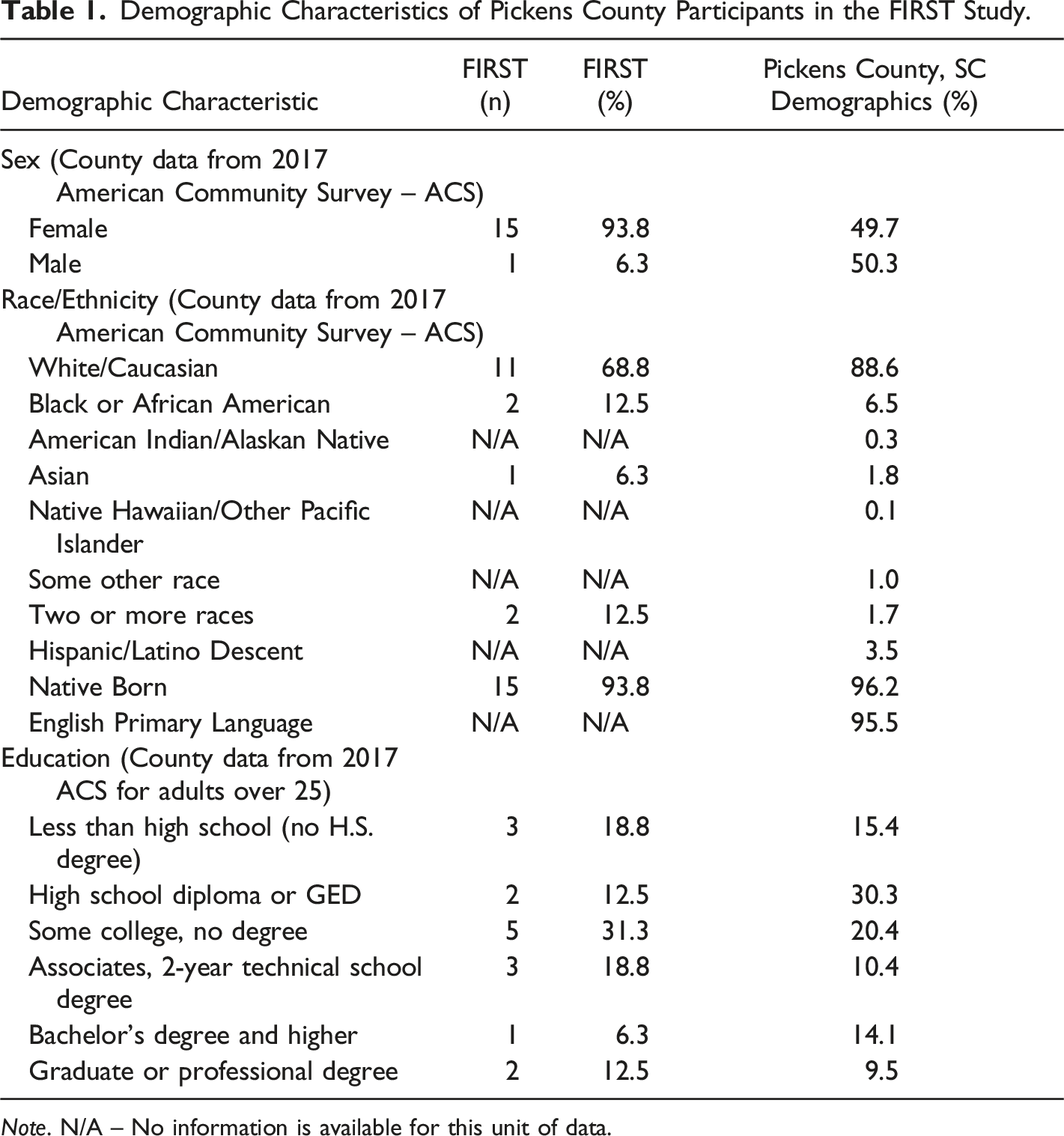
Note. N/A – No information is available for this unit of data.
Once an interviewee was pre-screened, they were interviewed between one and three times with each interview lasting no more than ninety minutes. Each interview had a separate guide associated with it. Interview one included ten open-ended questions on how the household has endured the COVID-19 pandemic. Interview one included a forty-two-question closed-ended background survey at the end (administered by the interviewer). Interview two included twenty open-ended questions that partially dealt with photos the interviewee had taken during their time between interview one and interview two. These photos add a “photovoice” qualitative element to the research. Interview three included fourteen open-ended questions on how the household had endured since the prior interview. Interview three included a closed-ended background survey at the end (administered by the interviewer). At a minimum, about six months passed between interviews one/two and interview three (for those interviewees who participated in a third interview). Considering the amount of time that had passed between the first/second and third interviews, interview three was substantively similar to interview one, as interviews one and three similarly asked respondents to talk broadly about their current situation (jobs, school health, relationships, housing, etc.). Interview two was unique, as it specifically focused on the household’s food situation, using the photovoice aspect as a platform to discuss the household’s eating and food shopping habits.
Analysis
In order to obtain transcripts for each interview, the Clemson University research team used internal funding to pay for transcriptions of the thirty-nine interviews from audio. These transcriptions were then “quality controlled”, a process which involved removing all names, addresses, and other personal/identifiable information related to the interviewee’s household and/or research team. Interview analysis was then conducted using Dedoose Version 9.0.17 (2021). This Dedoose software allows for researcher team members from across universities to upload content and code the same content simultaneously online. Considering the scope of the research at hand (five separate universities from five separate states), the ability to store and edit data from one online location was helpful. Through Dedoose, two Clemson University researchers coded excerpts from the thirty-nine Pickens County interviews using a codebook designed (and used) by the entire FIRST research team from each university. These codes were applied to corresponding excerpts from each interview, and the results were reviewed in Dedoose.
Dedoose analysis software was used to analyze the data from Pickens County FIRST interviews. The software titled “Code Charts” provided a range of methods to analyze the data, such as code clouds and quantitative code application tables. These methods were essentially several separate methods for determining the frequency of codes applied for each theme (and within each transcript). In total, the FIRST research team developed twenty-five separate codes to apply to each associated excerpt. These methods are valuable for visually identifying which of the themes were most frequently found within the data, and how these themes co-occurred with each other throughout the interviews. Findings from these analysis methods are discussed in the following section.
Results
Through analysis, the most prominent codes that associated with local household’s ability to manage food security were COVID – Social, Food Provisioning, and Economy/Money. These codes respectively associated with the behaviors, food shopping patterns, and resources necessary for Pickens County, SC households to maintain food security during the COVID-19 pandemic. As was expected some codes were applied more frequently than others. For example, there was little discussion of Disability (identified in 1.4% of the total excerpts coded), Race/Ethnicity (identified in 2.3% of the total excerpts coded), or Religion/Spirituality (identified in 2.4% of the total excerpts coded) throughout the thirty-nine interviews. This was to be expected, as the interview protocol and survey guided the discussion towards the topics of food budgeting, cooking, employment, childcare, and government assistance. Further, each interview was conducted during the COVID-19 pandemic and the interview protocol strongly encouraged the discussion of how the pandemic was affecting daily life. In part due to the nature of the discussion topics, the following codes emerged as specifically prominent through the data: COVID – Social, Food Provisioning, and Economy/Money. The following sections contain a summary of these themes and examples of how respondents provided them during interviews.
COVID – Social
When analyzing the coded interview transcripts, it became clear that the COVID-19 pandemic had affected every household under study. This is because the most commonly coded item had been COVID – Social, a code defined through the codebook as capturing: “any discussions of the social or behavioral impacts of the pandemic and any pandemic-related shifts in activities/behaviors/emotional or social states of beings.” Of the 1,433 total excerpts coded, 825 had the code COVID – Social applied (a rate of 57.6%) to them. These effects of the COVID-19 pandemic ranged from interviewees having COVID-19 themselves to losing work hours due to the COVID-19 pandemic. Further, this code addressed the social behaviors that respondents may have used to manage their household food security status. The following quote exemplifies a household’s use of their social sphere was able to help them manage their food security status: “Possibly my dad [provided help during the COVID-19 pandemic]. Like I said before, he’s not going to let my kids go without. He is going to make sure they have what they need. Christmas dinner, we were planning that or whatever. Now granted, he’s helping with that, I’m not supplying everything for that. And it’s basically him asking ‘What do you need me to bring? What do I need. Do I need to give you money on anything?’ And that sort of thing. So he is definitely helping out with that”
This household suggested that they relied on the respondent’s father for food and money at the Christmas dinner. The household includes the respondent (a single mother) and her two children, with consistent help from the grandfather who does not live in the home. While the household was relatively financially stable, the respondent had recently changed jobs in order to work from home (due in part to childcare. However, the job change resulted in wage reductions which led to some financial difficulties. It seems that the respondent relied on the father’s financial support (food and money) to manage their household food security status during the COVID-19 pandemic.
Several households in the research discussed using their social networks to access food, whether it be because the help was needed or simply welcome. The following quote describes a household that did not necessarily need the food support from family, but found it useful nonetheless: “[T]wo of my aunts lived together and they cleaned out their pantry the other day because they’re just not home a lot. And so they brought us three boxes of food. Just all kinds of staples and non-perishables and so I don’t think it was intentional but things like that helped.”
This household, with three working adults living in the home, suggested that they did not need the support but it did help the household to manage their food security status. The following quotes are from a household which did need help due to financial instability: “Increased [eating at someone else’s place like a family or friend] because of money…Increased [relying on others to get groceries for the respondent] slightly because of money.”
The respondent who provided these answers indicated that their household required food and money supports from social networks outside the home. The household composition included the respondent (a recently divorced single mother who works in the fast-food industry) and three children. The household was seemingly on the brink of food insecurity at the time of the interview, and external support from friends and family was necessary for the household to manage food security.
Food Provisioning
Although the COVID-19 pandemic affected all aspects of life (and can be interpreted in this study as having a predominant effect on household life), the focus of this article is to determine how the low-income Pickens County households were able to manage their household food security status during the COVID-19 pandemic. The second most commonly coded item in this research is Food Provisioning, a code defined through the codebook as: “any discussion of how people acquire food, including by buying it, bartering, growing it, or receiving donations.” Food Provisioning was identified in 531 of the 1,433 total excerpts coded (a rate of 37%). This includes the discussion of growing or cultivating one’s own vegetables, fruits, and meats. However, this code excludes the discussion of purchasing foods at restaurants. The reason that this code excluded the discussion of purchasing foods at restaurants is because this was an agreed upon standard set by the entire multi-university FIRST research team. Examples of the discussion of Food Provisioning include an interviewee referencing their use of food pantries, an interviewee describing changes in the grocery stores they shop at; and interviewees talking about meals provided to them by the school system through school bus deliveries. The following quote describes an interviewees’ experiences with accessing food during the COVID-19 pandemic: “When COVID first started, I was struggling financially, so [I accessed] the crap I ate at work, and that was pretty much it. And then once I got my apartment, I was able to go to friends’ houses and eat. And then once I got the EBT, I was able to actually, I actually make more meals now than I did before. Just because I didn’t have the extra money to get all the little stuff like the butter and the stuff that I normally wouldn’t buy unless I had extra money. So, we had a lot of peanut butter and jelly instead, and stuff like that.”
The above quote, provided by a single mother living with three children, exemplifies the difficulties in accessing foods through traditional methods. The interviewee is a full-time employee at a fast-food chain. It is clear that when the interviewee used her own income to purchase foods, they could not afford healthy meals and were left to eat “crap” and “a lot of peanut butter and jelly”. However, the household experienced an improvement in their eating habits when they had access to food from friends and increased EBT payments. The following quote describes the household’s eating habits once the options for food from friends and EBT arose: “now I’m able to eat more. And the macaroni and cheese and stuff in the pantry. That was actually given to me. And now, we haven’t been eating a lot of that kind of prepackaged stuff. Unless it’s just me or something. But I’ve been making more like brussels sprouts and stuff when the kids are with me. So, that’s [the macaroni and cheese provided as a gift] actually been in the pantry for a while, just because I’ve tried to eat more vegetables instead of macaroni and cheese and stuff.”
Again, the household was struggling to consistently purchase healthy foods when the only source of income was a full-time fast-food job. Once the household had access to foods from friends and EBT payments, the interviewee was able to purchase vegetables and even store excess foods.
This was a common theme throughout the interviews, that of not being able to rely on one or two incomes (typically from manual labor and/or service sector work) for food security. Instead, these households relied on additional income sources to attain food security. Additional income sources included support from family/friends, government assistance, and the emergency food system (food pantries and soup kitchens). Really, the COVID-19 pandemic encouraged many households to take advantage of these services as additional money supplies from the government were stimulated into the economy. For example, one interviewee describes the changes in their shopping habits as follows: “at the time we were not drawing any kind of benefits like food stamps or the school lunches, they provided the meals and stuff. We weren't drawing anything like that. So, I think honestly at the time my biggest concern was that. And so, food was pretty impactful, but then they quickly developed the meal where they would get each student a breakfast and a lunch every day. And so, we would swing by and pick those up. And then when I actually went out on leave I realized I don't have an income now. So, we should qualify for benefits, for EBT benefits, and of course we did. And so, once we secured that and once we kind of got into the rhythm of going and getting their school breakfast and lunches every day, it definitely was not as hugely negatively impactful to us as I know it was for some people. But we had to get those things taken care of for it to be that way.”
To reiterate, this household was shielded from the COVID-19 pandemic because of EBT payments and the emergency food system (daily school meal deliveries). These supports provided the household with access to foods that would have otherwise not been accessible (due to limited employment incomes). The respondent goes on to describe their food provisioning situation prior to their EBT access: “Well, before food stamps it was more like we’ve got $40 to spend, so we could go to Ingles [which is closer], but we’re going to get more if we go to Walmart [which is farther].” However, one respondent was disappointed with their EBT access, as they had to wait about six months to receive any benefits: “That [waiting for EBT access] was a huge disappointment for me, as far as the statewide level. That system has to be fixed. Because, you have people that are out there that don’t really need it, that have no problem getting it… And me, as a single mom of three, literally I was having to eat dinner at people’s houses every night because I have no food at my house. I’m sitting here begging these people [government] to help me, and they dropped the ball.”
This individual had difficulty accessing EBT benefit throughout 2020 and was displeased with the amount of time it took her household to finally receive the payments.
Through analysis, it becomes clearer that low-income households in Pickens County, SC required more than employment incomes to continue shopping at traditional grocery stores. Further, additional food provisioning options such as the emergency food system (including the use of food pantries) provided needed support as well. One change to food pantries during the COVID-19 pandemic was the availability of a drive-through option, allowing consumers to avoid viral exposure: “It was fairly packed [at the food pantry]. A lot of people was there and it was a long line, but they were very organized. We filled out paperwork and then you get a sticker and then you get in line. And the line moved very fast. I was there less than an hour… and I had my baby with me so they got me two boxes and they carried it out to my car and put it in my trunk for me.”
Food pantries were required to change their practices as a result of the COVID-19 pandemic, typically leading to a more efficient process with less physical contact.
Economy/Money
Household finances were also a theme that was coded for in the data. The third most commonly coded item in this research is Economy/Money, a code defined through the codebook as: “discussions of general economic patterns or trends, the finances or economic situation of a group of people ("rural community"), and discussions of money or finances as they relate to a particular person or household.” These discussions include national trends such as the poverty/unemployment rates, as well as individualized trends such as household income and government benefits. Economy/Money was identified in 456 of the 1,433 total excerpts coded (a rate of 31.8%). The discussion of Economy/Money typically involved the discussion of food prices, the receipt of COVID-19 stimulus checks and/or Child Tax Credits, and the discussion of household budgets as they relate to changes in employment incomes. Regarding the effectiveness of government support payments, specifically the revised Child Tax Credit and Economic Impact Payments, respondents typically found them useful. One respondent mentioned “these stimulus checks, they have been helping quite tremendously.” Another respondent reiterated this sentiment: “I think the stimulus checks they did [help], I’m sure that helped a lot of people. And now the Child Tax Credit checks, I think those helped a lot, especially with single parents.” However, the Child Tax Credit and the Economic Impact Payments typically did not have the capacity to address losses of long-term incomes.
An example of an excerpt with the applied Economy/Money code includes the following quote from a mother who had been laid off due to the COVID-19 pandemic: “I think the biggest struggle is trying to get everything on schedule because I’m used to about $600 every two weeks, so where I’ve had to adjust to that. I have that for the whole month so… Money, yeah. Money [is the household’s biggest struggle] because my husband’s having to work extra because he’s having to help make up what I’m not bringing in.”
The respondent goes on to suggest that there were times during the COVID-19 pandemic where she was concerned about the lack of groceries in the household, and the household’s inability to purchase more: “Me and my husband discussed it [not being able to afford more groceries] because it was making me kind of panic because we have kids here. So, I don’t like it [groceries in the household] being that low at all. So, it would kind of make me a little ill at times just because I get so stressed out about it”
Due to the fact that the respondent had recently been laid off because of the COVID-19 pandemic, the respondent’s husband’s income was forced to provide for the entire household; including the respondent, two children, and a grandparent. The loss of the respondent’s income was putting pressure on the household finances. The respondent indicated that there was a significant decrease in food shopping: “Before the pandemic, it [food shopping] was several times a week. Now it’s once a month.” Although the household was not yet in a state of very low food security, the household was marginally food secure and possibly suffering low food security at the time of the interview.
The household addressed the income reductions in part through SNAP usage: “Probably [use SNAP] may until December because I’m hoping about the second or third week in November I’m going to try and go back to work somewhere…I talked to a friend of mind and they’re hiring managers and since I already have manager experience from work, I was either going to try that or the work down here by my house is looking for managers or regular employees.”
The respondent clearly wants to go find work again to increase the household’s income, but while that is not an option the household is partially relying on SNAP benefits. Further, the household utilized the stimulus checks and unemployment benefits while the respondent was unemployed: “[T]hey’re only giving me $144 a week unemployment. So, by the time what I got to pay I ain’t got no extra money and I’m used to having extra money.” Again, these changes were directly due to a recent lay off and reduction in household employment income. Further, it should be noted that the recent lay off in this household was because the grandparent who is living in the household tested positive for COVID-19, causing the respondent and her teenage child to be laid off from their jobs (the teenage child had been able to quickly find additional part-time labor). The household managed their food security status through supplemental incomes, almost exclusively provided by the government (SNAP, stimulus checks, and unemployment benefits), while the respondent’s husband was forced to become the household’s primary income earner. Before the respondent was laid off, the respondent was the highest income earner in the household, further indicating the dramatic shift in household finances that resulted from their unemployment.
The COVID-19 pandemic did not affect each household in the same manner, however. Some households were protected from the effects of the COVID-19 pandemic through their jobs and relatives that could assist with childcare. The following quote comes from a respondent working as a nurse, with a husband who works in fast-food and four children (younger than eighteen years old) in the household: “He's [respondent’s husband] at work, I'm back at work. We haven't really been affected by the pandemic in that we have not been able to go to our respective jobs. I'm a nurse so I don't have that luxury either way. He's been back at work. We are making enough money between us at this point that we don't qualify for SNAP benefits and stuff like that anymore. So, we're securing food. We put it in our monthly budget now instead of having the other supplementary type stuff. But we're doing good. We've got food. Yeah, we're doing good.”
This household, which has eight people including the respondent’s mother and brother, has been shielded from the negative effects of the COVID-19 pandemic thanks to employment in the medical and restaurant fields. Further, the household benefited from the childcare labor of the respondent’s mother (the grandmother of the four children), as no one in the household was required to stop working or pay for childcare. With the support of three working adults (respondent, respondent’s husband, and respondent’s brother) and one childcare provider (respondent’s mother) the household was able to support four children without monetary losses or a reduction in work hours. However, this household was relatively fortunate to have such protections, with many households suffering the economic effects of both job loss and paying for childcare/increased childcare responsibilities.
Discussion
Pickens County, SC has a relatively ordinary food environment. Pickens County is an urban county (U.S. Census Bureau, 2010) with a food insecurity rate similar to that of the national average (Feeding America, 2020a). In Pickens County, one has the means to access numerous providers from the emergency food system. However, these amenities were at times not enough to sustain all low-income households from the crisis which was the COVID-19 pandemic. As employment opportunities, educational opportunities, and social opportunities decreased, many low-income Pickens County households were left with an inability to maintain food security. The employment incomes which allowed households to make regular trips to the grocery store were reduced. Further, the public-school childcare responsibilities that allowed single parents to work were reduced. However, as a result, many aspects of the national and local food environment were able to improve so as to keep low-income households’ food secure (or at least close to food security). These include efforts made by the federal and state governments to provide households with increased resources through P-EBT payments, adjusted Child Tax Credits, and Economic Impact Payments. At the local level, the emergency food system adjusted its delivery of services. The Pickens County school district provided a mobile delivery system (through school buses) so that meals were dropped off at regular school bus pick-up sites. Local food pantries provided drive-through access so that individuals could collect food without leaving their cars. These factors provided many low-income Pickens County households with the necessary buffer to maintain household food security during the COVID-19 pandemic.
This research poses the question of how low-income Pickens County residents were able to manage food security during the COVID-19 pandemic. Through this research, it was found that these residents specifically addressed food security management strategies through changes to their social behaviors, changes to their food provisioning habits, and changes to their household finances. For example, both financially stable and unstable households were able to utilize their social networks for food and money. These external social supports, whether major or minor, were able to help households manage their food security status. Further, households that had not typically relied on the emergency food system (i.e., food pantries, food stamps, school meals) found themselves using these services as integral portions of their households eating behaviors every day. Changes to daily life during the COVID-19 pandemic caused these households to adjust the manner in which food was provisioned in order to manage their food security status.
Additionally, households utilized the child tax credit, stimulus checks and unemployment to manage their food security status. In one instance the household dynamics changed, whereby the primary income earner (the respondent) was laid off, forcing the household to rely on government support and forcing the respondent’s husband to become the new primary income earner in order to manage household food security. Fortunately, some households were shielded from financial instability during the COVID-19 pandemic and were able to manage their food security status simply by being able to maintain their jobs and consistent working hours. Unfortunately, the previous scenario was more the exception than the rule in this research, as eleven out of the sixteen interviewee households lost income in some manner during the COVID-19 pandemic (due to either childcare, job changes, layoffs, no one worked to begin with, or reduced hours). All of these households were required to use strategies, whether these strategies be the use of social supports or changes to the way in which they collect food/money, in order to manage their food security status.
It is clear from this research that at the household level, social supports such as the Child Tax Credit, Economic Impact Payments, the emergency food system, P-EBT, and unemployment benefits were significant forces that provided low-income households with the tools needed to manage their food security status. Without these supports, many of the households under study in this research would have become food insecure during the COVID-19 pandemic. Therefore, it is recommended, at the very least, that one or more of the above social supports remain easily accessible to low-income populations. As exemplified in the above research, the implications for improved access to at least one of these social supports can allow a household to adequately manage their food security status.
Ultimately, the Pickens County food system was able to remain stable so as to maintain a food insecurity rate similar to that of rates prior to the COVID-19 pandemic. Despite the support of national, state, and local efforts, the 2021 food insecurity rate in Pickens County is projected to increase from 11.2% in 2019 to 11.9% in 2021 (Feeding America, 2021b). This is a concerning figure and leads to the potential appeal for maintaining the recent government support payments and emergency food system improvements made. Government support payments in the form of P-EBT, the revised Child Tax Credit, and Economic Impact Payments; coupled with improvements to the emergency food system in the form of school meal deliveries and increased food pantry efficiencies likely reduced Pickens County food insecurity. Further research would be beneficial to determine whether these measures should be reinstituted.
Footnotes
Declaration of Conflicting Interests
The author(s) declared no potential conflicts of interest with respect to the research, authorship, and/or publication of this article.
Funding
The author(s) received no financial support for the research, authorship, and/or publication of this article.
