



Abstract
On election day 2024, the headline for CBS News was “Pennsylvania is the top prize among battleground states.” Political experts and reporters generally agreed that three critical states—Michigan, Pennsylvania, and Wisconsin could swing the 2024 presidential election to either candidate. However, of the three states only Pennsylvania was labeled the “top prize,” “a must win” state, and “the granddaddy” of all the swing states by the media.
This commentary will examine the reasons why Pennsylvania played such an important role in the 2024 presidential election between Kamala Harris and Donald Trump, the strategies employed in the state by each campaign, and the election outcomes. It will also address the role that Pennsylvania unions played in the election.
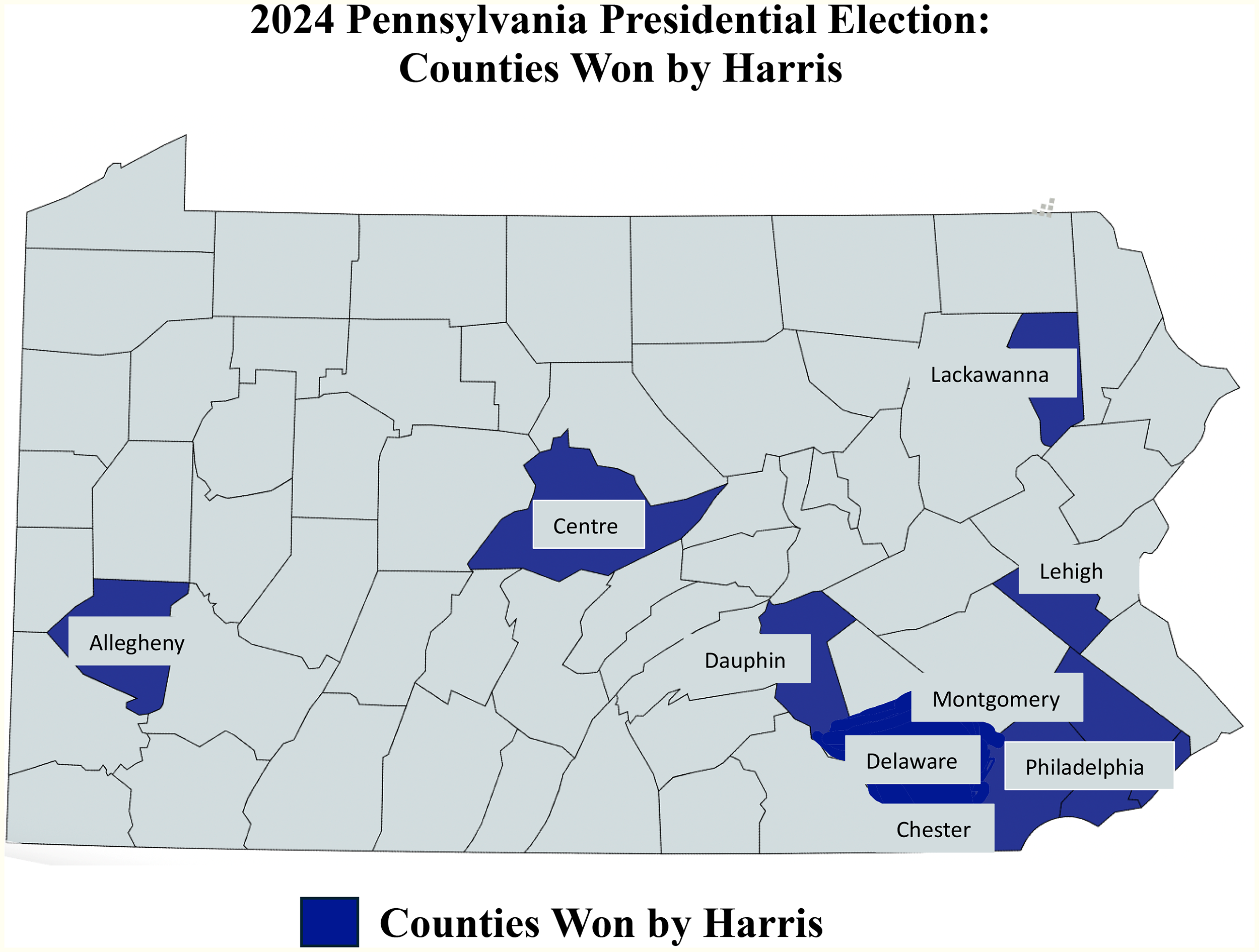
Pennsylvania 2024 Election Results by County.
Pennsylvania’s Importance in the 2024 Election
Pennsylvania's role as the key swing state in the 2024 presidential election was not a new one. The state played a similar role in the elections of 2016 and 2020. Pennsylvania's importance to the outcome of the election was due to several factors. One was that Pennsylvania had the most electoral college votes of all of the battleground states. In 2016 and 2020, it had 20 votes; that fell to 19 in the 2024 election following reapportionment in 2020. Michigan had 15 electoral votes (down from 16 in 2016 and 2020), and Wisconsin had 10 (Earl 2024).
A second factor was that Pennsylvania was a genuinely “purple” state (Zurcher 2024). Going into the election, the difference in voter registration between the Democratic and Republican parties was only 3.9 percent (Democrats 44.1, Republicans 40.2 percent) (Table 1) (Meyer and Walker 2024). The polling leading up to election day was so close that reputable polling groups could not predict the outcome of the election. The final poll, published on November 5th by FiveThirtyEight, had both candidates receiving 50 percent of the vote (Fivethirtyeight 2024).
Party Registration, Pennsylvania (Percent).
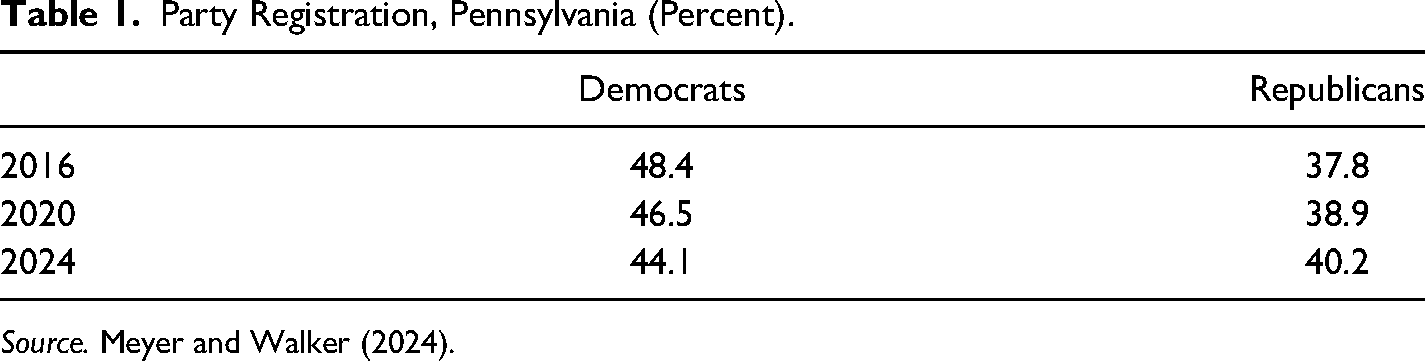
Source. Meyer and Walker (2024).
Lastly, Pennsylvania's importance in the 2024 presidential election was ensured by its must-win status. Almost all of the models created to predict the election outcome had the victorious candidate winning Pennsylvania. In fact, most analysts suggested it was not possible to win the election without winning Pennsylvania (Bickerton 2024; Bolton 2024; Electronic Times 2024).
The Campaigns
The Pennsylvania presidential primary election was held on April 23, 2024. Donald Trump won the Republican primary with 83.4 percent of the vote. President Joe Biden won the Democratic primary with 87.9 percent (New York Times 2024a). Both candidates’ campaigns were beginning to gear up for the general election campaign in mid-summer when Biden announced on July 21 that he was dropping out of the race, making Vice President Kamala Harris the de facto Democratic nominee for president. While Trump had held a number of rallies in Pennsylvania since the April primary, including the one in Butler where he was slightly wounded in an assassination attempt, Harris only had 107 days to campaign before the election.
Once both candidates had begun to campaign in earnest, they focused the vast majority of their attention on the seven battleground states (see Table 2). And of those states, Pennsylvania (51), along with Michigan (52), received the most candidate visits (Camberg 2024). Sixteen of Trump's Pennsylvania campaign visits took the form of his trademark rallies at large sports arenas, airport hangers, and fairgrounds. Only two of these rallies took place in the urban areas of Philadelphia and Pittsburgh. The other 14 were held in smaller cities such as Erie, Wilkes-Barre, Allentown, and Reading (twice) or in more rural locations in Lancaster, Butler, Indiana, and Westmoreland counties (Trump 2025). While Harris also held large rallies across the country, more of her Pennsylvania appearances took the form of campaign stops in smaller venues. And 75 percent of her visits in Pennsylvania were held in the urban areas around Philadelphia and Pittsburgh, and their suburbs (Wallace 2024).
Presidential Candidates’ Visits During 2024 Election July 21-November 4.
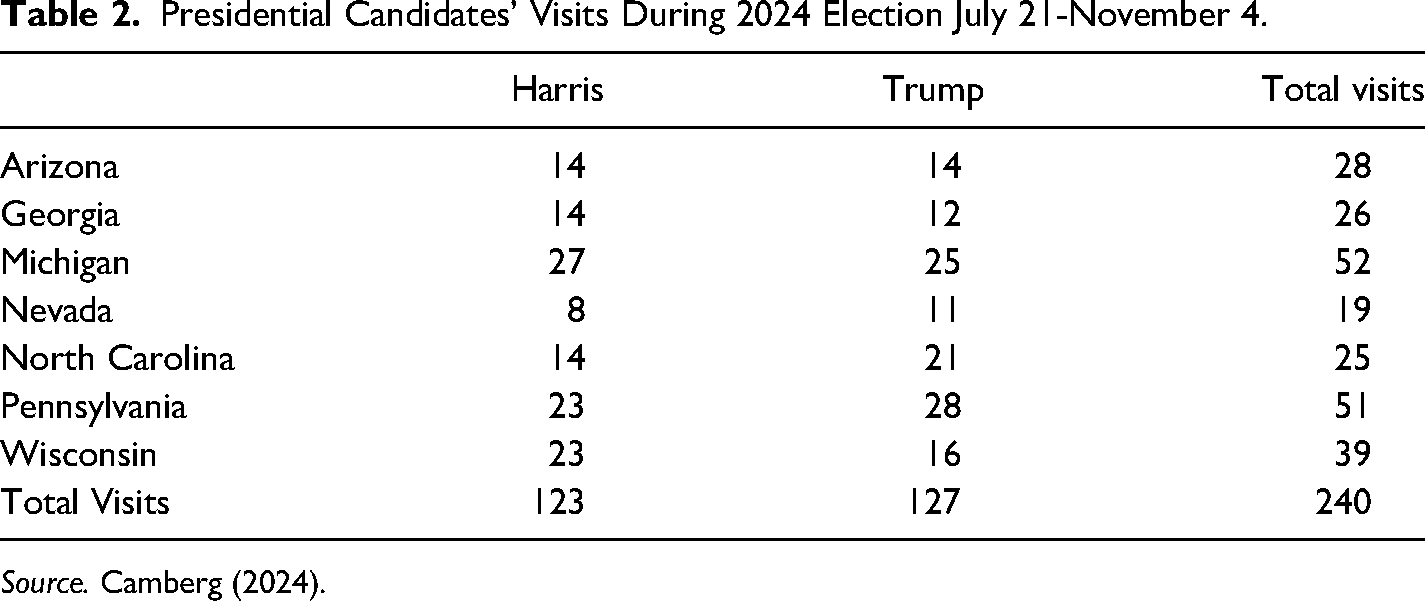
Source. Camberg (2024).
Spending on campaign advertising was an important part of both candidates’ campaigns. And Pennsylvania led all states in campaign spending on ads. The two campaigns combined to spend $538 million on advertising in the state, with Democrats edging out Republicans in spending by $294.7 million to $243.6 million (Wallace 2024).
In terms of substance, a small percentage of Harris’ ads focused on Trump's character, judgment, and personality; however, the majority were efforts to introduce herself to the electorate and paint her as a capable and positive leader. In terms of issues, Democratic ads highlighted the Biden administration's positive impact on the economy. They also focused on abortion, women's rights, and taxation (Piper and Klahr 2024).
Trump's ads focused largely on Harris. They specifically attempted to tie her to President Biden and the issues of inflation, border control, and immigration. And more than a quarter of Republican ads centered on transgenderism (Piper and Klahr 2024).
Election Outcome
On November 5, Trump won the 2024 presidential election. He received 312 electoral votes to Harris’ 226. In the popular vote, Trump received 49.9 percent of the votes cast (77,303,573 votes). Harris received 48.4 percent (75,019,257 votes), making Trump's margin of victory 1.4 percentage points and 2,284,312 votes (New York Times 2025).
In the process, Trump won all seven battleground states. In Pennsylvania, he received 50.4 percent of the vote (3,543,308) to Harris’ 48.7 percent (3,423,042). While Trump only defeated Harris in Pennsylvania by 1.7 percent, his third run for President saw him win a majority of the state's voters for the first time (see Table 3). He also received his highest share of the vote in his three runs for president, and his margin of victory in the vote count tripled from his win in 2016 (New York Times 2025).
Pennsylvania Presidential Election Results by Percent and Total Votes.
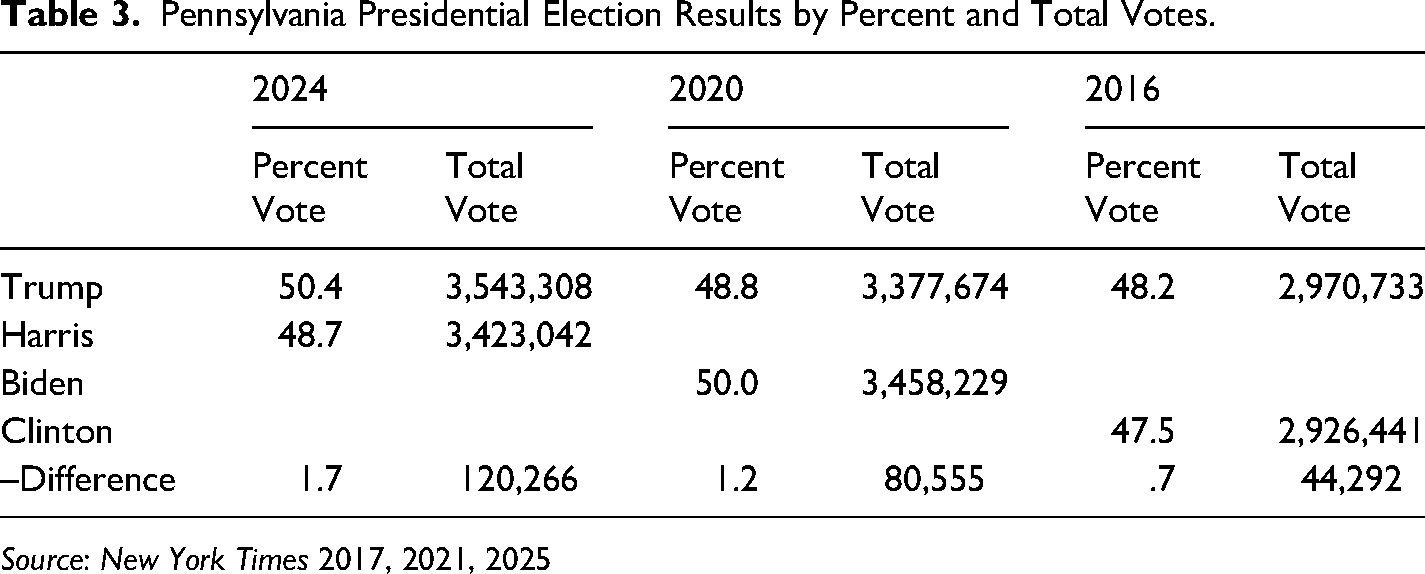
Source: New York Times 2017, 2021, 2025
Political consultant James Carville is credited with the characterization of Pennsylvania's political landscape as Pittsburgh and Philadelphia with Alabama in between. While not entirely accurate, the characterization underscores the fact that Democratic support has historically been centered in the state's two largest cities and their suburbs. This includes Allegheny County, as well as Philadelphia and the counties immediately adjacent to the city—Chester, Delaware, and Montgomery. Other reliably blue counties, include Dauphin (Harrisburg), Lehigh (Allentown), Lackawanna (Scranton), and Centre (State College), Kamala Harris won all nine of these counties (Figure 1) (McElwee 2024).
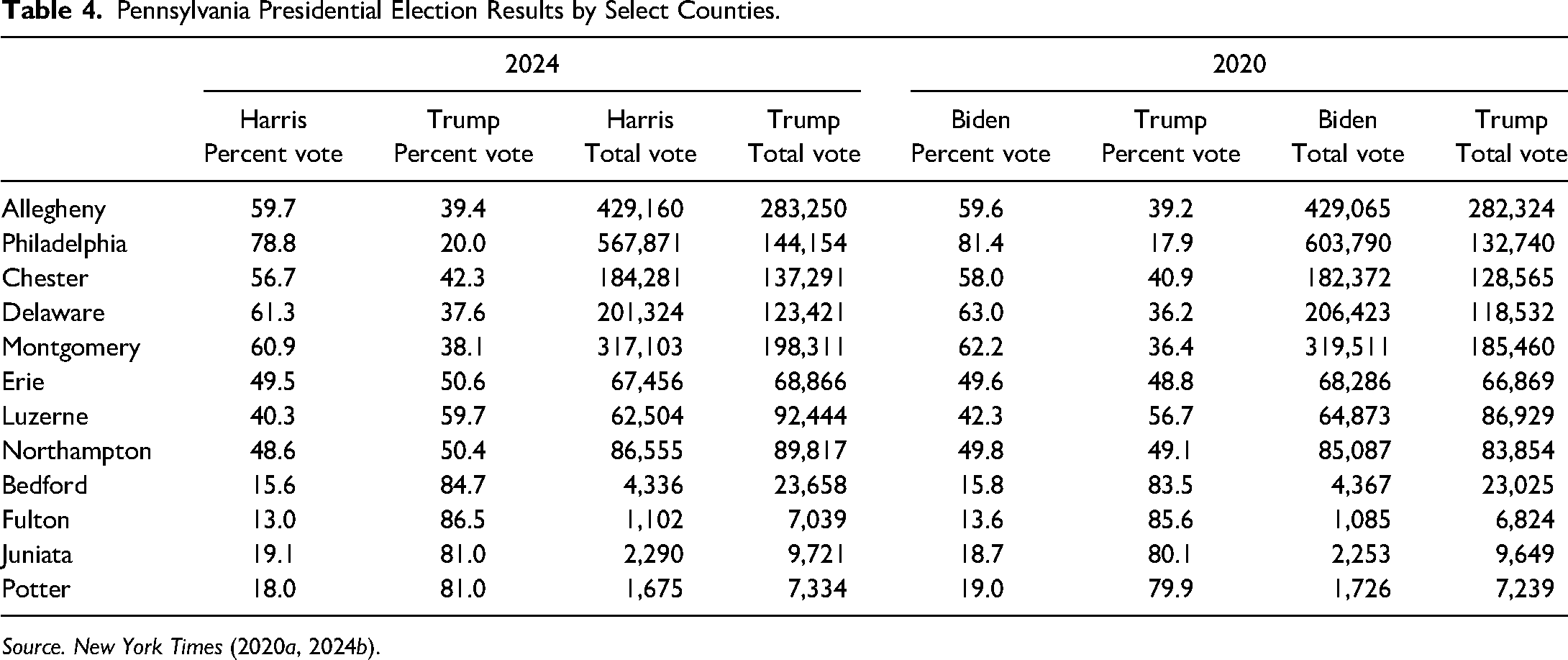
Republicans have historically been strong in the swaths of rural and semi-rural counties in the state's northern and southern tiers and in the central part of the state. Most of these counties are solidly, and in many cases overwhelmingly, red. These are the 58 counties that Trump won in 2024. He won 70 percent or more of the vote in 28 of these counties (and more than 80 percent in four, Bedford, Juniata, Fulton, and Snyder) (see Table 4). And he increased his margin of victory in 2024 in 56 counties from his 2020 performance (Cole 2024).
Pennsylvania Presidential Election Results by Select Counties.
Source. New York Times (2020a, 2024b).
A Harris campaign strategy memo shared with the press in October outlined their view of her path to victory. The memo identified four key things that Harris had to accomplish to win Pennsylvania. The first was to increase, or at least match, Biden's support in the urban Democratic strongholds of Philadelphia and Pittsburgh (Allegheny County). The second was to substantially increase her vote totals in the three heavily populated suburban counties around Philadelphia. This involved both increasing turnout in these counties and persuading suburban Republicans disenchanted with Trump to vote for Harris. Third, the vice president needed to win a handful of key swing counties that traditionally played an important role in Pennsylvania elections. Lastly, the memo indicated a need to chip away at Trump's support in the strongly red rural counties of the state (Smith 2024).
The only one of the keys to victory Harris accomplished was to match Biden's vote share and total in Allegheny County from 2020 (see Table 4). However, the Harris campaign could not match Biden's 2020 Philadelphia vote total. Harris received 567,871 votes, or 78.80 percent of the vote, in the city, compared to Biden's 603,790 votes (81.4 percent), a difference of 35,951 votes (New York Times 2020a). The drop in the vote share was compounded by the fact that voter turnout dropped by roughly 23,000 (Orso and Ghani 2024).
The hope of the Harris Campaign Team that voters in key Philadelphia suburbs would turn out in record numbers for the Vice-President and carry her to victory also was not borne out. Harris’ share of the vote in all three suburban counties was down compared to Biden's performance in 2020 (see Table 4), although voter turnout was strong enough in Chester County that she gained 1,909 votes. At the same time, Trump increased his vote totals from 2020 (New York Times 2020a, 2024b).
Just as the nation's elections have a small number of swing states that play a big role in determining the outcome of an election, Pennsylvania has swing counties that have played a similar role in recent elections. One of the keys to Trump's victory in 2016 was winning two blue-collar counties that had a long history of voting for Democrats in presidential elections.
Erie County is a historically working-class county in the northwestern corner of Pennsylvania with a strong union presence that has long been a Democratic county. As recently as 2008 and 2012, Barack Obama won 59 and 58 percent of the vote there, respectively (New York Times 2008, 2012). One of the keys to Trump's victory in the state in 2016 was flipping Erie from blue to red, winning the county by 1.7 percent (New York Times 2017). Notably, in 2020, Biden flipped the county back to blue, defeating Trump by one percent (New York Times 2020a). In 2024, Trump again won Erie, defeating Harris by the same one percent margin (New York Times 2024b).
Northampton County is a blue-collar county on the eastern border of Pennsylvania that has become increasingly diverse with the influx of Hispanic residents in the last few decades. Northampton has long been a swing county. Donald Trump won Northampton in 2016 by 3.8 percent (New York Times 2017). Biden edged Trump in the county in 2020 by slim margin of 49.8 percent to 49.1 percent (New York Times 2020a). In 2024, Trump again flipped the county red, defeating Harris 50.3–48.4 percent (New York Times 2024b).
Pennsylvania has 67 counties. In his 2016 run, Donald Trump won 56 of these counties, including the key swing counties of Erie and Northampton. In 2020, he won 54, losing Erie and Northampton to Joe Biden. In 2024, he won 58 counties, flipping four he lost in 2020, including Erie, Northampton, Monroe, and Bucks (New York Times 2016, 2020a, 2024b).
Labor’s Role in the 2024 Pennsylvania Election
Like the rest of the labor movement, almost all Pennsylvania unions endorsed Vice President Harris and worked to elect her. And while the Teamsters International Executive Board chose not to endorse a candidate in the presidential election nationally, the Pennsylvania Conference of Teamsters endorsed Harris, as did Teamsters Joint Councils in eastern and central Pennsylvania (Deto 2024).
While some union members look to their union for guidance on voting, the real benefit of union endorsements is the grassroots mobilization campaigns that unions engage in to support endorsed candidates. In recent decades, unions have become increasingly adept at advocating for their candidates and increasing voter turnout through grassroots education and “get out the vote” efforts (Lamare 2010; Li, Lamare and Bruno 2022).
The AFL-CIO called its effort in 2024 “the largest voter mobilization in the labor movement's history” and noted that the campaign had a sharp focus on the swing states. Overall, the AFL-CIO engaged 7.1 million voters; reached 3 million union voters in battleground states through digital ads; sent 2.5 million mailings, and 700,000 personalized letters written by local union leaders, to the homes of union voters (AFL-CIO 2024). The four largest public employee unions—AFSCME, AFT, NEA, and SEIU—worked together to coordinate “a multi-state voter outreach initiative” to build support for Harris in the seven battleground states (List 2024). As part of this effort, SEIU's goal was to have canvassers visit a million homes in the final days of the election. These unions were particularly focused on Pennsylvania (Hsu 2024).
Pennsylvania unions blanketed the state with tens of thousands of members going door to door to get fellow members to vote for Harris. Unions from surrounding states bused in activists to knock on “labor doors” in Pennsylvania. The union UNITE HERE claimed to have run “the largest independent labor-led field program in the US in the 2024 election,” specifically targeting Black and Latino voters in Philadelphia and its suburbs (Hsu 2024).
Union efforts in 2024 were particularly critical because of Trump's proven ability to win support from two groups who in the past had largely voted for Democrats—union members and working-class voters (“working-class” is generally defined as voters without any college education). In fact, many election analysts blamed Clinton's 2016 defeat on her loss of support (Hartman 2024) with those two groups and credited Biden's victory to winning back a significant share of the union and working-class vote (Williams 2024).
Election Analysis
There are a number of factors responsible for Trump's 2024 victory. They include him performing better than he did in 2020 with the majority of voting groups, including working-class voters, Black men and Latinos, and younger male voters, while keeping the strong support he received in 2020 from white men and rural voters. Pennsylvania largely followed these trends. In addition to Republican gains in voters registered since the last election, Harris’ campaign suffered from a drop in turnout and support in strongly blue Philadelphia and its suburbs and her inability to win key Pennsylvania battleground counties. In retrospect, the Vice President always faced an uphill fight, given that she only became the Democratic nominee on July 21. These factors led to Trump's victory in Pennsylvania (Levy 2024; Russell-Sluchansky 2024).
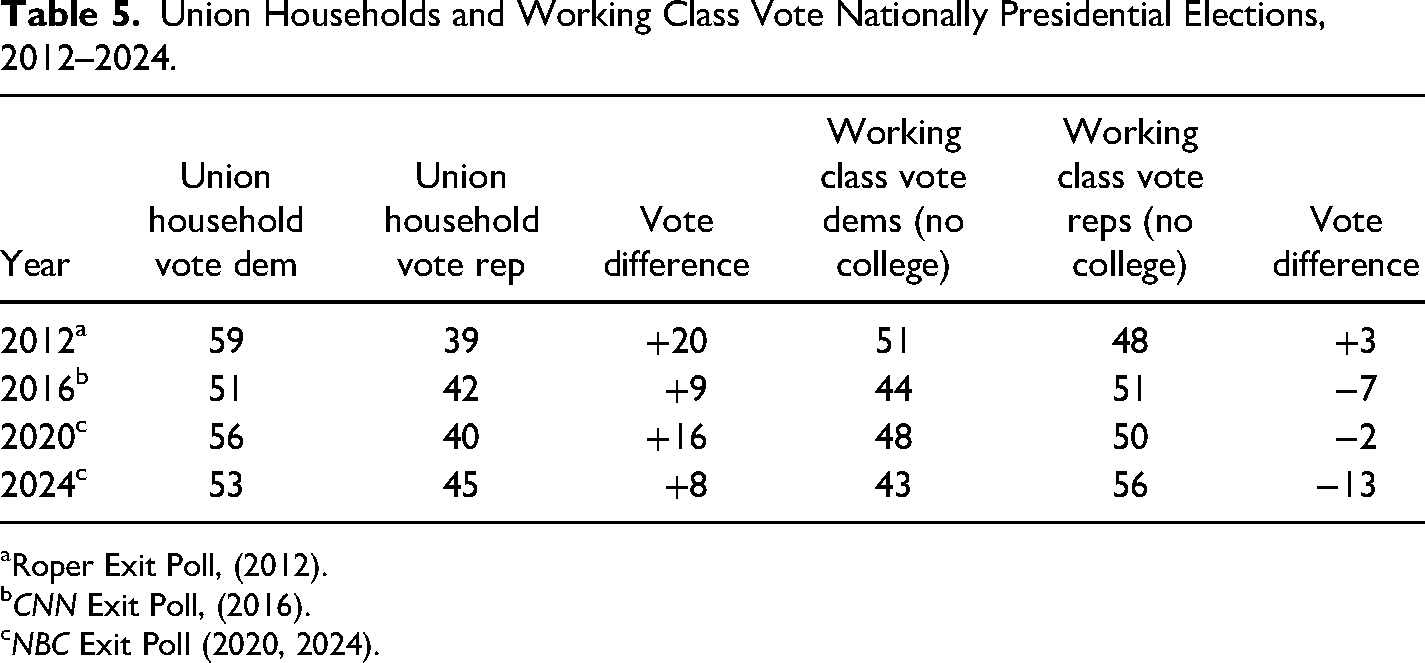
One of the most critical factors in the 2024 election was Trump's strength among working-class voters. As Table 5 indicates, nationally, as recently as 2012, the Democratic presidential candidate received the majority of working-class votes. While Obama won these voters in 2012 by three percentage points, Clinton lost them by seven percent in 2016, a 10-point swing.
Union Households and Working Class Vote Nationally Presidential Elections, 2012–2024.
aRoper Exit Poll, (2012).
bCNN Exit Poll, (2016).
Joe Biden won the 2020 election by increasing his share of votes among working-class voters nationally by five points, winning 48 percent compared to 44 percent for Clinton four years earlier, while Trump's support fell one point to 50 percent. In 2024, however, Harris won only 43 percent of working-class voters across the country, five points less than Biden received in 2020. At the same time, Donald Trump improved his vote total among this group to 56 percent, 13 points more than Harris. This shift more than accounted for Trump's national margin of victory of 1.4 percent (Table 5).
In terms of the working-class vote, Harris performed even more poorly in Pennsylvania with these important voting groups than she did nationally (Table 6). She also performed poorly in comparison with Biden's performance in 2020. In 2024, Harris received only 41 percent of the state's working-class vote, while Trump bettered his national performance, and his vote share from 2020, with this group, winning 58.0 percent. Just as in the national election, Trump's performance with these voters more than accounted for his winning margin of 1.7 percent in Pennsylvania.
Pennsylvania Union Households Vote and Working Class Vote Presidential Elections, 2020–2024.
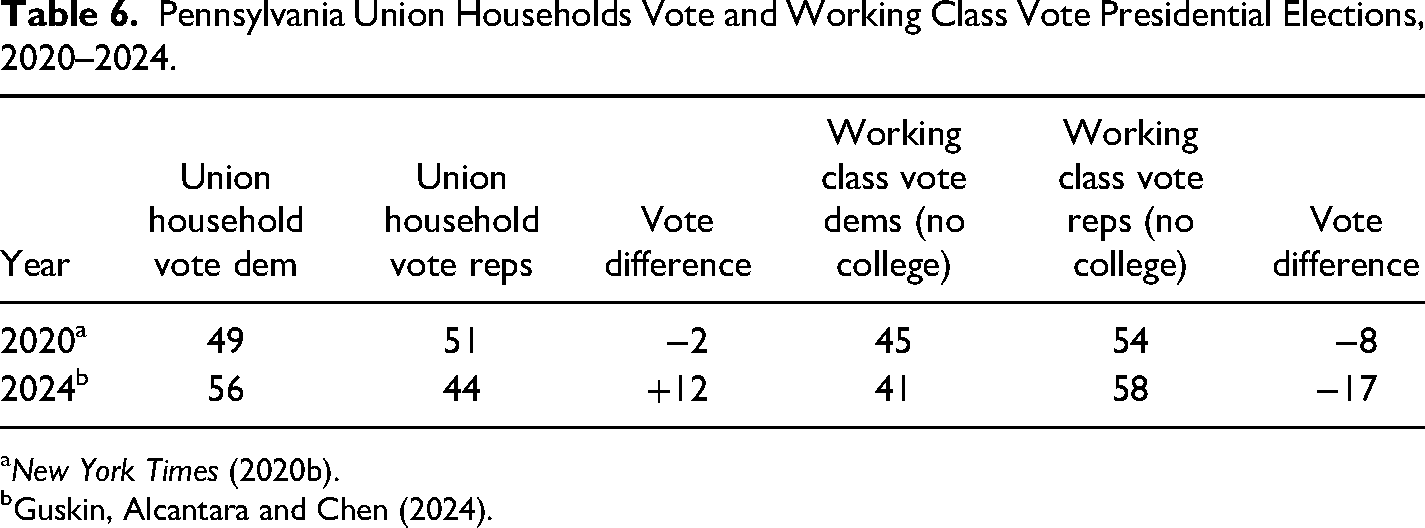
Somewhat surprisingly, the one bright spot for Harris’ Pennsylvania campaign was her strong showing with union households. In 2024, Harris won union households in the state by 12 points, 56–44 percent, topping her national margin of eight percent. Biden lost the Pennsylvania union household vote to Trump by two points. Her strong showing in union households was almost certainly a result of the efforts of the Pennsylvania labor movement to convince their members and their families to vote for her. This is particularly striking given her poor showing among largely non-union working-class voters (Matthews 2017; Thomhave 2024).
Consistent with his strong showing among working-class voters, Trump won all of the rural northern and southern tier counties, as well as the swing counties of Erie and Northampton. And he increased his margin of victory in most 2024 counties from his 2020 performance. In some solidly red counties, the increase was as much as 4.5 percent. But Trump's largest increases from 2020 were in blue counties that he lost. These included most importantly, the huge county of Philadelphia (a 4.7 percent increase), as well as Lackawanna (5.6), Lehigh (4.9), and Bucks (4.4 percent) counties (Guskin, Alcantara and Chen 2024).
In 2024, Harris lost ground with groups of workers that had been core supporters of the Democratic Party. In Philadelphia, significant numbers of Latino and Black voters voted for Trump. In Philadelphia's 114 majority-Latino voting precincts, Trump's vote share increased in each of his three elections, from 6.1 percent in 2016, to 15.3 percent in 2020, and to 21.8 in 2024 (Roth 2024). In 649 of the city's 688 majority-Black precincts, Harris performed worse than Joe Biden did in 2020 at the same time that Trump increased his share of the vote in these precincts over the last election (Jones 2024). Statewide, Biden won 92 percent of the black vote in 2020, to Trump's seven percent. In 2024, Harris’ share of the black vote fell to 89 percent, while Trump's grew to ten percent. As the first black woman to run for president, Harris’ campaign anticipated improving on Biden's share of the black vote. The fact that that did not happen was undoubtedly a big blow to her campaign (Oxford 2024).
Why did so many voters, both nationally and in Pennsylvania, cast their vote for Donald Trump over Kamala Harris? A Data for Progress analysis found that 37 percent of voters in the state identified the economy as the single most important issue in deciding who to vote for. And 53 percent of voters in Pennsylvania indicated they trusted Trump more than they trusted Harris to improve the economy. Harris lost most of these voters. In such a close election, this probably put Trump over the top (Data for Progress 2024).
Trump also benefitted from increased voter turnout in Pennsylvania, particularly in counties that were strongly red. This enthusiasm reflects Trump's success in building a movement that connected in deep ways with a number of segments of Americans for a decade now. There is significant evidence that Trump's strongest supporters, the white working-class, believe that they have been left behind by a global economy that seems to benefit everyone but them. And they see themselves and their traditional values, once dominant and mainstream in society, as being pushed aside and devalued in favor of others—people of color, gays and transgender people, immigrants, and the liberal “woke” elites. When it came time to vote, their anger and alienation, and their deep loyalty to a leader they felt shared their values, and was willing to fight for them, provided the energy that translated into the greater voter turnout of Trump supporters.
In 2024, Trump's campaign used every chance to stoke this sense of grievance and disorientation. The second most important issue identified by Trump supporters was immigration. His constant messages about “criminal” immigrants invading the country and engaging in rape and murder (and the abuse of pets), appears to have been very effective in winning votes, even among Latino workers (Data for Progress 2024).
The Trump campaign very effectively employed one additional issue to make the case to voters that Democrats and liberals were determined to change their world in a truly fundamental way—transgenderism. Republican commercials in Pennsylvania, and nationally, portrayed Harris as a supporter of transgenderism who was fighting to provide gender-affirming care to prison inmates paid for with taxpayers’ funds. The hard-hitting ads included photos of burly crossdressers and ended with the message “Kamala Harris’ agenda is for “they them,” Donald Trump is for you (Keller 2024).” The importance of these ads to the Republicans’ campaign is underscored by the fact that of the $993 million the party spent on advertising in 2024, $222 million was spent on ads about transgenderism (Davis 2024; Diaz 2024).
In sum, Harris lost the national election for a number of reasons. Among them was the fact that she underperformed in comparison to Joe Biden in every battleground state with several key voting groups. Biden won six of these states in 2020. Harris lost all seven. But the single most significant reason she lost was her failure to capture Pennsylvania.
A post-election analysis by two highly respected political analysts at the Brookings Institute concludes that Democrats need to undertake an initiative they call the “Pennsylvania Project.” They argue that “since Pennsylvania comes closest to being a microcosm of the country… [it] is a proxy for the national challenge Democrats face…. If Democrats can figure out how to turn Pennsylvania reliably blue, they will be well on their way to regaining a sustainable national advantage (Galston and Kamarck 2025).”
Footnotes
Declaration of Conflicting Interests
The author declared no potential conflicts of interest with respect to the research, authorship, and/or publication of this article.
Funding
The author received no financial support for the research, authorship, and/or publication of this article.