




Abstract
This paper examines policy convergence in Indigenous-local agreements in Canada using a dataset of 192 agreements collected between 2010 and 2014. It explores whether these agreements, which facilitate service sharing, contracting, and relationship formation, exhibit similarities across Indigenous communities, and whether these similarities are being driven by geographic location, proximity, or cultural similarity. Using word embeddings analysis, we find that culture is the strongest predictor of semantic similarity, with geographic location within the same province and proximity having much smaller effects.
Over the last 30 years, processes of regionalization and increasing policy complexity have resulted in the multiplication of new subnational governments and governing bodies 1 (Hooghe and Marks 2016). In settler states like Australia, Canada, and the United States, Indigenous communities and municipalities have become prominent political actors and upper levels of government have turned to them to address some of the country’s most challenging economic, environmental, and social problems (Alcantara, Broschek, and Nelles 2016; Galvin 2019; Gertler 2001; Wilson 2019; Wilson, Alcantara, and Rodon 2020). In some instances, Indigenous and local governments have partnered with each other by negotiating intergovernmental agreements to generate innovative solutions to their individual and collective needs (Berg 2019; Walker 2008; Webster 2020). In Canada, Alcantara and Nelles (2016) found over 300 agreements addressing a wide range of policy areas, such as capacity building, relationship-building, decolonization, and jurisdictional negotiation, the latter of which deals with service delivery and the joint management of lands and programs and services. The use of these agreements has grown over time, not only in Canada, but in other settler states (see Berg 2019; Webster 2020).
Initial studies of this topic were case study-oriented, with rich analyses of the emergence and implementation of specific agreements between signatories in a particular region (Alcantara and Kalman 2019; Webster 2020). More recent studies have looked at a broader range of agreements in terms of their design and effects, finding that they vary substantially in terms of how they address issues related to accountability and trust (Spicer et al. 2024) and whether they improve policy outcomes (Deaton and Lipka 2023; Huo, Charbonneau, and Alcantara 2022). Very little attention, however, has been paid to whether these agreements exhibit the hallmark characteristics of policy convergence, a term that describes “any increase in the similarity between one or more characteristics of a certain policy (e.g., policy objectives, policy instruments, policy settings) across a given set of political jurisdictions” (Knill 2005, 768). For instance, it would be interesting to know whether Indigenous-local agreements are highly unique to local contexts and the local actors that sign them or if they are similar to each other within and across policy areas and jurisdictions.
Exploring patterns of difference and similarity between agreements contributes to the literature on policy convergence more generally in addition to enabling a deeper understanding of Indigenous policy networks and policy learning. Although the term “Indigenous” tends to signal homogeneity, research suggests that there is, in fact, significant heterogeneity across communities in Canada, varying in terms of their constitutional traditions, political structures, economic systems, social structures, and language and culture (Borrows 2010; Voyageur and Calliou 2000). One might expect, given this heterogeneity, that the diffusion of intergovernmental agreements is likely to be idiosyncratic, rather than homogenous. Yet this assumption ignores the fact that these communities may have access to or have developed their own policy networks and communities that facilitate policy diffusion through emulation, learning, competition, and coercion.
In this paper, we draw upon an existing dataset of 192 Indigenous-local agreements, collected between 2010 and 2014 from across Canada (excluding Newfoundland and Labrador and Nunavut which had no agreements), to explore patterns of policy convergence. Except for agreements from British Columbia (many of which were publicly available online), the rest of the agreements were collected directly (sometimes in hard copy form) from Indigenous and municipal officials (Alcantara and Nelles 2016). Using these agreements, we apply word embeddings analysis to explore the extent to which Indigenous-local intergovernmental agreements are similar to one another. We also analyze whether any patterns of similarity observed are structured by geographic distance between communities, cultural similarity, and their location within the same province. Similar methods have been used to analyze international treaties (Allee and Elsig 2019) as well as subnational policy convergence in Canada (Brie, Huo, and Alcantara 2024) and the United States (Jansa, Hansen, and Gray 2019). We find that culture is the strongest predictor of semantic similarity, with geographic location within the same province and proximity having much smaller effects.
Policy Convergence
A large body of research exists on the extent to which different jurisdictions adopt similar policies. Policy similarity, otherwise known as policy convergence, is measured in a variety of ways, with most studies focusing on the extent to which different countries or jurisdictions adopt the same policy instruments (e.g., specific regulations or tax rates), policy styles (e.g., adversarial legalism, corporatism and the like), policy institutions (e.g., regulatory agencies), and policy regimes (Bennett 1991, 218; Howlett and Rayner 2008, 387). The key focus for these scholars is on policy outputs and outcomes (Knill 2005).
In contrast, the literature on policy diffusion and policy transfer focuses on the processes that produce policy convergence (Knill 2005, 769–72). Convergence tends to occur through one or more of the following four mechanisms: learning, emulation, competition, and coercion (Gilardi and Wasserfallen 2019, 1245). Policy learning occurs when policymakers draw lessons from other jurisdictions or policy areas (Dobbin, Simmons, and Garrett 2007, 460) to develop their own policy solution. The solution might be to copy and paste all or some of a policy or it may be to avoid a policy altogether. Rose (1991, 7) defines a lesson as “as an action-oriented conclusion about a programme or programmes in operation elsewhere.” It can be a program in “another city, another state, another nation or an organization’s own past.” Lesson learning can be fully rational in the sense that government officials have gathered and examined all available information before making a decision, or it can be more bounded, with policymakers relying on cognitive shortcuts, such as adopting practices from peers or other actors that are geographically, culturally, or historically proximate (Meseguer 2005, 72). Indeed, governments are more likely to replicate policies of their peers or adopt policies that are more readily available, because they are less costly to acquire and use (Alcantara 2009). As well, publicly available agreements may reassure policymakers about the relative risk involved in adopting a policy, since a widely adopted policy is likely one that has been tried, tested, and true (Elkins and Simmons 2005, 44).
In contrast to policy learning, emulation (or mimicry) involves policymakers being motivated by symbolic or normative reasons rather than rational concerns about functional efficiency. Policies are borrowed from other jurisdictions because they are seen as more innovative, progressive, and morally superior (Marsh and Sharman 2009, 272). According to Meseguer (2005, 79), “policy emulation is a ‘blind’ action in that it does not entail enhanced reflection about the mapping from policies to outcomes that any of the aforementioned versions of learning do.” Because emulation can be indicative of following particular trends by governments, it can become a symbolic act by which politicians boost “their status, credibility, or ‘modernity’.” Emulation is similar to isomorphism, in which policymakers adopt policies from other countries in hopes of enhancing their legitimacy internally and externally (DiMaggio and Powell 1983; Knill 2005).
Policy convergence can also occur because of economic competition. Jurisdictions interested in attracting new, or keeping their existing capital and labor must respond to other jurisdictions that are more friendly to economic investment by adopting their policies. Governments may lower taxes, eliminate regulations or create subsidies to convince companies to relocate or keep their businesses within their borders (Gilardi and Wasserfallen 2019, 1247). Municipalities seeking to compete in the knowledge economy, for instance, must produce public goods that are attractive to research and development companies and highly skilled labor, and so they must invest in infrastructure and policy to accomplish this goal (Gertler 2001). Jurisdictions competing for residents also tend to follow trends based on the behavior of competitors. Florida’s (2012) work on attracting the creative class, and subsequent iterations of this argument, have been particularly influential in driving policy convergence in municipal development strategies and investments over the two past decades.
Not all policy convergence is voluntary. Coercion, for instance, involves policymakers adopting certain policies because they are compelled to do so by external actors (Brie, Huo, and Alcantara 2024). Coercion can be “hard” in the form of military threats and policy mandates or “soft” in the form of conditions attached to loans, financial aid, and grants such as intergovernmental health transfers and foreign aid (Beland and Lecours 2007; Dobbin, Simmons, and Garrett 2007, 454). It can also occur by attaching conditions to the supply of information or policy expertise to a jurisdiction. Motivations for exerting and accepting coercion vary. Those who impose their will on others do so in the hopes of exporting their “fundamental values and principles,” while the recipients of coercion accept foreign influence for the “political or economic benefits” that accompany it, such as increased state capacity to address crises or funds to build expensive infrastructure that cannot be financed through private markets (Busch and Jörgens 2005, 864; Holzinger and Knill 2005; Sayers, Alcantara, and Armstrong 2022).
Overall, the literature suggests that policy convergence can take several forms, spanning from the micro- (e.g., specific policy instruments), to the meso- (e.g., policy styles), and finally to the macro-level (e.g., policy regimes). This convergence can be driven by a cognitive process of policy learning, a more sociological/constructivist process of mimicry and emulation, economic considerations relating to competition, or through coercion. How do these ideas apply to Indigenous-local intergovernmental policy making in Canada?
Policy Convergence, Indigenous Communities, and Municipalities in Canada
Indigenous communities in Canada 2 are categorized by the Canadian Constitution as belonging to one of three legal designations: First Nations (or Indians), Métis and Inuit. According to the Constitution Act, First Nations’ communities fall under the jurisdiction of the federal government, which exercises its jurisdiction mainly through the Indian Act, 1876, as well as through a suite of other related legislation (Asch 2014). The Indian Act established the creation of reserves, in which underlying title remains with the Crown but over which First Nations’ communities have collective property rights and the ability to create individual property rights that are similar, but not quite equivalent to those that exist outside of reserves (Flanagan, Alcantara, and Le Dressay 2010). Community members elect band councils, which are like municipal councils off-reserve, to exercise a range of local programs and services, including, education, housing, water and sewage, recreation, and the like (Morden 2016; Poucette 2018). Most Indigenous-local intergovernmental agreements are between First Nations and local governments (Alcantara and Nelles 2016).
Many Indigenous communities have signed historical treaties with the federal government, which (under Canadian law) transferred ownership of large swathes of Indigenous lands to the Crown in exchange for money and land reserved for their exclusive use (known commonly as reserves). In some provinces, such as British Columbia, northern Quebec, and Newfoundland and Labrador, historical treaties were never signed. As a result, the Crown created the modern treaty process in 1973 to negotiate comprehensive land claims agreements (otherwise known as modern treaties) with Indigenous communities to clarify title and facilitate economic development related to natural resources. Modern treaties are more expansive in scope, and involve the Crown transferring money, title and jurisdiction over selected lands to Indigenous communities, which they can then govern, use, and protect under the terms of the treaties. Many of these agreements include a chapter on self-government, which enable them to create regional governments with powers akin to provincial governments (Alcantara 2013; Wilson, Alcantara, and Rodon 2020).
As mentioned previously, Indigenous communities are highly diverse, even within the three legal categories established by the Canadian Constitution. Many communities have highly detailed and sophisticated constitutional orders that are separate from Canada’s, but which remain in force and govern life between community members (Borrows 2010). Despite this diversity, many communities also suffer from significant socio-economic distress due to the on-going legacies and continued practices of colonialism and so they struggle with high unemployment, poor housing conditions, water insecurity, and the like. Many of these problems are intractable and difficult to solve and so communities have explored different policy solutions and partnerships with various actors at multiple scales to address them (Wilson, Alcantara, and Rodon 2020).
One such partner has been municipalities, who deliver a similar range of services as Indigenous governments (with notable exceptions in areas with treaty agreements) but fall under different legislative and governance arrangements. Municipalities in Canada are a responsibility assigned to provincial governments in the Constitution Act, 1867, leading them to be often referred to as “creatures of the provinces.” Most provincial governments exercise roughly similar control over municipalities within their jurisdiction. Every province has a dedicated Minister responsible for municipal affairs and at least one statute that articulates the basic purpose, structure, and responsibilities of municipalities in the province. This legislation generally establishes the framework for how municipalities operate, their composition of council, the process for passing bylaws, conducting council meetings, fiscal and budgetary requirements, parameters for making decisions about local improvements, community grant and financial investments, and the enforcement of bylaws (Spicer, Lyons, and Graham 2019). None of this legislation would prevent a municipality from purchasing services from a private firm or signing an agreement with another public entity, such as a municipality or Indigenous band government, to contract the provision of a service, jointly deliver it, or establish a framework for cooperative activity.
Although most if not all First Nations maintain that their communities are “Nations” in the full sense of the word and therefore are not equivalent to municipalities, both sets of communities have similar responsibilities and face similar challenges at least under Canadian law. They both provide basic services, such as garbage removal, fire protection, emergency services, water and wastewater provision, recreational programming, snow removal, and the like, to their communities. They share similar interests in tourism, economic development, and sustainability and sometimes share borders which can result in members from both communities intermixing to shop or play hockey, work or attend school. As a result, there are good reasons for why these communities might seek out intergovernmental partnerships to address their individual and collective problems and goals (Alcantara and Nelles 2016; Berg 2019; Webster 2020).
Alcantara and Nelles (2016) documented the existence of numerous agreements between municipalities and Indigenous governments in Canada, finding that the number of agreements spiked dramatically in the 2000s; there were 264 agreements negotiated between 2000 and 2010, which accounts for more than four and a half times the agreements concluded in the previous five decades. That increase suggests that these actors may have become more aware of the potential value of interlocal agreements based on their own needs and the experiences of their peers. Given these patterns, should we expect to find policy convergence in our data? If so, what might be driving this policy convergence?
One possible answer is that there will be very little similarity across agreements, given that Indigenous communities are highly diverse not only in terms of their local, spatial contexts, but also in terms of their governance structures, their language and culture, their constitutional traditions, and the like (Borrows 2010; Voyageur and Calliou 2000). On the other hand, studies of policy diffusion and policy transfer suggest that policymakers tend to look to other jurisdictions to draw lessons or to emulate their policy instruments.
Literature on knowledge diffusion notes that institutional proximity facilitates interactive learning as actors tend to have a shared understanding of norms, practices, incentives, and cultures (Boschma 2005, Noonan, O’Leary, and Doran 2021). Communities may feel more comfortable adopting text from agreements that have been implemented—and by implication, tested and vetted by similar veto actors—in the same (or similar) institutional setting. From this perspective, we may find that similarities between groups within provinces may be greater than that between provinces, especially since municipalities in Canada derive their organization and authority from provincial legislation. As such, copying agreements within a province makes more sense because it minimizes the complications of copying documents that might not be consistent with the legal and institutional framework of their home province.
Following a similar logic, physical proximity may also play a role. Communities seek inspiration and material from agreements concluded by others that are geographically proximate to them, considering them to be their natural peers. They also are more likely to turn to their neighbors in the presence of civic capital, a term that describe the broad range of “civic relations that exist between people in a community who interact with each other through their involvement with schools, various cultural and leisure activities, and civic associations” (Nelles and Wolfe 2022, 7). As civic ties increase, so too does the natural tendency to communicate and work together, which may lead to the creation of formal or informal communication networks that promote policy diffusion through learning and emulation.
Beyond institutional and geographical proximity, policy convergence might also be driven by cultural proximity. In Canada, there are over 630 First Nations representing 40–50 cultural Indigenous groups and languages. These numbers do not include the different Inuit and Métis groups that are scattered throughout Canada. Some Indigenous groups form umbrella organizations, either formally or informally, that link their communities together politically and allow for collective action externally, interacting with other governments and bodies outside of their communities, or internally to provide programs and services (Alcantara 2013). For example, groups like the Métis National Council, Inuit Tapiriit Kanatami, Inuit Circumpolar Council—Canada, Congress of Aboriginal Peoples (CAP), Native Council of Nova Scotia, the Ontario Coalition of Indigenous Peoples, the North West Indigenous Council, Atlantic Policy Conference of First Nations Chiefs, and numerous smaller regional groups convene peers in face to face events and disseminate information to members through websites and newsletters. Frequently these organizations are arranged along cultural lines, and so it is possible that any patterns of policy convergence that emerge are structured at least in part by cultural similarity. In the next section of the paper, we empirically explore the extent to which institutional, geographic, and cultural proximity structures policy convergence among Indigenous-local intergovernmental agreements in Canada.
Data and Methods
Our data emanate from 192 agreements gathered from across Canada between 2010 and 2014. These legal documents commit municipal and Indigenous governments to engage in formal communication activities and protocols in hopes of facilitating coordination on issues and problems of mutual interest. Sometimes they involve the joint management of community resources and assets, like recreation centers or playgrounds. Most of the agreements commit municipalities to provide Indigenous communities with municipal-type services, such as water and wastewater, garbage collection, and fire protection, in exchange for financial compensation (Alcantara and Nelles 2016). Most agreements are structured as standard contracts. The contents of agreements differ, but most include sections that define key terms and list the parties involved and their responsibilities, the terms of service provision (e.g., commencement dates, payment schedules, etc.), relevant rates expectations and exceptions, procedures for termination, insurance and indemnity provisions, and dispute resolution provisions (Spicer et al. 2024).
To analyze the level of semantic similarity (e.g., our main dependent variable) between all pairs of texts, excluding with themselves, we calculated the cosine score following the approach used by Brie, Huo, and Alcantara (2024, 240), which entails gauging the semantic similarity between terms within documents, regardless of document size. 3 Cosine similarity, a prevalent unsupervised text analysis method, evaluates the semantic resemblance between sequences of words by calculating the angle of convergence between two term vectors, treating textual documents as sequences of words or tokens, yielding a score ranging from 0 (no similarity) to 1 (complete similarity). The calculation employs a formula where A and B represent numeric word vectors for each document, with each word assigned a value representing its frequency in the document. The formula is as follows:

We utilized R’s quanteda package (specifically, the textstat_simil() function) to compute the cosine similarity score across our agreements. This calculation accounts for differences in document size by preprocessing texts (e.g., converting to lowercase and stemming), ensuring comparability even when documents vary significantly in length. While various enhancements to cosine analysis have been proposed over the years (e.g., employing fuzzy sets or restricting analysis to specific word subgroups), we opt for the simplest form to maintain replicability and in alignment with recent practices in political science (Brie, Huo, and Alcantara 2024; Stier et al. 2018). Word embedding analysis has become a mainstream tool in political science, used to gauge similarity across various contexts, such as parliamentary speeches (Rheault and Cochrane 2020), online news and opinion political articles (Rozado and al-Gharbi 2022), and legal texts (Garrett and Jansa 2015).
In the model that follows, our goal is to examine the extent to which Indigenous communities are engaging in policy convergence with each other when they sign agreements with municipalities. Based on the literature above, our expectation is that patterns of convergence, to the extent they might exist, will be structured by whether the Indigenous communities are located within the same province, are geographically proximate (in kilometers and terciles, geolocalized via the Google API) to each other, and are culturally similar. Cultural similarity was determined by examining how each Indigenous community self-identified their nation/culture on their websites; there were 35 groups in total. These three variables—within province, geographic proximity, and cultural similarity—are our main independent variables. In terms of controls, we include two: one for policy area since two water agreements are more likely to be similar to each other relative to one focused on garbage, and another one on agreement type (e.g., capacity building, relationship-building, decolonization, and jurisdictional negotiation—see Alcantara and Nelles 2016) for similar reasons.
Results
We begin with some basic, descriptive information about our dataset. Figure 1 presents the distribution of all cosine scores across these pairs of documents (n = 34,782), displaying an average similarity score of 0.3 (recall that 0 = no similarity and 1 = absolute similarity). At first glance, these results suggest that the agreements as a whole are more idiosyncratic than similar. As we will show later, however, agreement similarity becomes more apparent when geographic location, proximity, cultural similarity, and policy area focus are taken into account.
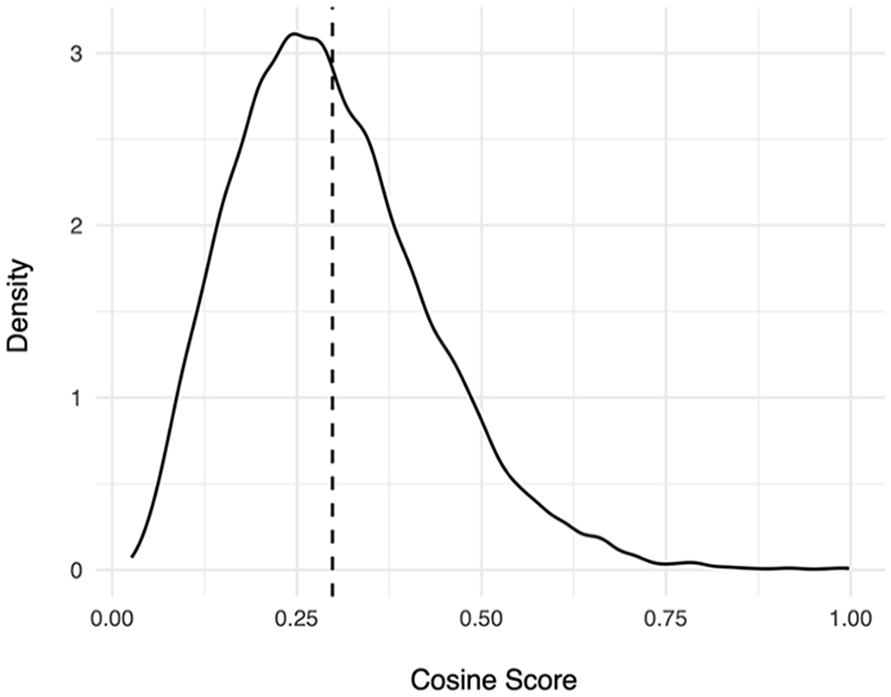
Cosine score density across all agreements.
Figure 2 presents the geographical location of the main reserve associated with each agreement within our dataset. Most reserves are located within British Columbia (n = 103), followed by Saskatchewan (n = 31) and Ontario (n = 19).
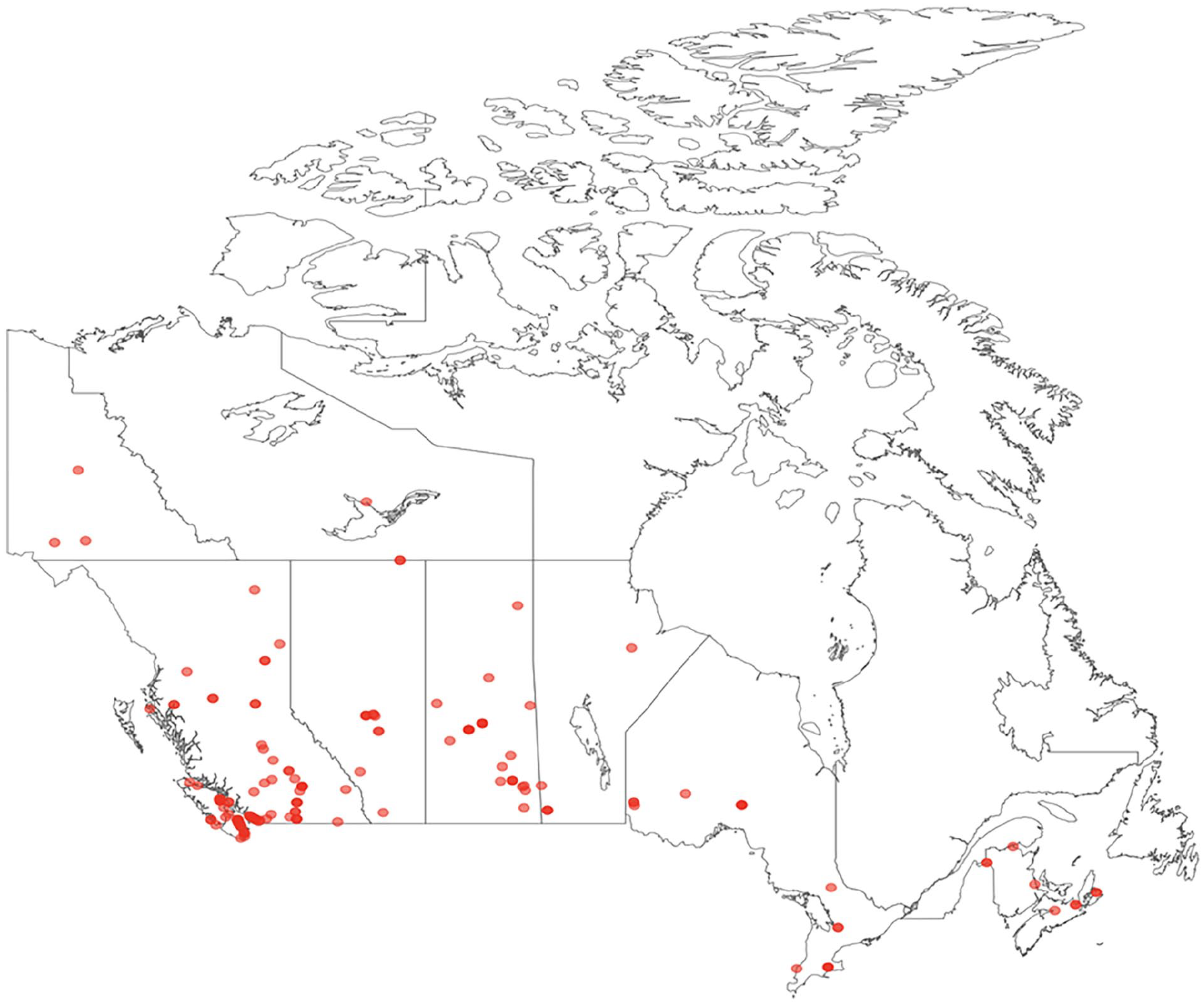
Main reserve location for each agreement.
Figure 3 presents the average cosine similarity score associated with the documents, aggregated by province/territory (subfigure a) and by cultural group (subfigure b). This figure represents the extent to which these agreements are similar to all other agreements within the dataset, except themselves. In other words, lower scores indicate that on average, agreements written within this province/territory or nation are more semantically distinctive from other agreements within the dataset. Our analysis of the data shows limited variance in aggregated scores across these divisions, suggesting that the variations observed in Figure 1 might be due to pairing types (i.e., whether documents share similar characteristics), rather than from where they originated.
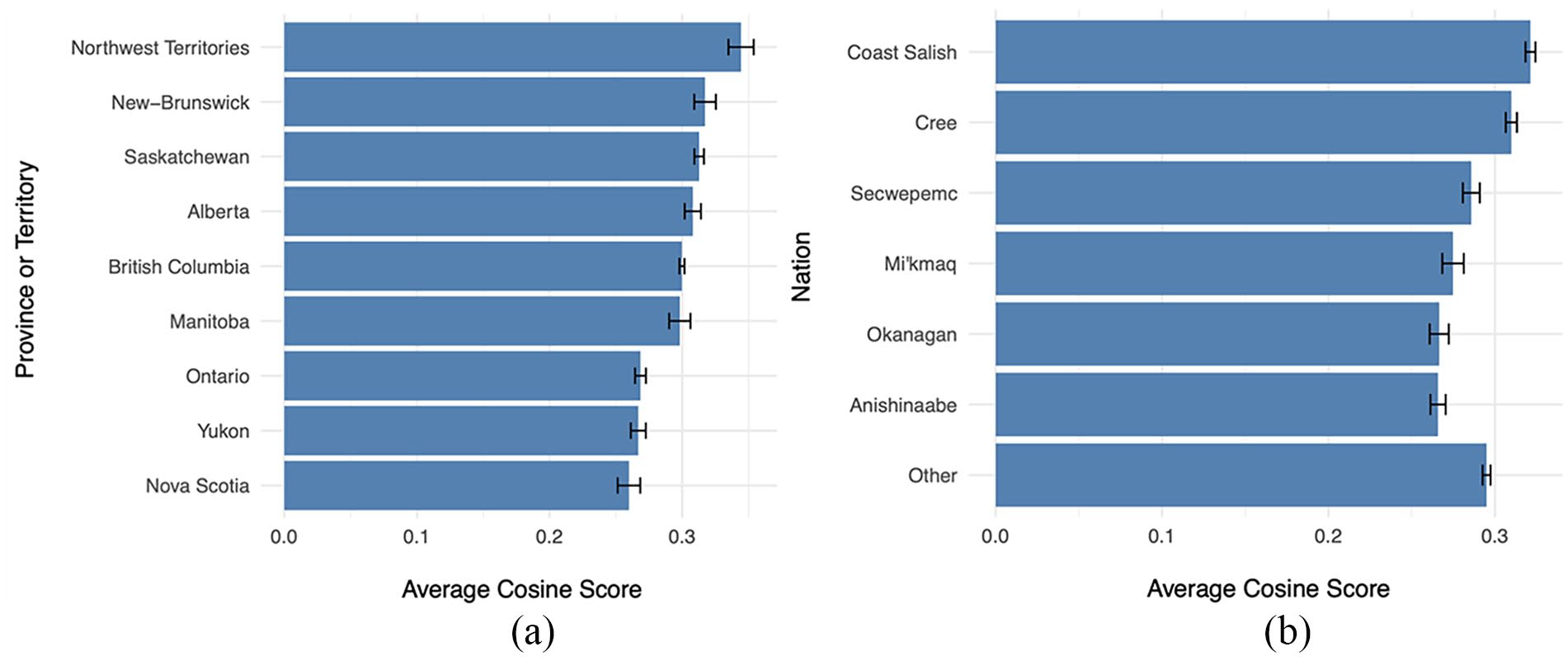
Average cosine similarity scores by province and nation. (a) By province or territory (b) By nation.
Figure 4 visualizes the density distributions of cosine similarity scores across pairings sharing different characteristics. Subfigure (a) presents the average score for pairings in which documents were written by authors from the same Indigenous nation as themselves, showing a higher level of similarity (0.36, n = 3,046) than pairings from non-similar nations (0.29, n = 31,726). 4 Subfigure (b) presents scores by provincial origins status, with pairings whose Indigenous nations are located within the same province sharing higher cosine scores (0.32, n = 11,964) than pairings from different provincial origins (n = 0.28, n = 22,818). Finally, subfigure (c) presents the distribution of cosine scores by the paired reserves’ distances, presented as terciles, showcasing higher levels of similarity for pairings located closer to each other (0.33 for the first tercile, n = 8,476, 0.3 for the second tercile, n = 8,500, and 0.28 for the third tercile, n = 8,784). These figures suggest that institutional proximity (within province), and geographic proximity do underpin some of the semantic similarity we observe across agreements, with the greatest difference observed for agreement pairings sharing cultural origins.
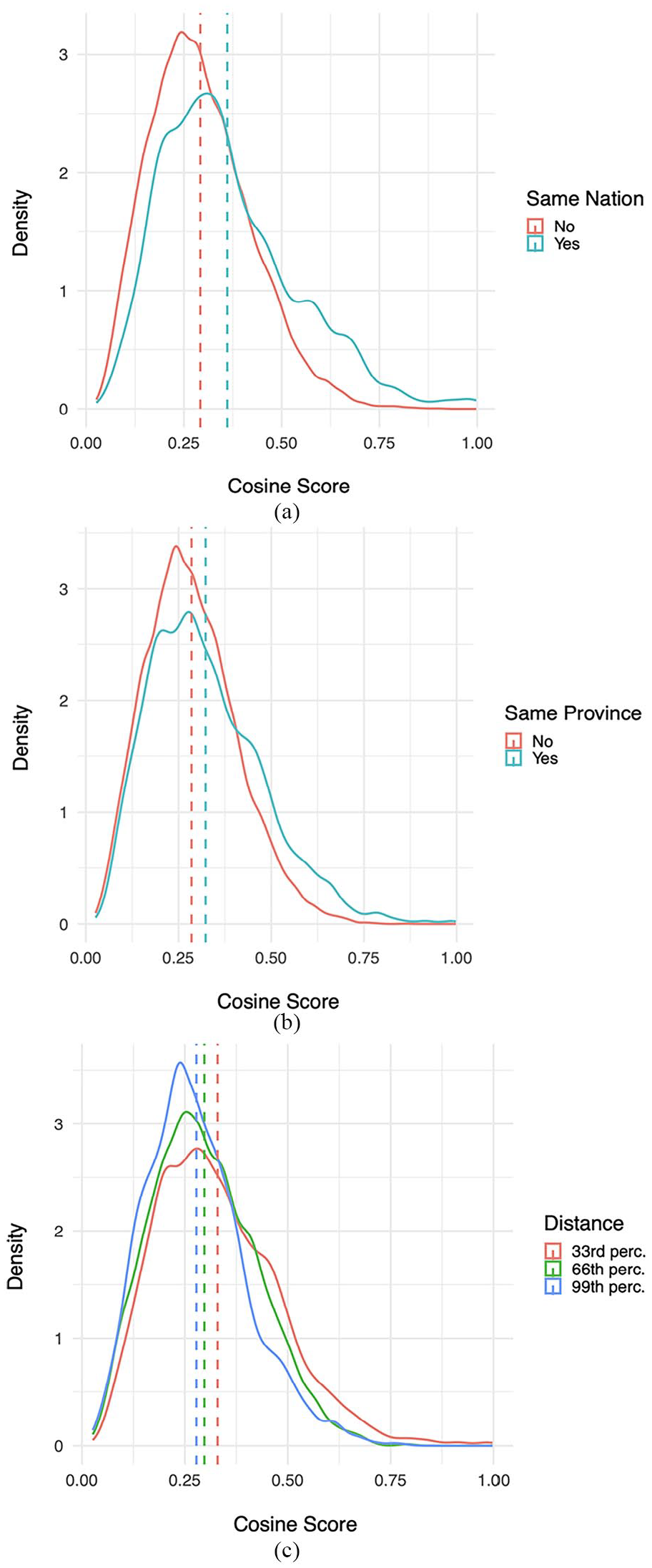
Cosine score density per pairing characteristics. (a) Same nation. (b) Same province/territory. (c) Distance between reserves.
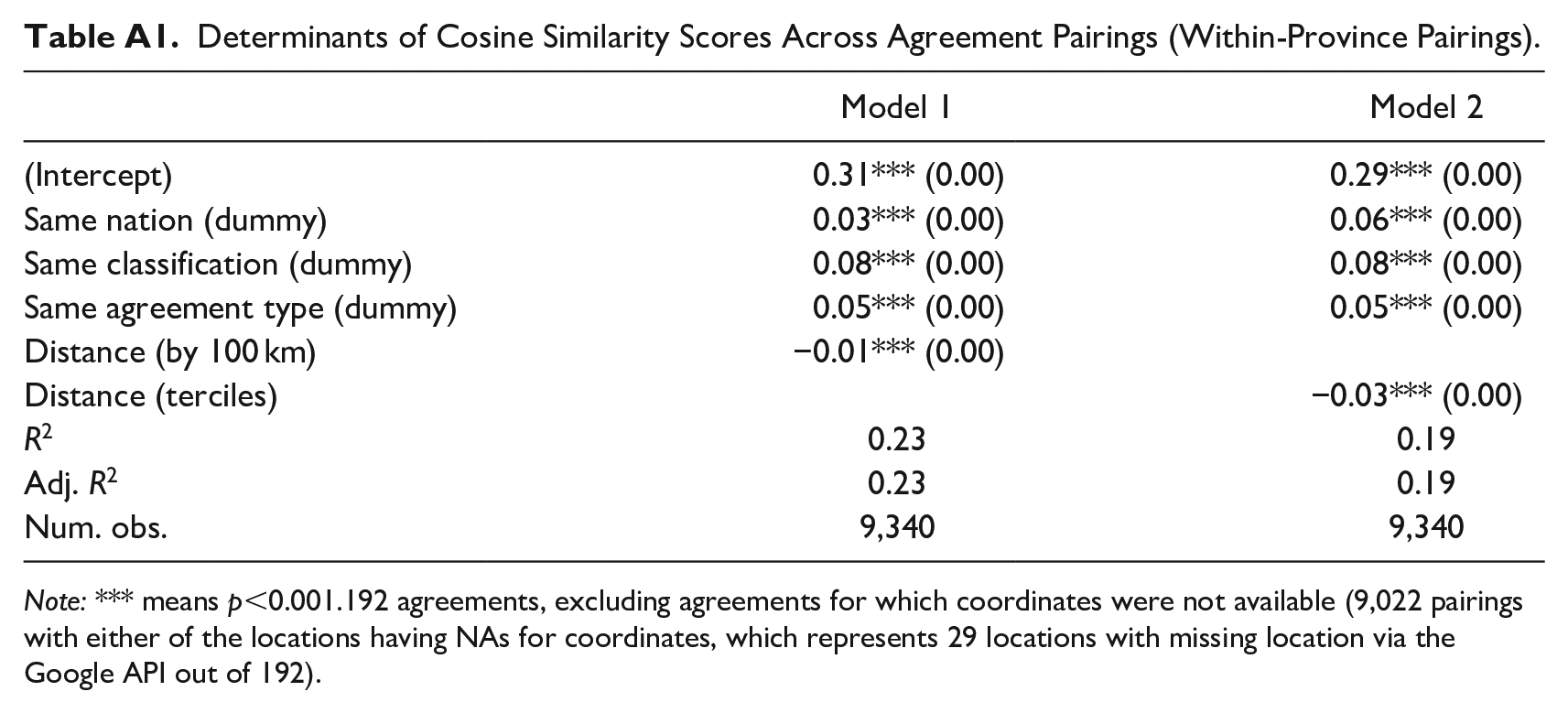
Table 1 presents the results from a regression model testing these determinants (within province, geographic proximity, and cultural similarity) of cosine similarity scores across pairings, using two different categorizations for distance (by 100 km in Model 1, and by tercile in Model 2). While all three criteria presented in Figure 4 are statistically significant predictors of semantic similarity, similar nation status is associated with the most substantial effect (0.05, p < .01). 5 Table A1 in the Appendix shows this model only for pairings located within the same province, confirming that distance effects persist even within provinces. 6
Determinants of Cosine Similarity Scores Across Agreement Pairings.
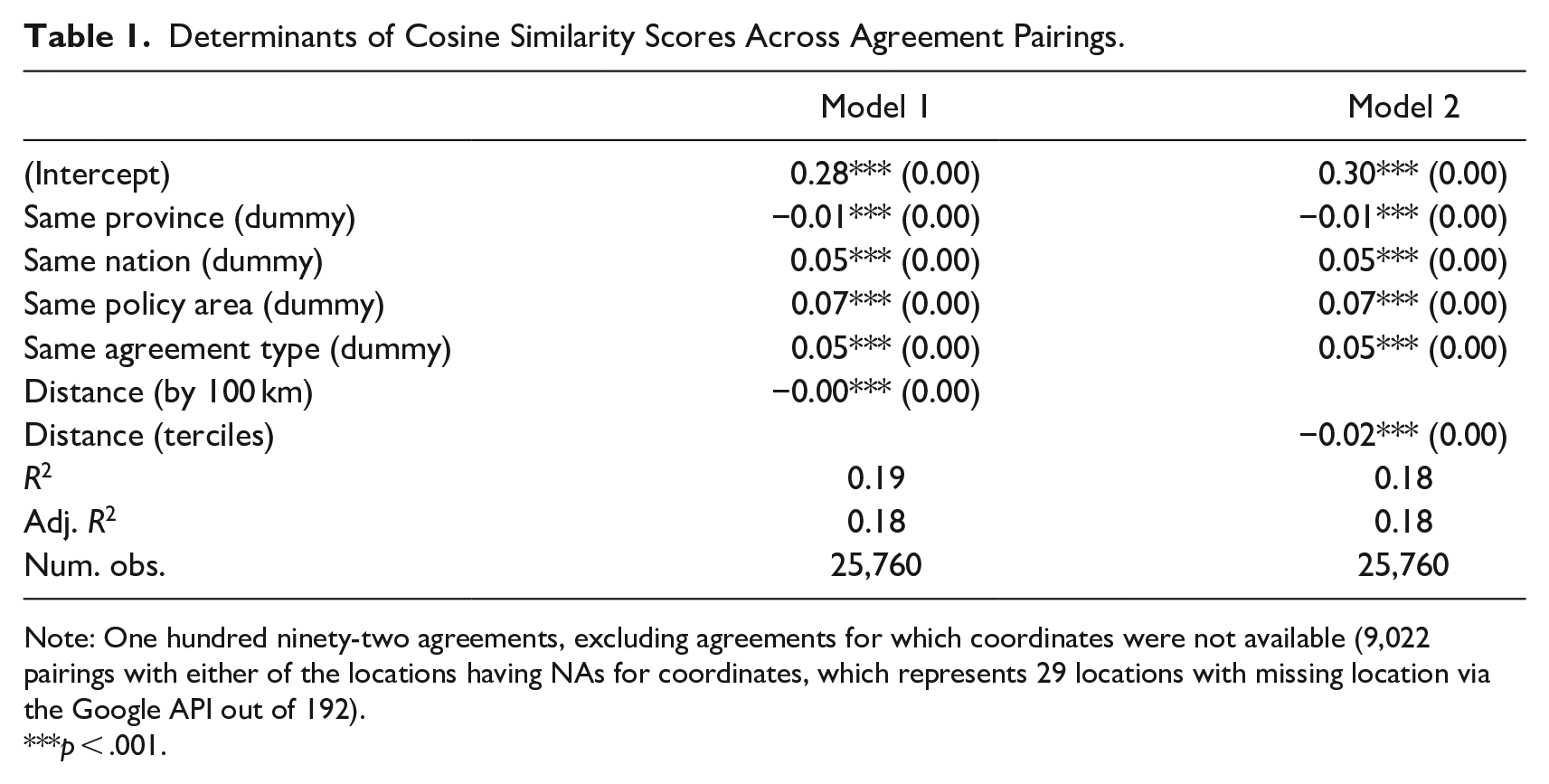
Note: One hundred ninety-two agreements, excluding agreements for which coordinates were not available (9,022 pairings with either of the locations having NAs for coordinates, which represents 29 locations with missing location via the Google API out of 192).
p < .001.
Discussion
Overall, these results suggest evidence of policy convergence among Indigenous-local intergovernmental agreements, with semantic similarity being driven mainly by cultural similarity. These results persist despite controlling for policy and agreement type. While these results do not identify the key policy convergence mechanisms at play, it seems likely that emulation and learning are occurring rather than competition and coercion, although further research using qualitative techniques will be needed to know for sure. Indigenous communities seem to be drawing upon their cultural “cousins” as they seek out legal language to structure and populate their intergovernmental agreements with municipalities, even when there may be similar agreements by policy type or area that are located outside the province, far away, or which are signed by an Indigenous community from another group. These results suggest that inter-local policy communities, such that they exist, are likely to be rooted mainly in cultural ties, and only loosely on other ties.
Conclusion
Using a unique database of agreements signed between Indigenous band governments and municipalities, this paper explored patterns of policy convergence in service sharing, contracting, and relationship formation agreements between Indigenous and settler communities. Interlocal agreements are becoming an increasingly popular policy tool for service and policy coordination among local governments (Spicer 2022). Indigenous governments are also turning to them to facilitate service and policy continuity across their communities. Municipalities are natural and increasingly attractive partners, despite long colonial histories marked by exploitation and dispossession. In Canada, this history includes acts of cultural genocide, such as the use of residential schools, forced migration, and assimilation, leading to mistrust between Indigenous communities and the Crown (Collie and Alcantara 2024). It would be understandable to assume that Indigenous communities would not see municipalities (extensions of the Crown and provincial governments) as natural partners in any context. However, that is not necessarily the case. As we see in this paper, agreements, even long-standing agreements governing complex policy spaces, are being formed by Indigenous and settler communities.
A growing body of literature has explored these agreements from several perspectives, including their emergence and impact on local relationships (Alcantara and Kalman 2019; Alcantara and Nelles 2016), service efficiency (Deaton and Lipka 2023; Huo, Charbonneau, and Alcantara 2022) and accountability and trust (Spicer et al. 2024). One increasingly crucial, yet unexplored question given the frequency of use of these agreements is how they are created and structured. In this paper, we focused on the notion of policy convergence, which aims to understand the extent to which policies are similar across political jurisdictions and contexts. Better understanding the contents of these agreements and how certain components are transferred through jurisdictions can help improve both our academic and practical understanding of how these agreements are structured, how effective they ultimately are and where challenges may lie in their use in the future.
Footnotes
Appendix
Determinants of Cosine Similarity Scores Across Agreement Pairings (Within-Province Pairings).
| Model 1 | Model 2 | |
|---|---|---|
| (Intercept) | 0.31*** (0.00) | 0.29*** (0.00) |
| Same nation (dummy) | 0.03*** (0.00) | 0.06*** (0.00) |
| Same classification (dummy) | 0.08*** (0.00) | 0.08*** (0.00) |
| Same agreement type (dummy) | 0.05*** (0.00) | 0.05*** (0.00) |
| Distance (by 100 km) | −0.01*** (0.00) | |
| Distance (terciles) | −0.03*** (0.00) | |
| R 2 | 0.23 | 0.19 |
| Adj. R2 | 0.23 | 0.19 |
| Num. obs. | 9,340 | 9,340 |
Note: *** means p<0.001.192 agreements, excluding agreements for which coordinates were not available (9,022 pairings with either of the locations having NAs for coordinates, which represents 29 locations with missing location via the Google API out of 192).
Data Availability Statement
Replication files will be made available on Dataverse upon acceptance for publication.
Declaration of Conflicting Interests
The author(s) declared no potential conflicts of interest with respect to the research, authorship, and/or publication of this article.
Funding
The author(s) received no financial support for the research, authorship, and/or publication of this article.

Data Availability Statement included at the end of the article