




Abstract
There is limited evidence on how local governments adopt formal contractual mechanisms to hold partners accountable and mitigate defection in the context of differing power dynamics. What kind of monitoring mechanisms do local governments choose to check opportunism and align incentives as they delegate service provision to another actor? Does the choice of monitoring mechanisms vary if the partner government is another local government, higher-level government, or a non-government actor? Does the choice of monitoring mechanisms used by local governments vary by the nature of service provision? To explore these questions, we examine a randomly selected sample of 163 public service contracts involving local governments in Iowa. Our findings suggest that the use of monitoring mechanisms is not homogenous and varies across different service areas and collaboration directions. In practice, our findings are useful for enhancing local governments’ internal contract management capacity for preventing contract failure, establishing accountability, and mitigating risk.
Introduction
Public service contracts are widely used for public service delivery in the United States to facilitate horizontal (city to city or county to county) relationships, vertical (county to city/city to state/county to state), and cross-sector (public to private sectors) collaborations (Carr and Hawkins 2013; Chen and Thurmaier 2009; LeRoux and Carr 2007; Zeemering 2012). Local governments often employ such contracts to navigate collective action problems. These may necessitate institutional commitments, featuring vertical accountability to higher governments, horizontal ‘peer accountability’ with other governments (Bovens et al. 2014), and cross-sector accountability with private partners (Li et al. 2021).
Differing power dynamics among various administrative levels and sectors affect how collaborators ensure mutual accountability. Emphasizing the growing role of vertical, horizontal, and cross-sectoral interdependence in multi-level governance (Bache and Chapman 2008; Papadopoulos 2010), specific contractual monitoring mechanisms can bridge disparities among partners and secure accountability across these collaboration directions. Some studies have explored using such mechanisms in Interlocal Agreements (ILAs) to limit opportunism and address collective action dilemmas (Andrew 2010; Andrew et al. 2015; Carr and Hawkins 2013). However, a gap remains in systematically exploring how local governments utilize contractual monitoring mechanisms to manage dilemmas emerging from service delegation across various levels of government, sectors, and service areas.
This study investigates the contractual monitoring mechanisms that local governments use in power asymmetric collaborations for public safety service provision. Rather than focusing on the sources of power asymmetries, our analysis identifies the use of contractual provisions that mitigate challenges from these power dynamics. Public service contracts can be impacted by disparities in the interests and resources of partners encompassing various levels of governmental and sectoral collaboration (Bel and Warner 2015; Feiock 2007). These collaborations often inherently exhibit power asymmetries due to differences in administrative authority (Hawkins and Andrew 2011; Mullin and Daley 2009), resource dependencies (Dahl 1961; Pfeffer and Salancik 1978; Hillman, Withers, and Collins 2009), restricted choice in service providers (Van Slyke 2007), and partner heterogeneity (Bel and Warner 2015; Brown and Potoski 2003; Carr, LeRoux, and Shrestha 2009). Such imbalances may either inhibit or enable collaboration, yet empirical evidence on how monitoring mechanisms are employed to enable accountability within these power dynamics is sparse.
To bridge this gap, this study focuses on the contractual monitoring mechanisms local governments utilize to ensure accountability in situations of power and authority imbalance, specifically within horizontal, vertical, and cross-sectoral collaborations in service contracting. We seek to understand how local governments monitor performance when they delegate service provision. The study also examines whether the selection of monitoring mechanisms varies based on the partnering entity, such as another local government, a superior county government, or a non-governmental actor. Another angle we probe is that of the potential variation of local governments’ monitoring choices based on the nature of service provision.
For this investigation, we analyzed a random sample of 163 public service contracts from an archive of interorganizational agreements created by local governments in Iowa. These contracts create principal-agent relationships between two or more organizations for the provision of services including emergency management, fire service, police protection, criminal investigation, and jails and corrections.
Our study advances the existing body of work on accountability in collaborative governance in four main ways. First, it offers a descriptive overview of diverse monitoring mechanisms local governments use in asymmetric collaborations across five primary public safety service types. Second, it enriches the literature on accountability in collaborative governance involving public service contracts. Third, it provides practical insights for intergovernmental contract management and accountability by underscoring the contractual safeguards chosen for collaboration across various directions and service types. Lastly, it seeks to reduce the geographical bias in empirical public administration research dominated by studies on governments from California, Florida, Ohio, New York, and Texas (Fowler and Fox 2023), by presenting empirical evidence from Iowa, a small Midwestern state.
Literature Review
Facilitating Accountability and Monitoring Partners in Public Service Contracts
Partners in public service contracts use monitoring to promote accountable partnerships. Fees for service contracts create principal-agent relationships where one entity assigns service provision authority to another, and monitoring provisions provide important performance information. According to Whitford (2009), the principal-agent problem of moral hazard arises in service delegation, necessitating monitoring to align the agent’s actions with the principal’s goals. This scenario is accentuated when the agent has more information, and, thus, power in negotiation (Koliba et al. 2011). From the principal-agent theory perspective, governance and accountability are achieved through monitoring and steering (Fama and Jensen 1983).
The Institutional Collective Action (ICA) framework further offers insights into mechanisms governments use to solve collective action dilemmas (Feiock 2013). The ICA framework suggests that monitoring and enforcement through voluntary agreements like public service contracts are cost-effective, reducing autonomy costs (Tavares and Feiock 2018). These agreements embed monitoring mechanisms to manage defection risks (Andrew 2010; Carr and Hawkins 2013). Regular interactions and information exchanges in such partnerships help mitigate uncertainty and reduce transaction costs (Benvenisti 1996). Therefore, the role accountability mechanisms play in self-governing service arrangements is crucial to understanding how contracts resolve principal-agent and collective action dilemmas (Elster 1989; Ostrom 1990).
Existing literature has studied the use of mechanisms such as records, reports, and financial audits (Albrecht, Kurtz, and Shafiq 2023; Andrew et al. 2015; Malatesta and Smith 2012; Poocharoen and Wong 2016; Van Puyvelde and Raeymaeckers 2020). Other researchers have attributed regular communications between partners as critical to successful collaborations (Scanlan 2005). In addition, effective monitoring is necessary to mitigate collective dilemmas and strategically manage service delivery expectations (Andrew 2010; Carr and Hawkins 2013). Monitoring requirements vary by service characteristics (Bel and Warner 2015; Brown and Potoski 2003; Feiock 2013), yet, few studies have examined variations in the monitoring mechanisms used in different services. For instance, services involving high investments may require stringent monitoring (Post 2004). This study fills this gap by exploring the monitoring mechanisms used in five subcategories of public safety services, highlighting variations across the five categories.
Monitoring in the Context Power Asymmetric Public Service Collaborations
The complexity of monitoring service delegation and agent opportunism increases due to power dynamics that vary across vertical, horizontal, and cross-sectoral collaborations. Despite research highlighting the importance of monitoring mechanisms in public service contracts (Strausz 1997; Van Slyke 2007), few studies examine the added complexity resulting from the direction of collaboration. This study follows the categorization approach of Andrew et al. (2015) and Li et al. (2021) for studying horizontal, vertical, and cross-sectoral collaborations to capture the various types of partnerships observed in the 28E dataset.
Power Differences Due to Jurisdictional Authority
Research frequently assumes power disparities based on jurisdictional authority when comparing governments across administrative levels (Hawkins and Andrew 2011; Mullin and Daley 2009). Governance network theorists propose that power manifests through both horizontal and vertical relationships between actors, grounded in mutual accountability (Koliba et al. 2011). Higher-level governments exert vertical formal authority over lower administrative governments through vertical collaboration structures (Koliba et al. 2011). When power dynamics vary across different administrative government levels, such as municipal, county, and state, vertical collective action dilemmas can occur. These dilemmas surface when an actor’s actions conflict with or complement those of higher or lower-level government units (Carr, Gerber, and Lupher 2007; Feiock 2009; Gerber and Loh 2015; Hawkins and Andrew 2011; Kim et al. 2022; Shrestha and Feiock 2011). Despite some studies on vertical collaboration and regional consolidation (Andrew et al. 2015; Carr 2004; Carr, Gerber, and Lupher 2007; Kwon, Feiock, and Bae 2014), the strategies governments employ to monitor partners in shared service provision amidst hierarchical power asymmetries remain under-researched.
Power Differences Due to Resource Dependency
Power asymmetry between partners from different administrative levels often arises due to resource dependency (Pfeffer and Salancik 1978). When service provisions demand substantial labor and expertise, such as in emergency planning or environmental initiatives, vertical collaborations emerge (Carr, Gerber, and Lupher 2007). Studies have focused on identifying the determinants of vertical collaboration and exploring dependency relationships. These relationships often exhibit high asymmetry in the costs and benefits of cooperation across different governmental levels (Carr, Gerber, and Lupher 2007).
However, power differentials are not confined to vertically structured interlocal collaborations. Resource and information disparities in horizontal collaborations can also produce power asymmetries, leading to collective action dilemmas (Hickson et al. 1971; Long 1949; Whitford 2009). The shift from traditional hierarchies to fragmented institutional arrangements and networks obscures the power dimensions among actors (Shergold 2008). Economic factors, such as local governments’ expenditure and tax revenues, partially depict the horizontal power differential in a region, as discussed by various scholars (Lewis 1996; Miller and Nelles 2018). Therefore, self-governing entities entering horizontal service contracts may find themselves resource-dependent on their partners, potentially lacking the jurisdictional control to exercise power over others (Dahl 1961).
Power Differences Due to Limited Choice of Service Providers
Lack of choice of service providers often results in power dependencies between partners (Van Slyke 2007). As indicated earlier, smaller-scale governments frequently establish vertical collaborations with their larger-scale counterparts to accommodate public services that necessitate substantial investments and enhanced expertise (Carr, Gerber, and Lupher 2007). Jurisdictional restrictions, combined with a limited supply of alternative providers and investment capabilities, promote reliance on higher-level governments as primary service providers. These power imbalances can make collaboration unpredictable and hazardous, leading less influential entities to eschew potentially exploitative cooperative arrangements. Consequently, the selected monitoring mechanisms to oversee partners are likely to differ based on these power discrepancies inherent in partner selection.
Power Differences Across Cross-Sectoral Collaborations
Cross-sectoral public service contracts introduce unique power dynamics compared to vertical and horizontal collaborations. Non-government actors’ capacities to deliver services and exercise control often differ from their government counterparts. While the trend toward cross-sectoral collaborations is escalating, these partnerships can sometimes carry risks (Bryson, Crosby, and Stone 2006). Partners’ heterogeneity due to sectoral differences (government vs. non-government) may pose potential risks to collaboration (Brown and Potoski 2003; Carr, LeRoux, and Shrestha 2009). Power disparities arising from heterogeneous goals between government and non-government actors can complicate public service collaborations. Monitoring these cross-sector partnerships, hence, proves challenging due to the contrasting sectoral goals and authorities, making it difficult to establish accountability.
Existing research underscores the need for a robust measurement system to track, monitor, and document changes and outputs in such collaborations (Page 2004). Additionally, studies of contract management within public-private partnerships emphasize the necessity for increased and frequent information monitoring and reporting to assess progress and performance (Grimsey and Lewis 2004). Governments can maintain control of these arrangements by transferring risks to non-government sectors using payment structures contingent on delivery and sanctioning cost and time overruns (Grimsey and Lewis 2004). Bryson, Crosby, and Stone (2006) suggested a premise that successful cross-sector collaborations likely possess an accountability system monitoring inputs, processes, and outcomes.
Although certain studies have delved into collaboration directions and monitoring mechanisms (Andrew et al. 2015), there is a limited understanding of the exact nature and types of monitoring mechanisms that local governments employ. These mechanisms help circumvent collective action dilemmas caused by sectoral differences and legislative authority disparities between government and non-government actors. To address this research gap, we seek to offer empirical evidence of the diverse monitoring mechanisms that governments employ to monitor non-government partners, particularly within the context of sectoral and jurisdictional power differences.
Methodology
This research adopts the 28E dataset built by the Networks & Governance Lab (NGL) at the University of Illinois at Chicago. The 28E dataset includes 21,629 intergovernmental and intersectoral agreements between the years 1993 and 2020, covering 33 different service areas. These agreements are filed based on Section 28E of the Iowa statutes and are publicly available on the official website of the Iowa Office of the Secretary of State (https://sos.iowa.gov). Section 28E of the Iowa statutes is a state requirement that requires public agencies to file the agreements they enter to collaboratively deliver public services (Chapter 28E of the Iowa Code). These agreements include contracts between local governments and other public and private entities such as cities, counties, state, federal, for-profit, and non-profit agencies in Iowa. The NGL researchers have integrated and optimized these agreements and transformed them into a user-friendly dataset. The dataset also includes information on filling date, partners, and purpose with a unique filing number associated with each agreement.
We examine contracts in five public safety service categories including emergency management, fire response, police protection, jail and corrections, and criminal investigations between 2007 and 2017. Examining these public safety interlocal service contracts is critical for several important reasons. First, public safety offers a highly diverse spectrum of service activities ranging from recurring standard policing, fire safety, and crime investigation to more episodic events such as those requiring a mutual aid response. Second, public safety provision has a high public salience, with clear inter-jurisdictional impacts. Third, the nature of public safety provisions is complicated due to local politics, and it remains uncertain if such agreements are contested through a litigation process (Andrew et al. 2015; Reynolds 2003).
A stratified sampling method is used to randomly draw 50 agreements from each of the five service categories for public safety. A random sample of 250 agreements is generated based on the filing number associated with each service contract when it is filed into the database. This approach reduces sampling bias and ensures that each record is uniquely identified. The entire population of public safety service contracts consists of 2,498 agreements filed between 2007 and 2017.
Since our focus is service contracts, we do not know which agreements are service contracts until after they are selected and coded. Therefore, we randomly sampled 50 agreements from each of the 5 public safety service areas and coded for the integration mechanism that identifies whether the agreement is a service contract or not. Next, we only keep the 163 service contracts and exclude 87 of the 250 agreements that were selected. This is done to ensure that we only include service contracts and remove other institutional forms such as agreements for joint operations, resource sharing, and creating new entities from our sample. Given the presence of principal-agent relationships and collaborative directions within public service contracts, they offer an apt framework for examining the monitoring decisions made by local governments in situations characterized by power asymmetry.
The time frame was selected based on a notable stabilization in the distribution of newly filed agreements between 2007 and 2017, after a period of substantial fluctuations (refer to Figure A1). Since the filing trend prior to 2007 exhibits an irregular pattern characterized by sudden fluctuations, it is challenging to draw any definitive conclusions regarding the persistent utilization of contractual monitoring mechanisms. However, starting from 2007 till the next decade, there is a consistent and steady trend observed in the filings of these service contracts. This period, spanning from 2007 to 2017, demonstrates a stable trajectory in service contracting between various governments and provides compelling evidence of learning and convergence toward mutually agreed-upon service arrangements. Thus, the post-2007 era represents an appropriate timeframe for studying commonly employed monitoring mechanisms.
This sample also effectively captures a diverse range of activities agreed upon between governments and their partners, as detailed in Table A1. Table A1 in the Appendix includes excerpts from the service contracts, explaining the kinds of activities governments and their partners undertake in each of the five service areas. Service contracts in police protection most commonly involve one party providing law enforcement services to another party. In most cases, county governments are the agents providing these services (see Table A2). Fire response service contracts involve the delegation of rescue, fire protection, and hazmat services to another party. Emergency management service contracts usually delegate the provision of emergency medical equipment and ambulance services to another actor. In criminal investigations service contracts, the most common form of activity is delegating investigation responsibilities to the Iowa Department of Inspections and Appeals (DIA) on behalf of another city government. In the category of jails and corrections, service contracts designate tracking, monitoring, jailing, law enforcement, and communications services to another party.
Through our meticulous content analysis, we have highlighted valuable insights into the types of services and activities that governments undertake when forming service contracts for public safety provision. This analysis significantly enhances our comprehension of the intricacies and wide array of activities involved in these agreements. Gaining a profound understanding of these nuances is critical in grasping the diverse utilization of monitoring mechanisms for effectively tracking partners across various service domains.
The methodological approach of this paper is based on a descriptive qualitative inquiry that relies on content analysis (Neergaard et al. 2009; Sandelowski 2000). All the service contracts are downloaded from the Iowa Office of the Secretary of State, and the information about (1) institutional form, (2) collaboration direction, and (3) monitoring mechanisms are coded by the research team at NGL. These three types of information are coded through text analysis and qualitative coding that follows double-blind requirements. To ensure intercoder reliability, three individual researchers coded and evaluated the sampled service agreements. Code comparisons are meant to ensure that researchers share a similar interpretation of the text being examined (Yanow and Schwartz-Shea 2015). The intercoder agreement for this study demonstrated a high level of consistency, with an average value of 88%. This indicates that in 88% of the cases for coding all variables, all coders arrived at the same conclusions, reflecting a strong agreement among them. For the remaining 12% of cases, intercoder disagreement was resolved through discussions.
We identify horizontal, vertical, and cross-sector collaborations based on the participants in the agreements. We adopt the categorization, that is, horizontal, vertical, and cross-sectoral collaboration directions, proposed by Andrew et al. (2015) and Li et al. (2021). The collaboration directions will be coded as horizontal when the participants are from the same administrative level (e.g., one municipality government collaborates with other municipality governments); vertical when the participants are from different administrative levels (e.g., municipality governments collaborate with county or state government); and cross-sector when local governments collaborate with non-profit or for-profit organizations.
The variations in contractual arrangements within our sample can be better understood by referring to Table A2, which provides a comprehensive overview of the involved government types and their respective partners within the five service areas. The table highlights that public safety service contracts primarily involve city governments as the principals, entrusting various services to county or state governments. This trend is particularly notable in areas such as jails and corrections, criminal investigations, and police protection. State and county governments play a prominent role in providing these services to the relevant municipalities. This detailed description provides valuable insights into the power dynamics involved in service delegation, specifically highlighting the asymmetric nature of the relationship whereby higher-level county or state governments act as agents. By shedding light on this power imbalance, the description provides valuable insights into the dynamics of service delegation, particularly regarding the monitoring mechanisms employed by principal governments at lower levels of the hierarchy to oversee higher-level agents.
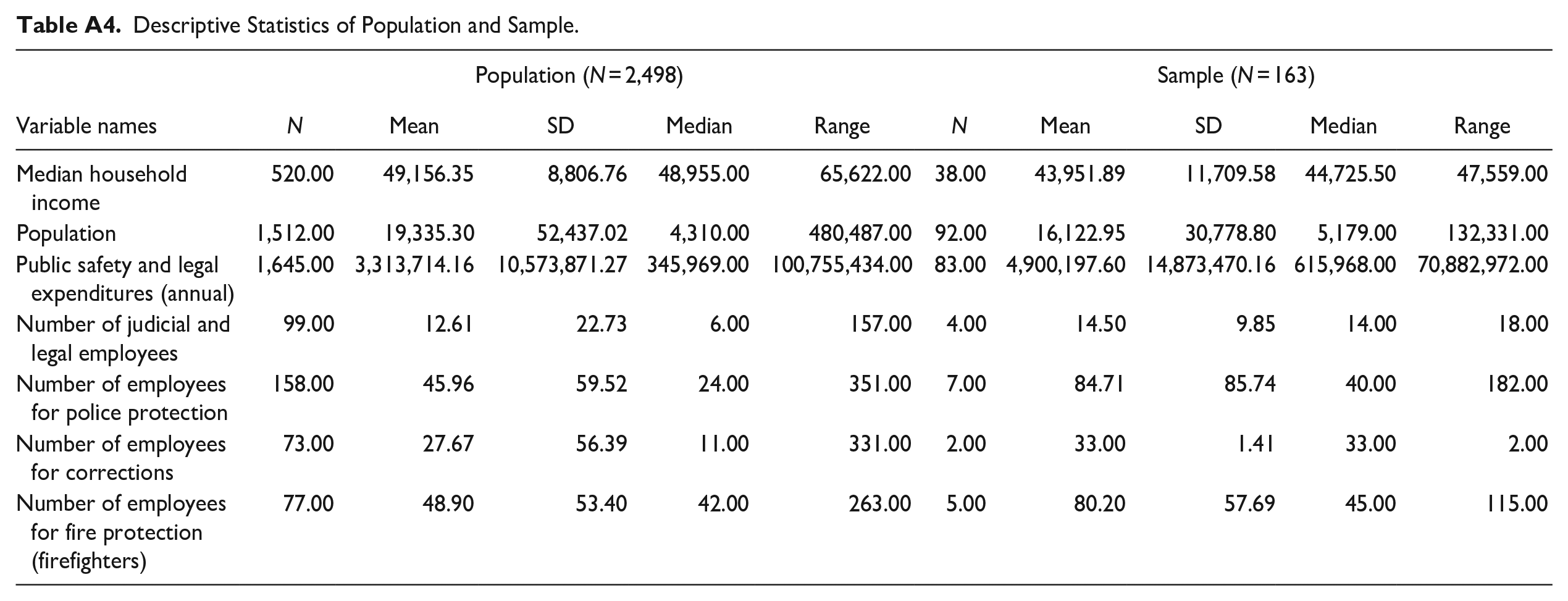
Table A4 displays insightful descriptive statistics regarding the size and nature of governments and actors engaged in service contracts for public safety provision. Notably, the mean population size of the jurisdictions within our sample stands at approximately 16,122, as compared to the overall average population of 19,335 of all participating governments in the entire range of public safety service contracts. Furthermore, we have conducted a Welch two-sample T-test based on population, which yields an insignificant p-value (t = –0.92289, df = 125.74, p-value = .3578). This outcome confirms that our sample is indeed representative of the size of governments engaged in the entire population of public safety service contracts between 2007 and 2017. This statistical validation bolsters the reliability and relevance of our findings.
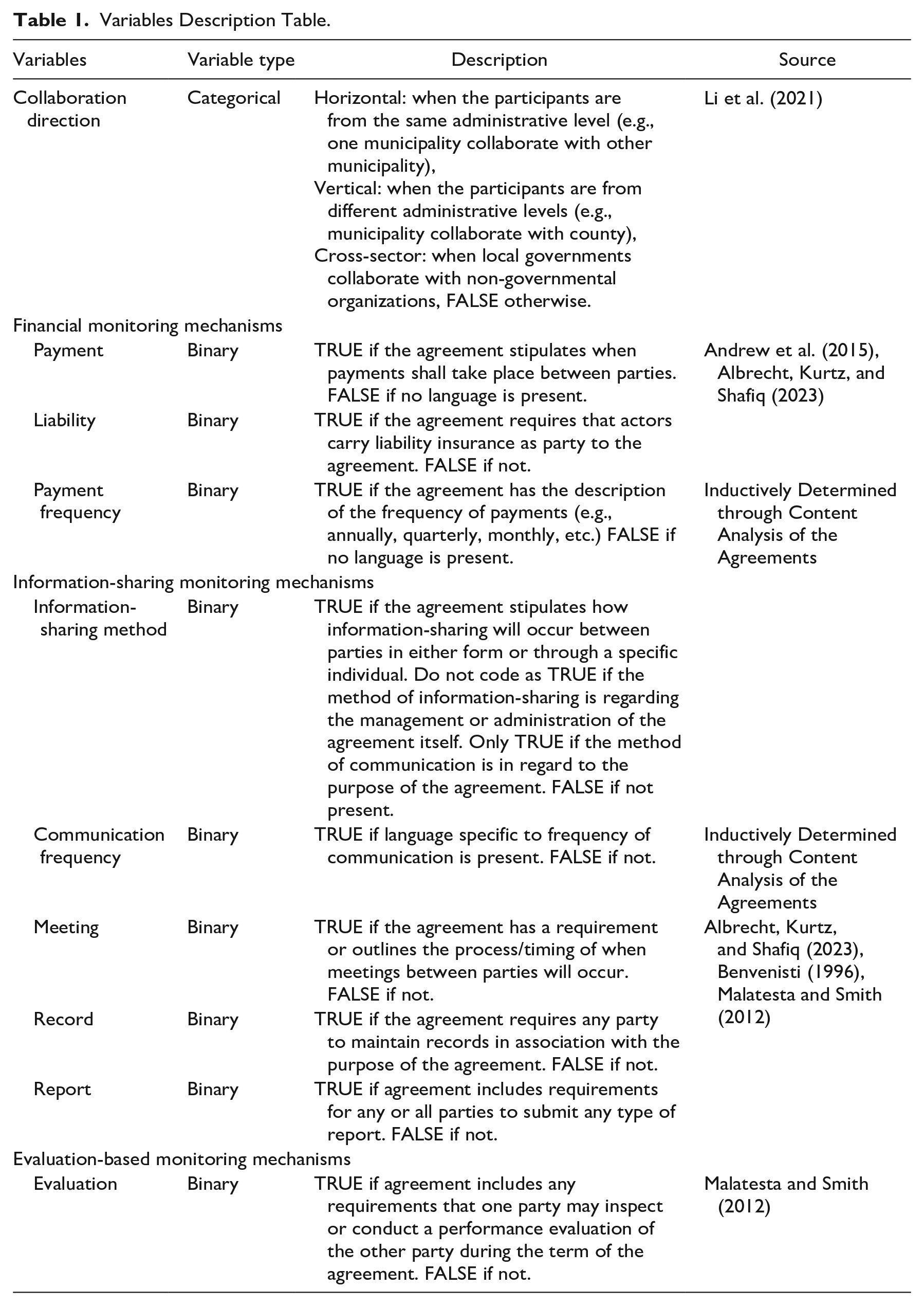
Our analysis goes beyond existing research to identify and code for three specific mechanisms that have not been studied in detail yet: financial, information-sharing, and evaluation-based contractual monitoring mechanisms. First, we accounted for three main types of financial monitoring mechanisms as suggested by literature and inductively identified through the content of public service contracts: (1) the presence of payment among participants, (2) the presence of a clause detailing the specific frequency of payments, and (3) the presence of liability information against any property damage. Second, we coded for information-sharing types of monitoring mechanisms as evidenced through the inclusion of clauses specifying: (1) information-sharing methods, (2) communication frequency, (3) meetings, (4) records, and (5) reports. Third, we coded the evaluation and auditing mechanism to reveal the attempts of local governments to control and monitor collaboration performance. The breadth of monitoring mechanisms we examine in our study represents an advancement over previous research, which only examines a limited set of mechanisms and fails to consider the frequency of payments and liability requirements (Andrew et al. 2015).
Table A3 in the Appendix gives excerpts to exemplify the various kinds of monitoring mechanisms present in these contracts. As evident, financial monitoring mechanisms appear as clauses that specify exact payments, and frequencies, and allocate responsibility for collection to another actor. Information-sharing monitoring mechanisms involve requirements for reporting and conducting meetings with a higher officer, for example, the Mayor or Sheriff. Evaluation-based monitoring mechanisms embedded in these contracts include regular feasibility and effectiveness assessment requirements. We identify these monitoring mechanisms, along with other variables used in this study, and code them as binary variables. Specifically, we label them as TRUE when the variable is present in the public service agreement and FALSE when it is not present. A detailed description of all the variables and sources of literature guiding their relevance can be found in Table 1.
Variables Description Table.
Results
Descriptive Statistics
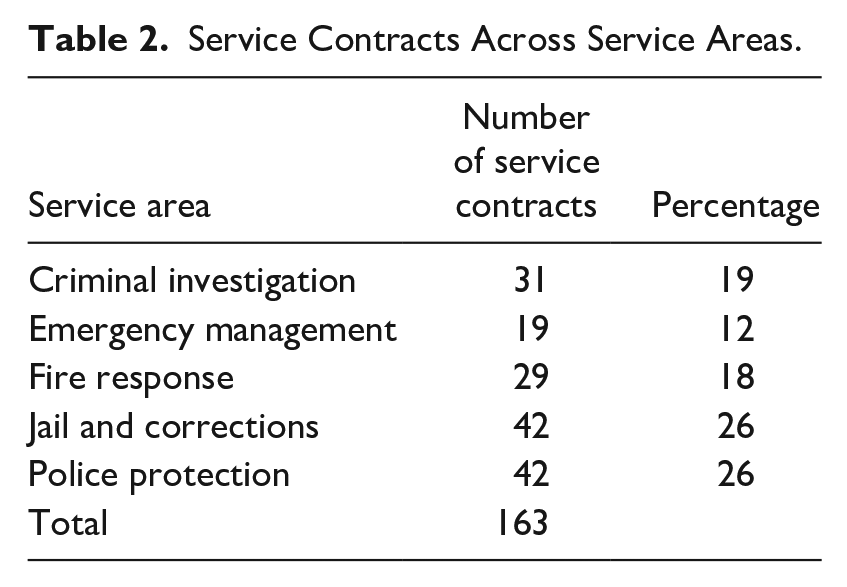
The cross-tabulations in Tables 2 and 3 provide valuable insights into how service contracts, representing principal-agent relationships, are utilized across different service areas and collaboration directions. A significant majority (163 out of 250) are service contracts structured as bilateral or dyadic relationships involving service delegation. Conversely, a smaller proportion (87 out of 250) exhibit joint and shared service provision. Table 2 reveals that service contracts are predominantly used in police protection as well as jails and corrections, each accounting for 26% of the sample, indicating the delegation of services to another actor. In addition, criminal investigation and fire response collaborations make up 19% and 18% of the agreements in our sample of 163 service contracts, respectively. An interesting finding is that in emergency management, local governments rely less on simple bilateral relationships, with only 12% of the service contracts reflecting this structure, as evident from Table 3. Overall, the cross-tabulations in Tables 2 and 3 offer valuable insights into the distribution of service contracts across various service areas and collaboration directions.
Service Contracts Across Service Areas.
Service Contract Across Collaboration Directions.
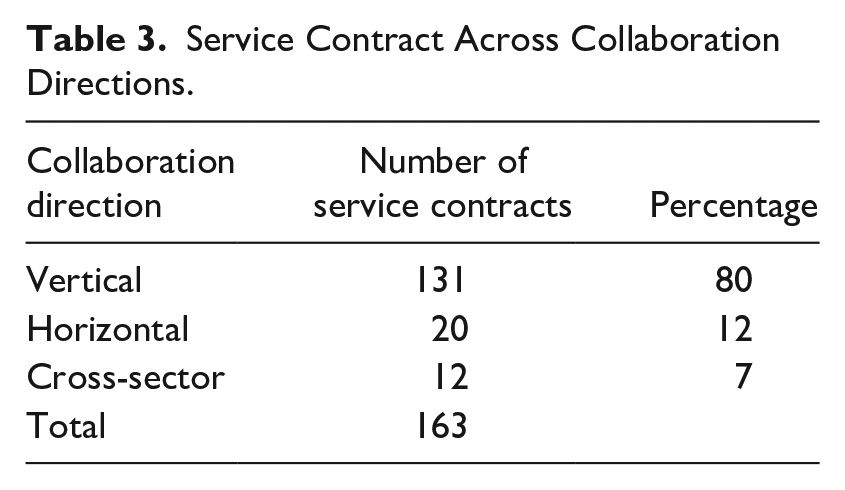
In our sample, vertical collaborations dominate, with 98% of them representing lower-level governments purchasing services from higher-level governments. Horizontal collaborations between local governments account for only 12%, while cross-sector collaborations are even rarer, making up only 7% of public safety service contracts. Figure A2 in the Appendix further illustrates the prevalence of vertical collaborations as the most common form of collaboration arrangements for public safety provision. Though less frequent, horizontal arrangements still occur in emergency management, fire response, and jails and corrections, suggesting some local governments delegate service provision and activities to other local governments. In contrast, cross-sector collaborations are infrequent, with only 12 service contracts indicating service delivery collaboration between governments and non-government agencies.
The Use of Financial Monitoring Mechanisms
Financial Monitoring by Service Area Types
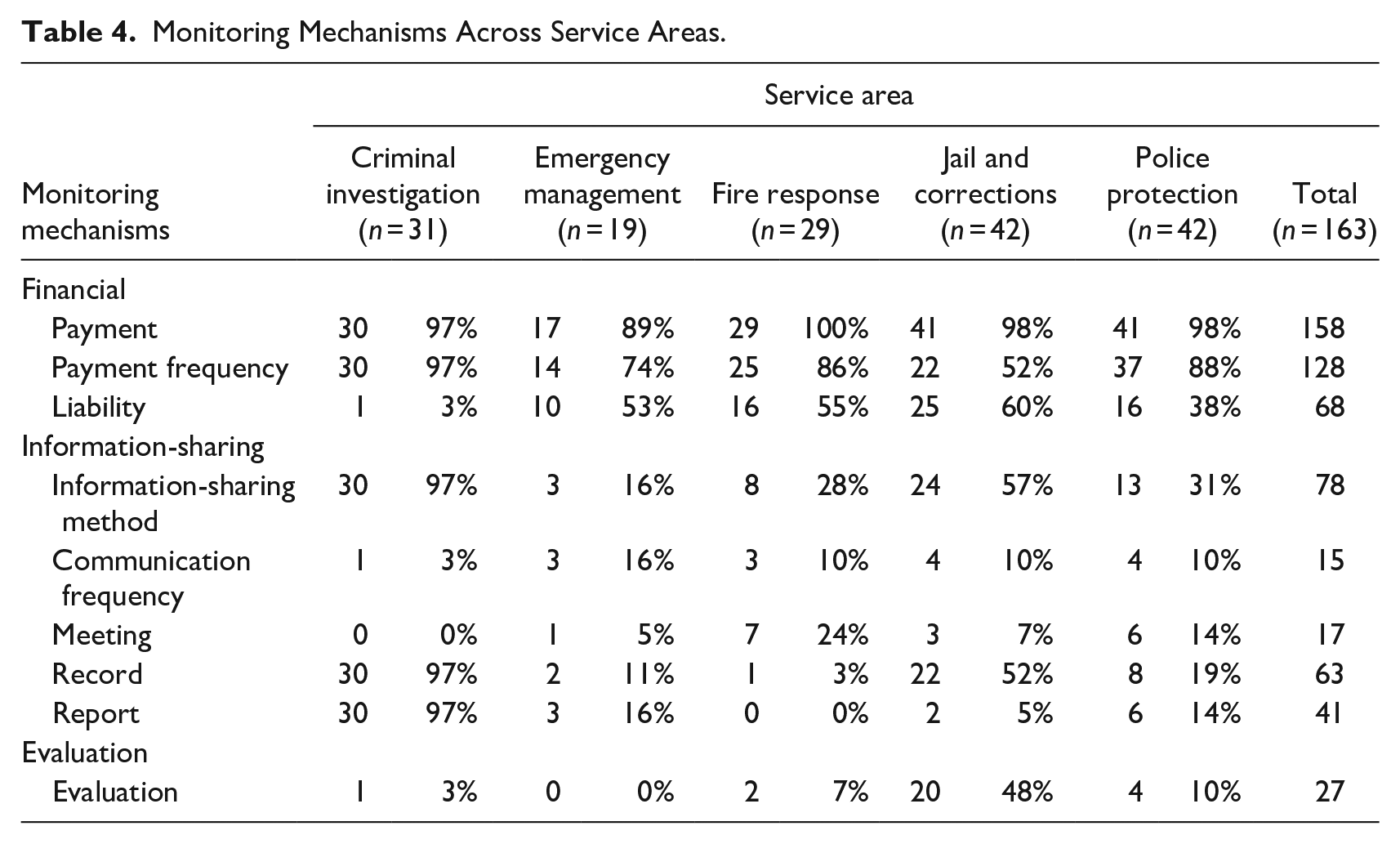
Table 4 reveals that financial-type monitoring mechanisms are the most common. In our sample, 97% of the service contracts contain payment clauses (158 contracts). Among them, 79% (128 contracts) specify the payment frequency, and 42% (68 contracts) include provisions for liability transfer. Payment clauses are the most prevalent feature across all service contracts among the five service areas (Table 4). However, not all contracts with payment clauses specify the payment frequency; only 81% of them include such provisions. Liability clauses are the least common monitoring mechanisms present in these contracts, especially in comparison to payment-related clauses. They are more frequently found in jail and corrections, as well as fire response collaborations, where potential property damage is a concern.
Monitoring Mechanisms Across Service Areas.
Financial Monitoring by Collaboration Directions
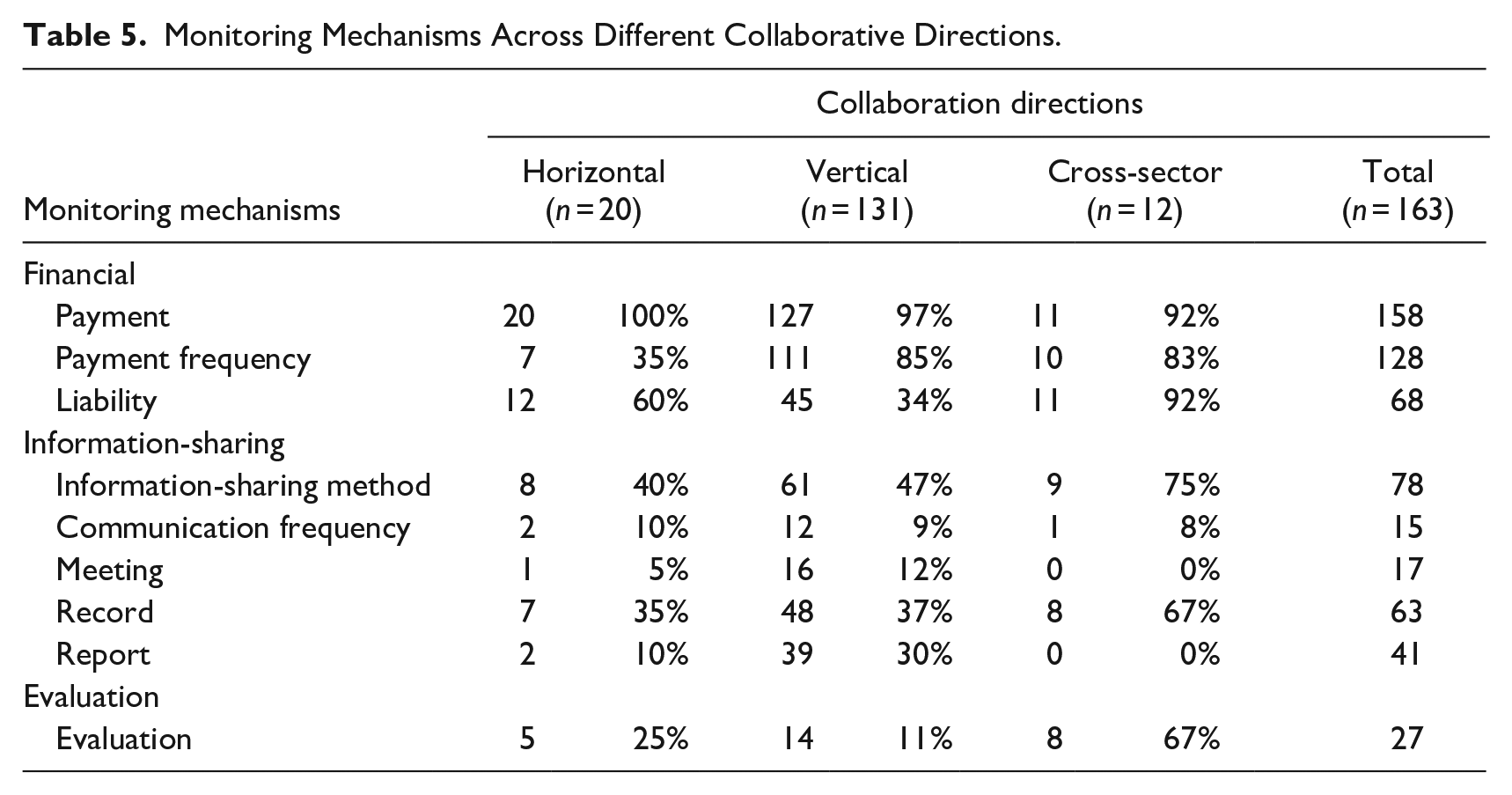
In terms of collaboration directions, as evident in Table 5, payment clauses are dominant in all three forms of collaborations: vertical (97%), horizontal (100%), and cross-sector (92%). Yet, the requirements specifying the frequency of payments are less common. Although payment clauses are widely adopted in horizontal service contracts, payment frequency is specified in only 35% of those. Payment frequency is predominantly observed in vertical (85%) and cross-sector (83%) collaborations. On the other hand, liability terms are found in 92% of cross-sectoral service contracts, a significantly higher occurrence compared to horizontal (60%) and vertical (34%) service contracts, respectively.
Monitoring Mechanisms Across Different Collaborative Directions.
The Use of Information-Sharing Monitoring Mechanisms
Information-Based Monitoring by Service Area Types
Information-sharing clauses are another form of commonly used monitoring mechanism in service contracts. Based on Table 4, 48% of cross-sectoral service contracts include clauses about information-sharing methods. Criminal investigation service contracts (97%) heavily rely on this mechanism, but it is less common in the other four service areas. Compared with information-sharing methods, communication frequency clauses are rarely used across all service areas (9% of service contracts). Moreover, 24% of fire response and 14% of police protection service contracts contain clauses on meetings. The inclusion of meeting clauses amounts to less than 10% in the other three service areas. Records and reporting requirements are more often adopted in comparison to meeting requirements, but their inclusion varies according to service area. To be specific, records are primarily used in criminal investigation (97% of the contracts) and jail and corrections (52% of the contracts). On the other hand, reports are more commonly included in criminal investigations (97% of the service contracts).
Information-Based Monitoring by Collaboration Directions
The adoption of information-sharing monitoring mechanisms also differs across collaboration directions, especially between inter-governmental and cross-sectoral service contracts. Seventy-five percent of cross-sector service contracts adopt information-sharing methods, while no more than half of vertical (47%) and horizontal (40%) service contracts include such clauses. Based on our data, the difference among collaboration directions on communication frequency is not noticeable. Comparatively, record-keeping clauses are the most observed form of information-sharing mechanism for cross-sectoral collaborations (67%), as compared to vertical (37%) and horizontal (35%) collaborations. Reporting clauses are more often used in vertical (30%) than horizontal (10%) collaborations. Our data also shows that cross-sector collaborations do not employ reporting and meeting mechanisms and primarily rely on records sharing.
The Use of Evaluation-Based Mechanisms
Evaluation-Based Monitoring by Service Area Types
The analysis of ex ante monitoring mechanisms that allow for ex post evaluations and auditing of public service collaborations reveals that 17% of service contracts in our data adopt such mechanisms (see Table 4). The use of such monitoring mechanisms varies by service type. Based on Table 4, evaluation clauses are mostly used in the jail and corrections service contracts (48%) and are rarely observed in the service contracts for other service areas.
Evaluation-Based Monitoring by Collaboration Directions
Based on the results from Table 5, there is a stark contrast in the adoption of evaluation mechanisms between inter-governmental and cross-sectoral actors. Specifically, 67% of cross-sectoral service contracts use evaluation clauses, while only 25% of horizontal and 11% of vertical ones employ clauses that require evaluations of ongoing activities.
Findings
The results reveal notable variations in how local governments utilize service contract monitoring mechanisms. These findings illuminate accountability choices made by local governments and their partners engaged in power asymmetric relationships within public service contracts across diverse public safety service domains. The implications of these results extend beyond their immediate context, inviting practical and theoretical reflection on how local governments adopt monitoring mechanisms in service contracts to promote accountability.
Vertical Collaborations Dominate Public Safety Services Provision
Our research emphasizes the prevalence of vertical collaborations in public safety service contracts. Local governments primarily orchestrate these collaborations with government tiers either above or below them. Our findings resonate with prior research that confirms the presence of vertical collaborations in policing and criminal investigations (Carr, Gerber, and Lupher 2007; Shrestha and Feiock 2011). The trend of local governments delegating service provision to more resourceful, politically accountable, higher-level governments can be attributed to challenges in boundary control and internal capacity. This is particularly true for our sample involving contracts on policing, fire, and emergency management, where the potential risk of shirking and conflicting incentives might jeopardize public safety.
Theoretically and practically, local governments seem to prefer vertical collaborations to maintain autonomy and circumvent potential hindrances from other local municipalities. This preference is especially apparent in high asset-specific services such as police protection and patrolling. The prevalence of vertical collaborations, in line with previous research, suggests that county governments, due to their larger geographical scope and economies of scale, are favored partners for handling cross-boundary emergencies (Andrew 2009; Benton 2002). Empirical evidence from Iowa’s local governments supports this, showing a tendency to partner with higher-level governments for service contracting. In practice, this can be seen as a strategy that maximizes cost-benefit efficiency and alleviates capacity constraints for less-resourced governments.
Monitoring Choices Vary Across Power Asymmetric Public Service Collaborations
Our research demonstrates variability and inconsistency in the use of monitoring mechanisms in intergovernmental and intersectoral collaborations. Governments tend to standardize the inclusion of payment specification clauses in their collaborative agreements. However, we noted that a significant number of horizontal, and fewer vertical and cross-sector public safety service contracts, lack details regarding payment frequency and disbursement.
Our findings yield three crucial insights about financial monitoring in asymmetric power service collaborations. First, local governments primarily leverage payment-based monitoring mechanisms to control service provision delegation. As such, they often employ financial resource flows as an accountability tool, thereby guiding partner behavior and ensuring mandated compliance.
Second, while local governments implement contractually specified financial monitoring—such as payment frequency and liability—across collaborative directions, they do not rely on these mechanisms exclusively. This hints at the potential use of alternative, non-contractual, and informal strategies for coordinating financial exchanges and communication. Additional research is required to investigate these alternative monitoring methods utilized by local governments in public service collaborations.
Finally, financial exchanges are more commonly defined in vertical and cross-sector collaborations compared to horizontal ones. This implies that local governments involved in asymmetric power relations across various levels and sectors often depend on financial monitoring. Our data suggest that local governments, when involved in asymmetric power relations, may find it beneficial to specify payment frequency and liability transfers in contracts, beyond mere payment clauses, to monitor compliance and prevent partner defections.
Monitoring Mechanisms Vary by Partner’s Sector
Our findings indicate that local governments place heightened importance on liability insurance when partnering with non-government entities for service delivery, compared to collaborations with other governmental counterparts. Echoing Grimsey and Lewis (2004), our results underscore the increased uncertainty associated with cross-sector collaborations, thereby necessitating thorough monitoring, sanctions, and protective measures to prevent loss or default. Discrepancies in resources and administrative power between governmental and non-governmental entities demand a higher frequency of financial and liability clauses in their agreements, leading to more stringent monitoring than in exclusively governmental collaborations for service contracting.
Concerning evaluation-based monitoring mechanisms, we found that these are not prevalent across service areas and collaboration types. Despite the overall limited use of evaluation-based clauses, our findings are in line with past research that recognizes the role of contractual safeguards in public-private collaborations as deterrents to opportunism (Klijn and Koppenjan 2015; Williamson 1979). Additionally, we discovered a greater likelihood of local governments employing evaluation-based monitoring mechanisms in collaborations with private sector and non-government entities than with governmental actors. This observation validates our initial premise that local governments strategically integrate contractual mechanisms requiring regular auditing and monitoring of non-governmental entities. Existing studies suggest that this focus on comprehensive non-governmental actor monitoring could arise from mistrust, divergent governance practices, and differing objectives between the public and non-profit sectors (Meyers, Riccucci, and Lurie 2001; Riccucci 2005). Thus, we argue that local governments select different monitoring types and characteristics based on the nature of their collaboration partner.
The observed dearth of evaluation-based mechanisms requires further research. What alternative non-contractual strategies do local governments implement to ensure consistent partner evaluation and monitoring? Detailed investigations and qualitative assessments are imperative to shed light on the governance complexities in interlocal collaborations entailing agency, power, and control issues, such as delegated service provision. Although prior research highlights informal cooperation and coordination in public safety collaborations (Bel and Warner 2015), a comprehensive analysis remains necessary to reveal the diverse strategies and informal monitoring mechanisms local governments employ to navigate power disparities and collective action dilemmas.
In addition, the use of information-sharing mechanisms varies across partner types. For example, records sharing serves as a dominant strategy when government entities collaborate with non-government actors, as opposed to their government counterparts. This insight augments our comprehension of how local government entities supervise their non-government collaborators for service provision, particularly in scenarios involving asymmetric power relationships.
Overall, while all contracts in our data involved principal-agent relationships, the adoption of various monitoring mechanisms differed based on the unique combinations of principals and agents. Insights from Iowa's local government experiences demonstrate that, in their role as contract principals, local governments should strategically tailor their monitoring mechanisms to suit their specific agents.
Monitoring Mechanisms Vary According to Service Types
Our research underscores the prevalence of monitoring mechanisms in public safety service contracts, yet their application varies by service area. For example, liability mechanisms are rarely observed in criminal investigations but are often employed in fire response and jails and corrections. Moreover, the highest instances of evaluation-based monitoring are noticed in jails and corrections. Similarly, the use of financial monitoring appears to be uneven. Even within particular monitoring mechanism types, we observe disparity in the use of different information-sharing mechanisms across service areas. For instance, the use of various information-sharing monitoring mechanisms within the criminal investigation service category is varied: most rely on record-sharing clauses rather than meeting requirements. Overall, our results show a nuanced use of monitoring mechanisms across service characteristics, indicating that service characteristics are an important underlying factor affecting accountability choices.
The findings of this study are beneficial for local public officials engaged in public service contract design and negotiation. Successful monitoring mechanisms can help local governments prevent contract failure and mitigate risk, thereby enhancing internal contract management capacity—an essential aspect of collaboration success and performance (Brown and Potoski 2003; Ernita Joaquin and Greitens 2012). By synthesizing a wide range of experiences across multiple local governments, this study provides local public officials with a comprehensive guide to key monitoring mechanisms. It eschews local governments' reliance on the experience from their own past public service contracts. Further, it delivers versatile options suited to diverse power dynamics and services, offering valuable recommendations for contract managers in their contract drafting process.
Next Steps
We propose three key areas for future research: the infrequent use of evaluation-based mechanisms in collaborations; the prevalence of evaluation and information-based clauses in cross-sector service contracts; and factors causing variations in the use of information-sharing monitoring mechanisms.
Further inquiries should examine the impact of monitoring mechanisms on the performance of public service collaborations. This would include exploring how such mechanisms can reduce information asymmetries, prevent defection, mitigate collaboration risk, and evolve with increasing collaboration history and trust between actors.
Our study, however, is constrained by its cross-sectional nature, limiting our ability to perform a longitudinal analysis of partner monitoring. While our results spotlight the variation in monitoring mechanisms across different administrative levels and service areas, they are based on a single snapshot in time. Future research using longitudinal analyses can provide deeper insight into how local governments navigate collective action dilemmas and power asymmetry challenges over time. Additionally, our analysis does not account for shifting power dynamics due to resource and information changes over time, which must be considered in future studies.
Footnotes
Appendix
Descriptive Statistics of Population and Sample.
| Variable names | Population (N = 2,498) | Sample (N = 163) | ||||||||
|---|---|---|---|---|---|---|---|---|---|---|
| N | Mean | SD | Median | Range | N | Mean | SD | Median | Range | |
| Median household income | 520.00 | 49,156.35 | 8,806.76 | 48,955.00 | 65,622.00 | 38.00 | 43,951.89 | 11,709.58 | 44,725.50 | 47,559.00 |
| Population | 1,512.00 | 19,335.30 | 52,437.02 | 4,310.00 | 480,487.00 | 92.00 | 16,122.95 | 30,778.80 | 5,179.00 | 132,331.00 |
| Public safety and legal expenditures (annual) | 1,645.00 | 3,313,714.16 | 10,573,871.27 | 345,969.00 | 100,755,434.00 | 83.00 | 4,900,197.60 | 14,873,470.16 | 615,968.00 | 70,882,972.00 |
| Number of judicial and legal employees | 99.00 | 12.61 | 22.73 | 6.00 | 157.00 | 4.00 | 14.50 | 9.85 | 14.00 | 18.00 |
| Number of employees for police protection | 158.00 | 45.96 | 59.52 | 24.00 | 351.00 | 7.00 | 84.71 | 85.74 | 40.00 | 182.00 |
| Number of employees for corrections | 73.00 | 27.67 | 56.39 | 11.00 | 331.00 | 2.00 | 33.00 | 1.41 | 33.00 | 2.00 |
| Number of employees for fire protection (firefighters) | 77.00 | 48.90 | 53.40 | 42.00 | 263.00 | 5.00 | 80.20 | 57.69 | 45.00 | 115.00 |
Author’s Note
The authors contributed equally to the production of the research and article. We thank Dr. Jered B. Carr for his thoughtful comments while reviewing this paper.
Data Availability Statement
Data sharing not applicable to this article as no datasets were generated or analyzed during the current study.
Declaration of Conflicting Interests
The authors declared no potential conflicts of interest with respect to the research, authorship, and/or publication of this article.
Funding
The authors received no financial support for the research, authorship, and/or publication of this article.
